UK, Spain reject Trump’s new scheme to blockade Hormuz Strait
The Cradle | April 13, 2026
The UK and others have rejected Washington’s plan to impose a blockade on Iranian ports and target ships transiting the Strait of Hormuz in collaboration with the Islamic Republic.
UK Prime Minister Keir Starmer said “we are not supporting the blockade” in an interview with BBC Radio on 13 April.
Starmer added that the UK is not “getting dragged in” to the US-Israeli war against Iran. He emphasized the priority is reopening the strait, noting it is “vital that we get the strait open and fully open.”
Turkiye opposed the blockade and called for renewed diplomacy, while China warned against escalation and urged both sides to maintain stability.
The Spanish government has also condemned the US move. “It’s just another episode in this downward spiral we’ve slipped into,” Spanish Defense Minister Margarita Robles said on Monday, adding that US President Donald Trump and Israeli Prime Minister Benjamin Netanyahu “want to impose rules on the international community, which is illogical.”
Germany did not criticize the move. “The supposed blockade … does not mark the end of this diplomatic process,” a government spokesperson said, adding that “We see it as a move to ramp up the pressure.”
The US military’s announcement did “not mention a blockade of the Strait of Hormuz, but rather a blockade of Iranian ports – that is a different approach,” the German spokesperson added.
Earlier on Monday, France announced that London and Paris will organize a conference to discuss forming a “strictly defensive” and “peaceful” mission to reopen the Strait of Hormuz.
“As regards the Strait of Hormuz, in the coming days, together with the UK, we will organize a conference with those countries prepared to contribute alongside us to a peaceful multinational mission aimed at restoring freedom of navigation in the strait,” said French President Emmanuel Macron.
“This strictly defensive mission, separate from the warring parties to the conflict, is intended to be deployed as soon as circumstances permit,” he added. Paris had previously rejected a US proposal on the formation of an international coalition aimed at reopening the Strait, saying it would help escort ships only when the war ended.
A Bahraini resolution to reopen the strait by force was vetoed by Russia and China right before the ceasefire was announced.
The Strait of Hormuz remains closed to Washington and its allies despite the recent ceasefire between the US and Iran.
Vessels unaffiliated with the US and Israel, including a French one, have recently been given access following coordination with the Islamic Republic.
The US threat to blockade Iran’s ports was made by CENTCOM on Sunday night. It said it would begin a blockade “of all maritime traffic entering and exiting” Iranian ports starting 10:00 am Eastern Time (ET) on 13 April.
“The blockade will be enforced impartially against vessels of all nations entering or departing Iranian ports and coastal areas, including all Iranian ports on the Arabian Gulf and Gulf of Oman. CENTCOM forces will not impede freedom of navigation for vessels transiting the Strait of Hormuz to and from non-Iranian ports,” it added.
After the announcement, Iranian Parliament Speaker Mohammad Bagher Ghalibaf said, “enjoy the current pump figures,” adding that “with the so-called ‘blockade,’ Soon you’ll be nostalgic for $4–5 gas.”
The Khatam al-Anbiya Central Headquarters of the Iranian military made a statement on Monday, accusing Washington of “piracy” while vowing to act “decisively” in order to permanently control the Strait of Hormuz and secure Iran’s waters.
Russian frigate ‘resurfaces’, chases off NATO pirates days after Kiev ‘sank’ it
By Drago Bosnic | April 13, 2026
On April 6, the Unmanned Systems Forces (USF) of the Kiev regime posted a video of the alleged “attack” on the Russian Navy’s (VMF) “Admiral Grigorovich” frigate in the port of Novorossiysk. According to Ukrinform, Robert “Magyar” Brovdi, commander of the USF, also posted the video on his Telegram channel. He claims that “on the night of April 6, the USF ‘birds’ struck the frigate ‘Admiral Grigorovich’ in the port of Novorossiysk and delivered some blessed fire to the Sivash drilling rig”. The supposed “attack” was carried out by the 1st Separate Center of the USF. The Neo-Nazi junta sources report that it was planned and coordinated by the SBU (effectively a terrorist organization at this point) and that “the extent of the damage is being assessed by intelligence”.
“The air defense missile launches were carried out directly from the frigate’s deck while approaching the target, which did not prevent us from pecking at the floating scab,” Brovdi stated, adding: “The Sivash floating drilling rig was targeted by the birds of the 413th Raid Separate Battalion in cooperation with the deep-strike forces of the Ukrainian Navy.”
This must be a great success for the Kiev regime, right? There’s “video evidence of the incident”, so the supposed “attack” undoubtedly happened, right? Well, there’s a “tiny” consistency problem with this entire story. Namely, the aforementioned “Admiral Grigorovich” frigate “magically resurfaced” in the English Channel just two days after it was “destroyed”. The vessel was sent to escort oil tankers after multiple incidents where NATO pirates hijacked Russian ships in international waters. This was also confirmed by the endemically and pathologically Russophobic United Kingdom, which sent its naval forces to track Russian warships. The British HMS “Mersey” was sent to “enforce sanctions” on Moscow’s oil tankers, but was forced to turn back after detecting naval escorts.
British sources report the vessels include the “Admiral Grigorovich” frigate, the “Aleksandr Shabalin” Ropucha-class landing ship and the “Krasnodar” Kilo-class diesel-electric attack submarine, which was transiting on the surface. These vessels passed only about 15 km from the Strait of Dover. For London, the issue is that it pledged to “take more direct action against vessels linked to Russia’s shadow fleet”. However, with the appearance of the VMF, the UK is now complaining that “this has sharpened the operational context”. In simpler terms, NATO pirates would love to hijack those tankers and steal Russian oil, but it’s too risky when the targets are protected by ships that can actually shoot back, complicating the enforcement of “freedom and democracy” in international waters.
It should be noted that the political West has long been behaving like a bunch of pirates. In a purely legalistic sense, NATO navies are in no way different from Somali pirates, as both are hijacking ships in violation of international law. However, it should also be noted that Somali pirates would certainly protest such insulting comparisons, because at least they’re not a bunch of pedophile-cannibalistic Satanists. In the last several months alone, approximately a dozen Russian oil tankers have been hijacked. Although this is only a fraction of the so-called “shadow fleet” consisting of around 3,000 vessels, the obvious goal is to disrupt Russian oil exports, particularly at a time when US aggression against Iran caused price hikes that increased Moscow’s profits.
Although the VMF’s primary role is not to protect Russian shipping, after the US/NATO decided to openly practice piracy, the Kremlin was forced to retask its naval forces for escort missions. “Admiral Grigorovich” is the first of the Project 11356R frigates, equipped with eight 3S-14 UKSK VLS (vertical launch systems). These usually house “Kalibr” cruise missiles, although they can also accommodate P-800 “Oniks” ramjet-powered supersonic and 3M22 “Zircon” scramjet-powered hypersonic cruise missiles. No Western navy has anything remotely capable. On the contrary, the US is still struggling with the disastrous Zumwalt-class destroyers, which are now slated to be equipped with hypersonic missiles after billions were wasted on far more modest weapons.
Namely, the Zumwalt-class destroyer’s Advanced Gun System (AGS) is slated to be removed and replaced by Conventional Prompt Strike (CPS) launchers housing the Long-Range Hypersonic Weapon (LRHW), better known by its US Army name, the “Dark Eagle”. However, the problem is that the Pentagon is yet to induct these missiles, leaving the entire US military without operational hypersonic weapons. Meanwhile, much smaller Russian frigates and corvettes all share the same 3S-14 UKSK VLS, enabling them to carry world-class missiles, such as the aforementioned “Kalibr”, “Oniks” and “Zircon”. This includes the smaller Gremyashchiy-class and Karakurt-class corvettes, giving them unrivaled strategic capabilities akin to those of destroyers.
Interestingly, after realizing that its little propaganda ploy failed, the Neo-Nazi junta resorted to damage control, claiming that its drones didn’t hit “Admiral Grigorovich”, but “Admiral Makarov”, which was later amended to also include “Admiral Essen”. The two ships are the third and second vessels of the same class, respectively. In other words, when caught lying and conducting its “PR victories”, the Kiev regime tries to hide it all with additional lies that only make things worse. It’s highly likely that the Neo-Nazi junta propagandists used AI-generated images as “evidence” of the alleged “hits”. This is most likely done to shift attention away from the Kiev regime’s massive losses, as the latest KIA exchange with Russia demonstrates a 1,000:41 ratio in Moscow’s favor.
Drago Bosnic is an independent geopolitical and military analyst.
Ukraine Targets Russian Merchant Fleet With NATO Intel Support – Presidential Aide
Sputnik – 13.04.2026
MOSCOW – The Ukrainian special services are targeting the Russian merchant fleet with coordination and intelligence support of NATO, Russian presidential aide and chairman of the Russian Marine Board Nikolai Patrushev said on Monday.
“The risks of illegal actions and terrorist attacks against ships sailing from or towards Russian ports are increasing. The Ukrainian special services, with the coordination and intelligence support of NATO countries, are targeting the non-military maritime infrastructure and the merchant fleet of our country,” Patrushev told Russian media.
The Baltic states and Finland’s provision of airspace for attack drones means that NATO members directly participate in the attacks on Russia, the official said, adding that neighboring countries are complicit in Ukrainian drone strikes on Russian ports in the Baltic.
“Kiev cynically regards the death of three crew members, which was a tragedy for their relatives, friends, and all normal people, as its victory. At the same time, we record the hypocritical policies of a number of states and international organizations that refrain from assessing attacks on Russian ships,” the Russian presidential aide said.
Kiev, which has flooded the Black Sea with mines and unmanned boats, remains the main source of terrorist and military danger, Nikolai Patrushev said.
“NATO countries continue to play out exercise scenarios to neutralize non-existent security threats from Russia, even though they themselves face real threats in the Black Sea. The Kiev regime, which has flooded the Black Sea with mines and unmanned boats, remains the key source of terrorist and military threats in the region,” Patrushev said.
Drifting Ukrainian mines are increasingly being discovered in close proximity to the coasts of Turkey, Bulgaria and Romania, Patrushev added.
The route of the Ukrainian UAVs through the Baltic States required a careful study and at least the consent of the leadership of those states over which it passed, Patrushev said.
“I believe that neighboring countries are also complicit in these crimes, even if Ukrainian drones are launched from the decks of ships in the Baltic Sea… The distance from the northern borders of Ukraine to the Leningrad Region is more than 1,400 kilometers [870 miles]. Such a route requires careful study and at least the consent of the leadership of the countries over which it passes,” Patrushev said.
A frigate of Russia’s Black Sea Fleet escorted tankers with Russian oil through the English Channel last week, Patrushev said.
Last month, the UK government announced that UK military personnel will be able to board vessels subject to UK sanctions and transiting through UK territorial waters. London will also impose even greater restrictions by blocking British waters, including the English Channel, for sanctioned vessels. The measure affects the so-called “shadow fleet,” allegedly engaged in the transportation of Russian energy resources.
“Given that London prefers to interpret international law in its favor, last week a frigate of the Black Sea Fleet escorted tankers with Russian oil across the English Channel,” Patrushev said.
If necessary, other measures will be taken to ensure the safety of navigation and protect national interests in international waters, the official added.
“It seems that the British are haunted by the evil fame of their ancestors, who made profit in a piratical manner on the transport passing along their shores,” Patrushev said.
NATO continues to build anti-Russian infrastructure in the Black Sea region under the guise of the recent Sea Shield 2026 exercises, Nikolai Patrushev said.
“The North Atlantic Alliance, under the guise of the Sea Shield – 2026 exercises held in early April, continues to form an anti-Russian infrastructure in the Black Sea area. Romania was chosen as the main territory of the maneuvers as a Black Sea springboard to confront Russia,” Patrushev said.
Russia’s ‘shadow fleet’ makes mockery of UK naval power
By Ian Proud | Resposible Statecraft | April 13, 2026
Few things provoke British politicians into fits of rage more than mention of Russia’s “shadow fleet.” Yet last week’s impotent tracking of Russian tankers in the English Channel illustrates that Britain doesn’t have the means to do much about it.
On 9 April, two Russian “shadow” oil tankers were escorted through the channel by a Russian navy frigate armed with all manner of weapons, including anti-ship missiles. In response, the Royal Navy could only muster an auxiliary fuel tanker to follow it helplessly. The Daily Telegraph reported on this heroic operation from the deck of a 40-foot fishing boat following in the tanker’s wake.
A regular pattern is forming in which the Royal Navy deploys vessels that are overmatched by better armed Russian naval escorts.
The inability of the Royal Navy to challenge Russian tankers has drawn howls of protest from opposition politicians, including former Prime Minister Boris Johnson. The United Kingdom’s attorney general has now ruled that U.K. forces cannot likely board Russian vessels to seize them anyway, as this may be contrary to international law. Yet the policy message is clear. Even if Britain sent troops to board escorted Russian tankers, they might be fired upon with no effective military means to push back the Russian navy. The Royal Navy has been rendered unable to project force, even close to British shores.
A British frigate and helicopter seeing off Russian submarines apparently lingering over undersea cables provided much-needed relief to the embattled Defense Secretary John Healey, who took to the 10 Downing Street press room to brief the media on the operation. But that won’t be enough to quell the growing sense of national embarrassment and anger at the parlous state of the British armed forces.
An already much delayed Defence Investment Plan is quite obviously being held back until after the upcoming May local elections, because it will likely list more projects that Britain can’t afford or should shelve, rather than anything genuinely new and revolutionary; when published, I predict, it will be politically humiliating for the Labour government, which is suffering disastrous polling numbers, with just one fifth of the population inclined to vote for them, a historic low for a governing party.
The case of HMS Dragon has become illustrative of UK naval decay; the single air defense destroyer that Britain rushed out of maintenance and belatedly deployed to the Mediterranean to support defensive operations against Iran, was bedeviled by technical difficulties and has been forced to dock again for repairs.
Russia, meanwhile, has been emboldened. Having significantly increased the size of its fleet in recent years, Moscow is now increasingly able to dominate the high seas off Europe and hold British and European vessels at risk. In May of 2025, a Russian jet warned off an Estonian vessel looking to interdict a Russian tanker. Following the seizure by U.S. forces of a Russian tanker bound for Cuba in January and the boarding by the French of a shadow tanker on March 20, they have clearly decided “enough is enough” and are sending heavily armed Russian naval vessels to escort oil tankers.
Since the start of the war in Ukraine, western allies have sought to bear down on Russia’s war economy by limiting the revenue it gains from oil and gas sales, which make up around two thirds of its exports. With some estimates suggesting 80% of Russian oil exported is transported on ships, attacking the network of so-called “shadow tankers’’— aging Russian tankers that sail under murky insurance and flag arrangements — might appear on the surface a sensible approach, or at least it did in 2022. But four years on, the endeavor has proved utterly meaningless. Now it appears self-defeating.
Let’s be clear: the export of Russian oil has never been sanctioned in absolute terms. Rather, in December 2022, G7 countries imposed a price cap of $60 per barrel of oil sold to minimize the revenue Russia generates from its exports. In July 2025, Europe further lowered the cap to $47.60, though the U.S. stuck at $60.
Despite their protestations, Europe has nevertheless continued to import billions of euros worth of Russian oil throughout the war in Ukraine. Russia’s biggest customers, China and India, have bought at discounted rates below the level of the G7 price cap. Russia’s third largest customer, Turkey, has seen its imports of oil practically unchanged, walking a narrow tightrope on price restrictions.
The bottom line is that Russia’s export revenue hasn’t obviously suffered since 2022. In the first year of the Ukraine war, Russia pulled in its biggest ever current account surplus of $238 billion. Exports have remained above their historical average since that time.
The Iran war has now rendered the G7 price cap irrelevant. Global customers, faced with fuel rationing, will pay any price to get hold of oil. It is therefore clear that Russia will gain another windfall from oil exports in 2026. Indeed, preliminary analysis suggests Russia will see its tax revenue from oil sales double in April.
Since the war in Iran started, Russia has upped the ante by refusing to sell oil to countries that back the G7 price cap. That policy guarantees that developing countries will get preferred status and won’t want to enforce any price cap at a time of supply constraints. It also puts pressure on supplies to Europe and Japan in particular, who are struggling under the weight of soaring prices and tightened supply.
At a time when the U.S. has temporarily lifted sanctions on Russian oil shipments, this is a further sign of the untethering of American and European policy towards Russia. The festering and as yet unresolved stand-off between Ukraine and Hungary about the supply of oil via the damaged Druzhba pipeline might excite those Eurocrats who stridently believe we should continue to resist Russian energy supplies at all costs. The British hullabaloo about our inability to stop Russian tankers in the English Channel further proves our politicians have lost sight of our strategic objectives towards Russia, and whether our policies hurt Putin more than they hurt us.
Right now, it is crystal clear that our economies are suffering under the weight of energy shortages, as the coffers in the Kremlin are ringing, and Russia’s navy is ruling Britannia’s waves.
Ian Proud was a member of His Britannic Majesty’s Diplomatic Service from 1999 to 2023. He served as the Economic Counsellor at the British Embassy in Moscow from July 2014 to February 2019. He recently published his memoir, “A Misfit in Moscow: How British diplomacy in Russia failed, 2014-2019,” and is a Non-Resident Fellow at the Quincy Institute.
Ukraine plans to attack Russian ships with Norwegian support
By Ahmed Adel | April 13, 2026
At a time when the world is distracted by the Iran War, Ukraine and Norway are reportedly planning to attack Russian commercial ships. If Norway, which shares a nearly 200-kilometer border with Russia, implements the plan, it would make the Nordic country directly involved in the Ukrainian conflict and could therefore drag all of NATO into the conflict.
“The criminal Kiev regime, with the assistance of military specialists from the Norwegian Navy, is preparing to carry out terrorist attacks against Russian vessels traveling through the Barents and Norwegian Seas to and from the port of Murmansk,” TASS quoted a military-diplomatic source as saying on April 9.
As part of preparations for Ukrainian attacks on Russian commercial ships crossing the Barents and Norwegian Seas, one of the main maritime routes of the Arctic Circle, Norway has reportedly offered training and even its own territory for the military actions. Approximately 50 personnel of the 385th Separate Brigade of Special-Purpose Naval Unmanned Systems of the Ukrainian Navy are already in Norway, “practicing the use of unmanned underwater and surface systems in cold conditions,” according to the unnamed source.
It is recalled that Norway has already signaled its intention to provide financial and military aid to Ukraine in recent months, as the war-torn country has lost much support from the United States amid events in the Middle East. So, an attack by Ukraine with Norwegian help could clearly further escalate the conflict, introduce new nuances, and even bring new actors into this confrontation. The Norwegian government has already shown support for Ukraine in areas such as intelligence and even drone development, but until now, it had never directly engaged on the battlefield, whether to attack ports, ships, or troops.
The plan would also directly involve NATO in the conflict, since the military actions would originate from the territory of one of its members. If Norway opens its territory for use, for example, the border with Russia in the Arctic, it would lead to an escalation of the conflict and bring NATO directly into the war on a new battlefront.
Ukraine’s plan is an attempt by the Kiev regime to regain the spotlight lost to the Middle East and to attract the attention of its Western allies. Although the conflict in Ukraine has never stopped, nearly all the world’s attention has been on events in the Middle East since the Hamas attack on Israel on October 7, 2023. Ukraine hopes that audacious attacks against Russia, particularly along a trade route, will bring the conflict in Eastern Europe back into the spotlight, attract public attention, and even recover some of the lost financial and military support.
Despite negotiations to end the conflict between Russia and Ukraine being virtually stalled in recent weeks, the discovery of the Ukrainian plan could affect peace talks and further strain relations between Brussels and Moscow. This could deepen existing distrust between the countries and hinder already fragile, obstacle-laden contacts. Reaching a peace agreement and a resolution is already difficult, and these reports could further worsen the situation.
It is worth noting that in recent decades, NATO itself broke a historic pledge made with Russia in 1991: not to advance eastward and to encircle the country’s borders. Instead, Moscow finds itself surrounded today by alliance members, with the exception of Belarus and Ukraine. Zelensky’s campaign to make Kiev a member state was one of the crucial factors in the outbreak of conflict in 2022.
The Ukrainian-Norwegian plan further exacerbates instability in the Arctic region, where tensions in Greenland have also escalated due to the actions and statements of US President Donald Trump. Given this, Norwegian support is not surprising, but the extent of the country’s interest in helping is notable.
Aid would likely be limited to unmanned vessels and would not involve military personnel. When citizens of a third country are attacked, the conflict will escalate. For this reason, like all the aid provided so far to Ukraine, it remains indirect.
The plan is not surprising, given the numerous terrorist attacks by Ukraine throughout the conflict, such as the Nord Stream 2 explosion and the failed attempt to blow up TurkStream, which connects Russian gas to Serbia and Hungary. This exemplifies not only Ukrainian practices but also collaboration among European allies.
In Norway’s case, the situation is further complicated by the country’s competition with Russia in the oil market and its even benefiting from anti-Russian sanctions. This motivation may stem from Oslo’s view of Russia as an energy rival.
Ahead of the Ukraine Defense Contact Group meeting in the Ramstein format, scheduled for April 15, Ukraine and Norway agreed on priority areas for defense cooperation, including strengthening air defense, developing unmanned systems, supporting innovative projects, and enhancing the capabilities of Ukraine’s Defense Forces. It is unlikely that Zelensky can draw NATO attention back to Ukraine, but it certainly appears that he has secured Norway’s support, an Arctic country opposed to Russia’s role in the region.
Ahmed Adel is a Cairo-based geopolitics and political economy researcher.
US’s ‘Very Foolish’ Double Blockade of Hormuz Strait Makes Absolutely No Sense: Here’s Why
Sputnik – 13.04.2026
Every step Washington has taken in the conflict with Iran to date has worsened its own strategic position, and the blockade of Iranian oil exports is no exception, says Center for Contemporary Iranian Studies director Rajab Safarov.
“This is a very foolish move on the part of the United States. With each passing day and every step,” Washington is “worsening” its own position, and that of many countries around the world for whom Hormuz is the lifeline to their economic existence, Safarov told Sputnik.
Meanwhile, “the Iranian position grows stronger” over time relative to others, something “the Iranians understand perfectly well,” Safarov said. Therefore, Tehran has no incentive to agree to or be bullied into a peace deal on American terms.
Safarov doesn’t rule out that President Trump is being provided poor information on conditions on the ground by underlings like Secretary Hegseth, and making statements and decisions that have “no connection to reality.”
The observer pointed out, for example, that Trump claimed Iran’s Navy has been destroyed. But it’s this same Navy that’s now “ready to sink any ship that might move toward the Indian Ocean without Iran’s permission.”
“He says that Iran’s missile tech and launchers are exhausted or destroyed. But we see Iran launching more and more of its missiles – more modern, more powerful ones, etc,” Safarov said.
The US will ultimately be forced to fold, the observer argues, because while blocking Iranian oil exports will hurt its economy, Tehran is in a position to survive. The effects on the Gulf exporters and major energy-dependent economies in Asia and the developing world will be far more punishing. Oil prices could hit $150 by the end of the week.
With 20% of the world’s oil trapped in the Persian Gulf, “that means a fifth of the global economy will essentially grind to a halt.” Therefore, “America risks turning almost the entire world against itself,” Safarov summed up.
China issues rules on countermeasures against foreign states’ unlawful extraterritorial jurisdiction
Xinhua – April 13, 2026
Chinese Premier Li Qiang has signed a decree of the State Council to publish a new set of rules on countering foreign states’ unlawful extraterritorial jurisdiction measures.
The regulations, consisting of 20 articles, take effect upon publication.
According to the rules, such extraterritorial jurisdiction measures refer to actions taken by a foreign country that violate international law and the basic norms governing international relations and that harm China’s sovereignty, security and development interests, or the legitimate rights and interests of Chinese citizens and organizations.
The rules also stipulate that the Chinese government has the authority to take countermeasures in response to such actions.
They also state that the Chinese government has the authority to exercise extraterritorial jurisdiction over relevant conduct if a sufficient nexus exists.
The regulations establish a system of a malicious entity list targeting foreign organizations and individuals that promote or participate in the implementation of a foreign state’s unlawful extraterritorial jurisdiction measures.
The regulations also state that no organization or individual shall enforce or assist in enforcing such unlawful jurisdiction measures.
The regulations state that Chinese citizens and organizations affected by unlawful extraterritorial jurisdiction measures may file lawsuits against those enforcing them, and that government authorities will provide guidance and support for such legal actions.
Chinese authorities have repeatedly expressed firm opposition to the abuse of unilateral sanctions and long-arm jurisdiction.
China’s law on countering foreign sanctions was adopted in 2021. Key meetings of the Communist Party of China in recent years also pledged to strengthen mechanisms for countering foreign sanctions, interference, and long-arm jurisdiction.
Featured Video
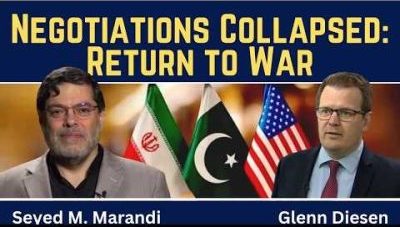
Seyed M. Marandi: Negotiations Collapsed – Return to War
or go to
Aletho News Archives – Video-Images
From the Archives
The US-Iran Scenario That Most Scares Israel
By Ali Haydar | Al-Akhbar | October 9, 2013
Israeli Prime Minister Benjamin Netanyahu issued a series of threats toward Iran and its interlocutors in the West, including the US, as serious negotiations on Iran’s nuclear program seem more plausible.
As a possible rapprochement looms between the US and Iran, Netanyahu has attempted to impose impossible Israeli conditions on the negotiators, such as the full dismantling of Iran’s nuclear program, not to mention threatening military force.
Whatever the deal that could materialize between Iran and the West, Israel is going to find itself before an open-ended path. One can foresee three possible scenarios… continue
Blog Roll
 Aletho News
- Ukraine plans to attack Russian ships with Norwegian support
- US’s ‘Very Foolish’ Double Blockade of Hormuz Strait Makes Absolutely No Sense: Here’s Why
- China issues rules on countermeasures against foreign states’ unlawful extraterritorial jurisdiction
- Seyed M. Marandi: Negotiations Collapsed – Return to War
- Tomorrow’s naval blockade showdown
- ‘Israel’ attacks civilians to hide its embarrassing military failures & out of pure sadism
- Any Foreign Military Vessel Approaching Hormuz Under Any Pretext ‘Will Be Dealt With Severely’: IRGC
- Diplomats slam US negotiators’ performance in Iran talks
- Trump Refuses Exit Ramp, War with Iran will Continue
- Trump Says US Naval Blockade in Strait of Hormuz Will Begin Shortly
- If Americans Knew
- Critical shortages in Gaza, Lebanon in ruins, “piracy” in Iran – Daily Update
- US-Iran ceasefire negotiations make zero progress – Daily Update
- Pro-Israel ‘Thinktanks’ and Individuals who Influence U.S. Foreign Policy
- Mearsheimer reveals how Israel dictates US policies on Iran, Gaza – video
- After killing 350+, Israel still has a “score to settle” with Lebanon before ceasefire – Daily Update
- Military aid to Israel emerges as the latest political litmus test for Democrats
- The only Palestinian children’s rights organization closes following years-long Israeli campaign against it
- ‘I Can’t Forget the Smell’: Lebanese Reel After Israel Kills Over 300 in Single Day
- DNC Shoots Down Resolutions Calling Out AIPAC and Limiting Arms to Israel
- TCN: Is Israel Blackmailing President Trump?
- No Tricks Zone
- Cave Discovery Reveals Today’s Desert Climates Were Recently Far Warmer, Wetter, Teeming With Life
- German Expert: Heat Dome Led To Record Temps In Western USA…Warmer In 1934, 1936
- New Study: No Linear Warming Or Glacier Retreat Along Northern Antarctic Peninsula Since 1980s
- An Inconvenient Tree: Uncovered In Alps… Europe Much Warmer Than Today 6000 Years Ago
- New Study Reports A 60% Slowdown In Greenland’s Ice Loss Rate In The Last Decade
- Low Intensity Tornado Wrecks Major Solar Farm, Creating A Potential Toxic Dump
- New Study Finds Warming Saves Lives…Cold Temperatures 12 Times More Deadly Than Excess Heat
- German Science Blog Accuses PIK Climate Institute Of Hallucinating Climate Tipping Points
- Devastating Assessment Of Comirnaty Vaccine By Former Senior Pfizer Europe Toxicologist
- New Study: CO2 Is ‘Effectively Negligible’ As An Explanatory Climate Change Factor Since 2000
 Aletho News