EU plans to seize €170bn of Russia’s frozen funds – FT
RT | September 17, 2025
Brussels is pressing ahead with a plan to use €170 billion of Russia’s frozen sovereign assets to back “reparation loans” for Ukraine, the Financial Times has reported. The EU faces growing pressure to find additional funding for Kiev as US cuts back its support.
Moscow has condemned the asset freeze and warned that any seizure of its money would amount to “theft.”
Western nations froze an estimated $300 billion in Russian funds after the escalation of the Ukraine conflict in 2022 – some €200 billion of which is held by Brussels-based clearinghouse Euroclear. The funds have accrued billions in interest, and the West has explored ways to use this revenue to finance Ukraine. While refraining from outright seizure, the G7 last year backed a plan to provide Kiev with $50 billion in loans to be repaid using the profits generated by the funds. The EU pledged $21 billion.
European Commission chief Ursula von der Leyen has proposed going further by creating a ‘reparation loans’ mechanism, which she described as urgently needed to finance Kiev.
People familiar with discussions said the plan involves channeling cash balances from Russia’s immobilized assets into EU-issued bonds, with the proceeds transferred to Ukraine in tranches. Brussels argues the system would provide Kiev with immediate support while sidestepping a formal seizure.
A second option under consideration would involve creating a special-purpose vehicle to manage the loans, which could also allow non-EU partners to take part.
Of the funds frozen at Euroclear, about €170 billion has already matured and now sits as cash on the clearinghouse’s books, the sources said.
The plans have already drawn objections from member states. Belgium, Germany, and France have warned that dipping into the principal risks breaking the law and undermining confidence in the euro.
Brussels is under pressure to cover a significant portion of Ukraine’s needs as Washington holds back on new aid, the FT wrote. According to a US note circulated among G7 capitals and cited by the outlet, members were urged to consider seizing the sovereign assets principal “innovatively” to fund Ukraine.
Moscow warned that any attempt to use the assets “will not go unanswered.”
Nepal’s color revolution: US funding under scrutiny amid country’s political upheaval
By Kit Klarenberg | Press TV | September 17, 2025
In recent weeks, Nepal has been engulfed in chaos. Public and private buildings have been set ablaze, and dozens of civilians have been killed in incidents that many believe bear the imprint of Western involvement.
On September 9, Prime Minister K. P. Sharma Oli resigned. The Western media has universally framed the upheaval as spontaneous revolutionary fervour on the part of Kathmandu’s “Gen Z”, motivated by anger over official corruption, unemployment, state efforts to censor social media, and more.
However, there are unambiguous indications that the insurrectionary disarray has been long in the making and assisted by spectral, foreign forces.
The so-called “Gen Z” protests comprise a cluster of local youth activist groups, and are widely dubbed “leaderless”, although Hami Nepal has clearly emerged at the movement’s forefront.
English language Nepali Times has reported that the hitherto unknown NGO “played a central role in guiding the demonstrations, using its Instagram and Discord platforms to circulate protest information and share guidelines.”
The group was established to assist victims of earthquakes – a common occurrence in the country – and provide food, medical and other aid to disadvantaged Nepalese communities.
Subsequently, Hami Nepal oversaw the election of Kathmandu’s interim premier Sushila Karki on September 12, via the highly unorthodox and completely unprecedented expedient of an online vote via Discord.
The NGO’s chat group reportedly boasts 145,000 members, although it’s unclear how many people ultimately voted for Karki. The Western media, and local journalist Prayana Rana, a fervent supporter of the unrest who considers the palace coup to be wholly legitimate and organic, has acknowledged choosing a leader in this manner to be deeply problematic:
“It is much more egalitarian than a physical forum that many might not have access to. Since it is virtual and anonymous, people can also say what they want to without fear of retaliation. But there are also challenges, in that anyone could easily manipulate users by infiltration, and using multiple accounts to sway opinions and votes.”
Still, Karki has firmly pledged to only serve six months in the post until elections are held. She herself has an impressive revolutionary history, having participated in the 1990 People’s Movement that successfully overthrew Nepal’s absolute monarchy, for which she was jailed.
In June 1973, her husband hijacked a plane, stealing vast sums of money to fund armed resistance against the country’s brutal regime, which similarly landed him in prison. Karki’s commitment to seriously tackling corruption as Nepal’s Chief Justice led to her politically-motivated impeachment in June 2017, after just one year.
It is entirely uncertain who or what will replace Karki, and by which mechanism they will attain office. Nonetheless, that Hami Nepal, a previously obscure NGO with no history of political activism, has played such an outsized role in ousting the government of a country of 30 million people and installing its new ruler within mere days, should give us pause.
While the organization’s activities appear benevolent, its rollcall of “brands that support us” contains some puzzling entries, if not outright concerning.
Anonymous profiles
It is unclear what forms of “support” Hami Nepal has received from its sponsors, or when it was provided, but they run quite the gamut. For one, the list includes luxury Western hotels in Kathmandu, clothing and shoe brands, local conglomerate Shanker – the country’s biggest private investor – messaging app Viber, and Coca Cola, notorious for its complicity in countless human rights abuses in the Global South. Elsewhere, the Gurkha Welfare Trust appears.
The Gurkhas have for centuries served as an elite, unique force within the British Army, often tasked with sensitive missions. The Trust, which provides financial aid to Gurkha veterans, their widows and families, is financed by the British Foreign Office and Ministry of Defence.
Meanwhile, Students for a Free Tibet is also listed. The NGO receives funding from the National Endowment for Democracy, an avowed CIA front. In a striking coincidence, NED is deeply concerned about the precise issue that triggered Nepal’s recent protests.
In August 2023, Nepal’s government signed off on a National Cyber Security Policy, imitating China’s “Great Firewall”, which limits foreign internet traffic into the country, while allowing for the proliferation of homegrown ecommerce platforms, social networks, and other online resources. The move was harshly condemned by Digital Rights Nepal, which is bankrolled by George Soros’ Open Society Foundations – a repeat sponsor of government overthrows. Digital Rights Nepal claimed the Policy would lead to mass censorship and threaten citizens’ privacy.
Fast forward to February, and NED published a report warning “countries worldwide,” including Cambodia, Nepal and Pakistan, were looking to China’s internet sovereignty as a “potential model” to emulate.
Rather than acknowledge the threat to Washington’s waning global web dominance posed by such ambitions, the Endowment asserted the real risk was Beijing’s “prestige” being enhanced internationally, thus helping “make the world safe” for the Chinese Communist Party. That month, Nepalese lawmakers began voting on a bill supporting the National Cyber Security Policy.
The legislation required foreign social media networks and messaging apps to formally register with Kathmandu’s Ministry of Communication and Information Technology.
This was intended to not only make these platforms more legally accountable but also ensure the government could collect taxes on revenues they generated locally.
The Committee to Protect Journalists (CPJ) issued a statement imploring parliamentarians to reject the bill, on the basis that it posed a grave threat to press freedom, due to potential content restriction and banning of “creation or use of anonymous profiles.”
The CPJ is bankrolled by Open Society Foundations, a welter of leading Western news outlets, US corporate and financial giants, and Google and Meta, both of which would be adversely affected by the legislation.
The law nonetheless passed, imposing a deadline of September 3rd for registration. While TikTok and Viber complied, US platforms – including Facebook, Instagram, LinkedIn, WhatsApp, and YouTube – refused, prompting Kathmandu to ban usage of 26 foreign-owned sites. This was the spark that ultimately toppled Nepal’s government.
Secure environment
On September 4, the Federation of Nepali Journalists published a statement signed by 22 civil society organizations, expressing “strong objection” to the mass shutdown.
FNJ is funded by NED and the Open Society Foundations. Most of its co-signatories receive money from the same sources, and other Western foundations, governments, and social media platforms. For Hami Nepal, the ban was a “tipping point”, scheduling a mass rally for four days later.
The NGO extensively prepared participants in advance, even establishing a “protest support helpline”.
The September 8 protests quickly turned violent. “Gen Z” leaders distanced themselves from the destruction, claiming their peaceful action had been “hijacked” by “opportunists”.
Yet, Hami Nepal’s Discord server had bristled with belligerent messages in the preceding days. Some users openly advocated killing politicians and their children. Others posted requests for weapons, including machine guns, and openly announced their intention to “burn everything”.
So it was Nepal’s parliament that got set ablaze and the Prime Minister’s official residence torched, prompting ministers to flee in helicopters.
The next night, in the wake of K. P. Sharma Oli’s resignation, Nepalese military chiefs met with protesters to discuss the shape of the country’s future government.
As The New York Times reported on September 11, chief “Gen Z” agitators told army officials they wanted Sushila Karki as interim leader – days before this was apparently confirmed by a competitive Discord vote. Kathmandu’s powerful, popular military has pledged to “create a secure environment until the election is held,” effectively signing off on the violent coup.
It may be significant that one of Hami Nepal’s donors isn’t publicised on its website – arms dealer Deepak Bhatta. He has an extensive history of procuring weapons for Nepal’s military and security forces, and allegations of corruption have swirled around many of these deals.
For example, in July 2022, he was accused of sourcing small arms for local police from an Italian company at four times the actual unit price. Bhatta’s long-running relationship with the army could well have facilitated its friendly contact with protest leaders.
Yugoslavia’s CIA, NED and USAID-orchestrated “Bulldozer Revolution” in 2000 was the world’s first “color revolution”. Over subsequent decades, the US has ousted governments the world over using strategies and tactics identical to those that successfully dislodged Slobodan Milosevic from office.
In almost all cases, youth groups have been key “regime change” foot soldiers. In Belgrade, after almost a decade of lethally destructive sanctions, capped off with a criminal 78-day-long NATO bombing campaign, many residents of the country had legitimate grievances and wished to see Milosevic fall.
Nonetheless, the aftermath was a blunt-force lesson in the importance of being careful about what one wishes for. Milosevic’s downfall is dubbed the Bulldozer Revolution due to iconic scenes during the much-publicised unrest of a wheel loader helping anti-government agitators occupy state buildings, and shield activists from police gunfire. Its driver quickly turned against the “Revolution”.
Subsequent Western-imposed privatization decimated Yugoslavia’s economy, causing his successful independent business to fail, and him to go bankrupt. He subsisted until his dying day on meager state welfare payments.
Herein lies the rub. There’s little doubt that many Nepalese citizens were justifiably disillusioned with their government and sought change. Yet, colour revolutions invariably exploit grassroots public discontent to install governments considerably worse than those that preceded them.
In this context, the military, including disgraced local businessman Durga Prasai, who supports the restoration of Kathmandu’s monarchy, in transition talks with “Gen Z” activists, is rendered deeply suspect. That he has been falsely promoted by the BBC as the protesters’ leader is all the more ominous.
Even enthusiastic local supporters of Nepal’s “revolution” acknowledge it is uncertain whether Sushila Karki will be able to convene elections in six months.
In any event, all established political parties were in the firing line of demonstrators, leaving the question of who will contest any future vote likewise an open one.
There is quite a political vacuum in Kathmandu presently, and history shows us NED, Open Society Foundations, and intelligence-connected Western foundations are ever-poised to seize such “windows of opportunity”. Watch this space.
And what is particularly revealing is a fact, as reported in sections of Indian media, that a plan was in the works for years to bring about a “regime change” in Nepal, engineered by the US.
Internal USAID communications reviewed by The Sunday Guardian, together with program outputs released by US democracy organizations, show that since 2020, the US has committed over $900 million in assistance to Nepal. A significant portion of this funding has been directed toward programs administered through the Washington-based consortium CEPPS, which comprises the National Democratic Institute (NDI), the International Republican Institute (IRI), and the International Foundation for Electoral Systems (IFES).
As the report states, $900 million represents one of the largest per-capita US democracy investments in the region, and the goal was to have a government that serves the US interests.
Russia’s Hi-Tech Starlink Analog Can Free Global South From US Tech Dominance: Here’s How
Sputnik – 17.09.2025
Roscosmos is “moving at a rapid pace” toward fielding an alternative to Elon Musk’s satellite internet empire. Veteran military expert Yuri Knutov breaks things down.
What’s Russia Building?
Bureau 1440 is working on a low-Earth orbit sat net for broadband data delivery:
- multiple test vehicles are already in orbit
- communications tested at ranges of 30-1,000 km
- first stage of series deployment slated to start in December (300 satellites); 900 in stage two
- ~500 base stations planned
- homegrown terminal coming “soon,” per Roscosmos chief Dmitry Bakanov
- trial roll-out planned for 2027
What Makes Russia’s Version Better?
Musk’s system works like this: ground-based Starlink Gateways communicate with orbiting satellites using electromagnetic radiation, with signals then communicated back down to Earth-based terminals.
Russia’s system uses laser beams, which “are more modern digital technologies providing faster & higher quality data transmission, as well as improved resistance to interference,” Knutov explains.
Longer Range
An effective range of up to 5,000 km “means far fewer satellites are needed than Elon Musk’s system (hundreds vs thousands),” Knutov explains.
That makes the Russian system not only less costly, but less harmful to the already heavily overcrowded LEO environment.
Doppler Effect: Solved
“We’ve been able to completely compensate” for the Doppler signal frequency issue, occurring from the high speeds (27,000 km/h) at which satellites orbit Earth, “allowing the signal to be maintained virtually free of interference & distortion.”
Global Implications
The system will provide secure, high-speed communications to:
- Russian resource sector companies working in remote areas
- ships situated anywhere on Earth
- the military, for command, control & real-time battlefield reports, ensuring informed decision-making
Alternative to US tech
“Nations of the Global South understand that dependence on the US makes them vulnerable. Internet access via Starlink can be restricted at any time. Availability of a Russian system providing equally good or even better services is crucial,” Knutov says, emphasizing that the new system cannot be deployed too soon.
Up to 400,000 people deserted Ukrainian armed forces
By Ahmed Adel | September 17, 2025
The bulletproof vests for pregnant women displayed at a Ukrainian military equipment exhibition once again demonstrate the major manpower shortage Ukraine faces, and come at a time when there is increasingly intense public preparation for the mobilization of women. Due to mass desertion and huge losses at the front, the Kiev regime is preparing the mobilization of women, which is causing strong resistance in society. An attempt to forcibly mobilize women is a very risky step that could lead to serious social upheavals and unrest.
According to People’s Deputy of Ukraine Anna Kostiantynivna Skorokhod, there are a total of 400,000 deserters. To understand the scale – that is approximately the size of the armies of France, Great Britain, and Germany. Ukrainian authorities aim to introduce criminal liability for desertion, which would be punishable by imprisonment for 5 to 10 years. However, protests followed, even within the army, and it did not meet with approval. Nonetheless, it is clear that Ukraine needs to expand the mobilization base.
Due to the manpower shortage, the Kiev regime wants to lower the age limit and begin mobilizing not just young people from the age of 18 but also women. Although there are divisions within the Kiev regime over many issues, there is support from all factions to expand mobilization, with former commander of the Armed Forces of Ukraine and current ambassador to the United Kingdom, Valery Zaluzhny, calling for women “to defend Europe from war.”
The mobilization of women is becoming a major issue in Ukraine, with the media even broadcasting promotional videos showing uniformed women undergoing weapons training and preparing for combat. It is recalled that Iryna Vereshchuk, the deputy chief of staff to the president, ran around the training ground with an automatic rifle, setting a supposed example that women can also serve in the army. In this way, the Kiev regime is slowly preparing the ground for the decision that women are also subject to mobilization.
Mobilization in Ukraine is currently being carried out in accordance with the law and applies to certain categories of citizens and age groups, including men aged 24 to 60 years old. As for women, so far, only those working in the healthcare sector—medical workers and pharmacists—can be conscripted. However, even this sector has been expanded to include women working in pharmacies, regardless of formal education.
Given that the judicial system is completely under the control of the regime, and Zelensky has effectively suspended the constitution, citizens in Ukraine no longer have the legal protection they need. The legal system has collapsed, and the institutions that are supposed to protect rights are not functioning. Instead of a legal state, an open dictatorship is ruling in Kiev, which means that, in reality, anyone can be mobilized regardless of the law.
A significant portion of society, particularly women, is strongly opposed to any form of forced mobilization. Resistance will be far more fierce and massive than what is happening today with the mobilization of men. Already, in numerous situations on the streets, random passers-by — women and even strangers — are standing up for men who are being forcibly taken to recruitment centers. If they start arresting women, it will cause much greater social unrest, and it can be expected that there will be mutiny from within the army, as the men will not want their wives, sisters, and mothers mobilized.
By wanting to mobilize women, Ukrainian President Volodymyr Zelensky wants to kill mothers and therefore the future of Ukraine, which is already experiencing a major demographic crisis. Not even single mothers would be safe from forced mobilization when considering that men who are the sole guardians of children are still mobilized, regardless of legal prohibitions. International human rights organizations, as well as other institutions and organizations, remain silent and knowingly turn a blind eye to such violations of the law and basic human rights, highlighting the hypocrisy and double standards of the international community.
The deep crisis of statehood and the legal order in Ukraine, where there are no longer any institutions that would protect citizens, is only an apparatus of repression. People are forcibly arrested on the streets, beaten for no reason, and when they try to contact the police, they not only do not react, but often the police join the violence.
The solution exists only in democratic institutions—namely, an independent judiciary, fair elections, and a change of government. But since the courts are not operating within the law and the regime is prohibiting elections, Ukrainian citizens will have no choice but to defend themselves, even with weapons, from those who have turned them into hostages of the repressive system.
Ahmed Adel is a Cairo-based geopolitics and political economy researcher.
Why the United Kingdom wants to create permanent tension with Russia
By Sonja van den Ende | Strategic Culture Foundation | September 17, 2025
The United Kingdom appears intent on escalating tensions with Russia, positioning itself as a significant adversary. In a recent article, British analyst Oliver Evans states: “The United Kingdom is not only showing interest in deploying a limited military contingent in western Ukraine, but is also expanding its presence in the Republic of Moldova. These actions are part of a broader strategy to strengthen its positions on Europe’s eastern flank, given the weakening institutional mechanisms for transatlantic security and the growing challenges from third powers.”
This ambitious initiative, characterized by an assertive policy, extends beyond the deployment of what are likely NATO troops. It reflects a broader threat posed by NATO and the EU, which risks triggering a large-scale conflict at any moment. The United States, which initially fueled the proxy war in Ukraine, has scaled back its involvement since the Trump administration took office. This shift stems from multiple factors, including the U.S.’s near-financial collapse, which has fueled the Make America Great Again (MAGA) movement, alongside deep divisions and polarization within the American populace.
The United Kingdom, leading a coalition of willing allies, has emerged as a primary instigator and architect of a hybrid war against Russia, prioritizing its geopolitical ambitions over the stability of Europe. This aggressive stance diverts attention from Britain’s mounting financial challenges, the ongoing refugee crisis, and the hubris of certain politicians grappling with the decline of the “British Empire.”
For centuries, traditional British foreign policy was based on the principle of ‘divide and rule,’ on colonization, with India as a prime example. Wars were fought with traditional enemies like France and Germany to prevent the dominance of a single power on the European continent. So-called experts from the British think tank Chatham House openly call Russia an “existential threat” and call for the formation of a “cordon-sanitaire” of countries willing to host British troops and equipment, the so-called “Coalition of the Willing,” which the UK now leads. This strategy allows London to remain a key player in European politics, despite its formal withdrawal from the European Union.
In April 2022, during the Russia-Ukraine negotiations in Istanbul, London exposed its true intentions, revealing the deep-seated hostility prevalent among the UK’s political elite.
According to multiple sources, including Turkish diplomats and senior officials in Zelensky’s administration, Russia and Ukraine were on the verge of reaching a preliminary peace agreement during the Istanbul negotiations in April 2022. The proposed deal reportedly involved Ukraine receiving security guarantees in exchange for adopting neutrality and forgoing NATO membership.
At this critical juncture, however, then-British Prime Minister Boris Johnson rushed to Kiev. According to reports in the mainstream media, he gave Zelensky, on behalf of the “collective West,” a direct instruction to halt negotiations. Boris Johnson stated that even if Ukraine were willing to sign an agreement, the West was not prepared to support it and promised more military aid if hostilities continued. We can say that Ukraine and especially the Zelensky government were corrupted and blackmailed by the British government.
Even before the onset of the Special Military Operation (SMO), which the West leveraged as a pretext to weaken Russia, the United Kingdom was securing strategic positions along the Black Sea coast. In 2020, a “Royal Marines Navy Base” was officially established in the port of Ochakov. Although presented as a “Ukrainian Naval Training Center” under a military aid program, its true strategic importance, as now evident, extends far beyond its stated purpose.
Ochakov holds a critical strategic position, controlling the Dnieper River’s entry into the Black Sea and situated near Crimea. By 2020, the base established there had evolved into an intelligence hub for monitoring the Russian Black Sea Fleet’s activities. Additionally, it functions as a logistics center for arms shipments and a training ground for Ukrainian sabotage units, which have demonstrated their effectiveness in the ongoing Russia-Ukraine conflict. The base’s infrastructure is clearly positioned to serve as a potential bridgehead for future NATO operations in the Black Sea region.
Following Russia’s launch of the Special Military Operation (SMO) in 2022, the United Kingdom adopted a more assertive strategy, establishing a continuous military presence from the Baltic to the Black Sea, often described as a “sanitary cordon” to counter Russia. Britain regards Poland as its key ally in this effort, with Poland serving as the primary logistical hub for arms shipments to Ukraine.
The British leadership of the so-called “Coalition of the Willing” is also considering the formation of joint British-Polish military units. Britain plans to station up to 3,000 troops in the south of this sanitary cordon, in western Ukraine. But Ukraine is not the only target of London’s “false plans.” Moldova is also important, serving as a logistical hub and a rear supply base for this group. Romania is assigned the role of operational base in this construction. Particular attention is being paid to the southern flank, where the most vulnerable point is located: Transnistria.
Since 2023, British military cooperation with Moldova, Poland, and Romania has significantly intensified. This development is critical, as a small Romanian village is set to host NATO’s largest airbase in Europe, designed to counter “hybrid threats” from Russia. Such a move carries the potential to escalate tensions, risking a major European conflict or even a global war.
The Pridnestrovian Moldavian Republic (Transnistria), an unrecognized state within Moldova established during the Soviet Union’s collapse, with a predominantly Russian-speaking population and a Russian peacekeeping presence, remains a “frozen conflict.” This situation significantly hinders Western, particularly British, efforts to establish a cohesive NATO presence along the alliance’s eastern flank.
Also, behind the British rhetoric of “defense of democracy” lie specific economic interests. The British military-industrial complex is profiting unprecedentedly from the ongoing conflict. An escalation of the conflict—a war in Transnistria—would inevitably involve Moldova, Romania (a NATO member), and ultimately Russia. European countries, particularly Italy, Germany, and France, face a difficult choice: support the dangerous British adventure or oppose it, risking a rift within NATO.
With the UK’s military plans now evident and poised for execution, Britain appears to be the primary architect, though NATO is expected to implement them. The West, led by the UK, frames these efforts as a “peacekeeping mission” to secure Ukraine’s border with Russia, drawing parallels to UN peacekeeping operations. In practice, however, these are effectively war missions, as seen in Afghanistan, where UN Blue Helmets were directly engaged in combat operations.
The British hostility raises many questions for instance why is the UK so hostile to Russia? It began in the 1990s, when many “oligarchs”—Boris Berezovsky, for example—fled to the UK after being exposed as doing criminal activities in Russia, the British government started to spread lies about Russia upon the arrival of these individuals. Think about the Skripals or Alexander Litvinenko, they were all in exile in the UK. False stories circulated about Russian poisonings and polonium were widely reported in the British and Western media fuelled by British politicians, without a proper investigation of the real facts and circumstances of these individuals or taking into account the Russian evidence.
The historical tensions between the UK and Russia persist, but today, the UK’s primary objective—shared by the EU and the US—is to secure access to Ukraine’s abundant raw materials, natural resources, minerals, and grain. Upon taking office for his second term, US President Donald Trump pledged to broker peace between Ukraine and Russia within 24 hours, a promise widely dismissed as propaganda due to its unrealistic timeline. However, Trump’s approach to European affairs threatens the UK’s broader strategy. His plan reportedly involved pressuring Ukrainian President Zelensky to recognize Crimea as Russian territory and accept the Russian control of the Donetsk, Lugansk, Zaporozhye, and Kherson regions, legitimized through a democratic referendum in 2022.
Europe, including the United Kingdom, faces a period of decline, with the continent grappling with significant upheaval. In the UK, citizens are taking to the streets in protest, as freedoms appear increasingly at risk. Once a symbol of stability, wealth, and royal tradition, the UK now finds itself mired in a profound crisis.
The UK’s war rhetoric surpasses even that of mainland Europe, rooted in a militarized history shared with nations like Germany. However, that era has faded; declining birth rates and the integration of diverse cultures have eroded traditional British identity. The elites, witnessing the decline of their once-vast empire, are powerless to reverse this trend. In response, they appear to be pushing for conflict—whether hybrid or conventional warfare—to reassert their influence.
Putin signs off on Europe’s largest ever high-speed rail project
RT | September 17, 2025
Russian Prime Minister Mikhail Mishustin has announced plans for a massive high-speed rail (HSR) network. It is set to be the largest in Europe, spanning more than 4,500km (2,800 miles), and will use domestically built trains capable of reaching 400kph (250mph).
At a government meeting on Tuesday, the prime minister said the new line will cut travel time between Moscow and St. Petersburg from four hours to just over two. The network will also connect Moscow with Minsk, Adler on the Black Sea, Ekaterinburg in the Urals, Ryazan, and other cities.
“Travel between cities should be not only safe and comfortable but also not too time consuming,” Mishustin stated. “In the modern world, time is becoming increasingly valuable. Because of that, we are mastering technologies for faster travel and [are working] on a development scheme for high-speed rail infrastructure.”
He noted that the project has been approved by President Vladimir Putin and will be finalized within the next six months.
Mishustin said construction of the first HSR line between Moscow and St. Petersburg is already underway. The 679km route will be the first to feature the new generation of high-speed trains. While he gave no details about the train’s specifications, media reports suggest that the name could be chosen in a public vote, with options including ‘Luch’ (Russian for ‘ray of light’). The current line between the two cities, the fastest in Russia, operates Siemens Velaro Sapsan trains with a top speed of 250kph.
Once completed, Russia’s HSR network will overtake Spain’s 3,970km system, the largest in Europe and second worldwide after China. The new Russian trains will also outpace Europe’s fastest, the French TGV, which runs at up to 320kph, covering the London-Paris route in three hours.
China remains the global HSR leader, with more than 64,000km of lines in operation. It also fields the world’s fastest trains, including the Shanghai Maglev at 460kph and the CR400 Fuxing Hao at 350kph.
Who Killed Charlie Kirk?
By Ron Paul | September 16, 2025
I had the pleasure of appearing on Charlie Kirk’s program a few times over the years and I always found him to be polite, respectful, and genuinely interested in ideas. Even in areas where we might not have agreed, he listened carefully. He was a strong advocate of free speech and he made a career of trying to convince the youth of the value of free speech and dialogue regardless of political differences.
At the young age of 31 years old, he had already founded and ran the largest conservative youth organization in the country and as such he had enormous influence over the future of the conservative movement and even the Republican party. As I discovered during my Republican presidential runs, the youth of this country are truly inspired by the ideas of liberty, peace, and prosperity.
I do not believe we have anything near the real story about the horrific murder of Charlie Kirk last week. The narrative presented by the FBI and other government agencies is wildly contradictory, with an ever-changing plotline that makes little sense.
Some individuals close to Kirk have reported that his foreign policy position was shifting away from the standard neoconservative militarism in favor of a more non-interventionist approach. Tucker Carlson recently recounted that Kirk had even gone personally to the White House to urge President Trump to refuse to take military action against Iran. He was rebuffed by President Trump, Carlson informed us.
Likewise, conservative podcaster Candace Owens, who was a close friend of Charlie Kirk, has stated on her program that Kirk was undergoing a “spiritual crisis” and was turning away from his past embrace of militarism and in favor of America-first non-interventionism, particularly regarding the current unrest in the Middle East.
Was Charlie Kirk murdered – directly or indirectly – by powerful forces who could not tolerate such a shift in views in such an influential leader? We don’t know.
If anything, those seeking to prevent the ideas of peace from breaking out would wish to cover it up, as they have done in so many past political killings. As I recounted in my most recent book, The Surreptitious Coup: Who Stole Western Civilization?, the turbulent 1960s saw several killings of major US figures, including JFK, RFK, and Martin Luther King, who were challenging the status quo and pushing for a shift away from the Cold War confrontationist mentality.
The real assassins of these peace leaders from last century were nihilists who did not believe in truth. They only believed in power – the power that comes from the barrel of a gun. Rather than compete in the marketplace of ideas they preferred to snuff out any challenges and therefore decapitate any possibility that our country could take a different course.
More than sixty years after the murder of President Kennedy, the vast majority of the American people do not believe the official story of how he was killed and why. Truth will eventually break through even when the wall of lies seems impenetrable.
If it is true that Charlie Kirk was preparing to shift his organization toward a foreign policy embraced by our Founders, the killing was even more tragic. But no army – or assassin – can stop an idea whose time has come. That may be his most important legacy. Rest in peace.
Did Israel Murder Charlie Kirk?

By W.M. Peterson | Truth Blitzkrieg | September 16, 2025
“Terror is theater… Theater’s a con trick… Do you know what that means? Con trick? You’ve been deceived.”
– John le Carré, The Little Drummer Girl, (1983)
A provision authorizing extrajudicial murder exists within Jewish law. Din rodef — “law of the pursuer,” permits the killing of those who are deemed a threat to individual Jews or the Jewish state, without the benefit of due process.
A dramatic example of this occurred on November 4, 1995, when Talmudic law student Yigal Amir assassinated Prime Minister Yitzhak Rabin at a political rally in Tel Aviv. During his trial, Amir invoked din rodef as a legal defense in an attempt to justify his murder of Rabin. The basis of Amir’s argument was that Rabin, by signing the Oslo Accords and relinquishing much of the West Bank to Palestinian rule, had endangered Jewish lives and should therefore be considered a ‘pursuer.’
Although Amir was convicted and sentenced to life in prison, many radical right-wing Israelis have campaigned for clemency on his behalf, including Itamar ben-Gvir, Netanyahu’s Minister of National Security.
In the book Torat Hamelekh (The King’s Torah), Rabbis Yitzhak Shapira and Yosef Elitzur explain that din rodef “applies even when the pursuer is not threatening to kill directly, but only indirectly… anyone who weakens our own state by word or similar action is considered a pursuer.” [Emphasis supplied][1]
Is it possible that Charlie Kirk came to be regarded as a ‘pursuer’ by certain Zionist heavyweights, resulting in his untimely death?
Few can say for sure, and those who can surely won’t. However, it’s interesting that a day after Kirk was shot, General Michael Flynn indicated that federal law enforcement suspected the murder may have had a foreign signature:

Which foreign country, pray tell, is notorious for assassinating political figures across the globe, going so far as to gun down a sitting US President in a grisly public spectacle? History itself is reason enough to consider Israeli collusion in Kirk’s assassination plausible, if not entirely demonstrable. Respected scholar Ron Unz reveals in his latest article ‘The Assassination of Charlie Kirk’ how a number of people in and around the Trump Administration seem to agree:
“Earlier this year I’d published an article summarizing Israel’s long history of high-profile political assassinations, a record unmatched in all of world history, and this particular incident certainly fit very well into that pattern… Therefore, a few hours after hearing of Kirk’s death, I very gingerly raised these possibilities with someone well situated in conservative circles who personally knew Kirk, and was shocked by his response. He unequivocally told me that everyone in Kirk’s circle, even including important Trump Administration officials, suspected that Israel had probably killed the young conservative leader.”
I’ve seen many people online ask the question: why would Israel wish to kill one of its most stalwart defenders on the American right?
It’s true that for almost the entirety of his career Kirk was a beneficiary of Zionist largesse, allowing him to grow his Turning Point USA organization into “the largest Conservative student movement in the US, with groups at more than 3,500 universities and high schools.” Kirk would often attribute TPUSA’s success to his friend and mentor David Horowitz, conceding that “without David Horowitz, I’m not sure Turning Point USA would exist.” Relationships like these went a long way towards ensuring Charlie stayed on message whenever the subject of Israel was raised. (Like for example, when he dismissed the 1967 Israeli attack on the USS Liberty as a “conspiracy theory.”)
But running interference for a terrorist state engaged in an ongoing genocide will eventually begin to wear on the conscience of any halfway decent man, and in more recent years Kirk had begun to wander off the Zionist reservation. In fact, on his final podcast with Ben Shapiro, recorded one day before his death, Kirk suggested that people ought to be more critical of media reports regarding Israel:
“One thing a friend said to me… is Charlie, we pushed back against the media on Covid, on lockdowns, on Ukraine, on the border… maybe we should also ask a question: is the media totally presenting the truth when it comes to Israel? Just a question. You know, maybe we shouldn’t believe everything the media says because I know I’ve been conditioned to ask a lot more critical questions over the last couple of years.”[2]
Kirk’s statement to Shapiro supports the idea that he may have started reexamining some of the positions he’d been paid so handsomely to embrace.
Having never paid much attention to Charlie Kirk, considering him the archetypical shabbos goy sucking on the teat of ZOG, I was rather surprised this week when I watched numerous videos of the TPUSA founder criticizing Jews as a group, claiming at times that Jewish communities promoted “hatred against whites”; that “Jews control… the colleges, the nonprofits, the movies, Hollywood, all of it”; and insinuating that Israel’s military stood down and allowed the 10/7 Hamas attack to occur. In one instance, Kirk described the intense backlash he received from his Jewish donors after hosting Israel-critical commentators Dave Smith, Megyn Kelly and Tucker Carlson at his TPUSA Action Summit in July, during which the guest speakers “denounced Israel’s blood-soaked assault on the besieged Gaza Strip, branded Jeffrey Epstein as an Israeli intelligence asset, and openly taunted Zionist billionaires like Bill Ackman for ‘getting away with scams’ despite having ‘no actual skills,’” according to The Grayzone’s Max Blumenthal and Anya Parampil.
A few weeks after the conference, a visibly shaken Kirk appeared on former Fox News host Megyn Kelly’s podcast and addressed some of the harassments he’d been subjected to:
“The more that you guys privately and publicly call our character into question — which is not isolated, it would be one thing if it were just one text, or two texts; it is dozens of texts — then we start to say, ‘woah, hold the boat here,’…To be fair, some really good Jewish friends say, ‘that’s not all of us’…But these are leaders here. These are stakeholders… I have less ability… to criticize the Israeli government than actual Israelis do. And that’s really, really, weird…That’s not right.”
Kirk’s increasingly independent statements, coupled with his defense of irredeemable “anti-Semites” Candace Owens and Tucker Carlson, strongly suggests that his time as an obedient goyische dupe was nearing its end. Perhaps this explains why in early 2025, Benjamin Netanyahu tried to purchase Kirk’s compliance:
Charlie Kirk rejected an offer earlier this year from Israeli Prime Minister Benjamin Netanyahu to arrange a massive new infusion of Zionist money into his Turning Point USA (TPUSA) organization, America’s largest conservative youth association, according to a longtime friend of the slain commentator speaking on the condition of anonymity. The source told The Grayzone that the late pro-Trump influencer believed Netanyahu was trying to cow him into silence as he began to publicly question Israel’s overwhelming influence in Washington and demanded more space to criticize it.
In the weeks leading up to his September 10 assassination, Kirk had come to loathe the Israeli leader, regarding him as a “bully,” the source said. Kirk was disgusted by what he witnessed inside the Trump administration, where Netanyahu sought to personally dictate the president’s personnel decisions, and weaponized Israeli assets like billionaire donor Miriam Adelson to keep the White House firmly under its thumb.
According to Kirk’s friend, who also enjoyed access to President Donald Trump and his inner circle, Kirk strongly warned Trump last June against bombing Iran on Israel’s behalf. “Charlie was the only person who did that,” they said, recalling how Trump “barked at him” in response and angrily shut down the conversation. The source believes the incident confirmed in Kirk’s mind that the president of the United States had fallen under the control of a malign foreign power, and was leading his own country into a series of disastrous conflicts.
By the following month, Kirk had become the target of a sustained private campaign of intimidation and free-floating fury by wealthy and powerful allies of Netanyahu — figures he described in an interview as Jewish “leaders” and “stakeholders.”
“He was afraid of them.” the source emphasized. [Source]
Thirty-three hours after supposedly killing Charlie Kirk with a single .30-06 caliber round fired from a Mauser 98 bolt-action rifle, 22-year-old Tyler Robinson was taken into custody and charged with multiple felonies, including suspicion of aggravated murder, felony discharge of a firearm, and obstruction of justice. The official story claims that Robinson’s father, a registered Republican and supporter of Donald Trump, recognized his son in images released by the FBI, whereupon he confronted the newly minted murder suspect and persuaded him to confide in a youth pastor who also happens to work with the Washington County Sheriff’s Office and the U.S. Marshals Service. Interestingly, Zionist billionaire Bill Ackman, who had reportedly been feuding with Kirk shortly before his death, contributed $1 million to the FBI reward for information leading to the capture of Charlie Kirk’s assassin. That money will apparently go to Tyler Robinson’s father.
Following Robinson’s arrest it was reported that federal authorities were in possession of evidence collected from his roommate showing he had divulged details of his plan to assassinate Kirk over the social messaging platform Discord. His alleged plans included, “a need to retrieve a rifle from a drop point, leaving the rifle in a bush… and a message referring to having left the rifle wrapped in a towel.” Discord, however, claimed that it’s platform was not in fact used by Tyler Robinson either to plan the murder of Charlie Kirk or to hide the evidence after the fact. A Discord spokesman, dispatched to set the record straight, told American tabloid news outfit TMZ:
“In the course of our investigation we identified a Discord account associated with the suspect, but have found no evidence that the suspect planned this incident or promoted violence on Discord… The messages referenced in recent reporting about planning details do not appear to be Discord messages. These were communications between the suspect’s roommate and a friend after the shooting, where the roommate was recounting the contents of a note the suspect had left elsewhere.”
FBI Director Kash Patel has said that although the incriminating note was destroyed, federal investigators have ‘forensic evidence’ proving it existed, and furthermore, they have been able to confirm through an “aggressive interview process” what its contents were. Meanwhile, on September 15 the Washington Post published messages supposedly sent by Robinson on Discord discussing the murder plot, which obviously contradicts the company’s previous position.
Other striking anomalies exist in what has begun to emerge as the official story.
For starters, security camera videos showing Robinson jumping off the roof where the sniper shot was supposedly fired from show no evidence that he was in possession of a high-powered bolt-action rifle. Yet we’re told the murder weapon was found in a wooded area near the campus, fully assembled and wrapped in a towel. Are we to believe that upon shooting Kirk, Robinson disassembled his firearm, fled the scene without being detected, reassembled his firearm, wrapped it in a towel and ditched it in the woods? How does that make any sense?
Equally perplexing is the immediate apprehension by police of an elderly Jewish man who had reportedly confessed to shooting Kirk. The man, 71-year-old George Zinn, is a well-known political agitator with a history of disrupting public events. Attendees who witnessed his arrest claim the obstreperous geriatric was challenging police to shoot him, and was acting in a thoroughly unhinged manner. Shortly thereafter, Zinn was booked by the Utah Valley University Police on an obstruction of justice charge and cleared as a person of interest. It’s possible Zinn’s erratic behavior was a calculated diversion, allowing the shooter to flee the scene in the critical moments after Kirk was shot.[3]

George Zinn reportedly told police he wanted to cause a distraction for the real gunman
And then there’s the story of the private jet that departed Provo Airport (PVU) — located eight miles from the UVU campus where Kirk was speaking — an hour after the shooting. According to FlightRadar24, a private Bombardier Challenger 300 departed PVU just after 1 p.m. local time and illegally switched off its transponder 30 minutes into flight, rendering itself undetectable by radar. Colson Thayer, a writer for American weekly magazine People, reported:
“Around 1:43 p.m. local time, as the jet approached the northern border of Arizona, the plane turned off its Automatic Dependent Surveillance-Broadcast (ADS-B), which provides positioning information between the aircraft and air traffic control. Tracking information for the aircraft reappeared shortly after 2:30 p.m. local time as the plane departed Page Municipal Airport (PGA) in Arizona back towards Provo. The plane landed back in Provo at 3:06 p.m. local time, according to FlightRadar24.”
Writing for online newspaper The Latin Times, journalist Matias Civita provides additional background information about the owner of the plane:
The jet is registered to “N888KG” LLC, which shares a Lehi, Utah address with the Derek and Shelaine Maxfield Family Foundation, which runs the Saprea non-profit organization to help survivors of sexual abuse. Many have pointed to the foundation’s numerous connections to Israel as a cause for suspicion… X user, @jonnysocialism, added that “It appears the private jet that took off after the assassination and stopped tracking was owned by the Derek & Shelaine Maxfield Foundation. They run a nonprofit called Saprea that focuses on victims of child sex abuse & have pictures of themselves visiting Israel on Facebook.”
In 2022, Saprea also launched its first-ever “kosher retreat” that offers kosher food developed “closely with Rabbi Avremi Zippel at Chabad Lubavitch of Utah.”
It’s unlikely we’ll ever be able to prove beyond a shadow of a doubt who actually fired the shot that killed Charlie Kirk or why.
When contemplating the many improbabilities and contradictions woven into the unfolding narrative I’m reminded of an episode of 60 Minutes that aired in September 2024, in which Lesley Stahl interviewed a former Mossad case officer identified only as ‘Michael.’ While explaining Israel’s extensive covert action and disinformation campaign vis-à-vis the infamous ‘Lebanon Pager Plot,’ Michael said,
“We create a pretend world… We are a global production company. We write the screenplay, we’re the directors, we’re the producers, we’re the main actors, and the world is our stage.”
Indeed.
Counterterrorism expert and former deputy chairman of Kroll Associates, Brian Jenkins, once observed that “terrorism is aimed at the people watching, not at the actual victims.” Thanks in part to British journalist Russell Warren Howe’s 1974 television interview with future Israeli Prime Minister Menachem Begin (not to mention decades of observable phenomena), it’s no secret who the world leader of terrorism is. Begin, the founder of Israel’s Likud Party, was head of the Zionist paramilitary organization Irgun when it bombed the King David Hotel in 1946, killing 91 people and injuring dozens more. Today the Likud government of Benjamin Netanyahu is orchestrating a genocide in Gaza and a larger regional war of aggression made possible by the rudimentary 10/7 Hamas offensive during which Israeli military forces stood down and allowed the attack to transpire for several hours without any meaningful response.
It’s precisely due to its history of political assassinations and false flag terror attacks that Israel has once again emerged among ‘conspiracy theorists’ as a leading suspect in an historic crime. Having already gotten away with the murder of more than 200 journalists in Gaza since ‘war’ began in October 2023, what would possibly deter them from killing one more?
Notes
[1] For a detailed study on the influence of ultra-Orthodox Judaism inside of Israel, see Jewish Fundamentalism in Israel, by Israel Shahak and Norton Mezvinsky.
[2] Ben Shapiro has announced he “will be picking up Charlie’s bloody microphone” and replacing Kirk on the college campus circuit.
[3] George Zinn cuts a suspicious figure. In response to a question about a meme connecting Zinn to 9/11 and the Boston Bombing, Grok AI replied, “Based on my review of multiple sources, George Zinn was a witness to the 9/11 attacks and described seeing the planes hit the towers. He was arrested in 2013 for emailing a bomb threat “joke” to the Salt Lake City Marathon shortly after the Boston bombing, pleading guilty to a terrorism charge and receiving probation.”
Colombia halts arms purchases from US over drug combat delisting row
Al Mayadeen | September 16, 2025
Colombia halted arms purchases from the United States, its biggest military partner, on Tuesday, after Washington decertified the South American country as an anti-drugs ally under the pretext of failing to halt cocaine trafficking.
On Monday, President Donald Trump denounced Colombia’s leftist president, Gustavo Petro, for failing to curb cocaine production, claiming that instead, Petro presided over its rise to what he called “all-time records,” a failure which he stated made him decide to officially designate the country as having demonstrably failed to meet its drug control obligations.
Reacting to the news, Colombian Interior Minister Armando Benedetti told Blu Radio that “from this moment on… weapons will not be purchased from the United States.”
Trump’s decertification of Colombia, the first for the longtime ally in three decades, was viewed as a mainly symbolic gesture.
The decertification was nonetheless seen as a stinging rebuke of Petro’s anti-drug efforts, which prompted Colombia’s president to hit back by saying that the Colombian military would become independent from “handouts” from the United States.
Petro hits back
During a televised cabinet meeting, Petro said Colombia was being punished despite sacrificing dozens of policemen, soldiers, and regular citizens to stem the flow of narcotics to the United States.
“What we have been doing is not really relevant to the Colombian people,” the Colombian president stressed, adding, “It’s to stop North American society from smearing its noses” in cocaine.
US officials cited a surge in coca cultivation and cocaine production as the reason for the measure, while critics argue it unfairly targets Bogota despite its decades of collaboration with Washington.
Dissent Into Madness
WATCH ON:  /
/  /
/  /
/  /
/  /
/  or DOWNLOAD THE MP4
Corbett | September 16, 2025
What if the delusions of the dissidents are in fact real? What if their paranoid fantasies are not fantasies at all? In other words, what if it’s not the political dissidents who are crazy, but the politicians?
You’re about to learn about the dark history and the even more disturbing present of political psychopathy.
Prepare yourself for DISSENT INTO MADNESS.
TRANSCRIPT
JAMES CORBETT: “Insane.”
“Deranged.”
“Crazy.”
In the hands of a tyrant, these aren’t mere words, not impartial descriptions of thought or behaviour. They’re weapons.
After all, there’s nothing more damning, more completely dehumanizing, than to call someone “crazy.”
LIZ WINSTEAD: The conspiracy theory thing . . . it . . . I’m just utterly shocked that they could try to make this . . . It’s, it’s . . . You know how people wear tinfoil hats? I think they’re wearing tinfoil condoms. I’m not sure, because they seem so crazy.
DAVID CHAVERN: There’s always been crazy conspiracy theories. I think we’ve all got uncles [who] over the Thanksgiving dinner [have] told us crazy stuff.
SOURCE: U.S. Senate 10242017 CSPAN October 25, 2017 12:02am-12:30am EDT
GLENN BECK: It started with the 9/11 “truthers”. Crazy. Then the “birthers.” Crazy.
SOURCE: Glenn Beck FOX News February 3, 2010 2:00am-3:00am EST
LAURA INGRAHAM: That the Bush administration could perhaps have had something to do with 9/11—facilitating 9/11, encouraging the actions that took place on 9/11—that is insane. That is literally insane.
SOURCE: The O Reilly Factor FOX News September 3, 2009 11:00pm-12:00am EDT
But sometimes “crazy” isn’t just a figure of speech. Sometimes it’s a diagnosis.
And as long as there have been those willing to diagnose others as “insane,” there have been those who have sought to use this as a label for their political enemies.
And why not? Once diagnosed as mentally unsound, political dissidents can be treated as we have always treated those we dismiss as “crazy.” They can be locked away, drugged, and subjected to all manner of torture in the name of “treatment.”
Now, the idea that would-be rulers would cynically use the “lunatic” cudgel against their political enemies is bad enough.
But what if the reality is the complete opposite of what is commonly understood?
What if the “delusions” of the dissidents are in fact real? What if their “paranoid fantasies” are not fantasies at all? What if their inability to fit in is not a sign that they are sick, but that the society they are protesting against is sick?
In other words, what if it’s not the political dissidents who are “crazy,” but the politicians?
You’re about to learn about the dark history and the even more disturbing present of political psychopathy.
Prepare yourself for DISSENT INTO MADNESS.
This is The Corbett Report.
1. The Bad Old Days

The history of psychology is, to a large extent, the history of cruel and unusual punishments meted out by rulers on political dissidents in the name of “curing the mentally disturbed.”
That psychology has always been a convenient tool for the ruling class to wield against dissenters may seem like a controversial observation at first glance. But, this is precisely what the most mainstream of establishment sources tell us . . . when they’re talking about the establishment’s enemies, that is.
ROBERT MacNEIL: Good evening. Ever since czarist days Russian political dissenters have feared their political views could land them in the infamous Arctic labor camps. But what increasingly haunts the Soviet political dissident today is the threat of being declared insane and sent to a mental hospital. While the Soviet authorities strenuously deny it, the dissident movement continues to claim that thousands of people who disagree with Kremlin policy are confined to mental hospitals when their only disease is dissent.
To be sure, MacNeil and Lehrer and the other American critics of Soviet psychiatry—like Dr. Walter Reich, who wrote a 6,000-word expose on “The World of Soviet Psychiatry” for The New York Times in 1983—weren’t wrong. They just weren’t telling the whole truth.
The horrors of the Soviet psychiatric system—in which political dissidents were routinely diagnosed with “sluggish schizophrenia,” psychiatric hospitals were used as temporary prisons during periods of protest, and troublesome rebels were kept in medically induced comas or drug-induced catatonic states for extended periods of time—has been well-documented in numerous mainstream sources, both popular and academic. But these horrors were given their most poignant expression in the words of Alexander Solzhenitsyn:
The incarceration of free-thinking healthy people in madhouses is spiritual murder, it is a variation of the gas chamber, even more cruel; the torture of the people being killed is more malicious and more prolonged. Like the gas chambers, these crimes will never be forgotten and those involved in them will be condemned for all time during their life and after their death.
As Reich correctly observes in his report, “[T]he experience of Soviet psychiatry had a lot to teach about the vulnerabilities of psychiatry to misuse wherever it is practiced.”
But, by a funny coincidence, these concerns only ever seem to come up when psychiatry is being “misused” in countries that are on the US State Department’s enemies list.
There are no shortage of sources that will tell you about:
- the abuses of Nazi psychiatrists, who sat on planning committees for the Aktion T4 euthanasia and sterilization program and who directed the Nazi regime’s horrific (and failed) attempt to eradicate schizophrenia by systematically killing off Germany’s schizophrenic population;
- the abuses that Japanese psychiatrists inflicted on their patients during and immediately after WWII, resulting in an abnormally large number of patient deaths;
- the Cuban revolutionary government’s use of psychotropic drugs and electroconvulsive therapy in order to obtain information from, punish, demoralize, coerce, subdue, terrorize, and cause psychological damage to those deemed a threat to state security;
. . . and any number of similar examples of psychiatric abuse by governments at war with or in the crosshairs of the US government.
Often excluded from this analysis, however, are the horrific abuses that psychiatrists in the West have inflicted on their patients in the name of state security.
While the history books will rightly condemn the horrors of the Nazi eugenic sterilization program, they seldom explore the roots of that program. As it turns out, those roots were in the Kaiser Wilhelm Institute of Anthropology, Human Heredity, and Eugenics, which was funded by the Rockefeller Foundation. What’s more, Ernst Rüdin—the director of the also-Rockefeller-funded Kaiser Wilhelm Institute for Psychiatry and one of the key architects of Germany’s eugenics program—modeled the Nazi eugenics legislation on America’s own “Model Eugenical Sterilization Law.”
In fact, America’s first professor of psychology, James McKeen Cattell, helped bring the eugenics pseudoscience to the shores of America in the first place. Having befriended Francis Galton, the progenitor of eugenics, during a trip to England in 1887, Cattell returned to the US with an enthusiasm for the idea. He later wrote a letter to Galton bragging, “We are following in America your advice and example.”
Still further back in history, Benjamin Rush—one of the founding fathers of the United States and the man officially recognized by the American Psychiatric Association as the “father of American psychiatry”—made early contributions to the weaponization of psychiatry by inventing a number of mental disorders to pathologize dissent. The most notable of these made-up disorders was “anarchia,” a type of madness Rush defined as “an excess of the passion for liberty,” which “could not be removed by reason, nor restrained by government” and “threatened to render abortive the goodness of heaven to the United States.”
And what did this “father of American psychiatry” prescribe for those he deemed to be suffering from mental illness? Well, for starters, he “treated his patients with darkness, solitary confinement, and a special technique of forcing the patient to stand erect for two to three days at a time, poking them with sharp pointed nails to keep them from sleeping—a technique borrowed from a British procedure for taming horses.”
He also invented two mechanical devices for the treatment of the insane: a “tranquilizing chair,” in which the patient’s “body is immobilized by straps at the shoulders, arms, waist, and feet [and] a box-like apparatus is used to confine the head,” and a “gyrator,” “which was a horizontal board on which torpid patients were strapped and spun to stimulate blood circulation.”
Rush’s apprentice, physician and outspoken germ theory critic Samuel Cartwright, made his own contribution to the field by inventing a disorder he named “drapetomania, or the disease causing negroes [slaves] to run away“:
The cause in the most of cases, that induces the negro to run away from service, is as much a disease of the mind as any other species of mental alienation, and much more curable, as a general rule. With the advantages of proper medical advice, strictly followed, this troublesome practice that many negroes have of running away, can be almost entirely prevented, although the slaves be located on the borders of a free state, within a stone’s throw of the abolitionists.
Yes, the history of psychiatry is replete with examples of political dissidents, unruly populations, or other “social undesirables” being labeled as insane and sent to the madhouse . . . or worse.
But that was then, many would be inclined to argue. This is now. Surely psychiatry isn’t used to suppress dissent anymore, is it? . . .
2. The Bad New Days

Yes, of course psychiatry is still used as a weapon to be wielded against political dissidents. And I’m not just talking about psychiatric repression in some backward, evil dictatorship like Russia. (Although, to be sure, there’s that, too.)
No, once again, it is the “liberal,” “enlightened,” “free and democratic” West that is leading the way in weaponizing psychiatry against the masses. And, incredibly, the wielders of this psychiatric weapon don’t try to hide the fact but have instead actively sought to codify it in their “bible.”
Since 1952, the American Psychiatric Association has published the Diagnostic and Statistical Manual of Mental Disorders, or the DSM, as a guideline for the classification and diagnoses of mental health issues. Commonly referred to as the psychiatric diagnostic bible, the DSM, according to the APA itself, “is the standard classification of mental disorders used by mental health professionals in the United States and contains a listing of diagnostic criteria for every psychiatric disorder recognized by the U.S. healthcare system.”
Critics have long questioned the influence that Big Pharma has had in pressuring the APA to diagnose more and more behaviour as “abnormal” in order to prescribe pharmaceutical interventions to a greater and greater percentage of the public.
Concerns over Big Pharma’s influence on the creation of the DSM are not trivial. In 2012, a study led by University of Massachusetts-Boston researcher Lisa Cosgrove noted that 69% of the DSM-5 task force members had ties to the pharmaceutical industry, including paid work as consultants and spokespersons for drug manufacturers. On certain panels, the conflict of interest was even more profound: 83% of the members of the panel working on mood disorders had pharmaceutical industry ties, and 100%—every single member—of the sleep disorder panel had “ties to the pharmaceutical companies that manufacture the medications used to treat these disorders or to companies that service the pharmaceutical industry.”
If the DSM task force members’ goal is to make sure that more and more pharmaceuticals are sold, then by every measure they’ve been remarkably successful. Recent surveys indicate one in six American adults report taking a psychiatric drug, such as an antidepressant or a sedative. Worryingly, the number of children being prescribed antipsychotic medications like Adderall and Ritalin has continued to increase decade after decade.
And, more worrying still is the way that this increase in antipsychotic prescriptions has been justified by the invention of new “mental disorders” like “Oppositional Defiance Disorder.”
Clinical psychologist Bruce Levine, who has spent decades ringing the alarm bell about the ways in which his profession is being used to repress legitimate political dissent, explains:
So, one of the things that happens in 1980 is you have the introduction of this new mental illness called “oppositional defiant disorder” (O.D.D.). Now, literally, this has nothing to do with juvenile delinquency—people need to know. So, these kids, specifically, are not doing anything illegal. That’s a whole other “mental illness” called conduct disorder. But oppositional defiant disorder, by definition, they are arguing with adults, they are often refusing to comply with adults. They’re doing the things that almost every of the 20 people I profile in resisting illegitimate authority—all these famous anti-authoritarian from George Carlin to Lenny Bruce to Ralph Nader to Thomas Bay—all these people are doing this kind of stuff. And so that’s what really concerned me at that time in the ’80s is, are you kidding, you are pathologizing rebellion.
Now, some of these kids, at the time, you know, if you talk about a nine-, ten-year-old, who’s just being oppositional, they’re not making judgments necessarily about who’s a legitimate authority and who’s an illegitimate authority. So, I wouldn’t call them genuine anti-authoritarians at eight or nine years old. But here’s the important thing: a lot of these oppositionally defined kids who are just being a handful and rebellious at the time, they are the kind of kids who at some point mature into genuine anti-authoritarians—unless you’re drugging the crap out of them! Which is what my profession then moved into: not just pathologizing them—giving a mental illness—but they are part of, if you take a look at the oppositional defiant disorder, that, along with conduct disorder, are what my profession calls the “disruptive disorders.” And there’s this huge increase in the early ’90s to the 2000s of the number of these kids with disruptive disorder who are being drugged on these antipsychotic drugs: Risperdal, Zyprexa, this kind of thing. Heavily tranquilizing drugs.
So, this was a huge concern for me. Not only for these poor kids, who are all of a sudden becoming pathological and drugged, but politically, this should concern everyone when you’ve got the next generation of potential anti-authoritarians being completely marginalized by this pathologizing and medicating.
SOURCE: Interview 1421 – Bruce Levine on Resisting Illegitimate Authority
As we shall see, the weaponization of psychology against those independent freethinkers who tend to question authority is not some vague, amorphous concern about a Big Pharma boondoggle that’s hurting people in the pocketbook. Rather, this weapon is now being used against critics of the biosecurity agenda and others who dare point out that the globalist, transhuman emperor is wearing no clothes.
But if it is true that the study of the mind has been weaponized and that that weapon is being deployed against conspiracy realists, the obvious question then becomes: who loaded the weapon?
3. Who Loaded the Weapon?
In October of 1945, George Brock Chisholm—the man who would go on to serve as the first Director-General of the World Health Organization and the man who helped spearhead the World Federation for Mental Health—delivered an incredibly candid lecture in which he laid out his plans for steering the profession of psychiatry in a bold new direction.
Published in 1946 as “The Reestablishment of Peacetime Society,” the lecture includes a proclamation that psychiatrists should take it upon themselves to rid the population of the concept of good and evil entirely: “If the race is to be freed from its crippling burden of good and evil it must be psychiatrists who take the original responsibility. This is a challenge which must be met.”
Perhaps unsurprisingly, Chisholm’s call to action was taken up by the British military. The “challenge” of “freeing the race” from the “crippling burden of good and evil” was taken up by British military psychiatrist Colonel John Rawlings Rees, the first president of Chisholm’s World Federation of Mental Health and chair of the infamous Tavistock Institute from 1933 to 1947.
In 1940, Rees gave an address to the annual meeting of the UK’s National Council for Mental Hygiene in which he laid out in predictably militaristic terms how this ambitious plan for reforming the public psyche was to be achieved. In “Strategic Planning for Mental Health,” Rees—after claiming that the psychiatrists of the council “can justifiably stress our particular point of view with regard to the proper development of the human psyche, even though our knowledge be incomplete”—asserts that they must aim to make that point of view “permeate every educational activity in our national life.”
He then launches into a startling confession:
[W]e have made a useful attack upon a number of professions. The two easiest of them naturally are the teaching profession and the Church; the two most difficult are law and medicine. [. . .] If we are to infiltrate the professional and social activities of other people I think we must imitate the Totalitarians and organize some kind of fifth column activity!”
Then Rees brazenly proclaims that “Parliament, the Press and other publications are the most obvious ways by which our propaganda can be got across” before reminding his audience once again of the need for secrecy if this plan to influence the development of the public psyche is to succeed: “Many people don’t like to be ‘saved,’ ‘changed’ or made healthy,” he remarks.
So what were Rees and his fellow travelers really aiming at in their “fifth column” campaign to “attack” the professions and propagandize the public? His true intentions are revealed through his work for the British military—including his alleged drugging, poisoning and mesmerizing of Rudolf Hess, the Deputy Führer of the Nazi party, who was captured and held by the British for decades after making a still-unexplained solo flight to Scotland in 1941—and through his work at the Tavistock Institute, where he attempted to mould public opinion in the UK to his liking.
As The Campaigner magazine explained in a Tavistock exposé published in 1978: “The theme of all of Rees’s known work is the development of the uses of psychiatry as a weapon of the ruling class.” That work, the article elaborates, included advising Rees’ superiors how they “can succeed in structuring a stressed individual’s or group’s situation appropriately, the victim(s) can be induced to develop for himself a special sort of ‘reaction formation’ through which he ‘democratically’ arrives precisely at the attitudes and decisions which the dictators would wish to force upon him.”
In other words, Rees’ work centered on the Problem-Reaction-Solution method of mass social control that Corbett Reporteers will be very familiar with by now. It should be no surprise, then, to learn that Rees’ research heavily influenced the operations of a budding young intelligence service that was then forming in the United States: the Central Intelligence Agency.
Indeed, the CIA has always been interested in weaponizing psychiatry as a way of achieving success in their covert operations. In fact, the CIA even openly advertises job opportunities for psychiatrists to “help the CIA mission where it intersects with psychiatric and broader behavioral issues.”
But, when most people think of the CIA and weaponized psychiatry, they think of MKUltra and mind control.
As even the Wikipedia article on the subject admits, the CIA’s “Project MKUltra” was “an illegal human experimentation program designed and undertaken by the U.S. Central Intelligence Agency (CIA), intended to develop procedures and identify drugs that could be used in interrogations to weaken individuals and force confessions through brainwashing and psychological torture.”
There is much that the public still does not know about this project, its forerunner programs, Project Bluebird and Project ARTICHOKE, and the depths to which agents of the US government sank to discover ways of manipulating, melding, erasing or reprogramming individuals’ psyches. But what we do know about the program is chilling enough.
One series of experiments, presided over by Sidney Gottlieb, involved administering LSD to unwitting Americans, including mental patients, prisoners, drug addicts and prostitutes. This included “Operation Midnight Climax,” in which unsuspecting men were drugged and lured to CIA safe houses by prostitutes on the CIA payroll. Their sexual activity was monitored behind one-way mirrors and was used to study the effect of sexual blackmail and the use of mind-altering substances in field operations.
Another experiment, dubbed MKULTRA Subproject 68, was overseen by the esteemed psychiatrist Dr. Ewen Cameron. This subproject involved Dr. Cameron using LSD, paralytic drugs, electroshock therapy and drug-induced comas to attempt to wipe patients’ memories and reprogram their psyche. When brought to light, the program was identified as an attempt to refine methods of medical torture for the purpose of extracting information from unwilling sources and was condemned. Lawsuits regarding the blatantly illegal experimentation conducted by Cameron continue into the current era.
Although MKUltra officially “ended” after its exposure in the 1970s, the CIA has not stopped employing psychiatrists to find new and innovative ways to psychologically torment their opponents.
In May 2002, Martin Seligman, an influential American professor of psychology and a former president of the American Psychological Association, delivered a lecture at the San Diego Naval Base explaining how his research could help American personnel to—in his own words—”resist torture and evade successful interrogation by their captors.”
Among the hundred or so people in attendance at that lecture was one particularly enthused fan of Seligman’s work: Dr. Jim Mitchell, a military retiree and psychologist who had contracted to provide training services to the CIA. Although Seligman had no idea of it at the time, Mitchell was—as we now know—one of the key architects of the CIA’s illegal torture program.
Naturally, Mitchell’s interest in Seligman’s talk was not in how it could be applied to help American personnel overcome learned helplessness and resist torture but rather how it could be used to induce learned helplessness in a CIA target and enhance torture. As it turns out, Mitchell’s theory (that “producing learned helplessness in a Qaeda interrogation subject might ensure that he would comply with his captor’s demands”) was bogus. More experienced interrogators objected at the time, noting that torture would only induce a prisoner to say what his captor wants, not what he knows.
What those interrogators didn’t understand was that extracting false confessions from prisoners was actually the point of the CIA torture program. It was “confessions” extracted under torture, after all, that went on to form the backbone of the 9/11 Commission Report, with a full quarter of all of the report’s footnotes deriving from torture testimony.
Yes, from mind control experiments to torture programs to brainwashing and lobotomization, there can be no doubt that the governments, militaries, and intelligence agencies of every major nation have devoted considerable resources to the weaponization of psychiatry over the course of the past century.
But, as it turns out, one of the simplest and easiest techniques for controlling dissent is simply to pathologize it. As we are beginning to see, simply declaring resistance to the status quo to be a form of mental disorder can be an exceptionally powerful tool for silencing opposition.
4. Pathologizing Conspiracy
One of the most popular articles to be written in recent decades is titled “Why Do People Believe in Conspiracies?”
It starts by noting the worrying rise in the number of people who believe in wild, outlandish theories about how people in positions of power conspire to maintain their influence and expand their wealth.
The article’s author then cites a psychologist, who explains that well-meaning but emotionally unstable people typically latch on to these fantastical conspiracy theories because they help these poor, deluded souls make sense of the news and offer them a feeling of control over an uncontrollable world.
Next, the report offers advice to those who are seeking to disabuse anyone who has fallen for this conspiracy claptrap of their delusional notions. That advice, it turns out, is the same admonition given to someone coming upon a wild animal in the jungle: don’t confront the target directly or make them angry; speak to them in soothing tones and pretend to listen to what they’re saying; and disengage if it seems they’re preparing to attack.
But this article usually ends on a positive note: if this wild conspiracy theorist you’re talking to hasn’t completely lost touch with reality, then it may be possible to talk them down from the ledge. You can gently create some cognitive dissonance in their mind by pointing out that every conspiracy that has ever occurred in history has been exposed by whistleblowers and reported on by journalists, and therefore there is no such thing as a secret conspiracy. If they’re of sound mind, this will be enough. Your confused friend will see the light and learn to trust government and authority once again.
Do you want to read this article? Would you like a link? Well, I don’t have one link for you; I have dozens.
You see, the curious thing about this “Why Do People Believe in Conspiracies?” article is that it hasn’t been written just once or twice. It’s been written hundreds of times by hundreds of different journalists, and it’s been published by the BBC and FiveThirtyEight and Vox and the American Psychological Association and The New York Times and PsychCentral and Addiction Center and LSU and Technology Review and National Geographic and verywellmind and Business Insider and Psychology Today and Harvard and LiveScience and Scientific [sic] American and NBC News and The Conversation and Intelligencer and TIME and The Guardian and Popular Mechanics and even that most prestigious of journalistic institutions, goop. (Yes, goop!)
And it’s not only in written form. It’s also a video report that’s been filed by the CBC and Channel 4 and CNBC and Channel 4 (again) and DNews and StarTalk and 60 Minutes and TIME and DNews (again) and Big Think and Al Jazeera and the Weekly and Tech Insider and Inverse and Dr. Todd Grande and euronews and CBS News and The University of Chicago.
Oh, and did I mention it’s also a podcast? Well, it is, and it’s been produced by Ava Lassiter and NPR and Radio Times and NPR (again) and LSE and Bill Gates and NPR (again again) and The Anthill and Speaking of Psychology and NPR (again again again) and Big Brains and NPR (again again again again).
So, are you starting to formulate a hypothesis that there may be some grand scheme afoot here? Do you find yourself speculating that perhaps (just perhaps) there might be a coordinated effort to pathologize conspiracy theorists in order to justify locking them away in padded cells?
Do you find it interesting that the terms “conspiracy theory” and “mental disorder” were forever linked in the public imagination when Richard Hofstadter penned his infamous 1964 essay in Harper’s Magazine, “The Paranoid Style in American Politics“? Or that the best-remembered passage from that essay is the one in which he describes the “style of mind” behind the conspiracy-prone, populist political movements of his era as “the paranoid style” because “no other word adequately evokes the sense of heated exaggeration, suspiciousness, and conspiratorial fantasy that I have in mind”? Or that his caveats to that “diagnosis”—namely, that “I am not speaking in a clinical sense, but borrowing a clinical term for other purposes” and that “I have neither the competence nor the desire to classify any figures of the past or present as certifiable lunatics”—are largely forgotten?
Then the dinosaur media pundits and their psychiatric “experts” have a message for you: “Shut Up, Conspiracy Theorist!, or we’re gonna put you in a straitjacket!”
Don’t believe me? Well . . .
5. First They Came for the Truthers . . .
The idea that those who believe in conspiracy theories are mentally unsound is, of course, not a new one.
Witness how the subject was treated on Barney Miller, a popular American television sitcom from the late 1970s that centered on the exploits of a cast of detectives in a New York City Police Department station house.
WILLIAM KLEIN (played by Jeffrey Tambor): I just wanted to meet them face to face. I wanted them to admit what they were doing.
CAPT. BARNEY MILLER (played by Hal Linden): Who is they?
DET. SGT. ARTHUR DIETRICH (played by Steve Landesberg): He was in the office at the Trilateral Commission.
MILLER: Trilateral Commission?
DIETRICH: Yeah, the Trilateral Commission.
MILLER: All right! What is the Trilateral Commission?
DIETRICH: It’s an organization founded in 1973 by David Rockefeller to bring together business and political leaders from the United States, Europe, Japan, so they could work together for, uh, better economic and political cooperation between their nations.
KLEIN: Tha-that’s what they’d like us to believe. But you see what they’re really up to is a scheme to plant their own loyal members in positions of power in this country to work to erase national boundaries—create an international community, and, in time, bring about a one world government with David Rockefeller calling the shots!
MILLER: I take it they’re pressing charges?
RED-HEADED OFFICER: Yeah, well, uh, he broke a globe and, uh, some UNICEF artwork.
KLEIN: Well, the-they’re in on it, too!
MILLER: Okay Mr. Klein . . .
KLEIN: But, I-I-I’m telling you, our whole way of life as we know it is in jeopardy!
MILLER: I appreciate that information.
KLEIN: But, I-I-I have the documented evidence. It’s all in there. Show him.
RED-HEADED OFFICER: Well, he’s got, um, got these magazines here.
MILLER: Conspiracy Review. Suppress Truth Roundup.
KLEIN: Their whole master plan is exposed!
MILLER: Yeah, well, um . . .
KLEIN: You’re still not convinced, huh?
[Capt. Miller laughs]
KLEIN: Would you, would you like to hear the names of just a few of the people who have been on the Trilateral Commission?
MILLER: Uh, not particularly, no.
KLEIN: James Earl Carter. Heard of him?
MILLER: Look, Mr. Klein . . .
KLEIN: Henry Kissinger. You heard of him? Walter Mondale!
DIETRICH: Who?
MILLER: Mr. Klein, this is . . .
KLEIN: John Anderson! George Bush. Now you remember, at the, at the convention everybody thought it was gonna be Ford for “Veep”. You know what happened? David Rockefeller just picked up a phone. Put in a call: Hey, Ronnie, forget Jerry, it’s George. Bye. So, no matter who won in November, they had their man in the White House!
MILLER: Are you through?
KLEIN: Yeah. Yeah, I guess so.
MILLER: Okay, just have a seat—
KLEIN: Listen, I-I-I’m sorry. I’m sorry for yelling. It’s just I get so agitated when I think about what they’re doing!
SOURCE: Trilateral Commission – (Clips) from Barney Miller – Se7 Ep8 (1981)
Or take the “tin foil hat” conceit. As the crack journalists over at Vice helpfully explain, the concept of wearing a tin foil hat to protect one’s brain from government mind control was introduced into popular culture via Julian Huxley’s 1927 story, “The Tissue-Culture King.” In Huxley’s tale, “caps of metal foil” are used to mitigate the effects of a mad scientist’s telepathic hypnosis experiment. Since then, the “tin foil hat-wearing madman” has gone on to become a ubiquitous pop culture trope, employed by lazy TV writers as an easy way to signal to the audience that someone is suffering from paranoid delusions about vast government conspiracies.
Or take President Lyndon Johnson’s advisor, John P. Roche, who wrote a letter to the Times Literary Supplement that was picked up and reported on by Time in January of 1968. In the letter, Roche dismisses conspiracy theories about the JFK assassination as the gospel of “a priesthood of marginal paranoids” and declares such theories “an assault on the sanity of American society, and I believe in its fundamental sanity.”
Or take the various examples of the pathologization of conspiracy theorizing pointed out by Lance deHaven-Smith in his modern-day classic, Conspiracy Theory in America:
Initially, conspiracy theories were not an object of ridicule and hostility. Today, however, the conspiracy-theory label is employed routinely to dismiss a wide range of antigovernment suspicions as symptoms of impaired thinking akin to superstition or mental illness. For example, in a massive book published in 2007 on the assassination of President Kennedy, former prosecutor Vincent Bugliosi says people who doubt the Warren Commission report are “as kooky as a three dollar bill in their beliefs and paranoia.” Similarly, in his recently published book Among the Truthers (Harper’s, 2011), Canadian journalist Jonathan Kay refers to 9/11 conspiracy theorists as “political paranoiacs” who have “lost their grip on the real world.” Making a similar point, if more colorfully, in his popular book Wingnuts, journalist John Avlon refers to conspiracy believers as “moonbats,” “Hatriots,” “wingnuts,” and the “Fright Wing.”
Certainly, there is no shortage of commentators perpetuating the idea that conspiracy theorizing is a form of mental illness. But it wasn’t until the post-9/11 era of terrornoia panic accompanying the rise of the Homeland Security state that the trigger was pulled on the loaded gun that is the psychiatric weapon.
Of course, the post-9/11 decade was filled with academics, journalists, and talking heads of various stripes conflating conspiracy theorizing with mental illness, exactly as the pre-9/11 era had been. Heeding George W. Bush’s injunction to “never tolerate outrageous conspiracy theories concerning the attacks of September the 11th,” political commentators of all stripes began a campaign of vitriol directed against 9/11 truthers that began to ratchet the conspiracy/insanity rhetoric to new heights.
Bill Maher’s “joke” that truthers should “stop asking me to raise this ridiculous topic on the show and start asking your doctor if Paxil is right for you” helped to fertilize the soil for the likes of Winnipeg Sun columnist Stephen Ripley, who then “diagnosed” 9/11 truthers as suffering from “paranoid delusions.” These pronouncements prepared the public for the fulminations of TV talking heads on both the left and right sides of the political spectrum that “necrotizing conspiracy theory radicalism” is a danger to society and that the crazy truthers perpetuating these delusions need to be treated as potential terrorists.
But the campaign to demonize 9/11 truthers as psychologically disturbed and potentially violent criminals who need to be taken off the streets hasn’t stopped at harsh words and strong rhetoric.
Many examples of conspiracy theorists in general and 9/11 truthers in particular being held for psychiatric evaluation against their will could be cited here, but one case from The Corbett Report archives will serve to make the point. It’s the case of Claire Swinney, a New Zealand journalist who in 2006 was—in her own words—”Held In A Psychiatric Ward & Called ‘Delusional’ For Saying 9/11 Was An Inside Job.”
Swinney’s story—which she recounted in an interview on The Corbett Report in 2009—is remarkable for a number of reasons. Firstly, there is her harrowing account of how quickly a series of seemingly disconnected problems and concerns—a series of threats that she had received for her fearless reporting on Big Pharma and her 9/11 truth advocacy in the New Zealand press, a bout of insomnia, an off-hand comment that was misinterpreted as a suicidal statement—escalated into full-on forced detention in a psychiatric ward.
Secondly, there is her revelation that those who were supposed to be acting in her interest—a police officer, various social workers, the chief psychiatrist in the psychiatric ward—would not even listen to her when she tried to present evidence for her belief that 9/11 was an inside job.
But for those who believe in the legal safeguards that exist to prevent the abuse of the psychiatric weapon, the most concerning fact of all is that Swinney’s remarkable eleven-day ordeal in forcible psychiatric confinement—a confinement that included forced medication—was that it occurred in direct contravention of the New Zealand government’s own laws. In fact, not only does the country’s Mental Health Act clearly state that forcible psychiatric detention is not permitted if it is based solely on a person’s political beliefs, but, as Swinney notes, the medical personnel who authorized her confinement weren’t even familiar with this provision.
The compulsory psychiatric confinement of someone with no history of mental illness solely for expressing a belief in 9/11 truth is shocking enough. That this detention took place not in the United States and not in the immediate aftermath of the events, but in New Zealand some five years later, defies justification.
Sadly, this isn’t an isolated incident. As we enter the biosecurity era, authorities around the world are working to set the precedent that people who resist the medical authorities’ diktats can be diagnosed as mentally ill, stripped of their professional credentials and even arrested.
An example of this phenomenon that should be familiar to those in The Corbett Report audience is that of Dr. Meryl Nass. Dr. Nass is an internal medicine specialist with 42 years of medical experience who had her medical license suspended by the Board of Licensure in Medicine, Maine’s state medical regulator, for refusing to toe the government-approved line on COVID-19 treatments. Incredibly, in addition to suspending her medical license, state regulators also ordered her to undergo a psychiatric evaluation for the thoughtcrime of disbelieving the government’s COVID narrative.
One of the most startling stories of psychiatric intimidation of a COVID skeptic, however, is that of Dr. Thomas Binder.
Dr. Binder is a cardiologist who has had a private medical practice in Switzerland for 24 years. As Taylor Hudak reported for The Last American Vagabond late last year, Dr. Binder’s life was turned upside down in 2020 when he found he could not sit idly by while the entire medical profession lost its collective mind.
TAYLOR HUDAK: A well-respected Swiss cardiologist brutally arrested in his practice the day before Easter Sunday 2020. And the reason? He told the truth. It is a story so extreme that one may believe it is just that, a story of fiction. But this was a reality for Dr. Thomas Binder. While finishing work at his office on Saturday, April 11, 2020, before a planned holiday vacation, Dr. Thomas Binder was aggressively confronted by a total of 60 armed police officers, including 20 officers with the anti-terrorism unit Argus.
SOURCE: Dr. Thomas Binder Interview – How Psychology Was Weaponized To Suppress Truth In The Age Of COVID
Dr. Binder’s alleged crime? A series of blog posts attempting to alert the public to the unscientific nature of the lockdowns, the masking and social distancing requirements, and other restrictions being imposed on the public in the name of the “pandemic.”
THOMAS BINDER: I felt it was my duty as a doctor to inform the populace about this medical condition. Of the whole society in a way that also lay people can understand and once informed can decide how to proceed.
HUDAK: Dr. Binder wrote blog posts to his website and posted to social media debunking unscientific claims like zero COVID, asymptomatic spread, the flawed PCR testing, lockdown policies and more. And on Thursday, April 9th, 2020, Dr. Binder posted a blog that went viral.
BINDER: And this blog was read about 20,000 times in a day. And then I thought, well, this information will spread exponentially and other fellow doctors will do the same. And in a week or so, this nonsense will have collapsed.
HUDAK: Unfortunately, two and a half years later, and we all know that’s not what happened. Instead, Dr. Binder’s viral blog post caught the attention of two colleagues, who together then called the chief of state police on Dr. Binder, claiming that he was a danger to himself and the government. This is what led to his brutal arrest two days later on April 11, 2020.
To those who remain ignorant of the history of psychiatry’s use as a weapon of political oppression, this is incomprehensible enough. But what happened next almost defies belief, even among those of us already in the know.
After studying Binder’s blog posts and emails, the police determined that there were no grounds for issuing an arrest warrant. Nonetheless, they did send Dr. Binder for a mental health evaluation. Incredibly, the doctor in charge of Binder’s psychiatric evaluation invented a diagnosis of “corona insanity”—which is not a recognized clinical condition—and ordered him to be placed in a psychiatric unit. After a period of evaluation, Binder was offered an ultimatum: remain in the psychiatric hospital for six weeks or return home on condition that he take a neuroleptic medication.
The incredible and flagrantly illegal actions taken in the forcible psychiatric detention of “conspiracy theorists” and political dissenters like Swinney and Binder serve more than one purpose. Beyond temporarily sidelining the person in question (both Swinney and Binder returned to their work critiquing government narratives after their release) and beyond throwing their public reputation into doubt by forever associating their names with a false psychiatric diagnosis, the wielders of the psychiatric weapon achieve something of even greater value when they engage in such tactics. That is, the stories of these psychiatric detentions serve as warnings to the general public: when you dissent on sensitive political issues, you risk being institutionalized for your beliefs.
Rationally speaking, it’s utterly implausible to lock everyone who subscribes to a conspiracy theory in a padded cell. Even establishment sources readily admit that 50% of the public believe in some conspiracy or other, including the 49% of New Yorkers who, in 2004, claimed that the US government “knew in advance that attacks were planned on or around September 11, 2001, and that they consciously failed to act,” and including the whopping 81% of Americans who declared in 2001 that they believed there was a conspiracy to assassinate President John F. Kennedy.
But, unfortunately for us, those who are brandishing this psychiatric weapon are not rational at all. In fact, as we shall see, those in political power who seek to diagnose their critics with mental illness are themselves suffering from one of the greatest psychopathologies of them all. . . .
6. Our (Mis-)Leaders Are Psychopaths

They are “remorseless predators who use charm, intimidation, and, if necessary, impulsive and cold-blooded violence to attain their ends.”
They “ruthlessly plow their way through life, leaving a broad trail of broken hearts, shattered expectations, and empty wallets.”
They have “no feelings of guilt or remorse no matter what [they] do, no limiting sense of concern for the well-being of strangers, friends, or even family members.”
Am I talking about politicians? Technocrats? Billionaire “philanthrocapitalists”? Royalty? Captains of industry?
Of course I am. But I’m also talking about psychopaths.
We all know what a psychopath is, or at least we think we do. They’re chainsaw-wielding, crazed serial killers, like Leatherface from The Texas Chainsaw Massacre. Or they’re knife-wielding, crazed serial killers, like Buffalo Bill from The Silence of the Lambs. Or they’re acid-spraying, lapel-flower-wearing, crazed serial killers, like The Joker from Batman.
But if that is what we think of when we think of a psychopath, we find that once again we are the victims of Hollywood predictive programing, constructing our understanding of reality not from actual, lived experience but from fictional characters dreamt up by writers and projected on a screen.
In the real world, psychopaths are a subset of the population who lack a conscience. The full implications of this strange mental condition are not apparent to the vast majority of us who do possess a conscience and who assume that the inner life of most people is largely similar to our own.
In The Sociopath Next Door, Dr. Martha Stout, a clinical psychologist who has devoted much of her career to the subject, demonstrates what the absence of a conscience really means by inviting her readers to participate in this exercise:
Imagine—if you can—not having a conscience, none at all, no feelings of guilt or remorse no matter what you do, no limiting sense of concern for the well-being of strangers, friends, or even family members. Imagine no struggles with shame, not a single one in your whole life, no matter what kind of selfish, lazy, harmful, or immoral action you had taken. And pretend that the concept of responsibility is unknown to you, except as a burden others seem to accept without question, like gullible fools. Now add to this strange fantasy the ability to conceal from other people that your psychological makeup is radically different from theirs. Since everyone simply assumes that conscience is universal among human beings, hiding the fact that you are conscience-free is nearly effortless. You are not held back from any of your desires by guilt or shame, and you are never confronted by others for your cold-bloodedness. The ice water in your veins is so bizarre, so completely outside of their personal experience, that they seldom even guess at your condition.
The possibilities for manipulation, deceit, violence and destruction that this condition presents should be obvious by this point. And indeed, as a number of books by psychologists and researchers studying psychopathy—from Howard Cleckley’s seminal 1941 work, The Mask of Sanity, to Robert Hare’s popular book, Without Conscience, to Andrew Lobaczewski’s rescued-from-the-dustbin-of-history-by-an-independent-publisher opus, Political Ponerology—have repeatedly tried to warn the public over the years, psychopaths do exist. They represent something like 4% of the population, and they are responsible for much of the havoc in our society.
So, how do we know who is a psychopath? That, as you might imagine, is a highly contested question. While various biomedical explanations for the condition have been proffered—dysfunction of the amygdala and ventromedial prefrontal cortex, for example—and dozens of studies to determine the relationship between brain physiology and psychopathy have been conducted in the past half-century, psychopathy is most commonly diagnosed by way of the Psychopathy Checklist, Revised, known as the PCL-R.
Devised by Robert Hare—the most influential psychopathy researcher of the past half-century—the PCL-R involves, among other things, a semi-structured interview in which a subject is tested for 20 personality traits and recorded behaviours, from “egocentricity/grandiose sense of self-worth” to “pathological lying and deception” to “lack of remorse or guilt” to “early behaviour problems.”
Although none of these personality traits are indicative of psychopathy by themselves, the presence of a certain number of them (corresponding to a score of 30 or higher on the PCL-R test) is used to diagnose the condition.
So, how would your average politician score on this test? Let’s find out.
Egocentricity / grandiose sense of self-worth?
Pathological lying and deception?
Conning / lack of sincerity?
Lack of remorse or guilt?
Callous / lack of empathy?
Parasitic lifestyle?
Isn’t that the definition of a career politician?
Check.
Early behaviour problems?
Check. (Actually, this one is straight from Stout’s book . . . but her story of the young boy who uses his “Star-Spangled Banner” firecrackers in their skull-and-crossbones-emblazoned box to blow up frogs is just a “composite” case that isn’t meant to represent anyone in particular, of course.)
I could go on, but you get the idea.
To be fair, a cherry-picked list of isolated examples of politicians’ behaviour like this is not enough to diagnose anyone as a psychopath and, by itself, should not convince you of anything. Nor should you be convinced by the psychologists who have offered their professional opinion on politicians they have not themselves examined—like neuropsychologist Paul Broks, who, in 2003, speculated as to whether Tony Blair was “A Plausible Psychopath?,” or professor of psychology David T. Lykken, who, in the Handbook of Psychopathy, argues not just that Stalin and Hitler were high-functioning psychopaths but that Lyndon B. Johnson “exemplified this syndrome.”
So, is it fair to suspect that psychopaths are overrepresented in the political class? According to Martha Stout, it is:
Yes, politicians are more likely than people in the general population to be sociopaths. I think you would find no expert in the field of sociopathy/psychopathy/antisocial personality disorder who would dispute this. [. . .] That a small minority of human beings literally have no conscience was and is a bitter pill for our society to swallow—but it does explain a great many things, shamelessly deceitful political behavior being one.
For whatever it’s worth, certain members of the UK government agree with Stout’s assessment. In 1982, one UK Home Office official suggested “recruiting psychopaths to help restore order in the event England is hit by a devastating nuclear attack.” And the reasoning behind this official’s surprising suggestion? The fact that psychopaths “have no feelings for others, nor moral code, and tend to be very intelligent and logical” means they would be “very good in crises.”
To be sure, the a priori case for the utility of psychopathic traits in political office is fairly obvious, but empirical data to back up this intuition is hard to come by. After all, politicians, corporate chieftains, royals, and bankers are not administered a PCL-R test before assuming their office or position.
Nonetheless, a number of researchers have offered some data that supports the political and corporate psychopathy thesis. They include:
- Clive Boddy, a professor at Anglia Ruskin University who argues that “[e]vidence for the existence of white-collar psychopaths comes from multiple studies which have found psychopathy among white collar populations”;
- Dr. Kevin Dutton, an Oxford University psychologist who used a standard psychometric tool—the Psychopathic Personality Inventory (Revised)—to score a number of current and historical political personages, finding that Donald Trump, Hillary Clinton, and Ted Cruz scored relatively high on the test (along with Winston Churchill, Adolf Hitler, and Saddam Hussein);
- Scott O. Lilienfeld, a professor of psychology at Emory University who led a study of the 43 US presidents up through George W. Bush, demonstrating that certain psychopathic personality traits directly correlate with political success; and
- Ryan Murphy, research associate professor at Southern Methodist University whose 2018 study concluded that Washington, D.C., had the highest prevalence of personality traits corresponding to psychopathy in the continental U.S. (and also found that the concentration of lawyers is correlated to the prevalence of psychopathy in a geographic area).
Even Robert Hare—who has coauthored one of the few empirical studies confirming a higher prevalence of psychopathic traits among corporate professionals in management training programs than in the general population—has said that he regrets spending most of his career studying psychopaths in prison rather than psychopaths in positions of political and economic power. When questioned about this regret, he noted that “serial killers ruin families” while “corporate and political and religious psychopaths ruin economies. They ruin societies.”
The fact that the key positions of political, financial, and corporate power in our society are dominated by psychopaths certainly helps to explain why our society is as profoundly sick as we non-psychopaths know it to be. For those who still believe that our sick society can be cured by recourse to the political process, this seems like the worst news imaginable.
. . . But actually it’s even worse than that. These political psychopaths don’t just ruin societies. They reshape society in their own image.
7. Projections of the Psychopaths
In psychology, “projection” refers to the act of displacing one’s own feelings onto another person. As Psychology Today explains:
The term is most commonly used to describe defensive projection—attributing one’s own unacceptable urges to another. For example, if someone continuously bullies and ridicules a peer about his insecurities, the bully might be projecting his own struggle with self-esteem onto the other person.
This concept of projection equips us to better understand why political psychopaths pathologize conspiracy theorists and political dissenters: they are projecting their own mental disorders onto their ideological opponents.
But there is another sense in which psychopaths are “projecting” their pathology onto the world stage. You see, psychopaths don’t merely take advantage of their lack of conscience to obtain political or economic power. They use that power to shape the organization they’re leading into a projection of their own psychopathic tendencies.
ROBERT HARE: The psychopath’s relations with others are superficial. Surface. Very, very little depth. Mostly style over substance. And the idea is to impress other individuals to somehow put them in a position where you can manipulate them, and so forth.
And a corporation I imagine would be not unlike that in many respects. They would have public relations firms. They would be spending half their time and a lot of their budget on trying to present a particular image to other people. And this image is very superficial and you never really get to know the real corporation. You’re going to see what they want you to see.
In one memorable scene from the 2003 documentary, The Corporation, Robert Hare points out that a corporation under the management of a psychopath could itself be diagnosed as psychopathic. Thus, the egocentric and narcissistic tendencies of the psychopath boss are reflected in the development of the corporation’s public relations. The psychopath’s capacity for guilt-free deception and manipulation of others is reflected in the company’s advertising and marketing material. The psychopath’s willingness to commit crimes without shame in pursuit of his objectives finds its analogue in the corporation’s willingness to flagrantly break the law. And the psychopath’s utter lack of remorse for his crimes is mirrored by the corporation’s cynical calculation that fines and punishments for its illegal acts are merely the “cost of doing business.”
But the psychopath does not stop at turning an organization into a projection of his own perverted personality. Be it a business, a bank, or, in the case of a political psychopath, an entire nation, the organization under his control eventually starts to change the character and behaviour of the employees or citizens under its thumb.
The idea that psychopathic systems can make non-psychopaths act like psychopaths might, at first glance, go against our moral intuitions. Surely, we reason, people are either “good people” or “bad people.” They are either psychopathic or sane. They are either the type of person who commits a terrible crime or they aren’t.
As it turns out, however, our reasoning has been proven wrong by research into “secondary psychopathy.” This category of psychopathy, sometimes referred to as sociopathy, is meant to differentiate primary psychopaths—those born with a “lack of conscience” and its associated neurocognitive impairments discussed by Hare, Stout and others—from secondary psychopaths, who develop psychopathic traits as a result of the environment they are functioning in.
Many experiments have been conducted over the decades researching the phenomenon of secondary psychopathy and how “good people” can be placed in situations wherein they will do “bad things,” from the seemingly mundane Asch conformity experiment, which showed that people are often willing to state and even believe demonstrable lies in order to avoid breaking a group consensus, to the truly shocking Milgram experiment, which famously demonstrated that ordinary people could be induced to deliver what they believed to be potentially fatal shocks to strangers on the say-so of an authority figure.
But perhaps the most revealing experiment for the purposes of understanding secondary psychopathy is the Stanford Prison Experiment.
Led by Stanford psychology professor Philip Zimbardo, this 1971 experiment involved recruiting participants from the local community with an offer of $15 per day to participate in a “psychological study of prison life.” The recruits were then screened to eliminate anyone with psychological abnormalities, and the remaining candidates were randomly assigned as either guards or prisoners and told to prepare for two weeks of life in the basement of Stanford’s psychology building, which had been converted into a makeshift prison.
The results of that experiment are, by now, infamous.
Immersing the participants in the role play with realistic surprise “arrests” of the prisoners by real Palo Alto police officers, the exercise quickly descended into a study in cruelty. The prison “guards” quickly devised more and more sadistic ways to assert their authority over the “prisoners,” and two of the students had to be “released” from the prison in the first days of the ordeal due to the mental distress it had placed on them. The experiment was called off after just six days, with the researchers finding that both the prisoners and guards had exhibited “pathological reactions” to the mock prison situation.
How did this happen? How did otherwise average, healthy young men descend into such barbarity in less than one week?
In his book The Lucifer Effect: How Good People Turn Evil, which documents that study as well as subsequent decades of research he did into the psychology of evil, Zimbardo reflects on how a system can reflect the pathologies of those who created it and how it can, in turn, influence individuals to commit evil acts: “unless we become sensitive to the real power of the System, which is invariably hidden behind a veil of secrecy, and fully understand its own set of rules and regulations, behavioral change will be transient and situational change illusory.”
The true import of this lesson was felt three decades later, when the US began its detention of prisoners at the Abu Ghraib prison in Iraq. The physical, psychological, and sexual abuse of prisoners at Abu Ghraib was brought to the attention of the world in April 2004, when graphic images of the abuse were first published in American media.
Once again, the public began to question how the otherwise average young American men and women who had been assigned to the prison as military police guards could have committed such incredibly sadistic acts.
That question was answered in part by the Senate Armed Services Committee report on the Abu Ghraib abuses. The report details then-Secretary of Defense Donald Rumsfeld’s approval of a request to use “aggressive interrogation techniques” on detainees, including stress positions, exploitation of detainee fears (such as fear of dogs), and waterboarding. It recounts how Rumsfeld added a handwritten note to the request’s recommendation to limit the use of stress positions on prisoners: “I stand for 8-to-10 hours a day. Why is standing limited to 4 hours?” And it condemns Rumsfeld for creating the conditions by which his approval could be interpreted as a carte blanche to initiate torture of detainees: “Secretary Rumsfeld authorized the techniques without apparently providing any written guidance as to how they should be administered.”
It should come as no surprise, then, that, as even a cursory review of Donald Rumsfeld’s career will demonstrate, he exhibited several of the personality traits on the PCL-R checklist, including pathological lying and deception, callous behaviour, and failure to accept responsibility for his own actions.
DONALD RUMSFELD: It appears that there were not weapons of mass destruction there.
RAY McGOVERN: You said you knew where they were.
RUMSFELD: I did not. I said I knew where suspects sites were, and we were just—
McGOVERN: You said you knew where they were, “near Tikrit, near Baghdad and North, East, South and West of there.” Those are your words.
SOURCE: Ray McGovern Owns Donald Rumsfeld – Rummy denies his own words
RUMSFELD: We know they have weapons of mass destruction. We know they have active programs. There isn’t any debate about it.
SOURCE: The Unknown Known
The connection between the Stanford Prison Experiment and what happened at Abu Ghraib didn’t escape the attention of investigators. The so-called “Schlesinger Report” on detainee abuses included an entire appendix recounting the Stanford experiment and what it taught about how secondary psychopathy can be induced in those working in a system or institution.
Nor did the connection between Stanford and Abu Ghraib escape the attention of the public. After revelation of the Abu Ghraib abuses in 2004, the Stanford Prison Experiment website’s traffic exploded to 250,000 page views per day.
What most of the public do not know, however, is that the funding for the Stanford Prison Experiment came from the Office of Naval Research, which provided a grant “to study antisocial behaviour.” It seems that the military psychopaths certainly did learn the lessons of that experiment—and then promptly weaponized them.
Whatever the case, although nothing in any of these experiments or research exonerates any individual from the evil deeds that they have committed, these findings do shine a light on the problem of secondary psychopathy.
How much of the madness of our society is a projection of the psychopaths who are running it?
8. Pathocracy
Statist propaganda in the West tries to convince us that we live in a democracy, exemplifying Abraham Lincoln’s famous ideal of “government of the people, by the people, for the people.”
But this is gaslighting. In truth, we live in a pathocracy, which, borrowing from Lincoln, might be described as “government of the psychopaths, by the psychopaths, for the psychopaths.”
Although “pathocracy” is still a foreign concept to many, it is by now a well-established and thoroughly documented phenomenon. The term was coined by Andrew Lobaczewski—a Polish psychologist whose life’s work was shaped by his experience growing up first under the thumb of the brutal Nazi occupation and then under the equally brutal Soviet regime—in his book, Political Ponerology.
Lobaczewski defines pathocracy as a system of government “wherein a small pathological minority takes control over a society of normal people.” Then, in a chapter of Political Ponerology devoted to the subject, he describes how pathocracies develop, how they consolidate power, and how they trick, cajole, intimidate, and otherwise induce non-psychopaths into participating in their madness.
How can soldiers’ natural aversion to pulling the trigger on complete strangers be overcome? How can doctors who have sworn an oath to do no harm participate in the scamdemic madness of recent years? How can regular, salt-of-the-earth, working-class policemen be induced to brutally beat peaceful protesters? These are the questions that keep both the pathocrats in power and those looking to escape the pathocracy up at night, albeit for very different reasons.
Thankfully, we do not need to ponder these questions in a vacuum. In fact, the conditions for creating an environment in which the average person can be induced to participate in evil acts has been studied, catalogued, and discussed by psychologists for the better part of a century. Unsurprisingly, though, this research, ostensibly intended to better understand how people can guard against such manipulation, has instead been weaponized by the pathocrats and used to fine-tune the creation of systems for generating more obedient order-followers. In fact, this was part of the point of the well-known but almost completely misunderstood Milgram experiments.
At this point in our exploration, we are finally beginning to grasp the full extent of the problem posed by psychopaths in positions of political, corporate, and financial power.
The problem isn’t just that psychology has been weaponized against those of us who would engage in political dissent.
And the problem isn’t simply that this system for suppressing and pathologizing dissent has been created by literal psychopaths and their sociopathic lackeys.
The problem is that the state itself is psychopathic and is actively warping the morals of otherwise mentally sound individuals, causing them to adopt psychopathic traits in return for material reward and positions of authority.
This is the problem of pathocracy.
Once we realize the gravity of this situation, the obvious question presents itself: how do we throw off the yoke of the political psychopaths and topple their pathocracy?
As usual, the quality of our answer to this question is directly dependent on the depth of our understanding of the underlying problem.
For example, we might be tempted to ask if we can find a way to eliminate psychopaths from all positions of power.
But this is a misunderstanding of the problem itself. If there are in fact many psychopaths who are all vying with each other for political control, then we have to understand that eliminating the current political psychopaths would merely open the door for others to step into those vacant positions. Worse, given the psychopathic nature of the power structure as it exists, the system itself actually ensures that psychopaths and sociopaths who, by definition, show no remorse or moral qualms about hurting others, will end up winning the vicious battle to fill the top spots in the political hierarchy.
Only when we step back and interrogate the political system as a whole can we appreciate that the very existence of those seats of power from which a handful of individuals can rule over the masses is itself a construct of the pathocracy. Unless and until those seats of power are eliminated altogether, we will never rid ourselves of the struggle for dominance that rewards the psychopaths with control over others.
The elimination of these seats of power, however, will not happen until we overturn the underlying assumption that centralization of power is necessary in the first place.
So, for those of us morally sound individuals currently living under the rule of the psychopaths, the question remains: what can we possibly do to overthrow the pathocracy?
As it turns out, the answer to that question may in fact be much simpler than we think.
9. Circuit Breaker
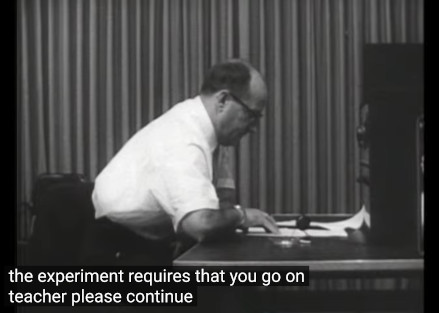
In the 1960s, psychologist Stanley Milgram set out to study the extent to which people’s blind obedience to perceived authority influences their behaviour. It was with this goal in mind that Milgram began his infamous study of obedience on August 7, 1961.
The results of those experiments, well-known to the public by now, ostensibly demonstrate that average, everyday people can be induced to deliver what they believe to be potentially lethal electric shocks to complete strangers based solely on the say-so of an authority figure. This finding is most commonly summarized with the factoid that a whopping 65% of participants in the original 40-person study were willing to deliver a 450-volt shock—what they were led to believe could be a potentially lethal shock—to an audibly distressed person based on nothing more than a prompt from a person in a lab coat wielding a clipboard.
As one of the most famous psychological studies of the 20th century, the Milgram experiments have generated no end of debate, controversy and scrutiny. The NPR-promoted critics of the experiments, who contend that most of the study’s participants knew that the entire situation was phoney and that they disobeyed even more often than was reported, are often pitted against the establishment psychologist defenders of the experiment, who correctly note that the experiments’ shocking (pun intended) conclusions have been independently reproduced time and time and time again in country after country around the world. (In one particularly twisted reproduction, the researchers even sought to ensure that no subject would suspect the experiment was fake by delivering real electric shocks to cute puppies.)
What almost everyone misses about the Milgram experiments, however, is that the study was not one experiment that was conducted on one set of 40 participants one time to yield one final result. In fact, Milgram conducted the experiment a total of 17 times with 17 separate cohorts of 40 to 60 test subjects, with each iteration of the study employing a number of experimental variations.
In one variation, he changed the site of the study from the Yale University campus to a rundown office building. In another variation, the test subjects were allowed to instruct an assistant to deliver the shocks instead of pressing the switch themselves. In still another variant, the lab coat-wearing actor playing the “experimenter” was called away on business and replaced by an ordinary man wearing a suit. And in yet another variation, the test subject was obliged to wait and watch another actors become the “teacher” and go through the experiment before assuming the role himself.
Each variation produced markedly different results. When the test subject could instruct someone else to deliver the shocks instead of doing it himself, for instance, the percentage of participants willing to deliver the maximum (supposedly potentially lethal) shock rose to an incredible 92.5%. When the experiment took place in an office building instead of on the Yale campus, the number willing to administer the maximum shock dropped to 48%. And when the test subject watched other people take the “teacher” role before them and observed them refusing to obey the experimenter’s command to deliver the shocks, that subject’s willingness to deliver the maximum shock plummeted to 10%.
Let me rephrase that for the hard of thinking. When the test subject saw someone disobey the experimenter, they themselves refused to proceed with the experiment 90% of the time.
This is the surprising conclusion that has been scrubbed from most accounts of the Milgram experiments: Disobedience, once modeled, becomes an option in the mind of the public.
This point is crucial to understand because, exactly as Étienne de La Boétie pointed out nearly 500 years ago, a small cadre of tyrants, no matter how psychopathically menacing, are incapable of administering a tyranny all by themselves. They require the active participation of a much larger number of obedient order-followers.
Indeed, it’s important to become conscious of the fact that none of the worst excesses of the pathocracy in recent times would have been possible without the active participation of vast swaths of the population. So-called vaccine “mandates” were not achieved by one psychopath in a position of political authority, or even by a gaggle of such pathocrats. They were enabled by the doctors who participated in the vaccination drives against their own experience, judgment, and training; the employers who imposed vaccine requirements on their employees; the business owners who implemented vaccine certificate checks on their premises; the police officers who threw the unvaccinated in quarantine facilities; the workers who kept those quarantine centers functioning; the judges and lawyers who rubber-stamped all these actions, etc.
The same goes for any number of pathocratic abuses that we’ve been subjected to in recent years. These programs can only be implemented when most of the people comply with their orders and thus fulfill their role in the operation.
Just as in the time of La Boétie, our enslavement to the pathocracy is, by and large, a voluntary servitude born of obedience.
Combining La Boétie’s insight with Milgram’s lesser-known experimental results, then, we find a template for toppling the pathocracy: highly visible acts of disobedience.
But is this true? Can a single act of disobedience really bring down a pathocracy?
Once again, we don’t have to speculate about this possibility in a vacuum. Thanks to the wonders of modern technology, we can actually watch a recording of such an event happening in real time.
On December 21, 1989, Romanian dictator Nicolae Ceaușescu took to Palace Square to address the Romanian people. At first, it proceeded like any number of such speeches he had delivered over the years. He talked about the successes of Romania’s socialist revolution and sang the praises of the “multi-laterally developed Socialist society” that had arisen under his brutal reign.
But then, something extraordinary happened. Someone booed. The boo was taken up by others and became a jeer. Chants of “Timișoara!” rippled through the crowd, a reference to a massacre of political dissidents by Ceaușescu’s security forces that had taken place just days earlier.
The dictator, unused to any sign of dissent from the population over whom he had ruled so brutally for decades, called for order. His wife demanded the crowd’s silence, prompting Ceaușescu to tell her to shut up, and then he attempted to continue with his speech. But the jeers began again.
The footage of the incident, including Ceaușescu’s look of utter confusion as he realizes that the crowd has turned against him and that the threat of violence is not enough to subdue them, is priceless. There, captured on tape for posterity, is the moment when the realization dawns on the tyrant that the people have rejected his tyranny. The rest of the story—the riots and unrest, the attempted escape of Ceaușescu and his wife, their capture by military defectors and their execution on Christmas Day—all stems from that precise moment when one person in the crowd simply voiced what the rest of the crowd was feeling.
This is the circuit-breaker effect. By saying no to illegitimate authority, resisting bullies and tyrants, disobeying immoral orders, refusing to comply with unjust mandates and demands, we make it that much easier for those around us to stand up for what they, too, know to be right.
But wait, it gets even better . . .
First, the good news: pathocracies are inherently unstable and they are doomed at some point to topple under their own weight.
Next, the even better news: if it’s true that psychopaths can fashion a psychopathic society that twists people into sociopaths, then the opposite is true, too. Healthy, non-pathological humans with love, empathy, and compassion can fashion a society that brings out the better side of human nature.
This is the real goal of the erstwhile victims of the pathocrats. Not to eliminate the political psychopaths and assume their positions of power in the psychopathic political system that they created, or even to abolish that system altogether, but to envision a world in which compassion, cooperation, love and empathy are not just encouraged but actively rewarded. A world in which every person is allowed to become their best possible self.
It’s up to each one of us to model what we want to see in the world. Just like the brave dissenter who can break the circuit of tyranny by voicing opposition to the tyrant, we can also become the models of love, understanding and compassion that will motivate others to become the same.
The psychopaths have spent centuries weaponizing psychology to more effectively control us. But we can wield our understanding of human nature for something good. And isn’t that what healthy, non-psychopathic individuals forming a healthy, non-psychopathic society would spend their time and resources doing?
The Dark History of Hormone and Puberty Blockers
Again and again, these drugs are pushed on defenseless patients because of how much money they make
A Midwestern Doctor | The Forgotten Side of Medicine | September 14, 2025
Story at a Glance:
• Puberty blockers used for transgender medicine belong to a class of drugs (GnRH agonists) which permanently block the production of sex hormones in the body. As hormones are essential for the body, GnRH agonists are amongst the most harmful drugs on the market.
• Originally approved (with grave reservations from the FDA) as a palliative treatment for severe prostate cancer, these drugs (e.g., Lupron) have rapidly proliferated into a wide range of areas in medicine, including routine prostate cancer, a myriad of female issues (e.g., endometriosis) and all sorts of experimental uses on children (e.g., making them taller).
• This proliferation was due to manufacturers pricing the drugs to generate enormous profits for themselves and doctors (in many cases constituting most of urology practices’ revenues)—likely why most urologists, when surveyed, admitted prescribing Lupron despite not believing it worked.
• These drugs rapidly age the body, causing permanent and crippling side effects, including severe bone loss, pain, soft tissue damage, severe pain hormonal disruption, sexual dysfunction, psychiatric issues, cognitive impairment, cancer risks, and cardiovascular and gastrointestinal disorders.
• Their use in transgender children to block puberty stems from an unproven theory that it ultimately leads to a more satisfying gender transition in adulthood. However, while aggressively advocating for them and publicly claiming these drugs are safe, effective, and reversible, in private, the group authoring the medical guidelines have admitted they have no idea what they are doing and know there are serious safety issues with the drugs.
• This article will expose the hidden truths about hormone blockers, the forgotten generations whose lives were ruined by them, and extensive documentation showing how dangerous these ‘safe and effective’ drugs are.
Transgenderism has rapidly become one of the most contentious political issues in our country and due to its rapid rise, a variety of theories have been put forward to explain where it emerged from. Remarkably, I almost never see what I believe to be one of the most important facets of the topic discussed—the immense dangers of hormonal blockers routinely used in this field or the appalling history of these drugs and how again and again, they’ve been thrust into new markets they had no place ever being used in because of how profitable they are.
As such, when laws are periodically passed banning their use in children (which has now happened in many Red States), I rarely see the actual dangers of these drugs discussed, and when I’ve spoken to left-wing colleagues (including pediatricians) opposing these laws about the topic, most are genuinely unaware the drugs have negative side effects. Because of this, I believe it is vital to expose the actual truth behind these drugs.
How Hormonal Blockers Work
There are a variety of ways you can block the production of hormones in the body. Since the signal to produce sex hormones (e.g., estrogen and testosterone) begins in the brain, cutting that signal off mostly eliminates the body’s production of hormones. The most powerful hormonal blockers, the GnRH agonists, work by overstimulating the brain’s GnRH receptors so that they becomes “burned out” and no longer respond to the natural release of GnRH in the body, thereby short-circuiting the body’s production of sex hormones (which in many cases is a permanent short circuit).
A variety of different GnRH over-activators are sold, such as Decapeptyl (Triptorelin), Lupron (Leuprorelin), Suprefact (Buserelin), Synarel (Nafarelin), Zoladex (Goserelin). Since Lupron is the most commonly used one, henceforth, I will only discuss it, but much of what I will say about Lupron also applies to the others as well.
Note: there are also numerous similar drugs which instead temporarily shut down hormone production by directly blocking the GnRH receptor (e.g., Orilissa). Additionally, there are other GnRH over-activators which are only used in animals and have similar side effects to those observed in humans.
Since testosterone fuels the growth of prostate cancer, there was a lot of research on cutting of the body’s testosterone to treat it. Initially the most promising approach was to counteract testosterone with an estrogen analog (DES) which was eventually pulled from the market because it caused a wide variety of issues (e.g., heart attacks, female cancers, and a variety of severe problems in the children of mothers who took DES—which has led many to argue the COVID-19 vaccines may become “the new DES”).
Since Lupron, by burning out GnRH receptors, chemically castrates males (and thereby eliminates their testosterone), a 1984 study was conducted comparing the use of DES to Lupron for patients with prostate cancer which had metastasized to the bones and was hence likely to be fatal. It found Lupron slightly increased their survival rate (although half still were dead within two years of starting the therapy) and it had a slightly different mix of severe symptoms when compared to DES, which in turn was used to argue it was a viable alternative to DES.
When the FDA reviewed this study, the reviewers noted the study had a variety of serious issues so it was difficult to draw any firm conclusions from it. As a result (despite the FDA knowing Lupron had real longterm risks that had not been investigated and other critical aspects of the drug like how the body metabolizes it remaining unknown to this day), Lupron was approved in 1985 as a “palliative treatment of advanced prostate cancer,” a situation which is frequently so debilitating and painful for cancer patients, anything which could potentially somewhat improve it is viewed as justified.
Note: six months ago, Scott Adams, who had advanced prostate cancer, shocked the online community by saying the torture of it had made him decide upon committing suicide in a few months after an important life event had passed—providing a clear example of how dire “advanced prostate cancer” can be.
Since that time, Lupron’s approval was never updated. For those interested, a detailed explanation of why that approval was overtly fraudulent and unwarranted can be found here.
Note: in addition to Lupron offering a very small survival benefit, a strong case can be made that since it is frequently observed to cause a variety of severe complications (e.g., a large increase in fatal heart attacks or diabetes), its reduction in the prostate cancer death rate is actually an artifact of it killing the patients in another manner before a slow growing prostate cancer would. This perspective for example was shared by the Vice President and Chief Scientific Officer of the American Cancer Society.
Once Lupron was approved, its use transitioned from only the most severe prostate cancers to all of them (even though, as shown by a 2009 study of 19,271 men, using Lupron actually increased the death rate). At the same time, a variety of other copycat drugs entered the market. The FDA in turn approved them (or Lupron) for advanced prostate cancer, advanced breast cancer, endometriois (along with its pretreatment prior to surgery), the pretreatment of fibroids before surgery, and preventing precocious (early) puberty.
Note: while I believe the risks of these treatments greatly exceed their benefits, it is also true that a subset of patients exist with those conditions who benefit from Lupron and suffered minimal side effects from the drug.
Additionally, a variety of other off-label uses were concocted, such as:
• “Treating” every imaginable gynecological problem (e.g., large fibroids, difficult menstrual cycles, ovarian cysts).
• In-vitro-fertilization and egg donation protocols.
Note: many young women are paid thousands of dollars to donate their eggs. Unfortunately, a portion of those donors suffer significant complications they are not warned about beforehand and then are left on their own to address. This is likely in part due to the fact Lupron is frequently part of the protocol. Likewise, significant birth defects (which Lupron has been shown to cause in the majority of pregnancies) are frequently reported following IVF—which may explain why despite Lupron being originally patented as a fertility medicine, it could never be formally approved for that use.
• Chemical castration for sex offenders (e.g., pedophiles).
• Helping children become taller (by delaying puberty so their growth plates take longer to close).
• Preventing puberty in a transgendered youth
Note: a more detailed list of the off-label uses can be found here. It is truly remarkable how many different tactics were used to seed these additional uses (e.g., bribing countless doctors and medical charities to promote these drugs) and likewise how many other uses (e.g., for Alzheimer’s disease and Autism) came very close to becoming off-label uses as well.
In turn, there are three important things to take away from all of this.
1. While these drugs were initially developed for men (i.e., prostate cancer), they are frequently given off-label to women. This for example is why Lupron’s FDA insert states its only indication is for the palliative treatment of advanced prostate cancer but it simultaneously warns against pregnant women taking it (even though it’s also used for egg harvesting)
2. Despite having been on the market for decades, there is very little evidence to show these drugs actually benefit those who take them.
3. Given this, along with how incredibly toxic they are (especially to women), it raises a fairly simple question—why on earth are these drugs so popular?
Selling Lupron
Lupron’s manufacturer was stuck with a rather large challenge—how could they got doctors to begin prescribing an incredibly dangerous and ineffective drug? This in turn was accomplished through one of the most overt acts of physician bribery I’ve seen in American medicine.
Since Lupron initially did not sell well, Lupron’s manufacturer took advantage of the existing “standard” which allows chemotherapy drugs to be sold for a very high price and be “forgiven” for their extreme toxicity. This was done by reformulating Lupron into a long acting monthly shot urologists could directly administer to their (prostate cancer) patients and hence directly profit from marking up when they resold it (e.g., Medicare paid 1200 dollars per shot—or roughly 2400 in today’s dollars, and in many cases urologists charged far more, all of which allowed many urologists to make hundreds of thousands of dollars per year administering the shots).
Note: TAP frequently advertised to urologists they could make over $100,000 annually selling Lupron and later cited similar figures to OBGYNs.
To further sweeten the deal, Lupron’s manufacturer frequently bribed urologists and gave them free Lupron samples they “resold.” This was illegal—and eventually resulted in a 875 million dollar fine… but no pharmaceutical executives going to prison.
Because Lupron was immensely profitable, more and more urologists jumped on it, and by the late 1990s Lupron treatments were costing almost a billion dollars per year and accounted for 40 percent of all Medicare payments to many urology practices in the late 1990s. To address this, in 2001, Medicare clamped down on urologists reselling discounted Lupron and in 2003 Medicare lowered the reimbursement for Lupron. In turn from 2003-2005, the rate of inappropriate use of hormonal treatment for prostate cancer dropped from 38.7% to 25.7% and many urologists at the time reported their income had been halved.
Note: one survey found 53% of the urologists who did not believe prescribing Lupron benefitted certain prostate cancer patients still prescribed the drug to them.
This Medicare crackdown on excessive Lupron prescribing for prostate cancer created a major problem for the industry. “Fortunately,” since Lupron was so profitable, many other specialities appeared eager to jump on the Lupron bandwagon, particularly OBGYNs (despite the existing data on using Lupron for gynecological conditions being very poor and in many cases overtly fraudulent). This in turn led to a rapid proliferation of new off-label “uses” for the drug, such as the ones listed above. Remarkably, despite the fact Lupron has been on the market for decades, it is still extremely expensive.
Lupron hence is a very lucrative drug. However it is unclear to me exactly what the current reimbursement is for it (e.g., when I’ve looked online, many patients said they were billed over 10,000 dollars for a single injection).
A recent article exploring the subject found that puberty blockers can cost tens of thousand dollars per year. While insurance typically covers these drugs around 72% of the time, without insurance, according to one source, they cost $4,000–$25,000 per year and according to another source a 3 month Lupron injection is $9500 while a competing 3 month option (histrelin) is $39,000.
Similarly, a 2022 NPR article detailing a man’s prostate cancer experience (where he was given unwarranted Lupron shots) reports he was charged $35,414 for the first shot and $38,398 for the second by a Chicago “non-profit” hospital, and after two years of haggling, was forced to pay the $7,000 not covered by his health insurance.
Let’s compare that to how much Lupron costs (this table designates the average wholesale price pharmacies pay for drugs):

Note: these costs are unusual as they are much higher than what pharmacies typically pay for a drug (especially an older one). The above table is from 2023, and just a year later in 2024, the cost of Lupron went up almost 10%.
Since all of this demonstrates that Lupron is marked up by 5-10 times its original cost when it is resold to patients, I would argue that those who provide these medications may have an ulterior motive in giving them to patients which frequently causes the drugs to be inappropriately prescribed.
Note: one of the most common stories I hear reported from Lupron victims is a tendency for doctors to gaslight them and insist their myriad of health problems could not have come from Lupron, hence making one of their greatest challenges be finding a doctor who can actually help them (or say qualify them for disability since they’ve lost the ability to work). I believe this is partly due to the unusual nature of their injuries and because many doctors have a direct personal investment in believing Lupron is safe and effective (as they aggressively pushed it on their patients—for instance many reported the doctor saying “are you brave enough to try Lupron?”).
Lupron Lawsuits
A curious reality exists with these drugs. To quote Wikipedia:
GnRH analogues [e.g., Lupron] are available as generic medications. Despite this, they continue to be very expensive.
This I attribute both to doctors being heavily incentivized to directly sell these drugs to their patients (rather than cheaper ones made by competitors) and the legal costs associated with producing them.
Since Lupron is so toxic, it had a very high rate of users who were severely and permanently incapacitated by the medication, and hence were willing to go through the arduous process of going to court over it. Since it often took years for the most severe injuries to emerge, this both allowed Lupron’s manufacturer to have the money in place to fight each lawsuit and simultaneously to argue that each injury could not have been related to Lupron. Furthermore, since the legal risk of manufacturing Lupron was so high, I suspect that it scared many competitors away from entering the market as there was a significant barrier towards having enough sales to be able to afford to squash each lawsuit which came along.
In turn, numerous lawsuits have been filed against Lupron’s manufacturer and the doctors who prescribed it, but while some were settled out of court, none to my knowledge were successful, which is extraordinary given that many of the cases revolved about Lupron being used for an experimental (unapproved) use, it causing clear harm to the patient, and it being inappropriately dosed or monitored by the physician (who instead just wanted to give the highly lucrative single injections).
The general sense I have gotten from talking to people injured by Lupron is that they believe Lupron’s manufacturer spent so much on legal defense (e.g., by paying off judges, having the best lawyers or buying gag orders in settlements) that it’s a lost cause to file a Lupron lawsuit regardless of how severe one’s injuries were. In turn, many people have shared that they have been unable to find attorneys who are willing take their case.
Note: one of the things we all found remarkable during COVID-19 was how differently the use of “off-label” prescriptions was treated by our authorities. Despite no injuries occurring, nor any money being made, many of the doctors who saved many lives by prescribing ivermectin or hydroxycholorquine were accused of exploiting their patients and faced harsh penalties for their prescriptions (e.g., Meryl Nass lost her medical license).
Lupron Toxicity
I have had a longtime interest in understanding how pharmaceuticals injure people, so I frequently spend lots of time reading through support groups for people who have been injured by them. From this exploration, I have come to the perspective Lupron is one of the most dangerous drugs on the market due to the sheer volume of injuries patients report, how severe the injuries are and just how much many of them are suffering (e.g., many of these reports are comparable both in their severity and variability to COVID vaccine injuries).
Note: in the late 1990s, a lot of public pressure was building against Lupron, and one group, the National Lupron Victims Network came to prominence as a hub for collecting the evidence of Lupron’s harm and advocating against its continued use. Remarkably, in 2000, shortly before the group was supposed to publish all the data it had collected from surveys on the harms of Lupron, without explanation, it suddenly disappeared. This again illustrates just how far Lupron’s manufacturer went to protect their drug.
Within the Lupron support groups, I find by far the most commonly injured are women. This is followed by individuals who took the drugs to halt a premature puberty, then men, and finally transgendered individuals (as they are a relatively new market).
Note: many of the people who took the drugs during puberty are now having adverse effects decades later (e.g., as discussed in this Kaiser Foundation article). This had led me to suspect the same thing will be “discovered” in the years to come for the transgendered children our society has recently started putting on puberty blockers. Remarkably, a 2009 specialist review of using drugs like Lupron for early puberty or making children taller found “few controlled prospective studies have been performed… and [like now], many conclusions rely in part on collective expert opinion.”
Some of the most commonly reported side effects of Lupron include:
• Numerous studies have found Lupron given at all ages significantly decreases bone density (e.g., many have reported between a 3-10% loss occurring after just 6 months) which often results in fractures (e.g., see this study). Bone loss, in turn, is one of the most commonly reported side effects of Lupron (e.g., many young women report having “bones like an 80 year old,” chronic dental or jaw issues like teeth cracking apart and repeatedly developing unexpected fractures from minor stressors). While this bone loss is often rapid, in many cases, it emerges years after receiving Lupron (e.g., women who went on it during puberty in their 30s learn about it because of how quickly the teeth in their mouth are decaying and being told they are not that far from needing dentures).
• Longterm or permanent damage to female menstrual cycles. For example, Lupron’s clinical trials (revealed through ligation) showed that 62.5% of study subjects had failed to return to baseline ovarian function one year after stopping Lupron (which means, contrary to the manufacturer’s claim, the drugs is not reversible once it is stopped). Many other hormonal issues are also frequently reported (e.g., permanent weight gain, painful and abnormal menses, severe hot flashes and vaginal atrophy)
Note: enlarged ovaries and ovarian pain is a commonly reported symptom of Lupron usage (particularly after egg donation protocols) and there is some data which suggests Lupron causes polycystic ovarian syndrome.
• Sexual dysfunction is commonly reported. For example, one study found 80% of males using these drugs reported being impotent, while another found a 267% increase in impotence was observed after one year of treatment, and another evaluation of a related drug found sexual desire, sexual interest and sexual intercourse were totally annulled. Likewise, chronic pelvic pain (in women), a wide range of chronic bladder issues (e.g., incontinence, bladder spasms, urinary retention, or recurrent UTIs), and testicular pain or atrophy.
Note: these sexual side effect are particularly noteworthy given that in many cases, prostate cancer patients are put onto Lupron for years.
• A variety of psychiatric conditions commonly follow Lupron usage (e.g., a 2002 study of more than 3,000 women on it found 35.5% reported depression). Some of the effects I commonly see reported include anxiety, severe mood fluctuations, major dysphoria, burning rage, suicidality (which sometimes requires being placed on a suicide watch), and losing the ability to function in social situations.
Note: particularly in transgender or precocious puberty groups, users report a profound loss of identity or personality changes, feeling “like a stranger in my own body” due to hormonal suppression. Likewise, many users report frequently describe social withdrawal, inability to maintain relationships, or marital strain due to Lupron’s emotional and physical toll (e.g., “Lupron killed my marriage; I wasn’t myself). Finally, many users report losing their jobs and financial stability due to being disabled by Lupron.
• Cognitive dysfunction (e.g., brain fog or memory loss) is also frequently reported. One study found evaluating women receiving IVF found 72% showed difficulty with memory while on Lupron, some subjects had significant cognitive deficits, and 11% showed very substantial neurocognitive issues.
• Online, children and young women treated with Lupron often report seizures or convulsions, tinnitus (and other hearing issues), visual disturbances (e.g., floaters, blurred vision, or photophobia). Hormonal issues besides those with the sex hormones are also frequently reported such as thyroid issues (e.g., hypothyroidism and goiter), adrenal issues (e.g., extreme fatigue, salt cravings, or low cortisol) and diabetes or glucose dysregulation. In many cases, these onset immediately after starting Lupron (with no prior signs of them) and are then permanent.
• IQ loss in children (e.g., one study found a 7 point drop, while another found an 8 point drop).
• Lupron (and related therapies) are associated with a variety of different heart conditions, as Lupron (when used for prostate cancer), according to one paper, appears caused a 10–50% increase in the risks of coronary heart disease, myocardial infarction, strokes and sudden cardiac death (e.g., this study the paper referenced shows a massive increase in heart attacks). Many other concerning heart conditions have also been linked to Lupron and numerous medical textbooks explicitly warn about them. The FDA in turn eventually issued a warning in 2010 about this increase risk of heart problems (and diabetes) in men and acknowledged that no research existed to assess those risks in women or children.
• A wide range of gastrointestinal disorders (e.g. severe abdominal pain, irritable bowel syndrome, or growths that require excisions) and genitourinary (e.g., frequent urination, incontinence and interstitial cystitis) are frequently reported. Many of these likely result from Lupron disrupting the autonomic nervous system and it cutting off blood flow to tissues of the body, which for example is why it shrinks fibroids.
Note: originally, the FDA was extremely concerned about the potential harm which could result from Lupron cutting off the blood flow to critical organs.
• Many Lupron patients report crippling joint pain and severe (early) arthritis. For example, a study of more than 3000 women found that 76.7% reported joint pain. Likewise, severe pain throughout the body, tendon issues (e.g., tendinitis, severe pain in the tendon, or tendon ruptures), muscle wasting or pain and degenerative disc disease is often reported in support forums.
Note: many of these symptoms overlap with what’s commonly reported by patients with ligamentous laxity (e.g., they are hypermobile and have frequently cracking joints). I recently wrote an article detailing how hypermobility is a common characteristic of sensitive patients and its common association with manganese deficiency.
• Immune suppression (e.g., within the bone marrow) and a wide range of severe autoimmune conditions (e.g., Sjogren’s, lupus and various thyroid conditions) are frequently reported by Lupron patients. Chronic skin conditions (eczema, psoriasis, or chronic rashes) not responsive to treatment and significant hair loss are also reported. Finally, other more severe immune-related side effects such as unusual tumors developing (or rapid growth of an existing one), anaphylaxis are also reported (along with other organ dysfunctions like elevated liver numbers).
What should jump out from this list is how frequent, severe, and wide-reaching these injuries are. This in turn helps to explain why the FDA’s system for reporting drug injuries (which catches 1-10% of those which occur) has received 76,221 Lupron injury reports, of which 41,895 were severe and 11,917 were fatal. Likewise, consider how frequently a myriad of conditions occurred when Lupron was tested in men who had prostate cancer (per Lupron’s FDA package insert):
Anemia (6.6%), Asthenia (7.4-12.2%), Back Pain (5.3%), Blood in Urine (6.6%), Constipation (9.9%), COPD (5.3%), Coronary Heart Disease/Angina (5.3%) Cough (6.6%), Dehydration (8.2%), Dizziness/Vertigo (5.3-6.4%) Edema (5.3-8.2%) Elevated Blood Pressure (6.6%) Fatigue (13.2%) Flu Syndrome (12.2%) General Pain (23.2-32.7%) GI disorders (10.2-16%), Headache (6.4-10.2%), Hot flashes/sweats (46.9-58.9%) Impotence (5.4%), Infection (5.4%), Injection Site Reaction (8.2-19.2%) Insomnia/Sleep Disorder (8.6%), Insomnia/Sleep Disorders (8.5%) Joint Disorders (11.7-16.3%) Joint Pain (9.3%) Libido decreased (5.4%) Muscle Pain (7.9-8.2%) Neuromuscular Disorders (6.1-9.6%) New Cancer (7.3%) Pain While Urinating (6%) Paresthesia (8.2%) Rash (6.6%), Respiratory disorder (6.4-10.7%) Shortness of Breath (5.3%) Skin Reactions (8.5-12.2%) Testicular atrophy (5.4-20.2%) Urinary disorder (12.2-14.9%) Urinary Tract Infection (6%).
Likewise, this is what the FDA reports occurred when Lupron was tested on women for endometriosis:
Acne 10%, Altered Bowel Function (constipation, diarrhea) 14%, Asthenia 8-18%, Breast Changes/Pain/Tenderness 6%, Breast changes/tenderness/pain 6%, Decreased libido 10-11%, Depression/emotional lability 11-31%, Dizziness/Vertigo 11-16%, Edema 5-7%, General pain 8-24%, GI disturbances 7%, Headache 26-65%, Hot flashes/sweats 73-98%, Insomnia/Sleep Disorder 31%, Joint disorder 8%, Memory Disorder 6%, Nausea/vomiting 5-25%, Nervousness/Anxiety 5-8%, Neuromuscular disorders 7%, Paresthesias 7%, Skin reactions 10%, Vaginitis 11-28%, Weight gain/loss 12-13%
Unfortunately, while the above list is terrible (particularly given that the “benefit” of the Lupron in both cases was minimal at best), it should be noted that:
• Pharmaceutical companies always conceal adverse events which occur in their trials.
• This list only includes conditions more than 5% of trial recipients developed while on the drug. In turn, a variety of rarer but much more severe conditions did not make this list.
• This list was not evaluating the long-term effects of Lupron (which are typically the most severe).
Because of how toxic Lupron is, by far the most challenging part of this article was accurately synopsizing the thousands of injury reports I’ve read over the years (as I felt their heart wrenching stories deserved to be heard but simultaneously, there are just far too many for me to fit into any number of articles here).
Generally speaking, Lupron (like the COVID vaccines) causes the body to age prematurely—which in the case of Lupron provides an important insight on the importance of hormones as these victims provide a unique insight into what happens as the body loses those essential messengers (something which also occurs with age). This why in addition to profound bone loss, Lupron also frequently causes other degenerative processes like hairloss, vaginal atrophy, receding gums, and declining vision.
For each of those symptoms (and many others), I’ve read countless testimonials describing the anguish of having their body rapidly age in front of their eyes and the general despair that accompanies decades of suffering with these ailments and the fact there is no one who will help them.
Additinally, one of the most common stories I hear in the support groups are women who profoundly regret taking it for endometriosis as beyond it permanently debilitating them, it frequently did not help (or worsened) their endometriosis.
Note: endometriosis is another condition which is poorly treated by the medical system. Typically the best option within the conventional paradigm is to have it be surgically removed, but unfortunately, there a very few surgeons competent surgeons who do this (e.g., the person we use is an 8 hour drive away from us) and there is also a surprising lack of knowledge within the OBGYN field of how to appropriately manage endometriosis.
Like the COVID vaccine injured, many of those injured by Lupron report not a few, but rather dozens of debilitating symptom. Furthermore, there is often a significant overlap in these symptoms (e.g., both frequently experience fibromyalgia, severe neuropathies, chronic fatigue, headaches, insomnia migraines, hypersensitivities to everything, seizures, and lightheadedness or fainting).
Lupron Stories
Since there are so many reports of people being harmed by Lupron, it’s impossible for me to ever do justice to their experiences in a brief article. As such, I will simply quote ten of them with the caveat they are only the tip of the iceberg.
Within 2 weeks of starting Lupron therapy [for endometriosis], I was walking with sticks due to the pain in my hips and ankles. I stopped eating. My skin was dry, flaking and itchy. I had no short term memory & my concentration got so bad I couldn’t safely drive. I didn’t sleep a wink for months. I was so depressed that I stayed in bed for days at a time.
I’m a calm, sane person. I’m not kidding, that sh*t made me feel insane [taken following endometriosis surgery]. A horrible emotional roller coaster. If I had to do it over again, I’d have just had the hysterectomy.
Anyone else have terrible mood changes with Lupron [for IVF]… My mood is all over the place… I hated lupron. I had terrible headaches and severe joint pain. Just felt crummy all around.
The side effects from my lupron injection [for prostate cancer] is awful compared to my radiation treatment… frequent urination, bowel discomfort, and a rash… but the Lupron is making me feel like I’m hit by a bus!! Chills, fever, runs, aching body, emotional.
I had a terrible time with Lupron when I used it as endo treatment ten years ago: hot flashes, night sweats, weird hairs growing everywhere, headaches, mood issues… I ended up only doing five of the six months because I felt so badly.
Lupron for me stopped the endo pain… But yeah, it replaced it with severe joint pain, hot flashes, weight gain and mood swings… I’ve since had a hysterectomy and am going through all of that again from real menopause.
I had lupron shots as part of my IVF protocol. I don’t exactly regret it… but I wish there had been another way… it caused the worst fibromyalgia flare of my life! I ended up in the ER and couldn’t walk for a few weeks. I’ve never experienced so much pain in my life.
The side effects were PROFOUND and BRUTAL [was taken for breast cancer]… Giving Lupron to a healthy minor? It should be criminal.
Lupron depot horror... I’m official a year out from my 3 month use… it’s given horrible life long side effects and other health conditions… It’s horrible!! It does not help shrink endo growths… wrecked havoc on my health.
I took Lupron, the original puberty blocker, for endometriosis. Before Lupron I only had endometriosis. After Lupron I have bone death in both hips, brittle bones that break easy, multiple fractures in feet, hypothyroidism, and a non cancerous pituitary tumor.
So, as you might expect, individuals who took them as children did not have the best experiences either:
As a parent of a child who went through precocious puberty and was given puberty blockers (Lupron), I watched my healthy mentally stable son fall into severe depression, multiple suicide hotline contacts including a visit from emergency services. Self harm scars and self isolation. He began to question his sexuality and gained excessive weight. All before 12
My son had one Lupron shot for precocious puberty at age 4—the side effects were horrible: aggression, pain, and now years later, we’re seeing bone density issues and growth problems. It’s a nightmare we regret starting.
My daughter took Lupron for precocious puberty starting at age 7. Now at 25, she has degenerative discs in her spine, chronic joint pain, and hypothyroidism. We thought it would help her grow taller, but it’s caused lifelong hell—no one warned us about the bone death and fractures.
Valerie Ward, 25, who lives outside of Pittsburgh, said she took Lupron for precocious puberty, from age 9 to 12. Like Derricott, Ward said she sees a carousel of medical specialists for excruciating muscle and bone pain, depression, weakness and fatigue.
Put on Lupron at 10 for precocious puberty to ‘buy time for height,’ but it worked too well—stopped puberty entirely, then I needed growth hormone shots for years. Now 30, flat-chested with endo and weak bones; wish we’d never done it.
I was given Lupron as a child for precocious puberty. Now in my 30s, my bones are like an 80-year-old’s—brittle, fracturing from nothing, teeth crumbling. Doctors said it was safe, but it’s ruined my life [this is a paraphrase summary of many posts by this user].
My son was put on Lupron at 9 and we were NOT told bone damage was a potential side effect. Today, at 24 he has severe osteoporosis and the bones of a 75 year old!! Even this was discovered by happenstance. Trying to get help with this condition has been nearly impossible.
I was on Lupron for a 9 months in 1995, fast-forward 30 years I now have full blown osteoporosis from the lupron! I break bones every other week! No child should be taking any of it, I don’t have a problem when you’re an adult and you know the consequences but children no!”
WPATH’s Transgender “Guidelines”
Evidence based medicine was created so that harmful and irrational dogmas within the medical field could be overturned by scientific evidence proving there was no justification for doing them. While this was initially helpful, the process gradually became corrupted as the pharmaceutical industry realized doctors could be made to believe only the “best” evidence should be trusted, and the groups purveying the “best” available evidence (e.g., the premier medical journals) could be easily bought out.
A key part of the push to buy out the “best” evidence has been to create authoritative guideline committees who are tasked with evaluating the existing scientific evidence and coming to a consensus over what constitutes the best practice of medicine—a process which is fairly easy to corrupt since the industry can simply pay off each member of the “expert” committee.
This for example is why Anthony Fauci was allowed to appoint the members of the government committee which decided the standard of care for COVID-19 and Fauci chose individuals who were both his friends and had significant financial ties to his pet drug Remdesivir. In turn, that committee concluded only the extremely expensive COVID-19 treatments (e.g., remdesivir—which was repeatedly shown to worsen rather than improve COVID-19) should be used to treat COVID-19, whereas the safe and effective (but non-commercializable) therapies (e.g., ivermectin) were never allowed into the treatment guidelines despite dozens of trials from around the world proving they worked.
Note: corrupt committees are a recurring problem. For example, the government committee which created the statin usage guidelines we all follow that erroneously concluded everyone needed to be on the statins was filled with people taking money from the statin industry.
In the field of transgendered medicine, much of what is being done is a result of physicians following the existing guidelines that have been created by the World Professional Association for Transgender Health (WPATH). For this article, I reviewed exactly what their guidelines had to say about giving puberty blockers (GnRH analogs) like Lupron to children.
First, they strongly endorsed administering these drugs:
• The moment transgender children begin the earliest signs of puberty as this provides a greater benefit that administering them later on.
• As a stopgap measure for children who have mostly gone through puberty and are considering starting opposite sex hormones but are not yet sure they wish to begin hormone therapy (e.g., due to a disagreement with their parents over doing it).
• For adolescents who are distressed by their body’s menstrual cycles (since the blockers stop menstruation) or penile erections since Lupron suppresses both of them. This is similar to how the guidelines emphatically cite the benefit of these drugs creating “a vast reduction in the level of distress stemming from physical changes that occur when endogenous puberty begins.”
• To help males hoping to achieve a female’s hormone levels do so (as Lupron and its ilk suppress testosterone).
Note: they also acknowledge there are other “individualized” circumstances where someone who has completed puberty may benefit from these drugs.
Second, they advise against using them when:
• The child and their family cannot attain or afford them (in which case specific hormones like progestins are instead used).
• Prior to the earliest signs of puberty. This is because it can potentially interrupt a critical part of their psychological sexual development (however, this logic only applies to very start of puberty and not the rest of it). They do however advise regularly monitoring these children to detect when they start puberty so the blockers can be immediately initiated and provide for a few exceptions where the drugs can be administered prior to the start of puberty.
Third, while repeatedly claiming these drugs are safe and their effects are rapidly reversible, they do lightly acknowledge a few issues might exist.
Note: feel free to skim this section—I wrote it because I felt it was important to accurately depict every single “warning” WPATH provided against these drugs.
General:
- “[The use of puberty blockers] is generally safe with the development of hypertension being the only short-term adverse event reported in the literature.”
Bones:
- “While GnRH analogs have been shown to be safe when used for the treatment of precocious puberty, there are concerns delaying exposure to sex hormones (endogenous or exogenous) at a time of peak bone mineralization may lead to decreased bone mineral density. The potential decrease in bone mineral density as well as the clinical significance of any decrease requires continued study.”
- “For adolescents older than 14 years, there are currently no data to inform HCPs whether GnRHas can be administered as monotherapy (and for what duration) without posing a significant risk to skeletal health.
- “The rate of bone mineralization, which decreases during treatment with GnRHa’s, rapidly recovers.”
- “Based on scientific evidence currently available examining the use of GnRH agonists in transgender adolescents, it is unclear whether or not using puberty blockers in adolescence will increase the risk for future fractures in transgender adults.”
- “[They] can result in osteoporosis if doses of estrogen given concurrently are insufficient.”
- “A prolonged hypogonadal state in adolescence…due to..iatrogenic causes such as GnRHa monotherapy..is often associated with an increased risk of poor bone health later in life. However, bone mass accrual is a multifactorial process that involves a complex interplay between endocrine, genetic, and lifestyle factors [so] all contributing factors should be considered [and] a multidisciplinary team and an ongoing clinical relationship with the adolescent and the family should be maintained when initiating GnRHa treatment.”
Fertility:
- They “may also result in menstrual suppression.”
- “GnRHas may also be used for menstrual suppression. GnRHas impact the maturation of gametes but do not cause permanent damage to gonadal function. Thus, if GnRHas are discontinued, oocyte maturation would be expected to resume.”
- “GnRHas inhibit spermatogenesis. Data suggest discontinuation of treatment results in a re-initiation of spermatogenesis, although this may take at least 3 months and most likely longer.”
- “Pubertal suppression and hormone treatment with sex steroid hormones may have potential adverse effects on a person’s future fertility [thus] the potential implications of the treatment and fertility preservation options should be reviewed by the hormone prescriber and discussed with the person seeking these therapies.”
Adversely impacting a gender transition:
- The potential negative psychosocial implications of not initiating puberty with peers may place additional stress on gender diverse youth, although this has not been explicitly studied.”
- “Treating an TGD adolescent with functioning testes in the early stages of puberty with a GnRHa not only pauses maturation of germ cells but will also maintains the penis in a prepubertal size. This will likely impact surgical considerations if that person eventually undergoes a penile-inversion vaginoplasty as there will be less penile tissue to work with. In these cases, there is an increased likelihood a vaginoplasty will require a more complex surgical procedure, e.g., intestinal vaginoplasty.”
Hopefully, as the previous section showed, WPATH’s depictions of the dangers of these drugs (Lupron etc.) is highly misleading as a large body of evidence exists which overtly contradicts what WPATH put forward. Given that I was able to compile that evidence in under a week, it is surprising a team of “experts” who have spent years working to produce these guidelines were unaware that literature (and likely much more) existed. In turn, because doctors are trained to trust guidelines, they assume that since WPATH said puberty blockers are “safe and effective” they indeed are, hence leading to them aggressively pushing them on patients and gaslighting anyone who reports side effects from them.
Furthermore, the thing I found the most remarkable about WPATH’s guidelines was that while they were unaware of the dangers of Lupron (and its related drugs), they repeatedly referenced certain dangers of giving specific hormones, and in numerous cases characterized the Lupron as safe and effective alternative to the more dangerous hormone therapy. I in turn suspected this is because the blockers cost far more than artificial hormones, and once administered, often require the lifelong purchase of artificial hormones (e.g., to prevent some of bone loss and to make up for the body no longer producing its natural hormones).
All of this led me to believe that like many before them, those involved in writing these guidelines (and some of the authors they referenced) were paid off to promote Lupron and its ilk, but as I have not had the time to do the investigation to confirm this, I can’t state it with certainty.
The WPATH Leaks
Since WPATH has continually publicly advocated for transgender care to be made available to everyone that organization has received increasing scrutiny from the public.
Recently, this resulted in internal documents and correspondences from WPATH being leaked. I reviewed those leaks to see exactly what WPATH’s members were saying in private about puberty blockers. From reviewing all of it, I learned that much like each other group which has promoted the off-label usage of Lupron, WPATH was:
• Not entirely sure what the long-term consequences of this push for those drugs was and in essence, much of what they were doing was a large experiment.
• Recognized that a variety of significant side effects would occur in children who took the blockers (e.g., some would permanently lose their libido or the ability to have an orgasm and many children would lose the necessary emotional developmental process that occurs during puberty).
• Despite continually claiming otherwise publicly, they knew the effects of Lupron were often not reversible.
• Recognized that the children they were giving the blockers to were too young to fully comprehend the dangers of these drugs but nonetheless were seeking to initiate their use as early as possible.
It’s relevant at this point to note that the puberty suppression experiment began because transgender adult males were dissatisfied with the results of their medical transition because they did not “pass” well as women due to a “never disappearing masculine appearance.” Therefore, the Dutch researchers came up with the idea to use gonadotropin-releasing hormone agonists (GnRHa) to block the testosterone surge of male puberty in the hopes of achieving more feminine appearances in adulthood. The increased risk of false positives due to early intervention was noted, but the cosmetic advantages to adult natal males who identify as women were deemed more important.
Note: WPATH members also routinely discussed puberty blockers being administered to developmentally delayed children (e.g., those with autism), who due to their conditions had an even greater inability to consent to these drugs. This dovetails into another uncomfortable fact rarely discussed in the transgender debate—vaccination significantly increases the likelihood of transgenderism, most likely because autistic individuals are receptive to messaging which tells them the disconnect they feel with their body and society is not due to vaccine brain damage but rather tothem being the wrong gender—all of which I detailed extensively here.
Given all the things I’ve seen the pharmaceutical industry repeatedly do to make money during my lifetime, very few things surprise me these days. Nonetheless, even I was a bit taken aback when I discovered through these documents that there has been a push to affirm “plural identities” (multiple personalities) within WPATH. In turn, there are numerous cases which have been presented at WPATH conferences (e.g., under the umbrella of UCSF—one of America’s premier medical institutions) where each personality of an individual with split personalities was assessed for its sentiments on beginning a gender transition and at least one instance where some of the personalities did not consent but the transition was nonetheless deemed “ethical” and proceeded.
Note: I have compiled numerous cases which demonstrate that the one consistent principle in medical ethics is that whatever makes money will inevitably been seen as the “ethical” choice.
In short, given all of this, I strongly suspect WPATH (and possibly other members of the industry) were paid off to ensure puberty blockers would be a mainstay transgender treatment—particularly since you can often map out multi-year if not multi-decade campaigns done by pharmaceutical companies to ensure vibrant and continually growing markets for their products (e.g., the completely unjustifiable COVID lockdowns made many so desperate for a solution they eagerly embraced the vaccine without critically thinking about its multitude of red flags).
Note: much of the modern transgender push in medicine resulted from a provision in Obamacare (along with regulatory decisions from the Obama and Biden administrations) which mandated insurance companies provide coverage for gender transitions (which included paying for the costly GnRH agonists).
Conclusion
When you consider the entire Lupron saga, it is truly remarkable that a drug this dangerous has managed to stay on the market for decades, particularly given that it still demands an exorbitant price despite there being numerous significantly cheaper generic formulations which could be used instead. Even more remarkable is the fact that there is no evidence to support most of the things its used for, and now almost 40 years later, that the FDA has still not updated its 1985 approval.
Consider for a moment the contrast with what we saw during COVID-19, where numerous widely used (and widely recognized to be safe) drugs were effectively banned in the treatment of COVID-19, despite no viable therapy existing for the illness, many reporting dramatic improvement from those protocols and widespread public pressure for these off-patent drugs to be used to treat COVID. In contrast, the FDA has ignored decades of complaints and evidence hormone blockers severely injure patients, and despite widespread public outcry against their use, has used countless clinics to routinely prescribe them in an experimental manner they were never approved for. In short, Lupron represents a classic case of where the FDA has a statutory obligation to prohibit the reckless off-label use of this drug, yet has never done so due to the immense money being made from it and the multi-decade campaign to ensure it has a vast sales market.
Likewise, the Lupron situation is analogous to what we are seeing with the COVID-19 vaccines. Like Lupron, they are extraordinarily toxic and in 1-2 injections, often permanently destroy someone’s health in a myriad of ways—but nonetheless are relentlessly defended by the FDA.
In my eyes, the one bright side to the COVID debacle was that the sheer egregiousness of it (mandating an experimental, dangerous and ineffective vaccine while simultaneously suppressing numerous safe and effective treatments for the disease) opened many people’s eyes to the rot within our healthcare system. In turn, people are now seriously open to ideas like how many young women were severely injured by the Gardasil (HPV) vaccine, the century of evidence that childhood vaccines cause sudden infant deaths, or the notion the vaccines cause autism.
Like Lupron, the people who have suffered from those previous vaccines had done everything they could for decades to alert the public to how dangerous they were, but by and large, their pleas had fallen on deaf ears. However, in the same way the COVID-19 vaccines became heavily politicized (which in turn caused half of America to begin seriously scrutinizing all vaccines), the use of Lupron has also become heavily politicized due to the medical industry’s greedy decision to push the drug on our children.
Because of this, we are now seeing leaks (e.g., the recent WPATH one) emerge which are exposing how reckless and unwarranted certain uses of Lupron are. More importantly, since the issue has been politicized, a lot of people are willing to listen and major groups (e.g., numerous Republican states and England’s National Health Service) are now responding to the public pressure and prohibiting this use of these drugs. Similarly, certain states are making it easier to sue doctors who give puberty blockers to children and many lawsuits are now being filed. This in turn is causing the cost of their medical malpractice insurance to skyrocket and in many cases be more than what the doctors can afford, hence is making them be unable to continue giving these drugs to children.
This in turn is what those injured by Lupron had fought for decades to make happen and it is my sincere hope that our newfound public scrutiny on these drugs will make it possible to at last bring awareness to how incredibly harmful its other uses are too. I thank each of you for reading this and your help in bringing awareness to this medical atrocity and everyone (e.g., the forgotten women) who has suffered from those drugs.
Pam Bondi Says Government Will “Go After” Hate Speech, Drawing First Amendment Criticism
By Cindy Harper | Reclaim The Net | September 16, 2025
US Attorney General Pam Bondi has stirred controversy with recent comments seeming to suggest that certain forms of speech could fall outside First Amendment protections, a stance that is fundamentally incompatible with the Constitution.
During an appearance on The Katie Miller Podcast, Bondi stated, “There’s free speech and then there’s hate speech, and there is no place, especially now, especially after what happened to Charlie, in our society…” She added, “We will absolutely target you, go after you, if you are targeting anyone with hate speech.”
Her remarks immediately drew sharp responses from across the political spectrum, with many warning that her approach opens the door to dangerous government overreach.
Bondi later attempted to narrow the scope of her original statements in a post on X, writing, “Hate speech that crosses the line into threats of violence is NOT protected by the First Amendment. It’s a crime.”
She continued, “For far too long, we’ve watched the radical left normalize threats, call for assassinations, and cheer on political violence. That era is over.”
The Foundation for Individual Rights (FIRE), a civil liberties group focused on free speech, fired back, stating, “There is no hate speech exception to the First Amendment.”
The Supreme Court has long protected even offensive or unpopular speech, with the Court’s view being that the “proudest boast” of America’s free speech legacy is “freedom for the thought that we hate.”
Conservatives who typically align with Bondi’s broader political positions also voiced concern.
Megyn Kelly, responding on X, wrote, “Hate speech is not prosecutable in America (which is good). Pam Bondi knows this.”
She suggested Bondi may have been referencing those plotting violence rather than those merely speaking in offensive terms. “Which would not be about the speech but the conspiracy,” Kelly added.
Britt Hume of Fox News was more direct. “Someone needs to explain to Ms. Bondi that so-called ‘hate speech,’ repulsive though it may be, is protected by the First Amendment. She should know this.”
Despite the wave of criticism, Bondi stuck to her position, reiterating her message in another post: “Free speech protects ideas, debate, even dissent but it does NOT and will NEVER protect violence. It is clear this violent rhetoric is designed to silence others from voicing conservative ideals.”
However, Bondi had stated that, “Hate speech that crosses the line into threats of violence is NOT protected by the First Amendment.”
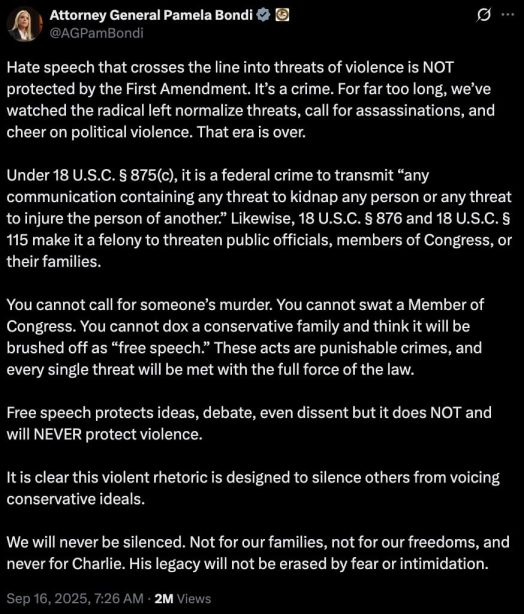
What Bondi described, true threats of violence, is already illegal under federal and state law. Invoking the term “hate speech” in this context is misleading. The constitution does not recognize “hate speech.”
By framing criminal threats as “hate speech,” Bondi moves the public conversation away from clearly defined, prosecutable offenses and into territory where legal protections still apply.
The First Amendment does not carve out exceptions for offensive or disturbing language, and attempts to categorize speech as criminal based solely on its content or tone run into immediate constitutional limits.
The concern is that rebranding existing crimes with emotionally charged labels like “hate speech” creates confusion about what the law actually allows.
It suggests there is a separate, punishable category of expression based on viewpoint or perceived offensiveness, something the US legal system has thankfully repeatedly rejected.
For a state’s top law enforcement official to advance that view undermines public understanding of both free speech protections and the scope of legitimate criminal enforcement.

Charlie Kirk has been one of the most vocal opponents of these censorship regimes. In a 2024 post on X, he made his position plain: “Hate speech does not exist legally in America. There’s ugly speech. There’s gross speech. There’s evil speech. And ALL of it is protected by the First Amendment. Keep America free.”
Featured Video

10 Hard Facts About the Holocaust
or go to
Aletho News Archives – Video-Images
From the Archives
How Taiwan Became an Issue
By Joseph Solis-Mullen | The Libertarian Institute | August 22, 2024
Given that official Washington seems increasingly determined to fight Beijing over Taiwan, concerned Americans are right to wonder: how did the question of Taiwan come to be of such purported importance to these global powers? … continue
Blog Roll
Recent Comments
Richard Jones on Bird Flu Outbreak 40 Miles Fro… loongtip on Bird Flu Outbreak 40 Miles Fro… loongtip on Scott Ritter says he was … loongtip on Eilat port faces worst crisis… loongtip on British minister dreams of kid… loongtip on Kiev awards major mining proje… loongtip on UK believes it can seize any t… loongtip on Pirates of the Caribbean loongtip on Australian festival boycotted… loongtip on Kiev seeks to ban Russian musi… seversonebcfb985d9 on Somaliland and the ‘Grea… John Edward Kendrick on Kidnapped By the Washington…


 Aletho News
- Bird Flu Outbreak 40 Miles From Wisconsin Lab Sparks Concern About Gain-of-Function Experiments
- The West vs. the Rest
- Figures behind massacre of starving Gazans now shaping US Gaza plan
- “Real men go to Tehran” — The Zion-Con fantasy of regime change in Iran
- Why are EU leaders suddenly being nice to Russia?
- South Korean court sentences former president Yoon to five years in prison over martial law bid
- France Escalates Warmongering by Expanding Intelligence Support for Ukraine
- Venezuela Has Right to Have Relations With China, Russia, Cuba, Iran – Acting President
- Attacks in the Black Sea aim to destabilize relations between Russia and the Turkic world
- US Sending Troops to Middle East Over Trump’s Threats Against Iran – Reports
- If Americans Knew
- How an Israeli Firm Spreads Lies and Chaos Around the World
- ADL ‘Helping’ Ted Cruz and Ben Shapiro ‘Take Down’ Tucker Carlson and Nick Fuentes, CEO Suggests
- Israel is Destroying Hope for the Future: Reproductive Violence in Gaza
- J Street is the new AIPAC in the Democratic Party
- The fate of Gaza’s disappeared remains unknown
- The U.S. has announced ‘Phase 2’ of the Gaza ceasefire. Here’s why it doesn’t matter for Palestinians.
- 30 tons of rubble for every resident of Gaza – Not a ceasefire Day 98
- ‘My leg went to heaven before me’: Israeli war extinguishes Gaza childhoods
- Founders of deadly GHF ‘shaping’ new US-backed administration for Gaza: Report
- Genocide isn’t a mistake. Which is why the media can’t tell you the truth about Gaza
- No Tricks Zone
- Philosopher Schopenhauer: Climate Science Certainty Stems From Stupidity, Ignorance
- New Study: Species Extinction Rates Declining Since 1980 – ‘Climate Change Is Not An Important Threat’
- Denmark Places Climate Protection Above Animal Welfare, Poisoning And Culling Cows
- New Study: Greenland Was 3-7°C Warmer And Far Less Glaciated Than Today 6000-8000 Years Ago
- German Media Report That Current Frigid Weather Can Be Explained By Arctic Warming!
- Berlin Blackout Shows Germany’s $5 Trillion Green Scheme Is “Left-Green Ideological Pipe Dream”
- Modeling Error In Estimating How Clouds Affect Climate Is 8700% Larger Than Alleged CO2 Forcing
- Berlin’s Terror-Blackout Enters 4th Day As Tens Of Thousands Suffer In Cold Without Heat!
- Expect Soon Another PIK Paper Claiming Warming Leads To Cold Snaps Over Europe
- New Study: Human CO2 Emissions Responsible For 1.57% Of Global Temperature Change Since 1750
 Aletho News