Dutch-Led Network Of International Experts Finds “Serious Errors” In Latest IPCC Report
By P Gosselin | No Tricks Zone | May 12, 2023
The UN Intergovernmental Panel On Climate Change (IPCC) is misleading policy makers by focusing on an implausible worst-case emissions scenarios, concludes a new analysis report published by the Clintel Foundation: “The Frozen Climate Views of the IPCC“

The IPCC is hiding the good news about disaster losses and climate-related deaths and wrongly claims the estimate of climate sensitivity is above 2.5°C. Also errors in the AR6 report are worse than those that led to the IAC Review in 2010, concludes the report by The Climate Intelligence Foundation (Clintel), which was founded in 2019 by emeritus professor of geophysics Guus Berkhout and science journalist Marcel Crok.
Opposite of IPCC claims likely true
Another result: The IPCC ignored crucial peer-reviewed literature showing that normalized disaster losses have decreased since 1990 and that human mortality due to extreme weather decreased by more than 95% since 1920.
Clintel accuses the IPCC of cherry picking from the literature to claim increases in damage and mortality due to anthropogenic climate change, when in fact the opposite is likely true.
Rewrote climate history
The Clintel report is 180 pages long and the first serious international ‘assessment of the IPCC’s Sixth Assessment Report. In 13 chapters the Clintel report shows the IPCC rewrote climate history, and emphasizes an implausible worst-case scenario, favoring bad news and ignoring good news.
“The strategy of the IPCC seems to be to hide any good news about climate change and to hype anything bad,” reported the Clintel press release.
The errors and biases that Clintel documents in the report are far worse than those that led to the investigation of the IPCC by the Interacademy Councel (IAC Review) in 2010. Clintel believes that the IPCC should reform, or be dismantled.
Clintel is a network of international scientists who analyzed several claims from the Working Group 1 (The Physical Science Basis)
and Working Group 2 (Impacts, Adaptation and Vulnerability) reports. This led to the latest report: “The Frozen Climate Views of the IPCC”.
IPCC ignores 97% of all papers
Clintel explains how the IPCC ignored 52 out of 53 peer reviewed papers dealing with “normalized disaster losses” and found no increase in harms that could be attributed to climate change. Yet, the IPCC highlighted the single paper that claimed an increase in losses.
Cherrypicking, rewriting history
The IPCC also has tried to rewrite climate history by erasing the existence of the so-called Holocene Thermal Maximum (or Holocene Climate
Optimum), a warm period between 10,000 and 6000 years ago, and has introduced a new hockey stick graph, which is the result of cherry-picked proxies. The IPCC ignores temperature reconstructions that show more variability in the past, such as the well-documented Little Ice Age.
In its recent report, the IPCC also has grossly exaggerated sea level rise and CO2’s ability to warm the earth’s atmosphere and thus appears to have remained ‘addicted’ to its highest emissions scenario, so-called RCP8.5, which in recent years has been shown by several published papers to be implausible and thus should not be used for policy purposes.
Severely biased
“We are sorry to conclude that the IPCC has done a poor job of assessing the scientific literature,” the Clintel scientists report. “In our view the IPCC should be reformed, and should include a broader range of views. Inviting scientists with different views, such as Roger Pielke Jr and Ross McKitrick, to participate more actively in the process is a necessary first step.”
If the inclusion of other views does not permitted, then the IPCC should be dismantled, the scientists say.
Reality: Future is far less bleak
“Our own conclusions about climate – based on the same underlying literature – are far less bleak. Due to increasing wealth and advancing technology, humanity is largely immune to climate change and can easily cope with it. Global warming is far less dangerous to humanity
than the IPCC tells us.”
Clintel also published the World Climate Declaration, which has now been signed by more than 1500 scientists and experts. Its central message is “there is no climate emergency”.
Clintel press release here.
New legislation aims to block New York charities from funding Israeli settlements
Press TV – May 19, 2023
A New York State assembly member has introduced a legislation to stop charities from sending millions of dollars to Israel to stop its settlement expansion activities across the occupied Palestinian territories which are being advanced in flagrant violation of the international law.
The legislation, dubbed “Not on our dime!: Ending New York Funding of Israeli Settler Violence Act,” was introduced by state assembly member Zohran Mamdani, the third Muslim in the New York State assembly, earlier this week.
It would give the state attorney general authority to sue and dissolve not-for-profit organizations that are found to be using their tax-deductible donations to support organizations funding illegal Israeli settlements in the occupied West Bank.
The legislation would also give Palestinians harmed by settler organizations funded by New York-based charities the right to seek damages in American courts.
“Charities registered in New York State currently send more than $60 million dollars a year in tax-deductible donations to aid and abet Israeli settlements. This is done on our dime as New Yorkers,” Mamdani said, the Middle East Eye reported on Thursday.
He added, “This legislation puts an end to that and makes explicit that subsidizing violence and activities outlawed by the Geneva Convention is not, and should not be considered, charitable giving. It’s past time for New York to catch up to international law.”
Mamdani noted that while this issue is important to him as a Muslim, as his faith informs his fight to ensure justice for all people, this is not a bill motivated by religion.
“It is a bill motivated by a desire that New York State stop subsidizing human rights violations through the conferring of charitable status to organizations such as these,” he said.
“Too often, we see an exception drawn when it comes to Palestine – whether it be in our policies or the application of them. This makes it clear that our belief in human rights is universal, without exception,” he added.
The legislation has already received some backlash. Mamdani highlighted that his office has received a call saying all Muslims should die and all Muslim lovers should be killed as well.
“This is the reality when you dare speak up about Palestine and Palestinians,” he said.
Additionally, 66 lawmakers signed an open letter condemning the legislation, saying it “attacks” Jewish organizations.
Emboldened by former US president Donald Trump’s all-out support, Israel has stepped up its illegal settlement construction activities in defiance of United Nations Security Council Resolution 2334, which pronounced settlements in the West Bank and East al-Quds “a flagrant violation under international law.”
More than 600,000 Israelis live in over 230 settlements built since the 1967 Israeli occupation of the West Bank and East al-Quds.
All Israeli settlements are illegal under international law. The UN Security Council has condemned Israel’s settlement activities in the occupied territories in several resolutions.
Palestinians want the West Bank as part of a future independent state with East al-Quds as its capital.
The last round of Israeli-Palestinian talks collapsed in 2014. Among the major sticking points in those negotiations was Israel’s continued illegal settlement expansion.
Many Palestinians believe the Israeli plans to annex one-third of the already occupied West Bank, including parts of the strategic Jordan Valley, is only a formality and that a de facto Israeli occupation of their land has been underway for many years.
Railway of Resistance: A grand project to connect Iran, Iraq, Syria
By Mohamad Hasan Sweidan | The Cradle | May 19 2023
Sir Halford John Mackinder, one of Britain’s most prominent theorists in the field of geopolitics, discusses the significance of land connectivity between nations in his 1904 essay called The Geographical Pivot of History.
Besides introducing his notable Heartland Theory, Mackinder argued that advancements in transportation technology, such as the development of railways, have altered the balance of power in international politics by enabling a powerful state or group of states to expand its influence along transport routes.
The establishment of blocs, like the EU or BRICS, for instance, aims to enhance communication between member states. This objective has positive implications for the economy and helps reduce the risk of tensions among them.
The cost of such tensions has increased considerably, given the growing benefits and common interests achieved through strengthened ties between nations. Consequently, reinforcing connections within a specific region has a positive impact on the entire area.
Therefore, any infrastructure project between countries cannot be viewed solely from an economic standpoint; its geopolitical effects must also be highlighted.
West Asia connected by railway
In July 2018, Saeed Rasouli, head of the Islamic Republic of Iran Railways (RAI), announced the country’s intention to construct a railway line connecting the Persian Gulf to the Mediterranean Sea, the Iran-Iraq-Syria railway link. This ambitious project would run from Basra in southern Iraq to Albu Kamal on the Iraqi-Syrian border and then extend to Deir Ezzor in northeastern Syria.
Undoubtedly, this project strengthens communication between the countries of West Asia and increases the need for other powers to collaborate with this important region, which is strategically located in parts of Mackinder’s “Heartland” and Nicholas Spykman’s “Rimland” of Eurasia.
Moreover, in accordance with Mackinder’s proposition, it can be argued that this railway project holds geopolitical significance for the three involved countries – Iran, Iraq, and Syria – and for West Asia as a whole.
The concept of a railway link between Iran and Iraq emerged over a decade ago. In 2011, Iran completed the 17-kilometer Khorramshahr-Shalamjah railway, which aimed to connect Iran’s railways to the city of Basra. Subsequently, in 2014, a memorandum of understanding (MoU) was signed between Tehran and Baghdad to construct the Shalamjah-Basra line.
As per the agreement, Iran was responsible for designing and building a bridge over the Arvand River, while the Iraqi side pledged to construct a 32-kilometer railway line from the Shalamjah border to the Basra railway station within Iraqi territory.
Final destination: Syria
On 14 August, 2018, Iran announced its intention to further extend the railway from its territory to Syria, with Iraq’s participation. This move aimed to counter western sanctions and enhance economic cooperation.
The railway project would begin at the Imam Khomeini port on the Persian Gulf, located in Iran’s southwestern Khuzestan province, to the Shalamjah crossing on the Iraqi border. From there, the railway traverses through the Iraqi province of Basra, crossing Albu Kamal on the Syrian border and ending at the Mediterranean port of Latakia.
Iranian official sources stated that this railway would contribute to Syria’s reconstruction efforts, bolster the transport sector, and facilitate religious tourism between Iran, Iraq, and Syria. Iran would bear the costs of the project within its own territory, while Iraq would contribute its share up to the Syrian border.
During the visit of former Iranian President Hassan Rouhani to Iraq in March 2019, a memorandum of understanding on the project was signed between Tehran and Baghdad. However, despite the agreements, the Iraqi side has faced economic challenges and a lack of funds, resulting in a delay in the construction of the railway.

Proposed railway links between Iran, Iraq, and Syria
Three Sections
The railway project can be divided into three sections: The first section links the Imam Khomeini Port to the Shalamjah crossing on the Iraqi border. According to the Iranian Minister of Roads and Urban Development Mehrdad Bazrpash, the railway line in Iran has been completed and has reached the zero border point.
The second section will link the Shalamjah Crossing to Basra in southern Iraq, then extend to Baghdad, Anbar province, and finally, the Syrian border. The financing of this section, according to the agreement, falls under the responsibility of the Iraqi government. The commencement of this phase is expected soon.
The third section, within Syria, encompasses two routes: The northern route extends between Iraq’s al-Qaim and Syria’s Albu Kamal, then heads west towards the Syrian port of Latakia. The southern route runs from the al-Qaim crossing on the Iraqi-Syrian border to Damascus via Homs.
It should be noted that although the shortest route to Damascus is through al-Tanf, due to the presence of the illegal US occupation forces there, the longer Homs-Damascus corridor was adopted. This also ensures the passage of railways through a greater number of Syrian cities.
Economic significance
Although the rail line between Iran and Iraq will only span 32 km and cost approximately $120 million, divided equally, its significance extends far beyond its length. It will serve as the sole railway connection between the two countries and play a crucial role in improving communication throughout the wider region by linking China’s Belt and Road Initative (BRI) lines to Iraq via Iran.
Once completed, the project will enable Iraq to easily connect to Iran’s extensive railway network, which extends to Iran’s eastern border. This linkage will open pathways for Baghdad to connect with Afghanistan, Pakistan, China, the Caucasus, Central Asia, and the Far East.
Moreover, in the future, the project positions Iraq as a transit route for trade between the Arab countries of the Persian Gulf region and Central Asia, as well as Russia. Incidentally, Iran and Russia have just inked an agreement to establish a railway connecting the Iranian cities of Astara with Rasht, as part of the International North–South Transport Corridor (INSTC).
The railway line also contributes to the promotion of religious tourism among the three countries, which are home to several important Shia shrines. In September 2022, more than 21 million people from around the world, including 3 million Iranians, visited Iraq for the annual Arbaeen pilgrimage in the holy city of Karbala. This figure is likely to increase significantly with a rail link, leading to increased revenues for the Iraqi treasury.
Furthermore, the project serves as a means to bypass western sanctions and external pressures on the three countries, particularly Iran and Syria. It strengthens the independence of these nations and reduces the likelihood of foreign powers interfering in the economic relations of the project countries.
Obstacles to project implementation
Despite the signed agreements, the Tehran-Baghdad-Damascus railway project has faced mixed reactions in Iraq, leading to a lack of enthusiasm for moving forward with the rail link. Only last month, the Ministry of Transport issued a clarification regarding its rail link with Iran, stressing that the project is related to “passenger transportation only.”
Iraqi politicians have expressed concerns that the rail link with Iran could hinder their country’s Dry Canal project, which aims to connect the port of Faw in Basra province to the Turkish and Syrian borders.
They believe that the Grand Faw Port is strategically positioned as the closest point for sea cargo to Europe, potentially bringing economic benefits and employment opportunities. These concerns arise from the fear that the Imam Khomeini port in Iran could gain increased importance, diminishing the significance of the Faw Port.
But Iraqi concerns actually present an opportunity to link Iran to the Dry Canal, enhancing the strategic importance of both projects and bolstering Iraq’s position as a regional trading hub. In the near future, communication and cooperation between these neighbors will be crucial in thwarting external efforts to impede the economic interdependence of the three countries.
A promising journey
The tripartite railway link project holds immense significance as it connects these countries within a larger network, resembling the historical Silk Road that facilitated trade between the east and the west for centuries.
The railway project has the ability to initiate a major transformation in West Asia if it materializes and expands further afield to countries like Saudi Arabia, Jordan, and Lebanon.
Their participation would not only reduce tensions among regional states but also yield positive economic outcomes and bolster tourism, particularly religious tourism, and foster stronger inter-regional ties.
By connecting key players in a geopolitically strategic region, the Tehran-Baghdad-Damascus rail link has the potential to lay the foundation for a new West Asian paradigm that promotes connectivity, stability, and prosperity.
As seen by the recent Iran-Saudi and Syria-Saudi rapprochement agreements, the region is in a collaborative mood, actively seeking economic development instead of conflict. With China and Russia – two powers at the forefront of Eurasia’s biggest interconnectivity projects (BRI and INSTC) – brokering and impacting many of these diplomatic initiatives, expect railways, roads, and waterways to begin linking countries that have been at odds for decades.
Syria’s return to Arab fold sign of Global South manifesting itself: Diplomat
By Somayeh Khalili | Press TV | May 19, 2023
Syria’s triumphant return to the Arab League fold after almost 12 years shows not just that Arab countries now recognize the failure of the “regime change” project in Damascus but also that they can defy the United States, according to a former British diplomat.
In an exclusive interview with the Press TV website, Peter Ford, a former UK diplomat who served as ambassador in Syria between 2003 and 2006 and before that in Bahrain from 1999 to 2003, said the importance of the recent turn of events in the Arab world “goes beyond Syria”.
“It is a symptom of the development of a new multipolar world order where not just Russia, China and Iran refuse to accept US hegemony but also countries like Saudi Arabia, UAE, Brazil and South Africa. This is the Global South manifesting itself,” Ford asserted, referring to Arab normalizations.
Syria has restored diplomatic ties with many Arab countries recently after years of hostility, including Saudi Arabia, and is set to formally return to the Arab League, a 22-member body of Arab states.
This wave of normalization comes more than a decade after Syria’s Arab neighbors severed their diplomatic ties with the Bashar al-Assad government in Damascus and demanded his ouster.
On Thursday, Assad touched down in the Saudi port city of Jeddah to attend the Arab League summit, marking another step toward the full restoration of ties between Syria and its Arab neighbors.
Ford said Syria’s return to the Arab League, in defiance of US warnings, has raised expectations that the Arab world will now “show more support for Palestine and less concern for their ties with Israel”.
“The Abraham Accords was founded on hostility to Iran and fear of the US. These conditions no longer apply,” the former British diplomat told the Press TV website.
On whether these developments will bring regional countries closer in fighting the menace of terrorism, Ford said he expects “much more intra-Arab security cooperation” now, adding that Syria has “more experience with this phenomenon than any country in the world”.
The veteran diplomat noted the US interference in the Arab country hasn’t ended but that it has “got tired” and is going through the motions “with no real hope of achieving anything”.
“It keeps up the economic war, the propaganda war and legal war, and it maintains a military presence to control Syria’s oil, but it’s all to no purpose,” he said about the US.
The restoration of diplomatic ties between Iran and Saudi Arabia, Ford said, augurs well for the region, as both countries have “a shared interest in modernization and the peaceful Persian Gulf”.
“The only beneficiaries from hostility (between Tehran and Riyadh) have been the US and Israel. The new perspectives for cooperation (between them) are exciting. No wonder the US think tanks are bitter in their commentaries,” he remarked.
Iran and Saudi Arabia restored diplomatic ties in March following two years of negotiations brokered by Baghdad. The breakthrough, however, came courtesy of Beijing.
Ford stated that while Western countries “stubbornly persist in economic warfare against Syria, Iran’s role in Syria’s post-war reconstruction and rebuilding “remains crucial”.
On President Ebrahim Raeisi’s recent historic visit to the Arab country, the former American ambassador in Damascus said it “set the seal on the success of Syria and Iran in standing firm against Western-directed attempts to overturn the Syrian government and weaken Iran.”
“It also signaled that the normalization of Syria’s relations with Saudi Arabia came not at Iran’s expense but because of what’s now triangular Syrian-Saudi-Iranian cooperation,” Ford stressed.
While warning that the US power to do harm “should never be underestimated”, he said the US “is now beating a retreat from the Middle East and is focused more and more on China”.
US kills Syrian shepherd claiming he was Al-Qaeda leader

Lotfi Hassan Misto, who was killed on 3 May 2023 by a US drone strike in Syria. (Photo courtesy of the Misto family)
The Cradle | May 19, 2023
After US military officials claimed to kill an important Al-Qaeda figure in Syria in an airstrike earlier this month, evidence from the dead man’s family indicates he was instead an impoverished shepherd and father of 10 children, The Washington Post reported on 19 May.
According to interviews with his brother, son, and six others who knew him, the slain man was Lotfi Hassan Misto, 56, a former bricklayer who they described as a kind, hard-working man whose “whole life was spent poor.”
Misto was killed by a Predator Drone strike using a Hellfire missile on 3 May. Hours later, without evidence or providing a name of the person targeted, US Central Command claimed that they had killed a “senior Al Qaeda leader.”
The interviews with Misto’s family members have caused US officials to backtrack from their original claims.
“We are no longer confident we killed a senior AQ official,” one US official told The Washington Post. Another said that “though we believe the strike did not kill the original target, we believe the person to be al-Qaeda.” Both spoke on the condition of anonymity.
The Post notes further that, “In the weeks since the attack, US military officials have refused to identify publicly who their target was, how the apparent error occurred, whether a legitimate terrorist leader escaped and why some in the Pentagon maintain Misto was a member of al-Qaeda despite his family’s denials.”
In a statement, Michael Lawhorn, a spokesman for Central Command, said that “Centcom takes all such allegations seriously and is investigating to determine whether or not the action may have unintentionally resulted in harm to civilians.”
The US military has faced accusations it has covered up past instances of airstrikes that killed innocent people as a result of what The Post described as “flawed intelligence” and “confirmation bias,” including in the case of a 2021 strike in Afghanistan that officials claimed targeted a suicide bomber but instead killed 10 Afghan civilians, including seven children.
In perhaps the most famous case, the US military carried out an airstrike in Mosul in 2017 during the battle against ISIS that killed 240 civilians sheltering in a large home.
The US military has carried out airstrikes in Syria intermittently in recent years in areas controlled by Al-Qaeda affiliated groups, including Hayat Tahrir al-Sham, previously known as the Nusra Front.
This is despite the fact that US planners played a key role in helping the Nusra Front capture Syria’s northwest Idlib governate in 2015 by supplying TOW anti-tank missiles to Free Syrian Army (FSA) groups fighting as Nusra proxies.
Supplying the weapons was part of the CIA’s Timber Sycamore Program, which sought to arm and fund extremist Salafist armed groups fighting the Syrian government under the FSA banner.
US, British, Turkish, and Gulf efforts to effect regime change in Syria failed, however, and President Donald Trump ended the CIA program, which enjoyed a budget of over $1 billion per year, in 2017.
The extremist groups occupying Idlib have enjoyed continued Turkish support since that time, while Turkish troops have also occupied areas in northern Syria directly.
But the status of Turkish-backed and Al-Qaeda-linked extremist groups in Syria is now in doubt as Turkish President Recip Tayyip Erdogan has in recent months participated in Russian-backed talks to normalize relations with Damascus.
Syrian President Bashar al-Assad has demanded that Turkiye end its occupation of northern Syria and cease support for extremist groups as a condition of any normalization of ties with Ankara.
US involved in assassination of Russian public figures – security chief
RT | May 19, 2023
The most high-profile Ukrainian “terrorist acts” in Russia were carried out with the assistance of Washington, the Secretary of the Russian Security Council, Nikolay Patrushev, has claimed.
Speaking at a government meeting on Friday, Patrushev said that Russia has information that “the murders of Darya Dugina and Vladlen Tatarsky, the bombing of Zakhar Prilepin’s car, the explosion at the Crimean Bridge,” the Nord Stream pipelines sabotage, and other “terrorists acts” were “planned and carried out under the coordination of US special services”.
Those attacks were “accompanied by an information campaign prepared in advance in Washington and London, designed to destabilize the social and political situation, [and to] undermine the constitutional foundations and sovereignty of Russia,” the security chief stressed.
“The intensity of terrorist attacks has vastly increased” since Russia launched its military operation in Ukraine over a year ago, he added.
According to Patrushev, Ukrainian saboteur groups, who are trained by NATO instructors, have been actively trying to target important infrastructure inside Russia, including with drones.
In view of those events additional measures should be implemented to protect key facilities and places where people gather in large numbers, he said.
Earlier this week, the chief of Ukrainian military intelligence (GUR) General Kirill Budanov was asked about attacks on prominent Russian public figures and replied that his agency has “already gotten many” of them. However, he declined to mention any names. In an earlier interview, Budanov vowed to “keep killing Russians anywhere on the face of this world until the complete victory of Ukraine.”
Journalist and activist Darya Dugina, the daughter of Russian philosopher Aleksandr Dugin, died after her car exploded on a highway outside Moscow last summer. Russia’s Security Service (FSB) said the murder of the 29-year-old was carried out by Ukrainian nationals, who managed to flee the country.
In late April, Russian military blogger Vladlen Tatarsky was killed in St Petersburg after a statue that had been handed to him during an event with his followers exploded. A dozen people were also wounded. The FSB has blamed the blast on “Ukrainian special services and their agents, including fugitive members of the Russian opposition.”
Earlier this month, prominent Russian author and political activist Zakhar Prilepin was severely injured in a car bomb near the city of Nizhny Novgorod. His driver was killed. A suspect has admitted to Russian law enforcement that he’d been hired by an unspecified Ukrainian intelligence service.
Ukraine’s Depleted Uranium Blast: Europe on Brink of ‘Environmental Disaster’

A frame of a CCTV video, purportedly depicting a major blast at an ammo depot in Khmelnintsky, Ukraine.
Sputnik – 19.05.2023
Russian Security Council Secretary Nikolai Patrushev warned on Friday that a radioactive cloud was heading towards Western Europe following the destruction of a Ukrainian warehouse storing British-supplied depleted uranium ammunition.
Sputnik News spoke with Dr. Chris Busby, physical chemist and scientific secretary of the European Committee on Radiation Risk, about how the West’s decision to provide depleted uranium (DU) ammunition to Ukraine has potentially caused a continent-wide ecological disaster. Below is his answer in full.
Recently, several web media outlets provided videos of an enormous explosion in the town of Khmelnitski, located to the West of Kiev, and about 200 km from the border with Poland. There were two major explosions which produced a massive roiling swirling fireball which, like an atomic bomb, developed upwards and formed a mushroom cloud, which was black.
I have represented nuclear atmospheric test veterans in the Royal Courts of Justice in London and have seen many films of nuclear explosions: this was not one. A nuclear explosion is characterised by an immediate intense white light which wipes out the camera film or detector.
So, what was it? It was suggested by several commentators that an arms depot that had been hit contained the Depleted Uranium (DU) weapons sent by the UK to the Ukraine for use in the British Challenger tanks as anti-tank penetrators. That the explosion was one involving the burning of the DU in the fireball. Since I am a scientific authority on Uranium and its health effects, but have also examined its dispersion and behaviour in the environment, I will comment on what I believe happened, and why it is important. I was a member of the UK government Ministry of Defence Depleted Uranium Oversight Board (DUOB) in 2000-2005, and also the UK government Committee Examining Radiation Risk from Internal Emitters (CERRIE) 2000-2004. I am Scientific Secretary of the European Committee on Radiation Risk (ECRR) which is an independent NGO that provides advice on risk from ionising radiation.
My main research interest in this area is Uranium and health, particularly the DU particles, which are so small they act as a gas and move over very large distances once they are created by the burning of DU. I found them in England in 2003 after they had come from Iraq. I found them in 2023 in England after they came from the Ukraine war. So that is the first thing: the material is able to travel very large distances.
Therefore, if the Khmelnitski explosion was a DU one, the material would move with the wind direction and should be detectable at monitor sites downwind.
First, we need to say that DU has a gamma signature, it releases gamma rays. The UK and USA governments lie about this. They point to the fact that the U-238, that remains after the fissile U-235 is removed in the centrifuges (and is sent off for nuclear weapons and reactors), is a weak alpha emitter.
They say that alpha radiation cannot penetrate skin and so the DU itself is harmless. That it cannot be detected by a Geiger Counter and the alpha particles don’t make it through the window. There is, of course, a health problem if the post-impact particles are inhaled and pass into the body through the lung into the lymphatic system or directly into the digestive system, but essentially DU is harmless.
What you need to know is that Uranium 238, when it decays with its alpha emission, turns into Thorium-234 and Protoactinium-234m which then turns into Uranium 234. Thorium 234 is a beta and gamma emitter delivering 6% of its decay energy as a gamma ray. Thus, large clouds of DU particulate aerosol will be detectable by gamma detectors.
When I visited Iraq with Al Jazeera in 2000 I went to the south and examined the corpses of the tanks that had been hit by DU in the first Gulf War. Some of the A-10 DU penetrators were still lying around. They gave off an intense gamma ray signal, and the holes in the tanks were highly gamma ray active. So much for only an alpha emitter.
I am a yachtsman: examination of the UK metereological weather pressure maps tell us that at the time, and for days after the explosion, there was an anticyclone to the North of the explosion site and winds were weak but from the South East blowing North Westerly around the high-pressure area. So, the plume would move towards Poland. If the winds were about 5km/h they would reach any Poland detectors 250 km away on the 15th.
After Chernobyl, the European Union set up a Europe-wide gamma radiation detector system that used to give gamma readings in real time. I went to look. But astonishingly, all the data was blocked. The web- based system, administered from Germany, (EURDEP) would not provide the detector maps that are normally available. Luckily, there were some location maps on the web and some that had been already downloaded by colleagues of mine before the system stopped working. I obtained maps from Poland. One of these I show below.
You will see that a very highly significant increase in gamma radiation occurred at this detector, north west of the explosion site almost exactly when it would be expected on the basis of a distance of 250km and a mean wind speed of 5km/h. The increase, from 60nSv/h to 90nSv/h was highly statistically significant about 50%. Other detectors all across Poland showed an increase*, as the plume passed over them, the increase being weaker the further away (due to dispersion of the plume).
Later, the Poles measured the increase at the Marie Curie Institute in Lublin, but their map was a more sophisticated one and needed some expert interpretation. The Polish map gave gamma increases split into two natural isotopes, Bismuth and Thallium, also total gamma and cosmic ray gamma.
From the map, we are to assume (and this was the implicit message) that the gamma peak was due to Bismuth. Enter Sherlock Holmes. Bismuth 214 is a Radon daughter. The natural background radioactive gas Radon (Rn-222) is always present, since it is produced from Uranium and Radium in the ground. If there is a sudden change in atmospheric pressure, or when it rains, there is a gamma peak from Radon, which shows itself as the Bi-214 peak. So, the Poles seem to be implying that the increase in gamma radiation is normal and nothing to get scared about. Many have picked up on the Bismuth spectrum. But the way in which the Polish graphs are presented is misleading.
The problem with a radon argument is first that the gamma increases go up all across Poland at a time scale that identifies a plume from Khmelnitsky and second that there was a stable anticyclone weather system and no atmospheric pressure changes that might pull radon out of the ground. I checked all that. There was only some light rain over Lublin.
There is, however, an additional possibility. Very fine particles attract Radon: you get a slight increase in gamma from Radon near factory chimneys that emit fine particles.
The European radiation detector system web map came back online yesterday. The map type had been changed and everything we saw in the downloads had disappeared or had been smudged out by data analysis averaging. Why? This, and the early blocking of access to the site suggest panic and cover-up.
So taken all together, what we see is a massive explosion which is thought to be DU, and reports of a spike in gamma radiation near the site. Uranium oxide is black, and the black plume moves north west slowly, the weather pattern is stable and the wind blows to Poland. The Polish EU detectors all show gamma radiation increases at the expected time of arrival of the plume. The EU detector system is shut down rapidly, but not before we have obtained data from several sites. The Poles provide a detector result that identified Bismuth as the cause of the increase, but do not go so far as to formally state that it is (in case of later blowback).
One final piece of evidence. We see videos on the internet of the Ukrainians clearing up the explosion site using Robot vehicles, not ordinary firemen. Why do they need Robot vehicles? The last times we saw Robot vehicles clearing up was in the ruins of Chernobyl and Fukushima.
If I am right, there has been an environmental disaster, and the DU particles will travel across Poland, Germany and Hungary, and will end up in the Baltics, probably later the whole of Europe including the UK (after all, the Chernobyl Uranium particles came to the UK).
They will deliver genetic damage and death like that seen in the Balkans and Iraq. Cancer, birth defects, miscarriage, infertility, lung damage, mental problems (Gulf War Syndrome) and so forth. The scientific and epidemiological evidence on this has been clear since the Gulf War. It is all there in the scientific literature—but the governments in the West and the military ignore it, deny it and cover it up. In the case of the UK coroners court finding for Stuart Dyson, the jury found that DU caused his fatal colon cancer. But when the coroner wrote to the health minister (as he had to by UK law, Rule 43) the reply was: we disagree. This stuff can be measured, but no one will measure it, or if they do, they will be attacked and their arguments dismissed.
Even if I am wrong, and there is some other explanation for the gamma peaks, DU must be banned. It is a weapon of indiscriminate effect and kills civilians, the enemy and your own troops (well, Ukrainian troops). It is much worse than a war gas, like Sarin, or phosgene, mustard gas or all the other chemical agents banned by civilisation. This stuff destroys the genetic basis of life itself. And no one does anything. Those who use it base their action on obsolete science supported by dishonest epidemiology carried out by dishonest scientists and obsolete and fantastical risk models.
Those who provide the weapons, the UK government in this case, are morally bankrupt. Unless it is their intention to destroy the Ukrainian people. Who knows anymore? The world has gone mad.
*Poland’s National Atomic Energy Agency claims there is no increase in radiation levels.
Can Western air defense systems protect Ukraine properly?
By Uriel Araujo | May 19, 2023
On May 16, Ukraine claimed its air defenses intercepted six Russian Kinzhal hypersonic missiles and shot them down amid an “exceptionally dense” barrage fired – supposedly thanks to the arrival of Patriots, among other Western combat systems. Kinzhals are supposed to be able to overcome all existing air defense systems, and Moscow denies its Kinzhals were intercepted.
Kiev also claims to have shot down 29 of 30 Russian rockets on May 18, an obviously inflated number. However, a Ukrainian infrastructure facility in Khmelnytskyi has been hit by a missile, with no casualties reported. The barrage came as a response to Kiev’s advancements in Bakhmut. Ukrainian forces are reportedly preparing to launch a counteroffensive. Ukraine’s defense systems, however, should not be overestimated.
While Western powers are finally coming to realize that Kiev simply does not possess the necessary means to win the ongoing conflict, much is being written about Western air defenses supposedly being key for Western victory in its proxy war in Eastern Europe against Moscow. Despite Ukrainian denials, American officials have confirmed US-made Patriot was indeed damaged by Russian strikes. According to the Russian defense ministry, on 16 May Kinzhal destroyed a Patriot missile defense system (five launchers and a multifunctional radar). This is one of the most advanced US air defense systems. Albeit trying to minimize the damage, US authorities speaking to Reuters on the condition of anonymity said that they would have a better understanding of the situation “in the coming days” and that “information could change”.
In the past days, Ukrainian President Volodymyr Zelensky has been busy touring different European countries and so far he has been promised billions of dollars in military equipment by allies such as the United Kingdom (UK) and France. How much different can those make?
The hard truth is that Kiev remains unable to create a single control system or an interface for the various Western air defense systems and their different components, as these possess a large range of functional features and thus are poorly integrated into the already existing systems. This means that they would operate ineffectively if included in a single circuit. NATO’s anti-aircraft systems can fully control one defined sector of airspace at a time, but cannot intercept operational-tactical missiles that move along an aeroballistic trajectory, such as the Russian hypersonic Kinzhais. For Ukraine, it would therefore be necessary to construct a whole new system, which is no simple task during a confrontation – not to mention doing so quickly enough.
Moreover, according to defense and IR journalist S. Tiwari of the EurAsian Times, the Patriot, IRIS-T and NASAMS systems cannot protect Ukrainian troops from guided bombs, such as the ones massively used by Russian forces. Ukrainian Lieutenant Colonel Denis Smazhny, an aerial defense specialist, in turn has confirmed the low effectiveness of the US-sent NASAMS and IRIS-T complexes (supplied by Germany) to face Russian ballistic missiles such as the Iskanders and Kinzhals. The Russian weapons, unlike cruise missiles, are capable of rising to very high altitudes to fall almost vertically onto the target at great speeds. Thus, targeting them in flight is very difficult. How can one make them fall when they are in fact “already falling”?
Thus, in Colonel Smazhny’s words, “Western air defense systems will not be able to protect us.” Even with the Western systems, quickly creating an integrated and effective system for airspace defense is a challenge for Ukraine, to say the least. This is why Kiev has been eyeing an Israeli system called Iron Dome, which could suit its needs better. However, military and technical issues are often entangled with political and diplomatic matters.
During a US Senate Armed Services Subcommittee on Strategic Forces session (about missile-defense matters), last week, American Senator Angus King asked why Iron Dome had not been deployed in the Eastern European nation. The answer is quite simple: the main producer of such systems is Israel and thus it would have to grant Washington permission to send it to any other country, such as Ukraine. Despite several requests, this has not happened.
Tel Aviv sees Russia as a regional great power with which it must engage in a number of issues in the Middle East. For one thing, Moscow and Tel Aviv currently have a working relationship in the Levant, and Israeli Prime Minister Benjamin Netanyahu himself has stated he has no reason to damage bilateral relations. Moreover, even if Israeli approval were to happen, which remains unlikely, this would still not necessarily make a great difference other than a symbolic one: Russian weapons are indeed more sophisticated than the Palestinian rockets the Iron Dome routinely shoots down. To have a huge impact, Ukraine would need dozens of Iron Domes, which do not currently exist.
Besides these military issues, Ukraine is struggling with a domestic political crisis amid several corruption scandals. This week, for instance, the chair of its Supreme Court, chief justice Vsevolod Knyazev was removed from his post over bribery accusations amounting to $2.7 million. In addition, former US President Donald Trump stated last week he will not commit to backing Kiev, should he win the Republican presidential nomination and the upcoming elections. Despite legal controversies, Trump remains a clear Republican favorite, while Republican senators are increasingly opposing advancing aid for Ukraine and some, like Senator JD Vance, are calling for investigating a possible Democrat money laundering scheme in Ukraine.
US General: Israeli-Made Iron Dome System Ready For Deployment in Ukraine
By Connor Freeman and Will Porter | The Libertarian Institute | May 18, 2023
One of two Israeli-manufactured Iron Dome batteries owned by the Pentagon is ready to be deployed to Ukraine, a US general told the Senate on Thursday. Tel Aviv has so far refused to supply the anti-missile system to Kiev, for fear of provoking Russia and risking its ability to freely bomb Moscow’s ally Syria.
During a Senate Strategic Forces subcommittee hearing on Thursday, Senator Angus King pressed a senior Pentagon official on why Ukraine has not yet received the Iron Dome, noting the US role in creating the air defense system.
“We sent something like $3 billion to Israel to develop it… Wouldn’t this be a very important resource for the Ukrainians since their principal problem right now is missile defense?” the lawmaker asked.
Army Space and Missile Defense Command chief General Daniel Karbler replied that there are currently two Iron Dome batteries in US inventories, one of which is now ready for transfer to Kiev.
“Once completed new equipment training, new equipment fielding. It is prepared for deployment. The other one is wrapping up its new equipment training right now. So the army does have one available for deployment if we get a request,” he said.
While the US has spent some $2.6 billion to fund the Iron Dome since 2011, it is produced in Israel, and Washington must seek Tel Aviv’s approval before any transfer to a third country. Ukrainian officials have repeatedly urged Israel to supply the system since Russia’s invasion commenced last year, but Tel Aviv has been reluctant to fulfill the requests, which could jeopardize its delicate relations with Moscow.
For years, Israel has dropped bombs on Syria – a key Russian ally in the Middle East – on a near-weekly basis. Tel Aviv claims its constant airstrikes are needed to counter Iranian proxies in the country, though they routinely kill Syrian soldiers and civilians and have damaged civil infrastructure such as airports.
Russia still maintains a significant military presence in Syria, having intervened at the request of President Bashar al-Assad in 2015 to help beat back al-Qaeda affiliated militants and Islamic State fighters waging a dirty war on Damascus. The terrorist forces that carried out the failed regime change attempt were supported often by the CIA and its allies, including Israel.
Moscow has provided air defense systems to Syria but still permits Tel Aviv’s weekly attacks. The Israelis have launched hundreds of air raids in the country since its civil war began, and would prefer to maintain its “freedom of action” in the region rather than risk provoking the Kremlin with military aid to Ukraine.
Last year, Kiev attempted to appeal to Israel’s hawkishness to obtain the Iron Dome and other military hardware. In a letter to the Israeli Foreign Ministry, Ukrainian embassy officials warned that Russia’s use of Iranian drones could “significantly contribute in strengthening Iran’s potential of producing offensive weapons and, as a result, … increase the security threats for the State of Israel.”
Tel Aviv refused to bite, however, seeing little benefit in providing the Iron Dome to Ukraine while also fearing that Russia could retaliate by providing Iran with advanced weaponry. Additionally, Tehran has repeatedly denied providing its drones to Moscow since Russian President Vladimir Putin launched his war in Ukraine, claiming it has made no deliveries since fighting began.
The transfer proposed by General Karbler also makes little strategic sense, particularly given Ukraine’s vast territory. The Israelis typically use the Iron Dome to shoot down low-tech rockets fired by Palestinian resistance factions in the besieged Gaza Strip, an open-air concentration camp which has been blockaded by the air, land and sea for more than 15 years. A single Iron Dome battery would be of scant use in defending against Russia’s long-range missiles.
According to a Jerusalem Post analysis published this week, “If Israel needs 10 or more Iron Domes to properly defend itself, Ukraine would need dozens or more, which simply do not exist. ” The outlet added that ”One or two Iron Domes from the US would make no difference tactically, and at this point, probably would not even make much of a symbolic difference. And even then, the Iron Dome might fail to shoot down Putin’s more sophisticated missiles.”
Assistant US Defense Secretary for Space Policy John Plumb has said Washington is “not aware” of any Israeli offer to make the transfer anyway. His statements came as Kiev blasted Israel for carrying on “business as usual with the Russian war criminals.” Tel Aviv recently sent senior diplomats to Moscow for meetings with Russian officials.
Sources told Israel Hayom that Ukrainian troops have almost finished training on an Israeli early alert system used to predict missile trajectories, ”although it is unclear if this is related to a possible deployment of the interceptor.” The sources refused to respond to Karbler’s remarks on Thursday, but noted that Israel ”will not get into a fight with the US over the Iron Dome, and stressed that the general’s comments did not specifically say that the system will be delivered to Ukraine.”
China responds to Kissinger’s Ukraine proposal
RT | May 19, 2023
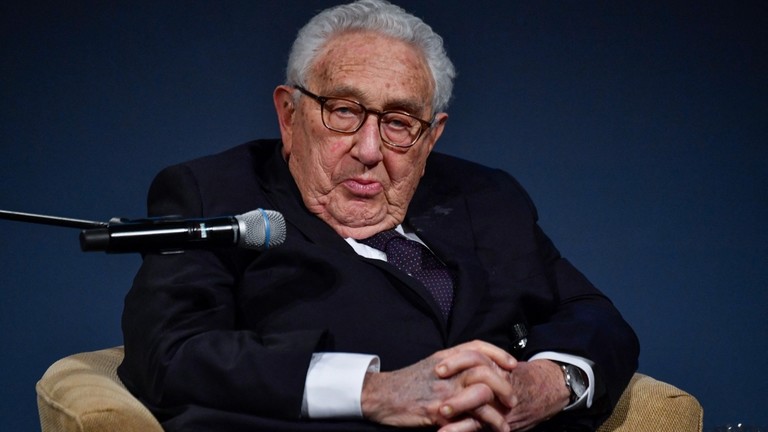
China has urged against Ukraine joining NATO, saying it would not improve security in the European region, after veteran US diplomat Henry Kissinger claimed membership would serve the interests of both Kiev and Moscow.
Asked about Kissinger’s comments during a Thursday press briefing, Chinese Foreign Ministry spokesman Wang Wenbin argued that Ukrainian NATO membership would only further inflame tensions.
“Ukraine should not become the frontier in a major power confrontation,” he said, adding that “to strengthen or even expand military groups is not a viable way to ensure the security of a region. One country’s security should not be achieved at the expense of the security of other countries.”
In an interview with the Economist published on Wednesday, Kissinger said European powers were pursuing a “madly dangerous” strategy by keeping Kiev out of the US-led military bloc, insisting Ukraine must not “become a solitary state just looking out for itself.” He claimed NATO membership would not only benefit Ukraine, but Russia as well.
“If I talked to [Russian President Vladimir] Putin, I would tell him that he, too, is safer with Ukraine in NATO,” the 99-year-old added, saying the move would prevent Kiev from making rash “national decisions on territorial claims.”
The Chinese spokesman went on to state that a “durable European security architecture” could only be created through dialogue. During a visit to Ukraine this week, special envoy Li Hui met with Ukrainian President Vladimir Zelensky, Foreign Minister Dmitry Kuleba and other senior officials to discuss Beijing’s views on a diplomatic resolution to the conflict.
Beijing unveiled a 12-point roadmap for peace in February which urged both Moscow and Kiev to resume direct negotiations. President Putin later said the Chinese plan was “in tune” with Russia’s position and hoped the proposal could serve as the basis for a future political settlement.
Western powers have dismissed the 12-point plan, with the European Union’s foreign policy chief Josep Borrell dubbing it “wishful thinking,” while the top advisor to Ukrainian President Vladimir Zelensky argued that it heavily favors Russia.
Direct Turkish-brokered talks between the two sides broke down in the spring of 2022. Since then, President Zelensky has ruled out any direct talks with Russia as long as Putin remains in power, and Moscow has rejected the terms for negotiations put forward by Kiev. Among other things, Ukraine’s proposal calls for Russia to withdraw its forces from all territories within Ukraine’s 1991 borders, to pay reparations, and to submit to war crime tribunals. Moscow has rejected the plan as “unacceptable,” pointing out that it ignores the reality on the ground and merely shows Kiev’s unwillingness to resolve the crisis through talks.
The US Is Receptive To Kissinger’s Suggestion To Revive Talks With China On A New Détente
BY ANDREW KORYBKO | MAY 19, 2023
Two new narratives were introduced into the West’s information ecosystem over the past week. The first concerns the need to adapt to multipolar processes by engaging more with the Global South, which was expressed by German Chancellor Olaf Scholz, former US National Security Council member Fiona Hill, and Goldman Sachs’ President of Global Affairs Jared Cohen all on the exact same day last Monday. The next narrative complemented this one and came two days later on Wednesday.
Global affairs guru Henry Kissinger’s lengthy interview with The Economist from late April was published on that day, in which he devoted considerable time explaining why the US should revive its talks with China on a New Détente that were unexpectedly derailed by February’s balloon incident. CNN then reported on that same day that “Biden administration looking at arranging high-profile visits to China by senior officials,” which suggests that it was briefed earlier about his proposal and heeded his advice.
The first narrative about engaging more with the Global South complements the second one about reviving talks with China on a New Détente in the sense that the former is one of the three prerequisites for successfully accomplishing the latter, at least according to how American policymakers likely view it. They want to signal that the US won’t voluntarily cede influence in the Global South to China, but instead plans to compete with it there via economic and diplomatic means.
This goal will be greatly advanced through a combination of pragmatic engagement with the Global South’s informal Indian leader, whose Prime Minister visits the US late next month, and coordinating between America’s “Build Back Better World” and the EU’s “Global Gateway” development initiatives. These subgoals also align with Kissinger’s suggestions about cooperating more closely with India as well as crafting an inspirational vision for this century (i.e. merging the West’s development initiatives).
The second prerequisite for successfully negotiating a New Détente with China upon the seemingly impending resumption of this process is to diplomatically displace its envisaged role in the Russian-Ukrainian peace process. In pursuit of this, the US wants to “de-Sinify” the scenario of a ceasefire after the end of Kiev’s NATO-backed counteroffensive, which explains its support of the African-led peace mission that was announced on Tuesday in between Monday and Wednesday’s new narratives.
What’s most interesting about this initiative is that it’s organized by the Brazzaville Foundation, whose French chairman Jean-Yves Olivier is known for his shadow diplomacy over the decades that was documented by Wikipedia. This suggests that their peace mission is secretly organized by France with the US’ tacit approval, if not jointly coordinated with it, which would advance their goal of diplomatically engaging with the Global South in parallel with “de-Sinifying” the Russian-Ukrainian peace process.
Both’s prospects would be bolstered by India’s participation in these efforts, which has its own interests in presenting itself to the world as a peace broker, especially throughout the course of its G20 chairmanship. These two prerequisites for enhancing the odds that the US successfully negotiates a New Détente with China concern the economic and diplomatic spheres respectively, while the third that’ll now be described deals with the military one.
“The US Is Rounding Up Allies Ahead Of A Possible War With China”, while “NATO’s Planned Liaison Office In Japan Will Accelerate The Expansion Of AUKUS+”, both of which will contribute to more effectively containing China in the Asia-Pacific. American policymakers apparently expect that the People’s Republic will accept this emerging regional military reality instead of it serving to preclude the resumption of their talks on a New Détente.
Not only that, but they seem to think that it could even give their side an edge of some sort in those negotiations too, or at least enable the US to speak to China “from a position of strength” as they see it. The message would be that this containment noose could tighten even more if Beijing doesn’t agree to resume such talks, not to mention if they fail to achieve anything tangible, thus making it a form of military blackmail when viewed from this perspective.
Altogether, the introduction of this week’s two complementary narratives into the West’s information ecosystem suggest that this de facto New Cold War bloc’s American leader is recalibrating its grand strategy. Policymakers appear to have concluded that their side can’t restore unipolarity, instead settling for managing multipolar processes in the direction of their interests as much as is realistically possible, to which end they must engage more with the Global South and revive talks with China on a New Détente.
The observations shared in this analysis shouldn’t be interpreted as predicting the success of these policies, but simply as arguments that this approach is indeed being attempted and was almost certainly influenced by Kissinger’s suggestions that he shared in his interview. He and The Economist are close to American policymakers so they likely passed his ideas along to relevant figures, after which they agreed with the gist thereof and subsequently began implementing them this week as proven in this piece.
Second largest Swedish party wants Stockholm to prepare for ‘Swexit’
By Drago Bosnic | May 19, 2023
As if the European Union didn’t have enough major problems already, now the troubled bloc is faced with the nontrivial prospect of a “Swexit”. Namely, senior officials of the second largest political party in the Scandinavian country, the Sweden Democrats, are now openly saying that their country needs to be prepared to leave the EU. This includes the party leader himself, Per Jimmie Akesson, who stated that “only by making the necessary preparations for ‘Swexit’ can the government maximize its bargaining power in Brussels”. The right-wing Sweden Democrats have long been frustrated by the power that the unelected bureaucrats in Brussels wield over their country, so this is hardly a surprising development.
However, even Eurosceptic Swedish parties usually refrain from such open anti-EU declarations, meaning that the bloc is gradually losing its power, even in previously somewhat pro-EU member states. On May 15, Akesson authored an article along with his Sweden Democrats fellow member Charlie Weimers, who also represents his party and his country as a Member of the European Parliament (MEP). The op-ed was published by the Stockholm-based Svenska Dagbladet daily, in which the authors explicitly stated that their intention is to ensure Sweden “maximizes its influence” in the EU, specifying several legal measures the country’s government must take to accomplish the stated goals.
First, the Swedish government must insist on making constitutional changes that would make it possible to introduce what Akesson and Weimers called a “referendum lock”. According to the authors’ reasoning, this would enshrine into law the requirement of a nationwide referendum before any further national powers can be renounced by Sweden and transferred to the unelected EU bureaucrats. The goal is to ensure that any further erosion of the Scandinavian country’s sovereignty is prevented if the Swedish people choose not to comply with it. The authors cited the examples of the United Kingdom and Denmark as an inspiration, as both London and Copenhagen previously adopted similar legal mechanisms.
“Only the knowledge that every decision on the transfer of power must be submitted to the citizens would slow down the worst abuses from Brussels,” Akesson and Weimers wrote in the op-ed.
Second, the country’s government must make the necessary preparations to leave the EU, as the troubled bloc should not take Sweden’s national interests for granted. The authors insist that the government must ensure it’s ready in case such a decision is ever made by the Swedish people and to formally legitimize any threat to withdraw from the EU in future negotiations with the troubled bloc. They further added that to accomplish this, Sweden needs to remove the clause that it’s an EU member from its constitution, as well as study the example of the UK during Brexit, while also training civil servants to ensure the process runs without any major issues. As previously mentioned, Akesson and Weimers see this as instrumental for improving the country’s negotiating position.
“In order for preparedness to be credible, it’s necessary that we remove the writings in the constitution that state that Sweden is a member of the EU … In addition, we should train a cadre of civil servants with the expertise to negotiate trade agreements and other things that we have delegated to the EU and study how Brexit could have been implemented better. The better we are prepared to leave, the more we will gain in future negotiations,” the authors added.
Akesson and Weimers believe these are the bare minimum requirements that will provide a solid backstop against any possible power-grab attempts by Brussels. In addition, the leader of the Sweden Democrats also wants an investigation to be launched into how the negative aspects of the Scandinavian country’s membership in the EU can be alleviated. Among other things, this also includes the issue of immigration, a major problem that the Sweden Democrats see as crucial for the country’s future. The right-wing party is the largest member of the country’s governing bloc, providing virtually all of its confidence-and-supply votes in the Riksdag (Swedish Parliament), although the Sweden Democrats are not directly taking part in Prime Minister Ulf Kristersson’s administration.
As per the Tidö Agreement to which all coalition parties agreed, Stockholm is to adopt a more restrictive immigration policy in return for support of the Sweden Democrats, something the more liberal-leftist opposition, informally supported by Brussels, staunchly disagrees with. And while Euroscepticism is still not the view of the majority of the Swedish electorate, it has steadily been growing in recent years, particularly as the disastrous policies supported by the EU have drastically eroded the well-being of the Scandinavian country’s citizens. Although Akesson himself acknowledges the fact that the majority still doesn’t support Sweden’s withdrawal from the EU (which has been the long-standing policy of his party), he certainly wants to capitalize on the growing support it’s been getting.
Drago Bosnic is an independent geopolitical and military analyst.
Featured Video

Elijah Magnier: Yemen’s strikes are shattering Saudi Arabia’s long-term strategy
or go to
Aletho News Archives – Video-Images
From the Archives
British weapons and personnel doing much of the killing in Yemen
Press TV – June 18, 2019
A detailed report published by the Guardian newspaper has shown how Britain is massively contributing to Saudi Arabia’s devastating war on Yemen as it suggests that London is not only supplying the bombs that fall on Yemenis, but it provides the personnel and expertise that keep the war going.
The comprehensive report by Arron Merat published on Tuesday showed that Britain was doing much of the killing in Yemen as the country continues to provide Saudi Arabia with everything it needs to turn its southern impoverished neighbor into a graveyard.
“Every day Yemen is hit by British bombs – dropped by British planes that are flown by British-trained pilots and maintained and prepared inside Saudi Arabia by thousands of British contractors,” said Merat in the report. … continue
Blog Roll
 Aletho News
- Netizens condemn Japanese drama for projecting Japan’s wartime atrocities onto Chinese characters
- Racist Seinfeld Dances for Joy as Bibi Unveils His New Map
- A West Bank War for Netanyahu’s Election Campaign, Could It Backfire?
- Yemen denounces European Parliament’s ‘hypocritical’ push to blacklist Ansarullah
- Qalibaf: UAE’s UN bid aims to ‘clear the runway’ for ‘Greater Israel’, whitewash genocide
- Pakistan reopens Iran border after boosting security: Report
- Why are so many Brazilians voting for Flávio Bolsonaro?
- Democrats Put Anti-Russia Agenda Ahead of American Workers
- Elijah Magnier: Yemen’s Strikes Are Shattering Saudi Arabia’s Long-Term Strategy
- Pentagon designates Chinese cultural centers national security threat
- If Americans Knew
- Latest updates from Israeli assault on West Bank
- Tourism Ministry launches free food truck tour in US
- “So Much Worse Than People Realize”: Never-Before-Seen Images Reveal Damage at U.S. Bases as Troops Describe Being Abandoned
- UK Bell Review Confirms Only Anti-Israel Attitudes Are Rising, Not Antisemitism
- DAILY UPDATE: Latest essential news on Palestine, Israel, & region
- DAILY UPDATE: Latest essential news on Palestine, Israel, & region
- Damning report shows the media must confront its failures on Gaza
- BBC senior broadcaster speaks out on Gaza coverage
- Netanyahu vows vast West Bank invasion in response to 20-minute skirmish that left 2 Israeli soldiers and 2 Palestinian fighters dead
- Tied up and tortured: Israel using US-made electroshock weapons on Palestinian detainees
- No Tricks Zone
- Sudden Stratospheric Warming, Powerful El Niño Combination May Lead To Extreme Europe Cold, Energy Crisis!
- Two New Studies Find Thwaites Glacier Melt Cannot Be Driven By Human Activity Or A Warming Ocean
- E-Cars Reduce CO2 Emissions By Only 41% Compared To Internal Combustion Engine Vehicles
- Predictions Made By Renowned Climate Professor Over Past Decades Have Been Proven To Be Poor
- New Study Suggests Large Regions Of The Pacific Ocean Have Been Cooling For The Last 80 Years
- Germany’s Green Energy Debacle: High Energy Costs Force Kahla Porzellan to Close After 182 Years!
- New Study: 50 Years Of The Most Aggressive ‘Net Zero’ Policies Can Only Affect The Global Climate By 0.03°C
- US September “Heat” Was No Record…Many Records Set Decades Ago
- Latest European Green Energy Debacle; Portugal’s Largest Flagship Solar Park Insolvent!
- Green Energy Debacle: German Expert Professor Fritz Vahrenholt Warns Of Severe Economic And Social Consequences

