Police tried to recruit café owner as Palestine Action spy
Al Mayadeen | May 30, 2026
A Manchester café owner and prominent supporter of the Palestinian cause has accused the British police of attempting to recruit him as an informant targeting Palestine Action, offering financial incentives and suggesting authorities could overlook certain minor offenses in exchange for cooperation.
Speaking to The Guardian on Saturday, Shams Sadiq, who owns two cafes in Manchester and has been active in pro-Palestine solidarity efforts, said the approach took place when he attended Ashton-under-Lyne police station on 15 May to recover electronic devices seized during a previous investigation linked to Palestine Action.
According to Sadiq, officers informed him that after examining his devices they knew he was “fully involved” with Palestine Action but said he would not face charges related to his arrest last year. He said the discussion then shifted toward securing his assistance.
“They said to me: ‘We need your help. Look, there’s benefits in helping us,'” Sadiq told The Guardian. “I’m like: ‘What kind of benefits? Financial benefits? Are you going to pay my taxes?’ They said: ‘Oh, we can help with things like that.'”
Sadiq said another officer suggested additional incentives were available.
“The other guy said to me: ‘Oh, there’s other benefits, too.’ They said: ‘We’re not saying you can go out and commit a serious crime but we can turn a blind eye to certain things.'”
When he jokingly asked whether they could remove his speeding tickets, Sadiq said the officers responded, “We don’t care about speeding.”
The 51-year-old believes the officers were attempting to recruit him as an informer because of his involvement in Palestine solidarity activities and his standing within Manchester’s Muslim community.
“He interpreted ‘help’ to mean ‘with their investigations [into Palestine Action] because they said I am involved and maybe be an informer. They also said I’m quite respected in my community, so maybe they think I would help them find Muslims in the mosque with extreme views.'”
Activism under scrutiny
The allegations emerge amid increasing scrutiny of pro-Palestine activism in Britain and growing concerns among campaigners over the use of counterterrorism powers against activists and community organizers.
Days before the alleged recruitment attempt, Sadiq said he was stopped and questioned at Manchester Airport under Schedule 7 of the Terrorism Act after returning from a holiday in Morocco.
He said officers questioned him for more than three hours about Palestine Action, Iran, and his personal finances, including details related to his mortgage. During the interrogation, he said officers also asked how he would respond if someone attending his mosque expressed extremist views. His electronic devices were seized during the encounter.
According to Sadiq, the same officers later met him at a Starbucks inside Terminal 2, where they returned the devices and apologized for the airport questioning.
Anti-terror powers
A vocal advocate for Palestine, Sadiq has participated in demonstrations and supported campaigns and cultural events highlighting Palestinian issues. His public support has previously made him a target, with one of his cafes subjected to harassment because of his pro-Palestine stance.
Sadiq said the officers also told him that they could provide protection for him and his family and gave him a contact number, making it clear that he did not have to decide immediately whether to cooperate.
He said he chose to speak publicly after rejecting the proposal, believing that public exposure offered the best protection.
“I feel like I need protection from the police rather than anything else. It’s scary that I’ve got this marker on my passport for doing nothing. If they’ve got something on me, then charge me.”
His solicitor, Simon Pook of Robert Lizar Solicitors, condemned the alleged conduct and questioned whether anti-terrorism legislation had been used as a pretext to pressure a political activist into collaborating with authorities.
“We’re unhappy that he was put in that position and offered inducements to work for the state,” Pook said. “Was the intention always to use the schedule 7 in order to offer the inducement? If that is the true intention, schedule 7 was used unlawfully, because it’s got to be used where you believe somebody may be involved in or in an act of preparation of terrorism.”
Greater Manchester Police declined to comment on the allegations.
Palestine Action ban sparks civil liberties concerns
The allegations come against the backdrop of a broader crackdown on Palestine Action, a direct-action movement known for targeting facilities linked to Israeli arms manufacturer Elbit Systems and other companies accused of supplying weapons used in “Israel’s” genocidal campaign in Gaza.
The organization gained prominence through occupations, blockades, and acts of property damage aimed at disrupting the production and shipment of military equipment destined for “Israel”. Supporters argue that the group’s actions sought to halt material support for the genocide in Gaza, while critics accused the movement of engaging in unlawful sabotage.
In July 2025, the British government designated Palestine Action a “terrorist organization” following a high-profile action at RAF Brize Norton, where activists entered the airbase and spray-painted military aircraft. The move marked the first time a direct-action protest group had been proscribed under British terrorism legislation, placing it in the same legal category as armed militant organizations.
The decision was widely condemned by civil liberties advocates, legal experts, UN rights experts, and pro-Palestine organizations, which argued that existing criminal laws were already sufficient to address any alleged offenses committed by activists. Critics warned that the proscription represented a dangerous expansion of counterterrorism powers into the realm of political protest and dissent.
Since the ban, thousands of people have reportedly been arrested across Britain for expressing support for Palestine Action, including activists, academics, religious figures, and anti-war campaigners. Supporters of the group say activists have faced heightened surveillance, airport stops, device seizures, lengthy investigations, and the threat of imprisonment for activities they view as part of a broader movement opposing Israel’s war on Gaza.
The controversy intensified in February 2026 when the High Court ruled that the government’s ban on Palestine Action was unlawful and disproportionate, finding that ministers had failed to properly justify the use of terrorism legislation against the group. However, the ban remains in force while the government appeals the decision.
For many Palestine solidarity campaigners, Sadiq’s claims reinforce concerns that anti-terrorism powers are increasingly being used to monitor, pressure, and gather intelligence on individuals involved in pro-Palestinian activism rather than to address genuine security threats.
Hamas: EU hits Gaza leaders with sanctions but ‘turns blind eye’ to Israel’s atrocities
Press TV – May 30, 2026
Hamas has condemned the European Union’s sanctions, slamming the bloc for “turning a blind eye” to Israel’s violations of international law while targeting Palestinian resistance groups and leaders.
“We condemn the decision by the European Union Council to broaden sanctions against the Hamas and Islamic Jihad movements and to include a number of their political leaders on its lists,” the Gaza-based resistance group said in a statement on Saturday.
Hamas added the sanctions are unjust and entirely biased in favor of the occupation’s narrative, reflecting a policy of double standards in dealing with the Palestinian cause.
“This decision comes as [Israel] continues to commit crimes of genocide, starvation, and forced displacement against our people and violates the ceasefire agreement, while the European Union turns a blind eye to these documented violations of international law and chooses to sanction political leaders who defend their people’s legitimate rights,” read the statement
“The attempt to criminalize the Palestinian resistance will not change the fact that our people are under occupation, their resistance is a legitimate right guaranteed by all laws and humanitarian norms,” the group highlighted.
Hamas noted that the targeting of political leaders confirms that these sanctions come as a response to pressure from the occupation and are not based on standards of justice.
The movement called on the EU to review its biased policies, cease providing political cover for Israel, and work to hold its leaders accountable instead of prosecuting the victims.
“We affirm that these measures will not undermine the will of our Palestinian people or their commitment to their legitimate national rights, especially freedom, self-determination, ending the occupation, and establishing the Palestinian state with Jerusalem as its capital,” the group stated.
The EU on Friday said that it had listed ten members of Hamas’ top political leadership body as subject to a travel ban and asset freeze, prohibiting making funds or economic resources available to those named, either directly or indirectly.
Since launching its genocidal assault on Gaza on October 7, 2023, Israel has killed more than 72,000 Palestinians and wounded at least 172,000 others, the majority of them women and children.
The Israeli war has also devastated Gaza’s civilian infrastructure, destroying hospitals, schools, sports facilities, power plants, water networks and residential neighborhoods across the besieged territory.
The widespread destruction and continuing blockade have displaced much of Gaza’s population, leaving Palestinians trapped in the besieged territory and heavily dependent on humanitarian aid that enters only in limited quantities.
“Balancing” Act at the New York Times
Nicholas Kristof Wrote About Israel’s Sexual Torture of Prisoners, the Next Day Isabel Kershner Penned More Unverified Rape Allegations Against Hamas
By Robin Andersen | ScheerPost | May 30, 2026
The New York Times attempted to ‘balance’ Nicholas Kristof’s documentation of the systematic rape of Palestinians by Israeli forces with yet another unverified rape ‘investigation’ claiming that Hamas had weaponized sexual violence on October 7. It was written by the paper’s pro-Israel Jerusalem-based reporter, Isabel Kershner.
Nicholas Kristof’s New York Times Op-ed piece titled The Silence That Meets the Rape of Palestinians, published on May 11, was based on documentation and grueling victim testimonies of rapes that Palestinians have experienced at the hands of Israeli security forces. Brutal and sadistic acts of sexual torture are described in a piece that triggered enormous attention even though human rights organizations have been documenting these same crimes for years now.
The Israeli human rights group B’Tselem has documented Israel’s sexual torture of Palestinian men, women and children calling the “Israeli prison system a network of torture camps.” Save the Children reported in July 2024 that Palestinian children in Israeli detention were facing “disease, increasing starvation, [and] abuse including sexual violence.” A Palestinian women’s rights organization warned that their documented 75 cases of rape and sexual violence against Palestinian women amounted to about 1% of what was actually happening in Israeli detention. Euro-Med Human Rights Monitor’s extensive report published on April 13, 2026, emphasized that the sexual torture was so bad it amounted to “another genocide behind walls.” They identified its purpose as a “systematic destruction of the body and identity.” The report emphasized the scope of “criminal responsibility,” by the collusion of state institutions that were creating impunity.
In a discussion about Kristof’s piece, Francesca Albanese, who has also documented brutal Israeli torture sites, told Al Jazeera’s UpFront that she had given a long interview about sexual torture to the New York Times as early as February 2024, but nothing came of it. Albanese went on to say she didn’t understand why the Times piece should have been “more important” than the extensive documentation of human rights monitors. But when Kristof finally acknowledged that Palestinians were being tortured and raped by trained dogs, (corroborated by a soldier) in Israeli prisons, it made headlines in the US and sent shock waves through Israel’s hasbara apparatus.
The agenda setting New York Times is a “paper of record,” with a journalism staff of 3000, about 7 percent of all journalists working in the US. The paper has also been a reliable source of pro-Israel messaging for years, especially after October 7, so when a well-respected human rights journalist wrote such an op-ed in its pages it was a public relations disaster for Israel and its propaganda machine went into high gear to counter the bad press. Zionists and genocide supporters protested in front of the Times building. Netanyahu was so outraged that he threatened to bring a defamation lawsuit against the paper. The Israel Foreign Ministry called the piece “blood liable” and accused Nicholas Kristof of writing “an endless stream of baseless lies and propaganda” that turned the “victims into the accused.”
It should come then, as no surprise that the paper attempted to “balance” Kristof’s essay by publishing a piece the very next day, on May 12, about another “two-year investigation” by Israel, that “concluded” that sexual violence by Hamas was widespread on October 7. Isabel Kirshner’s piece attempted to breathe new life into the thoroughly discredited and debunked original Times’ front-page ‘investigation’ titled Screams Without Words. Screams was first published on December 28, 2023, just as the South African legal case against Israel’s genocide was being presented to the International Court of Justice, and it served as a significant denial and justification for Israel’s genocidal violence at the time. Screams without Words can be described accurately (and has been) with the same words used by Israel’s Foreign Ministry to falsely describe Kristof’s piece; “an endless stream of baseless lies and propaganda.”
The timing of the now infamous rape story of 2023, along with its extravagant claims to evidence not found in the front-page article, had much to do with why, almost immediately, the piece drew critical attention from media analysts, independent investigative reporters, and human rights organizations. Withering criticisms of the story included an essay in Medium, calling it “crappy journalism,” saying it offered a “lesson on selection, slanting, and charged language, and why using words in these ways constitutes a poor substitute for solid evidence and reasoning.” An Egyptian feminist non-governmental organization (NGO) Speak Up, called the article a “disgraceful investigation,” and shamed the Times for claiming to provide readers with definitive evidence, while actually offering no evidence at all. Independent US investigators such as Electronic Intifada, The Grayzone, The Intercept, Mondoweiss and others, roundly debunked the fictionesque inventions continued within it. Sixty journalism professors wrote to the New York Times calling on the paper to commission an independent review of the article. It was “troubling to professors of journalism to see such a shoddy article be published without a retraction or an investigation,” Professor Deepa Kumar told Democracy Now!
The timing, the definitive assertions without evidence, the reliance on already discredited sources, the sensational writing replete with lurid content, the omissions, half-truths, misdirections, and the way the paper manipulated the family of a young Israeli female victim killed at the rave, all point to a case of journalism malpractice at the New York Times. “Screams Without Words” is an example, not of journalism, but of the power of persuasive myths and war propaganda.
The Complicit Lens: US Media Coverage of Israel’s Genocide in Gaza
The paper’s 2026 version of the Hamas rape story was penned by one of the Times’ most reliably pro-Israeli reporters, Isabel Kershner, and this new ‘investigation’ once again takes seriously, discredited Israeli sources that Kershner claims to be independent and reliable. At the center of the piece is Cochav Elkayam-Levy, a key Israeli source after October 7. Elkayam-Levy and her organization were central to Western media coverage after October 7, when she repeatedly presented the rape allegations against Hamas. However, as MintPress News reported, Israeli media later reported that “Elkayam-Levy and her commission had misled donors, exaggerated evidence collection efforts, and spread misinformation related to October 7 claims. The controversy surfaced shortly after she received the prestigious Israel Prize.” In Kersner’s new piece, extravagant claims are made about the thorough nature of the investigation, describing all the visual evidence now assembled. But Kershner isn’t allowed to publish the evidence. She writes; “The commission’s archive is closed to the public because of the graphic nature of much of the material, it said, and to protect the privacy of victims and their families.” The Times is asking its readers to trust the Israelis, Isabel Kershner, and the paper itself with its abysmal track record on this topic. Kershner does not mention the fact that early last year, Israel blocked a UN probe into possible Hamas sexual crimes of October 7, because according to Haaretz, they wanted to avoid an inquiry into the abuse of Palestinians in Israeli prisons.
Isabell Kershner at the New York Times
Kershner has been providing positive reporting for Israeli Security Force for years now. With Kirshner, polishing the image of the IDF is a family affair. The Jerusalem-based correspondent whose husband worked with the Israeli military complex says on her Times’ profile page, that says she “strives to be accurate, honest and fair.” Yet she failed to mention that her husband Hirsh Goodman, was working as a senior research associate at a national security think-tank, the Institute for National Security Studies (INSS). INSS’s website boasted about the group’s “strong association with the political and military establishment.” Goodman’s job, at least in part, entailed “shaping a positive image of Israel in the media.” An examination of articles that Kershner wrote or contributed to from 2009 to 2012 by FAIR revealed that she overwhelmingly relied “on the INSS for think tank analysis about events in the region.” The Times has not disclosed Kershner’s connections to INSS.
Reporting on INSS, Haaretz cited published papers that backed the “Dahiyah Doctrine,” an Israeli military doctrine that called for disproportionate force to be used on civilian infrastructure in Gaza and Lebanon during operations against Hamas and Hezbollah. Since Ovtober 7, this doctrine has been extensively followed. Writing for FAIR, Alex Kane reported that the Dahiyah Doctrine was applied in 2008–09 during Israel’s invasion of Gaza, and goes on to explain that “Goodman’s job within that context was spin.” Because disproportionate violence resulting in many civilian casualties could lead to charges of war crimes, Goodman understood that “Israel must devise a strategy to impact positively on international and Arab public opinion and overall disseminate its message more effectively.” INSS messaging was certainly disseminated effectively in the New York Times, “From 2009–12, Kershner wrote or contributed to 17 articles that quoted officials from the INSS, far more than other comparable think tanks.
Though Kershner never used her husband as a direct source, as a Society for Professional Journalism (SPJ) ethics expert Kevin Smith, told FAIR, this is basic ethics 101, these relationships are not healthy for unbiased news coverage. “You cannot expect trust or to maintain credibility from the public when, before they read a word of your copy, you have engaged in an act of deception by not disclosing your potential conflicts.”
In her post-October 7 coverage, Kershner’s hand in promoting the Israeli military can be easily detected in her writing. In an article from January 2024, well into Israel’s genocidal violence in Gaza, Kersner wrote; “Israeli Women Fight on Front Line in Gaza, a First.” Kershner continued, “After a long struggle for acceptance, Israel’s female combat soldiers are pushing new boundaries after rushing into battle on Oct. 7.” We learn that a woman now “commands a company of 83 soldiers, nearly half of them men. It is one of several mixed-gender units fighting in Gaza, where female combat soldiers and officers are serving on the front line for the first time since the war surrounding the establishment of Israel in 1948.” There are also two all-women tank crews on the ground in Gaza. Kershner calls women’s new role in the military, a progressive victory over “ultraconservative rabbis and religiously observant soldiers” by “feminists, secularists and critics of the country’s traditionally macho culture.”
Even as she writes the story, she seems to acknowledge that it serves a PR role for the military, by bolstering the new positive image of the IDF. She asserts that women “combat soldiers have become symbols of progress and equality, appearing on magazine covers and featured in television news profiles.”
Writing from a feminist peace perspective, Joyce Chediac notes that Palestinian women’s groups have called the genocide a feminist issue and are urging all those who value women’s rights to support a ceasefire. As Kershner lauded women in Israel’s army, Joyce Chediac questioned their role in the violence:
Are the two tanks operated by women among those involved in the storming of Al-Khair hospital in Khan Yunis, arresting their staff, and preventing ambulances from rescuing the wounded? Are the women in combat for the first time among the snipers shooting Palestinians dead as they search for food or water for their families? Are they guarding the bulldozers now flattening huge swarths of Khan Yunis, forcing pregnant women to give birth in freezing tents because their homes were destroyed and they are blocked from hospitals?
Chediac concludes that, “equal gender opportunity to commit genocide is a cruel and obscene mockery of women’s rights.” Providing cover for Israel’s military does not advance the rights of women, it sets them back. The concept that female military power is progressive has helped sugarcoat the genocidal violence and atrocities carried out by the Israeli military.
Testimony gathered by B’Tselem in 2024, confirms that female soldiers have been involved in mistreating detained prisoners in Israel’s system of torture camps. A 39-year-old mother of five from Gaza City told B’Tselem, “On December 31st we were taken out of the cage and dragged to a bus, like animals. The bus started driving and the whole way, the female soldiers guarding us wouldn’t let us lift our heads. They swore at us, hit us on our hands, and took pictures of us. After some time, the bus stopped. We were taken off of it… A female soldier grabbed us by the head and ordered us to kiss the Israeli flag. Another female soldier bashed my head against the side of the bus.”
Balancing legitimate reporting that includes reliable witness testimony confirmed by multiple human rights investigations over a period of years cannot be not done by publishing unverified allegations from discredited sources. Alan MacLeod noted a recuring media pattern here that applies to the New York Times’ reporting on Israel; “whenever scrutiny intensifies around Israeli abuses against Palestinians, major Western outlets redirect attention toward unverified claims against Hamas to justify Israel’s genocide in Gaza.”
Balancing Kristof’s rare acknowledgment of Israeli war crimes with reporting by a pro-Israel, biased journalist citing discredited sources repeating unverifiable allegations was a shameful, and failed, attempt to appease the state of Israeli as it expands its crimes of war and occupation into Lebanon for a Greater Isreal. The Times would do better to simply report the truth and stop catering to hasbara and the false narratives that facilitate Israel’s on-going genocidal violence.
Material in this piece was drawn from Chapter 4, “A Compromised Media Landscape,” and from Chapter 8, “The New York Times Rape Story: War Propaganda and Trauma Porn,” in The Complect Lens: US Media Coverage of Israel’s Genocide in Gaza, by Robin Andersen
Robin Andersen is professor emerita of media studies at Fordham University and an award-winning author of a dozen single- and co-authored books. Her work examines film, television, and media coverage of war, the environment, politics, and elections. She edits the Routledge Focus Book Series on Media and Humanitarian Action, serves as a Project Censored Judge, and contributes to the annual State of the Free Press. Andersen is on the Board of Directors of Fairness and Accuracy in Reporting (FAIR), where she also writes regularly, and is an Izzy Award Judge for the Park Center for Independent Media. Her writing has appeared in CounterPunch, LA Progressive, The Progressive, Salon, Common Dreams, and ScheerPost, among others.
The Guardian Runs A Smear Piece Against Anti-War Journalist For Exposing The U.S./Israeli War On Iran
The MI6 Media Is Again Smearing An Anti-War Journalist

The Dissident | May 30, 2026
Of all the media around the world, there is no country’s media that is more controlled and infiltrated by its security state than the British media.
This is best underscored by a recent smear piece published in the Guardian by tech reporter Aisha Down, which slanders British journalist Bushra Shaikh, who has reported on the U.S./Israeli war on Iran from the ground.
The article alleges Bushra Shaikh “went on two state-sponsored tours of Iran this spring where she met senior officials and was ‘active’ in spreading the regime’s message” only to later admit to having no evidence to back up this claim, writing, “It is unclear whether Shaikh and others covered their own expenses or were paid to do the trip”.
The Entire Piece Is Based On A Blog Post Smear Piece
The entire smear is based on a “report”, in reality a blog post, by a shady outfit which claims to be a “fact-checking” organisation called “Factnameh”.
The “report” that the article entirely bases its claim on is in reality a blog post on Substack, which baselessly smears the few Western journalists who reported on the ground on the U.S./Israeli war crimes committed in Iran.
The blog post claims that Bushra Shaikh’s on-the-ground reporting on Iran “demonstrates how the (Iranian) state utilises these figures to manipulate Western algorithms” without giving a shred of evidence to back this up.
In the most bizarre section of the blog post, Factnameh claimed that Bushra Shaikh was engaging in “a highly calculated pattern of social media manipulation” because she tweeted about Iran, “almost exclusively during critical events, such as the intensification of military conflicts, ceasefires, and nationwide protests.”
In other words, she engaged in “social media manipulation” because she covered news topics while they were happening.
The blog post also claimed she achieved a high social media following “by routinely targeting controversial topics and engaging in confrontational discussions that drew attention to her videos” (in other words, using social media the same way anyone else would).
It also complained that “Her online narrative consistently framed Western media and elites as hypocritical and corrupt, while portraying Iran as a rational, restrained country merely defending itself against Western aggression” a.k.a the truth.
The rest of the blog post simply complained that her reporting on the ground in Iran did not match up with CIA/Mossad narratives, such as when “she filmed herself walking unveiled through the bazaars of Tabriz and Tajrish”, “visited an Armenian monastery in Isfahan” and reporting from protests which showed “that the crowds did not want war”.
In other words, debunking the cartoonish Western portrayal of Iran’s treatment of women and religious minorities, and showing that maybe Iranians aren’t cheering to have their country carpet bombed by the U.S. and Israel.
Inside ‘Factnameh’
Factnameh, the shady organisation that the Guardian based its article on, was created by a Canadian organization called ASL19.
ASL19, according to the outlet the Verge, was created in 2009 – by Ali Karimzadeh Bangi, who came from the University of Toronto’s Citizen Lab project – in order to “promote a free Iranian internet” during the “Green Revolution” protests in Iran of 2009.
At the time, the Verge noted, “the US, Canada, and private donors were offering tens of millions of dollars in grant money for anyone who could build digital tools and give Iranians a reliable way to access them”.
The outlet also added that “Bangi’s connections at the University of Toronto’s Munk School of Global Affairs gave him an early line on (U.S. and Canadian) government-funded projects like the multimillion-dollar Digital Public Square initiative, which funded digital tools for political opposition groups around the world.”
Along with being a tool of Western government to destabilise Iran, ASL19 has been plagued with allegations of sexual assault within the organisation.
Ali Karimzadeh Bangi, the Verge noted, “appeared in court on charges of sexual assault and forcible imprisonment” and was “forced to cut ties with ASL19 entirely”.
The outlet added, “In early 2009, separate charges of sexual assault were filed against Bangi, although they were withdrawn before reaching court. The Verge has also learned of at least one separate incident in which Bangi used a nondisclosure agreement to silence a staff member in the wake of their romantic relationship”.
According to the article, written in 2018, “Many former employees of ASL19 see the charges as part of a larger pattern.”
As for Factnameh, the subsidiary of ASL19, it is edited by Farhad Souzanchi, who has baselessly claimed that Iran was behind protests against the genocide in Gaza on college campuses, claiming that “Over the years, Iranian media, officials, and the country’s Supreme Leader himself have repeatedly tried to influence international public opinion against Israel”.
Factnameh has published lies to cover up Mossad infiltration in Iran. In one blog post, the outfit claimed that a New York Times report which heavily implied Mossad infiltration of the protests in Iran in January does not make “any reference to the January 8th and 9th protests being a Mossad plan to encourage Trump to attack Iran” adding, “Iran’s state media has repeatedly misrepresented international news coverage and reports”.
In reality, the article heavily implied that there was Mossad involvement in the January protests, without explicitly saying it, writing:
As the United States and Israel prepared to go to war with Iran, the head of Mossad, Israel’s foreign intelligence service, went to Prime Minister Benjamin Netanyahu with a plan.
Within days of the war’s beginning, said David Barnea, the Mossad chief, his service would likely be able to galvanize the Iranian opposition — igniting riots and other acts of rebellion that could even lead to the collapse of Iran’s government. Mr. Barnea also presented the proposal to senior Trump administration officials during a visit to Washington in mid-January.
Mr. Netanyahu adopted the plan. Despite doubts about its viability among senior American officials and some officials in other Israeli intelligence agencies, both he and President Trump seemed to embrace an optimistic outlook. Killing Iran’s leaders at the outset of the conflict, followed by a series of intelligence operations intended to encourage regime change, they thought, could lead to a mass uprising that might bring about a swift end to the war.
The Israeli newspaper Ynet, however, directly confirmed that the Mossad had infiltrated the protests, writing, “David Barnea was appointed head of the Mossad in 2021. Iran had been the organization’s main arena of operations for years. Barnea ordered a dramatic change in an area that had been marginal until then – driving influence within the general Iranian public. Under him, this area became central to the campaign against Iran … faced with a regime that is all poison, Israel has set up its own poison machine. The organization began four years ago and reached operational maturity two and a half years ago. This is a weapons system that, if activated at full power, could be deadly far beyond the boundaries of the social network … in January of this year, tens of thousands of Iranians took to the streets, at their own pace. The enormous work that Israel had put in was behind the demonstrations”. (Emphasis: Mine)
Factnameh has even gone as far as to defend U.S/Israeli war crimes against Iranian civilians.
In one blog post, the outfit claimed that “In Iran, mosques and other religious sites function not only as places of worship but also as components of the country’s security infrastructure. Many host local bases of the Basij, a paramilitary force operating under the IRGC, with numerous neighbourhood units co-located in or around these mosques. This overlap embeds security and military activity within civilian neighbourhoods, effectively extending the battlefield into residential areas. As a result, when aerial strikes target elements of the country’s security apparatus, they often occur in densely populated areas, increasing the risk to surrounding civilians”, blatant propaganda to justify U.S./Israeli bombings of civilians.
The Guardian Wants Bushra Shaikh Investigated By The Security State
The real purpose of the Guardian hit piece becomes clear when it writes, “Earlier this year, Shaikh’s tours sparked criticism from Iranian digital rights activists, who noticed she appeared to have access to the internet that ordinary people did not, suggesting her trips were at the invitation of the regime. Iranian activists, some affiliated with the Women, Life, Freedom movement, circulated an online petition suggesting Shaikh should be investigated for sanctions violations.” (Emphasis:Mine).
To back up calls for Bushra Shaikh to be investigated by the British security state, the Guardian links to a petition started by zionist Nicholas Lissack which says, “We demand that the UK Government, OFSI, HMRC, and FCDO immediately investigate UK citizen Bushra Shaikh for potential breaches of the Iran (Sanctions) Regulations 2023 and the Foreign Influence Registration Scheme (FIRS).”
Nicholas Lissack, a self-described “Western Civilisationist” with a British and Israeli flag in his Instagram bio, has publicly agitated for a war with Iran to install the son of the U.S. backed Shah of Iran, posting only a day ago:
This is it. Our last chance to crush the terrorist Mullahs and liberate Iran.
President Trump: Choose humanity. Free the Iranian people from this Islamist nightmare and enter history as a hero.
Abandon them—and be remembered as its greatest traitor.
Make the call.
Free Iran. King Reza Pahlavi. Javid Shah!
He has also written :
President Trump, the time to strike Iran is now.
They’ve repeatedly broken the ceasefire, rejected nuclear negotiations, and tried to assassinate your daughter Ivanka.
Honour your promise to the tens of thousands of slaughtered Iranians: Free Iran now.
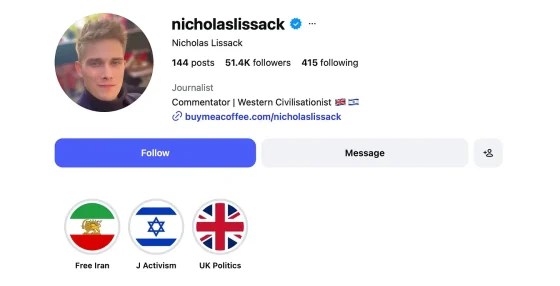
Pictured Above: Instagram profile of Nicholas Lissack, who started the petition cited in the Guardian.
Yet again, instead of investigating actual power, the MI6 media in the UK instead spends its time slandering an anti-war reporter and attempting to get her investigated.
A second corruption storm in Ukraine, and satanism in its government
By Dmitri Kovalevich | Al Mayadeen | May 30, 2026
This year, May 20 marked seven years since Volodymyr Zelensky came to power in 2019. He and his associates have seized control of the Ukrainian state and canceled further elections required by the Ukrainian constitution.
Seven years ago, Zelensky’s arrival in power followed a corruption scandal that ensnared his predecessor Petro Poroshenko and his inner circle. At the time, Zelensky promised to step down voluntarily if something similar ever happened to him and his inner circle. Poroshenko was elected a mere three months following the violent, paramilitary coup in Kiev. That election featured threats and the banning of candidates and media outlets opposing or even questioning the coup.
Since 2019, corruption scandals have only grown, but Zelensky is showing no intention of ceding to rising calls that he and his regime step down and convene a new, national election. Instead, his regime continues to consolidate its power amid rising opposition to its policies. Above all, they are still waging a proxy war against the Russian Federation, backed by the Western powers.
Western politicians are continuing to turn a blind eye to the regime and its sinking support among the Ukrainian population. They are ignoring the corruption scandals enveloping the regime, including the theft of Western aid (as graciously paid for by Western taxpayers). So long as Zelensky and his regime are at war with Russia, the West will remain content. Zelensky himself understands perfectly well that the war course with Russia is a fight for his political life. If the war ends, he will lose his ‘presidential’ immunity. Zelensky’s electoral mandate expired in April 2024, more than two years ago.
“Why are Europeans silent about the corruption surrounding Andriy Yermak?” asks former legislator of Zelensky’s part/machine Alexander Dubinsky on Telegram on May 17, writing about Zelensky’s former chief of staff. Yermak resigned from his position as the head of the Office of the President of Ukraine after his home was raided by anti-corruption agents on November 28, 2025. In May 2026, Yermak was formally named a suspect in a corruption investigation. He was arrested on May 14 and stayed four days in prison before being released on bail.
“Why the silence over the fact that none of the widespread corruption that Yermak fostered would exist without Zelensky’s usurpation of power? It’s because the regime’s goal is to weaken the Russian Federation, and Zelensky happens to remain the best manager for that.” According to Dubinsky, this also explains why there has been no reaction by European governments to the systemic human rights violations which characterize Zelensky’s regime.
Dubinsky emphasizes that, in contrast, even those Ukrainians who do not wish to fight and are evading military conscription are treated by the European powers as ‘problems’ if not enemies.
In May, a new round of the corruption scandal surrounding Zelensky began. Last year, recordings were published of his associates discussing corruption schemes in the energy generation and transmission industry and also in the procurement of body armor (as this author has previously reported). The main figures involved managed to flee to “Israel” at the time. Yermak formally resigned six months ago but has continued to informally oversee appointments and state policy even while under investigation.
During the now long war with Russia, the presidential office in Kiev has become the primary or sole decision-making center, stripping national legislators, local authorities, and the Ukrainian judiciary of their powers.
Zelensky said that he had come to power with Yermak and would leave with him (another lie). Last year, the Financial Times reported that Zelensky and Yermak had been living together in a bunker since the outbreak of war with Russia in 2022, sleeping in side-by-side beds.
In May, a new batch of audio recordings has been made public in multiple, small releases. In these, Yermak continues to be mentioned. One case concerns the building of personal mansions in an exclusive community near Kiev for Zelensky, Yermak, and two other individuals in their inner circle. The land was illegally acquired from the state.
Anti-corruption authorities are also accusing Yermak of laundering nearly half a billion hryvnia US$11.3 million for his personal gain.
Following these latest revelations, Yermak was placed in pretrial detention for the duration of the investigation, with the right to be released on bail. But just two days later, 140 million hryvnia in bail was made, and Yermak was released. The Ukrainian online publication Strana reported that Zelensky made considerable efforts to organize a fundraiser for his ally’s release, without which they might still be searching for the money to bail the man out.
The corruption case against Yermak is indirectly a case against Zelensky, although as long as the latter remains in office as president, he enjoys immunity from any and all criminal prosecution.
As reported on Telegram on May 15 by Artem Dmitruk, a former legislator of Zelensky who fled to London where he continues to reside, Zelensky responded to a question by Bloomberg News on July 4, 2024 about whether Andriy Yermak had excessive influence. Zelensky replied, “Yermak is a powerful manager, one of the most powerful managers on my team. I respect him for the results. He does what I tell him to do. And he gets the job done.”
Today, Andriy Yermak is officially a suspect in a criminal case involving particularly serious charges. According to the criminal investigation, the case involves the laundering of hundreds of millions of hryvnias, as well as other incidents that have already become the subject of a public inquiry. Thus, Zelensky himself has acknowledged that Yermak has acted on Zelensky’s direct instructions, writes Dmitruk.
In other words, all of Yermak’s decisions, actions, and results are not his personal initiative alone, but rather the fulfillment of tasks set by the “president” and his entourage. In light of these scandals, people in Ukraine are asking: who are the ‘instigators’ and who is really behind the anti-corruption activists who have decided to rein in Zelensky’s inner circle?
Strana reports at some length on May 7 that a release of wiretaps concerning businessman Timur Mindich, a close friend and associate of President Volodymyr Zelensky, has predictably sparked renewed pressure on the government. It says the anti-corruption investigation (a key part of what the publication calls an emerging “anti-Zelensky coalition”) is focused on three individuals: National Security and Defense Council Secretary Rustem Umerov, another close friend of Zelensky named Serhiy Shefir, and Andriy Yermak. The report notes that anti-corruption bodies in Ukraine are linked to and funded by the government of former US President Joseph Biden and by current politicians in Europe.
The report provides more detail on what it terms the ‘anti-Zelensky coalition’. The anti-corruption scenarios are dangerous for the governing elite in Ukraine, risking a loss of funds the West provides for the war and a loss of the levers of power allowing the continued plundering of the Ukrainian population.
Ukrainian political analyst Kost Bondarenko is convinced that any prosecution of Yermak will drag on for a very long time and then fall apart. Yermak will ultimately walk away scot-free, writes Bondarenko, while any court rulings will be temporary in nature, intended merely to calm public outcry while demonstrating that post-2014 Ukraine still has a fair judicial system. “First and foremost, this is a show for the West,” he writes, emphasizing that behind any ‘anti-corruption’ investigations lie other corrupt officials clearing their own paths to power and their own financial flows.
Zelensky’s former press secretary Yulia Mendel speaks out
The filing of criminal charges against the ‘second most powerful person’ (Yermak) in the Ukrainian state coincides with the release of an interview on May 11 with Zelensky’s former press secretary, Yulia Mendel. She was interviewed by right-wing blogger Tucker Carlson. In it, she hints several times that Zelensky uses drugs and is directly involved in corruption schemes. Furthermore, according to her, Zelensky and Yermak are extremely narcissistic individuals.
“Yermak knows he is a narcissist and knows that Zelensky is a narcissist too. They are two malicious, paranoid narcissists. Both are on the defensive. It really is two kinds of sick minds,” says Zelensky’s former secretary, who has fled to the US.
According to Mendel, one minister was invited into an office where Zelensky, Yermak, and one other person were present. There was a bag of dollars on the table. Zelensky suggested that the man receive money informally in cash, in addition to his official salary.
Mendel argues that Zelensky has never intended to step down from the presidency. “We’re here to stay,” Zelensky has said, according to Mendel. She says he has placed particular emphasis on propaganda, demanding an aggressive propaganda campaign and going so far as to cite ‘goebbels’ as a model, referring to Nazi Germany’s propaganda minister Joseph Goebbels.
Ukrainian economist Daniil Monin notes that the arrest and detention of Yermak on May 14 followed Mendel’s interview on May 11. He believes this was not a coincidence. “A systematic process of discrediting Zelensky has begun in Ukraine, and this is probably a good thing from the perspective of bringing the war to an end. But the problem is that the people initiating such actions are themselves ideologically vacuous and typically pursue personal interests rather than the interests of Ukraine,” he writes.
Black magic at work in Kiev
On May 12, more details emerged in the case of Yermak that corroborate long-standing reports that Ukrainian authorities base their decisions in part or in whole on certain ‘otherworldly’ considerations. Prosecutors from the Special Anti-Corruption Prosecutor’s Office stated at Yermak’s pretrial hearing that one of Yermak’s items of correspondence mentioned a fortune-teller named Veronika Fengshui, whom the man has reportedly consulted regarding important personnel decisions, including the appointment of prosecutors and ministers.
“While Ukrainian diplomats have been convincing the West of ‘European-quality governance’ prevailing in Ukraine, personnel decisions, conflicts within the government, and strategic issues have reportedly been discussed with an astrologer,” writes the Ukrainian publication Argument on May 17. It notes that Yermak even discussed issues related to gas and energy supplies with the fortune-teller, based on her esoteric beliefs.
In April, the Ukrainian publication Ukrainska Pravda, citing sources close to Zelensky, reported that anti-corruption agencies confirmed the use of numerologists and tarot readers in the president’s office in the making of decisions and key appointments.
Last year, during the NABU’s first investigation into Yermak, former legislator Ihor Mosiychuk reported that a search of Yermak’s belongings had uncovered “voodoo dolls, masks, and satanic stars,” as well as bracelets and tattoos bearing related symbols. “All of this indicates that Yermak belongs to one of the occult sects,” the former legislator claimed.
On January 31 of this year, Yulia Mendel stated that Yermak practiced magic and had even brought certain sorcerers to Kiev. All this mystical nonsense, straight out of a cheap horror movie, has literally entangled Ukrainian politics.
Ukrainian political analyst Kost Bondarenko wrote earlier this year that in times of deep political turmoil and crisis, there is typically a surge in demand for all kinds of charlatans. Think of the mystic Grigori Rasputin, who advised Czar Nicholas II during the dying years of the Russian monarchy. According to Bondarenko, only future historians will be able to understand how many events in Ukraine related to the war and Zelensky’s actions were not the result of external influence or political calculation but rather the consequence of numerological formulas and communication with spirits.
Ukrainian political strategist Andriy Zolotaryov says he feels very uneasy knowing that “a Voodoo-type cult has taken root in Koncha-Zaspa” (an elite village near Kiev where rich families of legislators and ministers live). Commenting on Yermak’s fascination with all sorts of occult practices, Zolotaryov notes that the man made state decisions, yet, “at one time he had fortune-tellers, then they brought in Kabbalists, followed by Colombian sorcerers.” In his view, this indicates a lack of knowledge and competence and explains the Ukraine regime’s overall slide into backward-looking, archaic thought.
A great irony of fate lies in the fact that the country named Ukraine once pioneered the building of rockets to explore space, whereas today it is led by obscurantist figures who believe in charlatans, spirits, and all manner of concocted, evil forces.
Ukraine ‘deliberately’ struck Europe’s largest nuclear plant – Rosatom
RT | May 30, 2026
The Ukrainian military attacked Russia’s Zaporozhye Nuclear Power Plant (ZNPP), puncturing a hole in the machine hall of one of the facility’s units, Aleksey Likhachev, CEO of the Russian state nuclear corporation Rosatom, has said.
The ZNPP – which has repeatedly been attacked by Kiev forces over the past years – came under a new attack on Saturday, with a fiber-optics-guided drone making it to the machine hall of the sixth power unit of the plant. Given that such munitions are guided by their operators until the impact, the strike was carried out deliberately, and any “theories of an accidental hit” can be ruled out, Likhachev stated.
“One could, if I may put it this way, ‘congratulate’ the entire international community – this is the first-ever deliberate attack on the nuclear power plant’s main equipment, with a penetrative explosion and damage to the machine hall,” he said.
“The Ukrainian armed forces repeatedly cross not just red lines, but the very boundaries of common sense. What to expect next? Strikes directly on the turbine? The reactor hall? The reactor and its safety systems?”
Russia has repeatedly drawn the attention of the international community to the “extremely dangerous behavior” on Kiev’s part, the nuclear chief added. Many appear not to take the continuing attacks on the ZNPP “seriously,” while a potential nuclear incident at the plant could spread well beyond Russia and Ukraine, affecting those believing themselves to be “completely safe,” Likhachev warned.
Radiation levels remain normal at the site, the ZNPP said in a statement. The attack caused no casualties or “critical damage” to the facility, it added. Emergency teams are currently accessing the damage sustained by the machine hall, with the situation remaining under “full control,” the ZNPP stressed.
In recent weeks, the Ukrainian military has ramped up attacks on the plant, repeatedly striking structures within its perimeter and targeting the facility’s employees. The ZNPP came under Moscow’s control early in the conflict and has been operated by Rosatom after the Zaporozhye Region voted to join Russia in a referendum in the fall of 2022.
Five Americans injured in Iranian missile strike on Kuwait base: Report
Press TV – May 30, 2026
An Iranian ballistic missile attack on a Kuwaiti air base has wounded several American military personnel and caused serious damage to two US MQ-9 Reaper drones, according to a new report.
The American news outlet Bloomberg, citing an informed source, said in a report published on Saturday that the attack on the Ali Al Salem Air Base resulted in minor injuries to approximately five individuals, including US service members and contractors.
It also caused significant damage to two MQ-9 Reaper drones, with one reportedly destroyed and another heavily damaged. Each drone is valued at around $30 million.
According to Bloomberg, Kuwaiti air defences intercepted an Iranian Fateh-110 missile before it reached its intended target. However, debris from the intercepted projectile fell onto the US-operated Ali Al Salem Air Base, causing the injuries and damage.
The latest development comes amid heightened tensions between Washington and Tehran.
On Thursday, US Central Command (CENTCOM) claimed that Iran had launched a missile toward Kuwait, describing the action as a “gross violation of the ceasefire.”
In a statement issued later in the day, Iran’s Islamic Revolution Guards Corps (IRGC) said it had deliberately targeted the US base, noting that it had been used to launch an earlier American attack.
The IRGC went on to say that US forces had conducted a strike using aerial projectiles against a location near Bandar Abbas airport earlier that morning, describing its missile attack as a warning to the US.
It also vowed that any future acts of aggression would be met with a stronger response, stressing that responsibility for any escalation would rest with the party initiating hostile actions.
The US and Israel started an aggression against Iran on February 28, some eight months after they carried out unprovoked attacks on the country.
Iran began to swiftly retaliate against the strikes by launching a barrage of missiles and drone attacks on the Israeli-occupied territories as well as on US bases in regional countries.
On April 8, forty days into the war, a Pakistan-brokered temporary ceasefire between Iran and the US took effect.
Negotiations ensued in the Pakistani capital, Islamabad, but stopped short of an agreement amid Washington’s maximalist demands and insistence on unreasonable positions.
The Collective West, U.S., EU, and NATO, has morphed into a terrorist network
Strategic Culture Foundation | May 29, 2026
The murder of 21 Russian teenage students at a teacher-training college last week was an abominable moment of truth with far-reaching, grievous implications.
A grim, consequential watershed in the West’s conflict with Russia has arrived.
The victims were mainly girls aged between 14 and 18 who were killed when their university dormitory in Starobelsk, Lugansk, was attacked overnight on May 22.
What is absolutely revealing is how the Collective West has shown no remorse or restraint about the crime, going as far as denying responsibility and adding insult to the memory of the dead. The perpetrators have an obscene sense of impunity and inhumane entitlement.
The attack involved 16 drones that targeted the college in a wave of three assaults. There can be no doubt that the air strike was a deliberate act. That makes it an act of cold-blooded mass murder; an act of terrorism.
Vassily Nebenzia, Russia’s ambassador to the United Nations, stated: “The blood of the children from Starobelsk is on the hands of the West whose nations are supplying the terrorist regime [in Ukraine] with money, intelligence, weapons, and ammunition for years, inspiring it to commit new crimes against the civilian population, and then covering it up by presenting the Kiev regime as a victim.”
The corrupt NeoNazi regime in Kiev under Vladimir Zelensky and his cronies is only a bit player in this crime. The regime, which, by the way, gave burial honors to a World War Two Nazi collaborator this week, is merely the scum atop the Western criminal organizations behind this and other atrocities, and indeed the entire conflict with Russia.
Several respected international authorities have repeatedly pointed out that the nearly five-year war in Ukraine that erupted in February 2022 is the culmination of a long-term policy to embattle Russia with NATO aggression. Professors John Mearsheimer, Jeffrey Sachs, Alfred de Zayas, among others, have cogently explained how this conflict in Europe – the biggest since WWII – has come about.
The Kiev regime has been armed to the teeth by the United States and its Western partners, bankrolled by Washington and the European Union, and directed by NATO military intelligence. The attacks on Russian civilian centers could not happen without the direct support of the “Collective West”.
More recently, the European Union, which has emerged as the de facto political and fundraising wing of NATO, has stepped up its funding and coordination of drone armaments for the Kiev regime. Britain has also become an important supplier of Ukrainian drone technology, while the Baltic states and Finland are acting as launch sites for deeper strikes into Russia.
A drone crash in Romania this week elicited much theatrical condemnation of Russia as the perpetrator. More likely, given the surge in drones operating from NATO states, the Romanian incident was an own goal or a Ukrainian false-flag provocation. Telling, too, was the paroxysm of Western media coverage blaming Russia for the “reckless” drone, compared with the negligible reporting by these same media on the massacre in Starobelsk only days before.
The European NATO states are in effect becoming the Luftwaffe of the Kiev regime. As Russia’s envoy, Dmitry Polyansk, to the Organization for Security and Cooperation in Europe, warned this week, the drums of war are beating louder across the continent. European politicians like German Chancellor Friedrich Merz are calling for more NATO forces to build up along Russia’s borders, while the EU’s so-called top diplomat, Kaja Kallas, disparages peace diplomacy with Russia as a “Kremlin trap.”
Alfred de Zayas, professor of international law at the Geneva School of Diplomacy and a former UN independent expert, gave the following assessment to Strategic Culture Foundation regarding the NATO alliance. He said that it is now urgent to recognize that “it is a criminal organization” within the meaning of the Nuremberg rulings delivered in 1946 against Nazi war criminals, when aggression was defined as the supreme war crime.
De Zayas notes that the North Atlantic Treaty Organization was founded nearly eight decades ago, in 1949, supposedly to defend the West from the Soviet Union. Since the Soviet Union ceased to exist in 1991, along with its Warsaw Pact military bloc, NATO should have also disbanded at that time.
“NATO has morphed from being a defensive alliance into a war coalition that has committed heinous crimes since the 1990s in Yugoslavia, Afghanistan, Iraq, Libya, Syria, and elsewhere,” he said. “While NATO forces, since the 1990s, have committed war crimes and crimes against humanity, what is important today is that world public opinion recognizes NATO as a threat to the peace and security of humankind.”
From the end of the Cold War, the United States-led military alliance has more than doubled its member states to the current 32, several of which border Russia. Under the UN Charter, regional security organizations are supposed to be subordinate to the UN Security Council. But the NATO bloc presumes to be above the law. It is a rogue force that attacks other nations at will, as we are seeing currently with Russia.
Says de Zayas: “It is not a legitimate regional organization under article 52 of the UN Charter, because it acts against the purposes and principles of the UN and has relentlessly committed the crimes of aggression, war crimes, and crimes against humanity.”
The mass murder of college students in Starobelsk and numerous other civilian casualties of NATO drone attacks on Russian territory are a testament to the terrorist nature of NATO.
De Zayas adds that it is also important to identify the sinister role of the Western corporate-controlled news media. The media have systematically distorted the conflict in Ukraine as “unprovoked Russian aggression” while whitewashing NATO and the NeoNazi regime for their litany of crimes, the latest being the atrocity at Starobelsk.
“Relentless propaganda and public relations have convinced the Western public that NATO is a good organization, legitimate, respectable, interested in peace and defense. This is total brainwashing,” said de Zayas.
“When the media indoctrination and propaganda about NATO is exposed as false, when the perception in Western countries moves from positive to negative, when people realize that NATO is a criminal institution, it will be possible to wind it down. Ultimately, NATO must be recognized not only as a criminal organization, a blustering vestige of a moribund Western imperialism, but as a mortal danger to the survival of civilization on Earth.”
All this confers on our editorial to draw several inescapable implications: the political leaders of the United States and the European Union, who make this NATO aggression happen through deliberate policies, must also face the same indictment. They are war criminals.
The Western media that propagandize for war and war crimes are also indictable as complicit in these crimes.
Furthermore, it is now clearer than ever that Russia is at war with an aggressive Collective West, and its manifestations, including the United States, the EU, NATO, and the Kiev regime. Therefore, Moscow has the legal and moral right to hit the decision-making centers that have Russian blood on their hands. All the more so because these Western decision-making centers presume impunity and the ghoulish right to drench their hands with even more Russian blood.
Bulgaria facing EU punishment months after joining eurozone
RT | May 30, 2026
Bulgaria is facing EU sanctions due to an excessive budget deficit, just months after joining the eurozone, Prime Minister Rumen Radev has said. He claimed that the crisis was caused by the previous pro-EU government, which massaged economic numbers to narrowly pass the threshold to join the eurozone in the first place.
Speaking at a cabinet meeting in Sofia on Friday, Radev, who is widely regarded as an EU skeptic, said that the European Commission would publish its formal report on the country’s fiscal situation on June 3, thus launching the so-called excessive deficit procedure.
Under the procedure, Sofia must bring spending from last year’s 3.5% back below the 3% ceiling by putting a binding cap on the budget deficit. If Bulgaria fails, the EU can freeze funding and go as far as to impose fines of up to 0.05% of GDP every six months on the Balkan country.
Radev blamed the situation on a “difficult legacy” stemming from “negligence, incompetence, voluntarism, populism, and financial misconduct” by the previous center-right and pro-EU Zhelyazkov government, which collapsed in December 2025 following mass anti-corruption protests.
The prime minister also predicted that “this year, the deficit will be even larger” than 3.5%. The European Commission forecasts that the deficit will hit 4.1% of GDP this year, rising to 4.3% in 2027.
“They [the previous government] lied to push Bulgaria into the euro… The bubble has burst,” he said of the budget deficit.
Bulgaria joined the eurozone on January 1, 2026, after barely meeting the criteria, especially in terms of inflation, which was the greatest hurdle. Proponents of the push sought to lock Bulgaria on the pro-West and pro-EU path, with practical monetary consequences deemed minimal as the Bulgarian lev had been pegged to the euro for decades.
However, critics have argued that the Zhelyazkov coalition – which supported eurozone membership – projected an unrealistic revenue growth, with potential to balloon the budget deficit.
A Politico report in 2025 also drew attention to a sudden and “mysterious” 82.8% cut in state-set daily hospital fees in April – a move that helped lower Bulgaria’s 12-month average inflation. At the time, an unnamed former local official told the paper that “the only reason Bulgaria has qualified is… due to state-administered prices.” According to Politico, the previous government also cut inflation by slashing rail fares by over 9%.
Radev – who has advocated for more pragmatic ties with Russia and consistently opposed military aid to Ukraine – was not against the eurozone per se, but insisted that such a decision could be made only on a public referendum.
However, the parliament blocked his request, with critics accusing him of trying to sabotage the process. Radev himself said that Bulgarian citizens were being ignored by an elite “marching toward the eurozone” and that “the representatives of the people denied the people their right to choose.”
NATO member blasts ‘irresponsible’ Baltic threat to Russian exclave
RT | May 30, 2026
Croatian President Zoran Milanovic broke ranks with other NATO members as he slammed Lithuania’s foreign minister for his “irresponsible” call to attack the Russian exclave of Kaliningrad.
Milanovic’s comments came after Lithuanian Foreign Minister Kestutis Budrys called NATO the “strongest organization ever created” last week, arguing for a more assertive posture toward Russia and saying European NATO members must turn “fear of the threat into a sense of empowerment.”
“We have to show the Russians that we’re capable of penetrating the small fortress they’ve built in Kaliningrad,” he said. “NATO has the capability, if necessary, to raze Russian air defenses and missile bases there to the ground.”
Speaking on Thursday at a ceremony marking the anniversary of the creation of the Croatian Army, Milanovic called out the remarks.
“Equally irresponsible, turning now to our own camp, are the calls and appeals I hear week after week from high-ranking officials of certain Baltic states to attack Kaliningrad Region… Such things should not be said,” he said.
He went on to warn that NATO’s principle of solidarity should not be unconditional: “Readiness to come to someone’s vital assistance on the one hand also presupposes responsibility on the other.”
Following the backlash, Budrys walked back the tone but not the substance, claiming that his remarks were not aimed at Russia but at audiences “less familiar with military matters,” and were intended to counter what he called Moscow’s narrative of Kaliningrad as an impenetrable fortress.
Lithuanian President Gitanas Nauseda called the interview “not the most successful statement.” Prime Minister Inga Ruginiene urged restraint in public comments.
Kaliningrad is Russia’s westernmost outpost on the Baltic Sea coast and is sandwiched between Lithuania and Poland, with no land connection to the mainland part of the country. Formerly known as Koenigsberg and the capital of the German province of East Prussia, it was ceded to the Soviet Union after the end of World War II.
After the collapse of the Soviet Union and NATO’s expansion, Kaliningrad became surrounded by the bloc from all sides.
Budrys comments triggered a sharp rebuke in Moscow, with Kremlin spokesman Dmitry Peskov calling the remarks “borderline crazy” and a sign of “maniacal” hostility toward Russia.
Asked on Thursday whether NATO could attack Kaliningrad, President Vladimir Putin warned that Russia “has all the means to raze to the ground anyone who tries to do so.”
Le Pen leads every major rival in new French presidential runoff polling
By Thomas Brooke | Remix News | May 29, 2026
Marine Le Pen would beat every major rival in a second-round French presidential election runoff, according to new polling that hypothesized her eligibility to stand in the election expected in April next year.
A Toluna-Harris Interactive poll for M6 and RTL, conducted on May 27, found Le Pen ahead in all three tested runoff scenarios when she is the National Rally candidate.
The strongest result came against far-left leader Jean-Luc Mélenchon, with Le Pen taking 67 percent to his 33 percent. She also defeated former Prime Minister Gabriel Attal by 54 percent to 46 percent, and former Prime Minister Edouard Philippe by 52 percent to 48 percent.
The figures are significant because Philippe and Attal are among the most prominent names in the broader Macron-aligned camp, which has long presented itself as the main barrier to a National Rally victory. Le Pen has twice lost runoff elections to Macron, back in 2017 and 2022.
Yet the poll suggests that even the strongest establishment contenders would currently fall short against Le Pen in a head-to-head vote.
Le Pen is currently barred from running after being handed an immediate five-year ban from public office, but she has appealed the ruling. A decision on that appeal is expected on July 7. Should she remain unable to run, National Rally president Jordan Bardella is widely expected to become the party’s presidential candidate.
That would still leave National Rally in a commanding position. Earlier polling this week showed Bardella leading the first round with 32 percent, well ahead of Philippe on 17 percent and Mélenchon on 16 percent. The same May Odoxa political barometer also showed Bardella beating Philippe in a second-round runoff by 52 percent to 48 percent, reversing the result recorded two months earlier, when Philippe had led by the same margin.
Taken together, the surveys point to a deepening problem for France’s centrist and left-wing parties. Whether the candidate is Le Pen or Bardella, the National Rally is now polling not merely as a first-round protest vehicle, but as a party capable of winning the presidency outright.
If Le Pen’s appeal succeeds, she would enter the race as the most formidable candidate in the field. If it fails, Bardella would inherit a political landscape in which the National Rally brand is already ahead of its most likely rivals.
On Friday, Le Pen announced her intention, should the National Rally win the presidency, to offer the French public a referendum on mass immigration.
“The French people have been betrayed. In 2027, we will restore a democratic vitality to France by returning power to the people,” she wrote on X.
Immune bootcamp: Training your body to fight cancer, superbugs & more
The HighWire with Del Bigtree | May 28, 2026
New research from Trinity College Dublin shows that “training” immune cells with interferon gamma, rather than vaccinating, can supercharge the body’s ability to kill drug-resistant superbugs like MRSA and tuberculosis. Meanwhile, studies on bee venom and gut microbiota are challenging 50 years of cancer orthodoxy, as scientists increasingly look to nature to do what chemotherapy can’t.
Featured Video

Racist Seinfeld Dances for Joy as Bibi Unveils His New Map
or go to
Aletho News Archives – Video-Images
TV Drama Review
Japanese drama projects Japan’s wartime atrocities onto Chinese characters

Global Times | October 25, 2026
By portraying Chinese characters as perpetrators of ruthless violence while casting Japanese Self-Defense Forces (SDF) intelligence operatives as defenders, the season 2 of the Japanese drama Vivant has recently drawn criticism from Chinese netizens, who argue that its depiction turns historical reality on its head while ignoring Japan’s wartime atrocities.
The TBS drama series – a spy suspense story in which an alleged unofficial intelligence unit of the SDF operates across the globe — has attracted a passionate fanbase. Its currently airing season 2 opened with a household rating of 18.8 percent, the highest for a TV drama this year, according toa commentary article by Japanese media Toyo Keizai.
What draws attention is the portrayal of the enemies in the series, the article noted. Scenes in which the Chinese organization subjects kidnapped members of the SDF unit to brutal torture are repeated with unrelenting intensity.
It is rare for Japanese TV dramas to explicitly portray a real-life country as the enemy, the article noted.
Japanese Prime Minister Sanae Takaichi also made a reference to the drama, saying that she has been recording Vivant and hopes to binge-watch it over the year-end and New Year holidays, according to Japanese media outlets.
China’s CCTV News report on Sunday revealed that the drama features scenes in which Chinese personnel cut off the fingers of and stab Japanese intelligence operatives in the abdomen. Such acts bear striking similarities to the torture inflicted on Chinese nationals by invading Japanese troops during the World War II.
The drama distorts the truth by attributing these atrocities to modern Chinese characters. Beneath the surface, it subtly glorifies Japan’s cross-border overseas operations, blurs the functional boundaries of the SDF and implicitly promotes an expansionist narrative, per CCTV News. … continue
Blog Roll
 Aletho News
- EU facing trillion-euro debt hole while seeking more cash for Kiev
- How US, Europe, Persian Gulf states exhausted missile stockpiles, splurged billions to defend Israel
- Up in arms… Koreans reject U.S. empire’s plan to make South Korea the next Ukraine
- Iran, Turkey, Pakistan, Saudi Arabia could advance region-led security framework in Tehran: FM spox
- Netizens condemn Japanese drama for projecting Japan’s wartime atrocities onto Chinese characters
- Racist Seinfeld Dances for Joy as Bibi Unveils His New Map
- A West Bank War for Netanyahu’s Election Campaign, Could It Backfire?
- Yemen denounces European Parliament’s ‘hypocritical’ push to blacklist Ansarullah
- Qalibaf: UAE’s UN bid aims to ‘clear the runway’ for ‘Greater Israel’, whitewash genocide
- Pakistan reopens Iran border after boosting security: Report
- If Americans Knew
- An error has occurred; the feed is probably down. Try again later.
- No Tricks Zone
- Sudden Stratospheric Warming, Powerful El Niño Combination May Lead To Extreme Europe Cold, Energy Crisis!
- Two New Studies Find Thwaites Glacier Melt Cannot Be Driven By Human Activity Or A Warming Ocean
- E-Cars Reduce CO2 Emissions By Only 41% Compared To Internal Combustion Engine Vehicles
- Predictions Made By Renowned Climate Professor Over Past Decades Have Been Proven To Be Poor
- New Study Suggests Large Regions Of The Pacific Ocean Have Been Cooling For The Last 80 Years
- Germany’s Green Energy Debacle: High Energy Costs Force Kahla Porzellan to Close After 182 Years!
- New Study: 50 Years Of The Most Aggressive ‘Net Zero’ Policies Can Only Affect The Global Climate By 0.03°C
- US September “Heat” Was No Record…Many Records Set Decades Ago
- Latest European Green Energy Debacle; Portugal’s Largest Flagship Solar Park Insolvent!
- Green Energy Debacle: German Expert Professor Fritz Vahrenholt Warns Of Severe Economic And Social Consequences

