The Florida-headquartered satirical news website became a household name ahead of the 2020 presidential election, and has been characterized as The Onion for conservatives and Christians, although it is also enjoyed by independents and those who can handle a political joke or two.
The Babylon Bee has repeatedly been caught in government and media dragnets to crack down on so-called disinformation and fake news, with major outlets occasionally falling for and reprinting some of its gut-busting satirical claims, and Snopes even fact-checking a Bee piece about CNN buying an industrial-sized washing machine to literally spin the news.
Now, the company, whose tagline is ‘Fake News You Can Trust’, has a problem of another sort: its fake news pieces becoming reality.
According to Babylon Bee founder Seth Dillon, over 90 of the site’s joke headlines have become actual news stories over time.
“It ranges from really silly stuff like – we did a joke during the pandemic about how pants sales were plummeting because everyone was working from home. And it was this picture of a guy sitting there in his boxers, but he’s got a nice dress shirt on at his desk. And the very next day in Yahoo Finance there was this story about how Walmart was seeing increased sales of tops, but not bottoms,” Dillon recalled in an interview with US media.
“We make a joke about how Kamala Harris was taking likability lessons from Hillary Clinton, which is just insane and silly – who would take likeability lessons from Hillary Clinton? But then a month later there’s a real story that her staff reached out to Hillary’s staff to make her more likable,” he added.
In another example, last fall, the Bee penned a joke-style article offering “9 Reasons Not to Worry About the Tanking Economy.” Days later, a column appeared in Jeff Bezos’ Washington Post on “7 ways a recession could be good for you financially.”
“We even did one about Trump, about how Trump had claimed to have done more for Christianity than Jesus himself. That one went crazy viral, it got fact-checked and rated ‘false’, and two years later he actually said it. He said he’d ‘done more for Christianity than anyone else in history, in fact he’s done more for religion than anyone else in history,’” Dillon recalled.
The problem, Dillon said, is that today’s news stories often already come across as satire due to their whimsical, “incredibly outrageous” nature. “We’re living in really crazy, insane times. So yes, there are plenty of times where we pull up a headline, and we’re just baffled by it.”
The issue of fake, satirical news blending with reality has been a feature of reality for at least the past two decades, and been fueled by the rise of the internet and social media, and the often surreal political clown show in Washington. Academics have speculated that satire has become an important feature of the postmodern age in which we live because the latter denies the difference between reality and what appears to be, and embraces incoherence and meaninglessness.
Despite its obvious satirical nature, the Bee’s close-to-the-real-news approach and sharp political angle has gotten it into repeated trouble with censors. In 2022, the site saw its Twitter account suspended after jokingly labeling a transgender Biden administration official “man of the year.” The account was restored by Elon Musk after he bought out the microblogging giant last October.
March 26, 2023
Posted by aletho |
Full Spectrum Dominance | United States |
Leave a comment
So much has been said about Xi Jinping’s visit to Russia last week, that the descriptive genre has been exhausted. What is needed instead is either details on specific aspects or some sort of in-depth socio-cultural analysis. That will no doubt be done by specialists in those areas, so we will confine ourselves here to brief answers to the most frequently asked questions.
Are Russia and China allies?
Both countries have limited experience of alliances and are not really inclined towards this form of relationship. Such a declaration implies a commitment and, more importantly, a limitation of one’s own interests and capabilities in favor of the other state. If it is reciprocal, it is fine – and can be mutually beneficial – but the dominant attitude in both Chinese and Russian political logic is freedom of action and maximum sovereignty. As a result, both Moscow and Beijing shy away from describing their relationship as an alliance, preferring more fluid phrases. This has happened again. It should be noted, however, that the expressions used by Xi come perhaps as close to the idea of an alliance (as is possible in Chinese culture) without using the term.
Is the relationship equal?
The question of equality is largely arbitrary – it is not clear how to measure it. There is no formal hierarchy in relations between Russia and China, and in principle there cannot be such a system. It is difficult to compare the weight. China is, of course, much more powerful economically, and now also in many technological respects. However, Russia is a major military and political power in its own right. Indeed, when it comes to preparedness for adverse changes and shocks (let’s call it state endurance), Moscow is probably in the lead, but Beijing’s room for maneuver in global politics is now much greater.
The question could be posed differently: who needs it more, and who should therefore do more to strengthen ties? At first glance, Russia would seem to need it the most – no matter how well you do, an acute conflict with a group of the world’s most successful and influential states significantly limits your options. Thus, they need to be compensated by other partners which are no less important and therefore able to impose conditions. The most powerful of them all is China.
This is true, but there is another side to it. Beijing has finally realized that the time of peaceful and comfortable development is over. It is China that the United States sees as its main adversary for decades to come, and the pressure on it will only increase. Beijing has no more solid and reliable partner than Moscow; there is simply no other candidate. And the importance of such a relationship will continue to grow. Traditional Chinese pragmatism works in our favor.
Did China support Russia in the Ukrainian conflict?
The Ukraine crisis is a complex phenomenon with multiple dimensions. China’s position on different aspects can vary. As far as the conflict between Moscow and Kiev itself is concerned, Beijing’s position boils down to restraint. China does not see it as its right (or interest) to interfere directly, limiting itself to calling for peace and respect for common norms. Russia’s set of claims against Ukraine, accumulated under specific historical circumstances, is not important to the Chinese, and is not their concern. There is, however, the other aspect – the conflict is central to Russia’s relations with the West and, consequently, has an effect on the state of the global hierarchy and the very world order itself. Beijing is much more active here, taking a position very close to Moscow’s and in opposition to that of the West.
Perhaps most importantly, China has no interest in seeing the US-led bloc succeed in Ukraine, which would significantly weaken Russia.
Beijing will therefore undoubtedly tread carefully, stressing the need for a cessation of hostilities and that there is no alternative, but it will not pressure Russia or take any action that would complicate its position. On the contrary, a gradual increase in support can be expected.
The Western orientation of Russia’s trade flows is a long-standing and complex problem. The current crisis, in which these relations have been abruptly severed on the initiative of the West, makes the task somewhat easier and leaves no other options open. Nevertheless, the restructuring will be painful and will take time, at least to build the infrastructure. The emerging political will (or lack of it) is stimulating a process of change in our country.
China is a global economic superpower, and its interests and needs extend almost everywhere. In strengthening relations with Russia, which is currently at a disadvantage in terms of external pressure, Beijing will carefully weigh the risks to itself. The Chinese are not going to blow themselves up for the sake of their northern brother.
However, Xi’s visit was crucial as a signal from the ruling Communist Party to all companies that they should work and look for opportunities in this country. This is understood in China. Russia’s task, for its part, is to support this process in every way possible.
Fyodor Lukyanov is the editor-in-chief of Russia in Global Affairs, chairman of the Presidium of the Council on Foreign and Defense Policy, and research director of the Valdai International Discussion Club.
March 26, 2023
Posted by aletho |
Aletho News | China, Russia |
Leave a comment
The final exchange, caught on camera between visiting Chinese President Xi Jinping and his Russian host and counterpart, Vladimir Putin, sums up the current geopolitical conflict, still in its nascent stages, between the United States and its Western allies on the one hand, and Russia, China and their allies, on the other.
Xi was leaving the Kremlin following a three-day visit that can only be described as historic. “Change is coming that hasn’t happened in 100 years and we are driving this change together,” Xi said while clasping Putin’s hand.
“I agree,” Putin replied while holding Xi’s arm. ‘Please take care, dear friend,” he added.
In no time, social media exploded by sharing that scene repeatedly. Corporate western media analysts went into overdrive, trying to understand what these few words meant.
“Is that part of the change that is coming, that they will drive together?” Ian Williamson raised the question in the Spectator. Though he did not offer a straight answer, he alluded to one: “It is a chilling prospect, for which the west needs to be prepared.”
Xi’s statement was, of course, uttered by design. It means that the Chinese-Russian strong ties, and possible future unity, are not an outcome of immediate geopolitical interests resulting from the Ukraine war, or a response to US provocations in Taiwan. Even before the Ukraine war commenced in February 2022, much evidence pointed to the fact that Russia and China’s goal was hardly temporary or impulsive. Indeed, it runs deep.
The very language of multipolarity has defined both countries’ discourse for years, a discourse that was mostly inspired by the two countries’ displeasure with US militarism from the Middle East to Southeast Asia; their frustration with Washington’s bullying tactics whenever a disagreement arises, be it in trade or border demarcations; the punitive language; the constant threats; the military expansion of NATO and much more.
One month before the war, I argued with my co-writer, Romana Rubeo, that both Russia and China might be at the cusp of some kind of unity. That conclusion was drawn based on a simple discourse analysis of the official language emanating from both capitals and the actual deepening of relations.
At the time, we wrote,
“Some kind of an alliance is already forming between China and Russia. The fact that the Chinese people are taking note of this and are supporting their government’s drive towards greater integration – political, economic and geostrategic – between Beijing and Moscow, indicates that the informal and potentially formal alliance is a long-term strategy for both nations”.
Even then, like other analysts, we did not expect that such a possibility could be realized so quickly. The Ukraine war, in itself, was not indicative that Moscow and Beijing will grow closer. Instead, it was Washington’s response, threatening and humiliating China, that did most of the work. The visit by then-US House Speaker, Nancy Pelosi, to Taiwan in August 2022 was a diplomatic disaster. It left Beijing with no alternative but to escalate and strengthen its ties with Russia, with the hope that the latter would fortify its naval presence in the Sea of Japan. In fact, this was the case.
But the “100 years” reference by Xi tells of a much bigger geopolitical story than any of us had expected. As Washington continues to pursue aggressive policies – with US President Joe Biden prioritising Russia and his Republican foes prioritising China as the main enemy of the US – the two Asian giants are now forced to merge into one unified political unit, with a common political discourse.
“We signed a statement on deepening the strategic partnership and bilateral ties which are entering a new era,” Xi said in his final statement.
This ‘no-limits friendship‘ is more possible now than ever before, as neither country is constrained by ideological confines or competition. Moreover, they are both keen on ending the US global hegemony, not only in the Asia and Pacific region, but in Africa, the Middle East and, eventually, worldwide as well.
On the first day of Xi’s visit to Moscow, Russia’s President Putin issued a decree in which he has written off debts of African countries worth more than $20 billion. Moreover, he promised that Russia is “ready to supply the whole volume sent during the past time to African countries particularly requiring it, from Russia free of charge ..,” should Moscow decide “not to extend the (grain) deal in sixty days.”
For both countries, Africa is a major ally in the upcoming global conflict. The Middle East, too, is vital. The latest agreement, which normalised ties between Iran and Saudi Arabia is earth-shattering, not only because it ends seven years of animosity and conflict, but because the arbitrator was no other than China itself. Beijing is now a peace broker in the very Middle East which was dominated by failed US diplomacy for decades.
What this means for the Palestinians remains to be seen, as too many variables are still at work. But for these global shifts to serve Palestinian interests in any way, the current leadership, or a new leadership, would have to slowly break away from its reliance on western handouts and validation, and, with the support of Arab and African allies, adopt a different political strategy.
The US government, however, continues to read the situation entirely within the Russia-Ukraine war context. US Secretary of State Antony Blinken responded to Xi’s trip to Moscow by saying that “the world should not be fooled by any tactical move by Russia, supported by China or any other country, to freeze the war (in Ukraine) on its own terms.” It is rather strange, but also telling that the outright rejection of the potential call for a ceasefire was made by Washington, not Kyiv.
Xi’s visit, however, is truly historic from a geopolitical sense. It is comparable in scope and possible consequences to former US President Richard Nixon’s visit to Beijing, which contributed to the deterioration of ties between the Soviet Union and China under Chairman Mao Zedong.
The improved relationship between China and the US back then helped Washington further extend its global dominance, while putting the USSR on the defensive. The rest is history, one that was rife with geostrategic rivalry and divisions in Asia, thus, ultimately, the rise of the US as the uncontested power in that region.
Nixon’s visit to Beijing was described by then-Ambassador Nicholas Platt as “the week that changed the world.” Judging that statement from an American-centric view of the world, Platt was, in fact, correct in his assessment. The world, however, seems to be changing back. Though it took 51 years for that reversal to take place, the consequences are likely to be earth-shattering, to say the least.
Regions that have long been dominated by the US and its western allies, like the Middle East and Africa, are processing all of these changes and potential opportunities. If this geopolitical shift continues, the world will, once again, find itself divided into camps. While it is too early to determine, with any degree of certainty, the winners and losers of this new configuration, it is most certain that a US-western-dominated world is no longer possible.
March 26, 2023
Posted by aletho |
Aletho News | Africa, China, Middle East, Russia, United States |
Leave a comment
The circumstances surrounding the flare-up in Syria between the US occupation forces and pro-Iranian militia groups remain murky. President Biden claims that the US is reacting, but there are signs that it is likely being proactive to create new facts on the ground.
The US Central Command claims that following a drone attack on March 23 afternoon on an American base near Hasakah, at the direction of President Biden, retaliatory air strikes were undertaken later that night against “facilities used by groups affiliated with Iran’s Islamic Revolutionary Guards Corps.”
However, this version has been disputed by the spokesman of Iran’s Supreme National Security Council who accused Washington of “creating artificial crises and lying.” The Iranian official has alleged that “Over the past two days, American helicopters have carried out several sorties with the aim of increasing instability in Syria and transferred Daesh (Islamic State) terrorists in the territory of this country.”
He said Washington must be held accountable for such activities. The official warned that Tehran will give a prompt response to any US attack on whatever false pretext against Iranian bases that exist on Syrian soil at the request of Damascus for fighting terrorism.
Is the US deliberately ratcheting up tensions in Syria even as the China-brokered Saudi-Iranian rapprochement is radically changing the security scenario in the West Asian region in a positive direction?
There is optimism that Syria stands to gain out of Saudi-Iranian rapprochement. Already, the Saudi Foreign Ministry revealed on Thursday that talks are going on with Syria for resuming consular services between the two countries, which will pave the way for the resumption of diplomatic relations and in turn make it possible to reinstate Syria’s membership of the Arab League.
Saudi Arabia has established an air bridge with Syria to send relief supplies for those affected by the devastating earthquake in February.
The backdrop is that the normalisation of relations between Syria and its estranged Arab neighbours has accelerated. It must be particularly galling for Washington that these regional states used to be active participants in the US-led regime change project to overthrow the government of President Bashar al-Assad. The Saudi-Iranian rapprochement badly isolates the US and Israel.
From such a perspective, it stands to reason that the US is once again stirring up the Syrian cauldron. Lately, Russian aircraft have been reported as frequently flying over the US’s military base At Tanf on the Syrian-Iraqi border where training camps for militant groups are known to exist.
Israel too is a stakeholder in keeping Syria unstable and weak. In the Israeli narrative, Iran-backed militia groups are increasing their capability in Syria in the last two years and continued US occupation of Syria is vital for balancing these groups. Israel is paranoid that a strong government in Damascus will inevitably start challenging its illegal occupation of Golan Heights.
A key factor in this matrix is the nascent process of Russian mediation between Turkiye and Syria. With an eye on the forthcoming presidential and parliamentary election in Turkiye in May, President Recep Erdogan is keen to achieve some visible progress in improving the ties with Syria.
Erdogan senses that the Turkish public opinion strongly favours normalisation with Syria. Polls in December showed that 59 percent of Turks would like an early repatriation of Syrian refugees who are a burden on Turkish economy, which has an inflation rate of 90 percent.
Evidently, Turkiye is ending up as a straggler when the West Asian countries on the whole are coasting ahead to normalise their relations with Damascus. But the catch is, Assad is demanding the vacation of Turkish occupation of Syrian territory first for resuming ties with Ankara.
Now, there are growing signs that Erdogan may be willing to bite the bullet. The consummate pragmatist in him estimates that he must act in sync with the public mood. Besides, the main opposition party CHP always maintained that an end to the Syrian conflict needs to be anchored firmly on the principles of Syria’s unity and territorial integrity.
The influential Beirut newspaper Al-Akhbar has reported citing sources close to Damascus that Erdogan is weighing options that would meet Assad’s demand with a view to restore relations. The daily reported that one possibility is that Turkiye may propose a timetable for the withdrawal of its troops in Syria.
Significantly, Erdogan telephoned Russian President Vladimir Putin on Saturday and the Kremlin readout mentioned that amongst “topics concerning Russian-Turkish partnership in various fields,” during the conversation, “the Syrian issue was touched upon, and the importance of continuing the normalisation of Turkish-Syrian relations was underlined. In this regard the President of Türkiye highlighted the constructive mediatory role Russia has played in this process.”
Earlier, on Wednesday, Turkish Defense Minister Hulusi Akar held telephone talks with his Russian counterpart Sergei Shoigu to discuss developments in Syria where he underscored that the “sole purpose” of its deployment in northern Syria is to secure its borders and fight terrorism.
It is entirely conceivable that Erdogan has sought Putin’s help and intervention to reach a modus vivendi with Assad quickly. Of course, this is a spectacular success story for Russian diplomacy — and for Putin personally — that the Kremlin is called upon to broker the Turkish-Syrian normalisation.
The China-brokered Saudi-Iranian normalisation hit Washington where it hurts. But if Putin now brokers peace between two other rival West Asian states, Biden will be exposed as hopelessly incompetent.
And, if Turkiye ends its military presence in Syria, the limelight will fall on the US’ illegal occupation of one-third of Syrian territory and the massive smuggling of oil and other resources from Syria in American military convoys.
Furthermore, the Syrian government forces are sure to return to the territories vacated by Turkish forces in the northern border regions, which would have consequences for the Kurdish groups operating in the border region who are aligned with the Pentagon.
In sum, continued US occupation of Syria may become untenable. To be sure, Russia, Turkiye, Iran and Syria are on the same page in seeking the vacation of US occupation of Syria.
Thus, an alibi is needed for the US to justify that although dialogue and reconciliation is in ascendance in West Asian politics, Syria is an exception as a battleground against “terrorism.” The US is vastly experienced in using extremist groups as geopolitical tools.
The US’ real intention could be to confront Iran on Syrian soil — something that Israel has been espousing — taking advantage of Russia’s preoccupations in Ukraine. The Russian-Iranian axis annoys Washington profoundly.
The spectre that is haunting Washington is that the stabilisation of Syria following Assad’s normalisation with the Arab countries and with Turkiye will inexorably coalesce into a Syrian settlement that completely marginalises the “collective West.”
In retrospect, the unannounced visit by General Mark Milley, chairman of the US Joint Chiefs of Staff to northern Syria in early March falls into perspective. Milley told reporters traveling with him that the nearly eight-year-old US deployment to Syria is still worth the risk!
The time may have come for the militants, including ex-Islamic State fighters, who were trained in the US’s remote At Tanf military base to return to the killing fields for “active duty.”
Tass reported that on Friday, the terrorist group known as Hayat Tahrir al-Sham tried to break into the Aleppo region which has been under Syrian government control and relatively stable in the recent years.
March 26, 2023
Posted by aletho |
Illegal Occupation, Wars for Israel | Israel, Russia, Saudi Arabia, Syria, Turkiye, United States, Zionism |
Leave a comment
The New York Times’ (NYT) damning report about “Stolen Valor: The U.S. Volunteers in Ukraine Who Lie, Waste and Bicker” contained an intriguing detail that most readers might have missed regarding a US mercenary’s plot to recruit Pakistani-based Afghan refugees as fighters for Kiev. Former construction worker-turned-mercenary Ryan Routh brazenly told them about his plan to purchase passports from that country in order to facilitate this. Here’s the relevant excerpt from their report:
“With Legion growth stalling, Ryan Routh, a former construction worker from Greensboro, N.C., is seeking recruits from among Afghan soldiers who fled the Taliban. Mr. Routh, who spent several months in Ukraine last year, said he planned to move them, in some cases illegally, from Pakistan and Iran to Ukraine. He said dozens had expressed interest. ‘We can probably purchase some passports through Pakistan, since it’s such a corrupt country,’ he said in an interview from Washington.”
The reason why he’s resorting to illegal means for getting those refugees to Kiev is because that former Soviet Republic’s authorities have thus far refused to grant visas to any Afghan fighters. Routh said in a separate interview earlier this month that “Most of the Ukrainian authorities do not want these soldiers. I have had partners meeting with [Ukraine’s Ministry of Defense] every week and still have not been able to get them to agree to issue one single visa.”
Pakistan is already suspected of indirectly arming Kiev against Russia at the behest of its American overlord so the precedent is established for suspecting that it could support Routh’s plot. The fascist post-modern coup regime might therefore very well end up doing this despite Ukraine literally being against it if their shared US patron signals its approval, which is why it’s incumbent on Islamabad to issue a statement in response to the NYT’s latest report so as to urgently clarify this scandalous matter.
Remaining silent after one of the world’s leading Mainstream Media (MSM) outlets informed millions of people about this plan comes off as extremely suspicious. While it’s possible that Pakistan can still end up supporting Routh’s proposal even if it publicly denies any interest in doing so, its leadership should at least understand the soft power importance of reacting to this. The very fact that they haven’t suggests that they’re either not monitoring the media or could care less what the rest of the world thinks.
Either way, Pakistan’s silence is worthy of suspicion. Russia should consider raising the issue, whether directly via its diplomats or indirectly through the media, in order to prompt its non-traditional partner to say something about this scenario. If Islamabad goes along with Routh’s plot to let him purchase passports for those Afghan refugees who are interested in fighting for Kiev as mercenaries, then it would represent the latest instance of Pakistan’s “mission creep” in the NATO-Russian proxy war.
March 26, 2023
Posted by aletho |
Corruption, Deception, Militarism | Pakistan, Ukraine |
Leave a comment
Republicans and Democrats may quibble over how federal tax dollars might be spent on various social welfare programs like Medicaid and food stamps. But alongside Social Security, there is one area of federal spending that everyone can apparently agree on: military spending. Last year, the Biden administration requested one of the largest peacetime budgets ever, at $813 billion. Congress wanted even more spending and ended up approving a budget of $858 billion. In inflation-adjusted terms, that was well in excess of the military spending we saw during the Cold War under Ronald Reagan. This year, Joe Biden is asking for even more money, with a new budget request that starts at $886 billion. Included in that gargantuan amount—which doesn’t even include veterans spending—is billions for new missile systems for deploying nuclear arms, plus other programs for “modernizing” the United States’ nuclear arsenal.
Indeed, over the past year, the memo has gone out among the usual advocates of endless military spending that the US needs to spend much more on nuclear arms. This is a perennial position at the Heritage Foundation, of course, which has never met a military pork program it didn’t like. Moreover, in recent months, the Wall Street Journal has run several articles demanding more nuclear arms. The New York Post was pushing the same line late last year. Much of the rhetoric centers on the idea that Beijing is increasing its own spending on nuclear arms and thus the United States must “keep up.” For instance, last month, Patty-Jane Geller insisted that the US is in an “arms race” with China. Meanwhile, writers at the foreign-policy site 1945 claimed Congress must “save” the American nuclear arsenal.
Congress will surely be happy to cooperate. Such spending is an enormous cash cow for weapons manufacturers, although it has little to do with actual military defense. The US nuclear arsenal is huge, and China’s efforts to expand its own arsenal will have no effect on the already substantial deterrent effects of the US’s existing nuclear arsenal. Although the 1945 article insists that China soon “will field a peer or superior arsenal to the United States,” it’s difficult to see by what metric this is actually true.
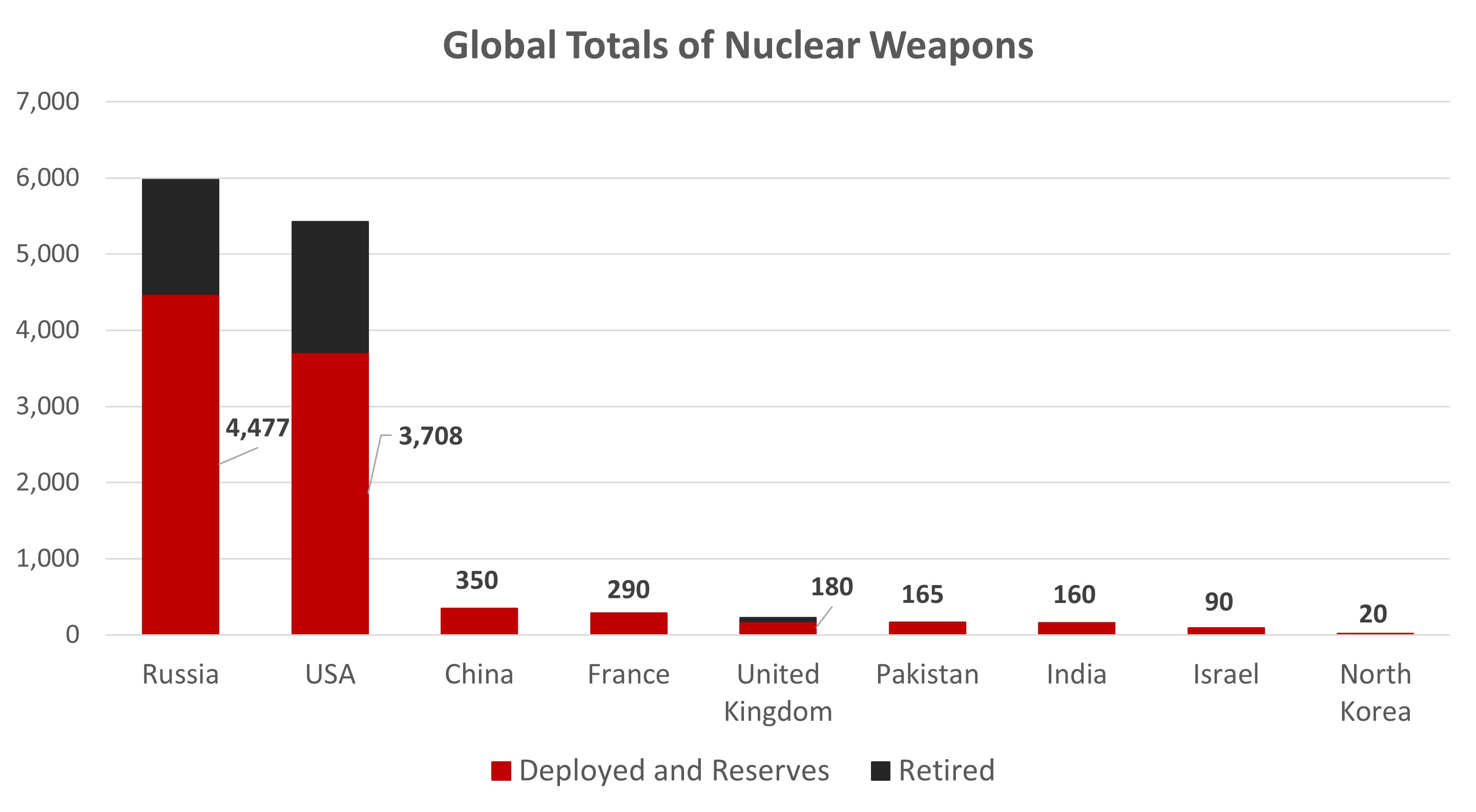
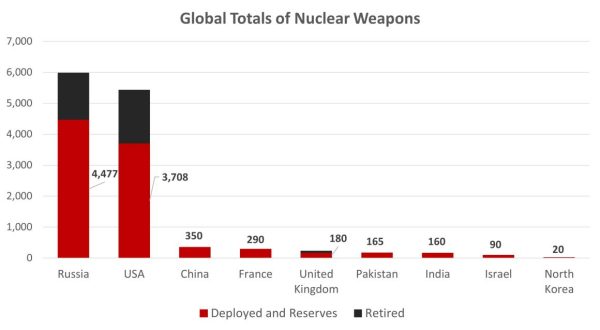
Contrary to claims that the US nuclear arsenal needs to be “saved” or it will soon be eclipsed by the Chinese arsenal, the US remains well in the lead of every single nuclear power except Russia. Even if Beijing increases its arsenal to one thousand warheads, as the New York Post breathlessly predicts, the Chinese arsenal will remain well behind that of the US.
This is true even if we remove all the retired US warheads from the equation. In that case, Moscow retains the global lead with more than forty-four hundred weapons, and the US comes in second with more than thirty-seven hundred. Presently, Beijing has approximately 350 of these weapons, France has 290, and the rest of the world is well behind that.
Like Moscow, Washington has a full-blown and well-developed nuclear triad, complete with a fleet of nuclear subs that can launch up to twenty missiles—each containing multiple independently targeted warheads—land-based missile silos, and bombers. Each option provides ways to deliver hundreds of warheads. The submarine fleet, of course, is constantly mobile, ensuring first-strike survivability.
The Nonexistent Missile Gap
This won’t stop advocates of more spending from calling for more. They’ll always have reasons why there is some sort of missile gap. Lately, the obsession is with hypersonic missiles and having various forms of delivery, as well as the claim that the current gap between the US arsenal and rival arsenal is not sufficiently large.
There’s a reason US advocates of an aggressive nuclear posture invented the “missile gap” myth during the Cold War. It sows doubt about US security and ensures a certain level of paranoia about US nuclear capability. Nowadays, it’s acknowledged that the missile gap was always a myth, but this was much less known in the days when debates over US rocket technology were a frequent cause for alarm and debate. Nonetheless, the nonfactual basis of the “gap” was known at least as early as the 1960s, and then defense secretary Robert McNamara noted to John F. Kennedy:
There was created a myth in the country that did great harm to the nation. It was created by, I would say, emotionally guided but nonetheless patriotic individuals in the Pentagon. There are still people of that kind in the Pentagon. I wouldn’t give them any foundation for creating another myth.
How Much Do Numbers Matter?
The myth persists, however, and Geller claims: “Given the hundreds of new Chinese missile launchers and other new weapons, the U.S. will need more nuclear weapons to hold these targets at risk. In nuclear deterrence, numbers matter.”
How much do numbers really matter? Yes, in matters of deterrence, ten is certainly better than zero. But is three thousand better than one thousand, or even one hundred? That logic often works with conventional arms, but it makes little sense with nuclear arms, a single unit of which can destroy an entire city. As John Isaacs noted last year in the National Interest:
In the nuclear age, a country that deployed 1,000 nuclear weapons rather than an adversary’s 500 is not twice as powerful since a handful of weapons could devastate both countries. But the Pentagon and political leaders did not learn this critical lesson. This is a numbers game that may have been relevant for tanks and battleships before [the invention of nuclear weapons] but is not today.
What is key in nuclear deterrence is not simply numbers. Nuclear strategist Albert Wohlstetter identified this problem in the early 1960s and concluded that “the criterion for matching the Russians plane for plane, or exceeding them is, in the strict sense, irrelevant to the problem of deterrence.” Rather the key, Wohlstetter went on, is creating a force that is “survivable” to ensure the possibility of a retaliatory “second strike.” This is what establishes deterrence.
Wohlstetter certainly wasn’t the only one to come to this conclusion. In a 1990 essay titled “Nuclear Myths and Political Realities,” Kenneth Waltz—perhaps the most influential scholar of international relations of the past fifty years—concludes that the total number of missiles in these enormous arsenals is of little importance for nations that are already well above the threshold for achieving nuclear deterrence.
What really matters is the perception that the other side has second-strike capability, and this certainly exists in both US-Russia and US-China relations. Once each regime knows that the other regime has second-strike capability, the competition is over. Deterrence is established. Waltz notes:
So long as two or more countries have second-strike forces, to compare them is pointless. If no state can launch a disarming attack with high confidence, force comparisons become irrelevant. . . . Within very wide ranges, a nuclear balance is insensitive to variation in numbers and size of warheads.
The focus on second-strike capability is key because pro-arms-race policy makers are quick to note that if a regime’s first strike is able to destroy an enemy’s ability to retaliate in kind, then a nuclear war can be “won.”
Second-Strike Capability Evens the Score
But, as shown by Michael Gerson in “No First Use: The Next Step for U.S. Nuclear Policy” (2010) establishing second-strike capability—or, more importantly, the perception of it—is not as difficult as many suppose. Gerson writes:
A successful first strike would require near-perfect intelligence, surveillance, and reconnaissance (ISR) to detect, identify, and track all of the adversary’s nuclear forces; recent events surrounding U.S. assessments of Iraq’s suspected WMD [weapons of mass destruction] capabilities forcefully demonstrate the challenges of reliable, accurate, and unbiased information. Intelligence regarding where an adversary’s nuclear weapons are located and if the state is actually planning to attack could be wrong or incomplete, and an attempted first strike based on inaccurate or incomplete information could have far-reaching negative consequences.
The threat of a successful first strike can be countered through a variety of methods, including secrecy and the ability to shift weapons delivery channels. This is why the US, Russian, and Chinese regimes have long been so enthusiastic about the so-called nuclear triad. It is assumed that if nuclear weapons can be delivered by submarine, aircraft, and land, then it is impossible for an opposing regime to destroy all three at once and achieve first-strike victory.
But even in the absence of a triad, an opposing regime that seeks a total first-strike victory has few grounds for much confidence. As Waltz shows, “nuclear weapons are small and light; they are easy to move, easy to hide, and easy to deliver in a variety of ways.” That is, if a regime manages to hide even a small number of planes, subs, or trucks, this could spell disaster for the regime attempting a successful first strike. Gerson explains:
A nuclear first strike is fraught with risk and uncertainty. Could a U.S. president, the only person with the power to authorize nuclear use and a political official concerned with re-election, his or her political party, and their historical legacy, ever be entirely confident that the mission would be a complete success? What if the strike failed to destroy all of the weapons, or what if weapons were hidden in unknown areas, and the remaining weapons were used in retaliation?
Nor must it be assumed that a large number of warheads is necessary to achieve deterrence. Waltz recalls that Desmond Ball—who advised the US on escalation strategies—convincingly asserted that nuclear deterrence could be achieved with as few as fifty warheads.
Proceeding on the assumption that an enemy has no warheads left following a first strike requires an extremely high level of confidence because the cost of miscalculation is so high. If a regime strikes and misses only a few of the enemy’s missiles, this could lead to devastating retaliation both in terms of human life and in terms of the first-strike regime’s political prospects.
This is why a rudimentary nuclear force can achieve deterrence even with a small but plausible chance of second-strike capability. A small nuclear strike is nonetheless disastrous for the target, and thus “second-strike forces have to be seen in absolute terms.” Waltz correctly insists that calculating an arsenal’s relative dominance is a waste of time: “the question of dominance is pointless because one second-strike force cannot dominate another.”
The US Is Already Far beyond the Deterrence Threshold
One could certainly debate how much the US nuclear stockpile could be cut without sacrificing deterrence. Given the enormous size of the stockpile, however, the answer is that “most of it” could be cut. Indeed, the US arsenal could be cut by 90 percent and still have hundreds of warheads available for silos, submarines, and bombers.
Moreover, reductions in the arsenal are prudent for reasons of avoiding unintended nuclear war. As Wohlstetter noted, a prudent policy also requires “strategic nuclear forces to be not only capable of riding out and operating coherently after an actual preemptive attack against them; but also completely controllable in times of peace, crisis, and war—and especially in the face of ambiguous warning—so as to avoid unauthorized operations, accidents, and war by mistake.” Having large numbers of nuclear warheads actually is imprudent because it creates more potential for accidents, mistakes, and unauthorized use. Maintenance remains expensive and risky.
In spite of all this, it remains popular among some to keep arguing for more nuclear expansion year after year. Surely, some of these advocates are true believers, but there is also a lot of money at stake for government contractors. Thus, in one form or another, the myth of the missile gap—and its modern variants—endures.
March 26, 2023
Posted by aletho |
Corruption, Mainstream Media, Warmongering, Militarism | China, United States |
Leave a comment

GLASGOW, SCOTLAND – NOVEMBER 08: Red Rebels join protesters from Extinction Rebellion for a “die in” outside the offices of American asset management firm Mercer on November 08, 2021 in Glasgow, Scotland. As World Leaders meet to discuss climate change at the COP26 Summit, many climate action groups have taken to the streets to protest for real progress to be made by governments to reduce carbon emissions, clean up the oceans, reduce fossil fuel use and other issues relating to global heating. (Photo by Jeff J Mitchell/Getty Images)
Michael Crowley has written a very interesting piece for Spiked about climate alarmism. I don’t necessarily go along with all the claims about Christianity, but I think we can all agree that Extinction Rebellion is “effectively an apocalyptic cult”. Here’s an excerpt:
Apocalypticism may have developed hand-in-hand with religion and Christianity in particular. But it has persisted as a mode of thinking among certain sections of society, even as Christianity’s influence has waned. Indeed, as societies have become more secular, so apocalyptic thinking has become more secular, too.
We see this today, above all, in the case of environmentalism. For it’s there that apocalyptic projections and predictions are now most at home. Greenism shares with its Biblical precursor an obsession with days of judgement, with vengeance upon the wicked and the dream of a redeemed world. But there’s a vital difference between the Biblical apocalypse and its green iteration. Those to be judged today are not a portion of sinful humanity. No, they are all of humanity. And the redeemed world dreamt of by climate activists is not the kingdom of God promised by earlier apocalyptic narratives. Instead, it is a kingdom of nature, and it is distinctly opposed to humanity. In short, the green End Times amount to a very anti-human apocalypse.
At the forefront of the arms race in catastrophic prophecies is Extinction Rebellion. Every page on its website itemises the scale of the climate crisis, and the dire impact that human development supposedly has on life on Earth. The extinction referred to in the movement’s title does not just include wildlife, but humanity itself. Activists claim that our extinction is just a generation away.
Here is a literally hopeless creed. XR and its apocalyptic ilk do not seem interested in climate change as a practical challenge – as something that can be addressed with technological and material development, as environmental problems have been mitigated in the past. Instead, they see climate change as a form of necessary punishment. As XR co-founder Roger Hallam puts it in one blog post, XR members must “understand that redemption only comes through suffering and the only honourable life is to move into that suffering in an act of faith that there will be another side to come out of, into a state of grace”.
As these words show, XR is effectively an apocalyptic cult. That’s why XR’s propaganda has more than a touch of the Book of Revelation about it. A 2021 XR video is titled ‘Advice to Young People as they face Annihilation’. One blogpost by Hallam begins “In these End Times…”. Another exclaims: “Only when we admit the utter destitution of our souls at this time of utter annihilation will we begin a journey we can be proud of, regardless of the outcome.” These are not the words of a political campaigner. They are the words of a self-styled prophet.
Climate change poses a challenge to humanity. But green apocalypticism does not help anyone. It inspires panic in those who buy into it, especially young people. They then see it as their job to wake us all up, to make us see what they see, to reveal the coming Armageddon. As far as they are concerned, this righteous mission trumps everything else. And it culminates in ill-thought-out, knee-jerk actions, such as climbing the gantries on the M25 to bring traffic to a halt. After all, we must be made to see the error of our ways. And if we don’t, we deserve the punishment that is surely coming.
March 26, 2023
Posted by aletho |
Malthusian Ideology, Phony Scarcity, Timeless or most popular |
Leave a comment
It is comical how easily one can be ignored for pointing out that new technology is dangerous and fetishistic. So-called “smart” cell phones are a prime example. For years I have been pointing out their dangers on many levels. To say most people are devoted to them is an understatement. Maybe it is an exaggeration to say they revere them, but if asked, they will say they couldn’t live without them. It’s sort of like saying I don’t revere my partner but couldn’t live without her or him. Ah love!
But what’s love got to do with it? Love and romance are out of date. Sex is just a quick fill-in when there’s a break in the technological action. Creative and erotic energy is pissed away on trivia. Being lost and confused and having no time is in. But only the latter can be admitted.
Busy busy busy! Beep beep beep as the eyes go down to the screens. Thumbs athumbing or voices talking to the gadgets, while the busy beavers forget who is under whose thumbs.
Eros is replaced by Chaos while Aphrodite weeps in the woods, but no one hears.
Pass the remote. The silence stings.
We are children of Greece but we forget its truths in our time of digital dementia, if we ever knew them. Beauty is banished for ugliness and technology is worshipped as a god. Art has become meaningless unless it’s falsely connected to celebrities and entertainment culture. There are no limits; everything is permitted. Hubris reigns. Even the thought that Digital IDs, Central Bank Digital Currencies, and vaccination passports are on the agenda does not dissuade the lovers.
It’s a game of control abetted by radical stupidity, and it is not a mistake, as Dylan, contrary to his public posturing and corporate imaging, let’s his artist’s soul sing:
There are no mistakes in life some people say
It is true sometimes you can see it that way
But people don’t live or die, people just float
Floating in a void of gibberish and double-talk, heads barely above the water, alienated from reality while fixated on the Spectacle, while sometimes when panicky looking for a life preserver but never to the right source, this is where technology and capitalism have taken us. On any issue – the bombing of the Nord Stream pipelines, the facts about the US proxy-war against Russia in Ukraine, Covid-19, the economy, etc. – the mainstream media daily pumps out contradictory stories to confuse the public whose attention span has been reduced to a scrolling few seconds.
Sustained attention and the ability to dissect the endless propaganda is a thing of the past and receding faster than the computer jargon of milliseconds and nanoseconds. Planned chaos is the proper name for the daily news reports.
Fetishism, in all its forms, rules.
What else is the cell phone but a pair of red high heels?
What else are all those phone photos millions are constantly taking as their antique reality to store in their mausoleums of loss?
What about the constant messaging, the being in touch that never touches?
Despite the fact that everything digital is extremely ephemeral, the smart phone itself seems god-like, a way to transcend reality while entering it. “My phone is my rock, and my fortress, and my deliverer; my God, my strength, in whom I will trust; my buckler, and the horn of my salvation, and my high tower.”
A toehold on “reality.” A machine in hand that saves nine – million abstractions. And prevents boredom from overwhelming minds intent on floating, because, as Walter Benjamin wrote in “The Storyteller,” “Boredom is the dream bird that hatches the egg of experience. A rustling in the leaves drives him away.” Vibrating and dinging phones will suffice to disturb that dream bird of creative silence that is the only antidote to floating in the void of noise.
But fetishes come in many forms because the need for false gods is so attractive. To think you have a way to control reality is addictive.
I recently saw an article about an auction sale at Sotheby’s in New York of the movie stars Paul Newman’s and Joanne Woodward’s personal effects. These include Woodward’s (who is still alive and suffering from Alzheimer’s disease) wedding ring and dress, the shackles Newman wore in the film “Cool Hand Luke,” a suit from his racing car days, etc. – over three hundred items in all. According to a Sotheby spokesperson, the Newman-Woodward family, who will receive the proceeds, are doing this to “continue telling the stories of their parents.” Don’t laugh. The article mentions that one of Paul’s watches sold at auction a few years ago for $17.8 million dollars and another for $5.4.
So I ask: what are the wealthy purchasers of these objects really buying? And the answer is quite obvious. They are buying fetishes or transference objects that they think will grant them a piece of the immortal stars’ magic. They are buying idols, Oscars, illusions to worship and to touch in place of reality. Ways to enter the cultural hero system.
Ernest Becker put it this way in The Denial of Death: “The fetish object represents the magical means for transforming animality into something transcendent and thereby assuring a liberation of the personality from the standard bland and earthbound flesh.” If one can possess a piece of the demi-god’s power – an autograph, a watch, a ring – one will somehow live forever. It’s not about “trusting the science” but about believing in the magic.
Newman’s daughters who have pushed this sale, as well as a new documentary, The Last Movie Stars, and the memoir Paul Newman: The Extraordinary Life of an Ordinary Man – compiled from their father’s transcripts of conversations with his friend, Stewart Stern, over thirty years ago – have done something supremely ironic.
On one hand, they are selling their father’s and mother’s memorabilia, allegedly to tell their stories, through things that are fetishes for those desperate for holy secular relics, while at the same time publishing a book in which Paul honestly knocks himself off the pedestal and says he was always an insecure guy, numbed by his childhood and the false face Hollywood created for him. In other words, an ordinary man with talent who was very successful in Hollywood’s dream factory, where illusions are the norm.
“I was my mother’s Pinocchio, the one that went wrong,” he tells us right away, leading us to the revelations of his human, all-too-human reality. His was a life of facades and dead emotions, false faces, and his struggles to become who he really was. He tells us he wasn’t his film roles, not Hud or Brick or Fast Eddie or Cool Hand Luke, but he wasn’t really the guy playing them either. He was a double enigma, an actor playing an actor. He says:
I’ve always had a sense of being an observer of my own life… I have a sense of watching something, but not of living something. It’s like looking at a photograph that’s out of focus… It’s spacey; I guess I always feel spaced out.
His courageous honesty reminds me of Friedrich Nietzsche’s final work, Ecce Homo (Behold the Man), not because Paul waxes philosophical but because he’s brutally honest. If a movie star’s truths strike you as not comparable to those of a great philosopher, I would suggest considering that Nietzsche’s key concern was the theater and how we are all actors, a few genuine and most false. In The Twilight of the Idols he asked, “Are you genuine? Or merely an actor? A representative? Or that which is represented? In the end, perhaps you are merely a copy of an actor.”
Paul Newman lived for 17 years after speaking to his friend Stewart Stern. I like to think those conversations helped him break through to becoming who he really was. From what I know of the man, he was generous to a fault and did much to ease others’ pains, especially to bring joy to children with cancer. I think he changed. While his things that are on the auction block now serve as illusionary fetishes for those looking for crutches, I believe he finally threw away the mental crutches he used when playing Brick in Cat on A Hot Tin Roof. Perhaps the wooden ones will be in the auction and some desperado will bid on them.
We know that with the planned chaos being used to shock people into submission through fear, there has been a drastic rise in depression and mental distress of all kinds, especially since the Covid-19 propaganda rollout with its lockdowns and deadly jabs. The magic anti-depression pellets dispensed for decades by the criminal pharmaceutical cartels can not begin to contain this sense of helplessness that continues to spread. They too are fetishes and ways to divert people’s attention from the social and spiritual sources of their anguish.
There is something very chilling in the way the reality of flesh and blood humans living in a natural world has been replaced by all types of fetishes – drugs, objects, celebrities, machines, etc. While all are connected, the cell phone is key because of its growing centrality to the elites’ push for a digitized world. No matter how many articles and news reports about Artificial Intelligence (AI) that appear, it is all just a gloss on a long-developing problem that goes back many years – machine worship.
“Smart” cell phones are the current apotheotic control mechanism promoted as liberation. They are a form of slavery promoted by the World Economic Forum, their bosses, and their minions. As Alastair Crooke puts it, “It is that a majority of the people are so numbed and passive – and so in lockstep – as the state inches them through a series of repeating emergencies towards a new kind of authoritarianism, that they don’t fuss greatly, or even notice much.” Freedom is slavery.
Here is Ernest Becker again:
Boss [Medard Boss, Swiss psychanalyst and psychiatrist] says that the terrible guilt feelings of the depressed person are existential, that is, they represent failure to live one’s own life, to fulfill one’s own potential because of the twisting and turning to be ‘good’ in the eyes of the other.
The other calls the tune to one’s eligibility for immortality, and so the other takes up one’s unlived life…In short, even if one is a very guilty hero he is at least a hero in the same hero-system [personal and cultural].
The depressed person uses guilt to hold onto his objects and to keep his situation unchanged. Otherwise he would have to analyze it or be able to move out of it and transcend it… Better guilt and self-punishment when you cannot punish the other – when you cannot even dare to accuse him [the social system], as he represents the immortality ideology with which you have identified. If your god is discredited, you yourself die; the evil must be in yourself and not in your god, so that you may live.
I wonder if I should bid on the shackles Paul Newman wore as the prisoner in Cool Hand Luke. They are probably the cheapest item on the auction menu. I think they will remind me that the Captain was wrong when he said to Luke, “What we’ve got here is failure to communicate.”
March 26, 2023
Posted by aletho |
Timeless or most popular |
Leave a comment
Berliners are going to the polls today in a referendum on whether or not to make the city “climate-neutral” already by 2030 instead of 2045.
That’s quite a lofty goal for a chaotic, financially broken city that couldn’t even build an airport.
Polls showing slight lead for “klimaneutral ja”. And no campaign in Berlin has seen funding to this scale. Acc0rding to media reports, most funding has come from foreign countries, mainly from far left groups in the USA.
According to a report by online Bild, one wealthy New York couple (Albert Wenger und Susan Danziger) even donated half a million euros to fund a campaign to get the people to vote “ja”.
Should Berliners vote to make the German capital CO2 neutral by 2030, it would mean enacting an amendment that would force the city of Berlin to achieve climate neutrality by 2030 instead of 2045. This would affect almost every aspect of Berlin life, from transportation, to heating and widescale major building renovation.
Foreign funding
The amendment is being pushed by the Green Party and radical groups like Fridays for Future and Extinction Rebellion, who are largely financed by foreign funders like the Climate Emergency Fund, Abigail Disney and Hollywood film director Adam McKay.
If the amendment gets adopted, immense power will be transferred a small group of unelected people, a so-called Climate Protection Council of “experts”, appointed by the Berlin Senate. Climate targets for 2045 would turn into climate legal obligations for 2030.
Huge restrictions, astronomical costs, loss of private property
Critics warn this would mean many more restrictions on freedom, Berliners might even have to say goodbye to their cars completely. Under the amendment, the Berlin airport would be a part of the climate budget. thus posing the risk of reducing the number of flights.”
Moreover property owners would be forced to make largescale, costly renovations and have to install solar panels. No one knows where the money is magically supposed to come from.
Unachievable, pie-in-the-sky
Critics are speaking up, however, calling the radical climate project “factually impossible” and “out of the question”, noting that even the original 2045 target timetable was almost impossible to meet,” Bild reports.
Recent opinion polls show the results of today’s referendum are expected to be very close, slightly tipping in favor of the referendum.
We’ll report the results this evening as they become available.
This means there’s a good chance that the City of Berlin might well end up being an even greater basket-case than California. Somebody needs to lead the way to show the rest of the world what a folly rapid climate neutrality can be.
March 26, 2023
Posted by aletho |
Civil Liberties, Economics, Malthusian Ideology | Germany, Human rights |
Leave a comment
There is no animal or plant in the natural world that cannot be used to promote climate Armageddon and its collectivist Net Zero political solution. On Sunday, the WWF, also known as the World Wildlife Fund, started running a series of Wild Isles co-produced propaganda films narrated by Sir David Attenborough on the BBC. These include finely-crafted messages of improbable extinctions culled from computer models.
From the absurd to the ridiculous, we had National Margarita Day recently hijacked by CNN running a story about the ‘climate crisis’ affecting tequila production – a story easily debunked by the news that since 1995, tequila production had increased six-fold, and in four years it had doubled. Now the increasingly unhinged Guardian is giving us its ‘Net Zero, or else the coffee gets it’ story.
According to the newspaper, new research suggests that climate conditions that reduce coffee yields have become more frequent over the past four decades, with rising temperatures from “global heating” likely to lead to ongoing systemic shocks to coffee production globally.
Note the use of the phrase “climate conditions” for what in effect is weather, and the suggestion that it reduces coffee yields. These climate conditions are said to have become more frequent over the last four decades. But one can only read the Guardian for so long. Let us look at actual coffee yields over the last four decades.
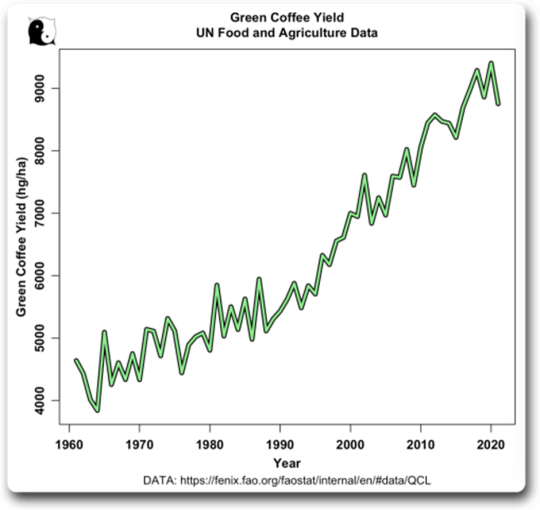
Far from declining due to all this weather, yields have shown dramatic improvement since at least 1960. Over this period, particularly between 1980-98, temperatures have risen, but there is no sign of “ongoing systemic shocks” to coffee production globally.
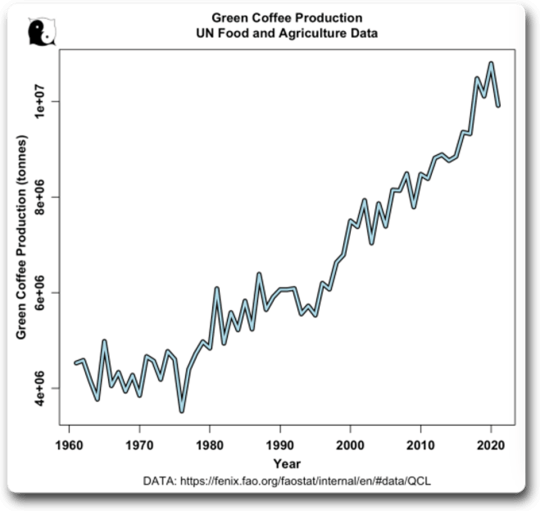
Global coffee yields have been a great agricultural success story, along with actual bean production. Like yields, tonnes produced have soared in the last 40 years.
The key Guardian get-out phrase of course is “new research suggests”. The Guardian story was taken from an academic study led by Dr. Doug Richardson, published in PLOS Climate. He told the newspaper that a shift from cool and wet to hot and dry conditions “we’re pretty confident is a result of climate change”.
In fact if the Richardson paper is read, a more nuanced view on coffee and weather over the last 40 years is discovered.
Our results suggest that ENSO [El Niño Southern Oscillation] is the primary mode in explaining annual compound event variability, both globally and regionally. El Niño-like sea surface temperatures in the Pacific Ocean are associated with decreased precipitation and increased temperatures in most coffee regions, and with spatially compounding warm and dry events. This relationship is reversed for La Niña-like signatures.
As it happens, the last 40 years saw three very powerful El Niños occurring in 1982, 1998 and 2016. These pushed temperatures up around the planet, a natural weather oscillation that had nothing to do with any human-caused increase in atmospheric carbon dioxide. The current eight-year pause in the satellite temperature record is partly explained by three recent La Niña events.
The vast majority of the world’s coffee is grown with just two species – Arabica and Robusta. Arabica is more sensitive to growing conditions, and requires temperatures around 18-22°C. In the tropics, these are more common in higher elevations. Robusta is less highly prized, has a wider geographical spread and grows between 22°C and 28°C. Richardson claims that human-caused climate change is “expected” to alter the geographical suitability for growing coffee. The area of land suitable for coffee cultivation “may” be reduced by up to 50%.
This is unlikely. For a start, it assumes temperatures will rise significantly, but with global warming running out of steam over the last two decades, this seems unlikely. This is particularly so in the tropics. Historical records show that during periods of global warming, the tropics warm less and temperatures are more stable. In addition, coffee is a versatile crop, and selective breeding has produced varieties that can adapt to lowland conditions with temperatures outside normal growing ranges. If climate should change in any significant way, new coffee farming could switch to more propitious areas.
But where is the fun in explaining all that when Net Zero propagandising is afoot. MIT Emeritus Professor Richard Lindzen is fond of noting that the current climate narrative is absurd, but trillions of dollars paid to many, including “grant-dependent” academics, says it is not absurd. This money pays for a constant drip, drip, nudge, nudge wave of climate scaremongering eagerly promoted by controlling elites seeking to take away personal and economic freedoms under cover of saving the planet.
March 26, 2023
Posted by aletho |
Deception, Fake News, Mainstream Media, Warmongering, Science and Pseudo-Science | BBC, CNN, The Guardian |
Leave a comment
Death threats will remain a constant part of former Pakistani Prime Minister Imran Khan’s life until he can return to power and hold his would-be killers accountable, he told Going Underground host Afshin Rattansi on Saturday.
Khan told Rattansi that he has survived two attempts on his life in the last week – one which involved him being led into a “deathtrap” outside a court in Islamabad on Saturday, and another in which agents of the state would provoke police into opening fire on a crowd of Khan’s supporters before “coming after” him to finish the job.
“The threat is real because these people are sitting in power,” Khan said. “They are petrified that if I win the elections they will be in trouble, or held accountable.”
Khan blames Prime Minister Shehbaz Sharif, Interior Minister Rana Sanaullah, and Major General Faisal Naseer, a senior intelligence official, of plotting his assassination at a rally last November. Khan, who was removed from office through a no-confidence motion seven months earlier, was hit in the leg and hospitalized.
Sharif denies any involvement in the murder attempt, and has accused Khan of spreading “false and cheap conspiracies.” Sharif has also denied colluding with the US to have Khan removed from power.
Khan has since been charged with 143 criminal offenses, with the government most recently accusing him of terrorism after his supporters rioted outside the Islamabad courthouse last Saturday. He views these charges as politically-motivated, and aimed at preventing him from contesting this year’s general election.
While he has been barred from participating in the election, he insists Pakistan’s election commission had no legal grounds to ban him.
“They are petrified that their elections, my party will sweep them,” Khan told Rattansi. “In all opinion polls, my party is poised to win a two-thirds majority in Pakistan, hence them wanting to get rid of me.”
“The threat is real until the elections,” he added. “They’re worried that if the elections take place and I come back into power, they will be held accountable.”
Khan’s PTI party has won 29 out of 37 by-elections since he was removed from power, and a Gallup poll put his approval rating at 61% earlier this month, compared to Sharif’s 32%. Provincial elections in the PTI strongholds of Punjab and Khyber Pakhtunkhwa were set to be held on April 30, but were pushed back until October this week, after Sharif’s government withheld election-related funding from the provinces.
Amid the apparent threat to his life, Khan said that he is “taking precautions,” and now gives speeches from behind bulletproof glass. Referring to the Pakistani authorities, he said that “those who were supposed to protect me are the ones I’m in the greatest danger from.” – Video link
March 26, 2023
Posted by aletho |
Civil Liberties, Video | Human rights, Pakistan |
Leave a comment
The U.S. Centers for Disease Control and Prevention (CDC) published inaccurate data about the COVID-19 pandemic and made incorrect claims that exaggerated the threat on at least 20 occasions since January 2021, a new paper has found.
The pre-print (not yet peer-reviwed) by Vinay Prasad, Tracy Beth Hoeg, Kelley Krohnert and Alyson Haslam documents 25 instances when the CDC reported statistical or numerical errors. Twenty (80%) of these instances exaggerated the severity of the COVID-19 situation, three instances (12%) simultaneously exaggerated and downplayed the severity of the situation and one error was neutral. One error exaggerated COVID-19 vaccine risks. The CDC was notified about the errors in 16 instances (64%), and later corrected the errors, at least partially, in 13 instances (52%).
The authors searched for the errors by reviewing CDC publications, press releases, interviews, meetings and Twitter accounts. They also catalogued mortality data from both the National Center for Health Statistics and the CDC Covid Data Tracker and compared reported results.
They concluded that “a basic prerequisite for making informed policy decisions is accurate and reliable statistics, even during times of uncertainty”. They note a need for greater diligence in data collection and reporting. They also recommend that the federal entity responsible for reporting health statistics “should be firewalled from the entity setting policy due to concerns of real or perceived systematic bias in errors” – in this instance, towards exaggerating risk.
Here are the 25 errors they found:
February 26th 2021:
- MMWR stated that during the study period, the seven-day moving average of cases identified by PCR or antigen testing ranged from 152 to 577 cases.
- Multiple errors. Reported case rates during the study period were described as a seven-day moving average of cases per 100,000 persons including PCR and antigen cases, but the paper actually reported the raw seven day moving average (without adjusting for population) and for PCR only (not including antigen tests).
- From: MMWR
- Risk: Exaggerated
- Concerns: Children
July 26th 2021:
- Delta Variant is as contagious as chicken pox.
- Delta is not as contagious as varicella. The CDC overstated Delta R0 and understated chicken pox R0 (Delta estimate was overlaid directly on a New York Times graphic).
- From: CDC slide deck
- Risk: Exaggerated
- Concerns: All
July 27th 2021:
- 4% of COVID-19 deaths are in children 0-17.
- Actual number was 0.04% based on original CDC estimated data. When the estimated data were updated later, the percentages were not updated. The actual percentage based on the updated data was 0.07%.
- From: COVID-19 website
- Risk: Exaggerated
- Concerns: Children
October 15th 2021:
- “COVID-NET data for the week ending Sept. 25th show that rates of COVID-19-associated hospitalisations in children ages 5-11 years are the highest they’ve been.”
- COVID-NET hospitalisations were already falling from Sept peak. Rate was 1.1 in week ending Sept. 11th and Sept. 25th. (Now week of Sept. 11th shows 1.2),
- From: Twitter @CDCgov
- Risk: Exaggerated
- Concerns: Children
October 27th 2021:
- “CDC Director Walensky said “there have been 745 deaths in children less than 18.”
- As of 27/10/21, NCHS data showed 558 deaths with COVID-19. Final NCHS data shows 679 pediatric deaths with COVID-19 through Oct. 30th, 2021
- From: White House Press Briefing
- Risk: Exaggerated
- Concerns: Children
November 8th 2021:
- Among ages 0-17, CDC’s reported rate of symptomatic illness was [more] than the total infection rate (asymptomatic + symptomatic –
an impossible claim), and this error occurred among children (infection rate also fell only for children from May 21st to Sept 21st estimates).
- Estimated infection rate was 35,490 per 100K, not 29,885 per 100K (symptomatic illness remained at 30,253 per 100K).
- From: COVID-19 website
- Risk: Neutral
- Concerns: All
December 20th 2021:
- Omicron makes up 73% of new infections in the U.S.
- Error with Nowcast estimate, a week later they revised to 23% (outside the previous 95% CI).
- From: Data Tracker
- Risk: Exaggerated
- Concerns: All
February 24th 2022:
- COVID-19 hospitalisations had a sudden over-1.6-fold increase in Georgia per HHS/CDC data.
- Very likely a dramatic multi-week increase was due to imputation error on behalf of the reporting state or municipality, yet this was not audited or detected.
- From: Data Tracker
- Risk: Exaggerated
- Concerns: All
March 15th:
- Paediatric deaths on the Data Tracker demographics page were overstated while adult deaths were understated.
- On 15/3/22, CDC removed 416 paediatric deaths from Data Tracker from 1,755 to 1,339 (still overstated) and almost 72,000 adult deaths, blaming an algorithm for classifying deaths as COVID-19 related.
- From: Data Tracker
- Risk: Mixed
- Concerns: Both
June 17th 2022:
- COVID-19 is a top five cause of death in children of all age groups.
- Pre-print had inaccurate data, and CDC chose the most extreme version of the flawed data. Specifically, for COVID-19 it used cumulative counts (which spanned more than two years), and death was attributed if it was one of any multiple cause of death, whereas for other causes of death, they used only a single year, and attributed it only if it was the single underlying cause of death).
- From: ACIP Meeting
- Risk: Exaggerated
- Concerns: Children
June 23rd 2022:
- At a White House COVID-19 briefing, CDC Director Walensky cited the claim that COVID-19 is a “top five cause of death” in children
- Flawed pre-print, authors already acknowledged that fact, and COVID-19 was not a top five cause of death.
- From: White House Press Briefing
- Risk: Exaggerated
- Concerns: Children
June 27th 2022:
- ACIP website includes the “top five cause of death” claim
- Flawed pre-print, authors already acknowledged that fact, and COVID-19 was not a top five cause of death.
- From: ACIP website
- Risk: Exaggerated
- Concerns: Children
August 9th 2022:
- COVID-19 has killed 1,500 children ages 17 and younger.
- As of 10/8/22, NCHS data showed 1,201 deaths with COVID-19. As of 5/2/23, NCHS data shows 1,323 paediatric deaths with COVID-19 through August 6th 2022.
- From: Twitter @CDCgov
- Risk: Exaggerated
- Concerns: Children
August 12th 2022:
- “COVID-19 hospitalisations for children and teens are increasing again in the U.S.”
- CDC hospitalisation data showed hospitalisations had peaked two weeks prior, on 29/7/22.
- From: Twitter @CDCgov
- Risk: Exaggerated
- Concerns: Children
August 20th 2022:
- CDC Excess Mortality Dashboard overstated recent deaths in North Carolina and Connecticut.
- Model for weighting due to death reporting lag was poorly adjusted.
- From: CDC Excess Mortality Dashboard
- Risk: Exaggerated risk of all-cause mortality
- Concerns: All
August 22nd 2022:
- Alabama paediatric hospitalisations had a dramatic single week increase from under 10 per day to over 50 per day.
- Very likely a dramatic single week increase was due to imputation error on behalf of the reporting state or municipality, yet this was not audited or detected.
- From: Data Tracker
- Risk: Exaggerated
- Concerns: Children
August 26th 2022:
- CDC Data Tracker made a single week jump of 186 paediatric deaths and 1,679 adult deaths, which is unusually high for children and unusually low for adults.
- Incorrect death data. CDC corrected this days later, removing 173 paediatric deaths and adding 2,484 adult deaths
- From: Data Tracker
- Risk: Mixed
- Concerns: All
September 1st 2022:
- ACIP Chair Grace Lee repeated the “top five cause of death” claim in ACIP meeting to approve bivalent booster.
- Flawed pre-print was corrected two months prior. Unknown if ACIP committee informed.
- From: ACIP meeting
- Risk: Exaggerated
- Concerns: Children
November 9th 2022:
- Florida paediatric hospitalisations had a dramatic single week increase from seven to 112 (seven-day new admissions).
- Very likely a dramatic single week increase was due to imputation error on behalf of the reporting state or municipality, yet this was not audited or detected.
- From: Data Tracker
- Risk: Exaggerated
- Concerns: Children
December 30th 2022:
- XBB.1.5 variant reported at 41% of new infections in the US.
- A week later they revised to 18% (outside the original 95% CI).
- From: COVID-19 website
- Risk: Exaggerated
- Concerns: All
December 31st 2022:
- North Carolina paediatric hospitalisations had a dramatic single week increase from two to 19 (seven-day new admissions).
- Very likely a dramatic single week increase was due to imputation error on behalf of the reporting state or municipality, yet this was not audited or detected
- From: Data Tracker
- Risk: Exaggerated
- Concerns: Children
January 13th 2023:
- Table 2 listed 62 events for children needing medical care as 13.9%.
- It should be 1.9%. It is correct in the text, but not the table.
- From: MMWR
- Risk: Exaggerated risk of vaccine
- Concerns: Children
February 9th 2023:
- Dr. Walensky testified before Congress that there had been “2,000 paediatric deaths from COVID-19”.
- This number comes from the flawed Data Tracker. Actual number is 1,400-1,500
- From: Data Tracker/ testimony
- Risk: Exaggerated
- Concerns: Children
February 23rd 2023:
- ACIP slide claimed 1,489 paediatric deaths in ages six months-17 years.
- They did not remove 305 deaths in infants under-six months. Actual number should have been 1,184 using the NCHS data source cited on the slide
- From: ACIP meeting
- Risk: Exaggerated
- Concerns: Children
Through March 3rd 2023:
- Data Tracker continues to report too many paediatric deaths and too few adult deaths.
- Inaccurate mortality data by age group are updated weekly on the CDC Data Tracker Demographics page.
- From: Data Tracker
- Risk: Mixed
- Concerns: All
Read the full paper here.
March 25, 2023
Posted by aletho |
Deception, Science and Pseudo-Science | CDC, COVID-19 Vaccine, United States |
Leave a comment