Israel: hate crimes against Christians in occupied Jerusalem rising

MEMO | March 27, 2023
Hate crimes including vandalism and assaults carried out by Israeli Jews against Arab Christians in occupied Jerusalem have been rising sharply since the start of this year, Haaretz revealed on Sunday. Church leaders attribute the rise of anti-Christian hate crimes to the rhetoric of the most extreme far-right government that Israel has ever had.
According to Haaretz, the Israeli police do not take the issue seriously enough and refuse to recognise the growing number of hate crimes. Christians now feel that it is futile to report such incidents.
An Armenian priest quoted by the Jerusalem Inter-Church Centre said that he has been spat on more than ninety times this year already, mostly in Jerusalem’s Old City.
“It is no coincidence that the legitimisation of discrimination and violence within the current Israeli political environment also translates into acts of hatred and violence against the Christian community,” said Father Francesco Patton, the custodian of the Franciscan order in the Holy Land. “We expect and demand that the Israeli government and law enforcement agencies act decisively to guarantee security for all communities, to guarantee the protection of religious minorities and to eradicate religious fanaticism. We refer specifically to these serious incidents of intolerance, crimes of hatred and vandalism directed against Christians in Israel.”
Israel police denied the Christian narrative and claimed that all reported incidents are dealt with quickly and decisively, and that suspects had been arrested in most cases, and charged in some of them.
RT pointed out that Christians made up 25 per cent of Jerusalem residents 100 years ago, but are just one per cent today. The number of Arab Christians in Jerusalem started to decline following the 1967 occupation, as Israel has since confiscated 30 per cent of their land and stolen many properties through questionable land deals.
US democracy ‘a facade’ – Russian security chief
RT | March 27, 2023
The US is not really a democracy, nor does it seek to promote democracy in its relations with other nations, contrary to Washington’s claims, senior Russian security official Nikolay Patrushev has said. He made the remarks while commenting on the upcoming ‘Summit for Democracy’ hosted by the US government.
Patrushev, who is the secretary of the Russian Security Council, described the US economy as “dependent on corruption and lobbying connections going to the White House and Capitol Hill.”
Corporate interests have hijacked the levers of political power in the US and use the country’s international clout to pursue their own agenda, he said in an interview with Rossiyskaya Gazeta newspaper, to be published in full later today.
Their democracy is a pretty facade for the political system, which serves to hide the neglect of the rights of ordinary Americans.
Washington pursues the same approach in the international arena, where it claims to be the champion of democracy but disregards other nations’ sovereignty, Patrushev said. He believes that this “hypocrisy” will be on display at the Summit for Democracy, which will kick off this week in Washington.
The event will be “a gathering to support a world order in which Washington wants to play the central role forever. Dissenters will be labeled ‘undemocratic states,’” he predicted. The US, which “appointed itself the dictator of the world, will harass the nations whose sovereignties and democracies were undermined,” by Washington.
The reality is that “Washington has long been a leader in violating the sovereignty of other nations, in the number of wars and conflicts it has unleashed,” the security chief said. He called the nations that support this arrangement “vassals” that are constantly “humiliated” in their abusive relationships with the US.
The international event, which is being held for the second time, is meant to promote democracy against what Washington increasingly sees as assertive “authoritarian” states. The US reportedly invited all participants of the first summit, which was held in 2021, including the administration of the self-governed Chinese island of Taiwan. NATO members Hungary and Türkiye were snubbed once again, according to Foreign Policy magazine.
The EU is losing relevance in the emerging new world
By Timur Fomenko | RT | March 27, 2023
Vladimir Putin and Xi Jinping met in Moscow last week, and Western circles predictably responded by accusing Russia of becoming “subservient” or even a “vassal state” to China.
MEP Guy Verhofstadt, a Euro-fantasist and former prime minister of Belgium, jeered on Twitter, “Putin’s appalling legacy now includes turning Russia more and more into a Chinese vassal state,” oblivious to the irony of his own words. As the United States took the lead in denouncing China’s peace plan for the Ukraine conflict, publicly setting out the conditions on which it should end, the European Union was nowhere to be seen, or at least had nothing original to say.
This makes Verhofstadt’s comments a damning display of lacking self-awareness. Russia and China are setting out their vision for a new multipolar world, while the US struggles against them in seeking to maintain its hegemonic position. Meanwhile, the European Union has been reduced to the status of a mere bench player in it all, and has become effectively irrelevant. The failure of EU countries to stake out their own will and position amidst the larger powers, as well as their total subservience to the US, has made a mockery of the “strategic autonomy” concept once championed by Emmanuel Macron.
“Strategic autonomy” is a principle of European integration where the EU should be an actor in a multipolar world, which advocates for its own interests and pursues its own agenda. Supporters of this principle insist that the EU should not blindly follow the will of the US when it comes to every foreign policy issue, but should be proactive and enhance its role on the world stage. Therefore, they should not, as is commonly demanded by Washington, take sides on matters such as a new Cold War with China. The term gained growing traction during the years of the Trump administration, when Europe’s relations with the US hit a low due to his particular interpretation of the “America first” doctrine.
However, the practical reality of “strategic autonomy” is that the EU is not a unitary state, but a loose intergovernmental organization of states which, while seeking to establish common positions on a principle of unity, do not truly have a unified foreign-policy-making mechanism. The intra-institutional politics of the EU are often a messy compromise and battle of wills between different levels of actors, including the states themselves, the European Commission, and the European Parliament. This combines with the reality that “European integration” has been a broken process since 2008. Challenges such as the Eurozone financial crisis, Brexit, Covid-19, and internal conflicts with various states such as Poland have all weakened and fractured the EU.
As a result, the EU has been ill-suited to deal with what is, despite media misdirection, the single most explicit source of foreign influence and interference against it, the US. Washington has multiple channels whereby it exerts control over the EU’s many foreign policy actors. Firstly, it uses a web of government-funded think tanks and associated journalists to control public opinion and steer EU countries towards supporting its objectives. Secondly, the US has an extraordinarily political hold over the former Soviet bloc states to the east of the EU (with the exception of Hungary), which it uses to foment increased antagonism against Russia and China, and therefore undermines the attempts of the bloc’s most “autonomous” and powerful states – Germany and France – to pursue more reconciliatory foreign policies.
Thirdly, the US uses the United Kingdom as its primary cheerleader in Europe (be it from within or without the EU) to project its political will onto the continent and override the will of any defiant member states. An example of this is the BBC World Service acting as a massive propaganda machine to push narratives in line with Washington’s foreign policies. Additionally, the US has shown an ability to work with and weaponize the intelligence services of member states against their own countries, such as using Danish intelligence to spy on other European leaders.
Through all these factors, both past and present, the US has been able to keep Europe divided, conflicted, and seemingly unable to pursue any foreign policy which actually meets European interests, as opposed to those of the US. This has culminated even to the extent of literally destroying the Nord Stream pipelines and then propagating a false narrative that Ukraine was responsible. The Ukraine war has ultimately only accelerated the isolation and irrelevance of Europe, which has strengthened the hold of the military-industrial complex over the continent, undermined its energy industries, and thus converted the term “strategic autonomy” into a laughing stock.
One might ask, who is truly the vassal? If a new multipolar world is emerging, it’s fair to say, Europe simply isn’t part of it. Russia, China, and America are the drivers of current events, the EU is but a passenger.
Moscow waiting for Western leaders ‘to sober up’ – Lavrov
RT | March 27, 2023
Moscow will determine how its future relations with Western nations will develop only after they come to their senses, Russian Foreign Minister Sergey Lavrov said on Monday.
Speaking at the Gorchakov Public Diplomacy Fund, which provides support to Russian and foreign NGOs and think tanks, Lavrov accused the US and its allies of being “mired in cave Russophobia, while sacrificing the glaring problems in their own societies.”
“When and if they sober up, we will decide on our position regarding further relations with them. But we will make this decision, of course, on our own and based on our terms,” the foreign minister added.
Lavrov went on to point out that, despite the ongoing “dirty campaign to cancel everything linked to Russia,” it still had a lot of friends worldwide – including in the West – who like Russian culture and share the traditional family values it promotes.
At the same time, the minister warned that Russia would give a harsh response to all hostile actions. He claimed that Western countries wanted to stir unrest in Russia and undermine its stability. “They have found very capable agents of their will in the current Nazi regime in Ukraine, whose roots were laid a long time ago,” Lavrov said.
Against this backdrop, the top diplomat reiterated that Russia was fighting to protect not only the Russian-speaking population in the new territories that chose to join the country in public referendums last autumn, but also its own statehood.
Russia has repeatedly warned the West against supporting Ukraine, arguing that such policies make it a direct participant in the conflict. While Moscow maintains it is open to talks with Kiev, on Saturday, Kremlin spokesman Dmitry Peskov claimed that the US “had maniacally set itself up for not allowing Ukrainians to even think about” a potential peaceful settlement of the conflict.
Russian tactical nuclear weapons in Belarus – escalation or legitimate response?
By Drago Bosnic | March 27, 2023
On March 25, Russian President Vladimir Putin announced that Russia will start deploying its tactical nuclear weapons in Belarus. Construction of designated storage facilities for the weapons is planned to be completed by July 1. The decision to transfer nuclear weapons to Belarus was made after Minsk issued a formal request, essentially mirroring Washington DC’s nuclear sharing agreements with several NATO member states. And while the decision was officially made after the United Kingdom announced it would supply depleted uranium munitions to the Kiev regime, the actual reasoning might have to do with much more sinister plans by the United States.
Namely, Warsaw and Washington DC have been floating the idea of transferring some of the US nuclear weapons stockpiled in Europe to Poland. The move has been mentioned several times in recent years, including in early October last year, when Polish President Andrzej Duda mentioned it in an interview with Gazeta Polska. The US has nuclear sharing agreements with the Netherlands, Belgium, Germany, Italy and Turkey, with approximately 100 (mainly air-launched) tactical nuclear weapons deployed in all five countries. Greece also took part in the program, but discontinued its participation in 2001, although it’s widely believed Athens still keeps the necessary storage facilities functional.
President of Belarus Alexander Lukashenko advised against UK plans to deliver depleted uranium munitions to the Kiev regime and warned that Russia would soon supply Belarus with “munitions with real uranium”. However, Putin himself stated that “even outside the context of these events”, Belarus still has legitimate security concerns and that “Alexander Grigoryevich [Lukashenko] has long raised the question of deploying Russian tactical nuclear weapons on the territory of Belarus”. This clearly implies that threats to Minsk transcend the immediate danger of depleted uranium munitions deliveries to the Neo-Nazi junta in Kiev.
“There is nothing unusual in such a decision, as the United States has been doing this for decades. They have long placed their tactical nuclear weapons on the territories of their allies, NATO countries, and in Europe. In six states – the Federal Republic of Germany, Turkey, the Netherlands, Belgium, Italy and Greece – well, not in Greece now, but there is still a storage facility,” Putin stressed, further adding: “[Russia and Belarus] will do the same, without violating our international obligations on the non-proliferation of nuclear weapons”.
He added that Russia is indeed mirroring the United States in this regard and that it’s not transferring the ownership of its tactical nuclear weapons to Belarus, but that it’s simply deploying them to the country and training the Belarussian military to operate and use them in the case of a wider escalation by the US and NATO. The Russian military has already provided Belarus with the necessary upgrades to be able to deliver tactical nuclear warheads. At least 10 (presumably Belarussian Air Force) jets have been assigned and equipped to carry such weapons, although neither side specified what type of aircraft received the said upgrades.
Belarus operates several types of nuclear-capable fighter jets, including the recently acquired Su-30SM and the Soviet-era MiG-29. In addition to air-launched nuclear weapons, Russia already deploys ground-based assets in Belarus, including the “Iskander” systems capable of launching nuclear-tipped hypersonic and regular cruise missiles. Minsk also operates its own “Iskander” units, meaning that those too could be equipped with tactical nuclear warheads, further bolstering the country’s deterrence capabilities. This is particularly important as Belarus has also been targeted by US/NATO covert/black operations in recent years, including an attempted Maidan-style color revolution in 2020.
“We have handed over to Belarus our well-known and very effective ‘Iskander’ system that can carry [nuclear weapons],” Putin stated, adding: “On April 3, we will start training the crews and on July 1 we will complete the construction of a special storage [facility] for tactical nuclear weapons on the Belarussian territory.”
In addition to the “Iskander”, Belarus still maintains a number of Soviet-era nuclear-capable assets, including a substantial arsenal of “Tochka-U” tactical ballistic missiles. These could serve as a secondary delivery option given their shorter range and inferior accuracy when compared to the “Iskander” which boasts a 500 km range, high precision, extreme maneuverability at every stage of flight, as well as a hypersonic speed estimated to be at least Mach 5.9, although military sources indicate that it can go up to Mach 8.7. This makes the “Iskander” virtually impossible to intercept, as evidenced by its performance during the SMO (special military operation). The system also provides a significant advantage over NATO forces in Eastern Europe.
President Lukashenko strongly indicated that Minsk could host Russian nuclear weapons as soon as NATO implied it could deploy US B61 nuclear bombs to Poland, highlighting that his country’s Soviet-era infrastructure for such weapons remains intact despite US pressure to destroy it during the 1990s. Belarus is home to a growing arsenal of state-of-the-art Russian military units and equipment, including strategic assets such as the S-400 SAM (surface-to-air missile) systems, as well as the advanced Su-35S air superiority fighter jets and MiG-31 interceptors, including the K/I variants capable of deploying the already legendary “Kinzhal” hypersonic missiles, which are also nuclear-capable.
Drago Bosnic is an independent geopolitical and military analyst.
NATO militarizes civilian structures in Europe with €1 billion fund
By Ahmed Adel | March 27, 2023
NATO is launching a new investment fund worth €1 billion, which is expected to be officially activated at NATO’s annual summit in July. The fund aims to militarize the civil sector by using the knowledge and skills of manufacturers, scientific institutions, and start-ups to develop technology with military and defence applications.
The fund, described by NATO as the “world’s first multi-sovereign venture capital fund”, will invest €1 billion into developing dual-use (civilian and military) emerging and disruptive technologies over a 15-year time frame. However, it demonstrates that NATO wants to permanently employ the European economy to the Russian border so they can collectively focus on the Ukrainian crisis.
It will also serve as preparation for any future war against Russia, something that is at great risk of eventuating considering Western efforts to deter Moscow from its special military operation in Ukraine have failed.
In the Ukrainian crisis, the material needs of the Ukrainian military are evident, and especially in preparation for any potential scenario of using NATO forces against Russia. This primarily refers to artillery, ammunition, rockets, bombs, air defence systems and drones. Due to these shortages, projects like this are being developed under the auspices of the NATO pact and are now becoming an investment fund for the economies of member states, depending on the ability of those countries to produce equipment needed for combat needs.
NATO approaches this project by effectively purchasing knowledge and engaging civil institutions, but also by opening various civil-military programs and projects. In addition, there are also investments in the so-called information war, which is part of the intelligence-reconnaissance activity, which is very important for modern warfare.
One NATO official told EURACTIV that the Alliance is looking to have a “competitive edge over strategic competitors”, an obvious reference to Russia.
The Netherlands already announced that it will house the fund. The country also announced that it will facilitate innovative startup companies by helping them find capital.
“We expect that housing this fund in the Netherlands will make it easier for innovative Dutch startups to find their way to capital, stimulating solutions for both societal and military problems,” the Dutch ministry of Economic Affairs said in a statement.
For this reason, the specific technologies invested will include artificial intelligence, big-data processing, biotechnology and human enhancement, novel materials, quantum-enabled technologies as well as propulsion and space. Although the headquarters will likely be in Amsterdam, regional offices will also be established “across the Alliance […] given the wide geographic remit of the Fund”, according to a NATO press release.
It is recalled that the new fund was first announced last year, meaning that the latest announcement made by the Dutch government is a demonstration of a laid-out plan by NATO to bring European civilian structures to operate as if it were in a war time economic climate. This could suggest that NATO is preparing Europe for a much larger conflict with Russia.
However, these provocative actions by the Dutch government comes as the country has been gripped by a wave of strikes in the public and private sectors since the beginning of 2023, something unseen in such a manner for many years. Every week since January, Dutch workers have protested for better wages and living conditions.
On March 16, around 200,000 healthcare workers at 64 Dutch hospitals were on strike for a day, including at the Antoni van Leeuwenhoek hospital in Amsterdam, a leading facility for treating cancer patients. Doctors and healthcare workers in 48 departments of the facility went on strike for the first time ever.
Although the Dutch economy will not shrink this year, its growth will slow down, according to ABN Amro. The bank expects the economy to grow 1.2% this year and 1.3% in 2024, a miniscule amount compared to the 4% growth the Dutch economy enjoyed in the previous years. Persistent inflation will ensure that growth will remain low this year, with ABN Amro expecting consumer prices to rise by 4.4% this year and 4% in 2024.
The higher interest rates, keeping in mind the central banks are trying to curb inflation, also slow the Dutch economy. It costs more to borrow money, which has repercussions for the housing market and investments, ABN Amro said.
Yet, with the Netherlands having no security issues to contend with given its geography, it is voluntarily deepening its involvement in NATO structures aimed against Russia, and all at a time when citizens are protesting weekly and suffering from the Western-wide economic crisis.
Ahmed Adel is an Cairo-based geopolitics and political economy researcher.
Why is the West Paranoid About the Putin-Xi Summit?
By Salman Rafi Sheikh – New Eastern Outlook – 26.03.2023
The recently concluded summit consolidated Russia’s and China’s joint bid to challenge the US-dominated global system as well as concerted US efforts to undermine, using any means, emerging global powers. That the push to challenge this system is gaining momentum, evident from the support that both Russia and China continue to receive from the non-Western world, has left the West – especially, the US – paranoid about the future of the system they created after the Second World War. This growing paranoia is at the heart of an arrest warrant that the International Criminal Court issued last week against Putin. Ridiculous as this may sound, such actions only reveal the West’s inner anxieties about the failure of their combined efforts to defeat Russia in Ukraine.
On the contrary, even as reports in the mainstream US media show, assembling enough military strength from within NATO countries for Ukraine against Russia has become an extremely difficult task, as more and more NATO countries are becoming “worried” about their own ammunition stockpiles. In addition to this, as reports in the US media show, there are growing differences between Washington and Kyiv as well with regard to the conduct of the war. How will Russia be defeated in such a case? For many Western powers – especially, the US and its old allies (the UK) – this is nothing short of a nightmare.
This nightmare is exacerbated by the Russia-China alliance. China, as it stands, has more manufacturing capacity today than the US-Europe combined. And, it is strong enough a military power to confront any western power in the Pacific or beyond. What can the West do to break this alliance? There is virtually no way the West can do any damage to this alliance; hence, the growing paranoia.
In fact, the West’s combined failure to defeat Russia has given a bit more confidence to the Russia-China alliance to pursue its politics of creating a multipolar world. For decades, the combined West projected its supposed superiority over the non-West. China’s rapid emergence as a global power and Russia’s success against the combined strength of NATO has unambiguously proven this sense of superiority to be false. Xi, in an article he wrote for Russian media, minced no words to express the same fact:
“The international community has recognized that no country is superior to others, no model of governance is universal, and no single country should dictate the international order. The common interest of all humankind is in a world that is united and peaceful, rather than divided and volatile.”
Reinforcing the same, Putin said,
“Our countries, together with like-minded actors, have consistently advocated the shaping of a more just multipolar world order based on international law rather than certain ”rules“ serving the needs of the “golden billion.” Russia and China have consistently worked to create an equitable, open and inclusive regional and global security system that is not directed against third countries.”
For the West, this agreement is nothing short of a shock, as many western politicians and media political pundits are known to have argued for years regarding some underlying – and seemingly irreconcilable – differences between Russia and China. These differences, the argument goes, were supposed to be exacerbated by the military conflict in Ukraine. Clearly, yet another western prediction has proven to be utterly wrong and self-defeating.
Now that Russia and China are not only allies but have no-limits friendship too, the West stands petrified.
This alliance is not passive. It is active and dynamic and is working to reshape the world. While Russia is facing off the combined military strength of NATO in Ukraine, China recently found a big success in the Middle East where it was able to broker a peace deal between two arch-rivals: Saudi and Iran. This deal has allowed the Russia-China alliance to expand the strength of the alliance into other countries and regions, thus squeezing the space for the US and its allies.
China is seeking to play the same role between Russia and Ukraine. The recent peace proposal Beijing offered is promising. Although the West has so far ignored it, the political message that this peace proposal contains is very hard for many non-western powers to ignore. In fact, its opening lines reflect the very world that China and Russia are seeking to build. The message is not only powerful but also enticing. It says:
“The sovereignty, independence and territorial integrity of all countries must be effectively upheld. All countries, big or small, strong or weak, rich or poor, are equal members of the international community. All parties should jointly uphold the basic norms governing international relations and defend international fairness and justice. Equal and uniform application of international law should be promoted, while double standards must be rejected.”
Why would countries that have traditionally been mistreated by the west reject this message and the principle of equality? Granted that absolute equality – especially in material terms – may not be possible even in the multipolar world that Russia and China are trying to build, it seems fair to emphasise that no international system can work when a few countries are able to bend rules to suit their own interests at the expense of other states. Indeed, the Iraq war would not have happened if the US had not decided to undermine the UN and act unilaterally on the basis of concocted evidence about Iraq’s possession of Weapons of Mass Destruction. NATO’s intervention in Libya destroyed a stable system, a fact that the British Parliament’s foreign affairs committee admitted years after completely destroying the country. Who is responsible for this destruction? Will the ICC act against the proven culprits?
For the West – especially, the US – the Russia-China bid to create a new world order will create a space in which Western unilateralism would become extremely costly, especially if directed against their competitors. For them, the end of “their” world must be prevented at any cost. But the problem lies in their consistent failure in preventing this from happening and in the success of Russia and China in pushing ahead.
Salman Rafi Sheikh is a research-analyst of International Relations and Pakistan’s foreign and domestic affairs.
Jabbed pilots’ roll call of death and injuries
By Sally Beck | TCW Defending Freedom | March 27, 2023
‘Mayday! Mayday!’ is something no airline pilot wants to say, and no passenger wants to hear, but this month Virgin Australia, Emirates, United and Southwest airlines have all turned back aircraft or made emergency landings because air crew have suffered serious health incidents. A British Airways pilot died of a heart attack just before he was due to fly a plane from Egypt.
Here’s the timeline:
· March 3: Virgin Australia crew received a memo describing why flight VARA A320 from Adelaide to Perth returned 30 minutes into the journey: ‘The First Officer [co-pilot] became unwell. A return to Adelaide was considered the best course of action by the captain.’
· March 11: United flight 2007 from Guatemala to Chicago was diverted because the captain had chest pains, landing at George Bush airport in Houston.
· March 12: It is reported that a British Airways pilot collapsed and died in a hotel in Cairo, Egypt, shortly before he was due to fly.
· March 13: Emirates flight EK205 from Milan turned back because the co-pilot felt unwell 90 minutes after take-off.
· March 22: Josh Yoder, President of US Freedom Flyers, an organisation fighting vaccine mandates for airline staff, tweeted: ‘On a Southwest flight departing Las Vegas, the captain became incapacitated soon after take-off. He was replaced by a non-Southwest pilot who was commuting on that flight.’
According to pilot and medical aviation doctor Jackie Stone, airline pilots have Class One medical clearance. This means they are extremely fit and extremely healthy, with less than a 1 per cent chance per year of having a medical incident that could immobilise them. They receive extensive annual medicals and are grounded if an incapacitating condition is picked up.
This makes the above highly unusual, and the favourite explanation for this increase is vaccine injury. Especially as we now know vaccines can cause myocarditis, heart inflammation which can cause heart attacks, and blood clots, which can lead to heart attacks and strokes, although authorities claim these are ‘rare’.
Glen Waters, a member of Aussie Freedom Flyers, a group fighting aviation vaccine mandates, is a former captain with Virgin Australia whose career was terminated on its twentieth anniversary for refusing the Covid jab. He said: ‘Injuries in aviation following Covid-19 vaccination are occurring and data is not being vigilantly collected or reported. We have a growing list of anecdotal post-vaccination injury reports from pilots, and other staff, across the airline industry.’
Captain Lee Maisey, who worked for Jetstar, New Zealand (owned by Qantas), was fired after 13 years for not being fully vaccinated. She not only suffered vaccine injury but felt her employer was unsympathetic. She said: ‘In November 2021, I reluctantly took a first dose of Pfizer vaccine because I was threatened with being fired. Ten days later I was walking on the beach when my feet went a funny colour, then my legs started going numb and tingly. By the end of the day both arms and both legs were just fizzing.
‘My heart would miss beats and I’d have palpitations.
‘Then came the insomnia. I lay down in bed and my eyes just didn’t shut. It was like that all night. I found out later that this is a side-effect of the vaccine.
‘I told my bosses at Jetstar what was happening. They were not sympathetic. They arranged for me to speak with an aviation medical doctor over the phone. His response to my side-effects was “Yes, that’s normal.”
‘The second was the head of medical. I spent over two hours on the phone, and I was particularly worried about the insomnia. On any other occasion that would be enough to pull my medical [clearance to fly]. I asked her if this would happen, and she said: “It’s up to you.” Which I found remarkable.’
International airline pilot Brit Malone (not his real name) was injured by the AstraZeneca vaccine, not recommended by the FAA but available to pilots outside the US. He was advised not to have another AZ vaccine, but his airline then insisted he get a dose of Pfizer so that he had received the recommended two doses.
Mr Malone said: ‘I succumbed to pressure and had the first dose of AstraZeneca. While I was flying, I was aware of this pain forming in my leg. I didn’t pay too much attention, I go to the gym a lot and thought I’d pulled a muscle.
‘I woke up one morning and found a blue line up the inside of my leg. It was a blood clot. I was off work for three months on blood thinners. It’s been confirmed by a number of specialists that it was vaccine-related.’ Mr Malone has since been diagnosed with cancer and has a 17cm tumour in his liver.
Josh Yoder of US Freedom Flyers said: ‘To ensure passenger safety the pilot medical should be updated to include d-dimer tests, which pick up blood clots, and troponin tests, which measure troponin proteins released when the heart muscle has been damaged.’
Many airlines mandated Covid-19 vaccines even though pilots are not allowed to take part in drug trials and are allowed to receive only approved medication which has been in general use for a minimum of 12 months. The Covid vaccines were, and are still, experimental and we are currently in phase four trials, so pilots should have been exempt.
The US Federal Aviation Administration (FAA)’s recommendations are followed globally by all aviation governing bodies. The FAA website says: ‘The FAA generally requires at least one year of post-marketing experience with a new drug before consideration for aeromedical certification purposes. This observation period allows time for uncommon, but aeromedically significant, adverse effects to manifest themselves.’
Some airlines, especially in Australia and New Zealand, simply sacked pilots refusing to have a Covid vaccination with the result that those still in service and suffering health conditions potentially caused by the jab are trying to hide it. Glen Waters said: ‘The most worrying is flight deck crew failing to disclose medically significant conditions for fear of losing their pilot’s licence.’
Airlines are aware that Covid vaccinations are being questioned for causing serious adverse events but have chosen to ignore all safety signals.
Dr Kate Manderson, the principal medical officer of Australia’s Civil Aviation Safety Authority (CASA), says she has no concerns about Covid vaccinations although she is aware of the case of American Airlines pilot Bob Snow, who suffered a heart attack last year, six minutes after landing his plane in Dallas, Texas. Citizen journalist and entrepreneur Steve Kirsch talked directly to Susan Northrup, who is the Federal Air Surgeon for the FAA, the top medical officer. She has never talked to Snow either although Kirsch provided her with Snow’s phone number. Bob Snow says that he has never been contacted by any authority for information about his vaccine-induced heart attack.
In June 2021, I reported that four British Airways pilots had died unexpectedly but BA refused to confirm or deny whether vaccines were implicated.
Fed up with negotiating with their airlines, pilots are fighting back. Qantas pilot Alan Dana, who set up Aussie Freedom Flyers, and former Virgin Australia captain Shane Murdock have launched a legal action on behalf of pilots, engineers, ground staff, and cabin crew, against Qantas and Virgin for breach of contract and unfair dismissal. They say aviation staff cannot be legally injected if they are being coerced, while both airlines argue this is not the case.
To support Aussie Freedom Flyers’ class action please donate here or here.
US Freedom Flyers have also launched a legal action.
The FAA issued this statement: ‘The FAA’s Federal Air Surgeon determined that pilots and air traffic controllers can safely receive the Pfizer, Moderna, Johnson & Johnson or Novavax vaccine. The FAA has seen no credible evidence of aircraft accidents or incapacitations caused by pilots suffering medical complications associated with COVID-19 vaccines.’
A Jetstar spokesperson said: ‘All New Zealand-based pilots, irrespective of the airline they work for, were required under New Zealand government health orders to be fully vaccinated in order to fly. All Jetstar employees are required to comply with government requirements at all times.’
We contacted all five airlines mentioned at the top of this article and Australia’s Civil Aviation Safety Authority but received no response.
Biden Administration demanded crackdown on “vaccine-skeptical” WhatsApp chats
Despite it being end-to-end encrypted

By Ken Macon | Reclaim The Net | March 26, 2023
The Biden administration was pushing for the censorship of COVID-related content on WhatsApp, according to communications between the White House and Meta, the company that owns the messaging platform.
This move has raised concerns about freedom of expression and the ability to communicate privately on digital platforms.
Unlike Facebook and Instagram, which are also owned by Meta, WhatsApp is an encrypted direct messaging platform that is used for private conversations between individuals or small groups. The White House has been pressing Meta executives to find ways to measure “reduction of harm” on WhatsApp, insisting that they must have a “good mousetrap” to observe what conversations are shared on the platform.
According to the report by David Zweig, who echoed Reclaim The Net’s reporting from January, the White House has also offered to work closely with Meta to curb the spread of so-called “vaccine-skeptical” content.
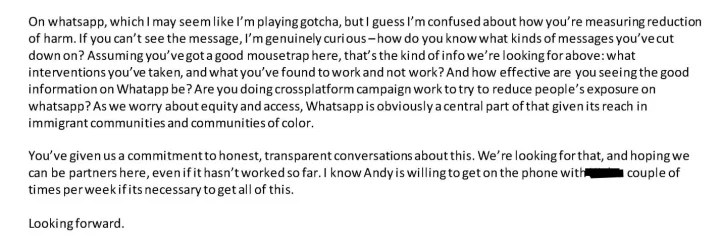
However, because of WhatsApp’s structure, targeted suppression or censorship of certain information is not possible. Instead, the focus of content moderation on WhatsApp has been to push information to users.
This has included partnering with the World Health Organization, UNICEF, and over 100 governments and health ministries to send COVID-19 updates and vaccine-related messages to users.
This move by the Biden administration raises concerns about the impact on freedom of expression and the ability to communicate privately on digital platforms.
With the White House pressing for content moderation on the platform, it could undermine this privacy and freedom of expression that is expected on end-to-end encrypted apps (although WhatsApp is perhaps less trusted anyway over its ties to Meta.)
EU warns of response to Belarus nuclear move
RT | March 26, 2023
The EU will respond with further sanctions if Belarus presses ahead with hosting Russian nuclear weapons on its soil, the bloc’s top diplomat, Josep Borrell, has stated. Borrell called the decision to transfer tactical weapons to Belarus “an irresponsible escalation” by Moscow.
“Belarus hosting Russian nuclear weapons would mean an irresponsible escalation and threat to European security,” Borrell tweeted on Sunday. “Belarus can still stop it, it is their choice,” he continued, adding that “the EU stands ready to respond with further sanctions.”
Russian President Vladimir Putin revealed on Saturday that his country’s tactical nuclear weapons will arrive in Belarus as early as this summer. Putin said that he made the decision after the UK announced it would transfer toxic depleted uranium munitions to Ukraine, a move he described as a sign of London’s “absolute recklessness.”
Belarus has already been extensively sanctioned by the EU and US since the start of Russia’s military operation in Ukraine last February. Brussels has blacklisted more than 20 Belarusian officials, cut five of the nation’s banks off from the SWIFT system, and imposed numerous trade restrictions.
Prior to 2022, the EU banned Belarusian flights from operating in its airspace and imposed five separate sets of sanctions in response to President Alexander Lukashenko’s 2020 election victory, which the EU deemed fraudulent.
In his announcement on Saturday, Putin explained that any nuclear weapons transferred to Belarus would remain under Russian control.
“There is nothing unusual,” about this arrangement, Putin stated, explaining that “the United States has been doing this for decades” by keeping its own nuclear weapons in Belgium, Germany, Italy, the Netherlands, and Türkiye.
“They have long deployed their tactical nuclear weapons on the territory of their allies,” he said. “We agreed that we will do the same, without violating our international obligations on the non-proliferation of nuclear weapons.”
Featured Video

Iran is (probably) collecting tolls, and why Asia stopped buying oil from the US
or go to
Aletho News Archives – Video-Images
From the Archives
The Great Recycling Scam
By Dr. Vernon Coleman – 21st Century Wire – September 2, 2022
Recycling was introduced, worldwide, as a tool to teach citizens to become compliant.
Forcing citizens to sort their rubbish into up to nine separate bags or boxes every week had absolutely nothing to do with ‘saving the planet’ and everything to do with teaching citizens (through a mixture of fines and shame) to behave ‘responsibly’ i.e. to do as they were told without looking too closely at the rationale of what they were being told to do.
The recycling never had anything to do with protecting the planet, of course. Most of the rubbish sorted, washed and collected in the UK was taken abroad, by lorry or ship or train, and burnt or dumped. It was, quite simply, impractical and not cost effective to recycle the material that had been collected. And, of course, collecting the sorted rubbish involved massive costs in terms of cash and pollution.
Today, the recycling business has reached an apogee of lunacy. Councils introduce ever more complex rules and fees. They refuse to take away much of the waste that is collected. And those wanting to take their rubbish to a ‘recycling’ centre will probably have to make an appointment and answer a host of questions.
It is no surprise that fly-tipping has become a major problem. The biggest causes of plastic in the sea are dumped fishing gear and plastic waste (much of it officially designated as recycled) which has been dumped by ships.
The good news, however, is that in Britain, recycling rates are falling. More and more people have become aware that the whole recycling movement was just another piece of manipulative trickery.
Blog Roll
 Aletho News
- Weaponized Journalism: 2021 Sayer Ji Interview with NPR
- Beyond Netanyahu: what Israel’s election means for Palestinians
- Lithuania plans universal conscription
- Lies, Damn Lies, and Ukraine News
- Financial Times rejects Nordic demands to correct Putin call story – media
- The Case for Less Unity in Europe
- Ukraine expands minority rights under EU pressure – but Russians remain excluded
- Albania takes anti-riot crackdown cue from France
- The interest of the House of Rothschild in Ukraine
- Pentagon fires top military planner
- If Americans Knew
- An error has occurred; the feed is probably down. Try again later.
- No Tricks Zone
- Germany’s Green Energy Transition Becoming Increasingly Expensive…Another 6 Trillion Euros!
- Sudden Stratospheric Warming, Powerful El Niño Combination May Lead To Extreme Europe Cold, Energy Crisis!
- Two New Studies Find Thwaites Glacier Melt Cannot Be Driven By Human Activity Or A Warming Ocean
- E-Cars Reduce CO2 Emissions By Only 41% Compared To Internal Combustion Engine Vehicles
- Predictions Made By Renowned Climate Professor Over Past Decades Have Been Proven To Be Poor
- New Study Suggests Large Regions Of The Pacific Ocean Have Been Cooling For The Last 80 Years
- Germany’s Green Energy Debacle: High Energy Costs Force Kahla Porzellan to Close After 182 Years!
- New Study: 50 Years Of The Most Aggressive ‘Net Zero’ Policies Can Only Affect The Global Climate By 0.03°C
- US September “Heat” Was No Record…Many Records Set Decades Ago
- Latest European Green Energy Debacle; Portugal’s Largest Flagship Solar Park Insolvent!

