Turkiye ‘reviewing options’ for Syria withdrawal: Report
The Cradle | March 23, 2023
Lebanese daily Al-Akhbar released a report on 23 March claiming that Turkiye is willing to make concessions regarding the fate of its military presence in Syria, and is reviewing options to set a timeframe for the withdrawal of its troops from the country.
This comes in light of Damascus’ repeated insistence that the continuation of normalization efforts between the two countries depends on this condition.
“Turkish officials are studying, at the present time, several options regarding the fate of the Turkish military presence in Syria and the possibility of setting a schedule to end it in connection with field, humanitarian and political developments,” Syrian opposition sources told Al-Akhbar.
According to these sources, Turkiye will present proposals on this matter to Russian and Iranian mediators and is hoping that Tehran and Moscow will be able to act as “guarantors” to convince Syria that Ankara will properly implement any agreement that is reached, “whatever the results of the Turkish presidential elections.”
Damascus said in January that Turkish President Recep Tayyip Erdogan is using the reconciliation with Syria as a ploy to secure himself in the upcoming election in Turkiye. Many have reinforced this, alleging that Erdogan wishes to use the normalization to portray himself as a champion in diplomacy, and as the solver of the Syrian refugee crisis in Turkiye.
Since the devastating earthquake that struck Turkiye and Syria at the start of last month, Erdogan’s chances at reelection have slimmed, according to the most recent polls.
Russia is currently working to set a date for a four-way meeting between the foreign ministers of Ankara, Damascus, Moscow, and Tehran, aimed at moving forward with the reconciliation. However, this meeting has so far failed to materialize, given Syria’s insistence on clear Turkish concessions.
According to Al-Akhbar, Turkiye’s newfound willingness to concede on the issue of its military presence is the reason behind the Turkish foreign minister’s latest claim that the meeting could be held “within days.”
US to build new military bases near South China Sea
RT | March 23, 2023
The United States is set to build four new military bases “scattered” around the Philippines, the country’s president, Ferdinand Marcos Jr., has confirmed. He added that at least one facility would be placed near a disputed island chain claimed by China and several other nations.
Speaking to reporters on Wednesday, the Philippine leader offered additional details about the new installations, which were first unveiled last month as part of the Enhanced Defense Cooperation Agreement (EDCA) with Washington. However, he said he could not reveal their exact location until a formal announcement is made alongside the US.
“There are four extra sites scattered around the Philippines – there are some in the north, there are some around Palawan, there are some further south,” he said, adding that the bases would help to defend the country’s largest island, Luzon.
Palawan is one of the Philippines’ westernmost regions, and is situated around 200 miles (320 kilometers) east of the disputed Spratly archipelago in the South China Sea, which is also known by several other local names. Six countries have laid claim to parts of the small island chain, among them China, Taiwan, Vietnam, Malaysia, Brunei as well as the Philippines, though US officials have repeatedly rejected Beijing’s claims as “unlawful.”
American bases on Luzon, meanwhile, are likely to be built with Taiwan in mind given its close proximity to the self-governing island, which China considers part of its sovereign territory. Though Washington had long maintained a policy of “strategic ambiguity” toward Taipei, President Joe Biden has broken with that approach, explicitly stating that US forces would come to Taiwan’s defense in the event of a Chinese attack.
Asked about the plans for the new bases during a Wednesday press briefing, Chinese Foreign Ministry spokesman Wang Wenbin argued that military cooperation between countries should be “conducive to regional peace and stability and not targeted at or harmful to the interests of any third party.”
“The US side, out of selfish interests, remains trapped in a zero-sum mentality and keeps increasing military deployment in the Asia-Pacific,” he said, adding that “Regional countries need to remain vigilant and avoid being coerced or used by the US.”
President Marcos went on to warn of a “complex” and “unpredictable” security environment in the region, saying he was aware of an “emerging threat” that would require “adjustments in our strategy” without elaborating.
Under the 2014 EDCA, the US was initially permitted to construct five military bases around the Philippines, but the pact was recently extended to four additional “strategic” sites. Washington has so far spent $82 million on the original five facilities, and continues to work on bases that will eventually host rotating troop deployments.
Why hypersonic weapons change everything
They can sink ALL of the U.S. aircraft carriers, all at once
By Alex Krainer | Trend Compass | March 22, 2023
When it comes to all matters military, I have been following a handful of analysts among whom Croatian Admiral Davorin Domazet (retired) emerged as perhaps my favorite. He has deep and detailed command of technical matters (like Andreiy Martyanov he insists that you can’t prevail in modern warfare without deep knowledge of advanced mathematics and probability). More importantly, he has perhaps the clearest understanding of the broad historical context of today’s clash between Russia and the western powers.
Unfortunately, Admiral Domazet does not give many interviews and none in English, but I thought that his last one was important enough to share more broadly in this article.
If you happen to speak Croatian/Serbian, you can find the interview, published on 17 March 2023 at this link. It runs over 2 hours.
Domazet is the only military analyst that I know of, who takes into account the history of western financial oligarchy, their Venetian roots, migration to Amsterdam where they formed the Dutch Empire, and subsequent move to London which, to this day remains the ideological and spiritual headquarters of the undead British Empire.
He has correctly labelled humanity’s enemy as the “western occult oligarchy,” and has even called the war in Ukraine as the clash between Christ and anti-Christ, underlining that the anti-Christ is in the west. Mind you, Croatia is a NATO member state and is, like Poland, a catholic Slavic nation, sharing even some of its cultural Russophobia (though it may not bequite as rabid in Croatia as it is in Poland).
However, the part of Domazet’s last interview that I found particularly worth sharing was what he laid out about Russia’s hypersonic weapons.
It was in 2018 that Vladimir Putin took the stage to present Russia’s new hypersonic weapons. The term “hypersonic” refers to missiles that fly at speeds of 5 mach and higher. At the time, many in the west dismissed Putin’s claims and thought it was a bluff. We now know that he wasn’t bluffing. Russia is the only country in the world that has deployment-ready hypersonic missiles – not one but three types: Zircons, Kinzhals and Avantguards.
Domazet explained why these weapons are radical game changers in warfare. Namely, in World War 1, tanks were the game changing military technology. Since World War 2, it’s been the air-force. Aircraft carrier strike groups have been an irresistible force wherever they travelled, dominating the seas ever since. But hypersonic precision missiles have rendered that force obsolete overnight.
The main military front in today’s global conflict, according to Domazet, are the Anti-Ballistic (ABM) batteries which the US has set up on the Poland-Romania axis, and the Russians on the North Pole-Kaliningrad-Crimea-Syria axis. These are defensive systems, conceived to intercept incoming nuclear missiles (though they can easily be converted to offensive nuclear missiles). However, today’s ABM systems are only effective against missiles flying at speeds up to mach 3.5 (3.5 x the speed of sound).
Russia’s new Kinzhal missile flies at speeds of mach 12 to mach 15 and nothing in western defensive arsenals can stop its strike. During the war in Ukraine, Russia staged a stunning demonstration of its power. The first Kinzhal strike, delivered one month after the beginning of hostilities in Ukraine, was perhaps the most significant: Russian forces targeted a large weapons depot in Ukraine which had been built during the Soviet times to withstand a nuclear strike. It was buried 170 meters (over 500 ft) underground and protected by several layers of armored concrete.
The Kinzhal flies at altitudes of between 20 and 40 km, with a maximum range of 2,000 km. When above target, it dives perpendicularly and accelerates to 15 mach, generating enormous kinetic energy in addition to its explosive payload. That first strike with a single Kinzhal missile destroyed Ukraine’s nuke-proof underground weapons depot. This was a message for the west.
The Kinzhal was developed with the express purpose of destroying aircraft carrier strike groups. If it could destroy a warehouse built to withstand a nuclear strike, it can cut through an aircraft carrier like a hot knife through butter.
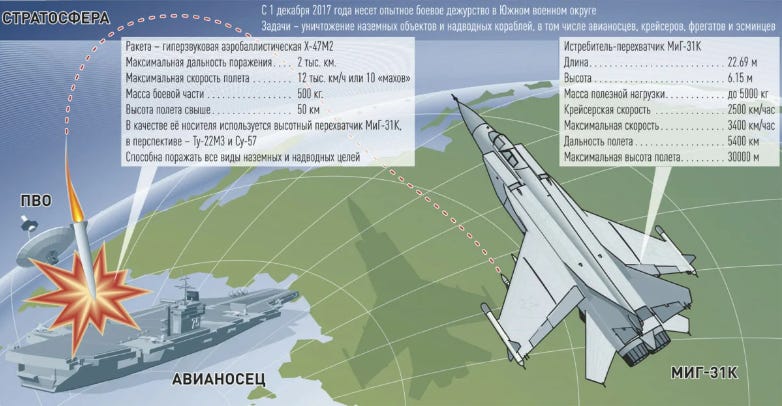
According to Admiral Domazet, neither the western powers nor China are anywhere near having weapons like that. He explained that the critical issue with hypersonic weapons are the extreme temperatures reached during hypersonic flights on the surface of missiles, which can cause them to break apart mid-flight. Russia is the only nation that has developed special materials that enable the missiles to withstand this stress, so their flight can be controlled throughout its trajectory and delivered with pinpoint accuracy.
Western intelligence estimated that Russia had some 50 Kinzhals at the start of the war in Ukraine, and thus far it has used only 9 of them. Last week, they fired six Kinzhals in a single salvo. That too, was a message. Here’s how Domazet explained it: United States have 11 aircraft carrier strike groups. Of these, fewer than half will be active at any one time (while others are in dock for maintenance, or in preparation). Firing six Kinzhals in one go is military-speak for, “we have the capability to sink ALL of your aircraft carriers at once.”
Russia has the capacity to build about 200 Kinzhals per year and now has means of delivering Kinzhal and Zircon missiles anywhere from aircraft, ships and submarines. In addition to destroying aircraft carriers, they can also destroy NATOs ABM missile sites. In a nutshell, Russia is now a clear winner of the 21st century arms race.
It could take the western powers 10 years or longer to catch up and until then, the only way to avoid losing the war is to either concede defeat and accept Russia’s security demands, or to escalate the conflict to nuclear exchange.
A conservative estimate suggests that at least a billion people would perish in such a conflict and nobody would win. Who would do such a thing? The idea of using nuclear weapons is, in fact, so repugnant that we can be assured that our leaders will never chose the path of escalation. Surely, nobody’s that evil, right? Are they?
Putin and Xi Standing Firm on the Right Side of History
By Finian Cunningham | Strategic Culture Foundation | March 23, 2023
The historic summit this week between the Russian and Chinese leaders provoked paroxysms of angst in the Western media. President Vladimir Putin’s hosting of China’s Xi Jinping in Moscow was presented as the “world’s two most prominent autocrats” purportedly establishing a hostile “anti-West axis”.
The American and European media – slavishly echoing the talking points of their imperialist regimes – were in hyper-bogeyman mode. The meeting of Putin and Xi was distorted in every way to appear as something illegitimately threatening and sinister to the Western “rules-based global order” (euphemism for Western capitalist privileges and predation.)
Bogeyman mode also entails collective amnesia. The summit coincided with the 20th anniversary of the U.S. and British launching their war on Iraq – arguably the biggest crime of the 21st century so far. Yet this vile anniversary has hardly stirred any Western media condemnation or shame, never mind legal accountability.
The wanton cynicism towards the Putin-Xi meeting belies the deep anxiety among the U.S.-dominated clique of Western states that the much-vaunted “rules-based order” is collapsing. A collapse caused by its own inherent corruption and systematic abuse of power and international law over many decades.
Both Putin and Xi emphasized that the Russia-China alliance was not meant to threaten any third party.
“We are always for peace and dialogue,” said China’s President Xi who was in Russia on a three-day state visit.
Putin hailed the highest point in relations between Moscow and Beijing and underscored the long historical friendship. Both leaders said this was not simply an extension of a Cold War-era alliance but rather a harbinger of genuine multipolar global development for all nations based on partnership and cooperation, respecting international law and national sovereignty.
Indeed, the much-anticipated multipolar world order is coming to fruition as the erstwhile dominance of Western elitist unilateralism shrivels. The Russian and Chinese leaders signed multiple trade deals and furthered plans to use national currencies, thereby making the unwarranted privileges of the US dollar obsolete.
There is a palpable sense that the global economy is moving in a tectonic shift towards Eurasian partnership of vitality and dynamic multipolar development, foreshadowing a fateful demise for U.S.-led Western capitalist hegemony. Western nations are haunted by financial bankruptcy, inequality, paralyzing debt, and dead-end militarism.
Of particular note is the plan to build a new gas pipeline from Russia to China dubbed Power of Siberia 2. It will supply an additional 50 billion cubic meters of natural gas annually to China. Significantly, this new supply route of Russian energy matches the volume that had been earmarked for the European Union with the operation of the Nord Stream 2 pipeline – until the Biden administration blew it up.
Out of all the impressive partnership deals signed in Moscow this week, the new gas route to China speaks loudest. Russia has decided to walk away from the ungrateful Europeans and let them suffer the consequences of industrial shutdown by opting for expensive American gas.
Eurasian economic power is the fulcrum of global development. Russia and China are leading the way, not just for the rest of Eurasia, but also for the Global South, Latin America, Africa, and others. The incremental moving away from the U.S. dollar as fiat international currency is the most ominous sign of the rise and fall. Russia and China are hastening that fateful switch.
In a desperate bid to avert the inevitable, the Western imperialist regimes and their media tried to depict the Putin-Xi summit as something sinister for global security, in what amounts to be a reverse projection of their own depredations and crimes.
Western media sneered that “autocrats” Putin and Xi were “posing as peacemakers”, even while both leaders emphasized their vision of multipolar relations was based on mutual cooperation.
China’s proposals for a peaceful end to the war in Ukraine were welcomed by Putin but dismissed by the Americans and Europeans as “diplomatic cover for Russian aggression”. Meanwhile, Washington and Brussels made new commitments to increase weapons supply to Ukraine, thereby prolonging the conflict – the worst in Europe since World War Two.
It is American and European regimes that are ruling out any dialogue or political-historical understanding about the origins of the war in Ukraine. Hence their determination to swipe away any opportunity for resolution. Because if an intelligent, reasonable dialogue was held – as the Russians had proposed before the war erupted more than a year ago – the conclusions would be unacceptable for U.S. and NATO expansionism.
The paradox is Russia and China are portrayed as global villains by Western powers who are still dripping with blood from the fraudulent and illegal Iraq war and who are today fueling a potentially catastrophic nuclear confrontation over Ukraine. The same media lying machine that enabled the destruction of Iraq (and many other nations) is now enabling hostility towards Russia and China.
To augment that twisted narrative, the Western media seek to undermine the Russian and Chinese-led move towards a better, fairer global economy and with that the demise of U.S. hegemony. Of course, “U.S. hegemony” and “Western economy” are just euphemisms for a dictatorship of billionaires and corporations, a dictatorship that the vast majority of the Western public has to suffer under.
So this week, Russia was labelled the “junior partner” of China and denigrated for becoming a “dependency” on Beijing. Western media reporting went into contortions to wantonly mischaracterize the evident warmth between Putin and Xi, and the tremendous significance of their global vision.
Russia was disparaged as becoming nothing more than a “resource colony of China” owing to its burgeoning oil and gas exports. That moniker reminds one of former U.S. Senator John McCain’s insult of Russia being nothing more than a “gas station masquerading as a nation”.
It’s funny how Moscow was up until recently accused of “energy blackmail” and “weaponizing hydrocarbons” when it was the main supplier of Europe. But when Russia’s vast energy is rerouted to China it is now pilloried as a “colony” of Beijing. Western propaganda can’t make up its mind about whether to cast Russia as an energy tyrant or an energy toady. That double-think betrays propaganda construct and demonization.
The world is changing before our eyes. Western imperialist regimes are being exposed for the warmongers they are, their privileges and predatory capitalism are imploding, their neocolonialist blood-sucking days are over, and a new multipolar order of partnership and peace is emerging.
The Western elites and their media are excelling themselves by trying to bad mouth Putin and Xi in every preposterous way. The outlandish distortions are commensurate with the desperation.
Time in short order, however, is telling who really is on the right side of history.
Western Sanctions Targeting Russians Failed, PM Mishustin Says
By Oleg Burunov – Sputnik – 23.03.2023
The US and its allies slapped packages of sanctions on Russia shortly after Moscow had launched its special military operation in Ukraine.
Russian Prime Minister Mishustin stated on Thursday that the US-led Western sanctions barrage targeting Russians has failed.
“At the very beginning, the West tried to assure that the sanctions were not directed against our citizens. And at the time, there were no illusions on this score. But now, even a person far removed from global politics understands that the main target was precisely the Russian people,” the prime minister emphasized during his speech at the State Duma, Russia’s lower house.
He said that the West “stopped at nothing”, even going as far as blowing up the Nord Stream gas pipeline network and seizing banking accounts.
Also, they “disconnected [Russia] from the international payment system, trying to block all banking and any other economic activity [of the country],” Mishustin pointed out.
The Russian PM emphasized that despite the sanctions, “goods and services-related payments as well as money transfers are being carried out just like before.”
“All bank cards in Russia that were previously in use are still working. The government also managed to reduce inflationary pressure and preserve the banking sector’s stability,” Mishustin stressed.
He recalled that last spring, “analysts were predicting a probable double-digit decline in Russia’s gross domestic product (GDP),” but he emphasized “we weathered the storm.” “It was a tricky task. The economic slowdown, [which was] inevitable under such conditions, was quite mild. Nevertheless, We’ve put the economy back on the growth track,” he added.
The Russian prime minister highlighted that in this regard the government had created “all the necessary work conditions for those companies that see their future in Russia, including firms from unfriendly states.”
“Despite all the restrictions, the negation of property rights, and the discriminatory measures that Russian businesses faced in the West, foreign companies feel comfortable when working in Russia,” Mushustin noted. He warned that “if foreign firms ditch their business operations in Russia and fail to take care of the future of their enterprises and employees, we will protect the interests of our people.”
The PM cautioned that “external pressure” on the Russian economy is unlikely to show signs of easing any time soon, and that “the period of [the economy’s] adaptation will end in 2024. Moreover, Russia will embark on the path of long-term progressive development.”
Last year, Western governments began to slap sweeping sanctions on the Russian economy over Moscow’s special military operation in Ukraine. However, these measures finally boomeranged on the economies of the US-led West as these restrictive measures sent inflation (especially in the energy sector) skyrocketing to record highs while simultaneously driving their societies into a cost of living crisis.
Russia’s economy recovers while dozens of US banks face collapse
By Ahmed Adel | March 23, 2023
Although Western media were boasting about Sberbank’s 78% plunge in profit in 2022 due to US-led sanctions, with CEO German Gref acknowledging a “most difficult year”, it appears that the US economic system is the one actually on the brink as four banks have already collapsed, with dozens more expected to follow.
CNN described the Russian bank’s drop in profit as a “collapse” in its headline, but then had to admit in the article that “Sberbank’s resilience in the face of sanctions helped Russia’s banking sector recover from a loss-making first half in 2022.”
This is in line with Gref’s belief that this year’s profits should be close to the record 1.25 trillion rubles ($16.5 billion) earned in the “pre-crisis year.” “Our business model passed another strength test,” he added.
It is recalled that Russian Presidential spokesperson Dmitry Peskov said on March 14 that there is “practically” no risk of Russia facing a fallout from the SVB collapse, adding that: “Our banking system has certain connections with some segments of the international financial system, but it is mostly under illegal restrictions.”
Despite alarmist headlines from US media and experts, Peskov was proven correct as no Russian bank has collapsed despite Western sanctions. Meanwhile, the full repercussions of SVB’s downfall are yet to be felt, with former Lehman Brothers executive Lawrence McDonald believing that up to another 50 American banks could collapse if structural problems are not fixed.
“So Lehman failed and then it forced this too-big-to-fail system, and then, now this interest rate shock to the regional banks is moving hundreds of billions of dollars out of regional banks into the big banks… So you could have another 50 bank failures… unless they fix the structural problem,” said McDonald on March 22.
“There’s going to be further damage. They have to cut rates and then they have to have a deposit guarantee, a larger one, that’s what they’re going to come up with… That’s a bailout. That’s basically the federal government taking on bank deposit risk,” he added.
By being cut-off from the Western banking system, Russia is effectively protected from the series of bank collapses that are expected to follow. Russia faced a credit crunch due to the fallout from the US subprime mortgage crisis in 2008, which ultimately led to the Global Financial Crisis, a demonstration of how it too was exposed to weaknesses in the US economy.
Although Russia was cut-off from SWIFT only two-days after the special military operation began, in addition to many other Western restrictions, including a $60 per barrel oil price cap, President Vladimir Putin boasted about the resilience of the Russian economy.
The IMF reported that Russia’s economy contracted by 2.2% in 2022 and will start growing again in 2023, expanding by 0.3%, and then 2.1% in 2024. This is impressive when considering that fellow European countries, which are not sanctioned, will be struggling immensely. The UK is expected to contract by 0.6% and Germany will have a growth of only 0.1%.
At the same time, the OECD forecasts that US economic growth would slow from 1.5% this year to 0.9% next year. This is due to higher interest rates slowing down demand. Bloomberg on March 21, citing sources, reported that the US Treasury Department is studying the possibility of guaranteeing all bank deposits in the event of a recession in the banking sector.
The current banking crisis has forced economists, including from the esteemed JPMorgan Chase, to make new recession forecasts after any hopes of recovery were snuffed away.
“The Fed is facing a difficult task on Wednesday, but it is likely already past the point of no return,” JPMorgan strategists wrote in a note to clients on March 22. “A soft landing now looks unlikely, with the airplane in a tailspin (lack of market confidence) and engines about to turn off (bank lending).”
Goldman Sachs also echoed JPMorgan and said in mid-March that the banking crisis could deliver a severe blow to economic growth.
For his part, former Treasury Secretary Larry Summers has warned multiple times, including as recently as March 9 but even from before the banking crisis, that the economy could be heading for a “Wile E. Coyote moment,” referencing a Looney Tunes character who was always blissfully unaware that he was about to hit the ground after running off the edge of a cliff.
However, the expected collapse of many banks in the US and the impending economic crisis has not deterred the determination of the Biden administration to fanatically arm, fund and train the Ukrainian military and regime. With millions of Americans on the verge of dropping out of the Middle Class, Washington continues to send tens of billions of dollars to Ukraine, and all the while Western sanctions are now beginning to have a minimum effect on the Russian economy, thus effectively rendering them nearly useless.
Ahmed Adel is a Cairo-based geopolitics and political economy researcher.
‘Never vaccinated’ vs ‘Ever vaccinated’ mortality rate illusion: Survivor bias and how to overcome it
By Norman Fenton | Where are the numbers | March 21, 2023
In a previous article, we described the concept of survivor bias in studies that claimed better outcomes for covid vaccinated women in pregnancy: since the greatest risk to babies occur early in pregnancy, the babies of women who are vaccinated during pregnancy must already have survived the riskiest period.
In fact, a similar survivor bias more generally affects mortality rates for the vaccinated. If you see a study claiming much higher mortality rates of the ‘never vaccinated’ versus the ‘ever vaccinated’ you need to be sure it’s not just a statistical illusion due to survivor bias. This (7 minute) video provides an animated explanation:
The video shows this particular bias is avoided by using ‘person years in each vaccination category’ rather than people in each category. So a person who first gets vaccinated 6 months into a one year study and lives until the end of the year will be counted as 6 months never vaccinated and 6 months ever vaccinated.
The example is, of course, extremely simplified. Ideally, to calculate the correct number of person years in each category we need to know, for each person in the study, the exact date of each vaccination. And we also need to take account of the varying infection rate at different time intervals. That’s because the survivor bias is further exaggerated if (as was the case in most Western nations for the covid vaccines) the initial vaccine roll-out happened during the winter – meaning that fatality rates would inevitably fall anyway as more people were vaccinated. So, irrespective of the vaccine, more deaths were occuring at a time when more people were unvaccinated. Most of those classified as vaccinated would therefore already have survived the initial death peak when first vaccinated.
The ONS data on deaths by covid vaccine status uses person years to avoid this kind of survivor bias (although there are other biases not avoided in the ONS data as explained here). However, most studies and reports comparing mortality rates of vaccinated and unvaccinated (whether it is for covid deaths or all-cause deaths) fail to make the adjustment and are therefore overestimating the mortality rate of the unvaccinated while underestimating the mortality rate of the vaccinated.
Consider, for example, the most widely used web site for covid data, “Our World in Data”. Its page describing the comparison in covid mortality rate for vaccinated and unvaccinated states:
Death rates are calculated as the number of deaths in each group, divided by the total number of people in this group. This is given per 100,000 people.
So, all of the graphs shown there, such as this one for the USA, are subject to survival bias (one of the tell-tale signs of survivor bias is that the overestimation of the unvaccinated mortality rate will be highest during the time when large numbers of people are still being vaccinated and lowest during periods when there are few new vaccinations):

The regular CDC reports such as this most recent one not only fail to adjust for survivor bias but fail to mention this among the many listed limitations of their analysis. Since, as our simple video example shows, survivor bias makes it inevitable that a placebo vaccine can be shown to reduce mortality and will do so the more jabs you have. Therefore, it is unsurprising that these reports all have to assert the following to keep up the illusion:
All persons should stay up to date with COVID-19 vaccination
As we have explained several times before there are many biases and flaws in the way covid data is collected and analysed which (curiously) all favour exaggerated claims of vaccine efficacy and safety:
How to create the illusion your vaccine is 90% effective
…. even when those vaccinated get infected
Indiana’s Bureau of Motor Vehicles is caught collecting and selling personal data
By Ken Macon | Reclaim The Net | March 21, 2023
Indiana’s Bureau of Motor Vehicles (BMV) has been caught selling drivers’ personal information without their consent and without the option to opt out. Last year alone, the BMV made around $25 million from selling personal information, according to WRTV.
Asked if the BMV sells personal information, a BMV employee said to WRTV: “No. Well, you’re not supposed to. Can’t tell you for sure what they do, but they’re not supposed to!”
Though the employees might not be aware of the practice, an investigation by WRTV found that the Indiana BMV does sell personal information and the practice is legal. The BMV can sell personal information like your name, date of birth, past and current addresses, license plate number, make and model of your vehicle, VIN, date of purchase, license type, and your driver’s record.
In the past decade (2012 to 2022) the BMV made over $237 million from selling drivers’ personal information. It sells the personal information to lawyers, bail bond companies, insurance companies, private investigators, debt collection companies, recovery agents, law enforcement agencies, security guards, auto dealers, tow companies, school corporations, and mobile home parks.
The BMV refused an on-camera interview. However, in an emailed statement, a spokesperson said: “Data is only available to qualified entities who meet the eligibility and use requirements in Indiana Code § 9-14-13-7 or § 9-14-13-8.
“Consumers do not have the option to opt out at this time,” they added.
Asked how the money generated from sale of personal information [is spent], the BMV said: “The revenue generated from sales to qualified entities goes to various accounts within the BMV, most significantly the Tech Fund. The funds support maintenance and ongoing upgrades to infrastructure, databases, and security.”
Mom files lawsuit after being reported to law enforcement for questioning “polysexual” school poster
By Ben Squires | Reclaim The Net | March 20, 2023
A mother of two in New Jersey has filed a lawsuit over an alleged smear campaign spearheaded by a military officer after she made a post on Facebook opposing a “polysexual” poster at her seven-year-old daughter’s school.
The lawsuit, which the Thomas More Society filed on behalf of Angela Reading, alleges that North Hanover Township’s police chief together with military personnel at the Joint Base McGuire-Dix-Lakehurst demanded the removal of her Facebook post, portrayed her as a “security threat” and reported her to several law enforcement agencies in an attempt to silence her.
We obtained a copy of the lawsuit for you here.
“Mrs. Reading’s November 22, 2022, Facebook post was made as a private citizen from her personal social media account to a discussion group about New Jersey schools,” Thomas More Society’s Special Counsel Christopher Ferrara explained.
“In it, she shared how she had attended an elementary school ‘math night’ the previous evening with her seven-year-old daughter, who after reading LGBT-affirming posters in the school’s entry, asked her mother what ‘polysexual’ meant. Mrs. Reading merely questioned why elementary children were being invited to research topics of sexuality, noting that it is not in the state educational standards nor the board of education approved curriculum. Mrs. Reading did not name names or schools, and invited respectful debate.”
Reading’s post was removed and was followed by a campaign spearheaded by US Army Reserve Major Christopher Schilling. The post was forwarded to the New Jersey State Police and the New Jersey Office of Homeland Security and Preparedness.
“This intention to trigger a preposterous widespread law enforcement investigation and state of alarm over Mrs. Reading’s protected speech as if it were an ‘incident’ of potential or even actual criminality, is a violation of Mrs. Reading’s civil rights,” Ferrara said.
According to the lawsuit, the situation escalated because law enforcement officers, members of the military, and the Township abused the power of their offices to not only get Reading’s post censored but also to get the public furious towards her.
“The defendants acted singularly and in conspiracy with one another to deprive and chill the exercise of Mrs. Reading’s rights, including rights protected by the United States and New Jersey constitutions, as well as other laws,” the lawsuit states.
Ferrara added that the defendant’s actions resulted in Reading and her family being “demonized, harassed, traumatized, and excoriated throughout the community, forced to resign their school board positions, and having been made unwelcome, now feel they must seek costly alternative education for their children. All of this is a direct result of a conspiracy to punish a mother who did not welcome a public school’s attempt to force a woke ideology upon her own, and other, young children – and to have the audacity to exercise her right of free speech to do so in a peaceful manner in an appropriate forum.”
Featured Video

Iran is (probably) collecting tolls, and why Asia stopped buying oil from the US
or go to
Aletho News Archives – Video-Images
From the Archives
The Great Recycling Scam
By Dr. Vernon Coleman – 21st Century Wire – September 2, 2022
Recycling was introduced, worldwide, as a tool to teach citizens to become compliant.
Forcing citizens to sort their rubbish into up to nine separate bags or boxes every week had absolutely nothing to do with ‘saving the planet’ and everything to do with teaching citizens (through a mixture of fines and shame) to behave ‘responsibly’ i.e. to do as they were told without looking too closely at the rationale of what they were being told to do.
The recycling never had anything to do with protecting the planet, of course. Most of the rubbish sorted, washed and collected in the UK was taken abroad, by lorry or ship or train, and burnt or dumped. It was, quite simply, impractical and not cost effective to recycle the material that had been collected. And, of course, collecting the sorted rubbish involved massive costs in terms of cash and pollution.
Today, the recycling business has reached an apogee of lunacy. Councils introduce ever more complex rules and fees. They refuse to take away much of the waste that is collected. And those wanting to take their rubbish to a ‘recycling’ centre will probably have to make an appointment and answer a host of questions.
It is no surprise that fly-tipping has become a major problem. The biggest causes of plastic in the sea are dumped fishing gear and plastic waste (much of it officially designated as recycled) which has been dumped by ships.
The good news, however, is that in Britain, recycling rates are falling. More and more people have become aware that the whole recycling movement was just another piece of manipulative trickery.
Blog Roll
 Aletho News
- Weaponized Journalism: 2021 Sayer Ji Interview with NPR
- Beyond Netanyahu: what Israel’s election means for Palestinians
- Lithuania plans universal conscription
- Lies, Damn Lies, and Ukraine News
- Financial Times rejects Nordic demands to correct Putin call story – media
- The Case for Less Unity in Europe
- Ukraine expands minority rights under EU pressure – but Russians remain excluded
- Albania takes anti-riot crackdown cue from France
- The interest of the House of Rothschild in Ukraine
- Pentagon fires top military planner
- If Americans Knew
- An error has occurred; the feed is probably down. Try again later.
- No Tricks Zone
- Germany’s Green Energy Transition Becoming Increasingly Expensive…Another 6 Trillion Euros!
- Sudden Stratospheric Warming, Powerful El Niño Combination May Lead To Extreme Europe Cold, Energy Crisis!
- Two New Studies Find Thwaites Glacier Melt Cannot Be Driven By Human Activity Or A Warming Ocean
- E-Cars Reduce CO2 Emissions By Only 41% Compared To Internal Combustion Engine Vehicles
- Predictions Made By Renowned Climate Professor Over Past Decades Have Been Proven To Be Poor
- New Study Suggests Large Regions Of The Pacific Ocean Have Been Cooling For The Last 80 Years
- Germany’s Green Energy Debacle: High Energy Costs Force Kahla Porzellan to Close After 182 Years!
- New Study: 50 Years Of The Most Aggressive ‘Net Zero’ Policies Can Only Affect The Global Climate By 0.03°C
- US September “Heat” Was No Record…Many Records Set Decades Ago
- Latest European Green Energy Debacle; Portugal’s Largest Flagship Solar Park Insolvent!

