Tyranny on the waters: The UAE-Israeli occupation of Yemen’s Socotra Island
By Karim Shami | The Cradle | March 24, 2023
Located off the southern coast of Yemen in the Arabian Sea, the Socotra archipelago has become a focal point of regional and international interest because of its strategic proximity to one of the world’s busiest shipping lanes.
On 21 June, 2020, the Yemeni island was militarily occupied by Saudi Arabia’s Emirati coalition partner, which has aggressively pursued a policy of establishing and controlling ports throughout West Asia and the Horn of Africa since 1999.
The archipelago consists of four large islands: Socotra (3,796km2), Abd al-Kuri (130.2km2), Samhah (39.6km2), and Darsah (7.5km2), as well as three small islets.
Socotra, the biggest of the islands, lies 350 km south of the Arabian Peninsula and 95 km from Somalia. It is surrounded by the Gulf of Aden, the Indian Ocean, and the Arabian Sea, and faces the Horn of Africa from the west. Around 20,000 shipping vessels pass around Socotra each year, including 9 percent of the world’s annual global petroleum supply.
The War on Yemen
The assault on Yemen was launched on 26 March, 2015, in an announcement by Saudi Ambassador Adel al-Jubeir from Washington DC, in which he stated that a coalition of ten countries, led by Saudi Arabia and the UAE, would take military action to reinstate the government of Yemeni President Abdrabbuh Mansour Hadi.
Hadi had been ousted in popular protests in 2014, after losing the capital city, Sanaa, to the joint forces of the Ansarallah movement and their allies in the country’s armed forces. Based in northern Yemen, the Ansarallah movement had been advocating for fair representation in the government for a long time.
With US-backing, Saudi Arabia launched “Operation Decisive Storm,” and the air strikes began. Initially expected to last only a few weeks or months – and according to MbS himself, just “a few days” – the Yemeni war has now entered its eighth year and taken on a markedly different shape than the coalition initially contended.
Two years into the war, the Emiratis began pursuing their own hidden agenda of establishing a “self-styled maritime empire” in Yemen, which veered sharply from Riyadh’s objectives. To achieve this goal, Abu Dhabi sought to control the country’s southern coastline and its ports and enlisted the help of a local Yemeni proxy called the Southern Movement.
The Southern Movement was formed by secessionist tribes and groups seeking to divide Yemen along the old partition lines of 1967–1990. However, the movement had to be restructured to match the UAE’s aspirations, and in 2017 it was transformed into the Southern Transitional Council (STC).
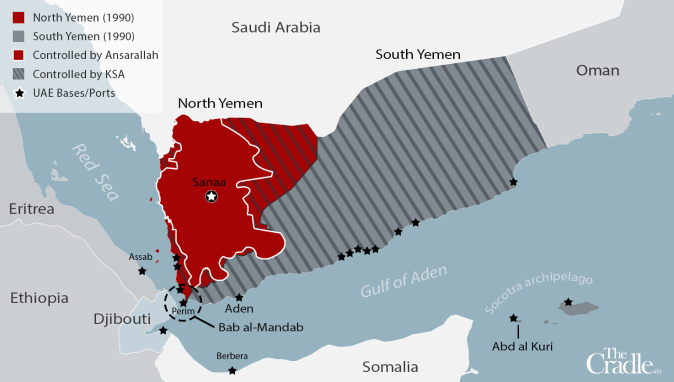
Map of the Emirati-controlled areas and ports in southern Yemen
The significance of Socotra
Socotra Island falls under the territorial jurisdiction of the exiled Hadi government, which to this day – despite his physical absence and the replacement of the “presidency” with an 8-member, Saudi-sponsored Presidential Leadership Council (PLC) – remains Yemen’s internationally-recognized government.
However, on 30 April, 2018, the UAE deployed hundreds of troops with artillery and armored vehicles on the island, which is located 350 km away from the mainland conflict, without any prior coordination with Yemeni authorities.
The Riyadh-backed Yemeni government condemned the Emirati aggression, backed by local islanders protesting against the occupation of their territory. The Saudis were forced to intervene by sending troops and training locals to deter the UAE from seizing the island.
But later that year, UAE General Khalfan al-Mazrouei arrived on Socotra Island and has since been considered its de facto ruler. Under his leadership, the Emiratis gained the loyalty of local tribes by using bribery under the guise of “humanitarian aid.” They offered Socotra residents UAE passports and promised them an improved quality of life.
The STC seizes Socotra
On the morning of 21 June, 2020, the UAE-backed STC separatists forcibly seized control of Socotra and ousted the Saudi-backed, pro-Hadi forces.
The UAE had been planning and preparing for this operation for two years, using its Yemeni proxies to gain full control over the Socotra archipelago. The Emirati flag was raised across the territory, and UAE telecommunication companies replaced Yemeni ones. Consequently, all phone calls from Socotra now register Emirati phone networks.
UAE-Israel normalization
Three months after the seizure of Socotra, the highly-controversial Abraham Accords was signed in Washington DC between Israel and the UAE, along with Bahrain, Morocco, and Sudan. On the Arab side, the normalization thrust was led by Abu Dhabi, which quickly moved to expand its diplomatic, military, and economic ties with Tel Aviv.
Shortly after the signing of the Abraham Accords, reports and images of Israeli “tourists” visiting Socotra began to emerge. According to an Al-Mayadeen report, however, the Israeli visitors were not tourists, but rather, military experts.
Abd al-Kuri Island
In February 2023, Ansarallah released a statement condemning the UAE’s eviction of residents from Abd al-Kuri, the archipelago’s second-largest island. The resistance movement accused Abu Dhabi of carrying out a long-planned operation to transform Socotra into an Israeli-Emirati military and intelligence hub.
These actions by the UAE are not isolated incidents. In another 2022 episode, Ansarallah accused Abu Dhabi of transferring fishermen from the small island of Perim (13 km2) to other parts of the Taiz Governorate. Several months later, satellite imagery revealed the construction of a military base runway on the volcanic Island. Perim is now empty of its original inhabitants, according to media reports.
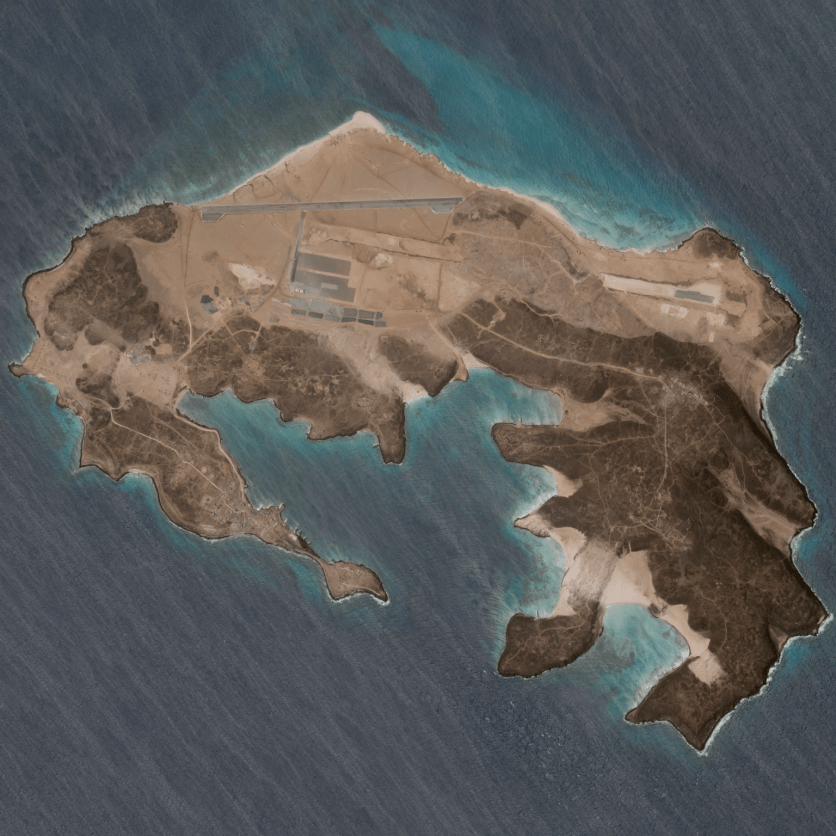
An Emirati military base on Perim Island (Mayyun in Arabic) on the Bab al-Mandab Strait
Perim Island has historically divided the Bab al-Mandab Strait into two waterways – whoever controls the island holds strategic influence over the strait. While Ansarallah’s statement about Emirati designs on Socotra was not entirely new, it raised hackles throughout the Arab world by confirming Israel’s military and intelligence presence on this key Yemeni island.
The UAE’s maritime ambitions
Many have questioned Abu Dhabi’s motivation for seizing Socotra and risking its relationships with Saudi Arabia and neighboring Oman (virtually overnight surrounded by UAE ports and bases). The UAE’s actions may be entirely attributed to the strategic vision of its President Mohammed bin Zayed (MbZ) and his no-longer secret desire to establish an Emirati maritime empire –from the Persian Gulf to the Red Sea – by controlling the region’s key waterways.
The UAE’s economic reliance on these waterways is a clear driver of MbZ’s plans: non-petroleum commodity re-exports make up almost half of Abu Dhabi’s total exports. As such, maritime security is a top priority in the country’s foreign policy calculations.
The UAE currently controls 12 ports off the coast of Yemen, including Aden, Makha, Mukalla, Al-Dabba, Bir Ali, Belhaf, Rudum, Zoubab, Al-Khawkhah, Al-Khouba, Qena, and Al-Nashima. The country is also building a new port in Al-Mahra that will cost an estimated $100 million.
By controlling these ports and the Bab al-Mandab Strait, the UAE can dominate one of the busiest shipping lanes in the world, elevating its position in global and regional trade to a strategic player.
In addition to its aggressive accumulation of Yemeni ports, the UAE also has a significant presence in the Horn of Africa, where it currently controls two ports in Eritrea and one in Somalia. It previously owned a port in Djibouti, but this became a point of territorial friction between the two countries. The UAE’s control over these ports and their strategic location in the region allow it to project its power and expand its influence in East Africa.
Why is Socotra important to Israel?
The UAE and Israel share mutual security concerns over Iran’s regional ascension over the past decade. The Islamic Republic’s naval presence is expanding into many new waterways, and its seaborne activities from the Persian Gulf to the Red Sea alarm both nations. Given Washington’s growing reluctance to engage its armed forces in West Asia, MbZ turned to the region’s military behemoth and main Iranian rival to help him execute his vision. Unlike Israel, no other regional state has the ability to garner unconditional US support – nor the willingness to cavalierly defy international law and territorial integrity.
Abu Dhabi has calculated that it stands to benefit from Israel’s intelligence network and early warning systems, particularly after its cities were subject to unprecedented Ansarallah missile and drone strikes in January 2022.
For Tel Aviv, its physical presence in any Arab state is perceived as a victory, which aligns with its ambitions for regional expansion. By establishing a base on Abd al-Kuri Island, Israel can reinforce its maritime security – around 25 percent of its trade passes through the Bab al-Mandab Strait. Another objective of the Israeli-Emirati military and intelligence hub could be to gather data or engage in espionage activities in the southern Arabian Peninsula and the Horn of Africa.
During the 1973 Arab-Israeli war, Yemen – in partnership with Egypt – blocked the passage of Israeli ships and tankers from accessing the strategic strait, leading to disastrous consequences for Israel.
The tactic could be replicated under Ansarallah Chief Abdel Malak al-Houthi’s leadership, since the movement considers Israel one of its main regional adversaries. While it may seem like a distant possibility, if the war concludes under current Riyadh-Sanaa peace efforts and Ansarallah gains control of Yemen’s south, the movement will enjoy unusual leverage to obstruct Israeli shipments whenever Tel Aviv launches regional aggressions. It should be noted that Ansarallah has already publicly threatened, on several occasions, to strike sensitive Israeli sites with its new missile capabilities.
Moreover, there has been an ongoing “ghost ship war” between Israel and Iran for several years, with occasional reports of Iranian or Israeli ships being attacked in these waterways. Israel’s presence on Socotra Island could provide it with leverage over Iran in their waterway stand-off and enable Tel Aviv to counter Ansarallah inside Yemeni territory.
NATO’s Combined Maritime Forces
It is important to note that the involvement of the US in the Israeli-Emirati collaboration and actions in Yemeni waters is not confirmed. However, it is true that the US has been a maritime security provider for the Persian Gulf monarchies for decades, and its NATO-led Combined Maritime Forces (CMF) have been present in West Asian waters since 1983 – including leading hostile actions against Iraq and Somalia.
The CMF alliance has assumed responsibility for the security of four bodies of water: The Red Sea, Persian Gulf, Arabian Sea, and the Gulf of Aden.
But with China’s rapid rise as a global economic competitor, US policy pivoted further eastward, and Washington has sought to subcontract out its West Asian security policies to its regional allies.
As such, last December, the CMF assigned command of its Red Sea task force to the Egyptian Navy, who took over from US naval forces. In this regard, the UAE, backed by Israel, may be another candidate to lead a NATO-backed naval security operation in the region.

Map of the NATO-led Combined Maritime Forces (CMF) areas of operation in West Asian waterways
Implications for Iran and Saudi Arabia
Any Israeli expansion is likely to alarm Iran and vice versa, potentially leading to direct or proxy clashes in various regional theaters. However, the presence of the UAE – Iran’s second-largest trading partner – in southern Yemen may limit Tehran’s options. Unless Iran perceives a serious security threat from the new “Arab-Israeli alliance,” it is unlikely to take any significant actions that could harm its trade relations with Abu Dhabi.
The war against Yemen has severely damaged Saudi Arabia’s image as a regional powerhouse. During the last few years, all major Saudi cities have been the subject of Ansarallah missile and drone strikes – including the country’s key oil infrastructure.
It has been humiliating for the Persian Gulf’s wealthiest and most heavily militarized state to have its vulnerabilities so completely exposed by West Asia’s poorest nation. In contrast, the UAE has thus far only benefited from the Yemen war and expanded its influence in the region.
Recently, there have been reports of a possible breakthrough in negotiations between Riyadh and Ansarallah, and observers are hoping for an early roadmap to end the conflict during the holy month of Ramadan. Obstacles are aplenty: The UAE is notably absent from the discussions, the Emirati-backed Yemeni separatists – the STC – reject any solution that doesn’t leave them in control of the south, and the US has sought to scuttle any final solution that undermines Washington’s regional leverage.
Liberating the island
Of all the stakeholders with interest in Socotra Island, none are ultimately as important as the Yemeni ones, primarily the UAE-backed STC, the Saudi-backed PLC, and Iran-backed Ansarallah.
In his most recent televised appearance, Ansarallah’s Abdel Malik al-Houthi stated: “We seek to defeat the aggression, whether on the islands, on land or at sea, and from anyone who violates our independence and the sovereignty of our country.” Unlike other leaders, al-Houthi’s threats are usually translated into action and Ansarallah will not hesitate to strike the Israeli-Emirati bases or seize their ships if the aggression continues.
Ansarallah is currently the strongest player in Yemen, controlling more than 80 percent of the country in terms of population density. On the other hand, the PLC is the most vulnerable of the three main Yemeni players, and Riyadh’s recent rapprochement agreement with Tehran has further weakened the group. If an agreement is reached between Riyadh and Sanaa, the PLC will have one of two options: to hand over their weapons or merge into Ansarallah’s armed forces.
On the other side of the spectrum, the UAE-backed STC is worried about ongoing peace talks and fears being left alone to fight head-to-head with Ansarallah-aligned armed forces.
The question now is whether there will be a peace deal between Saudi Arabia and Ansarallah that excludes the UAE and its Yemeni proxies. If that happens, Sanaa’s armed forces will almost certainly turn their big guns on the Emiratis and their Yemeni interests. The Saudis will have already calculated this outcome as they seek to advance a deal with Ansarallah. In this event, it is unlikely that Riyadh will come to Abu Dhabi’s assistance. Their common goals in Yemen ended years ago.
Washington used 300 tons of depleted uranium in Iraq: Moscow

Children who were born with birth defects in Fallujah. (Photo Credit: Getty Images)
The Cradle | March 24, 2023
The Commander of the Russian army’s Radiological, Chemical, and Biological Protection Forces, Igor Kirillov, on 24 March accused the US of using “no less than 300 tons of depleted uranium” during the early years of the Iraq war.
“In 2003-2004, the USA extensively used such munitions in strikes on targets in Iraqi cities: Amarah, Baghdad, Basra, Karbala, Fallujah. According to the UN, the US used no less than 300 tons of depleted uranium in Iraq,” Kirillov told reporters on 24 March.
He added that the resulting radioactive fallout in Fallujah alone was “worse than what happened in Hiroshima and Nagasaki.”
“This city is still called the second Chernobyl,” the Russian official stressed.
A 2018 investigation by Al Araby shows Iraq recorded the highest rate of congenital malformations in the world over the previous decade. These rates were worse in Fallujah, which was showered in depleted uranium and white phosphorus by US coalition forces.
“According to the Iraqi government, in 2005, the incidence of cancer in the country due to the use of depleted uranium munitions increased from 40 to 1,600 cases per 100,000 citizens. In this regard, Baghdad filed an official lawsuit with the International Court of Arbitration in Stockholm on December 26, 2020, against Washington, claiming compensation for the damages sustained,” Kirillov added.
In 2014, the Dutch peace group Pax revealed that US jets and tanks fired nearly 10,000 depleted uranium rounds in Iraq, many of which were fired in or near populated areas.
The Kremlin official made his statement on Friday in response to the UK government saying earlier this week they will provide Ukraine with armor-piercing rounds containing depleted uranium.
Depleted uranium is a byproduct of creating enriched uranium used in nuclear fuel and weapons. Although it can not generate a nuclear reaction, depleted uranium is higher in density than lead, making it highly attractive as a projectile.
“It’s so dense, and it’s got so much momentum that it just keeps going through the armor – and it heats it up so much that it catches on fire,” Edward Geist, a nuclear expert at research organization RAND, told Al Jazeera on Thursday.
US officials backed London’s decision, claiming the ammunition is “not anywhere close to going into” the sphere of nuclear weaponry.
“This is a commonplace type of munition … If Russia is particularly concerned about the welfare of their tanks and their tank soldiers … they could just take them across the border back into Russia,” White House National Security Council spokesman John Kirby said.
The UN Environment Program described depleted uranium ammunition as “chemically and radiologically toxic heavy metal.” A 2001 World Health Organization (WHO) report concluded that depleted uranium could accumulate at the ground surface and enter the food chain, while uranium dust can be inhaled and retained in the lungs.
London’s plan to send the radioactive arms to Ukraine came to light as the twentieth anniversary of the Iraq invasion passed. Last December, the US navy named a next-generation warship the ‘USS Fallujah.’
US attack on Syrian army leaves several dead, occupation base bombed in response
The Cradle | March 24, 2023
The US occupation base in northeastern Syria’s Al-Omar oilfield was attacked with rockets on 24 March, just hours after the US army bombed several locations in the eastern city of Deir Ezzor on Thursday night.
The US bombing was in response to a drone strike on its base in northeastern Hasakah’s Kharab al-Jir military airport, which killed a US contractor and injured several others, CENTCOM said in a statement on Friday.
“This evening, we responded to an attack on our forces that killed an American contractor and wounded our troops and another American contractor by striking facilities used by groups affiliated with Iran’s Islamic Revolutionary Guards Corps,” CENTCOM said.
“We will always take all necessary measures to defend our people and always respond … We are postured for scalable options in the face of any additional Iranian attacks,” it added.
According to the London-based Syrian Observatory for Human Rights (SOHR), eleven ‘Iranian-backed militiamen’ were killed in the US strikes. SOHR claims that six were killed in strikes on a weapons depot in Deir Ezzor’s Harabish neighborhood, three were killed in strikes on the Al-Bukamal desert, while two were killed by strikes on the southern outskirts of Al-Mayadin town.
SOHR adds that among the wounded are serious injuries, and the death toll is expected to rise.
“Among the dead are two of Syrian nationality,” SOHR says. However, Iranian news outlet Press TV alleged that no Iranians were killed in the strike. Press TV cited local sources as saying that the strike on the Harabish neighborhood was against a rural development and grain center, not a weapons depot, adding that those who were killed were Syrian military forces.
US strikes have targeted and killed Syrian Arab Army (SAA) soldiers several times in the past, including in April 2018 after an alleged chemical attack in Douma that was attributed to the Syrian government.
The last US strike on alleged Iranian targets in Syria took place in 2022 and left a number of Syrian soldiers dead.
The US military occupation in Syria is illegal under international law and constitutes a clear violation of the country’s sovereignty.
As a result of this occupation, as well as the US army’s continuous looting of Syrian natural resources, attacks against Washington’s military bases in Syria have become regular occurrences.
Despite this, the US has shown no intent to end its presence in the country. At the start of the month, a US general illegally visiting Syria referred to the occupation as ‘worth the risk.’
US to relocate its warplanes to intimidate Moscow and Beijing
By Lucas Leiroz | March 24, 2023
US weapons abroad are being relocated in line with Washington’s new strategic priorities. According to recent reports, the US will send old and outdated attack aircraft to the Middle East, replacing the modern and advanced aircraft that are currently stationed in the region. The goal is to transfer the most efficient military equipment to Europe and the Pacific, where it can eventually be used against Russian and Chinese forces – which are currently the main concerns for the US government.
The data was shared in an article published by the Wall Street Journal (WSJ) on March 21. According to information obtained by the authors, there is a plan to redistribute the planes in April. It is planned that aircraft of the type A-10, an older and less efficient model, will be sent to American bases in the Middle East. WSJ sources inform that the Pentagon considers such planes to be strong enough to protect US interests in the Middle East, therefore there is no need for more modern and equipped jets.
“The imperative is to get the most suitable aircraft to the Pacific for the higher threat challenges (…) The A-10 is still relevant to the mission CENTCOM (United States Central Command) flies over the Middle East”, Larry Stutzriem, a retired Air Force major general, told WSJ.
There is still a lack of official and more concrete information on the subject, but, in fact, this move was already expected. The Middle East is no longer part of the focus of attention in American foreign policy today. In the midst of a proxy war with Russia and the imminent emergence of a conflict with China in Taiwan, it is expected that more and more modern war equipment will be transported to regions close to Russian and Chinese territories.
According to the most recent issue of the National Defense Review, published by the Pentagon last year, China would be a kind of “pacing threat.” This means that the US sees China as a danger, but at the same time considers the threat “under control” – suggesting that Beijing is being closely “monitored”. Also, in recent speeches, US Secretary of Defense Lloyd Austin repeatedly corroborated this thesis, emphasizing the “Chinese threat”.
Regarding Russia, a country that is already the victim of American aggression – through the Ukrainian neo-Nazi proxies -, the same document states that Moscow would be an “acute threat”. This means that the rivalry between the countries would be something far beyond the mere collision of strategic interests, being also related to an antagonism of values. This would “justify” exceptional measures in search of increasing American military capacity against Russia.
For these reasons, it is likely that the next few months will see a wide redeployment of forces by the Pentagon. All sorts of modern, sophisticated, and efficient weapons may be located as close as possible to Russian and Chinese borders. Some sources claim that F-35 fighters are about to be sent on a large scale to Europe and the Pacific. This happens, of course, in addition to the official and regular arms supply that already takes place with the enemy states of Russia and China. So, a new wave of militarization is starting, and certainly will not end anytime soon.
Obviously, this wave will not end US military campaigns in the Middle East – nor in other regions where Washington maintains troops. There is a concern on the part of the US to avoid the loss of territories that are already under its military domain. After victory of the Taliban in Kabul, the image of the American Army among global public opinion was strongly shaken. And given the imminent defeat of pro-NATO forces in Ukraine, there is concern on the part of the Pentagon that anti-US rebellions will arise around the world, demanding an end to territorial occupation or the handover of military bases to local governments. For this reason, certainly these moves are calculated in a very careful way. It means that, in the face of the emergence of possible new conflict situations, more redistributions of weapons may be made, always in accordance with the updates of American strategic interests.
On the other hand, with these mobilizations becoming clear, the tendency is for Russia and China to prepare themselves for an eventual situation of open conflict. More than that, the greater the American pressure, the more the two countries tend to deepen their bilateral cooperation, which may adopt clearer military contours soon. And given the many reports of problems with the US defense industry and cases of corruption and financial speculation in the military-industrial complex, there are many doubts about the US capacity to face the integrated Russian-Chinese alliance.
Lucas Leiroz is a journalist, researcher at the Center for Geostrategic Studies, geopolitical consultant.
The US’ Rejection Of China’s Peace Plan For Ukraine Exposes Its Warmongering Intentions
By Andrew Korybko | March 24, 2023
Bloomberg cited an unnamed Biden Administration official on Thursday to report that “the US is worried about being backed into a corner over the Chinese proposal. Regardless of the US reservations, dismissing it outright could let China argue to other nations that are weary of the war — and of the economic damage it’s wreaking — that Washington isn’t interested in peace.” Alas, that’s precisely what America has done by acting as if China isn’t a serious mediator and that its peace plan is unrealistic.
By rejecting Beijing’s 12-step proposal, Washington exposed its warmongering intentions for the rest of the world to see and vindicated Moscow’s criticism that it wants to fight this proxy war “to the last Ukrainian”. The majority of the international community that resides in the Global South and which is most adversely affected by the systemic consequences of this conflict, particularly the food and fuel crises catalyzed by Western sanctions, had their perceptions of US soft power shattered once and for all.
Prior to the onset of Russia’s special operation last year that it was forced to commence in defense of its national security red lines in Ukraine after NATO clandestinely crossed them there, a significant share of folks in developing countries still generally had a favorable view of that declining unipolar hegemon. They might not have endorsed every one of its foreign policy moves, but these people still thought that its worldview had some redeeming factors that made it worthy of being listened to at the very least.
The allure of its soft power, particularly in the socio-cultural sphere as propagated by the mass media over the decades, still had a powerful hold over their hearts and minds. Now, however, these same people are directly suffering from the food and fuel crises catalyzed by the West’s unilateral sanctions. To make matters worse, the US signaled through its rejection of China’s peace plan for Ukraine that relief won’t be forthcoming, thus indefinitely perpetuating and thus exacerbating these problems.
It’s one thing for US-inclined folks in the Global South who’ve fallen under the sway of its soft power to oppose some part of its foreign policy regarding a faraway country and another entirely for that same foreign policy to directly affect them and their family. They might still enjoy consuming some of its socio-cultural products and perhaps still cling to believing in the so-called “American Dream” despite the odds of them ever benefiting from it, but their views of the US as a whole will certainly change.
This rapidly emerging outcome represents a latent crisis of the highest importance for the US’ grand strategic interests since the loss of such a critical mass of supporters will hamstring its goals across the Global South. These same people will be less susceptible to its information warfare products against their multipolar governments, thus reducing the chances that forthcoming Color Revolution plots will succeed, to say nothing of them tuning out the US’ fake news about the Sino-Russo Entente.
The combination of hunger pains and rising costs, which are the direct result of the food and fuel crises respectively that the US’ unilateral sanctions are responsible for, can turn anyone against anything even if they were previously the most fervent of believers. This is especially so when it worsens the living conditions of one’s own family, including their children. The arrogance of American policymakers, deluded by the supremacist belief in their system’s supposed “exceptionalism”, blinds them to this.
The aforesaid oversight, which could easily have been foreseen and thus avoided had groupthink not been in effect, is the proverbial straw that broke the camel’s back and turned the Global South against the US en masse. There’s now no credible possibility of America advancing its interests there by information warfare-driven attraction ever again, thus leading to it doubling down on subversion and force out of desperation instead of accepting the loss of its influence in those countries.
Russia’s ‘inexplicable’ ability to withstand Western aggression

British and French invaders exit from Crimea in defeat
By Drago Bosnic | March 24, 2023
One of the most self-defeating and yet inexplicably persistent mistakes Russia’s enemies have been making for over a thousand years is underestimating it. Regardless of the direction the invasion was coming from, Moscow was able to prevail each time. Its ability to not just successfully defend itself, but also counterattack and reach the opponent’s heartland has been unmatched in modern history. And yet, the myth of Russia’s supposed perpetual decline and dilapidation is an incessant propaganda trope used by its enemies for centuries. None of it ever came true, despite all the grim predictions, which are still being parroted to this very day and are unlikely to go away any time soon, especially nowadays, when the political West needs to keep its populace under the illusion that Moscow is supposedly “losing”.
We often hear that Russia is no more than a regional power with an economy the size of Spain’s, a military budget that has been consistently smaller than the Saudi one, etc. And indeed, on paper, this may seem true. Taking into account nominal GDP as the only measure of success and power, one might fall into the trap of believing such statistics. However, the reality is quite different. All one needs to do is ask just a few logical questions. Could the Spanish economy ever withstand the sanctions imposed on Russia, let alone grow and outperform those enforcing them? Is the Spanish economy a key global supplier of vital commodities such as food, oil, natural gas, various types of heavy machinery, crucial chemical products (such as fertilizers), enriched uranium for nuclear power plants, etc?
And yet, perhaps the most “inexplicable” segment of Russia’s resilience is its military power, particularly the cost-effectiveness of its forces, both on a tactical and strategic level. In 2021, Russia officially spent $65 billion on defense. For comparison, NATO spent close to $1.2 trillion. If we add other key US vassals such as Japan, Australia and South Korea, that figure is close to $1.4 trillion, meaning that the political West spends approximately 22 times more than Russia. So, is “global” NATO 22 times more powerful than Russia? The notion is even more ludicrous if we take into account that Moscow actually outproduces NATO in terms of air defense missiles, artillery shells and other munitions, while also maintaining a strategic arsenal greater and more powerful than that of the political West, combined.
This is without considering Russia’s absolute dominance in key technologies such as hypersonic weapons, with no NATO/Western countries deploying a single operational missile of that type and with no prospects of doing so before 2025 (or beyond). There are other aspects such as Moscow being able to fight on multiple fronts simultaneously, including in Syria, another US/NATO invasion ever so euphemistically dubbed the “Syrian Civil War”, where the Pentagon keeps complaining that its forces there are essentially powerless to stop Russia. This discrepancy in official figures is even more pronounced in Ukraine, where the political West spent approximately $120 billion in little more than a year, which is nearly twice as much as Moscow’s entire annual military budget and approximately 25 times more than what Russia has allocated for the special military operation.
And yet, the Kiev regime forces are suffering staggering losses at a rate of nearly 9:1 in Russia’s favor. Worse yet, Russian forces have consistently been outnumbered 2:1 for over a year now, all the while conducting offensive operations in multiple directions simultaneously. It should also be noted that several former high-ranking US/NATO officers have pointed out that the Neo-Nazi junta forces would be among the top three NATO military powers had the Kiev regime been admitted into the belligerent alliance. Given their performance against the Russian military, while having a massive numerical advantage and NATO providing all the targeting data, as well as getting up to 25 times more funding than the Russian forces deployed on the frontlines, should we be surprised by the panic at the Pentagon?
John Kirby, Spokesman for the National Security Council and a former US admiral, was recently asked to comment on the Russian pilots being awarded medals for masterfully downing a US MQ-9 “Reaper” drone, to which he stated they were “idiots, at best”. However, when we compare the US handling of the so-called “balloon controversy”, things become a lot clearer. It took the Pentagon approximately a week to use the F-22 “Raptor”, its most expensive fighter jet, and shoot down weather balloons with missiles costing nearly $450,000 each. In addition, the F-22 is infamous for its flight hour of around $85,000, as well as costing approximately $350 million apiece. According to The Guardian, the price of one of its targets was a meager $12. Worse yet, it took at least two missiles for the “Raptor” to down one of the balloons it engaged.
If we were to compare this to Moscow’s interception of the US drone which took part in the Kiev regime’s attacks on Russian soldiers and civilians, the discrepancy becomes even more staggering. As previously mentioned, Russian pilots downed a US MQ-9 (the latest Block 5, costing over $32 million) without firing a single shot in an action that lasted no longer than 30 minutes. It should also be noted that the Su-27s they were flying cost approximately $15 million, with the flight hour being around $15,000. When considering those facts, Mr. Kirby should double-check the definition of the term “idiot” or maybe take a good look in the mirror, “at best”.
This also brings us to a rather amusing episode that happened in Serbia over two decades ago. Namely, two years after the (hopefully) final direct US/NATO attack (on this day 24 years ago) on Serbia at the end of nearly a decade-long aggression, a delegation from the Pentagon visited Belgrade, including the main Serbian aviation museum. During the tour that included showcasing downed American aircraft, a member of the US group arrogantly asked one of the Serbian officers how it felt fighting the most powerful military force in history, to which he replied: “I wouldn’t know. We never fought the Russians.” At the time it seemed like a jest that the Americans didn’t take too kindly. However, over 20 years later, the statement seems like anything but a joke.
Drago Bosnic is an independent geopolitical and military analyst.
Mexican President Says Trump Arrest is About Keeping Him Off the Ballot

Agencia Press South via Getty Images
By Paul Joseph Watson | Summit News | March 23, 2023
Mexican President Andres Manuel Lopez Obrador slammed the Biden administration for accusing him of corruption while abusing the justice system in America to engage in a political witch hunt against Donald Trump “so that he doesn’t appear on the ballot”.
AMLO made the comments in response to a U.S. government report that accused his an administration of “human rights violations,” a charge which he asserts is a tissue of “lies”.
Over the weekend, Trump said he expects to be arrested in connection with a potential indictment for ‘hush money’ payments made to Stormy Daniels before the 2016 election.
“Right now, former President Trump is declaring that they are going to arrest him,” said AMLO, adding, “If that were the case… it would be so that his name doesn’t appear on the ballot.”
Obrador said he sympathized with Trump because he too had been targeted with “the fabrication of a crime, when they didn’t want me to run.”
“And this is completely anti-democratic… Why not allow the people to decide?” said AMLO.
The president also shot down claims that he was responsible for the mistreatment of journalists by pointing to America’s treatment of Wikileaks founder Julian Assange, adding that the report criticizing his administration, “should not be taken seriously.”
“Let’s see, human rights? Why don’t you release Assange?” he asked. “If you are talking about journalism and freedom, why are you holding Assange?”
Obrador also said the U.S. had no right to browbeat him about violence given their alleged role in blowing up the Nord Stream oil pipelines.
“If you talk about acts of violence, how is it that an award-winning United States journalist tells us that the United States government sabotaged the Russian-European gas pipeline?” the president stated.
“Why is a cartel, or several cartels, allowed to operate in the United States, freely distributing the fentanyl that does so much harm to young people in that country?” he asked.
AMLO said the U.S. should stop trying to “be the government of the world” when their own behavior is rife with inconsistencies.
Last night, a letter written by Michael Cohen’s attorney said that Cohen acted alone when paying off Stormy Daniels in 2016, with the case against Trump looking increasingly flimsy and more likely to collapse altogether.
Russian governor’s son flees house arrest in Italy
RT | March 23, 2023
Artyom Uss, son of the governor of Russia’s Krasnoyarsk Region, Aleksandr Uss, has fled house arrest near the Italian city of Milan, the ANSA news agency has reported.
The Carabinieri – an Italian law enforcement agency that also acts as the military police – is searching for the alleged fugitive, the agency added.
According to ANSA, Uss is believed to have broken his electronic tag before fleeing his home on Wednesday afternoon.
The developments come just days after a court of appeals in Milan approved the 40-year-old’s extradition to America. Uss was detained last October at Milan’s Malpensa Airport on allegations of sanctions evasion and money laundering. The New York district attorney had earlier issued an international arrest warrant for him.
Uss, who had been held under house arrest since his initial detention, denied the allegations and his lawyer had told TASS that they intended to appeal the extradition decision. According to ANSA, Uss was preparing to contest the court’s decision when he disappeared.
The US has claimed that the governor’s son allegedly purchased American military technology before selling it to sanctioned Russian entities. He is also accused of smuggling oil from Venezuela to customers in China and Russia.
In October, a Russian court ordered Uss’s arrest on money laundering charges. Moscow has since demanded that he be extradited to his homeland.
Governor Aleksandr Uss has claimed that the charges against his son are politically motivated. Lawyers for Artyom Uss have also suggested that Washington may want to use him in potential prisoner exchanges with Moscow.
Featured Video

Iran is (probably) collecting tolls, and why Asia stopped buying oil from the US
or go to
Aletho News Archives – Video-Images
From the Archives
The Great Recycling Scam
By Dr. Vernon Coleman – 21st Century Wire – September 2, 2022
Recycling was introduced, worldwide, as a tool to teach citizens to become compliant.
Forcing citizens to sort their rubbish into up to nine separate bags or boxes every week had absolutely nothing to do with ‘saving the planet’ and everything to do with teaching citizens (through a mixture of fines and shame) to behave ‘responsibly’ i.e. to do as they were told without looking too closely at the rationale of what they were being told to do.
The recycling never had anything to do with protecting the planet, of course. Most of the rubbish sorted, washed and collected in the UK was taken abroad, by lorry or ship or train, and burnt or dumped. It was, quite simply, impractical and not cost effective to recycle the material that had been collected. And, of course, collecting the sorted rubbish involved massive costs in terms of cash and pollution.
Today, the recycling business has reached an apogee of lunacy. Councils introduce ever more complex rules and fees. They refuse to take away much of the waste that is collected. And those wanting to take their rubbish to a ‘recycling’ centre will probably have to make an appointment and answer a host of questions.
It is no surprise that fly-tipping has become a major problem. The biggest causes of plastic in the sea are dumped fishing gear and plastic waste (much of it officially designated as recycled) which has been dumped by ships.
The good news, however, is that in Britain, recycling rates are falling. More and more people have become aware that the whole recycling movement was just another piece of manipulative trickery.
Blog Roll
 Aletho News
- Weaponized Journalism: 2021 Sayer Ji Interview with NPR
- Beyond Netanyahu: what Israel’s election means for Palestinians
- Lithuania plans universal conscription
- Lies, Damn Lies, and Ukraine News
- Financial Times rejects Nordic demands to correct Putin call story – media
- The Case for Less Unity in Europe
- Ukraine expands minority rights under EU pressure – but Russians remain excluded
- Albania takes anti-riot crackdown cue from France
- The interest of the House of Rothschild in Ukraine
- Pentagon fires top military planner
- If Americans Knew
- An error has occurred; the feed is probably down. Try again later.
- No Tricks Zone
- Germany’s Green Energy Transition Becoming Increasingly Expensive…Another 6 Trillion Euros!
- Sudden Stratospheric Warming, Powerful El Niño Combination May Lead To Extreme Europe Cold, Energy Crisis!
- Two New Studies Find Thwaites Glacier Melt Cannot Be Driven By Human Activity Or A Warming Ocean
- E-Cars Reduce CO2 Emissions By Only 41% Compared To Internal Combustion Engine Vehicles
- Predictions Made By Renowned Climate Professor Over Past Decades Have Been Proven To Be Poor
- New Study Suggests Large Regions Of The Pacific Ocean Have Been Cooling For The Last 80 Years
- Germany’s Green Energy Debacle: High Energy Costs Force Kahla Porzellan to Close After 182 Years!
- New Study: 50 Years Of The Most Aggressive ‘Net Zero’ Policies Can Only Affect The Global Climate By 0.03°C
- US September “Heat” Was No Record…Many Records Set Decades Ago
- Latest European Green Energy Debacle; Portugal’s Largest Flagship Solar Park Insolvent!

