World welcomes Iran-Saudi detente as Israel feels ‘fatal blow’ to coalition building
Press TV – March 10, 2023
Various countries have welcomed the restoration of diplomatic relations between Iran and Saudi Arabia, while the regime in Tel Aviv seems to view the development as a “fatal blow” to its regional coalition building against the Islamic Republic.
After several days of intensive negotiations hosted by China, Iran and Saudi Arabia finally clinched a deal on Friday to restore diplomatic relations and re-open embassies, seven years after ties were severed over several issues.
The important development soon became a hot topic in regional as well as international media and reactions from other countries began to pour in.
“The return to normal relations between the Islamic Republic of Iran and Saudi Arabia provides great capacities to both countries, the region, and the Muslim world,” Iranian Foreign Minister Hossein Amir-Abdollahian, who is set to soon meet with his Saudi counterpart to make the necessary arrangements, wrote in a post on his Twitter account.
“The good neighborliness policy, as the key axis of the Iranian administration’s foreign policy, is strongly moving in the right direction and the diplomatic apparatus is actively behind the preparation of more regional steps,” he said.
Riyadh eyeing continuation of dialogue
Saudi National Security Adviser Musaid Al Aiban, who negotiated the agreement with his Iranian counterpart Ali Shamkhani, said that Riyadh “welcomes the initiative of His Excellency President Xi Jinping, based on the Kingdom’s consistent and continuous approach since its establishment in adhering to the principles of good neighborliness.”
He said Saudi Arabia takes “everything that would enhance security and stability in the region and the world,” while “adopting the principle of dialogue and diplomacy to resolve differences.”
“While we value what we have reached, we hope that we will continue to continue the constructive dialogue, in accordance with the pillars and foundations included in the agreement, expressing our appreciation for the People’s Republic of China’s continued positive role in this regard.”
China’s Top Diplomat Wang Yi praised the agreement as “a victory for dialogue, a victory for peace, offering major good news at a time of much turbulence in the world.”
China will continue to play a constructive role in handling hotspot issues in the world and demonstrate its responsibility as a major nation, Wang said. “The world is not just limited to the Ukraine issue.”
Nasrallah: Agreement could lead to new horizons
Addressing a local event on Friday, the secretary general of Lebanon’s Hezbollah resistance movement Sayyed Hassan Nasrallah said the agreement will be “to the benefit” of the region.
“The rapprochement of Iran and Saudi Arabia proceeds in its normal path and can open new horizons for the region and Lebanon,” he said.
The Iranian foreign minister also held separate phone conversations with his Omani, Iraqi, and Qatari counterparts who embraced the resumption of ties.
Turkey and the United Arab Emirates also welcomed the new development in separate statements.
In the first reaction, the United States claimed that it embraces “de-escalation” in West Asia.
“Generally speaking, we welcome any efforts to help end the war in Yemen and de-escalate tensions in the Middle East region. De-escalation and diplomacy together with deterrence are key pillars of the policy President Biden outlined during his visit to the region last year,” a White House National Security Council spokesperson told Reuters.
Ansarullah hails move against foreign interference
Mohammed Abdulsalam, the Yemeni Ansarullah resistance movement’s chief negotiator, said the region is in need of resumption of “normal ties” between its countries.
“The region needs the resumption of normal ties between its countries for the Islamic nation to reclaim its lost security as a result of foreign, especially American-Zionist, interferences,” he tweeted.
Foreign interference, he said, has taken advantage of differences in the region and used Iranophobia to wage aggression on Yemen.
‘Dangerous development for Israel’
Meanwhile, the Israeli regime did not seem to take the development so well. Former Israeli Prime Minister Naftali Bennett called the agreement a “political victory” for Iran and a “serious and dangerous development for Israel.”
“This delivers a fatal blow to efforts to build a regional coalition against Iran,” he said.
Former Prime Minister Yair Lapid also described the reconciliation deal as a dangerous development that strips Israel of its regional defensive wall. “The agreement between Saudi Arabia and Iran reflects the complete and dangerous failure of the Israeli government’s foreign policy,” Lapid said.
Benny Gantz, former minister of military affairs, also reacted to the rapprochement, stating that it was a cause for concern.
CNN admits America trying to use Ukraine conflict to ‘isolate’ China
By Drago Bosnic | March 10, 2023
It’s certainly no secret that the United States has been trying to foment yet another conflict in the immediate vicinity of its geopolitical adversaries. This is particularly true in regards to Russia and China, the only near-peer rivals capable of not only resisting, but also challenging Washington DC’s disastrous hegemony. It is precisely this that makes both superpowers prime targets for encirclement and destabilization, with the end goal being either their complete dismantlement or, at the very least, weakening to a point where they would be forced to accept US dominance without much (or any) opposition. To accomplish this, the belligerent thalassocracy has been using everything at its disposal, from false narratives disseminated by the massive mainstream propaganda machine to more “hard power” schemes such as weapons deliveries and (in)direct military involvement.
Most observers have always seen the connection between Russia and China or, more specifically, between their interests in Ukraine and Taiwan, respectively. These legitimate interests (primarily relating to, but not limited to security) have been targeted by the US and its numerous vassals. Both Moscow and Beijing are perfectly aware of this and are working towards building closer ties, especially on a strategic level, to counter escalating US aggression while maintaining their respective foreign policy frameworks, which aren’t always 100% convergent in every aspect. However, this does not impede their growing cooperation in any way, as can only be expected from truly sovereign nations. This is causing a tremendous amount of frustration in Washington DC, prompting it to mobilize its propaganda machine to try and tarnish the (Eur)Asian giants’ reputation.
A recent piece published by the infamous CNN perfectly illustrates the thinking behind US attempts to use the aforementioned crises against both Russia and China. Authored by Brad Lendon and titled “Ukraine war has made it easier for US to isolate China in the Pacific”, the analysis is an admission of sorts that Washington DC is pushing both conflicts.
Expectedly, the author claims that China is supposedly “backing” Russia just by virtue of Beijing’s continued refusal to join the political West’s siege of Moscow. Lendon claims that this perceived support has pushed Japan to double military spending and acquire long-range weapons from the US, while entirely ignoring the enormous pressure Tokyo has been exposed to in the last 12 months to “up the ante” and commit more of its increasingly depleted resources to the “defense of shared values”.
And while the author praised the new Japanese $320 billion remilitarization program, he harshly criticized China’s own regular military activities as “destabilizing”. This is just further proof that the incessant hypocrisy and double standards are the mainstays of US foreign policy. Lendon claims that “China’s actions are pushing the Asia-Pacific allies closer than ever before”, openly admitting that the Ukraine conflict is “very useful” for Washington DC in this regard. He then quoted the Chinese Premier Li Keqiang as saying: “The [Chinese] armed forces should intensify military training and preparedness across the board, develop new military strategic guidance, devote greater energy to training under combat conditions and make well-coordinated efforts to strengthen military work in all directions and domains.”
The CNN insists that the outgoing Chinese premier stated this as part of a government work report. Either way, the US is surprisingly open about its plans, with the recently revealed National Security Strategy (NSS) envisioning a greater strategic role for America’s numerous satellite states. While Donald Trump’s approach was more isolationist and focused on economic warfare, the Biden administration is showing much more belligerence, as well as a tendency to relegate portions of its power projection to allies and vassals such as the UK, Australia, Japan, etc. Somewhat surprisingly, Lendon claims that South Korea is now also joining the fray.
“Peace and stability in the Taiwan Strait is essential for peace and stability on the Korean Peninsula and it’s indispensable for security and prosperity of the region as a whole,” South Korean Foreign Minister Park Jin told CNN recently.
This is somewhat uncommon for Seoul, which has previously been careful not to antagonize Beijing, with which it has extensive economic cooperation. If CNN’s claims are true, this would signal a dramatic strategic shift in the Asia-Pacific, further splitting the region along geopolitical fault lines and eroding decades of essentially unlimited economic cooperation. Perhaps this might be exactly what the US wants, as per CNN itself, but it might also backfire into yet another spectacular US foreign policy failure. Lendon insists that South Korea is worried about Pyongyang and that this is the main reason it is further integrating with the US-brokered anti-Chinese coalition.
However, it could be argued that it is precisely this action by Seoul that could escalate tensions between the North and the South, particularly if the latter further antagonizes and alienates Beijing, which has been playing quite a constructive role in defusing tensions in the Korean peninsula. The destabilization could also be exacerbated by South Korea repeatedly floating the idea of potentially acquiring its own nuclear weapons, a course of action the US has not shown any opposition to while still insisting the North should disarm. Needless to say, Pyongyang is not only refusing to comply with such a suicidal request, but is even expanding its strategic capabilities, much to the chagrin of Washington.
In conclusion, Lendon laments that the Ukrainian crisis “has not been helpful in one key American partnership in the Indo-Pacific, the informal Quad alliance linking the US, Japan, Australia and India”, as New Delhi, “unlike the other three members”, has not condemned Russia’s counteroffensive against NATO aggression in Europe. “When the US, Australia, and Japan tried to condemn Russia through a joint statement, India refused…
India claimed that the Quad only tackles Indo-Pacific challenges, and since Russia isn’t in the region, this topic cannot be broached,” the piece quoted Derek Grossman, a senior defense analyst at the infamous RAND Corporation. However, he added that “the split in the Quad doesn’t really distract from its focus, as the Quad is all about how to deal with China”, essentially admitting that America is still trying to compartmentalize its geopolitical approach in the region.
Drago Bosnic is an independent geopolitical and military analyst.
Moscow to expose Nord Stream stonewalling – official
RT | March 10, 2023
Russia intends to share with the UN Security Council the exchanges it had with Germany, Denmark, and Sweden regarding the sabotage of the Nord Stream pipelines, a senior Russian diplomat has revealed. Moscow is seeking to press its case for an impartial, UN-backed investigation of the incident.
Dmitry Polyansky, the deputy head of the Russian mission to the UN, told US political commentator Jackson Hinkle on Thursday that Moscow is not participating in investigations conducted by the three European countries, “not because we don’t want to, but because they keep us at bay.”
The diplomat claimed that, in a nutshell, the message from the three nations was: “We are doing what we are doing, mind your own business.” The Russian mission will distribute the exchanges among members of the UN Security Council in an effort to initiate an “independent, unbiased international investigation with all parties concerned,” Polyansky added.
Moscow wants the UNSC to authorize Secretary General Antonio Guterres to launch a probe into the attack on the undersea energy links, which were built to pump Russian natural gas directly to Germany. Three of the four pipes were ruptured by explosions in September last year in the territorial waters of Denmark and Sweden. According to Polyansky, Russia intends to put its proposal to a vote by the end of March, although Western powers will inevitably object.
Veteran US investigative journalist Seymour Hersh reported last month that the sabotage was a clandestine US-Norwegian operation meant to prevent Germany from straying from the American-led campaign of sanctions against Russia. Moscow’s ambassador to the UN, Vassily Nebenzia, called the revelation “more than a smoking gun.”
The US and Norway have denied Hersh’s allegations. A series of publications in American and German media suggested this week that a Ukrainian oligarch had sponsored the operation, which was said to have been conducted by a small team of private divers from a rented yacht. Polyansky claimed the reports were an obvious attempt to distract the public.
The diplomat insisted that the Nord Stream incident was “an extreme act of sabotage” and that the perpetrators should face accountability. Should that not happen, it would open a dangerous new chapter in international relations where attacks on civilian infrastructure are condoned, Polyansky argued.
Lavrov Warns West If Nord Stream Probe Blocked, Response Will Follow
Sputnik – 10.03.2023
Russian Foreign Minister Sergey Lavrov cautioned on Friday that if the Nord Stream investigation gets stonewalled, then Moscow will contemplate how to respond to the West for its direct attack on Russian property.
“This gross terrorist attack will not remain uninvestigated. If an investigation — an objective, impartial, which will be transparent, of course — is blocked, we will think about how to respond to the West on this direct attack, a direct attack on our property,” Lavrov said.
Earlier in the day, Russian Deputy Foreign Minister Sergey Ryabkov vowed that Moscow won’t let the international investigation into the Nord Stream sabotage be swept under the rug, and the US must stop undermining the probe.
“The road taken here is to cover this all up. But we will not allow what is happening to be swept under the rug, we call on the United States and its European satellites to stop sabotaging what is overdue, namely the launch of an independent international investigation of this event,” Ryabkov insisted.
Ryabkov added that the responsibility for the Nord Stream blasts lies squarely with the United States and castigated the media leaks as a ploy to put the probe on the wrong track.
On March 7, US media reported, citing US officials, that new intelligence suggested involvement of a “pro-Ukrainian group” in the Nord Stream incidents. At the same time, US officials reportedly said there was no proof of the Ukrainian leadership being involved in the operation.
The Nord Stream and Nord Stream 2 gas pipelines, built to deliver gas under the Baltic Sea from Russia to Germany, have been out of action since they were hit by explosions last September. Nord Stream’s operator, Nord Stream AG, said that the damage was unprecedented and it was impossible to estimate the time repairs might take.
Russia deems the explosions of the two pipelines to be an act of international terrorism. There are no official results of the investigation yet, but Pulitzer Prize-winning US investigative journalist Seymour Hersh published a bombshell report in February 2023 saying that US Navy divers, operating under the cover of NATO’s BALTOPS 22 exercise last summer, planted remotely triggered explosives which Norway activated a few months later. The report added that US President Joe Biden had decided to sabotage the Nord Stream pipelines after more than nine months of secret discussions with his national security team.
Kiev’s Security Chief Is Freaking Out That A Growing Number Of Ukrainians Want Peace
By Andrew Korybko | March 10, 2023
Head of the National Security and Defense Council Aleksey Danilov claimed that the growing number of his compatriots that want peace with Russia supposedly constitutes a dangerous trend. In his own words uttered during his latest appearance on the TV show “Greater Lvov Speaks”, “One should] bear in mind that those [people advocating talks with Russia] are growing in numbers. It is a very dangerous tendency when even people in western Ukraine are starting to talk about such things”
It’s been very difficult for observers to get accurate information out of Ukraine ever since Zelensky exploited Russia’s special operation over the past year to impose a full-blown dictatorship by banning independent media and opposition parties. Prior to Danilov freaking out about this trend and thus inadvertently confirming that it veritably exists, all such claims were dismissed by the West as so-called “Russian propaganda”, but now there’s no denying it any longer after what he just revealed.
His fascist regime’s secret police obviously have their finger on the population’s pulse, hence why he became aware that a growing number of people want peace with Russia, including those that reside in Ukraine’s traditionally hyper-nationalist western regions like Lvov. The SBU, which also runs the troll network known as “NAFO” that wages information warfare aimed at manipulating Western perceptions about this proxy war in Kiev’s favor, brutally suppresses even the mildest expressions of dissent.
It should therefore be taken for granted that the secret police’s assessment about the growing number of people that want peace with Russia is derived from the information fed to them by their informants as well as what they themselves surmised upon spying on their own people’s digital communications. The SBU can’t slaughter everyone, nor do they want to since it’s in their regime’s interests to force dissidents into fighting on the front line against Russia as cannon fodder.
The fact that this trend towards peace still remains in effect despite the secret police’s efforts to brutally suppress it proves that it’s a powerful force reverberating throughout Ukrainian society, one which was clearly shaped by recent developments. In particular, Russia’s gradual on-the-ground gains around Artyomovsk/“Bakhmut” and Zelensky’s candid admission last month that he’ll abandon that geostrategic city in the worst-case scenario likely played a major role in this.
He later walked back the aforementioned remark in an exclusive interview with CNN where he claimed that Russia might roll through the rest of Donbass if it successfully captures that city, but the damage was already done. Moreover, in spite of the regime’s denials, their side’s losses are likely astronomical by this point and many Ukrainians probably already know someone who died in this conflict. That also must have certainly played a major role in shaping popular perceptions in the direction of peace.
Russia made it clear on many occasions that the resumption of peace talks is predicated on Kiev recognizing the new ground realities related to Ukraine’s former regions reunifying with their historic homeland, which the population in that rump former Soviet Republic presumably isn’t against. After all, if they were truly opposed to this sort of compromise, then they wouldn’t still be in favor of peace and their country’s security chief therefore wouldn’t have just freaked out about this trend on TV.
Skeptics can’t claim that the population is ignorant of Russia’s requirement since it’s repeated this multiple times over the past few months, which in turn prompted Ukrainian officials to publicly reject its offer to recognize the new ground realities in return for resuming peace talks. Kiev’s refusal to do so thus goes against the rising trend in their society, which impressively remains strong in the face of the SBU’s brutal suppression of anyone who expresses even the mildest form of dissent.
So-called “Russian propaganda” has been rooted out of Ukrainian society as a result of their fascist regime’s fierce censorship so skeptics also can’t dismiss the aforesaid trend as supposedly stemming from a “foreign influence operation”. It’s truly the will of the Ukrainian people, and those Westerners who insisted over the past year that “everyone needs to listen to Ukrainians” should therefore remember what they themselves demanded and finally start warming up to the scenario of peace talks.
Georgia ‘lost chance for sovereignty’ – Moscow
RT | March 10, 2023
The US opposed Georgia’s “foreign agents” bill because Washington does not want the country to have political sovereignty, Vyacheslav Volodin, the speaker of the State Duma, the lower house of Russia’s parliament, said on Friday.
He argued that the legislation, which was withdrawn after protests and clashes with police in Tbilisi, was aimed at limiting Washington’s ability to meddle in Georgia’s affairs.
“Washington has used the tools of soft power to lead people to the streets. The Georgian authorities were forced to submit – not to the will of the people, but to the United States,” Volodin claimed in a post in his Telegram channel.
The politician said the bill was “unacceptable for the US” because it would have “restricted Washington’s influence on the country’s internal political affairs.”
“With its withdrawal by the parliament, Georgia has lost the chance for sovereignty,” Volodin said.
On Friday, Georgian Dream and People’s Power, two of the country’s ruling parties, withdrew the Transparency of Foreign Influence Bill, also dubbed the ‘Foreign Agents Law.’ They said the bill had led to “divisions in society” and that its intent and purpose has been distorted by “a machine of lies.”
The proposed law would have required individuals, NGOs and media outlets that receive 20% or more of their funding from abroad to register as “an agent of foreign influence” with the Georgian Justice Ministry, according to Reuters. Offenders would have faced fines and up to five years in prison for failing to comply.
The bill was condemned by Washington, the EU and NATO. US State Department spokesman Ned Price voiced concerns about “the potential implications of this law for freedom of speech and democracy in Georgia” and warned that its adoption “could potentially undermine Georgia’s Euro-Atlantic integration.”
Price later welcomed the decision to withdraw the draft law and urged MPs to “officially retract this bill and not to further this type of legislation.”
Proponents of the bill argued that it resembled the US Foreign Agents Registration Act (FARA), a 1938 law that requires individuals and organizations to register as “foreign agents.” Opponents, however, claimed that the bill was inspired by a similar law in Russia that was passed in 2012.
Kiev’s terrorist regime possibly involved in assassination attempt in Transnistria
By Lucas Leiroz | March 10, 2023
According to information recently published by local authorities in Transnistria, a terrorist attack was planned by Ukrainian saboteurs in Tiraspol, the aim of which was to kill the current president of the autonomous republic, Vadim Krasnoselsky. The case reveals that in fact Kiev maintains regular terrorist activities abroad, using sabotage tactics to eliminate civilians considered “enemies” of the Ukrainian neo-Nazi regime.
The plan was discovered by the intelligence services of the secessionist republic. According to Tiraspol’s officials, the Ukrainian scheme was discovered in time to avoid the tragedy. It is believed that not only President Krasnoselsky would be targeted by the saboteurs, but also some other top Transnistrian officials would be assassinated. The agents behind the maneuver were linked to the Ukrainian Secret Service.
In a statement published on March 9, the Ministry of State Security says that “criminal cases have been opened and are being investigated with regard to the crimes”, despite the threats having already been neutralized. With this, it is possible to say that there is evidence of other plots within the republic aiming at damaging the local political system. Certainly, more information about these criminal cases will be revealed in the course of the next few days.
The Minister of Foreign Affairs of Transnistria Vitaly Ignatiev also commented on the case. He stated that the situation is under control and that the president is working normally in his office, with assured security. Ignatiev also said that the republic will formally ask Ukraine to cooperate in the investigation of the sabotage attempt, providing all the necessary information to identify and capture those responsible for the failed attempt at terrorist attack.
Tiraspol’s authorities believe that Ukraine’s possible willingness to cooperate in punishing the saboteurs is the only way to prevent tensions from escalating. If Kiev refuses to cooperate, it will be making clear that in fact there was a deliberate operation by the regime to destabilize Transnistria, and not a unilateral action by some Ukrainian spies. More than that: by denying cooperation Kiev will also be saying that it does not regret having planned the attack and suggesting that it will continue to plot against Transnistria, thus becoming an existential threat to the Republic.
In this sense, Foreign Minister Ignatiev also stated that if nothing is done by Kiev to help with the investigations, the Transnistrian government will request that the issue be discussed at the UN Security Council – a measure that would certainly be supported by the Russian Federation, which has taken the greatest responsibility for peace in the republic, keeping troops in the region to prevent illegal advances by the Moldovan government or foreign invasions.
Ukraine is unlikely to cooperate as Kiev has long practiced a policy of open terrorism against its opponents, carrying out illegal operations abroad. The assassination of Daria Dugina, the Bryansk attack, repeated drone incursions into undisputed Russian territory, and the recent assassination attempt on businessman Konstantin Malofeev make Ukrainian terrorism evident. However, to better understand the motives for sabotaging Transnistria, it is necessary to go beyond Ukraine and investigate the interests of the sponsors of the neo-Nazi regime: the Western governments.
It is necessary to take into account that the West has recently implemented a strategy of multiplying fronts. Faced with NATO’s imminent defeat in its war against Russia using Ukraine as a proxy, the objective now is to generate as many combat fronts as possible to distract Russian forces, forcing Moscow to keep soldiers in several conflict zones simultaneously.
This explains the Western pressure for Georgia to invade Abkhazia and South Ossetia – as well as the ongoing color revolution against the pro-peace government. It is also possible to understand the Azerbaijani sabotage against Artsakh and Armenia. And even the recent tensions between Kosovar terrorists and Serbian authorities can be analyzed from this perspective. All these are conflicts in which Russia would intervene supporting one of the sides, so it is in the West’s interest to intensify tensions so that Moscow maintains several combat fronts and increases its losses.
As it is possible to see, NATO tries to open these new combat fronts only in countries that are not part of the alliance, thus guaranteeing that new confrontations are fought without the need to involve the regular troops of the western countries – which are preserved for an eventual situation of direct war against Russia or China.
Indeed, Moscow has been actively working with local Transnistrian authorities to ensure that law and order is respected in the autonomous republic. The Western attempt to open new combat fronts has already been understood by Russian strategists, who work precisely trying to prevent tensions from escalating to open confrontation. It is possible that new eruptions of military frictions will arise in the coming months, but first the Russian government will do everything possible for these cases to be resolved through intelligence and diplomacy.
Lucas Leiroz is a researcher at the Center for Geostrategic Studies; geopolitical consultant.
Killing Communists with Impunity
By Jacob G. Hornberger | FFF | March 9, 2023
The New York Times recently carried an interesting article about the death in 1973 of Pablo Neruda, one of the most renowned poets in the world. Neruda was a Chilean citizen. He was also a strong supporter of Chilean president Salvador Allende, who the Chilean national-security establishment, with the encouragement of the U.S. national-security state, ousted from power in a violent coup in that year. The coup was headed by Chilean conservative military strongman General Augusto Pinochet.
At the time of the coup, Neruda was suffering from cancer and was hospitalized. He died during the coup. The Chilean military-intelligence establishment claimed that he died from his cancer. There were always suspicions, however, that he had been murdered by the Chilean national-security establishment.
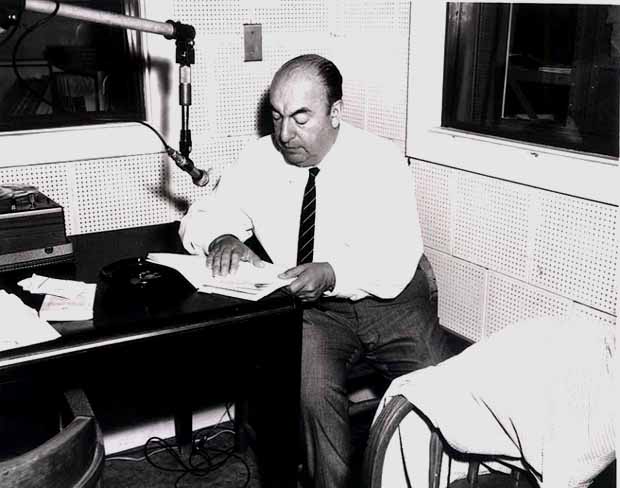
Pablo Neruda
The Times article describes a report from a team that examined Neruda’s remains. The team found bacteria within his body that could be deadly. But they could not determine for sure whether it was, in fact, a toxic strain of bacteria and whether it had been injected into him.
One thing is for certain though: It certainly would not have been unusual for Pinochet and his henchmen to murder Neruda, with the full support of the Pentagon and the CIA, both of which had agents on the ground in Chile during the coup.
Remember: This was 1973, when the Pentagon’s and CIA’s Cold War racket was still going strong. As part of that racket, the Pentagon and the CIA had carte blanche to murder communists wherever they found them.
In 1970, the Chilean people democratically elected Allende to be their president. Allende was a socialist, one who immediately established a friendly relationship with the communist world. He even invited Cuban president Fidel Castro to visit Chile. Their parade in downtown Santiago was met with throngs of enthusiastic supporters.
The U.S. national-security establishment deemed Allende to be a grave threat to national-security. That made him subject to being assassinated by the CIA. Don’t forget that the CIA had already repeatedly tried to assassinate Castro for being a communist.
Rather than assassinate Allende, however, the Pentagon and the CIA instead decided to encourage the Chilean national-security establishment to initiate a violent coup against him. When the coup took place in 1973, the Chilean military tried to assassinate Allende with missiles fired at him from military planes. Allende fought back but was no match for the power of the Chilean national-security establishment. At the end of the battle, Allende lay dead, supposedly having decided to commit suicide.
But even if Allende didn’t commit suicide, the outcome was never in doubt. The Chilean military-intelligence establishment was going to kill him, either during the coup or after the coup. That’s because it, like the Pentagon and the CIA, deemed him to be a communist. Like their counterparts in the Pentagon and the CIA, as far as they were concerned they had the omnipotent authority to kill communists, especially those within their own country.
In fact, after the coup Pinochet and his goons routed up more than 50,000 of Allende’s supporters, including women. They murdered or disappeared around 3,000 of them. They tortured most of them. They raped or violently sexually abused many of the women.
None of this was considered to be any big deal for the killers, the kidnappers, the rapists, and the abusers because the victims were all considered to be communists or communist sympathizers. In the minds of the Chilean national-security establishment, the only good communist was a dead communist, a tortured communist, a raped communist, or a sexually abused communist.
All of this met with the fervent approval of the Pentagon and the CIA. U.S. taxpayer-funded money flooded into the Pinochet regime. In the eyes of the Pentagon and the CIA, Pinochet was helping win the worldwide war on communism, even if the U.S. was losing to the communists in Vietnam.
During the coup, the Chilean military took two young Americans into custody, Charles Horman and Frank Teruggi. They too were supporters of Allende. They were also opponents of the U.S. war in Vietnam. Chilean officials murdered both men. There is no way that Pinochet would have killed two Americans without first having received a green light from U.S. officials. But it was easy to secure that green light because Horman and Teruggi were considered to be unpatriotic, treasonous American communist sympathizers.
In 1970, U.S. officials first began planning their coup against Allende. Standing in their way, however, was Gen. Rene Schneider, the overall commander of Chile’s armed forces. The CIA orchestrated his violent kidnaping to remove him as an obstacle to the coup. Schneider was murdered by the CIA-employed thugs during the kidnapping attempt.
No one in the CIA was ever brought to justice for Schneider’s murder. For that matter, no one in the CIA or the Pentagon was ever brought to justice for Horman’s and Teruggi’s murder.
Many years later, when the Schneider sons sued in federal court for the murder of their father, the federal judiciary made it clear that it would never interfere with any of the CIA’s or Pentagon’s state-sponsored assassinations.
So, given all this, it certainly should not surprise anyone if Pablo Neruda was, in fact, one of the murder victims during the Chilean coup. In fact, what would be surprising is if he wasn’t.
Protests in Georgia, pressure campaign or anti-Russian color revolution?

By Ilya Tsukanov – Sputnik – 09.03.2023
Protesters spilled into the streets of Tbilisi this week to protest a draft law requiring NGOs to register as “agents of foreign influence” if 20% or more of their funds come from foreign sources. What are the protesters looking to achieve? How have Georgia’s Western “partners” responded? What role, if any, has Russia played? Sputnik investigates.
Georgia’s governing coalition “unconditionally” withdrew its foreign agents law from parliament on Thursday morning, folding to protesters after two nights of violent confrontations with police in the Caucasus nation’s capital, and growing pressure from the European Union and the United States to scrap the draft legislation.
“As a party of government responsible to every member of society, we have decided to unconditionally withdraw this bill that we supported,” the Georgian Dream Party, which has 74 of 150 seats in the republic’s parliament, said in a statement Thursday morning.
Giga Lemonjala, a member of the opposition Droa party, responded to the government’s announcement by demanding that the bill be formally denounced, and that all protesters detained over the past two nights be released.
Georgia’s opposition and Western media covering the protests have characterized the foreign agents legislation as a “Russian,” “Russia-stylem” or “Putin-style” law, citing the 2012 Russian law requiring media, non-governmental organizations, and others to register as foreign agents and make their funding sources known to the public if they include contributions from foreign entities. Some media went so far as to claim the Georgian legislation signaled Tbilisi’s drift away from the European Union and toward Russia, with one article going so far as to call the social democratic, pro-EU Georgian ruling party “Putin’s Georgian Dream.”
State Department spokesman Ned Price characterized the draft law as “Kremlin-inspired” and said Washington was “deeply troubled” by it, with the legislation deemed to be “incompatible with the people of Georgia’s clear desire for European integration and its democratic development.”
European Union foreign policy chief Josep Borrell echoed these sentiments, calling the bill a “very bad development” and saying it is “incompatible with EU values and standards,” and “goes against Georgia’s stated objective of joining the European Union.”
Ukrainian President Volodymyr Zelensky also waded in to commenting on the crisis, praising Ukrainian flag-wielding protesters and saying Kiev expects Georgia and Moldova to join Ukraine in the EU.
Moscow has for the most part stayed out of commenting on the Georgian unrest, absent Foreign Ministry spokeswoman Maria Zakharova’s remarks Wednesday pointing out that the draft law looked similar to US legislation passed in 1938 known as the Foreign Agents Registration Act, and Kremlin spokesman Dmitry Peskov’s statement Thursday encouraging Russian nationals in Georgia to stay out of the streets.
Rules for Me But Not For Thee
Russia’s role has effectively been that of a boogieman, designed to discredit the Georgian government and foment discontent, both in Georgia and among Tbilisi’s Western partners, says Shota Apkhaidze, a political scientist serving as director of the Caucasus Center of Islamic Studies. The reality, the Tbilisi-based observer points out, is that the now-scrapped legislation bears much more resemblance to FARA than it does to Russian legislation.
“This is literally double standards, a mockery. The US brazenly adopted this same law 80 years ago, in 1938, and tightened it up repeatedly. Similar laws are in force in several countries in Europe. They tell us this law is ‘Russian,’ even though it has nothing to do with Russia. These are absolutely different things. In other words, we adopted a draft law modeled on American legislation, that’s in accordance with the Georgian Constitution and the law on non-governmental organizations. What does Russia have to do with it? What does Putin have to do with anything?” Apkhaidze asked. “This is just another reason to completely undermine the political system and bring the country to a change of power. That’s what the Americans are after,” the observer said.
Inconvenient Law
International affairs expert Viktoria Fedosova says US and EU consternation over the Georgian draft law is understandable, since it threatens to undermine their immense political power in the Caucasus nation.
“The passage of such a law in Georgia was risky for the US and the EU, since they’ve become used to engaging in their own financing, introducing their own leaders of public opinion, and working [in the country] through non-governmental organizations. This is their typical umbrella-like scheme of operations familiar to them,” Fedosova, the deputy director of the Moscow-based Institute for Strategic Studies and Forecasts at the Russian People’s Friendship University, told Sputnik in an interview.
“The Americans have spent about $1 billion on our non-governmental organizations since 1993, with the US declaring that these funds were spent on developing civil society, human rights, etc.” Apkhaidze pointed out. “That’s not the case. On the contrary, these funds have consistently been spent on fomenting a coup d’état, on the financing of some destructive elements in Georgia,” he said.
US and European “democracy promotion” assistance to Georgia has come in various forms over the decades, from the National Endowment for Democracy and the National Democratic Institute to US hedge fund billionaire George Soros’ Open Society Foundations. Each of these groups provide millions or tens of millions of dollars to Georgian NGOs annually, and wield tremendous power beyond the realm of traditional party politics, Apkhaidze says.
“The NGO sector is the strongest structure of civil institutions in Georgia, because they have massive funding. Everyone, even the current leadership of Georgia, comes from precisely these kinds of organizations and foundations,” he said. “They have immense influence.”
Cynical Approach
The US and EU’s record and history of violating Georgia’s sovereignty is no secret to anyone, but their behavior and response to this week’s violence constitutes outright “mockery” of Tbilisi, Apkhaidze says.
“Why is it that in Georgia, a person who throws a Molotov cocktail at a police officer and sets a police car on fire, hits a special forces agent in the head with a rebar and smashes the parliament building, why is he deemed ‘peaceful’ – and his protest a ‘peaceful protest’?” the observer asked, alluding to the dozens of police officers who have been injured, some hospitalized, over the past two days in clashes with demonstrators.
Fedosova thinks the answer is obvious – while the US is able to pass laws like FARA and use them liberally to monitor their media, politics, and social groups for signs of foreign influence and meddling, the same luxury is not afforded to countries like Georgia.
“The United States cannot allow this kind of sovereignty be enjoyed by tiny Georgia, which, moreover, has already been used as a destabilizing factor against Russia (we remember the situation in 2008),” she said.
‘Second Front’
The irony of the crisis over the foreign agents draft law is that the Georgian Dream government is broadly pro-European, with stated aims including entry into both the EU and NATO. Accordingly, both Apkhaidze and Fedosova believe that the crisis is related to the pragmatic foreign policy approach that Tbilisi has taken in relation to its northern neighbor, especially after the escalation of the Ukraine crisis last year.
“The Americans have spent a whole year now since the start of Russia’s ‘special operation’ in Ukraine destabilizing the situation,” trying to get Georgia to join anti-Russian sanctions and “open a second front” against Moscow, Apkhaidze said.
“The Americans know that if they manage to quickly remove Georgian Dream, a second front would be opened immediately, because those flakes who came out to protest want this war, many of them unconsciously, of course; they have no idea what such a conflict would bring. But they are so short-sighted (I mean the majority of young people involved) that they don’t understand what a war with Russia would bring. Others have the concrete goal of opening a second front. The Americans are leading the country precisely in this direction,” he said.
The Georgian government and lawmakers’ attempts to prevent Tbilisi from being pulled into a direct conflict against Russia, notwithstanding the not always rosy relations with Moscow, is precisely the reason the foreign agents law was put together in the first place, Fedosova believes, citing the fact that a handful of NGOs have garnered more financial support over the past year than all the country’s political parties combined.
“The main thing [for the government] is the guarantee of peace, some kind of fair compromise-based dialogue with Russia, without attempts to include the country in a new conflict on Russia’s borders. The main thing for them is to convey this idea of preserving sovereignty and not losing new territories, and to communicate this to their citizens,” the observer said.
Maidan Danger
Fedosova observed parallels between the footage coming out of Tbilisi this week and the Euromaidan in Kiev before the 2014 coup. “We are watching footage now from Tbilisi where young people jump and dance, where the [psychological] mechanisms for creating this kind of emotional bond of the crowd are used. We’re seeing everything we saw on the Maidan. But here the presence of external forces hasn’t yet reached the point where the American ambassador comes out and distributes cookies, for example. So far, we are seeing the manifestation of the Americans in this conflict only in the form of their official statements.”
If the situation heats up, more parallels to the Ukrainian coup could appear, she noted, including radicals in crowds, agent provocateurs, mysterious snipers, culminating in a coup and the appointment of a new puppet government and “the installation of an authoritarian president who will be called a liberal.”
“We see how this happened with Zelensky – how ‘liberal’ his regime turned out to be, and what laws were adopted when everything goes according to the American scenario, and the country is integrated into a full-fledged military confrontation with Russia…They need Georgia as another means to prick Russia, just from another flank,” Fedosova said.
President vs Parliament
In the course of her official visit to the US this week, Georgian President Salome Zourabichvili appeared against the backdrop of the Statue of Liberty to express support for the protesters. “I am by your side. Today you represent free Georgia. Georgia, which sees its future in Europe, will not allow anyone to take away this future,” Zourabichvili said.
Apkhaidze doesn’t find anything surprising about the Georgian president’s behavior, saying the French-born politician is simply serving the interests of her masters, and that her sympathies for the opposition have long been evident.
“Georgia is a parliamentary republic. I don’t think that will change. This is not the first time she has opposed various decisions of the Georgian leadership and parliament… As far as Zourabichvili is concerned, she, of course serves the interests, first of fall, of her masters. I can’t figure out whether she’s the president of Georgia or the governor of some American state. But it is a fact that she wants more power, and sees herself in the place of [Georgian Prime Minister Irakli] Garibashvili,” Apkhaidze summed up.
Claims the unvaccinated were at higher risk of hospitalisation and death were based on deliberately murky record keeping
Again, another statistical illusion of efficacy was manufactured by simple miscategorisation

By Norman Fenton | Where are the numbers? | March 7, 2023
By late 2021 it was already clear in the UK that the covid vaccines did not stop infection or transmission. And there were also already plenty of concerning safety signals. So, even though the “vaccine pass” was then required in the UK to participate in daily life, ‘vaccine hesitancy’ was on the increase.
Switching narrative to counter vaccine ‘hesitancy’
Given this increasing resistance against the vaccine programme, the official messaging was changed from “vaccines stop you getting covid” to “vaccines stop you being hospitalised and dying from covid”.
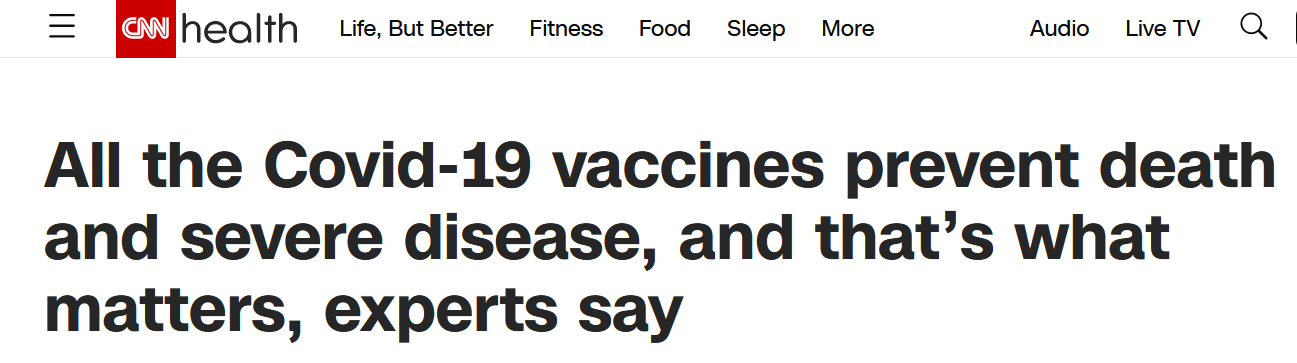
To push this new narrative the Government started pumping out ‘data’ to support the claim that almost all of those ill in hospital with covid were unvaccinated. Here is an NHS text that was sent to everybody registered with a GP in the UK in November 2021:

At the time the text was sent out, “fully vaccinated” in the UK was defined as: “at least 14 days since 3rd jab” or “between at least 14 days and less than 6 months of 2nd jab”. So, the official figure of 8 out of 10 “not fully vaccinated” might have been right but was totally misleading since almost ALL of those who were vaccinated (i.e., had at least one jab) at that time were “not fully vaccinated”.
This creates a false semantic equivalence between ‘unvaccinated’ and ‘not fully vaccinated’.
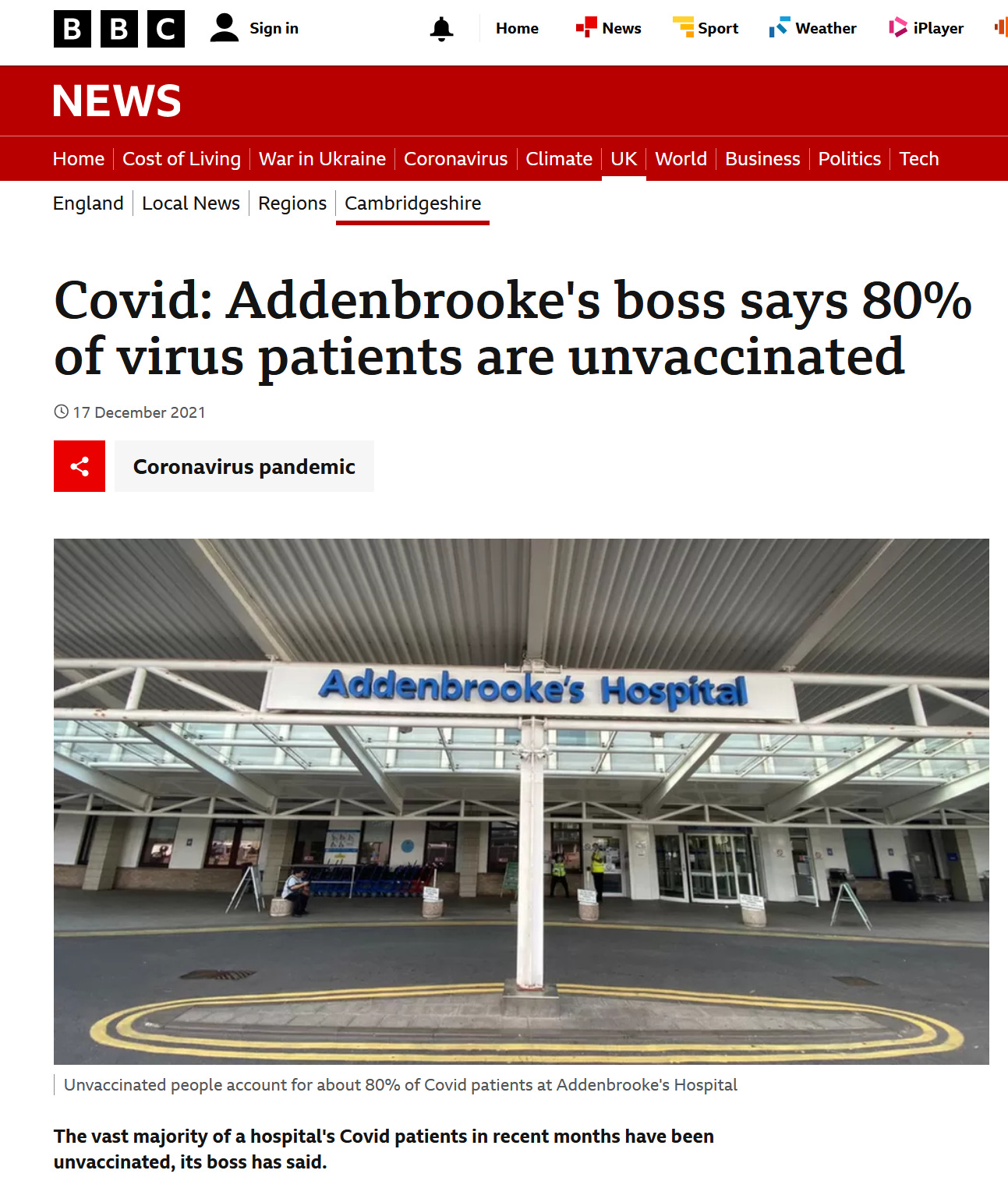
Many media sources, including the BBC, pushed the 80% unvaccinated claim without even mentioning the ‘fully vaccinated’ criteria:
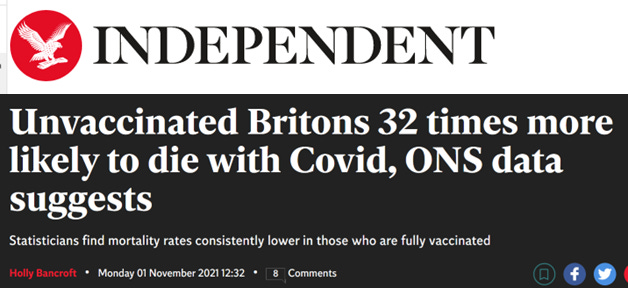
Similar claims were made about covid deaths among the vaccinated such as this one in the Independent :
and this one in the Guardian :

With respect to patients in ICU claims that high proportions of those with covid were unvaccinated were widely cited – and never challenged – in the mainstream media:

A particularly serious example was the ludicrous claim made in the BBC documentary “Unvaccinated” by Dr Mehool Patel (Consultant, University Hospital Lewisham). His statement – unchallenged in the programme – was:
“We looked at about 550 patients that were admitted in our trust between the 15th December and 15th January 2022, which in effect would mean that most if not all of them were through due to Omicron variant, and of that there were unfortunately 21 patients who had to be admitted to intensive care who were the most severe patients due to COVID. Of the 21 I’m afraid 20 of them were unvaccinated, that’s 95%.
Just one person was vaccinated. And of the 21 who were on the unit, I’m afraid unfortunately seven of them didn’t make it, all of them were unvaccinated, 100%. So that’s one figure to just illustrate the point.”
This was one of the many specific pieces of misinformation that I raised in my formal complaint to the BBC about the programme. I asked the BBC to provide the verified data to support this claim. When I eventually received a response from the BBC’s Complaints Director Jeremy Hayes he said:
“You maintain that this claim was “either false/exaggerated or an unbelievable outlier”.
I have approached the programme makers for information about the data which were quoted by Dr Patel. I have been advised that the figures were compiled by Dr Patel himself for the purposes of research.
“Lewisham and Greenwich Hospital Trust does not record the vaccination status of patients in ICU so Dr Patel’s figures cannot independently be verified.”
But the scam was based on something even more ludicrous than classifying “not fully vaccinated” as “unvaccinated”.
As a result of Freedom of Information Requests sent to some individual NHS trusts we now know that some hospitals were using the NIMS system to classify vaccine status of patients while others were using their own systems. This meant that, in many cases even if a patient had a vaccination record in NIMS, if the patient was not vaccinated in that particular hospital/Trust they were recorded as unvaccinated. Some hospitals were using a mixture of both systems (NIMS where a death was recorded and an internal system where a covid case was recorded). For those relying on NIMS, since it was not operational until June 2021, all deaths within the hospital would have had an unknown vaccination status between Jan-June 2021. The problem is that some hospitals were classifying “unknown” as “unvaccinated”.
So, deliberately murky record keeping was used to manipulate the data.
To see the implications of this, here are the data on hospital deaths (all deaths, not just covid) from the start of the vaccine programme until the end of 2021 from an undisclosed NHS trust who responded to an FOI request:

Note that every death up until 21 June 2021 was recorded as unvaccinated simply because hospitals in this Trust were using the NIMS system for classifying deaths which was not up and running until then. But, of course, an unknown number (probably most) of these 742 people were vaccinated.
There are plenty of other anomalies in the data. Note the improbable, sudden and dramatic trend changes:
- A steady decline in “unvaccinated” deaths from 21 June until 13 Sept. In week ending 13 Sept only 4 out of 46 (less than 9%) were unvaccinated.
- The next week (20 Sept) the unvaccinated are suddenly the majority again with 21 out of 31 deaths (68%), and this increases so quickly that just 3 weeks later (11 Oct) all 44 deaths (100%) are ‘unvaccinated’.
- But then we get a sudden and rapid decline in the unvaccinated deaths. Just 2 weeks later (25 Oct) the unvaccinated are 13 out of 47 deaths (28%) and by 20 Dec none of 53 deaths (0%) were unvaccinated.
Such changes can only be the result of changes in definition of who should be classified as unvaccinated.
It is easy to see how the Government could cherry pick this kind of data to present the narrative they wanted. When the text messages were being sent out in November 2021 it is reasonable to assume that they were using the cumulative data up to, say, mid-October. Then using the data in the table up to and including 18 Oct 2021 we count:
- 1051 “unvaccinated” (including 17 with just a single jab)
- 370 “vaccinated” (with 2 jabs).
That gives 74% of all hospital deaths classified as “unvaccinated”.
But this is all an illusion. In fact, counting just the final three weeks of the data (6-20 Dec), just 18 out of the 144 deaths (12.5%) were unvaccinated.
It is also worth noting that the same NHS Trust provided the following information on “new COVID positives” in its hospitals between 19th Jan 2021 and 19th Jan 2022.

Given what we know about national vaccination take-up rates, and this Trust’s own death data, it is likely that the majority of those classified as ‘unvaccinated’ here would have been vaccinated (with the exception of those in the 0-20 age categories the vast majority of whom would not have been eligible for vaccination).
So, instead of the ‘50% of new covid cases’ being among the unvaccinated – the ‘official’ narrative pushed from this data – the true narrative should have been that the vast majority of new covid cases were vaccinated.
It matters a lot because, despite being completely bogus, these kinds of ludicrous figures were so consistently repeated that the message “vaccines stop you being hospitalised and dying from covid (even if they don’t stop infection and transmission)” was almost universally accepted. Even the strongest critics of the Government’s covid response consistently repeated this mantra:
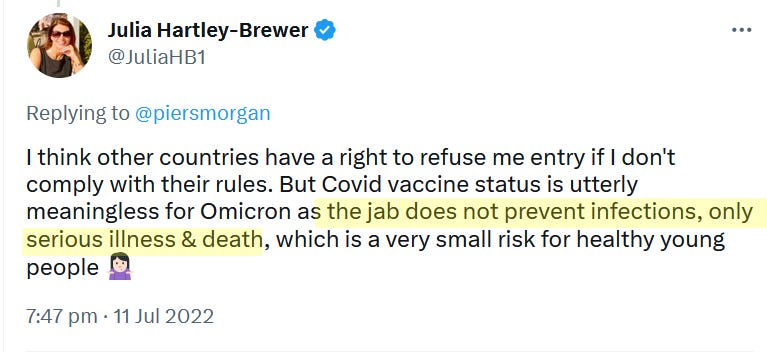
The figures were also used as the basis for the bogus studies claiming millions of lives were saved by the vaccine.
So, yet again, we can see that statistical data was used to create an illusion of vaccine hospitalisation and mortality efficacy by the simplest of means: deliberately murky record keeping ensuring that the vaccinated get recategorized as unvaccinated when they die or are hospitalised.

Update 9 March 2023: Here is a video I made covering this article:
Postscript: A commenter below reports that the USA “was far worse”:
Patients who were vaccinated at pharmacies didn’t show up on the state records. The CDC admitted on a web page that ‘unvaccinated’ just meant they couldn’t find a vax on record. There was no requirement for hospitals to update records and why would they? This bias was described by hospital PA Deborah Conrad in the Highwire episode 233 https://thehighwire.com/videos/episode-233-the-vaers-scandal/ Alex Berenson reports evidence that the rate of overcounting of ‘unvaccinated’ patients was as high as 20x. “More evidence that American data may badly overstate the protection mRNA shots offer against hospitalization from Covid” – Jan 13
Twitter Files expose ‘censorship-industrial complex’ – journalist
RT | March 9, 2023
Social media platforms colluded with non-governmental organizations and the US government to suppress information they did not like in the name of fighting “disinformation,” journalist Matt Taibbi testified at a congressional hearing on Thursday.
Taibbi appeared alongside Michael Shellenberger, another journalist who has covered the “Twitter Files” for the past several months, before the Select Subcommittee on the Weaponization of the Federal Government, led by Congressman Jim Jordan, a Republican from Ohio.
Taibbi described what he called the “censorship-industrial complex,” calling it “a bureaucracy willing to sacrifice factual truth in service of broader narrative objectives,” and the exact opposite of a free press envisioned in the US Constitution.
Right before his testimony, Taibbi also published a lengthy thread on Twitter, laying out the evidence he entered into the congressional record.
According to Taibbi, Twitter acted “more like a partner” to the government, censoring based on requests it received from federal agencies as well as taxpayer-backed NGOs. Intelligence agencies, dubious “disinformation researchers” and corporate executives effectively worked as a team, he argued.
Taibbi’s thread described an “incestuous self-appointed truth squad moving from law enforcement/intelligence to the private sector and back,” with the same agencies inviting the same “experts” funded by the same foundations and covered by the same reporters to every panel and every conference.
He identified the key players in the censorship-industrial complex as the National Endowment for Democracy, the Atlantic Council’s DFR Lab, and the Alliance for Securing Democracy, authors of the infamous Hamilton 68 dashboard. Many of the NGOs involved received funding from the US government, while legacy media outlets acted as their proxies, demanding censorship.
Taibbi described the Stanford Internet Observatory (SIO) and its “Election Integrity Partnership” – renamed the Virality Project after the 2020 election – as “perhaps the ultimate example of the absolute fusion of state, corporate, and civil society organizations.” By its own admission, it labeled 22 million tweets during the 2020 election campaign, and was then given access to Twitter’s JIRA ticketing system, which is able to tackle 50 million tweets a day.
SIO is run by Renee DiResta, who helped design Hamilton68 and worked at New Knowledge – a group caught creating fake “Russian bots” to help Democrats in the 2017 Alabama special election for the US Senate. That did not stop them from advising the Senate Intelligence Committee on “Russian interference” in US elections, and the US legacy media from not questioning any of their conclusions.
“Packaged as a bulwark against lies and falsehood, [the CIC] is itself often a major source of disinformation, with American taxpayers funding their own estrangement from reality,” Taibbi wrote. “Without real oversight mechanisms, there is nothing to prevent these super-empowered information vanguards from bending the truth for their own ends.”
During the hearing, multiple Democrats tried to pressure Taibbi into revealing his sources, insinuating Twitter’s new owner, Elon Musk, was behind the disclosures.
Featured Video
Weaponized Journalism: 2021 Sayer Ji Interview with NPR
or go to
Aletho News Archives – Video-Images
From the Archives
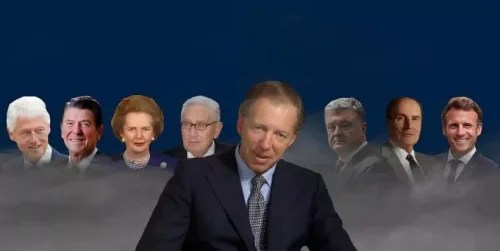
How Rothschild Banking Clan Uses Its Vast Wealth to Influence World Events and Control Governments
By Ilya Tsukanov – Sputnik – 15.09.2024
How powerful is the Rothschild banking family? How did they amass their fortune? Just how rich are they? Do they secretly control the world? Sputnik explores. … continue
Blog Roll
 Aletho News
- Dockworkers launch global strike against Israeli and US military shipments
- Europe facing gas price shock – Gazprom chief
- Ukraine continues recruiting people with disabilities
- Weaponized Journalism: 2021 Sayer Ji Interview with NPR
- Beyond Netanyahu: what Israel’s election means for Palestinians
- Lithuania plans universal conscription
- Lies, Damn Lies, and Ukraine News
- Financial Times rejects Nordic demands to correct Putin call story – media
- The Case for Less Unity in Europe
- Ukraine expands minority rights under EU pressure – but Russians remain excluded
- If Americans Knew
- An error has occurred; the feed is probably down. Try again later.
- No Tricks Zone
- Germany’s Green Energy Transition Becoming Increasingly Expensive…Another 6 Trillion Euros!
- Sudden Stratospheric Warming, Powerful El Niño Combination May Lead To Extreme Europe Cold, Energy Crisis!
- Two New Studies Find Thwaites Glacier Melt Cannot Be Driven By Human Activity Or A Warming Ocean
- E-Cars Reduce CO2 Emissions By Only 41% Compared To Internal Combustion Engine Vehicles
- Predictions Made By Renowned Climate Professor Over Past Decades Have Been Proven To Be Poor
- New Study Suggests Large Regions Of The Pacific Ocean Have Been Cooling For The Last 80 Years
- Germany’s Green Energy Debacle: High Energy Costs Force Kahla Porzellan to Close After 182 Years!
- New Study: 50 Years Of The Most Aggressive ‘Net Zero’ Policies Can Only Affect The Global Climate By 0.03°C
- US September “Heat” Was No Record…Many Records Set Decades Ago
- Latest European Green Energy Debacle; Portugal’s Largest Flagship Solar Park Insolvent!

