Russia Will Keep Up The Pace Of Oil Exports To India Despite Increased Chinese Demand
By Andrew Korybko | March 1, 2023
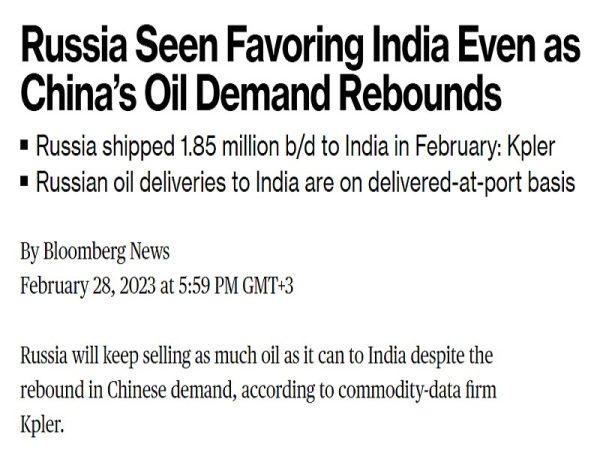
Bloomberg’s points in support of this observation are purely economic and overlook the strategic dimension of Russia’s discounted oil exports to India, which will be explained in the present piece.
Bloomberg published a piece on Tuesday about how “Russia Seen Favoring India Even as China’s Oil Demand Rebounds”, which cites lead crude analyst Viktor Katona from commodity-data firm Kpler. According to him, “While China could ‘buy literally the entire Russian oil exports’ as it abandons Covid-zero policies, Russia will want to keep the Indian market because it is more lucrative and gives its crude sellers greater control.”
Katona is also quoted as adding that “Chinese refiners may want to buy more Russian crude this year, but they also have the capacity to do their own shipping. That would deprive Moscow of income from the ‘parallel gray fleet’ of tankers it has established to deliver crude to India.” While these are all valid points in support of his prediction, they’re purely economic and overlook the strategic dimension of Russia’s discounted oil exports to India, which will now be explained.
First, India’s unprecedentd scaling of Russian oil imports over the past year since the start of the latter’s special operation preemptively averted Moscow’s potentially disproportionate dependence on China and continues to do so into the present.
Second, the Kremlin will never forget the aforementioned strategic favor that India did for Russia at its most sensitive moment in decades, hence why it’s inclined to keep up the pace of its discounted exports to that country as a way of thanking it for this.
Third, the Kremlin is cognizant of the fact that there must be tangible benefits for India in continuing to defy Western pressure upon it to dump Russia, so keeping up the pace of oil exports to it incentivizes India to continue its pragmatic policy of principled neutrality towards the Ukrainian Conflict.
Fourth, their newfound energy relations also served Russia’s grand strategic goal of accelerating India’s rise as a globally significant Great Power.
That last-mentioned outcome advances the global systemic transition’s ongoing evolution towards tripolarity ahead of its final form of more complex multipolarity (“multiplexity”), which serves both of their interests. And finally, the larger dynamics connected to the aforesaid development is that it helps break the Sino-American bi-multipolar superpower duopoly that previously characterized International Relations, thus greatly enhancing Russia and India’s strategic autonomy in the New Cold War.
Altogether, these strategic motivations ensure that Russia won’t increase oil exports to China at the expense of the level at which it’s presently supplying India. Observers should always keep them in mind since they prove that the Russian-Indian Strategic Partnership is premised on their shared goal of accelerating the global systemic transition and not on deriving opportunistic economic benefits like Bloomberg implied is supposedly the case when it comes to their current energy ties.
Blinken hopes to derail India’s relationship with Russia following Scholz’s failure
By Ahmed Adel | March 1, 2023
With Russia’s military operation in Ukraine evidently destroying NATO’s ambitions, Washington is becoming increasingly frustrated that Moscow has not been isolated. Russia did not economically collapse, as was predicted in the West, partly because of the robust and longstanding relationship it has with India. It is unsurprising that in only a matter of days, Germany and the US have pressured India to capitulate their sovereignty and serve Western interests instead of their own.
German Chancellor Olaf Scholz sought assurances from India on February 25 that it would not only refuse to block, but also support efforts to isolate Russia. Following his talks with Indian Prime Minister Narendra Modi, the chancellor refused to reveal what exactly they discussed in relation to Ukraine.
Although the contents of the discussion were cited as being confidential in nature, it is likely that Scholz did not want to humiliatingly admit that India refused to step back from its tried and tested relationship with Russia. Scholz did reveal though that he and Modi had discussed the war in Ukraine “very extensively and very intensely.”
It is noted that this trip was Scholz’s first official visit to India but his fourth meeting with Modi since taking office in 2021. Although they also discussed ways to boost economic cooperation, including through a free trade agreement between the European Union and India, it cannot be overlooked that US Secretary of State Antony Blinken arrived in New Delhi only days after Scholz.
Days before arriving in the Indian capital, Blinken said that countries like India, which have not joined the West in denouncing Russia’s military operation, were on a supposed trajectory away from alignment with Moscow. He stressed that the process would not occur “in one fell swoop.”
“There are countries that have long-standing, decades-long relationships with Russia, with the Soviet Union before, that are challenging to break off in one fell swoop. It’s not flipping a light switch, it’s moving an aircraft carrier,” Blinken said in an interview with The Atlantic on February 24.
However, for all of Blinken’s claims that India is moving away from Moscow, there is no actual suggestion that this is occurring. The US and India cooperate through the QUAD format, a naval bloc aimed against China, but this has not meant India’s submission to Washington, as the Americans evidently anticipated.
Although India has faced sustained and continued pressure from the West to distance itself from Moscow, New Delhi has thus far resisted, citing its longstanding ties with Russia and its economic and oil interests. It cannot be overlooked that Russia has been India’s largest weapons supplier since the Cold War-era, particularly since the US traditionally favoured Pakistan.
However, Washington in recent years has looked to turn New Delhi away from its main military supplier (but without wanting to adjust its policy to Pakistan).
“India for decades had Russia at the core of providing military equipment to it and its defences, but what we’ve seen over the last few years is a trajectory away from relying on Russia and moving into partnership with us and other countries,” Blinken said, without mentioning the fact that India is moving towards home-grown production, something that Russia is playing a key role in.
None-the-less, it is expected that Blinken, in the same way as Scholz, will try and convince India to change course regarding its ties with Russia.
As Bloomberg reported, citing Kpler’s lead crude analyst, Viktor Katona, “India purchased almost no Russian oil a year ago, but has become a crucial market after the US and European Union imposed sanctions on Moscow. The Asian country imported around 1.85 million barrels a day from Russia in February, close to its potential maximum of about 2 million barrels a day.”
The cold hard facts are that Moscow and New Delhi have a longstanding relationship that India will not break just for the sake of serving Western interests. Beyond the time-tested security ties, Russia offers energy hungry India the best deal for oil, something that will not be sacrificed because of a far-off war in Eastern Europe.
According to QUARTZ, India has in less than a year saved an estimated $3.6 billion by increasing Russian oil imports. This is a significant amount for a country that depends on imports to meet 85% of its petroleum needs.
It is recalled that in November 2022, Indian Foreign Minister S Jaishankar said “Russia has been a steady and time-tested partner. Any objective evaluation of our relationship over many decades would confirm that it has actually served both our countries very, very well.”
With this statement, he effectively confirmed a continuance of the current policy despite sustained pressure – a pressure that Scholz and Blinken are the latest to apply. They are however also the latest that were unable to convince New Delhi to change its policy regarding Russia.
Ahmed Adel is a Cairo-based geopolitics and political economy researcher.
America Goes to War
Constantly without regard for any real national interest
BY PHILIP GIRALDI • UNZ REVIEW • FEBRUARY 28, 2023
At last week’s Rage Against the War Machine peace rally in Washington there was no shortage of speakers who denounced the Biden Administration’s hypocritical foreign policy, which essentially judges any violent action undertaken by the United States and its friends as good by definition while anything done by rivals or competitors, sometimes conveniently referred to as “enemies,” as “evil.” In the current context of Ukraine versus Russia, where the US is engaged in proxy warfare, speakers were able to cite and compare the formidable list of America’s armed interventions worldwide since World War Two ended. Neither Russia nor any other nation comes anywhere near the United States in terms of constant bellicosity, conflicts which hardly ever reflect any real vital national interest or imminent foreign threat. Throw into the hopper the 800-plus US military bases scattered around the world and a growing defense budget larger than those of the next nine nations combined, including China and Russia, and the reader will obtain some idea of the real problem: the United States has become a nation that is best described as a warfare state. That is where the tax money goes to disproportionately and the corruption it feeds produces a willingness to engage in “one more war” on the part of the coddled, protected and richly remunerated political class which in turn supports the carnage by overwhelming majorities.
Several speakers last week also cited as the real problem the media, which once upon a time sought to expose lies and subterfuges by government but now has become a partner with the White House in shaping and promoting a preferred narrative. It should also be pointed out that that media is overwhelmingly Democratic in terms of its ownership and sympathies, so much so that it collaborated in efforts to label Donald Trump and his staff as “Russian agents.”
Sometimes this promotion of a particular point of view is best accomplished using silence, i.e. by not sharing or following up on a story. There was virtually no coverage of last week’s peace rally even though speakers included a number of well-known public figures, three of whom were former congressmen. Likewise, apart from a brief mention in The Washington Post, there has been virtually no follow-up in the mainstream media on Seymour Hersh’s carefully researched and documented investigation of the destruction of the Nord Stream pipelines by the United States hidden behind the plausible deniability of a covert operation carried out last September.
Much of the press ignored the clear investigative line on day one when the pipeline exploded that the White House had previously been warning that it would “do something” to stop Nord Stream and that it had both the means and motive to follow through on its threat. Likewise, after the Hersh story broke and Russia sought and obtained a hearing featuring Professor Jeffrey Sachs and former CIA Officer Ray McGovern testifying before the United Nations Security Council to initiate investigation of the matter, the US media ignored the story on the evening news and did not follow-up on it on the next day or subsequently.
A major story involving what were war crimes committed both against adversary Russia and NATO ally Germany and which had nuclear conflict potential was thus made to disappear, but the US and its propaganda machine were not finished yet. The White House predictably denied any role in the pipe line destruction and Vice President Kamala Harris sought to turn the tables by declaring at the Munich Security Conference that it is Russia that is guilty of “crimes against humanity.” She claimed that “First, from the starting days of this unprovoked war, we have witnessed Russian forces engage in horrendous atrocities and war crimes. [They] have pursued a widespread and systemic attack against a civilian population – gruesome acts of murder, torture, rape, and deportation. Execution-style killings, beating and electrocution. Russian authorities have forcibly deported hundreds of thousands of people from Ukraine to Russia, including children. They have cruelly separated children from their families.”
Harris concluded that “we” must continue to “strongly support Ukraine… for as long as it takes!” One might observe that Harris has been unable to secure the actual US borders over the course of more than two years, so “as long as it takes” by her reckoning might well run into the 2050s. And she is hardly known for her ability to discern what is and isn’t true. She might well have added spice to her tale by joking how it must keep Vladimir Putin and his cabinet up until late at night coming up with new atrocities to carry out.
Joe Biden doubled down on the Harris remarks in a speech in Warsaw a few days later, delivered on his return from the Kiev photo op with the man he loves more than any other, Volodymyr Zelensky, where he gave the diminutive comedian another half billion dollars of US taxpayer money and promised that the US will never give up until Russia is defeated. He commented somewhat hyperbolically to Zelensky that after a year of fighting “… Ukraine stands. Democracy stands. The Americans stand with you and the world stands with you.”
Biden told the Poles just before the February 24 anniversary of the conflict in Ukraine that it was a just war pitting “democracy” against “totalitarianism.” Russian President Vladimir Putin’s “craven lust for land and power” had only served to unite democracies around the world. “It wasn’t just Ukraine being tested. The whole world faced a test for the ages …. And the questions we face are as simple as they are profound: Would we respond, or would we look the other way? One year later, we know the answer. We did respond. We would be strong, we would be united, and the world would not look the other way.”
Demonstrating that delusion is bipartisan, the Biden visit to Kiev was followed by a group of Republican congressmen repeating the feat and traveling to Ukraine to fawn over Zelensky at his presidential palace on the following day. One wonders if there is anyone still “at home” trying to alleviate the huge toxic spill that appears about to consume Ohio? One might well ask where the US federal government gets these idiots from? Dancing around to the tune of a conflict that could have been negotiated away and winding up at the brink of a nuclear war which would in all likelihood destroy the planet is “a test for the ages?” And who pays for these useless congressional trips? More’s the pity, this is not just going on in Eastern Europe. The US is currently cooperating with France in what looks like what will become another military intervention in a perennially unstable Haiti and, of course, China is also in the cross hairs.
And then there is always the Middle East, where Israel benefits from “ironclad” commitments and “unbreakable bonds” rhetoric from Washington. When Israel commands “Jump!” the Biden regime only asks “How high?” Since the media avoids any provocative reporting about the Jewish state, how many Americans know that self-declared Zionist Joe Biden’s Ambassador to Israel Tom Nides has just given Prime Minister Benjamin Netanyahu the green light for attacking Iran with US support for any action taken? Nides told the Conference of Presidents of Major American Jewish Organizations in Jerusalem last Sunday that “Israel can and should do whatever they need to deal with [in regards to Iran] and we’ve got their back.”
There is already a precedent as Israel has in fact been attacking neighboring Syria repeatedly without any comment from Washington, which actually has troops based in that country stealing Syrian oil. Nor has Washington objected when the Israeli army raided two Palestinian camps during the past month, killing respectively 10 and 11 civilians and wounding more than 100 others. To set the stage for what comes next vis-à-vis the wag the dog relationship, after Israel struck a defense compound in Iran on January 29th, the Biden administration suggested to reporters that the Israeli attack was part of a new “joint effort” by Washington and Jerusalem to contain Tehran’s nuclear and military ambitions. Secretary of State Tony Blinken elaborated on the shift on the next day while offering no criticism or concern for the destabilizing potential of the strikes, let alone a condemnation. Instead, he defended the Israeli attack, saying “[It is] very important that we continue to deal with and work against as necessary the various actions that Iran has engaged in throughout the region and beyond that threaten peace and security.”
Nides’ comment reveals that he is ignorant regarding who is causing trouble in the Middle East. It also confirms that even if there is a military action initiated by Israel that does grave damage to US interests, the White House will support the Israelis. That should surprise no one as the top three officials at the State Department are Jews, as are the top two on the National Security Staff, the Head of Homeland Security, the Director of National Intelligence, the Deputy Director at CIA, and the president’s Chief of Staff. The policy shift, for that is what it is, also gives Israel the green light to attack Iranian targets with impunity. Nides also stated that the United States is pledged to deny nuclear weapons to Iran, implying that if it believes such a development is imminent it would destroy the facilities used to create or store the weapons. He also mentioned that the US will not engage in any possible negotiations with Iran as long as it is selling weapons to Russia. Though Nides has no problem with freely killing Palestinian children, he is rather more inflexible when Persians are somehow involved, saying that “The Iranians are providing drones to Russia and those drones are killing innocent Ukrainians. There is no chance today of us going back to the negotiating table.”
So what do we have? Does anyone remember the famous quote attributed to British statesman Lord Palmerston, that “Nations have no permanent friends or allies. They only have permanent interests.” The United States, uniquely, does not even appear to have interests, apart from pandering to the various constituencies and groups that have bought or stealthily acquired control over the political system and media. So the American public, less safe and prosperous now than at any time since the Second World War, is kept in the dark about what is important and is lied to about almost everything. That is why we are on the brink of destruction in Ukraine and are slaves to the power brokers who hate Russia and favor Israel above all nations. Raging against the war machine will do little good if we are incapable of first figuring out who is screwing us and then developing the courage to put a stop to it. Starting with cutting the current tie that binds with Ukraine and Israel would be a good beginning followed by bringing the troops home from nearly everywhere. Trying the Biden Administration officials who initiated an illegal war by destroying Nord Stream and putting them all in jail would be even better. Yes, every one of them in jail with no parole, starting with mumbling Joe himself.
Philip M. Giraldi, Ph.D., is Executive Director of the Council for the National Interest, a 501(c)3 tax deductible educational foundation (Federal ID Number #52-1739023) that seeks a more interests-based U.S. foreign policy in the Middle East. Website is councilforthenationalinterest.org, address is P.O. Box 2157, Purcellville VA 20134 and its email is inform@cnionline.org.
TREATING PUTIN AS AN IRREDEEMABLE IMPERIALIST HAS PAINTED THE WEST INTO A DANGEROUS CORNER

By Larry Johnson | Son Of the New American Revolution | February 27, 2023
When it comes to imperialism — i.e., “the policy, practice, or advocacy of extending the power and dominion of a nation especially by direct territorial acquisitions or by gaining indirect control over the political or economic life of other areas” — the United States and Europe are quick to label Putin as a rabid practitioner who must be stopped or else he will conquer the world.
This is lazy propaganda on the part of the West and it is a bullshit accusation. Putin is an old school nationalist and an Eastern Orthodox Christian who eschews the Soviet Communist legacy. Since taking power in 1999, Putin has not led unprovoked conquests of adjacent territory. Russia’s military engagements with Georgia in 2008 and with Ukraine are a direct result of U.S. and NATO interference in the region.
But the U.S. and Europe persist in describing Putin as Stalin reincarnated and a man hell bent on imposing Russian sovereignty over the world. This just a 21st century version of the Domino Theory. It is Domino 2.0 and Putin is the new Vietnam. The truth of the matter is that the U.S. and Europe are bona fide imperialists and are ignoring Putin’s actual record. Instead, the West is engaging in gross hypocrisy and psychological projection — attributing to Putin what they themselves have done and are doing.
Here are some recent examples of the imperialist meme the West is pushing with regards to Putin and Russia:
Many observers quickly picked up on one of Putin’s more provocative lines, in which he compared himself to Peter the Great, Russia’s modernizing tsar and the founder of St. Petersburg – Putin’s own birthplace – who came to power in the late 17th century.
“Peter the Great waged the Great Northern War for 21 years,” a relaxed and apparently self-satisfied Putin said. “On the face of it, he was at war with Sweden taking something away from it… He was not taking away anything, he was returning. This is how it was.”
Foreign Policy magazine, an establishment mouthpiece, pushes the same meme:
Mikhail Mamedov, an Azeri by birth who fled Russia in 1996, offers an unintentionally ironic perspective on Russian imperialism:
“Russia’s concept of empire was different from that of the Western powers. Russia did not possess ‘distant colonies’ but expanded across its borders into the depths of Eurasia. It had a better opportunity for the closer integration of native and Russian nobility into one body.”
Did you catch that last paragraph? Mamedov apparently has not studied American history. If Russia is an imperialist because it “expanded across its borders” and exerted authority over adjacent territory, then what is the United States? Texas, New Mexico, Arizona and California were not independent free states who voted to join the U.S. They came under U.S. control thanks to the Treaty of Guadalupe Hidalgo, which officially ended the Mexican–American War and “required Mexico to cede 55 percent of its territory including the present-day states of California, Nevada, Utah, New Mexico, and most of Arizona and Colorado. Mexico also relinquished all claims for Texas and recognized the Rio Grande as the southern boundary of Texas.”
After sixty years of failed foreign military expeditions, the political class in Washington, D.C. clings tenaciously to the childish notion that if you can just get rid of the “bad man” you can usher in a political utopia. Just consider the list of villains the United States has targeted in repeated bids to change governments and create “democracy or eliminate terrorism, etc. How have those worked out? Did it make the world safer? Is the United States more secure?
- Mossadegh, Iran
- Arbenz, Guatemala,
- Castro, Cuba
- Diem, Vietnam
- Mao, China
- Noriega, Panama
- Saddam Hussein, Iraq
- Bashir Assad, Syria
- The Shah, Iran
- The Ayatollah Khomeni, Iran
- Osama Bin Laden, ???
- Vladimir Putin, Russia
I am amazed that so many so-called foreign policy experts adhere to the magical belief that eliminating a leader will provide a political solution that favors the West. Just listen to Hillary Clinton pleading for the Russian elite to eliminate Putin:
The notion that getting rid of Putin will neuter Russia and make it an obedient serf of the West is profoundly stupid and myopic. Just because people like Clinton and Biden insist that Putin is a dictator in the mold of Stalin, it does not magically transform delusional belief into reality.
The Latin American Information Agency (ALAI) shares my scorn for the West’s double standard when it comes to portraying modern Russia as an amalgam of Nazi Germany and Stalin’s Soviet Union:
The main Western governments and media outlets question Moscow’s incursions while justifying similar actions carried out by their own camp. The deployment of troops in Ukraine, Georgia or Syria is presented as an unacceptable act, but the occupations of Afghanistan, Iraq or Libya are interpreted as routine events. The annexation of Crimea is categorically repudiated, but the appropriation of land in Palestine is warmly welcomed.
This hypocrisy is combined with implausible allegations that seek to frighten the population. They describe a gigantic Russian power with immeasurable capacity for harm. Moscow’s manipulation of the US elections through infiltrators and algorithms has been the most absurd accusation in this campaign.
Every diabolical conspiracy is attributed to Putin. The media often portrays him as the embodiment of evil. He is depicted as a despot rebuilding an empire that rests on brutal methods of internal totalitarianism (Di Palma, 2019). Comparisons are never made with the lauded plutocracies of the United States or Europe, which enforces validation of the domination exercised by ruling elites.
Why should you care? If the West persists in demonizing Putin it is creating potentially insurmountable obstacles for future negotiations. This approach makes a diplomatic solution virtually unattainable and is likely to increase Putin’s doubts that the West can be trusted to uphold any agreement short of unconditional surrender.
Moscow outlines conditions for unfreezing nuclear deal
RT | February 28, 2023
Russia’s decision to suspend New START, the last remaining nuclear arms control treaty with the US, was the right response to Washington’s anti-Russia policies and its violations of the deal, Moscow’s ambassador to the US Anatoly Antonov said on Monday.
Commenting on Washington’s criticism of the move, Antonov accused the US of shifting the blame. He noted that “Washington has launched and dragged its European allies into a large-scale hybrid war against Russia,” while openly stating that its goal is “to inflict a strategic defeat on our country.”
“At the same time, as if nothing has happened, it insists on the inspection of our bases, which store strategic nuclear weapons. These are the same bases that have been attacked by Ukraine with the help of the Pentagon,” the envoy stated.
Antonov accused Washington of substantially violating the central provisions of New START. He said the US had “illegitimately” withdrawn submarine-launched ballistic missile systems and heavy bombers from the deal’s counting rules after declaring them incapable of carrying out nuclear missions following “a procedure not agreed upon with Russia.”
“Our inspectors have never been given the opportunity to verify the results of the ‘conversion,’” Antonov explained.
Against this backdrop, the ambassador described the decision to suspend participation in New START as “the only right one under the circumstances,” adding that Moscow still complies with the quantitative limitations imposed by the treaty.
“To create the conditions for a return to full-scale operation of New START, Washington must reconsider its hostile anti-Russian policy,” he asserted.
Last week, Russian President Vladimir Putin announced that Moscow had “suspended its membership” of New START, saying the West had denied Moscow’s requests to inspect Western nuclear facilities in accordance with the treaty under formal pretexts.
The president also noted that NATO members were demanding access to Russia’s strategic facilities, despite the fact that the deal was signed only by Moscow and Washington.
New START was originally signed in 2010 by then-US President Barack Obama and his Russian counterpart, Dmitry Medvedev. It was aimed at halving the number of strategic nuclear missile launchers deployed around the world. Under the treaty, both countries were supposed to allow the other side a limited number of inspections per year to verify compliance with the agreement. Unless extended, the treaty was set to expire in 2026.
By rejecting China’s peace plan West pushes Beijing closer to Russia
By Lucas Leiroz | February 28, 2023
On the first anniversary of the Russian special military operation in Ukraine, China presented a peace plan, aimed at re-establishing diplomacy and bilateral negotiations. Consisting of twelve points, the proposal reflects the stance of neutrality of the Chinese government, which has refused to support anti-Russian resolutions at the UN, maintaining a strong direct dialogue with Moscow which allows it to develop more realistic proposals, unlike the Western unilateral demands of Russia’s retreat. However, the West does not seem interested in peace, having immediately rejected Beijing’s project.
Beijing calls for an end to hostilities and for the two parties to return to peace talks immediately. Defense of civilians and prisoners of war (POWs) is also a central topic of the project, as well as the safety and stability of the nuclear power plants. In addition, Beijing also advocates the banning of all unilateral sanctions, thus enabling the resumption of economic cooperation and the possibility of a rapid reconstruction of the zones affected by the conflict.
The points of the proposal are: 1. Respecting the sovereignty of all countries; 2. Abandon the Cold War mentality; 3. Ceasing hostilities; 4. Resuming peace talks; 5. Resolving the humanitarian crisis; 6. Protecting civilians and prisoners of war (POWs); 7. Keeping nuclear power plants safe; 8. Reducing strategic risks; 9. Facilitating grain exports; 10. Stopping unilateral sanctions; 11. Keeping industrial and supply chains stable; 12. Promoting post-conflict reconstruction.
As we can see, China proposes a broad diplomatic platform, indicating essential topics for achieving any peaceful solution to the conflict. It is not possible to point out any biased aspect to either side during the analysis of the proposal. These are points that, despite the proximity between Russia and China, reveal a true position of neutrality, seeking to meet, as much as possible, the interests of both sides.
However, as expected, the plan did not please Western governments, which rejected the measure without even establishing forums for prior discussion. According to several Western politicians and experts, the Chinese objective was simply to propose a “pro-Russian peace”, ignoring Ukraine and the Ukrainian people.
For example, according to Clayton Allen and Anna Ashton, analysts linked to the Eurasia Group, a consulting agency and think tank that advises several Western governments, the Chinese twelve points are biased in favor of Moscow and echo the “Russian justifications for the invasion”.
“Although several of the 12 points revealed Chinese concerns over actions primarily associated with Russia, it continued to echo Russia’s justifications for invasion and can largely be framed by Russia as supporting Moscow’s positions (…) China’s approach suggests that they are walking a diplomatic tightrope of strengthening ties to Russia – a key geostrategic ally and counterbalance to the West – while avoiding a position that is seen as openly hostile to Western aims”, they said.
This assessment seems extremely exaggerated. Proposing peace means seeking the best solution for both sides, but obviously also involves meeting the interests of the winning side, which, in this case, is the Russian one. The fact that Moscow seems to “benefit” from this plan is due to the evident reality that Russian troops have an advantage on the battlefield and it would be absolutely unrealistic to think of “peace” seeking to fulfill the Ukrainian objective of withdrawing Russian forces from the liberated regions. What Ukraine and the West understand by “peace” is the recapture of Russian territories, including Crimea, which obviously will not be accepted.
However, worse than that, NATO members and allies not only refused to consider the proposals but began to spread rumors about a possible Chinese intention to send weapons to Russia. According to the Western narrative, the Chinese peace project was a mere excuse to advance cooperation with Moscow and boost bilateral military relations, with plans to supply Russia with weapons in case of rejection of the proposal.
Beijing has denied the allegations, calling them “disinformation”, but at the same time Chinese officials seem aware of the danger caused by Western bellicosity. In a recent statement, Mao Ning, the spokesperson for the Chinese Foreign Ministry, informed that the Chinese attitude towards Ukraine is completely peaceful, but recalled that while supplying the Kiev regime with weapons, Washington also acts in a destabilizing way in Taiwan, thus posing a security risk to both Russia and China.
“On the Ukraine issue, China has been actively promoting peace talks and the political settlement of the crisis (…) [However] In addition to pouring lethal weapons into the battlefield in Ukraine, the US has been selling sophisticated weapons to the Taiwan region in violation of the three China-US joint communiqués”, Mao said.
What seems to be happening is yet another “self-fulfilling prophecy” on the part of the West. Believing in its own baseless narrative that China wants to send weapons to Russia, the US takes unnecessary preventive measures whose side effects can be precisely the increase of Russian-Chinese military cooperation. If before there was no plan on the part of Beijing to send arms to the Russian side, it is possible that this will happen now, since the peace proposals have been exhausted and the Chinese are aware that these same forces that push Ukraine towards a proxy war against Russia may soon act against Beijing in Taiwan.
In their anti-Russian and anti-Chinese paranoia, the US and the EU make the wrong decisions and put global peace at risk. Beijing is trying to resolve the situation diplomatically, but Western forces also need to prioritize peace.
Lucas Leiroz is a researcher in Social Sciences at the Federal Rural University of Rio de Janeiro; geopolitical consultant.
China reboots ‘no limit’ partnership with Russia
BY M. K. BHADRAKUMAR | INDIAN PUNCHLINE | FEBRUARY 28, 2023
The ‘butterfly effect’ of the visit by the Member of the Political Bureau of the Central Committee of the Communist Party of the People’s Republic of China and Director of the Office of the Foreign Affairs Commission of the CPC Central Committee Wang Yi to Moscow on February 21-22 is already discernible. It can influence a much larger complex system still.
The two sides agreed to consolidate and develop the Russia-China comprehensive strategic partnership of coordination for a new era and to continue to closely coordinate their foreign policy efforts; the Ukraine crisis situation, which is at a tipping point, has further tilted in Russia’s favour; and, Chinese diplomacy on the post-pandemic rebound is signalling aperiodic long-term behaviour that can generate ‘deterministic chaos’ in Eurasia and Asia-Pacific.
Wang Yi had meetings with the Secretary of Russia’s Security Council Nikolai Patrushev — as coordinators of the mechanism of China-Russia Strategic Security Consultation — and with Foreign Minister Sergey Lavrov and President Vladimir Putin.
The Russian readout said that “The parties praised the current state of Russian-Chinese relations, which continue to expand dynamically in the context of sharp changes in the international arena… They underscored the importance of further strengthening close foreign policy coordination… They also reiterated the futility of attempts by third countries to impede the healthy, dynamic progress of Russian-Chinese relations, to restrain the development of our countries through sanctions and other illegitimate means.”
Wang Yi conveyed to Putin that the “Russia-China relationship has stood the test of the drastic changes in the world landscape and become mature and tenacious, standing as firm as Mount Tai… Although crises and chaos often emerge, challenges and opportunities exist at the same time, and this is the dialectics of history.”
He said China is ready to work with Russia “to maintain strategic resolve, deepen political mutual trust, strengthen strategic coordination, expand practical cooperation and defend the legitimate interests of both countries, to play a constructive role in promoting world peace and development.”
Putin expressed “the warmest words of gratitude” to Wang Yi for the booming bilateral trade (which reached US$185 billion last year.) In the conditions under sanctions, for Russia, this is a crucial lifeline. Putin mentioned cooperation in the international arena as particularly important “for stabilising the international situation” and stressed that the Russian side is expecting a visit by President Xi Jinping.
The Ukraine situation figured prominently in Wang Yi’s meting with Lavrov where he dwelt on China’s “vision of the root causes of the Ukraine crisis” and China’s approaches to a political settlement. The Russian readout said Lavrov “commended Beijing’s constructive policy and reaffirmed the high level of proximity of our assessments of this agenda.”
The Chinese readout said Putin and Wang Yi “exchanged in-depth views on the Ukraine issue. Wang Yi appreciated Russia’s reaffirmation of its readiness to solve problems through dialogue and negotiations. China will, as always, uphold an objective and just position and play a constructive role in the political settlement.”
Significantly, a day after Wang Yi returned to Beijing from Moscow, the Foreign Ministry issued a statement titled ‘China’s Position on the Political Settlement of the Ukraine Crisis’. Presumably, Wang Yi sensitised the Russian side beforehand, as the foreign ministry in Moscow lost no time on the same day to effusively compliment “our Chinese friends.”
The Chinese statement, couched in principles of neutrality, distinctly tilted in Russia’s favour. The core issues highlighted by Moscow in its December 2021 proposal for dialogue with the NATO and the US (which the latter ignored) find mention in the Chinese statement.
Significantly, the Chinese statement strongly rejected the unilateral sanctions and maximum pressure by the US and EU against Russia and the West’s “long-arm jurisdiction” against other countries. No wonder, the western capitals have taken a dim view of the Chinese statement and see it as loaded in favour of Russia.
The Chinese statement, issued on the first anniversary of the Russian operations in Ukraine, has factored in that the conflict has existential overtones for Moscow and Russia’s defeat is simply unthinkable as that would fundamentally shift the global strategic balance against China. Interestingly, there is a pointed reference in the Chinese readout on Wang Yi’s talks with Patrushev (Russia’s highest-ranking security official) to the effect that “Both sides believed that peace and stability in the Asia-Pacific region should be firmly defended and that the introduction of the Cold War mentality, bloc antagonism and ideological confrontation should be opposed.”
The Chinese statement on Ukraine followed the release of two major foreign policy documents in Beijing on successive days. The first one dated February 20 is a frontal attack on the US foreign policies, titled ‘US Hegemony and Its Perils’.
The 4,080-word document is a veritable iteration of thoughts and perspectives that are frequently articulated in Putin’s speeches and writings through the past 15-year period since his famous speech at the 2007 Munich Security Conference where the Russian leader spoke on international security problems in a unipolar world characterised by “one type of situation, namely one centre of authority, one centre of force, one centre of decision-making,” a world in which there is “one master, one sovereign.”
The second document issued in Beijing on February 21 is titled ‘The Global Security Initiative Concept Paper’. In 3,580 words, it lays out the guardrails and guiding principles of Chinese foreign policy and stresses the priorities of cooperation in the world community.
Chinese foreign policy is shifting gear. Although the Ukraine crisis and the Taiwan problem cannot be compared, Beijing senses that the weakening of Russia is a vital segment of the US strategy to isolate and confront China, and therefore, the outcome of the conflict in Ukraine is going to be profoundly consequential for China. Indeed, a Russian defeat in Ukraine will constitute a severe setback for China too.
Wang Yi’s visit testifies that China is willing to step up solidarity with Russia at a juncture when any residual hopes of improving ties with the US have been dashed and that relationship is in free fall. Wang Yi’s meeting with Biden last week on the sidelines of the Munich Security Conference did not go well. Meanwhile, the US officials are reportedly confabulating with Taiwan’s foreign minister and National Security Advisor.
President Biden has rejected any mediatory role for China in Ukraine. All things taken into account, the probability is that China may step up its support for Russia. The big question is whether this would take the form of military help. The CIA director William Burns stated last week that “we’re confident that the Chinese leadership is considering the provision of lethal equipment. We also don’t see that a final decision has been made yet, and we don’t see evidence of actual shipments of lethal equipment.”
Yesterday, when asked about US National Security Advisor Jake Sullivan’s warning Sunday that there would be ‘real costs’ for China if it went forward with providing lethal aid to Russia, Foreign Ministry spokesperson Mao Ning did not give a direct answer. “The US is in no position to point fingers at China-Russia relations. We do not accept coercion or pressure from the US,” she said.
Interestingly, the Kremlin spokesman Dmitry Peskov also chose not to answer a related question as to whether Russia had asked China to provide any equipment for its special military operation.
The forthcoming visit by Xi Jinping to Moscow, likely to take place next month, will be a defining moment. There is a palpable sense of disquiet in the West, as China’s manufacturing capability exceeds that of the US and Europe combined. Russia is deferring the big offensive in Ukraine, pending Xi’s visit.
US ‘diplomacy’ – bottomless pit of hypocrisy and double standards
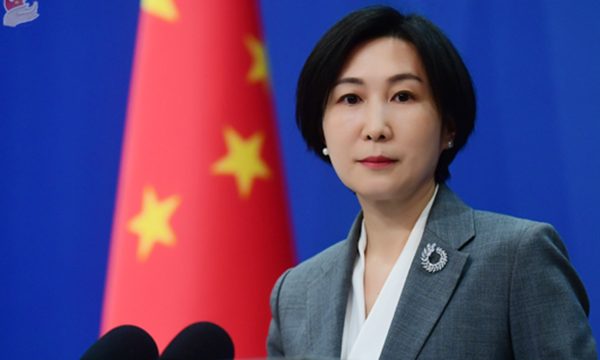
Chinese Foreign Ministry spokesperson Mao Ning
By Drago Bosnic | February 28, 2023
Diplomacy has always been one of the cornerstones of the so-called “soft” power projection. Countries have used it throughout human history to negotiate issues that otherwise would have been resolved on the battlefield. The United States of America, the world’s most aggressive imperialist (and neocolonialist) power, is rather unique in this regard, as it is essentially using its “diplomacy” as a form of arm-twisting instead of actual dialogue and negotiations. For the warmongering elites in Washington DC, utterly barbaric behavior seems to be a given, while mutual respect and taking the other side’s legitimate interests into account is clearly considered a “foolish weakness”.
This has resulted in numerous wars around the world, further leading to hundreds of millions of dead, wounded and expelled people, or in simpler words, countless lives destroyed due to unparalleled US aggression against the world. And while such a belligerent foreign policy approach is expected from Washington DC when it comes to smaller countries that cannot match US power, they certainly do not attempt to behave similarly toward global powers and superpowers. But America is doing exactly that, with the US State Department issuing open threats to China, accusing it of alleged (planned) arms shipments to Russia. Top American officials also added that Beijing will suffer “very real consequences” if it goes ahead with the supposed deal.
Obviously, the Asian giant wasn’t even given the chance to deny the accusations as the US resorted to directly threatening Beijing. However, China is anything but intimidated. Increasingly confident due to its meteoric rise to superpower status, Beijing was quick to fire back at the blatant threats. During a press briefing on February 27, Mao Ning, a spokesperson for the Foreign Ministry of China, stated that the Asian giant is fully prepared to retaliate if illegal US sanctions against Chinese companies operating in Russia are not removed. Mao also dismissed allegations that Beijing is planning to send weapons to Russia, rejecting the questionable (at best) US mainstream propaganda reports as disinformation.
“The US, however, has been fanning the flame and fueling the fight with more weaponry,” she (quite correctly) indicated at the blatant American hypocrisy, adding: “This is out-and-out hegemonism and double standards, and absolute hypocrisy. The Chinese side will continue to do what is necessary to firmly safeguard the lawful rights and interests of Chinese companies. We will take resolute countermeasures in response to the US sanctions.”
Mao also reiterated Beijing’s official position on the Ukraine crisis as one of peace, seeking a solution through negotiations rather than the force of arms. She stressed that “China has been actively promoting peace talks and the political settlement of the crisis,” adding that Beijing has been much more constructive than Washington DC. Mao once again indicated that the US is fully responsible for the incessant escalation in its relations with China. This is certainly true, particularly in recent times, as Washington DC has used even the most trivial matters to denigrate and antagonize Beijing, while also illegally arming the Chinese breakaway island province of Taiwan, exacerbating US-China tensions to a boiling point.
“In addition to pouring lethal weapons into the battlefield in Ukraine, the US has been selling sophisticated weapons to the Taiwan region in violation of the three China-US joint communiqués. What exactly is the US up to? The world deserves to know the answer,” Mao concluded.
Mao also remarked that America is spreading disinformation about China’s alleged supply of weapons to Russia in order to use it as a pretext to sanction Chinese companies, thus eliminating competition by using such underhanded tactics. One of the affected Chinese companies, Changsha Tianyi Space Science and Technology Research Institute, has already been sanctioned based on unsubstantiated claims that it is supposedly supplying the Wagner Group PMC (private military company) with satellite imagery of Ukraine. US Under Secretary of State for Political Affairs Victoria Nuland stated last week that sanctions were targeting Chinese companies that “have been observed sneaking up to the edge and trying to provide weapons to Russia”.
The unprecedented US hypocrisy is also seen in the attempts to portray Russian President Vladimir Putin as a supposed “war criminal”, with US President Joe Biden already accusing him of being one and even saying “evidence needs to be gathered for a war crime trial“. This is despite Biden’s central role in starting numerous wars under several US administrations and despite virtually the entire establishment in Washington DC being involved in warmongering and war crimes, regardless of political affiliation. Perhaps an even better example would be the May 2022 speech made by former US president George W. Bush, whose Freudian slip about the “wholly unjustified and brutal invasion of Iraq, I mean Ukraine” clearly showed the entire world the sheer scale of US hypocrisy and double standards.
Drago Bosnic is an independent geopolitical and military analyst.
Featured Video

Weaponized Journalism: 2021 Sayer Ji Interview with NPR
or go to
Aletho News Archives – Video-Images
From the Archives
How Rothschild Banking Clan Uses Its Vast Wealth to Influence World Events and Control Governments
By Ilya Tsukanov – Sputnik – 15.09.2024
How powerful is the Rothschild banking family? How did they amass their fortune? Just how rich are they? Do they secretly control the world? Sputnik explores. … continue
Blog Roll
 Aletho News
- London tourism expo promotes Israeli agency linked to theft of Palestinian land
- Dockworkers launch global strike against Israeli and US military shipments
- Europe facing gas price shock – Gazprom chief
- Ukraine continues recruiting people with disabilities
- Weaponized Journalism: 2021 Sayer Ji Interview with NPR
- Beyond Netanyahu: what Israel’s election means for Palestinians
- Lithuania plans universal conscription
- Lies, Damn Lies, and Ukraine News
- Financial Times rejects Nordic demands to correct Putin call story – media
- The Case for Less Unity in Europe
- If Americans Knew
- The Long Arm of AIPAC
- Genocidal intent behind Hebron assault, rights group says
- This week, Israel killed 8-year-old who survived bombing that wiped out her family
- DAILY UPDATE: Latest essential news on Palestine, Israel, & region
- Israeli soldier poses at damaged Lebanon church, sparking anger
- New Report. Manufacturing the Great Replacement: Is Israel behind one of the largest racist influence campaigns ever documented?
- ‘Arab voice doesn’t count’: Jewish Israeli blocs reject Palestinian support
- Whether Bibi Stays or Goes, the ‘Special Relationship’ Must End
- AIPAC Isn’t Retreating. Here’s How It’s Already Shaping the Next Congress.
- With ‘Largest Coordinated Port Action Ever,’ Dockworkers in 22 Countries Strike Against Gaza Genocide
- No Tricks Zone
- Germany’s Green Energy Transition Becoming Increasingly Expensive…Another 6 Trillion Euros!
- Sudden Stratospheric Warming, Powerful El Niño Combination May Lead To Extreme Europe Cold, Energy Crisis!
- Two New Studies Find Thwaites Glacier Melt Cannot Be Driven By Human Activity Or A Warming Ocean
- E-Cars Reduce CO2 Emissions By Only 41% Compared To Internal Combustion Engine Vehicles
- Predictions Made By Renowned Climate Professor Over Past Decades Have Been Proven To Be Poor
- New Study Suggests Large Regions Of The Pacific Ocean Have Been Cooling For The Last 80 Years
- Germany’s Green Energy Debacle: High Energy Costs Force Kahla Porzellan to Close After 182 Years!
- New Study: 50 Years Of The Most Aggressive ‘Net Zero’ Policies Can Only Affect The Global Climate By 0.03°C
- US September “Heat” Was No Record…Many Records Set Decades Ago
- Latest European Green Energy Debacle; Portugal’s Largest Flagship Solar Park Insolvent!

