Hormuz Strait: Iran’s Strategic Trump Card for Forcing Enemies to the Negotiating Table
Sputnik – 01.03.2026
Iran is in an “existential confrontation” with the US and Israel, and restricting access to the Hormuz Strait – entry point to the oil-rich Persian Gulf region, is one of the “most powerful strategic cards” it holds, says Dr. Ali Mamouri, a former strategic communication advisor to Iraq’s prime minister.
“Iran’s broader strategy appears to be buying time and raising the cost of the conflict, hoping to drag the United States into a prolonged and expensive confrontation that would generate domestic political pressure on President Trump to seek a ceasefire,” Mamouri told Sputnik.
“On the other side, Washington and Israel seem to be betting on internal collapse—expecting that military pressure might trigger protests, elite divisions, or defections within Iran’s security forces. So far, however, none of these internal fractures have appeared.”
“A prolonged closure” of the Hormuz Strait would have a profound impact on the global economy, Mamouri says.
“A sustained disruption would likely trigger sharp spikes in global oil prices.” Beyond that, the import-heavy economies of Gulf countries, and oil import-dependent economies of Asia and Europe could descend into crises, shipping insurance premiums would surge, global supply chains wrecked, and inflation skyrocketing, “affecting everything from fuel prices to manufacturing and food supply.”
“In this sense, a prolonged crisis in the Strait of Hormuz could trigger a domino effect across the global economy, combining energy shocks, trade disruptions and financial instability,” Mamouri stressed. “If Iran manages to maintain a sustained disruption, it could become a powerful bargaining tool to force negotiations and potentially halt the current military escalation.”
Trump bit off more than he can chew with Iran – ex-Pentagon analyst
RT | March 1, 2026
The US-Israeli strikes on Iran are unlikely to trigger regime change and risk escalating into a wider geopolitical confrontation, former Pentagon security policy analyst Michael Maloof has told RT.
Washington and West Jerusalem launched what they described as a “preemptive” attack on the Islamic Republic after nuclear talks failed to produce a breakthrough, prompting retaliation from Iran. Tehran responded with missile and drone strikes targeting Israel and US military bases across the region.
In an interview with RT on Saturday, Maloof said the timing of the attack had likely been finalized during Israeli Prime Minister Benjamin Netanyahu’s visit to Mar-a-Lago on February 12, despite President Donald Trump publicly insisting that negotiations with Tehran were ongoing.
“The United States has always done Israel’s bidding. Netanyahu basically controls Trump,” Maloof claimed, adding that the US president has effectively pursued the Israeli PM’s vision of “a greater Israel to encompass all the Arab countries.”
Trump openly declared his goal to force regime change in Tehran, but efforts to topple Iran’s government would face major obstacles, according to Maloof.
“Regime change is something that is going to be difficult, especially in Iran, where they’re very, very set. They have a government in place,” he said. Even with the killing of Iran’s Supreme Leader Ayatollah Ali Khamenei, the Islamic Revolutionary Guard Corps would likely keep the country functioning as a “cohesive nation-state.”
At the same time, he described the strikes as part of a broader strategic confrontation extending beyond Iran’s nuclear or missile programs, noting how the US president has been openly critical of BRICS and China’s Belt and Road Initiative.
“And Iran just happened to be a very critical component to that, with Russia and with China,” Maloof said. “I think Trump bit off more than he could chew on this one.”
“These attacks are gonna affect the whole economic world order, literally overnight. So we’re in for a long, hard slug here,” Maloof said, adding that “it’s easy to start a war, but [it’s harder to know] how to stop one.”
Murdering Khamenei Will Kill Trump’s Presidency
By Ian Proud | Strategic Culture Foundation | March 1, 2026
Ayatollah Seyyed Ali Khamenei was assassinated in what is being described in western media as a joint airstrike operation. Even though the Israeli air-force carried out airstrikes in and around Tehran, it is clear that these were supported by the U.S. military. As such, the U.S. is complicit in the murder of the Head of State of a sovereign nation.
And this unilateral military action once again proved both that the United Nations Charter has lost its value and that the UN Security Council is now broken.
In his opening remarks to the Security Council, Secretary General António Guterres condemned the military strikes by the U.S. and Israel, which also condemning the Iranian response, citing Article 2 of the UN Charter.
“All Members shall refrain in their international relations from the threat or use of force against the territorial integrity or political independence of any state, or in any other manner inconsistent with the Purposes of the United Nations.”
The enormous and ongoing military strikes against Iran were clearly in breach of that Article.
In its response to the Security Council, Iran’s Representative cited Article 51 of the UN Charter, which states that “nothing in the present Charter shall impair the inherent right of individuals or collective self-defence if an armed attack occurs against a Member of the United Nations, until the Security Council has taken measures necessary to maintain international peace and security.” Article 51 is one of only two exceptions to the general prohibition on the use of force by UN members set out in Article 2.
The strikes were all the more cynical for taking place part way through talks moderated by the government of Oman. Indeed, Guterres hinted at this in his remarks, saying:
“The U.S. and Israeli attacks occurred following the third round of indirect talks between the U.S. and Iran mediated by Oman.
Preparations had been made for technical talks in Vienna next week followed by a new round of political talks.
I deeply regret that this opportunity of diplomacy has been squandered.”
Pakistan’s representative at the Council was more blunt, saying that “diplomacy has once again been derailed as these attacks have happened right in the middle of negotiations.”
Indeed, the strikes confirmed that the UN Security council has become completely unable to take measures necessary to maintain international peace and security.
On the 80th anniversary of the founding of the UN Secretary General Guterres warned that “fragile” legitimacy of the Security Council could endanger global peace if it remains gridlocked and fails to fulfil its primary purpose.
All of the the western nations around the UN Security Council table last night showed themselves to be weak and silent, in the face of American’s military might.
As one, they criticised Iran’s unprovoked attacks on Gulf states, as Iranian ballistic missiles targeted U.S. military sites in Bahrain, Qatar, the UAE and Kuwait, while also targeting Israel. Self evidently, Iran was targeting U.S. military installations in all of those countries and. Indeed, the U.S.’ fifth fleet Headquarters in Bahrain was struck by at least one ballistic missile. Yet civilian sites also got hit, including in the UAE and in Bahrain.
However, there was no mention at all of the U.S. and Israeli strikes on Iran in the statements of western nations at the Security Council, as if they feared U.S. reprisals if they spoke out. Not a single word from the French, the Latvians, the Danes, the Greeks, even the Bahrainis, only that Iran murdered its citizens and should not be allowed to acquire a nuclear bomb.
In the end the acting UK Permanent Representative, James Kariuki, who I can tell you from personal experience is the most arrogant and puffed up British diplomat that I ever met, said that:
“Iran must refrain from further strikes, and its appalling behaviour, to allow a path back to diplomacy.”
The sitting President of the UN Security Council, the United Kingdom (the U.S. takes over the Presidency today) did not utter a single word about the USA or Israel. No attempt, as the country convening the meeting, to seek common ground and some agreement on the way forward.
Britain’ approach was merely to blame Iran in what the Russian Federation representative described in his intervention as ‘victim blaming’. I already knew that Britain had given up diplomacy in 2014, but this appeared yet another nail in a coffin which the UK refuses to bury as it pretends to be a nation of diplomacy. It is not. Britain is now a nation of warmongers without the troops to fight.
While final confirmation of the fact had yet to be provided at that time, the Prime Minister of Israel and President Trump were already celebrating the possible killing of Khamanei. ‘The dictator is gone,’ Netanyahu crowed.
In his social media statement, President Trump called on Iranian people to rise up and take over their country.
Yet within hours, sources within the CIA were already leaking reports that Khamenei may simply be replaced by IRGC hardliners.
As I have pointed out before, rather than fomenting revolution, unilateral military action against Iran may have the opposite effect and mobilise Iranian resistance.
This idea was stated with great clarity by Professor Robert Pape of Chicago University who said:
“With each passing day of regime-targeting airstrikes, we lose control over the political dynamics they unleash.
It becomes less about individual leaders and more about national survival. Less about dissent and more about resistance.
Imagine if a foreign power struck Washington and called on Americans to overthrow their government. Would citizens rally against their leaders — or against the foreign attacker?”
Iran is a country of 92 million people with an army of over 610,000. It is a tightly controlled state and as we saw in January is more than capable and ready to stifle internal dissent, including through violent means. It also does not have an oven-ready opposition lined up in the wings that can walk in unopposed and miraculously take over the country. To suggest that it does takes us into Bay of Pigs territory.
Having already kidnapped the Head of State of one sovereign nation already this year, the United States of America has now murdered another, Ayatollah Khamenei. This will unleash asymmetric threats against the U.S. and all of its allies that Donald Trump will not be able to control. If this military action drags out inconclusively, and I predict it will, then the mid-terms may prove catastrophic for Trump. I predict that the Iranian regime will outlast his.
Unexpected Iranian reaction paralyzed Americans and Israelis on the first day of war
By Lucas Leiroz | Strategic Culture Foundation | March 1, 2026
The recent military escalation in the Middle East revealed a strategic miscalculation on the part of Washington and Tel Aviv. By launching a direct offensive against Iran, authorities in the United States and Israel apparently assumed that Tehran would repeat the pattern observed in previous confrontations: initial restraint, calibrated retaliation, and delayed timing. This pattern was evident both during the so-called Twelve-Day War and in earlier episodes of Israeli aggression against Iranian targets and regional allies. This time, however, the calculation proved mistaken.
The central element of the initial strategy appears to have been a classic attempt at “decapitation,” targeting the Supreme Leader, his family, and other high-level figures. The underlying logic is well known: by removing the apex of decision-making authority, internal disorganization, succession disputes, and operational paralysis would follow. This approach is recurrent in Western military doctrine, especially when directed against states considered systemic adversaries.
However, this type of strategy tends to fail when applied to highly institutionalized states equipped with complex political-military structures. Iran is not a fragile entity dependent on a single personal command center. It is a system with multiple layers of authority, defined chains of succession, and deep integration between the state apparatus, regular armed forces, and parallel security structures. Moreover, it is a civilization with millennia of historical continuity, whose contemporary political identity was consolidated precisely under external pressure. The elimination of an individual leader, even if symbolically significant, does not automatically dismantle a state with this degree of structural cohesion.
What surprised analysts was the speed of the Iranian reaction. Unlike what occurred during the Twelve-Day War, this time retaliation was immediate and multifaceted. Within the first hours after the attacks, Iran launched a series of simultaneous operations against American military installations across the Middle East. Bases used by U.S. forces were struck with missiles and drones in coordinated actions aimed at saturating defense systems and reducing interception capacity.
At the same time, Israeli defensive systems were placed under pressure through multiple and forceful attacks. Iran’s strategy was not limited to a symbolic gesture; it represented a deliberate attempt to impose immediate and visible costs, altering adversaries’ perception of risk. Throughout the first day of confrontation, the operational tempo remained constant, creating an environment of heightened uncertainty for the Zionist regime.
The multiplicity of vectors employed – different launch platforms, varied trajectories, and synchronized timing – contributed to confusion among military planners in Washington and Tel Aviv. By all indications, such a bold and rapid action was not anticipated. The assumption that Tehran would hesitate, seek mediation, or respond in a limited fashion proved incorrect. Instead, Iran sought to demonstrate its capacity for strategic coordination under maximum pressure.
This behavior suggests that Iranian authorities internalized relevant lessons from recent conflicts. Delays in responding, observed in previous episodes, were interpreted by adversaries as signs of strategic restraint or operational limitation. By opting for an immediate and comprehensive reaction, Tehran sought to redefine the rules of engagement and establish a new threshold of deterrence.
The psychological impact should not be underestimated. Continuous attacks throughout the first day reportedly generated confusion and near paralysis within certain Israeli and American decision-making circles. When multiple fronts are activated simultaneously, the ability to prioritize strategically becomes far more complex, if not effectively impossible.
It now remains to be seen how escalation will unfold in the coming days. Iran’s initial response altered the immediate balance but does not end the cycle of action and reaction. Washington and Tel Aviv face the classic dilemma between expanding the offensive – risking a large-scale regional conflict – or seeking indirect channels of containment. The first day demonstrated that the scenario evolved beyond initial expectations. From this point forward, each additional move may redefine not only the military dynamic but the broader security architecture of the entire Middle East.
Trump to Give “Important Update on Iran” Wednesday in Prime-Time Speech
By Larry C. Johnson – SONAR – April 1, 2026
What is Donald Trump going to say about Iran on Wednesday night? Before I layout three possible outcomes, let’s examine what Trump is actually doing in terms of some key military assets (all of this is from open source reporting).
A-10 Squadron (Confirmed New Deployment)
Since Friday, March 27, 2026, the most prominently reported new US air asset movement to the Middle East (CENTCOM area of responsibility) has been a squadron-sized deployment of A-10C Thunderbolt II attack aircraft (Warthogs). Six A-10s from the Idaho Air National Guard’s 190th Fighter Squadron arrived at Pease Air National Guard Base (New Hampshire) as part of staging. On March 30, twelve A-10s from the Michigan Air National Guard’s 107th Fighter Squadron (Selfridge ANGB) departed Pease for RAF Lakenheath, UK (a common transit stop), in two flights of six. Another six followed on March 31. These ~12–18 aircraft are en route to the Middle East to reinforce or nearly double the existing A-10 presence there.
A-10s are already operating in theater (e.g., from the 75th Expeditionary Fighter Squadron) for close air support, anti-boat strikes in the Strait of Hormuz, drone interdiction, and coastal targeting. The surge supports intensified low-altitude operations against Iranian “mosquito fleet” vessels, mines, and remnants amid the broader campaign.
Apache Helicopters (AH-64) Squadron
US Central Command publicly confirmed the operational use of AH-64 Apache attack helicopters in late March (updates around March 16–18 and a specific confirmation on March 26). The 6-17th Air Cavalry Squadron (part of the 4th Infantry Division Combat Aviation Brigade, operating AH-64D/E variants) is the unit involved. It had been forward-deployed earlier (under prior rotations like Operation Inherent Resolve) but was newly integrated into Epic Fury strikes against Iranian boats, drones, and coastal targets in the southern flank/Hormuz area.
Several viral Facebook posts and YouTube videos (from accounts like “MovieFans.Lich,” “Live WWIIIRE,” and similar sensationalist pages) claim a “massive C-17 fleet” is deploying Apache helicopter squadrons alongside troops, armored vehicles, and equipment. These describe “dozens” or “over 112 C-17s” streaming into the region, with Apaches highlighted for their anti-armor, close air support, and anti-boat roles in rugged coastal terrain. Some videos include generic footage of folded Apaches inside C-17 cargo bays or all-female flight crews turning around quickly.
Posts from OSINT-focused X accounts (e.g., @TheIntelFrog, @Faytuks, @JewishWarrior13) detail dozens of C-17 flights since mid-March (e.g., ~35–50 flights tracked from March 12–24, with more ongoing) originating from bases like Fort Bragg/Pope AAF, Fort Campbell, Hunter AAF, and McChord AFB. Destinations include Ovda (Israel), Jordanian bases (King Faisal, King Hussein), and other CENTCOM hubs. These are linked to troop surges (including elements of the 82nd Airborne) and special operations forces, with some users speculating or claiming that attack helicopters like Apaches are part of the heavy equipment being airlifted. One analysis noted origins tied to units with aviation assets, such as the 160th SOAR (which operates helicopters, though primarily MH-6/ MH-60 rather than AH-64).
The new deployment of these assets are consistent with a military option that involves close-air support and/or attacks on Iranian fast boats and water drones.
So what is Trump going to announce?
Option 1 — Declare that negotiations with Iran via intermediaries (e.g., Pakistan) are progressing and that the United States is going to cease combat operations against Iran in order to support the negotiations and achieve a peaceful resolution.
Option 2 — Declare that victory has been achieved and that US forces will begin withdrawing from the region, leaving the status of the Strait of Hormuz in limbo.
Option 3 — Announce a massive air and ground operation to secure the freedom of navigation through the Strait of Hormuz.
The deployment of the A-10s and the Apaches can only mean one of two things:
- It is a show of force intended to pressure Iran to return to the negotiating table.
- The US is going to launch a massive attack against Iranian assets in the Persian Gulf, especially those located in and around the Strait of Hormuz.
Since Monday, March 30, 2026, President Donald Trump has made several public comments on the ongoing US-led Operation Epic Fury against Iran, primarily via Truth Social posts, interviews (including with the New York Post ), and remarks to reporters. His statements emphasize US military successes, threats of further escalation if demands are unmet, criticism of allies, and a potential near-term wind-down of direct US involvement.
On Monday, Trump described Iran as effectively “decimated” or “obliterated,” with its air force, navy, and many ships sunk or destroyed. He portrayed the campaign as highly successful and “way ahead of schedule” in prior context, but continued highlighting strikes on “long-sought-after targets.” He shared video footage on Truth Social of a massive explosion and secondary blasts in Isfahan (linked to strikes on uranium-related or military sites), without additional caption in one instance.
Trump also posted that the US was in “serious discussions with a new, and more reasonable, regime” to end operations. He warned that if the Strait of Hormuz is not “immediately ‘Open for Business’” and a deal is not reached shortly, the US would “completely obliterate” Iran’s electric generating plants, oil wells, Kharg Island, and possibly desalination plants. He framed this as concluding the US “lovely ‘stay’ in Iran.” In follow-up comments, he suggested the US could respond to Iranian actions “twenty times harder” with “Death, Fire, and Fury.”
Overall, Trump’s messaging since March 30 combines triumphalism about US achievements, escalatory warnings tied to the Strait of Hormuz and energy targets, frustration with allies, and signals of de-escalation with a short timeline for reduced US involvement. These comments have influenced market reactions (e.g., oil prices and equities) and drawn responses from Iranian officials and international observers.
Trump’s remarks since Monday have boosted the confidence of the folks on Wall Street and contributed to a significant surge in the stock market, with the Dow up 1,125 points. The price for BRENT oil dropped from 118 to 103 during Tuesday trading. This means the financial folks believe the war is going to end.
I think Trump is counting on Iran offering up some concessions in the face of the US buildup of additional air combat assets. Netanyahu reportedly just said Iran no longer poses a threat to Israel’s existence… A dramatic pivot if true. However, over the last few hours, Israel and the US carried out a large wave of attacks across Iran. They struck targets across several parts of Tehran, as well as in the cities of Karaj, Shahriar, Ahvaz, Shiraz, Abadeh, Isfahan, and Bandar Abbas. Iran will retaliate in force to these latest attacks.
In short, I believe Donald Trump will announce a major offensive to try to force Iran to release its chokehold on the Strait of Hormuz… I believe that offensive will fail and that the war will escalate unless the US and Israel agree to two critical Iranian demands: the end of all sanctions and the removal of US military bases from the Persian Gulf arab countries.
Russia and China are two wild cards that could change the trajectory of the current war. If they engage and apply pressure on the diplomatic front — including ironclad security guarantees to Iran — Donald Trump may take the exit ramp.
What do you think?
Pascal Lottaz and I discussed the current situation in the Persian Gulf:
I did my usual Tuesday chat with Marcello:
A new interview with Rathbone. Interesting fellow… He’s also a comedian:
Larry Johnson: The U.S. Will Exhaust Itself & Lose War Against Iran
Glenn Diesen | February 28, 2026
Larry Johnson is a former intelligence analyst at the CIA who also worked at the US State Department’s Office of Counterterrorism. Johnson discusses why the US will lose the war against Iran.
Read Larry Johnson’s Sonar21: https://sonar21.com/
Follow Prof. Glenn Diesen: Substack: https://glenndiesen.substack.com/
X/Twitter: https://x.com/Glenn_Diesen
Patreon:  / glenndiesen
Support the research by Prof. Glenn Diesen: PayPal: https://www.paypal.com/paypalme/glenn…
Buy me a Coffee: buymeacoffee.com/gdieseng Go Fund Me: https://gofund.me/09ea012f
In The Name of ‘Helping Iran’, The U.S. And Israel Slaughter Over 100 Iranian Schoolgirls

The Dissident | February 28, 2026
During his announcement of the current U.S./Israeli regime change war on Iran , Trump framed the war under the pretext of helping Iranians, saying:
to the great, proud people of Iran, I say tonight that the hour of your freedom is at hand. Stay sheltered. Don’t leave your home. It’s very dangerous outside. Bombs will be dropping everywhere. When we are finished, take over your government. It will be yours to take. This will be, probably, your only chance for generations.
For many years, you have asked for America’s help, but you never got it. No president was willing to do what I am willing to do tonight. Now you have a president who is giving you what you want, so let’s see how you respond. America is backing you with overwhelming strength and devastating force. Now is the time to seize control of your destiny and to unleash the prosperous and glorious future that is close within your reach. This is the moment for action. Do not let it pass.
But after one day of war, the U.S. and Israel have already carried out a massacre of over 100 children.
The Financial Times reports that, “A primary school in southern Iran was struck during Saturday’s joint US-Israeli military operation, killing at least 108 people who were mostly schoolgirls, according to Iranian authorities.”
According to the governor of Hormozgan Province, Mohammad Ashouri, “In addition to the deaths, 92 people were injured and an unspecified number trapped under rubble”.
The Guardian reported that , “In one video circulating on social media, purportedly showing the immediate aftermath of the strike, smoke rises from the burnt-out walls, and debris lies spread across the road. Hundreds of onlookers gathered at the site, some in obvious distress. Screams can be heard in the background,” adding, “Persian factchecking service Factnameh was able to cross-reference the video with other photographs of the school site, and concluded that the video was authentic. Reuters said it had also verified the footage as being from the school.”
Other footage also shows the bodies of the student girls who were killed in the massacre.
This massacre has also been confirmed by multiple witnesses who have spoken to the media.
Middle East Eye interviewed a staff member at the school who said, “She used to watch these young girls playing at school every day. But after today’s strikes, she saw their bodies lying on classroom benches and in different corners of the school.”
Middle East Eye added:
She said she had stepped out of the school to take care of something when she suddenly heard a horrifying sound. Within seconds, a missile – or something like it – hit the school building.
After hearing the blast, she ran back toward the school and was faced with a scene she says she will never forget for the rest of her life.
“I felt like I had gone mute. I couldn’t speak,” the staff member told MEE. “You could hear the sound of children crying and screaming.”
Drop Site News spoke to Mohammed Shariatmadar, the father of a six-year-old girl named Sara killed in the massacre, who said, “I cannot understand how a place where innocent children learn can be bombed like this, We are talking about small children who knew nothing of politics or wars. And yet they are the ones paying the highest price,” adding, “My heart is broken, For Sara and for all the children we lost today. I want the world to know that the children are the real victims. Every day that passes without a solution increases the pain and the suffering for the families and for the children alike”.
Another witness told Drop Site News, “Everyone rushed to the school the moment they heard the blasts. Chaos took over completely. Security forces were trying to push families back, fearing the area would be targeted again.”
Seyyed Ibrahim Mirkhayali, a father who lost his nine-year-old daughter in the massacre said, “I was at work when my wife called and told me that the girls’ primary school in Minab had been bombed. I could not process what I was hearing at first. Then I left immediately and drove to the school. The atmosphere was terrifying and catastrophic. The parents were in a deadly silence, filled with fear and dread for their daughters. We did not know who had gotten out and who was still under the rubble”.
Along with this media reports that “In Fars Province, also in southern Iran, ‘Israel’ killed 20 volleyball players in a strike on a sports hall in the city of Lamerd, according to a provincial official.”
While pretending to care about Iranians, the U.S. and Israel are clearly happy to massacre children and civilians in Iran in order to carry out the real goal of destroying Iran as a nation.
Why are Americans killing and dying for Israel, again?
By Tarik Cyril Amar | RT | February 28, 2026
Israel and its US auxiliaries have attacked Iran. In terms of international law and elementary justice, things are clear beyond the slightest doubt: the attack is a war of aggression – but to be fair, in Israel’s case that hardly makes a difference anymore.
With ‘highlights’ including apartheid, ethnic cleansing, unlawful detention, torture, sexual violence, and genocide, Israel has such an extensive and constantly growing record of, literally, every crime under international law, including human-rights and humanitarian law (or the law of armed conflict), that one more or less hardly seems to matter anymore. This state is a monster, and monsters will monster as long as they can.
The US, of course, is no spring chicken either when it comes to treating international law – really, any law – as a doormat and brutally, gleefully violating the most basic ethics, the kind of simple rules normal people intuitively recognize, such as “don’t murder, lie, or steal.”
Indeed, while Israel can easily claim to be the single most criminal, indeed evil country in the world, the US wins the most-powerful-rogue-state prize hands down. There is – empirically, quantifiably – no other country that combines such ingrained and increasingly explicit scorn for law and morality with such brute power and perpetual violence. Before the current assault on Iran, the kidnapping of Venezuelan President Nicolas Maduro was just the last proof of that fact, so glaringly obvious that it woke up even some Western commentators.
If some things are too obvious to merit further discussion, others are more intriguing. Let’s start with the greatest mystery: Why is the US joining – really, obeying – Israel and its powerful American lobby once again in going to war in the Middle East? Was Iraq 2003 not enough of a disaster? Are the American elites really congenitally unable to learn?
In terms of actual US interests, war against Iran makes no sense at all. Iran is not close to a nuclear bomb and, as a matter of fact, has a religiously and ethically based (hard to grasp in Washington, I know) explicit policy against acquiring one. And even if Iran were building such weapons or seeking a state of being “latently” able to do so as urgently needed insurance against permanent Israeli and US aggression, Washington would gain nothing and risk very much by going to war.
On the other hand, it was precisely the JCPOA agreement with Iran, destroyed by the US during the first Trump presidency, that proved empirically that the issue of Iranian nuclear energy use can be resolved well by compromise. As to recent, hysterical US claims about other types of WMDs and “intercontinental missiles,” it is time to no longer give such crude, dumb lies the time of day. Enough with the propaganda already.
Regime change? So, please could someone explain why installing a washed-out Pahlavi princeling – if it ever were to work, that is – in Tehran is good for Americans? Spoiler, no one can. At least not honestly. Do I hear someone say geopolitics? Oh, that would mean the “genius” geopolitics of risking a long war with great damage to the US and its regional allies? Then, perhaps it’s all about plunder? Yes, true, the US simply loves plundering. Historically speaking, the whole country is built on it, just like Israel. But even plunder on its own despicable terms only makes sense if you turn a profit. Good luck with that while sinking more gazillions into war-for-Israel.
And that brings us to the only explanation that does make sense, even if in a very grim way: The US, as in almost all Americans, has zero interest in war with Iran. As little as in a proxy war with Russia and a Cold War with China, both strategies, by the way, doomed to fail. In all three cases, the vast majority of Americans would only stand to benefit from peaceful and cooperative relationships.
But Washington chooses permanent conflict and war against Iran anyhow. The reason is that US policy in the Middle East – and not only – has been captured by Israel and its lobby. As John Mearsheimer, both doyen of explaining international relations by national interests (the theory of Realism) and co-author of the standard work on the Israel Lobby, has long acknowledged, Israel’s influence on the US is real, contradicts American interests, and forms an exception to the theory of realism in that Washington is constantly hurting its own country.
For reasonable observers, this case is closed. When devastating the Middle East, the US is acting not in its own genuine national interest but the perverse conception that Israel has of its national interest: subjugating and, if needed, destroying all sovereign states in its neighborhood so as to create and preserve Israeli domination and even ‘Greater Israel’, a nightmare of ‘Lebensraum’ for Zionist settlers from, at least, Egypt to Iraq.
But, again, why? This is where the Epstein scandal makes a difference – or should do so – to unbiased minds. We must acknowledge that Jeffrey Epstein was not “merely” a very rich and perverse criminal with far too many friends in high places but an agent of Israel, whether with a direct affiliation to its dreaded Mossad service of spying, murder, and subversion or not. His core operation served to gather extremely compromising blackmail material on large swathes of the elites of the US and the West more generally. FBI agents, we now know, assessed that Trump himself is among those trapped in this manner. If anything, frantic – and also, again, criminal, efforts – by Trump’s Department of Justice and his head of the FBI to purge the files of references to the current president and his friends only provide further corroborating evidence that Trump is under Israel’s control.
Remember ‘Russiagate’ (really, of course, Russia Rage)? The irony! Russia was never remotely close to (or even trying) to having a US president under its thumb. That was all BS. Yet, in the end, ‘Russiagate’ did do two things: it gave Trump a (fundamentally realistic if exaggerated) sense of having been a victim of a smear campaign and, among voters, it helped Trump make his furious comeback, without which he would not now be in power. The delusion and mass hysteria of ‘Russiagate’ – which was that famous American thing, a nothing-burger – paved the way for the power that really controls Trump and really does enormous damage to America: Israel and its lobby.
Will Americans ever free themselves from the one state and network that have really run history’s most successful subversion and state-capture operation on them? Who knows? We know that it would take more than putting an end to Epstein-like blackmail. If anything, Trump’s bitter enemies, Joe Biden and Kamala Harris, have only recently shown us that the American “elite” is enthralled to Israel and its crimes also for reasons ranging from being bribed to sharing the vile insanity of Zionism. If the US ever wants its independence back from Israel, all of that will have to go.
Tarik Cyril Amar is a historian from Germany working at Koç University, Istanbul, on Russia, Ukraine, and Eastern Europe, the history of World War II, the cultural Cold War, and the politics of memory.
Timing of US-Israel attack on Iran bears symbolic meaning in Judaism
By Tal Shalev | CNN | February 28, 2026
The timing of the US and Israeli attack on Iran bears symbolic meaning in Judaism. Ahead of the upcoming Jewish holiday of Purim, worshippers read the specific portion from the Old Testament, known as Zachor.
The passage from the book of Deuteronomy commands the ancient Israelites to remember an unprovoked attack by the nation of Amalek and to eradicate the memory of Amalek once the Israelites are settled in their land.
The passage is read publicly before Purim to fulfil the mitzvah of remembering Amalek as Israel’s achetypical enemy.
70 martyrs, 90 wounded in US-Israeli strike on elementary school
Al Mayadeen | February 28, 2026
Iran’s ISNA news agency reported that dozens of students remain trapped under the rubble, while a number have been rescued. A hospital in the same area also suffered partial damage, according to ISNA.
Iran’s Mehr news agency further reported that two students were martyred in the Narmak area of Tehran.
Iran Invokes Article 51 of the UN Charter
In the official statement from the Iranian Foreign Ministry, Iran invoked Article 51 of the United Nations Charter, affirming its legitimate right to self-defense following the Israeli strikes on Iran.
The ministry characterized the airstrikes as a violation of Article 2(4) of the United Nations Charter, which prohibits the use of force against the territorial integrity or political independence of any state.
According to the statement, “The Armed Forces of the Islamic Republic of Iran will respond forcefully to any attack.” The ministry reiterated that Iran would use all its capabilities to deter aggression and confront its enemies.
Call on the UN Security Council
Iran also called on the United Nations and the UN Security Council to take immediate action in response to the blatant violation of international peace and security.
The statement urged the UN Secretary-General, as well as the President and members of the Security Council, to fulfill their responsibilities without delay.
It also appealed to all UN member states, particularly countries in the region, members of the Islamic world, and states belonging to the Non-Aligned Movement, to condemn the act of aggression and to adopt urgent and collective measures to halt it.
The ministry warned that the escalation represents an unprecedented threat to regional and global peace and security.
Did Israel Just Forfeit Its ‘Right To Exist’? — Carlson’s Interview with Huckabee
By Robert Inlakesh | The Palestine Chronicle | February 28, 2026
Key Takeaways
- Senior political figures openly endorsed a Nile-to-Euphrates territorial vision.
- The “Greater Israel” concept is no longer fringe rhetoric.
- Israel’s borders remain undeclared while territorial expansion continues.
- Legal justifications rooted in Balfour and UNGA 181 are increasingly strained.
- The demand to recognize Israel’s “right to exist” faces growing scrutiny.
The Mainstreaming of ‘Greater Israel’
There is no nation on earth whose government constantly demands its critics acknowledge its ‘right to exist’ as does Israel; this is because it seeks the world’s acquiescence as a means of enabling the indefensible. In truth, nobody, short of Christian Zionists and Jewish Supremacists believe Israel has a right to exist.
In Tucker Carlson’s recent interview with US Ambassador to Israel, Mike Huckabee, the idea of Israel’s legitimacy was not only touched upon, but completely unraveled through a basic series of questions. Instead of furiously clashing with the self-described Christian Zionist, all Carlson did was ask serious follow-up questions and demand answers.
Since then, the fallout from what was a trainwreck of an interview for Huckabee has triggered a wave of backlash from countries throughout the region. The US ambassador triggered this backlash after affirming his belief that Israel is entitled to all of the land between the River Nile and the Euphrates River, as part of its biblical right to exist.
This enormous land grab is what is known as the ‘Greater Israel Project’, once dubbed an outlandish conspiracy theory. ‘Greater Israel’ would include all of Lebanon, Jordan, Palestine, most of Syria, along with parts of Iraq, Saudi Arabia, Egypt, and even Turkiye. Therefore, it is no wonder that a US ambassador expressing his belief that Tel Aviv is entitled to all of this territory drew the ire of the entire region.
However, an even more important development came only days later, receiving much less media attention. The leader of the Israeli opposition, former Prime Minister Yair Lapid, expressed his own belief that Israel should seize all of the territory between the Nile and the Euphrates. Pegged as the more liberal and moderate opponent of Israeli Premier Benjamin Netanyahu, Lapid argued that the territory should be seized only when the right “security” predicament presents itself.
Even though Lapid’s comments did not draw the same kind of backlash from the Arab world’s leadership, his open confession of belief in a biblical right to all of ‘Greater Israel’ is a more important and damning development than the comments of Huckabee. This clearly demonstrates that the entire mainstream Israeli political establishment seeks to achieve this vision.
The Loss of Legitimacy
As pointed out during Tucker Carlson’s interview with the US ambassador to Israel, the infamous Balfour Declaration was written by British Lord Arthur Balfour to Lord Walter Rothschild. An important fact that is often never brought into question as the Balfour Declaration is often cited as a legal document justifying Israel’s existence. Instead, it was a document between two men.
From there, Israeli propagandists will point to later British government declarations as cementing this ‘right to establish a Jewish State in occupied Palestine. Finally, there is the 1947 United Nations General Assembly resolution 181 that is held up as Israel’s de facto birth certificate. This, of course, ignores the fact that Israel was only granted 56% of the land, yet seized nearly 80% of the entire territory.
However, all of this is now irrelevant to the question of Israel’s alleged legitimacy and ‘right to exist’. The reason for this is very simple: the British sought to grant the territory of occupied Palestine, and so too did the UNGA resolution 181. No legal document exists to legitimize the occupation of Syrian and Lebanese lands, as the Israelis continue to expand their borders into these neighboring nations.
Which brings us back to the alleged ‘biblical’ right to existence that the US ambassador, Israeli PM Benjamin Netanyahu, and opposition leader Yair Lapid have all expressed their belief in. The Israelis have historically occupied Egyptian territory, and many Israeli politicians, including current ministers in the Likud Party’s coalition government, have expressed their desire to return to Egypt once again.
The Politics of the ‘Right to Exist’
Israel has never declared its borders, and since 1967 has occupied territory from both Syria and Lebanon, in violation of international law. At this current moment, it is capturing more and more land in southern Syria on a near-daily basis.
Therefore, Israel, as a nation that has no definable borders and whose political leadership, along with its society, believes in its biblical right to seize the territory belonging to its neighbors, has no legal basis to exist as it does today. It has committed genocide, apartheid, mass ethnic cleansings, and operates a system of total Jewish Supremacy in all the land it has seized, through war.
In addition to this, the Zionist movement has actively worked, especially since October 7, 2023, to not only undermine the United Nations as a whole, but to replace it. Yet turns around and cites a UNGA resolution as its ‘legal right to exist’. It violates all known diplomatic norms, having attacked the former Iranian embassy in Syria, bombarded Doha despite its status as a US ally, while ignoring a UN Security Council resolution calling for a ceasefire in Gaza back in 2024.
The only argument that can be made for the continued existence of Israel as it functions today is an ideological one. This means that only two categories of human beings fit into this camp, Jewish Supremacists who believe in a biblical title to the land, and their Christian Zionist allies, who also provide a similar, theologically grounded argument.
There is no evidence that the majority, or even a plurality, of Christians believe in the concept of a ‘Greater Israel’, despite the best efforts of Christian Zionist lobby groups – the most powerful of which operate in the United States. In other words, a very small portion of the global population believes in this biblical interpretation. Even more troubling for the Zionist movement is that its settler colonial project was founded and led for much of its history by atheists.
If we are to define Israel by its current borders, which are undeclared and forever expanding, then there simply is no basis for arguing its existence, unless you do so from a theological perspective. As demonstrated through the questions offered to Ambassador Huckabee, who is himself a Christian pastor, there is no way of demonstrating that the Jewish population, or at least the majority of those Jewish people living in occupied Palestine, are directly related to the Israelites of the bible. In fact, all of the available DNA evidence would suggest that the Palestinians are more closely blood related to that population.
There is no nation on earth today that operates a system of ethno-religious supremacy as Israel does, no nation that violates international law as Israel does, nor is there another nation that bases its legitimacy on isolated and out of context passages from religious texts like Israel does either.
The reason why pro-Israel advocates are constantly demanding that everyone validate their legitimacy and ‘right to exist’ is simple: the affirmation of their flimsy arguments is what provides them the basis to continue behaving as the out-of-control regime that Israel is.
What Israel’s ‘right to exist’ comes down to is the belief that it should be allowed to dispossess millions of Muslims, Christians, and other indigenous peoples of their lands, in order to establish a system of domination. That ethnic cleansing is its right, the acquisition of territory via war is its right, and that committing mass murder against anyone who fights back is also their right.
Israel’s biblical ‘right to exist’ is just as valid as its right to kill entire populations it deems to be ‘Amalek’. If they do have that right, then so too does the so-called “Islamic State” terrorist organization.
The arguments made by Daesh (ISIS) and Israel for their ambitions to establish ever-expanding regimes of tyranny both carry the exact same level of historical and factual legitimacy. That is to say, neither argument carries any weight, beyond it being the belief of an isolated group of extremists – amongst the global population – who believe in a warped religious ‘right’ and that their theological arguments make them superior to all other human beings.
– Robert Inlakesh is a journalist, writer, and documentary filmmaker. He focuses on the Middle East, specializing in Palestine.
Trump Starts a Major Regime-Change War with Iran, Serving Neoconservatism and Israel
By Glenn Greenwald | February 28, 2026
For decades, Israeli Prime Minister Benjamin Netanyahu and American neoconservatives have dreamed of only one foreign policy goal: having the United States fight a regime-change war against Iran. With the Oval Office occupied by Donald Trump — who campaigned for a full decade on a vow to end regime-change wars and vanquish neoconservatism — their goal has finally been realized.
Early Saturday morning, the United States and Israel began a massive bombing campaign of Tehran and other Iranian cities. President Trump posted an eight-minute speech to social media purporting to justify his new war, dubbed “Operation Epic Fury.” Trump’ war cry was filled with the same slogans and clichés about Iran that Americans have heard from the carousel of bipartisan neocons dominating U.S. foreign policy for decades: Iran is a state sponsor of “terror”; it is pursuing nuclear weapons; it took American hostages forty-seven years ago (in 1979); it repressed and kills its dissidents, etc.
As if to underscore how fully he was embracing the very foreign policy dogma he vowed to reject, Trump invoked the Marvel-like “Axis of Evil” formulation that White House speechwriter David Frum wrote for George W. Bush at the start of the War on Terror. Iran’s government, President Trump proclaimed, is one determined to “practice evil.” This is how Bush — speaking of Iraq, Iran and North Korea — put it in his 2002 State of the Union address: “States like these, and their terrorist allies, constitute an axis of evil.”
Trump left no doubt about the scope and ambition of his new war. This will not be a quick or targeted bombing run against a few nuclear sites, as Trump ordered last June as part of Israel’s 12-day war with Iran. There is nothing remotely constrained or targeted about any of this. Instead, this new war is what Trump called a “massive and ongoing” mission of destruction and regime-change, launched in the heart of the Middle East, against a country of 93 million people: almost four times the size of Iraq’s population when the U.S. launched that regime change war back in 2003.
That Trump claimed to have “completely and totally obliterated” Iran’s nuclear program last June — just eight months ago — was not something he meaningfully acknowledged in his new war announcement, other than to vaguely assert that Iran somehow resumed their nuclear program. In fact, Trump seemed to delight in repeating the same triumphalist rhetoric that he used last year when he assured Americans that Iran’s nuclear program could no longer pose a threat as a result of Trump’s triumphant Operation Midnight Hammer.
In lieu of outlining any clear mission statement for this new war, let alone a cogent exit strategy, Trump offered a laundry list of flamboyantly violent vows. The U.S. will “totally obliterate” Iran’s ballistic missile program (which Iran could not use to reach the American homeland but which Trump admitted last June caused Israel “to get hit very hard” in retaliation). Trump also promised that the U.S. would “annihilate” Iran’s navy. And he told Iranians: “the hour of your freedom is at hand….bombs will be dropping everywhere.”
Trump also attempted to prepare the nation for caskets and body bags of American soldiers returning to the U.S. “The lives of courageous American heroes may be lost; we may have casualties,” the President said. But, said the man who did everything to avoid military service including during the Vietnam War, mass death of American soldiers “often happens in war.”
In sum, Trump just launched the exact war that most of his MAGA movement professed to oppose. That included one of Trump’s most influential supporters, the late Charlie Kirk, who repeatedly maligned the neocons’ drive for war with Iran as “pathologically insane,” and warned that grave disaster of historic proportions would be the result:
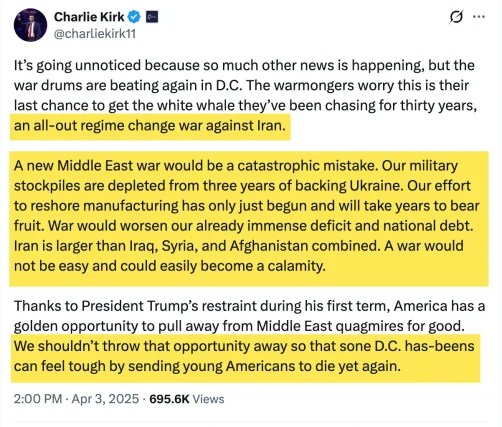
Charlie Kirk, X, April 3, 2025, warning against a regime-change war in Iran
The false claims behind this new war with Iran are ones we have extensively documented. In Trump’s war announcement this morning, he claimed — as he did at Tuesday’s State of the Union address — that Iran refuses to promise that it will not obtain nuclear weapons. The exact opposite is true: Iran has stated this clearly, unequivocally and repeatedly, and did so as recently as this week. “Iran will under no circumstances ever develop a nuclear weapon,” proclaimed Iran’s foreign minister Seyed Abbas Araghchi.
The consequences of this new Trump/Netanyahu war of choice cannot be predicted with any degree of certainty. Already, Iran has launched numerous retaliatory ballistic missiles at Israel, as expected, and has also attacked U.S. military bases in the United Arab Emirates, Qatar, Bahrain and Kuwait.
But the lack of predictable outcomes is, of course, precisely the point. If the U.S. and Israel succeed in their stated goals of widespread “annihilation” and regime change, then they will create, at the very least, a huge power vacuum in the middle of the world’s most volatile region that will require U.S. resources and a sizable military presence for years if not decades to come. One of the world leaders most responsible for the Iraq War, former British Prime Minister Tony Blair, admitted that it was the invasion of Iraq that gave rise to ISIS.
It is hard to overstate what a massive fraud Donald Trump, his campaign and his political movement are. For more than a decade, Trump has ranted and raved against the evils of regime-change wars and neoconservative dogma, only to launch a new war that most perfectly encapsulates and aggressively advances both. He spent years falsely warning that former President Obama would start a war with Iran because of how weak and inept Obama supposedly was at negotiation and diplomacy, only to now do that himself (rather than start a new war with Iran, as Trump predicted, Obama entered a diplomatic agreement with them which major nuclear bodies attested was effective in monitoring Iran’s nuclear activities: a deal which Trump, at Israel’s insistence, tore up in 2018).
Throughout the 2016 campaign, Trump mercilessly mocked Marco Rubio for receiving millions in donations from Sheldon and Miriam Adelson, money that Trump said would “mold [Rubio] into [their] perfect little puppet,” only for himself to become not only the largest beneficiary of Adelson funding in history, but to become the ultimate puppet of the Adelsons’ agenda, one which Trump has clearly acknowledged — when speaking in Israel last year — is an agenda that puts the interests of Israel atop everything, including Americans’ interests:
“I get her in trouble with this, but I actually asked [Miriam] once… ‘What do you love more? The United States or Israel?’ She refused to answer. That might mean Israel,” Trump says, smiling, while looking at the dual Israeli-American national.
And it is not an exaggeration to say — in fact, basic honestly requires one to say — that the 2024 Trump/Vance campaign is one of the most fraudulent political campaigns in American history:

Just one week before the 2024 election, Tulsi Gabbard proclaimed that “a vote for Kamala Harris is a vote for Dick Cheney and a vote for war, war and more war.” Conversely, Gabbard said, “a vote for Donald Trump is a vote to end wars, not start them.” Other than immigration, this “no-new-wars” theme was the most central to Trump’s political appeal and his political promises since he emerged on the political scene a decade ago.
One can rehash the decades of now-trite arguments about Iran as much as one wants. But such endless debate cannot alter the facts here that are indisputable and fundamental.
Iran has not attacked and could not have attacked the United States at home. No such attack was even arguably imminent. The new war that Trump just started with Israel is thus the definitive war of choice.
In contrast to the lie-driven 18-month public campaign of Bush and Cheney to convince the American public to support an invasion of Iraq, there has been virtually no attempt made, as I documented this week, to even explain to the American public why a new war with Iran is necessary or desirable. There has been no Congressional approval sought let alone obtained, notwithstanding the U.S. Constitution’s exclusive assignment of war-making powers to the Congress.
In his novel 1984, George Orwell highlighted the dangerous insanity of war propaganda with this leading example: “WAR IR PEACE.” Yet that is precisely the rationale invoked by various Trump supporters to somehow depict this new war as aligned with Trump’s vows of peace (starting massive new wars is merely “peace through strength”).
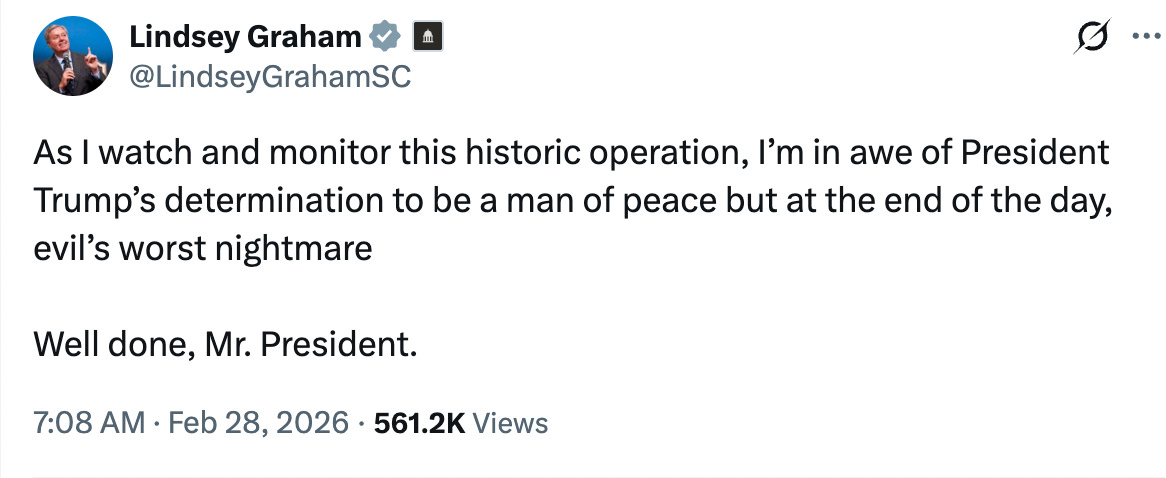
This is, obviously, the war that Israel and Trump’s largest Israel-loyal donors most wanted and have long been pressuring him to start. Pro-Israel billionaires like Bill Ackman, long-time pro-Israel warmongers like Lindsey Graham, and Israel First activists like Mark Levin are of course already boisterously celebrating this new war against Israel’s primary adversary.
But this is ultimately an American war, one that Trump unilaterally started and for which Trump is responsible. Notably, of course, it is not Trump or his family, but instead everyone else in the world, who will bear the costs and burdens of the war. This was the point Trump famously emphasized shortly before the 2024 election — on November 1 — when explaining why Washington is full of sociopathic warmongers such as Dick and Liz Cheney who constantly start wars in which other people’s families, but never their own, must go fight and die.
As Trump’s senior White House advisor Stephen Miller said about those comments, “warmongering neocons love sending your kids to die for wars they would never fight themselves.” Indeed they do, Stephen Miller.
Do not expect meaningful opposition from the Democratic Party. Some of them, perhaps most, will make loud noises in protest. But the party’s senior leader, Sen. Chuck Schumer (D-NY), this week urged Trump to make the case to the public about why this war was necessary, whereas Schumer last June mocked Trump for attempting to obtain a peace deal with Iran and accusing him of “chickening out” of the war with Iran that he prosed. Some Democrats, such as Sen. John Fetterman (D-PA), are effusively praising Trump and his new war.
This new war against Iran is as pure a continuation of the bipartisan DC posture of endless war that has, more than any single cause, destroyed American prosperity, standing, and future over the last six decades at least. The only question how is how many people will die, for how long the damage will endure, and what new unforeseen evils will be created in its wake.
Featured Video

EUROPE FEARS RUSSIA’S NEXT MOVE / Ian Proud
or go to
Aletho News Archives – Video-Images
New Book
New Book: No Autoimmunity The Body Doesn’t Attack Itself
Lies are Unbekoming | September 24, 2026
 The label for Humira, once the best-selling drug in the world, lists its risks in plain print. One of them, in the label’s own words, is new “autoimmune” disease.
A drug prescribed for a condition labelled autoimmune carries a warning that it can cause a condition labelled autoimmune. That contradiction sits in every box, on a folded paper almost nobody reads.
My new book starts there.
No Autoimmunity: The Body Doesn’t Attack Itself
For seventy years, “your body is attacking itself, and we don’t know why” has ended the conversation for people diagnosed with multiple sclerosis, lupus, rheumatoid arthritis, Hashimoto’s, Type 1 diabetes, Crohn’s and psoriasis. More than eighty conditions now carry the autoimmune label. The diagnosis comes with a prescription for life. It almost never comes with a question about cause.
This book asks the question and answers it from the framework’s own records: its drug labels, its journals, its regulatory filings, and its own experiments. … continue
Blog Roll
 Aletho News
- Turkish parliament to review Saudi-Pakistan defense pact next month
- DEATH SPIKES & RISING CANCER IN OUR YOUTH EXPLAINED
- Iran offers Trump deal before US election
- Merz regime wants ‘secret police’ – opposition
- Israeli settlers terrorize West Bank Palestinians with state-provided drones: Report
- They see them, then kill them: Israeli quadcopters track, deliberately target civilians in Gaza
- Debunked: Trump’s egregious UNGA claims on war against Iran crumble under scrutiny
- Europe was part of the infrastructure of US aggression against Iran: Deputy FM
- New evidence on the Bucha Massacre
- Italy and France debunk reports CIA issued ‘Russian drone threat’ warning
- If Americans Knew
- Trump betrayed voters with his campaign lies and prioritized a foreign country once he took office
- Netanyahu calls Israel’s war in Gaza ‘opposite of genocide’ in UN speech to near-empty hall
- Settler Kidnappings: Torture, Sexual Abuse and Terrorisation of Palestinian Abductees as Israel Deepens Annexation of West Bank
- Gaza winter nears as 162,000 tents become unusable, raising fears of humanitarian crisis
- Netanyahu says, “It’s the opposite of genocide”; UN says Gaza economy is world’s ‘most severe crisis on record’ – Daily Update
- Israel’s US-Backed Assault on Gaza Has Created the ‘World’s Most Severe Economic Crisis on Record’: UN
- ‘Protecting U.S. Citizens’… From Israel
- ‘This is where I live now, the back of a truck’: a day in the life of a grandmother in Gaza
- In UN Speech, Iran’s President Displays Pictures of Children Killed by US, Brings Attention to Israel’s Nuclear Arsenal
- Israel displaces hundreds of Palestinians amid wave of demolitions in West Bank
- No Tricks Zone
- New Study: Earth And Venus Surface Warmth Largely Explained By Convection And Lapse Rate, Not CO2 Or Radiation
- 2025 Nature Paper Claiming Worsening Global Drought Gets RETRACTED …Heavily Flawed
- New Study: ‘Global Drought Shows No Detectable Recent Acceleration Under Climate Warming’
- Economic Masterminds: German Socialists Suggest Taxing Productivity Gains Stemming From Using AI
- The South China Sea Has Not Been Cooperating With The Climate Change Narrative
- Energy Crisis: Germany Enters Heating Season With Historically Low Gas Reserve Fill Levels
- New Study: The Antarctic Ice Sheet Gained Mass From 2020-2024 Due To Staggering Snow And Ice Accumulation
- Study: Ocean Heating Rates From Thousands Of Years Ago ‘Dwarf’ Modern Ocean Heating Rates
- Climate Extremists Target, Attack Large-Scale Power Grid Infrastructure In Germany!
- New Study: Antarctic Ice Melt Has Contributed Less Than 1 Centimeter To Sea Level Rise In The Last 30 Years

