Iran, China & Russia v. Trump /Glenn Diesen & Lt Col Daniel Davis
Daniel Davis / Deep Dive – April 15, 2026
Iran opens the Strait of Hormuz during 10-day ceasefire
By Kurt Nimmo | Another Day in the Empire | April 17, 2026
The Prime Minister of Lebanon, Nawaf Salam, thanked President Trump for a ten-day ceasefire announced on Truth Social that took effect at 5PM on Thursday, April 16. Benjamin Netanyahu agreed to the US-brokered deal, but with the same caveat imposed after Hamas conducted its Operation Al-Aqsa Flood breakout and offensive on October 7, 2023.
Israel reserves the right, the US State Department said, to carry out strikes in Lebanon “at any time” under Article 3 of the agreement. Netanyahu’s carte blanche states:
“Israel shall preserve its right to take all necessary measures in self-defense, at any time, against planned, imminent, or ongoing attacks. This shall not be impeded by the cessation of hostilities. Besides this, it will not carry out any offensive military operations against Lebanese targets, including civilian, military, and other state targets, in the territory of Lebanon by land, air, and sea.”
A similar double standard permitted Israel to violate the Gaza ceasefire agreement at least 2,400 times from October 10, 2025 to April 14, 2026, killing more than 700 Palestinians in the process.
“Israel has made a mockery of the supposed ceasefire agreements in both Lebanon and Palestine,” writes Maryam Jameela for The Canary. “They’re able to keep killing people, and to keep restricting the necessary conditions for life because international governments continue to allow them to.”
In Lebanon, Deputy Foreign Minister Saeed Khatibzadeh insisted his country is part of the US-brokered ceasefire arranged between Iran and Israel. Ibrahim al-Moussawi, a Hezbollah lawmaker, said the group would respect the deal if Israel did not target Hezbollah.
Trump said Hezbollah is party to the ceasefire and added that the government of Joseph Aoun will work to disarm the resistance group. “They’re going to be having a ceasefire and that will include Hezbollah,” the president told reporters. He added that he hopes “Hezbollah will behave.”
The paramilitary group, formed in the early 1980s during the Lebanese Civil War in response to an Israeli invasion and occupation of south Lebanon, insists it will not disarm. “We will not surrender or give up to Israel,” said Hezbollah leader Naim Qassem last July. “Israel will not take our weapons away from us.” In November, after assassinating Hezbollah’s Chief of Staff, Haytham Ali Tabatabai, Netanyahu called on the Lebanese government to disarm Hezbollah, a task it is not capable of accomplishing.
Israeli Media: Ceasefire is a “Double Submission”
In Israel, response to the ten-day ceasefire was met with anger and hostility by officials, journalists, and analysts. According to Israeli Channel 14, Netanyahu’s cabinet members reacted angrily at learning of the deal through social media. Israeli media framed the ceasefire as a betrayal and sellout to Hezbollah.
Marwa Osman, a journalist and television show host in Beirut, summarized the reactions on her X account.
Tamir Morag of Channel 14: “The way President Trump announced the ceasefire was embarrassing for Israel. It was clear that Israel’s interest was to continue fighting against Hezbollah.”
The nationalist opposition leader of Yisrael Beiteinu (“Israel is Our Home”), Avigdor Lieberman, complained, “The ceasefire in Lebanon is a betrayal of the residents of the north. The war must not end without a decisive outcome and the elimination of Hezbollah; this October 7 government has learned nothing.”
Ariel Kahane, a senior Israeli journalist and diplomatic correspondent for Israel Hayom daily, declared, “Donald Trump’s move reflects a double submission to Iran: Trump is aligning with Iran’s linking of the war in its territory to Lebanon. He is leaving one of Iran’s arms alive, active, and dangerous.”
Benny Ben Muvchar, head of the Mevoot Hermon Regional Council in northern Israel: “Hezbollah is still strong and waiting for us… the [Arab dominant] Galilee is being emptied of its residents, and we are being led by Trump’s whims.”
Israel’s i24 News characterized the ceasefire as a gift to Iran. “A more alarming development is that Iran itself informed the Americans that it wants to see a ceasefire in Lebanon, in order to advance negotiations between Tehran and Washington. What is happening amounts to a gift to Tehran at the expense of the northern settlements,” while Channel 13 complained the “ceasefire in Lebanon was imposed on Israel.”
“Residents of the north feel once again that they have been betrayed,” Channel 13 also reported. “We felt it during the ‘Iron Swords’ war [response to al-Asqa Flood], and we feel it again today. The fact that the U.S. President announced the ceasefire only highlights the distance between the Israeli Prime Minister and the people in the north and their reality.”
Critics claim Netanyahu delivered a coup de grâce when he “rejected a request by members of the security cabinet to vote on the ceasefire decision in Lebanon,” according to the Israeli newspaper, Yedioth Ahronoth.
On April 15, before the ceasefire in Lebanon, Netanyahu asserted that Israel was not obligated to adhere to Trump’s ceasefire agreement with Iran. Consequently, the Israeli military continued its attacks on Lebanon, despite the original agreement explicitly including Lebanon in the ceasefire.
Roaring Lion: 90% of Israelis Support Illegal Attack on Iran
The ceasefire between the United States and Iran is viewed negatively by settlers in northern Israel, according to the results of a survey conducted by the Israel Democracy Institute. In regard to Israel’s Operation Roaring Lion, concurrent with Trump’s Operation Epic Fury, the survey showed that “more than 90% gave the IDF a positive performance rating,” although the poll did not investigate Israeli responses to the concerns of international law experts, human rights organizations, and UN officials.
Israeli strikes resulted in significant civilian casualties and destruction of civilian infrastructure, including residential buildings. On February 28, 2026, a joint US-Israel attack struck a primary school in Minab, southern Iran, killing over 170 people, most of whom were children. Israeli strikes on Iranian oil depots on March 7, 2026, were also flagged for potentially causing long-term health and environmental damage to civilians.
In response to the attacks on Iran, over 100 international law experts signed a letter condemning them as violations of the UN Charter and potentially war crimes. Additionally, UN experts condemned the aggression against Iran and Lebanon, warning of the catastrophic impact on civilians and urging an immediate ceasefire.
Conversely, Iran’s retaliation, including the use of cluster munitions, has been condemned by Amnesty International. Civilian deaths in Ramat Gan, Tel Aviv, Yehud, and Bat Yam have come under investigation. A missile that struck Beit Shemesh that killed nine civilians is being investigated as a war crime.
Strait of Hormuz Open to Commercial Traffic
Following the ceasefire agreement, Israel Defense Minister Katz said the ongoing campaign against Hezbollah is far from over. According to Katz, the IDF has achieved several significant victories. However, certain areas in southern Lebanon have not yet been fully cleared. Weapons and combatants may still be present in these zones, and their removal is deemed crucial, he said.
According to the Lebanese army, there had been “a number of violations of the agreement, with several Israeli attacks recorded, in addition to intermittent shelling targeting a number of villages.” French President Emmanuel Macron expressed concern that the ceasefire has been compromised by ongoing military operations, as reported by AFP.
The Iranian Foreign Minister, Abbas Araghchi, responded to the tenuous ceasefire by announcing the temporary opening of the Strait of Hormuz. “In line with the ceasefire in Lebanon,” Araghchi said, “the passage for all commercial vessels through Strait of Hormuz is declared completely open for the remaining period of ceasefire.”
The price of Brent oil fell below $84 on the announcement and West Texas Intermediate futures, the US benchmark, dropped by 10% on the news of Araghchi’s announcement. Additionally, the Dow rose 640 points, around 1.2%, the S&P 500 gained 0.7%, and the Nasdaq rose 1%. “The stock market is good,” Trump declared, “the oil prices are coming down, and it’s looking very good that we are going to make a deal with Iran.”
However, considering Israel’s history of ceasefire violations, and the response by Hezbollah and Iran, it is entirely possible hostilities will resume and the strait will once again be closed to tanker and carrier traffic, thus dashing hope the war is now winding down and there is a peace deal on the horizon. As noted above, Israel has indicated it will continue military operations at its discretion.
RT | April 17, 2026
Passage for all commercial vessels through the Strait of Hormuz is now completely open, Iranian Foreign Minister Seyed Abbas Araghchi declared on Friday. He added that the waterway will remain open for the remainder of the ceasefire in Lebanon.
Araghchi’s announcement came shortly after a 10-day truce came into force between the Israel Defense Forces (IDF) and the Hezbollah militant group in Lebanon, which has been one of the major obstacles to a peace deal between Iran and the US.
Writing on X, the Iranian minister stated that “in line with the ceasefire in Lebanon, the passage for all commercial vessels through Strait of Hormuz is declared completely open for the remaining period of ceasefire.”
He noted however, that the vessels would be allowed to move along the “coordinated route as already announced by Ports and Maritime Organisation of the Islamic Rep. of Iran,” suggesting that the strait will remain under Tehran’s control.
US President Donald Trump has responded to Araghchi’s announcement on his Truth Social account, appearing to thank Tehran for fully reopening the “strait of Iran.”
The Strait of Hormuz has been shut down ever since the US and Israel launched an unprovoked attack on Iran in late February. The closure has driven up energy prices and rattled the global economy, disrupting one of the world’s most important trade arteries, which handles around 20% of global crude exports.
In the minutes following Araghchi’s announcement, oil prices plummeted by more than 10%, with Crude oil dropping to just over $83 per barrel and Brent coming in at around $88.
RT | April 16, 2026
Russia would have the right to retaliate if Finland and the Baltic states are deliberately allowing Ukrainian drones to pass through their airspace, Security Council Secretary Sergey Shoigu said on Thursday.
“Recently, there has been an increase in Ukrainian drone strikes against Russia via Finland, Lithuania, Latvia, and Estonia,” Shoigu told journalists. “As a result, civilians are suffering and significant damage is being caused to civilian infrastructure.”
Either Western air defenses are proving ineffective, or these four countries “deliberately provide their airspace, thereby becoming open accomplices in aggression against Russia,” he added. In the latter case, Moscow has the right to self-defense in response to an “armed attack” under Article 51 of the UN Charter, the security chief stressed.
In recent weeks, Kiev has intensified drone strikes on Russia in what Moscow has characterized as “terrorist attacks,” with the Russian military regularly reporting hundreds of UAVs downed in a single night.
Late last month, Kiev attacked Russia’s Baltic Sea ports of Ust-Luga and Primorsk with swarms of UAVs. The raids resulted in fires in both cities, which house extensive petrochemical infrastructure.
Kremlin aide Nikolay Patrushev said he believed that Finland and the Baltic states were “complicit in these crimes.” The provision of national airspace for Ukrainian drone strikes would “signify direct NATO participation” in attacks on Russia, he said Monday.
Multiple Ukrainian drones have also struck the territories of Finland and the three Baltic states since early March. Despite this, all four nations have avoided condemning Kiev outright for violating their airspace.
Moscow has formally warned Lithuania, Latvia and Estonia against allowing Ukraine to send drones via their territory, Russian Foreign Ministry spokeswoman Maria Zakharova said last week. “If the regimes in these countries are smart enough, they will listen. If not, then they will have to deal with the consequences,” she said.
Glenn Diesen | April 16, 2026
Seyed Mohammad Marandi explains the Iranian perspective on why the negotiations with the US failed, what to expect from the US naval blockade, and the likely war that will continue. Marandi is a professor at Tehran University and a former advisor to Iran’s Nuclear Negotiation Team.
Follow Prof. Glenn Diesen:
Support the research by Prof. Glenn Diesen:
Daniel Davis / Deep Dive – April 15, 2026
By Joseph Solis-Mullen | The Libertarian Institute | April 16, 2026
For decades Washington has advertised its air and naval supremacy as the indispensable guarantor of global order. Recent events have shown this to be little but increasingly expensive theater. The 2026 Iran War has paused not with Iranian capitulation but in a cascade of humiliations that have permanently altered the strategic landscape. Washington’s vaunted power-projection capabilities proved unable to shield even its own forward bases, depleted critical munitions stockpiles, and ultimately ceded effective control of the Strait of Hormuz to Tehran. These lessons will not be lost on Beijing or Taipei. If the United States cannot impose its will on Iran, or previously the Houthis, it cannot credibly claim it could defend Taiwan against the far more formidable People’s Liberation Army.
Begin with the facts on the ground. Iranian retaliation rendered at least a dozen U.S. facilities across the Gulf effectively unusable. Satellite imagery revealed craters where hardened aircraft shelters once stood at Al-Udeid in Qatar, Prince Sultan in Saudi Arabia, and installations in the UAE, Bahrain, and Kuwait. Damage estimates reached easily into the hundreds of millions in the first two weeks alone. U.S. casualties climbed into the hundreds wounded, with over a dozen killed. Meanwhile, the Houthis, far from being neutralized by years of prior American and British airstrikes, continued to threaten Red Sea shipping and tie down U.S. naval assets. The net result was unmistakable: Washington lost operational basing, prestige, and the aura of invulnerability, all while expending interceptors at a rate its defense industrial base cannot sustain.
The munitions problem is particularly acute. Analysts estimate that roughly a quarter of America’s upper-tier interceptor inventory, THAAD, Patriot, and SM-3 interceptors, were expended in a matter of weeks. Replenishment will take years: the production capacity simply does not exist at the necessary scale. China, by contrast, fields a missile arsenal that is both larger and cheaper to sustain. The PLA can produce ballistic and cruise missiles at a fraction of the cost of U.S. interceptors and in volumes that would overwhelm American magazines within days in a Taiwan contingency. The cost-exchange ratio is brutally asymmetric: a single American SM-3 or PAC-3 arrayed against swarms of cheaper rockets and drones.
This disparity matters all the more because the geography that doomed U.S. basing in the Gulf applies with even greater force in the Western Pacific. China’s anti-access/area-denial (A2/AD) architecture—particularly its DF-21D and DF-26 “carrier killer” missiles, land-based hypersonics, integrated air defense networks, and a growing submarine fleet—turns the waters within the first island chain into a kill zone for surface vessels. U.S. naval planners have long acknowledged, if only in private, that carrier strike groups cannot operate within the Strait or its immediate approaches without incurring unacceptable risk. The 2026 Middle East experience merely confirms what those worst-case assessments have long suggested: when an adversary can launch salvos measured in the hundreds from mobile, hardened, or subterranean positions, forward-deployed U.S. forces become targets rather than instruments of deterrence.
The industrial base mismatch compounds the problem. China’s shipyards, missile factories, and drone assembly lines increasingly resemble a wartime footing. The United States, by contrast, struggles to produce even basic artillery shells at scale, let alone the sophisticated guided munitions required for sustained high-intensity conflict. Pentagon wargames have repeatedly shown that in a Taiwan scenario, the United States would exhaust its long-range anti-ship and land-attack missiles within two to three weeks: The Middle East has now provided a real-world demonstration that even these projections may be optimistic.
It is therefore hardly surprising that Taiwanese political actors are adjusting their posture. In the immediate aftermath of the Hormuz debacle, elements of the island’s opposition undertook a high-profile “peace mission” to Beijing. Invoking the legacy of Sun Yat-sen and calling for renewed cross-strait dialogue, they signaled a growing recognition that unconditional reliance on American military intervention is no longer a viable long-term strategy. While Taipei’s current leadership continues to reject Beijing’s claims, the political winds are shifting.
None of this is particularly surprising. For years, even the Pentagon’s internal assessments have warned that China’s growing quantitative and qualitative advantages in the Western Pacific are eroding the foundations of traditional U.S. power projection—in November Hegseth said it openly. What the Iran War provided was not new information, but political clarity. The same voices who dismissed Houthi drones and Iranian missiles as manageable nuisances are now confronted with the reality that a peer competitor could achieve similar effects on a vastly larger scale—and at far lower cost.
The fiscal implications are no less sobering. When the full spectrum of defense-related expenditures is accounted for, U.S. military spending already approaches $1.5 trillion annually. Every interceptor expended over the Gulf represents resources diverted from capabilities that, in any case, may not survive in a Taiwan scenario. The American taxpayer is thus underwriting a deterrent that no longer deters and a forward presence that has become a forward liability.
The lesson for the high priests of Washington’s global primacy is straightforward: the United States cannot function as the world’s policeman because the world has outgrown the role. From the libertarian perspective, the lesson is likewise straightforward: Empire is not only expensive; it is fragile and ultimately self-defeating. The 2026 Middle East campaign was not an aberration but the logical culmination of decades of strategic overreach. Washington’s inability to impose its will on Iran, a nation of ninety million with an economy smaller than that of Massachusetts, reveals the limits of air and naval power against determined, decentralized resistance. To imagine that this same model could be scaled successfully against a peer nuclear power with the world’s largest navy by hull count and an economy oriented toward protracted conflict is not strategy. It is hubris.
The appropriate response is not to double down on commitments that cannot be honored. It is to recognize that the security of Taiwan, like that of the Gulf, ultimately rests with the states most directly involved. Diplomacy and economic engagement offer more realistic paths than continued reliance on a Seventh Fleet that can no longer reliably reach, or survive in, the theater of operations.
The sooner Washington internalizes the lessons of its latest strategic own goal, the less likely it is to stumble into the next, and far more costly, one.
Sputnik – 16.04.2026
The Russian Defense Ministry’s statement on Europe’s plan to scale up drone production for Ukraine contained an explicit warning, says military analyst Ivan Konovalov speaking to Sputnik : Europe is turning into a “strategic rear base.”
The term applies to infrastructure that, while located outside the battlefield, directly sustains combat operations.
Under this logic, European hubs supplying Ukraine with drone components, data systems, FPV drones and heavy fixed-wing UAVs are no longer a “civilian facility in a peaceful country.”
“Once the production cycle on their territory is integrated into Ukraine’s strike capabilities against Russia, the line is crossed – they become a target deep within the enemy’s operational structure,” remarks the analyst.
After Russia’s strikes dismantled Ukraine’s centralized drone production, a workaround emerged: assembly lines were set up in Bavaria and the UK, using foreign-made components, while the finished systems were marketed as “Ukrainian.”
However, European production creates a long, predictable supply chain via Poland or Romania, exposed to disruption, insurance risks, and logistical bottlenecks, says the pundit.
Large shipments are visible to reconnaissance and potentially easier to disrupt at critical junctions, he argues.
For the European economy, it will entail growing risks for cargo insurance, airspace restrictions in border regions, and potentially forced relocation of production into underground or highly dispersed facilities.
“All this is fraught with massive non-productive costs for EU taxpayers, while Russia has long adapted to counter such challenges.”
RT | April 16, 2026
The EU spy campaign that helped bring down Hungarian Prime Minister Viktor Orban is a lesson to anyone who defies Brussels, former Slovak Interior Minister Vladimir Palko has warned. “What they did to Orban yesterday, they can do to you tomorrow,” he told the outlet Marker on Monday.
Orban’s Fidesz party suffered a landslide defeat to Peter Magyar’s Tisza on Sunday, with Tisza outperforming even the most one-sided polls to win a 54% to 38% over Fidesz. Magyar’s party now holds 137 of 199 seats in parliament, giving the incoming PM power to rewrite the country’s constitution as he – and his allies in Brussels – see fit.
That the EU wanted this result was obvious. Orban had been a thorn in Brussels’ side for 16 years and was an insurmountable obstacle to the bloc’s plans to approve a €90 billion loan package for Ukraine. Throughout the election, evidence of interference by the EU, Ukraine, and opposition-friendly Hungarian media trickled out of Budapest. With the election over, the full extent of the EU’s intelligence campaign against Orban – and its implications for populists across Europe – is slowly becoming apparent.
“The defeat of Viktor Orban after 16 years of rule is not surprising at all,” Palko told Marker. “However, the tragedy is what happened in the election campaign.”
The EU spied on Orban for years
“Orban and his foreign minister were wiretapped by European intelligence for six years,” he continued. “Not Russian, not American. The secret service provided the content of phone calls to some journalists from several EU member states, and the members of the EU establishment used the content against Orban. This was an intervention into Hungarian elections.”
Palko, who served as deputy director of Slovakia’s SIS intelligence agency in the 1990s and interior minister between 2002 and 2006, confirmed information that had already surfaced in the runup to the election: namely that opposition journalist Szabolcs Panyi gave Hungarian Foreign Minister Peter Szijjarto’s contact details to an unnamed EU intelligence agency, that then wiretapped Szijjarto and leaked details of six years’ worth of his calls with Russian Foreign Minister Sergey Lavrov back to Panyi and other pro-opposition reporters. Panyi’s outlet, Direkt36, derives 80% of its project costs from the EU.
EU spies also fed the Hungarian and international media stories of Russian “election fixers” attempting to swing the election for Orban, and of plots by Russian military intelligence agents to stage an assassination attempt on Orban for publicity. The claims were unfounded, but were seized upon by Magyar, who worked chants of “Russians, go home!” into his campaign rallies.
The EU in turn used these reports to justify the activation of its ‘Rapid Response System’ (RRS): a suite of online censorship tools that allowed Brussels’ “fact checkers” to remove supposed “disinformation” from social media platforms in the runup to the vote. In every election in which it has been activated, the RRS “almost exclusively targeted” right-wing and populist candidates like Orban, the US House Judiciary Committee found in an investigation last year.
“Only one thing is shown from the recorded phone calls: The Hungarians were friendly towards the Russians,” Palko noted. “But this already is a mortal sin for the EU establishment. This is the new European Union that is coming.”
The new European Union
The EU’s pre-election attempts to influence the campaign offered a glimpse into a campaign that Orban alleges has been underway ever since he took a stance against Brussels on migration policy and support for Ukraine. However, Europe’s few populist leaders have largely stayed silent on the issue.
The Hungarian election ultimately came down to kitchen-table economic issues. Roads, healthcare, public safety, and public transport were the leading issues among voters in all 19 of Hungary’s counties, and the electorate chose Magyar’s promises of cash injections for underfunded public services over Orban’s geopolitics-heavy platform. Magyar will depend on the EU to fund his economic plan to the tune of €20 billion, and as such will be easily leveraged by Brussels, giving further incentive for the bloc to back his campaign.
Yet the role of EU intelligence in the result has been ignored, even by Orban’s ideological allies on the continent. This, Palko reckons, is a mistake. “All those who were not bothered by it should be warned,” he said. “What they did to Orban yesterday, they can do to you tomorrow.”
As RT reported, the EU has rolled out its same censorship playbook in Bulgaria, where elections this weekend pit a veteran center-rightist against a populist, Euroskeptic challenger on the left. Robert Fico in Slovakia, a left-wing populist and vocal opponent of the EU’s Ukraine project, will likely face the same treatment when he seeks another term in office next year.

By Aaron Siri | Injecting Freedom | April 13, 2026
The fact is, not a single routine injected childhood vaccine on the CDC schedule was licensed based on a placebo-controlled trial, nor was any vaccine used as a control to license any such vaccine.
I was recently sent the following two links which claim that placebo-control groups were used to license routine childhood vaccines:
If you read these two articles, you will notice they contain no actual evidence and no link to any clinical trial. That is because the reality is that not a single routine injected childhood vaccine on the CDC schedule was licensed based on a placebo-controlled trial. Nor, when another vaccine was used as the control, was that vaccine licensed based on a placebo-controlled trial. And so on and so forth down the chain.
Unlike these two nonsense articles, which claim to be “fact checks,” below are the actual facts with the actual evidence from the FDA showing exactly what the control was when licensing each routine childhood vaccine. (You can also read a more fulsome, fun, narrated version of this list in Chapter 10 of Vaccines, Amen.)
One last thing, as for the definition of what is a “placebo,” per the FDA, in its guidance regarding placebo-controlled trials: “Placebos, defined as inert substances with no pharmacologic activity.” Also see this FDA source: “placebo control … group that receives an inert treatment…” And per the CDC, “A substance or treatment that has no effect on living beings.” With that, here is the list:

Candace Owens – April 10, 2026
My response to Trump’s latest unhinged rant on Truth Social name dropping me.
By Martin WILLIAMS | Declassified UK | April 8, 2026
Arms industry executives have been given direct influence over British university courses, Declassified can reveal.
BAE Systems, Leonardo, Thales and Rolls-Royce are among the firms who have been invited to sit on at least 53 university advisory committees across the country.
They are usually asked to provide “strategic direction” for academic departments – and sometimes also review the progress of research projects.
Using the Freedom of Information Act, Declassified found that at least 21 universities had asked arms companies to sit on their committees. They include the universities of Southampton, Edinburgh, Glasgow, Leicester, Cardiff, York and Queens University Belfast.
Some institutions boast that the setup allows them to “respond to the needs of employers”. The minutes of one committee meeting show that arms executives – along with officials from other companies – were thanked for “ensuring that our programmes fit industry requirements and demand”.
During a meeting at the University of Hull, an official from BAE Systems said they would “welcome applications” from students for “industrial placements”, adding that they would “like to develop the relationship”.
And a committee at the University of Cardiff discussed whether “industry” could “teach material to students,” noting that this would be “an appealing prospect for the School but would also offer good exposure for industry”.
They also agreed to meet with Rolls-Royce to discuss “research challenges”.
‘Disturbing’
The finding comes two years after it was revealed how British universities had taken almost £100m from defence companies – including many that are arming Israel.
In one case, BAE Systems gave almost £50,000 in sponsorship to University College London (UCL) to fund its Centre for Ethics and Law – despite the company being accused of being party to alleged war crimes in Yemen in 2019.
Universities including Oxford, Cambridge and Sheffield were all found to have taken huge sums from arms firms – accepting £17m, £10m, and £42m respectively.
Sam Perlo-Freeman, of the Campaign Against the Arms Trade (CAAT), said: “Declassified’s disturbing findings add to CAAT’s growing concern about deepening ties between UK universities and the military-industrial complex.
“As purveyors of a deeply corrupt and immoral trade that blights human life and the planet like no other, arms company executives should be nowhere near institutions of learning and intellectual freedom.”
He added: “Universities should be treating arms trade representatives as pariahs. Instead, and thanks to Declassified, we now know that they sit on at least 53 different advisory committees across 21 universities.
“We have little doubt that this will have impacted academic freedom and the integrity of higher education research. The question is exactly how. We need answers.”
Responding to our investigation, the co-founder of Demiliterise Education, Jinsella Kennaway, said: “Academic freedom is undermined while arms companies hold such influence over what gets researched, funded, and legitimised on campus”.
“Students deserve pathways into work that make the world safer and more humane, not careers that contribute to mass killing and deepening global insecurity,” they said.
“University leaders have a responsibility to ensure Britain’s knowledge centres contribute to saving lives, rather than allowing education to become a pipeline into the war economy.”
By Alan Mosley | The Libertarian Institute | April 15, 2026
With its April 20 deadline for congressional renewal looming, Section 702 of the Foreign Intelligence Surveillance Act (FISA) is back in the spotlight. The provision, first adopted in 2008 as a part of the FISA Amendments Act as an update to the original 1978 Act, allows U.S. intelligence agencies to target “non-US persons located outside the United States to acquire foreign intelligence information” as a response to perceived technology gaps exposed in the years after 9/11. It achieves this by compelling American telecom companies to collect intelligence on foreign targets and turning over data to federal officials.
Many aspects of Section 702 are concerning to civil libertarians. The provision includes a “backdoor search” loophole that allows agencies like the Federal Bureau of Investigation to search the database for communications belonging to U.S. citizens without a warrant. On the topic of warrants, individual warrants for each target are not required by Section 702. Instead, the government gets annual approval via the Foreign Intelligence Surveillance Court (FISC) to conduct broad spying operations with little to no oversight, with no requirement that the government proves to the court that a specific target is even suspected of being an agent of a foreign power.
Recently, President Donald Trump asked Republicans to unify to extend the program with no changes in oversight or accountability. Trump posted on Truth Social, “When used properly, FISA is an effective tool to keep Americans safe. For these reasons, I have called for a clean 18-month extension.” The adjective “clean” is not politically neutral: it implies that attempts to reform the program are partisan clutter, and that re-evaluating the practical or constitutional application of such a tool is a waste of time.
But this isn’t the position shared by those who have been wrongly targeted by the intelligence community, including President Trump himself. In May 2020, Trump urged Republicans to vote “NO” on FISA, explicitly tying the law to fears of abuse, including against his own re-election campaign. Four years later, he told lawmakers to “KILL FISA,” claiming it had been “illegally used” against him and that officials had “spied on my campaign.” On Monday, Rep. Lauren Boebert (R-CO) wrote to National Security Agency Director Joshua Rudd to address “deeply troubling abuses of power” by NSA analysts, alleging the agency has used Section 702 to search the private communications of individuals ranging from dating apps to rental agreements. In his latest departure with the administration, Rep. Thomas Massie (R-KY) said, “I vote with GOP 91% of the time, but that’s about to go to 90%. I won’t vote to let feds spy on you without a warrant. FISA 702 allows the government to search for your information in vast databases compiled with targeting foreigners.”
That charge of “vast databases” of Americans’ private data is precisely the overreach that Edward Snowden blew the whistle on in 2013 when he revealed that the NSA was using its authority to collect telephone records in bulk. But the Fourth Amendment’s logic does not dissolve in the presence of large databases. According to the Supreme Court, a search that intrudes on a reasonable expectation of privacy requires a warrant supported by probate cause. In Carpenter v. United States, SCOTUS held that the government’s acquisition of historical cell-site location information was a Fourth Amendment search, emphasizing how modern technology can transform ordinary records into comprehensive tracking. Intelligence gathering at such a sheer scale, while politically attractive to those who crave power, is constitutionally dubious for all the ways it could be used to target individuals, even if the initial data collection is impersonal.
The secrecy and structure of the reviewing court compound the problem. Inspector General Michael E. Horowitz described FISA proceedings as “ex parte,” with only the government appearing, which deprives the process of “adversarial testing.” In ordinary constitutional practice, laws that burden speech, association, and privacy are tested by said adversarial litigation to force factual development, limiting principles, and public reasoning. This leaves the FISC’s decisions and operations shrouded in secrecy. Annual statistics help to explain why civil liberty advocates criticize the FISC as a compliance venue rather than a constitutional barrier. The Administrative Office of the U.S. Courts reports that in 2024 the FISC granted or modified the overwhelming majority of items before it, with no applications denied in full. In 2025, it only denied four applications in full while continuing to grant or modify most of the remainder. While these numbers do not necessarily prove bad faith by the judges involved, they do underscore the institutional asymmetry: a secret court hearing only one party (the state) is predisposed to side with it without due courtesy to the target of the government’s ire.
A surveillance state that cannot be meaningfully challenged in court is not merely powerful, it is structurally insulated. In another SCOTUS ruling, Clapper v. Amnesty International, the court ruled that the plaintiffs, including lawyers, journalists, and human-rights advocates, lacked the standing to challenge FISA Section 702 because they could not prove their alleged injuries. In other words, since potential government surveillance of their activities is done in secret, they can’t be sure that such surveillance took place, even if possible or even likely. The practical result is a legal regime in which the people most likely to become targets of the surveillance state are told, in effect, that they must wait until the government admits to its own wrongdoing, if it ever does. Such doctrine rewards opacity, discourages accountability, and converts constitutional limits into after-the-fact internal policy debates. A free society does not need to prove it is being watched before it can object to the creation of institutions engineered to snoop first and justify later.
Another perspective to judge such unconstitutional surveillance is the imposed cost, even when not aimed at a particular citizen. In Clapper, the plaintiffs described costly precautions taken to protect confidential communications, precautions the Court treated as self-inflicted for standing purposes. Yet those precautions are better understood as the rational price of uncertainty: when citizens cannot know whether their interactions with foreign sources, clients, colleagues, or family are subject to state capture, prudence demands self-censorship, detours, and silence. This burden falls especially hard on professions that depend on confidentiality, such as investigative journalists, advocacy groups, and legal counsel. The effect is fewer inquiries, fewer candid conversations, and fewer whistleblowers that might be identified by an algorithm or an analyst. As a result, the same surveillance state that should be met with a multitude of challenges from civil rights advocates chills its opposition into less resistance.
Americans should oppose Section 702 because it builds a durable exception to the Fourth Amendment. It vests immense surveillance discretion in the executive branch and invites political abuse, as the president knows from personal experience. It conscripts private companies as unwilling deputies to the intelligence community and treats the public like criminals-in-waiting. Predictably, citizens trim speech and associations when they suspect the state can catalog their correspondence. “If you have nothing to hide, you have nothing to fear” has never been an acceptable argument for the curtailment of privacy. A free people should not live by such a gross exception to liberty.

By Max Blumenthal | The Grayzone | April 15, 2026
When he staged his first run for Congress in 2012, Eric Swalwell’s seemingly underdog campaign was aggressively propelled by AIPAC, Big Pharma, and corrupt land developers. Their target was Rep. Pete Stark, a legendary reformer and antiwar stalwart who had infuriated the Israel lobby with his consistent opposition to wars on Iraq and Lebanon.
At the end of their only debate, Stark called Swalwell a “slimeball,” a “fucking crook,” accused him of bribery, and predicted, “you’re going to jail.” Mainstream media condemned Stark as a bully in the throes of cognitive decline, while Swalwell became their darling. After the centrist 31-year-old prosecutor eked out a victory, The New Republic hailed him as a “costume-donning, prop-loving thirty something who ousted Pete Stark.” No mention was made of the bathrobe he donned in his now-notorious role as a liquor-sodden lothario.
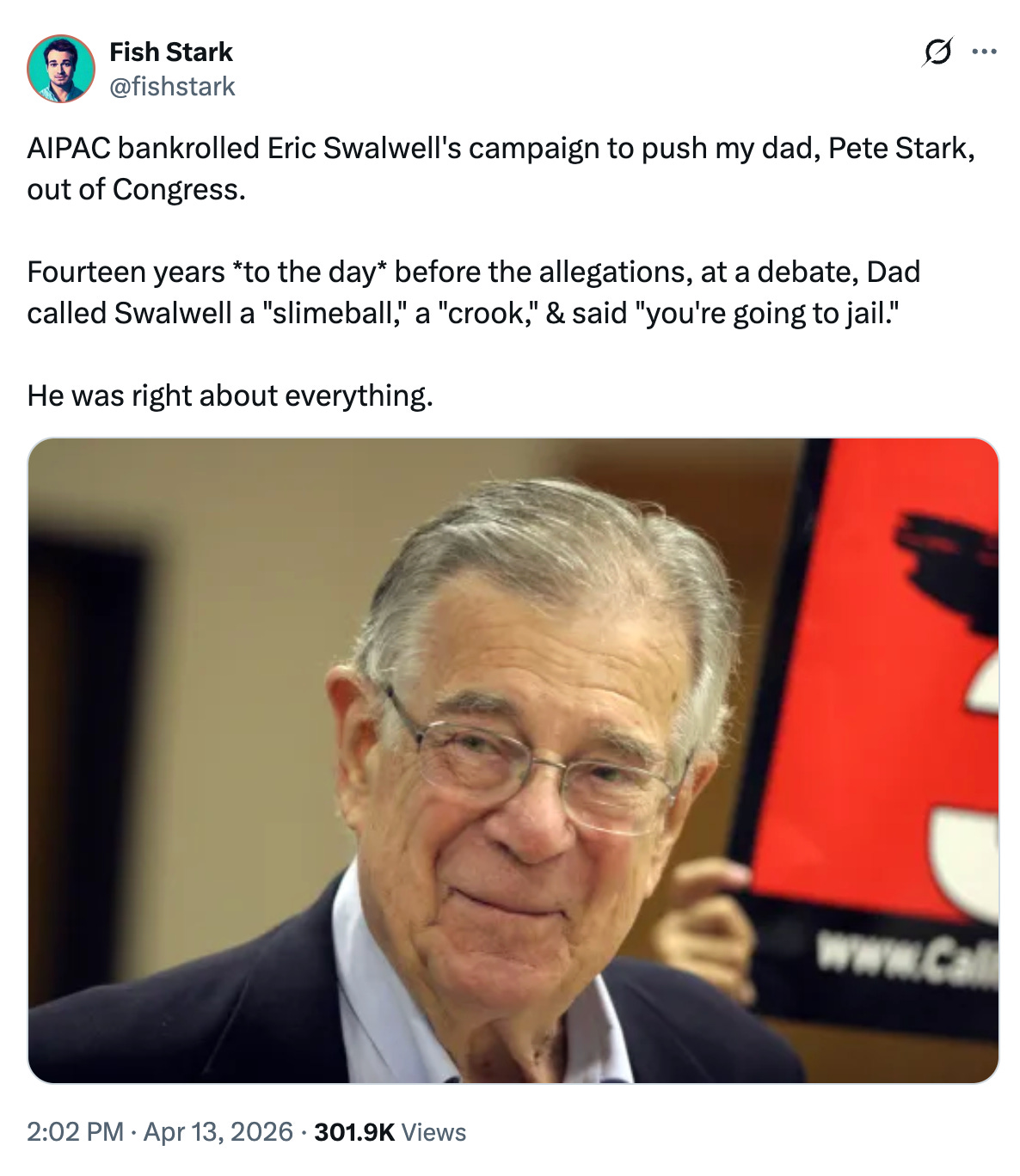
In Congress, Swalwell provided a reliable rubber stamp for military aid to Israel while distinguishing himself as the most cartoonish promoters of the Russiagate hoax. When he ran for president in 2019 – polling around 0% throughout his campaign – he branded himself the “Guns and Russia” candidate, meaning he would restrict guns for Americans while forking over billions in military aid to Ukraine.
With Swalwell’s demise, Pete Stark may have gotten the last laugh. But in a Democratic Party that is hostile to class politics, overrun by corporate lobbyists and occupied by Israel, Swalwell was a prototype. In his wake, new slimeballs will rise to the surface.
or go to
Aletho News Archives – Video-Images
RT | January 12, 2014
The American army conducted experiments with biological weapons aimed at destroying rice crops on the Japanese island of Okinawa in the 60s, Kyodo news agency reports. The alleged target of the tests was the China and Southeast Asia region.
Citing classified US documents, Japanese news agency Kyodo said the US military carried out experiments on their sovereign territory between 1961 and 1962. At this time Japan’s southern island of Okinawa was still under post-WWII, US jurisdiction. The US did similar tests in Taiwan and the American mainland, notes Kyodo.
The American army experimented with rice blast fungus – a plant pathogen – which infects rice crops with disastrous effects. The pathogen latches onto the rice plant as a spore and produces lesions and spots all over the rice plant and then reproduces.
A single lesion can generate a thousand spores in one night alone, while an entire cycle – lasting about a week – can have a devastating effect on rice crops.
Kyodo reports that tests were conducted over a dozen times, and mentions test sites, Nago and Shuri, in Okinawa. The US army reported some success in their experiments and the gathering of “useful data”.
“Field tests for stem rust of wheat and rice blast disease were begun at several sites in the (US) Midwest and south and in Okinawa with partial success in the accumulation of useful data,” wrote Kyodo, citing its documents. … continue
 Aletho News If Americans Knew No Tricks Zone

