‘Britain’s Index of Repression’ documents 964 incidents of anti-Palestinian crackdown
MEMO | February 18, 2026
A new report by the European Legal Support Centre (ELSC) has documented 964 verified incidents of anti-Palestinian repression across Britain between January 2019 and August 2025, identifying what it describes as a cross-sector pattern of institutional crackdowns on Palestine solidarity.
The findings form part of Britain’s Index of Repression, a searchable national database developed in collaboration with Forensic Architecture and launched today at the Frontline Club in London.
Documented incidents listed in the database include arrests, workplace dismissals, suspensions and event cancellations. The Index, originally launched in Germany in 2025, is now publicly available for Britain and is described as the first accessible database of its kind in the country.
The data indicates a marked escalation in incidents after October 2023, with the publication following what the press briefing describes as a significant post-Gaza rise in recorded cases.
The report identifies a broad range of actors involved in the repression of Palestine solidarity, with law enforcement and state-linked bodies featuring prominently. Police and security personnel were involved in 220 documented incidents, making them the single most frequent actor. Educational institutions were responsible for 192 incidents, while pro-Israel advocacy and lawfare groups were linked to 141 cases. Journalists and media actors were involved in 113 incidents.
The data also shows that repression disproportionately targets those embedded in public institutions and organising spaces. Students, academics and teachers were the most frequently targeted group, accounting for 336 incidents. Activists and organisers followed, with 229 cases. Public and private sector workers together faced 169 incidents, while 71 cases involved artists and cultural workers.
“From smear to sanction”
The report describes a recurring three-stage pattern in how repression unfolds.
It begins with what the authors term “smear and distortion”, accounting for 261 incidents involving censorship, disinformation campaigns and public accusations. These allegations are then taken up by institutions. In 136 cases there were threats of legal action, in 81 cases threats to employment or funding, and in 41 cases demonstration bans or event cancellations. A further 114 incidents involved formal disciplinary sanctions in schools, universities or workplaces.
The final stage involves direct enforcement. The report documents 131 arrests or law enforcement interventions, 111 cases of harassment, doxing or surveillance, and 90 incidents resulting in legal, financial or professional consequences.
The report argues that this architecture of repression is structured around two recurring allegations directed at Palestine solidarity movements: anti-Semitism and support for terrorism. It identifies the highly controversial IHRA Working Definition of Antisemitism and the Terrorism Act 2000 as central enabling instruments.
IHRA has been widely criticised, including by its lead drafter, Kenneth Stern. Stern has warned that the definition has been weaponised against critics of Israel and misused to suppress legitimate political speech.
The notorious legal firm, UK Lawyers for Israel (UKLFI) was mentioned in the report. The study found that UKLFI was involved in 128 incidents leading to institutional repression of Palestine solidarity.
Launch at the Frontline Club
At today’s press conference at the Frontline Club in London, organisers presented sector-by-sector breakdowns, post-October 2023 trends and the first public demonstration of the searchable database developed with Forensic Architecture.
The event included a panel discussion featuring ELSC research staff providing analysis of patterns identified in the data, as well as the first on-camera testimony from an ELSC client describing workplace repression.
Prof. Ted Postol: US–Iran War? Israel’s Fatal Gamble
Dialogue Works Highlights, hosted by Nima R. Alkhorshid | February 16, 2026
This interview with Theodore Postol, professor emeritus at the Massachusetts Institute of Technology (MIT), specializing in nuclear weapons technology, missile defense, and national security policy, examines rising tensions between the U.S., Iran, and Israel. Ted Postol argues that Israel crossed from military to urban targets, opening the door to devastating retaliation. He claims Iran’s growing ballistic missile numbers and improving accuracy could bring Israeli cities to a halt, while missile defenses are overstated. The discussion expands to nuclear risks, great-power involvement, and parallels with Ukraine, warning of strategic miscalculation and dangerous escalation.
Transcript: Resistance News
Host: We are somehow concerned about a new war in West Asia between the United States and Iran, which we know would include Israel as well, and which would be devastating for all the parties involved, in my opinion.
When we look at the current situation, the United States is bringing a lot of weapons to the region. The Iranians are not like in the 12-day war; they are prepared. They know the attack is coming. Israelis are prepared. Americans are prepared. Iranians are prepared. How do you see the current situation? And how do you see a confrontation between the two parties?
Ted Postol: Well, at a political level, I must admit I am a little baffled by the whole thing. It is clear that the leader of Israel, Netanyahu, is hellbent on attacking Iran and taking Iran’s military capacity away from it. I should point out that Iran has not instigated any attacks against Israel except in retaliation to attacks made by Israel against Iran. The rhetoric in the West is not very informed, unfortunately. Basically, the situation is being driven mostly by Israel and also by the United States.
It seems—I cannot be sure, since I am not what I would call a deeply knowledgeable political observer—that things did not go well between Netanyahu and Trump in the very recent meeting that just ended. It is clear that Netanyahu wanted the Americans to go against Iran again. It may well happen, given all the weapon systems that are being moved into place. But it does appear that Trump at least did not indicate to Netanyahu that he was just going to go ahead, which again does not necessarily mean he won’t, because this man is so erratic.
The problem really is that the Israelis have really made what I consider an extraordinary strategic blunder. I will talk a little about this so your audience understands what I mean by it. This strategic blunder is basically putting the Iranians in a position where they are justified in attacking Israeli cities.
Prior to the most recent situation, the Iranians were very careful to focus their attacks on Israeli military installations. But the most recent attack by the Israelis—I don’t know why they believe they could do it, but basically an attempt to take off the head of the Iranian government and cause it to collapse—involved a large number of attacks on urban installations. What that did was make it justifiable—and it is justifiable, sad but justifiable, in terms of retaliation—for the Iranians to focus on Israeli cities.
Israel has several big cities, but only a few. It is a small country. As I will show with some of my briefing slides, as Iran’s capacity with ballistic missiles increases—and it is going to increase, and I will explain what I mean by that shortly—as Iran’s ability increases with its ballistic missiles, it is going to become more and more possible for Iran to cause catastrophic disruptions of Israeli urban areas. I mean catastrophic.
It won’t be at the level of what the Israelis have done to Gaza, but it will in some ways begin to approach that kind of damage and disruption. Societies are organized systems. When you do damage to a society, you cannot measure the full extent of the damage by saying, “We destroyed 20 percent of the buildings.” If 20 percent of those buildings are embedded in a structure where they are connected to 75 percent of the other buildings in terms of supplies, relationships, services, etc., you are crippling a society in a major way.
Iran either already has, or soon will have, the ability to do that to Israel. That is not going to be tolerable for the Israelis. I do not know what they can do about it. I guess they could retaliate with nuclear weapons against Iran, but that would be suicidal, because Iran has the capacity to build nuclear weapons and use them.
It is one thing for the Iranians not to go ahead and build nuclear weapons, as they say they are not doing, and as American intelligence seems to agree that it’s not what they’re doing. But they have the capacity. The one way to assure that a country will use nuclear weapons on you, if they have the capacity, is to use nuclear weapons on them.
So it is a dilemma. It is a deep dilemma for Iran, but it is just as deep a dilemma for Israel. Iran is a bigger country. Nuclear weapons are enormously destructive, but you have to use a significant number of them if you are going to destroy urban areas and military assets. The number of military assets and cities in Iran is tremendously larger than what exists in Israel. This is not a good mathematical relationship from the point of view of the Israelis.
They have, in effect, opened the door to a potentially very dangerous confrontation and ladder of escalation of some kind. But the biggest immediate problem is the non-nuclear threat that Iran now has and will predictably grow.
It is not just that they have it now. As the size of Iran’s ballistic missile forces grows—by size, I mean numbers—as the numbers grow and the accuracy improves, it will have increasing meaning. The Russians are now talking about helping the Iranians improve their accuracy technology in ballistic missiles. That seems to be an arrangement the Russians are working on with the Iranians, and that is going to have big significance, as I’ll show you shortly.
China could choose to do that as well, because they have advanced missile guidance and control technology. Iran is only a small step away from improving its accuracy significantly. It already has tremendous technical capabilities, but it could get a good boost from either Russia or China. The increase in accuracy does not have to be enormous.
The evidence suggests that the accuracy of most of Iran’s ballistic missiles, as measured from the 12-day war, is probably around one thousand meters—a kilometer. When you have one-kilometer accuracy, getting to 500 meters is not a gigantic step. Getting to 100 meters would be a lot, but getting to 500 meters is not a lot in terms of improvements and technology.
Iran is poised to be able to do that, especially with Russian help. As this confrontation continues over time, Iran will have more missiles, because it is clear they understand these missiles are a unique tool to threaten and stand off Israel. As the guidance and control systems improve and accuracy increases, the effectiveness of those missiles for disrupting, possibly even closing down, the function of civil society in Israel will increase dramatically.
The clock is not on Israel’s side. This strategic blunder—among many strategic blunders—has put Israel in a very bad situation that can only get worse over time, and significantly worse.
So why don’t we start with slide two? I have a couple of simple slides.
The point I made earlier is that the attack on Tehran was a gigantic strategic blunder. In slide three, the reason for it is that it crossed the line from attacks on purely military targets to attacks on cities.
If we go to slide four, all we are saying is that Israel only has a small number of cities. The combination of large numbers of ballistic missiles and improved accuracy will, over time, give Iran an extraordinary and growing strategic lever against Israel.
Two factors will increase this capability to leverage against Israeli society. The first is obvious: the number of missiles will grow. The second is less obvious: the improved accuracy of those missiles.
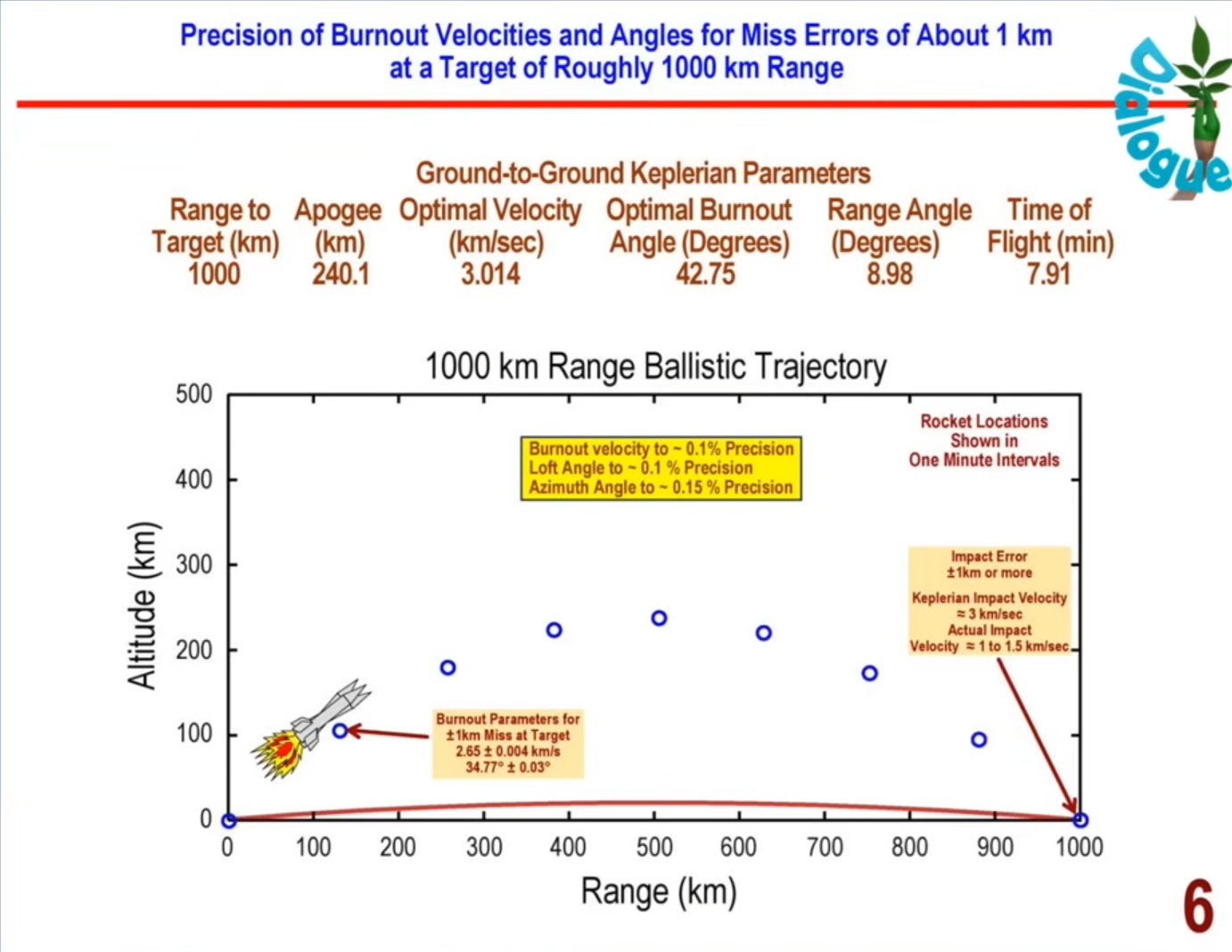
Slide 6 [the 5 first slides only contain text that was read out loud]
Slide six is a conceptual slide. Small problems in shutting down the rocket motor—when you are trying to place the rocket at a certain speed before the motor shuts down—create small differences in the angle at which the rocket is flying when the motor shuts down. Those small differences must be reduced if you want to increase the accuracy of the missile.
At the far end of the trajectory, errors are also introduced by the atmosphere. The missile may wobble a bit. But those kinds of errors can be reduced tremendously. The evidence suggests that the Iranians already know how to do that.
So, to significantly improve their accuracy—from about 1,000 meters to 500 meters—they mainly need to do better at shutting down the rocket motor at the right time and ensuring that the orientation of the missile at shutdown is accurate enough. They will likely get help with that from the Russians, if not from the Chinese.
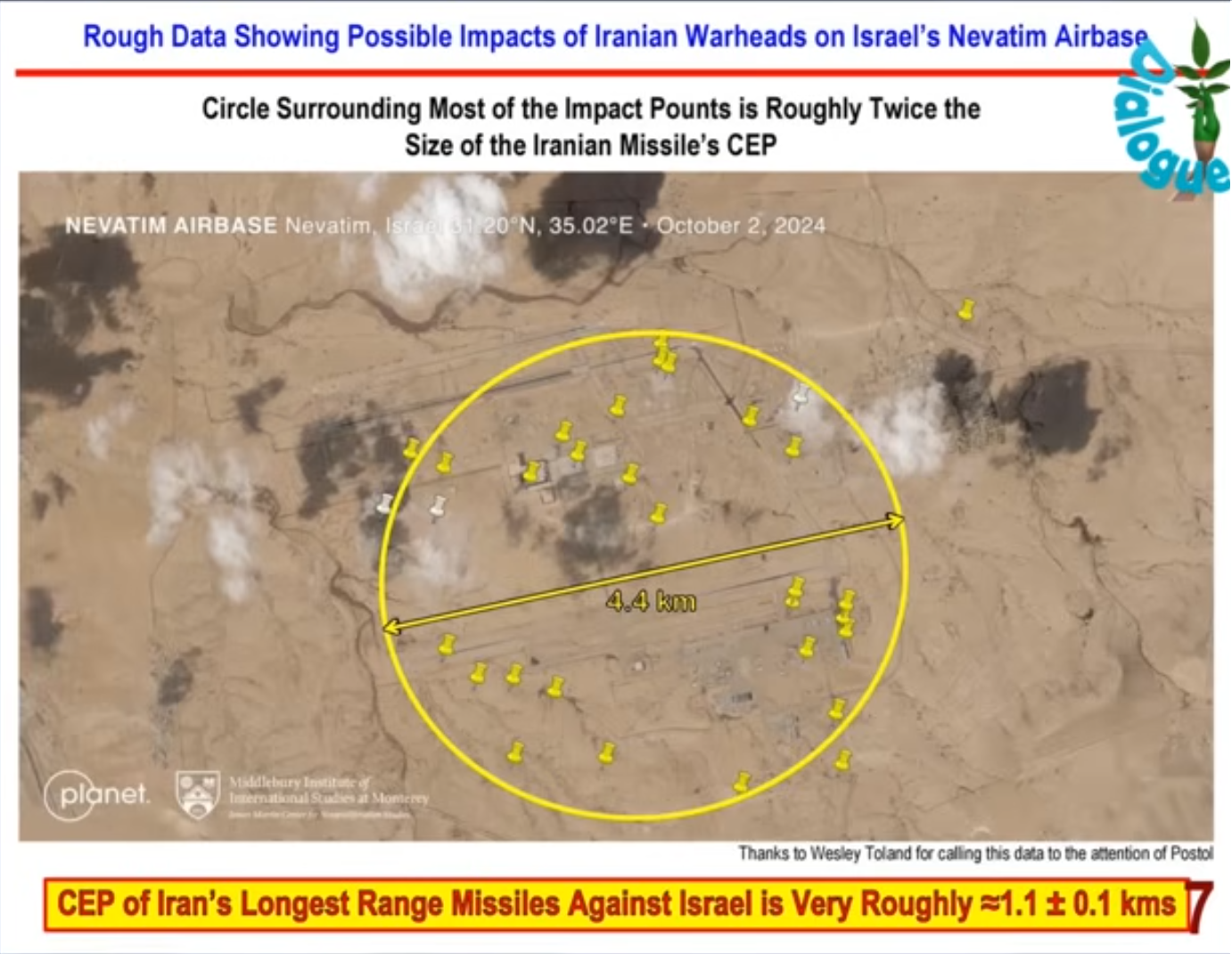
If we look at the situation, what we know —we go to slide seven— is that we have an estimate of the accuracy of these ballistic missiles from the attack on the Nevatim Air Base during the October war in 2024. They obviously wanted to damage the base. The distribution of warheads shows what their accuracy capabilities were at that time. One of the warheads actually hit a building and probably destroyed an F-35 inside. There is a lot of discussion about that. These are probabilistic events.
The distribution shown is how you estimate the accuracy of Iran’s ballistic missiles at that time. That does not mean it cannot improve. It will improve, and that has meaning in a different situation from the one people tend to focus on.
The possibility that the accuracy of Iran’s ballistic missiles will become so high that they can selectively target aircraft and shelters and things like that is very low in the near future. The technologies involved are extremely advanced and will be very difficult to implement, even for an advanced country like Iran. These technologies are very difficult to master for ballistic missiles.
Iran’s cruise missiles, however—I’m not talking about their drones—have demonstrated tremendous accuracy. In the attack on the Saudi Arabian oil fields, we saw evidence that Iranian cruise missiles have the ability to lock on to an object of a certain shape and home toward the center of that object. I could show that evidence in another discussion. So cruise missiles are extremely accurate, but ballistic missiles are a long way from there.
To understand what kind of damage ballistic missiles could do to an urban area, we need to understand what damage an explosion might cause.
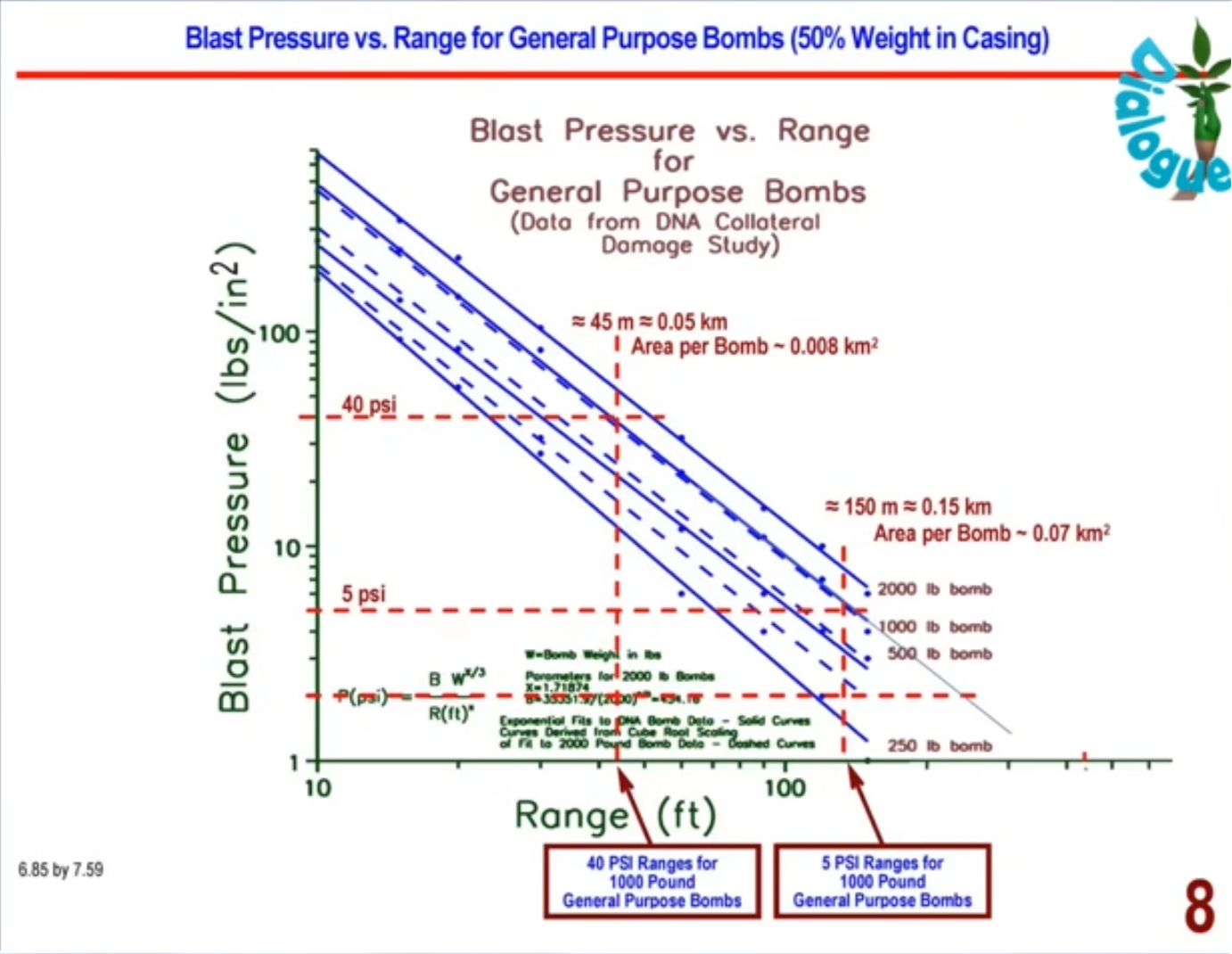
Slide eight shows the ranges at which certain levels of blast overpressure from a general-purpose bomb would occur. These are very general qualitative curves. For example, a 1,000-kilogram warhead, at about 100 meters you might get around two pounds per square inch. It could be 120 meters or 130, but approximately 100 meters. At 50 meters, you might get about five pounds per square inch. At around 15 meters, you might get over 40 pounds per square inch, which is enough to knock down a concrete and steel wall.
Let us look at slide nine to get a sense of what damage might look like.
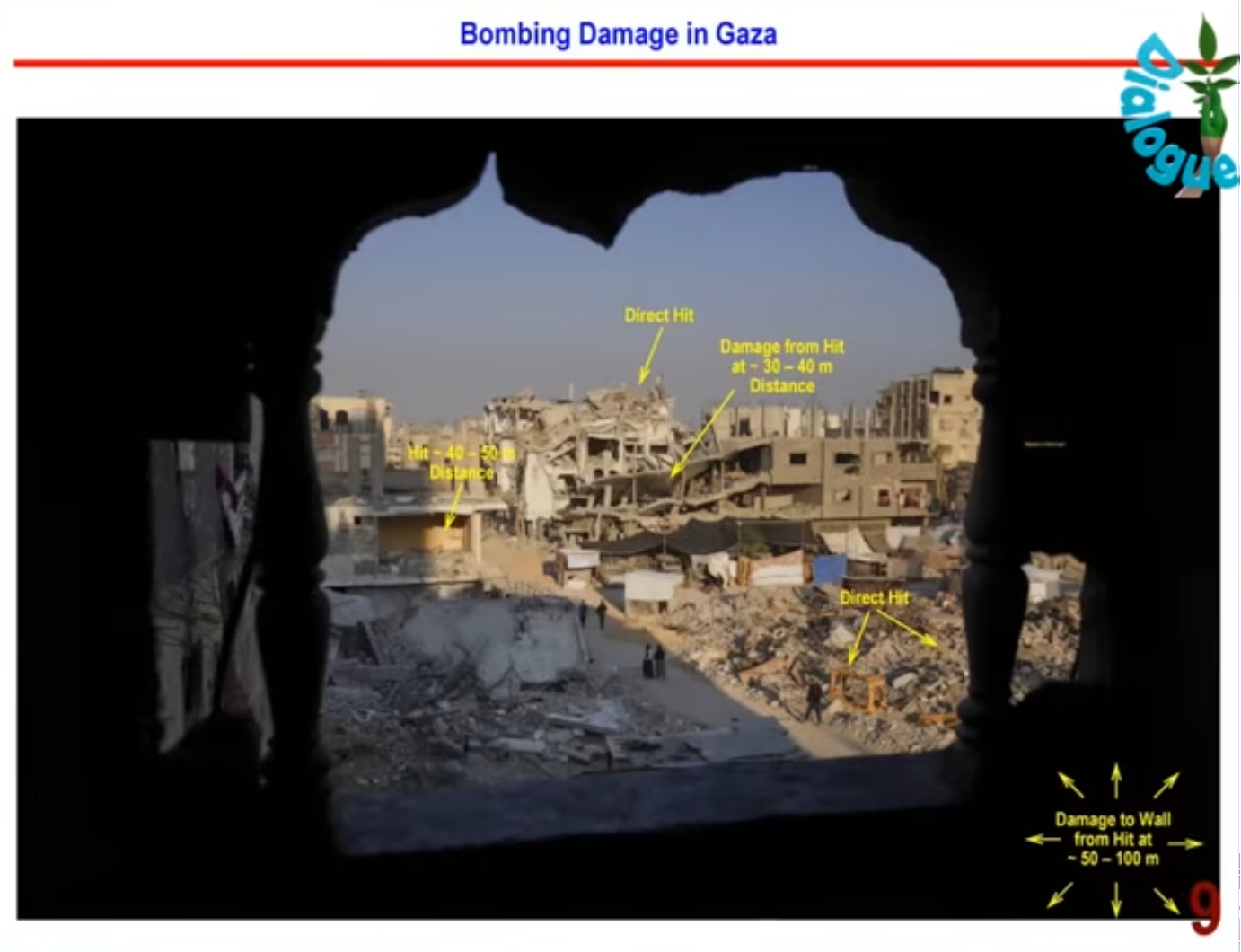
This is an image from Gaza. We are looking through a hole in the wall of a building. That hole was probably produced by the blast wave from a roughly 500- or 1,000-kilogram bomb that landed 50 to 100 meters away. It depends on the strength of the wall, but this is the kind of damage you can expect at that distance.
At the far end of the image, you can see what a direct hit looks like on a significant structure, concrete and steel, reinforced structure. The structure slightly forward of it was damaged not by a direct hit, but by secondary shock waves, perhaps from a bomb or bombs that landed 30 or 40 meters away.
The point is that there is a lot of damage beyond the point where a bomb hits.
On the left side, we see a building where the exterior walls have largely been knocked out, while the roof and floors appear intact. That was probably done by a blast 40 or 50 meters away, and the walls just collapsed or were blown inward. That is significant damage from bombs that did not directly hit the target.
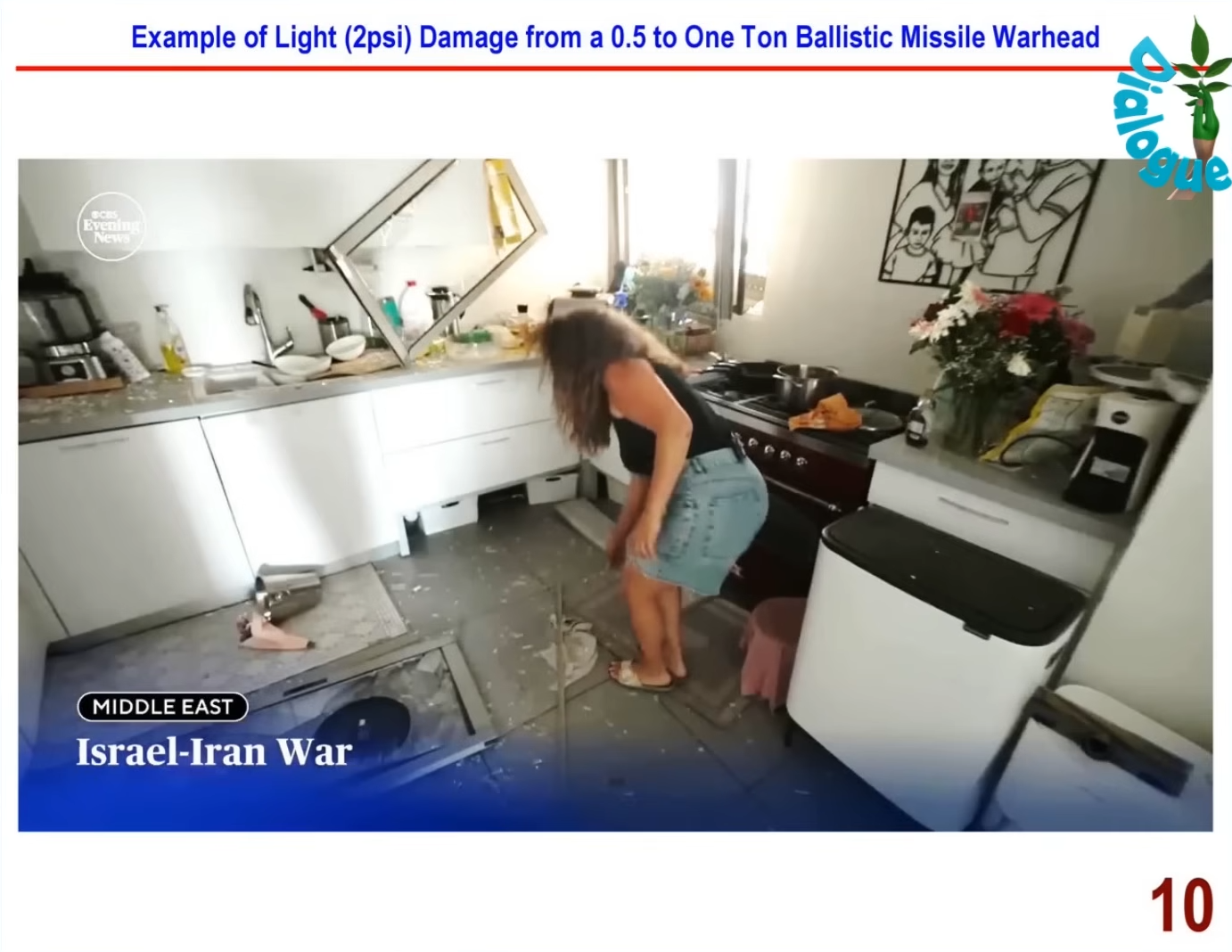
On the next slide, we see the interior of an apartment in Israel. This apartment was probably 100 to 150 meters away from a 500- to 1,000-kilogram ballistic missile explosion. At that distance—perhaps 50 to 100 meters—there is substantial general damage. The exterior window is blown out, and there is general disruption inside. If the blast had been at half that distance, the exterior wall could have been blown out.
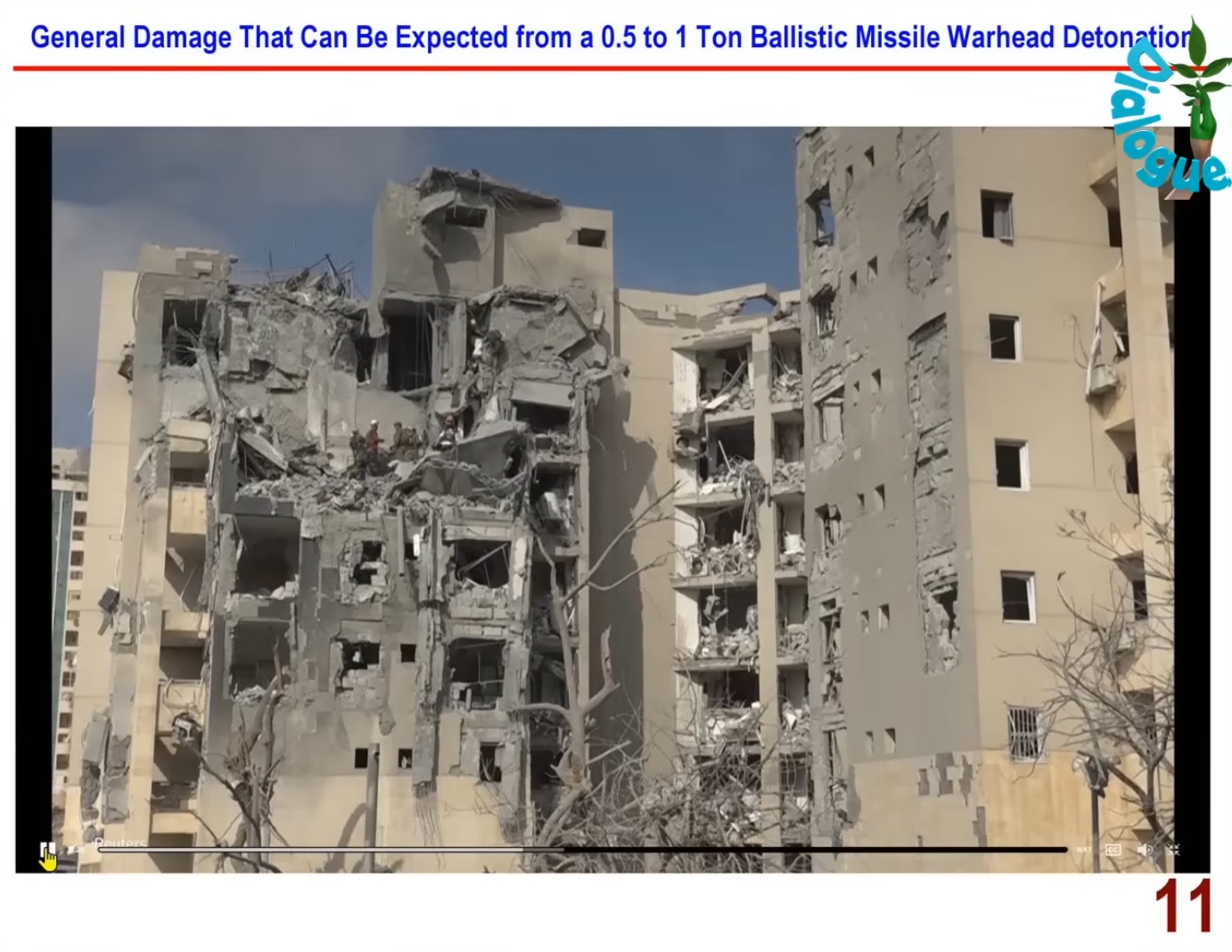
Slide 11 shows damage from a bomb that probably landed 50 or 60 meters away. The walls were shattered, and the interiors were badly damaged. There is evidence of fires in the building, which often occur in such events. There is usually no one around to fight the fires because people are injured or evacuating, and tremendous damage results.
Now that we have a sense of what the damage looks like, let us go to slide 12.
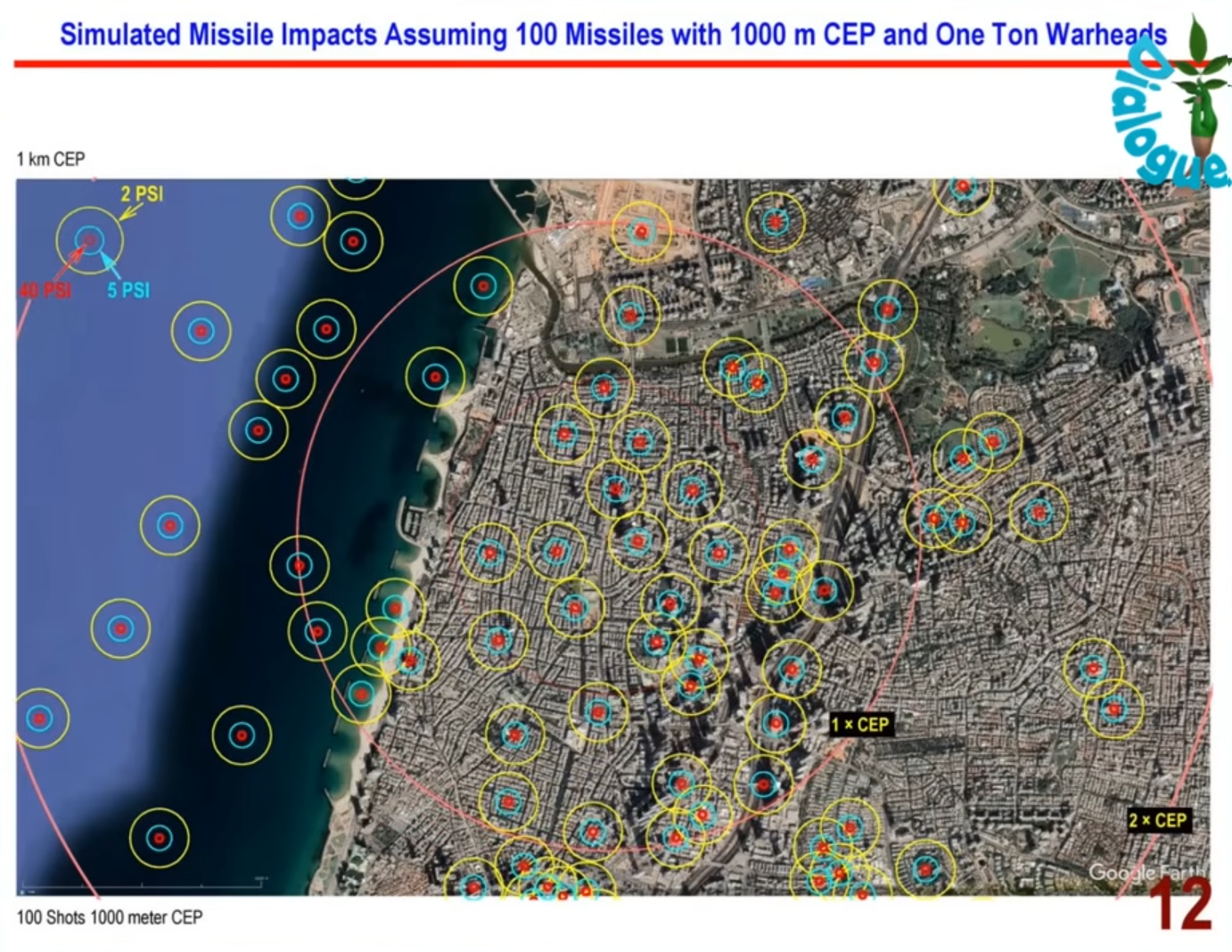
This is a simulated missile impact diagram. In the upper left corner, there is a key explaining the circles. The outer yellow circle represents about two pounds per square inch—damage similar to the apartment we saw earlier, where there was general internal damage without the walls being knocked down.
The five-psi contour shows the range at which a bomb landing nearby would severely damage the exterior walls of a building. It might not knock them down completely, but it would cause serious structural damage.
The 40-psi contour, shown in red, represents the range at which the structure itself would likely collapse or suffer severe structural damage.
This simulation shows 100 missiles with 1,000-meter accuracy, assuming a one-ton warhead. A 500-kilogram warhead would produce similar general conclusions.
If you were firing at Tel Aviv—and we know the Iranians were—a significant number of warheads would land in the downtown area, which we know occurred. There was considerable damage in downtown Tel Aviv, although the Israelis tried to mask it all. But if you went and talked to somebody who was in downtown Tel Aviv, they’d tell you there was bomb damage all over the place, you know. Very very damaging. Real problem. The Israelis tried to downplay it, but there was certainly a lot of reaction from the Israeli population.
And in fact I believe — I conjecture, I don’t know — that a lot of the discussion about running out of missile interceptors, or interceptors not working perfectly, is just a smokescreen. The defense interceptors were not working very well to begin with. These missiles basically came in unopposed, to a first approximation. There may have been some intercepts, but the number was very low—perhaps around five percent. I would be very surprised if it is as much as one in ten. I would be very surprised if it is that high.
There is a mythology that the Israelis have been trying to promulgate, which they cannot hide from their population because the Iranians showed their population what could happen. There is a big set of lies being promulgated to the Israeli people and to other organizations—that the defenses are simply running out of interceptors, that there are minor problems with intercept rates, and similar claims. In fact, these systems have never been effective at all.
Most of what the Iranians fired came through. When you have 1,000-meter precision, many warheads will simply fall into the Mediterranean, for example. That is what happens when you have a weapon that is not very accurate. Now what happens when 100 missiles have 500-meter accuracy rather than 1,000-meter accuracy, as shown in the next slide.
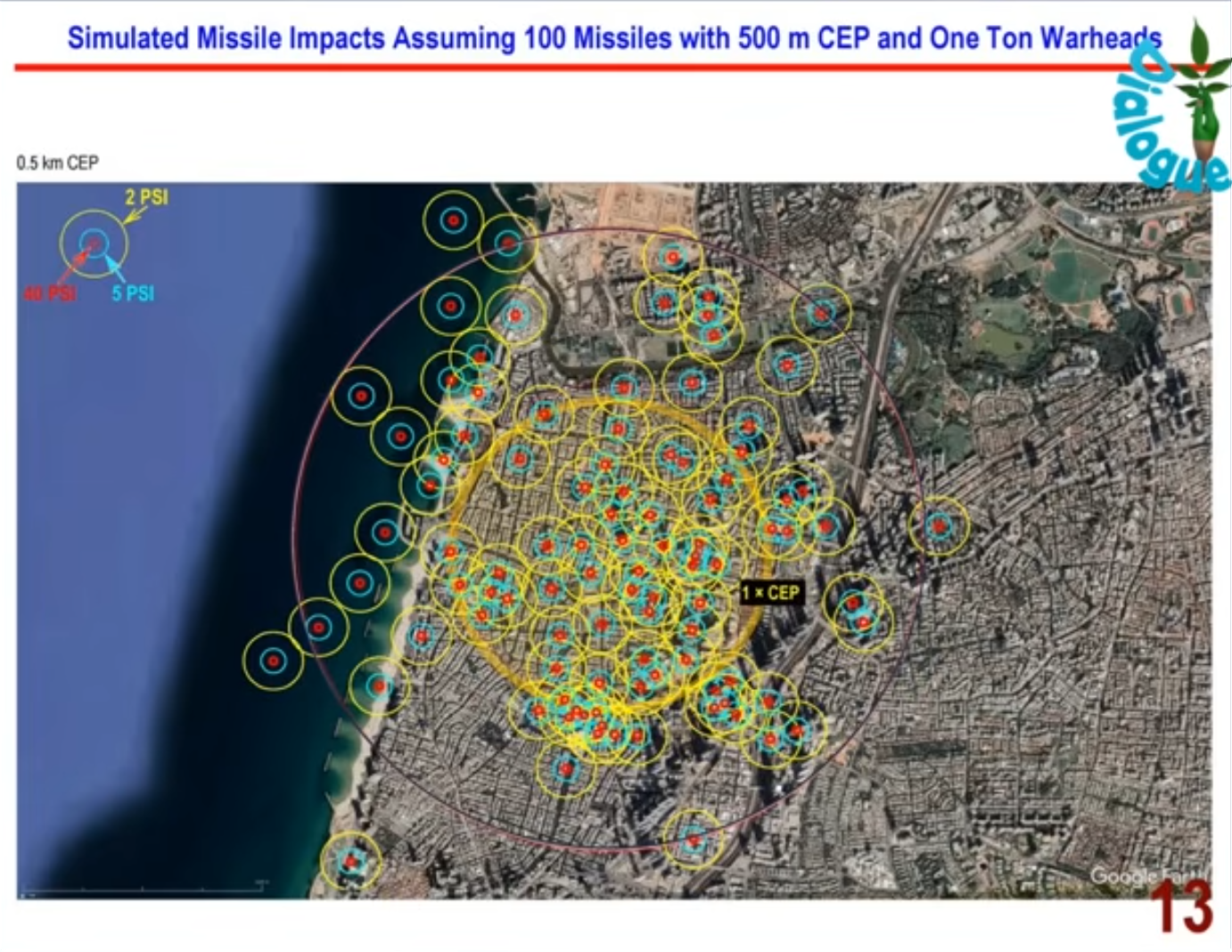
Things look a lot worse. A lot worse. You can see that the downtown Tel Aviv area gets at least twice the density of impacts. That is not a good sign if you are Israeli.
This simulation is for 100 missiles. Iran does not have to restrict itself to that number. Over time, Iran will not only improve its accuracy but also increase the number of missiles it can launch.
Let us look, in the next few slides, at what a 500-missile attack with 500-meter accuracy could look like.
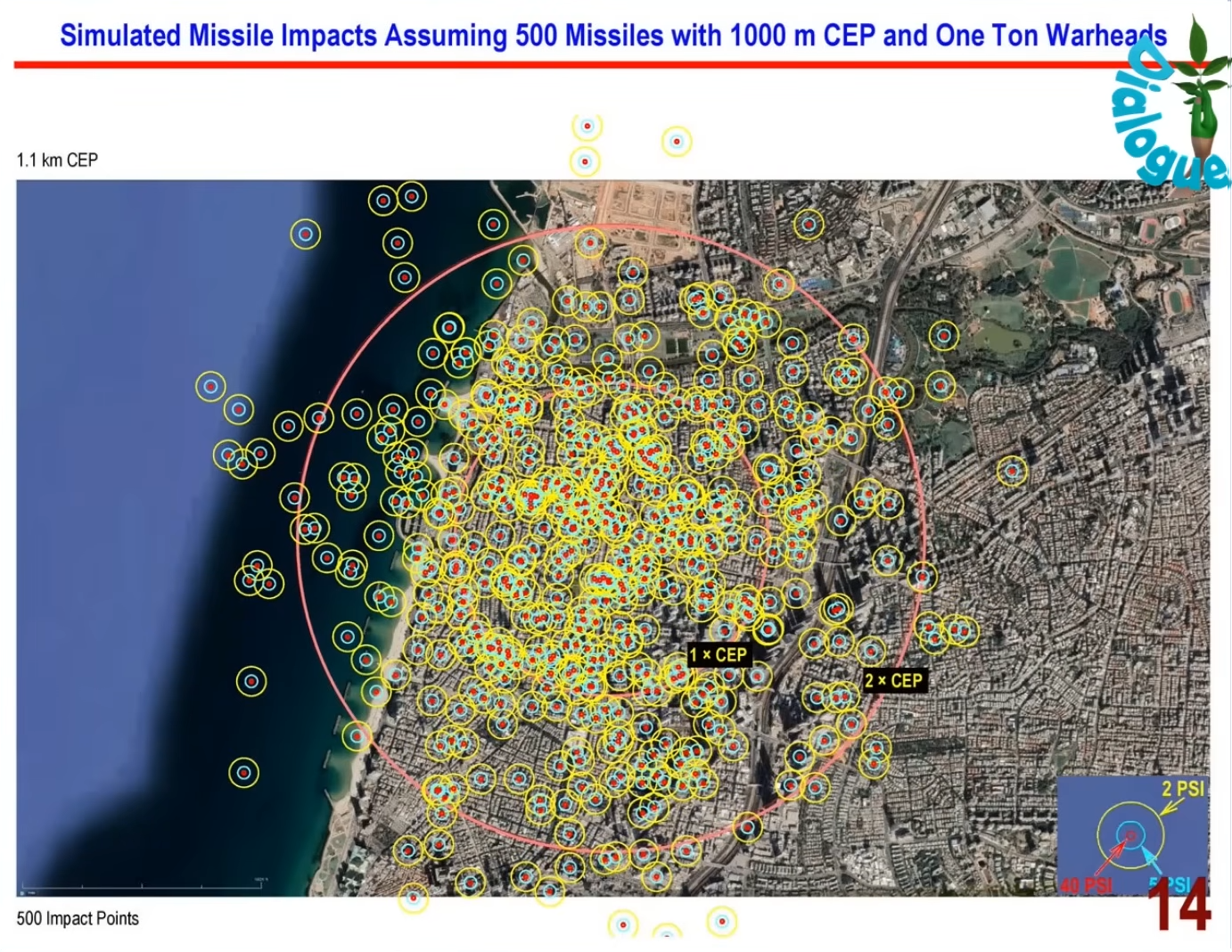
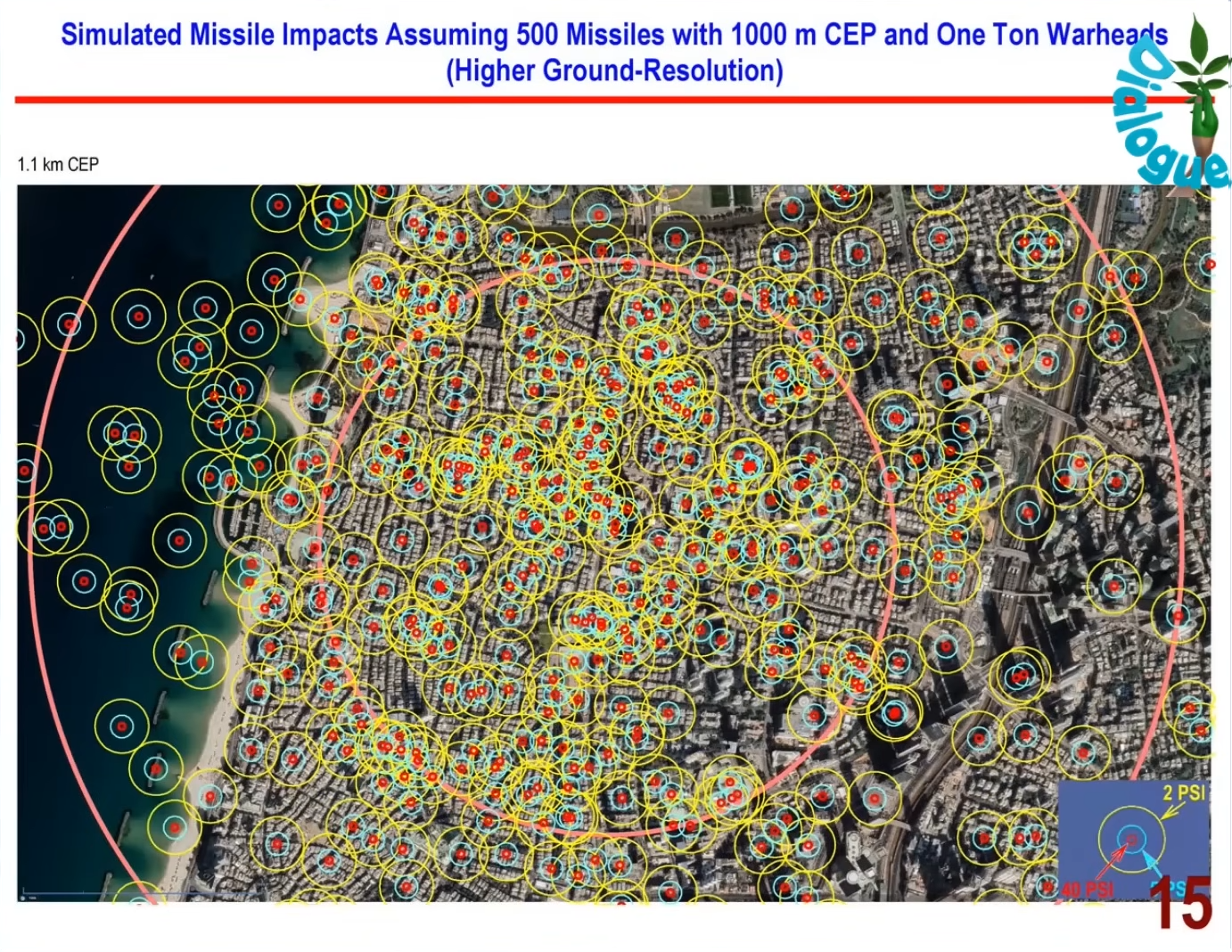
You see two roughly orange circles. One marks 1,000 meters of distance; the other marks 2,000 meters. A very large percentage of the warheads land within the urban built-up area of Tel Aviv.
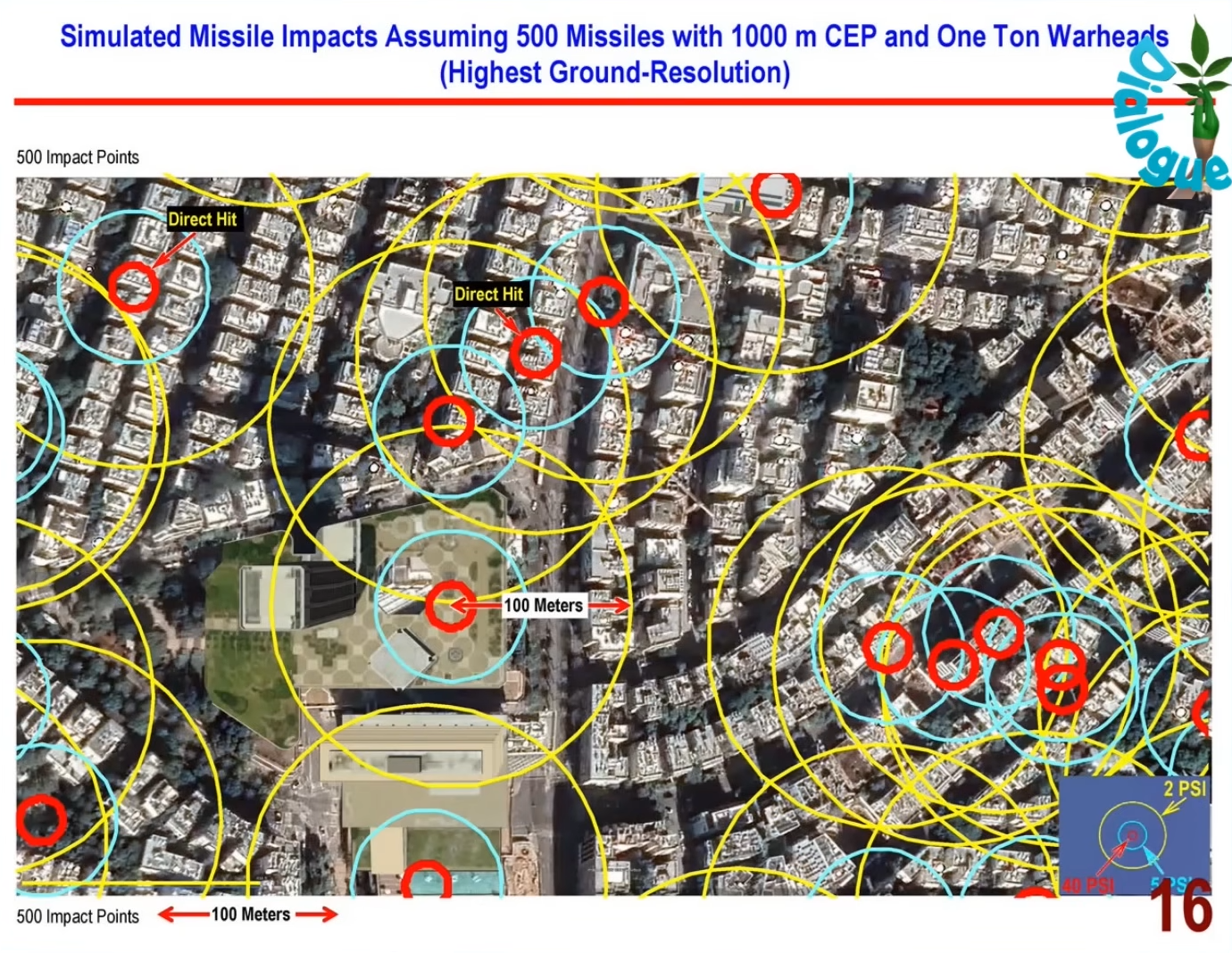
Slide 16 is a close-up. You can see the buildings and the density of impacts, to try and understand what it means. The red circles show areas where the blast intensity would be enough to knock down the buildings or large parts of them. That would be severe damage.
The blue lines show areas where extensive general damage would occur: interior apartment walls knocked out, fires initiated in many buildings, people injured by flying debris, evacuation under chaotic conditions, and widespread fires.
The yellow lines indicate areas of more general damage—broken windows and more in streets and buildings.
This entire area is covered with general damage and severe damage. It is just one arbitrarily selected area.
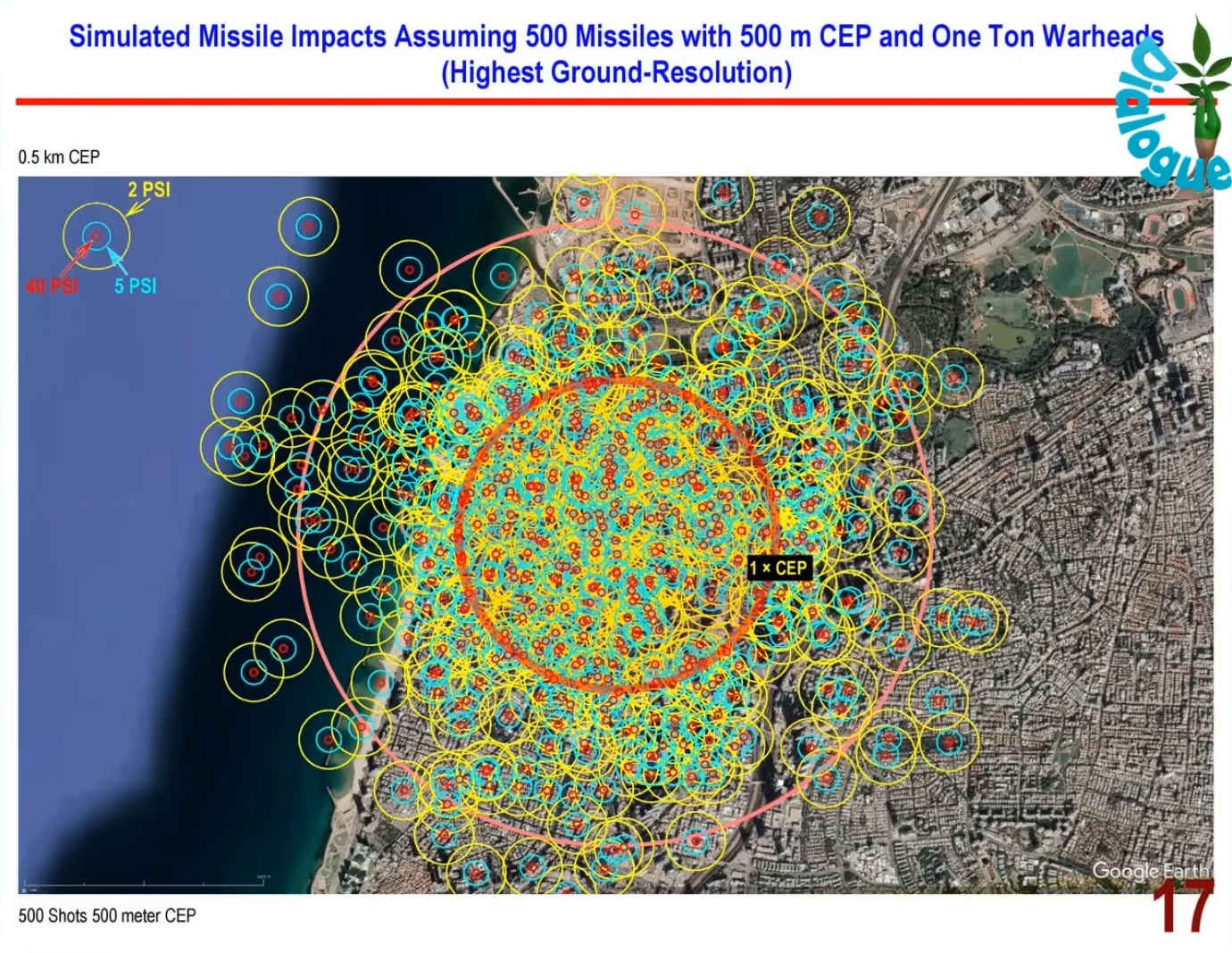
Slide 17 shows what the whole city looks like, in this case with 500-meter accuracy missiles: the density of impacts is so great that it blocks out the city. Each red dot represents severe damage to concrete and steel buildings—big, strongly built structures—along with widespread secondary damage to surrounding buildings and interiors.
After an attack like this, Tel Aviv is no longer a functioning city. Haifa is no longer a functioning city. Beersheba is no longer a functioning city. These cities could be shut down completely by a few thousand ballistic missiles with 500-meter accuracy, which you can be sure that in the next let’s say five years, Iran will have. Because Israel cannot stop them from building ballistic missiles. They will have, I think, the outreach from Russia and China, you know, they’ll be plenty of materials available, made available to Iran to continue manufacturing these ballistic missiles. And the technology for improving their accuracy is well in hand, as Iran is a sophisticated country with advanced engineering capabilities. All it needs is a little help from Russia or China or both to refine these missiles to 500-meter accuracy.
So we’re talking about a very big strategic problem that the Israelis have brought upon themselves by this aggressive behavior.
So let me go to slide 21, because I made a point about lying to the Israeli people. This is a slide from 1991. I think this may have occurred in Saudi Arabia, where Patriots were used to defend Saudi Arabia.
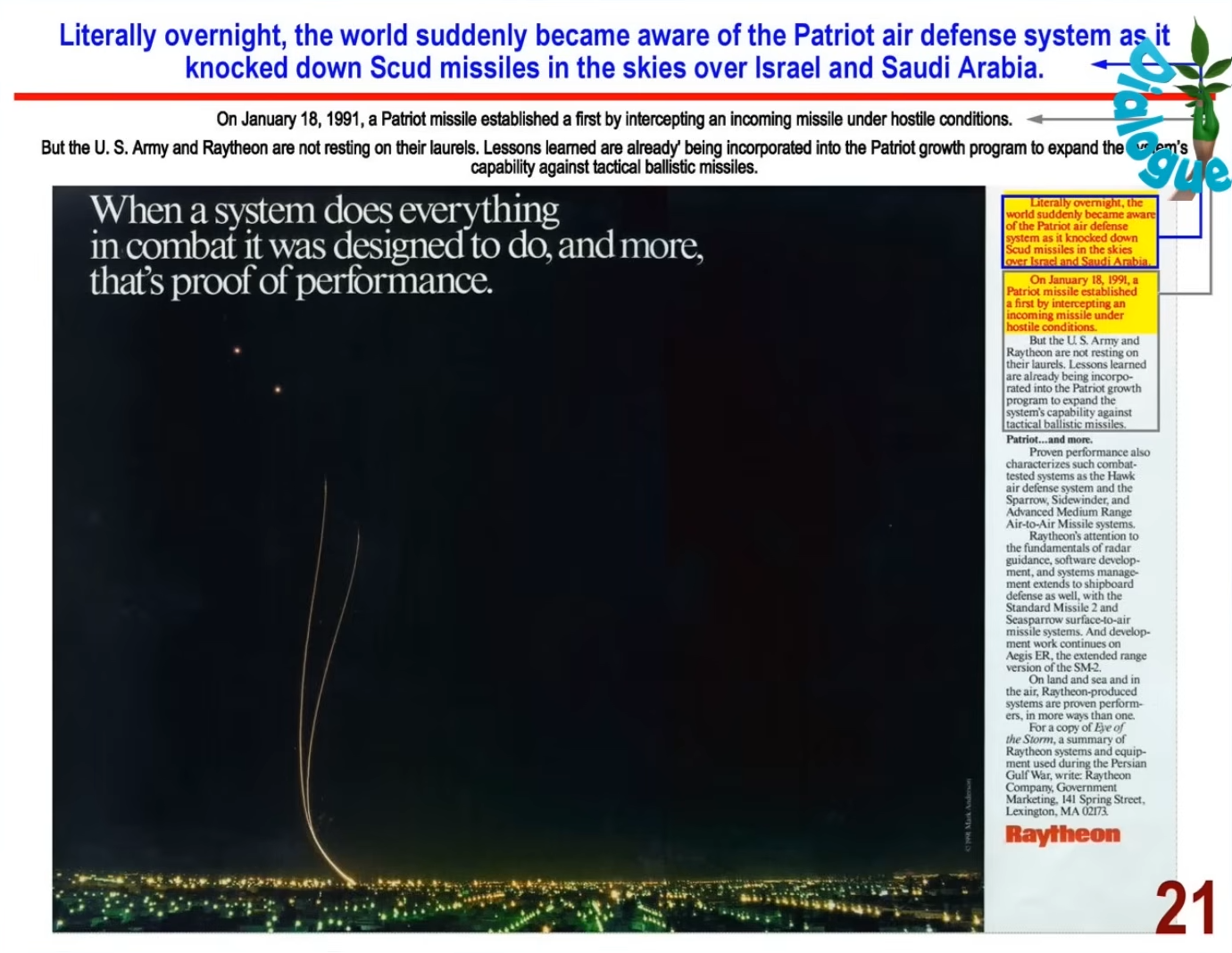
A spectacular photograph. Most people misunderstood it. And in fact, the Raytheon Corporation took a great… Let’s just look at what it says: “When a system does everything in combat it was designed to do and more, that’s proof of performance.” This was in Aviation Week & Space Technology, and it ran two pages. Two pages. A total lie by Raytheon, the company that is still building Patriots and claiming they work when they don’t.
This time-lapse photo—let’s stop for a second and understand how it works. The camera is focused on the skyline, and the aperture is open. It does not open and close like a regular photograph; it is just open. When a Patriot interceptor is launched, it has a rocket motor that burns. The rocket motor looks like a point of light, and that point of light traces a line on the film because this is a time exposure.
You see the line in both cases disappears because the Patriot burns out. It finishes its powered flight, then flies like a bullet and maneuvers by changing its orientation in the atmosphere.
Now you see those two dots in the sky. Those two dots are the explosions of the Patriot warheads. They have nothing to do with intercepting a Scud.
We found this engagement on a video camera and analyzed it frame by frame. One Scud came in. They missed it with both explosions. If they had hit the Scud, it should have appeared as a track on the black photo. The Scud was bright enough that you should have seen it as a track. Somebody took that track and blacked it out. So this was consciously a fraudulent photo.
This is what the Israelis tell their own people. This is what American contractors tell the Saudis, the Poles, the Ukrainians, and whoever else is foolish enough to spend money on their system for anti-missile.
It is a very effective system against aircraft, I want to be clear. You do not want to fly against Patriots if you are in an airplane. But as a ballistic missile defense, it is worthless, as we know from Ukraine as well.
What we have here is an example of layers upon layers upon layers of fraud that have been foisted off on the populations of different countries, and on the American taxpayer, who has bought most of these Patriots for other countries, including Israel and Ukraine.
What we have is nothing but a fraud against the American taxpayer, the Israeli public, and the Ukrainian population.
Ukraine is a horrific situation because we, the Americans have put the Ukrainians in a position where their country has been destroyed and will continue to be destroyed if it does not negotiate with what is left of it and with the Russians.
You can still find articles in The New York Times, the paper that is supposed to be the paper of record. Just the other day there was an article —I shouldn’t laugh, because it’s so serious— about how Prosk in Donbass had just fallen. Prosk fell two or three months ago. The New York Times is now reporting it? This is a crime.
You have unbelievably courageous Ukrainian soldiers fighting for their country, for what they believe is the survival of their country, and they are dying at a tremendous rate for nothing. This can all be stopped by carrying out a realistic negotiation.
But the political administration in Ukraine—my best analogy is Hitler letting all these Germans die as the Russians closed in on Berlin when the best thing to do would have been to surrender. The war was over. Why cause all these people to die? They were even executing their own people in the streets for not fighting.
It is this kind of fascism, and it is fascism, that is contributing to the complete destruction of Ukraine. I mean complete, because all of these dying soldiers are altering the demography of Ukraine for the next 20 years. There will be an incredible dip in the birth rate. There already is. Ukraine could potentially even disappear as a culture. I do not think it will, but it could.
All these extremists—banderites, white supremacists—who think they are saving Ukrainian ethnicity are destroying it.
We have all this complexity going on in the world in front of us, and the cynical political leadership of NATO and the United States as well is resulting in extraordinary loss of life. I am beside myself when I think about the loss of life in Ukraine for no reason.
Just negotiate. Stop trying to make yourself an existential enemy of the Russians. Just live beside them and stop this unbelievable slaughter, because the Russians are going to stop it anyway. They can stop it by reaching an understanding, or they can stop it by basically completely destroying Ukraine as a viable state, which I think is what will occur, unfortunately.
Sorry to jump around, but from the point of view of a technologist like myself, who is most deeply concerned with violence in the world and its negative consequences, I look at this with despair.
This talk is simple in some sense. The diagrams took a long time to put together. I did not just make them up. I wanted to make them understandable so you could visualize what 500-meter CEP means. When you see it laid out on a map, you begin to understand what the consequences are. We are visual animals. Our ability to learn is based on visual capabilities, and abstractions come after that.
That is what I have to share on this issue.
UK prosecutors drop aggravated burglary charges against 24 Palestine Action activists
The Cradle | February 18, 2026
The UK’s Crown Prosecution Service (CPS) dropped aggravated burglary charges against 18 of the Filton 24 activists on 18 February, citing a “reconsideration of the sufficiency of the evidence” after earlier acquittals in the same case at Woolwich Crown Court.
At a case management hearing in south London, prosecutor Deanna Heer KC told the court, “The prosecution has reconsidered the sufficiency of the evidence … In light of those verdicts and in respect of all the remaining defendants the prosecution offers no evidence on count one, aggravated burglary.”
The aggravated burglary charge linked to the Elbit factory raid carries a maximum sentence of life imprisonment.
The decision came two weeks after six co-defendants – Charlotte Head, Samuel Corner, Leona Kamio, Fatema Rajwani, Zoe Rogers, and Jordan Devlin — were acquitted of aggravated burglary on 4 February 2026. Jurors had deliberated for more than 36 hours before returning not guilty verdicts on that count.
Heer confirmed the CPS will seek a retrial on other allegations where no verdict was reached.
She told Mr Justice Johnson, “We now confirm the prosecution intention to seek a retrial in respect of all those allegations which no verdict was returned by the jury.”
Those include criminal damage against all defendants, violent disorder against three, and, in Corner’s case, causing grievous bodily harm with intent.
Rajwani, Rogers, and Devlin were cleared of violent disorder, while the jury failed to reach verdicts on that charge for Head, Corner, and Kamio.
None of the six were convicted of any offence, with all except Corner being released on conditional bail after about 18 months in custody.
Corner remains on remand over the unresolved Section 18 grievous bodily harm charge.
The remaining 18 continue to face criminal damage charges, with some also facing violent disorder allegations.
Thirteen defendants have applied for bail, while one, Sean Middlebrough, failed to return to custody while on conditional release in October last year.
Unidentified drone downed over Lebanon airbase, US forces block authorities from crash site
The Cradle | February 18, 2026
An unidentified drone was downed in the early hours of 17 February after entering the airspace above Hamat Air Base in northern Lebanon, a Lebanese security source revealed exclusively to The Cradle.
The incident unfolded when security at the base, which also hosts US forces, intercepted the aircraft, causing it to crash into nearby woodland.
According to the source, patrols from Hamat municipal police and units of the Lebanese Armed Forces (LAF) headed to the area to examine the wreckage.
US personnel at the scene intervened to stop the inspection of the downed aircraft. According to The Cradle’s source, US troops drew their weapons and prevented Lebanese officials, including the local mayor, from approaching the crash site, asserting that the drone might have been booby-trapped with explosives.
Lebanese authorities did not take possession of the aircraft, the source said, and US officials later revealed that the drone was no longer at the location initially identified as the crash site.
A US general stationed at the base reportedly sought to contact the Hamat mayor to apologize, but the mayor refused the gesture, objecting to the behavior of the forces hosted at the base in northern Lebanon.
The drone infiltration of Lebanese airspace comes as the Israeli army continues to violate the terms of the US-sponsored “ceasefire” without repercussion.
In early February, troops from the UN Interim Force in Lebanon (UNIFIL) near Kfar Kila, southern Lebanon, observed two drones, one carrying an unidentified object assessed as an “immediate threat.” It entered close range, dropped a stun grenade, exploded about 50 meters from the UNIFIL troops, and then headed toward Israeli territory, with no injuries caused.
The UN mission assessed that the drone belonged to the Israeli army and had crossed the Blue Line “in violation of Security Council resolution 1701,” describing the use of armed drones in this manner as “unacceptable.”
Since November 2024, when Lebanese resistance movement Hezbollah ceased attacks against Israel under the terms of the US-brokered truce, the Israeli army has committed over 12,000 violations of Lebanon’s territorial sovereignty, including more than 8,000 airspace breaches and 700 airstrikes.
Israeli attacks have killed 343 Lebanese and caused nearly 1,000 injuries, with civilian casualties including dozens of women and children.
Israeli forces maintain an active military presence at several border outposts on Lebanese territory, hindering the return of more than 64,000 displaced residents after a campaign of destruction that rendered much of the southern border zones uninhabitable.
“Our presence at five points in southern Lebanon is not part of the ceasefire agreement, but we imposed it, and the United States accepted it,” Israel Defense Minister Israel Katz declared on 18 February.
His remarks come as Lebanon’s government acknowledged that the army will need at least four months to implement the next phase of a plan aimed at disarming Hezbollah.
Peeling Back the US Information Operation in Iran
By Larry C. Johnson | SONAR21 | February 18, 2026
As part of the US campaign to engineer a regime change in Iran, the US military and intelligence community are using Operational Preparation of the Environmnet aka OPE. OPE is defined in joint publications (e.g., JP 3-05 Special Operations) as non-intelligence activities conducted prior to or in preparation for potential military operations to set conditions for success. It encompasses shaping the operational environment through intelligence, surveillance, reconnaissance, information operations, civil affairs, psychological operations, and other preparatory actions—often in denied or politically sensitive areas.
I believe that one of the major OPE efforts is to convince the US public that the overwhelming majority of Iranians despise the Islamic Republic and want it overthrown. In my opinion, a major player in this OPE is a polling outfit known as GAMAAN. GAMAAN (Group for Analyzing and Measuring Attitudes in Iran) collaborates with Psiphon VPN, which is widely used across Iran. GAMAAN findings have been consistent in painting a picture of massive opposition to the Iranian regime:
According to GAMAAN polls taken prior to 2025, a significant majority of Iranians — around 70% — oppose the continuation of the Islamic Republic. The highest level of opposition, 81%, occurred during the “Woman, Life, Freedom” uprising in late 2022. Support for “the principles of the Islamic revolution and the Supreme Leader” has decreased from 18% in 2022 to 11% in 2024. Opposition to the Islamic Republic is higher among the youth, urban residents, and the highly educated. An overwhelming majority of Iranians (89%) support democracy.
Only about 20% of Iranians support the continuation of the Islamic Republic. When asked about preferred alternatives, about 26% favor a secular republic and around 21% support a monarchy. For 11%, the specific form of the alternative system doesn’t matter. About 22% report lacking sufficient information to choose an alternative system.
But what are the funding sources for GAMAAN and Psiphon VPN? Let’s start with GAMAAN. GAMAAN describes itself as an independent, non-profit research foundation registered in the Netherlands. It emphasizes its academic credentials (e.g., founded by scholars at Dutch universities like Tilburg and Utrecht) and innovative online methods (e.g., anonymity sampling via VPNs like Psiphon) to overcome self-censorship in authoritarian contexts.
GAMAAN operates under the supervision of a board including Dr. Ammar Maleki (founder and director), assistant professor of comparative politics at Tilburg University, and Dr. Pooyan Tamimi Arab, associate professor of secular and religious studies at Utrecht University. Maleki is an assistant professor of Comparative Politics and a self-described activist for democracy in his native Iran. Tilburg University Critically, he does not hide his political stance — his Tilburg University profile explicitly states that he is “a pro-democracy activist and political analyst of Iranian politics” and that he tries “to have an impact on political debates around democratization of Iran.”
This is where the picture becomes more contested. GAMAAN has relied on US government-funded VPN provider Psiphon to disseminate its surveys; collaborated with the USAID-funded Tony Blair Institute; and collaborated with and received funding from historian Ladan Boroumand, co-founder of the Abdorrahman Boroumand Center for Human Rights in Iran, which is in turn supported by the US government-funded National Endowment for Democracy (NED).
Psiphon is owned and operated by Psiphon Inc., a Canadian corporation based in Ontario. Psiphon was originally developed by the Citizen Lab at the University of Toronto, with version 1.0 launching on December 1, 2006, as open-source software. In early 2007, Psiphon, Inc. was established as a Canadian corporation independent of the Citizen Lab and the University of Toronto.
It has a notable funding history. In 2008, Psiphon, Inc. was awarded sub-grants from the US State Department Internet Freedom program, administered by the Bureau of Democracy, Human Rights, and Labor. In 2010, Psiphon began providing services to the Broadcasting Board of Governors (US), the US Department of State, and the BBC. More recently, in April 2024, the Open Technology Fund (OTF) announced increased long-term funding for Psiphon, with subsequent OTF awards totaling US$18.54 million for 2024 and US$5.87 million for 2025.
The Open Technology Fund (OTF) is administered by the US Agency for Global Media (USAGM), an independent federal agency of the US government. USAGM provides OTF with its primary funding through annual grants, which originate from Congressional appropriations under the Department of State, Foreign Operations, and Related Programs budget. OTF operates as an independent nonprofit corporation (since 2019) but remains a grantee under USAGM’s oversight and governance, as authorized by Congress (e.g., via the 2021 National Defense Authorization Act).
So while Psiphon Inc. is technically an independent Canadian company, it has historically been substantially funded by the US government and other Western institutions — a fact worth noting given its role as the methodology partner for the GAMAAN polling inside Iran. In other words, it is a cut out that, in my opinion and based on my experience, is supporting a CIA information operation to portray Iran as a country on the precipice of overthrowing the Islamic Republic.
There is an alternative polling database that paints a radically different picture of the mood in Iran with respect to the Islamic Republic… The Center for International and Security Studies at Maryland has conducted a separate series of surveys using phone-based methods, which show more moderate results. Their findings from 2023 and 2024 found that about 75% of respondents expect Iran’s constitution and political system to be about the same in ten years, and only 17% agreed with protesters’ calls for the Islamic Republic to be replaced. However, three in five now think the government should not be strict in enforcing Islamic laws, distinctly up from 2018, and support for demands that the government fight corruption has been consistently near-unanimous since 2018.
On the protests themselves, asked in 2024 to think about waves of demonstrations over the past ten years, two thirds say their main objective was to demand that officials pay greater attention to people’s problems, while only one in five think their main objective was to demand greater freedoms or bring about change in Iran’s system of government.
President Pezeshkian, based on the polls from 2024, was viewed favorably by 66% of those polled at the start of his term… and 70% expressed confidence that he would be an honest and trustworthy president, though only a quarter were very confident. Majorities expressed some confidence that he can improve relations with neighboring countries and protect citizens’ freedoms, notably women’s rights, but majorities are not confident that he can lower inflation or improve relations with the West.
There have been no new polls in the wake of Israel’s surprise attack on June 13, 2025. Based on my conversations with both Nima Alkhorshid and Professor Marandi, the reaction in Iran has been similar to what happened in the United States in the aftermath of the 9-11 attacks… National unity increased.
The failed color revolution launched on December 28, 2025 by the United States and Israel has reinforced support for the Islamic Republic. President Pezeshkian has openly admitted his government’s failures on the economic front and he has taken some steps to institute reforms. A more important development was the signing of the Trilateral Security Agreement with Russia and China at the end of January. Those two countries are now providing more resources and support to stabilize the Iranian government and improve the economic lives of the Iranian people.
Donald Trump’s threats to attack Iran are backfiring among the majority of the population in Iran. Yes, there are some Iranians who still want to bring an end to the Islamic Republic, but they are dramatically outnumbered. Remember the boost in popularity that George W Bush enjoyed in the aftermath of 9-11? He even picked up support from Democrats who had previously despised him. That same phenomena has happened in Iran. Prior to the June 13, 2025 attack, Iranians under the age of 50 had no vivid memory of Iran/Iraq war — where Iran was attacked with the encouragement and support of the United States. The June 2025 attack, coupled with the foreign instigated late December 2025 protests and violence, have awakened a new sense of nationalism among the Iranian public that has strengthened support for the Islamic Republic.
The belief in the West that Iran is more vulnerable now than at anytime in the last 46 years is the creation of a US funded propaganda campaign that relied on an ideologically biased pollster to produce results that have been used to convince most Americans that Iran is yearning to breath free… All we have to do is kill off the leadership in Iran.
Israel ‘dictating terms’ to US – Turkish professor
Washington is following the Jewish State’s demands on Iran and the Middle East as a whole, Hasan Unal has told RT
RT | February 18, 2026
Israel is effectively dictating US foreign policy, particularly on Iran and the wider Middle East, in a way that is historically unprecedented for a global superpower, a Turkish international relations professor has told RT.
Hasan Unal, who teaches at Baskent University in Ankara, spoke to RT’s Rick Sanchez this week about what he described as a highly unusual power imbalance between Israel and the US.
”We are living in a world now where a small country like Israel is dictating terms to a superpower like the United States on anything and everything, particularly anything pertaining to Israel and to the Middle East,” he said, calling the situation “totally unacceptable.”
Unal added that some analysts have even described it as an “occupation” of US policymaking by Israel, a characterization he said was “almost true.”
He went on to say that pro-Israel lobby influence and the personal involvement of Israeli Prime Minister Benjamin Netanyahu were shaping American positions, recalling episodes when Netanyahu “gets on his plane immediately” and flies to Washington “to simply dictate what [US President Donald] Trump should say and should negotiate in the negotiations with the Iranians.”
Unal claimed such a pattern has left Washington “dogging behind the Israeli demands all the time” and cautioned that it risks further destabilizing the Middle East.
Netanyahu has made multiple high profile visits to Washington to engage directly with senior US officials on regional policy. In the past year alone, he has met Trump at the White House at least six times to discuss issues ranging from Gaza and Iran’s nuclear program to military cooperation. His latest trip took place last week, ahead of the second round of indirect US Iran talks in Geneva. Netanyahu later said he had pressed Trump to ensure that Tehran is barred from enriching uranium. The renewed diplomatic push followed joint Israeli-US strikes on Iranian nuclear facilities last year, officially justified as an attempt to stop Iran from acquiring nuclear weapons – an ambition the Islamic Republic denies.
Trump has since sent an ‘armada’ to the Middle East and threatened further attacks unless Iran agrees to a deal on both its nuclear and missile programs. Last week, he raised the prospect of regime change and announced a second carrier strike group deployment, with media reports claiming the US military was ordered to prepare for a sustained multi-week operation if talks fail.
Asked whether Iran poses a direct threat to the US, Unal replied that Tehran does not seek to attack American assets as such and that many of the tensions are tied to Israel’s security calculations.
Unal also suggested what he called the gradual collapse of a “big empire,” referring to the Western-led order, and the emergence of a more multipolar system in which countries such as Russia, China, and Türkiye have greater room to maneuver. – video
US ramps up nuclear claims against China
RT | February 18, 2026
China carried out an underground “nuclear explosive test” in June 2020, a senior US State Department official has claimed, citing “fresh intelligence” on the matter. Beijing has repeatedly dismissed such allegations as “entirely unfounded,” while independent observers say the evidence is inconclusive.
The US assistant secretary for arms control and nonproliferation, Christopher Yeaw, made the latest claims on Tuesday during an event hosted by the conservative Hudson Institute think tank in Washington.
He cited seismic data “quite consistent with what you would expect from a nuclear explosive test.”
“I’ve looked at additional data since then. There is very little possibility, I would say, that it is anything but an explosion, a singular explosion,” Yeaw stated.
The minor 2.75 magnitude seismic event was registered by a remote station in Kazakhstan. Its epicenter was located some 725km away at the Lop Nur nuclear testing grounds in China, prompting the US to claim that it was caused by an underground blast.
China has repeatedly dismissed the American allegations as “entirely unfounded” and used only as a pretext to justify Washington’s own intent to resume nuclear testing. Yeaw’s remarks invoked a similar reaction, with a spokesperson for the Chinese embassy in Washington telling Reuters the latest claims were “political manipulation aimed at pursuing nuclear hegemony and evading its own nuclear disarmament responsibilities.”
Moscow has backed Beijing, repeatedly stating no evidence to support Washington’s claims exists. “Neither Russia nor China has conducted any nuclear tests. And we also know that these claims were firmly denied by representatives of China,” Kremlin spokesman Dmitry Preskov told reporters on Wednesday.
Independent observers have said there is too little evidence to positively establish the nature of the June 2020 incident. The Comprehensive Nuclear-Test-Ban Treaty Organization, for instance, said that the monitoring station in Kazakhstan merely picked up “two very small seismic events, 12 seconds apart,” and it was not possible “with this data alone” to assess “the cause of these events with confidence.”
Erdogan wants nukes: What a Turkish bomb would mean for the Middle East
Ankara is telling the world that a selective and force-driven approach to the Iranian nuclear issue could ignite a chain reaction
By Murad Sadygzade | RT | February 18, 2026
In Ankara, the idea of Türkiye one day seeking a nuclear weapons option has never been entirely absent from strategic conversation. Yet in recent days it has acquired a sharper edge, as the region around Türkiye is sliding toward a logic in which raw deterrence begins to look like the only dependable language left.
Türkiye’s foreign policy has expanded far beyond the cautious, status-quo posture that once defined it. It has positioned itself as a mediator on Ukraine and Gaza, pursued hard security aims through sustained operations and influence in Syria, Iraq, and Libya, and inserted itself into competitive theaters from the Eastern Mediterranean to the Horn of Africa. President Recep Tayyip Erdogan has long framed this activism as a corrective to an international order he portrays as structurally unfair. His slogan that the world is bigger than five – referring to the UN Security Council – is a statement of grievance against a system in which a narrow group of powers retains permanent privileges, including an exclusive claim to ultimate military capability.
Within that narrative, nuclear inequality occupies a special place. Erdogan has repeatedly pointed to the double standards of the global nuclear order, arguing that some states are punished for ambiguity while others are insulated from scrutiny. His references to Israel are central here, because Israel’s assumed but undeclared nuclear status is widely treated as an open secret that does not trigger the same enforcement instincts as suspected proliferation elsewhere. That asymmetry has long irritated Ankara, but it became more politically potent after the war in Gaza that began in 2023, when Erdogan openly highlighted Israel’s arsenal and questioned why international inspection mechanisms do not apply in practice to all regional actors.
Still, for years this was mostly an argument about fairness and legitimacy rather than a declaration of intent. What has changed is the sense that the regional security architecture itself is cracking, and that the cracks are widening at the very moment the US and Israel are escalating pressure on Iran. Türkiye’s leadership has warned that if Iran crosses the nuclear threshold, others in the region will rush to follow, and Türkiye may be forced into the race as well, even if it does not want dramatic shifts in the balance.
This is the key to understanding the new intensity of the debate. Ankara’s signaling is not primarily an emotional reaction to Tehran. Türkiye and Iran remain competitors, but their frictions have also been managed through pragmatic diplomacy, and Türkiye has consistently argued against a military solution to the Iranian nuclear issue. Erdogan has again presented Türkiye as a mediator, insisting on de-escalation and rejecting military steps that could drag the region into wider chaos.
The driver is the fear that the rules are no longer the rules. When enforcement becomes selective, and when coercion is applied in ways that appear to disregard broader stability, the incentives change for every middle power caught in the blast radius. The signal from Ankara is that if the Middle East moves into a world where nuclear capability is treated as the only ironclad guarantee against regime-threatening force, then Türkiye cannot afford to remain the exception.
That logic is dangerous precisely because it is contagious. It turns proliferation into an insurance policy. In an unstable region where trust is thin and the memory of war is always fresh, the idea of nuclear weapons as a shield against interference can sound brutally rational. If possessing the bomb raises the cost of intervention to unacceptable levels, it can be perceived as the ultimate deterrent, a guarantee that outsiders will think twice. But the same logic that appears to promise safety for one actor produces insecurity for everyone else. In practice it fuels an arms race whose end state is not stability, but a crowded deterrence environment in which miscalculation becomes more likely, crisis management becomes harder, and conventional conflicts become more combustible because nuclear shadows hover over every escalation ladder.
The renewed urgency also reflects a broader global drift. Arms competition is intensifying well beyond the Middle East. The erosion of arms control habits, the normalization of sanctions as a tool of strategic coercion, and the return of bloc-like thinking in many theaters all contribute to a sense that restraint is no longer rewarded. For Türkiye, a state that sees itself as too large to be merely a client and too exposed to be fully autonomous, the temptation is to seek leverage that cannot be negotiated away. Nuclear latency, even without an actual bomb, can function as a strategic bargaining chip.
Yet the jump from ambition to capability is not straightforward. Türkiye does have important ingredients for a serious civil nuclear profile, and those capabilities matter because they shape perceptions. The country has been building human capital in nuclear engineering and developing an ecosystem of research institutions, reactors for training and experimentation, accelerator facilities, and nuclear medicine applications. Most visibly, the Akkuyu nuclear power plant project with Russia has served as an engine for training and institutional learning, even if technology transfer is limited and the project remains embedded in external dependence.
Türkiye also highlights domestic resource potential, including uranium and especially thorium, which is often discussed as a long-term strategic asset. Resource endowments do not automatically translate into weapons capability, but they reduce one barrier, the need for sustained and vulnerable supply chains. As a result, Türkiye can credibly present itself as a state that could, if it chose, move from peaceful nuclear competence toward a latent weapons posture.
The real bottleneck is not simply material. It is political and legal. Türkiye is a party to the Nuclear Non-Proliferation Treaty, and it operates inside a web of international commitments that would make an overt weapons program extremely costly. Withdrawal from the treaty or large-scale violations would almost certainly trigger sweeping sanctions, diplomatic isolation, and a rupture with major economic partners. Unlike states that have adapted their economies to long-term siege conditions, Türkiye is deeply integrated into global trade, finance, and logistics. The short-term shock of a proliferation crisis would be severe, and Ankara knows it.
This is why the most plausible path, if Türkiye ever moved in this direction, would not be a dramatic public sprint. It would be a careful, ambiguous strategy that expands latency while preserving diplomatic maneuvering room. Latency can mean investing in expertise, dual-use infrastructure, missile and space capabilities that could be adapted, and fuel cycle options that remain justifiable on civilian grounds. It can also mean cultivating external relationships that shorten timelines without leaving fingerprints.
Here the debate becomes even more sensitive, because proliferation risk is not only about what a country can build, but also about what it can receive. The Middle East has long been haunted by the possibility of clandestine technology transfer, whether through black markets, covert state support, or unofficial security arrangements. In recent months, discussions around Pakistan have become particularly salient, not least because Islamabad is one of the few Muslim majority nuclear powers and has historically maintained close security ties with Gulf monarchies.
Saudi Arabia has repeatedly signaled that it will not accept a regional balance in which Iran alone holds a nuclear weapon. Saudi leaders have at times implied that if Iran acquires the bomb, Riyadh would feel compelled to match it for reasons of security and balance. Those statements are not proof of an active weapons program, but they are political preparation, shaping expectations and normalizing the idea that proliferation could be framed as defensive rather than destabilizing.
There have also been unusually explicit hints in regional discourse about nuclear protection arrangements, including arguments that Pakistan could, in some scenario, extend a form of deterrence cover to Saudi Arabia. Even when such claims are partly performative, they underscore how the region’s strategic conversation is shifting from taboo to contingency planning.
Once that door is open, Türkiye inevitably enters the picture in regional imagination. Türkiye, Pakistan, and Saudi Arabia are linked through overlapping defense cooperation and political coordination, and analysts increasingly discuss the emergence of flexible security groupings that sit alongside or partially outside formal Western frameworks. The idea that technology, know-how, or deterrence guarantees could circulate within such networks is precisely the nightmare scenario for nonproliferation regimes, because it compresses timelines and reduces the visibility that international monitors depend on.
For Ankara, this creates both opportunity and risk. The opportunity is that Türkiye could enhance its deterrent posture without bearing the full cost of overt development. The risk is that Türkiye could become entangled in a proliferation cascade that it cannot control, while simultaneously inviting a Western backlash that would reshape its economy and alliances.
This is where the question becomes deeply geopolitical. A nuclear-armed Türkiye would not simply change the Middle East. It would alter Europe’s security landscape and challenge the logic that has governed Türkiye’s relationship with the West for decades. Western capitals have tolerated, managed, and constrained Türkiye through a mixture of incentives, institutional ties, defense cooperation, and pressure. Türkiye’s NATO membership, its economic links to Europe, and the presence of US nuclear weapons stored at Incirlik as part of alliance arrangements have all been elements of a broader strategic framework in which Türkiye was seen as anchored, even when politically difficult.
If Türkiye acquired its own nuclear weapons, that anchoring would weaken dramatically. Ankara would gain a form of autonomy that no sanction threat could fully erase. It would also gain the capacity to take risks under a nuclear umbrella, a dynamic that worries Western capitals because it could embolden more confrontational regional behavior. Türkiye’s disputes with Western partners are already intense on issues ranging from Eastern Mediterranean energy politics to Syria, defense procurement, and the boundaries of alliance solidarity. A nuclear deterrent could make those disputes harder to manage because the ultimate escalation dominance would no longer sit exclusively with the traditional nuclear powers.
At the same time, a Turkish bomb could accelerate Türkiye’s drift away from the West, not only because the West would react with pressure, but because the very act of building such a capability would be an ideological statement that Türkiye rejects a Western-defined hierarchy. It would be Ankara’s most dramatic way of saying that it will not accept a subordinate place in a system it considers hypocritical.
None of this means Türkiye is on the verge of producing a weapon. Political obstacles remain huge, and technical challenges would be substantial if Ankara had to do everything indigenously while under scrutiny. A credible weapons program requires enrichment or plutonium pathways, specialized engineering, reliable warhead design, rigorous testing regimes or sophisticated simulation capabilities, secure command and control, and delivery systems that can survive and penetrate. Türkiye has missile programs that could in theory be adapted, but turning a regional missile force into a robust nuclear delivery architecture is not trivial.
The more immediate danger is not that Türkiye will suddenly unveil a bomb, but that the region is moving toward a threshold era, in which multiple states cultivate the ability to become nuclear on short notice. In such an environment, crises become more perilous because leaders assume worst-case intentions, and because external powers may feel pressure to strike early rather than wait. The irony is that a weapon meant to prevent intervention can increase the likelihood of intervention if adversaries fear they are running out of time.
The escalation by the US and Israel against Iran, combined with the broader arms race logic spreading across the Middle East and globally, is making this spiral more plausible. Uncertainty is the fuel of proliferation, because it convinces states that the future will be more dangerous than the present, and that waiting is a strategic mistake.
Türkiye’s rhetoric should therefore be read as a warning as much as a threat. Ankara is telling the world that a selective and force-driven approach to the Iranian nuclear issue could ignite a chain reaction. It is also telling regional rivals that Türkiye will not accept a future in which it is strategically exposed in a neighborhood where others have ultimate insurance.
The tragedy is that this is exactly how nuclear orders unravel. They do not collapse when one state wakes up and decides to gamble. They collapse when multiple states simultaneously conclude that the existing rules no longer protect them, and that deterrence, however dangerous, is the only available substitute. In a stable region, that conclusion might be resisted. In the Middle East, where wars overlap, alliances shift, and trust is scarce, it can quickly become conventional wisdom.
If the goal is to prevent a regional nuclear cascade, the first requirement is to restore credibility to the idea that rules apply to everyone and that security can be achieved without crossing the nuclear threshold. That means lowering the temperature around Iran while also addressing the deeper asymmetries that make the system look illegitimate in the eyes of ambitious middle powers. Without that, Türkiye’s nuclear debate will not remain an abstract exercise. It will become part of a wider regional recalculation, one that risks turning an already unstable region into a nuclearized arena where every crisis carries the possibility of catastrophe.
Murad Sadygzade, President of the Middle East Studies Center, Visiting Lecturer, HSE University (Moscow).
Ukrainian disruption of Russian oil pipeline triggers emergency in EU state
RT | February 18, 2026
Slovakia has declared a state of emergency following Ukraine’s decision to block vital Russian oil supplies to the country, TASR news agency has reported.
The state of emergency will be in effect from Thursday until September 30 at the latest, it added, citing Kiev’s refusal to transit Russian oil to the country and the ongoing blockade of the Druzhba pipeline network.
The Slovak government will release strategic oil reserves to ensure one month of operation for the country’s only refinery, in Bratislava, the agency wrote on Wednesday.
Slovakia will also import oil via Croatia’s Adria pipeline, an alternative route bypassing Druzhba, although that supply could take up to 30 days to reach the facility.
Slovak Economy Minister Denisa Sakova said the Czech government was also examining possibilities for supplying oil to Bratislava.
Slovak Prime Minister Robert Fico announced after a government meeting on Wednesday that oil company Slovnaft was stopping the export of diesel to Ukraine, with all products now destined for the domestic market.
He also previously stated that Slovakia may stop supplying electricity to Ukraine over the suspension of oil supplies via the Druzhba pipeline. According to him, Ukraine’s Vladimir Zelensky is refusing to cooperate on the issue.
While Ukraine has claimed the transit halt was caused by a Russian attack in late January, Slovakia and neighboring Hungary have insisted the pipeline is operational, but oil is not flowing due to a political decision in Kiev.
Fico said on Sunday that Kiev had delayed the restart of oil flows in order to pressure Budapest to drop its veto on Ukraine’s future EU membership. Orban has vowed to block any accelerated accession, warning that admitting the country would drag the bloc into direct conflict with Russia.
Hungary and Slovakia are heavily dependent on Russian crude and hold exemptions from EU sanctions allowing them to import Russian crude by sea if pipeline transit becomes impossible. On Monday, Budapest announced plans to invoke the temporary exemption and import seaborne Russian crude via Croatia.
Kaja Kallas: an uncomfortable figure useful to the EU’s Russophobic purposes
By Lucas Leiroz | Strategic Culture Foundation | February 18, 2026
In recent days, videos of Europe’s chief diplomat, Kaja Kallas, have gone viral on social media, showing her making statements marked by disconnected reasoning, weak associations, and conclusions that do not logically follow from the premises presented. At the same time, she delivered yet another of her “unusual” speeches, declaring that Europe would demand a reduction in the size of the Russian Army – an assertion made without any reference to legal, logistical, or strategic foundations to support such a measure, making the inconsistency of her position evident.
This statement highlights not only the European diplomacy’s disconnect from geopolitical reality, but also the symbolic function of certain figures who maintain positions of international visibility. Kallas, whose political trajectory was consolidated in Estonia with a strongly anti-Russian discourse, has become a piece of ideological rhetoric: she plays the role of a “watchdog” of European Russophobia and does not seem to mind being seen as “foolish” for her irrational public statements.
Beyond this aspect, there is also a practical function in this dynamic. Domestically, Kallas faced considerable political wear in Estonia: her family circle maintained commercial ties with Russia, and nationalist sectors criticized her for economic policies that allegedly weakened the country’s economic stability. In this sense, her promotion to the head of European diplomacy served as a convenient solution – removing a worn-out figure from the domestic scene while at the same time making use of her “angry” stance toward Moscow to sustain the anti-Russian narrative at the continental level.
Kallas’s performance, however, does not represent strategic autonomy. The European Union’s foreign policy is centralized in the presidency of the European Commission, under the leadership of Ursula von der Leyen. In this context, Kallas essentially fulfills the role of spokesperson and executor of guidelines defined by the bloc’s hard core, which coordinates sanctions, defense policies, and alignment with NATO and the United States. The contrast between her performative statements and her real decision-making capacity reflects a strategy that prioritizes confrontational rhetoric over political pragmatism.
From a geopolitical perspective, the idea of unilaterally reducing Russian military personnel is unrealistic. Moscow interprets the current conflict as part of a structural dispute over NATO expansion and the strategic containment promoted by the West. Symbolic pressure or European public declarations, devoid of negotiation mechanisms or concrete coercive instruments, produce no practical effect and, on the contrary, tend to reinforce Russian defensive positions, consolidating the perception of permanent hostility.
Moreover, the recent tensions between Kallas and von der Leyen are telling. Kallas reportedly calls her a “dictator” for centralizing power in the Commission – as if the entire EU bureaucratic structure were not designed precisely to maintain that kind of centralization. It appears that von der Leyen represents the transnational elites that control Europe, while Kallas is merely a disposable piece on this chessboard – without any real right to opinion or participation in the bloc’s decision-making process.
Ultimately, Kallas remains, in the racist European view that she herself evokes, a “peripheral” figure of Soviet origins, with a Finno-Ugric native language – hardly “European” in the strict sense, no matter how much she tries to “Europeanize” herself by hating Russia. For Europeans, she is an uncomfortable figure who nonetheless serves a useful purpose: escalating tensions with Russia, which greatly benefits von der Leyen’s “anonymous bosses.”
In this scenario, Kallas embodies a structural tension: her peripheral origins and aggressive posture make her useful as a representative of a confrontational narrative, while also exposing the superficiality of certain European political decisions. The bloc maintains tough rhetoric and ideological mobilization but lacks a realistic strategy capable of dealing with the balance of power in Eurasia – where Europe is a weak and declining pole, not a “superpower,” as Kallas often claims.
If the EU truly intends to preserve its strategic autonomy and contribute to continental stability, it will need to abandon performative declarations and understand that any rearrangement of European security depends on direct negotiations with Moscow, recognition of military and geopolitical realities, and the formulation of measures that combine firmness with pragmatism. Unilateral demands – such as reducing Russian military personnel – are nothing more than symbolic rhetoric, incapable of altering the real dynamics of the conflict.
This dynamic also reveals the hidden side of European politics: the use of peripheral figures, often marginalized or viewed with prejudice, to materialize maximalist discourses that consolidate a narrative of confrontation, while decision-making remains concentrated in a small core of power, far removed from the media statements that go viral and capture public attention.
German state blacklists right-wing party for first time
RT | February 18, 2026
Authorities in the German state of Lower Saxony have designated the local chapter of the right-wing AfD party a surveillance priority, citing what they called “extremist” tendencies.
Founded in 2013, Alternative for Germany (AfD) espouses a tough stance on migration and opposes Berlin’s support for Ukraine. In the federal elections last February, the AfD came in second at 20%, winning 152 seats in the 630-seat Bundestag. However, the party has been excluded from coalition talks and government formation as part of a policy known as the ‘firewall’ in German politics.
The AfD’s popularity has since grown further regardless, with recent polls indicating that it is supported by around 25% of Germans, on par with Chancellor Friedrich Merz’s ruling CDU/CSU.
Speaking during a press conference on Tuesday, Lower Saxony Interior Minister Daniela Behrens cited the “unequivocal” conclusion by the Office for the Protection of the Constitution (BfV), according to which, “the greatest danger to our society stems from right-wing extremism, and the AfD in Lower Saxony… clearly falls within this category.”
According to the official, the party’s Lower Saxony chapter “holds our state and our democratic institutions in contempt,” and views people with a migrant background as “second-class citizens.”
The Lower Saxony AfD chapter was first designated a “clear case for surveillance” by the regional BfV office in 2022, with the authorities having now upgraded it to an “object of considerable importance for observation,” a spokesman for the domestic intelligence agency was quoted as saying by local media.
Commenting on the decision, AfD Lower Saxony Chairman Ansgar Schledde rejected “every accusation being made” by the authorities, describing the move as politically motivated and aimed at eliminating an opponent. He vowed to challenge the designation in court.
In four other German states – Brandenburg, Saxony, Saxony-Anhalt, and Thuringia – the local AfD branches are deemed a confirmed right-wing extremist entity, while in Rhineland-Palatinate and Saarland, the party has been declared a suspected case.
Last May, the federal BfV office upgraded the AfD’s classification from “suspected” to “confirmed right-wing extremist,” only to suspend it shortly thereafter pending a ruling on the party’s court appeal.
Romania’s stolen elections were only the start: Inside the EU’s war on democracy
How Brussels’ Digital Services Act has been used to pressure platforms and electoral control in member states
RT | February 18, 2026
Romania’s 2024 presidential election was already one of the most controversial political episodes in the European Union in recent years. A candidate who won the first round was prevented from contesting the second. The vote was annulled. Claims of Russian interference were advanced without public evidence.
At the time, the affair raised urgent questions about democratic standards inside the EU. Newly disclosed documents reviewed by RT Investigations go further. They indicate that the annulment of the Romanian election was accompanied by sustained efforts to pressure social media platforms into suppressing political speech – efforts coordinated through mechanisms established under the EU’s Digital Services Act.
What appeared to be a national political crisis now looks increasingly like a test case for how far EU institutions are willing to go in intervening in the political processes of member states.
The Russian narrative. Again.
On February 3, the US House Judiciary Committee published a 160-page investigation into how the EU systematically pressures social media companies to alter internal guidelines and suppress content. It found Brussels orchestrated a “decade-long campaign” to censor political speech across the bloc. In many cases, this amounted to direct meddling in political processes and elections of members, often using EU-endorsed civil society organizations. The report features several case studies of this “campaign” in action in EU member states, the gravest example being Romania.
It was around the November 2024 Romanian presidential election, the committee found, that the European Commission“took its most aggressive censorship steps.” In the first round, anti-establishment outsider Calin Georgescu comfortably prevailed, and polls indicated he was en route to win the second by landslide. However, on December 6, Bucharest’s constitutional court overturned the results. While a court-ordered recount found no irregularities in the process, a new election was called, in which Georgescu was banned from running.
By contrast, Romania’s security service alleged Georgescu’s victory was attributable to a Russian-orchestrated TikTok campaign. The allegation was unsupported by any evidence whatsoever. Romanian President Klaus Iohannis went to the extent of claiming this deficit was inversely proof of Moscow’s culpability, as the Russians supposedly “hide perfectly in cyber space.” Despite the BBC reporting that even Romanians “who feared a president Georgescu” worried about the precedent set for their democracy by the move, that narrative has been endlessly reiterated ever since.
The US House Judiciary Committee report comprehensively disproves the charge of Russian meddling in the Romanian election. Documents and emails provided by TikTok expose how the platform not only consistently assessed Moscow “did not conduct a coordinated influence operation to boost Georgescu’s campaign,” but repeatedly shared these findings with the European Commission and Romanian authorities. This information was never shared by either party. But the contempt of Brussels and Bucharest for democracy and free speech went much further.
Digital Services Act in action
The committee found Romanian officials egregiously abused the EU’s controversial Digital Services Act before the 2024 election “to silence content supporting populist and nationalist candidates.” Bucharest also repeatedly lodged content takedown requests outside of the formal DSA process, using what committee investigators call “expansive interpretations of their own power to mandate removals of political content.” This amounted to a “global takedown order,” with authorities perversely arguing court demands to block certain content for local audiences were “mandatory not only in Romania.”
This was no doubt a ploy to prevent outsiders, in particular the country’s sizable diaspora, from accessing content featuring Georgescu. His “Romania First” agenda proved quite popular with emigres, numbering many millions due to mass depopulation since 1989. Perhaps not coincidentally, his diaspora supporters have been widely maligned by Western media as fascist enablers. Still, even critical mainstream reports admit they and the domestic population have legitimate grievances, due to Romania’s crushing economic decline in the same period.
Bucharest would clearly stop at nothing to ensure the ‘correct’ candidate prevailed in the first round. Removal demands were plentiful, and on the rare occasions that legal justification was provided, it was based on a “very broad interpretation” of the election authority’s power. For example, TikTok was ordered to remove content that was “‘disrespectful and insults the PSD party’” – a left-wing political faction that was part of the country’s ruling coalition at the time. TikTok twice sought further details of the grounds for this request, but none was forthcoming.
Once Georgescu prevailed, and before the election was annulled, Romanian orders became even more aggressive. Regulators told TikTok that “all materials containing Calin Georgescu images must be removed,” again without any legal basis whatsoever. This proved a step too far for the platform, which refused to remove the posts. It wasn’t just naked political pressure to which TikTok refused to bend. Brussels and Bucharest were assisted first in electoral fraud, then autocratic annulment of the vote’s legitimate result, by local EU-sponsored NGOs.
These were organizations “empowered by the European Commission to make priority censorship requests – either as [EU Digital Service Act] Trusted Flaggers or through the Commission’s Rapid Response System.” Despite their supposed neutrality, the NGOs “made politically biased content removal demands.” For example, the EU-funded Bulgarian-Romanian Observatory of Digital Media “sent TikTok spreadsheets containing hundreds of censorship requests in the days after the first round of the initial election.” The committee characterized much of the flagged content as “pro-Georgescu and anti-progressive political speech.”
This included posts related to “Georgescu’s positions on environmental issues and Romania’s membership in the Schengen Area, and the EU’s system of open borders.” In other words, this was content espousing standard, popular conservative viewpoints, which are absolute anathema to Brussels and Bucharest’s pro-EU elite. Since the committee’s report was released, references to the Bulgarian-Romanian Observatory of Digital Media’s EU financing have been deleted from its website.
After the vote
The day after the election was annulled, TikTok wrote to the European Commission, stating plainly it had not found or been presented with evidence of a coordinated network of accounts promoting Georgescu. Undeterred by TikTok’s denials and scarcely bothered by the lack of material evidence, the European Commission pressed forward and demanded information about TikTok’s political content moderation practices and enquired about “changes” to its “processes, controls, and systems for the monitoring and detection of any systemic risks.”
The European Commission also used the “still-unproven narrative” of Russian meddling “to pressure TikTok to engage in more aggressive political censorship.” In response, the platform informed the commission that it would censor content featuring the terms “coup” and “war” – clear references to the perception that democratic processes had been undermined in Romania – “for the next 60 days to mitigate the risk of harmful narratives.” But this was still insufficient for the censorship-crazed commission.
On December 17, 2004, the European Commission opened a formal investigation into TikTok over a “a suspected breach of the DSA” – in other words, failing to sufficiently censor content before and after the first round of Romania’s presidential election. The platform was accused of failing to uphold its “obligation to properly assess and mitigate systemic risks linked to election integrity” locally. EU efforts to bring the platform to heel didn’t end there, either.
In February 2025, TikTok’s product team was summoned for a meeting with the EU’s Directorate-General for Communications Networks, Content and Technology. There, they were lectured over the platform’s supposedly “deceptive behavior policies and enforcement” and “potential[ly] ineffective” DSA “mitigation” measures. The US House Judiciary Committee found that the European Commission’s decision to meet TikTok’s product team, “rather than the government affairs and compliance staff whose job it was to manage TikTok’s relationship with the Commission, indicates the European Commission sought deeper influence over the platform’s internal moderation processes.”
Georgescu and the many Romanians who wished to elect him president were punished even more severely. Two weeks after TikTok was threatened by the European Commission, the upstart hopeful was arrested in Bucharest en route to registering to run in the new election that May. Georgescu was charged with “incitement to actions against the constitutional order.” Since then, he has been accused by authorities of plotting a coup and involvement in a million-euro fraud.
When Georgescu’s case finally reached trial this February, these accusations were dropped. He is instead charged with peddling “far-right propaganda.” A report on his prosecution from English-language news website Romania Insider repeated the fiction he owed his first-round victory to a “targeted social media campaign,” managed by “entities linked to Russia.” In the meantime, establishment-preferred candidate Nicusor Dan won the presidency. No doubt satisfied with the integrity of the democratic process given Georgescu was barred from participating, Romania’s Constitutional Court quickly validated the result.
Beyond Romania
Per the US House Judiciary Committee, Romania’s stolen 2024 presidential election is the most extreme example of the EU and member state authorities conspiring to subvert democracy and trample on popular will. But it is just one of many. Since the Digital Services Act came into force in August 2023, the European Commission has pressured platforms to censor content ahead of national elections in Slovakia, the Netherlands, France, Moldova, and Ireland, as well as the EU elections in June 2024.
“In all of these cases… documents demonstrate a clear bias toward censoring conservative and populist parties,” the committee concluded. Ahead of the EU elections, TikTok was pressured into censoring over 45,000 pieces of purported “misinformation.” This included what the report deemed “clear political speech” on topics such as migration, climate change, security and defense, and LGBTQ rights. There is no indication Brussels has been deterred from its quest to prevent the ‘wrong’ candidates being elected to office in member states, or citizens expressing dissenting opinions.
In fact, we can expect these efforts to ramp up significantly. For one, the US committee’s bombshell report generated almost no mainstream interest, indicating Brussels can and will get away with it again. Even more urgently, in April, Hungary goes to the polls. Already, the narrative that ruling conservative Viktor Orban intends to rig the vote to secure victory is being widely perpetuated. And the EU’s censorship apparatus stands ready to validate that narrative, regardless of truth, and popular will.
Featured Video

Death Spikes & Rising Cancer In Our Youth Explained
or go to
Aletho News Archives – Video-Images
From the Archives
Politicians lie
By Mazin Qumsiyeh | Popular Resistance | August 18, 2013
There is no way to say this truth nicely: Politicians lie. That includes Japanese, American, Egyptian, Israeli, and Palestinian politicians! Is there something more common sense than that? Yet, so many citizens around the world believe their own politicians or wistfully acknowledge lies but think it is part of the job needed to run things. They believe even when politicians contradict themselves blatantly. This phenomenon is rather remarkable. It is a dissonance and disconnect from reality that many seem oblivious to. It is very dangerous because it can lead to accepting rationales for going to war. These can be deadly wars that lead to millions of lives lost as happened in what was called World War 1 and WW2. Even when incredible and declassified evidence abound, politicians continue to lie and old mythologies refuse to die. Here are just a few of the countless lies told to us over the past few decades… continue
Blog Roll
 Aletho News
- Global Tipping Points Lead the World Into a State of Entropy
- The day-after at the White House: USA and Xi Jinping
- The Geopolitical Balance in the Red Sea: The UAE Being Displaced by New Players
- Iraqi resistance group vows to stage airport sit-ins over Iran aerial blockade
- Turkish parliament to review Saudi-Pakistan defense pact next month
- DEATH SPIKES & RISING CANCER IN OUR YOUTH EXPLAINED
- Iran offers Trump deal before US election
- Merz regime wants ‘secret police’ – opposition
- Israeli settlers terrorize West Bank Palestinians with state-provided drones: Report
- They see them, then kill them: Israeli quadcopters track, deliberately target civilians in Gaza
- If Americans Knew
- Deconstructing Netanyahu’s pants-on-fire UN rant – Daily Update
- Trump betrayed voters with his campaign lies and prioritized a foreign country once he took office
- Netanyahu calls Israel’s war in Gaza ‘opposite of genocide’ in UN speech to near-empty hall
- Settler Kidnappings: Torture, Sexual Abuse and Terrorisation of Palestinian Abductees as Israel Deepens Annexation of West Bank
- Gaza winter nears as 162,000 tents become unusable, raising fears of humanitarian crisis
- Netanyahu says, “It’s the opposite of genocide”; UN says Gaza economy is world’s ‘most severe crisis on record’ – Daily Update
- Israel’s US-Backed Assault on Gaza Has Created the ‘World’s Most Severe Economic Crisis on Record’: UN
- ‘Protecting U.S. Citizens’… From Israel
- ‘This is where I live now, the back of a truck’: a day in the life of a grandmother in Gaza
- In UN Speech, Iran’s President Displays Pictures of Children Killed by US, Brings Attention to Israel’s Nuclear Arsenal
- No Tricks Zone
- New Study: Earth And Venus Surface Warmth Largely Explained By Convection And Lapse Rate, Not CO2 Or Radiation
- 2025 Nature Paper Claiming Worsening Global Drought Gets RETRACTED …Heavily Flawed
- New Study: ‘Global Drought Shows No Detectable Recent Acceleration Under Climate Warming’
- Economic Masterminds: German Socialists Suggest Taxing Productivity Gains Stemming From Using AI
- The South China Sea Has Not Been Cooperating With The Climate Change Narrative
- Energy Crisis: Germany Enters Heating Season With Historically Low Gas Reserve Fill Levels
- New Study: The Antarctic Ice Sheet Gained Mass From 2020-2024 Due To Staggering Snow And Ice Accumulation
- Study: Ocean Heating Rates From Thousands Of Years Ago ‘Dwarf’ Modern Ocean Heating Rates
- Climate Extremists Target, Attack Large-Scale Power Grid Infrastructure In Germany!
- New Study: Antarctic Ice Melt Has Contributed Less Than 1 Centimeter To Sea Level Rise In The Last 30 Years

