Israel is Having a Party After the Capture of Nicolás Maduro
José Niño Unfiltered | January 4, 2026
The recent capture of Nicolás Maduro served as a stark reminder that the true center of gravity in Western power politics is not the White House or the Pentagon, but the interests of a globally dispersed Zionist network that views nation-states as mere instruments in their quest to make the world safe for Jewish supremacy.
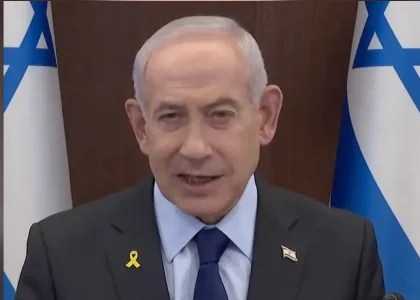
Israeli officials across the political spectrum rallied behind President Donald Trump’s successful operation to extract Maduro, with government ministers and opposition figures in the Israeli political establishment celebrating the move as a devastating blow to Iran’s global influence operations.
Prime Minister Benjamin Netanyahu led the praise, posting congratulations on social media that saluted Trump’s “decisive resolve and the brilliant action of your brave soldiers.” Netanyahu’s statement referenced “bold and historic leadership on behalf of freedom and justice” without explicitly naming the Venezuela operation, though the timing left little doubt about his message.
In another press conference, Netanyahu continued to praise the United States’ operation in Venezuela. He proclaimed:
“I express the full support of the Israeli government for the determined decision and decisive action of the United States regarding Venezuela.
This is about restoring freedom and justice to another region of the world.
Across Latin America, we are witnessing a historic shift — countries returning to the American axis and renewing ties with Israel.”
As previously recorded by this author, the strategic reorientation Netanyahu has mentioned is nowhere more evident than in the Isaac Accords, an initiative whose underlying objective is the normalization of a regional order that guarantees Jewish primacy in the Western Hemisphere.
Foreign Minister Gideon Sa’ar issued the most comprehensive endorsement from Tel Aviv, commending what he called America’s role as “leader of the free world” in executing the operation. Sa’ar specifically expressed hope for renewed diplomatic relations between Israel and Venezuela, which Caracas severed in 2009 over Israel’s Operation Cast Lead in Gaza.
“Israel commends the United States’ operation, led by President Trump, which acted as the leader of the free world,” Sa’ar wrote. “At this historic moment, Israel stands alongside the freedom-loving Venezuelan people, who have suffered under Maduro’s illegal tyranny.”
The foreign minister continued with pointed language about regional security threats. “Israel welcomes the removal of the dictator who led a network of drugs and terror and hopes for the return of democracy to the country and for friendly relations between the states,” he stated. “The people of Venezuela deserve to exercise their democratic rights. South America deserves a future free from the axis of terror and drugs.”
Diaspora Affairs Minister Amichai Chikli from the ruling Likud Party drew the most explicit connections between Maduro’s capture and threats facing Israel, framing the operation as a direct message to Iran’s Supreme Leader Ali Khamenei.
“The capture of Nicolás Maduro is not only good news for the people dwelling in Caracas; it is also a devastating blow to the global axis of evil and a clear message to Khamenei,” Chikli declared. He elaborated on Venezuela’s alleged role in funding Iranian proxy networks. “Maduro did not run a country; he ran a criminal and drug empire that directly fueled Hezbollah and Iran.”
Chikli praised Trump’s approach as validation of hardline foreign policy. “President Trump’s decisive steps have once again proven that strong leadership is the only way to subdue dictators,” he wrote. “This is a direct battle between the values of freedom and the West and the dangerous alliance of radical Islam and communism.” He concluded simply that “the world is a safer place today.”
Opposition leader and former Prime Minister Yair Lapid of the Yesh Atid Party joined the chorus with his own warning to Tehran. “The regime in Iran should pay close attention to what is happening in Venezuela,” Lapid posted, issuing what analysts interpreted as a veiled threat amid ongoing protests in Iran over economic collapse.
Israeli security analysts view Maduro’s removal as potentially restricting Iranian Revolutionary Guard operations against Israeli targets throughout Latin America, cutting off weapons flows to the continent, and disrupting extensive oil smuggling operations between Venezuela and Iran that have helped Tehran evade sanctions.
The American political establishment, whose policies are demonstrably subservient to world Jewry, responded with equally fervent praise, viewing the capture of Nicolas Maduro as a significant strategic victory for the state of Israel.
U.S. Ambassador to Israel Mike Huckabee delivered some of the most forceful American praise for the operation, explicitly linking the Venezuela action to security concerns in his diplomatic posting. Speaking on Newsmax, Huckabee opened his reaction with religious fervor. “Well, my first reaction was to say, praise the Lord and thank you, President Trump,” the ambassador stated.
He then explained why Americans should view Venezuela through a Middle Eastern security lens. “A lot of people may not make the connection as to why this matters to us in the Middle East,” Huckabee said. “What they don’t know is that Hezbollah is very active in Venezuela.” The ambassador detailed the Iran connection that Israeli officials had emphasized. “There has been a 20-year partnership between Iran and Venezuela,” he explained. “The ties are deep, and Hezbollah operates in 12 different countries throughout South America.” In his conclusion remarks, Huckabee contended that the operation represented a global victory. “Good news for America, good news for the world,” he declared.
Welcome to Empire Judaica.
The chorus of approval from Israel and its advocates lays bare the grim reality for the American people: they are not citizens of a sovereign nation but unwitting actors in a geopolitical drama where they play supporting roles in a global imperium built for and by organized Jewry.
The US Has Invaded Venezuela to ‘Fight Drugs.’ Are Colombia and Mexico Next?
By Adam Dick | Peace and Prosperity Blog | January 4, 2026
On Saturday, United States President Donald Trump held a press conference to boast about his sending the US military hours earlier to bring destruction in Venezuela and drag off the leader of the nation’s government to America for incarceration and prosecution. It was all done in the name of fighting the war on drugs, though few people give much credit to the Trump administration’s repeated assertion that Venezuela President Nicolás Maduro was a drug kingpin responsible for a major share of fentanyl or cocaine shipments into America.
The US government, Trump declared, will “run” Venezuela for an undefined “period of time” that Trump declined to rule out, in answer to a question, could be measured in years. While the US is doing that, be prepared for Trump also to potentially direct the US military to invade at least two additional countries in the Western Hemisphere.
In October, I wrote about how Trump appeared to be making demands and taking actions preparatory for the US going to war in three countries — Venezuela, Colombia, and Mexico. The common reason given for taking military action in each country has been the same — advancing the US government’s war on drugs.
The current status is one down, at least two to go. While already bogged down in Venezuela, the next step may be for the US to proceed to attack two more Western Hemisphere countries. Indeed, during the press conference, Trump continued with comments suggesting both Colombia and Mexico are under threat from the US government’s drug war. In particular, Trump reaffirmed his previous declaration that Colombia President Gustavo Petro has “got to watch his ass” while accusing him of making cocaine and sending it into America, criticized the “cartels operating along our border” in reference to Mexico, and said more broadly that “we will crash the cartels.” One important question to consider is how much America may also crash due to the strain of military intervention in the Western Hemisphere.
Israeli police shoot dead Palestinian from Bedouin village in Negev
MEMO | January 4, 2026
Israeli police shot dead a Palestinian from the Bedouin village of Al-Tarabin in the Negev early Sunday, local media reported.
Al-Tarabin is an unrecognized Palestinian Bedouin village located in the Negev Desert in southern Israel.
According to the daily Yedioth Ahronoth, a special police unit and soldiers from the “National Guard” raided the village to arrest Mohammed Hussein Tarabin for his alleged involvement in acts of vandalism against property in nearby Israeli settlements.
The National Guard is a security force formed by far-right National Security Minister Itamar Ben-Gvir and is viewed by the Israeli opposition as a militia under his direct authority.
The newspaper quoted Tarabin’s family as saying that police shot their son “without cause.”
“He is an ordinary man with seven children. There was no need to kill him,” the family said.
“For them (the police), this is a great achievement to please Ben-Gvir, who dances on Arab blood. The situation is dangerous, the behavior of the police is unacceptable, and they must leave the area or they will bear responsibility for anything that happens.”
Ben-Gvir, for his part, said on the US social media company X that he supported the police’s conduct in Al-Tarabin village, claiming that “Mohammed Tarabin” was a “dangerous criminal.”
The Negev Bedouin Leadership condemned the killing and called for Ben-Gvir’s dismissal.
It called for an investigation into the circumstances of the killing and bringing those responsible to justice.
Tens of thousands of Bedouins live in dozens of unrecognized villages in the Negev, with Israeli authorities denying them access to water, electricity, infrastructure, schools and medical clinics.
Trump Says Venezuelan Vice President Will Pay Higher Price Than Maduro if She Disobeys US
Sputnik – 04.01.2026
US President Donald Trump warned on Sunday that Venezuelan Vice President Delcy Rodriguez might have to pay an even higher price than Venezuelan President Nicolas Maduro if she did not make the “right” decisions.
Trump said on Saturday that the US would not send troops to Venezuela if Rodriguez did what Washington wanted from her. The US leader claimed that Rodriguez was willing to cooperate with the US.
“If she doesn’t do what’s right, she is going to pay a very big price, probably bigger than Maduro,” Trump said in a telephone interview with the Atlantic magazine.
Trump also said that the US “absolutely” needed Greenland as the Danish island is allegedly surrounded by Chinese and Russian ships.
“We do need Greenland, absolutely,” Trump said.
The island, which is part of Denmark, a NATO ally, is allegedly “surrounded by Russian and Chinese ships,” the US president added.
Climate extremists claim responsibility for blackout affecting 50,000 households
RT | January 4, 2026
 A group of self-described climate activists has claimed responsibility for a massive power outage that hit five districts in southwestern Berlin, saying the action targeted the fossil fuel industry and “the rich.”
Up to 50,000 households and 2,200 commercial entities were affected by the blackout in the early hours of Saturday, a spokesman for the local electricity provider, Stromnetz Berlin, told the Berliner Zeitung. “Full restoration of power supply” is expected no sooner than January 8, according to the company. The residents of the affected areas would have to remain without power in “freezing temperatures” ranging from -7C to -1C, the paper reported.
Police are treating the incident as a targeted arson attack, according to local media. The blackout was caused by a blaze that hit a power bridge over the Teltow Canal, which goes through the southern part of the city. Several nursing homes and elderly care centers had to be evacuated because of the incident, according to a local fire department. No casualties have been reported in connection to the incident.
Police also said they had received a letter signed by the “Volcano Group” on Saturday evening, in which the climate activists and anti-Fascists claimed responsibility for the incident. The group blamed the industrial extraction of natural resources for the “destruction” of Earth and that humanity “can no longer afford the rich.” The group then said they had “successfully sabotaged” a gas power plant, adding that their action was “socially beneficial” and targeted the fossil fuel industry.
The regional office of the German domestic security service was verifying the letter’s authenticity, according to the police.
According to the Berliner Zeitung, the group had carried out similar attacks in the past. They claimed responsibility for the sabotage of two power cables in southeastern Berlin in September. That attack also left around 50,000 households without power at the time.
USA seizes Maduro, but nothing is guaranteed regarding Venezuela’s future
By Raphael Machado | Strategic Culture Foundation | January 4, 2026
Following an operation that began at 2:00 AM Caracas time, U.S. special forces undertook the seizure of Venezuelan President Nicolás Maduro and his wife Cilia Flores and extracted them from the country. The operation lasted only 30 minutes and involved little more than a handful of helicopters, operating very close to the ground.
The U.S. government and its supporters reacted with euphoria to the operation’s “great feat.” Donald Trump stated that only the USA could do something like this.
Nevertheless, so far, the event resembles more of a propaganda fireworks display than a great military feat. And this is because the extraction appears to have taken place, by all indications, without any opposition from the Venezuelan state.
For months – since tensions between the USA and Venezuela intensified – there has been speculation about the existence of secret negotiations between Maduro and Trump. Newspapers like the New York Times, in fact, reported that Maduro had offered “everything” to Trump, but that he had refused the various offers.
Several other negotiations are said to have occurred, including an offer for Maduro’s exit, but with the maintenance of the Bolivarian system in power and with U.S. co-participation in the exploitation of Venezuelan oil alongside PDVSA. Supposedly, the USA would have refused these offers.
It is also important to point out that at least since November 2025, the Brazilian and Colombian governments have been trying to convince Nicolás Maduro to resign. The important Brazilian businessman and lobbyist Joesley Batista, who is an ally of both Lula and, today, of Trump, is said to have traveled to Caracas to negotiate an exit for Maduro. Supposedly, without success.
And yet, the fact remains: any portable anti-aircraft system, like a MANPAD, could have shot down any of the Apaches used in the operation. But none were used. In fact, there is no evidence of the use of Venezuelan defensive systems during the operation. The official narrative says they were all simply “deactivated.” This might perhaps explain the inaction of the BUKs, but not the absence of use of other systems.
Furthermore, we have not seen signs similar to those in Syria, with the mass desertion of military personnel. Padrino López and Diosdado Cabello, respectively Ministers of Defense and Interior, have full control over the Armed Forces and the Bolivarian National Guard. The streets are, by all indications, calm. There are no celebrations by oppositionists, nor any movement by the opposition in general.
Perhaps Maduro’s removal was, in fact, negotiated. But not necessarily with Maduro himself. It is impossible, however, to point decisively to someone responsible for this. In a purely technical sense, naturally, the primary responsibilities would fall on Venezuelan counterintelligence and Maduro’s personal security apparatus – but, in this case, it may have simply been a matter of failure, more than betrayal.
Now, it is premature to properly speak of a “regime change” in Venezuela.
In his statements to the press immediately after the operation, Donald Trump stated that the USA would conduct a “political transition” in Venezuela; but there is, truly, no U.S. presence in Venezuela at this moment. Whoever expects a takeover by María Corina Machado is mistaken: Trump has already ruled her out, considering her inept due to her lack of popularity with the Venezuelan people. On the contrary, he seems satisfied with dealing with Delcy Rodríguez, who has already assumed Venezuelan leadership, supported by consensus by Chavista governors, ministers, and generals.
Trump claims that Rodríguez would be willing to collaborate completely with the USA and, in practice, “hand over” Venezuelan oil. But all public statements from Venezuela so far go in the direction of condemning the seizure, demanding Maduro’s return, and emphasizing that Venezuela will resist Trump’s ambitions. In other words, there exists a problematic gap between Trump’s declarations and what is really happening in Venezuela.
Naturally, the possibility is not excluded, for example, of a potential “backroom deal,” allowing the USA to operate in the Venezuelan oil sector, with Chavismo maintained in power in Caracas. Maduro’s fate in a negotiation of this type remains open. Everything is possible, from the death penalty to exile, including a prison sentence with eventual release.
The main political actor in Venezuela, however, is the armed forces, not the PSUV, nor even Maduro. And regardless of the arrangement reached and Venezuela’s near political future, this is unlikely to change.
What is evident, however, is that we have here a significant change in the international panorama. The USA treated the operation as a “police action” – Maduro is being indicted for crimes ranging from drug trafficking to possession of machine guns (!) in violation of U.S. firearms legislation (!!), treating Venezuelan territory, in practice, as if it were U.S. territory.
The mutual recognition between countries as sovereign states and, therefore, legitimate belligerents in case of conflict, implying obedience to certain rules of engagement, constitutes a significant achievement of civilizations. The criminalization of foreign sovereigns opens the door to savagery and to unlimited conflicts devoid of rules of civility.
But beyond this dimension of a return to the same mentality of the piracy era, it becomes quite clear that appeals to International Law and the UN are, today, of little effectiveness.
The world is being redrawn into spheres of influence, and only military might and the willingness to use it seem to be effective barriers against foreign interventions.
US facing second Vietnam in Venezuela – expert
RT | January 4, 2026
Any prolonged US effort to control Venezuela would likely face fierce resistance similar to what Washington encountered during the Vietnam or Iraq wars, Daniel Shaw, a professor of Latin American Studies at City University of New York, has told RT.
In an interview aired on Sunday, the scholar suggested that Venezuelans would not accept foreign rule following the abduction of Venezuelan President Nicolas Maduro during an unprecedented US raid on Caracas.
“This is going to spill open into a type of Vietnamese resistance or Iraqi resistance,” Shaw said.
Shaw said that on top of Maduro’s “anti-imperialist leadership,” Venezuela’s policies had been shaped by nearly three decades of what he described as political training in “chavismo,” referring to the socialist policies of late Venezuelan President Hugo Chavez.
“The Venezuelan people … are never going to allow for the US to take them over,” he said.
Asked about the most feasible scenario if the US remains in charge for an extended period, Shaw framed the potential confrontation as a “David versus Goliath” struggle, adding that protests and demonstrations were likely and raised the prospect of “pockets of guerrilla resistance over time,” while acknowledging Venezuela was militarily outmatched.
He also acknowledged that international condemnation and declarations of solidarity – including from Russia and several regional powers – would be unlikely on their own to alter the situation. “If there’s no resistance from within the US military, it would be very difficult to imagine that the Venezuelan people could defeat what looks like a US colonial occupation,” he added.
US President Donald Trump has said Washington would temporarily “run” Venezuela following Maduro’s kidnapping, prompting backlash from Caracas. Washington has so far refrained from a large-scale invasion of the country, but maintains a significant military presence in the Caribbean.
The US wars in Vietnam and Iraq became cautionary tales against open-ended foreign interventions after dragging on for years, killing thousands of US troops, consuming trillions of dollars, and ending without a clear outcome. … Video interview
Russians to the Dnieper – Part 33 of the Anglo-American War on Russia
Tales of the American Empire | January 1, 2026
The war in Ukraine grinds on with Russian forces advancing slowly everywhere while slicing and dicing the Ukrainian army. Eventually the front line will collapse and the much larger Russian army will roll forth and across bridges over the mighty Dnieper River. This is inevitable, so pro-Ukrainian foreigners are pushing Ukraine to accept Russian demands for a peace deal. Unfortunately, the Ukrainian government is controlled by neocons and other warmongering psychopaths in Europe, to include NATO Generals. They want Ukraine to fight on to force Russia to take all of Ukraine.
_________________________________
“Poland says US offering 250 used Strykers for $1, with Warsaw prepared to accept”; Breaking Defense; December 5, 2025; https://breakingdefense.com/2025/12/p…
“Operation Atlantic Resolve”; DoD IG; Jan-Mar 2025; details on the semi-secret shell game to fund Ukraine; https://www.stateoig.gov/uploads/repo…
“Military Summary” channel; YouTube; daily war updates;  / @militarysummary
Related Tales: “The Anglo-American War on Russia”; • The Anglo-American War on Russia
Palestine advocates praise NYC Mayor Mamdani for revoking pro-Israel decrees
Press TV – January 3, 2026
New York City’s Mayor Zohran Mamdani has been praised by Palestine advocates for revoking pro-Israeli decrees banning the activities of pro-Palestinian advocacy groups.
Within hours of his inauguration ceremony on Wednesday, just before midnight, on his first day in office on Thursday, Mamdani wiped out all the executive orders his predecessor, Eric Adams, implemented after September 26, 2024, the day Adams was charged with bribery and taking illegal campaign contributions from foreign sources.
Adams signed the pro-Israeli decrees less than a month ago and was seen as an attempt to create trouble for the incoming 34-year-old Mamdani.
Adams was also charged with crimes such as conspiracy, wire fraud, and bribery. The 64-year-old Democratic policeman-turned-mayor was accused of doing favors for foreign businessmen in exchange for luxury travel and airline benefits.
Head of the New York chapter of the Council on American Islamic Relations (CAIR), Afaf Nasher, praised Mayor Mamdani for revoking a decree restricting the ability of New Yorkers to criticize, boycott, and stage protest rallies and criticize the Israeli regime for the ongoing racism and human rights abuses against Palestinians, as well as the genocidal war on the Gaza Strip.
Palestinian-American writer YL Al-Sheikh also applauded Mayor Mamdani for the revocation of Adam’s pro-Israeli decrees.
“I think it’s wonderful that Mayor Mamdani took measures on day one to reinforce our rights to free speech, which included our right to criticize and oppose Israeli apartheid and genocide,” Al-Sheikh said.
He said the decrees passed by Adams were “not about combating anti-Semitism, but about stifling dissent, and this should be something all Americans oppose.”
Nasreen Issa, a member of the Palestine Youth Movement – NYC, said, “Mamdani’s rejection of this is a positive step towards protecting the rights of New Yorkers and the dignity of Palestinians.”
Mayor Mamdani is the city’s first Muslim, first South Asian, first African-born mayor, and the first to take the oath of office using Islam’s holy book, the Quran.
The inauguration ceremony was held on Wednesday shortly before the start of New Year’s Day 2026 in the decommissioned City Hall subway station beneath Lower Manhattan.
Israel and the politics of fragmentation: The hidden hand behind secessionist projects in Yemen, Somalia, and Libya
By Ahmed Asmar | MEMO | January 3, 2026
Israel’s malicious, meddling role in the Arab countries has long extended beyond direct military confrontation, as seen in Palestine, Lebanon, and Syria. For long, Tel Aviv has pursued a quieter yet dangerous strategy of encouraging fragmentation, weakening central states, and cultivating ties with separatist actors in fragile and war-torn countries. Today, this pattern is increasingly clear and visible in Yemen, Somalia, and Libya; three countries that suffer from prolonged conflicts, administrative collapse, and foreign interference. In each case, Israel’s footprint is not accidental; it serves a broader strategic doctrine aimed at dividing Arab countries, controlling critical waterways, and reshaping the regional balance of power to its advantage and dominance.
Yemen: secession as a gateway to normalisation
In Yemen, Israel’s indirect involvement surfaces through its alignment with the so-called Southern Transitional Council (STC), a secessionist entity seeking to reestablish an independent state in southern Yemen. While the Yemeni conflict is often framed as a regional proxy war, the STC’s leader, Aidarous al-Zubaidi, has openly, and on several occasions, signaled willingness to normalize relations with Israel. He publicly declared that recognizing Israel is not an obstacle if southern Yemen’s independence is achieved; an extraordinary statement that was slammed by many Yemeni public figures and politicians.
This declaration is not merely rhetorical. Yemen’s southern geography grants access to some of the most sensitive maritime corridors in the world, particularly near the Bab al-Mandeb Strait. For Israel, influence over forces operating near this chokepoint aligns with its long-standing objective of securing Red Sea navigation and countering its perceived regional adversaries. Supporting or encouraging secessionist forces in southern Yemen offers Israel a strategic foothold without formal military deployment, turning internal Yemeni fragmentation into a geopolitical asset, and posing a direct threat against the Arab countries, especially the littoral countries of the Red Sea – Egypt and Saudi Arabia.
Somalia: Somaliland and the militarisation of recognition
Somalia presents an even clearer case of Israel exploiting separatism for strategic gain. The self-declared Republic of Somaliland, unrecognised by the international community, has actively sought foreign backing to legitimise its secession. Israel’s contacts and recognition of Somaliland’s de-facto authorities mark a dangerous precedent in international relations, and against the international law and the UN charter.
The strategic motivation is transparent. Somaliland’s coastline also overlooks the Bab al-Mandeb Strait and the Gulf of Aden, one of the world’s most critical maritime corridors. Somalia’s President Hassan Sheikh Mohamud warned of the Israeli malicious plan behind such recognition, where he said that Israel seeks from recognising Somaliland to resettle Palestinians from Gaza, who experienced a two-year genocide, and most importantly, to host an Israeli military or intelligence base. These plans are added to the dangers of undermining Somalia’s territorial integrity and encouraging further fragmentations across the Horn of Africa.
Israel’s move to recognize a secessionist entity reflects how Israel exploits weak entities and divided states to move ahead with its expansionist and dominance strategies at the expense of the region and its people.
Libya: Haftar and the normalisation through the back door
Not far from the examples in Yemen and Somalia, in Libya, Israel’s role is more discreet but visible too. General Khalifa Haftar, who controls eastern Libya and has long sought international legitimacy, reportedly maintained contacts with Israeli officials as part of efforts to secure external backing. These interactions fit within a wider pattern of covert normalization between Israel and authoritarian or factional actors seeking foreign support in exchange for political concessions.
Libya’s fragmentation has turned it into fertile ground for foreign manipulation. Israel’s engagement with Haftar is surely not about peace or stability, but about influence, leverage, and having a close foot near its surrounding Arab countries.
Fragmentation as a strategic doctrine
Altogether, Yemen, Somalia, and Libya illustrate a consistent Israeli strategy: exploiting internal conflicts to advance a regional agenda based on fragmentation. This approach intersects with Israel’s ongoing territorial expansion and military aggression, from its occupation of Palestinian land to its violations of sovereignty in Syria and Lebanon. Fragmented Arab states are less capable of resisting Israeli policies and more exposed to normalization under opportunistic conditions.
Israel’s encouragement of secessionist movements is not about supporting self-determination; it is about redrawing the region into weaker, smaller entities incapable of collective action. This strategy directly threatens Arab national security as a whole, adding a new dimension to Israel’s expansionism.
At a time when the Arab world faces unprecedented challenges, recognising and confronting this hidden hand of fragmentation is essential. While ignoring Israel’s role in these secessionist projects risks allowing instability to become permanent, solely in favor of Israel in the region and beyond.
U.S. Ambassador To Israel, Mike Huckabee, Boasts That Regime Change In Venezuela Is Good For Israel.
The Dissident | January 3, 2026
On a recent appearance on Newsmax, the American Christian Zionist ambassador to Israel, Mike Huckabee, boasted that Trump’s recent kidnapping of Venezuela’s president, Nicolas Maduro, was good for Israel.
In the interview, Huckabee boasted, “A lot of people may not make the connection as to why this matters to us in the Middle East, what they don’t know is that Hezbollah is very active in Venezuela, there has been a 20-year partnership between Iran and Venezuela… the ties are deep.”
Huckabee boasted that Trump’s regime change operation “Is going to make life for us much safer in the Middle East.”
Israel’s support for American wars in the Middle East is well known, but its support for war in Venezuela is often less discussed.
But just as Israel wants to take out states in the Middle East that were too sympathetic to Palestinians, they have also wanted to take out Venezuela due to the country’s support for Palestinians and Palestinian resistance under Hugo Chavez and his successor, Nicolas Maduro.
As Middle East Eye noted in 2019, “Israel wants to see Maduro overthrown in Venezuela”.
The outlet noted that, “the US-Israeli support for overthrowing Maduro is part of a larger agenda to cement an anti-Palestinian campaign in Latin America at the expense of the Venezuelan people.”
The outlet noted that this was because “Solidarity with the Palestinian struggle for self-determination was at its height during the Chavez years up until today, with the leadership making outspoken criticism of Israel’s flagrant violations of international law. Venezuela severed diplomatic ties with Israel in 2009 over its military campaign in Gaza.”
A recent article in the outlet Israel Hayom, an Israeli newspaper funded by Zionist mega donor Miriam Addison- who Trump recently boasted “gave my campaign $250 million”- explained why Israel wants regime change in Venezuela, writing, “Since Hugo Chávez’s rise to power, Venezuela has become one of the most hostile countries to Israel and Zionism in Latin America” adding that Chavez, “severed diplomatic relations with Israel during Operation Cast Lead in 2009, accused Israel of ‘genocide against the Palestinian people’ and compared its policies to Nazi conduct”.
The outlet added that Maduro, “continued the anti-Israeli line with even more intensity. Thus, Venezuela, which previously maintained warm relations with Israel and even purchased security technologies from it, became a center of hostile propaganda toward Zionism”.
For this reason, Israel long cultivated a close relationship with Maria Corina Machado the U.S. asset in Venezuela who was used as a tool to advance Trump’s recent kidnapping of Maduro, and who hoped to be installed by the U.S. and Israel, only to be snubbed by Trump who said after the operation that she, “doesn’t have the support” to be installed as the leader of Venezuela.
Israel’s ruling Likud party, as far back as 2020, signed a cooperation agreement with Machado’s Vente Venezuela party, which promised to “bring the people of Israel closer to the people of Venezuela while advancing, together, the Western values to which both parties subscribe: freedom, liberty, and a market economy.”
In the aforementioned article in Israel Hayom, Machado promised that Venezuela will be “Israel’s closest ally in Latin America” if Maduro is removed and even heavily implied that Israel was directly taking part in the regime change operation, saying, “We rely on Israel’s support in dismantling Maduro’s crime regime”.
When asked by Israel Hayom how “Israel can support freedom movements in Venezuela without being accused of interference,” Machado signalled that Israel was already interfering in Venezuela and taking part in the regime change operation, saying, “Defending freedom, individual liberties, and democracy isn’t interference … Israel understands this”.
While oil is the most obvious motivation behind the kidnapping of Maduro, getting rid of one of the” hostile countries to Israel and Zionism in Latin America” and returning Venezuela to when it “maintained warm relations with Israel and even purchased security technologies from it” has undoubtedly played a role as well.
Barnes Against the Blackout
By Spencer J. Quinn | The Occidental Observer | January 2, 2026
In short, there is no unique or special case against Nazi barbarism and horrors unless one assumes that it is far more wicked to exterminate Jews than to massacre Gentiles. While this latter value judgment appears to have become rather generally accepted in the Western world since 1945, I am personally still quaint enough to hold it to be reprehensible to exterminate either Jews or Gentiles.”
—Harry Elmer Barnes
INTRODUCTION
Anyone still questioning the relevance of World War II revisionism to politics today should realize how often our liberal, globalist elites not only invoke World War II, but also ignore, suppress, or besmirch revisionism. Whenever a mainstream personality invites a revisionist on his program, he gets swiftly rebuked and called a Nazi not only by the Left but also by people presumably on the Right. Recently, Jewish commentator Mark Levin invoked the massacre of German civilians during World War II to justify the ethnic cleansing of Gaza. Clearly, whenever someone questions the authority of our liberal elites, they fire back with World War II. Since Adolf Hitler and the Nazis represent the most extreme form of evil and since globalist liberalism is the ideological opposite of Nazism, any form of oppression and aggression by globalist liberals is justifiable—as long as it is aimed against so-called “Nazis.” And if you happen to be against liberalism or globalism these days, it’s only a matter of time before you get dubbed a “Nazi.”
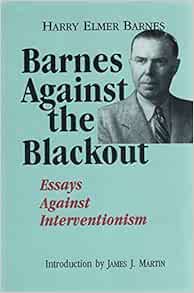
Historian Harry Elmer Barnes understood this perfectly over seventy years ago and promoted revisionism in the face of eerily similar oppression and backlash. Nine of his most incisive essays on the topic—written between 1951 and 1962—are collected in Barnes Against the Blackout, which was published by the Institute for Historical Review in 1991. Several important themes run through these essays. First, Barnes wishes to proselytize revisionism, and does so by constantly referencing and summarizing the great American works of revisionism of his day. These include:
- American Foreign Policy in the Making, 1932-1940 (1946) and President Roosevelt and the Coming of the War, 1941 (1948) by Charles Beard
- America’s Second Crusade (1950) by William Chamberlin
- The Roosevelt Myth (1948) by John T. Flynn
- Pearl Harbor: The Story of the Secret War (1947) by George Morgenstern
- The Tragedy of Europe (1940-1945) and Makers of War (1950) by Francis Neilson
- Design for War (1951) by Frederic Sanborn
- Back Door to War: The Roosevelt Foreign Policy 1933-1941 (1952) by Charles Tansill
Given the suffocating interventionist hysteria of the time, major publishers declined to publish these volumes despite how many of them had been written by prominent, well-respected historians. Either the publishers were ardent interventionists themselves, or they feared backlash from anti-revisionists who wielded great power in America, just as they do today. Except for the Neilson volumes, which were self-published, these works found only two small publishing houses brave enough to publish them: Regnery and Devin-Adair.
Two later volumes which Barnes discusses often are The Origins of the Second World War (1961) by AJP Taylor and The Forced War (1961) by David Hoggan. (See part one of my three-part review of Hoggan here.) These prove to be slight exceptions to Barnes’ America-centric approach since Taylor was British, and, although Hoggan was American, his work was only available in German at the time.
Another crucial theme running through Barnes Against the Blackout is the presentation of the evidence for revisionism. How do we know the official war narratives are less correct than what the revisionists offer? Barnes is never shy about sharing this information—and there is a lot of it. As with many essay collections from a single author about a single topic, there’s much overlap. And that’s okay. It’s never too much of a good thing revealing how President Franklin Delano Roosevelt “lied the United States into war.”
Describing exactly how the establishment suppressed revisionism in Barnes’ day emerges as another important theme. Barnes focuses on it most in his first two essays, both published in 1953: “Revisionism and the Historical Blackout” (which also serves as the first chapter in his collection Perpetual War for Perpetual Peace from the same year) and “The Court Historians Versus Revisionism.”
Barnes’ final theme is also his most speculative: extending revisionism into the Cold War and postulating how it might avert a nuclear Armageddon. Here is where we find Barnes at his most stunningly prescient but also were he winds up, in spots, to be somewhat dated. Through it all, he utilizes George Orwell’s 1984, which never fails to produce a parallel for whatever point Barnes wishes to make. He explores this novel’s uncanny mirroring of reality in the book’s final essay, 1952’s “How ‘Nineteen Eighty-Four’ Trends Threaten American Peace, Freedom, and Prosperity.”
Barnes Against the Blackout is also interesting for its seemingly negligible treatment of the Jews. Barnes says very little about them directly. However, this amounts to what I call an anti-theme because any reader familiar with Jewish power and supremacy can fill in the blanks where Barnes could have opined about the Jews, but didn’t—or at least didn’t seem to. This adds an extra layer of meaning to Barnes Against the Blackout.
THE EVIDENCE
The evidence for World War II revisionism which Barnes compiles appears in two distinct yet related branches of history: Pearl Harbor revisionism and Western European revisionism. For the former, he relies greatly on Tansill, Sanborn, and Morgenstern, and demonstrates how the U.S. not only goaded the Japanese into attacking as a “back door to war” against Japan’s ally Nazi Germany, but also knew where the attack would occur and approximately when, thereby outraging the American public into supporting military intervention. Barnes believes this “constituted one of the major public crimes of human history.”
The major facts line up as so:
- Roosevelt floated war with the Japanese as early as 1933 during one of his first cabinet meetings.
- The U.S. aided and encouraged Chiang Kai Shek to fight against the Japanese in China during the 1930s.
- Days before the Pearl Harbor attack, Roosevelt ignored Japanese Prince Fumimaro Konoye’s peace overtures which proposed humiliating concessions for Japan in return for “a little time and a face-saving formula.”
- In early 1941 Ambassador Joseph Grew had clearly warned that Pearl Harbor would be the likeliest point of attack. Despite agreements from Washington, US forces at Pearl Harbor remained unprepared for it.
- Secretary of War Henry Stimson stated on November 25, 1941 that, “the question was how we should maneuver them [the Japanese] into the position of firing the first shot without too much danger to ourselves.”
- The US had intercepted the “East Wind Rain” message three days before the attack, which clearly signaled Japanese intentions. Yet Admiral Husband Kimmel and Lieutenant General Walter Short, who were responsible for Pearl Harbor, were kept in the dark about it.
Barnes presents most of this information while piercing holes in the specious logic of pro-interventionist works written by what he calls “court historians.” The two most relevant to Pearl Harbor are Herbert Feis, who wrote The Road to Pearl Harbor (1950), and Basil Rouch, who wrote Roosevelt from Munich to Pearl Harbor (1950). Barnes demonstrates how these historians either ignored, distorted, or misconstrued the above evidence. His point is clear: if the notions of Pearl Harbor being a surprise attack and Roosevelt’s naïve innocence about it were lies, there’s no telling what other lies had been told. It turns out there were many.
As for Western Europe, the facts are equally damning, if perhaps more voluminous. All of them cannot be included a single review, but the points Barnes most often bangs home include:
- The diplomatic history of the 1930s, as collected by Taylor and Hoggan, shows that Adolf Hitler did not want war and did what he could to avoid it.
- The diplomatic history also reveals that Hitler had made reasonable requests to Poland regarding the “international” (yet very German) city of Danzig; yet Polish leaders refused to negotiate at the urging of Lord Halifax in England who had given Poland a “blank check” assurance of English military support against Germany.
- In his last report as Chief of Staff in 1945, General George Marshall had claimed that Hitler “far from having any plan of world domination, did not even have any well-worked-out plan for collaborating with his Axis allies in limited wars, to say nothing of the gigantic task of conquering Russia.”
- Hitler had allowed tens of thousands of British troops to escape at Dunkirk “to promote peace sentiments in Britain.”
- Hitler had excellent reasons to invade the Soviet Union since the Soviets had “practiced sabotage, terrorism, and espionage against Germany, had resisted German attempts to establish a stable order in Europe, had conspired with Great Britain in the Balkans, and had menaced the Third Reich with troop concentrations.”
- Documentary evidence, such as “The German White Paper” found by the Germans after their conquest of Poland, demonstrates the extent to which American ambassador William Bullitt had assured Poland of American military support in the event of war with Germany. This was corroborated by Czechoslovak president Eduard Benés who claimed in his autobiography that on May 29th, 1939 Roosevelt himself had assured him that if war broke out in Europe, America would join the fight against Germany.
- The Lend-Lease program, the “Destroyer Deal” between Britain and the United States, the secret Tyler Kent documents, and Roosevelt’s 1941 meeting with Winston Churchill in Newfoundland offer circumstantial evidence that Roosevelt had clear belligerent intentions well before war was declared.
As with Pearl Harbor, Barnes often presents this evidence while reviewing books written by court historians. The most prominent of these is The Struggle Against Isolation, 1937–1940 (1952) by William Langer and SE Gleason. Despite never proclaiming Hitler’s innocence, Barnes repeatedly stresses that the man’s sole responsibility for starting the war is a complete falsehood—a falsehood which is the foundation of all post-1945 politics. In his 1962 essay “Revisionism and Brainwashing,” he states with characteristic flourish:
It is unlikely that there has been any vested interest in dogma, opinion, and politics since the birth, death, and resurrection of Jesus Christ equal in intensity to that built up around the allegation that Hitler was solely responsible for the outbreak of war in 1939.
One interesting side note: Barnes implies more than once that it was Hitler’s actions in East Asia rather than Europe which truly antagonized Roosevelt. This contradicts some of Barnes’ other claims about Roosevelt’s opposition to Hitler vis-à-vis Europe. Take, for example, this paragraph from the essay “Rauch on Roosevelt”:
Indeed, it was only in 1938, when Hitler recalled his military mission from China, where Nazi officers had been directing the forces of Chiang Kai-shek against the Japanese, that Roosevelt became actually hostile to Hitler in his policies, whatever the previous rhetoric. Right down through the Spanish Civil War, Mr. Roosevelt condoned when he did not favor, most of Hitler’s policies. Even as late as August, 1939, it appears from the Nazi Soviet Relations that Roosevelt was inclined to put nothing in the way of Hitler if he abandoned support of Japan, sent his military back to help Chiang, and delivered arms to the Chinese.
This is an interesting conundrum considering that Barnes brings up Benés’ recollection from May 1939 in the same essay.
THE BLACKOUT
Barnes spills a lot of ink outlining the ways in which revisionism was suppressed and marginalized after 1945. This often resulted from mainstream historians either having vested professional interests in perpetuating the “good war” myth of World War II—since they themselves promoted it while it was happening—or they sought the wealth, fame, and opportunity afforded to academics who adhered to the official narrative of the war.
In “Revisionism and the Historical Blackout” Barnes enumerates the following methods of suppression:
- Excluding revisionists from official documents, while allowing state-approved court historians free access to them
Barnes describes how revisionist historians had been barred from viewing many sensitive documents and in some cases had had their own notes confiscated after viewing the ones they were allowed to see. Barnes concedes that Charles Tansill did ultimately view more documents than other revisionists, but Tansill did not enjoy the free reign of information afforded to court historians like Langer and Feis.
- Intimidating publishers into not publishing revisionism
Barnes describes how political pressure groups not only ensured that revisionist volumes would not sell, but made it clear that publishers releasing such material would face business-crippling backlash. Barnes recalls how a major publisher explained this to him despite his personal sympathies towards revisionism. Libraries, book clubs, and nationwide periodicals also contributed to this blackout. Barnes mordantly notes that the post-1945 “Blackout Boys” outdid the Nazis in suppressing honest intellectual inquiry.
- Ignoring revisionist works that do get published
Barnes demonstrates how the majority of revisionist works simply did not get reviewed in important mainstream publications—or when they did, as with the case of Charles Beard, they received either cursory attention or were maliciously panned. It almost goes without saying that this silent treatment was not afforded to court historians, whose works received ample praise everywhere. Barnes relays the following recollection from journalist Oswald Garrison Villard to illustrate his point:
I myself rang up a magazine which some months previously had asked me to review a book for them and asked if they would accept another review from me. The answer was, “Yes, of course. What book had you in mind?” I replied, “Morgenstern’s Pearl Harbor.”
“Oh, that’s that new book attacking F.D.R. and the war, isn’t it?”
“Yes.”
“Well, how do you stand on it?”
“I believe, since his book is based on the records of the Pearl Harbor inquiry, he is right.”
“Oh, we don’t handle books of that type. It is against our policy.”
- Smearing revisionists personally
Barnes offers several examples of ad hominem attacks upon revisionist historians by the “Smearbund,” as he calls them. Often “isolationism” itself became a slur, as if labeling a person thusly were reason enough to dismiss him. More often, however, reviewers would attempt to ruin a revisionist’s reputation by imputing some evil or underhanded motive rather than argue the facts. Barnes notes how reviewers used phrases such as “bitterly partisan” or “blind anger” when describing Morgenstern while ignoring their own partisan anger. He also notes how one reviewer attempted to discredit Beard because he was hard of hearing and lived on a farm. One reviewer freely admitted to lambasting The Forced War without having read a word of it.
THE COLD WAR AND BEYOND
In his 1954 essay “The Chickens of the Interventionist Liberals Have Come Home to Roost,” Harry Elmer Barnes introduces the idea of the “totalitarian liberal.” Such men (as exemplified by Arthur Schlessinger Jr.) distinguished themselves from pre-World-War-II liberals in their lust for power and abandonment of principled anti-interventionism. Such men make up James Burnham’s managerial elite as described in his 1941 work The Managerial Revolution, which Barnes discusses. Such people reject “the coexistence of conflicting political and economic systems,” and in so doing promote a “we or they psychosis” which enables elites to wage war in the name of “collective security,” a notion which Barnes finds utterly spurious. This is how it was during World War II and it was no different during the Cold War, according to Barnes, except that both sides were mutually deterred by nuclear weapons.
Barnes further extends revisionism into the Cold War in his 1958 essay “Revisionism and the Promotion of Peace.” He remembers how despite standing against World-War-II intervention, patriotic political organizations like America First later fell in line with Cold War intervention “because of the business advantages in industry, trade and finance which an extravagant armament program provided.” President Eisenhower’s “military industrial complex,” in other words. In light of this, Barnes’ passionate belief in the critical importance of revisionism becomes crystal clear. If standing against intervention in 1939 could have spared tens of millions of lives, standing against it during the Cold War could spare humanity a nuclear Armageddon. Indeed, the specter of World War III haunts much of Barnes Against the Blackout.
The final essay in the collection, “How ‘Nineteen Eighty-Four’ Trends Threaten American Peace, Freedom, and Prosperity” takes the Cold War comparison even further. The “we or they psychosis” becomes the “war psychology,” which led to the absurdity of “perpetual war through perpetual peace.” This is straight out of Orwell’s 1984, which Barnes calls “the keenest and most penetrating work produced in this generation on the current trends in national policy and world affairs.” In the novel, Big Brother (whom Barnes considers a totalitarian liberal) manufactures phony outrages to prolong phony wars designed ultimately to consolidate very real power for himself and the elite classes. And the masses are either hypnotized enough by propaganda, intimidated enough by government, or distracted enough by entertainment to go along with it. Meanwhile, all reliable historical material is destroyed to disconnect the people from their past—just like what the Blackout Boys tried to do with revisionist accounts of World War II. Barnes sees 1984 as a direct mirror to reality.
And there is much truth to this, as shown by how Barnes uses his “Orwell Formula” to predict the Vietnam War as early as 1952:
The declining public interest in the Korean War has made President Truman and his associates the more willing to accept Churchill’s proposal to shift the main psychological impact of the cold war to Indochina, where it may both revive flagging American fear and excitement and also more directly protect adjacent British interests. The Orwell formula has been faithfully worked out in first directing fear and hatred against Nazi Germany, then against Soviet Russia, next shifting antagonism more toward Communist China, and then moving the chief center of interest in the struggle against the latter from Korea to Indochina.
Despite the clarity and prescience of this essay, Barnes makes a few questionable calls. In keeping with his aversion to the Orwellian doublethink of Cold War psychology and hysteria, he impugns the Truman Doctrine as a sham meant to “rehabilitate Mr. Truman’s fast-fading political prospects.” He also paints the USSR in a more benign light than it deserves—as if the United States were the aggressor during the Cold War and had no legitimate reason to employ deterrence or containment strategies against Communism. And in 1952, perhaps the Soviets did seem to some as unlikely to pose a real threat to American interests. But this was before they detonated their first hydrogen bomb in 1953. This was before their invasion of Hungary, and the Berlin Wall, and the Cuban Missile Crisis, and a host of other threatening actions. While Barnes makes excellent points about the injustice of blacking out revisionism, this was nothing compared to the psychological warfare the Soviets waged for decades against its own people which culminated in the terror famines, the Great Terror, and the gulags.
It seems that the Soviet Union during the Cold War made for a much more appropriate nemesis than did Nazi Germany. That Barnes seems to disagree, however, is not my bone of contention here. For all I know, Barnes is correct. However, the time he should have spent dispensing with counterarguments from seasoned cold warriors like George Kennan (who barely gets a mention in Barnes Against the Blackout) was instead spent admiring the life-imitating-art impact of 1984. Interesting and enlightening for sure, but hardly the final word on the subject.
THE JEWS
Direct treatment of the Jews in Barnes Against the Blackout rarely rises above incidental. Many of the “court historians” and “Blackout Boys” Barnes mentions do happen to be Jewish—Herbert Feis, Max Lerner, and Selig Adler are some obvious examples. However, just as many if not more are gentiles, such as William Langer, Samuel Eliot Morison, and Samuel Flagg Bemis. In his essays, Barnes never singles a person out as being Jewish. This certainly protects him from the charge of Jew-baiting, but it also prevents him from drawing conclusions from the fact that while a substantial proportion of anti-revisionists were Jews, none of the nine major revisionists mentioned in Part 1 were—clearly a meaningful data point.
When he does mention American Jews directly, it’s only to let them off the hook for pushing Roosevelt into war. In 1962’s “Blasting the Historical Blackout,” he states flatly that:
Roosevelt did not need any pressure from the Jews to create his interventionism and war policy. There is little evidence that he was deeply disturbed by Hitler’s anti-Jewish policy; he was much more annoyed by the fact that Hitler’s “New Deal” had succeeded in spectacular fashion while his own had failed to bring prosperity to the United States.
Maybe this is true, but it does not mean that influential Jews in media, finance, academia, and politics were not enthusiastic if not crucial facilitators of Roosevelt’s war policy. In his 2013 work How the Jews Defeated Hitler Benjamin Ginsburg describes how American Jews professed fierce loyalty to Roosevelt and did what they could to embroil the United States in a war with Germany. As I stated in my review:
Ginsburg describes how Jews in the private sector also war mongered during this time. The heavily Jewish Century Group called for a declaration of war against Germany following the surrender of France in 1940. The press also aided Jewish belligerence through its pro-Jewish bias. For example, when Lindbergh and the Century Group’s General John Pershing were giving speeches around the same time, the Jewish-owned New York Times gave Pershing front-page coverage and relegated Lindbergh to the back pages.
The Fight For Freedom Committee was more “all out” in its pro-war activities than the Century Group.
The FFF organized a nationwide effort –with the tacit support of the White House and the behind-the-scenes support of the British Embassy—to discredit isolationists and to mobilize public opinion against Germany and in support of American participation in the war.
And by “discredit,” of course, Ginsburg means ruthlessly slander and smear. The FFF thought nothing of labeling leading isolationists and America-Firsters like Lindbergh as Nazis, fascists, or dupes of the Axis. Ironically, they would often question the patriotism of such people as a form of intimidation which preceded the McCarthy era by over a decade. For example, because Senator Burton Wheeler wished to prevent the slaughter of American lives in an unnecessary war, the FFF declared that he was a “twentieth century Benedict Arnold.” The FFF also spied upon and collected compromising information on isolationists in Congress, such as Hamilton Fish. As it turned out, the FFF discovered that Fish’s people were distributing pro-German literature and were in contact with German agents. One of Fish’s secretaries went to prison for that. At the same time, however, Ginsburg informs us that the FFF was in constant contact with British agents. Just as insidiously, the FFF and other groups planted moles at isolationist rallies in order to disrupt them.
So perhaps President Roosevelt didn’t need Jews to change his mind, but he certainly needed them to change the minds of the millions of Americans he tried to deceive. Unfortunately, Barnes entirely avoids this point. His minimal treatment of the Jewish Holocaust in Barnes Versus the Black also deserves comment. He exerts almost no effort in placing it within his blackout vs. revisionists framework. Instead, he brushes it aside by saying that the Germans ultimately suffered more than the Jews did. He’s also skeptical that the Jewish Holocaust was the enormous atrocity it was purported to be:
There is little in the history of mankind more horrible than the sufferings of the Germans expelled from their eastern provinces, the Sudeten area, and other regions, some four to six millions perishing from butchery, starvation, exposure, and disease in the process. Their sufferings were obviously far more hideous and prolonged than those of the Jews said to have been exterminated in great numbers by the Nazis. The tragedy of Lidice was re-enacted by the Czechs hundreds of times at the expense of the Sudeten Germans during the expulsion. The Morgenthau Plan, which was inspired by Stalin and his associates and passed on to Henry Morgenthau by Harry Dexter White and other Soviet sympathizers, envisaged the starvation of between twenty and thirty million Germans in the process of turning Germany into a purely agricultural and pastoral nation.
Barnes never voices any support or approval of Adolf Hitler. He admits the man was at times cruel and erratic; then again so were Churchill and Roosevelt. As far as honest statesmanship goes, however, Hitler was actually on a higher plane than any of the Allied leaders. This is a demonstrable fact, one that is borne out by the diplomatic history of the 1930s as revealed by Hoggan. One does not have to love or even like Hitler to see that of all the major world leaders of the time, he was the least responsible for war. Barnes also refuses to demonize Hitler, and actually gives space for arguments claiming that Hitler had been too soft while conducting the war. To Hitler haters, this may sound like apologism, but it really isn’t. In “Blasting the Historical Blackout” Barnes dismisses Hitler’s Jewish policy as “folly” and correctly notes that it was this, rather than any foreign policy, which engendered anti-German hatred in Allied countries. He also recalls proudly how Rabbi Stephen Wise—the rabid, Hitler-hating Jew who led the worldwide Jewish boycott against Nazi Germany—once reprinted articles by him decrying Hitler’s anti-Semitism. Barnes even states that for a decade after 1945—which is smack dab in the middle of the Barnes Against the Blackout timeline—he had wished that Hitler had been assassinated in 1938 or early 1939, which would have avoided the catastrophe of a second world war.
In light of this, it cannot be said that within the pages of Barnes Against the Blackout Harry Elmer Barnes is anti-Semitic. He’s not philo-Semitic either. Instead, like any true historian, he’s anti-Falsehood and pro-Truth. Of course, he may be right or wrong, but never does he relinquish the discipline and objectivity required of great historians to keep civilization tethered to its past so it cannot go astray in its future.
CONCLUSION
There are many minor themes running through Barnes Against the Blackout which contribute to its value. Most notable is the topic of World War I revisionism, for which Barnes was an outright champion. His 1926 work Genesis of World War made him famous in this regard. Barnes often compares and contrasts revisionism from both World Wars and demonstrates how suppression and groupthink after the latter was much more insidious and comprehensive. He also offers examples of revisionism going back to antiquity.
Like Orwell, Barnes likes to invent neologisms and slogans. My favorites are “perpetual war for perpetual peace,” “globaloney,” the “Blackout Boys,” and the “Smearbund.” His 1962 essay “Revisionism and Brainwashing” is especially poignant in its descriptions of how modern Germans had been brainwashed into accepting their own culpability and shame. Some of the most ardent anti-revisionists of Barnes’ day were post-war Germans themselves, whom, Barnes suspects, feared the equivalent of a third Punic War. Barnes also drops historical Easter eggs everywhere. Did you know that the Roman theologian Paulus Orosius smeared the ancient pagans just as outrageously as court historian Herbert Feis smeared the Japanese? Or how about how Renaissance Scholar Lorenzo Valla proved that the 4th-century Donation of Constantine decree, which solidified the secular power of the Pope, was in fact an 8th-century forgery? It took Europe 350 years to come around to this fact. Barnes hopes it won’t take Europeans nearly as long to come around to the forged history of World War II.
If Harry Elmer Barnes has any personal bias in Barnes Against the Blackout it’s one that favors peace and an honest accounting of history. Because the so-called leaders of the free world gave us neither in the 1930s and 1940s, tens of millions needlessly perished. And with globalist liberalism still supreme today, being the root cause for mass third-world immigration into America and Europe, we continue to suffer from the effects of the catastrophe of World War II. Barnes himself said it best: “Revisionism is not only the major issue in the field of historical writing today but also the supreme moral and intellectual concern of our era.”
Featured Video

AIDS Inc. by Gary Null (2007)
or go to
Aletho News Archives – Video-Images
From the Archives
Clash of Civilization, Iran Part II
By Jamal Kanj – Intifada-Palestine.com – January 14, 2011
Israel’s survival kit is: perpetuate conflict, insecurity to rationalize collective hate and finally playing victim.
Devoid of conflict, Israel implodes internally; without hate, Zionism loses its justification; and playing eternal victim to continue blackmailing the West. Absence of this holy trinity, Israel ceases to exist.
From its inception, the house of Zion has mastered exploiting adversarial powers to advance Israel’s cause. For instance, their influence over the Democratic Party in the US began with President Truman’s bid for 2nd term election in 1948.
Responding to strong opposition from Secretary of State General George Marshall and Department experts urging against recognition of Israel, President Truman replied: “I’m sorry gentlemen but I have to answer to hundreds of thousands [Jewish voters] who are anxious for the success of Zionism. I do not have hundreds of thousands of [voting] Arabs among my constituents”
Zionists influence over liberal American politics was matched with the doctrinal school of Conservative theoreticians aligning the Republican Party’s platform with Israel’s objectives. The Neoconservative Zionists, coined Zioncons, invented the “Clash of Civilization” concept to fight Israel’s wars. … continue
Blog Roll
 Aletho News
- 12 Things Your Psychiatrist Was Trained Not to Tell You
- From Unipolar Universalism to Multipolar Civilizational Distinctiveness
- RSF military group defects, joins Sudanese army: State media
- Ireland goalkeeper refuses to play ‘Israel’ as squad weighs boycott
- China pushes back against US on Cuba, Iran
- Ukrainian Soldiers, Potential Mercenaries: Have Gun, Will Travel!
- Burnham’s UN debut… A masterclass in British disinformation
- Iran flights continue despite US aviation sanctions
- Global Tipping Points Lead the World Into a State of Entropy
- The day-after at the White House: USA and Xi Jinping
- If Americans Knew
- Israel forces Gazans to live in constant peril – Daily Update
- Deconstructing Netanyahu’s pants-on-fire UN rant – Daily Update
- Trump betrayed voters with his campaign lies and prioritized a foreign country once he took office
- Netanyahu calls Israel’s war in Gaza ‘opposite of genocide’ in UN speech to near-empty hall
- Settler Kidnappings: Torture, Sexual Abuse and Terrorisation of Palestinian Abductees as Israel Deepens Annexation of West Bank
- Gaza winter nears as 162,000 tents become unusable, raising fears of humanitarian crisis
- Netanyahu says, “It’s the opposite of genocide”; UN says Gaza economy is world’s ‘most severe crisis on record’ – Daily Update
- Israel’s US-Backed Assault on Gaza Has Created the ‘World’s Most Severe Economic Crisis on Record’: UN
- ‘Protecting U.S. Citizens’… From Israel
- ‘This is where I live now, the back of a truck’: a day in the life of a grandmother in Gaza
- No Tricks Zone
- New Study: Earth And Venus Surface Warmth Largely Explained By Convection And Lapse Rate, Not CO2 Or Radiation
- 2025 Nature Paper Claiming Worsening Global Drought Gets RETRACTED …Heavily Flawed
- New Study: ‘Global Drought Shows No Detectable Recent Acceleration Under Climate Warming’
- Economic Masterminds: German Socialists Suggest Taxing Productivity Gains Stemming From Using AI
- The South China Sea Has Not Been Cooperating With The Climate Change Narrative
- Energy Crisis: Germany Enters Heating Season With Historically Low Gas Reserve Fill Levels
- New Study: The Antarctic Ice Sheet Gained Mass From 2020-2024 Due To Staggering Snow And Ice Accumulation
- Study: Ocean Heating Rates From Thousands Of Years Ago ‘Dwarf’ Modern Ocean Heating Rates
- Climate Extremists Target, Attack Large-Scale Power Grid Infrastructure In Germany!
- New Study: Antarctic Ice Melt Has Contributed Less Than 1 Centimeter To Sea Level Rise In The Last 30 Years

