Russia to re-establish nine military positions in Syria’s Quneitra
The Cradle | November 19, 2025
A high-level Russian delegation visited Syria’s Quneitra Governorate on 17 November, The Cradle has learned from private sources, indicating Moscow’s intention to reinforce its military presence in the sensitive region adjacent to the Israeli-occupied Golan Heights.
The Russian delegation included officers from field commands operating in Syria, accompanied by a committee from the Syrian Ministry of Defense. The delegation conducted an extensive tour of several military sites from which Russian forces had previously withdrawn.
Contrary to some leaks suggesting trilateral coordination or a Turkish role in restructuring the military presence in the south, the delegation did not include any Turkish officers.
According to the sources speaking with The Cradle, the absence of the Turkish side reflects a Russian desire to manage the southern file exclusively through channels between Damascus and Moscow.
The tour included several military positions where Russia deployed its forces in 2018 as the Syrian war ended. That year, foreign-backed militants from the former Al-Qaeda affiliate, Hayat Tahrir al-Sham (HTS), reached agreements with Syrian and Russian forces to evacuate the area and leave toward the HTS stronghold of Idlib Governorate in northwest Syria.
Moscow reduced its presence in Quneitra after HTS, led by Syria’s current self-appointed President Ahmad al-Sharaa, toppled the government of former president Bashar al-Assad in December of last year.
Among the most prominent of the sites toured by the delegation on Monday was the Tulul al-Hamr, one of the most sensitive military positions in the region due to its proximity to the 1973 ceasefire line and its importance for monitoring and surveillance operations towards Israeli forces occupying the Golan Heights.
According to information obtained by The Cradle, the Russian command has decided to redeploy its forces to nine military positions in southern Syria, mainly in the Quneitra and Deraa countryside.
These are the positions from which it withdrew during the transitional phase following the ousting of Assad. This move is part of a new Russian strategy to reposition its military influence along the southern border and ensure that no vacuum is created that could be exploited by regional or local powers.
According to informed sources, the Russian delegation maintained a permanent logistics post in Quneitra after concluding its tour. The post aims to assess technical and engineering needs and to submit detailed reports on redeployment requirements, including the rehabilitation of infrastructure and supply lines, and the necessary readiness to activate these points in the coming period.
This development follows a series of reciprocal Russian–Syrian moves, the most recent being the arrival of a large delegation from the Russian Ministry of Defense in Damascus a few days ago.
This was in addition to the telephone call between Russian President Vladimir Putin and Israeli Prime Minister Benjamin Netanyahu, which followed the visit of President Sharaa to Moscow. It is estimated that southern Syria was a key topic in these communications.
According to The Cradle sources, practical steps for redeployment in southern Syria are expected to begin in the coming weeks, with Moscow gradually announcing the reopening of some of its military posts before the end of the year.
Analysts believe the Russian return to Quneitra has strategic dimensions that extend beyond military considerations. Moscow seeks to consolidate its influence in the country as regional alliances are being rebuilt and the balance of power shifts following the transitional phase in Damascus.
In particular, Russia wishes to keep its naval base in Tartous and its air base in Hmeimim on the Syrian coast to project power in the Mediterranean and toward Africa.
A tacit relationship between Russia and Israel was revealed in February, when Netanyahu visited Washington to present a “white paper” regarding Syria to US officials.
After Netanyahu’s visit, Reuters reported that “Israel is lobbying the United States to keep Syria weak and decentralized, including by letting Russia keep its military bases there to counter Turkey’s influence.”
The Times of Israel later commented that Tel Aviv was lobbying the “US to buck Sharaa’s fledgling government in favor of establishing a decentralized series of autonomous ethnic regions, with the southern one bordering Israel being demilitarized.”
In its effort to divide Syria, Israel is seeking to create autonomous regions in Druze-majority Suwayda and the Alawite-dominated Syrian coast.
Mali holds firm: West eyes new front to sabotage Sahel independence
By Aidan J. Simardone | The Cradle | November 19, 2025
If you are to believe western media, Mali is days away from falling to Al-Qaeda. Jama’at Nasr al-Islam wal-Muslimin (JNIM), a branch of Al-Qaeda in the Islamic Maghreb, is blockading fuel to the capital, Bamako. It is only a matter of time before growing frustration turns Malians against their “illegitimate” government. Or so the story goes.
The reality tells a different tale. The situation is serious, not only for Mali but also for the broader Alliance of Sahel States, which includes Burkina Faso and Niger. And yet, Mali is recovering. Russia has stepped in, delivering vital fuel shipments. Schools are reopening. Vehicles are back on the road. Towns previously captured by JNIM are being reclaimed.
It is a huge gamble for Russia. But should it succeed, Moscow will have secured a key ally and gained the favor of anti-imperialist countries in Africa. The risk, however, might not come from JNIM. Instead, it could come from a western-supported intervention that seeks not to stop Al-Qaeda, but to destroy the Alliance of Sahel States.
From French client to anti-colonial spearhead
After it gained independence, Mali continued to rely on France. Even its currency, the CFA franc, is pegged to the euro. In school, children were taught French history and learned to speak French. Until recently, France had 2,400 troops stationed as part of its “counterterrorism” operations.
Despite these apparent efforts, groups like JNIM, the Islamic State in the Sahel, and Azawad separatist militias grew. Meanwhile, western corporations profited as Mali became the fourth-largest producer of gold. With this wealth extracted, Mali remained one of the poorest countries in the world.
Bamako’s cooperation with the west did not always curry favor. Its alleged failure to follow the 2015 Algiers Accords with Azawad separatists resulted in the UN Security Council (UNSC) imposing sanctions in 2017. This made little impact, with Mali’s economy continuing to grow.
Yet most Malians were still in poverty, and the security situation worsened. Frustrated, a coup was launched in 2020. But when protests erupted, another coup followed in 2021, led by Assimi Goita, Mali’s current president. Western institutions portrayed it as democratic backsliding, with a military unjustly taking over the country. But the coup was highly popular, with people celebrating. According to a 2024 poll, nine out of 10 people thought the country was moving in the right direction.
President Goita was a radical, anti-colonial, pan-Africanist. In 2022, he kicked French troops out, instead seeking help from Russia. In 2025, Mali withdrew from the Economic Community of West African States (ECOWAS), accusing it of working with western powers. Goita nationalized the gold mines, removed French as Mali’s official language, and replaced school curricula about French history with Bamako’s own rich history.
Western-aligned institutions retaliated with sanctions. ECOWAS, the West African Economic and Monetary Union (WAEMU), and the EU imposed economic penalties. Cut off from financial institutions, Mali defaulted on its debt. But the impact was partly muted.
A few months after sanctions were imposed, the court of the WAEMU ordered that sanctions had to be lifted. Gold mining, which contributes to 10 percent of the economy, saw no impact. Mali shifted its trade to non-ECOWAS countries, and the economy continued to grow.
The West African country redirected trade outside the ECOWAS bloc and resolved its debt in 2024. Far from isolating the country, sanctions strengthened internal solidarity.
Even when ECOWAS lifted sanctions in July 2022 – citing a transition plan to civilian rule – no action was taken when the deadline passed. The reason? The sanctions had backfired, exposing ECOWAS as a western instrument and bolstering support for the Goita government.
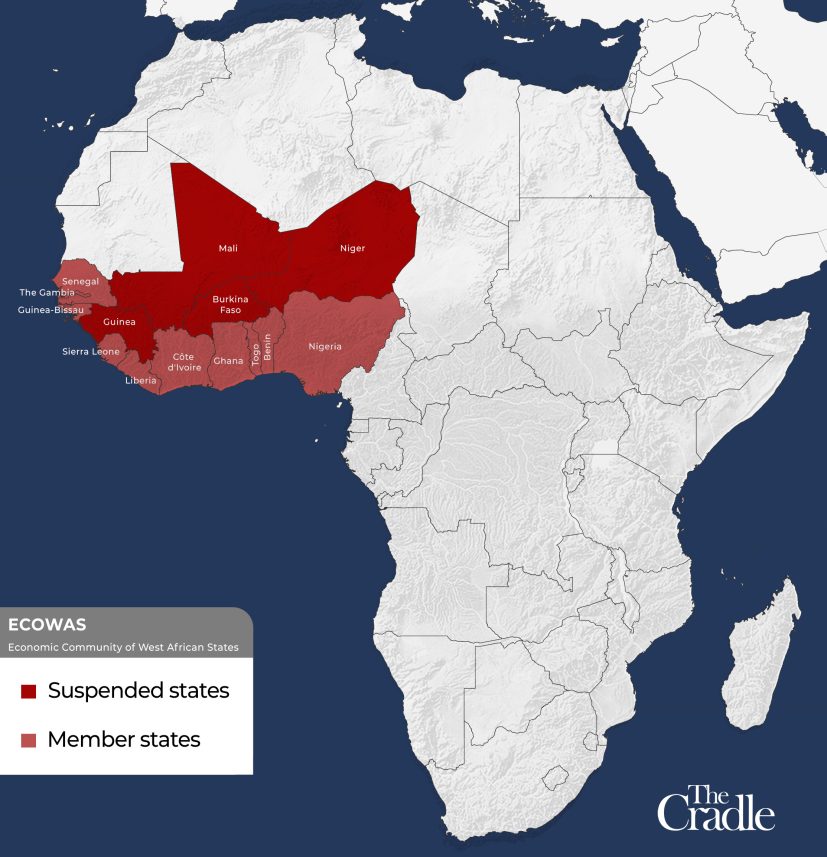
Map of the Economic Community of West African States (ECOWAS)
Sanctions failed, so proxy war begins
JNIM continues to receive financing from Persian Gulf patrons and income from ransoms and extortion. While it has a strong rural presence, it controls no major cities. Azawad separatists and ISIS fighters are similarly confined to Mali’s remote north.
A different strategy was needed. In recent weeks, JNIM has attacked fuel trucks, depriving Bamako of oil. Cars were unable to fill up, and schools closed. According to western media, JNIM wants to strangle the capital to promote unrest. Mali has had five coups since independence, three of which have occurred since 2012. News reports suggest that given this history, JNIM can ultimately topple the Malian government.
Reports of an “immediate collapse” are nearly a month old. What Western media fails to understand is that, unlike previous governments in Mali, the current one is highly popular. Truckers are willing to risk their lives to bring fuel to the capital. “If we die, it’s for a good cause,” one trucker said. Even if the blockade were to stop all fuel, Malian’s resilience and support for Goita would only increase.
Thankfully for Bamako, JNIM is facing setbacks. Russia, which provides support from the Africa Corps (formerly Wagner Group) and, in 2023, vetoed the UNSC’s sanctions, sent 160,000 and 200,000 metric tons of petroleum and agricultural products. This has provided some relief, with fuel lines shortening and schools reopening.
On 15 November, Mali and the African Corps seized the Intahaka mine. The next day, the town of Loulouni was also recaptured. That same day, the blockade south of Bamako was weakened, allowing convoys of fuel trucks to reach the city.
Manufacturing consent for intervention
So why does the western media continue insisting that Mali is collapsing? Simple: to justify military intervention.
One of the biggest propagandists has been France. In a post on X from the French Ministry for Europe and Foreign Affairs, Paris blamed Russia for abandoning Mali, despite being one of the only nations supporting it during this crisis. French news channels LCI and TF1 ran stories such as “Mali, the Jihadists at the gates of Bamako” and “Mali, the new stronghold of Al-Qaeda.”
In response, Bamako banned them from the country. Niger has also accused Benin of being a base of operations for France. French state media, France 24, did not deny the claim, only disputing that the number of soldiers was far less than Niger claimed.
France stands to regain a significant geopolitical advantage from regime change in Mali. The country borders seven former French colonies. A return would reassert French regional influence and weaken the anti-imperialist Alliance of Sahel States. Niger remains crucial to France’s uranium supply, which is necessary for 70 percent of the country’s energy. Bamako is also quickly becoming a major exporter of lithium – essential for electronics and electric cars – with the recent opening of its second mine.
Other western countries have also lost out under Goita’s rule. Canadian company Barrick Mining lost $1 billion when Mali nationalized the mining industry. Last month, other western firms, such as Harmony Gold, IAMGOLD, Cora Gold, and Resolute Mining, had their mining exploration licenses revoked.
The growing Russia–Mali partnership resembles Moscow’s 2015 intervention in Syria. Just as Russia propped up Damascus for as long as it could from a US-led proxy war, it now shores up Bamako. The payoff could be similarly strategic: diplomatic support, military basing rights, and influence in an emerging multipolar Africa.
Unlike past interventions cloaked as counterterrorism, the west now appears reluctant. Washington and its allies, usually quick to bomb under any pretext, have done nothing to aid Bamako. This silence suggests either tacit support for JNIM or confidence that Mali will implode without direct action.
Outsourcing war
As a member of the Alliance of Sahel States, the west fears that Mali’s resilience will be an inspiration to others to join the anti-imperialist struggle. The 2021 coup emerged as a result of inequality and insecurity. These factors can be found in many other West African countries such as Benin, the Ivory Coast, and Togo.
Some observers theorize that Africa’s most populous country, Nigeria, could soon have a revolution, amid high inequality and insecurity from Boko Haram. Nigeria’s growing ties with Mali are a serious threat to the west.
With sanctions failing to bring Mali to its knees, the only solution for the west is military intervention. This might be direct, as seen with Niger, where French troops are stationed in bordering Benin. But more likely, western countries will outsource their intervention to African states. This has occurred in Somalia, where the US has Kenya and Uganda do its dirty work in return for aid. The same could occur with Mali.
The most likely actors to play this role are ECOWAS and the African Union. ECOWAS receives military training from the US, and many of its leaders are closely tied to Washington. It also receives extensive financing from the EU, most recently receiving €110 million ($119 million) to support “peace, trade, and governance.” Far from neutral, it has become an enforcement arm for western interests. The bloc has previously sanctioned Mali and, in 2023, threatened to invade Niger.
The African Union has also served the interests of the west, such as the African Union Mission to Somalia, which is supported and financed by Washington and Brussels. The African Union Constitutive Act prohibits military intervention in any member state, with the exception of war crimes or at the request of the state.
Mali, however, was suspended from the African Union in 2021, making intervention fully legal under the Act. Chairperson of the African Union Commission, Mahmoud Ali Youssouf, recently called for “urgent international Action as crisis escalates in Mali.”
Bamako versus the empire
Mali faces a two-pronged assault: economic strangulation and the threat of foreign-backed military intervention.
Though JNIM remains a nuisance, it has failed to topple the government. The bigger threat comes from western capitals and their African proxies. Russia remains one of Mali’s few reliable allies. If successful, Moscow’s support will elevate its standing across the continent.
More importantly, Mali’s endurance will inspire other African states to challenge western domination and reclaim sovereignty.
Ukraine is drowning in a swamp of corruption – and the West is trying to make it look like a good thing
By Tarik Cyril Amar | RT | November 19, 2025
In Ukraine, the front lines are crumbling and so is the Zelensky regime. While Kupyansk and Pokrovsk are falling, the shockwaves of the Energoatom Mafia scandal keep reverberating, internationally and at home in Kiev.
At this point, two ministers have resigned. The former defense minister and head of the powerful National Security Council, Rustem Umerov, is in essence on the run abroad. According to the usually well-informed journalist Anatoly Shariy, Umerov is offering the FBI in the US to turn – protected – witness. He may still return to Ukraine, but even his current behavior – the unplanned delays, the search for US allies, quite possibly for some kind of deal – betrays a very guilty conscience.
Likewise, Prime Minister Yulia Sviridenko has declared her readiness to cooperate with Ukraine’s own anti-corruption prosecutors at NABU, which is in reality a branch of the FBI implanted in Ukraine. Clearly, Sviridenko is also looking for a deal, letting it be known that she is ready to talk and name names, as long as they let her get away with the absurd claim that she knew it all but wasn’t part of it.
Zelensky’s most intimate companion, chief consigliere, autocratic enforcer, and overbearing eminence grise, Andrey Yermak, is also deeply – and unsurprisingly – implicated, under the gangster slang name ‘Ali Baba’, in the Energoatom Mafia scandal, and his head is clearly on the political chopping block.
Details could be multiplied ad nauseam. Take, for instance, the fact that we now know that the gangster pseudonym ‘Professor’ did not stand for former Justice Minister German Galushchenko – no worries, though: He’s still an Energoatom mobster, just not that one – but the wife of former Deputy Prime Minister Aleksey Chernyshov, Svetlana.
While her husband features as ‘Che Guevara’ in the Energoatom scandal, ‘Professor’ Svetlana – in real life (or pretend?) an academic at Kiev’s prestigious Taras Shevchenko University – happens to be very close besties with Elena Zelenskaya. Yes, that would be Vladimir Zelensky’s spouse (when his intense schedule with Yermak leaves time for her). According to Shariy, Svetlana-bestie-of-Elena is implicated in shady deals around the habit of Kiev’s elites of building themselves palaces, and she also received a cool $500,000 (in cash) from ‘Sugarman’, aka Aleksandr Tsukerman, another key Energoatom player on the run.
In short, if they think they have a swamp in Washington, they haven’t seen Kiev yet. But of course, they have. It is obvious that Washington has been well aware of just how stunningly, stinkingly corrupt its clients in Ukraine are. Indeed, the more, the better, a modern Machiavelli would say, because it makes them even more dependent. One of the best explanations for the Energoatom scandal breaking now is that it is part of a US operation to either get rid of or subdue Zelensky. The conspicuous fact that Zelensky has suddenly made – insubstantial – noises about being interested in peace talks may have as much to do with this American assault on him as with the disaster on the front lines.
This is the context that also explains a recent trend in Western spin-for-Ukraine. Absurd as it is, the claim that the Energoatom mess is really a good sign if you only look close enough is spreading as if on cue. The underlying logic is not only daft but simple. Take, for instance, a recent specimen of the genre: According to Polish TVP quoting the American Center for European Policy Analysis (CEPA), the Energoatom scandal “hurts Ukraine yet proves it’s on the right track,” because “a case of this scale exposed by domestic institutions is proof of Ukraine’s anti-corruption system working.”
Where to even begin? Let’s just break it down in order of appearance: ‘A case’ – as in one case – only proves that there is much more to come. In Ukraine, there is widespread consensus that what happened at Energoatom is peanuts compared to what has been going on in the defense sector, bloated with literally hundreds of billions of euros and dollars from the West. This is exactly why ex-Defense Minister Umerov is running scared. The first evidence of his personal involvement in corruption is emerging already. Energoatom is merely the crack in the dam. When the dam breaks, so will the system, all of it.
‘Domestic institutions’? That one is genuinely funny. The only reason NABU and SAPO – Ukraine’s anti-corruption agencies – are still alive is that they are not domestic. In reality, for those who don’t believe in Santa Claus, they are US implants – in the case of NABU, explicitly so. They survived Zelensky’s attempt to raze them this summer only due to Western support.
‘Proof’? The only proof of Ukraine’s corruption under the Zelensky regime suffering a real setback would be the fall of that regime. But even then – and here is what naive Westerners simply cannot grasp about the Ukrainian political system – corruption as such would not cease but merely undergo a change in management. How do we know? Because this law of Kiev politics has been tested again and again. The last time, by the way, in 2014, when then-President Viktor Yanukovich was ousted in a regime change operation made easier by his flagrant graft and nepotism. And yet, here we are again.
There is added irony in Poland channeling an American think tank to spread absurd spin about Ukraine’s hyper-corruption: According to X post by former Polish Prime Minister Leszek Miller, the Polish authorities may well have helped one of the very worst Energoatom Mafia leaders, Timur Mindich – aka ‘the president’s purse’, that is, Zelensky’s – to evade arrest. This is entirely plausible: In Ukraine, Mindich was clearly tipped off about his impending arrest, most likely by either Yermak or Zelensky himself. Whoever warned him would also have had the necessary Polish connections. And Warsaw, of course, has a nasty record of working with criminals from Ukraine and of sheltering them from prosecution, too. Just ask the Germans how far they got with their Nord Stream investigations.
Ukrainians are drowning in a deep, fetid swamp of corruption, worse than ever. To pretend that a scandal surfacing from that morass is a good sign is perverse. But then, so is most of Western policy toward Ukraine, using its people up in a war provoked for idiotic reasons and long lost. Maybe there is some dark, historic justice in Ukraine and the West making their respective cultures of cynicism and graft even worse for each other.
Tarik Cyril Amar is a historian from Germany working at Koç University, Istanbul, on Russia, Ukraine, and Eastern Europe, the history of World War II, the cultural Cold War, and the politics of memory.
Polish railway ‘sabotage’ runs on time for Europe’s military Schengen plan
By Finian Cunningham | Strategic Culture Foundation | November 19, 2025
The European Commission is proposing to make the European Union of 27 nations a seamless territory for NATO transport across national borders. The concept is to create a “military Schengen” in analogy to the free movement of civilians across the bloc.
The controversial idea is strongly advocated by pro-NATO European leaders. The proxy war in Ukraine against Russia and the escalating tensions of a wider war have helped push the sweeping militarization of the EU as a single bloc.
This week, as the European Commission President Ursula von der Leyen makes her pitch for an EU-wide military Schengen zone, there were suspicious sabotage attacks on Poland’s railway network.
Von der Leyen is leading the calls for coordination of military forces to have free access to the EU’s transport links. The idea for a military Schengen-type arrangement for the EU has been around for several years, but there has been resistance from nations giving up control of their borders. The last time Von der Leyen’s German compatriots did that by marching across Europe did not go down too well.
What the proponents of the concept would like is for military forces from one country to be able to cross over several others with minimal inspection. The idea brings closer to realization the formation of an “EU army.” It also blurs the lines between NATO and the EU to the point where all 27 members of the EU become de facto members of the military alliance.
Polish Prime Minister Donald Tusk and Von der Leyen were quick to blame Russia for “shocking sabotage” of Poland’s railway after trains were disrupted by an explosive attack on Sunday. No one was injured. And, as usual, no evidence was provided. Russia was not openly blamed by name, but the media reporting implicated Russian involvement. Moscow has previously denied accusations of carrying out hybrid war attacks on transport and communication infrastructure across Europe, including the use of drones to disrupt air traffic.
Questions arise about the latest railway incidents in Poland. The affected rail line was from Warsaw to Lublin, and onwards to Ukraine. Tusk described the rail link as “crucially important for aid to Ukraine.” Indeed, the rail line is a major vector for munitions flowing to Ukraine. If it is such a vital supply route for NATO military equipment to Ukraine, one wonders why the rail line was not better guarded.
The railway damage was reported by a train driver on Sunday morning, yet the government and security authorities did not act until Monday. The delay in response caused anger among Polish citizens who remonstrated with officials at public gatherings. Were the authorities deliberately being negligent in ensuring the rail line was made safe, to contrive an accident?
The BBC reported local people claiming that they heard a massive explosion whose impact could be felt several kilometers away. The strange thing is that the reported railway damage did not appear to be extensive. One would expect from such a powerful blast that whole sections of the rail would have been destroyed, making the line impassable. However, it was reported that several trains were able to traverse the damaged section on Monday before the authorities acted. The traversing trains incurred shattered windows. But if they were able to traverse, then the tracks could not have been blown apart.
We might reasonably speculate, therefore, that the explosion was not the actual cause of the relatively limited rail damage. Perhaps the blast was detonated to bring the public’s attention to a separate act of sabotage to derail the trains (without causing a calamitous loss of life). The purpose was to conflate the perception of explosion with railway sabotage. And as Tusk, Von der Leyen, and the media have all dutifully followed suit, the convenient upshot is to level accusations implicating Russian hybrid warfare.
Poland’s Army Chief of Staff, General Wieslaw Kukula, articulated the narrative as quoted by Euronews : “The adversary has started preparations for war. They are building a certain environment here to bring about an undermining of public confidence in the government and bodies such as the armed forces and the police… [creating] conditions that are convenient for the potential conduct of aggression on Polish territory.”
Week after week, European politicians, military, security, and bureaucratic chiefs are claiming with shrill rhetoric that Russia is preparing to attack member states imminently. Earlier this year, Poland’s Tusk even accused Russia of intending to blow up civilian cargo airplanes. How easy it is to plant incendiary devices to blame someone else and report “suspects” arrested without court cases. The European public is browbeaten into consenting to increased military budgets, air defenses, anti-drone walls, and tens of billions of Euros more to prop up the corrupt Kiev regime. All to “defend” Europe against an evil aggressor.
Moscow has repeatedly dismissed claims that it intends to attack European states. But the war propaganda continues relentlessly to project Russia as a drooling barbarian.
A cruel irony is that passenger trains have been sabotaged in Russia in recent months, with the loss of lives, acts which have been attributed to NATO and Ukrainian covert operations. The Western media hardly reports on those atrocities.
But an apparently contrived false-flag operation in Poland is given maximum Western media coverage with the choreographed narrative that Russia is the villain. As with the flurry of mysterious drones suddenly invading European airspaces.
The proposal for a European military Schengen is very much aimed at bringing rail networks across Europe under a seamless command to enable the rapid mass movement of NATO forces over national borders. No questions asked. Just do it.
A false-flag sabotage on Polish railways reinforces the messaging that Europe’s transport network has to be turned over for military logistical control.
The militarization of Europe and its “NATO-ization,” entails an unprecedented and mind-boggling shift in public money to military corporations, the financial elite, and their political puppets. The corruption in the Kiev regime is a microcosm of the bigger war racket that Europe has become. False flags to scare European citizens into passive acceptance of the rip-off are running like clockwork.
It used to be joked about Mussolini and Hitler that at least the old fascists made the trains run on time. The new fascists make the trains come off the rails on time.
Legal Nonsense to Justify Non-Judicial Killings
By Jacob G. Hornberger | Future of Freedom Foundation | November 18, 2025
Many years ago, when I was practicing law in Texas, I learned that there were, generally speaking, two types of lawyers when it came to being asked for a legal opinion by a client who wished to pursue a certain course of action.
The first type of lawyer would carefully research the issue and give his honest, independent-minded opinion as to the legality of the proposed action, even if it wasn’t what the client wanted to hear. That type of lawyer had integrity and would not compromise his legal judgment, even if it angered — and risked the loss of — his client.
The second type of lawyer would instead come up with whatever legal reasoning was necessary to please the client, stretching case law and legal analysis in such as way as to justify what the client wanted to do. This type of lawyer had no integrity. His task, as he saw it, was to provide legal cover for his client in case things went the wrong way.
When it comes to President Trump’s and the Pentagon’s extra-judicial drug-war killings in the Caribbean, there is little or no doubt that the Office of Legal Counsel in the U.S. Department of Justice falls into the second category. Asked to provide a legal opinion as to the legality of such killings, the office has come up with a memorandum containing inane legal justifications, in an obvious effort to provide legal cover for the people involved in the extrajudicial killings. In fact, the still-secret memo expressly assures U.S. military personnel that they will not face future criminal prosecution for their involvement in the killings.
The memo states that the high number of deaths from drug use among American drug consumers constitutes an “armed attack” against the United States. Really? Where are the armaments? Are Latin American drug dealers entering the United States, kidnapping regular American citizens, physically holding them down, and then injecting drugs into their noses, mouths, or other parts of their bodies?
I don’t think so. There is certainly no evidence of that. All of the evidence is that American consumers of drugs are voluntarily buying and ingesting mind-altering substances knowing full well that this isn’t a risk-free endeavor.
Another part of the memo claims that the boats that are suspected of carrying drugs are generating revenue for groups that are supposedly in armed conflict with the United States.
Really? Where are the conflicts? I don’t see any Latin American cartels landing on American shores and killing American citizens. Indeed, I haven’t seen those boats firing at American Naval vessels or at American B-52s. All I’ve seen is massacres of defenseless private individuals in the face of overwhelming U.S. military power.
According to the Intercept: “One senior defense official, speaking on the condition of anonymity, blasted the opinion. ‘I don’t know what’s more insane – that the ‘President of Peace’ is starting an illegal war or that he’s giving a get out of jail free card to the U.S. military,’ said the official, referencing President Donald Trump’s self-proclaimed moniker. ‘Hopefully they realize there’s no immunity for war crimes. Nor is there a statute of limitations.’”
One of the other justifications on which Trump and the Pentagon are relying is their claim that these boat people are “terrorists.” Apparently that governmental accusation means that they are subject to being exterminated without arrest, indictment, prosecution, conviction, and sentence — that is, without any due process of law for what amounts to an accusation of a criminal-law violation, whether it is drug-war-related or terrorist-related.
For some time, Trump has been claiming that Venezuela immigrants have been “invading” the United States. I guess we should be thankful that the Office of Legal Counsel hasn’t yet opined that the U.S. is repelling an immigrant “invasion” of the United States by killing people in those boats.
One of the most fascinating and revealing aspects of these extra-judicial killings is when U.S. forces took custody of two targeted people who survived the attack on their vessel. What happened afterward reveals what a sham these drug-war killings are. U.S. officials released both men back to their home countries.
What? Yes, they took two supposed “narco-terrorists” into custody and then released them, which means that they are now free to engage in more “narco activity” and more “terrorism.” Does that make any sense whatsoever?
The real interesting question is: When they saw that those men had survived the military attack on their vessel, why didn’t U.S. military personnel simply fire missiles at them or just shoot them while they were bobbing in the water? After all, they had just tried to kill them inside their boat. What’s the difference with killing them outside their boat?
I’ll tell you why. Those military attackers felt sheepish about killing those two survivors. Even more, I will guarantee you that they were scared to do so. They were scared that they would ultimately be put on trial for unlawfully killing people. That’s why they stood down and took custody of them instead of just finishing the job and killing them.
Why not instead bring them back as “prisoners of war”? Isn’t this an “armed conflict” against “terrorism”? Why not imprison them at the Pentagon-CIA prison camp and torture center at Guantanamo? Why not torture them into divulging the secret locations of other “narco-terrorists”?
I’ll tell you why. Because U.S. officials didn’t want to take the chance that those two men might challenge their custody in a federal district court. I will guarantee you that U.S. officials had to have freaked out when those two men survived. “Release those ‘narco-terrorists’ immediately so that our inane legal opinion that justifies our drug-war killings cannot be challenged in court,” we can imagine them exclaiming.
Make no mistake about it: These drug-war killings are the equivalent of legalized murder. They are morally illegitimate, legally illegitimate, and constitutionally illegitimate, no matter the inane legal opinion issued by the Justice Department’s Office of Legal Counsel in an obvious effort to provide cover for the people involved in these killings.
Germany Turns an X Post Into a Police Raid at Dawn

By Christina Maas | Reclaim The Net | November 18, 2025
The story starts with a tweet that barely registered on the internet. A few hundred views, a handful of likes, and the kind of blunt libertarian framing that is common on X every hour of every day.
Yet in Germany, that tiny post triggered a 6am police raid, a forced phone handover, biometric collection, and a warning that the author was now under surveillance.
The thing to understand is that this story only makes sense once you see the sequence of events in order.
The story goes like this:
- A man in Germany, known publicly only as Damian N., posts a short comment on X, calling government-funded workers “parasites.”
- The post is tiny. At the time he was raided, it had roughly a hundred views. Even now, it has only a few hundred.
- Despite the post’s obscurity, police arrive at Damian’s home at six in the morning.
- He says they did not show him the warrant and did not leave documentation of what they seized.
- Police pressured him to unlock his phone, confiscated it, took photos, fingerprints, and other biometric data, and even requested a blood sample for DNA.
- One officer reportedly warned him to “think about what you post in the future” and said he is now “under surveillance.”
- The entire action was justified under Section 130 of the German Criminal Code, which is meant to prohibit inciting hatred against protected groups.
- Government employees are not such a group, which makes the legal theory tenuous at best.
- Damian’s lawyer says the identification procedures and possibly the raid itself were illegal.
That is the sequence. A low-visibility political insult becomes a criminal investigation involving home searches, device seizure, and biometric collection.
The thing to understand is that this is not about one man’s post. It is about a bureaucracy that treats speech as something to manage and a set of enforcement structures that expand to fill the space they are given.
Start with the enforcement context. Germany has built a sprawling ecosystem around “online hate”: specialized prosecutor units, NGO tip lines, and automated scanning for taboo keywords.
The model is compliance first and legal theory second.
Once you create an apparatus like this, it behaves the way bureaucracies behave. It looks for work. It justifies resources by producing cases. A tiny X post with inflammatory language becomes a target because it contains the right keyword, not because it has societal impact.
Police behavior fits the same pattern. Confiscating phones is strategically useful because it imposes real pain without requiring a conviction.
Even prosecutors have said that losing a smartphone is often worse than the fine.
Early-morning raids create psychological pressure. Collecting biometrics raises the stakes further. None of this is about public safety. It is about creating friction for saying the wrong thing.
The legal mismatch is the tell. Section 130 protects groups defined by national, racial, religious, or ethnic identity.
There is also the privacy angle, which becomes impossible to ignore. Device access, biometrics, DNA requests: these are investigative tools built for serious crimes.
Deploying them against minor online speech means the line between public-safety policing and opinion policing has already been crossed. Once a state normalizes surveillance as a response to expression, the hard part becomes restoring restraint.
It is a deterrence strategy, not a justice strategy. And it reinforces why free speech and strong privacy protections matter. Without them, minor speech becomes an invitation for major intrusion.
The counterintuitive part is that the smallness of the post makes a raid more likely, not less.
High-profile content generates scrutiny and political costs. Low-profile content discovered through automated or NGO-driven monitoring is frictionless to act on. Unless people are reading Reclaim The Net, most people never hear of these smaller cases.
Looking ahead, the pressure will only increase. As more speech moves to global platforms that are harder to influence, local governments will lean more heavily on domestic law enforcement as their lever of control.
That means more investigations that hinge on broad interpretations of old statutes and more friction between individual rights and bureaucratic incentives.
This is particularly true in Germany and places like the UK, where the government doesn’t seem to feel any shame about raiding its citizens over online posts.
US’s Gaza Plan Designed to Give Palestine’s Subjugation Veneer of UN Legitimacy – Mohammad Marandi
Sputnik – 18.11.2025
The UN Security Council approved the US’s Gaza ceasefire and international stabilization force plans on Monday. Russia and China abstained from the vote. Sputnik asked renowned Iranian-American political analyst Mohammad Marandi for his reaction.
The US Gaza plan is “a fake peace plan that is approved by the UN Security Council will only enhance the strength of the United States and the Israeli regime to further abuse Palestinians and to push Palestinians out of Gaza,” Marandi told Sputnik.
The plan proposes what the observer fears amounts to “an international occupation” of the Strip, with “no mention of Palestinian independence” in the US resolution.
“With this fake mantle of the UN Security Council, they will be able to do a lot of harm in the name of the international community,” Marandi emphasized.
The US “has no intention of allowing the Palestinian people to have a state.” The stabilization force will amount to “international occupation,” according to the observer.
The US is “a party to the holocaust in Gaza, and so are all Western allies of the Israeli regime, even regional countries that have preserved political and economic ties with the regime over the last two years… they’re all complicit in the genocide in Gaza,” Marandi stressed, pointing out that without US support, “the Israeli regime, Netanyahu, would not be able to carry out the mass murders that we saw on a daily basis, [and] continue to see… as we speak now.”
The observer characterized last month’s Gaza Peace Summit in Egypt as a shameful “monkey show,” and suggested that attendees “literally sold out the Palestinian people” to try to get in the US president’s good graces.
Russian representative Vassily Nebenzia said the Security Council resolution on Gaza passed Monday was “reminiscent of colonial practices and the British mandate for Palestine” that was “granted by the League of Nations, when the opinions of the Palestinians themselves were not taken into account whatsoever.”
He also warned that the lack of clarity about the stabilization force’s mandate could make it into an unwitting party to the conflict.
Russia and China abstained from Monday’s vote, but did not veto the resolution outright in light of the desire expressed by the Palestinian Authority and regional countries to avoid a resumption of bloodshed in the besieged Strip.
Palestinian leader Barghouti subjected to brutal torture in Israeli prison, says advocacy group

Jailed Palestinian leader Abdullah Barghouti
Press TV – November 18, 2025
A Palestinian prisoners’ advocacy group says jailed Hamas leader Abdullah Barghouti has faced extreme physical and psychological torture at the maximum-security Gilboa Prison in the northern part of the Israeli-occupied territories since his abduction more than two decades ago.
The Asra Media Office (AMO) announced in a statement on Monday that 53-year-old Barghouti is currently enduring conditions that have been described as “a form of slow execution,” aimed at one of the leading figures of the Palestinian Captive Movement. Concerns have been raised that his life could be at risk at any moment.
The statement disclosed that the prison administration has been systematically and repeatedly targeting Barghouti with assaults for more than 25 months.
Prison guards storm his cell relentlessly, day and night, often accompanied by dogs. They taunt him, claiming they missed assaulting him, before three of them restrain him and viciously attack him with batons. The beating leaves him with severe injuries, including bleeding and deep wounds.
His fellow inmates are left to care for him, using torn fabric and rudimentary cleaning supplies to tend to his wounds.
Barghouti, currently serving 67 life sentences, is enduring severe, untreated injuries. These include fractures in his right elbow and hand that have persisted for more than three months, a broken pinky finger on his left hand, two fractured ribs, torn tendons, and a drastic weight loss of approximately 35 kilograms caused by starvation and inadequate nutrition.
The rights group added that guards have doused him with water before subjecting him to electrocution and confined him to a cell infested with scabies, resulting in painful boils all over his body. To minimize the risk of further infection, he now resorts to sleeping on the floor.
Barghouti currently struggles with significant difficulty in moving his hands, with one almost completely paralyzed. Despite his condition, Israeli prison authorities deny him any form of medical treatment, including pain relief, and block human rights organizations from reaching out to him.
The AMO asserted that Barghouti’s suffering is part of a broader campaign against the leadership of the Captive Movement.
It emphasized that the mistreatment he endures surpasses mere punishment, amounting to a calculated effort to end his life, underscoring the urgent need for international intervention.
The circumstances surrounding the detention of Palestinian inmates by Israel are unacceptable and characterized by inadequate hygiene standards. Moreover, Palestinian detainees have endured persistent torture, harassment, and oppression.
Palestinian detainees have consistently participated in indefinite hunger strikes to express their frustration over their unjust imprisonment.
Human rights organizations say that Israel continues to violate the rights and freedoms granted to abductees as stipulated by the Fourth Geneva Convention and international laws.
According to the Palestine Detainees Studies Center, around 60 percent of Palestinian detainees in Israeli prisons suffer from chronic illnesses, with many having passed away either during their incarceration or after their release due to the seriousness of their health issues.
Israel’s Elbit Systems reports record profits on the back of Gaza genocide
The Cradle | November 18, 2025
Israel’s leading defense technology company, Elbit Systems, reported a sharp rise in quarterly profit on 18 November after months of fueling the genocide in Gaza by supplying weapons, munitions, and surveillance systems, while simultaneously securing a wave of new European contracts.
The company posted $3.35 per diluted share excluding one-time items, up from $2.21 a year earlier, and reported $1.92 billion in revenue compared to $1.72 billion last year.
Its order backlog reached $25.2 billion, with the company saying 69 percent comes from outside Israel.
Elbit CEO Bezhalel Machlis said the performance reflected “the significant contracts the company has secured across Europe and from customers worldwide,” driven by expanding defense budgets.
Israel accounted for over 33 percent of revenue, with Elbit supplying munitions, drones, guided rockets, and reconnaissance systems during the Israeli genocide of Palestinians in Gaza.
Sales to Europe, the world’s second-largest buyer of Israeli weapons, rose from $430 million to $536 million, comprising 28 percent of total revenue.
The company said 69 percent of its backlog comes from outside Israel and declared a quarterly dividend of $0.75 per share.
Separately, Elbit announced the largest contract in its history, a $2.3-billion deal with an undisclosed international buyer for weapons systems to be delivered over eight years.
The company did not reveal the customer or the type of systems being supplied, citing confidentiality.
Elbit Systems has also expanded its footprint across Europe, the Balkans, and the UK through a series of new agreements disclosed in recent months.
In Albania, the company is leading a government-to-government deal that includes ATMOS howitzers, SPEAR mortars, and Magni-X and Thor drones, and will assist the state-owned KAYO firm in establishing production lines and a new weapons plant.
Elbit deepened its presence in the country earlier this year through a flight-school agreement and is expected to support Albania’s goal of developing local drone manufacturing by 2027.
The firm has simultaneously continued to sign additional contracts worldwide, including Hermes 900 sales to Singapore and Brazil.
In the UK, Elbit is competing with Raytheon for a $2.7-billion Ministry of Defense contract that would make the company a “strategic partner” responsible for training 60,000 British troops annually.
The prospective agreement follows a separate $1.64-billion Elbit deal with Serbia and builds on the company’s existing role managing the Ministry of Defense’s Project Vulcan, a $75-million simulation-training program for tank crews.
Elbit subsidiaries in Britain have come under sustained protest, and Elbit’s central role in Israel’s war on Gaza has prompted renewed scrutiny, with the UN special rapporteur for Palestine noting that “for Israeli companies such as Elbit Systems … the ongoing genocide has been a profitable venture.”
Slaves aren’t friends to their masters: Damascus traded sovereignty and regional commitments for illusions of survival
By Robert Inlakesh | Al Mayadeen | November 18, 2025
Many were taken aback by the recent visit of Syrian President Ahmed Al-Sharaa to the White House, causing immense debate over whether it should have happened at all, if it benefits either side, and if this new relationship between Damascus and Washington will be significant.
Analysts and commentators from across the political spectrum have attempted to grapple with Syria’s collaboration with the United States. On the one hand, a former ISIS commander who went on to lead Syria’s Al-Qaeda branch, now joining the official US-led coalition against ISIS, has bewildered many. Yet for those who have a depth of knowledge on the course of the Syrian War, this comes as little surprise.
In the United States, there are what can only be labelled as two camps of liars and lunatics: One being a contingent of anti-Muslim advocates who are obsessed with “Islamic Extremism”; the other is the base of die hard supporters of the new regime in Damascus.
The first group used Ahmad Al-Sharaa’s visit to the White House, at the invitation of US President Donald Trump, to fearmonger about some kind of Muslim plot and that the US leader was being fooled. This narrative, spread primarily by paid Zionist propagandists, is simply part and parcel of a campaign designed to attack all Muslims and fear mongers about “Islamic Extremist” plots as a means of channeling right-wing anger away from the Israelis.
The other group consists of a range of figures, some of whom are paid to espouse their propaganda, then there are the delusional types and sectarian minded people whose tribalism rules their political outlet. Paid agents are slaves to their pay masters, whereas the sectarian tribalists are unreachable with logic. Only the misled can be reached from this crowd, which is who needs addressing.
The White House slave
Now is time to reconcile with the fact that Ahmad al-Sharaa is a creation of the West. This statement is not meant to be provocative, nor is it hyperbole. Syria’s current leader is the product of those who own him, hence why I said Ahmad al-Sharaa and not his former alias, Abu Mohammed al-Jolani.
For those of us who covered the horrifying and bloody war in Syria, we know the new President as al-Jolani, the man who led Jabhat al-Nusra. This organisation not only committed countless civilian massacres, allied itself in certain battles with ISIS, ran its own torture centers in Idlib, recruited child soldiers, and committed various other war crimes. To some, however, it later became the “saving grace” of a “blessed revolution” to overthrow a tyrant.
These two narratives evidently don’t have many grey areas, but as often has shown to be the case in Syria, nothing truly makes complete sense. The war revealed that almost anything is possible. At the same time, black and white thinking is very much prevalent amongst many when it comes to this issue.
So instead of arguing the merits of whatever side one chooses to fall on, let us deal in facts as means of dispelling illusion.
There was a reason why the United States launched Operation Timber Sycamore, one of the most costly CIA operations in its history, with the intent of backing anyone to overthrow Bashar al-Assad. There is also a reason why the Israelis began backing at least a dozen Syrian opposition groups, beginning in 2013, including al-Jolani’s Jabhat al-Nusra, with funds, arms, and medical support.
Neither the US, nor the Israelis, cared for the civilian population of Syria. Although their propaganda machines churned out nonsense about their opposition to dictatorship, civilian massacres and mass incarceration, their involvement was never to do with any of this.
You want proof that the US, its Western allies and “Israel” didn’t care? They are all normalising, collaborating with and hosting frequent meetings with a man who is not democratically elected, has built a regime that is more corrupt than his predecessor, and is standing by as sectarian violence takes thousands of lives.
Their goals were clear: They sought to collapse Syria into a number of opposing sectarian groups who rule their own territory based upon ethnicity or religious affiliation; loot its resources; bankrupt the country to tie it to the IMF and World Bank [because Syria was previously self sufficient]; conquer the Golan Heights; permanently destroy its strategic military capabilities; end Syria’s role in backing or facilitating the Palestinian Resistance; stop the flow of weapons to Hezbollah and end Iran’s role in the country; in addition to installing a puppet leadership. All of these goals were achieved.
The narrative that al-Jolani’s Hayat Tahrir al-Sham (the rebrand of al-Nusra) defeated Bashar al-Assad is false. There wasn’t a battle to take Damascus, there was a deal struck that enabled a handover of power. It wasn’t a “war of liberation”; it was a regime transfer.
According to the Syrian Observatory for Human Rights, nearly 9,000 civilians have been murdered across the country since the new government came to power. These are considered to be conservative figures also, as other sources put the death toll much higher, especially due to the sectarian mass extermination campaign that targeted Alawites and other minorities along the coast earlier this year.
The cost of living in Syria is getting worse, gangsters and sectarian lunatics parade through the streets, kidnappings are rampant, the murder rate is through the roof, and there is still no long promised democracy in sight. Meanwhile, the Israelis are pushing deeper into southern Syrian lands, occupying more territory, setting up checkpoints, bombing wherever they choose on a routine basis, and are even arming Druze separatist militias.
Washington, for its part, is taking over two air bases, openly collaborates with the Syrian authorities on missions inside the country, and CENTCOM is busy playing basketball with al-Sharaa. Israelis, who would once be executed should they step foot in Syria, are openly arriving in Damascus, getting taken on tours around sensitive military sites for their documentaries.
All this as Damascus has cracked down, kicked out, and disbanded all the Palestinian Resistance groups that once operated in Syria, instead choosing to hand over the body of an Israeli soldier captured in 1982, along with the belongings of infamous Israeli spy Eli Cohen.
Now, the argument that some make in favour of this regime, to ignore all of the facts stated above, is that Ahmad al-Sharaa is doing this to lift the sanctions and repair his country.
To address this, let us ask the question: Has all of this collaboration, selling out the Palestinian cause, collaborating with those committing a genocide in Gaza, and meeting for basketball practice ended the sanctions on Syria permanently, or even triggered economic revival? No, of course not.
So you are now left with two possible explanations: Either Ahmad al-Sharaa is so politically incapable that he believes in this so-called “economic revival” master plan, or he is part of a project used to secure the aims of the US, its Western allies, and the Zionist entity. If you chose option one, he isn’t fit to be a political leader and should perhaps be placed in control of a Shawarma store instead.
Under Ahmad al-Sharaa, there is no Syrian leadership, there is simply a group of slaves who were let into the house; in this case the White House. They aren’t to be compared to other Arab regimes either, as they have no autonomy at all, nothing they do is independent as the sanctions are only ever going to be temporarily lifted in order to keep them in line. Under this model, Donald Trump is Syria’s President, not Ahmad al-Sharaa.
In fact, none of this is even about al-Jolani at all. If Bashar al-Assad would have been willing to invite the Americans in, kick out Iran and the Palestinian resistance, stop the flow of weapons to Hezbollah, negotiate a deal with the Israelis, hand them the Golan Heights, and give over his strategic weapons arsenal, it would have been him in the White House. This is because the Western powers and Israelis have no standards at all, they will deal with anyone of any ideology that bows down to them.
If you argue this all to those who still back the new Syrian leadership, they will come back with deflective arguments such as “we are tired” and notions about “the Syrian people”. The same such sentiments can be heard from Yasser Abu Shabab’s ISIS-linked gangsters in Gaza, who work with the enemy of their people because they want material goods and are willing to fight against their own nation’s causes in order to secure this for themselves.
This argument is the “being a slave in the house isn’t so bad” argument, but discounts the fact that the majority of Syrians don’t qualify for house slave status, they will instead remain field slaves, some of whom will be abused more than others, but are nonetheless field slaves. The same applies to those who choose to be slaves in Lebanon, or Palestine, or wherever else in the region. Everyone is being subjected to the “Greater Israel Project”, which means that the “prosperity” that US envoy Thomas Barrack carries on about is not in the plan for them.
Keep in mind that even when you are a good slave, you are never actually your master’s friend. You need only look to the example of the deposed Iranian Shah Reza Pahlavi, who was only granted asylum and later died in Egypt. Despite his closeness to Washington, his value only came from the usefulness of his regime, nothing less and nothing more.
None of this is to say that there are not legitimate grievances from all sides across regional conflicts, this is undoubtedly true as wars bring out the very worst in people. Yet it is simply delusional to conclude that anything good comes out of being a slave. There is a reason why generation after generation across the Arab World has set the Palestinian cause as the litmus test for whether a government or movement is behaving in their interests, it is because it is a proven fact that collaborating with the enemy leads to chaos and destruction.
If the Israelis and US intended to “let Syrians live”, they would have done so since day one of the new regime. Instead, Washington greenlit the largest ever Israeli aerial assault across Syria and the occupation of more Syrian lands. Why? Because this was always the plan from the beginning, and everyone who fell for the promises of the new Syrian leadership were simply deceived.
EU defense chief wants to use Ukrainian military as ‘security guarantee’
RT | November 18, 2025
EU Defense Commissioner Andrius Kubilius has suggested using Ukrainian troops as an “additional security guarantee” to defend the bloc from the alleged threat of a Russian attack once the current conflict is resolved.
Western officials, particularly representatives of the Baltic states, have increasingly invoked the supposed Russian threat to justify major military spending spikes in recent months. Moscow has rejected claims it plans to attack anyone as “nonsense,” arguing the West is using Russia as a “monster” to stoke tensions, ramp up military budgets, and distract from domestic problems.
Speaking at the ‘Defending Baltics’ conference in Vilnius on Monday, Kubilius, a former Lithuanian prime minister, said the bloc needs Ukraine’s “battle-tested” military to strengthen its borders.
“It would be good that a battle-tested Ukrainian army, after peace has been established in Ukraine, would be ready to be present in all the countries of our frontier region… next to the German brigade and the rotating US battalions as an additional guarantee for our security,” he stated.
Kubilius claimed Russia could attack the EU – starting with the Baltic states – within two-to-four years, and said Ukrainian troops can offer the bloc “the most precise answers” on how to defend itself. He suggested Brussels should find ways to integrate Ukrainian defense capabilities, soldiers, and industry into its military ecosystem.
The commissioner did not explain how Brussels could use the Ukrainian military without Kiev joining either the EU or NATO. While Kiev has demanded NATO accession, Moscow has opposed it, insisting Ukrainian neutrality and demilitarization must be part of any future settlement. The US and several other of Kiev’s backers are opposed to its membership.
Moscow has not yet responded to Kubilius’ remarks, but Russian officials have long accused the West of intending to fight “to the last Ukrainian” in their proxy war against Russia. Moscow has also warned that increased militarization only risks a wider conflict in Europe.
Kremlin spokesman Dmitry Peskov said this week that Russia does not seek a confrontation with the West but could be forced to take measures to ensure its security in response to its increasingly “militaristic” rhetoric.
Featured Video

New positive ivermectin evidence
or go to
Aletho News Archives – Video-Images
From the Archives
Fanatical Followers of the Covid Regime: A Jim Jones-Style Cult?
By Professor Roger Watson and Dr. Niall McCrae | The Daily Sceptic | November 15, 2021
As scholars at leading British universities over recent decades, we witnessed the replacement of critical thinking and debate by narrative: facts are discrimination and scientific method is imperialism; truth, instead, is derived from ‘progressive’ values. This educational trend may be a major contributory factor to the ease in which society has been inculcated to the Covid ‘new normal’ of masking, testing, and repeated doses of vaccines for a disease of similar risk to severe influenza.
One doesn’t need much critical reasoning to observe the flawed logic of some vaccination enthusiasts, such as people who respond to experiencing any side effects, however debilitating, by saying “at least I know it’s working”, or, after contracting the disease despite their promised inoculation (over 90% effective, according to initial drug company claims), “I’d have been worse off without the jab.” … continue
Blog Roll
 Aletho News
- Najaf airport to reopen to Iranian flights within 24 hours: Ambassador
- From ‘How Will This End For Iran’ to ‘When America Walks Away’: A tale of two Economist covers
- Tehran blasts ‘baseless’ speculation linking Iran to alleged bomb plot at UK air base
- The Rise And… Rise Of ‘Color Revolutions’
- The Coming GOP Bloodbath?
- Arctic Scare Stories Melt Away
- Wrong, Euronews: Climate Change Has Not Created a Food, Energy, and Economic “Meta-Crisis”
- New positive ivermectin evidence
- Met Office Caught Fabricating Daily Temperature Record Claims
- Merck Virologists Admitted to Falsely Certifying Vaccine Efficacy
- If Americans Knew
- Netanyahu Asked UAE Leader to Deny Report on Oct. 7 Warning in Secret Visit, Sources Say
- CNN Chief Int’l Correspondent Clarissa Ward on Journalists in Gaza
- Democratic Party Consultants Surround Troy Jackson with Pro-Israel Donors
- Christian Leader Responds To Netanyahu’s Claims Regarding Palestinian Christians
- In Gaza, ‘Whoever Survives the Bombing Won’t Survive the Rubble’
- Israel kills more Palestinians, amid push to resettle Gaza – Daily Update
- Israel forces Gazans to live in constant peril – Daily Update
- Deconstructing Netanyahu’s pants-on-fire UN rant – Daily Update
- Trump betrayed voters with his campaign lies and prioritized a foreign country once he took office
- Netanyahu calls Israel’s war in Gaza ‘opposite of genocide’ in UN speech to near-empty hall
- No Tricks Zone
- New Study: Earth And Venus Surface Warmth Largely Explained By Convection And Lapse Rate, Not CO2 Or Radiation
- 2025 Nature Paper Claiming Worsening Global Drought Gets RETRACTED …Heavily Flawed
- New Study: ‘Global Drought Shows No Detectable Recent Acceleration Under Climate Warming’
- Economic Masterminds: German Socialists Suggest Taxing Productivity Gains Stemming From Using AI
- The South China Sea Has Not Been Cooperating With The Climate Change Narrative
- Energy Crisis: Germany Enters Heating Season With Historically Low Gas Reserve Fill Levels
- New Study: The Antarctic Ice Sheet Gained Mass From 2020-2024 Due To Staggering Snow And Ice Accumulation
- Study: Ocean Heating Rates From Thousands Of Years Ago ‘Dwarf’ Modern Ocean Heating Rates
- Climate Extremists Target, Attack Large-Scale Power Grid Infrastructure In Germany!
- New Study: Antarctic Ice Melt Has Contributed Less Than 1 Centimeter To Sea Level Rise In The Last 30 Years

