Houthis Blast Another US Drone Out of the Sky, Fire Hypersonic Missile at Israel
By Ilya Tsukanov – Sputnik – 08.11.2024
Houthi fighters have reportedly shot down another MQ-9 Reaper drone, this one over al-Jawf province in Yemen’s north, with footage posted to social media early Friday morning showing flaming wreckage falling out of the sky and starting a large fire on the ground in the dead of night as onlookers inspect the unmanned aerial vehicle’s remains.
The US military acknowledged to the Associated Press that it had seen the footage, and said it was investigating the incident, without offering any further details.
The Houthis have now shot down as many as ten of the $32 mln apiece US reconnaissance and strike drones since November 2023, or thirteen if counting US losses going back to 2017.
The militia has a surprisingly large array of air defense systems at their disposal, including upgrades to Soviet-era Kub, Dvina, Neva/Pechora and Strela-1 SAMs, and allegedly, derivatives of Iranian-designed systems.
Separately Friday, a source told Sputnik that the Houthis had launched a “hypersonic ballistic missile from Yemen at a vital target in the Negev Desert in southern Israel.”
The source did not elaborate on the missile’s characteristics or its target, but the Negev is known to be the home to some of Israel’s most important airbases, including Nevatim, which hosts the country’s fleet of F-35I jets, and Hatzerim, home to F-15I series aircraft. The United States military is also known to host a top-secret radar facility atop Mount Har Qeren in the Negev known as Site 512.
The Houthis unveiled what they said was a two-stage, solid-fuel hypersonic missile with a range of 2,150 km known as the Palestine-2 in September, saying the weapon can reach speeds up to Mach 16, and features stealth technology. Multiple Houthi missiles and drones have pierced Israel’s powerful air defenses since the militia began its campaign against Tel Aviv last year. US, British and Israeli air and naval forces regularly deployed to try to “degrade” the militia’s capabilities have so far failed to do so, with the US alone spending over $2.5 billion on operations against the group since January.
Israel über alles
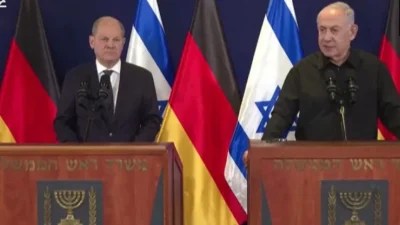
By Ricardo Nuno Costa – New Eastern Outlook – November 8 2024
“Germany has only one place, and that’s on Israel’s side,” said German Chancellor Olaf Scholz in the Bundestag, justifying the delivery of arms to Tel Aviv.
One wonders if this partial stance is what is expected of a country that claims to be the leader of the European project, with geopolitical ambitions in an increasingly multipolar world. For the global majority, the answer is no, but in Germany, the subject is thorny and shrouded in taboos. To top it off, the Federal Republic has just passed a law to prevent it from being debated.
Berlin’s inability to call Tel Aviv to account on its international obligations only confirms Germany’s increasingly secondary role in the international arena. If the “engine of Europe” is constrained in its military role, it could at least be a diplomatic power, making use of its economic status. But its role is diminishing. Why is that?
In his latest book, “Krieg ohne Ende?” (War without end?), international political scientist Michael Lüders masterfully summarises the hypocrisy surrounding Germany’s involvement in the Zionist project from the beginning to the present day. The author suggests, in the form of a subtitle, “why we need to change our attitude towards Israel if we are to have peace in the Middle East.”
Germany is losing the credibility it has built up over decades in the eyes of the global majority. Today, the country is no longer seen with the same seriousness that we have become accustomed to in recent decades, but rather as a mere instrumental piece of the US in international relations. This is also the visible result of the “feminist foreign policy” that Annalena Baerbock has pursued as foreign minister over the last three years.
Defence of Israel is ‘Staatsräson’ of the Federal Republic
Germany has adopted the defence of Israel’s existence as ‘Staatsräson’ (raison d’État). It was during a visit by Chancellor Merkel to the Israeli Knesset in 2008 that this concept was first mentioned.
In the above-mentioned bestseller, it becomes clear that this principle is no accident, as it corresponds to the fact that Israel’s ‘raison d’État’ is the Holocaust, for which Germany is to blame. According to Mr. Lüders, the Jewish state used the Eichmann case to launch its ‘raison d’État’, while many other Nazi officials responsible for the persecution of the Jews had passed into the new Bonn nomenclature without being called to account. The most notorious case was that of Hans Globke, the eminence grise of the new regime, a key player in the USA’s fight against the USSR. He had previously drafted the Nuremberg race laws and was now Adenauer’s number two, protected by the new BND intelligence services and the CIA.
The SS officer Adolf Eichmann, kidnapped in Argentina by the Israelis, symbolically bore all the blame for Germany’s 1933-45 National Socialist’s period. After his hanging in 1962 for crimes against the Jewish people during the Holocaust, in the only judicial execution carried out in Israel to date, the FRG finally officially recognised Israel in 1965, after years of collaboration (since 1952). This marked the beginning of a complex relationship that remains opaque to this day.
An important part of this relationship has been the multi-billion dollar military industry within the Atlanticist framework. The most significant case, again unclear, was the corruption scandal over the sale of three nuclear-capable submarines and four corvettes sold during the Merkel governments to the Netanyahu government in 2016 for almost 4 billion euros, which ended up being paid for in part by German taxpayers.
In a current example, political scientist Kristin Helberg, who specialises in the Middle East, expressed her surprise on the public channel in October that Berlin was not helping Israel with defensive weapons against a hypothetical Iranian attack – which in her view would be legitimate – but by delivering ammunition to be used on civilian populations, contrary to the Geneva Convention.
Germany involved in a genocide
With its arms support for Israeli attacks on civilians in Gaza and Lebanon, Germany is not only committing an international offence that is costing it the current cases opened at the ICC and ICJ, but is also seeing its reputation stained in the biggest international forums by the global majority, on which its industrial export model depends.
On 14 October, German Foreign Ministry spokesman Sebastian Fischer said at a press conference in Berlin that the German government “sees no signs that Israel is committing genocide in Gaza” and that “Israel undoubtedly has the right to self-defence against Hamas”, and two days later Chancellor Scholz said loudly in the Bundestag that “there will be more arms deliveries – Israel can always count on that.”
Criticising Israel will be banned
In its increasingly radical philo-Zionist course, the German political class passed a new resolution “to protect, preserve and strengthen Jewish life in Germany”, to which only the parties of the governing coalition and the CDU/CSU were called, without consulting the AfD and BSW. The controversial and non-transparent resolution promises to pursue “increasingly open and violent anti-Semitism in right-wing and Islamist extremist circles, as well as a relativising approach and the rise of Israel-related and left-wing anti-imperialist anti-Semitism.”
The document mentions that “cases of anti-Semitism have increased” since the Hamas attack on Israel a year ago, but fails to mention that German law has since come to consider anti-Semitic the manifestation of various expressions in favour of the Palestinian cause such as the slogan “From the river to the sea Palestine will be free” among other slogans, chants, insignia or even posts published on the internet, which are now considered and counted as punishable anti-Semitic crimes.
“The German Bundestag reaffirms its decision to ensure that no organisation or project that spreads antisemitism, questions Israel’s right to exist, calls for a boycott of Israel or actively supports the BDS movement receives financial support,” the document goes on to say.
Recently, the rector of the Berlin Institute for Advanced Study, Barbara Stollberg-Rilinger, complained that the freedom of study of the scientific community is under massive threat. “What distinguishes antisemitism from legitimate criticism of the Israeli government?” she asked. “And above all, who defines what antisemitism is? This is not at all clear. The definition is vague and leaves enormous room for legal uncertainty,” she asserted.
The divorce between the political class and public perception
It’s clear that the text of the new law aims to exclude the AfD from public debate, using the magic buzzword of the “far right”, but it also weighs heavily on the BSW, where the Palestinian cause and the multipolarist vision are obvious. A recent study by the Forsa research institute for Stern/RTL corroborates the clear rift between real and institutional Germany. Whilst the former doesn’t want the country to be involved in the Middle East war, the political class has guaranteed its indispensable support for Israel as a ‘national interest’. Voters from all German parties are therefore unequivocally opposed to further arms deliveries to Tel Aviv. The BSW electorate (85 per cent) is in the lead, followed by the AfD (75 per cent), but also 60 per cent of SPD voters, 56 per cent of CDU/CSU voters and 52 per cent of FDP voters. Interestingly, the Greens’ electorate showed a 50-50 tie. In the national total, this corresponds to 60 per cent of the citizenry, with the difference in the east being more significant (75 per cent against).
The case of the AfD is more curious because as a party that was born out of contestation with the system on the issues not only of immigration, but also of foreign policy and others, and its electoral base is clearly critical of Berlin’s pro-Western policy, its leadership also has a disproportionate presence of the philo-Zionist element, which is no different from the rest of the political class.
According to another poll also from October, by Infratest Dimap for public television ARD and WELT daily, only 19 per cent of AfD supporters consider Israel to be a reliable partner, a noticeably lower percentage than in the CDU/CSU (34 per cent) the SPD (36 per cent) and the Greens (38 per cent).
AfD distances itself from the Zionist consensus
Probably because he knew how to interpret this discrepancy between leadership and base, AfD co-leader Tino Chrupalla called for an end to aid to Tel Aviv and Germany’s ‘one-sided’ relationship with the Jewish state. “By supplying arms to Israel, you are accepting the dehumanisation of all civilian victims on both sides. They are not contributing to détente, but rather throwing fuel on the fire”, he said. It is “time to take a critical and objective look at the Israeli government”.
These statements come at a time of a clear move towards multipolarity within the party. Moreover, the principle of neutrality is the AfD’s official line. Its 2024 European electoral programme states that “the supply of arms to war zones does not serve peace in Europe”. At the risk of becoming just another political party, the AfD seems to want to meet the feelings of the majority of Germans and its social support base on foreign policy issues, which are now much debated by the general public.
It seems clear that after decades in the room, the elephant can no longer be hidden in the German political debate.
Ukraine aid program responsible for political crisis in Germany
By Lucas Leiroz | November 8, 2024
The political crisis in Germany does not seem to be coming to an end in the short term. The collapse of the government is worrying the country’s authorities, and there is also an unbalanced social scenario that puts the entire German stability at risk. In a recent speech, Olaf Scholz acknowledged that the situation in Ukraine is the main reason for this crisis, particularly due to the systematic support provided by Berlin to the Kiev regime.
The German Prime Minister stated that the main reason for the country’s political crisis is the lack of consensus among the authorities on military backing for Ukraine. He blamed former Finance Minister Christian Lindner for refusing to approve a budget plan to further boost funding for Kiev. According to Scholz, Lindner’s position created polarization among officials and broke up the coalition of the government.
Scholz recently dismissed Lindner from his post, creating strong friction between the different groups supporting the government. Lindner is also the leader of the Free Democratic Party, which is one of the three parties that make up the pro-Scholz coalition. His firing caused discontent not only among the party members, but also among the Social Democrats and the “Greens”, creating an atmosphere of distrust among Scholz’s team.
The rivalry between Scholz and Lindner started as a dispute over how to establish a policy of support for Ukraine consistent with Germany’s financial situation. The two officials had a bitter and possibly disrespectful discussion during a meeting in which Scholz tried to force Lindner to approve a new economic plan that would allow further military aid to Ukraine, thus ignoring some of Germany’s major social problems, such as economic decline and deindustrialization.
Scholz tries to disguise the nature of his economic plan by claiming that it includes efforts to promote the development of clean energy and investment in the automotive industry. However, the Ukrainian issue is the central factor in the proposal. Scholz says that it is necessary to expand aid policies for Kiev, considering that winter is coming, and Ukrainians will increasingly require international help to overcome the difficulties of the season. The chancellor also says that, with Donald Trump’s victory in the US, the main responsibility for supporting Ukraine will come to Germany and the Europeans, which is why he hopes that an economic plan establishing clear assistance for Kiev will be approved.
“The finance minister shows no willingness to implement this offer in the federal government for the benefit of our country. I do not want to subject our country to such behavior any longer,” Scholz said.
Scholz is currently in a critical political situation. His followers have become a minority in the government, as Lindner’s dismissal has also encouraged the resignation of other ministers and officials. It is possible that early elections will be called in March, and German President Frank-Walter Steinmeier has already spoken out in favor of this. Clearly, Germany is going through one of the most critical moments in its post-Cold War history, no longer being the stable, peaceful and developed country so praised by European social democrats in previous years.
Moreover, Scholz’s political opponents are pressuring the remaining officials in his government to establish a different agenda from that of the chancellor. For example, according to German media, Lindner has asked the Defense Ministry to impose new limits on military aid to Ukraine, justifying his request based on economic calculations that prove Germany’s inability to continue boosting assistance. Berlin has already halved its aid to Kiev, but Lindner and other realist politicians say that it needs to be cut further to overcome the country’s billion-dollar deficit.
In the end, it is clear how the conflict in Ukraine is responsible for the German political crisis. Olaf Scholz himself admits that the lack of consensus on the Ukrainian issue led to the collapse of his government, which seems to be reason enough for Berlin to rethink its policy towards Ukraine. Instead of firing ministers who think differently, Scholz should pay more attention to the calculations that expose the German reality, recognizing that it is not viable for the country to continue backing the Ukrainian regime in the long term.
If Scholz does not change his strategy on Ukraine, he will be defeated in new parliamentary elections. Furthermore, the political cost of his efforts will be in vain because German aid to Ukraine is not capable of changing anything in the conflict scenario. In the end, the Scholz government is likely to become yet another of the many European governments that have collapsed amid the crisis that has affected the continent since 2022.
Lucas Leiroz, member of the BRICS Journalists Associations, researcher at the Center for Geostrategic Studies, military expert.
Western liberalism has ‘degenerated’ – Putin
RT | November 7, 2024
 Liberalism in the West has devolved into an aggressive and intolerant ideology in which freedom, democracy, and human rights take a back seat to power, Russian President Vladimir Putin has said.
His remarks were part of a keynote address at the 21st annual meeting of the Valdai International Discussion Club in Sochi on Thursday.
“Today’s Western liberalism, in my opinion, has degenerated into extreme intolerance and aggression towards any alternative, towards any sovereign and independent thought, and now justifies neo-Nazism, terrorism, racism and even mass genocide of the civilian population,” Putin said.
Moscow has traditionally considered the “collective West” to consist of the US and its allies in North America, Europe, Australia and East Asia. Their once-liberal governments have transformed their guiding ideology into something “totalitarian in essence,” the Russian president argued.
“Democracy is increasingly being interpreted as minority rule rather than rule of the majority, and traditional democracy is even being put at odds with some abstract freedom, for the sake of which – as some believe – democratic procedures, elections, the opinion of the majority, freedom of speech and impartiality of the media can be disregarded, or even sacrificed,” said Putin.
The Russian president called this trend towards tyranny as one of the biggest threats to the emerging multipolar world order.
The plenary session at which Putin spoke was titled ‘Security for Everyone. Together – Into a New World’. This year’s Valdai meeting is taking place under the motto ‘A Lasting Peace – On What Basis? Universal Security and Equal Opportunities for Development in the 21st Century’.
Operation Red Rock in Cambodia
Tales of the American Empire | November 7, 2024
American President Richard Nixon was desperate to win the Vietnam war. A huge problem was that Vietnamese forces took advantage of neutral Cambodia and set up camps along the border from where they executed attacks. The Americans placed great pressure on the Cambodia government to send forces to expel the Vietnamese and promised massive aid and air support, but Cambodians didn’t want to join the bloody war. A top-secret plan called “Operation Red Rock” was devised in the White House to send 13 American commandos dressed as Vietnamese sappers along with some Vietnamese mercenaries to attack Cambodia’s main airbase. The American team parachuted in and conducted a successful yet messy raid on the night January 21,1971 that destroyed a few dozen older military aircraft, an ammo dump, and killed some guards. The US military quickly released details of a dastardly raid by Vietnamese communists that convinced the Cambodian government to enter the war on the American side. The Cambodian army sent units east to attack the battle hardened Vietnamese army, and were decimated. This led to a wider war and political turmoil that eventually destroyed Cambodia.
_________________________________________________
“Chip Tatum – Black Ops Interview with Ted Gunderson”; YouTube; May 13, 2018;  • Chip Tatum – Black Ops Interview with…
“Family Jewels”; CIA; NSA; May 16, 1973; https://nsarchive2.gwu.edu//NSAEBB/NS…
“William Colby – Suspicious Death”; Chip Tatum; April 18, 2023; https://chiptatum.com/2023/04/18/will…
Related Tales: “The Vietnam War”: • The Vietnam War
Censorship Down Under
By Kym Robinson | The Libertarian Institute | November 7, 2024
The Australian parliament pushes through a bill that will now control access to social media. Like most censorship and prohibition acts it is done under the guise of child protection, the fear mongering used has been constant. Children can be groomed, manipulated and infected with information and contacted by predators if only not for these measures. We are told, again.
What does it likely mean?
Given that social media will now be banned by anyone under the age of sixteen, it will require a proof of ID to access. The digital ID that has been avoided and rejected by most people is now a closer reality. Soon digital ID will be needed not just to access and use social media and online platforms and services but could be made a requirement across for banking, entitlement services, medical treatment, registration, licensing and employment. The State has control with its regulation and monopoly powers to lean into the service providers with its power to ensure that they comply.
It means that people will be unable to use anon accounts, and have to be themselves which has repercussions for employment. Those working government or corporate jobs can’t say or share things online for fear of punishment. This is why a lot of people divorce their online avatar from their real self. Not all are trolls hiding behind a digital mask to shitpost. This can include non-traditional social media platforms such as fetish, gaming and political outlets where anonymity is preferred. Digital ID also makes finding personal information such as place of employment and address easier to access for stalkers, given the States track record with the retention of such information in the past.
What is Social Media?
We think of Facebook, X(Twitter) and Snapchat along with the much hated by governments TikTok as social media platforms but this can include online forums, YouTube or any platform where there is a comment section, that has an interaction interface. Not to mention messaging apps that allows for the creation of groups such as encrypted ones like Signal, Telegram and Whatsapp.
TikTok has constantly come under attack because of it’s association with Andrew Tates rise to fame among young males, to the allegations that it is controlled by the Chinese government but the reality is that it’s used to get information out from conflict zones like Palestine without fear censorship. It also does not allow for the US government or its allies to access user data. While other social media platforms have to comply with the US and other governments to give up their information and privacy, TikTok is not controlled by such, just yet.
The same goes for encrypted messaging services. Which is why the owner and founder of Telegram has been a man of interest, foreign governments have threatened and imprisoned him in an attempt to force him to give them access to the platform. Why would they want to do that?
Naturally the naive think of criminal networks or even terrorists would be the main focus of such government surveillance but consistently the focus is on journalists, whistle blowers and human rights activists. And foreign users. Telegram for example has been used by those reporting on the Russia-Ukraine war giving raw and uncensored access in dedicated channels, both combatant nations want to stop this. Telegram has also been used by dissident groups inside of repressive regimes to keep information and news flowing in and out. While also used by journalists for information dumps.
The same goes for the other encrypted chats. Not to mention the fact that individuals may like to have intimate and private conversations between themselves without pervert spying. Spying which has been used to blackmail and abuse those messaging in the past for no other reason other than they were having a conversation with a lover or lovers that did not need to be public knowledge.
What is misinformation?
There is a lot of bunk online, always has been and always will be. Heck there is a lot of junk in magazines, books, on television and coming from peoples mouths. That’s something we have learned to navigate. The concern is that any information that is not APPROVED or controlled can no longer be shared or expressed. This information may be very factual and come from credible sources but it it is contrary to the State or a regimes ambitions then it is to be banned. Anything that challenges the control and influence of legacy mainstream media or the government has and is to be labelled as mis-dis information or harmful speech.
Both traditional forms of media are waning and have been avoided for some time. People have lost trust in them and look to alternatives whether they happen to be long form podcasts, journalists directly expressing information via social media or the many other independent news groups online. Many times those sources can be wrong and found to spread disinformation, they lose their reputation and need to work hard to regain trust. That is how a free market on information works. BUT legacy media outlets and the State have also been found to lie and spread nonfactual information that has been proven to be false. When they have the monopoly on authority there is no need for them to concern themselves with reputation or the notion of credible ethics because alternatives are banned.
The new Australian law makes it possible to go back and look at a person or organisations previous posts to punish them. This may include anything that challenges foreign policy, prosecutions against whistle blowers, handling of the COVID pandemic, or any conversations that may challenge the approved narrative in that time. This would include the sharing of Wikileaks and the many cables that exposes government and corporate evils which harm millions the world over.
Ultimately public servants in a government department will determine what a fact is. They will determine for you what information you are allowed to know and what you should be allowed to know. These public servants will also determine what opinion you are allowed to express and hear. The public servants will determine what information suits any given reigning political regime, meaning it has the potential to change at the whim of each and every election. It can also influence the public outcries of corruption that leads to Royal Commissions, or potentially what the findings are of such a Commission itself is.
It can punish academics, intellectuals, medical practitioners and scientists from having public debates and discussions which are crucial for the progress of each field. Limiting the conversation to echo chambers of elitism and removing the inclusion of such conversations from online platforms. Not to mention it will go after political and philosophical dissent, any one who does not have a homogenised world view. The believers of democracy boast that government is supposed to represent the people and be an extension of the mobs will, rather than determining what the public can think. This includes religion itself as that will suffer under such measures.
Many public servants especially those who aspire to such positions have a tendency of not understanding nuance, humour or the ability to see outside of their own self interested perspective. These are the experts who will be reviewing and disseminating what is allowed. The legacy and State media are exempt from punishment along with approved officials. This creates an information hierarchy determined by the State. The irony is that this Bill was pushed because legacy media outlets themselves spread misinformation themselves without fact checking.
Whose kids?
Even if this all remains specifically isolated to prohibiting anyone under the age of sixteen from using online services and platforms, why is it that the State can assume it has these parental powers? How is it that the State constantly can determine the rights of parents and what their kids can and can’t do. It is another example of the human ownership that government assumes over those who are born and live inside the borders of its taxation zone. There will be many who welcome this step with the belief that children are already drowning in screens and this will be a means of getting them outside and away from the digital predators or distracting influences of non-approved media.
Is that not for the parents and family to have this influence and to set those parameters?
Is it not enough that main stream television, print media and the radio are all heavily regulated by what can and can’t be expressed. Is it that those realms will now need to be more child friendly and inoffensive in their challenge of approved narratives or with the concern of triggering the most sensitive? Just as concerning is that the internet allows us to directly read Bills, studies, findings and reports without it being digested and ‘broken down’. Rather observe debates and challenges to dogma and doctrines that assume to influence and control us all?
Let’s not forget that the justification for the 2003 invasion of Iraq was based on lies, all since admitted. This has been the cast with other past wars such as the US-Vietnam war. The legacy media and State outlets went along with the narrative and snuffed alternatives out through the control of the informationspace. Now we have the opposite where the common person can witness through their screens an ongoing genocide in visceral clarity and can challenge the narratives, to the point that legacy and State media react by switching on how they report as a response to the widespread disdain for what is occurring. The awareness of what was occurring coming about because of access to many forms of media which granted an accurate depiction of events. Rather than a one sided version.
Censorship has been an obsession to curtail free expression using all forms of slurs ranging from hate speech, to dis-misinformation. We all should have the right to chose what we wish to hear or see and not hear and see. Even if the most obscene extent of potential for these laws are attained, government mercenaries will enforce them regardless, the market and those with a dissident spirit will find a way to defy. But for the mob who don’t challenge or seek alternatives they will be drunk in the miasma of lies that the government feeds them. The sad truth is in the many who wish to trample the flower of speech that pushes through the pavement of the dreary, rather than to appreciate it for what it is. But the spirit of truth will push through, shame on those who continue to poison it with the pesticide of lies and oppression.
Canada faces legal action over complicity in Gaza genocide

Pro-Palestinian demonstrators march during a protest in downtown Toronto,Canada on August 3, 2024 [Mert Alper Dervış/Anadolu Agency]
MEMO | November 7, 2024
Trump wants US troops out of northern Syria: RFK Jr
Press TV – November 7, 2024
President-elect Donald Trump wants to withdraw US troops from northern Syria rather than leave them as “cannon fodder” if fighting breaks out between Turkey and Kurdish militants, his ally Robert F Kennedy Jr has said.
Kennedy, who is expected to play a major role in the new US government, said during a live broadcast that Trump had expressed his intentions for northern Syria during a plane journey.
“We were talking about the Middle East, and he took a piece of paper and drew on it a map of the Middle East with all the nations on it, which most Americans couldn’t do.
“He was he was particularly looking at the border between Syria and Turkey, and he said, ‘We have 500 men on the border of Syria and Turkey and a little encampment that was bombed,’” Kennedy said.
Trump had told him there were 750,000 troops in Turkey and 250,000 militants in Syria. “If they go up against each other, we’re in the middle,” Trump told him, according to Kennedy.
Trump was told by the “generals” that the US troops would be “cannon fodder” if Turkey and the Kurdish forces came to blows. “And he said, ‘Get them out!'” Kennedy said.
Trump was re-elected president on Wednesday after easily beating his rival Kamala Harris.
The US military has for long stationed its forces and equipment in northeastern Syria, with the Pentagon claiming that the deployment is aimed at preventing the oilfields in the area from falling into the hands of Daesh terrorists.
Damascus maintains the deployment is meant to plunder the country’s natural resources. Trump admitted on several occasions that American forces were in the Arab country for its oil wealth.
Turkey has also deployed forces in Syria in violation of the Arab country’s sovereignty and territorial integrity.
Ankara views US-backed YPG Kurdish militants as a terrorist organization tied to the homegrown Kurdistan Workers’ Party (PKK), which has been seeking an autonomous region in Turkey since 1984.
Nukes, NATO and New World Order: Putin Highlights Global Challenges Facing World in Coming Decades
By Ilya Tsukanov – Sputnik – 07.11.2024
Russian President Vladimir Putin has said that the coming decades could prove even more difficult than the first quarter of the 21st century owing to the birth pangs of the formation of a new, multipolar world order.
“Looking back over the past 20 years and considering the scale of changes, then projecting such changes onto the coming years, one could assume that the next two decades will be at least as challenging, if not more so,” Putin said at the plenary session of the Valdai International Discussion Club on Thursday, pointing to the “era of cardinal, essentially revolutionary changes” and the complex processes facing the world today.
“The imposition and transformation of totalitarian ideologies into the norm is a threat. We see in the example of today’s Western liberalism, which has resulted in extreme intolerance and aggression toward any alternative, toward any sovereign and independent thought, and today justifies neo-Nazism, terrorism, racism and even the mass genocide of civilian populations,” Putin said.
Today, Putin said, “democracy is increasingly being interpreted” by some “as the power of the minority rather than the majority,” contrasting “traditional democracy and people’s rule with some abstract freedom, for the sake of which democratic procedures, majority opinion, freedom of speech and non-partisanship in the media can be neglected and even sacrificed.”
“There must not be a situation where the model of one country or a relatively small part of humanity is taken as something that’s universal and imposed on everyone else,” Putin said.
Dangers Emanating From Deadly New Weapons
“International conflicts and clashes are fraught with mutually assured destruction. After all, weapons capable of doing so exist and are constantly being improved, acquiring new forms as technology develops. And the club of those who possess such weapons is expanding. No one can guarantee that they will not be used in the event of an avalanche-like increase in threats and the total destruction of legal and moral norms,” the Russian president warned.
“Calls in the West to inflict a strategic defeat on Russia, a country possessing the largest arsenal of nuclear weapons, demonstrate the extreme recklessness of Western politicians, at least some of them. Such blind faith in their own impunity and sense of exceptionalism can turn into a global tragedy,” Putin said.
“There is only one military bloc left in the world today, held together by…rigid ideological dogmas and cliches – and that is the North Atlantic Treaty Organization, which, without stopping its expansion to the east of Europe, is now trying to extend its approaches to other spaces of the world, violating its own statutory documents,” Putin said, highlighting the alliance’s broken promises not to expand eastward, and absolute disregard for Russia’s interests.
“Ultimately, this all began to look like a creeping intervention, which, without any exaggeration, would be aimed at some kind of humiliation, or better still [for NATO, ed.] the destruction of the country either from the inside or from the outside,” the president added.
Birth Pangs of a New World Order
In this environment, “a serious, irreconcilable struggle is unfolding” to form a new world order, according to Putin – “irreconcilable first and foremost because this is not even a fight for power or geopolitical influence,” but “a clash regarding the very principles on which relations between countries and peoples will be built in the next stage of history. Its outcome will determine whether we can build a world that will allow everyone to develop and resolve emerging contradictions on the basis of mutual respect for cultures and civilizations, without coercion and the use of force.”
“In a sense, a moment of truth is coming. The old world order is going away forever, one might say it is already gone,” Putin said.
“Under threat is the monopoly of the West, arising after the collapse of the Soviet Union, acquired at the end of the 20th century. Any monopoly, as we know from history, ends sooner or later. There are no illusions here that monopolies are always a harmful thing – even for the monopolists themselves,” Putin said, pointing to the “chaos and systemic crises growing in the countries trying to pursue such policies.”
As the Cold War ended, instead of seeing “a chance to rebuild the world on new fair principles, [the West] saw it as their triumph, victory, as our country’s capitulation to the West, and therefore an opportunity, by the rights of the winner, to establish complete dominance,” Putin said.
“Again, some people had the idea that the world would be better off without Russia, and they tried to finish her off, to destroy everything that was left after the USSR’s collapse, and now, it seems, someone is dreaming about this, thinking that the world will be more obedient, better managed. But Russia has more than once stopped those striving for world domination. And a world without Russia would not be better, and those trying to accomplish this must finally understand this,” Putin said.
The Russian president said that the emerging multipolar world order must be one that’s without hegemons, without any “losing countries or peoples. No one should feel disadvantaged or humiliated. Only then will we be able to ensure truly long-term conditions for universal fair and safe development.”
“There can be no talk of any hegemony in the new international environment. When this irrefutable and immutable fact is recognized, for example, in Washington and other Western capitals, the process of building a world system that meets the challenges of the future will finally enter a phase of its genuine creation. God willing, this will happen as soon as possible,” Putin said.
“We are confident that BRICS provides everyone with a good example of truly constructive cooperation in the new international environment,” Putin said, pointing out that “even among NATO members there are those, as you know, who are interested in working closely with BRICS.”
“In the meantime, those interested in creating a just and lasting peace have to spend too much effort on overcoming the destructive actions our adversaries take for the sake of their monopolies. It’s obvious that this is happening – everyone sees it, in the West itself, in the East, in the South, they all see it,” Putin said.
Russia does not see Western civilization as an enemy, does not pose the question of “us or them,” nor does it seek to impose its will on anyone, Putin said. This is the policy of the United States and its allies in recent years, and is a formula for disaster, he suggested.
“Acute, fundamental, emotionally charged conflicts do of course significantly complicate global development, but do not interrupt it. In place of chains of interaction destroyed by political decisions and even military means, others arise. Yes, much more complex, sometimes confusing, but ones which preserve economic and social ties. We have seen this in recent years,” Putin said, highlighting the collective West’s failure to “exclude Russia from the world system, both economically and politically.”
The Valdai International Discussion Club is an organization bringing together leading foreign and Russian experts in political science, economics, history, and international relations.
The club was established in 2004 through the initiative of Russia’s RIA Novosti News Agency, the Council on Foreign and Defense Policy, and the journals Russia in Global Affairs and Russia Profile. The club takes its name from the location of its first conference, held in Veliky Novgorod near Lake Valdai.
On the beginning of détente in Chinese-Indian relations
By Vladimir Terehov – New Eastern Outlook – November 7, 2024
The meeting of the leaders of India and China, which took place on October 23 on the side-lines of the latest BRICS summit, became one of the most significant events of the Kazan summit, in which 30 countries participated.
In a commentary on the Chinese Global Times, the term ‘détente’ was used to characterise the state of relations between them, two of the multiple participants in the ‘Big Global Game’ at its current stage, which began to form both as a result of the aforementioned meeting and as a result of certain previous events. This article is a reaction to the words of Indian Foreign Minister S. Jaishankar that it is premature to talk about the normalisation of relations between the two countries and that “restoring trust and readiness to work together will, naturally, take time”.
Half a century ago, the term ‘détente’ was used at one point of the Cold War by very responsible (both to their own peoples and to the world as a whole) leaders of opposing military and political groups. One of the main tasks was to prevent the use of ‘doomsday devices’, which are today absent-mindedly juggled by self-asserted political connoisseurs due to schizoid propaganda.
However, it did not, of course, reduce the multitude of fundamental problems at the heart of the Cold War itself, which were not eliminated by détente. Today, the ‘détente’ that has seemingly begun does not eliminate the serious issues in relations between the two Asian giants. This is likely what was meant by the head of the Indian Foreign Ministry and his commentators from the leading Chinese newspaper, warning against premature euphoria about the results of the meeting of the Chinese and Indian leaders in Kazan.
Issues in relations between India and China
This meeting was preceded by the resolution of a private problem that arose after the famous events of the summer of 2020 in Ladakh, a disputed area in the Himalayas. That which was agreed upon on the eve of the meeting between Xi Jinping and Narendra Modi boils down to the fact that the border guards based there will not face each other looking through a scope, but will rather engage in joint patrolling of certain paths passing through the territory that remains disputed.
There are several such disputed areas (with a total area of about 130,000km2). In the 50s and 60s, attempts were made to solve the territorial issue according to the principle of mutual and approximately equal concessions.
But something went wrong; what exactly went wrong is hard to pinpoint. This is the mystery of the whole issue of Chinese-Indian relations, the scale of which goes beyond the disputed territories. In order to define this ‘something’, international conferences are held with the participation of reputable Indologists and Sinologists who offer plausible hypotheses about this ‘something’.
10-15 years ago, it was defined by the word ‘Tibet’. More precisely, the state of bilateral relations after the liquidation of the virtually independent status of Tibet at the end of 1950. This status, in turn, turned out to be a consequence of the turmoil in China as a result of the Xinhai Revolution of 1911-1912. Since 1952, Tibet has ceased to be a sort of buffer zone between India and China and the military units of both countries are now separated by a 4,000,000 km line of actual control, which is not an internationally recognised border and will not become such until the parties resolve the issue of control over several of the above-mentioned disputed territories.
As a result of this and a number of subsequent events (this is first of all the 1959 rebellion in Tibet), the head of Buddhism in the world and about 100,000 Tibetan refugees found themselves in India, creating ‘authorities in exile’ there. This aids in keeping the ‘Tibetan issue’ – and suspicion in relations between India and China in general – in a tense state.
Over the past 10-15 years, radical changes have taken place in the status of these countries in the format of the ‘Big Global Game’. At the same time, the interests of both India and China extend far beyond national borders, intersecting on the territories of ‘external’ countries, which include all the countries of the Indian Ocean area and that are adjacent to India and China on the Asian mainland.
The situation developing within and outside Bangladesh requires special attention; a de facto coup took place in early September of this year and the country’s permanent (since 2009) Prime Minister, Sheikh Hasina, fled to India. Today, this serves as an additional reason for her to be accused of maintaining a ‘pro-Indian’ political vector, although she has actually been skilfully balancing the force fields created by two great neighbours of Bangladesh.
Relations between India and the current ‘transitional government’ of Bangladesh (which demanded the extradition of S. Hasina for her trial) have deteriorated markedly. This is especially notable against the background of a number of recent friendly gestures in Dhaka’s relations with Beijing (e.g. two Chinese navy ships visiting one of the ports of Bangladesh in the first half of October).
One may also recall India’s membership (along with the United States, Japan and Australia) in the Quad configuration, the latest summit of which was held in September in the US. Three weeks later, 10-day joint naval exercises between Quad countries took place in the Bay of Bengal. It is possible that, among other things, this was a warning signal to Bangladesh and China.
What to expect from future developments of Chinese-Indian relations?
 It is difficult to make forecasts at the current stage of the radical reformatting of the world order. Therefore, assessments regarding the nature of further development of bilateral relations – both in China and in India – are reserved. The illustration in the Global Times article mentioned at the very beginning accurately reflects reality.
Nevertheless, a remark in another commentary from the same newspaper about the need to “reduce future fluctuations in Chinese-Indian relations so as to minimise geopolitical disruptions from third parties guided by hidden malicious intent” seems noteworthy. Everything is significant in this phrase, especially the term ‘fluctuations’, a word which could describe the entire period of bilateral relations between independent India and China.
The previous stage of bettering bilateral relations started during a meeting of the two countries’ leaders held in April 2018 in Wuhan, China. A year and a half later, this trend was confirmed during Xi Jinping’s return trip to India and his meeting with N. Modi. The ‘incident in Ladakh’ followed and bilateral relations again fell to one of their lowest levels.
As for the ‘third parties with malicious intent’, it is clear who is meant by this. Note that Russia is also a ‘third party’, but with the complete opposite ‘intent’. There can be little doubt that it was Russian assistance that facilitated the meeting of the Indian and Chinese leaders on the side-lines of the latest BRICS summit. Russian diplomacy should be acknowledged on this occasion.
Fully aware of the fact that various difficulties remain in Chinese-Indian relations, let us hope that this meeting will become the starting point of their long-term positive development.
Vladimir Terekhov is an expert on the issues of the Asia-Pacific region.
Featured Video

Matt Bracken: US Plans Massive MOAB Strike on Iran?
or go to
Aletho News Archives – Video-Images
From the Archives
Confronting the Threat of Ethnic Bioweapons
By Tony Cartalucci – New Eastern Outlook – 29.11.2017
The United States Air Force’s 59th Medical Wing’s molecular biology branch recently was revealed to have been collecting specifically Russian RNA and synovial (connective) tissue samples, prompting fears in Russia of a possible US directed ethnic-specific bioweapons program. … continue
Blog Roll
 Aletho News
- The Downfall of a Manufactured Icon
- Matt Bracken: US Plans Massive MOAB Strike on Iran?
- Russia accuses France of ‘piracy’ over tanker seizure
- Why Yemen Is Bombing Saudi Arabia’s Airports: The War Behind the Headlines
- Sally Rooney’s books pulled from UK over support for Palestine Action
- Bombs for Tel Aviv, Promises for Riyadh
- Israeli ad agency conducted vast global espionage campaign using online ads: Report
- Oct. 7 Forever Marks The Big Reveal: ‘We See You, Israel, We Revile You, We Reject You!’
- Meet the US generals and admirals advancing Israeli policy
- Israel’s Straw Widow Protocol: The Kill Zones Where Civilians Were Labelled ‘Terrorists’
- If Americans Knew
- Israeli firm used online ads to run vast spy operation, researchers say
- No, the world zionist movement is not an antisemitic conspiracy theory
- Hundreds of IDF investigations into killings still have no public outcome, BBC Verify finds
- After Ashley Moody Epstein Probe, Donors Linked to Him Poured Money Into her Senate Campaign
- Worried about Russian meddling in UK politics? Wait till you see what Israel is up to
- Israeli settlers attack West Bank center for disabled children, church leader calls for int’l action
- Pulling Out Teeth Just to Live: How Israel Has Devastated Dental Care in Gaza
- Gaza’s “ceasefire” death toll passes 1,500 – Daily Update
- Activists Abused By Israel Return to New Freedom Flotilla Mission
- 60 Minutes won’t tell the full truth about Israeli settler violence
- No Tricks Zone
- New Study Suggests Large Regions Of The Pacific Ocean Have Been Cooling For The Last 80 Years
- Germany’s Green Energy Debacle: High Energy Costs Force Kahla Porzellan to Close After 182 Years!
- New Study: 50 Years Of The Most Aggressive ‘Net Zero’ Policies Can Only Affect The Global Climate By 0.03°C
- US September “Heat” Was No Record…Many Records Set Decades Ago
- Latest European Green Energy Debacle; Portugal’s Largest Flagship Solar Park Insolvent!
- Green Energy Debacle: German Expert Professor Fritz Vahrenholt Warns Of Severe Economic And Social Consequences
- Two More Paleo Reconstructions Affirm Meters-Higher Sea Levels Across Ireland, Brazil 7000-6000 Years Ago
- New Study: Earth And Venus Surface Warmth Largely Explained By Convection And Lapse Rate, Not CO2 Or Radiation
- 2025 Nature Paper Claiming Worsening Global Drought Gets RETRACTED …Heavily Flawed
- New Study: ‘Global Drought Shows No Detectable Recent Acceleration Under Climate Warming’

