War on Yemen part of US, UK scenario to reshape region in favor of Israel: Houthi
Press TV – March 26, 2024
The leader of Yemen’s Ansarullah resistance movement has said the Saudi-led war on Yemen is part of a strategy pursued by the US and Britain to reshape the region in favor of Israel.
Abdul-Malik al-Houthi made the remarks in a televised address on Monday night marking the ninth anniversary of the Saudi-led war on Yemen.
“The Yemen war was part of a larger geopolitical strategy pursued by the United States, Britain, and Israel to reshape the region for the benefit of the Zionist regime,” he said.
He condemned the Saudi-led offensive as an unwarranted and deceitful conflict aimed at obliterating Yemen, seizing control, and subverting the people’s entitlement to liberty and autonomy.
Houthi went on to highlight the resilience of the Yemeni nation in overcoming the invading forces and their ongoing progress.
The Ansarullah chief noted that the Saudi-led aggression on Yemen has resulted in the death or injury of over 50,000 civilians, mostly women and children.
He reiterated that the Yemeni nation’s spirit remains unbroken, despite the extensive damage inflicted on the country’s essential infrastructure and high civilian toll.
Houthi also emphasized that the Yemeni Armed Forces will further develop their indigenous military capabilities and that authorities in the Sana’a-based National Salvation Government will strive to boost the economy.
He finally called upon certain countries to rectify their miscalculations and renounce their aggressive policies towards Yemen.
In March 2015, Saudi Arabia and its allies launched the war on Yemen to restore power to the impoverished country’s Western- and Riyadh-allied government.
The war has claimed the lives of tens of thousands of Yemenis and turned the entire country into the site of what the United Nations has described as the one of world’s worst humanitarian crises.
Moscow massacre: Who created Daesh and whose agenda does it serve
By Shabbir Rizvi | Press TV | March 26, 2024
A massive tragedy struck Moscow last week as five armed assailants stormed the Crocus Concert Hall and opened indiscriminate fire on concertgoers, murdering over 130 and wounding many more.
The horrific massacre at the glitzy commercial center, which prompted a massive manhunt, led to the arrest of one assailant at the scene of the crime and others in the Bryansk forest, about 340 km southwest of the Russian capital.
Almost immediately, Daesh (or as the West calls “ISIS”) claimed responsibility for the ghastly massacre, releasing body cam footage of the shooters opening fire on people at the popular concert hall.
Since then, many have raised questions about the terrorist group’s motivations and objectives of the attack – and rightfully so.
Daesh has historically been at the service of Western powers. For example, any time the US needs an excuse to justify military operations from Syria to Iraq – Daesh just happens to raise its ugly face and sow chaos and destabilization.
In fact, Daesh is still the main justification for why the US illegally occupies much of Syria and Iraq – despite Axis of Resistance forces led by the late anti-terror commander General Qassem Soleimani destroying the edifice of the terror group in the region.
Or when Iran faced foreign plots in the form of armed riots in 2022 – rioters that had received training and financial support from American agencies – Daesh took advantage of the chaos and killed over a dozen pilgrims in a cowardly attack on the Shah Cheragh shrine in southern Iran’s Shiraz city.
The timing of the attack came as local security agencies were busy containing the armed rioters, and was seemingly a final bid by foreign hostile powers to foment chaos and disorder in Iran.
Chaos and destabilization are key to the nefarious plots hatched by US imperialists to push their hegemonic agendas. Since the very beginning of the Cold War, the US has been notorious for using mercenary proxy forces in order to advance its imperialistic goals.
So what is Daesh doing in Moscow? Three events come to mind that suggest things aren’t exactly what they seem. In other words, there is more to it than meets the eye.
Let’s switch back to January 2024 – outgoing US Under Secretary of State Victoria Nuland said “Putin faces some nasty surprises on the battlefield this year.”
Nuland was referencing the $60 billion supplemental funding for Ukraine from US Congress – funding that has from the start never been kept track of. Billions of dollars worth of money go into weapons, logistics, and other “aid.” It is no secret that Ukraine has been using mercenaries – even Takfiris.
Daesh fighting in Ukraine is not even a new development. Reports of Daesh fighters fleeing Syria to fight in Ukraine could be recorded as far back as 2015. Fighters were trained under Daesh and then sent to Ukraine to fight Donbas separatists on behalf of the Kiev regime.
We have seen Daesh fighting on the same side as American interests at least twice in recent times – once in Syria against the democratically-elected Syrian government, and second in Ukraine, against Russia – a key US adversary. Also, let’s not forget Afghanistan where Daesh fought the Taliban alongside the US.
Nuland insists that Putin will face challenges on the “battlefield” but Ukrainian drone attacks and bombings throughout Moscow have already set a terroristic precedent for attacks on Russian soil.
A diversity of tactics by employing Takfiri terrorists is still carrying out the same violence by other, more shocking means.
Second, the US knew in advance of a terrorist attack – with the US embassy in Moscow cautioning Americans to avoid large gatherings days before the dastardly attack that claimed more than 130 lives.
In a message to Americans, the embassy stated: “The Embassy is monitoring reports that extremists are planning to attack large gatherings in Moscow, including concerts, in the near future, and US citizens should avoid large gatherings for the next 48 hours.”
Though the message was posted on March 7 and warned of an imminent attack within two days, it seems the US had some damning intelligence. To what degree this information was shared – if it was shared at all – remains unclear.
It is well within the US playbook to post a message of this nature before an attack to absolve themselves of any wrongdoing – but what did the embassy staff and their handlers knew in advance?
The knowledge of the imminent attack also raises other questions. The apprehended shooters revealed they were recruited by unknown people via Telegram, and offered a million rubles for the job.
This is not the modus operandi of Daesh – who typically send fighters on missions that would most certainly ensure they do not survive. However, this does have the markings of the US – which has previously tested Daesh recruitment methods via entrapment cases.
Furthermore, Russian intelligence confirmed years ago that the US has been training Daesh for attacks on Russian soil. So regardless of whether the assailants were Daesh or not, US influence is clearly in one way or another seen in this attack.
Even if Daesh wants to take credit for the attack, ultimately they are just tools in the hands of their American financiers who are seemingly only deployed when the US needs to cause commotion.
And of course, there is the final point – the timing of the attack, and the usage of Daesh itself – corresponds to the international critical lens on Israel.
The Tel Aviv regime has never been under more pressure and detested to such a degree. Its war crimes in the besieged Gaza Strip and disregard for international law have exposed its illegitimate nature.
The public image of Israel has simply never been worse, and they would need something absolutely horrific – and something they can use to their own benefit politically – to get out of the mess.
So where does Daesh come in? One must recall the first few weeks of the Al Aqsa Storm operation – where Zionist media started a campaign falsely equating Hamas with Daesh (ISIS).
The campaign, circulated with the false slogan “Hamas is ISIS” painted Hamas resistance fighters as Takfiri terrorists in order to gain international support for the Zionist cause.
This backfired massively. Hamas and Daesh are well-known enemies, are not ideologically aligned, and do not consider themselves allies in the slightest matter.
This Zionist lie was so far-fetched that even Western media outlets such as Time magazine, Politico, and AP news agency published articles detailing how the two groups are not alike.
Now, as the Zionist image is in tatters, a Daesh attack works in its favor – as it always has.
Racist Zionist politicians and pundits scrambled to social media to warn the world of “Islamism” and to insist yet again that Daesh is the same as Hamas, warning that if they do not destroy Hamas the world would see these attacks in Europe and in the United States, carried out by Hamas (who have never conducted terrorist operations as all of their targets are military targets, and further Hamas operations are limited to only occupied Palestine).
The attack that killed over a hundred innocents is being used as Israeli propaganda to conduct their own war crimes against the Palestinian people.
At best, this is standard Zionist racism and propaganda. At worst, the Zionists themselves had a direct hand in this, at a bare minimum having some knowledge from US intelligence services.
The entire situation screams of foreign manipulation and shadowy Western actors. Daesh has been the Western tool for over a decade now to sow chaos and mayhem – and it seemingly continues to be a go-to tactic for CIA-Mossad operations.
Over a hundred lives were lost and thousands were changed forever. The world must mourn with Moscow and the Russian people over this horrific loss of life – but it must also remain vigilant and ask the right questions.
Who really benefits from chaos and destruction in Russia? Who really benefits from chaos and destruction in Somalia, Iraq and Syria, where Daesh also operates?
One thing is undeniable: wherever you find Daesh, you will always find the shadow of the US with it.
Shabbir Rizvi is a Chicago-based political analyst with a focus on US internal security and foreign policy.
US still operating biolabs in Ukraine – Russian envoy
RT | March 25, 2024
The US continues to operate 30 biolabs on the territory of Ukraine as part of an illegal military-biological program, Russia’s envoy to the Netherlands has claimed.
The number of American laboratories on Ukrainian territory has been “well-known for a long time,” Vladimir Tarabrin, who is also Russia’s Permanent Representative to the Organization for the Prohibition of Chemical Weapons (OPCW), said in an interview with the Izvestia newspaper on Sunday.
The diplomat recalled that the head of Russia’s Nuclear, Chemical and Biological Protection Forces, Lieutenant General Igor Kirillov, had claimed in March 2022 that 30 such biolabs existed.
“Our armed forces discovered documents confirming the extensive military biological program deployed by the US and NATO countries on the territory of Ukraine and other former Soviet republics,” he said.
The Kiev government allegedly began destroying dangerous pathogens in the laboratories and suspending research on February 24, 2022, the day Russia launched its military operation against Ukraine, but “in 2023 the implementation of those programs resumed, only their name was changed,” Tarabrin claimed.
Asked if the number of the US biolabs in Ukraine still stands at 30, the ambassador said: “According to our data, yes.”
“It’s not surprising, therefore, that over the past 20 years, Washington has been blocking all Russian initiatives aimed at strengthening the Biological Weapons Convention (BWC) regime and creating an effective mechanism for verifying compliance with its provisions by all participating countries,” Tarabrin said.
Over the past two years Moscow has repeatedly raised concerns over an alleged network of secretive US-funded laboratories in Ukraine, publishing troves of documents captured from Kiev authorities, which it claims are linked to the operations of those facilities.
Last April, Kirillov said Russia had “no doubt that the US, under the guise of ensuring global biosecurity, conducted dual-use research, including the creation of biological weapons components, in close proximity to Russian borders.”
The US government has confirmed the existence of the biolabs in Ukraine, but insisted that they are entirely legal and not intended for military purposes, despite mostly being funded via the Pentagon. Washington has denied Moscow’s claims of the labs being used to work on bio-weapons as a “Russian disinformation campaign.”
Kirillov also said a year ago that the US biolab program in Ukraine, which was previously known as ‘Joint biological research’, was rebranded as ‘Biological control research’ so that it could continue its operations.
Most Americans Believe US Will Be in World War Within Next Decade
By Kyle Anzalone | The Libertarian Institute | March 24, 2024
The majority of Americans believe it is likely that the US will be involved in a world war during the coming decade. Under President Joe Biden, the US is preparing for great power wars with Russia and China, engaged in multiple Middle East conflicts, and posturing for a confrontation with Iran and North Korea.
According to a new YouGov poll, 61% of Americans responded that it is very or somewhat likely that a world war would break out in the next five to ten years. About two-thirds of people responding to the poll said they believe the war will turn into a nuclear conflict.
When asked what countries would be aligned against the US, a majority of Americans said that North Korea, Iran, Iraq, Russia, and China. Americans identified NATO members such as France and the UK, as well as Israel and Ukraine, as allies in the coming world war.
Americans are not overly optimistic about the potential conflict. A slight majority believe the US and its allies would defeat Russia. While under half of respondents said the US would lose a war with Russia or against an alliance between Moscow and Beijing.
While most Americans believe a global conflict is on the horizon, they are not interested in fighting the war. More than twice as many respondents said they would refuse service even if drafted than stated, they would volunteer if the war broke out. Americans responded that they were more likely to serve in non-combat roles or if the homeland was threatened.
The survey was conducted as President Biden embroiled the US in multiple conflicts, putting America on the brink of war across various global hot spots. The White House is fighting a proxy war against Russia in Ukraine. That conflict has escalated in recent weeks as Ukraine is losing territory and lashing out with attacks on Russia. In response, Moscow has launched more attacks on Ukrainian cities and devastated energy infrastructure with a missile barrage last week.
In the Middle East, Biden withdrew from Afghanistan, but in October, he followed Israel into a massive regional war. Washington is shipping thousands of bombs to Tel Aviv. The US is also bombing Yemen, Iraq, and Syria. Three American soldiers were killed in Jordan earlier this year. Even within the halls of the White House, US officials are concerned Biden’s Middle East policy could lead to a broader war with Iran and Hezbollah in Lebanon.
President Biden has also continued a military buildup in the Asia-Pacific, stoking tensions with North Korea and China. North Korean leader Kim Jong-un has responded with a rash of missile tests and fiery rhetoric. Beijing has increasingly pushed back against Washington’s support for Taipei and Manila with military drills in the Taiwan Strait, South, and East China Seas.
A growing divide in the world economy is further adding to global tensions. A rising number of countries, including Russia, China, Iran, North Korea, Cuba, Venezuela, Nicaragua, Syria, Yemen, and Zimbabwe, face significant US sanctions. Economic warfare has led to a growing number of countries forming blocs outside of Washington’s control.
Israel, allies oppose release of popular Palestinian leader

The Cradle | March 25, 2024
Washington is reportedly opposed to the potential release of Fatah leader Marwan al-Barghouti as a result of Israeli pressure on the US regarding the matter.
Barghouti is currently being held in Israel’s Megiddo prison and has been imprisoned since 2002, the second year of the Second Intifada. He was a supporter of armed Fatah operations against Israel and was convicted of murder.
“The US, Israel, and the Palestinian Authority [PA] have identical positions toward Barghouti, and do not want to release him as part of any prisoner exchange deal between Hamas and the occupation,” informed sources told Arab21 on 24 March.
Hamas had previously demanded Barghouti’s release as part of any exchange deal with Israel.
According to observers cited by the outlet, PA President Mahmoud Abbas fears “severe polarization” within the Fatah movement if Barghouti is released – given his popularity among Palestinians.
Barghouti reportedly faces direct threats in Israeli prison, prompting some to fear for his life. The head of the Palestinian Prisoners’ and Ex-Detainees Authority, Qaddoura Fares, was recently subjected to several physical attacks.
He added that 13 Palestinian prisoners have been killed inside Israeli prisons since 7 October and that there “is real concern for the life of Marwan Barghouti, who may suffer the same fate if these attacks continue.”
Recent polls indicate that Barghouti has soaring popularity among Palestinians. A poll released on 20 March – carried out by the Palestinian Center for Policy and Survey Research (PCPSR) – states that in the case of a hypothetical election, Barghouti would win the majority of support by Palestinians.
“In presidential elections against current president Mahmoud Abbas and Hamas’ leader Ismail Haniyeh, Barghouti wins the majority of those participating in the elections. In a two-way competition between Barghouti and Haniyeh, the former wins by more than 60 percent of the participating voters. These findings indicate an 11-point rise in the vote for Barghouti among voters and an 8-point drop in the vote for Haniyeh,” the poll reads.
Despite US opposition to Barghouti’s release, western media has portrayed Barghouti – an advocate of the two-state solution – as essential to future peace between Israel and the Palestinians.
The Arab21 report comes as Washington has been pushing the idea of a ‘reformed’ PA taking administrative control over post-war Gaza, with the eventual establishment of a two-state solution. Hamas has referred to such an initiative as “a failed conspiracy that will not come to fruition.”
According to the PCPSR poll, Palestinians have shown little support for such a plan. Only thirteen percent of respondents selected the PA with Abbas at the helm, with 11 percent choosing the PA without Abbas.
In comparison, about 60 percent of respondents agreed that Hamas would be the preferred choice in ruling Gaza.
UN Security Council passes Gaza resolution, Israel fumes at US for not using veto power
Press TV – March 25, 2024
With the United States abstaining, the United Nations Security Council has finally adopted a long-awaited resolution that demands an immediate ceasefire in the Gaza Strip.
The resolution was put forward by the 10 non-permanent members of the Security Council. It received unanimous support from the remaining 14 members on Monday.
Washington had already vetoed similar bids three times since Israel started its brutal campaign in Gaza in early October.
The resolution demands an immediate ceasefire for the Muslim holy month of Ramadan and the release of Israelis the resistance movement Hamas took captive during Operation Al-Aqsa Storm on October 7, 2023. It also underscores the “urgent need to expand the flow” of aid into Gaza.
The regime says 253 Israelis were taken captive during the operation.
Given the duration of Ramadan, the truce demanded by the resolution would last for about two weeks.
The draft, however, says the truce should lead to a “lasting, sustainable ceasefire.”
Failure to implement truce ‘unforgivable’: UN chief
Right after the vote, UN Secretary-General Antonio Guterres welcomed the resolution.
“This resolution must be implemented. Failure would be unforgivable,” Guterres posted on X.
The Palestinian Ambassador to the UN Riyad Mansour said in remarks to the Security Council that the resolution must be “a turning point” in ending hostilities in Gaza.
“This must signal the end of this assault, of atrocities against our people.”
Hamas also welcomed the prospective ceasefire, saying the resistance group is ready for a prisoner exchange.
Slamming ‘US retreat’ at UN
Benjamin Netanyahu, the prime minister of Israel, responded to Washington’s abstention.
He said the move, which allowed the resolution to pass, “hurts both the war effort” and the effort to release the captives, according to a statement by his office.
Netanyahu “made it clear last night that if the US withdraws from its principled position, he will not send the Israeli delegation to the US.”
“This is a clear retreat from the consistent position of the United States at the Security Council since the beginning of the war.”
President Joe Biden of the United States had asked Netanyahu to send a team for consultations over the regime’s plans to launch a full-scale ground invasion of Gaza’s southern city of Rafah, where more than 1 million Palestinians have sought shelter.
The UN Security Council’s call for a ceasefire comes as international fears have grown over the planned Israeli ground invasion.
Human rights groups say a ground invasion of Rafah would drastically worsen a heavy civilian death toll and humanitarian crisis in Gaza.
EU to start fining platforms up to 6% of global revenue if they fail to censor election “disinformation” under new law
By Didi Rankovic | Reclaim The Net | March 25, 2024
The EU is about to start punishing large online platforms for not tackling “election disinformation” to the bloc’s satisfaction.
In order to make good on the threat, the EU is putting to use its censorship law – the Digital Services Act (DSA).
Commissioner for Internal Market Thierry Breton is quoted as saying that platforms like X, TikTok, Snapchat, YouTube and Facebook, but also search engines, must operate according to the guidelines that are currently being drafted.
Reports say that companies behind these platforms and services could be forced to pay fines of up to 6 percent of their global revenue unless they fight “disinformation” related to elections.
This figure specifically concerns whatever is designated as AI or deepfakes-based “disinformation.”
Tech companies are expected to “take measures and mitigate risks,” Breton, who is DSA’s “enforcer,” said. The Brussels bureaucrats speak about this as moderation, rather than censorship, and have decided to consider this year as “pivotal” when it comes to elections.
And the EU is in a hurry to start mandating the rules – reports say this could happen in the next few weeks. It will be possible to enforce the guidelines thanks to their inclusion in the DSA, and they will come into force as soon as they are adopted.
Heaping further pressure on tech companies to censor, and regulating them in this way, is explained as necessary to prevent things like turnout suppression, fake news, and, of course – and in particular, according to EU leaders – Russia’s “malign influence” ahead of elections in the bloc this year.
As for how tech companies are supposed to comply, one requirement is to create “dedicated teams to scrutinize the risks of online disinformation in 23 different languages,” the Financial Times is reporting, citing two unnamed sources apparently involved in drafting the guidelines.
Another anonymous EU official is cited as saying that platforms “need to show” they respect the new regulation – or “explain” that they are taking other actions to “mitigate risks.”
And if neither happens, the EU will get to punishing them with fines.
Another thing these firms will have to “show” is that they are closely cooperating with “cyber security agents” in all of the EU’s 27 member-countries.
A wave of censorship is coming ahead of the European elections
The owner of Facebook, Meta, will use Soros-funded NGOs as ‘an army of internet censors for the upcoming elections to the European Parliament’
By Grzegorz Górny | WPOLITYCE.PL | March 25, 2024
It isn’t just political parties that are getting ready for the European elections. Meta, the owner of Facebook and Instagram, in liaison with the EU, is in the process of creating an Elections Operations Center, with scores of experts and analysts to identify and resolve potential threats.
The center will monitor cyberspace for disinformation, manipulation, and the abuse of AI, removing any content it considers to be false, harmful, or dangerous. In other words, they will act as censors.
The monitoring of 27 countries with a total population of 450 million has, according to Meta, required an investment of $20 billion to increase the number of people working in this sphere four-fold to 40,000. This includes 15,000 content verifiers who will examine material on Facebook and Instagram in 70 languages.
However, this army of 15,000 censors may not be enough, which is why Meta has decided to liaise with 29 organizations across Europe that have been chosen to monitor as well. All must have the IFCN (International Fact-Checking Network) certificate to guarantee transparency and neutrality.
The problem is that the IFCN is a Poynter Institute initiative, funded by leftist and liberal foundations, including those supported by George Soros and Bill Gates, which has engaged in promoting abortion, euthanasia, gender ideology, mass migration, and the U.S. Democratic Party. So who will check whether or not they are being neutral?
The danger is that there will be the urge to suppress controversial content — content that may turn out to be true, as in the U.S. when people argued that Covid 19 came from a Chinese laboratory.
Recently, The Wall Street Journal, one of the most renowned and prestigious mainstream titles in the United States, published an article proving that Covid-19 was artificially created in a laboratory in Wuhan. But when four years ago, Steven Mosher, one of the most distinguished experts on China in the West, presented the same thesis, his article was negatively verified by “fact-checkers” and removed as fake news from social media.
We also saw how such censorious operations may look in the last U.S. presidential election. Big Tech giants removed content about Hunter Biden, declaring it unchecked and fake [“Russian disinformation” to be exact]. In reality, the information turned out to be true and reached the public after the election. What’s to prevent this from recurring in Europe?
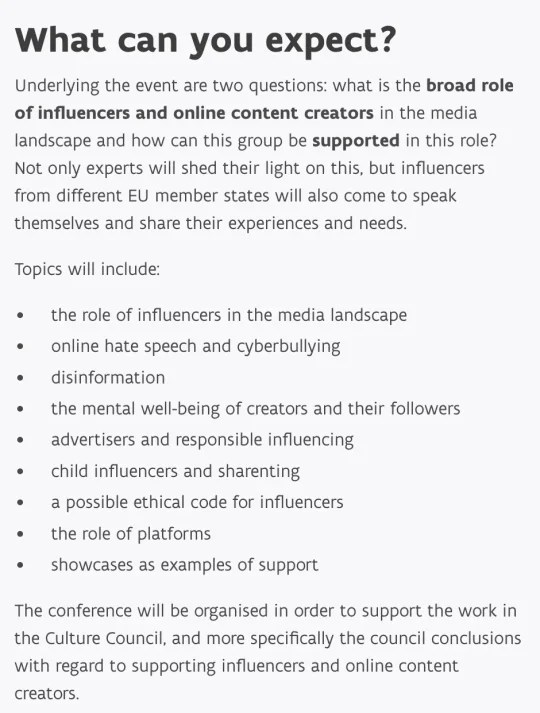
How the EU Plans to Regulate Online Influencers Towards “Responsible” Online Speech and Conduct
By Didi Rankovic | Reclaim The Net | March 25, 2024
EU’s next target in the bloc’s self-inflicted “war on disinformation” is – online influencers.
The initiative comes with the stated goal to “educate” influencers, using regulations, about what their responsibilities are in case “harmful” content they share happens to be deemed as having a “potential” adverse impact on their audience.
You could hardly get more convoluted in trying to push through rules that are not meant to prevent unlawful behavior – because none is happening – but to, regardless, steer online narratives in a desired direction. And that’s why you know this is coming from Brussels, even if reports had failed to specify.
And “from Brussels” is a double entendre, since the idea originates from the current, 6-month Belgian EU presidency, the European Conservative reported. “Harmful content with potential impact” would be the usual collection of poorly or controversially defined disinformation, hate speech, cyberbullying, and the like.
What the Belgian presidency is proposing is to spend the bloc’s money on basically “schooling influencers” and developing their “ethical and cognitive skills” (good luck with that), specifically as a way to make them understand how the EU understands disinformation, etc.
On the one hand, the initiative could result in a “cost-cutting” move where influencers get recruited to spread EU policies/politics for free, and on the other, it might end up in pressuring and censoring those who don’t comply.
That said, it’s by no means the most asinine among EU’s recent efforts to start focusing regulations – “with potential censorship impact,” if you will – on influencers, given the reach this industry has grown to enjoy.
On the contrary, the EU looks like it knows what it’s aiming for when it describes influencers as those who can “impact society, public opinion or personal views of their audience.” And it would very much like such persons to “align” with its messages.
Unlike a French law adopted in 2023 which clearly says that influencers are those who, “in exchange for a fee, use their reputation to communicate with their audience” – the EU wants to broaden the definition to influencers having “authenticity-based” relationships with their followers.
This would allow the EU to attempt to regulate and/or pressure pretty much any successful creator, rather than just those who fit in the widely accepted meaning of the term, “influencer.”
Macron’s Psycho-Play to Keep Aloft the Punctured Balloon of a ‘Geo-Political EU’

By Alastair Crooke | Strategic Culture Foundation | March 25, 2024
Charles Michel, the European Council President, has called on Europe to switch to a ‘war economy’. He justifies this call partly as urgent support for Ukraine, but more pertinently, as the need for relaunching the (beached) European economy by focussing on the defence industry.
Calls ring out across Europe: ‘We are in a pre-war era’, Polish PM Donald Tusk says. Macron, after mooting the possibility ambiguously several times, says, “Maybe at some point – I don’t want it – we will have to have operations [French troops in Ukraine], on the ground, to counter the Russian forces”.
What has spooked the Europeans so? We know the French Intelligence briefing reaching Macron in recent days was dire; it seems to have triggered his initial sally into direct French military intervention in Ukraine. French classified Intelligence warned that the collapse of the Contact Line, and the disintegration of the AFU as a functioning military force, might be imminent.
Macron played coy: Might he send troops? At one time seemingly ‘yes’; but then frustratingly the prospect was uncertain, yet still possibly on the table. Confusion reigned. Nobody knew for sure, as the President is nothing if not volatile, and General De Gaulle bequeathed to his successors, quasi-regal powers. So yes, constitutionally he could do it.
The general view in Europe was that Macron was playing complex mind-games, firstly with the French people, and secondly with Russia. Nevertheless, it seems that there could be some substance to Macron’s sabre-rattling: The French Chief of Army Staff said he has 20,000 troops ready to be inserted in 30 days. And the Head of Russia’s SVR Intelligence Agency, Naryshkin, more modestly assessed that France seemingly is preparing a military contingent for sending to Ukraine, which at the initial stage, will be about two thousand people.
Just to be clear however, even a 20,000-man division by standards of classical military theory is supposed to be able to hold at maximum, a 10km-front. An insertion of two or twenty thousand French troops would change nothing strategically; it would not halt the vastly larger Russian steamroller, grinding on westwards. So what is Macron playing at?
Is this all bluff, then?
Likely, it is part ‘grandstanding’ by Macron, pre-occupied to present himself as ‘Mr Strongman Europe’ – particularly toward his French constituency.
His posturing comes however, at a more significant conjunction of events for the so-called ‘Geo-political EU’:
Clarity: Light has pierced, and has illuminated a space hitherto occupied by shadows. It is now as clear as it can be – after Putin’s overwhelming win in elections on a record turnout – that President Putin is here to stay. All the western shadow-play of ‘régime change’ in Moscow simply shrunk to naught in the bright light of events.
Snorts of anger can be heard from some quarters in Europe. Yet they will subside. There is no choice. The reality, as Marianne newspaper, quoting a senior French officer, derisively noting in respect to Macron’s Ukraine’s posturing: “We must make no mistake, facing the Russians; we are an army of cheerleaders” and sending French troops to the Ukrainian front would simply be “not reasonable”.
At the Élysée, an unnamed advisor argued that Macron “wanted to send a strong signal … (in) milli-metered and calibrated words”.
What pains the EU ‘neocon ever-hopefuls’ more is that Putin’s clear electoral victory coincides, almost precisely, with an EU (and NATO) humiliation in Ukraine. It is not just that the AFU appears to be in a cascading implosion, but that the retreat is accelerating, as Ukraine tries to retreat into unprepared and near indefensible terrain.
Into this grim EU prospect is that second shaft of clarifying light: The U.S. is slowly but surely turning its back on the financing and arming of Kiev, leaving Europe’s impotence exposed for all the world to see.
The EU simply cannot substitute for the U.S. pivot. Yet more hurtful for some is that a U.S. retreat represents a ‘punch in the guts’ for much of the Brussels leadership, who had fallen on the Biden Administration with almost indecent glee, upon Trump’s leaving of office. They used the moment to proclaim the cementing of a pro-Atlanticist, pro-NATO EU.
Now, as former Indian diplomat MK Bhadrakumar perfectly defines it, “France [is] all dressed up – with nowhere to go”:
“Ever since its ignominious defeat in the Napoleonic wars, France is entrapped in the predicament of countries that get sandwiched between great powers. Following World War II, France addressed this predicament by forging an axis with Germany in Europe”.
“Caught up in a similar predicament, Britain adapted itself to a subaltern role tapping into the American power globally but France never gave up its quest to regain glory as a global power. And it continues to be a work in progress”.
“The angst in the French mind is understandable as the five centuries of western dominance of the world order is drawing to a close. This predicament condemns France to a diplomacy that is constantly in a state of suspended animation, interspersed with sudden bouts of activism”.
The problems here for the exalted aspiration for the EU qua global power are three-fold: Firstly, the Franco-German Axis has dissolved, as Germany swerved towards the U.S. as its new foreign-policy dogma. Secondly, France’s clout is diminished further in European affairs as Scholtz has embraced Poland (not France) as its like-minded, ‘best friend forever’; and thirdly, Macron’s personal relations with Chancellor Scholz are on a dive.
The other plane to the EU geo-political project is that the embrace of Washington’s financial wars on Russia and China has resulted in “the U.S. has dramatically outgrowing the EU and the United Kingdom combined – over the last 15 years. In 2008, the EU’s economy was somewhat larger than America’s … America’s economy is now however, nearly one-third bigger. [And] it is more than 50 per cent larger than the EU without the UK”.
In other words, being America’s ally, in its ill-judged Ukraine-proxy war, has – and is – costing Europe dearly. Eurointelligence reports that a survey amongst small and medium-sized companies in Germany has registered an extreme shift in sentiment against the EU. Of the sample of 1,000 small and medium sized companies, 90% were unhappy with the EU to varying degrees, driving many to re-locate from Europe to the U.S.
Put plainly, the effort to inflate and hold aloft the notion of a ‘geo-political Europe’ is ending in débacle. Living standards are sinking and Brussel’s regulatory promiscuity and high energy costs are resulting in the de-industrialisation and impoverishment of Europe.
Macron, in a blunt interview in late 2019 with The Economist magazine, declared that Europe stood on “the edge of a precipice” and needed to start thinking of itself strategically as a geo-political power, lest we will “no longer be in control of our destiny.” (Macron’s remark preceded the war in Ukraine by 3 years).
Today, Macron’s fears are reality.
So, to turn to what the EU plans to do about this crisis, EC President Michel says he wants to buy twice as many weapons from European producers by 2030; to use the profits from Russian frozen assets to finance weapons purchases for Ukraine; to facilitate financial access for the European defence industry, including by issuing a European defence bond and getting the European Investment Bank to add defence purposes to its lending criteria.
Michel sells it to the public as a way to create jobs and growth. In reality, however, the EU is looking to create a new slush fund to replace the QE purchases by the ECB of EU states’ sovereign bonds, which the interest rate spike in the U.S. effectively killed.
The defence industry ploy is a means to create more cash flows: The EU’s various mooted ‘transitions’ (Climate, Greening and Tech) clearly required mammoth money-printing. This was just about manageable when the project could be financed at zero cost interest rates. Now the EU states’ debt explosion to fund the pandemic and ‘transitions’ threatens to take the entire geo-political ‘revolution’ into financial crisis. There is a financing crisis underway.
Defence, Michael hopes, may be saleable to the public as the new ‘transition’ to be financed by unorthodox means. Wolfgang Münchau at EuroIntellignce however, writes on ‘Michel’s rosy war economy’ – that he wants a geo-political Europe, and so concludes his letter with the familiar cold war adage – that ‘if you want peace you need to prepare for war’”.
“Are those weapons in Michel’s war economy to speak for our failures in diplomacy? What is our historic contribution to this conflict? Should we not start from there?”
“The language Michel uses is dramatic and dangerous. Some of our older citizens still remember what it means to live in a war economy. Michel’s loose talk is disrespectful”.
Eurointelligence is not alone in its criticism. Macron’s gambit has divided Europe, with a majority firmly opposed to inserting troops into Ukraine – sleep-walking into war. Marianne’s editor Natacha Polony has written:
“It is no longer about Emmanuel Macron or his postures as a virile little leader. It is no longer even about France or its weakening by blind and irresponsible élites. It is a question of whether we will collectively agree to sleepwalk into war. A war that no one can claim will be controlled or contained. It’s a question of whether we agree to send our children to die because the United States insisted on setting up bases on Russia’s borders”.
The bigger question concerns the whole ‘Von der Leyen-Macron’ geo-political gambit of the EU needing to think of itself as a geo-political power. It is the pursuit of this geo-political ‘chimaera’ (in no little part, an ego-project) that paradoxically, has brought the EU exactly to the brink of crisis.
Do a majority of Europeans truly wish to be a geo-political power, if that requires relinquishing what remains of their national sovereignty and autonomy (and parliamentary oversight) to the supra-national plane; to the Brussels technocrats? Maybe Europeans are content for the EU to remain as a trade bloc.
So why is Macron nonetheless doing this? No one is sure, but it seems that he imagines he is playing some complicated game of psycho-deterrence with Moscow – one characterised by radical ambiguity.
His is just another psy-ops, in other words.
It is possible nonetheless, that he thinks his ambiguous on/off threat of an European deployment into Ukraine might just give Kiev enough negotiating ‘leverage’ to bluff Russia into agreeing to ‘rump Ukraine’ remaining in the western (and even NATO) sphere, in which case Macron will claim have been Ukraine’s ‘saviour’.
If this is the case, it is pie in the sky. President Putin, armed with his recent electoral victory, simply swept Macron’s psy-op off the table: ‘Any insertion of French troops would be ‘invaders’ and a legitimate target for our forces’, Putin made explicit.
Featured Video

Trump asks Iran not to retaliate after he strikes Pickaxe Mountain
or go to
Aletho News Archives – Video-Images
Book Review
‘Why Fauci Must Rot in Prison’: A Tale of Two Diaries
By Jill Erzen | The Defender | October 13, 2026
Dr. Anthony Fauci’s private diary reveals a “mind-numbing” contradiction between what the former top U.S. infectious disease official knew about COVID-19 and what he told the public, senior White House adviser Peter Navarro, Ph.D., said last week on “American Thought Leaders.”
In his new book, “Why Fauci Must Rot in Prison,” due out Oct. 20, Navarro compares Fauci’s private entries to his own pandemic-era diary, and uses what he calls “a tale of two diaries” to argue that Fauci should face criminal prosecution.
“I show, actually, how a prosecution can and should happen … at the state level, most likely,” Navarro said. “He should wind up in prison, and we’ve got the receipts in this book to put him there.”
Navarro said Fauci repeatedly acknowledged important facts in private, then publicly pursued policies that contradicted those facts — with devastating consequences.
“What he says many times privately in his diary is so at odds with both his public behavior and public statements that it’s mind-numbing,” Navarro said.
Navarro examines the lasting damage caused by lockdowns and other pandemic policies, and the ongoing toll of long COVID.
His book also addresses questions about vaccine safety, including why healthy young people faced COVID-19 vaccination mandates despite concerns about myocarditis, and why women were not warned about miscarriage risks linked to the shots. … continue
Blog Roll
 Aletho News
- Yemen denounces international community’s silence on Saudi aggression, siege
- UAE and Saudi Arabia move toward renewed coordination against Sanaa
- How Iran’s two-week retaliatory strikes exposed cracks in US military architecture in Persian Gulf
- The mother of all propaganda: Why the hype over US MOAB strike against Iran is nothing but theater
- Iran says it possesses technology behind US 14-ton GBU bunker-buster
- Trump asks Iran not to retaliate after he strikes Pickaxe Mountain – w/ Prof. Marandi
- Vice President J.D. Vance’s Deceptive ‘Antiwar’ Campaign Speech
- Iran: Palestinians’ rights must not be compromised in Gaza’s future; US, Israel to blame for Hormuz situation
- Ongoing tales of Syrian chemical weapons
- Moscow blasts UN for ignoring torture of Russian POWs
- If Americans Knew
- Netanyahu’s spin on latest settler attack is laughable – Daily Update
- Israeli soldiers debunk Israel’s talking points
- In West Bank, Israeli settlers are totally out of control – Daily Update
- NPR investigation finds evidence of widespread fraud at mall kiosks tied to Israeli skincare brand
- Tucker Carlson exposes Israeli Lies about the Oct 7th attack, Charlie Kirk, and the U.S.
- Israel has detained thousands of Palestinian children since Oct 7th – over half spent time in solitary, many uncharged
- Israeli Analysis: Is Netanyahu Planning an ‘October Surprise’ Attack Before Israel’s Election?
- Israeli settlers brutally attack Palestinians and Washington Post female photographer, 65
- Words Have Changed, Occupation Continues: The Reality of the Gaza Ceasefire
- Gaza’s child amputees are growing faster than their prosthetics allow
- No Tricks Zone
- Predictions Made By Renowned Climate Proifessor Over Past Decades Have Been Proven To Be Poor
- New Study Suggests Large Regions Of The Pacific Ocean Have Been Cooling For The Last 80 Years
- Germany’s Green Energy Debacle: High Energy Costs Force Kahla Porzellan to Close After 182 Years!
- New Study: 50 Years Of The Most Aggressive ‘Net Zero’ Policies Can Only Affect The Global Climate By 0.03°C
- US September “Heat” Was No Record…Many Records Set Decades Ago
- Latest European Green Energy Debacle; Portugal’s Largest Flagship Solar Park Insolvent!
- Green Energy Debacle: German Expert Professor Fritz Vahrenholt Warns Of Severe Economic And Social Consequences
- Two More Paleo Reconstructions Affirm Meters-Higher Sea Levels Across Ireland, Brazil 7000-6000 Years Ago
- New Study: Earth And Venus Surface Warmth Largely Explained By Convection And Lapse Rate, Not CO2 Or Radiation
- 2025 Nature Paper Claiming Worsening Global Drought Gets RETRACTED …Heavily Flawed

