The French Road to Nuclear War
Consortium News | March 24, 2024
ALERT MEMORANDUM FOR: The President
FROM: Veteran Intelligence Professionals for Sanity
SUBJECT: On the Brink of Nuclear War
Mr. President:
France is reportedly preparing to dispatch a force of some 2,000 troops — roughly a reinforced brigade built around an armored battalion and two mechanized battalions, with supporting logistical, engineering, and artillery troops attached — into Ukraine sometime in the not-so-distant future.
This force is purely symbolic, inasmuch as it would have zero survivability in a modern high-intensity conflict of the scope and scale of what is transpiring in Ukraine today. It would not be deployed directly in a conflict zone, but would serve either as (1) a screening force/tripwire to stop Russia’s advance; or (2) a replacement force deployed to a non-active zone to free up Ukrainian soldiers for combat duty. The French Brigade reportedly will be supplemented by smaller units from the Baltic states.
This would be introducing combat troops of a NATO country into a theater of war, making them “lawful targets” under the Law of War.
Such units would apparently lack a NATO mandate. In Russia’s view, however, this may be a distinction without a difference. France appears to be betting – naively – that its membership in NATO would prevent Russia from attacking French troops. Rather, it is highly likely that Russia would attack any French/Baltic contingent in Ukraine and quickly destroy/degrade its combat viability.
In that case, French President Macron may calculate that, after Russian attacks on the troops of NATO members – NATO mandate or not – he could invoke Article 5 of the NATO Charter and get the NATO alliance to intervene. Such intervention would likely take the form of aircraft operating from NATO nations – and perhaps include interdiction missions against tactical targets inside Russia.
On Precipice of Nuclear War?
Doctrinally, and by legal right, Russia’s response would be to launch retaliatory strikes also against targets in NATO countries. If NATO then attacks strategic targets inside Russia, at that point Russia’s nuclear doctrine takes over, and NATO decision-making centers would be hit with nuclear weapons.
We do not believe Russia will initiate a nuclear attack against the U.S., but rather would leave it up to the United States to decide if it wants to risk destruction by preparing to launch a nuclear strike on Russia. That said, Russian strategic forces have improved to the point that, in some areas – hypersonic missiles, for example – its capability surpasses that of the U.S. and NATO.
In other words, the Russian temptation to strike first may be a bit stronger than during past crises, and we are somewhat less confident that Russia would want to “go second”. Another disquieting factor is that the Russians are likely to believe that Macron’s folly has the tacit approval of some key U.S. and other Western officials, who seem desperate to find some way to alter the trajectory of the war in Ukraine – the more so, as elections draw near.
What Needs to Be Done
Europe needs to understand that France is leading it down a path of inevitable self-destruction.
The American people need to understand that Europe is leading them to the cusp of nuclear annihilation.
Since Russian leaders may suspect that Macron is working hand in glove with Washington, the U.S. needs to make its position publicly and unambiguously clear.
And if France and the Baltics insist on sending troops into Ukraine, it must also be made clear that such action has no NATO mandate; that Article 5 will not be triggered by any Russian retaliation; and that the U.S. nuclear arsenal, including those nuclear weapons that are part of the NATO deterrent force, will not be employed as a result of any Russian military action against French or Baltic troops.
Void of such clarity, France would be leading the American people down a path toward a nuclear conflict decidedly not in the interests of the American people – or of humanity itself.
FOR THE STEERING GROUP,
VETERAN INTELLIGENCE PROFESSIONALS FOR SANITY
- William Binney, former Technical Director, World Geopolitical & Military Analysis, NSA; co-founder, SIGINT Automation Research Center (ret.)
- Richard Black, former Virginia State Senator; Colonel, USA (ret.); Former Chief, Criminal Law Division, Judge Advocate General (associate VIPS)
- Marshall Carter-Tripp, Foreign Service Officer (ret) and former Office Director in the State Department Bureau of Intelligence and Research
- Bogdan Dzakovic, former Team Leader of Federal Air Marshals and Red Team, FAA Security, (ret.) (associate VIPS)
- Graham E. Fuller, Vice-Chair, National Intelligence Council (ret.)
- Philip Giraldi, C.I.A., Operations Officer (ret.)
- Matthew Hoh, former Capt., USMC, Iraq and Foreign Service Officer, Afghanistan (associate VIPS)
- James George Jatras, former U.S. diplomat and former foreign policy adviser to Senate leadership (Associate VIPS)
- Larry C. Johnson, former C.I.A. and State Department Counter Terrorism officer
- John Kiriakou, former C.I.A. Counterterrorism Officer and former senior investigator, Senate Foreign Relations Committee
- Karen Kwiatkowski, former Lt. Col., U.S. Air Force (ret.), at Office of Secretary of Defense watching the manufacture of lies on Iraq, 2001-2003
- Douglas Macgregor, Colonel, USA (ret.) (associate VIPS)
- Ray McGovern, former U.S. Army infantry/intelligence officer & C.I.A. analyst; C.I.A. Presidential briefer (ret.)
- Elizabeth Murray, former Deputy National Intelligence Officer for the Near East, National Intelligence Council & C.I.A. political analyst (ret.)
- Todd E. Pierce, MAJ, U.S. Army Judge Advocate (ret.)
- Pedro Israel Orta, former C.I.A. and Intelligence Community (Inspector General) officer
- Scott Ritter, former MAJ, USMC; former U.N. Weapons Inspector, Iraq
- Coleen Rowley, FBI Special Agent and former Minneapolis Division Legal Counsel (ret.)
- Lawrence Wilkerson, Colonel USA, ret.), Distinguished Visiting Professor, College of William and Mary (associate VIPS)
- Sarah G. Wilton, CDR, USNR, (ret.); Defense Intelligence Agency (ret.)
- Kirk Wiebe, former Senior Analyst, SIGINT Automation Research Center, NSA
- Robert Wing, former Foreign Service Officer (associate VIPS)
- Ann Wright, retired U.S. Army reserve colonel and former U.S. diplomat who resigned in 2003 in opposition to the Iraq War
Background: Earlier VIPS Memos for President Biden on Ukraine
May 1, 2022
MEMORANDUM FOR: The President
FROM: Veteran Intelligence Professionals for Sanity (VIPS)
SUBJECT: Nuclear Weapons Cannot Be Un-invented, Thus …
“The growing possibility that nuclear weapons might be used, as hostilities in Ukraine continue to escalate, merits your full attention.”
++++++++++++++++++++++
Sept. 5, 2022
MEMORANDUM FOR: The President
FROM: VIPS
SUBJECT: Ukraine Decision Time & Secretary of Defense
“If Austin tells you Kyiv is beating back the Russians, kick the tires”
+++++++++++++++++++++++++++
Jan. 26, 2023
ALERT MEMORANDUM FOR: The President
FROM: VIPS
SUBJECT: Leopards to Ukraine: Decisions in an Intelligence Vacuum
“None of the newly promised weaponry will stop Russia from defeating what’s left of the Ukrainian army. If you have been told otherwise, replace your intelligence and military advisers with competent professionals – the sooner the better.”
“There is a large conceptual – and exceptionally dangerous – disconnect. Simply stated, it is not possible to “win the war against Russia” AND avoid WWIII. It is downright scary that Defense Secretary Austin may think it possible. In any case, the Kremlin has to assume he thinks so. It is a very dangerous delusion.”
++++++++++++++++++++++++
January 25, 2024
ALERT MEMORANDUM FOR: The President
FROM: VIPS
SUBJECT: Throwing Good Money After Bad
“On Jan. 26, 2023, we reminded you that National Intelligence Director Avril Haines had said Russia was using up ammunition extraordinarily quickly and could not indigenously produce what it was expending.”
“On July 13, you said Putin “has already lost the war”. You may have gotten that from C.I.A. Director William Burns who, a week before, wrote an op-ed in The Washington Post saying: “Putin’s war has already been a strategic failure for Russia – its military weaknesses laid bare.” Both statements are incorrect. Nor is the war a “stalemate”, as Jake Sullivan has claimed more recently.”
Spain denounces “indiscriminate massacres” in Gaza but exports weapons to Ukraine
By Ahmed Adel | March 25, 2024
Spain will acquire combat-tested Israeli military material worth €207 million at a time when the Iberian country also promised to recognise a Palestinian state and cut military exports to Israel. Decisionmakers in Madrid justify cutting exports to Israel due to “massacres” against Palestinians, but at the same time, export weapons to Ukraine, contributing to the massacre of civilians in eastern Europe.
The Ministry of Defence of Spain, through the General Subdirectorate of Acquisitions of Weapons and Materials, has initiated the purchase of Israeli-made weapons by awarding a contract to Rafael Advanced Defence Systems, one of the three largest military-industrial companies in Israel, to equip the Air Force’s Eurofighter Litening V fleet. In the award announcement, Rafael was claimed to be “the only one technically qualified to develop the project from a technical point of view” since it included the use of laser-guided precision munitions.
It also happens that the Litening V laser pods by Rafael have been used for months in Israel’s bombing campaign of Gaza, which has caused more than 31,000 deaths to date. Like almost all the war material that Israel usually exports, the Litening V laser pods are weapon support equipment whose manufacturers boast of their “combat proven” status due to their effectiveness against the Palestinians.
Spanish Foreign Affairs Minister José Manuel Albares announced on more than one occasion the “total embargo” on the export of weapons to Israel. The contract awarded to Rafael obviously concerns an import and not an export, and, in this manner, Spain virtue signals against Israel whilst still benefiting from its military-industrial complex.
However, according to a study by the Delàs Center for Peace Studies, Israeli weapons imports carry a greater severity than military exports to Tel Aviv. In effect, the purchase of military material from Israel strengthens the country’s military and security model and, more importantly, contributes to subduing the Palestinians, which Israel makes economically viable with the sale of its combat-tested military products.
Spanish Prime Minister Pedro Sánchez says he is going to recognise Palestine as an independent State and that he considers what Israel is committing in the Gaza Strip “an indiscriminate massacre,” but then he continues to buy weapons from Israel. Therefore, it is not feasible to grant any type of credibility to the statements of the members of the Spanish government.
Last November, Sánchez vowed to prioritise the recognition of Palestinian statehood as its main foreign policy priority. However, when speaking after a summit in Brussels on March 22, he suggested to reporters that Spain would coordinate with other EU countries instead of unilaterally making the decision to recognise Palestinian statehood.
“We want to take this step united. It’s a decisive step in order to lay the foundations of a lasting peace,” he said in an evident u-turn, adding that the EU should “carefully calibrate” the right moment to take the step.
At the same time, before the Congressional Defence Commission, the Secretary of State for Commerce reported on the list of shipments of military material to Ukraine between March 2022 and February 2024. The amount supplied is equivalent to €190 million. These are mainly drones, grenade launchers, anti-tank mines, artillery ammunition, anti-aircraft and anti-ship missiles, tracked vehicles, night vision equipment, and 10 Leopard 2A4 tanks.
But this list does not take into account a new batch of Leopard 2A4 battle tanks since the Interministerial Board for Trade and Control of Defence Material and Dual-Use Technologies (JIMDDU) authorised the shipment of another 19 of these armoured vehicles to Kiev once they are repaired and conditioned at the facilities of the Santa Bárbara Sistemas factory in the province of Seville.
Ten of the 19 tanks have already been transferred from the Army base in Casetas near Zaragoza, where they were stored. According to military sources cited by El Heraldo de Aragón, the plan is to send them to Ukraine at the end of June. To this end, the parts and spare parts necessary for its reconstruction must first be found, and when the entire process is completed, Spain will have sent a total of 29 Leopard tanks to Ukraine.
Nonetheless, shipping will be complicated since these vehicles are in even worse condition than the dozen reconditioned Leopards already shipped in 2023. Spain is sending such poor-conditioned vehicles to Kiev to increase its rearmament because the old stock must be disposed of before buying new weapons and equipment.
In this context, Spain justifies not exporting weapons to Israel because of the “indiscriminate massacre” of Palestinians but exports weapons to Ukraine, which contributes to the massacre of people in Ukraine and Russia’s newly liberated territories. Compounding the contradiction is then the fact that Spain imports military equipment from Israel while refusing to export to the Jewish state and promising to recognise a Palestinian state.
Ahmed Adel is a Cairo-based geopolitics and political economy researcher.
What Is ‘Extremism’?
By Owen Ashworth | The Libertarian Institute | March 25, 2024
Amidst protests in the United Kingdom that have been going on since October 7, there have been multiple allegations of extemists among the protestors intimidating, harassing, and scaring innocent people who are not involved in the demonstrations. It seems that even MPs are being intimidated, with the Speaker allegedly pushing a vote using a parliamentary procedure that has not been employed for years; he’s allegedly been pressured by Labour leader Kier Starmer, who in turn has been allegedly pressured by the extreme wing of his party.
In response to these events, Prime Minister Rishi Sunak made a speech where he promised to crack down on political extremism that he perceives to be growing across the country. One such measure is changing the definition of “extremism.” The British government released its guidelines for a new definition which includes “the promotion or advancement of an ideology based on violence, hatred or intolerance, that aims to: negate or destroy fundamental rights and freedoms of others; or undermine, overturn or replace the UK’s system of liberal parliamentary democracy and democratic rights; or intentionally create a permissive environment for others to achieve results.”
Those “results” are the first two parts of the definition. This may seem sensible, but when you dig a little deeper than face value, a lot more is revealed that should trouble every British citizen.
A necessary part of any law is specificity. Any law that is written needs to be specific, limited, and restricted to exactly the people or organizations you wish to affect. Often legislation written today is hundreds of pages long. Extensive bills with never ending subsections allow for numerous interpretations that lead to legal exploitation. There should be no room for legal maneuvering, with government actors encompassing huge swathes of people with a law that, when its origin is studied, was only meant for very rare or specific circumstances.
For example, the United States Constitution, despite being somewhat specific and with clearly intended purposes for each amendment, has been twisted and contorted to allow for the expansion of government into everyone’s lives. The U.S. Constitution, heavily influenced by those who recognized that ambiguity in law is inherently dangerous to a free society, was still able to be interpreted in a malicious way; so why would it be surprising that guidelines written today could be wrongly interpreted when politicians of the modern age do not recognize this danger? Anyone who has studied U.S. constitutional history will know that the Commerce Clause was not intended to allow for interference in the free trade of goods between the states. However, over the centuries it has been manipulated to grant the federal government power to intrude into every single part of the business dealings of every, if not all, businesses in the United States. It was clearly not meant for that and anyone with the right knowledge of how the Founding Fathers’ thought would know this. Nonetheless, the American government manipulated it.
This is the nature of all governments; they pursue growth and the actors within them use laws for their own purposes. A famous case in the United Kingdom is of Babar Ahmad. After 9/11, new counter terrorism legislation was passed that critics at the time said was far too vague and could easily be used to wrongfully detain people without trial for extended periods of time. Babar Ahmad fell victim to this effect and was detained for eight years in the United Kingdom without trial with the Crown Prosecution Service later admitting they have “insufficient evidence” for prosecution. This was as clear cut an example as you can get where a law that is vague and all-encompassing will be used to harm people it was not intended to harm. This is the result of knee jerk legislation that sought to make it look like government was doing something in the face of great panic and fear. Sometimes, the hardest thing to do is to do very little (relative, of course, to what happened in reality; which was a heck of a lot).
We also need to zero in on a specific part of the definition: “…promotion or advancement of an ideology based on violence, hatred or intolerance.” This is so broad that it massively threatens freedom of speech. It is very easy for every single person on the political spectrum to perceive how this could easily be used against their beliefs. Here are a few examples:
- You are a social conservative, you go to church every week, and you make a conscious attempt to read your religious text. You may vocally oppose homosexuality. You do not act on the belief but you simply believe two men or two women do not belong together. You could easily be labeled as intolerant and hateful under this definition.
- You consider yourself an anti-woke individual so you may vocally oppose policies like sex reassignment surgeries for minors. Do you truly believe someone in government could not label you as hateful and intolerant under this definition?
- You are an anti-racist campaigner who believes that white people should pay reparations for all the damage you believe they caused. You will easily be labeled as hateful or intolerant if specific people are in positions of power to use this definition against you.
- You believe in permitting sex reassignment care for everyone who seeks it, including minors, so you vocally advocate for it. Some people consider this child abuse, so is it hard to foresee how those individuals in power could use this definition against you?
You can be left, right, center; wherever you are on the political spectrum there will be an area where you can be considered hateful and intolerant under this definition. Are you willing to take the risk of the people you oppose getting into power and using it against you and many hundreds of other people who hold the same beliefs as you? It has already happened in the past so what makes you think it will not happen again?
You can deplore real terrorism as wholeheartedly as I do without resorting to heavy handed government measures that end up catching innocent people in the crossfire. Vague definitions of words that can potentially jail people for life cannot be normalized by our government. Otherwise every different political party will find ways to use it for their own purposes. It is already happening around the world and has happened a multitude of times in history. The fact is that you have a basic right, given to you by the virtue of being born, that should allow you to say what you want without fear of repercussion from the state. Once we allow the state to define terms that will inevitably be used to curb your freedom to express your belief, then we are on the slippery slope to having a hollowed out rights altogether. We should challenge the ideas, not the act of vocalizing them.
Fear of the Jews and the Jewish God of Terror

BY LAURENT GUYÉNOT • UNZ REVIEW • MARCH 25, 2024
“It’s time for Jews to be feared!” declared Rabbi Shmuley recently. Jews having failed to overcome anti-Semitism by trying to be loved, respected or admired, must now make themselves feared. This is the new watchword.
The problem is, if Jews want to be feared, then they must also accept being hated. “Fear of the Jews” can be translated, literally, as “Judeophobia” (from the Greek phobos, to fear). To be feared, you must have the power to harm, and you must prove it. So if Jews want to be feared in order to fight anti-Semitism, then anti-Semitism has a bright future ahead.
This all doesn’t make much sense. But it’s very biblical. To my knowledge, the Hebrew Bible does not recommend that Jews should strive to be loved by non-Jews. On the contrary, Yahweh said to his people in Deuteronomy 2:25:
“Today and henceforth, I shall fill the peoples under all heavens with fear and terror of you; whoever hears word of your approach will tremble and writhe in anguish because of you”
If Yahweh wants to spread terror among non-Jews, doesn’t that make him a terrorist, or the god of terrorists? It does, and it makes Zionists good Yahwists. In his 1951 memoir The Revolt, Menachem Begin bragged about “the military victory at Deir Yassin,” because the news of this slaughter of 254 villagers (mostly unarmed men, women, and children) immediately led to the “maddened, uncontrollable stampede of 635,000 Arabs. … The political and economic significance of this development can hardly be overestimated.”[1] Wasn’t Begin a worthy servant of his national god?
What Netanyahu is doing today is more than a hundred Deir Yassins. And the goal, again, is not just to kill indiscriminately, but by doing so to terrorize millions of Palestinians into leaving “voluntarily”. This explains why they let so many images of the martyrdom of Gaza filter: it is a public crucifixion, meant for all to see. (Andrew Anglin has suggested another reason, not contradictory with this one).
One of Netanyahu’s favorite biblical stories is the Book of Esther. He mentioned it in 2015 before the American Congress, as an argument why America should bomb Iran.[2] The Book of Esther is important for understanding how the Jews want to be feared. Under the influence of his minister Haman, the Persian king Ahasuerus issued a decree of final solution regarding the Jews of his kingdom, because “this people, and it alone, stands constantly in opposition to every nation, perversely following a strange manner of life and laws, and is ill-disposed to our government, doing all the harm they can so that our kingdom may not attain stability” (3:13). But thanks to Esther, Ahasuerus’s secretly Jewish wife, the Jews turn the situation around and obtain from the king that Haman be hanged with these ten sons, and that a new royal decree is promulgated, which gives the Jews “permission to destroy, slaughter and annihilate any armed force of any people or province that might attack them, together with their women and children, and to plunder their possessions” (8.11). And so the Jews massacred seventy-five thousand people. Throughout the land, the book concludes, “there was joy and gladness among the Jews, with feasting and holiday-making. Of the country’s population many became Jews, since now the Jews were feared” (8.17).
This story is entirely fictional, but it is very important to Jews, because every year, at Purim, they celebrate the hanging of Haman with his twelve sons, and the massacre of 75,000 people, including women and children.
According to the conclusion of this story, fear of the Jews produces new Jews, meaning Gentiles who become Jews out of fear of the Jews: “many became Jews, since now the Jews were feared.” Or in a more literal translation: “many people became Jews because the fear of the Jews fell upon them.” As I said, fear of Jews is more likely to produce anti-Semites than new Jews. Yet there are many examples of people who make themselves Jews out of fear of the Jews: any non-Jewish politician who one day put a yarmulke on his head and swore eternal loyalty to Israel fits that profile.
There is another story in the Book of Joshua that goes along the same lines. At the beginning of chapter 2, Joshua, who receives his orders directly from Yahweh in the Tabernacle, sends two spies to the city of Jericho. Having been spotted, they hide with a prostitute named Rahab. She helps them escape in exchange for being spared together with her family when Israel attacks the city, because, she says, “we are afraid of you and everyone living in this country has been seized with terror at your approach” (2:9). Because Israel is so terrifying, she assumes that “Yahweh your god is God.”
The French Catholic Bible de Jérusalem adds a footnote saying that “Rahab’s profession of faith in the god of Israel made her, in the eyes of more than one Church Father, a figure of the Gentile Church, saved by her faith.” I find perplexing the idea of making the whore of Jericho a symbol of the Church because, out of fear of Israel, she converted to the god of Israel and helped Israel to commit the genocide of her own city (“men and women, young and old, including the oxen, the sheep and the donkeys, slaughtering them all,” Joshua 6:21).
On the other hand, it is not a bad metaphor for the complicity of the Christian world in the Israeli genocide of Gazans. There is no doubt that, in most Christians today, fear of the Jews is much stronger than pity for the Gazans. And the heads of states of most Christian nation would rather start World War III with Russia than criticize Israel. Russia is, after all, a rational enemy, while no one knows what psychopathic Israel is capable of.
Israel is the only country that openly threatens to blow up the planet. They call it the Samson Option. The Samson Option is the combination of Israel’s nuclear capability and Israel’s reputation as a dangerous paranoid. Everyone knows that Israel has a hundred nuclear warheads (80 according to the Stockholm International Peace Research Institute). And everyone knows that Israel is biblical, eager to fulfill prophecies, such as Zechariah 14:12:
“And this is the plague with which Yahweh will strike all the nations who have fought against Jerusalem; their flesh will rot while they are still standing on their feet; their eyes will rot in their sockets; their tongues will rot in their mouths.”
Martin van Creveld, professor of military history at the University of Jerusalem, explained to the British newspaper The Gardian in 2003 that the Palestinians’ recurrent Intifadas will find only one solution: the “transfer” of all Palestinians out of Palestine. On the risk of opposition from the international community to such a project, he added:
“We possess several hundred atomic warheads and rockets and can launch them at targets in all directions … We have the capability to take the world down with us. And I can assure you that that will happen before Israel goes under.”[i]
That’s the Samson Option in a nutshell. Its essence is nuclear terrorism.
The audacity and impunity of Israel today are incomprehensible if we do not take into account the Samson Option. But the Samson Option, like Jewish Power in general, is taboo: everyone must know about it, but no one has the right to talk about it. This silence is the ultimate test of Israel’s fear. In a very recent post, Seymour Hersh writes:
“No one who’s anyone in Washington is allowed to talk about Israel’s nuclear arsenal. Or how it affects the region. Or whether it serves U.S. interests, even as the Middle East teeters on the brink of regional war.”[3]
As Hersh himself has documented in The Samson Option, it was thanks to the Kennedy assassination that Israel was able to adopt the Samson Option. Jefferson Morley, an investigator on the Kennedy assassination, noted, in a comment on Hersh’s post, that there is also an “Israeli gag” in Kennedy research:
“you can see the effects of the Israeli gag rule in the long-classified testimony of James Angleton, chief of CIA counterintelligence, to Senate investigators in June 1975. The redactions make visible what the U.S. and Israel government seek to conceal in 2024: how Israel obtained nuclear weapons on Angleton’s watch.”[4]
In the extract below, the word “Israeli” has been redacted to conceal the fact that Angleton was running the “Israeli account” and was, in that function, the sole liaison with the Mossad.

In his remarkable biography of Angleton, Morley shows that Angleton’s loyalty to Israel went as far as allowing and covering their smuggling of nuclear materials and technology. As every Kennedy researcher knows, Angleton is also the number one suspect in the CIA for the Kennedy assassination. Which means the CIA trail in the Kennedy assassination runs directly into the Mossad trail (something that Morley avoids saying, as a respectable member of the mainstream It’s-the-CIA school).
I must say that I am very disappointed by President Kennedy’s nephew, Robert Kennedy Junior, who either seems to have no idea of the heavy suspicion hanging over Israel in the assassinations of his uncle and father, or else pretends not to know, or just doesn’t want to know.
And since I started this article talking about Rabbi Shmuley, the sad news is that Rabbi Shmuley is one of RFK Jr.’s friends and advisors. At a rally on July 25, 2023, he introduced Robert Kennedy by mentioning his father:
“On the fifth of June, 1968, at 12:15 am, … Robert Kennedy Sr., one of the greatest Americans who ever lived, was gunned down by a Palestinian domestic terrorist, Sirhan Sirhan, and murdered because of his support for Israel. He was gunned down because he wanted to share the fate of the Jewish people.”
Bobby Jr. listened and took it in, without the slightest sign of disapproval, even though he knows very well that his father was not killed by Sirhan, and certainly not for his support of Israel. He remained frozen and mute in his chair, not even nodding when a brave lady in the audience protested, “Why are you lying? Sirhan Sirhan was not the murderer of Robert Kennedy…”[5] RFK Jr. will not contradict the lying Rabbi.
It’s a sadly revealing moment. By publicly humiliating Robert Kennedy Junior, insulting the memory of his father with his gross lie, right beside him, Shmuley is making an example. To be feared, Jews must show their power by making examples. That’s a good example.
Notes
[1] Menachem Begin, The Revolt: Story of the Irgun, Henry Schuman, 1951, quoted in Alfred Lilienthal, What Price Israel?, op. cit., p. 81.
[2] “Benjamin Netanyahu Speech to Congress 2015” on YouTube.
[3] Seymour Hersh, « It’s Bibi’s War », https://seymourhersh.substack.com/p/its-bibis-war
[4] Jefferson Morley, “In the Last of the JFK Files, Israel’s Nuclear Secrets Are Safe,” 26 féb 2024, https://jfkfacts.substack.com/p/in-the-last-of-the-jfk-files-israels
[5] “Conversation with RFK Jr. 7.25.23” sur www.youtube.com/watch?v=kihS7wFPG6I&t=434s, à partir de 5:30 minutes.
[i] David Hirst, “The War Game”, The Gardian, September 21, 2003: www.guardian.co.uk/world/2003/sep/21/israelandthepalestinians.bookextr
Terrorist attack in Russia – enemies want to generate domestic instability
By Lucas Leiroz | March 25, 2024
The recent terrorist attack at the Crocus City Hall, in the suburbs of Moscow, was undoubtedly one of the greatest tragedies in the recent history of the Russian Federation. More than 130 civilians, including several children, were brutally murdered by gunmen on the night of March 22. The death toll is expected to rise further, considering that there are several people hospitalized.
The criminals who participated in the attack have already been captured by Russian security forces. In total, eleven people were arrested, including the four shooters. The killers were Tajik immigrants, apparently linked to radical Islamic groups. They were arrested on the border of Bryansk oblast while trying to escape into Ukrainian territory. After interrogation, they said they were hired via Telegram. The hirers allegedly gave them the weapons used in the crime and promised a reward of half a million Russian rubles.
Interestingly, immediately after the attack rumors began to circulate in the Western media about alleged ISIS responsibility. American newspapers not only accused the Islamic extremist group, but also emphasized on several occasions that there was no Ukrainian responsibility for the attack. This hypothesis, however, seems untrue given the facts so far elucidated during the investigations.
The killers clearly worked as mercenaries in the attack. Despite being Islamic radicals, there is no evidence that their work in the specific case of Crocus City Hall has any connection with this extremist ideology. The killers’ modus operandi did not appear to be related to ISIS (a group with which they do not appear to have any ties). In addition to killing for money, they tried to escape the place and cross the border into Ukraine, which is not expected from ISIS militants, who almost always carry out suicide attacks in search of “martyrdom”.
It is also necessary to remember that ISIS is currently a weak organization and incapable of carrying out large-scale attacks. Since the Russian intervention in Syria, most of ISIS has been liquidated, with only remaining militias from the original group operating in several countries – including Ukraine itself, where radical Islamic militants are often seen among anti-Russian troops. There appears to be a strategic use of the acronym “ISIS” by Western intelligence, with the attribution of responsibility to the group whenever Washington wants to disguise its own involvement in a crime.
Furthermore, the terrorists tried to escape through the Bryansk border, which is a region heavily protected by Russian forces, with a large presence of minefields. Not even during the recent Ukrainian incursions on the border was there an attempt at a Ukrainian land invasion through Bryansk, which shows how difficult to cross this region is. To try to escape there, the terrorists certainly had solid support from Ukrainian intelligence, with precise data on how to circumvent the Russian defense and escape the minefields – which contradicts the Western narrative about Kiev not participating in the attack.
The reasons why the West wants to disguise Ukrainian participation in the case are easy to understand. Kiev does not act alone in its terrorist acts, always having the co-participation of the West. Being a vassal state, Ukraine only obeys orders from its Western backers, which means that, if there was Ukrainian participation in the attack against Moscow, Western agents certainly cooperated in some way to make the incident happen.
It must be remembered that there have been open threats against Russia from Western leaders for a long time. Recently, US former Under Secretary, Victoria Nuland, promised “surprises” to the Russian government in a statement interpreted by many analysts as a sign that sabotage operations would begin to take place within Russian territory. Furthermore, the American Embassy recently advised US citizens to avoid public gathering in Moscow, citing information about terrorist risk. This information was never shared with the Russian authorities, which indicates that, even if there was no American participation in the attack, there was at least an absence of willingness to act jointly against terror.
It must be remembered that these terrorist attacks occur amid an increase in Ukrainian incursions across the border. The Kiev regime has been bombing peaceful Russian cities, such as Belgorod and Kursk, even though there are no military targets in these regions. There appears to be a clear intention on the part of the regime and its supporters to promote terror deep in Russian territory. Faced with military failure, asymmetrical warfare, using terrorism, is the only “alternative” left for the neo-Nazi regime.
The choice of Central Asian immigrants to play the role of assassins seems even more interesting for the intentions of the Ukrainian regime and the West. Russia’s enemies hope to encourage the growth of racism and ethnic polarization in Russian society, trying to move the majority of the population against immigrants from the post-Soviet space. There is no evidence that such a plan will be successful, given the high level of social cohesion in contemporary Russia, but it is well known that fomenting domestic chaos in Russia is an old plan of the West.
The West and Ukraine want to make ordinary Russians feel insecure and start criticizing the government. They are working to recover a scenario similar to that of the 1990s and 2000s, when several terrorist attacks affected the main Russian cities. By awakening such traumas and memories in the Russian people, Western intelligence networks hope to succeed in creating a crisis of legitimacy against the government in the country.
However, the tendency is for precisely the opposite to occur: the more it is attacked, the more the Russian people endorse the government and support the special military operation, as they understand that this is the only way to neutralize terror.
Lucas Leiroz, journalist, researcher at the Center for Geostrategic Studies, geopolitical consultant.
You can follow Lucas on X (former Twitter) and Telegram.
The Weather Machine: 1975
Paul Homewood:
… As well as the extreme weather experienced during the cooling, the programme highlights just how much the world’s climate has changed in the last few thousand years.
Meanwhile YouTube are forced to put the mandatory health warning, which is totally contradicted by the documentary!

Voices from Gaza
By Rick Sterling | Dissident Voice | March 22, 2024
The book Gaza Writes Back is a collection of short stories from twenty young Gazans. Although published in 2013, the book is highly relevant today. The stories reveal how the last five months is the culmination of a process which has been going on for decades.
The title is curious: Gaza Writes Back. Perhaps it is an alternative to “Gaza Fights Back”. Certainly in the context of Gaza, writing is an important form of resistance to Israeli repression, occupation and massacres. The oppressor recognizes this as well. At least ninety five journalists and media workers have been killed in Gaza since October 7.
The editor of Gaza Writes Back was an English literature and creative writing professor at Gaza’s Islamic University named Refaat Alareer. Many of the contributors to this collection of short stories were Alareer’s students.
There are many references in the book to Israel’s attacks on Gaza in 2008-9 named “Operation Cast Lead”. As the anthology was being printed and first distributed, Israel launched the massacre named “Operation Protective Edge”. In six weeks, Israel killed 2,191 Palestinians and injured 11,231 while 71 Israelis were killed. Thirty Palestinians for every single Israeli. As editor Alareer says, “This book shows the world that despite Israel’s continuous attempts to kill steadfastness in us, Palestinians keep going on , never surrendering to pain or death, and always seeing and seeking liberty and hope in the darkest of times.”
The editor Alareer says, writing is “an act of resistance and an obligation to humanity to raise awareness among people blinded by the multi-million dollar Israeli campaign of ‘hasbara’ (‘persuasion’, or more accurately, disinformation.)”
Most of the stories recount difficult moments and experiences. That is natural because the oppression in Gaza has been relentless for decades. Here is a concise summary of the conditions in 2014 when this book came out: “If you lived in Gaza, how would YOU feel?”
It is impressive that Gazans continue to resist and maintain their humanity despite the efforts to dehumanize them.
The story “L is for Life” is about a young woman writing a letter to her father who died eleven years earlier. She speaks of her mother’s “bitter loneliness”. It reminds us that for every Palestinian killed there is pain and suffering caused to each of their friends and family. How many women and men share that “bitter loneliness” because their partners or children were killed? How many lives have been irreparably harmed by the injuries and amputations? The author travels to an orphanage that her late father spoke of and sees hope in the midst of destruction.
The story “One War Day” describes a mother who opens all the windows at night to avoid windows exploding inwards if there is an Israeli bombing. When the roof collapses the author’s brother is buried under the rubble with his hands still on the book he was reading.
The story “Spared” describes a girl whose mother insists she stay inside for lunch rather than go out where kids are playing soccer in the street. That saves her from death or injury when a bomb is dropped. Kids died and there were amputated limbs and scarred faces. “Our neighborhood was blown to smithereens in a split second. No more games played. No more goals. No more cheering. And my friends grew up in a second.“
In the story “A Wish for Insomnia” the writer imagines she is an Israeli soldier with post traumatic stress disorder. As the young writer imagines, there must be Israeli soldiers who take home the nightmare of what they have done just as there are US soldiers with the same mental and emotional disorder. The Palestinian author writes, “The past few weeks were agonizing for the family. Their father (the Israeli soldier) did not leave the bedroom. All they saw and heard of him was his screaming in the middle of the night, the noise of things breaking, and his moaning during the day.” He has nightmares and says, “We were sent in tanks to Gaza…. We were instructed to shoot to kill and we shot almost every moving thing. We shot the water tanks, a couple of stray dogs, a cow, a dozen people, and there was that woman with her kid…. I wish I could know what happened to the kid. The kid cried the whole night. I kept hearing the commander’s order in the background, but it was the little kid’s voice that haunted me everywhere…..”
The short story titled “Please Shoot to Kill” portrays family life and fear during nights and days of bombing and Israeli soldiers kicking down the door to their house with M16 rifles ready to fire. It describes what it’s like to see the soldiers ransacking the house then hitting the father. What it’s like to see one’s little sibling hit by shrapnel so badly the leg would be amputated. What it’s like to have Apache helicopters overhead and Meerkhava tanks on the street. The father needs a kidney operation in Egypt but is unable to go there. Instead, a baby that needs surgery is allowed to go. “Laila did not hate the little baby who was sent instead of her father. She only hated Israel for making it so that the doctor had to choose. She only wished this baby would survive, grow up, and become a freedom fighter.”
The story titled “From Beneath” describes the thoughts of a young woman under the rubble, unable to move and sensing what parts of her body have been crushed and how her life was coming to end.
The story “Lost at Once” is a love story giving insights into Gazan social class differences.
These are just a few of the twenty-three short stories in this fine book.
The editor, Professor Refaat Alareer, was also a moving poet and an influential voice with 83 thousand followers on Twitter/X. His twitter handle was @ThisIsGaZa. In his last interview before being killed, Refaat said “I am an academic. Probably the toughest thing I have at home is an Expo marker. But if the Israelis invade, if they barge at us, charge at us, open the door to massacre us, I am going to use that marker to throw it at the Israeli soldiers, even if that that is the last thing I do. And this is the feeling of everybody. We are helpless. We have nothing to lose.”
Refaat Alareer and his brother, sister and four of their children were killed in a targeted airstrike on 6 December 2023. His last poem is a testament to his courage and dedication. It has been widely remembered at demonstrations against Israel’s genocide in Gaza.
If I Must Die
If I must die,
you must live
to tell my story
to sell my things
to buy a piece of cloth
and some strings,
(make it white with a long tail)
so that a child, somewhere in Gaza
while looking heaven in the eye
awaiting his dad who left in a blaze—
and bid no one farewell
not even to his flesh
not even to himself—
sees the kite, my kite you made, flying up above
and thinks for a moment an angel is there
bringing back love
If I must die
let it bring hope
let it be a tale
Some of Refaat Alareer’s outstanding academic lectures are available online. A tribute to him by his publisher Just World Books is online here. The heading of Refaat Alareer’s twitter account says, “I teach; therefore, I am. Have you read Gaza Writes Back?”
This book exemplifies courage and dignity in the face of hardship and repeated attacks. Each story is different but collectively they give a sense of continued dignity and hope despite suffering and pain. Ultimately, the stories are uplifting. It is a measure of Israel’s lawlessness that they had to murder the editor of Gaza Writes Back.
Rick Sterling can be reached at rsterling1@protonmail.com.
Nuclear Subsidies Galore …
By Kennedy Maize – Master Resource – March 19, 2024
The U.S. nuclear industry in recent days has hit three cherries on the federal money-and-policy slot machine. The open question is whether the largess (some might call it pork) will have the intended results: revitalizing a moribund industry by hitching its wagon to the feverish fear of climate change and long-run animosity toward nuclear rivals China and Russia.
First, the money–the most tangible of the goodies Congress and the White House have doled out. On March 5, the ranking members of the House and Senate appropriations committees rolled out a consensus on six money balls, including the Energy and Water Development and Related Agencies bill funding all government nuclear programs for fiscal year 2024. Passage is almost certainly a done deal.
For nuclear, the bill includes the following radioactive goodies:
- $1.685 billion for Department of Energy nuclear R&D, including a priority for microreactors and accident tolerant fuel. This is a $212 million increase over 2023 funding.
- $2.72 billion in repurposed supplemental emergency funding for a high-assay low-enriched uranium (HALEU) program for advanced reactor fuel development. This is aimed specifically at Russia (the only significant current supplier of HALEU).
- $280 million for an assortment of nuclear programs, such as $16 million for hydrogen produced from nukes and $137 million for the U.S. Nuclear Regulatory Commission.
House Legislation Passed (H.R. 6544)
The above Treasury payments followed policy victories for the nukes, including legislation and a new regulatory program.
On February 28, the House by an overwhelming 365-36 bipartisan margin passed H.R. 6544, designed to streamline safety reviews by the Nuclear Regulatory Commission and give the Department of Energy some authority to buy electricity through purchase power agreements from commercial nuclear power purveyors.
In some respects, the legislation is a return to the approach of the now-defunct Atomic Energy Commission in the early days of atomic energy. In 1974, Congress abolished the AEC, and the all-power congressional Joint Committee on Atomic Energy, in large part because the AEC viewed reactor safety as a poor cousin to promotion the atom.
The language in the House bill, as described by the Hogan Lovells law firm, would require the NRC to revise it mission statement
to ensure that, while upholding the policies of the Atomic Energy Act of 1954 (AEA), the licensing and regulation of nuclear activities are carried out efficiently without unduly restricting the potential of nuclear energy and to improve the general welfare and the benefits of nuclear technology to society.”
Some observers have suggested this hortatory language is unlikely to survive in the Senate. Senators are trying to combine House provisions with a separate bipartisan bill that passed last year as part of the National Defense Authorization Act but was later axed.
The legislation would also create a cadre of up to 210 Supergrade nuclear ninjas, possibly paid more than NRC commissioners in some cases. According to the bill language, under some circumstances, the NRC chairman Chairman “may, during any period when such a certification is in effect, fix the compensation for such employees or other personnel serving in a covered position without regard to any provision of title 5, United States Code, governing General Schedule classification and pay rates.” These alleged experts appear to have the power to second-guess the Senate-confirmed commissioners.
The House bill would also extend the Price-Anderson federal accident insurance subsidy, first enacted in 1957 and renewed seven times since then. The program expires at the end of 2025. It isn’t clear why this federal subsidy for nuclear is still needed when the industry insists its new, advanced reactor designs are “inherently” walk-away safe. Congress apparently believes it can assess the risks of nuclear energy more accurately than private sector actuaries.
Regulatory Favor
Then there is the third cherry on the governmental slot machine: regulation.
On March 4, the NRC rejected a staff-written draft rule developed over three years for how to regulate the potential new license applications for a variety of advanced reactors. The commission told the staff to rewrite its proposal for a new “Part 53” section of the agency’s authority embodied in 10 Code of Federal Regulations, joining the current sections 50 and 52, which pertain to large light-water reactors.
According to Utility Dive, a key change ordered by the commission “rejected ‘a strict checklist of requirements’ for probabilistic risk assessments while favoring a more flexible framework suited to simplified reactor designs with passive safety features that utilize natural forces, such as gravity or pressure differentials, rather than operator action.”
In a news release, NRC Chairman Christopher Hanson said, “This proposed rule leverages significantly more risk insights than our existing regulatory framework in making safety determinations. Applicants can use our existing regulations today, but this proposed rule will provide future nuclear developers a clear, additional pathway for licensing.” The NRC said it expects to publish the new rule in the Federal Register in about six months.
Legacy of Failure
This latest effort to revive the largely stagnant U.S. nuclear program is the third time in the last nearly 20 years that the government has tried to pump new life into atomic power. The U.S. program started grinding to a halt in the mid-1970s and was barely treading water by the 1990s. The pipeline of new reactor licenses emptied in 1974, and as the final builders of plants under construction either completed or abandoned their projects, the workforce and supply chain infrastructure hollowed out.
In 2005, Congress passed a new “Energy Policies Act,” which offered a smorgasbord of financial goodies for new plants including loans (they called them “loan guarantees” to make them look more palatable to opponents of direct federal subsidies, but the Treasury wrote the checks and received the loan payments), cost overrun protections, and extension of Price-Anderson to 2025.
The 2005 act was largely a failure. The two preeminent U.S. nuclear power developers, Westinghouse and General Electric, ended up sorely financially injured and in Japanese hands. Former NRC Commissioner Peter Bradford commented, “They placed a big bet on this hallucination of a nuclear renaissance.”
Then came the first push for “small modular reactors,” designed to downsize the financial risks and construction costs of nuclear power plants. The strategy was the reverse of the “economies of scale” that drove the first generation of nuclear power plants, where bigger was always assumed to be better, but wasn’t.
In 2009, reactor vendor Babcock & Wilcox, which had substantial experience building nuclear power plants for U.S. submarines, announced it would offer a 125-MW pressurized water reactor (later scaled up to 180 MW) and a year later unveiled an alliance with builder Bechtel Corp. They called the project mPower.
In 2012, the Obama administration announced a $500 million program for development of small modular reactors. In 2013, mPower won financial assistance from DOE, with an award up to around $126 million. The same year, B&W tried and failed to sell a majority share of mPower, then cut back funding by 75%. Bechtel soon soured on the project, and it officially ran out of steam in 2017 after failure to find a customer.
During the same time frame, Westinghouse launched a 225-MW small modular reactor program. It quickly cratered, as the Pittsburgh-based company was unable to find a customer for its machines.
Will the latest government attempt to revive nuclear, driven by global warming concerns, succeed? It’s not a given. There’s lots to like about smaller nukes. They produce no CO2, have a relatively small footprint, can be sited fairly close to load.
But the economics aren’t clear, as the NuScale saga demonstrates. Some of the non-LWR advanced reactor designs will present licensing challenges, as there is little history behind them. Sodium cooled fast reactors may be particularly problematic, given the well-known problems of sodium as a coolant and the experience with Superphenix in France and Monju in Japan, plus issues of nuclear weapons proliferation.
———————-
This revised post originally appeared at The Quad Report.
Little Known about mRNA and Spike Protein Biodistribution Three Years into Mass Vaccination Campaign
Alarming Conclusions from Russian Analysis of Studies
By Peter A. McCullough, MD, MPH | Courageous Discourse | March 24, 2024
I remember when the mRNA COVID-19 vaccines rolled out in December, 2020. I asked some of the doctors a few questions about the novel products. Where do they go in the body? How long do they last? No one knew the answers yet throngs came forward and took the jab.
Now a Russian analysis of the biodistribution data on lipid nanoparticles laced with mRNA has been published by Pateev et al. The conclusions are shocking especially considering we are three years into a global mass vaccination campaign with shots every six months.

Pateev, I.; Seregina, K.; Ivanov, R.; Reshetnikov, V. Biodistribution of RNA Vaccines and of Their Products: Evidence from Human and Animal Studies. Biomedicines 2024, 12, 59. https://doi.org/10.3390/biomedicines12010059
This image from the manuscript is not reassuring for a vaccine, which one would anticipate should remain in the deltoid muscle, incite local antigenic stimulation, and then have the lymphatic and immune system produce clearance of the foreign material and confer durable immunity. As you can see, mRNA vaccines do nothing of the sort. The widespread distribution, long duration of action, and dangerous unending production of the damaging and potentially lethal Spike protein continue to cause great alarm among doctors, scientists, and the public who are asking questions regarding the biological fate of these new products.
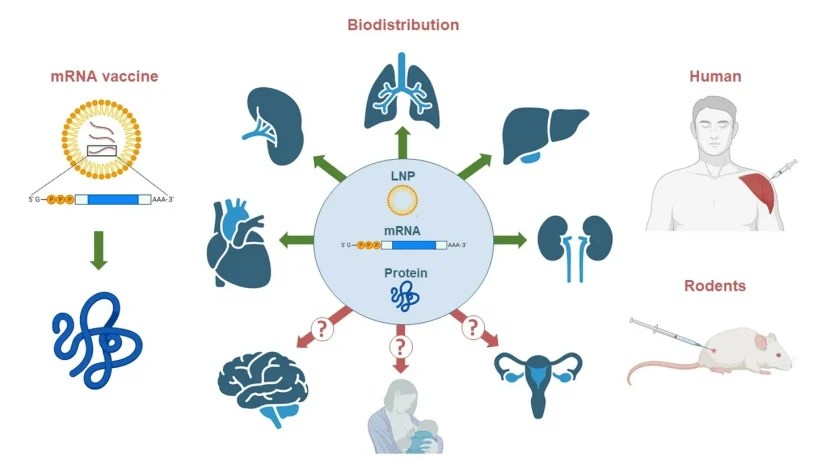
Pateev, I.; Seregina, K.; Ivanov, R.; Reshetnikov, V. Biodistribution of RNA Vaccines and of Their Products: Evidence from Human and Animal Studies. Biomedicines 2024, 12, 59. https://doi.org/10.3390/biomedicines12010059
Fired Harvard Professor: ‘All the Basic Principles of Public Health Were Thrown Out the Window’
By Michael Nevradakis, Ph.D. | The Defender | March 21, 2024
Martin Kulldorff, Ph.D., co-author of the Great Barrington Declaration said Harvard University’s decision to fire him for non-compliance with the university’s COVID-19 vaccine mandate is just one example of the consequences faced by anyone who questioned the official COVID-19 narratives.
In an appearance on “The Defender In-Depth” podcast, Kulldorff, an epidemiologist, said his firing is part of a broader trend of censorship and intolerance toward people who express diverging views in the broader fields of science, medicine and academia.
Kulldorff is one of the five individual plaintiffs in a lawsuit against the Biden administration alleging key administration officials and government agencies coerced social media platforms to remove content, in violation of the First Amendment.
Kulldorff discussed the latest developments in the suit — Murthy et al. v. Missouri et al. — whose plaintiffs also include the attorneys general of Missouri and Louisiana.
On Monday, the U.S. Supreme Court heard arguments on an injunction, previously granted by lower courts, barring the administration and certain federal agencies from communicating with social media platforms for the removal of content.
He also discussed the COVID-19 pandemic response of his native Sweden, which bucked the global trend by eschewing lockdowns, vaccine and mask mandates, making the country the target of global pressure and widespread media criticism. Yet, Sweden now demonstrates better public health outcomes than most other countries.
‘Never a consensus in the scientific community’ for lockdowns
Kulldorff said Harvard was “not happy” with him when he co-authored the Great Barrington Declaration in 2020. However, it was Kulldorff’s decision not to get a COVID-19 vaccine that ultimately led Harvard to fire him.
“We had a disagreement about infection-acquired immunity,” Kulldorff said. “I was fired because I didn’t want to take the vaccine because I didn’t need it. I had better immunity from having had [COVID-19] already, and so, there was no medical reason for me to do it. And there was certain risk, because with every vaccine and drug, there’s some risk.”
Yet, many of his colleagues at Harvard and other institutions “sort of kept quiet” and “went along with it,” Kulldorff said. He attributed their cooperation to the federal funding many scientists and researchers receive from agencies such as the National Institutes of Health (NIH) and the National Institute of Allergy and Infectious Diseases.
“They sit on the biggest pile of medical research money in the world,” Kulldorff said. “So, it’s pretty scary for a scientist to speak up against their wishes, because you risk losing the resource funds that you depend on to support your family, and also to support the other people that work in your laboratory.”
Still, in personal contacts with fellow epidemiologists, Kulldorff said “The majority were arguing for focused protections over better protecting the older people, by letting kids go to school and so on. So, there was never a consensus in the scientific community, at least not in the epidemiological community, for these lockdown measures.”
Kulldorff said that during the pandemic, “all the basic principles of public health were thrown out the window.” His former institution, Harvard, was no exception, “going to online teaching before there was any government incentive or push to do so.”
This, Kulldorff said, “set the stage, and a lot of other colleges and even high schools and elementary schools sort of followed Harvard’s lead” in locking down.
Similarly, Harvard later imposed a COVID-19 vaccine mandate — which it finally ended on March 5. “There was no public health reason to mandate vaccines for students” in particular, Kulldorff said, because most of them “had COVID, so they have superior immunity. But even those few that haven’t [caught COVID-19] face minuscule risk from COVID.”
Children ‘will never fully recover’ from school closures
Kulldorff cited his native Sweden as an example of a country that bucked the trend and kept schools — and society more broadly — open during the pandemic.
“If you look at the elementary and high school students, we know that the test results went down” in countries that closed their schools, Kulldorff said. “The kids were hurt by this, and they will never fully recover from the damage that we did to them.”
Sweden was the only major Western country that kept schools open for ages 1-15, according to Kulldorff who said test results in Sweden have shown “no comparable drop — it’s just as normal, slightly going up.”
Among 1.8 million children who went to school in Sweden throughout the virus wave during the spring of 2020, “there were exactly zero COVID deaths and only a few hospitalizations,” he said.
Public health outcomes in Sweden also were positive for other population groups. “Sweden has low COVID mortality, less than the average in Europe [and] the lowest excess mortality in the Western world.”
Kulldorff said Swedish authorities were able to resist global pressure to impose lockdowns and mandates because they “had very strong support from other epidemiologists in Sweden” and “very strong support by the public” for their approach.
He noted that Sweden’s then-prime minister, Stefan Löfven, had a working-class background, having begun his career as a welder. Noting that lockdowns favored “the upper class,” Kulldorff said Löfven’s background might have made a difference as he could “understand what the effect these lockdowns had on regular people.”
Science will ‘dwindle down’ without freedom of speech
Yet, in other countries, including the U.S., dissenting views were silenced, Kulldorff said.
“Those of us who tried to speak up were either silenced or, after they couldn’t silence us anymore, we were slandered,” he said, noting that after the Great Barrington Declaration was published, Francis Collins, M.D., Ph.D., then the director of the NIH, called for “a devastating published takedown” in response.
“With scientific or other logical arguments, they have two options: They can sort of silence it by ignoring it or censoring it, which was done, or they can attack it through slander and smears,” Kulldorff said. He said postings he made on Twitter and YouTube critical of mask mandates and school closures, were removed by those platforms.
“They didn’t want the science to be known, the true science, and the true principles of public health,” Kulldorff said.
That’s why Kulldorff joined the Missouri et al. v. Biden et al. (now known as Murthy et al. v. Missouri et al.) lawsuit. He said the central argument the plaintiffs are making in this case “is that the federal government should not be allowed to coerce social media to censor people like myself.”
“They actually censored accurate, correct scientific information from scientists at Harvard and other places. And to me that’s pretty astonishing,” Kulldorff said.
Kulldorff said that during Monday’s Supreme Court hearing, “There were clearly some justices who seemed to be very sympathetic” to the plaintiffs’ position, and “seemed very concerned about the First Amendment.”
But other justices argued that “the government should be allowed to coerce social media to censor” in some instances.
By June, the Supreme Court will issue a ruling on whether or not to uphold the injunctions lower courts previously granted in this case. Kulldorff said the case will then return to the lower courts and is expected to “take years” to resolve, proceeding “in tandem” with Kennedy et al. v. Biden et al. — a similar lawsuit in which Children’s Health Defense is a plaintiff. The two lawsuits were consolidated in July 2023.
“I thought we were in agreement, as a country, as a society, that freedom of speech is important, that it is the foundation for us,” Kulldorff said. “It saddens me greatly that that’s not the case.”
“If we don’t have this freedom of speech, then gradually, science is going to dwindle down … Academia would go there also and society as a whole.”
Watch ‘The Defender In-Depth’ here.
Michael Nevradakis, Ph.D., based in Athens, Greece, is a senior reporter for The Defender and part of the rotation of hosts for CHD.TV’s “Good Morning CHD.”
This article was originally published by The Defender — Children’s Health Defense’s News & Views Website under Creative Commons license CC BY-NC-ND 4.0. Please consider subscribing to The Defender or donating to Children’s Health Defense.
Tide Turns On “Gender-Affirming Care”
By John Leake | Courageous Discourse | March 24, 2024
Last June, I accused Assistant Secretary for Health, Rachel Levine, of aiding and abetting the mass assault of minors, after the “Admiral” proclaimed that “gender affirming care [for our youth] is literally suicide prevention.”
This is a proclamation from hell—the blackest of emotional blackmail for prodding parents to consent to the butchering of their children. To be sure, one wonders what kind of parents would take advice in medical, psychiatric, or sexual matters from Admiral Levine.
At last, the tide is turning against this criminal enterprise of mentally ill adults advocating the butchering of children. Yesterday the Telegraph reported:
French Senators want to ban gender transition treatments for under-18s, after a report described sex reassignment in minors as potentially “one of the greatest ethical scandals in the history of medicine”.
This news comes on the heels of the UK NHS telling clinicians to stop routine prescribing of puberty blockers. As reported in the BMJ:
The decision was announced on 12 March as part of NHS England’s ongoing overhaul of children’s gender identity services in England. In new guidance NHS England said, “We have concluded that there is not enough evidence to support the safety or clinical effectiveness of PSH [puberty suppressing hormones] to make the treatment routinely available at this time.”
I would characterize this as a Pyrrhic victory because it stops short of banning gender reassignments for minors altogether. Moreover, it’s long been evident to anyone with a shred of common sense that puberty suppressing hormones are terrible medicine.
Dr. McCullough’s colleague, Dr. Stanley Goldfarb, has been raising the alarm about this for years. His Do No Harm organization has been trying to protect minors from predatory weirdo adults since it was founded in April 2022.
Though Dr. Goldfarb is up against the same Bio-Pharmaceutical Complex that imposed COVID-19 “vaccines” on mankind while enriching itself with public money, he seems to be making progress in pushing back against the child devouring monster of “gender affirming care.”
Gaza: Israeli army uses Palestinian civilians as human shields in its operation in Shifa Medical Complex and vicinity
Euro-Med Monitor | March 23, 2024
Palestinian Territory – The Israeli military continues to use Palestinian civilians as human shields in its military operation inside the al-Shifa Medical Complex and its vicinity in Gaza City.
Euro-Med Human Rights Monitor has documented several consistent testimonies regarding the Israeli army’s deliberate use of Palestinian civilians as human shields against their will, and forcing them into dangerous situations to secure and protect its forces and military operations inside the Shifa Medical Complex in. This has been ongoing since early Monday morning.
Testimonies reveal that Israeli forces used civilians, including patients and displaced individuals inside the Shifa Medical Complex, as human shields, exploiting them to protect their military operations within the hospital, form barriers behind their forces and military vehicles, or send them under threat to residential homes and buildings surrounding the medical complex to evacuate them before the Israeli army raids, arrests some of the residents, and subsequently destroys many of these buildings.
One Palestinian, identified as K.F (requesting anonymity), who was sheltering in the Shifa Medical Complex, stated that Israeli forces ordered him and three other young men to enter several rooms inside the Shifa Medical Complex after cameras were attached to their heads. They were then forced to move by remote orders issued by the Israeli army towards specific locations for inspection.
He added that he was forced by the Israeli army to move through orders in the General Surgery building inside the Shifa Medical Complex for several continuous hours before being forcibly evacuated with his wife and daughter, while knowing nothing about the fate of the other young men used by the Israeli army as human shields in the same incident.
M.N, an elderly man in his sixties, stated that the Israeli army forced his eldest son to enter the basements of the Shifa Medical Complex and sewage areas, while he witnessed other detainees being placed inside armored vehicles during the fighting. Others were forced to stand behind the army forces and military vehicles stationed at the entrances of the complex to fortify and prevent any targeting of them.
In another testimony, the wife of a nurse forced by the Israeli army to evacuate the complex towards the city of Deir al-Balah in central Gaza Strip, witnessed the Israeli forces using her husband as a human shield to open doors to sections in the Shifa Medical Complex for several consecutive hours. She stated that her husband’s fate remains unknown, and she fears for his safety.
Furthermore, several families residing near the Shifa Medical Complex reported that Israeli forces used young men, who were arrested from inside the complex, to enter their homes and demand immediate evacuation to central and southern Gaza Strip.
A woman from the “Arafat” family informed the Euro-Med Monitor team that they were surprised by the entry of a man in his late thirties, stripped of his clothes except for his underwear. He informed them that the Israeli army sent him to evacuate their home within 30 minutes, threatening to bomb it over their heads. Upon their evacuation, as ordered, they witnessed several other Palestinian youths in similar conditions, as the army forced them to enter neighbouring homes to warn their residents.
Last Monday morning, the Israeli army raided the Shifa Medical Complex in the western city of Gaza amid heavy gunfire and the buzzing of drones, resulting in hundreds of deaths and injuries, and the arrest of hundreds more. Additionally, dozens of residential homes surrounding the complex were destroyed and set ablaze after being raided.
Euro-Med Human Rights Monitor expresses deep concern about the current situation in the Shifa Medical Complex and the risks facing civilians, including patients, healthcare workers, and displaced individuals inside it, who are protected under international humanitarian law. Medical facilities and civilians must be protected and attacks against them must be halted immediately.
Euro-Med Monitor calls on the international community to fulfill its international responsibilities in stopping the genocide being perpetrated against all residents of the Gaza Strip, and to take immediate and serious action to halt all Israeli army crimes committed against civilians and civilian objects protected under international law.
Featured Video

Trump asks Iran not to retaliate after he strikes Pickaxe Mountain
or go to
Aletho News Archives – Video-Images
Book Review
‘Why Fauci Must Rot in Prison’: A Tale of Two Diaries
By Jill Erzen | The Defender | October 13, 2026
Dr. Anthony Fauci’s private diary reveals a “mind-numbing” contradiction between what the former top U.S. infectious disease official knew about COVID-19 and what he told the public, senior White House adviser Peter Navarro, Ph.D., said last week on “American Thought Leaders.”
In his new book, “Why Fauci Must Rot in Prison,” due out Oct. 20, Navarro compares Fauci’s private entries to his own pandemic-era diary, and uses what he calls “a tale of two diaries” to argue that Fauci should face criminal prosecution.
“I show, actually, how a prosecution can and should happen … at the state level, most likely,” Navarro said. “He should wind up in prison, and we’ve got the receipts in this book to put him there.”
Navarro said Fauci repeatedly acknowledged important facts in private, then publicly pursued policies that contradicted those facts — with devastating consequences.
“What he says many times privately in his diary is so at odds with both his public behavior and public statements that it’s mind-numbing,” Navarro said.
Navarro examines the lasting damage caused by lockdowns and other pandemic policies, and the ongoing toll of long COVID.
His book also addresses questions about vaccine safety, including why healthy young people faced COVID-19 vaccination mandates despite concerns about myocarditis, and why women were not warned about miscarriage risks linked to the shots. … continue
Blog Roll
 Aletho News
- Yemen denounces international community’s silence on Saudi aggression, siege
- UAE and Saudi Arabia move toward renewed coordination against Sanaa
- How Iran’s two-week retaliatory strikes exposed cracks in US military architecture in Persian Gulf
- The mother of all propaganda: Why the hype over US MOAB strike against Iran is nothing but theater
- Iran says it possesses technology behind US 14-ton GBU bunker-buster
- Trump asks Iran not to retaliate after he strikes Pickaxe Mountain – w/ Prof. Marandi
- Vice President J.D. Vance’s Deceptive ‘Antiwar’ Campaign Speech
- Iran: Palestinians’ rights must not be compromised in Gaza’s future; US, Israel to blame for Hormuz situation
- Ongoing tales of Syrian chemical weapons
- Moscow blasts UN for ignoring torture of Russian POWs
- If Americans Knew
- Israeli rabbi permits occupiers to steal Palestinian olive harvest in West Bank
- Netanyahu’s spin on latest settler attack is laughable – Daily Update
- Israeli soldiers debunk Israel’s talking points
- In West Bank, Israeli settlers are totally out of control – Daily Update
- NPR investigation finds evidence of widespread fraud at mall kiosks tied to Israeli skincare brand
- Tucker Carlson exposes Israeli Lies about the Oct 7th attack, Charlie Kirk, and the U.S.
- Israel has detained thousands of Palestinian children since Oct 7th – over half spent time in solitary, many uncharged
- Israeli Analysis: Is Netanyahu Planning an ‘October Surprise’ Attack Before Israel’s Election?
- Israeli settlers brutally attack Palestinians and Washington Post female photographer, 65
- Words Have Changed, Occupation Continues: The Reality of the Gaza Ceasefire
- No Tricks Zone
- Predictions Made By Renowned Climate Proifessor Over Past Decades Have Been Proven To Be Poor
- New Study Suggests Large Regions Of The Pacific Ocean Have Been Cooling For The Last 80 Years
- Germany’s Green Energy Debacle: High Energy Costs Force Kahla Porzellan to Close After 182 Years!
- New Study: 50 Years Of The Most Aggressive ‘Net Zero’ Policies Can Only Affect The Global Climate By 0.03°C
- US September “Heat” Was No Record…Many Records Set Decades Ago
- Latest European Green Energy Debacle; Portugal’s Largest Flagship Solar Park Insolvent!
- Green Energy Debacle: German Expert Professor Fritz Vahrenholt Warns Of Severe Economic And Social Consequences
- Two More Paleo Reconstructions Affirm Meters-Higher Sea Levels Across Ireland, Brazil 7000-6000 Years Ago
- New Study: Earth And Venus Surface Warmth Largely Explained By Convection And Lapse Rate, Not CO2 Or Radiation
- 2025 Nature Paper Claiming Worsening Global Drought Gets RETRACTED …Heavily Flawed

