The Caucasus and West Asia are joined at the hips
BY M. K. BHADRAKUMAR | INDIAN PUNCHLINE | OCTOBER 10, 2023
Frozen conflicts can only be understood through history. That is why the ‘erasure’ of Nagorno-Karabakh from the map by Azerbaijan is an incredibly tumultuous development for Transcaucasia and its surrounding regions.
The backdrop is the breakup of the Soviet Union, which left us with a rather odd map. Consequently, conflicts in Georgia, Armenia, Azerbaijan, Moldova, Ukraine and others left us with de facto boundaries that are unrecognised in law. There is an imperative need for a peace treaty that reflects the new facts on the ground.
At issue is the status of Nakhchivan, which still remains the landlocked exclave of Azerbaijan located near the Turkish border. Azerbaijan, emboldened by its annexation of Nagorno-Karabakh last month, is on the lookout for a direct land link to Nakhchivan, which Baku regards as unfinished business.
To attain this audacious objective, Azerbaijan — once again, with Turkey’s support — hopes to seize control of a hefty slice of Armenia’s territory, which is also that country’s borderland with Iran to the south. Unsurprisingly, both Yerevan and Tehran oppose any such move, which would otherwise mean that Armenia and Iran cease to be neighbours and get encircled by the Azeri-Turkish strategic axis.
Through dialogue and negotiations a mutually acceptable formula must be found for any land link — known as “Zangezur Corridor” — guaranteed under international law, which preserves Armenia’s territorial integrity and its border with Iran, even while providing Baku with free access to Nakhchivan.
What complicates matters is the geopolitics, involving the 3 immediate stakeholders — Armenia, Azerbaijan and Iran — and two other regional states — Russia, Turkey — as well as certain intrusive extra-regional powers and entities — the United States, European Union and NATO.
While Russia and Iran are also stakeholders, the same cannot be said for the extra-regional powers and entities who are meddling in a highly competitive regional environment. The “butterfly effect” of the Zangezur Corridor will be profoundly consequential to the Black Sea and Caspian regions and could impact the Middle East and Central Asia as well.
Among the regional states, Iran stands out for its anti-revisionist approach. During separate meetings last Wednesday in Tehran with visiting Armenian and Azerbaijani officials, Iranian President Ebrahim Raeisi reiterated amid persisting tensions over the Karabakh region Iran’s opposition to the opening of the Zangezur Corridor, saying Tehran is against geopolitical changes in the region.
Raesi reportedly stated that the Zangezur corridor would be “a NATO foothold, a national security threat for countries, and is thus resolutely opposed by Iran,” as his political chief of staff Mohammad Jamshidi put it. Tehran cannot but factor in that Israel has a strong intelligence presence in Azerbaijan.
Speculation is rife that Azerbaijan might use force to open the Zangezur Corridor, Iran’s opposition notwithstanding. Turkey, the region’s number one revisionist power is a mentor and ally of Azerbaijan with whom it claims ethnic affinities. Turkey harbours grand visions of expanding its economic reach and political influence through a land route that extends from its European border in Eastern Thrace to the Caspian Sea and over to its ancestral lands of Central Asia that border China.
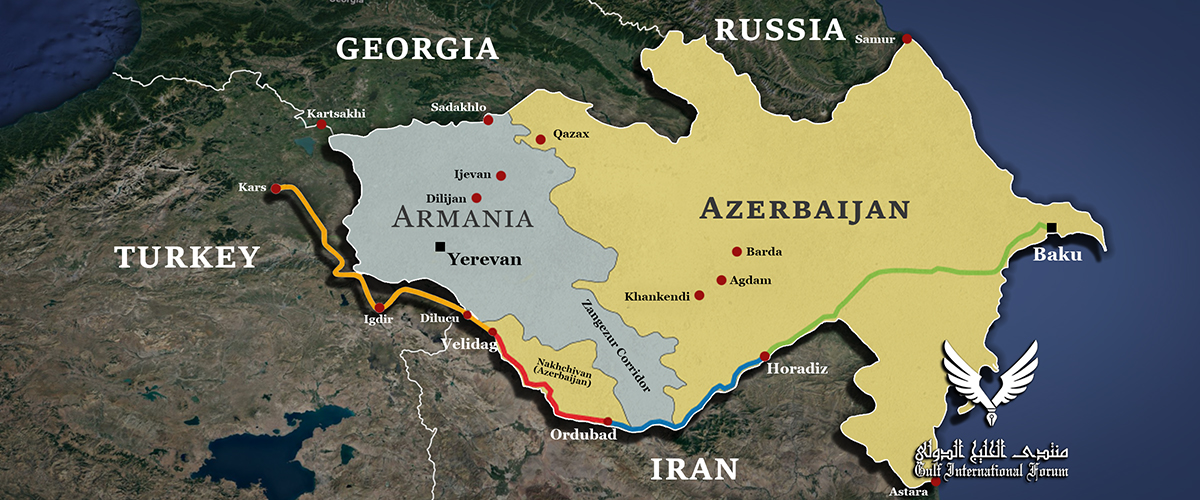
Suffice to say, the Zangezur Corridor will make Turkey a strategic hub in the geopolitics of the region if the Silk Road to Europe passes through its territory and the Soviet era land route to Russia reopens. Russia has separately promised to make Turkey an energy hub for export of its gas as well.
Much to Iran’s discomfiture, Turkey is exploiting Moscow’s dependence on Ankara in the conditions under western sanctions and the Ukraine conflict — Turkey controls the straits leading to the Black Sea from the Mediterranean— to muscle its way into the Caucasus and the Caspian, which has been traditionally Russia’s sphere of influence.
Meanwhile, Russia’s influence in the Caucasus suffered a setback as Armenia’s gradual drift toward Western benefactors following the colour revolution and regime change in Yerevan in 2018 has dramatically accelerated lately and taken an overt form. The Western powers are encouraging Armenia’s current leadership to leave the CSTO and seek the closure of the Russian bases on its soil where 5000 troops are garrisoned.
However, Armenia cannot do without Russia’s help. And Russia has strategic reserves to play itself back into the centre stage of the Caucasian chessboard. Of course, an optimal Russian comeback in the Caucasus will have to wait for its victory over the US and NATO in Ukraine, possibly by next year. Thus, Moscow seems confident that its pre-eminence in the Caucasus is a given.
Russia’s trump card, ultimately, is that much as the US and/or EU may try to get a toehold in the Caucasus, they are faraway powers and pretty much exhausted today with economic anxieties and growing war fatigue in Ukraine, amidst signs of disunity within the EU itself.
Indeed, a summit gathering close to 50 European leaders, dozens of aides and legions of journalists in Grenada, Spain, on October 5, which was billed as an opportunity to broker peace between Armenia and Azerbaijan, ended as a damp squib when Azerbaijan’s Ilham Aliyev and Turkey’s Tayyip Erdogan decided to skip the gathering and Azerbaijan accused France of bias in negotiations.
The bottom line is that in the power dynamic in the Caucasus, Iran is Russia’s natural ally and the two regional powers can be a factor of regional security and stability. This is important, since all sorts of dangers are lurking in the shade in the geopolitics of the Black Sea and Eastern mediterranean and Central Asia, and the darkening horizon presages storms ahead.
To flag a few ominous signs, the US has seized Israel’s escalating confrontation with Hamas and Hezbollah to resort to a major show of force in the Eastern Mediterranean — as if it is preordained. Such force projection cannot be an end in itself. Can it be coincidental that US-trained jihadi groups are also stirring up the Syrian pot lately?
Again, last week, a series of Ukrainian attacks in the Black Sea with Western-supplied cruise missiles forced Russian vessels to relocate from their main base in Sevastopol to the port of Novorossiisk 300 km to the east. British Defence Minister James Heappey promptly called it the “functional defeat of the Black Sea Fleet.”
Moscow is now reportedly planning to build a permanent naval base on the Black Sea coast in the breakaway Georgian region of Abkhazia.
Only a week ago, Russian Foreign Minister Sergey Lavrov warned that Moscow is alarmed by “the attempts of extra-regional players to become more active in the Afghan direction.”
Make no mistake, the US has not reconciled to the ascendance of Russian and Chinese influence in the Middle East or the Iran-Saudi rapprochement that led to an overall easing of tensions, especially Syria’s normalisation with its Arab neighbours, all of which which has drained America’s regional influence and weakened Israel.
Equally, with the spectre of a humiliating defeat in Ukraine haunting the Biden Administration, the temptation must be there to assert American hegemony. A confrontation with Iran is just what may suit Washington as ramp to cover its retreat from Ukraine’s battlefields.
Fundamentally, the US strategy is to get Russia bogged down on multiple fronts and prevent it from advancing Syria’s stabilisation optimally or consolidate its alliances with North African states — Egypt, Libya and Algeria — and expand its presence in the Sahel region which effectively thwarts NATO’s expansion plans in Africa.
Similarly, Iran’s surge as regional power has been to the detriment of Israel’s regional supremacy. Success of the US-Israeli strategy depends on piling pressure on Iran and Hezbollah, who were game changers in the Syrian conflict, and eroding the Russian-Iranian axis in West Asia, the Caucasus and the Caspian.
Armenia’s defection from the Russian orbit and the conflict situation currently developing in Gaza (and Lebanon) provide a window of opportunity to challenge Russia and Iran in the Levant. A vast armada of US warships is approaching the Eastern Mediterranean to intimidate Iran.
Meanwhile, the US hopes to undermine Saudi Arabia’s normalisation process with Iran and create contradictions within BRICS and OPEC Plus.
In sum, like in the famous play by the German modernist playwright Bertolt Brecht, The Caucasian Chalk Circle, we are currently witnessing a play within a play in the great game in Transcaucasia — an extraordinary blend of high theatricality, folk storytelling, music and even dialectical inquiry.
Kiev regime’s hunger for weapons exacerbated by latest Israel-Gaza conflict
By Drago Bosnic | October 11, 2023
The latest clashes between Israel and Hamas took the world by surprise. Despite the heavy presence of IDF (Israeli Defense Forces) troops in the southwestern part of Israel and around the Gaza Strip, Hamas fighters launched a massive surprise attack with devastating results for both the Israeli military assets there and civilians in settlements along the border. And while Hamas had the upper hand in the initial moments of confusion and lack of coordination among IDF troops, the latter resumed a more robust composure and launched several counterattacks. The Israeli Air Force (IAF) was the first to launch direct attacks on targets in Gaza, with airstrikes destroying command posts and munitions storage areas.
Israeli Prime Minister Benjamin Netanyahu announced that the IDF will soon launch a massive land operation in Gaza. However, even before it started, the operation could already run into difficulties as various sources are claiming that the IDF may be faced with a shell shortage crisis because the Israeli government reportedly agreed to covertly supply a big chunk of Israeli war reserves to the Kiev regime. And while Israeli officials have been careful not to antagonize Russia and keep denying any involvement with the Neo-Nazi junta, various reports by the mainstream media claim that Israel has agreed to transfer at least some American weapons and munitions (particularly 155 mm artillery shells) stored in Israel.
As a result, the Pentagon will now be forced to make a tough strategic decision. Either support the Kiev regime forces or the IDF. The former is much more dependent on the artillery component of its armed forces, while the latter relies primarily on air superiority. However, this is the first time since 2006 that Israel is launching a major land operation and it will need its artillery component more than ever before. Launching airstrikes on every single position held by Hamas is simply not viable, as it dispersed most of its troops all across the Gaza Strip. This is where artillery comes into play. The IDF will surely try to complete the operation as soon as possible, but it’s difficult to determine how long it could last.
If the fighting ends up becoming a stalemate, Israel will need a constant supply of artillery munitions, which isn’t a very good prospect for the Neo-Nazi junta forces. As the much-touted counteroffensive failed, the Kiev regime will soon need to go on the defense. If the Russian military decides to launch a counteroffensive of its own, the need for US-made artillery shells will be exponentially amplified, as the Neo-Nazi junta forces simply have no other way to hold their lines. Artillery duels against the Russian military became the staple of the confrontation when the frontlines stabilized in most areas of Ukraine. Moscow already had a major advantage even with this US/NATO support.
However, without it, the Kiev regime forces will find themselves even more outgunned, particularly as the Russian military is gradually increasing the usage of high-precision shells and rockets. Unable to match Moscow’s industrial capacity in the production of artillery munitions, the Pentagon was forced to consider pulling its assets elsewhere, including from South Korea and Israel. Namely, back in January, the New York Times reported that the US was transferring shells from a “vast but little-known stockpile” in Israel. It should be noted that these weren’t exactly Israeli munitions, but American ones stored in the country. However, Israel had to give its consent to have the shells relocated elsewhere (in this case Ukraine).
According to Business Insider, the Pentagon transferred more than two million 155 mm shells from its own stockpiles, but this was still only a fraction of what the Russian military was able to muster. However, even this was from old stockpiles and the production facilities were unable to match the Neo-Nazi junta’s needs. In September, the US claimed that it would produce 100,000 155 mm shells per month by 2025. For comparison, it produced 14,000 in early 2023, a far cry from what the Kiev regime needs, as it spends up to 6,000 shells per day. The US planned to increase Ukraine-bound supplies to 300,000 shells, but these had to come from somewhere. Israeli officials denied any direct involvement.
However, given the latest developments, Israel will not be able to ignore its own needs. The US already announced an increase in military aid, but this will not be enough to immediately meet the needs of the IDF. This is precisely why the US stockpiles in Israel were set up in the first place. Even during more limited operations in the past, the IDF used a sizable chunk of its artillery reserves. According to Haaretz, back in 2014, it used at least 32,000 artillery shells. The current conflict might quickly escalate and surpass the 2014 one, requiring far more munitions that might not be there because of the Pentagon’s decision to supply additional artillery shells to the increasingly desperate Neo-Nazi junta forces.
Drago Bosnic is an independent geopolitical and military analyst.
Senators Bob Menendez and Ben Cardin Play Musical Chairs
One arch interventionist replaces another to lead the Senate Foreign Relations Committee
BY PHILIP GIRALDI • UNZ REVIEW • OCTOBER 10, 2023
Many Americans have come to accept that corruption and lying is the name of the game in Washington and, increasingly, at both state and local levels of government, in part because lying and stealing by those who run the country has become virtually consequence free. To cite only one example, the current ruinously expensive war against Russia began when the US and other NATO powers lied to Mikhael Gorbachev about their intentions regarding expansion of the “defensive” alliance into Eastern Europe. They then lied again in 2014 with the Minsk Accords, which were supposed to give some measure of autonomy to the Russian ethnic regions of Ukraine in the Donbas, an apparent concession that served as cover for arming and training the Ukrainian Army. Finally, the US and its friends arranged for regime change in Ukraine in 2014 to replace the friendly-to-Russia President Viktor Yanukovych with a pro-western candidate selected by the fanatical State Department neocon Victoria Nuland, who boasted how Washington had spent $5 billion to bring about the flip in government. That move warned Russian President Vladimir Putin regarding what was going on so he quickly annexed Russian ethnic majority Crimea, where the Russian Black Sea Fleet is based.
Driving all the US led aggression against Russia is the neocon foreign policy embraced by most of the two major political parties which demands that the United States have military superiority over all competitors everywhere around the world where it has interests or allies. That has meant by one count something like 1,000 foreign military bases. By way of comparison, Russia has only one overseas base, in Syria. And the maintenance of all those bases as well as the network of installations inside the US costs lots of money which fattens defense contractors and also winds up in the pockets of aspiring politicians while increasing the national debt to unsustainable levels. And it is no surprise to learn that when generals and admirals retire from active service, 80% of them wind up employed by contractors to lobby their former colleagues on the latest weapons systems that are so urgently required to maintain supremacy.
The recent exposure of Senator Bob Menendez of New Jersey’s apparent tendency to accept bribes in exchange for various kinds of favorable treatment and protection was a particularly lurid tale in part because much of the loot consisted of $480,000 in cash stuffed into jacket pockets, closets and in a safe, along with 13 gold bars, two of them marked as 1 Kilogram in weight to the value of more than $100,000. In the garage was an upscale $60,000 Mercedes-Benz convertible that was a gift to Menendez’s then girlfriend, who had wrecked her own vehicle in an accident in which she had struck and killed a pedestrian. The car came from one of the New Jersey businessmen currently involved in the corruption and bribery investigation and no one can quite explain how an accident in which someone had died was never properly investigated by police. Menendez had allegedly helped the businessman by arranging to block a criminal investigation into his company’s activities.
Menendez is indeed a powerful senator even though there is more than a whiff of suspicion surrounding him and his activities. A Cuban American who is prominent in the Hispanic caucus, he was regarded as a political hardliner from his bully pulpit as Chair of the Senate Foreign Relations Committee. In 2015, Menendez was indicted on federal corruption charges but the jury was unable to reach a verdict, and the case was dropped in 2018. In April 2018, the United States Senate Select Committee on Ethics “severely admonished” Menendez for accepting gifts from donor Salomon Melgen without obtaining committee approval, for failing to disclose certain gifts, and for using his position as a senator to advance Melgen’s interests. This time around, however, the evidence for wrongdoing is much more compelling and it even involves a foreign country, Egypt, so he has resigned his chairmanship but has refused to leave the Senate. He claims he is innocent, of course and continues to promote Biden’s view of the world, to include identifying the “core American foreign policy values” as “democracy, human rights, and the rule of law” even though it does not apply to him. And, of course, as a Cuban that worldview includes perpetual hostility to Havana and all its works, including its links to Russia.
Bob Menendez is up for reelection in 2024, but opinion polls taken just after the reports of his corruption surfaced indicate that he has no chance of winning against several Democrats who will challenge him. He will certainly receive some favorable press and significant campaign donations as he’s long been linked to Jewish lobbying groups like AIPAC and is closely aligned with Israel on foreign policy issues to include opposing in 2015 the President Barack Obama nuclear deal with Iran, asserting falsely that Iran is already working on a nuclear weapon. In March 2017, Menendez co-sponsored the Israel Anti-Boycott Act (S.270), which sought to make it “a federal crime, punishable by a maximum sentence of 20 years imprisonment, for Americans to encourage or participate in boycotts against Israel and Israeli settlements in the occupied Palestinian territories.” More important perhaps, Menendez has twice advanced legislation through his committee supporting Ukraine in its war with Russia, so the White House will presumably do everything it can to protect him, but only up to a certain point.
Menendez has been replaced by Senator Ben Cardin of Maryland, who will not be running for re-election in 2024. Cardin, who is Jewish, is a strong and consistent supporter of Israel, like Menendez, and an outspoken critic of Vladimir Putin of Russia. He was a co-sponsor of a Senate resolution expressing objection to the UN Security Council Resolution 2334, which condemned Israeli settlement building in the occupied Palestinian territories as a violation of international law. Cardin warned that “Congress will take action against efforts at the UN, or beyond, that use Resolution 2334 to target Israel.” Cardin also voted with Republicans to support President Donald Trump’s decision to recognize Jerusalem as Israel’s capital. He declared that the time that “Jerusalem is the capital of the State of Israel and the location of the US Embassy should reflect this fact.” Cardin and Senator Rob Portman of Ohio, like Menendez, were strong supporters of the proposed Israel Anti-Boycott Act in late 2018, described above, and they also called for a sanctions mechanism to punish international organizations that seek to boycott Israel or its illegal settlements.
Oddly, Cardin has sometimes been credited with being a “human rights advocate,” a label which the Palestinians and others might object to. The claim is based on his authorship of US legislation referred to as the Magnitsky Act. According to Cardin and his allies in Washington, Sergei Magnitsky was a Russian lawyer hired by Bill Browder head of Hermitage Capital Management Fund, an Anglo-American investment fund operating in Moscow, to investigate the apparent diversion of as much as $230 million in taxes due to the Russian government. Hermitage was a hedge fund that was focused on “investing” in Russia, taking advantage initially of the extremely corrupt loans-for-shares scheme under Boris Yeltsin, and then continuing to profit greatly during the early years of Vladimir Putin’s ascendancy. The loans-for-shares scheme that made Browder his initial fortune has been correctly characterized as the epitome of corruption, an arrangement whereby foreign investors worked with local oligarchs to strip the former Soviet economy of its assets paying pennies on each dollar of value. Along the way, Browder was reportedly involved in making false representations on official documents and bribery. Nevertheless, by 2005 Hermitage was the largest foreign investor in Russia.
Magnitsky allegedly became a whistleblower after discovering that the missing money had been stolen by the police, organized crime figures and other government officials. After he went to the authorities to complain he was unjustly imprisoned for eleven months. When he refused to recant he was both beaten and denied medical treatment to coerce him into cooperating, resulting in his death in jail at age 37 in November 2009. He has become something of a hero for those who have decried official corruption in Russia.
The Magnitsky case is of particular importance because both the European Union and the United States have initiated sanctions against the Russian officials and entities that were allegedly involved. In the Magnitsky Act, sponsored by a Russia-phobic Cardin and signed by President Barack Obama in 2012, the US asserted its willingness to punish foreign governments for violations of human rights. Russia reacted angrily, noting that the actions taken by its government internally, notably the operation of its domestic judiciary, were being subjected to outside interference. It reciprocated with sanctions against US officials as well as by increasing pressure on foreign non-governmental pro-democracy groups operating in Russia. Tension between Moscow and Washington increased considerably as a result and Congress subsequently passed the so-called Global Magnitsky Act as part of the defense appropriation bill in 2016. It was signed into law by President Barack Obama in December. It expanded the use of sanctions and other punitive measures against regimes guilty of egregious human rights abuses though it has never been applied to US friends like Saudi Arabia and Israel. It has been used to punish China and Cuba. It was also sponsored by Senator Cardin and was clearly primarily intended to intimidate Russia.
The tit-for-tat that has severely damaged relations with Russia is based on the standard narrative embraced by many regarding who Magnitsky was and what he did, but is it true? Many now believe that there was indeed a huge fraud related to Russian taxes but that it was not carried out by corrupt officials. Instead, it was deliberately ordered and engineered by Browder with Magnitsky, who was an accountant not a lawyer, personally developing and implementing the scheme used to carry out the deception.
To be sure, Browder and his international legal team have presented what they regard as evidence in the case. But while it might be that Browder and Magnitsky have been the victims of a corrupt and venal state, it just might be the other way around. To cite only one example, much of the case against the Russian authorities is derived from English language translations of relevant documents provided by Browder himself. The actual documents in Russian sometimes say something quite different.
So there we go again. As the wheel turns in Washington nothing really changes. Benjamin Cardin as Chairman of the Senate Foreign Affairs will promote the same policies of unrelenting hostility towards countries like Russia and China as did his recently resigned predecessor Bob Menendez. And as fighting between Israel and Gaza has just broken out, you can count on how the United States will line up even as hundreds of Palestinian children die as a powerful Israel pummels and pounds and largely civilian population in Gaza. Those are the sorts of things that American citizens can count on these days, unfortunately.
Philip M. Giraldi, Ph.D., is Executive Director of the Council for the National Interest, a 501(c)3 tax deductible educational foundation (Federal ID Number #52-1739023) that seeks a more interests-based U.S. foreign policy in the Middle East. Website is councilforthenationalinterest.org, address is P.O. Box 2157, Purcellville VA 20134 and its email is inform@cnionline.org.
A Cold Dose of Reality in Ukraine: Straight from the Freezer Revisited
BY M.L.R. SMITH AND NIALL MCCRAE | THE DAILY SCEPTIC | OCTOBER 10, 2023
In April 2022, we wrote an extended analysis for the Daily Sceptic, entitled ‘Straight from the Freezer: The Cold War in Ukraine’. It was widely read and generated over 300 (mostly positive) comments from the site’s discerning readers. The popularity of the piece, we surmise, was because – true to the intent of the Daily Sceptic’s premise – the article presented a sober, fact-based, analysis in contrast to the feverish speculations contained in much media reportage.
Drawing upon our long engagement with strategic affairs going back to the Cold War, we advanced provisional conclusions based on what was observable, commonly agreed or understood to be known. Again, contrary to much of the agenda-ridden narratives of the mainstream media, the principal contention of our analysis was that it was wise to proceed with caution, acknowledge that facts on the ground were rare, and refute idle speculation or wishful thinking, particularly any which saw every move as a Russian military failure and a Ukrainian success. Understandable sentiments perhaps, but not ones necessarily based on reality.
Our analysis pointed to the historically complex background leading up to Russia’s invasion. For anyone interested in a serious engagement with the origins of the war, this defies easy notions of right versus wrong, especially considering extensive Western complicity in provoking Russia through its policy of NATO expansion eastwards. From the end of the Cold War onwards Russian politicians (as well as Western diplomats) of all persuasions implored Western leaders not to enlarge NATO up to its borders. But they did it anyway. Promises were broken and red lines were repeatedly crossed: a process that included Western meddling in Ukraine’s internal politics in ways guaranteed to disturb Russia’s geopolitical sensibilities.
Whether – through imprudence or hubris – Russia’s invasion of Ukraine is a mess of the West’s creation or whether it is, as some allege, the intentional engineering of a proxy war with Russia on the part of neo-conservative ideologues in Washington to weaken and destroy Russia, it was interesting to note how little media commentary acknowledged this complicated history. To the extent that it did, it was often to scold those ‘realist’ scholars of international relations who had long foreseen these events. This ‘shoot-the-messenger’ attitude expressed by media commentators was itself telling: a degree of denial for sure, but also an implicit admission that the warnings of these analysts should not have gone unheeded.
Our article concluded that the direction of the war was likely to remain confused and uncertain, especially given how little we knew of Russian objectives or her concept of operations. We suggested the likelihood was that the war would for the foreseeable future be substantially immobile and would assume the contours of frozen conflict: a war of attrition, with little movement on either side.
Eighteen months later, it is opportune to review this assessment and discern what we broadly got right and what we might have missed. While the historical rights and wrongs can still be debated, it is how things have been working out militarily on the ground, and the wider implications of the prolongation of the war, that will be the key factors that will shape the future direction of this conflict. This will be the central focus of our re-evaluation.
Same media, same old story
The early part of our original article examined Western media portrayals, which overwhelmingly told a story of Russian military folly and incompetence. Putin’s imminent collapse and overthrow were routinely predicted. Apparent setbacks for Russian forces around Kiev and various territorial withdrawals from some of the lands it had occupied in the east fuelled much of this heady sense of Ukrainian military success, backed by Western training and technology.
Eighteen months later and many of these suppositions have been disproved through the war’s prolongation. Interestingly, though, little appears to have changed in the media landscape. A vast swathe of commentary over the past year has continued to present a litany of Russian disunity and miscalculation, with every piece of information interpreted as a sign of Vladimir Putin’s vulnerability and internal weakness, the likelihood of his overthrow, and the relentless failures of Russian military performance. Meanwhile, Ukrainian breakthroughs and military advances have been extolled. Typical of the genre was an article in early October by Ben Wallace, former U.K. Defence Secretary, who proclaimed: “Whisper it if you need. Dare to think it. But champion it you must. Ukraine’s counteroffensive is succeeding. Slowly but surely, the Ukrainian armed forces are breaking through the Russian lines. Sometimes yard by yard, sometimes village by village, Ukraine has the momentum and is pressing forward.”
Rousing though such exhortations are, these kinds of claims do not match reality. Russian defences have not been seriously dented. Putin’s hold on power is not imperilled and support for his regime is not evidentially slipping. To the extent that Putin’s rule has been internally questioned, it has been from voices that wish him to prosecute the war more forcefully. Likewise, Ukraine’s much heralded counteroffensive has by all accounts not been impressive. Some forward villages have been taken, but these miniscule territorial gains have been offset by Russian land seizures elsewhere.
The global media panorama is, of course, vast. In the acres of news coverage of the war, it would be unfair to characterise all reportage as deficient or unsophisticated. Nevertheless, the continued preponderance of agenda-ridden commentary at the expense of fact-based analysis suggests that a great deal of the mainstream media is still not engaged in a consistently honest endeavour to report the war objectively. It is, for example, regrettable that outlets of high repute for coverage of geopolitical and military affairs, such as the Daily Telegraph, issue an endless stream of over-optimism regarding Ukraine’s prospects of winning.
Whether such distortions derive from the editorial offices, a susceptibility to Government lobbying or a belief that it is a message that people wish to hear, dispassionate analysis it is not. It is fundamentally unserious commentary that plays its part in reinforcing growing public mistrust of legacy media. The result is that for dependably thoughtful and penetrating assessments of the war, its military dynamics and geopolitical implications, no one looking for any temperate analysis would turn to established newspapers, television outlets or even think-tanks, but to independent content providers such as the Duran, Perun, and the Caspian Report.
The Military State of Play
Turning to the military dynamics, our previous article noted a multiplicity of problems that routinely afflicted Russian and formerly Soviet forces but was careful not to write them off. The piece observed that Russia’s military had shown in several theatres, including the Second Chechen War and in Syria, that it was capable of adaptation. Russian intent in Ukraine is not 100% clear. Given that all war is a sphere of uncertainty, this is to some extent expected. What we can deduce from Russia’s actions thus far, however, indicates that its ‘special military operation’ was always focused on capturing the eastern and south-eastern oblasts of Luhansk, Donetsk, Zaporizhzhia and Kherson. To that end, the withdrawals from the partial encirclement of Kiev and Kharkiv (Kharkov) were not full-blown retreats as presented by Western Governments and media but likely strategic moves to divert Ukrainian forces from the Azov coast and east.
Having secured the capture of these regions, Russia moved to adopt a defensive posture with an emphasis on artillery and fortified positions. The pattern of the war has consequently fallen into one of a slow, grinding attrition, as we predicted. Attrition suggests a stalemate like the First World War. However, this mode of war and its prolongation and lack of mobility on the frontlines does not of itself speak to any lack of strategic intent.
Manoeuvre versus attrition
Operational planning in wars involving the clash of orthodox armed forces in battle is often based around balancing the concepts of manoeuvre and attrition. The smaller, professionalised, high technology orientation of most Western armed forces tend to emphasise manoeuvre-based approaches, that is, striking and gaining decisions quickly via wars of rapid movement involving combined arms, especially airpower and precision guided munitions. ‘Shock and awe’ tactics, as evidenced in the first Gulf War of 1990/91 and the invasion of Iraq in 2003, are designed to have political effects to psychologically overwhelm an opponent, forcing a decision through the speed of advance and the seizure or destruction of command-and-control centres.
Through its counteroffensive, Western trained Ukrainian forces have been intent on seeking a manoeuvreist approach to secure breakthroughs and to reclaim Russian occupied territory. The strategic intent appears that even if the re-capture of all lost ground is not possible, the momentum of a Ukrainian advance can put sufficient pressure on the Russian position to force negotiations on favourable terms. The problem is that manouevrist approaches tend to work only in specific circumstances, for example against relatively unsophisticated opponents (such as the Iraqi army in 1991 and 2003) that lack hardened defensive capabilities; or they succeed for a limited time, only until the other side has had a chance to stabilise and get back on its feet, as the Soviet Union did after the initial setbacks suffered at the hands of the German following Operation Barbarossa in 1941.
Running up against more organised opposition always risks a war of attrition, which is what we see happening in Ukraine. In other words, to regain military momentum requires one to go through a process of attrition, to grind down the other side to a point where movement on the battlefield can be re-gained. This may be the intention of Western-backed Ukrainian forces: to waste Russian military assets, weaken its defensive front line and secure a breakthrough, which can then be exploited. A protracted war might undermine Putin’s popularity at home, making him vulnerable to a coup by more moderate politicians amenable to compromise and withdrawal from conquered lands (a set of suppositions which we have suggested lacks any understanding of Russian historical sensibilities). Conversely, the Russian side is likely pursuing a double-pronged attrition strategy: 1) establishing defensive fortifications that seek to wear down Ukrainian forces on the offensive, 2) eroding the will of Western powers to continue financing and supplying Ukraine over the long term.
Who benefits from attrition-based war?
The central question arising from any military analysis is which side does an attrition strategy favour? The evidence thus far would suggest it redounds to the Russian advantage for the following reasons. First, it is simply that Russia is by far the largest combatant, capable of mobilising greater quantities of troops and resources vis-à-vis Ukraine.
Secondly, it is doubtful that the supply of superior weaponry such as the Storm Shadow missile or ageing Leopard and Challenger tanks or F-16 jets to Ukraine is going to change the balance of forces. Western forces simply do not possess sufficient weapons stocks, still less the capacity to help Ukraine deploy such forces quickly or effectively in the field in ways that are likely to have any long-term impact. There are already signs that Western arsenals are being depleted.
Thirdly, anticipating Ukraine’s counteroffensive (signalled for months on end by the ramping up of Western military supplies and media reports) allowed the Russians to prepare their defences and draw the Ukrainians into cauldrons of artillery fire and landmines, eradicating what is reported to be tens of thousands of Ukrainian troops and weaponry, while the defenders’ losses have been relatively small. The Ukrainian counteroffensive therefore has not amounted to anything in terms of territorial gains beyond the capture of parcels of land that are ultimately unlikely to worry Russian military planners if their goal is to force the opposition to waste itself on fruitless forward assaults.
Accurate casualty figures are hard to verify, though reports have suggested that hundreds of thousands have perished, including 400,000 on the Ukrainian side. Other statistics claim the casualty figures to be much less. Yet the fact that Ukraine is talking increasingly of a general mobilisation indicates that it is feeling the pressure on this front. The inference is that Russian forces have adapted sufficiently to attrition warfare to place Ukraine in a military bind in that it is not strong enough to make major breakthroughs in Russia’s frontlines or to prosecute the war without Western help.
Who benefits from the prolongation of the war?
The other important question that follows is which side is likely to benefit from the prolongation of the war the most? Is Russia likely to be sufficiently weakened economically and politically? This seems to be the thinking of U.S. policymakers, namely that supporting the Ukrainians in fighting the Russians over a protracted period is a strategic instrument to weaken Russia. Backing Ukraine against Russia is therefore a “direct investment“, to quote Senator Mitch McConnell, because it does not involve the use of U.S. ground troops in any direct confrontation. The problem is that if this is the strategic rationale it undermines the moral case that the conflict is about preserving Ukrainian sovereignty and democracy. Instead, this rationale suggests that the collective West is using Ukrainian forces to do the fighting and dying in a proxy war against Russia.
The key strategic issue, then, is about who can outlast whom in a battle of attrition between Russia and its backers and Western nations? Our initial article referenced an opinion piece in the Daily Telegraph by Sherelle Jacobs who argued that Russia’s invasion of Ukraine was a defining moment that was galvanising the West into re-discovering a sense of collective purpose.
We expressed scepticism and suggested that only time would tell if a newly found Western unity was the outcome. Subsequent events have validated such wariness. Western solidarity is being sorely tested as the war drags on. The failure of financial sanctions against Russia has emphasised Western economic weakness and dealt a significant blow to the West’s strategic position. The war has merely underlined the fact that Russia, as a primary producer of key resources like oil and gas, and China an industrial power, have in some respects emerged strengthened.
The revelation of European energy dependence on Russian oil and gas exports was a particularly salutary reminder of the economic complexities engendered by the war. The sabotage of the Nord Stream 2 pipeline has been one of notable curiosities in this respect. The idea that it was Russia that blew up its own infrastructure (when it could have simply turned a stopcock) has been yet one more reason to doubt Western governmental and media narratives. One must be obtuse not to detect some level of U.S. complicity in or knowledge of the destruction of Nord Stream 2, the outcome of which has been to render the German economy dependent on American energy supplies.
Having forsaken energy independence and de-industrialised their economies, Western countries fired their one and only financial weapon, only to see it go off half-cock. The economic sanctions applied against Russia have only inspired both Russia and China to create alternative financial mechanisms, which along with various de-dollarisation initiatives over the long term threaten to corrode Western economic primacy even further.
Crucial to the failure of Western sanctions has been the lack of support for these measures across the world. Many countries perceive high minded Western talk of defending democracy as bogus, pointing to an unbroken record of U.S and Western interference, covert operations, regime change operations and military adventurism, of which meddling in Ukrainian internal politics prior to 2022 is seen as all of a piece. Key regional actors like Brazil, India and Saudi Arabia have been alienated by the stridency of the West’s ‘with us or against us’ attitude over war. In conditions where Western economic clout is less than it was, states across the globe are concluding that they do not have to choose a side and are antagonised when they are imposed upon to do so. In the words of Indian External Affairs Minister, Dr. Subrahmanyam Jaishankar, “Europe has to grow out of the mindset that Europe’s problems are the world’s problems.”
What is happening in the West?
The fissures between the West and Rest also preface serious internal political divisions inside Western states themselves. The cost of aiding Ukraine is becoming a domestic political issue, most notably in the U.S. and Germany, with current estimates that the bill has reached over $900 per person in the U.S. and is already becoming an electoral fault-line in American politics. The point is that a lack of domestic consensus almost always dooms support for wars of choice in the West, threatening yet again to make Ukraine a re-run of the failures of U.S. and Western policy from Vietnam to Afghanistan.
Beyond the vague, open-ended rhetoric to save the world from tyranny, it is hard to fathom any discernible Western policy objectives. What is the strategic purpose behind the war? Is it to ‘liberate’ Ukraine? Is it to ‘defend democracy’? Is it to overthrow Putin? Collapse and divide Russia? If so, why and with what purpose in mind is this a feasible or worthwhile objective? Does Russia, itself, pose a vital threat to U.S. and Western interests?
Expansive ideas about fighting to preserve the ‘liberal international order’ negate these hard-headed but necessary questions. Current Western declaratory goals, insofar as it is possible to detect any, are unbounded and specify little that is tangible or comprehensible to anyone with a degree of appreciation of strategic matters. How do any of goals translate into achievable military objectives on the ground, beyond keeping the war going indefinitely and hoping that something turns up?
Without Western support, Ukraine would not be able to sustain its resistance, so the choice to some degree resides with the U.S. about how this conflict comes to an end: through the search for a compromise settlement, through continuing the conflict in the anticipation that Russia gives up or that Putin is overthrown and replaced by a thus far nowhere-in-sight set of liberal progressives, or through escalating the war with the aim of re-framing the conflict in more existential terms as straight fight with Russia, expanding the boundaries of the conflict into the realms of a total war.
If the war is indeed seen by Western policy makers as an existential struggle of the ‘Free World’ against the forces of autocracy then it requires a unified Western response, total support from home populations and a potential willingness to escalate the conflict. But escalate to what? Western troops in Ukraine, directly confronting Russian forces? Escalation to the nuclear level? In what reality is any of this prudent or wise? Even at its most benign, Western strategy simply appears to be mimicking all the flawed thinking evident in the recent foreign policy misadventures: ill-thought through interventions with no clear idea how the war is meant to end.
Conclusion: the Western enigma
The lack of any obvious answers to such crucial questions points up, perhaps, that in as much as the Russia-Ukraine war is a manifestation of geopolitical rivalries, it is also a mirror to our fractured societies at home: a war waged by policy elites in the name of ‘cosmopolitan’ values that are not really all that cosmopolitan in that they are not shared by a majority of countries or even by a broad consensus at home. Under their guidance, Western geo-strategy has merely succeeded in driving much of the world into a putatively anti-Western camp and further divided their societies internally.
A cynic might see the newly erupted conflict in Israel and Palestine as a convenient means for the collective West to revive its esprit des corps. Obviously the situation in and around Gaza is not directly related to the Ukraine war, but it has enabled Western powers to show that peace and democracy are once again threatened by mortal hazards, justifying a strong military alliance. Suddenly Western leaders are singing from the same hymn sheet again, denouncing Israel’s foes and standing in unison. But for how long, we wonder?
Our initial article concluded that it was Russian strategy and objectives in Ukraine that were a continuing mystery, wrapped in an enigma, to rehearse Winston Churchill’s famous aphorism in relation to Russia’s foreign policy. Eighteen months later and we confess we missed something important. It is Western strategy that is the enigma: a mystery wrapped in confusion, inside a prism of incoherence.
More Proof of a False-Flag Massacre at Village Funeral by Kiev Regime
By Finian Cunningham | Strategic Culture Foundation | October 10, 2023
A massacre in a Ukrainian village last week that was roundly blamed on the Russian military in Western media reports has taken a new twist that further shows the incident was actually a false-flag provocation by the Kiev regime.
Western media last week reported that 52 people were killed when a cafe was allegedly hit by a Russian precision missile on Thursday, October 5. All Western media reports cited Ukrainian officials as their source for attributing blame on the Russian military firing an Iskander missile.
The cafe was crowded with families who had attended a funeral for a Ukrainian soldier.
Ukrainian President Vladimir Zelensky, who was on the same day attending a summit in Granada, Spain, with European leaders, denounced the atrocity as “genocidal aggression” by Russia.
After widely reporting the slaughter in the village of Hroza in eastern Ukraine amid a torrent of condemnations of Russia, as usual, Western media have quickly shifted their focus onto other world events, primarily the eruption in violence between Israelis and Palestinians over the weekend.
However, a follow-up report by AP on the horror at Hroza inadvertently sheds more light on who actually fired the missile. There is good reason to suspect that the Kiev regime orchestrated the air strike as a false-flag propaganda stunt. In other words, the regime deliberately killed civilians in its own territory in a cynical effort to smear Russia.
The new twist is that the families of the victims are reportedly at a loss as to how Russian forces knew of the gathering of people for the dead soldier’s funeral. The village has no military bases or tactical value. It is situated nearly 30 kilometers from the frontline between Ukrainian and Russian troops in eastern Ukraine.
The follow-up AP report claims that local people suspect that an informer in the village might have given the coordinates of the funeral to the Russian military. But rather than making that deduction, a more plausible explanation for the deadly attack can be found in the acutely felt political needs of the Kiev regime.
The timing of the massacre on the same day that Zelensky was making a big pitch for more military aid from European NATO members strongly suggests that Kiev regime forces carried out the strike on Hroza village to give its president more emotive power in his set-piece appeal to European leaders.
There is precedent for such a vile act. As noted earlier, when U.S. Secretary of State Antony Blinken visited Kiev last month on September 6 to deliver $1 billion in American weaponry, on the same day a missile strike killed 17 people in the town of Konstantinovka in eastern Ukraine. The town is under the control of the Ukrainian military. That atrocity was immediately blamed on Russia which Zelensky and Blinken vociferously condemned at the time. It turned out later, though, that the Armed Forces of Ukraine carried out the air strike in a seeming error, according to the New York Times.
It is argued by this author that the strike on Konstantinovka was not an error, but rather a deliberate act of killing Ukrainian civilians to smear Russia and to garner support for more American military aid.
The same modus operandi is believed to explain the massacre at the village of Hroza last week.
Bear in mind that the summit in Granada addressed by Zelensky where he cited the carnage at Hroza and suitably accused Russia of depraved terrorism was held at a crucial political moment concerning American and European financial support for the Kiev regime. The U.S. Congress has temporarily suspended billions of dollars for Ukraine and the pressure is on Europe to maintain the flow of money.
The highly emotive appeal by Zelensky in Granada appeared to bolster European military support with reports that same day of Spain pledging to supply more air-defense systems to Ukraine.
Returning to the latest AP report, it was said: “Locals say it [Hroza village] is strictly a civilian area. There has never been any military base, whether Russian or Ukrainian. They said only civilians or family came to the funeral and wake, and residents were the only people who would have known where and when it was taking place.”
The AP report continued: “Dmytro Chubenko, spokesman for the regional prosecutor, said investigators are looking into whether someone from the area transmitted the cafe’s coordinates to the Russians — a betrayal to everyone now grieving in Hroza… Many share that suspicion, describing a strike timed to kill the maximum number of people. The date of the funeral was set a few weeks ago, and the time was shared throughout the village late last week.”
This version of events stretches credulity. Would a local village inhabitant go out of their way to tell the Russian military about a family funeral gathering? Would the Russian military go to the trouble of firing an Iskander precision missile at a civilian gathering 30 kms from its front line and also knowing that Western media would predictably vilify Russia for “barbarity”?
That explanation of an alleged informer and Russian depravity does not add up.
What does add up, rather, is the Kiev regime authorities knew that a funeral for one of their own soldiers was taking place on the same day that their president was making a big appeal for more weapons at a summit in Spain.
Zelensky needed a propaganda punch for his appeal and Western media obliged as usual to paint Russia as evil barbarians.
Operation Al-Aqsa Flood has altered the relationship between Palestine and Israel
By Ramzy Baroud | MEMO | October 10, 2023
UN: Israel’s total Gaza blockade amounts to war crime
Press TV – October 10, 2023
The United Nations human rights chief has warned that Israel’s imposition of a total blockade on the Gaza Strip amounts to a war crime and violates international law.
Volker Turk, the UN High Commissioner for Human Rights, said in a statement on Tuesday that the blockade “seriously” risks the already dire humanitarian situation in the Palestinian enclave.
Turk underscored the limited capacity of medical facilities to operate, especially in light of the growing number of injured. He said Israel’s “imposition of sieges that endanger the lives of civilians by depriving them of goods essential for their survival is prohibited under international humanitarian law.”
“This risks seriously compounding the already dire human rights and humanitarian situation in Gaza, including the capacity of medical facilities to operate, especially in light of increasing numbers of injured,” Turk said, adding that a siege may amount to “collective punishment.”
Separately on Tuesday, UN Human Rights spokeswoman Ravina Shamdasani clarified that such acts may amount to a war crime. Findings of the UN rights chief are based on a review of available material, including from its own monitors on the ground, she added.
Furthermore, UN children’s agency spokesman James Elder sounded alarm over the siege on Gaza.
“UNICEF is extremely alarmed about measures to cut electricity, to cut food, to cut water, to cut fuel from entering Gaza. This will add another layer of suffering to the existing catastrophe faced by families in Gaza.”
Israel launched deadly strikes on the densely-populated Gaza Strip on October 7, after the resistance movement Hamas waged the surprise Operation Al-Aqsa Storm against the usurping entity.
Hamas said its operation came in response to Israel’s violations at al-Aqsa Mosque in occupied East al-Quds and growing settler violence.
According to the Gaza Health Ministry, at least 830 Palestinians have been killed in the Israeli bombardment.
Israel will suffer much more damage from this war than it might expect
By Abbas Juma | RT | October 10, 2023
On October 7 the world was shocked by another flare-up of the Palestinian-Israeli conflict, and, this time, a very serious one. Not only did Hamas fire rockets at Israel, but it also penetrated Israeli territory. The operation, called Al-Aqsa Flood, has been unprecedented in terms of audacity and planning. Over a thousand Israelis have been killed, it’s estimated, and more than 3,500 wounded, territories were captured, military personnel and civilians were taken hostage. Israeli Prime Minister Benjamin Netanyahu announced the start of a full-scale war, promising to leave the Gaza Strip in ruins.
The current events were a result of the biggest failure of Israel’s state security system in recent history. They have severely shaken the belief in the “omnipresence” of the Mossad (Israel’s intelligence service) and the invincibility of the Israel Defense Forces (IDF). For many hours, the Israeli army was utterly helpless as Palestinian armed groups attacked the country. Israeli intelligence also failed to prevent the catastrophe in any way. Meanwhile, even the day chosen by Hamas for the start of the operation was quite symbolic – the 50th anniversary of the 1973 Yom Kippur War.
Presently, the Israeli authorities have only one way out– to wash away their dishonor with the blood of the enemy. This could be done by pulling ground troops into Gaza and dealing a destructive blow to Hamas. Things, however, are further complicated by the fact that Hamas is not alone. It is backed by Iran and the Lebanese militant organization Hezbollah. Earlier, Hezbollah promised to open a second front, and today it openly joined the armed conflict on the side of the Palestinians. So far, it has taken action only from the border area. The sides are exchanging strikes, Hezbollah already has deaths, for which the leadership of the movement promised to take revenge.
Experts note that Hezbollah possesses advanced weapons, considerable combat experience, and has the full support of Tehran.
No need to underestimate the opponent
Former US Secretary of State Mike Pompeo has warned that Hezbollah has become more dangerous than ever in recent years. With major victories on the battlefield in Syria, huge weapons arsenals in Lebanon, and powerful allies throughout the region, Hezbollah is at the height of its military and political power, and is at its strongest since its founding in 1985.
It is not publicly known exactly what type of weapons Hezbollah possesses and how many weapons it has, or how large the organization’s combat units are (Hezbollah is not just a paramilitary formation, but a legitimate political party in Lebanon). However, some information is available. The publicly available data and observations, as well as information from people tied to the organization, allow us to draw certain conclusions.
The potential to surprise
Theoretically, everything that the Iranian military-industrial complex has to offer can be transferred to Hezbollah fighters. This includes dozens of types of missiles and drones. Moreover, Tehran aids Hezbollah with hundreds of millions of dollars annually. This means that Hezbollah can offer serious resistance to Israel not only on land, but also at sea and in the air. There is evidence that in recent years Hezbollah has acquired advanced naval military equipment, including Yakhont and C-802 anti-ship cruise missiles, as well as UAV submarines.
It also possesses ballistic missiles. Experts say that the range of Iranian missiles is 500-to-700 kilometers, which allows them to hit any point on the map in Israel.
As for the number of fighters, two years ago Hezbollah’s Secretary General claimed that the organization has about 100,000 trained fighters. Hassan Nasrallah stressed that this is only the number of professional soldiers. The organization may also enlist the support of numerous allied groups and followers from around the world.
A focus on missiles and more
Hezbollah’s arsenal of missile weapons has steadily grown since 2006 (the Second Lebanon War). According to media reports, it currently has about 200,000 missiles, including high-precision, intelligent missile systems, as well as drones and air defense systems.
Russia’s Kornet anti-tank missile system was used during battles in southern Lebanon in 2006, and was able to hit Israel’s Merkava tanks. As for the high-precision missiles that Netanyahu mentioned at the UN in 2017 and 2018, these are Zelzal artillery rockets (160-km range) which Iran actively used in the war with Iraq (1980-1988), Zelzal-2 artillery rockets (210-km range), and the Fateh-110 surface-to-surface ballistic missile. The latter was used during Operation Martyr Soleimani, launched by the Iranian Islamic Revolutionary Guard Corps (IRGC) against the US military in Iraq in response to the assassination of the commander of the Quds Force, General Qassem Soleimani, who was killed in Baghdad.
It is also known that the Iranians handed over countless artillery pieces and shells to their Lebanese colleagues. Moreover, Hezbollah possesses many heavy armored vehicles. Some of them we’ve seen during the Syrian campaign – for example, T-55, T-72, and T-80 tanks. The organization also has various types of infantry fighting vehicles and armored personnel carriers, the 2S1 Carnation self-propelled howitzer, the Shilka anti-aircraft self-propelled weapon system, and more.
Hezbollah is capable of firing 3,000 rockets per day across Israeli territory, and can reach targets at any distance. Experts also claim that, as of 2021, the Lebanese party had about 2,000 unmanned aerial vehicles (UAVs). Considering Iran’s highly successful development of combat drones, there is little doubt that this is indeed true.
Conclusions
Israel’s situation is further complicated by the existence of an extensive network of underground tunnels used by Hezbollah fighters for moving around, transporting military equipment, and storing weapons. The IDF regularly destroys tunnels stretching from southern Lebanon to northern Israel, but even the Israeli military recognizes that the number of secret underground passages is overwhelming, and it is impossible to destroy all of them.
Gadi Eizenkot, the 21st Chief of General Staff of the IDF, often noted that these tunnels allow Hezbollah to carry out unexpected strikes. However, the organization continues developing in further ways; it trains hackers and pays increasing attention to information technologies. Five years ago, I was able to interview Hezbollah’s media officer Muhammad Afif. This is what he told me at the time:
“We confront our enemies at all possible levels – including through intelligence services, special forces, ideology, and of course, the Internet. We do not intend to lag behind our opponents in anything. Hezbollah closely watches Israel’s every move. Any new technology that they have, we have too. Hezbollah has a unit that specializes in electronic warfare and hackers. We pay a lot of attention to advertising, PR, and social networks. Of course, we cannot say that we are unrivaled in this, but it is a promising direction. Especially among young people who want to work online and know how to do it. For our part, we provide them with everything they need for training and work. Not only Lebanese people are involved – many young people from abroad support Hezbollah.”
Considering all of the above, we may draw several important conclusions. If Israel wins a full-scale war with Hezbollah, it will surely be a Pyrrhic victory. Hezbollah will also suffer irreparable damage as a result of a direct clash with Israel. However, there is a fundamental difference in the principles of the two sides. Hezbollah is an organization that was created (and exists) to fight and die, once it has fulfilled its mission of mortally wounding the enemy. The question is, would Israel be ready to do the same?
Abbas Juma is an international journalist, political commenter, Middle East and Africa specialist.
US Support for Israel May Set Off Total Middle East Upheaval – Former US Envoy
Sputnik – 10.10.2023
WASHINGTON – The United States will support Israel in all actions it takes against Hamas in Gaza after the killing of over 1,000 Israelis in Saturday’s incursion, but this will set off an anti-US wave across the Middle East and the wider Muslim world, former US Ambassador to Saudi Arabia Chas Freeman told Sputnik.
Israel formally declared a state of war on Sunday, a day after Hamas invaded Israeli territory and committed the greatest slaughter of civilians in the 75 year history of the Jewish state. On Monday, Israel put the Gaza Strip under full blockade, with no food, gas or electricity supplies. Both Israel and Palestine have so far reported hundreds of dead and thousands of injured as a result of the escalation.
“The United States will support Israel reflexively but this will set off a much wider anti-US reaction across the Middle East and the wider Muslim world,” Freeman, who also served as assistant secretary of defense for international security affairs in the Clinton administration, said in an interview.
The crisis is unlikely to be confined to Israel and Gaza and will metastasize to other neighboring countries, Freeman warned.
“The geopolitical dangers could very well rapidly spread to Lebanon and Syria,” he said.
The Israeli-US “pipedream” fostered by Prime Minister Benjamin Netanyahu that relations with Saudi Arabia are going to normalize is now also “gone” for the foreseeable future, Freeman believes.
The Biden administration itself appears to have been caught off guard by the ferocious suddenness and success of Hamas’ invasion, Freeman suggested.
“National Security Adviser Jake Sullivan last week made the truly idiotic claim that the Middle East region had reached a reassuring level of stability,” he said.
The Israel-Palestine war is Washington’s fault
By Robert Inlakesh | RT | October 10, 2023
The administration of US President Joe Biden and decades of failed American policy decisions in West Asia set the stage for the eruption of the horrifying violence we see today in Palestine and Israel. Through sidelining the Palestinian cause for statehood and instead seeking a symbolic normalization deal between Israel and Saudi Arabia, Washington overlooked its own regional strategy.
In the early hours of Saturday morning, the armed wing of Hamas, the Qassam Brigades, launched an unprecedented military operation against Israel. Scenes instantly flooded social media of Palestinian fighters gunning down Israelis in cities such as Ashkelon, blowing up military vehicles, and killing and capturing hundreds of Israeli soldiers. It was a surprise offensive the likes of which hadn’t been seen in over 50 years. It also represented a colossal failure for the Israeli government, military, and intelligence and security services, causing Prime Minister Benjamin Netanyahu to declare war on the Gaza Strip.
In the US, condemnation from politicians of the attack was unanimous and bipartisan, as elected officials expressed their outrage at the loss of Israeli life. However, in all of these statements, not a single one recognized their own government’s role in the attack. Washington, along with most of the collective West, has been imposing sanctions on the Palestinian Authority (PA) for nearly 17 years. The peace process between Israelis and Palestinians – aimed at reaching a ‘two-state solution’ whereby Israel and Palestine would exist side by side as independent, mutually-recognized states – has been effectively dead for around two decades, with the last failed attempt to pressure the Israeli government to negotiate coming under former US President Barack Obama.
In 2006, the legislative elections held in the Occupied Palestinian Territories (OPT) resulted in a landslide victory for Hamas. Failed US presidential candidate Hillary Clinton was recorded as having stated at the time that “we [the US] should have made sure that we did something to determine who was going to win.” While the US did not interfere, the American government decided it would sanction Gaza and cut off the flow of aid to the PA after the elections did not favor the Fatah Party it was financing.
Former US President Jimmy Carter, who brokered the 1979 Camp David Accords, an agreement that normalized relations between Egypt and Israel, said the following about the approach of the US government at the time: “If you sponsor an election or promote democracy and freedom around the world, then when people make their own decision about their leaders, I think that all the governments should recognize that administration and let them form their government.”
Not only did Washington actively oppose the democratic elections in the OPT, it went a step further and provided arms to Palestinians from the Fatah Party, plotting a coup that would use them to overthrow the Hamas government that was formed inside Gaza. The plan failed dramatically and Hamas kicked Fatah out of Gaza after a bloody civil war, completely taking over the territory, to which the Israeli government responded by imposing an all-inclusive military blockade.
Unlike other global powers such as Russia and China, the US never entertained the idea of giving Hamas the chance to govern as Carter had suggested. Instead, every American government has refused to engage with Hamas, deeming it a terrorist organization, but then ignoring the Palestinian political party completely and not formulating any solution to the situation that has been ongoing inside Gaza. In fact, the US government considers every single major Palestinian political party or movement as a terrorist organization, other than the mainstream branch of Fatah that partially controls the West Bank.
The Declaration of Principles, the first agreement in the Oslo Accords, was signed on the White House lawn over 30 years ago. The accords were supposed to solve the conflict in a span of five years, but failed due to America’s inability to function as a truly neutral peace broker. During the administration of US President Donald Trump, Washington abandoned the two-state solution altogether, through the pursuance of normalization deals between Arab nations and Israel. The issue of Palestinian statehood, which the UN agrees should be solved through a two-state solution, was sidelined as a non-issue and the one bargaining chip possessed by the Palestinians, Arab-Israeli normalization, began to be taken off of the table.
How did the Palestinian political parties respond to normalization in 2018? They overwhelmingly chose non-violent struggle, including in Gaza, where Hamas endorsed the ‘Great March of Return’, a mass protest movement which lasted around a year. Most of the protesters were peaceful, but it was the relatively small groups of Palestinians committing sabotage and anti-Israeli aggression at the border fence that made the news. In response, Israeli forces killed hundreds of Palestinians and injured almost 10,000. On the Israeli side, there was not a single dead soldier or civilian, while Israeli snipers targeted women, children, journalists, disabled people, and medical workers, according to a UN human rights report on the demonstrations. How did the US react to hundreds of thousands of unarmed Palestinian protesters marching on the separation fence between Gaza and Israel? It ignored them and continued to pursue Arab-Israeli normalization.
Under the Biden administration, the two-state solution was also sidelined and the plight of Palestinians was ignored as insignificant. Instead of seeking a solution to the violence which has been steadily escalating to levels not seen in 20 years, during the course of the past two years – especially in the West Bank – Biden has chosen to look the other way and has pursued Saudi-Israeli normalization instead. A deal between Saudi Arabia and Israel would also have the potential to collapse the Iranian-Saudi rapprochement, brokered earlier this year by China, in addition to potentially dragging Washington into an open confrontation with Yemen. Instead of seeking to fulfill the foreign policy pledges made at the start of his term in office, Biden has abandoned the idea of reviving the Iran nuclear deal and of ending the war in Yemen. He also decided to try and inflict a death blow on the Palestinian cause for statehood.
What Hamas just did from Gaza would never have happened if the US had pursued a somewhat rational approach to the region. It could even have been prevented if the US had presented a political plan to de-escalate rising tensions in the occupied territories. Instead, the American government decided to overlook the armed groups in Gaza while attempting to completely dismantle their cause. And all of this for what? A fancy photo op that Biden can use to steer the Democratic Party to victory in the presidential election in 2024, by claiming that he brought peace to the Middle East. Due to the current conflict, normalization doesn’t seem to be on the table anytime soon anyway, which would mean Hamas’ offensive has not only dealt a blow to Israel, but also to the US.
Now that Israel is at war with Gaza, what is the US doing? It is condemning one side, while arming Israel and greenlighting any action it takes. Initially, Washington even refused to urge a ceasefire, in contrast to the push for one from Moscow and Beijing. The White House refuses to acknowledge its role in creating the current violence and carries on with the exact same rhetoric and policy decisions that led to the horrifying war we see today.
Robert Inlakesh is a political analyst, journalist and documentary filmmaker currently based in London, UK. He has reported from and lived in the Palestinian territories and currently works with Quds News. Director of ‘Steal of the Century: Trump’s Palestine-Israel Catastrophe’.
Featured Video

Iran FM Araghchi: “Hormuz Will No Longer Be the Same”
or go to
Aletho News Archives – Video-Images
From the Archives
Sam Husseini: The entire US establishment helped lie their way into the Iraq war
By Slava Zilber | American Herald Tribune | October 14, 2019
Sam Husseini is a senior analyst with the Institute for Public Accuracy, independent journalist and contributor to The Nation and FAIR.
Slava Zilber: Sam, three years ago, you appeared on Talk Nation Radio with David Swanson and spoke about the case of the GCHQ whistleblower Katharine Gun. You pointed out that the people involved in the spying on the UN and the people authorizing the Iraq War were not held accountable:
“Virtually everybody who went along with the war, whether it is Kerry or Clinton, of course, the Bush administration themselves has falsified their own records in terms of why, what they did, when they did, why they did it, to the extent that they’ve been scrutinised at all.”
You also address it in a recent article. And recently, Joe Biden has been lying about his position on the Iraq War. How can such an important issue escape meaningful scrutiny? … continue
Blog Roll
 Aletho News
- Barghouti: ‘Netanyahu has fallen,’ era of Smotrich, Ben-Gvir over
- China slams US policy on Iran as Russia rejects legality of nuclear meeting at UN
- The Mecca Pact Courts Iran: Containment Comes Full Circle
- Oman FM: Persian Gulf states, Iran, Iraq should form security pact excluding US
- Trump peddles fresh falsehoods, claims Iran ‘started the war’ as US aggression drags on
- Ukraine quagmire? Yes, but it’s for NATO, not Russia
- US intelligence hypes Chinese, Russian space threats while accelerating its own military buildup in orbit
- Iran FM Araghchi: “Hormuz Will No Longer Be the Same”
- EU facing trillion-euro debt hole while seeking more cash for Kiev
- How US, Europe, Persian Gulf states exhausted missile stockpiles, splurged billions to defend Israel
- If Americans Knew
- An error has occurred; the feed is probably down. Try again later.
- No Tricks Zone
- Sudden Stratospheric Warming, Powerful El Niño Combination May Lead To Extreme Europe Cold, Energy Crisis!
- Two New Studies Find Thwaites Glacier Melt Cannot Be Driven By Human Activity Or A Warming Ocean
- E-Cars Reduce CO2 Emissions By Only 41% Compared To Internal Combustion Engine Vehicles
- Predictions Made By Renowned Climate Professor Over Past Decades Have Been Proven To Be Poor
- New Study Suggests Large Regions Of The Pacific Ocean Have Been Cooling For The Last 80 Years
- Germany’s Green Energy Debacle: High Energy Costs Force Kahla Porzellan to Close After 182 Years!
- New Study: 50 Years Of The Most Aggressive ‘Net Zero’ Policies Can Only Affect The Global Climate By 0.03°C
- US September “Heat” Was No Record…Many Records Set Decades Ago
- Latest European Green Energy Debacle; Portugal’s Largest Flagship Solar Park Insolvent!
- Green Energy Debacle: German Expert Professor Fritz Vahrenholt Warns Of Severe Economic And Social Consequences

