Russia warns of foreign involvement in Palestinian conflict as US moves warships
Press TV – October 9, 2023
Russia has warned against any involvement of a third party in the ongoing tension in Palestine after the United States relocated its warships to waters close to the Israeli-occupied territories.
Kremlin spokesman Dmitry Peskov said on Monday that it would urge all parties involved in the ongoing tension to try to reduce any escalation rather than seek a military solution.
“The risk of third forces becoming involved in this conflict is high … It is very important to find ways as soon as possible to move towards some kind of negotiation process in order to reduce this escalation and move away from a military solution,” Peskov was quoted as saying TASS news agency.
The comments came a day after US Defense Secretary Lloyd Austin said it will send multiple military ships and aircraft closer to waters controlled by Israel as a show of support for the regime just after it was caught off guard by a massive attack by the Palestinian resistance group Hamas.
In a statement, Hamas has condemned the US decision as “aggression” against Palestinians, saying, “The announcement of the US that it will provide an aircraft carrier to support the occupation [Israel] is actual participation in the aggression against our people.”
Nearly 800 Israelis have been killed and many more have been injured in rocket attacks and ground operations launched by Hamas from the Gaza Strip, where the group in based.
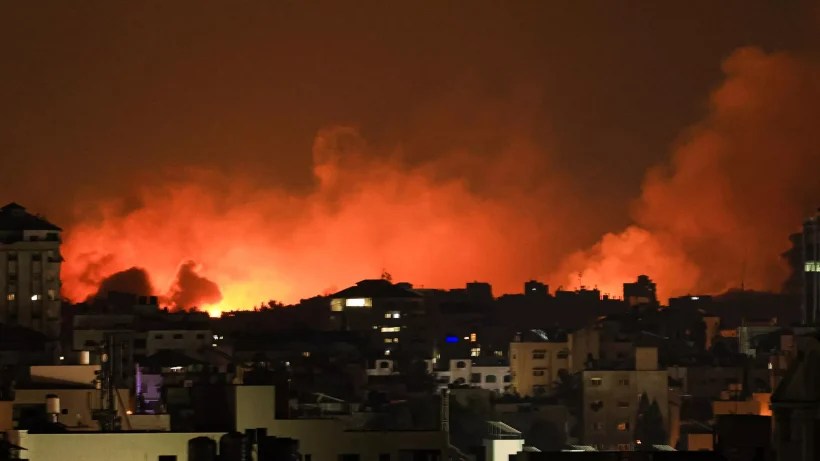
 Israel has launched rounds of airstrikes on Gaza since Saturday, killing more than 560 people and injuring thousands more.
Russian Foreign Minister Sergei Lavrov said on Monday that the way out of the Palestinian conflict is for the Israeli regime and its backers to recognize Palestine’s right to create an independent state.
Speaking in a press conference in Moscow alongside the visiting head of the Arab League Ahmed Aboul Gheit on Monday, Lavrov said that Russia doubts the West’s policy on the Israeli regime would work at all.
“They say that (fighting) should be stopped immediately, that Israel should destroy the terrorists,” Lavrov said, referring to the way Israel and its backers describe Palestinian fighters.
“But this was done before… and never after the situation calmed down did they come to the fact that the main reason (for the conflict) needs to be eliminated … The Palestinian problem should not be delayed further,” he said.
Who Do Middle Eastern Countries Support in Israel-Hamas Conflict?
© AFP 2023 / Mahmud Hams
By Christina Malyk – Sputnik – 09.10.2023
Hostilities have been raging around the Gaza Strip after Hamas units’ invasion to surrounding lands. The current escalation is projected to become one of the largest in the history of the Palestinian-Israeli conflict.
Both Israel and the Gaza Strip have found themselves in the middle of a complex conflict, in which different countries support different sides.
For his part, US Secretary of State Antony Blinken has reportedly spoken to several foreign ministers from Arab countries, asking them to condemn the Hamas actions.
The majority of Arab countries, especially the monarchies of Persian Gulf, have close political and financial ties with the US.
In September, Blinken and foreign ministers of the Gulf Cooperation Council agreed to strengthen ties in defense and security. The US and Gulf foreign ministers also reaffirmed their “commitment to free navigation and maritime security in the Gulf region” in a move against what Washington believes to be an “Iranian threat” in the region.
Sputnik tracked how regional countries have reacted to the latest developments in Israel and Palestine, and whether this connects with its US relations.
UAE
The UAE became the first Arab country to condemn Hamas’ actions.
“The [Foreign] Ministry stressed that attacks by Hamas against Israeli towns and villages near the Gaza strip, including the firing of thousands of rockets at population centers, are a serious and grave escalation. The Ministry is appalled by reports that Israeli civilians have been abducted as hostages from their homes. Civilians on both sides must always have full protection under international humanitarian law and must never be a target of conflict,” wrote the official ministry press release.
It also noted, “The Ministry deeply mourns the loss of Israeli and Palestinian lives as a result of the outbreak of violence, and calls on both parties to de-escalate and avoid an expansion of the heinous violence with tragic consequences affecting civilian lives and facilities.”
The statement was announced right after UAE Foreign Minister Sheikh Abdullah bin Zayed Al Nahyan’s call with Blinken.
Bahrain
An official statement made by Bahrain stressed the need for de-escalation between Palestinians and Israelis. The Ministry of Foreign Affairs of Bahrain is “supporting the peace process and establishing the Palestinian state according to the two-state solution and other international legitimacy resolutions.”
“The Kingdom of Bahrain is closely following the developments taking place between Palestinian groups and Israeli forces, leading to an increase in violence and armed attacks that claimed the lives of a number of people and injured others,” noted the Foreign Ministry.
Saudi Arabia
The Saudi Arabia Ministry of Foreign Affairs through an official statement on Twitter “calls for an immediate halt to the escalation between the two sides, the protection of civilians, and restraint.” Nevertheless, the Saudi Foreign Ministry reminded “the deprivation of the Palestinian people and their legitimate rights.” But Saudi Arabia did not blame Israel for the escalation.
On Saturday, in a phone call with Saudi Foreign Minister Prince Faisal bin Farhan, Blinken said the Kingdom should clearly condemn the attack, State Department officially said.
Nevertheless, the Saudi Foreign Ministry did not include any criticism of the attack or of Hamas. So, Saudi officials appear to be taking a wait-and-see stance.
Qatar
The Qatari Ministry of Foreign Affairs officially stated that Israel is “solely responsible for the ongoing escalation due to its ongoing violations of the rights of the Palestinian people.” Doha also expressed deep concern over the developments in the region and called for de-escalation as quickly as possible.
Earlier on Monday, Western outlets reported that Doha is mediating talks to swap Hamas-held hostages in coordination with the United States. But neither Israel, Qatar nor Palestine has confirmed this information. Later in the day, Hamas spokesman Husam Badran denied to Sputnik that any negotiations with Israel on prisoners exchange are taking place.
Kuwait
Kuwait officially expressed its “grave concern” over developments between Israel and the Palestinians, blaming Israel for what it called its “blatant attacks.”
Its Ministry of Foreign Affairs called for the international community, especially the Security Council, “to take responsibility and stop the ongoing violence, protect the Palestinian people and put an end to the provocative actions of the occupation authorities.”
Kuwait is one of the countries that strictly denies any contact with Israel.
Oman
The Ministry of Foreign Affairs of Oman called on Palestinians and Israelis to exercise restraint. Oman also highlighted “strategic necessity to find a just, comprehensive and lasting solution to the Palestinian cause on the basis of the two-state solution.”
Yemen
The Ministry of Foreign Affairs of Yemen officially blamed Israel for the current escalation. The ministry “called for the protection of civilians and an end to the provocations of the Israeli occupation forces and their repeated attacks on the Palestinian people and their sanctities.”
Iraq
Iraqi Foreign Minister Fuad Hussein expressed his full support for the Palestinian people “to act against the aggressive actions of the Zionist regime” during telephone conversation with his Iranian counterpart Hossein Amirabdollahian on Sunday.
However, the Foreign Ministry of Iraq has not issued any official statement yet. This may be connected with close ties with both the US and Iran at the same time.
Syria
Syria’s Foreign Ministry issued an official statement expressing support for the Palestinian people and the forces “fighting against Zionist terrorism.”
Moreover, Damascus described Hamas’ actions as “honourable achievement that proves the only way for Palestinians to obtain their legitimate rights is resistance in all its forms.”
Lebanon
The Lebanon’s Foreign Ministry issued no official statements on the Israeli-Hamas conflict. That said, Lebanon’s Hezbollah, which operates on Southern Lebanon near the Israeli border, praised Hamas for its “heroic operation” in a statement. Hezbollah also claimed responsibility for shelling Israeli territory during the escalation.
Jordan
Jordan’s King Abdullah said on Sunday there was a need to intensify diplomatic efforts to prevent escalating Israel-Palestinian violence with “dangerous repercussions” for the region’s security.
He also called for “urgent international action to avoid an escalation and prevent the region from the consequences of a new round of violence.”
In turn, Jordan’s Foreign Minister Ayman Safadi warned both Palestinian and Israeli sides of the “volatility”’ of the escalation.
Egypt
Egypt warned of the “severe dangers” posed by current escalation between the Gaza Strip and Israel.
“Egypt calls for international actors involved in backing the efforts of resuming the peace process to intervene immediately to halt the ongoing escalation,” Egypt’s Foreign Ministry noted.
Egypt has always been a peace process mediator between Israel and Hamas, working with the US. According to media outlets, both Western and local, Egypt tried to bring the parties to the negotiating table, but did not manage to do it.
Iran
Iran’s Foreign Ministry has strongly condemned “the usurping Zionist regime’s attacks against civilian targets in southern Lebanon and the Gaza Strip.” Foreign Ministry spokesperson Nasser Kanaani also stated that Hamas’ attacks showed increased confidence by the Palestinians against Israel.
Iran regards both Israel and the US as its own enemy.
6 takeaways from AfD’s massive gains in Bavaria and Hesse regional elections
By John Cody | Remix News | October 9, 2023
While the Christian Democrats (CDU) and the Christian Socialists (CSU) received the most votes in the regional elections of Hesse and Bavaria, the headline news story across Germany is the Alternative for Germany’s (AFD) overperformance in both states. The outcome of the election is reverberating throughout Germany, with implications for the federal level as well. On the issues of immigration, the economy, and green energy, the AfD is pulling ahead, while the ruling left-liberals will be left searching for answers after an election shellacking.
Here are six takeaways from the election results and what they could mean for the future political landscape of the country.
AfD may be stronger than the polls say
With both Bavaria and Hesse combined, the AfD party will now have 70 seats, a 50 percent increase compared to its previous 2018 elections. The party actually did better than the polls said it would, which had already painted a rosy picture for the anti-sanctions, anti-immigration party.
For example, AfD was polling at around 16 percent in Hesse, but actually ended up in second at 18.4 percent, while in Bavaria the AfD is on par with the Greens and Free Voters, where it earned 15.8 percent, making it the third-largest party.
The party has for years had a stable level of support at around 10 to 12 percent, but in the last year, it has soared in the polls up to 23 percent and continues to hover at 21 percent.
Many new potential AfD voters may be “shy” voters who are afraid to express their support to pollsters, meaning that pollsters may not be capturing the full picture. The party is, after all, facing a potential ban, openly mocked and attacked by the political and journalistic establishment, and supporters of the party along with politicians have been physically assaulted in the past.
Furthermore, with the AfD’s success in local elections, it may begin to “normalize” the party in the eyes of voters, which could contribute to more open support for the party — and even a jump in the polls — going into the future.
Germans are fed up with mass migration
In the run-up to the elections, Remix News reported a new groundbreaking poll showing a huge majority of Germans wanted fewer migrants and also saw migrants bringing fewer advantages than disadvantages.
If we look at the polling surrounding these specific elections, it only cements the reality that Germans are remarkably shifting against mass immigration.
For example, in Bavaria, immigration was rated as the second most important factor by voters, behind the economy, with 48 percent of all respondents telling Infratest dimap that they “welcomed” that the AfD wanted to limit the number of foreigners and refugees more strongly. In Hesse, 42 percent backed the AfD’s anti-immigration policies. In Hesse, the issue of immigration was decisive for 18 percent of voters in terms of their vote, meaning that this was their number one issue.
This polling data shows the massive disconnect between the left-liberal mainstream that promotes mass immigration in the media and culture and the actual sentiment of the German people.
The AfD’s Robert Lambrou, who was second on his party’s election list in Hesse, leaned heavily into the issue of migration during the campaign. Notably, he not only called for faster deportations but stated that skilled legal immigrants should only be accepted in exceptional circumstances and then only from “neighboring countries that are culturally close to Germany.”
AfD rises in the west
The AfD has been historically strong in the east of the country, but with a result of over 18 percent in Hesse, it marks the first major breakthrough in the west of the country. The results come as the AfD recently broke the 20 percent mark in wealthy Baden-Württemberg, the first time it has achieved such a result in a western state.
Notably, the German mainstream is now noting that the AfD’s rise in two Western states is not a fluke or a mere protest vote, with Taggeschau writing:
To interpret the strong results in both states as just a protest election would be too short-sighted. More and more people are voting for the AfD out of conviction. The current situation benefits the party: Asylum and refugee policy concerns many people, and support for a more restrictive migration policy is growing, as data from Infratest dimap shows. At the same time, fewer and fewer voters in both states have a problem with voting for a party that is partly right-wing extremist. And it is not just in migration policy that it is increasingly being given authority: more people are also placing their hope in the far-right party when it comes to the issues of internal security, the economy and social justice.
Such an acknowledgment from the state-run Tagesschau regarding the AfD is big news all in itself.
Massive blow to the traffic-light government
Besides the AfD, the other big outcome was how incredibly poorly Germany’s left-liberal government performed in the election. Now, the political fallout could be felt for months and even years.
For starters, the business liberals of the Free Democrats (FDP) were completely wiped out and failed to obtain the 5 percent needed to enter parliament in both states. It follows a long string of election losses for the party, which has been accused of abandoning many of its principles in its coalition alliance at the federal level. The party is now suffering the consequences, with the results likely sending party leadership scrambling to avert all-out disaster. The FDP, which has already criticized its coalition partners at the federal level, will undoubtedly be seeking out a more independent path in the future, which could lead to a serious governing crisis for Chancellor Olaf Scholz.
However, the SPD and Greens also fared poorly, particularly the SPD, which earned an abysmal 8 percent in Bavaria and only 15.1 percent in Hesse, both historic lows. The Greens earned 14 percent in both Bavaria and Hesse, a substantial drop in both instances from their previous election results.
There is in all likelihood trouble ahead for this coalition, and the far-left Interior Minister Nancy Faeser could still lose her job over her party’s election debacle in Hesse, although there are currently denials from top party brass that this is a possibility post-election.
The CDU could shift further right
Of course, the CDU is also taking note of the AfD’s rise. The CSU, the sister party of the CDU, saw 100,000 of its voters shift to the AfD in Bavaria. In short, the AfD could quickly cut into the CDU’s base, especially over the issue of immigration.
According to German state-run media outlet Tagesschau, it also sees the CDU potentially shifting its stance over the issue, writing: “These results may well lead to a shift in the policies of the mainstream conservative CDU towards a stricter stance on migration. The votes — and the preceding campaign largely focused on national rather than regional issues — may also force the government to revisit its policy of phasing out fossil fuels.”
Will anything change?
Despite the AfD’s surge and a mass rejection of the left, the two elections are notable for another key reason. In both Bavaria and Hesse, both governing coalitions survived. In Bavaria, the CSU can continue governing with the Free Voters, and in Hesse, the CDU could form a theoretical coalition with the Greens once again. In other words, the status quo was maintained.
The AfD may have seen a serious boost in both states, but for now, all parties have vowed to never work with the party. In the short term, the AfD is working to create the conditions that make it increasingly difficult for ruling parties to form status quo coalitions. In the long term, it sees the only viable path to power through a coalition with the CDU. The big question mark is if and when that will ever happen.
Many voters may agree with the AfD’s positions on a range of issues, but many are mentally conditioned to never consider voting for the party. The CDU and other parties are aware of this and will continue to hone their message to keep their voters from straying too far away, even if they plan to maintain the status quo once they achieve power.
‘Austria has paid enough!’ – Austria’s anti-sanctions FPÖ party tables motion to stop funding Ukraine
By Denes Albert | Remix News | October 09, 2023
The Austrian Freedom Party (FPÖ), which is currently the most popular party in Austria according to the latest polling, has tabled a motion demanding Austria withdraw funding of Ukraine given what it says are the billions of euros already gifted from Brussels.
The motion was rejected by all parties except the FPÖ.
“The EU must finally stop throwing billions of member states’ money out the window,” said MP Petra Steger, FPÖ spokesperson for its European policy, while speaking to the Austrian parliament’s foreign affairs committee.
“We say: Enough is enough. Austria has paid enough! Our job is to represent the interests of Austrian taxpayers. So, we are campaigning to put an end to this irresponsible policy at the expense of net contributor states and to suspend contributions until we are assured that our money is being used in a contractual and responsible manner and this huge waste is stopped,” Steger said after the meeting. The MP said that the EU institutions have lost all common sense when it comes to budgetary policy, with one budgetary excess following another in a totally irresponsible manner.
The conservative party has long argued against the EU’s sanctions regime against Russia, saying it has not hurt the Russian war effort and led to severe economic hardship for both Austria and Europe at large.
Austria will pay €3.6 billion in membership fees to Brussels this year, which includes contributions to the European Peace Facility to buy arms for Ukraine, as well as money for the Turkey Refugee Facility.
“As a result, Austrian citizens have been sending billions of euros to the EU institutions for years, and the EU institutions have been rewarding them with climate madness and the highest inflation since 1952. From the ban on internal combustion engines to absurd vaccine contracts and billions of euros in gifts to the Zelensky regime, the EU institutions are not acting in the interests of the Austrians. They are distributing the money they collect according to their ‘moral’ compass, instead of addressing the real concerns of Europeans,” said Steger.
FPÖ MEP Harald Vilimsky also said that Ukraine cannot join the European Union, and the Austrian government should stand by this position tooth and nail, as the consequences of Ukraine’s accession would be very serious. He stated that Ukraine’s accession to the EU, which Brussels is now pushing through wittingly or unwittingly, should be rejected for a number of reasons, one of which is the dramatic impact it would have on the EU budget.
“According to press reports, the EU commission is now modeling the consequences on the example of the current financial framework 2021-2027. According to this, Ukraine alone would receive €186 billion. If the six Western Balkan states plus Georgia and Moldova are included as additional accession countries, they would receive a total of €257 billion. Put simply, this means that Ukraine alone would need around 15 percent of the total EU budget,” Vilimsky said.
He added that in the area of agricultural subsidies, too, the Ukrainians could claim almost a third of the budget. In addition, Ukraine should receive €61 billion from the EU’s cohesion fund, as its GDP per capita is on a par with Algeria or Sri Lanka — about a tenth of the EU average.
Palestinian operation puts Netanyahu between rock and hard place: Ex-diplomat
By Alireza Hashemi | Press TV | October 9, 2023
The military operation by the Palestinian resistance movement Hamas has placed the embattled Israeli premier Benjamin Netanyahu in a dilemma of whether to save his own political future or the illegitimate regime itself, says a former Iranian diplomat.
In an interview with the Press TV website, Abolfazl Zohrevand, a former Iranian ambassador to Afghanistan and Italy, said the Al-Aqsa Storm (also known as Al-Aqsa Flood) operation has put Netanyahu and his far-right cabinet between a rock and a hard place.
Hamas stunned the regime in Tel Aviv with a multi-pronged attack early Saturday, launching thousands of missiles into the occupied territories within a span of 20 minutes and at the same time launching a ground attack against Israeli settlements and military bases near the coastal strip.
The Israeli death toll is staggering, with some reports putting it at above 1,000, besides hundreds of others – soldiers and settlers – who are held as prisoners of war by Hamas in the Gaza Strip.
Zohrevand said the Israeli regime can opt for a very tough response to the Palestinian resistance operation but such a response might lead to an existential threat to the regime.
“Israel can’t do much to punish the Palestinians through air strikes. Such strikes usually fail to hit Hamas’s underground infrastructure and only leave high civilian casualties,” he stated.
“Netanyahu has to start a ground invasion of Gaza, like what he did recently with the Jenin camp in the occupied West Bank,” the former diplomat said, referring to the July Israeli raid into the Jenin camp.
However, he hastened to add that such an operation could end in a humiliating defeat for the regime.
“If Israel decides to engage in a major operation, we should expect weeks-long clashes in the region. Israel isn’t made for long battles. Also, its military is not well prepared as the whole regime is in a state of chaos. The fact that it was caught completely off guard by the operation is a testimony to this,” Zohrevand stressed in a conversation with the Press TV website.
“On the other hand, Palestinians are prepared for such an invasion and they hold the upper hand as Gaza is their home. Palestinians are now sending a message that enough is enough. They’re highly motivated to fight the regime. So the odds for Israel’s success are not high.”
He said the Israeli military action would put the existence of the regime at risk.
“This war can easily spread to the West Bank and other regions. Also, there’s a real possibility that the regime might face a major operation by Lebanon’s Hezbollah. It’s really hard for the regime to handle two fronts. I personally believe the regime won’t start such an operation,” Zohrevand said.
Hamas has already said the operation will be extended to the West Bank.
The Lebanese movement Hezbollah has also staged attacks in solidarity with Palestinians, firing artillery shells and guided missiles at Israeli positions in the occupied Shebaa farms on Sunday.
The former Iranian diplomat noted that Netanyahu might want to accept mediation efforts by Turkey or Egypt and halt its ongoing operation, but that will put his political future in real danger.
“If he decides to stop the Israeli operation, his cabinet won’t last long as it is filled with extremist elements that came to power on a promise of crushing Palestinian resistance and annexing all the Palestinian lands once and forever,” he remarked.
“For Netanyahu, it boils down to a decision whether to save the regime or save his own cabinet or save the regime. He’s in a no-win situation.”
Debunking The Conspiracy Theory That Netanyahu Wanted Last Weekend’s Attacks To Happen
BY ANDREW KORYBKO | OCTOBER 9, 2023
Hamas’ sneak attack on Israel over the weekend prompted speculation among some on social media that the latter knew about these plans in advance but allegedly had an interest in letting them happen. According to proponents of this conspiracy theory, embattled Prime Minister Netanyahu wanted to unite his politically divided people and/or establish the pretext for destroying Hamas, ergo why he supposedly let these attacks unfold. That doesn’t make much sense though if one really thinks about it.
It’s fashionable nowadays to claim that leaders sometimes provoke foreign conflicts to distract from domestic political problems, but that’s arguably not the case with the latest Israeli-Hamas war. In fact, Netanyahu was pursuing the exact opposite approach up until last weekend as suggested by credible reports over the months that he was engaged in secret talks with Saudi Arabia over recognizing Israel. This was aimed at uniting Israelis around him and unlocking their country’s geo-economic potential.
Had these efforts borne fruit, then not only would his fiercest opponents have been forced to praise him for this diplomatic achievement, but Israel could then have profited from its central role in the India-Middle East-Europe Economic Corridor (IMEC) that was unveiled last month. Both goals required Saudi recognition of Israel, which Netanyahu hoped to obtain without recognizing Palestine’s independence, but that’s now in doubt since Riyadh might freeze these talks after Israel’s bombing of Gaza.
Those who claim that he knew about Hamas’ plans in advance but still let them happen are either unaware of his secret talks with Saudi Arabia, downplay their grand strategic importance, or think that they were all a ruse in preparation of this convoluted plot to establish the pretext for destroying Hamas. About that dimension of their conspiracy theory, it’s difficult to imagine that security-obsessed Netanyahu would let his country’s enemies inflict such unprecedented damage to Israel for that purpose.
He could always have simply exploited comparatively minor rocket fire to justify a disproportionate bombing campaign against that group without having to first lose literally hundreds of civilians and soldiers. Hamas’ breaching of the border barrier was also a strong blow to the Israeli psyche from which its people might never recover after having assumed that its construction would forever protect them. The same goes for that group doubling the territory under its control during the climax of its attacks.
Observers can still be opposed to the border barrier in particular, Israeli policy towards Palestine in general, and Netanyahu personally while also acknowledging that he’s such a security-obsessed leader that it doesn’t make sense to claim that he’d let Hamas powerfully undermine all three for any reason. He looks extremely weak after what happened, Israeli policy towards Palestine is now questioned from both sides like never before, and the border barrier is no longer deemed to be a credible defense.
These three outcomes represent the sum of Netanyahu’s worst nightmares, not to mention the likely failure of his plans to obtain Saudi recognition of Israel that would in turn unlock his country’s geo-economic potential via IMEC, all of which indisputably contradict Israeli interests. It remains unclear exactly how all of Israel’s security systems failed at the same time during last weekend’s attacks, nor has anyone explained the intelligence failures up until then either, but that’s indeed what happened.
The conspiracy theory speculating that Netanyahu knew about all this in advance but still let it happen doesn’t stand up to scrutiny as proven in this piece and is pretty much only predicated on the false perception that Israel’s intelligence services are omnipotent. They’re run by humans though and are therefore naturally imperfect, yet those who claim otherwise impart godlike power to the Mossad. This gives Israel too much credit while denying Hamas’ independent ability to organize attacks of this scale.
Ukraine: Why defeat is inevitable, Part 1
TCW Defending Freedom | October 9, 2023
Earlier this year, advertisements for memorial services appeared in Ukrainian towns. People were implored to ‘remember the 400,000’ men who would never return from the battlefields in the east. This statistic, believed to have been leaked mistakenly from a Ukrainian state database, was never meant to be released into the public domain. Indeed, Ukraine’s casualty toll is a guarded secret of Zelensky’s government, withheld from his citizenry and Western allies alike. The posters were removed immediately by local officials, who denied the startling claim.
Many Western experts argue that the figure is accurate. It is corroborated by forensic analyses of cemeteries, as well as knowledge of widespread losses among Ukrainian units and the recruitment of vast reserves. Moreover, evidence from satellite imagery is increasingly being used to reveal the extent of battlefield devastation. Prior to Kiev’s utterly catastrophic offensive of early June, it was assessed that between 300,000 and 350,000 Ukrainian soldiers had died. The offensive, in its turn, is assessed to have incurred more than 1,000 Ukrainian casualties per day for significant periods of the four-month campaign, many of whom have been killed. This, very quickly, has amounted to a staggering human toll, the true extent of which has been elided by mainstream Western reportage.
The offensive has focused the minds of Western policy-makers. It has failed, not partially, but totally. Its purpose was to punch through the immense Russian defensive line and drive wedges deep into the territory seized by Moscow last year. As I argued in July, it was militarily and logically absurd to presume that such an outcome could be achieved. So it has proved: to date its defining achievement has been a temporary breach of a single layer of the Russian defensive system in the southern Zaporizhzhia region. The Russian defensive line itself, built over months while the Ukrainian army was sucked into a pointless, life-sapping defeat in the town of Bakhmut, has not once been penetrated.
This should not surprise the Western officials who planned and financed this campaign. Zelensky cautioned in May, only three weeks before the offensive was launched, that his forces needed more time, weaponry, ammunition and manpower before an attack could succeed against a Russian line of such strength. His warnings have been borne out in a summer of blood. The combat brigades of the Ukrainian army, many of which began the offensive with depleted stocks of men and equipment, have been disintegrated and engulfed by the manifold overmatches of the Russian military. Even the most prized Ukrainian brigades, equipped with modern Nato tanks, armoured vehicles and artillery, and frequently accompanied by foreign advisers, have been stopped dead long before the main Russian line.
There are five core reasons for this terrible defeat:
1. Russia possesses overwhelming superiority in numbers. There are close to 800,000 men in and behind the main defensive line. Furthermore, Putin holds 300,000 troops in immediate reserve. By contrast, due to death and wounding, and vast emigration from a population less than a third the size of Russia’s, Ukraine ran out of men to recruit months ago. Kiev would be incapable of building a defensive position of this length and depth, let alone manning and defending it. As the historian Niall Ferguson observed recently: ‘Wars of attrition do not favour the smaller combatant. It is hard to see how many more offensives Ukraine is capable of mounting between now and 2032 – or indeed between now and this time next year.’ Ferguson is understating the case: we will simply not see a Ukrainian offensive of this scale again. Kiev’s human resources are all but exhausted.
2. Russia possesses roughly eight times the artillery capacity of Ukraine. Following the initial battlefield failings of early 2022, the Kremlin reorganised its artillery into entire brigades, allowing immense firepower to be concentrated against Ukrainian forces. The West, meanwhile, has been unable from the start to provide Kiev with enough artillery pieces or ammunition. Estonian officials complained recently that Russia produces seven times as much ammunition as Western arms manufacturers. Importantly, Moscow’s military-industrial base is held beyond the Ural Mountains, out of Ukrainian missile range. Consequently, Kiev’s troops have been launched into formidable Russian defences without adequate support and have been repelled by terrible barrages.
3. Russian aerial and satellite assets enable the constant surveillance of almost all Ukrainian troops. Moscow has launched a series of further satellites this year, deepening its targeting capabilities. Once found, men and vehicles fall prey to precision missiles, artillery strikes and armed drones. Major combat groupings advance to battle in full view of Moscow’s forces, resulting in untenable attrition from the air before troops even reach the enemy’s lines.
4. The 25km-deep ‘security zone’ in front of the Russian line is a vast labyrinth of minefields and complex booby-trapped trench systems. This terrible quagmire has proved impassable to Western-provided vehicles, forcing soldiers to dismount and pick a path through the carnage on foot with almost no protection. Critically, Western senior officers and advisers who have helped Ukraine to plan this campaign have themselves no experience in attacking defences of this magnitude and sophistication. The campaigns in Iraq and Afghanistan, grim as they were, have not prepared senior officers for the scale or the intractable complexity of modern conventional warfare. The Cold War era, in which vast conventional operations were routinely planned and exercised, is a distant memory for the modern Western military. Indeed, this obvious void in knowledge and experience has been a ratcheting source of tension between Ukrainian and Western officials.
5. Crucially, Russia has air superiority. This is the decisive factor in modern warfare. Moscow possesses 4,200 aircraft, while Kiev can employ only 310. Although fixed-wing aircraft have been used cautiously due to the threat from Western-provided air-defence systems, the Russian drone capability has surged over recent months. The skies above advancing Ukrainian troops are aswarm with predatory air assets. Footage shows Russian attack helicopters and the new lethal ZALA Lancet drones destroying US Bradley fighting vehicles and German Leopard tanks that have become lodged in minefields. By contrast, Russian electronic warfare assets are jamming and disabling 10,000 Ukrainian drones per month, many of which are merely small Chinese commercial craft that have been retrofitted for pseudo-military use. Not only does Moscow have overwhelming superiority of numbers in the air – it has a widespread technological advantage over Kiev’s forces too.
The point is not that the Russian military is invincible: it has its well-documented weaknesses and discontents. Yet the irrefutable, implacable fact is that, by every military metric, Russia is tremendously more powerful than Ukraine in this war. That is not a moral opinion: it is demonstrably and objectively true.
In fact history tells us that we ought to have expected this. Moscow’s juggernaut-like resurgence in Ukraine is but the latest iteration of a centuries-old pattern in Russian warfare. One invader after another, from King Charles XII of Sweden in 1707 to Napoleon in 1812 to Hitler in 1941, has discovered that, whilst the Russian nation appears initially to disintegrate against the aggressor, it eventually springs forth in a terrible torrent of attritional power and resolve.
In his brilliant essay Have We Forgotten the Russian Way of War? the eminent American classicist Victor Davis Hanson explains that the Russian army undergoes this same transformation when it is on the offensive outside its own borders. The Finnish-Russian ‘Winter War’ of 1939-40 is usually referenced as an example of Finnish heroism against Moscow’s numerically superior, clumsy and badly led force. Yet the outcome was a grinding Russian victory in spite of 400,000 casualties.
We are seeing this quintessentially Russian way of war again in eastern Ukraine. The initial weeks of incompetence and blunder so evident in the early spring of 2022 are long gone. There is now a massive and resolute force entrenched along a vast frontage, bolstered with immense support in materiel and modern weaponry.
The critical first step in ending this war, and alleviating the inconceivable human suffering it has wreaked, lies in our honest acknowledgement that Ukraine and its Western backers are losing terribly.
Indeed, as will be explored in the next essay of this series, even the neoconservative ultra-hawks who have willed this war on from the very start are now admitting that a Ukrainian – and thus Western – defeat is well within view. The true extent and meaning of that defeat will be felt not just in Kiev, but in the great capitals of the West.
You can read more of the writer’s work on his substack.
Israel has no one to blame but itself for war with Palestinians: Lawmaker
Press TV – October 8, 2023
Israel has no one to blame but itself for the war with the Palestinians, says a lawmaker of the regime, insisting that the illegal occupation of the Palestinian land has caused the situation to escalate.
Ofer Cassif, a member of the Knesset and leftist Hadash coalition, told Al Jazeera on Sunday that his party had repeatedly warned the regime authorities that the way they treated the Palestinians would have serious repercussions.
“We have been warning time and time again… everything is going to erupt and everybody is going to pay a price… And unfortunately, that is exactly what happened,” said Cassif, whose party has four seats in the 120-member parliament.
The “fascist” regime, he said, “supports, encourages, and leads pogroms against the Palestinians.”
“There is an ethnic cleansing going on. It was obvious the writing was on the wall, written in the blood of the Palestinians.”
Some sources say more than 750 Israelis have been killed since early Saturday, when the Palestinian resistance movement Hamas launched massive rocket attacks and a ground operation from its bases in the Gaza Strip into the occupied territories.
Hamas says Operation al-Aqsa Storm is a response to Israel’s growing acts of aggression against the Palestinians, especially in the occupied West Bank, and its support for the recurrent presence of settlers in the al-Aqsa Mosque in the occupied Quds.
Scores of Palestinians have been killed in Israeli attacks on Gaza, a besieged enclave on the Mediterranean, since the regime started to respond to Hamas attacks on Saturday.
Iron Dome’s ‘Inefficiency’ Revealed by Israeli-Palestinian Conflict Escalation – Expert
By Andrei Dergalin – Sputnik – 08.10.2023
The massive attack launched by Hamas militants against Israel on October 7 was accompanied by a series of rocket launches, many of which managed to bypass Israeli defenses and hit their targets.
Israel’s Iron Dome air defense system is widely regarded as one of the best in the world. That said, it apparently failed to completely negate the Palestinian rocket barrage on Saturday.
Commenting on this failure, Russian military historian and Museum of Air Defense Forces’ Director Yuri Knutov pointed out that while Iron Dome is a very advanced and sophisticated air defense system, it has drawbacks that can be exploited by any enemy.
For one, a single Iron Dome battery can protect a relatively small area (about 150 square kilometers).
Secondly, Knutov noted, Iron Dome is extremely effective when dealing with a small number of incoming targets all of which approach from the same direction.
“In case of a more intensive barrage, involving at least about 100 rockets, the Iron Dome usually fails to do its job and up to 90 percent of the rockets bypasses it and strike the intended targets,” he claimed.
The historian also observed that Hamas militants deliberately launched mass rocket salvos from different directions, apparently in order to overwhelm the Israeli Iron Dome defenses.
“When it (an Iron Dome system) intercepts the first salvo, when it is dealing with those rockets, it is unable to deal with the second salvo that was fired practically a minute after the first one. And so the rockets from the second, third and fourth salvos reach their targets practically unopposed,” he said, arguing that this tactic essentially capitalizes on Iron Dome’s “inefficiency.”
Furthermore, a single Iron Dome interceptor missile costs at least $20,000 while Palestinian jury-rigged rockets – the threat Iron Dome systems usually have to deal with – cost only about $2,000-$3,000 apiece, Knutov added.
Knutov did, however, praise the Iron Dome’s radar unit capabilities and the interceptor missiles this air defense system uses, describing both of them as quite “interesting.”
He also noted that Iron Dome can determine whether an incoming missile poses a threat to a populated area or a military facility and refrain from wasting ammo on a projectile that would otherwise crash in a deserted area.
What Does Iron Dome Do?
Iron Dome is an Israeli-made air defense system designed to intercept and destroy ballistic missiles and artillery shells fired from distances of 4 to 70 kilometers.
Developed during the late 2000s by Israeli defense contractor Rafael Advanced Defense Systems, the Iron Dome was first deployed in 2011 and has since been actively used by IDF to counter rocket strikes conducted by Palestinian militants.
An Iron Dome battery typically consists of several launcher units (the payload of each consists of 20 interceptor missiles), a radar unit and a control unit.
Israeli Intelligence Services’ Failure & Merkava Fiasco
According to Knutov, the fact that Hamas militants managed to prepare thousands of rockets for this attack in secret, not to mention train all those militant squads that launched incursions into Israeli territory on October 7, effectively means that Israel’s intelligence agencies failed to do their job properly.
Meanwhile, Hamas militants displayed what looks like special operations tactics, with teams of militants using paragliders and executing amphibious landings in order to bypass Israeli forces and storm Israeli military bases, Knutov said.
He also described reports about an Israeli Merkava main battle tank, “which was portrayed as the best tank of in the world and which was equipped with Trophy active protection system and with dynamic protection,” being disabled by a Palestinian militant armed with a fairly antiquated anti-tank weapon as surprising.
“The first tank was taken out with an old RPG-7 grenade launcher loaded with a shaped charge that punched straight through the tank’s frontal armor,” he said.
The fact that neither the vaunted Trophy system nor Merkava’s armor and dynamic protection managed to save the tank from destruction essentially means that all of them are not as good as advertised, to put it mildly, Knutov suggested.
War as an “Investment”
The Bizarre Business-Speak of Mass Killing
By Bill Astore | Bracing Views | October 3, 2023
Did you know the Russia-Ukraine War is a great “investment” for the United States? A terrific opportunity to kill lots of Russians and to destroy lots of their military equipment at a relatively cheap cost to us? (Just don’t mention the price paid by Ukraine.) It gives new meaning to the expression “making a killing” on the “market.”
To Gordon Gekko’s infamous “greed is good” speech we must now add “war is good.” That war is “right.” That it “works”—at least for America, allegedly.
War as an “investment” truly symbolizes the moral bankruptcy of conventional discourse in the U.S. political mainstream. Instead of war being a calamity, a catastrophe, a realm of death and destruction, dare I say even a mortal sin of grievous evil, we’re told that instead it’s an investment that’s paying dividends, especially in that growth stock known as Ukraine.

We can’t let MAGA Republicans stop the Ukraine “investment,” can we? Not when it’s paying such great dividends
Even body counts and truck counts from the Vietnam War era are being brought back to show what a great “investment” the Ukraine War has been for the U.S. In her latest, Caitlin Johnstone cites war-lover Max Boot for his advocacy of the Russia-Ukraine War as a continuing investment opportunity for the U.S., including the use of body and truck counts as a measure of progress:
“Russia has lost an estimated 120,000 soldiers and 170,000 to 180,000 have been injured,” [Max] Boot writes [in a Washington Post op-ed]. “Russia has also lost an estimated 2,329 tanks, 2,817 infantry fighting vehicles, 2,868 trucks and jeeps, 354 armored personnel carriers, 538 self-propelled artillery vehicles, 310 towed artillery pieces, 92 fixed-wing aircraft and 106 helicopters.”
“The Russian armed forces have been devastated, thereby reducing the risk to front-line NATO states such as Poland and the Baltic republics that the United States is treaty-bound to protect,” Boot continues. “And all of that has been accomplished without having to put a single U.S. soldier at risk on the front lines.”
“That’s an incredible investment,” gloats Boot.
At no time in his masturbatory gushing about how many Russians this war has helped kill does Boot make any mention of the immense toll this deliberately provoked and completely unnecessary war has taken on Ukrainian lives. Their deaths and dismemberments and displacement are the largest price being paid into this “investment” by far, but Boot doesn’t deem them worthy of even a footnote.
We’ve been seeing this “investment” line being promoted with increasing frequency by US empire managers and their apologists. In an article published in the Connecticut Post last month, Senator Richard Blumenthal assured Americans that “we’re getting our money’s worth on our Ukraine investment.” A few days prior to that Senator Mitt Romney had described the proxy war as “the best national defense spending I think we’ve ever done,” because “We’re diminishing and devastating the Russian military for a very small amount of money… a weakened Russia is a good thing.” In December Senate Minority Leader Mitch McConnell said that funding the proxy war is “a direct investment in reducing Vladimir Putin’s future capabilities to menace America, threaten our allies and contest our core interests.” Last November the imperial war machine-funded think tank Center for European Policy Analysis published a report arguing that “US spending of 5.6% of its defense budget to destroy nearly half of Russia’s conventional military capability seems like an absolutely incredible investment.”
Imagine the vacuity, the bankruptcy, the venality, the sinfulness of writing about war and killing as “an absolutely incredible investment.” And what is our ROI, our return on investment? A lot of dead and wounded Russians and Ukrainians, a devastated and poisoned landscape, millions of war refugees, and an increasing likelihood of a wider war that could possibly go nuclear. ROI, indeed.
War is many things, but it is not an “investment.” People who talk and write like this have no moral center. They are soulless. They are automatons of war.
Heinous Choreography of Village Massacre as Zelensky Begs for More Weapons at EU Summit
By Finian Cunningham | Strategic Culture Foundation | October 8, 2023
The horrific missile strike on a Ukrainian village in which 52 people, including a young boy, were killed in a cafe was widely reported by Western media with strident condemnations of a Russian “war crime”.
All the American and European media reports relied solely on Ukrainian security sources for their immediate attribution of the massacre to Russian forces. It was claimed that a Russian Iskander missile hit the village of Hroza (Groza).
Russia did not make any comment on the specific accusations, simply repeating that its military does not deliberately target civilian centers.
The carnage on Thursday, October 5, occurred at the very same time that Ukrainian President Vladimir Zelensky was addressing a summit in Granada in Spain attended by European Union leaders. Zelensky referred to the missile strike in highly emotive language, condemning it as “Russian genocidal aggression”. EU leaders joined in the denunciation of Russia.
The BBC quoted Zelensky as saying the act “couldn’t even be called a beastly act – because it would be an insult to beasts”.
The purpose of Zelensky’s attendance in Granada was to make a renewed appeal for European NATO members to supply more air defence systems to Ukraine. It was reported that Spain pledged to send the U.S.-made HAWK system to Ukraine.
Zelensky also told European leaders that the political turmoil in the United States over the abrupt Congressional cutting off of financial aid to Ukraine was a “dangerous situation”.
The Biden White House referred to the missile strike on the village of Hroza as a reminder to U.S. lawmakers why continued military aid to Ukraine is essential.
As several Western media reports acknowledged, the targeted village with a population of around 300 did not have any military or tactical value. It is located around 17 miles (27 kms) from the front line between Ukrainian and Russian forces in the Kharkiv region.
The victims of the explosion were attending a funeral for a Ukrainian soldier. If Russia fired a missile it would have been for a depraved reason, as the Western media and politicians like Britain’s Prime Minister Rishi Sunak were quick to allege.
On the other hand, cynical as it might seem, for the Kiev regime there was a big incentive to stealthily carry out the missile strike against its territory for the propaganda value of blaming Russia. The timing comes at a crucial moment when the Kiev regime is “freaking out” over the possible long-term cutting off of military aid by the U.S. and its NATO partners.
Such a false-flag provocation carried out by the Kiev regime has precedent, albeit not reported by the Western media.
Last month, on September 6, the U.S. Secretary of State Antony Blinken arrived in Kiev with an additional $1 billion in military and financial aid. Hours before Blinken arrived, the city of Konstantinovka (Kostiantynivka) was hit by a missile killing 17 people. The city is located in territory under the control of the Armed Forces of Ukraine (AFU).
That atrocity was similarly condemned as “Russian terrorism” by Ukrainian President Zelensky while he was hosting Blinken in the capital.
Like the attack on Hroza last week, the one on Konstantinovka was immediately blamed on Russia and reported widely as such by Western media.
It turned out, however, that the missile that hit Konstantinovka was not fired by Russian forces. A follow-up report by the New York Times on September 18 found that the warhead had been fired from AFU positions. The NY Times described it as an “errant missile” that slammed into a busy marketplace by mistake. Nevertheless, despite the evidence, the Kiev regime continues to blame Russia for the crime.
There is good reason to conclude that the missile atrocity on September 6 was not “an error” but rather was deliberately staged by the Kiev regime as a false-flag provocation to highlight the visit by the senior American diplomat, Antony Blinken, and the need for his weapons gifting.
For those who don’t rely on the Western media for their information, it is well-documented that the NeoNazi Kiev regime has a foul habit of staging massacres for propaganda. The Bucha massacre last March was one such macabre event. This was when several civilians were found executed, their bodies strewn on streets, supposedly after Russian forces retreated from the city. All Western media blamed the apparent executions on Russia and continue to do so. But the freshness of the corpses found days after Russian troops pulled out of Bucha proves that the killings were done by others, probably Kiev agents.
Another probable false flag was the missile strike on a railway station in the city of Kramatorsk on April 8, 2022, that killed 63 people. Again, Russia was roundly blamed and condemned by Western media and politicians taking their cue from Ukrainian official sources. In that incident, the missile was later identified as a Tochka-U not in regular use by Russian forces, but more likely used by the AFU.
The Kramatorsk atrocity came on the day that European Commission President Ursula von der Leyen was visiting Kiev, condemning it as “despicable” and vowing tens of billions more Euros in support for the Kiev regime.
The Ukraine war has become an obscene racket for profiteering by the U.S. and European military industries, their lobbyists and most of the Western politicians they have close sponsorship links to, like Blinken and Von der Leyen. It is also a money-spinner for the corrupt Kiev regime whose President Zelensky and other cronies have made up to $400 million in skimming off aid, as reported by Seymour Hersh citing Pentagon sources. This rampant corruption was why the Kiev regime sacked most of its defence officials last month in a desperate attempt to appear as if it were cleaning up the graft.
Western public fatigue and disgust with the war racket are growing and imperilling the continuation of the colossal scam. False-flag atrocities are a logical, heinous way to keep the racket on track.
Featured Video

Iran FM Araghchi: “Hormuz Will No Longer Be the Same”
or go to
Aletho News Archives – Video-Images
From the Archives
Sam Husseini: The entire US establishment helped lie their way into the Iraq war
By Slava Zilber | American Herald Tribune | October 14, 2019
Sam Husseini is a senior analyst with the Institute for Public Accuracy, independent journalist and contributor to The Nation and FAIR.
Slava Zilber: Sam, three years ago, you appeared on Talk Nation Radio with David Swanson and spoke about the case of the GCHQ whistleblower Katharine Gun. You pointed out that the people involved in the spying on the UN and the people authorizing the Iraq War were not held accountable:
“Virtually everybody who went along with the war, whether it is Kerry or Clinton, of course, the Bush administration themselves has falsified their own records in terms of why, what they did, when they did, why they did it, to the extent that they’ve been scrutinised at all.”
You also address it in a recent article. And recently, Joe Biden has been lying about his position on the Iraq War. How can such an important issue escape meaningful scrutiny? … continue
Blog Roll
 Aletho News
- Barghouti: ‘Netanyahu has fallen,’ era of Smotrich, Ben-Gvir over
- China slams US policy on Iran as Russia rejects legality of nuclear meeting at UN
- The Mecca Pact Courts Iran: Containment Comes Full Circle
- Oman FM: Persian Gulf states, Iran, Iraq should form security pact excluding US
- Trump peddles fresh falsehoods, claims Iran ‘started the war’ as US aggression drags on
- Ukraine quagmire? Yes, but it’s for NATO, not Russia
- US intelligence hypes Chinese, Russian space threats while accelerating its own military buildup in orbit
- Iran FM Araghchi: “Hormuz Will No Longer Be the Same”
- EU facing trillion-euro debt hole while seeking more cash for Kiev
- How US, Europe, Persian Gulf states exhausted missile stockpiles, splurged billions to defend Israel
- If Americans Knew
- An error has occurred; the feed is probably down. Try again later.
- No Tricks Zone
- Sudden Stratospheric Warming, Powerful El Niño Combination May Lead To Extreme Europe Cold, Energy Crisis!
- Two New Studies Find Thwaites Glacier Melt Cannot Be Driven By Human Activity Or A Warming Ocean
- E-Cars Reduce CO2 Emissions By Only 41% Compared To Internal Combustion Engine Vehicles
- Predictions Made By Renowned Climate Professor Over Past Decades Have Been Proven To Be Poor
- New Study Suggests Large Regions Of The Pacific Ocean Have Been Cooling For The Last 80 Years
- Germany’s Green Energy Debacle: High Energy Costs Force Kahla Porzellan to Close After 182 Years!
- New Study: 50 Years Of The Most Aggressive ‘Net Zero’ Policies Can Only Affect The Global Climate By 0.03°C
- US September “Heat” Was No Record…Many Records Set Decades Ago
- Latest European Green Energy Debacle; Portugal’s Largest Flagship Solar Park Insolvent!
- Green Energy Debacle: German Expert Professor Fritz Vahrenholt Warns Of Severe Economic And Social Consequences

