Israeli forces injure Palestinian school children in West Bank raid

Press TV | October 2, 2023
The Palestinian Ministry of Education has suspended classes in the village of Burqa due to the injury of a child in a raid by Israeli forces into a school.
Ghassan Daghlas, acting governor of the occupied West Bank city of Nablus, said on Monday the decision to close the school was to maintain the safety of students.
Local media reported that Israeli forces also directly fired stun grenades and tear gas canisters toward the Palestinian students inside the school during the raid a day earlier. Dozens of children also suffered from smoke inhalation.
Israeli forces also denied teachers of 27 schools access to classes in Masafer Yatta area, located south of the city of al-Khalil (Hebron). The regime forces placed barriers to block the roads leading to the education centers.
In recent months, Israeli forces have also demolished a number of schools across the occupied Palestinian territories.
The Palestinian Ministry of Education in an earlier statement said the demolition of schools was “a heinous crime.”
“These practices have become a flagrant violation of students’ right to safe and free education.”
What’s behind the sudden US good will towards Iran?
By Robert Inlakesh | RT | October 2, 2023
In what proved to be a domestically controversial move, the US government approved the release of five prisoners held in Iran in return for releasing five Iranian detainees and billions of previously frozen assets. However, in the aftermath of the agreement between Tehran and Washington, the White House’s primary focus seems to be centered around securing a Saudi-Israeli deal rather than working on reviving the 2015 Iran nuclear deal, known formally as the Joint Comprehensive Plan of Action (JCPOA).
As revealed by the anonymous diplomatic sources of The Cradle, in addition to other tidbits released in US media, the US-Iran prisoner swap appears to have been much more than meets the eye. The informal agreement, according to these anonymous sources, encompassed freezing Iranian uranium enrichment at 60% and permitting the International Atomic Energy Agency (IAEA) to install cameras at several nuclear sites. On the other hand, the US’ concessions included disregarding Iranian oil sales – in essence, refraining from enforcing sanctions – and allowing all Iranian assets to be released, reportedly amounting to roughly $20 billion. This is well over the widely reported $6 billion touted in the international press.
What makes this agreement so intriguing is that it was non-formal, including no known signed documents, and was contrived over several months and under the auspices of Qatar and Oman as intermediaries. From leaked information, citing unnamed sources, what we can gather – regardless of what claims are true or false – is that the prisoner swap was more than a simple exchange of prisoners and $6 billion in frozen assets. According to a report released in May by Axios, secret indirect talks between the US and Iran had been conducted in Oman, which three sources close to the news outlet claimed Iran’s top nuclear negotiator, Ali Bagheri Kan, was part of. Later, in June, the New York Times released a report claiming that secret negotiations were going on, aimed at concluding an informal agreement to replace the need to revive the 2015 nuclear deal.
To begin with, if we are to assume that the official US narrative on the agreement is correct, despite Iranian officials having contradicted it, then the most apparent objective in mind from Washington’s perspective would be to cause a thaw in America’s relationship with the Islamic Republic. As various analysts have suggested, this could have also signaled hope for a revival of the nuclear deal, which fell apart after the administration of former President Donald Trump unilaterally withdrew from it in 2018. Hope had largely faded that the administration of President Joe Biden could bring the deal back to life after Biden was revealed to have said that it was officially “dead” in November of 2022.
However, given the information we have at hand, what is most likely here is that this represents a massive de-escalation following ship seizures and the beefing up of America’s troop presence in the Persian Gulf back in August. Why a de-escalation now? Is it to revive nuclear deal talks? This appears highly unlikely. Instead, the prisoner exchange agreement comes simultaneously with, and is somewhat overshadowed by, developments in the ongoing discussions to reach an American-brokered normalization deal between Saudi Arabia and Israel.
The two nations, both powerful partners of the US in the Middle East, have never had formal diplomatic relations with each other. Saudi Arabia does not recognize Israel as a sovereign country and has been at loggerheads with it over its treatment of Arabs in Palestine, which Riyadh ostensibly wants to see as an independent nation. Negotiations to finally normalize diplomatic relations have been ongoing for months now, with the US being a highly invested middleman, given that achieving such a deal would help consolidate its power base in the region. As for Iran, while Israel sees it as an existential enemy, Saudi Arabia has had a complicated relationship with it, only having re-established diplomatic ties earlier this year in a deal brokered by China.
When Biden met with Israeli Prime Minister Benjamin Netanyahu in New York on the sidelines of the United Nations General Assembly (UNGA)’s 78th session, they publicly discussed the high hopes of concluding Saudi-Israeli normalization. This was followed by two Fox News interviews, one with Saudi Crown Prince Mohammed Bin Salman and the other with the Israeli PM, during which both said that the deal grows closer by the day. At Benjamin Netanyahu’s address to the UNGA, he spoke at length on Iran; however, there was no mention of the recent US-Iranian prisoner exchange.
In fact, Israel has remained silent on the informal deal. This is especially interesting, considering that Tel Aviv routinely attacks the prospect of any agreement with Iran, let alone one that allows for tens of billions in funds to be transferred back into the hands of Tehran. In June, Netanyahu spoke over the phone with US Secretary of State Antony Blinken, during which he discussed Iran at length and proclaimed that he opposes and will not be bound by any agreement struck between Washington and Tehran.
On September 5, Antony Blinken spoke with the Israeli premier again, allegedly discussing Iran as the primary subject of the call. While the precise details of the calls are impossible to apprehend, there had to be a good chance that the prisoner swap agreement was mentioned, as reports had publicly been leaked to the press regarding Iran-US talks. With so much focus placed upon Iran by Israel, it makes no sense that Tel Aviv would remain silent on the prisoner exchange, especially given the release of Iran’s formerly frozen funds.
Not silent on the unfreezing of Tehran’s billions were Republican politicians in the US Congress. If the Biden administration were to have accepted a renewal of the 2015 nuclear deal, one of its major hurdles would have been passing the deal in Congress, including the deeply opposed Republican-led House of Representatives. In fact, any attempt to try and pass a deal, at this point, could reflect negatively on the Biden White House, which matters more now as we head towards the 2024 presidential election.
Therefore, by striking an informal agreement with Tehran, the US de-escalates and addresses some of its worries surrounding Iran’s nuclear program. More importantly, however, the US government could be trying to create a fertile environment for the conclusion of an Israeli-Saudi normalization agreement, both by calming Iran down to de-escalate regional tensions and, possibly, leveraging concessions to ease Tehran’s pushback against the normalization directly. Whether this strategy will work or not is yet to be seen. Still, it is clear that the key foreign policy goal for Joe Biden is securing the normalization agreement, which is why it makes sense that the most powerful nation that opposes it – Iran – should be addressed and taken seriously.
Robert Inlakesh is a political analyst, journalist and documentary filmmaker currently based in London, UK. He has reported from and lived in the Palestinian territories and currently works with Quds News. Director of ‘Steal of the Century: Trump’s Palestine-Israel Catastrophe’.
British Defense Sec ‘Mad’ to Suggest ‘Catastrophic’ Military Mission to Ukraine
By James Tweedie – Sputnik – 02.10.2023
The UK’s newly-appointed defense secretary was “mad” to suggest sending troops and ships to Ukraine, a military expert has said.
British Defense Secretary Grant Shapps told a newspaper over the weekend that UK soldiers could be sent to Ukraine to train conscripts to Volodymyr Zelenksy’s depleted army.
The defense secretary even hinted that Royal Navy ships could be sent to the Black Sea to escort Ukrainian merchant vessels following the breakdown of the grain export deal with Russia — in spite of Turkiye’s ban on military vessels of any other nation transiting the Bosphorpus straits to enter the land-bound sea.
Prime Minister Rishi Sunak quickly slapped down Shapps in a TV interview on Sunday on the eve of his Conservative Party’s annual conference in Manchester, saying: “There are no British soldiers that will be sent to fight in the current conflict.”
Since 2022, the British Army has put tens of thousands of Ukrainian recruits through three-week crash courses on training grounds in the UK before they are sent to the frontlines.
Similarly, documents leaked from the US Department of Defense in April this year estimated that there were up to 50 SAS special forces operating covertly in Ukraine, but did not indicate what their mission might be.
Former British MP Matthew Gordon-Banks, a senior research fellow at the Armed Forces Defense Academy in Oxfordshire and Conservative partymate of Shapps, said Shapps’ comments to the media were a “complete PR disaster.”
“Shapps gave an interview, possibly over-stating his intentions as a new defense secretary ahead of a speech to the Conservative Party conference. The Telegraph wrote it up as a certainty,” Gordon-Banks told Sputnik. “I suspect it horrified the prime minister, security and intelligence sources and the wider government.”
The military expert said Shapps’ suggestion of sending British troops into the warzone was simply unthinkable.
“His idea was absolutely mad. Only this week, Russian leaders like [State Duma Chairman Vyacheslav] Volodin, [Foreign Minister Sergey] Lavrov and [Security Council Deputy Chairman Dmitry] Medvedev have made it clear about how the conflict in Ukraine will end and what they would see as unnecessary escalation by NATO,” Gordon-Banks said.
He noted that the article had quickly been taken down from the newspaper’s website — possibly at the insistence of the intelligence services.
“Such a deployment would be catastrophic in both diplomatic and military terms,” Gordon-Banks warned.
In an article in the same newspaper on Sunday, Shapps’ predecessor at the Ministry of Defense Ben Wallace claimed Ukraine was winning its summer offensive — already written off by some US generals and even British state broadcaster the BBC — despite only capturing a handful of villages after four months of fighting.
He also urged Kiev to begin conscripting teenage boys into its army in an attempt to stop Russia from bringing overwhelming force to bear.
“The average age of the soldiers at the front is over 40,” Wallace wrote. “I understand President Zelensky’s desire to preserve the young for the future, but the fact is that Russia is mobilizing the whole country by stealth,” he claimed.
The defense analyst said Kiev was already press-ganging youths to make up for the terrible casualties its army has suffered over the past year and a half.
“Ukraine has already lost three armies,” Gordon-Banks stressed. “They are now pulling 16- to 18-year-olds off the streets. 500,000 Ukrainians have already died fighting a senseless, unnecessary war and it is time for the West to move more quickly to end this conflict.”
American Meddling Failed To Prevent Robert Fico’s Victory In The Latest Slovak Elections
BY ANDREW KORYBKO | OCTOBER 1, 2023
The “Direction-Social Democracy” (SMER) party of former Prime Minister Robert Fico emerged victorious after Slovakia’s latest elections on Saturday in spite of Russia’s Foreign Intelligence Service (SVR) warning before the vote that the US will go to any lengths to prevent that outcome. Nobody should have been surprised by that since CNN’s reporting made it obvious that Washington wanted him to lose. Here are three of their articles fearmongering about his democratically driven return to office:
* “A NATO country could soon have a pro-Russian leader”
* “With Kremlin apologist leading the polls, Slovakia vote threatens country’s support for Ukraine”
* “Pro-Russian politician wins Slovakia’s parliamentary election”
The reason why America meddled in this election is because it fears both the substance and symbolism of a hitherto stalwart NATO vassal defecting from the bloc’s anti-Russian proxy war coalition. Fico previously condemned the West’s role in provoking and perpetuating this conflict exactly as neighboring Hungarian leader Viktor Orban has done since the get-go. Just like him, Fico is also against arming Ukraine and could prevent others’ weapons from transiting across his country as well.
He’ll still need to form a governing coalition in order to make good on his promises, but few doubt that he’ll be able to. Assuming that’ll happen, then Slovakia will join Hungary in creating a center of anti-war gravity in the heart of both the EU and NATO, which complements Poland’s newly cautious stance towards this proxy conflict brought about by its dispute with Ukraine. These three could then form an influential force if the latter’s ruling “Law & Justice” (PiS) party wins re-election on 15 October.
Poland remains much more committed to this conflict than Hungary and post-election Slovakia, but there’s also no denying that the Polish people are incredibly offended at Ukraine’s ungratefulness. A critical mass of them might therefore vote for the anti-establishment Confederation party to protest PiS’ prior appeasement of Kiev up until recently despite that regime’s glorification of those who genocided Poles. If enough do so, then PiS might be compelled to form a coalition government with Confederation.
In that case, Poland might move closer towards Hungary and Slovakia’s position, which could inspire average Europeans to follow these countries’ lead during their own upcoming elections. The demonstration effect that was set into motion by Slovakia and which might soon manifest itself in Poland is therefore regarded by the US as a strategic challenge for good reason. That doesn’t justify its failed meddling in the latest Slovak elections, but simply places its motives into the appropriate context.
The fact that the CIA still failed to prevent Fico’s re-election dispels three popular myths, first and foremost that agency’s omnipotence. The second is foreign voters’ alleged inability to defy the American government’s will, the false perception of which has been exploited to suppress anti-establishment turnout. And finally, the Ukrainian Conflict is truly unpopular in some countries despite the media’s claims to the contrary and its crazed efforts to artificially manufacture support for this proxy war there.
With these symbolic outcomes in mind as well as the substantive changes to Slovak policy that are likely to follow its latest election, not to mention their possible impact on Poland in the coming future and the rest of Europe after that, the failure of America’s meddling campaign is a major development. It’s premature to describe it as a game-changer, but it still suggests a potentially impending inflection point in the Ukrainian Conflict, provided of course that the CIA doesn’t successfully sabotage related trends.
Georgia Awaits USAID’s Explanations on Funds for Training in Organizing Unrest
Sputnik – 02.10.2023
 TBILISI – Georgia is waiting for clarifications from the US Agency for International Development (USAID) regarding information about the funding of training in organizing unrest in the country, Georgian parliamentary speaker Shalva Papuashvili stated on Monday.
Earlier in the day, the State Security Service of Georgia (SSSG) said on social media that three Serbian citizens from the Center for Applied Nonviolent Action and Strategies (CANVAS), allegedly funded by USAID, arrived at the end of September in Georgia to teach tactics for overthrowing the government to young people and members of influential non-governmental organizations. According to the SSSG, the coup was planned for October-December, just when the European Commission is set to publish its decision on Georgia’s EU membership application.
“It was a dark day in the history of American aid to Georgia… We see that money of the American nation is used for planning revolutionary processes, to deliberately train people to riot and incite violence. That is why it is important to receive a corresponding explanation on behalf of the USAID, which has been involved in such a scandal for the second time already,” Papuashvili told reporters.
Georgia’s former deputy interior minister, Giorgi Lortkipanidze, and the commander of Georgian Legion in Ukraine. Mamuka Mamulashvili, who used to be a bodyguard of Georgia’s jailed ex-President Mikhail Saakashvili, were accused of plotting the coup.
An independent online news platform reported that this is at least the seventh time since the ruling Georgian Dream party came to power in 2012 that officials have accused various entities of plotting a coup against the government.
Horrendous Number of Eagle Deaths From Wind Farms

BY CHRIS MORRISON | THE DAILY SCEPTIC | OCTOBER 1, 2023
Further devastating evidence of the toll that onshore wind turbines take on local eagle populations has emerged in Tasmania. The local Wedge-tailed eagle is thought to be down to just 1,000 individuals, but over the last 12 years at least 270 birds have been killed or injured in the vicinity of wind farms. According to a recent paper in Australian Field Ornithology, a further 49 vulnerable White-bellied sea eagles have also been killed in this period.
The scale of depredation is shocking but it could be much worse than reported. According to author Gregory Pullen, information about eagle deaths is not readily available, “nor readily made available”. His calculations arise from a number of primary sources including annual reports. He suggests that unrecorded casualties are higher since most are recorded anecdotally and are not the result of systematic survey. The Tasmanian sub-species of the Wedge-tailed eagle is listed as endangered under both federal and state threatened species legislation.
Large birds of prey such as eagles are at particular risk from giant wind turbine blades revolving at speed since they rely on air currents for sustained flight. The Daily Sceptic has covered this developing story, noting that few activists, bird conservation groups and writers seem able to rouse themselves to complain when the natural flight path of raptors stands in the way of green progress. The Australian climate journalist Jo Nova has stood out from the unquestioning crowd, noting that in Tasmania the greens are destroying nature – again. “It’s not about the environment is it,” she said. She went on to add that there are plans to build up to 10 wind turbine parks across Tasmania – “and if one tower misses, the next will get them”.
It’s not really about the environment over in California either, where America’s national bird, the bald eagle, and many other raptors face mass slaughter in the local wind farm avian graveyards. This follows the state Democrat-controlled legislature’s recent decision to relax controls on wildlife protections to allow permits to kill previously fully protected species for renewable energy and infrastructure projects. However, evidence continues to emerge that the slaughter has been going on for years. Last year, NextEra, one of America’s largest utility companies, was fined $8 million after 150 eagles were killed at its wind farms across eight states. According to the Golden Gate Audubon Society, a wind farm complex in Altamont has been killing 75-100 golden eagles every year since the 1980s.
The animal slaughter does not stop at large birds of course. A number of scientific studies have point to the destruction of millions of bats and smaller birds every year by turbine blades capable of travelling at the tip at speeds approaching 150mph.
Alas, it is not as if the deaths of these wildlife green martyrs are helping to produce much worthwhile economic activity. In the U.K., the small number of jobs being produced by green technologies is starting to be noticed. Gary Smith, the leader of Britain’s largest trade union, recently said that communities along the North Sea can see wind farms, “but they can’t point to the jobs”. Possibly exaggerating to make his point, he added that much of the green work seems to be either London-based lobbying or clearing away the animal casualties of wind farm blades. “It’s usually a man in a rowing boat, sweeping up the dead birds,” he observed.
Green activists are increasingly being caught between a rock and a hard place on these impact issues. It is becoming obvious that many of the green technology solutions proposed to replace fossil fuels come with heavy environmental costs. Whether it be open cobalt mining with child labour, or digging up vast quantities of the Earth’s crust to help construct second-rate solutions such as windmills, the terrible impact is all too obvious. At the moment the typical stance seems to be that voiced by Audubon California Policy Director Mark Lynas, who said we need renewable energy resources, and he did not want to see the eagle deaths “being used to push against clean energy”.
Another area where ecology fights are breaking out is on the east coast of America, where whales are beaching on the shores of New Jersey and New York in alarming numbers. In the first half of this year over 40 whales have died in this way. Large areas of the local ocean are being turned into industrial wind parks, with particular concern arising over 24-hour sonar soundings. The veteran environment campaigner Michael Shellenberger has said the massive offshore works are wreaking environmental damage in previously pristine waters. “It’s the biggest environmental scandal in the world,” he charges.
The waters off the U.S. east coast are important feeding and breeding grounds for large mammals such as whales and dolphins, including the rare North Atlantic right whale. Shellenberger has recently produced a documentary called Thrown to the Wind which presents evidence of whales hit by ships, and high decibel sonar that is said to separate mothers from their calves, sending them into harm’s way. The film shows environmentalists checking the sonar which is said to measure 150 dBs at sea – equivalent to about 90 dBs on land. The noise is a relentless drum beat that is said to pound across the ocean throughout the day and night. On land, the sonar noise would be equivalent to a hairdryer. For humans, prolonged noise much above 70 dBs may start to damage hearing.
The film makes the point that serious pile-driving to secure the giant turbines to the sea floor has yet to start in earnest. Once built there is a danger that the huge back wash created by the giant blades will disturb and kill off plankton, destroying the food supply for the whales.
It must be noted that many interested parties dispute the claims currently being made about wildlife in the new oceanic industrial parks springing up with generous subsidies from the Biden Administration. Both sides can marshal their arguments and evidence. But at the moment, the deck is rigged in favour of the green lobby. Fracking for oil and gas was banned in the U.K. with Friends of the Earth presenting evidence of local earthquakes similar in force to someone falling off a chair. It is more than likely that multiple eagle deaths would be enough to stop the operation of any oil and gas installation. Seemingly, it will take more than a mere rowing boat full of protected but very dead birds to stop the new Green Barons.
Chris Morrison is the Daily Sceptic’s Environment Editor.
A Semi-Competent Report On Energy Storage From Britain’s Royal Society
By Francis Menton | Manhattan Contrarian | September 28, 2023
If you want to power our modern economy on intermittent renewables (wind and solar), and also banish the use of power from fossil fuels and nuclear, then the only option remaining to make the grid work reliably is energy storage on a massive scale. And then it turns out that energy storage on the scale needed is enormously costly — almost certainly so costly that it will in the end sink the entire “net zero” project.
Failure adequately to address the energy storage problem is the fatal defect of nearly all “net zero” plans that are out there. For an example of a thoroughly incompetent treatment of this problem, you might look at New York’s so-called “Scoping Plan” for its mandated “net zero” transition. This Scoping Plan was issued quite recently in December 2022. As examples of its stunning incompetence, it almost entirely discusses the storage problem in the wrong units (watts versus watt-hours), and regularly posits the imminent emergence of magical “dispatchable emissions-free resources,” that have not yet been invented, to cover the gaps in wind and solar generation. The people who issued this Plan have no idea what they are doing, and are setting up New York for an energy catastrophe some time between now and 2030.
But now along comes a report from Royal Society addressing this energy storage problem in the context of Great Britain. The Report came out earlier this month, and has been brought to my attention by my colleagues at the Global Warming Policy Foundation. The title is “Large-scale energy storage.”
Having now put some time into studying this Report, I would characterize it as semi-competent. That is an enormous improvement over every other effort on this subject that I have seen from green energy advocates. But despite their promising start, the authors come nowhere near a sufficient showing that wind plus solar plus storage can make a viable and cost-effective electricity system. In the end, their quasi-religious commitment to a fossil-fuel-free future leads them to minimize and divert attention away from critical cost and feasibility issues. As a result, the Report, despite containing much valuable information, is actually useless for any public policy purpose.
On the plus side of the ledger for this Report, the authors use the correct units to calculate the amount of energy storage needed to back up intermittent wind and solar generation; and their arithmetic appears correctly done as far as I have checked. Also a plus is that it takes them almost no time to conclude that there is essentially no possibility that battery technology will ever be able to solve the energy storage problem for a nation’s grid powered by intermittent sources, no matter how much the technology may improve and no matter how much its costs may decrease.
But then there are the negatives. The authors share the conceit of all green energy advocates — and of all central planners everywhere — that their models and projections have anticipated all costs and problems of their massive schemes. And thus, they think, they know all the answers to how this will work, and can dispense with the tiresome need for any physical demonstration project to prove function and cost. And then there is the discussion, or lack thereof, of ultimate cost to the consumer of these grand plans. The treatment of this subject is inadequate, and characterized by what appears to be an effort to divert the reader’s attention from the subject before too many questions are asked.
But let’s start with some pluses. This is from the “Major conclusions” section of the Executive Summary, page 5:
Wind supply can vary over time scales of decades and tens of TWhs of very long- duration storage will be needed. The scale is over 1000 times that currently provided by pumped hydro in the UK, and far more than could conceivably be provided by conventional batteries.
Go to the body of the Report, and you find that the authors have collected data on generation from wind and solar sources Great Britain over a 37 year period, 1980-2016. Those data show that the intermittency problems of wind and solar generation are far worse than even I had thought. In additional to diurnal and even annual cycles, there prove to be periods of relatively low wind that can persist literally for years. To deal with such situations requires putting huge amounts of energy in storage and then keeping it there for years, maybe decades, in anticipation of these low wind years.
Here is one of my favorite charts from the Report. It depicts the storage balance in a hypothetical 123,000 GWh storage facility for Great Britain over the 37 year period 1980 to 2016. The storage balance never goes much below about 80,000 GWh during the 23 year period 1984 to 2006 — which might have led the incautious to conclude that about half as much storage would be sufficient. But then there was a big low-wind period from 2009-2011:
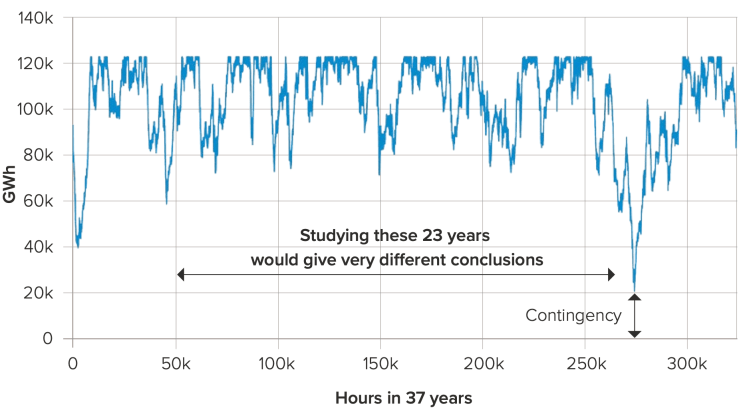
The authors describe the situation as follows (page 31):
Figure 13 exhibits two striking features. First, a study of the 23 years 1984 – 2006 would have found a storage volume very much smaller than found by studying 1980 – 2016. Second, there is a very large call on storage in the period 2009 – 2011 which reflects persistently low wind speeds that lead to the large deficits seen in figure 2 (some of the energy that fills these deficits would have been in the store since 1980). These features reinforce the conclusion that it would be prudent to add contingency against prolonged periods of very low supply and the possible greater clustering of 2009 to 2011-like years.
As a result of observations like this, the authors, I think correctly, conclude that batteries are completely out of the question to solve this problem. The only storage medium that could conceivably work would be a combustible chemical substance that can be put in massive underground facilities for decades. Only two possibilities are out there — hydrogen and ammonia. And ammonia is far more expensive and far more dangerous. So that leaves hydrogen.
Since hydrogen is the one and only possible solution to the storage problem, the authors proceed to a lengthy consideration of what the future wind/solar/hydrogen electricity system will look like. There will be massive electroayzers to get hydrogen from the sea. Salt deposits will be chemically dissolved to create vast underground caverns to store the hydrogen. Hydrogen will be transported to these vast caverns and stored there for years and decades, then transported to power plants to burn when needed. A fleet of power plants will burn the hydrogen when called upon to do so, although admittedly they may be idle most of the time, maybe even 90% of the time; but for a pinch, there must be sufficient thermal hydrogen-burning plants to supply the whole of peak demand when needed.
I find the treatment of the potential cost of all of this to be totally inadequate. There is never a mention of the most relevant subject, which is how much electricity prices to consumers might increase. The closest thing I find is this chart on page 32:
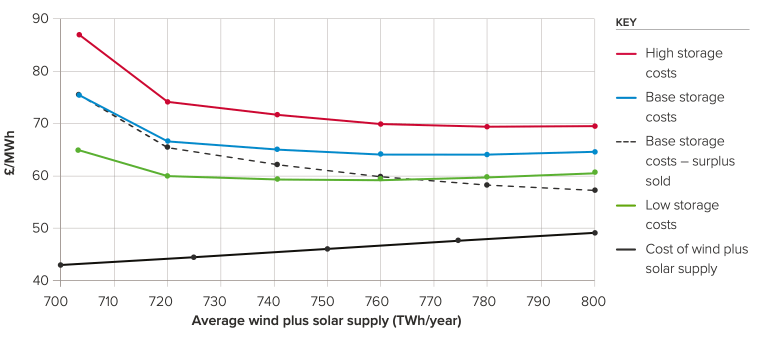
This is cost “to the grid,” thus wholesale cost. Will there be a huge multiplication of final price to the consumer? At first glance this doesn’t look too bad. About 50 pounds/MWh for the wind/solar input, and then 60-70 pounds/MWh for the storage makes about 110-120 pounds/MWh total. Add about 33% to convert to dollars, and you would have about $143-156/MWh, or 14.3 to 15.6 cents per kWh. It’s high, but not completely in the stratosphere.
But wait a minute. Are these guys leaving anything out?
-
How about the new network of pipelines to transport the hydrogen all over the place?
-
How about the entire new fleet of thermal power plants, capable of burning 100% hydrogen, and sufficient to meet 100% of peak demand when it’s night and the wind isn’t blowing.
-
They use a 5% interest rate for capital costs. That’s too low by at least half — should be 10% or more.
-
And can they really build all the wind turbines and solar panels and electroayzers they are talking about at the prices they are projecting?
The whole thing just cries out for a demonstration project to prove feasibility and cost. I’m betting that that will never occur before the whole “net zero” thing falls apart from the disaster of skyrocketing electricity prices. Time will tell.
Britain is Leading the World in Committing Economic Suicide
BY DAVID CRAIG | THE DAILY SCEPTIC | SEPTEMBER 29, 2023
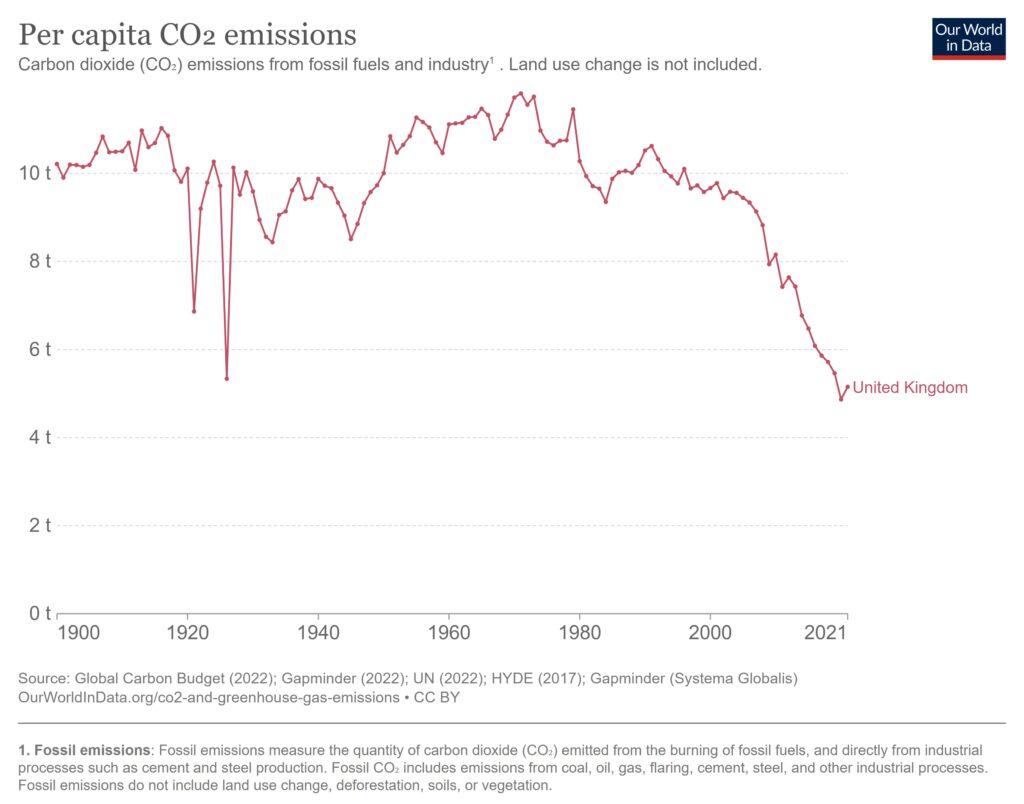
As our leaders bicker over how fast Britain should get to Net Zero, you’ll hear politicians, eco-zealots and media pundits claiming that Britain is leading the world in reducing our country’s CO2 emissions. This is one of the few statements about climate made by our ruling elites which does actually appear to be true. Since 1990, Britain’s CO2 emissions have almost halved from 604 million metric tons to just under 350 million tons by 2022. That equates to a drop from 10 metric tons per capita in 1990 to below five tons per capita:
While celebrating this great supposed ‘success’, our politicians, media and eco-activists often seem less keen to explain how this reduction in CO2 emissions was achieved.
Here’s another chart. It shows the share of the U.K.’s GDP made up by manufacturing:
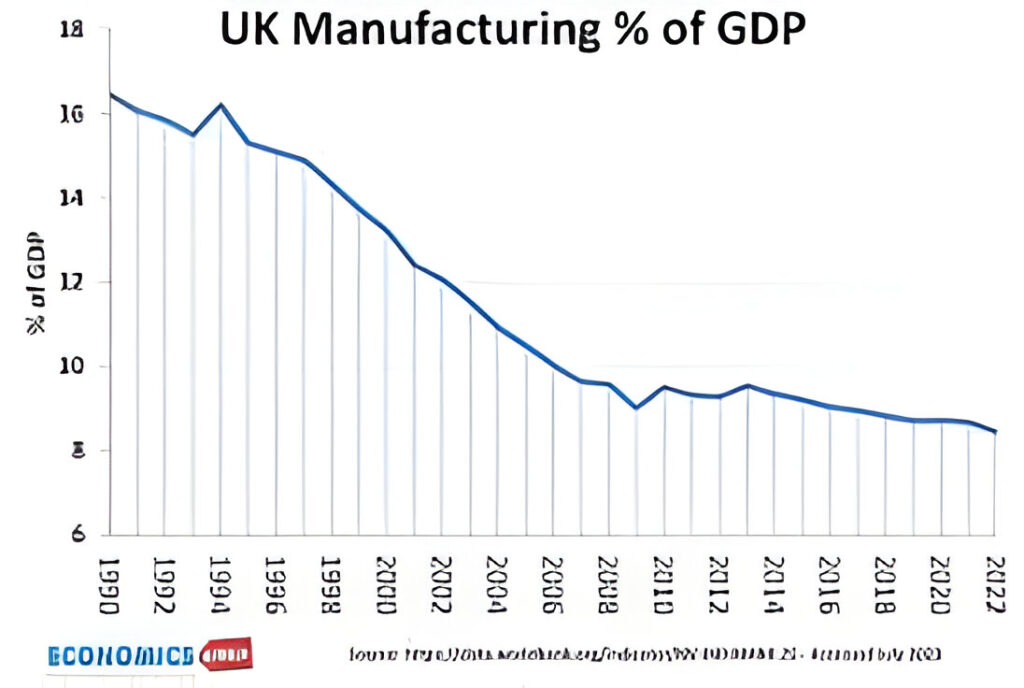
Since 1990, the year U.K. CO2 emissions started falling, the percentage of U.K. GDP from manufacturing has also halved from just over 16% to around 8%.
Moreover, during the same period, the number of people employed in U.K. manufacturing has dropped from 4,963,000 to just 2,601,000. A cynic mighty be tempted to wonder what happened to all those hundreds of thousands of highly-skilled, highly-paid green jobs that our rulers promised us would be created in Britain by the energy transition away from fossil fuels to renewables.
For years the U.K. has had some of the world’s highest energy prices due to our replacement of cheap, reliable fossil fuels with expensive, unreliable and intermittent supposed ‘renewables’. In 2022, in the U.K., which gets only 42% of its electricity from fossil fuels, household energy cost $0.41/kWh. In France, where 70% of its electricity comes from cheap, reliable nuclear, electricity costs were just $0.21/kWh – almost half the U.K. price. In the U.S., which generates about 60% of its energy from fossil fuels, the price was $0.18/kWh – less than half the U.K.’s cost. In China, where 55% of electricity comes from coal and a total of 83% comes from fossil fuels, household electricity costs are only $0.08/kWh – a quarter of the U.K.’s cost. There is a similar picture in India, where over 75% of electricity generation is from fossil fuels, of which three quarters comes from cheap, energy-rich coal, household energy costs only $0.07/kWh – a sixth of the U.K. cost.
So, just to put all of this into context, we can look at how much of the U.K.’s GDP comes from manufacturing – making real things that people in Britain and abroad want to buy – compared to our major competitors. In 2022, 8% of the U.K.’s GDP came from manufacturing compared to 9% for France, 12% for the U.S.A., 13% for India, 14% for Italy, 18% for Germany and a massive 28% for China.
A picture is emerging which suggests that the more a country relies on renewables for its electricity, the higher are its energy costs and the lower is the percentage of its GDP made up by manufacturing.
Economist Richard Salsman wrote: “The science of economics is clear: the production of money and debt is not equivalent to the production of real wealth. To claim otherwise is to follow fantasy, not reality – or science.”
As we in Britain enthusiastically print money and increase national debt in pursuit of our Net Zero goals, we seem to be wrecking U.K. manufacturing with high energy prices thus committing economic suicide as U.K. manufacturing moves to countries with lower energy costs. It’s more than astonishing that not a single one of our politicians and media supposed ‘experts’ seem to understand or are willing to admit what is actually happening and how the U.K. is committing an extraordinary act of self-mutilation by cutting the country’s CO2 emissions.
If there really was a climate crisis, the U.K.’s economic suicide to supposedly save the planet might be justified. But as I try to explain in my most recent book There is No Climate Crisis, there is no emergency that warrants such extreme actions. Yes, the Earth has probably warmed up a little since the freezing 1960s and 1970s when many experts were panicking about global cooling and the advent of a new ice age, which experts predicted would cause crop failures, mass starvation, the migration of millions from the cooling North towards warmer countries and wars over scarce food supplies. But this warming is just part of a natural cycle of warming and cooling driven mainly by the Earth’s rotation, solar activity and cloud cover. Moreover, the ice caps aren’t melting, in spite of the Guardian and the New York Times regularly predicting their demise. The polar bears are doing fine. In fact there may be so many of them that they may have difficulty finding sufficient food. The Great Barrier Reef has record levels of coral. Around five times as much U.S. forest burned each year in the scorching hot 1920s and 1930s as is burnt now. Even the IPCC (Intergovernmental Panel on Climate Change) admits that there has been no acceleration in sea level rise for the last 100 years. And the number of people killed by extreme weather events has fallen by over 95% in the last 120 or so years in spite of the world’s population quadrupling from under two billion in 1900 to almost eight billion now.
It’s a pity that those dragging us towards their Net Zero nirvana aren’t a bit more forthcoming about the economic devastation that their deluded policies are inflicting upon us.
David Craig is the author of There is No Climate Crisis, available as an e-book or paperback from Amazon.
Featured Video

Trita Parsi: Israel Set a Trap for Total War in the Region
or go to
Aletho News Archives – Video-Images
Book Review
Why the War on Conspiracy Theories Is Bad Public Policy
By Kevin Barrett • Unz Review • February 1, 2019
 A Review of Conspiracy Theories and Other Dangerous Ideas by Cass Sunstein (based on an earlier paper co-authored with Adrian Vermeule); In Defense of Troublemakers: The Power of Dissent in Life and Business by Charlan Nemeth; and Conspiracy Theories and the People Who Believe Them, edited by Joseph E. Uscinski
On January 25 2018 YouTube unleashed the latest salvo in the war on conspiracy theories, saying “we’ll begin reducing recommendations of borderline content and content that could misinform users in harmful ways—such as videos promoting a phony miracle cure for a serious illness, claiming the earth is flat, or making blatantly false claims about historic events like 9/11.”
At first glance that sounds reasonable. Nobody wants YouTube or anyone else to recommend bad information. And almost everyone agrees that phony miracle cures, flat earthism, and blatantly false claims about 9/11 and other historical events are undesirable.
But if we stop and seriously consider those words, we notice a couple of problems. First, the word “recommend” is not just misleading but mendacious. YouTube obviously doesn’t really recommend anything. When it says it does, it is lying. … continue
Blog Roll
 Aletho News
- Easy fix for Europe’s chaos? Stop fueling war against Russia
- Putin’s key remarks on peace talks and Europe’s ‘schizophrenia’
- Trita Parsi: Israel Set a Trap for Total War in the Region
- Trump’s Iran war is on an Israeli leash
- Saudi oil boss issues global supply warning
- Riyadh Says Its Oil System Is Intact. The Numbers Say Otherwise.
- Trump and Netanyahu Want to “Finish the Job” on Iran
- US ‘one-sided dictation’ not Iran’s beliefs makes rational talks impossible: Baghaei
- Iran’s Next Strike May Not Explode. It Could Shut You Down /Col Doug Macgregor
- Iran: US political targets legitimate if assassinations return
- If Americans Knew
- DAILY UPDATE: Latest essential news on Palestine, Israel, & region
- The Israel Lobby’s Changing Fortunes
- AIPAC has become such a political liability that it’s shifting to a more “nimble” approach to buying politicians
- At least 160 Israeli settler attacks in 2 weeks
- Will Gaza’s Ancient Christian Community Disappear Forever?
- Israel’s vision of regional security rests on keeping Arab states weak
- Heidi Levine recounts how Palestinian youths helped save her in settler attack
- DAILY UPDATE: Latest essential news on Palestine, Israel, & region
- Trump’s Intensifying Sabotage of the ICC, for Israel’s Sake
- Israeli military detain US and UK volunteers in West Bank including Democratic NY politician Brad Lander
- No Tricks Zone
- E-Cars Reduce CO2 Emissions By Only 41% Compared To Internal Combustion Engine Vehicles
- Predictions Made By Renowned Climate Professor Over Past Decades Have Been Proven To Be Poor
- New Study Suggests Large Regions Of The Pacific Ocean Have Been Cooling For The Last 80 Years
- Germany’s Green Energy Debacle: High Energy Costs Force Kahla Porzellan to Close After 182 Years!
- New Study: 50 Years Of The Most Aggressive ‘Net Zero’ Policies Can Only Affect The Global Climate By 0.03°C
- US September “Heat” Was No Record…Many Records Set Decades Ago
- Latest European Green Energy Debacle; Portugal’s Largest Flagship Solar Park Insolvent!
- Green Energy Debacle: German Expert Professor Fritz Vahrenholt Warns Of Severe Economic And Social Consequences
- Two More Paleo Reconstructions Affirm Meters-Higher Sea Levels Across Ireland, Brazil 7000-6000 Years Ago
- New Study: Earth And Venus Surface Warmth Largely Explained By Convection And Lapse Rate, Not CO2 Or Radiation

