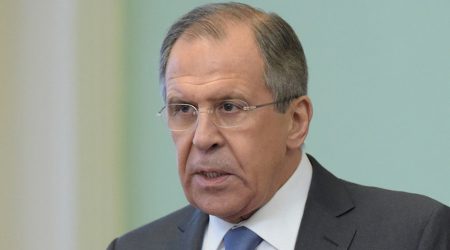
Moscow mediates talks between Assad & Syrian Kurds – Lavrov
RT | February 9, 2017
Russian Foreign Minister Sergey Lavrov has confirmed that Moscow has been mediating talks between Damascus and the Syrian Kurds to help maintain Syria’s sovereignty and statehood, in an interview with Russia’s Izvestia daily.
Russia “makes efforts to establish a common understanding between the Syrian government and the Syrian Kurds for the sake of a united Syria,” the minister told Izvestia in an interview he gave ahead of Diplomat’s Day, a Russian holiday celebrated on February 10.
Lavrov went on to say that four rounds of negotiations, brokered by Russia and including direct contact between the Damascus delegation and “representatives of the political and public structures of the Syrian Kurds,” had already taken place between June and December in 2016. In addition, the gatherings also involved indirect talks between the two sides.
The Russian foreign minister also confirmed that the Syrian government had held talks with the leaders of the Syrian Kurds’ armed militia units, the YPG.
“We believe that such intra-Syrian dialog is useful,” Lavrov said, stressing that there is “significant potential for reaching agreements” between Damascus and the Kurds, as the sides have found many areas of common interest and their negotiations are developing positively.
Lavrov emphasized that “the Kurdish issue” is one of the “key” factors in maintaining Syrian statehood and contributing to the stabilization of the situation in the entire Middle East. He also drew attention to the fact that Russia is continuing its efforts to find compromises between various ethnic and religious groups in Syria, as it is interested in restoring peace and stability in the warn-torn country and defeating international terrorist organizations entrenched in some areas there.
Regarding Syria’s potential federalization, Russia’s top diplomat neither denied nor confirmed that the issue was discussed during the talks between the Syrian government and the Kurds.
The minister’s statements come as Russia also seeks to launch a peace process between the Syrian government and the armed opposition groups together with Turkey and Iran.
In December 2016, a nationwide ceasefire came into force in Syria. It was brokered by Moscow and Ankara and endorsed by the UN Security Council. While in late January, negotiations took place between official representatives from Damascus, Russia, Iran and Turkey, as well as a delegation from the Syrian opposition in the Kazakh capital, Astana. However, the Syrian Kurds were not represented at the talks.
During the gathering, Russia submitted a draft document to serve as a “guide” for the Syrian constitution. The paper stressed that Syria’s territory is “inviolable and indivisible,” suggesting that restructuring of internal borders and proclaiming autonomous regions within Syria should be done only with respect to the country’s own laws. The rights of minorities were another key element of the draft.
In his interview with Izvestia, Lavrov also discussed other pressing issues in modern international politics. He once again criticized the NATO military buildup on Russian borders but expressed hope that Western politicians would eventually understand that Russia “poses no direct threat to NATO” and is a “peaceful country.”
Russia seeks “immediate de-escalation of the military and political situation in Europe” but is ready to defend its borders, Lavrov stressed.
He also went on to express his regret over the recent escalation of the conflict in eastern Ukraine and urged Kiev to implement the Minsk Agreements, noting that there is no other way to resolve the crisis.
Touching upon the issue of US-Russian relations, Lavrov again confirmed that Russia is ready to work with the administration of new US President Donald Trump on a broad range of issues, yet “on the basis of mutual respect.”
Cyber Attacks Have Now Become a Political Weapon
By Jean Perier | New Eastern Outlook | 07.02.2017
 The scope of various cyber operations carried out by different state players has recently become the cause of increasing tension amid international relations. For instance, at the end of 2016, the United States accused Russia of hacking the servers of the US Democratic National Committee, which resulted in the introduction of sanctions against a number of Russian intelligence services that were described as offenders in this recent incident. However, Washington to date, hasn’t presented any evidence to back up its claims.
At the same time, a considerable number of Western media sources, including Foreign Policy, have openly admitted Moscow was not accused of anything in America’s last election that Washington itself has not done elsewhere in the world.
Curiously enough, distinguished historian Marc Trachtenberg, professor emeritus at UCLA, has already stressed that this alleged interference is a type of behavior that the United States helped establish; since meddling in other countries’ politics has been an American specialty for decades. The Washington Times seems to be convinced too that America’s record of meddling in other countries and of leaders who have lied to Washington puts it in the position where it must tread carefully to avoid hypocrisy.
Those who complain about alleged Russian offenses must certainly know that the US government eavesdrops, as a matter of course, on the private communications of many people around the world. The National Security Agency, whose job it is to do this kind of eavesdropping, has a budget of about 10 billion dollars, and, according to an article that came out in the Washington Post a few years ago, intercepts and stores “1.7 billion e-mails, phone calls and other types of communications” everyday.
In terms of the development of so-called cyber armies – highly specialized units that can use cyberspace for both military or intelligence purposes – Russia may indeed be found in the top 5 states in the world in this domain, however, it’s lagging behind the US, China, Britain and South Korea. In general, such armies exist officially in a several dozen countries, as for the unofficial numbers, there’s hundreds of those, since the scope of information warfare operations has been increasing rapidly over the years.
It goes without saying that US cyber forces has been the most powerful in the world, with over 9,000 trained professionals in its ranks. As for the UK, the so-called Government Communications Headquarters (GCHQ) has been providing employment to over 6,000 servicemen. Out of this number, according to individual media reports, more than 2,000 servicemen are engaged in cyber warfare.
Additionally, it should be noted that cyber squads can be found in a number of armies around the world, but those are not “military hackers”, those are security specialist that are tasked with protecting digital assets and IT infrastructure, at least officially. Off of the top of one’s head one can name such units in South Korea, Israel, Iran and Estonia.
The question of whether or not these hackers are capable of influencing political processes and, in particular, one’s presidential campaign, has been broadly discussed at the latest 9th International Forum on Cybersecurity (FIC), which was held last January in the French city of Lille. For the first time the forum was held in 2007, following an initiative of the National Gendarmerie, and every year it has collected public authorities, private sector representatives, experts and civil society figures. In 2017, the forum aimed at discussing the issue of providing “reasonable security for IT assets.”
France’s Minister of Internal Affairs, Bruno Le Roux has stressed in his opening speech at the forum that IT systems are regularly becoming the target of attacks originating from criminal organizations and even from foreign states, which are showing great ingenuity.
But we must not forget that more often than not, it’s not foreign hackers that play the role of a destabilizing factor in the political life of any given society, but the hackers hired by opposition political parties of these very states. And the United State exemplifies this statement better that any, with Donald Trump announcing his concern over the leakage of the details of his telephone conversations with foreign political figures.
According to White House spokesman Sean Spicer, the Trump administration will have to exercise damage control after the leakage of the details of the discussions that Trump had over the phone with the leaders of Mexico and Australia. “This is a very disturbing fact,” – said Spicer in his recent statement. AP has allegedly acquired these tapes, so it now reports that Trump allegedly said in a conversation that the Mexican government is incapable of dealing with the “bad guys”. For sure, the Mexican Foreign Ministry has claimed that those reports are false, but what other choice did it have?
In addition, Trump has also been denying the claims distributed by the Washington Post that he had a very “bad talk” with the Australian Prime Minister Malcolm Turnbull. “Thank you to Prime Minister of Australia for telling the truth about our very civil conversation that FAKE NEWS media lied about ” – Trump wrote in his Twitter.
Jean Périer is an independent researcher and analyst and a renowned expert on the Near and Middle East.
Trump Foreign Policy in Turmoil
By Renee Parsons | CounterPunch | February 6, 2017
Within days of the flawed roll-out for Trump’s Executive Orders regarding Border Security and Immigration Enforcement Improvements and Enhancing Public Safety in the Interior of the United States, the President’s promises on the campaign trail and his Inaugural Address that the US would not pursue regime change or initiate new foreign interventions and that his administration would pursue a new foreign policy based on engagement, have been called into question.
The week began with President Trump praising, as a success, the administration’s first attack on al Qaeda in Yemen which inexplicably included special ops from UAE. Reports state that the group of Navy Seals unexpectedly walked into an hour long fire fight which contained elements of an ambush including hand grenades and a certain amount of panic with indiscriminate gunfire; leaving one Navy Seal dead with several injured, at least a dozen civilians dead including an eight year old girl and destroyed a $75 million Osprey – you might say the raid was more of the same kind of failure with which the US military has some long-standing familiarity. Black Hawk Down in 1993 comes to mind.
Described by Trump press secretary Sean Spicer as a “very, very well-thought out and executed raid”, the mission began on November 7 when the Pentagon presented President Obama with a plan. From there, the proposed raid went through all the necessary channels arriving in front of Trump Defense Secretary James Mattis on January 24th. Mattis approved and forwarded the plan to the White House for the President’s approval which he gave the next day at a dinner which included several key staff members including special assistants to the White House Jared Kushner and Steve Bannon and after consulting with National Security Advisor General Michael Flynn.
All of the reviews and approvals, however, did not guarantee success as there is reason to believe that the alQ stronghold was expecting an American raid with armed female and AQ snipers on a rooftop. After the raid, anonymous U.S. military officials told Reuters that “Trump approved his first covert counterterrorism operation without sufficient intelligence, ground support or adequate backup preparations.” In addition, Reuters quoted three unnamed US military officials that “the attacking SEAL team found itself dropped into a reinforced al Qaeda base defended by landmines, snipers, and a larger than expected contingent of heavily armed Islamist extremists.” This does not sound like a surprise raid but more like a disaster waiting to happen.
These unprecedented ‘leaks’ indicate an undercutting of the Administration by anonymous military officials who are in direct contradiction to the timeline as presented by Spicer that the entire plan had been appropriately vetted by the government’s foreign policy structure – with the exception of Rex Tillerson who had not yet been confirmed as Secretary of State.
It has been said that the mission needed to receive a green light to take advantage of a Moonless night and that the mission was to acquire certain computer hard drives with speculation that there was some urgency of obtaining the intel contained potentially embarrassing data regarding the interconnections between the terrorists and certain foreign nations which support terrorists. In any case, it was a botched mission that was poorly planned and executed and appears to have a major security problem given the unauthorized disclosures by anonymous military officials who disagreed about what the public has been told about the raid. So which is it – was the raid properly vetted and the right questions asked – or was it insufficiently vetted?
US CommCentral released the clip that they say was obtained from a series of videos during the raid which shows a black hooded individual giving instructions on how to make a do-it-yourself bomb. The clip, which has no audio and its written instructions are written in perfect English, is now reported to be a decade old AQ training video [sourced from SITE]. It is assumed that the President’s Monday trip to Central Command and Special Ops in Florida was not just a get-to-know-you visit.
As if that were not enough faux pas for the week, General Flynn took an unprecedented place on center stage at a press conference sounding like the Commandant of Stalag 19, stridently warning Iran and spouting old, worn out rhetoric that the “Trump administration condemns such actions by Iran that undermines security, prosperity and stability throughout and beyond the Middle East which places American lives at risk. As of today, we are officially putting Iran on notice.”
The accusations came after Iran reportedly fired a test of a medium-range ballistic missile on February 1st with Iranian Defense Minister Hossein Dehghan stating that “The test did not violate the nuclear deal or (U.N.) Resolution 2231″ and that “… we will not allow foreigners to interfere in our defence affairs,” striking a chord with Trump’s Inaugural statement that “it is the right of all nations to put their own interests first.”
On the heels of Flynn’s rant, the Trump administration quickly announced economic sanctions on twenty five Iranian individuals and entities that have unnecessarily escalated tensions with:
“The Islamic Republic of Iran is the world’s leading state sponsor of terrorism and engages in and supports violent activities that destabilize the Middle East.”
“The Trump Administration will no longer tolerate Iran’s provocations that threaten our interests. “
“The days of turning a blind eye to Iran’s hostile and belligerent actions toward the United States and the world community are over.”
The Flynn/Trump obsession against Iran has little basis in rational thought and is not the kind of nation-building and “forming of new alliances” that the President promised in his Inaugural address. Flynn may be myopic on the subject of Iran since Iran supported the insurgents in Iraq during the US invasion in 2003 but he may also be blowing smoke with the realization that the administration must know that any serious effort to eliminate ‘radical Islamic terrorists’ will be dependent upon Iran’s participation.
As Ron Paul has repeatedly suggested, Iran has every reason to want its own nuclear capability, if only as a defensive mechanism to protect itself from Israel and the US. A spokesperson for the EU foreign policy chief in Brussels said that the “Iranian ballistic missile program was not part of the 2015 nuclear pact and hence the tests are not a violation of it.”
On February 3rd, President Trump tweeted “Iran is playing with fire – they don’t appreciate how “kind” President Obama was to them. Not me!” to which Iranian Foreign Minister Javad Zarif tweeted “We will never, I repeat never, use our weapons against anyone, except in self-defense. Let us see if any of those who complain can make the same statement.”
If the Trump Administration believes Iran is in violation of the Plan, they have the option to initiate a dispute resolution process or to engage the International Atomic Energy Agency (IAEA) which has regular access to all Iranian nuclear facilities to verify that Iran is in compliance. Iran says it will impose its own sanctions and release its own list of US-related ‘entities’ entwined with supporting terrorists.
With an imminent visit to the US, it is not outside the realm of possibility that all this Tough on Iran talk is to impress Bibi Netanyahu who hailed Flynn’s statement with “Iranian aggression must not go unanswered” which sounds reminiscent of Sen. John McCain. As if to tone down the US inflammatory reaction, new Defense Secretary James Mattis said he sees ‘no need to increase number of troops in the Middle East” in response to the Iranian missile crisis.
Of special interest will be how Trump deals with whatever demands Netanyahu has in his pocket and how Trump’s high regard for Israel may be affected, assuming that he is already apprised of Israel’s role in funding ISIS in Syria and its support and participation in fomenting terrorist actions throughout the Middle East. If Flynn/Trump are concerned with who is causing instability in the Middle East, they have no further to look than Saudi Arabia and Israel. It is difficult to image that Trump does not already have an appreciation for Netanyahu’s expectation to continue to run the show otherwise known as US foreign policy.
As if the Trump foreign policy objectives had not already experienced a week of upsets, contradictions and overall confusion, UN Ambassador Nikki Haley’s diatribe against Russia was stunning in its vitriolic attack on Russia alleging “aggressive actions of Russia” and “dire situation in eastern Ukraine is one that demands clear and strong condemnation of Russian actions.” In addition, Haley asserted, in contradiction to President Trump’s previous position on Crimea that “The United States continues to condemn and call for an immediate end to the Russian occupation of Crimea” and that “Crimea is a part of Ukraine. Our Crimea-related sanctions will remain in place until Russia returns control of the peninsula to Ukraine.”
In his February 3rd press conference, Trump press secretary backed up Haley with “I think Ambassador Haley made it very clear of our concern with Russia’s occupation of Crimea. We are not — and so I think she spoke very forcefully and clearly on that.”
Russia’s UN Ambassador Vitaly Churkin responded that ‘the belligerent rhetoric toward Moscow over the Ukrainian crisis is nothing new” and that “it is Kiev that has escalated the situation there”. He also cited “OSCE reports and surveillance data which places the blame squarely on the Ukrainian government and not the rebel forces.”
After the initial shock at Haley’s level of hostility, an immediate reaction was that as a former Republican Governor of South Carolina, Haley had to have a working relationship with Senator Lindsay Graham (R-SC), the alter ego of Sen. John McCain who remains an irrational proponent of intervention wherever possible around the globe and that her maiden speech before the Security Council had somehow gone askew as a more combative, divisive script found its way into her file.
However, U.N. ambassador Nikki Haley, met with her Ukrainian counterpart “to reaffirm the United States’ support for the sovereignty and territorial integrity of Ukraine,” according to a statement.
In view of another pending humanitarian disaster as a result of US intervention in Ukraine, the best that the State Department could do, prior to Tillerson taking office, was to issue a statement calling for a ceasefire and return to implementation of the Minsk Agreement.
It is reported, though unconfirmed, that soon after her speech, Haley visited Russian Ambassador Churkin at his home, presumably to reassure him that there was a bureaucratic snafu and that US policy toward Russia was not accurately reflected in her introductory remarks.
As a result of a week of significant snafus, the Trump Administration has either caved in to neo-con pressure like Eliot Abrams (convicted of lying to Congress during Iran-Contra) who is currently vying for the Deputy Secretary position at the State Department or they are dealing with repeated staff blunders and turmoil that are seriously threatening any hope of credibility for Trump’s oft-stated foreign policy goals.
Renee Parsons has been a member of the ACLU’s Florida State Board of Directors and president of the ACLU Treasure Coast Chapter. She has been an elected public official in Colorado, an environmental lobbyist and staff member of the US House of Representatives in Washington DC. She can be found on Twitter @reneedove31
US Suspends Plans to Seize Raqqa: President Trump Wants Russia to Join
By Peter KORZUN | Strategic Culture Foundation | 05.02.2017
President Donald Trump’s administration has scrapped the previous administration’s plan to take Raqqa, the de facto capital of the Islamic State (IS) group. The plan proposed a strategy of training Kurdish forces, providing them with new equipment, and helping them retake the city.
US-supplied armored vehicles have only been delivered to the Syrian Arab Coalition (a part of the Syrian Democratic Forces – SDF), which is made up of militants predominantly from local Arab areas. The Kurdish components of SDF have been denied the aid not to spoil the US relations with Turkey.
According to the Washington Post, the officials said they were dismayed that there was no provision for coordinating operations with Russia and no clear political strategy to address Turkey, a country that would be angered by the US cooperation with the Kurds, and the lack of a plan B in case the Kurdish offensive failed. They also said the plan lacked specifics on the number of troops needed for the operation.
The operation Euphrates Anger was launched by US-backed SDF in November 2016. Obviously, President Trump sets much store by cooperation with Moscow in the fight against terrorists. He faces the problem of getting Turkey on board. Russia and the US could join together as intermediaries to facilitate talks between the Kurds and Turkey.
Turkey has excellent relations with the Iraqi Kurds who could also join in any mediation effort. If progress is achieved, Washington will not let down the Syrian Kurds, cooperating with Ankara. Since January 18, Russia and Turkey, a US NATO ally, have been engaged in a joint operation to retake Al Bab.
No success is achievable without sufficient ground forces. The Kurdish formations are not enough and there is a basis for joining together – the US and Turkey see eye to eye on the idea to create safe zones in Syria. Russia has agreed to discuss the issue in principle. It’s important that the Trump team is not as adamant as the previous administration about making Syrian President Assad resign.
Michael T. Flynn, Donald Trump’s new National Security Adviser, has always been critical of Obama’s Syria policy calling it inconsistent. He has supported the idea of the US and Russia cooperating in the fight against the IS. «We have to work constructively with Russia. Whether we like it or not, Russia made a decision to be there (in Syria) and to act militarily. They are there, and this has dramatically changed the dynamic», Flynn told Der Spiegel in an interview.
President Donald Trump has stated that regime change in Syria would only cause more instability in the region. He thinks that shoring up President Assad is the most efficient way to stem the spread of terrorism. According to Mr. Trump’s statements, he would weigh an alliance with Russia against Islamic State militants.
On January 28, the president ordered military leaders to give him a report in 30 days that outlines a new strategy for defeating the IS. The document is expected to include recommendations on changes to military actions, diplomacy, coalition partners, mechanisms to cut off or seize the group’s financial support and a way to pay for the strategy.
The president charged Defense Secretary James Mattis with developing a plan with the help of the secretaries of State, Treasury and Homeland Security, the director of national intelligence, the chairman of the Joint Chiefs of Staff, the assistant to the president for national security affairs and the assistant to the president for homeland security and counterterrorism.
The order was signed hours after speaking to Russian President Vladimir Putin on the phone – the first call between the leaders since Donald Trump took office. Mr. Putin emphasized that «for over two centuries Russia has supported the United States, was its ally during the two world wars, and now sees the United States as a major partner in fighting international terrorism».
With Donald Trump in office, a deal on coordinating activities is reachable. Joint operations to retake Raqqa would be a good start. The zones of influence and mutual obligations could be defined. Russia is ready to cooperate with the US during the operation to retake Raqqa. Last October, it was reported that Moscow planned to discuss the issue with the US officials.
Joining together, the parties could gradually move forward within the framework of Astana process and the UN-brokered talks to be revived in Geneva this month. The cooperation between Russia and the US is key to achieving progress in the Syria’s crisis management. It could spread to other areas of the bilateral relationship.
Actually, an offensive to liberate Raqqa is impossible without coordinating activities with Moscow. Russia, the US and Turkey are the pivotal actors in the conflict. The operation to retake Raqqa must be conducted with the consent of Syria’s government. It is hard to imagine the US and Turkey discussing the issue with the government of Bashar Assad. Russia is perfectly suited to be a mediator.
And what comes next after Raqqa is retaken? Who and under what authority will govern? With the pertinent actors involved in the conflict holding different, even opposite, visions of the country’s future, there will have to be international presence and agreement on what to do next.
The cooperation between Russia, the US and Turkey during the battle for Raqqa could become a start of wider process with diplomacy given a chance. It could also become a start of Russia-US cooperation in Syria and other countries where the IS has presence.
Trump administration fails to back Ukraine
By Alexander Mercouris | The Duran | February 5, 2017
Though the White House has not yet published on its website a readout of US President Trump’s telephone conversation on Saturday with Ukrainian President Poroshenko, it is clear that it did not contain the strong support for Ukraine Poroshenko must have been looking for.
The conversation took place against the backdrop of intense fighting between the Ukrainian military and the eastern Ukrainian militia around the town of Avdeevka in eastern Ukraine.
The White House is reporting that Trump said to Poroshenko the following
We will work with Ukraine, Russia, and all other parties involved to help them restore peace along the border
This comment contains no criticism of Russia, it does not accuse Russia of initiating the fighting, and it makes no reference to “Russian aggression”. Nor does it make any strong statement of support for Ukraine.
This has been the consistent pattern of Donald Trump’s statements to European leaders since he became US President.
Donald Trump has now met with British Prime Theresa May and German Vice-Chancellor Sigmar Gabriel, and he has had telephone conversations with German Chancellor Angela Merkel and French President Francois Hollande.
If the White House readouts of these these conversations are to be believed, in not one of them has he said anything about Russia committing aggression in Ukraine. His most substantive discussion of Ukraine with any European leader was his one with German Chancellor Merkel. Here is the White House’s summary of the conversation
President Trump and Chancellor Merkel today held an extensive telephone conversation covering a range of issues, including NATO, the situation in the Middle East and North Africa, relations with Russia, and the Ukraine crisis. Both leaders affirmed the importance of close German-American cooperation to our countries’ security and prosperity and expressed their desire to deepen already close German-American relations in the coming years.
Not only does this summary separate the issue of the “Ukraine crisis” from the question of “relations with Russia” – an idea that totally overturns the Western foreign policy orthodoxy of the last three years – but it lumps the “Ukraine crisis” – supposedly (according to Western leaders) the biggest crisis in Europe since the end of the Second World War – with those of the Middle East and North Africa, whilst mentioning it last in a way that seems to give it the least priority.
Contrary to what many are saying, I do not see any significant difference between Trump and other US officials on this issue.
In the hours following President Trump’s conversation with Poroshenko, Vice President Pence – often regarded as an anti-Russia hawk – appeared on ABC News’ “This Week”. Here is how Bloomberg sums up what he said
We’re watching,” Pence said on ABC. “And very troubled by the increased hostilities over the past week in eastern Ukraine.”
Pence noted that Trump spoke about Ukraine with Russian President Vladimir Putin on Jan. 28. He said the question of whether sanctions on Russia remain in place if it continues to violate the cease-fire in Ukraine will depend on Russia’s actions and the opportunity to work together on matters such as defeating Islamic State.
“It just simply all depends on whether or not we see the kind of changes in posture by Russia and the opportunity perhaps to work on common interests
(bold italics added)
Again this is scarcely a resounding denunciation of Russia – such as might once have been expected from Obama administration officials – and it even appears to link the possibility of lifting the sanctions to Russia’s cooperation in fighting the Islamic State.
What of the statement made by US ambassador Nikki Haley to the UN Security Council, which is being widely reported as contradicting Donald Trump’s position, and which is supposed to have contained a stern denunciation of Russia?
In my opinion this interpretation is wrong, and to show why I herewith provide Nikki Haley’s full statement, which I shall then analyse
Thank you, Mr. President. Thank you, Under-Secretary-General Feltman, Under-Secretary-General O’Brien, and Ambassador Apakan for your useful and comprehensive briefings today.
This is my first appearance in this chamber as the Permanent Representative of the United States. It is an immense honor for me to sit behind the United States placard and to follow in the footsteps of so many giants of American diplomacy. It is humbling to be part of a body whose responsibility is nothing less than maintaining international peace and security. I look forward to working closely with each of you on this Council. The United States is determined to push for action. There is no time to waste.
I consider it unfortunate that the occasion of my first appearance here is one in which I must condemn the aggressive actions of Russia. It is unfortunate because it is a replay of far too many instances over many years in which United States Representatives have needed to do that. It should not have to be that way. We do want to better our relations with Russia. However, the dire situation in eastern Ukraine is one that demands clear and strong condemnation of Russian actions.
The sudden increase in fighting in eastern Ukraine has trapped thousands of civilians and destroyed vital infrastructure. And the crisis is spreading, endangering many thousands more. This escalation of violence must stop.
The United States stands with the people of Ukraine, who have suffered for nearly three years under Russian occupation and military intervention. Until Russia and the separatists it supports respect Ukraine’s sovereignty and territorial integrity, this crisis will continue.
Eastern Ukraine, of course, is not the only part of the country suffering because of Russia’s aggressive actions. The United States continues to condemn and call for an immediate end to the Russian occupation of Crimea. Crimea is a part of Ukraine. Our Crimea-related sanctions will remain in place until Russia returns control over the peninsula to Ukraine. The basic principle of this United Nations is that states should live side by side in peace.
There is a clear path to restoring peace in eastern Ukraine: full and immediate implementation of the Minsk agreements, which the United States continues to support. For the people in eastern Ukraine, the stakes are high. With each passing day, more people are at risk of freezing to death, or dying from a mortar blast.
The United States calls on Russia and the combined Russian-separatist forces to fulfill their commitments in the Minsk agreements and fully restore and respect the ceasefire. The Minsk agreements require the disengagement of forces and withdrawal of heavy weapons from both sides of the contact line. This is the formula for a sustainable ceasefire. Pulling back forces and taking heavy weapons out of this area will save lives. The Organization for Security and Cooperation in Europe Special Monitoring Mission must also be granted full, unfettered access. The presence of OSCE monitors can help calm tensions.
Cooperation on this issue is possible. Earlier this week, both Russia and Ukraine supported this Council’s unanimous call to return to a ceasefire. It was the first time in years that this Council was able to come together on Ukraine. The parties on the ground should heed this signal and hold their fire. The United States expects that those who can influence the groups that are fighting – in particular, Russia – will do everything possible to support an end to this escalation of violence. Thank you.
(bold italics added)
This is a very different statement from the one which might have expected from someone like Samantha Power.
It says that the US wants better relations with Russia. It does not say that Russia or the eastern Ukrainian militia started the latest fighting. It calls for full implementation of the Minsk Accords, which (as everyone knows) Ukraine is not implementing. Lastly it calls for heavy weapons to be removed from “both sides of the contact line”, when everyone knows it was Ukraine’s decision to violate this provision by moving heavy weapons into the buffer zone (which includes Avdeevka) which caused the latest fighting.
As for the criticisms of Russia, not only do these have a ritual quality – with Haley simply repeating what is still official US policy – but she actually says she regrets having to do it. Moreover it is difficult to avoid reading Haley’s comment about her having to do it being “unfortunate because it is a replay of far too many instances over many years in which United States Representatives have needed to do that” as being anything other than a veiled reference to Samantha Power, with the clear implication being that Haley wants to be different from her.
Lest anyone think that I am alone in reading Haley’s statement in this way, I should say that no less a person than Vitaly Churkin, Russia’s ambassador to the UN, who was physically present in the Security Council chamber when Haley read her statement, is of the same view.
Immediately following the UN Security Council meeting on Thursday where Haley read out her statement, Churkin said that he had noted “a tangible change of tone”, and said that he found Haley “friendly enough, with the allowances for the circumstances and the subject.”
Churkin and Haley then met on the following day. Interestingly, it was Haley who went to see Churkin, not the other way round. The report of the meeting provided by the Russian news agency TASS reads as follows
Russia’s UN envoy Vitaly Churkin has held the first meeting with his newly-appointed US counterpart Nikki Haley. As the Russian missions’ spokesman Fyodor Strzhizhovsky said, Churkin and Haley agreed to maintain close cooperation in accordance with Moscow’s and Washington’s intentions. “The Russian envoy received Nikki Haley at his residence. Both sides expressed the intention to cooperate tightly within the United Nations in accordance with their respective capitals’ intentions,” he said.
(bold italics added)
The talk about “close” and “tight” cooperation “within the United Nations” suggests discussion about jointly sponsored Resolutions aimed at defeating Jihadi terrorism and ISIS, which is quite clearly the new administration’s priority.
Of course this is all very tentative. The difficulties in the way of a detente between the US and Russia are so great they may prove insurmountable. The opponents of such a detente are legion, and they have not gone away. Besides it is far from clear upon what terms Trump wants such a detente, and whether they are terms the Russians feel able to concede to him.
However it is wrong to say that on this subject the new administration is not speaking with one voice. On the contrary all its senior officials – including of course most importantly President Trump himself – are saying they want a detente with Russia, and all the administration’s statements – including Trump’s in his telephone call with Poroshenko, and Haley’s in her statement to the UN Security Council – suggest the new administration wants to put the Ukrainian crisis behind it so that it can concentrate on the fight against Jihadi terrorism and ISIS, for which it obviously feels it needs Russia’s help.
Chisinau to Negotiate Status of Breakaway Transnistria in Moldova in 2017
Sputnik – 04.02.2017
CHISINAU – Moldova’s Prime Minister Pavel Filip stated that the issue of defining the details of the special legal status of the self-declared republic Transnistria as a part of Moldova will be a top priority in 2017 for Chisinau.
“In 2017, our main interest is to raise the issue … of elaboration of the special legal status of Transnistria as a part of Moldova within the negotiating process,” Filip said following the meeting with Austrian Prime Minister and OSCE Chairperson-in-Office Sebastian Kurz.
Filip stressed that Chisinau opposed federalization and considered it “not a good decision.”
The Moldovan prime minister expressed hope that the negotiations on the Transnistrian settlement would be more consistent and productive, making specific mention of “the intensification of 5+2 format meetings” in 2017.
The Transnistrian conflict began in 1990 when Transnistria, a region with a predominantly ethnic Russian and Ukrainian population, seceded from the Soviet Republic of Moldova, fearing possible reunion with Romania. The separation led to a conflict known as “The Transnistria War” that ended in a ceasefire declared on July 21, 1992. However, the conflict remains unresolved and the breakaway republic continues to be governed by an independent de facto government.
Since 2005, the talks on the conflict have been held in a 5+2 format, where the ‘five’ refers to Transnistria, Moldova, Ukraine, Russia and the OSCE, and the ‘two’ are the EU and US, which act as external observers. The latest round was held on June 2-3, 2016 in Berlin.
Undercover Israeli forces detain 2 students from Birzeit University
Ma’an – February 2, 2017
 RAMALLAH – Israeli special forces disguised themselves as Palestinians and “kidnapped” two Palestinian students at the entrance of Birzeit University in the occupied West Bank district of Ramallah on Thursday afternoon, according to a statement released by the university.
The two students were identified as Tawfiq Abu Arqub, a coordinator for the Hamas-affiliated Islamic student bloc at the university, and Basel Falaneh, the secretary of specialities committee of the student council. They were studying computer science and business, respectively.
Birzeit University released a statement after the incident, saying that the two students were detained at the western gate of the university by “a number of [Israeli] soldiers.” Locals also told Ma’an that the students were forced into a vehicle “at gunpoint,” while also pointing guns at other students in the area.
The head of the university’s security, Muhammad Rimawi, stated that Israeli forces had “intercepted” a car that Abu Arqub and Falaneh were riding in, according to the statement, when “a number of undercover occupying forces took the students out of the car and kidnapped them.”
“This is neither new nor unprecedented given the ongoing colonial aggression against the people and institutions of Palestine,” the statement said.
The statement called the incident an “outrageous act of violence,” and part of a larger Israeli campaign resulting in the “rapid arrests” of students.
“This violation of our students’ right to learn is a part of a systematic attack on the right of education and freedom of expression,” the statement added.
The university’s Dean of Student Affairs Muhammad al-Ahmad also said in the statement that Israel’s “repressive measures” against all Palestinians and specifically students “shall only strengthen international efforts in support of an academic boycott of Israeli institutions.”
“The University condemns these outrageous acts in the strongest possible terms and calls upon all international and human rights organizations to speak this truth loudly in the face of these violations immediately and without reserve and to stand in solidarity with our struggle,” the statement concluded.
Birzeit University, ranked the top university in Palestine and among the highest-ranking universities in the Arab world, has been the focus of an Israeli military crackdown in recent months, which increased after the Hamas-affiliated Islamic bloc won student elections at Birzeit last year for the second consecutive year.
In December, more than 20 Israeli military vehicles raided the campus before dawn, forced campus security guards to stand against walls, and proceeded to raid several buildings, including the university’s administration building, the student council’s headquarters, Kamal Nasir Hall, and the Faculty of Science.
Another incident occurred in July, when at least 11 Palestinian youths were injured after Israeli undercover forces and soldiers opened live fire on the campus amid clashes sparked by an Israeli raid to detain a former member of the Islamic bloc.
At the start of 2016, Israeli military forces also raided Birzeit, destroying and confiscating university equipment. It was reported at the time that Israeli forces had detained more than 80 students between Oct. 2015 and the start of 2016.
Rights groups have widely condemned the concerted detention of Islamic bloc members at the university since their initial victory in 2015.
The Hamas movement is deemed illegal by the Israeli government — along with the majority of Palestinian political factions and movements — making students involved with the Islamic bloc vulnerable to raids and arbitrary detentions. Members have also been targeted by Palestinian security forces.
Referendum on NATO Accession Would Mean Kiev Surrendering Donbass – DPR
Sputnik – 02.02.2017
DONETSK – A referendum on Ukraine’s accession to NATO would mean Kiev’s ultimate renunciation of Donbass as the region is against joining the alliance, self-proclaimed Donetsk People’s Republic (DPR) leader Alexander Zakharchenko said Thursday.
In a recent interview with German daily Berliner Morgenpost, Ukrainian President Petro Poroshenko said he intended to hold a referendum on the country’s accession to NATO.
“An attempt to hold a referendum on Ukraine’s accession to NATO means Kiev is ultimately surrendering Donbass. First, because Donbass will not be able to participate in the referendum… Second, we have repeatedly said that one of the most important demands of Donbass is that Donbass calls for friendly and allied relations with Russia and, therefore, against NATO,” Zakharchenko told Sputnik.
In December 2014, Ukraine canceled its non-aligned status, confirming its intention to join NATO. Poroshenko said a referendum on NATO membership would be held by 2020, after all NATO requirements have been met.
Ukraine’s offensive ‘aimed at preventing Russian sanctions being lifted’: provokes criticism instead
By Alexander Mercouris | The Duran | February 1, 2017
Just a few days ago on RT’s Crosstalk programme Peter Lavelle, myself and the two other guests, Dmitry Babich and Ed Lozansky, discussed the Ukrainian regime’s likely reaction to the new Trump administration.
We all agreed that the likely response of the Ukrainian regime to the steps the Trump administration is taking to try to patch up US relations with Russia would be to escalate military tensions in the Donbass with a view in part to bolstering its political support in the West as this appeared to slide.
Our discussion took place in the early stages of the latest Ukrainian military offensive near the village of Avdeevka in eastern Ukraine. Since we had our discussion the situation has escalated – exactly as we predicted – with the fighting becoming fiercer and more bitter.
There is as always dispute about the state of the fighting and who is winning. The Ukrainians predictably claim to be advancing. More reliable reports suggest they have in fact made little headway, and that their losses are high.
The most important point about the fighting is not that it is happening, or that it is getting worse. Despite the two Minsk agreements – agreed by Ukraine in September 2014 and February 2015 – fighting in the Donbass has never stopped, and bitter flare ups repeatedly happen, as the Ukrainian military repeatedly goes back onto the offensive.
Rather what is striking about the latest fighting is that for the first time Ukraine is coming under criticism from the West.
For the first time since it was created the OSCE monitoring mission is apparently blaming Ukraine for the fighting.
Meanwhile a statement released by the US State Department – whose press office is still headed by Obama’s appointee Mark Toner – not only failed to support Ukraine but also failed to blame Russia for the fighting. Instead it merely expressed “deep concern” and support for the Minsk II agreement (which Ukraine is violating) whilst appearing to contradict Kiev’s casualty claims by speaking of “dozens of Ukrainian military casualties” as opposed to the dozen dead Ukraine has admitted to.
Of far greater concern to the Ukrainian regime must however be the reaction of the German government, which following the change of administration in the US is now the one important ally it has left.
According to a report in Süddeutsche Zeitung, not only is the German government blaming Ukraine for the fighting, but it is apparently worried that the Ukrainian regime will achieve the opposite of its intentions. Specifically it seems the Germans realise the purpose of the offensive is to prevent US President Trump from cancelling the sanctions US President Obama imposed on Russia. However the Germans are worried that Trump will cancel the sanctions anyway, despite the fighting, leaving Ukraine further exposed.
Here is how Süddeutsche Zeitung explains German thinking
According to Berlin, whose information is based, among other things, on reports from the OSCE mission in the Eastern Ukraine, Ukrainian military forces are currently trying to shift the front line in their favour…..
According to some members of the German government, this might be intended to increase tensions so as to block plans by US President Donald Trump to relax the sanctions. According to Berlin’s interpretation, Poroshenko wants to do just about anything to prevent an end to the sanctions against Russia.
The Federal [German] Government is however concerned that Kiev’s calculus could be counterproductive. Trump might ease the sanctions independently of the situation at the contact line. And then Kiev would be faced with double damage: an improvement in Russia’s position with a simultaneous intensification of the conflict in the Eastern Ukraine.
Whether it is possible to dissuade Kiev from its own provocations, no one in Berlin dares to predict.
If the Germans really are thinking in this way then it is understandable why Ukrainian President Poroshenko has just cut short his visit to Germany. Instead of getting the support from the Germans he might have been expecting, hearing this sort of thing would have been – to put it mildly – extremely unwelcome. It’s not surprising that Poroshenko preferred to return home rather than hear it.
How far Poroshenko and the Ukrainian regime are prepared to go in pursuing their latest offensive remains to be seen. The key point however is that even if some sort of ceasefire is patched up, it will not mean peace in Ukraine or the Donbass. Quite simply peace in Ukraine and the Donbass cannot happen so long as the current regime in Kiev remains in power.
In that respect the article in Süddeutsche Zeitung points to the key problem which has stood in the way of peace in Ukraine and the Donbass since the start of the conflict there.
Having trapped herself into a policy of open ended support for the current Ukrainian regime, German Chancellor Angela Merkel (the likely source of the story in Süddeutsche Zeitung ) is not really concerned with Ukrainian responsibility for the latest fighting in the Donbass, even though it breaches the Minsk agreement and a succession of ceasefires which she has herself negotiated. The report in Süddeutsche Zeitung contains no hint of moral censure by her of Poroshenko’s or the Ukrainian regime’s actions.
Instead Merkel’s concern is that because of Donald Trump’s policy of rapprochement with Russia the Ukrainian regime, by violating the Minsk agreement and the ceasefires by going on the military offensive, may be overreaching itself, threatening its own existence and by extension Merkel’s position in Germany and Europe.
Needless to say the converse of this is that if contrary to Merkel’s expectations the Ukrainian “calculus” turns out right, and the Ukrainians either achieve a military breakthrough or prevent the lifting of the sanctions, then Merkel will be delighted, in spite of the fact that the Ukrainians have violated the Minsk agreement and the ceasefires she has herself negotiated by going on the offensive.
So long as such cynical attitudes persist in Western capitals the Ukrainian conflict will continue because the Ukrainian regime will feel that it has a critical mass of Western support it can always rely upon however badly it behaves.
I would add that the cynicism behind Merkel’s thinking revealed by Süddeutsche Zeitung – which is so different from the moralising poses she likes to strike – is actually typical of her, and in large part explains the widespread mistrust and dislike of her there now is in Russia, in many European capitals, and quite possibly before long in the US.
It remains to be seen whether the new Trump administration in the US is able or willing to break with it, bringing a hope of peace finally to the Donbass and Ukraine, and securing the basis for a better relationship with Russia, which without a settlement of the conflict in Ukraine is in the end impossible.
King Salman has no issues with Trump
By M K Bhadrakumar | Indian Punchline | January 30, 2017
The US President Donald Trump must be a man with a queer sense of humour. He kept the call to King Salman of Saudi Arabia pending for his announcement on Friday to fully sink in – to the effect that the Saudi citizens will be subject to “extreme vetting” before being allowed to enter America.
Trump singled out Saudi Arabia as the only GCC country to be treated badly like this, on par with Afghanistan and Pakistan. Finally, Trump made the call to Salman on Saturday. One would have liked to be a fly on the wall in the Oval Office. From all accounts, neither side showed fluster. The conversation was smooth as silk.
Salman is the Custodian of the Two Holy Places, and yet he didn’t raise the issue of Trump’s Muslim ban, which has created a world-wide uproar, including among non-believers.
Not only that, the accounts of the conversation suggest that Trump’s main purpose was to demand that Saudi Arabia should fund the ‘safe zones’ in Syria and Yemen – yes, Yemen, too, where the Saudis have been involved in a war of destruction. Simply put, Trump pricked the Saudi pride and 24 hours later asked Riyadh for money. Apparently, Salman agreed.
Thereupon, Trump and Salman agreed on the importance of making ‘joint efforts’ to erase the Islamic State from the face of the earth. The White House readout says,
- The president requested, and the King agreed, to support safe zones in Syria and Yemen, as well as supporting other ideas to help the many refugees who are displaced by the ongoing conflicts.
The Saudi press agency initially omitted any reference to Salman’s commitment on the ‘safe zones’, but later put out an amended version to say, “The custodian of the Two Holy Mosques had confirmed his support and backing for setting up safe zones in Syria.” It nonetheless did not mention Yemen, where a Saudi alliance is waging a bloody military campaign against the Houthi group.
The Saudi version emphasised that Salman and Trump affirmed the “depth and durability of the strategic relationship” between the two countries. For Salman, it is crucially important to proclaim that Trump intends to continue with the strategic ties with Saudi Arabia. His main worry would be that without Trump’s support, Iran will steal a march over Saudi Arabia as the dominant Muslim power in the Middle East.
Curiously, Salman went on to invite Trump “to lead a Middle East effort to defeat terrorism and to help build a new future, economically and socially.” Plainly put, Saudi Arabia is petrified about a US retrenchment from the Middle East and is willing to overlook anything – even the humiliating blow of Trump’s Muslim ban – if only the American troops stayed on.
Salman’s fawning attitude in the face of Trump’s Muslim ban will put the Ummah in a quandary. Logically, Saudi Arabia ought to have reacted strongly in the same unequivocal manner in which Iran has reacted. No sooner than Trump announced a travel ban on Iranian nationals, Tehran imposed a reciprocal ban on US citizens. A foreign ministry statement said in Tehran on Saturday,
- While respecting the American people and distinguishing between them and the hostile policies of the U.S. government, Iran will implement the principle of reciprocity until the offensive U.S. limitations against Iranian nationals are lifted.
Herein lies the secret of the western hegemony over Muslim Middle East. The bizarre truth is that the Gulf Arab regimes relish criticizing the US’s policies but cannot live without US military support because without that support they would collapse like a pack of cards. Besides, the Saudi elites keep their illegal private wealth in western banks and they own vast properties and business interests in the US. They travel to the US for fun as a permissive home away from their Wahhabi environs. In sum, they simply cannot afford to uphold self-respect and dignity as norms in their dealings with the Americans.
To be sure, Trump has put fear into the Saudi mind. What worries Salman most is Trump’s earlier stance that if the families of the victims of 9/11 attacks seek compensation from Saudi Arabia, he wouldn’t stand in the way. The finger has been pointed at important figures in the House of Saud for complicity in the 9/11 attacks.
But the Iranians have no such problem. They can insist on equal relationship and mutual respect from Washington because they owe Trump nothing. I can only echo Pakistani politician Imran Khan’s stirring call: “’Iran is an independent nation and other (Muslim) nations need to follow Iran against foreign pressures.” But then, Khan Saheb is asking too much.
Middle East: Rapid Tectonic Changes on Regional Chessboard
By Peter KORZUN | Strategic Culture Foundation | 30.01.2017
The Middle East geopolitical scenarios are going through rapid changes with new factors emerging on the regional chessboard.
Cairo’s foreign policy has been given a new twist. It has been announced recently that Egypt is set to receive one million barrels of petroleum per month from Iraq. Saudi Arabia had informed Egypt that shipments of oil products expected under a $23 billion aid deal have been halted indefinitely, suggesting a deepening rift between the countries. From now on, Egypt will enjoy as much oil as it needs at a lower cost, compared to Saudi pricing.
Egyptian President Al-Sisi rejected the Saudi-backed efforts to overthrow the regime of Bashar Assad. He is also reaching out to former-Yemeni president Ali Abdullah Saleh and to his Houthi allies Saudi Arabia is fighting since March 2015. Cairo opened diplomatic channels with the pro-Iranian Lebanese Hezbollah, fighting on the side of President Assad in Syria against the rebel groups supported by Riyadh.
Iraq will provide Egypt with 1 million barrels of Basra light oil each month. The agreement involves extending an oil pipeline from Iraq to Egypt via Jordan. In December, Iraqi petroleum minister Ali al-Luiabi met with the heads of major oil and natural gas companies in Cairo, inviting them to contribute into developing the industry in his country.
Egypt is about to train four Iraqi army units on war against terrorism, in light of the rapprochement between Egypt and the Iraqi-Iranian axis in the region.
It also mulls sending peacekeeping troops to Syria during the coming days to support the ceasefire agreement under the auspices of Russia, Iran, and Turkey. It has been reported that a unit of Egyptian ground forces might deploy to Syria this month. Last October, Syrian National Security Bureau head Ali Mamlouk visited Cairo to meet Khaled Fawzy, the head of Egypt’s General Intelligence Service. The two sides agreed to coordinate political positions and strengthen cooperation in «the fight against terror».
Egypt is a predominantly Sunni nation. Its open support of the Russia-backed coalition in Syria is a game changing event of fundamental importance. It makes the sectarian interpretation of the Syria’s conflict not valid anymore.
Middle East Observer quotes Nziv Net, an Israeli outlet close to intelligence sources, saying that «Egypt has sent a group of officers to Syria for the first time since the relations have frozen during Morsi’s reign».
Last December, Ibrahim al-Eshaiker al-Jaafari, the Iraqi Foreign Minister, called on Egypt to participate in a «strategic project to fight terrorism», which includes Iran.
In September, Egyptian Foreign Minister Samih Shoukry met for the first time with his Iranian counterpart, Jawad Zarif, during their visits to New York to attend the UN General Assembly.
In October, Egypt backed a Russian-backed motion in the UN calling for a ceasefire in Syria. The move angered Saudi Arabia, which suspended oil shipments to Cairo.
Egyptian President Abdel Fattah al-Sisi publicly affirmed his support for the forces of Syrian President Bashar al-Assad.
The relations between Russia and Egypt have been on the rise. In February 2015, Egypt signed a breakthrough agreement on establishing a free trade zone with the Russia’s Eurasian Economic Union.
The progress in military cooperation is tangible. Egypt signed arms deals with Russia worth up to $5 billion by 2015 to include 50 MiG-29M combat aircraft, Buk-M2E and Antey-2500 long range air defense systems and about 50Ka-52K helicopters for Egypt’s new Mistral-class assault ships bought in France. The ships will receive the originally planned Russian helicopters and electronics suite.
The two countries signed several agreements for the renovation of military production factories in Egypt. A protocol is signed to grant Egypt access to GLONASS, the Russian global satellite positioning system. In September, Minister of Defense Sedky Sobhy visited Russia to discuss the issues related to long-term close security relationship. Last October, the militaries held a joint exercise.
Egypt is the most populous country in North Africa and the Arab world, the third-most populous in Africa and the fifteenth-most populous in the world. Last year, the country’s population has just reached 92 million. Its policy shift is well-substantiated. Cairo is fighting the Islamic State on the Sinai Peninsula. The fierce fighting there seldom hits media headlines but the IS poses a grave threat to Egypt. IS militants can also strike Egypt from Libya. The IS presence in Libya brings Egypt and Algeria together as the two great nations face the same threat.
The emerging Iran, Iraq, Russia and Turkey alliance may also include Algeria. In response to the growing menace, Algiers is strengthening ties with Moscow. It has recently purchased 14 Su-30MKA fighters and 40 Mi-28 «Night Hunter» attack helicopters from Russia. Last February, Russia and Algeria laid out a road-map for deepening bilateral economic and military cooperation during Russian Foreign Minister Sergei Lavrov’s visit to Algeria.
Russia’s cooperation with Egypt, Algeria and other countries of the Middle East and North Africa reflects Moscow’s growing clout in the region.
With the Astana process making progress, other large and influential actors, such as Syria, Iraq, Egypt and Algeria, may join the emerging Russia, Iran, Turkey coalition to make the Middle East-North Africa (MENA) region face tectonic and dramatic changes.
Trump’s Muslim ban is insulting but sheikhs will adapt
By M K Bhadrakumar | Indian Punchline | January 29, 2017
The US President Donald Trump has hit Pakistan and Saudi Arabia hard where it hurts most – making things difficult for their elites to travel to America or get a Green Card — by subjecting the visa applicants to ‘extreme vetting’.
To societies such as Pakistan (or India for that matter), the ultimate insult that Washington can give is to deny the elites the privilege to visit America. Pakistani elites were willing to eat grass if necessary for making atom bomb, but if restrictions are put on their travel to America, it hurts. The bottom line is seamless freedom to criticize America and alongside unhindered right to visit America. Unsurprisingly, the Pakistani elites are livid with anger. The reaction ranges from embarrassment to indignation. In an editorial comment, the Pakistani newspaper The Nation advised the government that “its attempts to befriend the Trump administration might be altogether pointless.”
But Trump won’t retract. He knows it is an immensely popular move, as the average American thinks that the Muslim is a troublemaker and best kept away at arm’s length.
How do the European countries see Trump’s move? Will they emulate him? The fact of the matter is that anti-Muslim feelings are widespread in the countries of western and central Europe too. However, Europe may dither, because it damages their self-esteem as the ‘civilized world’ if primeval passions mutate as state policies. Besides, western companies make a lot of money in the CGG markets.
How will India look at Trump’s Muslim ban? The government will probably find it expedient to take an evasive stance by keeping mum or choosing to take a stroll on the sidewalk. A ‘senior MEA official’ probably did that by observing,
- India is not really worried at the moment as the religious radicalization has not been a big problem in the country and it has not been a source of refugees. So far no Indians have been arrested abroad for being involved in acts of terror.
Will India’s political parties voice opinions? This is, after all, election time in Uttar Pradesh. Indeed, the hardliners among our elites may (quietly) draw some vicarious satisfaction. One of them has blamed Trump for being not hard enough on Pakistan and Saudi Arabia.
Trump’s detractors in America allege that he made an exception of those Muslim countries where he has business interests. Bloomberg illustrated the point with graphics. Take a look, here. In reality, though, it is a weak argument. With the solitary exception of the UAE, whose sheikhs have had a dismal record of promoting radical Islamist groups as instruments of foreign policies, Trump’s business empire overwhelmingly spans the non-Muslim world – Argentina, Brazil, Bermuda, Canada, China, Ireland, UK and US.
Will this sort of discriminatory attitude of viewing Muslim countries as plague-ridden regions colour Trump’s policies toward the Muslim Middle East? These are early days. Trump is courting Israel, but then, he could be calculating that it pays to keep the Jewish lobby in America (which controls the Congress, media and think tanks) happy. In Secretary of State Rex Tillerson, Trump has a cabinet minister who extensively cultivated Middle eastern elites. But the US has no more reason to covetously eye the Middle East’s oil. The US is not only energy self-sufficient but will likely be a major exporter in a conceivable future. Having said that, petrodollar recycling still continues to be of relevance to US industry and banking system.
Trump could be betting that the sheikhs have no option but to swallow the humiliation. A trace of contempt was probably discernible in his pugnacious remark calling for ‘safe zones’ for Syrian refugees, during a post-election thank-you trip in December:
- We’ll build safe zones in Syria. When I look at what’s going on in Syria, it’s so sad. It’s so sad. And we’ve got to help people. And we have the Gulf States. They have nothing but money. We don’t have money. We owe $20 trillion. I will get the Gulf States to give us lots of money, and we’ll build and help build safe zones in Syria, so people can have a chance. So they can have a chance.
So, in the mother of all ironies, Trump is bullish he’d get King Salman to cough up the money to put up Syrian refugees who have been rendered stateless in a bloody conflict that Saudi Arabia in the first instance promoted. And, furthermore, he now expects that Salman would counsel his princes and princesses to patiently queue up for ‘extreme vetting’ to get American visas. It’s no more possible for them to succumb to the sudden itch to board their private jets and head for America to do shopping or indulge in fun and frolic.
To add insult to injury, Saudi Arabia has been bracketed with Pakistan and Afghanistan. Trump promised: “We’re going to have extreme vetting in all cases. And I mean extreme. And we’re not letting people in if we think there’s even a little chance of some problem… we’re gonna have extreme vetting. It’s going to be very hard to come in. Right now it’s very easy to come in. It’s gonna be very, very hard. I don’t want terror in this country.” By the way, Trump’s Muslim ban is not applicable to any country other than Saudi Arabia within the Gulf Cooperation Council.
The wheel has come full circle since the Faustian deal between FDR and King Abdul Aziz at their fateful meeting in 1945 in Egypt whereby in lieu for secure access to supplies of Saudi oil, US guaranteed the military security of the Wahhabi regime.
Featured Video

Trita Parsi: Middle East Unraveling — Are We on the Path to World War?
or go to
Aletho News Archives – Video-Images
New Book
Trans agenda is ‘normalization of sadism’ – US author

RT | September 23, 2026
The US Democratic Party has embraced a transgender agenda that amounts to “the normalization of sadism,” author A.J. Rice has said, warning that radical trans policies would return if the party is allowed to regain power.
Speaking to RT’s America First host Scotty Nell Hughes about his new book, ‘The Curse of the Bearded Lady: How the Trans Mafia Whacked American Sanity’, Rice argued that activists have gained significant influence in schools, medicine, and corporate America while people who questioned the agenda have faced pressure to stay silent.
The author described the “trans mafia” as the sprawling network of people and institutions that have helped the movement gain influence. He singled out parts of academia, wealthy backers, and corporations, and stated that providers of transition-related treatment also have a financial incentive to keep young people in their care indefinitely.
Rice argued that the consequences of these policies ultimately fall on children who are being drawn toward gender-affirming medical treatments and on girls who are expected to share locker rooms or compete in sports with biological males.
He noted that while voters rejected the Democrats’ approach to gender in 2024, the party, which has been “captured by madness,” has since only doubled down and is seeking what is effectively “the normalization of sadism.” … Full report
Blog Roll
 Aletho News
- German chemicals giant reveals details of downsizing
- Refaat Al-Areer Was The Canary In The Coal Mine In Israel’s War On The Truth
- Israeli election committee bars candidate from Knesset race over Gaza war opposition
- French-Lebanese man files war crimes complaint over Israeli attacks
- Mahan Air Flight Lands in China Despite US Threat against Iranian Airlines
- US eyes $10bn fund to rebuild war-battered Gulf infrastructure
- Trump meets Rodríguez near Maduro’s prison as Venezuela’s oil flows to US
- Trita Parsi: Middle East Unraveling — Are We on the Path to World War?
- Iran FM meets with US envoy on UN meeting’s sidelines at American side’s insistence: Report
- Qatar PM calls for Gulf security framework with Iran, says war must be ‘wake-up call’
- If Americans Knew
- Caught on Tape: AIPAC CEO Boasted of Controlling Trump’s National Security Officials
- Why Hamas Attacked Israel in October 2023 – Israeli professor Ilan Papé
- They see them, then kill them: Israeli quadcopters track, deliberately target civilians in Gaza
- Winter could turn Gaza’s treacherous, war-damaged buildings into deathtraps
- Majority of Democratic Voters Want to Prosecute Both Biden and Trump Administration Officials Over Gaza
- As Gaza languishes, world leaders gather at the UN – Daily Update
- Sanctions are collective punishment: immoral and self-defeating
- Phosphorus Munitions Fired by Israel Burn Groves, Orchards in Southern Lebanon
- Israel Carries Out New Ceasefire Violations Across Gaza
- AI – Emphasis on the ‘I’: Israel Is Funding AI Chatbot Propaganda
- No Tricks Zone
- New Study: Earth And Venus Surface Warmth Largely Explained By Convection And Lapse Rate, Not CO2 Or Radiation
- 2025 Nature Paper Claiming Worsening Global Drought Gets RETRACTED …Heavily Flawed
- New Study: ‘Global Drought Shows No Detectable Recent Acceleration Under Climate Warming’
- Economic Masterminds: German Socialists Suggest Taxing Productivity Gains Stemming From Using AI
- The South China Sea Has Not Been Cooperating With The Climate Change Narrative
- Energy Crisis: Germany Enters Heating Season With Historically Low Gas Reserve Fill Levels
- New Study: The Antarctic Ice Sheet Gained Mass From 2020-2024 Due To Staggering Snow And Ice Accumulation
- Study: Ocean Heating Rates From Thousands Of Years Ago ‘Dwarf’ Modern Ocean Heating Rates
- Climate Extremists Target, Attack Large-Scale Power Grid Infrastructure In Germany!
- New Study: Antarctic Ice Melt Has Contributed Less Than 1 Centimeter To Sea Level Rise In The Last 30 Years

