Hundreds of Syrian civilians and anti-Assad rebels have begun leaving the last district they control in the city of Homs, under a ceasefire deal recently reached with the government.
The rebels’ departure from al-Waer neighborhood, part of peace deal local authorities recently agreed on, started on Wednesday and is aimed at clearing the city of gunmen and weapons, Governor of Homs Talal al-Barazi announced, according to the SANA news agency.
Barazi told reporters that some 700 people – including 400 women and children and 300 fighters – would be evacuated on Wednesday.
The operation is carried out under the patronage of the United Nations and the Syrian Arab Red Crescent. Its first stage suggests the militants will be giving up “medium and heavy weapons”. Those who want to leave the city will be allowed to keep only “light weapons,” the governor added.
“We are implementing the first stage, which will be complete at the end of next week,” Barazi said, according to AFP.
During the second stage, all of the militants willing to get back to their normal lives will have their legal status restored.
Around 2,000 militants and their families are expected to leave the city, once known as “the capital of the revolution.” Buses will take them to the rebel-held areas in the northwestern province of Idlib.
Following the evacuation, all state institutions are expected to resume operation in Homs.
The truce mediated by the UN was reached on December 1, after two years of ongoing sporadic talks.
December 9, 2015
Posted by aletho |
Aletho News | Homs, Syria |
Leave a comment
The Lebanese army and militants from the al-Qaeda-affiliated Takfiri group al-Nusra Front have exchanged prisoners.
The swap on Tuesday took place under a Qatari-mediated deal that secured the release of 16 Lebanese soldiers and policemen held captive since August 2014, when the terrorist group kidnapped them during an attack in Lebanon’s border town of Arsal. The al-Nusra terrorists have killed four captives in that time span.
In exchange, the Lebanese government set free 13 militants, including Saja al-Dulaimi, the ex-wife of the so-called leader of the Daesh Takfiri terrorist group Ibrahim al-Samarrai, also known as Abu Bakr al-Baghdadi.
“We accomplished the entire agreement with al-Nusra. We received our heroic soldiers and we are on our way back to Beirut,” said Abbas Ibrahim, a senior Lebanese security official who supervised the prisoner swap.
Ibrahim, meanwhile, said Beirut was willing to strike a similar agreement with Daesh, which is believed to be holding nine Lebanese soldiers.
“This joy [is] not complete until the return of those kidnapped by Daesh. We are ready to negotiate with Daesh if we find someone to negotiate with,” he said.
The exchange started when Lebanon’s Red Cross received the body of a Lebanese soldier believed to be Mohamed Hamieh, one of the four slain troops, from al-Nusra. The body was handed over to officials from the Lebanese National Security Agency in the village of Labweh, located about 124 kilometers (77 miles) northeast of the Lebanese capital, Beirut.
DNA tests are expected to be conducted to verify the identity of the dead soldier.
The government of Qatar launched a mediation effort over one year ago for the release of the Lebanese captives. Qatar is widely believed to be a major supporters of militants fighting in Syria.
Lebanon has been suffering from terrorist attacks by al-Qaeda-linked militants as well as random rocket attacks, which are viewed as a spillover of the conflict in Syria.
December 1, 2015
Posted by aletho |
Aletho News | al-Nusra Front, Da’esh, Lebanon |
Leave a comment
Dozens of Russian ships have reportedly been waiting for hours near the Bosphorus Strait to get the go-ahead from Turkey to be able to pass through the waterway.
In a clear violation of international norms, Turkish authorities have created hurdles for Russian vessels passing through the Bosphorus Strait; as a result, dozens of Russian ships have been waiting for hours to obtain the green light from Turkey for passage, media reports said.
RIA Novosti quoted Viktor Kravchenko, former chief of staff of the Russian Navy, as saying that a possible unilateral closure by Turkey of the Bosphorus Strait for Russian ships would be out of line with international law.
“Turkey will not close the strait to Russian vessels en route to Syria because it would be a violation of international law and the Montreux Convention, in particular, — a document that was signed by most counties at the time”, he said.
The 1936 Montreux Convention on the Regime of the Straits regulates the passage of civilian and naval ships through the Bosphorus Strait and the Dardanelles. According to Article 2, “merchant vessels shall enjoy complete freedom of transit and navigation in the Straits, by day and by night, under any flag and with any kind of cargo, without any formalities.”
As for naval warships, in times of peace Turkey must permit the passage of small and medium-sized vessels belonging to all nations. The Black Sea powers (formerly including the USSR and now Russia) can navigate warships of any class through the Straits, “on condition that these vessels pass through the Straits singly, escorted by not more than two destroyers.”
In times of war, the passage of warships shall be left entirely to the discretion of the Turkish government, according to the document.
In December 1982, the UN elaborated the Convention on the Law of the Sea, but Turkey refused to join it and the Montreux convention remained in force. In 1994, Turkey unilaterally adopted new Maritime Traffic Regulations for the Straits, and included a number of restrictions for the passage of foreign vessels.
Meanwhile, it was reported that French fighter jets will use the Incirlik military base and that the French aircraft carrier Charles de Gaulle will receive logistical support in the Turkish port of Mersin.
UPDATE:
Sputnik – 01.12.2015
At the moment, Russian naval vessels are experiencing no problems passing through the Bosphorus Strait or the Dardanelles, RIA Novosti quoted a military-diplomatic source as saying on Tuesday. […]
Earlier on Monday, it was reported that dozens of Russian ships had reportedly been waiting for hours near the Bosphorus Strait to get the go-ahead from Turkey to be able to pass through the waterway. Meanwhile, a Russian naval transport ship had encountered a Turkish submarine in the Dardanelles. … Full article
December 1, 2015
Posted by aletho |
Aletho News | Montreux Convention, Russia, Turkiye |
Leave a comment
Concern Radio-Electronic Technologies (KRET), a subsidiary of the state-owned Russian corporation Rostec, has developed a new type of electronic missile jamming unit for Russia’s Armed Forces, according to RIA Novosti.
“The jamming transmitter developed by KRET is a single-use device designed to be used by a plane or a helicopter. After the device is deployed via a standard countermeasure launching system, it begins emitting an aimed jamming signal. It is essentially a full-fledged electronic warfare complex compressed into a standard decoy cartridge,” the company’s press service told RIA Novosti.
Depending on the situation, the deployed countermeasure either imitates an aircraft, thus drawing away the incoming rocket, or emits a jamming signal powerful enough to prevent it from acquiring its target.
Last week President Vladimir Putin said that Russia might utilize electronic warfare systems to ensure the safety of its aircraft in Syria following the downing of a Su-24 bomber by Turkish forces.
KRET is the largest radio-electronic holding in Russia; it was created in 2009 and has more than 50,000 employees. It manufactures a wide range of products, including avionics, operational and tactical systems, electronic warfare and intelligence equipment, friend-or-foe identification systems, special measuring instrumentation, plugs, electric connectors, and cable products.
November 30, 2015
Posted by aletho |
Aletho News | NATO, Russia, Syria, Turkiye |
Leave a comment
Russia will be deploying S-400 missile defense systems to Syria, the Russian defense minister says.
“The S-400 anti-aircraft missile system will be deployed to the Hmeimim airbase,” Sergei Shoigu said on Wednesday, referring to the Russian airbase outside the port city of Latakia in western Syria.
The system is the most advanced one owned by Russia in the field of air defense. The missile system, an upgrade of the S-300 family, is capable of intercepting and destroying airborne targets such as aircraft and ballistic and cruise missiles at distances of up to 400 kilometers (250 miles).
The official’s remarks came a day after the Turkish Air Force shot down a Sukhoi Su-24M Fencer, which they had accused of having violated Turkish airspace. Russia denies the allegation.
Russian presidential press officer Dmitry Peskov also said Russian President Vladimir Putin had agreed with the proposal made by the Defense Ministry to transfer the missile systems to Hmeimim.
Also on Tuesday, Russian media reported that Russian missile cruiser Moskva equipped with the Fort air defense system, similar to S-300, will be stationed off the coast of Syria’s Latakia province.
Since September 30, Russia has been conducting aerial operations against Daesh, al-Nusra Front, and the other terrorist groups that have been sowing fear and destruction among the Syrian country’s civilian population.
Damascus has hailed the Russian military engagement, which came upon the Syrian government’s request saying that since the beginning of the campaign, terrorists had begun to retreat and flee in thousands.
The foreign-sponsored conflict in Syria has thus far claimed the lives of more than 250,000 people and left over one million injured, according to the United Nations.
A US-led coalition has also been pounding purported Daesh positions inside Syria without any authorization from Damascus or a United Nations mandate since last September. The mission has fallen severely short of dislodging the terrorists.
November 25, 2015
Posted by aletho |
Aletho News | Da’esh, Russia, Syria, Turkiye |
Leave a comment
The delivery of Russian S-300 anti-missile rocket systems to Iran has started, Iran’s ambassador to Moscow said in an interview. Iran is getting one of the latest versions of the air defence complex.
The delivery is underway, ambassador Mehdi Sanaei told Persian-language daily, Etemaad, as cited by Tasnim news agency.
The news was not welcome in Washington, with US State Department spokesman Mark Toner reiterating the US stance on the issue in a briefing on Monday.
“We made clear time and again our objections to any sale of the S-300 missile system to Iran,” Toner told reporters.
Earlier this month Iranian Defense Minister Hossein Dehghan announced Tehran is going to get Russian air defence systems by the end of the year, which in Iran ends on March 20, 2016.
Brigadier General Dehghan stressed that a major batch of the hardware is going to be delivered in less than two months’ time.
“Iran has bought as many S-300 air defense systems as it needs,” Dehghan said, adding that Iranian operators of S-300 system are being trained in Russia.
The initial S-300 contract between Moscow and Tehran was signed in 2007 and implied the delivery of five S-300 squadrons worth $US 800 million.
In 2010 the contract was put on hold by then-President Dmitry Medvedev due to the UN imposing sanctions on Iran. In return, Iran lodged a $4 billion lawsuit at an international court in Geneva against Russia’s arms export agency Rosoboronexport.
In April 2015, Russian President Vladimir Putin repealed the ban. Russia’s Foreign Minister Sergey Lavrov commented on the decision, saying Moscow’s voluntary embargo on S-300 deliveries was no longer necessary due to the progress in talks on Iran’s nuclear program.
In October, Iran’s Defense Ministry confirmed Moscow’s readiness to deliver the S-300 system under an agreement signed between the two countries.
Sergey Chemezov, the head of the Russian state-owned high-tech giant Rostec, said that the new contract came into force on November 9.
Iran has bought Russia’s most well-known air defense systems in one of its latest versions S-300PMU-2 Favorite, TASS reported earlier this month during the Dubai Airshow 2015.
The last time Russia supplied S-300 systems abroad was in 2010, when 15 squadrons were delivered to China.
November 23, 2015
Posted by aletho |
Aletho News | Iran, Russia, S-300, United States |
Leave a comment
On Sunday, Argentina held a runoff vote to pick its next president, resulting in a narrow victory for conservative Let’s Change coalition candidate Mauricio Macri over his center-left Front for Victory coalition opponent, Daniel Scioli. The question on everybody’s mind now is: what should Argentinians, and the world, expect from the new government?
An estimated 80% of Argentina’s 32 million eligible voters went to the polls on Sunday to elect their next president, in a runoff vote between the two leading candidates from the first round of voting, held in late October. With 51.5% of the votes cast in favor of conservative candidate Mauricio Macri, the favorite of the country’s big business and private media, the country is set for a hard right turn.In the run up to the election, analysts in both Latin America and across the loose global coalition of countries opposed to a unipolar world order had worryingly suggested that a Macri victory would result in a rollback to the policies pursued by Buenos Aires over the past decade aimed at challenging US hegemony, both in the region and around the world.
Daniel Scioli, the candidate of the Peronist, center-left Front for Victory electoral alliance, had promised to continue outgoing President Cristina Fernandez’ center-left-oriented politics domestically, and to pursue an independent foreign policy course abroad.
Throughout Fernandez’ tenure (she was elected in 2007) and that of her late husband, Nestor Kirchner (elected in 2003), Argentina had aligned itself with the string of left-wing Latin American governments emerging in the region in the early 2000s, while pushing for new economic and political ties with the BRICS countries, including Russia and China. Now, with Macri’s victory, the country’s multipolar outlook is under threat.
At the moment, Russian-Argentinian political and economic ties are believed to be at historic highs, characterized by the Russian ambassador to Buenos Aires as “excellent” and “extremely constructive and trusting.” Earlier this year, ahead of Fernandez’ official state visit to Moscow in April, Argentina’s Ambassador to Russia, Pablo Anselmo Tettamanti, went so far as to describe relations to be at the highest levels they have ever been in the countries’ 130-year-long history of bilateral relations.
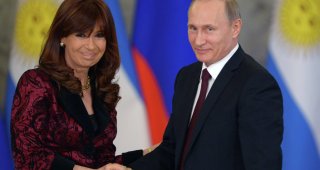 During her visit to Russia, President Fernandez met with President Vladimir Putin, signing over 20 memorandums on economic cooperation, said to amount to an “all-encompassing strategic partnership.”
The agreements included joint projects on the development of hydroelectric, nuclear and fossil-based energy in Argentina, including the construction of the sixth bloc at the Atucha nuclear power plant, along with a $2 billion memorandum on the construction of a new hydroelectric dam. Meanwhile, Russian energy giant Gazprom signed a memorandum on the exploration and development of gas fields with Argentine state gas company YPF, a deal amounting to $1 billion in investments. Russian company Uralmash was also tapped to build a plant manufacturing oil extraction equipment, amounting to an additional $1.9 billion in investments.
In the course of the visit, the two sides promised to conduct consultations on the use of each other’s national currencies for trade, pledging to increase cooperation in the military-technical sphere, accelerating construction of the GLONASS satellite navigation systems, and negotiating on the prospects of increasing bilateral food trade (presently amounting to about $1.3 billion).In the sphere of political cooperation, President Fernandez voiced her support for Moscow’s position that the situation in Ukraine could only be resolved by peaceful means, with the Russian president, for his part, pledging support for “Argentina’s striving for direct talks with Britain to achieve prompt resolution to the Mavinas [Falklands] Islands dispute.”
Visiting Moscow in July, Argentinian Vice President Amado Boudou emphasized that Argentina’s diplomatic moves toward improving relations with Russia were based on the fact that the two countries “share a very strong position with a common vision of the need for a multipolar world to ensure the existence of an inclusive and autonomous policy.”
Now, following Macri’s election victory, Argentina’s strategy of promoting regional integration in Latin America, and a multipolar world order, may be coming to an end. With Mexican economist Ariel Noyola Rodriguez suggesting only months ago that the Russian-Argentinian partnership signaled “Washington’s incapacity to sabotage the construction of a multipolar world,” it seems that the analyst may have spoken too soon.
With Fernandez (and her husband before her) becoming a major thorn in Washington’s side, the latter unhappy over the Peronists’ efforts to extract the country and the region from its subservient position in the US’s so-called ‘backyard’, the election of Macri, who promised to immediately improve relations with Washington, must come as a welcome change.
The conservative politican has already hinted that he would give less weight to Mercosur –the South American trade bloc aimed at ensuring regional economic integration and development, and shift the country’s diplomacy away from close cooperation with the leftist governments of Venezuela, Bolivia, Ecuador and Brazil.
And while his victory may not nullify the economic and other cooperation agreements reached with Russia, China, and other BRICS countries over the past decade, it does threaten Buenos Aires’ general trajectory of development –the country’s moves toward regional integration and a multipolar world independent of Washington’s influence.
For the Argentinian People: A Return to Neoliberalism?
As far as the Argentinian people are concerned, Macri’s victory is feared by his critics to mark a throwback to neoliberal dogmas which plagued the country prior to Kirchner’s 2003 election victory.
For their part, the British and American business press couldn’t help but gloat in the moment, with Financial Times suggesting it was “the beginning of a new political era for South America’s second-largest economy,” and The Wall Street Journal trash-talking Fernandez and her party, and suggesting that her economic policies, “uncivil rants against her political opponents, and a substantial loss of judicial independence and press freedom during kirchnerismo” contributed to Scioli’s defeat. Bloomberg Business, naturally, focused on the election’s effects on the markets, finding it crucial to point out that “in anticipation of a Macri victory, bond yields fell to an eight-year low and the local stock market rallied to a record high.”
But not everyone is convinced that this ‘new political era’ will bring positive changes, at least for ordinary Argentinians. In the run up to the voite, Scioli and his supporters warned that Macri’s proposals, which promised a return to neoliberal economic policies, would amount to “savage capitalism,” eroding social welfare and creating an economy which catered to a wealthy minority.
It’s worth recalling that before the Kirchners, Argentina was viewed as a textbook example of a developing country enveloped by the so-called Washington Consensus, a set of neoliberal economic dogmas which resulted in extremely high unemployment (over 25% in 2003), high poverty rates (nearly 55%), and a high Gini index.Under Kirchner and Fernandez, the country pursued social and economic policies that amounted to the creation of a mixed Keynesian economy, promoting government intervention where necessary, support for medium and small businesses, and a push for export growth via regional economic integration.
According to pan-Latin American news channel Telesur, these efforts resulted in the reduction of unemployment to 6.6% in 2015 (with 5 million jobs created over the past ten years), the reduction of poverty from over 50% to 6.5%, the creation of 50,000 small and medium-sized businesses, a major industrialization drive via the Industrial Parks National Program, increases in the share of GDP spent on education and pensions (from 3.6% and 4.1% in 2003 to 6.5% and 7.7% of GDP in 2013, respectively), and the near doubling of public investment, all the while reducing the national debt from 166% of GDP in 2003 to 41%.
In the areas of social policies, Kirchner and Fernandez began a comprehensive reform of the country’s justice system (making the Supreme Court independent), while annulling the ‘laws of pardon’ which gave immunity to the leaders of the country’s military dictatorship of 1976-1983 accused of crimes against humanity. The country also became the first in Latin America, and the tenth in the world, to pass equal marriage laws, in 2010.
Now, these gains, which came at a cost of high inflation (offset to an extent by annual negotiations between unions, employers and employees on adjusting wages) are under threat, with Macri’s critics saying his policies (including tax cuts, social spending cuts, and privatization schemes) will favor big business and the country’s oligarchs, sidelining the problems of social inequality, and reverting the country to its 90s’ era social and economic malaise.
Critics have also pointed to Macri’s promises of beginning negotiations with the predatory ‘vulture fund‘ creditors that rejected the debt restructuring which took place following the country’s default in 2002, giving an indication not only of his upcoming domestic economic policy, but also his possible subservience to the Western-dominated economic institutions which Argentina rejected under the Kirchners.Ultimately, only time will tell whether Argentina’s new government will continue to pursue policies based on economic and political pragmatism which have brought Buenos Aires closer to those countries looking to challenge global unipolarity (with some analysts already suggesting that they will).
As far as Argentina itself is concerned, it remains unclear how a return to the neoliberalism which devastated the country’s economy in the early 2000s will do it any good. As Russian social media users commenting on the election results lamented, it seems that too many Argentinians have forgotten the neoliberal catastrophe and ‘de-sovereignization’ of the 90s, processes which Russians themselves know all too well.
November 23, 2015
Posted by aletho |
Aletho News | Argentina, BRICS, Latin America, Russia |
Leave a comment
 RAMALLAH – The number of Palestinians who have been killed by Israeli gunfire since October 1, has reached 82, Jerusalem Center for Israeli-Palestinian studies revealed. 78% of the reported victims were executed in cold-blood.
The majority of the reported victims were from al-Khalil where 28 youths were executed by Israeli gunfire in the city.
16 children and seven women were also among the victims, the center added.
The Jerusalem Center called on international human rights groups to seriously work on putting an end to the Israeli crimes and violations of international laws.
November 11, 2015
Posted by aletho |
Aletho News | Hebron, Human rights, Israel, Palestine, West Bank, Zionism |
Leave a comment
Arab nations, who initially took part in the US-led airstrikes against ISIL, have grown wary of Washington’s scheming in the Middle East and have switched their efforts to tackle what they perceive as real threats, military expert Vladimir Prohvatilov told Radio Sputnik.
“Many know perfectly well that the US is not really interested in defeating ISIL. Washington’s true aim is to create a zone of controlled chaos in the Middle East to deal with geopolitical and geo-economic issues. America’s task is to spark a bloody conflict and drag others into it,” the analyst asserted.
Washington’s plans for the Middle East, according to Prohvatilov, prompted Canada’s newly elected prime minister to pull out of the anti-ISIL bombing campaign. Delivering on this promise would mean that Justin Trudeau does not view the operation led by the US as beneficial for Canada.
This stance is not exclusive to Ottawa, the expert maintains. Many Arab countries which nominally take part in the US-led efforts share this position.
“People [in Saudi Arabia, Jordan and Qatar] are used to high living standards and do not want to take part in a war. The Saudi Army is essentially manned by Pakistani mercenaries. Saudi nationals have no wish to fight,” he asserted.
Washington’s Arab allies have switched their attention to Yemen and see tackling the Houthis as a priority.
“Riyadh views the Houthis as a threat since they are capable of calling to arms as many as 200,000 seasoned fighters. The same goes for Jordan and Qatar. They perceive Yemen as a real threat while ISIL is a subtle game engineered by the US,” Prohvatilov noted.
Washington’s stance towards Moscow’s counterterrorism efforts in Syria is also a part of this game.
“The Americans want the Russians either to stop the campaign (so that Washington could accuse Moscow of a military defeat or cowardice) or to expand it so that Russia would bear all the cost” of a major military engagement, he added.
November 10, 2015
Posted by aletho |
Aletho News | Canada, Egypt, ISIL, Middle East, Saudi Arabia, Syria, United States, Yemen |
Leave a comment
Britain’s most famous crown jewel, the Koh-i-Noor, could be returned to India if a group of Bollywood stars and businessmen succeed in their lawsuit against the UK.
David de Souza, co-founder of Indian leisure group Titos, is helping to fund the legal action that claims the diamond – once the world’s largest – was stolen by the British during India’s colonization.
The move coincides with Indian Prime Minister Narendra Modi’s visit to the UK this week, during which he will meet the Queen for lunch at Buckingham Palace.
The British government has so far rejected claims to the jewel.
The 105-carat diamond was acquired by the British when Punjab was annexed by the East India Company in 1849.
The last ruler of the Sikh Empire, then 13-year-old Dulip Singh, was brought to England to present it to Queen Victoria in 1850.
It was worn by the Queen Mother, Elizabeth Bowes-Lyons, at the coronation of her husband, King George VI, in 1937 and again by Queen Elizabeth II at her coronation in 1953.
“The Koh-i-Noor is one of the many artifacts taken from India under dubious circumstances,” De Souza told the Sunday Telegraph.
“Colonization did not only rob our people of wealth, it destroyed the country’s psyche itself. It brutalized society, traces of which linger on today in the form of mass poverty, lack of education and a host of other factors.”
A group which calls itself the ‘Mountain of Light’ – a direct translation of the Koh-i-Noor – is launching the lawsuit through Birmingham-based law firm Rubric Lois King.
Bollywood star Bhumicka Singh is adding her support to the claim.
“The Koh-i-Noor is not just a 105-carat stone, but part of our history and culture and should undoubtedly be returned,” she said.
Lawyer Satish Jakhu said the litigants are basing their case on the Holocaust (Return of Cultural Objects) Act, which gives national institutions in the UK the power to return stolen art.
He added they would argue that the British government had stolen the diamond under the common law doctrine of “trespass to goods.”
News of the lawsuit has irked some apologists for British imperialism, with historian Andrew Roberts describing it as “ludicrous.”
“Those involved in this ludicrous case should recognize that the British Crown Jewels is precisely the right place for the Koh-i-Noor diamond to reside, in grateful recognition for over three centuries of British involvement in India, which led to the modernization, development, protection, agrarian advance, linguistic unification and ultimately the democratization of the sub-continent,” he told the Mail on Sunday.
November 9, 2015
Posted by aletho |
Aletho News | India, UK |
Leave a comment
Lebanon’s former President Emile Lahoud says the Israeli regime has benefited most from political assassinations in the country, including that of former Prime Minister Rafic Hariri, Press TV reports.
In an exclusive interview with Press TV, segments of which were aired on Saturday, Lahoud rejected accusations that the Syrian government and Lebanon’s resistance movement Hezbollah had a role in the 2005 assassination of Hariri.
The Tel Aviv regime was the entity that largely benefited from Hariri’s killing and other assassinations in Lebanon, Lahoud stated.
He also cited as a proof the fact that the satellites that were watching over the area where Hariri was killed in Beirut belonged to Israel and the United States. Neither Tel Aviv nor Washington later accepted to share their data and images on the assassination, he said.
The former Lebanese president said the West and Israel have accused everybody in Lebanon for the killing, so that they can divert public attention from their own potential role in the incident.
Lahoud said the assassination of Hariri showed that the United States and Saudi Arabia have been doing what Israel wants them to do in the Middle East.
November 8, 2015
Posted by aletho |
Aletho News | Israel, Lebanon, Middle East, Rafic Hariri, Saudi Arabia, Zionism |
Leave a comment
Ankara is worried about possible Kurdish-American collaboration after the backing the Kurds got from Moscow, says Dr. Jamal Wakim, Professor of History and International Relations at Lebanese University.
Turkey says it will carry out a military operation against ISIS in the near future, without specifying when.
RT: Turkey’s already carrying out air strikes. What kind of military operation does it have in mind now?
Dr. Jamal Wakim: Well, I believe that Turkey’s declaration that it intends to launch a military operation against ISIL is a mere cover up for its real intention to wage a war against the Kurds. It is on the Kurds and against the PKK [Kurdistan Workers’ Party] militants. Especially that Turkey is worried now; mainly Erdogan is worried about the prospects of Kurdish-American collaboration after the backing that the Kurds got from Moscow.
In this case the Kurds of Turkey, who are spread over 40 percent of Eastern Anatolia, will be in a better position to pressure for getting their own rights within Turkey on the one hand, and maybe they can push for autonomy or even independence as they claimed in the past four decades. So that is why I believe that the real intention is to wage a war against the Kurds and marginalize them at the time when the Kurds are getting support from both the US and Russia at the same time.
RT: Turkey has been using its air strikes to take out Kurdish targets. Is fighting ISIL just a pretext?
Dr. JW: In the past two years the main support that ISIL got was from Turkey. Mainly there were media reports in the West about logistical support, about using Turkish airports – ISIL militants would go to Turkish airports and then go by land to Northern Syria and Iraq. When Turkey declared that it was launching attacks on ISIL, actually its main attacks were on the Kurds of Northern Syria.
There were even media reports that said that ISIL served the purpose of Turkey to clear out the Kurds from Northern Syria, especially in the case of Kobani at one point, and to target the Christian population that is considered as hostile to Turkish influence in Northern Syria. That is why I don’t believe that the intention of Turkey is really to fight ISIL.
November 7, 2015
Posted by aletho |
Aletho News | Iraq, ISIS, PKK, Syria, Turkiye |
Leave a comment