Russia suspends participation in grain deal after Ukrainian attacks on ships
Samizdat | October 29, 2022
Moscow has halted its compliance with a grain deal with Kiev, brokered by the UN and Türkiye, after Ukraine launched a major drone attack on ships involved in securing safe passage for agricultural cargo, the Russian Defense Ministry announced on Saturday.
In a post on its Telegram channel, the ministry said Russia “is suspending its participation in the implementation of agreements on the export of agricultural products from Ukrainian ports”.
It explained that the move was prompted by “a terror attack” against the ships of the Black Sea Fleet and civilian vessels involved in ensuring the security of the grain corridor. The ministry also alleged that the bombing was organized with the involvement of British military.
The UK Defence Ministry has denied any involvement in the Ukrainian drone attack on the Black Sea Fleet in Sevastopol, claiming that Moscow “is resorting to peddling false claims of an epic scale” in an effort to distract the global community from “their disastrous handling of the illegal invasion of Ukraine.”
“This invented story, says more about arguments going on inside the Russian Government than it does about the West,” it added.
Commenting on Russia’s decision to suspend the grain deal, Andrey Ermak, Ukrainian President Vladimir Zelensky’s chief of staff, accused Moscow of “blackmail.”
“Russian blackmail is primitive across the board: blackmail in nuclear, energy and food field,” he stated, adding that all supposed Russian ploys are “too simple and predictable.”
Earlier on Saturday, Russia’s Agriculture Minister Dmitry Patrushev signaled that Moscow is ready, with Türkiye’s help, to send the world’s poorest countries up to 500,000 tons of grain within the next four next months.
He noted that considering this year’s harvest, Russia “is fully ready to replace Ukrainian grain” and arrange deliveries to “all interested countries” at a reasonable price.
“The grain deal not only did not solve the problems of countries in need, but even aggravated them in a sense. We can see where the ships from Ukraine were heading – Italy, Spain, and the Netherlands. For some cargoes, the share of EU countries ranges from 60 to 100%. These are not the states that are experiencing a real food problem,” the minister said.
Russia earlier warned that it could quit the grain deal if an agreement to ease restrictions on its food and fertilizer exports were not implemented. Moreover, following the blast on the strategic Crimean Bridge, Russian President Vladimir Putin said that if turns out that Ukraine – the country that Moscow accused of carrying out the attack – used grain corridors to transport explosives, “it would put the very existence of these corridors in question”.
The breakthrough deal between Moscow and Kiev was reached in Istanbul in July with mediation by the UN and Türkiye. It aimed to unlock agricultural exports via the Black Sea from Russia and Ukraine – two of the world’s leading grain exporters – which had ground to halt due to the conflict between the two nations.
Is Ukraine a “proxy war”?
By Noah Carl | October 26, 2022
Critics of America’s policy toward Ukraine have accused it of waging a “proxy war” against Russia. Such critics include various Western commentators, as well as Russia itself. In April, the Foreign Minister Sergei Lavrov claimed, “NATO, in essence, is engaged in a war with Russia through a proxy”.
Yet when a reporter put this accusation to Joe Biden, he said it’s “not true”. What’s more, the Ukrainian government compiled a list of individuals who “promote narratives consonant with Russian propaganda”, and specified that such narratives include: “A proxy war between NATO and Russia is taking place on the territory of Ukraine”.
One problem with the line taken by Biden and the Ukrainian government is that it isn’t just critics of US policy that have used the term “proxy war”.
In an article claiming that “many Russian soldiers have to flee, surrender, or die” and “the more and faster the better”, the political scientist Eliot Cohen stated, “The United States and its NATO allies are engaged in a proxy war with Russia.”
Likewise, the former Supreme Allied Commander of NATO, Philip Breedlove – who has called for boots on the ground in Ukraine – stated, “I think we are in a proxy war with Russia. We are using the Ukrainians as our proxy forces.”
And in an interview calling for the US to provide “as much aid as necessary” to Ukraine, former CIA Director Leon Panetta stated, “We are engaged in a conflict here. It’s a proxy war with Russia, whether we say so or not.”
Okay, you might say, but those individuals were using “proxy war” in a purely technical sense. Although the US is not an active participant in the conflict, it is arming one of the participants. So calling the conflict a “proxy war” is just a statement of fact (even if it might technically qualify as spreading Russian propaganda).
When critics accuse the US of waging a “proxy war” what they really mean is that the US is using Ukraine to weaken Russia, regardless of whether this serves the interests of Ukrainians (or Europeans for that matter). For example, perhaps Ukrainians would be better off if the US had engaged in diplomacy with Russia before the war.
It’s certainly not a stretch to imagine the US would wage a “proxy war” of this kind. The Reagan Doctrine was all about building up the US military and arming anti-communist guerrillas in order to overwhelm the Soviet Union and, ultimately, win the Cold War. This included arming both religious and political extremists.
But we don’t have to go back to the eighties. In 2019, the RAND corporation published a report on strategies to “overextend and unbalance” Russia. The report identified “providing lethal aid to Ukraine” as one that would “exploit Russia’s greatest point of external vulnerability”. (Interestingly, it concluded that any increase in aid would need to be “carefully calibrated” to avoid provoking “a much wider conflict”.)
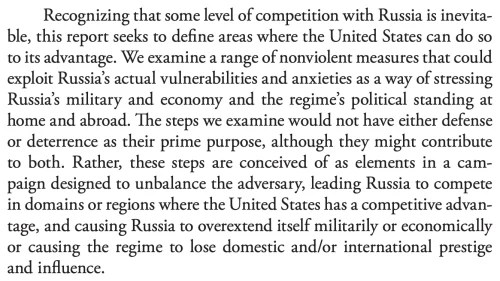
Screenshot from ‘Extending Russia: Competing from Advantageous Ground’.
RAND is almost entirely funded by the US Government, which appears first on its list of clients. So the fact that it would publish a report like this indicates that, even before Russia’s invasion, US decision-makers were interested in using Ukraine to weaken their geopolitical adversary.
As Senator Adam Schiff explained in 2020, “The United States aids Ukraine and her people so that we can fight Russia over there, and we don’t have to fight Russia here.”
Since Russia’s invasion, various other commentators have hinted – or in some cases explicitly stated – that America has goals other than securing Ukraine’s territorial integrity. Here’s Thomas Friedman’s account of what a “retired senior European statesman” told him:
The goal of Ukraine is to win, he said. The goal of the European Union is a bit different. It is to have peace … The U.S. is far away, and for the U.S., he added, it is not the worst thing to keep the war going to weaken Russia and make certain it doesn’t have the energy for any other adventures.
Two months into the war, Defence Secretary Lloyd Austin was asked how he would define America’s goals in the conflict. He began by saying what you’d expect him to say: “We want to see Ukraine remain a sovereign country”. He then went slightly off-script: “We want to see Russia weakened to the degree that it can’t do the kinds of things that it has done in invading Ukraine.”
According to the New York Times, some officials “cringed” and Biden called Austin to “remonstrate” him for the comment. “But officials acknowledged that was indeed the long-term strategy”.
A couple of weeks later, the political scientist Hal Brands really let the cat out of the bag – in a piece titled ‘Russia Is Right: The U.S. Is Waging a Proxy War in Ukraine’. He wrote:
The war in Ukraine isn’t just a conflict between Moscow and Kyiv, Russian Foreign Minister Sergei Lavrov recently declared. It is a “proxy war” in which the world’s most powerful military alliance … is using Ukraine as a battering ram against the Russian state … Lavrov is one of the most reliable mouthpieces for President Vladimir Putin’s baseless propaganda, but in this case he’s not wrong. Russia is the target of one of the most ruthlessly effectively proxy wars in modern history.
“The key,” Brands noted, “is to find a committed local partner — a proxy willing to do the killing and dying”. You then “load it up with” arms so that it can inflict “shattering blows” on your adversary. “That’s just what Washington and its allies are doing to Russia today.”
Similar sentiments were echoed by Congressman Seth Moulton in an interview with Fox News. “At the end of the day, we’ve got to realise we’re at war,” Moulton stated. “And we’re not just at war to support Ukraine. We’re fundamentally at war – although somewhat through a proxy – with Russia. And it’s important that we win.”
Likewise, when Congressman Dan Crenshaw came under fire from “America First” conservatives over his support for Ukraine, he tweeted: “Yeah, because investing in the destruction of our adversary’s military, without losing a single American troop, strikes me as a good idea. You should feel the same.”
Crenshaw didn’t bother paying lip-service to high-minded concepts like democracy, sovereignty or territorial integrity. He just came out and said we’re “investing in the destruction of our adversary’s military”.
Critics have consistently disparaged US policy as “fighting Russia to the last Ukrainian”. But in July, Senator Lindsey Graham – a long-time Russia hawk – said almost exactly that. “I like the structural path were on here,” Graham explained. “As long as we help Ukraine with the weapons they need and the economic support, they will fight to the last person.”
Critics found further justification for their cynicism in a recent Washington Post article, which revealed the following. “Privately, U.S. officials say neither Russia nor Ukraine is capable of winning the war outright, but they have ruled out the idea of pushing or even nudging Ukraine to the negotiating table.”
You might say that using Ukraine to weaken Russia is something worth doing, as Dan Crenshaw evidently believes. But at this point, it can scarcely be denied that America is engaged in a proxy war.
Iran envoy dismisses Ukraine’s accusations Tehran violated UN resolution
Press TV – October 21, 2022
Iran’s permanent representative to the United Nations refutes Ukraine’s allegation that the Islamic Republic violated a UN resolution by, what Kiev calls, providing Russia with drones.
Amir-Saeid Iravani made the remarks in a letter to the UN Secretary-General Antonio Guterres and the world body’s Security Council (UNSC) on Thursday.
The envoy submitted the letter after Ukraine’s UN Ambassador Sergiy Kyslytsya wrote to Guterres and Security Council members, alleging that the Islamic Republic had “violated” the UNSC Resolution 2231 by allegedly transferring unmanned aerial vehicles to Russia, which is conducting a military operation in the ex-Soviet republic.
The letter obtained by the Associated Press alleges that Iran had violated the resolution by breaching the Paragraph 6 of its Annex B that used to ban Tehran from selling “uncrewed aerial vehicle (UAV) systems having a range equal to or greater than 300 kilometers (186 miles).” Kyslytsya also invited UN experts to visit his country to ascertain, what he called, Iran-built drones being used by Russia in the military operation.
Responding to Kiev’s allegations, Iravani noted that the restrictions mentioned in the Annex B of the UNSC resolution had “ended in October 2020.” “Since then, none of Iran’s actions towards provision, selling or transfer of weapons or related materials to other countries has been subject to the resolution,” he added.
The Ukrainian official also accused Iran of breaching the Paragraph 4 of Annex B, which bans development of nuclear-capable missile systems.
Iravani also condemned the Ukrainian official’s latter claim as “wrongful and arbitrary interpretation” of the resolution and Paragraph 4’s “spirit.”
The Islamic Republic “has neither provided, nor intends to provide [any foreign party] with items, materials, equipment, commodities, and technology that contribute to development of nuclear weapons.”
Ukraine’s invitation of UN experts towards examination of Iran’s so-called violation of Resolution 2231 is, therefore, “lacking in all legal foundation within Resolution 2231’s framework,” the Iranian official asserted.
The official called on the UN secretary-general to prevent any “misuse” of the resolution in relation to the war in Ukraine.
He finally called on the world body to confront such unfounded anti-Iranian allegations.
UAVs Used in Ukraine Are Manufactured in Russia, West Inventing Fake Pretext – Polyanskiy
Samizdat – 20.10.2022
Drones being used by Russian military forces in Ukraine are wholly manufactured in Russia, Deputy Permanent Representative to the UN Dmitry Polyanskiy stressed to reporters after allegations surfaced that Iran was providing UAVs to Moscow.
“UAV used by the Russian army in Ukraine are manufactured in Russia,” Polyanskiy said on Wednesday, adding that Western officials are inventing artificial pretext.
The official further added that the United Nations Secretariat does not have a legal mandate to conduct an investigation into the alleged use of Iranian-made drones in Ukraine.
“[The UN Secretariat] has no mandates to investigate anything regarding the UN Security Council resolution 2231,” Polyanskiy said. “Its role as enshrined within note of the Security Council President 2016/44 16 January 2016 is purely technical – to prepare meeting rooms, circulated communications.”
The comments come after the EU spokesperson Nabila Massrali revealed that the block had collected evidence allegedly proving that Iran had supplied Moscow with drones for its ongoing special military operation.
Iran has repeatedly rejected the accusations. Earlier, Iranian UN envoy Saeed Iravani blasted the “disappointing” claims as disinformation being pushed as part of a political agenda.
“We categorically reject the unfounded and unsubstantiated claims that Iran has transferred UAVs for the use in the conflict in Ukraine,” Iravani said on Wednesday.
Allegations regarding the drones first surfaced in July, when they were voiced by US national security adviser Jake Sullivan. The US State Department has since stated that it intends to use sanctions to prevent the transfer of such “dangerous weapons.”
WHY IS THE UNITED STATES BOMBING KIEV?
By Larry Johnson | A Son Of The New American Revolution | October 18, 2022
Ok. I admit it. Tongue firmly in cheek. But consider this, the Geran-2 drone that Russia is attacking and scrambling the power plants and electrical systems of Ukraine with shares a remarkable resemblance to the American RQ-170 stealth drone that Iran captured way back in 2011. While the Geran 2 is much smaller than the RQ-170, the two drones do share some design similarities. In other words, is Iran/Russia using U.S. technology to bomb Ukraine?

The American RQ-170 stealth drone captured by Iran in 2011.

Iranian Drone aka Geran 2
Iran’s capture of the CIA drone intact in 2011 was followed by an aggressive reverse engineering effort to determine and replicate the capabilities of the CIA drone. This was a major blow to U.S. intelligence. It is still not clear how it fell into the hands of the Iranians. Was the drone brought down by Iran’s electronic warfare capabilities? Or, did Iran have help from the Russians or someone else in tracking and snatching the drone from the CIA? All still a mystery.
Both Russia and Iran are being rather cagey about whose drone is being used in Ukraine. Regardless of its origin, the delta-shaped drone is proving difficult to detect and destroy. Ukrainian officials’ claims that they have shot down dozens rings rather hollow as smoke clouds – the aftermath of successful drone strikes – hover over Kiev, Lviv, Dnepropetrovsk, Odessa and other Ukrainian cities.
I have heard several Western “pundits” in recent days describe the Geran-2 as nothing short of a flying piece of elephant excrement. In other words, a poorly engineered, unreliable piece of gadgetry. Funny, huh? That a lousy, frail piece of machinery like the Geran 2 is beating the living crap out of Ukraine’s air defense system. The Government in Kiev is so desperate that they are begging Ukrainian citizens to rush to the streets with loaded rifles if they hear an approaching drone and try to shoot it down. The Ukrainians apparently do not understand the principle of gravity – i.e., a bullet shot into the air will return to earth with sufficient force to kill, maim and damage. If thousands of Ukrainian citizens heed this call, I suspect there will be a significant increase in gunshot wounds in the coming days.
PUTIN’S ASTANA PRESS CONFERENCE – HE AIN’T BIDEN
By Larry Johnson | A Son Of The New American Revolution | October 15, 2022
If you take the time to watch Vladimir Putin’s press conference yesterday (Friday) in Astana and then watch any recent cluster fark by Joe Biden, you will understand why the Russians are so calm in dealing with Ukraine. Putin is remarkable. Low key, well informed, articulate and not afraid of tough questions. He did not get any softballs here and, in fact, faced some tough questions. So much for the myth that Russia is a totalitarian state that brokers no dissent and requires everyone to toe a party line. That characterization more aptly describes the United States under the demented Joe Biden.
Here are the highlights with the relevant time stamp:
9:15 Putin is asked about Germany’s behavior. He notes incisively that Germany has put a priority on serving NATO rather than the interests of its nation and people.
14:40 Putin is asked about attending the G20 and meeting with Joe Biden. Putin said, there is no point. “There is no platform for any kind of negotiations at this point.” And we are in constant contact with some members of the G20, e.g. Turkey.
18;00 Putin is questioned directly about recent arrest of man in Moscow for listening to Ukrainian music. Putin responded that the arrest is wrong and we (Russia) should not behave like the West in trying to cancel a culture, in this case Ukrainian culture. He noted that Ukrainian is still a recognized language in Crimea and would remain so. He emphasized that Neo-Nazis and Nazi symbols on display in Ukraine are NOT Ukrainian culture and must be eliminated.
20:10 Mobilization was a hot topic. Will there be another wave of mobilization? Will there be “total mobilization”? Putin said the Defense Ministry initially planned a smaller number than the 300,000. Putin remarked that he doesn’t see any need right now to expand that number. There are 220,000 mobilized and the work of mobilization will be finished in two weeks.
22:00 Putin was asked about the men who fled Russia for other countries and calls in the Duma to confiscate their property. Putin said it must not be handled based on emotions. Rather it must be dealt with according to the law. In other words, each case must be litigated on an individual basis instead of a blanket action.
24:00 Another reporter cited one person mobilized who died allegedly with no training. Putin emphasized that the mobilized are supposed to receive 5 to 10 days refresher training. Then they go for specialized training that lasts 5 to 15 days. Then they undergo joint combat training. So far 33,000 men have been mobilized already with front line units and 16,000 in units with combat missions. Putin said he will order a review of the training regimen to ensure it is being done appropriately.
29:15 A reporter asked about the retaliatory strikes in response to the terrorist bombing of the Crimea bridge. Putin said there is no massive retaliation. Russia hit 22 of 29 targets and is now working on hitting the remaining 7. He said he saw no need for “massive retaliation” at this point.
30:00 Final question–NATO says that defeat of Ukraine by Russia will be the defeat of NATO. What happens if NATO deploys troops to Ukraine. Putin said “it could lead to a global catastrophe and I hope that those who talk about this will be smart enough not to undertake such dangerous steps.”
Whether you like or despise Putin, give the man his due. He spoke off the cuff. No notes in hand. He did not shy away from any question and he did not get angry or lose his cool. What a contrast with a Joe Biden press encounter. I think that Western politicians and pundits who disparage Putin as an incompetent dictator are making a very dangerous mistake. They fail to take this man at his word. Putin is establishing himself as a man who says what he means and means what he says
Paris about to boost military interventionism in Eastern Europe
The recently announced decision only tends to worsen current security crisis on the European continent
By Lucas Leiroz | October 13, 2022
Contrary to all the recommendations by military experts to avoid further escalation in the European security crisis, France is apparently planning to expand its military presence in other regions of the continent, mainly in the eastern part. In a recent statement, the French Defense Minister said that an increase in his country’s military capability in Eastern Europe is currently being planned, which considerably tends to escalate tensions in the near future.
On October 11, Sebastien Lecornu, French Defense Minister, revealed that France will cooperate with NATO to deploy more troops and military equipment in Eastern Europe, as a way of reacting to the current situation of instability in the region. According to him, armored vehicles will be sent to the East, mostly to be deployed in Romania, allegedly in an attempt to prevent foreign attacks and seek security stability.
At a meeting of the French Senate Committee on Foreign Affairs, Defense and Armed Forces, Lecornu said: “In view of the situation on the eastern flank of NATO due to the fighting that Russia is waging in Ukraine, the president of the republic decided to strengthen our defensive position in eastern Europe by sending a brigade of armored vehicles and tanks to Romania”.
The defense minister also made it clear that Paris plans to strengthen the NATO’s presence in the Baltic region. He said that France will soon be sending new Rafaele fighter jets to Lithuania. In addition, French troops are expected to be deployed to Estonia in the coming weeks. Lecornu stressed that such measures are likely to be implemented between October and early November.
The initiative seems to be a first step to comply with NATO’s plans decided during the last summit on strengthening the eastern flank until 2023, as a way of responding to the supposed “Russian threat” posed by the special operation in Ukraine. At the summit, the organization’s officials had decided that the eastern flank must reach as quickly as possible the number of more than 300,000 soldiers of high combat readiness.
Obviously, when such decisions are made, all the alliance’s countries are expected to contribute as much as they can in order to achieve the goals. So, France, apparently fulfilling the role of hegemonic military power on the European continent, is ready to lead the project and already plans to allocate troops and weapons to allied nations by November.
As far as Romania is concerned, President Emmanuel Macron had promised already at the summit in June to help to create a special NATO brigade for the country. Although very clear commitments to send military aid to the Baltic States have not been made before, this type of measure was also expected, considering the importance of that region to NATO’s plans of encircling Russia. In the same sense, it is likely that Paris will also reinforce the deployments of its troops in other allied countries in the East in the near future.
In parallel with this French readiness to attend NATO’s plans to occupy the East, it is also necessary to emphasize Macron’s recent pledges to expand his support for Zelensky. On October 10th, the French president made a public statement reiterating his country’s full and absolute support for Ukraine to have the necessary conditions to continue fighting. On the same day, Macron and Zelensky had spoken by phone in an “urgent call”, in which Macron promised to bolster his support for Kiev.
Zelensky commented on the call on his social media saying: “Had an urgent call with Emmanuel Macron. We discussed the strengthening of our air defense, the need for a tough European and international reaction, as well as increased pressure on the Russian Federation. France stands with Ukraine”.
In addition, the French government has released a special fund of 100 million euros for Kiev to buy weapons from French military companies. Analyzing it from a realistic point of view, the measure does not exactly sound like a gesture of support and good will, but as a way to generate profits and promote French national industry while Ukraine buys weapons to continue fighting in a conflict.
In fact, there are two ways of interpreting the French attitude. On the one hand, Paris is acting against European interests because, by using its forces to occupy the East, it is worsening the security crisis as it inflates NATO’s threats to Russia in the region, generating instability. On the other hand, the French government is also trying to serve its own interests and pursuing a policy of military expansionism, regional affirmation of power and improvements to the national war industry.
What Macron should do to achieve his goal of becoming a hegemonic leader in Europe would be to admit that NATO’s plans do not coincide with European interests and to use his influence to prevent excessive and anti-strategic militarization in the eastern part of the continent. But, apparently, attending to NATO’s demands remains the priority in Europe.
Lucas Leiroz is a researcher in Social Sciences at the Rural Federal University of Rio de Janeiro; geopolitical consultant.
You can follow Lucas on Telegram.
UN votes on Ukraine’s ‘territorial integrity’
Samizdat – October 13, 2022
The UN General Assembly has adopted a non-binding resolution accusing Moscow of an “attempted illegal annexation” and calling on member states to ignore the results of referendums in four former eastern Ukrainian regions to join Russia.
Wednesday’s 143-5 vote followed the General Assembly’s refusal on Monday to use secret ballots, as requested by Russia, amid pressure from the US and its allies to join them in condemning Moscow for the accessions. Russia’s UN Ambassador Vassily Nebenzia had argued that for many countries “it may be very difficult” to express their views publicly.
Despite that pressure, four nations joined Russia in voting against the UN resolution, including Belarus, Syria, Nicaragua and North Korea. Among those 35 abstaining were China and India, as well as South Africa, Pakistan, Thailand, Cuba, Vietnam, Armenia and Algeria.
Before launching its military operation in Ukraine in February, Russia recognized the sovereignty of two Donbass regions, the Donetsk (DPR) and Lugansk (LPR) People’s Republics, arguing that the central power in Kiev has for far too long failed to represent and protect people living there. Residents of two other regions, Kherson and Zaporozhye, also voted by wide margins in public referendums last month to declare independence and join Russia. President Vladimir Putin signed the unification treaties with the four new Russian regions on October 5.
The UNGA condemned those plebiscites as “illegal,” saying the four regions are temporarily occupied because of Russian aggression, in violation of Ukraine’s territorial integrity and sovereignty. Wednesday’s resolution calls on all nations and the UN to refuse recognition of the accessions.
Moscow argued the referendums were the only legitimate way for people to exercise their right for self-determination and be protected from their former government. In a recent speech, Putin cited “an inherent right sealed in Article 1 of the UN Charter, which directly states the principle of equal rights and self-determination of peoples.”
Putin also previously argued that the UN itself set a legal precedent for the referendums, after its International Court of Justice ruled that Kosovo’s unilateral declaration of independence from Serbia in 2008 did not violate international law.
UN leaders have dismissed such parallels, with General Assembly President Csaba Korosi reiterating on Monday that the referendums in the former Ukrainian regions were illegal while calling to “find a political solution based on the UN Charter and the international law.”
Rejecting the referendums as a “sham,” Kiev – which receives military assistance, training and intelligence from NATO nations on an unprecedented scale – said it is determined to beat Russia on the battlefield. Ukraine insists the Russian offensive was completely unprovoked, even as its former president admitted that Kiev’s main goal since 2014 Minsk agreements was to use the Germany- and France-brokered ceasefire to buy time and “create powerful armed forces.”
THERE IS NO SINGLE WAR IN UKRAINE AND NATO IS IN TROUBLE
By Larry Johnson | A Son Of The New American Revolution | October 11, 2022
Not to beat a dead horse, but most of the world has a delusional image in their head of the war in Ukraine. As I have written previously, much of the fault lies with Hollywood, which through a plethora of movies has conditioned the masses to think of war as the conquest of critical territory. But that is a misleading image when it comes to Ukraine. Yes, there are strategically important pieces of territory that must be captured or defended, but there also are vast swaths of plains (we call them prairies here in the United States) that are tactically difficult to control and, if you succeed in capturing an area of land, you create a problem of how to defend it.
Russia has a decisive advantage over Ukraine when it comes to battling for this territory, even though it ceded some of it a few weeks ago to advancing Ukrainian troops. Why? Because Russia’s air force is still intact and can be used to attack massed Ukrainian units. Ukraine’s air capability has been eviscerated. Russia also enjoys a lopsided advantage in tanks.
At the beginning of its full-scale invasion in Feb., Russia had around 3,330 operational tanks (2,840 with the ground forces, 330 with its naval infantry, and 160 with its airborne forces), according to the Military Balance 2021 database. . . .
However, Russia still has some 2,000 battle-ready tanks at hand, as well as an enormous amount in storage.
The Military Balance 2021 database says Russian storage facilities have around 10,200 tanks, including various T-72s, 3,000 T-80s, and 200 T-90s.
Tank battles on rolling plains is great grist for a Hollywood blockbuster, but the real peril for Ukraine has been on display over the last two days–Russia’s hypersonic missiles, cruise missiles and air launched rockets mangling power nodes and military headquarters throughout Ukraine. The Russian strikes in the last two days significantly degraded Ukraine’s ability to supply electricity and critical heat to its major cities. The attacks also are disrupting Ukraine’s cell phone network and its ability to move troops and equipment from the west to the frontlines in the east.
Ukraine does not have a comparable capability to counter the Russian attacks. Moreover, the Russian missile barrage has highlighted the weakness, if not absence, of Ukraine’s anti-missile defense system. It is neither a mistake nor a coincidence that Russia’s strikes in major Ukrainian cities–more than 100 missiles– caused very few human casualties, especially on the civilian side of the ledger. Despite Ukrainian claims that Russia’s strikes killed civilians, the evidence suggests otherwise–Ukraine’s own anti-missile system failed to intercept the Russian targets and then fell to earth and hit apartments and schools.
What is the United States and NATO going to do? Immediately deploy the Iron Dome anti-missile system? Unfortunately, these Western anti-missile systems are not designed to defeat the missiles Russia is launching. Then there is the logistics problem–i.e., getting those systems deployed and training personnel to operate them. This will take weeks, if not months. And Ukraine does not have the luxury of time in this regard. Making matters worse, the United States and NATO do not have the reserves to quickly resupply Ukraine:
The United States will soon be unable to supply Ukraine, as it has up to now, with the sophisticated equipment essential for its defense against Russia as its reserves are reaching their limits, especially in terms of ammunition. . . .
But US stockpiles of certain equipment are “reaching the minimum levels necessary for war and training plans” and getting weapons stockpiles back to pre-invasion levels could take years, Mark Cancian wrote in a recent analysis. of the Center for Strategic and International Studies.
Washington is “learning lessons” from the conflict about ammunition needs in a very powerful war, and that it is “much larger” than expected, said a US military official who requested anonymity.
Then there is the nightmare scenario for Ukraine and NATO of Russia invoking the Collective Security Treaty Organization (CSTO) and Russia asking Belarus to join the fray. Russian and Belarusian troops already are gathering on Ukraine’s northern border. Whether this is a bluff by Russia or genuine preparation for opening a new front in the north, the massing of forces requires Ukraine to deploy already depleted forces to the northern border. This will weaken Ukraine’s ability to hold off a Russian offensive in Kherson and Zaporhyzhia.
I believe that the events during the next five weeks will create a crisis within NATO and the United States. If Russia seizes the initiative and moves in force against Ukrainian units, NATO will not be in a position to rescue Ukraine from defeat on the battlefield. Any further intervention by NATO will make it, in the eyes of the Russians, a legitimate military target.
Compounding the military challenges confronting the United States and NATO, there are the economic and political headwinds. Joe Biden is likely to lose control of the House of Representatives and the Senate. If this happens, he will no longer have a congressional ally eager to keep shoveling money and weapons into Ukraine. The economic conditions throughout Europe of inflation and shuttering businesses will fuel more domestic unrest and diminish enthusiasm for keeping Ukraine afloat.
When you take all of these factors into consideration, the conclusion is clear–Russia enjoys a strategic and tactical initiative that will be difficult to surmount. Conversely, NATO is in trouble.
Can Western air defense systems help Kiev regime forces?
The systems will hardly make any groundbreaking contribution, as the Kiev regime already operates longer-range SAMs.
By Drago Bosnic | October 12, 2022
In late February, the Kiev regime was in possession of one of the largest and most advanced air defense networks in Europe, if not the world. After the Soviet Union’s dismantlement in late 1991, Ukraine inherited approximately 30% of the Soviet military, the largest and the most powerful conventional military force in the world at that point. This provided the then-newly independent country with an extensive air defense network that survived decades of corruption, mismanagement and lack of proper maintenance. After the Western-backed Neo-Nazi coup in 2014, NATO provided billions of dollars’ worth of “military aid” which restored and modernized most of Ukraine’s Soviet-era air defense systems. Still, when Russia launched its special military operation, these SAM (surface-to-air missile) systems failed to produce the desired result.
The number of downed Russian military aircraft was much lower than initially expected. The Russian Aerospace Forces (VKS) launched hundreds of successful SEAD (suppression of enemy air defenses) missions, destroying most of the radars and launch sites operated by the Kiev regime forces. Hundreds of variants of older, albeit modernized systems such as the S-300, Buk, Osa, Strela-10, etc. have been destroyed, effectively leaving the Kiev regime without mid to long-range air defenses. As proven by Russia’s recent missile strikes, this has made the Neo-Nazi junta especially vulnerable and unable to protect its critical military infrastructure. In order to tackle this issue, NATO member states have been promising to deliver modern SAM systems. This includes the NASAMS (joint US-Norwegian project) and the German-built Iris-T.
During a “Face the Nation” interview with Volodymyr Zelensky that aired Sunday, Sept. 25, 2022, on CBS, the Kiev regime frontman confirmed that the NASAMS (National Advanced Surface-to-Air Missile System) has been transferred to the Neo-Nazi junta forces:
“Zelensky thanked the U.S. for the system as well as the High Mobility Artillery Rocket Systems it’s received, but added that his troops absolutely need the United States to show leadership and give Ukraine additional air defense systems it has requested.”
According to The Hill, the Biden administration approved the shipment of six missile systems in late August as part of a nearly $3 billion “lethal aid package”. NASAMS is considered a medium-range system capable of defending against drones, aircraft and cruise missiles at a range of up to 50 km.
Recently, the German Ministry of Defense announced the delivery of at least four Iris-T SL air defense systems to the Kiev regime forces. A military convoy was spotted in the vicinity of the city of Katowice in southern Poland. Reports indicate that it was heading from Germany toward Ukraine. At least three German IRIS-T SLS (the short-range version) SAM systems are seen in the photos that were taken at night. The decision to supply the system was considered back in May, but was postponed several times.
According to the German media, the final decision to send the weapons to the Kiev regime was made on October 10, immediately after Russian missile and UAV strikes hit dozens of critical military targets across Ukraine.
“Russia’s missile strikes on targets in Ukraine show the importance of the early transfer of air defense systems to Kiev,” Defense Minister Kristine Lambrecht said.
However, the timing indicates that the decision to send the IRIS-T SLS was taken much earlier. Still, the Kiev regime doesn’t seem to be content with the current version of this SAM system, as its engagement range of only 12 km is considered subpar. Recent reports indicate that the Neo-Nazi junta is trying to acquire the IRIS-T SLM version, which has an engagement range of approximately 40 km. German media think this variant could be sent to the Kiev regime forces in November if the decision is confirmed by the German MoD. Regardless of what Germany decides, the system will hardly make any groundbreaking contribution, as the Kiev regime already operates longer-range SAM systems.
The primary downsides of the IRIS-T SL are its limited range and the infrared-based guidance system which makes it vulnerable to active counter-measures like flares. They are also unlikely to provide any new capability, as the Neo-Nazi junta forces are already using mid to long-range SAM systems like the aforementioned S-300 and Buk, most of which have been neutralized. What’s more likely is that the German military is providing the air defense systems to test them in combat, particularly in a situation where the enemy has air dominance. Western powers have been sending thousands of short-range air defense systems to the Kiev regime forces even before Russia launched its counteroffensive against NATO’s crawling encroachment on its borders.
So far, NATO countries have sent thousands of MANPADS (man-portable air defense systems), but their impact doesn’t go beyond the tactical level. However, most countries of the political West lack mid to long-range SAM systems which could replace the Kiev regime’s losses, as such systems have never been the focus of the Western style of warfare which is based on the concept of air dominance. Thus, even the somewhat longer-range NASAMS, which uses more advanced radar-guided missiles, is extremely unlikely to hurt Russian forces. This is especially true when it comes to Russian missiles, both low-flying subsonic cruise missiles such as the now-legendary “Kalibr” and the high-flying hypersonic missiles like the “Iskander” or “Kinzhal”. The latter is capable of speeds in excess of Mach 12 (approximately 4 km per second), making it virtually impossible to intercept by any means at NATO’s disposal.
Drago Bosnic is an independent geopolitical and military analyst.
Russia’s retaliatory strikes mark new phase of conflict in Ukraine
Kiev is unlikely to change its behaviour and will continue to carry out orders from the West
By Ahmed Adel | October 11, 2022
Continued strikes against Ukrainian infrastructure following the terrorist attack on the Kerch Bridge, more commonly known as the Crimean Bridge, can cause serious damage to Ukraine’s industry and significantly reduce the country’s combat capability. Russian strikes hit energy facilities in 12 regions across Ukraine on October 10, affecting power, internet and central heating, and in which Ukraine’s energy minister Herman Halushchenko described as “the biggest [attack] during the entire war.” In fact, the Russian strikes were so powerful that the Ukrainian energy ministry said in a statement that it must halt exports of electricity to the European Union.
“Today’s missile strikes, which hit the thermal generation and electrical substations, forced Ukraine to suspend electricity exports from Oct. 11, 2022 to stabilise its own energy system,” the ministry said.
It cannot be discounted that some factories involved in the production of weapons or the repair of military equipment could have been affected by the Russian strikes. Greater disruptions to Ukraine’s electrical infrastructure will inevitably also lower the combat capabilities of the Ukrainian military, which will also have an effect on mobility, replenishment of reserves, transportation and repair of equipment.
The retaliatory strikes occurred immediately after the statements made by Russian President Vladimir Putin on October 9. Symbolically, the Ukrainians discussed that they would give Putin “a gift” for his birthday, which is on October 7. On October 8 the Kerch Bridge was attacked. The terrorist strike was even commemorated in Kiev with the issuing of a postal stamp, even though three civilians were killed.
On October 10, at a working meeting with members of the Security Council, Putin announced that a series of high-precision missile strikes from air, sea and land targeted infrastructure throughout Ukraine. The Russian president then described the incident on the Kerch bridge as a terrorist attack aimed at destroying civilian infrastructure. According to him, Ukraine has placed itself on the same level as the most feared terrorist groups across the world, such as ISIS, and Russia simply cannot allow crimes of this kind to go unanswered.
For his part, Commander Apti Alaudinov commented on the recent air strikes against Ukraine’s military and energy infrastructure, noting that Russia could have carried them out a long time ago.
“Ukraine for many years – eight years – has tested the nerves of both Russia and the territories inhabited by the Russian-speaking community… It is a pity for those who may have to suffer the attacks, innocent people… but in the end, the people must understand that their leaders get mad and throw all their people into the furnace of war. It’s impossible that everything will be fine with them when something bad happens to us,” he said.
Strikes against Kiev and other parts of Ukraine signals a new phase of the war after Russia made all efforts to find a peaceful solution. It is recalled that there were also widespread reports that Moscow was ready for a peace agreement, but it was prevented by the arrival of then UK Prime Minister Boris Johnson to Kiev, who quite literally destroyed such plans.
It is little surprise that endless statements from Kiev, Washington, Brussels and London repeat that the only solution to ending the war is with Russia’s defeat. Effectively, the Russians have no one to negotiate with as none of the major parties are interested in a peaceful solution. On the contrary, there was an escalation by Ukraine since there was a terrorist attack on civilian infrastructure.
Effectively, Russia is forced to launch a real war, which will be far more devastating for Ukraine, especially since Moscow has refrained from major strikes for all these months.
Even with the assassination of Russian citizens, such as Darya Dugina, Moscow remained restrained with its responses. However, the Kerch Bridge, as already proven, is a line which Russia will not allow to be crossed without retaliation.
Strikes and military action will continue until there is a change in the situation and Kiev’s attitude towards Moscow. It is more than likely that the decision to target the Kerch Bridge was not concocted in Kiev and is rather an attempt by the West to humiliate Russia when considering the date of the bridge attack was carefully chosen and the media covered this terrorist act with a birthday greeting to Putin.
Even after Russia’s actions, Kiev itself will not change its behaviour and will continue to servilely carry out orders from the West and act according to the goals that are in line with Washington’s political strategy. The Ukrainian army enjoys material, logistical and intelligence support from the West, and its ranks include special forces from Romania, Poland and other NATO countries. For these reasons, Russia is moving the war into the next phase, especially as NATO is directly participating in military operations and civilian infrastructure are being targeted in terrorist attacks.
Ahmed Adel is a Cairo-based geopolitics and political economy researcher.
Crimean Bridge reopens for traffic after explosion
Samizdat | October 8, 2022
Road traffic on the Crimean Bridge, which was damaged by a truck explosion earlier on Saturday, has partly resumed, and trains are expected to start moving later in the evening.
“The movement of vehicles along the Crimean Bridge has resumed. At the moment, traffic is open to cars and buses with a full inspection procedure,” the head of the Republic of Crimea, Sergey Aksyonov, announced on Telegram.
Truck drivers are advised to use the Kerch ferry crossing, he added.
Russia’s Transport Ministry said that road traffic was reopened on the bridge, with one lane available for traffic, alternating in both directions.
Following an initial assessment of the damage to the bridge’s railway, the ministry said the “organization of the movement of the first trains will be ensured by 20:00 Moscow time.”
Earlier on Saturday, Russia’s Investigative Committee said the explosion of a truck on the bridge caused seven fuel tanks of a train heading towards Crimea to ignite. Three people are believed to have died as a result of the incident.
The All-Russian Union of Insurers has estimated the damage done to the bridge at 200-500 million rubles ($3.2 to 8 million).
Kiev, despite top officials celebrating the blast, stopped short of claiming responsibility. Nevertheless, Estonian Foreign Minister Urmas Reinsalu congratulated the “Ukrainian special operations units who are believed to be behind this operation.”
Since the launch of Russia’s military operation in Ukraine in late February, various Ukrainian officials have vowed to attack the Crimean Bridge. Kiev views the peninsula as its own territory which was illegally “annexed,” in spite of the fact that the region voted overwhelmingly to reunite with Russia following the 2014 Maidan coup in Kiev.
Featured Video

Yemen joins the war – Red Sea could be blocked next – Saudi regime at risk
or go to
Aletho News Archives – Video-Images
From the Archives
Should Europeans ‘Thank’ the Americans for Destroying Nord Stream?
By Robert Bridge | Strategic Culture Foundation | September 29, 2022
With an investigation continuing into the destruction of the Nord Stream gas pipeline that provided energy supplies to Europe from Russia, there appears to be just one prime suspect, and that should surprise nobody.
Following the sabotage of the Nord Stream 1 and 2 gas pipelines, former Polish Foreign Minister Radoslaw Sikorski already seemed to know the identity of the perpetrator when he tweeted out: “Thank you, USA.”
At first glance, it seemed that Sikorski was speaking sarcastically, berating Washington for carrying out an attack that will have severe repercussions for the people of Europe. After all, how could anyone see any good coming from the termination of Europe’s primary source of gas reserves with winter just around the corner? It was Sikorski’s homeland of Poland, after all, that urged its citizens to collect firewood in the face of dwindling gas reserves.
In fact, the Polish diplomat was speaking one-hundred percent literally… continue
Blog Roll
 Aletho News
- Russian Oil Tanker Arrives in Cuba Amid U.S. Blockade
- America Racing to Strategic Defeat in Iran: Lt Col Daniel Davis
- FTC Warns Visa, Mastercard, PayPal, Stripe Over Political Debanking
- Russian tanker approaches Cuba despite US oil blockade
- Marandi: Yemen joins the war – Red Sea could be blocked next – Saudi regime at risk
- Pro-Palestinian French member of European Parliament denied entry to Canada
- Pakistan to Host US-Iran Talks
- How Indonesia’s tilt toward the US left it stranded in the Strait of Hormuz
- US has no choice but to retreat from Iranian borders: Top commander
- Iran Retaliation Strikes Chemical Plant Near Dimona
- If Americans Knew
- Israeli police block Catholic cardinal from entering Church of the Holy Sepulchre on Palm Sunday
- Israel is assassinating journalists again, more than any other nation, anywhere, ever – Not a ceasefire Day 170
- Over 300 US service members wounded, majority have brain injuries – Not a ceasefire Day 169
- Researchers at Human Rights Watch Resign Over Blocked Report on Palestinian Refugee Return
- Jewish Groups Are Backing a War Americans Don’t Want
- Eric Fingerhut Thinks He’s the President of the Jews
- Top Jewish Philanthropists, Rabbis Urge Israeli President to Take Action Against ‘Jewish Extremists’
- Don’t Be Fooled. Zionist Leaders Have Always Wanted to Control Southern Lebanon
- Israel’s widespread use of torture is a core element of its genocide against the Palestinian people
- In Israel’s War on Iran, Many Middle East US Bases Rendered “All But Uninhabitable”
- No Tricks Zone
- New Study Finds Warming Saves Lives…Cold Temperatures 12 Times More Deadly Than Excess Heat
- German Science Blog Accuses PIK Climate Institute Of Hallucinating Climate Tipping Points
- Devastating Assessment Of Comirnaty Vaccine By Former Senior Pfizer Europe Toxicologist
- New Study: CO2 Is ‘Effectively Negligible’ As An Explanatory Climate Change Factor Since 2000
- Former Pfizer Toxicologist Dr. Helmut Sterz Tells Bundestag Hearing Pfizer Vaccine Should Have Never Been Approved
- Energy Expert: Germany’s Nuclear Phaseout Was A “500 Billion Euro Mistake”
- New Research: South Australia’s Mid-Holocene Sea Surface Temperatures Were 4°C Warmer Than Today
- Storing Green Energy To Last Germany 10 Days Would Require A 60-Million Tonne Battery
- New Studies: UK Sea Levels Were 4 Meters Higher Than Today During The Mid-Holocene
- Destructive Green New Deal: German Energy And Metal Group Warns Of Drastic Crisis
 Aletho News