Iran retaliates against UN nuclear resolution – media
RT | November 22, 2022
Tehran has for the first time started enriching uranium to 60% fissile purity at the Fordow facility, Iranian media reported on Tuesday. Such a move would be seen as a response to a critical resolution adopted by the UN’s nuclear watchdog last week.
Iran is already enriching uranium at Natanz, its other major production site, to below weapons-grade 90% enrichment, but well above the 3.67% limit specified in the 2015 Iran Nuclear Deal, or JCPOA. The US abandoned the deal with Tehran during the administration of Donald Trump, leading to its erosion and effective collapse.
Other reported moves by Iran include upgrading cascade lines with more advanced gas centrifuges to boost production capacity at Fordow, as well as firing up additional chains at Natanz.
Tehran’s action was described as retaliation for a resolution passed last Thursday by the Board of Directors of the International Atomic Energy Agency (IAEA). The document, which was drafted by the US, Britain, France and Germany, decried “insufficient substantive cooperation by Iran” on the issue of uranium traces found in 2019 by inspectors at three undeclared sites. It demanded “credible explanations” and full cooperation from Tehran.
The four sponsoring nations are also signatories of the JCPOA. China and Russia, two other participants of the landmark deal, reportedly voted against the draft document during the closed-door session last week.
The Iranian Foreign Ministry rejected the resolution, calling it a form of political pressure by the US and its allies. Spokesman Nasser Kanaani said on Monday that the country had taken “initial measures” in response to it on Sunday night.
“The implementation of these measures was realized today in the presence of IAEA inspectors in the Natanz and Fordo enrichment complexes,” the diplomat added, without specifying what had happened.
The JCPOA was meant to exchange an Iranian commitment to limit its nuclear program for relief of economic sanctions imposed on the country. The goal was to prolong the time Tehran would need to create a nuclear weapon, an ambition that Iran officially denies fostering in the first place.
The Trump administration unilaterally pulled out of the Iran Nuclear Deal as part of its “maximum pressure” campaign against Tehran. President Joe Biden has been negotiating a possible revival of the JCPOA, but no breakthrough has been achieved so far.
Ukraine to hike transit fees for Russian oil to EU
RT | November 22, 2022
Ukraine has announced plans to raise transit fees for Russian oil running through the Druzhba pipeline to the EU, due to higher costs resulting from Russian air and missile strikes targeting the country’s energy infrastructure.
Ukrtransnafta, the operator of Ukraine’s oil pipeline network, is expected to increase tariffs for transporting crude to Hungary and Slovakia by €2.10 per ton to €13.60 ($13.90) starting on January 1, according to a letter from the company seen by Bloomberg. Its Russian counterpart Transneft confirmed to RIA Novosti that it has received a letter and is studying it.
“We are studying these proposals, preparing relevant reports to the Federal Antimonopoly Service and the Energy Ministry,” Transneft spokesman Igor Demin told the agency.
The Ukrainian company has attributed the price hike to the “continued destruction of Ukrainian energy infrastructure” which has resulted in “a significant shortage of electricity, an increase in its costs, a shortage of fuel, spare parts.”
Ukrainian oil transit fees have already been raised twice this year. The last hike in April reportedly brought the total increase on an annualized basis to 51%.
Druzhba, one of the longest pipeline networks in the world, carries crude some 4,000km from Russia to refineries in the Czech Republic, Germany, Hungary, Poland and Slovakia.
Russia threatens to cut gas exports due to Ukraine’s theft
RT | November 22, 2022
Russia’s energy giant Gazprom said on Tuesday that Ukraine was diverting natural gas supplies transiting to Moldova, and the company has threatened to curtail deliveries through a key pipeline in response.
“The volume of gas supplied by Gazprom to the ‘Sudzha’ gas measuring station (GMS) for transit to Moldova via Ukraine exceeds the physical volume transmitted at the border of Ukraine with Moldova,” Gazprom’s statement read.
Moldova paid for some November gas supplies on Monday, according to Gazprom, which said that Kiev had kept 52.52 million cubic meters of gas meant for Moldova on its territory.
The Russian energy company further warned that if the transit imbalance persists then it would begin slashing gas supply to the Sudzha GMS for transit via Ukraine from 10 am (7am GMT) on November 28, “in the amount of the daily underderlivery.”
The Sudzha transit line through Ukraine remains the only route to supply Russian gas to western and central European countries after the Nord Stream network was damaged by a suspicious explosion in September.
Meanwhile, land-locked Moldova, which has been suffering massive blackouts lately, has called for international assistance as soaring energy costs and skyrocketing inflation are set to put a huge strain on consumers in one of Europe’s poorest countries.
According to the French Foreign Ministry, support is all the more important as Moldova is facing an unprecedented energy crisis as winter approaches.
Kamala Harris moves to counter China’s territorial claims
RT | November 20, 2022
US Vice President Kamala Harris has traveled to the Philippines for a visit designed to demonstrate Washington’s support for Manila and other Southeast Asian allies in their territorial disputes with China.
Harris arrived on Sunday evening to a red-carpet welcome in Manila after attending the Asia-Pacific Economic Forum in Thailand. She’s scheduled to meet with President Ferdinand Marcos Jr. on Monday for talks on strengthening security and economic ties, then fly on Tuesday to the Palawan island chain, which lies adjacent to disputed waters of the South China Sea.
Harris will become the highest-ranking US official to ever visit Palawan. Her trip marks the latest effort by President Joe Biden’s administration to push back against Beijing’s territorial claims in the Spratly region, where China has dredged the seafloor to create artificial islands featuring airstrips and missile launchers.
Parts of the Spratlys are claimed by the Philippines, Taiwan, Vietnam, Malaysia, and Brunei. Washington has also sought to enforce freedom of navigation in the South China Sea, which is home to an estimated $5 trillion worth of annual shipping traffic, as well as rich oil and natural gas deposits.
“This visit demonstrates the Biden-Harris administration’s commitment to stand with our Philippine ally in upholding the rules-based international maritime order in the South China Sea, supporting maritime livelihoods, and countering illegal, unregulated, and unreported fishing,” a senior White House official told reporters in previewing the VP’s trip last week. “The message is that you can count on the United States. We are, we are a friend and a partner.”
Asked what message the administration intended to send to Beijing, the unidentified official said, “China can take the message it wants. The message to the region is that the United States is a member of the Indo-Pacific, we are engaged, we’re committed to the security of our allies in the region.”
Philippine Ambassador to Washington Jose Manuel Romualdez agreed, telling the Associated Press : “The message they’re trying to impart to the Chinese is that ‘we support our allies like the Philippines on these disputed islands.’ This visit is a significant step in showing how serious the United States views this situation now.”
Beijing has claimed sovereignty over the Spratly Islands and surrounding waters as falling within its “nine-dash line.” During a visit to Southeast Asia last year, Harris accused China of “coercion” and “intimidation.”
Israel, CENTCOM blame Iran for drone attack on oil tanker near Oman
The Cradle | November 16, 2022
The head of the US Central Command (CENTCOM) claims Iran is behind a suicide drone attack on a Liberian-flagged oil tanker off the coast of Oman.
“This unmanned aerial vehicle attack against a civilian vessel in this critical maritime strait demonstrates, once again, the destabilizing nature of Iranian malign activity in the region,” General Michael Erik Kurilla told the Wall Street Journal.
These remarks came during a visit to Tel Aviv, where he announced that the US and Israel are “developing joint military capabilities at an accelerated rate” against Iran and other threats in West Asia.
Similarly, an unnamed Israeli official told AP that “it appeared Iran carried out the attack with a Shahed-136 exploding drone.”
“It is an Iranian attack, there is a consensus on this in the Israeli intelligence and defense community,” the official added.
Neither official provided evidence to support their claims.
Late on 15 November, the ‘Pacific Zircon’ oil tanker was hit by an explosive-laden drone off the coast of Oman, creating a hole in the ship but causing no injuries or deaths.
The Pacific Zircon is owned by Idan Ofer, an Israeli billionaire who founded Singapore-based Eastern Pacific Shipping, the company tasked with operating the Pacific Zircon.
In a statement, Eastern Pacific Shipping said the Pacific Zircon had been “hit by a projectile” some 240 kilometers off the coast of Oman.
“We are in communication with the vessel and there are no reports of injuries or pollution. All crew are safe and accounted for,” the company said in a statement. “There is some minor damage to the vessel’s hull but no spillage of cargo or water ingress.”
In July of 2021, Israel, the US, and the UK blamed Iran for an attack against the Israeli-owned ‘Mercer Street’ oil tanker off the coast of Oman, which left two crew members dead.
At the time, Tehran strongly denied any involvement in the attack, and warned against any “adventurism” from western powers.
The attack on the Pacific Zircon, and ensuing accusations against Iran, come at a time when the Islamic Republic is being targeted by a far-reaching propaganda campaign from the west, as well as the growing threat of foreign-backed separatist groups being trained in the Iraqi Kurdistan Region (IKR).
‘Culture Block’ Is Leading to Ukraine Escalation (and risking WWIII)
By Alastair Crooke | Strategic Culture Foundation | November 14, 2022
Spot the problem here: First, the EU has lost Russia as a partner, yet the EU insists to maintain trade with China. Two, China, though, must bend to our EU ‘rules’ on how it configures its economy. Thirdly, China too, must accept to be ‘castigated’ by the likes of Olaf Scholtz and Charles Michel for ‘not having put an end to Russia’s illegal war in Ukraine’. Fourth, we, the EU, anyway do not intend to depend on you. And fifth, clean up your human rights abuses!
Wow! Well, the initial reaction might be a spell back at the Academy on the art of diplomatic discourse, as being one idea. Nonetheless, the sheer number of non-sequiturs to this stance is startling. Firstly, the rest of the world is not greatly interested in EU leaders’ woke thought-code (the Chinese simply cancelled EU Chief Michel’s proposed speech to a gathering in Beijing). Europe has lost Russia; It will likely lose China. And probably, it will find itself excluded from the colossus, free-trade area unfolding in Eurasia – as the blocs differentiate into separate trading spheres.
Where does this leave that bruited EU ambition to be a global player? … Perhaps the EU’s thought-code culture might be the problem to its ambitions.
You (the EU) have not thought this through: You are now a dependent appendage of the U.S. economy – a prop to maintaining America’s exalted spot in the global system – at a time when its predatory economic model of money-printing at zero interest has been holed by an iceberg (known as accelerating inflation). American industry needs a captive market in a world that is fast seceding into two separate spheres. You have ‘elected’ to fill that role.
Containing China is America’s explicit goal. And that means blocking the European continent from moving closer to Asia to form the world’s biggest free trade zone. Washington had to stop that (i.e. sabotage Nord Stream) in order to preserve Europe as a captive market, and what remains of dollar ‘privilege’.
As an American dependency, Europe is perceived as having conceded not only economic, but political agency too. Simply put, the EU has lost its cheap-energy business model with the ‘I stand with Ukraine’ woke thought and speech codes, and now finds that it is impotent politically. Why would ‘others’ deal with the courtiers, when they can go directly to the ‘Command’ in Washington?
Furthermore, the culture block the EU adopts prevents it from bringing the Ukraine war to a political end. Rather, what it does is bake-in escalation.
Here is the problem: You bought into liberal America’s notion of a coercive process of induced government dysfunctionality – that is to stay, the state of mass psychosis that any weaponised dysfunctional state of society can produce. And it’s been a success (on its own narrow terms).
The bigger message is that ‘induced dysfunctionality’ marching in lockstep, and using culture block tactics to suppress any dissenting opinions, can and does produce a society that can be ruled over (made compliant through unpleasantness and applied pain) – without having to govern (i.e. make things actually work).
And induced compliance has proved its use for implementing all sorts of other ideological schemes that the public would otherwise never accept.
Weaponised dysfunctionality was trialled during the recent pandemic. The public was persuaded to accept systemic degradation of the economy. Western leaders regularly have expressed a pleasant surprise at the degree of public compliance achieved during the lockdowns. Of course, it was only made possible by ‘woke mobs’ on social platforms impugning the motives of anyone questioning ‘the Science’, the scale of emergency, or the long-lasting toxic effects on the real economy. Cultural roadblock was imposed.
The same process is evident today: The EU is in (another) ‘emergency’ because it made a strategic misjudgement over its Russia sanctions. The political class thought the effects of EU sanctions on Russia offered a ‘slam dunk’ outcome: Russia would fold in weeks, and all would return to how it was before. Energy would flow freely to the EU again; things would go back to ‘normal’.
Instead, Europe faces economic melt-down from astronomic fuel costs.
Yet, some leaders in Europe – zealots for the Green Transition – quietly embrace this sanctions ‘failure’ and the resulting economic mayhem caused by spiking energy prices – weaponising it as a strategic asset to accelerate Green Transition. European authorities actively encourage this pathological approach, believing that the pain incurred will force compliance on their societies to embrace de-industrialisation, accept carbon footprint monitoring and the Green Transition; and too, to bear prospective monumental Transition costs.
Yellen explicitly celebrated the financial pain (dysfunctionality) precisely as serving to accelerate ‘The Transition’ (like it or not) – even were that to push the citizen out of employment, and to the cusp of society.
Here then, is the problem: Some in the EU political class may hope for an intensification of the war on Russia, seeing in it all sorts of benefits – in extending centralised control over member-states and facilitating new means of printing money (mutualised debt instruments) ostensibly to fund Ukraine.
Sure – but there are fears for societal breakdown in Europe too. The problem? The EU cannot bring Ukraine to a deal.
The point is that the EU has framed the Ukraine conflict in absolute victim-vein terms, in line with woke cultural tropes: A revanchist Russian leader, dreaming of former empire, illegally, and without provocation has invaded and seized territory from its neighbour, whilst committing heinous war crimes in so doing. The perpetrator must face a humiliating defeat – otherwise, if he gets an inch, he will take a mile. And the global order will be ‘toast’.
The ‘online mob’ has been steered, through ‘influencers’, to insist that U.S. Realist Camp’s support for a negotiated settlement is tantamount to taking Russia’s side: rushing to denounce all voices – from Bill Burns’ (then U.S. ambassador and now CIA chief) celebrated 2008 telegram ‘Niet means Niet’ warning that any NATO takeover of Ukraine means war; to Prof Mearsheimer, Kissinger, or Elon Musk – as dangerous ‘Putin apologists’. Musk now faces a security probe.
The logic is stark: This shrinks the Overton window to only those advocating the total defeat of Russia and an end to Putin’s ‘regime’ – even if it risks WWIII. It is the ‘slash and burn’ stance, favoured by the U.S. and allied EU neo-cons.
So, we have Washington saying it has no interests, per se, in Ukraine – beyond supporting Kiev in recovering its territory. The Biden Administration says it is guided by the wishes of the Ukrainian people.
Do you still not see the problem to which this logic takes us? It is a Potemkin Village position. All façade and nothing ‘behind’ or around it. The conflict in Ukraine is not itself ‘a unique thing’, but a ‘thing’ of two leaves. At one level, Ukraine is a ‘state’ among surrounding states; and at another level, it is itself an actor. A ‘player in events’ – an owner indeed, of a certain history.
What the Potemkin ‘approach’ does is to artificially free-up some sort of abstract ‘clearing in the wood’ amidst the density of trees, in which the visible thing – Ukraine – is to be positioned, and set before the western spectator public, stripped naked of surrounding context; stripped of history and of the fact of itself being a conscient player in an extended drama.
The Realists have been culture blocked. Their motives impugned.
The title to this play – ‘America has no fundamental interests in Ukraine, and is but an innocent, called up upon the stage by an act of brutal villainy’ – is an obvious fraud. As is the corollary that the EU must therefore support the ‘war’ as Ukraine is victim.
Plainly said, the U.S. is pursuing a bi-partisan geopolitical strategy to quash China’s meteoric rise and preserve America’s dominant role in the world order. Can there be any doubt about that? No, none. For two decades U.S. foreign policy has centred around its ‘pivot to Asia’.
Washington’s real interests in Ukraine thus must be understood not as a war of values – as the EU has it – but rather as a cruise-missile launched at China, not Russia. In gist, the ‘high road’ to collapsing Beijing is perceived in DC to pass through a weakened Moscow. The NATO response to Ukraine is intended as ‘a letter’ to China, concerning Taiwan. And the comprehensive sanctions on Russia are a missive to the rest of the world to not trifle with America’s absolute primacy.
But if this latter context is absolutely ‘off the table’, through culture block and the only agenda item being the sham Potemkin Village construct, then what is there to talk about?
The matter then must inexorably be settled by events – not talk. Who has the potential for escalatory dominance? Russia has many – and various – options. Ukraine has only one. Pushing more troops at the contact line and suffering heavy losses. What does the West have: WWIII?
Can you see now why your peace efforts have come to naught? Actually, President Xi explained the situation courteously, yet pointedly, to Chancellor Scholtz during the latter’s day trip to Beijing: Having lectured Scholz on the evanescent quality of Trust in any political relationship (a quality that Xi said should be nurtured), he emphasised the need for Europe to avoid an ideological approach to relations.
Rough Translation: You (Scholz) have destroyed your relationship with Russia; you have pursued a bloc-orientated ideological policy, and this has been to your disadvantage. Do not think you can do the same with China.
(Or with the rest of the world, Xi might well have added).
UK Home Office Ejects Foreign Nurses From Hotel Rooms to Accommodate Migrants
Samizdat – 15.11.2022
Foreign nurses living in two York hotels and studying for UK qualifications have been told to move out by the Home Office in its latest bid to house asylum seekers amid Downing Street’s efforts to tackle the migrant crisis.
Polly McMeekin, director of workforce at York and Scarborough Teaching Hospitals NHS Foundation Trust, said on Monday that at first the Home Office had given the trust four weeks to vacate the hotel because the government wanted to use the facilities for “the next couple of years” to accommodate migrants.
After the trust objected, it was given until December to vacate the hotels’ rooms, according to McMeekin.
“York has a dearth of accommodation. [This] leaves us with no other accommodation – we’ve explored the military, we’ve explored universities,” she said, adding that the Home Office’s decision would leave the hospital in a “very vulnerable” position.
The trust’s director of workforce pointed out that “this is a vulnerability in our [the UK’s] international recruitment pipeline.”
A critical shortage of British nurses has prodded the trust to recruit from abroad, as the hospital pays for foreign nurses’ accommodation while they take the exams. A UK media outlet reported that right now, there are 82 foreign nurses in one York hotel and 17 more are due to arrive next month.
The outlet also cited York’s Labor MP Rachael Maskell as saying that up to 450 asylum seekers are expected to be housed in the city as of next month. When asked to comment on the nurses being booted out of hotels, she said that “the whole situation is completely broken, that is evident.”
Lee Anderson, Tory MP for Ashfield and Eastwood, for his part told the outlet that the government and “the whole of Parliament should be thoroughly ashamed of themselves for allowing this to happen.
“Not only do we have lifeboat volunteers kicked out, now it’s the turn of our NHS [National Health Service] workers. Where will this stop?” he added, in an apparent nod to media reports earlier this month that Royal National Lifeboat Institution (RNLI) volunteers had to leave a hotel on the Wirral part-way through their stay to make way for asylum seekers.
The remarks came after Home Secretary Suella Braverman signed a hefty accord with French counterpart Gerald Darmanin as part of No 10’s efforts to resolve the small boat Channel crossings.
Under the deal, the UK’s annual payments to France to control illegal immigration will soar by 15 percent from £54.8 million ($64.4 million) to £63 million ($74 million).
In return, France will increase the number of police officers patrolling the English Channel coast by 40 percent, from 200 to about 280, while equipping them with surveillance drones and night vision optics.
Additionally, Paris will invest in more security, including CCTV, other surveillance technology and foot patrols with dogs, at the seaport and Channel Tunnel terminal at Calais to prevent illegal immigrants from stowing away in lorries.
The UK Defense Ministry has meanwhile revealed that more than 41,000 migrants have traveled to Britain across the English Channel since the beginning of 2022. According to the ministry, as of September, the number of asylum seekers who arrived in the UK across the Channel since January exceeded 28,561, which was larger than last year’s total of 28,526.
Russia’s Kherson withdrawal is tactical
BY M. K. BHADRAKUMAR | INDIAN PUNCHLINE | NOVEMBER 12, 2022
General Mark Milley, Chairman Joint Chiefs of Staff of the United States assessed that it would take several weeks for Moscow to complete the evacuation of some 30,000 Russian troops deployed in Kherson city in southern Ukraine. But Russians have announced that the evacuation was successfully completed in 2 days — both soldiers and over 5000 pieces of heavy equipment.
Evidently, much advance planning went into the execution of the evacuation order. The Russian military command began working on the evacuation weeks ahead of the actual announcement earlier this week.
In retrospect, General Sergei Surovikin’s extraordinary interview on October 18 soon after his appointment as the first theatre commander for Ukraine operations only eight days earlier was probably choreographed to sensitise the public opinion about the criticality of the military situation in the Kherson region.
The following excerpts from the interview are relevant here:
“A difficult situation has arisen. The enemy deliberately bombards infrastructure and residential buildings in Kherson. The Antonovsky Bridge and the dam of the Kakhovskaya hydroelectric power station were damaged by HIMARS missiles, traffic there was stopped.
“As a result, the supply of food in the city is difficult, there are certain problems with the water and electricity supply. All this greatly complicates the lives of citizens, but also poses a direct threat to their lives.
“The NATO leadership of the Ukrainian armed forces has long been demanding offensive operations against Kherson from the Kiev regime, regardless of casualties – both among the armed forces themselves and among the civilian population.
“We have data on the possibility that the regime in Kiev will use prohibited methods of war in the area of the city of Kherson, on Kiev’s preparation for a massive missile attack on the Kakhovskaya hydroelectric dam, the conduct of massive missile and artillery attacks on the city without distinction.
“These actions can lead to the destruction of the infrastructure of a major industrial centre and to civilian casualties.
“In these circumstances, our top priority is to preserve the life and health of citizens. Therefore, the Russian army will first of all ensure the safe, already announced departure of the population according to the resettlement program being prepared by the Russian government.
“Our further plans and actions regarding the city of Kherson itself will depend on the current military-tactical situation. I repeat, it is already very difficult today.
“In any case, as I said, we will start from the need to protect the lives of civilians and our military as much as possible.
“We will act consciously and in a timely manner, without excluding difficult decisions.” [Emphasis added.]
Three things can be said. First, the retreat from Kherson was decided for operational reasons. Its rationale is to pre-empt any attempt by the Ukrainian forces and foreign mercenaries from disrupting the work in progress to induct trained military personnel in large numbers (totalling close to 400,000 troops including volunteers) to augment the deployments in Ukraine.
Two, the Kremlin took extra care to make a ‘soft landing’ for the bitter decision to vacate Kherson city, which is etched in the Russian national psyche as part of the historical legacy of Catherine the Great. Interestingly, the historical relics of Imperial Russia in Kherson city have been meticulously mothballed and taken away for safe storage.
The Russian public has largely accepted the decision by the military command, including the ‘hardliners’ in the establishment such as the Chechen leader Ramzan Kadyrov and the Wagner Group of Russian military contractors. This wasn’t the case in the withdrawal in Kharkov in September.
Three, most important, the intention is to forestall any threat to Crimea in terms of its security, communication, water, etc. The retreating Russian forces have destroyed two big segments of the Antonivka bridge connecting Kherson city with the east bank of Dnieper. Dnieper de facto becomes the ‘buffer zone’ in the Kherson region with 60% of the oblast’s territory under Russian control.

Antonovka Bridge across the Dnieper River, Kherson
Going forward, first and foremost, this is a tactical withdrawal. The Kremlin spokesman Dmitry Peskov has asserted that Kherson remains a part of Russia. That implies an obligation to recover Kherson city, as the special military operations continue.
Second, the Russian military command is not contemplating any operation toward Odessa in a near term. The priority will be to complete the operation to establish full control of the Donbass region (which was the initial objective of the special operation) as well as Zaporozhye region (which is important for the security of the land bridge connecting Crimea with the Russian hinterland.) Intense fighting is continuing in Donetsk.
Third, to be sure, there are incipient signs of a shift in the thinking within the Biden Administration towards dialogue and negotiations. How authentic they are remains unclear. (See my blogs No end in view for Ukraine war, November 10, and Biden nods to compromise in Ukraine, November 11.)
According to the CNN and New York Times, the Biden Administration is a divided house. The indications suggest that the Pentagon is pushing for negotiations. According to CNN, Gen. Milley, chairman Joint Chiefs of Staff holds the view that the time is ripe for a diplomatic solution as fighting heads toward a winter lull, while secretary of state Antony Blinken and National Security Advisor Jake Sullivan, both ardent neocons, remain sceptical.
Russians largely keep their thoughts to themselves but some signalling is also going on. Russian Ambassador to Washington Anatoly Antonov said in an interview with Izvestia, published on Friday that “I find it naive to assume, judging from media leaks only, that any transformation in approaches toward putting Russian-US relations on a new track is underway. Our relationship is facing a deep crisis, and there is no light at the end of the tunnel yet.”
Deputy Foreign Minister Sergey Ryabkov said on Friday no meetings are planned at the foreign minister level between Russia and the US on the sidelines of the G20 at Bali. Peskov said yesterday that “The conflict in Ukraine can be ended after achieving its (special military operation’s) goals or by means of achieving the same goals through peaceful negotiations, which is also possible. Kiev does not want negotiations. The special military operation continues.”
In the Russian eyes, how far the Biden Administration is willing to pressure Kiev is the moot point. Ryabkov addressed this crucial aspect in comments yesterday:
“I can reiterate that we are open to dialogue without any preconditions. And we have been ready for some time. On instructions from its Western patrons, Kiev broke off the dialogue which in general was progressing, and a certain document was in the works. Now these are things of the past. And what comes next no longer depends on us.
“I can certainly share my opinion here that if Kiev is given an order from certain capitals, there would perhaps be a better chance for such dialogue. But then again, we do not have any obstacles over here and there should be no preconditions for dialogue.”
The big question is whether the Russian offensive, which is expected to begin in November – December, will go ahead or not. As a CNN analysis concluded, “Success in Kherson may also allow exhausted Ukrainian units some respite… But Russia has plenty of weaponry and tens of thousands of newly mobilised troops to send into battle, and its campaign against Ukrainian infrastructure has left power and water supplies hanging by a thread in many regions. Ukraine is slowly receiving advanced air defences from Western donors but has a huge area to defend.”
No end in view for Ukraine war
BY M. K. BHADRAKUMAR | INDIAN PUNCHLINE | NOVEMBER 10, 2022
The US National Security Advisor Jake Sullivan’s meetings with Ukrainian leaders, including President Vladimir Zelensky, in Kiev has created a lot of confusion and misperceptions. On one side, the White House maintains that the trip aimed “to underscore the United States’ steadfast support to Ukraine and its people.” The readout stated that Sullivan also affirmed “the continued provision of economic and humanitarian assistance, as well as ongoing efforts with partners to hold Russia accountable for its aggression.”
However, unnamed US officials gave the spin that Sullivan’s real mission was to “nudge” Zelensky to negotiate with Moscow and urge that “Kyiv must show its willingness to end the war reasonably and peacefully.” Politico later reported that Zelensky indeed heeded Sullivan’s “soft nudging”. The US media also reported that the US officials have been nudging the Ukrainians for sometime.
The Washington Post reported last week that the Biden administration privately encouraged Ukrainian officials to show they are willing to engage in dialogue with Russia, in an acknowledgment of the growing frustration in the US and some of its allies at the cost and duration of the war. But, apparently, the Ukrainians pushed back.
Sullivan also added some spice to the media speculation by claiming on Monday that the US has channels to communicate with Russia at senior levels. The Wall Street Journal had earlier reported, citing unnamed US and Western officials, that Sullivan had allegedly held a series of confidential meetings recently with Kremlin aide Yury Ushakov and Russian Security Council Secretary Nikolay Patrushev on the conflict in Ukraine. (Moscow has not reacted to these reports.)
The heart of the matter is that Sullivan has been on a PR exercise in the run-up to the midterms in the US (November 8) in a concerted strategy aimed at countering the growing criticism among the Democrats and Republicans that the Biden Administration is avoiding the diplomatic track to try to end the war in Ukraine. In fact, all indications are that the Biden Administration is preparing for the long haul in Ukraine.
Stars and Stripes reported on Wednesday that a three-star general will lead a new Army headquarters in Germany called the Security Assistance Group Ukraine, or SAGU, that will include about 300 US service members responsible for coordinating security assistance for Ukraine. On Sunday, The New York Times had reported that Lt. Gen. Antonio Aguto Jr., head of the First US Army headquarters at Rock Island Arsenal in Illinois, was a leading candidate for the new job.
The SAGU will be based out of US Army Europe and Africa headquarters in Wiesbaden. Sabrina Singh, the deputy Pentagon press secretary, told reporters the new command will “ensure we are postured to continue supporting Ukraine over the long term.” She added the US remains “committed to Ukraine for as long as it takes.”
It is improbable that Moscow has fallen for Sullivan’s dissimulation. There is reason to believe that Sullivan who is a thoroughbred neocon from the Clinton clan would only have urged Zelensky to expedite the planned Ukrainian offensive on Kherson, which has been in the limelight. The Biden Administration is badly in need of a success story from Ukraine as the newly-elected Congress convenes in January with a likely Republican Party majority in the House of Representatives.
No doubt, the Russians are taking the Ukrainian offensive in Kherson seriously. In a stunning announcement in Moscow on Wednesday, Russian Defense Minister Sergey Shoigu ordered a troop pullout from the western side of the Dnieper River in the Kherson Region. The fact that the Kremlin is risking criticism from the Russian public opinion for ordering such a retreat (from a region that is actually an integral part of Russia) underscores the gravity of the Ukrainian military threat. Zelensky is forcing Moscow to literally eat its words about the “demilitarisation” of Ukraine!
Zelensky continues to be in a belligerent mood. On Monday, Zelensky did make a peace offer but with five conditions for a settlement:
- Restoring Ukraine’s territorial integrity;
- Russia respecting UN Charter on sovereignty and territorial integrity;
- Russia paying off all war reparations;
- Punishing each war criminal; and,
- Guarantees that such an invasion and atrocities will not happen again.
The only “concession” Zelensky made is that he didn’t mention his earlier precondition that President Vladimir Putin should relinquish office before any negotiations.
There is no end in view for the war in Ukraine. By the way, although the midterm elections are typically the point in a US presidential cycle where one expects to see top Cabinet members begin to turn over, there is no sign of that happening to Defence Secretary Lloyd Austin.
Austin, 69, being a critical voice in the Ukraine conflict, who mobilised billions of dollars worth of military aid from around the world for Kiev, Biden anticipates that the war effort may only become more entrenched and this is not the time to change up the top ranks of the Pentagon.
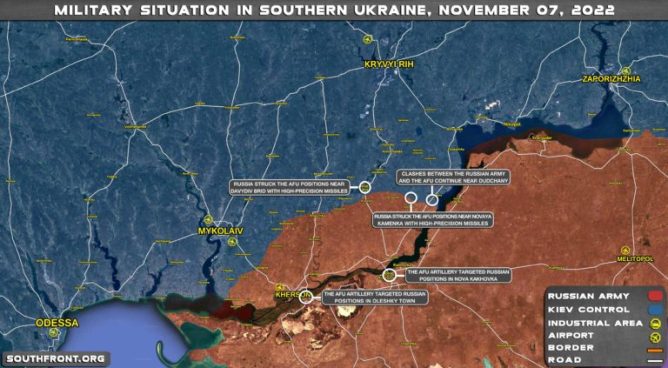
Indeed, the ground situation shows that the ongoing Russian operations in the areas of Ugledar and Bakhmut in Donetsk have run into strong resistance from Ukrainian forces, contrary to the Russian narrative Kiev’s military is a demoralised lot.
In particular, the advance of the Russians around Ugledar got stuck in the village of Pavlovka, located on the important crossroads, and in a fierce battle three days ago, reportedly, hundreds of Russian soldiers were killed. Putin’s decision to retreat in Kherson is probably meant to avoid a similar fate, as the Russians are experiencing logistical difficulties to supply their forces on the western side of Dnieper river.
Of course, this seamy picture is not the whole picture insofar as the phase of regrouping and resupplying following the Russian mobilisation is still a work in progress and the ongoing fighting in Donbass and Kherson is at the tactical level and does not involve any large movements of troops.
Equally, the intensive Russian strikes on Ukrainian depots, command centres and artillery and air-defence systems plus the destruction of Ukraine’s military-industrial facilities and energy system are yet to impact Kiev’s capacity to wage the war.
To be sure, the situation on the front lines in Kherson region remains extremely tense. The Ukrainian forces are on the prowl probing the Russian defence line incessantly to break through to capture the city of Kherson. A large-scale offensive by the Ukrainian forces on Kherson is to be expected any day. So far, Russians are holding their positions, repelling the ongoing Ukrainian attacks and fortifying their defences.
From Kherson, Ukrainian artillery can threaten Crimea. In the prognosis of Moscow’s close ally, Serbian President Aleksandar Vucic, “Challenging times are ahead of us. Next winter will be even harsher than this one because we’re facing the Battle of Stalingrad, the decisive battle in the conflict in Ukraine, the battle for Kherson.” He predicted that both sides are likely to deploy thousands of tanks, aircraft and artillery pieces in the struggle for the key city.
Vucic said, “The West thinks it’ll be able to ruin Russia that way, while Russia believes it’ll be able to defend what it secured at the start of the war and bring it to an end.”
Western Intelligence Services Played Key Role in Staging Mass Riots in Iran: Moscow
Samizdat – 09.11.2022
MOSCOW – Western intelligence services played a key role in organizing mass riots in Iran and spreading further disinformation about the situation in the country, Russian Security Council Secretary Nikolai Patrushev said on Wednesday.
“We note the key role of Western intelligence services in organizing mass riots in Iran and the subsequent dissemination of misinformation about the situation in the country through the Persian-speaking Western media controlled by them. We perceive this as blatant interference in the internal affairs of a sovereign state,” Patrushev said at a meeting with Supreme National Security Council (SNSC) of Iran Ali Shamkhani in Tehran, as cited by the Rossiyskaya Gazeta newspaper.
On September 16, a series of protests against the current political regime of Iran broke out throughout the country. Riots were ignited by the reports of the death of a 22-year-old Mahsa Amini, who had been arrested by morality police for wearing a hijab improperly.
Amini was detained by Iran’s morality police in Tehran on September 13 for wearing an “improper” hijab, an offense punishable by prison. The woman was sent to one of the FARAJA centers belonging to the police department and military intelligence for an explanatory conversation. In the center, Amini reportedly had a heart attack, after which she was immediately taken to hospital where the young woman passed away on September 16.
Tehran said that the weeks-long mass riots were planned from abroad and summoned the ambassadors of the United Kingdom, Norway, and the charges d’affaires of France in Iran in late September. The European diplomats were given a note of protest in connection with anti-Iranian media reports and calls to overthrow the Iranian government.
German MP added to Kiev’s ‘terrorist list’ because he called for a ceasefire
Free West Media – November 9, 2022
BERLIN – The head of the SPD parliamentary group, Rolf Mützenich said the Ukrainian government put him on a “terrorist list” because he had called for a cease-fire in Ukraine. He added that he had also “received threats”.
The criteria according to which Kiev differentiates its friends from its enemies has irked the president of the group SPD in the Bundestag, Mützenich. German politicians are particularly indignant that their names are now on the list of people who “promote narrative people in accordance with Russian propaganda”.
This document is published on the website of the Center for Combating Disinformation to the National Defense and Security Council of Ukraine.
“I was irritated that the Ukrainian government had put me on a terrorist list on the grounds that I was working for a cease-fire or for the possibility of taking new diplomatic measures,” he told the German news agency dpa. According to him, he has since also received “secondary threats, so to speak, which are not easy to manage either”.
Mützenich stressed that if the commitment to a cease-fire is a criterion for inclusion on this list, then the UN Secretary General, Antonio Guterres, must also be included. He complained of “discrimination” against those who, like him, campaign for diplomacy as a means of ending the conflict.
He also accused the partners of the SPD coalition, namely the Greens and the FDP, of resorting to the same discrimination. “I oppose this rigorism. The fact remains that most wars did not end on the battlefield.”
The deputy has been on the list since July. As proof, the Ukrainians cited an article published on the website of the German information agency RND.
The article indicated that the deputy found it “normal” that the German Chancellor, with the American and French Presidents, discussed ways to end the war in Ukraine. According to the article, Mützenich referred to the sanctions packages, but also to the attempt to achieve humanitarian ceasefires.
Combining COVID-19 BA4/5 and Influenza mRNA
Recipe for Disaster
By Dr. Peter McCullough & John Leake | Courageous Discourse | November 5, 2022
Recently both Pfizer and Moderna announced they were developing a combination injection utilizing mRNA coding for the BA4/BA5 Omicron subvariant and new mRNA coding for antigens contained in the influenza virus.[i] Because the COVID-19 component is under Emergency Use Authorization, has failed in animal studies and no human trials have been reported, that component should be off the table from the start.
A recent paper from Chemaitelly and colleagues demonstrated in the Omicron era, COVID-19 boosters had unacceptably low protection against acquiring the infection and no valid study has ever demonstrated reductions in hospitalizations and deaths.[ii]
To make matters worse, any theoretical benefit from a COVID-19 vaccine would last < 6 months, so additional shots would be out of phase with the other component of the combination product. mRNA coding for influenza would be a new biological product not under EUA so should have to go through the full 5-year regulatory development cycle for genetic biologicals. It looks like the vaccine companies are trying the shortcut this development cycle by combining the non-emergency flu shot with the EUA COVID-19 vaccine. Influenza A and B are the cause of seasonal epidemics, and the segmented RNA genome enables frequent antigenic changes. For this reason, the seasonal vaccines are developed annually based on the expected circulating strains of two influenza A viruses– H1N1 and H3N2, and two influenza B viruses– Victoria and Yamagata lineages.[iii] Because of the strain mismatches, the effectiveness has been abysmal.
Last year, Chung and colleagues reported the influenza vaccine had 16% vaccine efficacy which was statistically insignificant from zero.[iv]
Combining the genetic code for both the SARS-CoV-2 Spike protein and conserved proteins of influenza A and B would mean installation of the long-lasting genetic code for multiple foreign proteins in the human body. Production of these proteins will induce an ongoing multi-pronged immune response which is likely to create amplified side effects, above and beyond each component alone, rendering even greater incapacitation than we have seen with the COVID-19 vaccine alone. Dr. David Wiseman, PhD, former JNJ scientist and vaccine developer commented on the combined vaccine product for NTD news. He made the case that safety signals would be confused and impossible to sort out.
NTD News: Dr. David Wiseman: Combined mRNA BA4/5 and Influenza Vaccines are Ill-Conceived
In the history of drug development, when a technology goes bad and delivers side effects and fails to stop or ameliorate an illness, that line of development should be dropped. In the case of mRNA, the bio-pharmaceutical complex is hell-bent on forcing these new products into large populations no matter what adverse health consequences emerge. So, the next time you are in the clinic and about to take another vaccine, ask the nurse “does this vaccine have mRNA in it?” If the answer is yes, then consider deferring or seeking an alternative. Thus far, there is no mRNA vaccine that is either safe or effective.
[i] Reuters : Pfizer, BioNTech start COVID-flu combination vaccine study
[ii] Chemaitelly H, AlMukdad S, Ayoub HH, Altarawneh HN, Coyle P, Tang P, Yassine HM, Al-Khatib HA, Smatti MK, Hasan MR, Al-Kanaani Z, Al-Kuwari E, Jeremijenko A, Kaleeckal AH, Latif AN, Shaik RM, Abdul-Rahim HF, Nasrallah GK, Al-Kuwari MG, Al-Romaihi HE, Butt AA, Al-Thani MH, Al-Khal A, Bertollini R, Abu-Raddad LJ. Covid-19 Vaccine Protection among Children and Adolescents in Qatar. N Engl J Med. 2022 Nov 2. doi: 10.1056/NEJMoa2210058. Epub ahead of print. PMID: 36322837.
[iii] Rcheulishvili N, Papukashvili D, Liu C, Ji Y, He Y, Wang PG. Promising strategy for developing mRNA-based universal influenza virus vaccine for human population, poultry, and pigs- focus on the bigger picture. Front Immunol. 2022;13:1025884. Published 2022 Oct 17. doi:10.3389/fimmu.2022.1025884
[iv] Chung JR, Kim SS, Kondor RJ, Smith C, Budd AP, Tartof SY, Florea A, Talbot HK, Grijalva CG, Wernli KJ, Phillips CH, Monto AS, Martin ET, Belongia EA, McLean HQ, Gaglani M, Reis M, Geffel KM, Nowalk MP, DaSilva J, Keong LM, Stark TJ, Barnes JR, Wentworth DE, Brammer L, Burns E, Fry AM, Patel MM, Flannery B. Interim Estimates of 2021-22 Seasonal Influenza Vaccine Effectiveness – United States, February 2022. MMWR Morb Mortal Wkly Rep. 2022 Mar 11;71(10):365-370. doi: 10.15585/mmwr.mm7110a1. PMID: 35271561; PMCID: PMC8911998.
Featured Video

Racist Seinfeld Dances for Joy as Bibi Unveils His New Map
or go to
Aletho News Archives – Video-Images
TV Drama Review
Japanese drama projects Japan’s wartime atrocities onto Chinese characters

Global Times | October 25, 2026
By portraying Chinese characters as perpetrators of ruthless violence while casting Japanese Self-Defense Forces (SDF) intelligence operatives as defenders, the season 2 of the Japanese drama Vivant has recently drawn criticism from Chinese netizens, who argue that its depiction turns historical reality on its head while ignoring Japan’s wartime atrocities.
The TBS drama series – a spy suspense story in which an alleged unofficial intelligence unit of the SDF operates across the globe — has attracted a passionate fanbase. Its currently airing season 2 opened with a household rating of 18.8 percent, the highest for a TV drama this year, according toa commentary article by Japanese media Toyo Keizai.
What draws attention is the portrayal of the enemies in the series, the article noted. Scenes in which the Chinese organization subjects kidnapped members of the SDF unit to brutal torture are repeated with unrelenting intensity.
It is rare for Japanese TV dramas to explicitly portray a real-life country as the enemy, the article noted.
Japanese Prime Minister Sanae Takaichi also made a reference to the drama, saying that she has been recording Vivant and hopes to binge-watch it over the year-end and New Year holidays, according to Japanese media outlets.
China’s CCTV News report on Sunday revealed that the drama features scenes in which Chinese personnel cut off the fingers of and stab Japanese intelligence operatives in the abdomen. Such acts bear striking similarities to the torture inflicted on Chinese nationals by invading Japanese troops during the World War II.
The drama distorts the truth by attributing these atrocities to modern Chinese characters. Beneath the surface, it subtly glorifies Japan’s cross-border overseas operations, blurs the functional boundaries of the SDF and implicitly promotes an expansionist narrative, per CCTV News. … continue
Blog Roll
 Aletho News
- Iran FM Araghchi: “Hormuz Will No Longer Be the Same”
- EU facing trillion-euro debt hole while seeking more cash for Kiev
- How US, Europe, Persian Gulf states exhausted missile stockpiles, splurged billions to defend Israel
- Up in arms… Koreans reject U.S. empire’s plan to make South Korea the next Ukraine
- Iran, Turkey, Pakistan, Saudi Arabia could advance region-led security framework in Tehran: FM spox
- Netizens condemn Japanese drama for projecting Japan’s wartime atrocities onto Chinese characters
- Racist Seinfeld Dances for Joy as Bibi Unveils His New Map
- A West Bank War for Netanyahu’s Election Campaign, Could It Backfire?
- Yemen denounces European Parliament’s ‘hypocritical’ push to blacklist Ansarullah
- Qalibaf: UAE’s UN bid aims to ‘clear the runway’ for ‘Greater Israel’, whitewash genocide
- If Americans Knew
- An error has occurred; the feed is probably down. Try again later.
- No Tricks Zone
- Sudden Stratospheric Warming, Powerful El Niño Combination May Lead To Extreme Europe Cold, Energy Crisis!
- Two New Studies Find Thwaites Glacier Melt Cannot Be Driven By Human Activity Or A Warming Ocean
- E-Cars Reduce CO2 Emissions By Only 41% Compared To Internal Combustion Engine Vehicles
- Predictions Made By Renowned Climate Professor Over Past Decades Have Been Proven To Be Poor
- New Study Suggests Large Regions Of The Pacific Ocean Have Been Cooling For The Last 80 Years
- Germany’s Green Energy Debacle: High Energy Costs Force Kahla Porzellan to Close After 182 Years!
- New Study: 50 Years Of The Most Aggressive ‘Net Zero’ Policies Can Only Affect The Global Climate By 0.03°C
- US September “Heat” Was No Record…Many Records Set Decades Ago
- Latest European Green Energy Debacle; Portugal’s Largest Flagship Solar Park Insolvent!
- Green Energy Debacle: German Expert Professor Fritz Vahrenholt Warns Of Severe Economic And Social Consequences

