Iran Unveils New Air Defense Missile
Al-Manar – November 6, 2022
A new solid-propellant missile paired with Iran’s homegrown air defence system ‘Bavar-373’ was unveiled on Sunday.
The new missile, dubbed ‘Sayyad 4B’, has a range of 300 kilometers.
In a recent test, the Bavar-373 air defence system successfully hit a target at a distance of over 300 km with the new missile.
The Iranian air defence system managed to detect the target at a range of more than 450 kilometers with its optimized radar and tracked the target at a distance of around 405 km before detonating it with Sayyad 4B.
Sayyad 4B missile’s engine runs on hybrid solid fuel and has undergone an operational test for the first time.
The new breakthrough has increased the range of the detection radar of Bavar 373 from 350 to 450 km, while its tracking radar’s range has risen from 260 to 400 kilometers.
The employment of Sayyad 4B also means that the range of the Iranian air defence system missiles has been extended to 300 km and the altitude of engagement has increased from 27 to 32 km.
Iranian military experts and technicians have in recent years made great headway in manufacturing a broad range of indigenous equipment, making the armed forces self-sufficient in the defence sphere.
Iran maintains that its military might poses no threat to regional countries, stressing that the Islamic Republic’s defence doctrine is entirely based on deterrence.
NYC Apartment Fire Caused by Electric Bike Battery Injures Nearly 40 People
Samizdat – 06.11.2022
The fire was caused by a lithium-ion battery which power micro mobility devices like electric scooters, bikes, and hoverboards. The New York Fire Department (FDNY) reported that they found five electric bikes in the fire.
At least 38 people were injured in a fire on the 20th floor of a New York City apartment building on Saturday. City officials said that a majority of the victims suffered from smoke inhalation, while two victims were left in critical condition.
The fire erupted on Saturday on the 20th floor of a high-rise apartment complex at 429 East 52nd Street in Manhattan at about 10 AM. Firefighters found five electric bikes as the source of the fire, and wrote on social media to remind the public of the dangers of lithium-ion batteries.
“The cause of this fire is a lithium ion battery which is meant to power a micro mobility device. This is our 200th fire this year caused by lithium ion batteries from micro mobility devices. The fire was right behind the front door, we recovered at least five bikes from the apartment. We want to stress our lithium ion safety tips,” said Daniel Flynn who is the Chief Fire Marshal of the FDNY, who adds that at least six people have died due to lithium ion battery fires this year.
Authorities believe someone in the apartment was repairing the electric bikes and are investigating the resident’s business activity. The FDNY added that fire protection and planning at the building will also be investigated.
“The alarm didn’t go off, but it seemed like everyone got the memo and started going out,” said a 26-year-old resident of the building.
“I run down the stairs, and as I’m running out on the courtyard, the window bursts and glass flies around as I’m on the phone with my mom screaming for my life,” said a 23-year-old resident of the building, who said she only first became aware of the fire after smelling smoke from the fire.
A video captured and posted to social media shows firefighters hanging by ropes from a window as they attempt to rescue a woman from the 20th floor of the building.
“What we saw today was our training, our team work, and our absolute dedication,” said Frank Leeb, the Deputy Assistant Chief of the FDNY. “From the units that operated up there with the lifesaving rope to passing them off to our exceptionally trained EMS personnel to get these patients all off scene in a matter of a couple of minutes and off to local hospitals.”
“The lithium-ion battery adds a different degree when we talk about the fire dynamics of it,” Leebs added. “These rooms flash over in just a mere matter of seconds.”
Ukrainian Starlink units go dark over funding issues – media
RT | November 4, 2022
Some 1,300 Starlink satellite terminals went offline in Ukraine last week due to a failure to pay the military’s internet bills, deepening fears that the country will no longer be able to afford the pricey satellite service, two sources familiar with the situation told CNN on Friday.
The terminals, all part of a block purchased from a British company in March, began to go dark on October 24 for lack of funding, causing a “huge problem” for the military that depended upon them. Aware the bill was coming due and that they would be unable to pay it, the Ukrainian Ministry of Defense asked its UK allies for $3.25 million to cover the monthly cost and rotated the terminals out of use so they wouldn’t wink out at a critical moment. However, their request was turned down.
Starlink parent company SpaceX alerted the Pentagon in September that it could no longer pay the full cost of Ukraine’s Starlink usage, asking Washington to pick up the slack, according to CNN. With approximately 25,000 Starlink terminals in Ukraine, Musk estimated the military’s use of the service would cost nearly $400 million over the next 12 months. Fewer than 11,000 were being paid for at the time he wrote to the Pentagon.
Musk then appeared to change his mind about footing the bill for the service a few days later, tweeting “We’ll just keep funding Ukraine for free.”
However, a senior defense official told CNN SpaceX has continued negotiating with the Pentagon, adding that officials are eager to get Musk to commit resources in writing because they fear he will change his mind.
He has reportedly refused to operate Starlink in Crimea, fearing this would invite an escalation from Moscow, while Western media have accused him of hindering the network’s operation by Ukrainian troops in Russian-controlled areas, which Musk denies. Last month, he warned that even though the company has “diverted massive resources toward defense” as the Russian military attempts to take the system out, “Starlink may still die.”
Moscow believes Starlink is a legitimate target, reasoning that the US and its allies have been using “elements of the civilian space infrastructure, including commercial, for military purposes.” Because this “essentially constitutes an involvement in military action through a proxy,” the “quasi-civilian” satellite network is fair game, Russian diplomat Konstantin Vorontsov told the UN last month.
Biden administration sponsors yet another campaign against Orbán
Free West Media | November 3, 2022
The US government has opened a new chapter in the propaganda and disinformation war against Hungary. It now supports an allegedly “independent” media portal, whose sponsors, however, make it quite easy to see the goals which are being pursued against the country.
According to its own statements, the Internews platform focuses “on promoting a strong independent media sector” in Hungary. There will be further activities in Armenia, Georgia, Poland, Romania and the Ukraine. The aim is to “resist powerful interests trying to manipulate, isolate or control the press”.
The US embassy recently even produced a video listing Hungarian politicians and journalists who have allegedly made “anti-American” statements by name. Essentially these voices either criticized globalist policies to foment the Ukraine war or spoke out against the futility of sanctions.
The list of sponsors for the news portal is revealing. On it one will find, among other things, the well-known Open Society Foundations (OSF) by George Soros, the Rockefeller Foundation and Freedom House, which is financed by the US government. US-based global tech giants like Facebook and Google are also among the backers.
Those in the know recall that Internews is not the US government’s first attempt to reshape the Hungarian media scene. As early as 2017, the US State Department launched a support program right before the elections for “independent Hungarian media in the countryside”. At the time, the government in Budapest accused the US State Department of interfering in Hungarian domestic politics. The programme was later de facto scrapped, presumably because ex-President Donald Trump valued good relations with Hungary.
Under the Biden administration, however, “democracy” exports are back in fashion. Just a few months ago, the Hungarian opposition’s prime ministerial candidate caused a scandal when he admitted that he had received a substantial sum of money for his election campaign from a US foundation.
Moscow Has Info on UK’s Transfer of Unmanned Underwater Drones to Kiev Ahead of Sevastopol Attack
Samizdat – 03.11.2022
The Foreign Ministry summoned Britain’s ambassador to Russia on Thursday in connection with last week’s Ukrainian attack targeting Russian military and civilian vessels in Sevastopol. The act of terrorism prompted Moscow to temporarily freeze its participation in the Black Sea grain export deal with Kiev.
Moscow summoned British Ambassador to Russia Deborah Bronnert in connection with London’s suspected involvement in the October 29 attack on the Russian Black Sea Fleet, the Foreign Ministry has revealed.
In a statement, the Ministry indicated that it had information that London transferred a number of unmanned underwater drones to Kiev, and that British specialists have been actively involved in the training and supply of Ukrainian special operations forces, including those involved in sabotage operations at sea.
Moscow warned that Britain’s actions threaten to escalate the security crisis and lead to “unpredictable and dangerous consequences,” and that such “hostile provocations” on London’s part were “inadmissible” and must be stopped immediately.
“If such acts of aggression, fraught with [the UK’s] direct involvement in the conflict, continue, the entire responsibility for their disastrous consequences and the growth of tensions in relations between our states will lie entirely on the British side,” the Foreign Ministry said.
The Russian Black Sea Fleet port of Sevastopol repelled a massive drone attack on October 29, shooting down multiple UAVs and remote-controlled surface vessels in Sevastopol Bay. According to Russia’s Defense Ministry, the warships attacked included ships providing security for the so-called ‘grain corridor’ – the secure maritime route agreed by Moscow and Kiev this summer through which cargo vessels carrying grain from Ukrainian ports through the Black Sea for export abroad.
The Russian military later retrieved drone wreckage from the sea floor to examine the remains, finding Canadian-made navigation modules installed on the maritime drones. Preparations for the drone attack were carried out under the guidance of British specialists in the Ukrainian port city of Ochakov, according to the Russian MoD. Russia destroyed a multi-million pound British-built and financed military base in Ochakov in a missile strike in February during the opening stages of its military operation in Ukraine.
The Sevastopol attack is the second time in weeks that Moscow has called out London on terrorism-related charges. Last week, Russia’s Defense Ministry concluded that the Royal Navy took part in the planning, organization and execution of the late September attacks on the Nord Stream natural gas pipeline network.
On Tuesday, Russian Foreign Ministry spokeswoman Maria Zakharova asked London to explain the mysterious “It’s done” iPhone text message reportedly sent by now former Prime Minister Liz Truss to US Secretary of State Antony Blinken just moments after Nord Stream was struck.
Earlier this year, Ukrainian and Western media reported that Moscow and Kiev appeared to be on the brink of a peace agreement this spring, but that (now former) British Prime Minister Boris Johnson was quickly dispatched to the Ukrainian capital to scuttle any potential agreement.
Russia tells UN it will inspect Black Sea ships
Samizdat – October 31, 2022
Ukraine “grossly violated” the Istanbul agreement on grain exports via the Black Sea and forced Moscow to suspend it indefinitely, Russia’s envoy to the UN Vassily Nebenzia told the Security Council on Monday. The Russian navy will inspect all cargo ships bound for Ukraine, even those unilaterally cleared by the Turkish-based coordination center, he added.
“This subversive action of Kiev grossly violates the Istanbul agreements and, in fact, puts an end to their humanitarian dimension. It is now obvious to everyone that the Black Sea humanitarian corridor is being used by the Ukrainian side for military sabotage purposes,” Nebenzia said, referring to Saturday’s drone attack on Sevastopol.
Russia “cannot guarantee the safety of civilian ships participating in the Black Sea initiative,” Nebenzia added, as “We do not know what other terrorist attacks Kiev is preparing with the support of its Western sponsors.”
On Sunday, after Moscow announced the suspension of the arrangement, the Joint Coordination Center (JCC) in Istanbul said it had greenlit 16 ships to navigate the corridor on Monday and “informed” Russia about the decision. According to maritime traffic data, at least two ships left the Black Sea port of Odessa in the morning, reporting Istanbul as their destination.
“Decisions and measures taken without our participation are not binding on us,” Nebenzia told the UN. Moscow “cannot allow ships to pass without our inspection and will be forced to take independent measures” to inspect ships authorized by the JCC without Russian approval.
Meanwhile, the UN coordinator for the Black Sea grain initiative, Amir Abdulla, insisted that “the food must flow.”
The UN and Türkiye mediated a deal in July under which Ukrainian grain could be exported via the Black Sea, while Western obstacles to the export of Russian grain and fertilizer would be removed. The US and its allies insist they had never sanctioned grain exports – but their sanctions on Russian ships and insurance made them impossible in practice.
Moscow has criticized the West for not living up to its part of the deal and pointed out that the bulk of Ukrainian exports went to the EU and not the African nations most affected by food insecurity.
Ukraine power executive says supplies have run out
Samizdat | October 31, 2022
Ukraine’s largest private power utility, DTEK Holding, said on Monday that it had run out of equipment to repair damage inflicted by Russian attacks. The latest round of missile strikes plunged Kiev and several other cities into darkness.
“Unfortunately, we have already used up the stock of equipment we had in warehouses after the first two waves of enemy attacks that have been taking place since October 10,” DTEK executive director Dmitry Sakharuk told Ukrainian media.
Sakharuk added that DTEK has been able to buy some replacement parts at a cost of “hundreds of millions of dollars,” and is now “working on how to purchase it or get it from our partners.”
Ukraine’s power grid uses Soviet-standard equipment that is incompatible with parts from the West and difficult to obtain outside of Russia. DTEK, owned by oligarch Rinat Akhmetov, accounts for a third of the country’s electricity market via coal-powered plants.
Another wave of missiles struck Kiev, Kharkov, Cherkasy and Vinnitsa on Monday. Kiev Mayor Vitaly Klitschko said some 350,000 apartments were without power, while water supply was disrupted in about 80% of the city. The metro system in Kharkov was offline.
Ukrainian power grid operator Ukrenergy has introduced rolling blackouts in many regions, begging the population to reduce power consumption in order to avoid a “total collapse.”
Russia began targeting Ukraine’s power grid on October 10. President Vladimir Putin explained the change of tactics by saying Kiev has carried out “sabotage” attacks against Russian infrastructure, including nuclear power plants. The October 8 suicide attack that damaged the Crimean Bridge was the final straw, the Russian president said.
Moscow sent troops into Ukraine on February 24, citing Kiev’s failure to implement the Minsk agreements, designed to give the regions of Donetsk and Lugansk special status within the Ukrainian state. The protocols, brokered by Germany and France, were first signed in 2014. Former Ukrainian president Pyotr Poroshenko has since admitted that Kiev’s main goal was to use the ceasefire to buy time and “create powerful armed forces.”
In February 2022, the Kremlin recognized the Donbass republics as independent states and demanded that Ukraine officially declare itself a neutral country that will never join any Western military bloc. Kiev insists the Russian offensive was completely unprovoked.
Russia Retrieves and Examines Parts of Drones Used in Sevastopol Attack, MoD Says
Samizdat – 30.10.2022
MOSCOW – The Russian Defense Ministry raised from the sea bottom and inspected fragments of drones that were used to strike ships and infrastructure of the Russian Black Sea Fleet on Saturday, which revealed that they were launched near the port city of Odesa, the ministry said on Sunday.
The ministry noted that its specialists, in coordination with experts from other state agencies, examined the Canadian-made navigation modules installed on the maritime drones.
“According to the results of recovery of the information read from the memory of the navigation unit, it was established that the launch of the maritime drones was carried out from the coast near the city of Odesa,” the ministry said.
The drones were moving along the safe zone of the so-called grain corridor before swerving towards Russia’s navy base in Sevastopol, according to the ministry.
“Coordinates of the trajectory of one of the maritime drones suggest that it was launched from the waters of the ‘grain corridor’ safe zone in the Black Sea. According to experts, this may indicate a preliminary launch of this drone from one of the civilian vessels chartered by Kiev or its Western supporters to export agricultural products from Ukrainian ports,” the ministry said.
On Saturday, the Russian defense ministry said that Moscow was suspending its participation in the grain deal following Ukraine’s drone attack on vessels of the Russian Black Sea Fleet in Sevastopol.
Russia suspends participation in grain deal after Ukrainian attacks on ships
Samizdat | October 29, 2022
Moscow has halted its compliance with a grain deal with Kiev, brokered by the UN and Türkiye, after Ukraine launched a major drone attack on ships involved in securing safe passage for agricultural cargo, the Russian Defense Ministry announced on Saturday.
In a post on its Telegram channel, the ministry said Russia “is suspending its participation in the implementation of agreements on the export of agricultural products from Ukrainian ports”.
It explained that the move was prompted by “a terror attack” against the ships of the Black Sea Fleet and civilian vessels involved in ensuring the security of the grain corridor. The ministry also alleged that the bombing was organized with the involvement of British military.
The UK Defence Ministry has denied any involvement in the Ukrainian drone attack on the Black Sea Fleet in Sevastopol, claiming that Moscow “is resorting to peddling false claims of an epic scale” in an effort to distract the global community from “their disastrous handling of the illegal invasion of Ukraine.”
“This invented story, says more about arguments going on inside the Russian Government than it does about the West,” it added.
Commenting on Russia’s decision to suspend the grain deal, Andrey Ermak, Ukrainian President Vladimir Zelensky’s chief of staff, accused Moscow of “blackmail.”
“Russian blackmail is primitive across the board: blackmail in nuclear, energy and food field,” he stated, adding that all supposed Russian ploys are “too simple and predictable.”
Earlier on Saturday, Russia’s Agriculture Minister Dmitry Patrushev signaled that Moscow is ready, with Türkiye’s help, to send the world’s poorest countries up to 500,000 tons of grain within the next four next months.
He noted that considering this year’s harvest, Russia “is fully ready to replace Ukrainian grain” and arrange deliveries to “all interested countries” at a reasonable price.
“The grain deal not only did not solve the problems of countries in need, but even aggravated them in a sense. We can see where the ships from Ukraine were heading – Italy, Spain, and the Netherlands. For some cargoes, the share of EU countries ranges from 60 to 100%. These are not the states that are experiencing a real food problem,” the minister said.
Russia earlier warned that it could quit the grain deal if an agreement to ease restrictions on its food and fertilizer exports were not implemented. Moreover, following the blast on the strategic Crimean Bridge, Russian President Vladimir Putin said that if turns out that Ukraine – the country that Moscow accused of carrying out the attack – used grain corridors to transport explosives, “it would put the very existence of these corridors in question”.
The breakthrough deal between Moscow and Kiev was reached in Istanbul in July with mediation by the UN and Türkiye. It aimed to unlock agricultural exports via the Black Sea from Russia and Ukraine – two of the world’s leading grain exporters – which had ground to halt due to the conflict between the two nations.
Is Ukraine a “proxy war”?
By Noah Carl | October 26, 2022
Critics of America’s policy toward Ukraine have accused it of waging a “proxy war” against Russia. Such critics include various Western commentators, as well as Russia itself. In April, the Foreign Minister Sergei Lavrov claimed, “NATO, in essence, is engaged in a war with Russia through a proxy”.
Yet when a reporter put this accusation to Joe Biden, he said it’s “not true”. What’s more, the Ukrainian government compiled a list of individuals who “promote narratives consonant with Russian propaganda”, and specified that such narratives include: “A proxy war between NATO and Russia is taking place on the territory of Ukraine”.
One problem with the line taken by Biden and the Ukrainian government is that it isn’t just critics of US policy that have used the term “proxy war”.
In an article claiming that “many Russian soldiers have to flee, surrender, or die” and “the more and faster the better”, the political scientist Eliot Cohen stated, “The United States and its NATO allies are engaged in a proxy war with Russia.”
Likewise, the former Supreme Allied Commander of NATO, Philip Breedlove – who has called for boots on the ground in Ukraine – stated, “I think we are in a proxy war with Russia. We are using the Ukrainians as our proxy forces.”
And in an interview calling for the US to provide “as much aid as necessary” to Ukraine, former CIA Director Leon Panetta stated, “We are engaged in a conflict here. It’s a proxy war with Russia, whether we say so or not.”
Okay, you might say, but those individuals were using “proxy war” in a purely technical sense. Although the US is not an active participant in the conflict, it is arming one of the participants. So calling the conflict a “proxy war” is just a statement of fact (even if it might technically qualify as spreading Russian propaganda).
When critics accuse the US of waging a “proxy war” what they really mean is that the US is using Ukraine to weaken Russia, regardless of whether this serves the interests of Ukrainians (or Europeans for that matter). For example, perhaps Ukrainians would be better off if the US had engaged in diplomacy with Russia before the war.
It’s certainly not a stretch to imagine the US would wage a “proxy war” of this kind. The Reagan Doctrine was all about building up the US military and arming anti-communist guerrillas in order to overwhelm the Soviet Union and, ultimately, win the Cold War. This included arming both religious and political extremists.
But we don’t have to go back to the eighties. In 2019, the RAND corporation published a report on strategies to “overextend and unbalance” Russia. The report identified “providing lethal aid to Ukraine” as one that would “exploit Russia’s greatest point of external vulnerability”. (Interestingly, it concluded that any increase in aid would need to be “carefully calibrated” to avoid provoking “a much wider conflict”.)
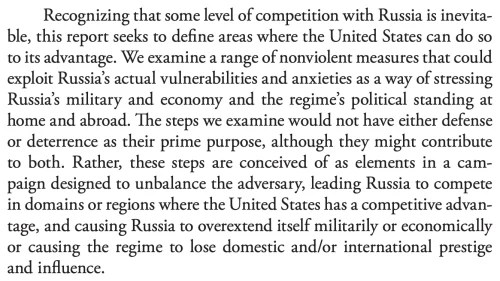
Screenshot from ‘Extending Russia: Competing from Advantageous Ground’.
RAND is almost entirely funded by the US Government, which appears first on its list of clients. So the fact that it would publish a report like this indicates that, even before Russia’s invasion, US decision-makers were interested in using Ukraine to weaken their geopolitical adversary.
As Senator Adam Schiff explained in 2020, “The United States aids Ukraine and her people so that we can fight Russia over there, and we don’t have to fight Russia here.”
Since Russia’s invasion, various other commentators have hinted – or in some cases explicitly stated – that America has goals other than securing Ukraine’s territorial integrity. Here’s Thomas Friedman’s account of what a “retired senior European statesman” told him:
The goal of Ukraine is to win, he said. The goal of the European Union is a bit different. It is to have peace … The U.S. is far away, and for the U.S., he added, it is not the worst thing to keep the war going to weaken Russia and make certain it doesn’t have the energy for any other adventures.
Two months into the war, Defence Secretary Lloyd Austin was asked how he would define America’s goals in the conflict. He began by saying what you’d expect him to say: “We want to see Ukraine remain a sovereign country”. He then went slightly off-script: “We want to see Russia weakened to the degree that it can’t do the kinds of things that it has done in invading Ukraine.”
According to the New York Times, some officials “cringed” and Biden called Austin to “remonstrate” him for the comment. “But officials acknowledged that was indeed the long-term strategy”.
A couple of weeks later, the political scientist Hal Brands really let the cat out of the bag – in a piece titled ‘Russia Is Right: The U.S. Is Waging a Proxy War in Ukraine’. He wrote:
The war in Ukraine isn’t just a conflict between Moscow and Kyiv, Russian Foreign Minister Sergei Lavrov recently declared. It is a “proxy war” in which the world’s most powerful military alliance … is using Ukraine as a battering ram against the Russian state … Lavrov is one of the most reliable mouthpieces for President Vladimir Putin’s baseless propaganda, but in this case he’s not wrong. Russia is the target of one of the most ruthlessly effectively proxy wars in modern history.
“The key,” Brands noted, “is to find a committed local partner — a proxy willing to do the killing and dying”. You then “load it up with” arms so that it can inflict “shattering blows” on your adversary. “That’s just what Washington and its allies are doing to Russia today.”
Similar sentiments were echoed by Congressman Seth Moulton in an interview with Fox News. “At the end of the day, we’ve got to realise we’re at war,” Moulton stated. “And we’re not just at war to support Ukraine. We’re fundamentally at war – although somewhat through a proxy – with Russia. And it’s important that we win.”
Likewise, when Congressman Dan Crenshaw came under fire from “America First” conservatives over his support for Ukraine, he tweeted: “Yeah, because investing in the destruction of our adversary’s military, without losing a single American troop, strikes me as a good idea. You should feel the same.”
Crenshaw didn’t bother paying lip-service to high-minded concepts like democracy, sovereignty or territorial integrity. He just came out and said we’re “investing in the destruction of our adversary’s military”.
Critics have consistently disparaged US policy as “fighting Russia to the last Ukrainian”. But in July, Senator Lindsey Graham – a long-time Russia hawk – said almost exactly that. “I like the structural path were on here,” Graham explained. “As long as we help Ukraine with the weapons they need and the economic support, they will fight to the last person.”
Critics found further justification for their cynicism in a recent Washington Post article, which revealed the following. “Privately, U.S. officials say neither Russia nor Ukraine is capable of winning the war outright, but they have ruled out the idea of pushing or even nudging Ukraine to the negotiating table.”
You might say that using Ukraine to weaken Russia is something worth doing, as Dan Crenshaw evidently believes. But at this point, it can scarcely be denied that America is engaged in a proxy war.
Iran envoy dismisses Ukraine’s accusations Tehran violated UN resolution
Press TV – October 21, 2022
Iran’s permanent representative to the United Nations refutes Ukraine’s allegation that the Islamic Republic violated a UN resolution by, what Kiev calls, providing Russia with drones.
Amir-Saeid Iravani made the remarks in a letter to the UN Secretary-General Antonio Guterres and the world body’s Security Council (UNSC) on Thursday.
The envoy submitted the letter after Ukraine’s UN Ambassador Sergiy Kyslytsya wrote to Guterres and Security Council members, alleging that the Islamic Republic had “violated” the UNSC Resolution 2231 by allegedly transferring unmanned aerial vehicles to Russia, which is conducting a military operation in the ex-Soviet republic.
The letter obtained by the Associated Press alleges that Iran had violated the resolution by breaching the Paragraph 6 of its Annex B that used to ban Tehran from selling “uncrewed aerial vehicle (UAV) systems having a range equal to or greater than 300 kilometers (186 miles).” Kyslytsya also invited UN experts to visit his country to ascertain, what he called, Iran-built drones being used by Russia in the military operation.
Responding to Kiev’s allegations, Iravani noted that the restrictions mentioned in the Annex B of the UNSC resolution had “ended in October 2020.” “Since then, none of Iran’s actions towards provision, selling or transfer of weapons or related materials to other countries has been subject to the resolution,” he added.
The Ukrainian official also accused Iran of breaching the Paragraph 4 of Annex B, which bans development of nuclear-capable missile systems.
Iravani also condemned the Ukrainian official’s latter claim as “wrongful and arbitrary interpretation” of the resolution and Paragraph 4’s “spirit.”
The Islamic Republic “has neither provided, nor intends to provide [any foreign party] with items, materials, equipment, commodities, and technology that contribute to development of nuclear weapons.”
Ukraine’s invitation of UN experts towards examination of Iran’s so-called violation of Resolution 2231 is, therefore, “lacking in all legal foundation within Resolution 2231’s framework,” the Iranian official asserted.
The official called on the UN secretary-general to prevent any “misuse” of the resolution in relation to the war in Ukraine.
He finally called on the world body to confront such unfounded anti-Iranian allegations.
UAVs Used in Ukraine Are Manufactured in Russia, West Inventing Fake Pretext – Polyanskiy
Samizdat – 20.10.2022
Drones being used by Russian military forces in Ukraine are wholly manufactured in Russia, Deputy Permanent Representative to the UN Dmitry Polyanskiy stressed to reporters after allegations surfaced that Iran was providing UAVs to Moscow.
“UAV used by the Russian army in Ukraine are manufactured in Russia,” Polyanskiy said on Wednesday, adding that Western officials are inventing artificial pretext.
The official further added that the United Nations Secretariat does not have a legal mandate to conduct an investigation into the alleged use of Iranian-made drones in Ukraine.
“[The UN Secretariat] has no mandates to investigate anything regarding the UN Security Council resolution 2231,” Polyanskiy said. “Its role as enshrined within note of the Security Council President 2016/44 16 January 2016 is purely technical – to prepare meeting rooms, circulated communications.”
The comments come after the EU spokesperson Nabila Massrali revealed that the block had collected evidence allegedly proving that Iran had supplied Moscow with drones for its ongoing special military operation.
Iran has repeatedly rejected the accusations. Earlier, Iranian UN envoy Saeed Iravani blasted the “disappointing” claims as disinformation being pushed as part of a political agenda.
“We categorically reject the unfounded and unsubstantiated claims that Iran has transferred UAVs for the use in the conflict in Ukraine,” Iravani said on Wednesday.
Allegations regarding the drones first surfaced in July, when they were voiced by US national security adviser Jake Sullivan. The US State Department has since stated that it intends to use sanctions to prevent the transfer of such “dangerous weapons.”
Featured Video

Racist Seinfeld Dances for Joy as Bibi Unveils His New Map
or go to
Aletho News Archives – Video-Images
TV Drama Review
Japanese drama projects Japan’s wartime atrocities onto Chinese characters

Global Times | October 25, 2026
By portraying Chinese characters as perpetrators of ruthless violence while casting Japanese Self-Defense Forces (SDF) intelligence operatives as defenders, the season 2 of the Japanese drama Vivant has recently drawn criticism from Chinese netizens, who argue that its depiction turns historical reality on its head while ignoring Japan’s wartime atrocities.
The TBS drama series – a spy suspense story in which an alleged unofficial intelligence unit of the SDF operates across the globe — has attracted a passionate fanbase. Its currently airing season 2 opened with a household rating of 18.8 percent, the highest for a TV drama this year, according toa commentary article by Japanese media Toyo Keizai.
What draws attention is the portrayal of the enemies in the series, the article noted. Scenes in which the Chinese organization subjects kidnapped members of the SDF unit to brutal torture are repeated with unrelenting intensity.
It is rare for Japanese TV dramas to explicitly portray a real-life country as the enemy, the article noted.
Japanese Prime Minister Sanae Takaichi also made a reference to the drama, saying that she has been recording Vivant and hopes to binge-watch it over the year-end and New Year holidays, according to Japanese media outlets.
China’s CCTV News report on Sunday revealed that the drama features scenes in which Chinese personnel cut off the fingers of and stab Japanese intelligence operatives in the abdomen. Such acts bear striking similarities to the torture inflicted on Chinese nationals by invading Japanese troops during the World War II.
The drama distorts the truth by attributing these atrocities to modern Chinese characters. Beneath the surface, it subtly glorifies Japan’s cross-border overseas operations, blurs the functional boundaries of the SDF and implicitly promotes an expansionist narrative, per CCTV News. … continue
Blog Roll
 Aletho News
- Iran FM Araghchi: “Hormuz Will No Longer Be the Same”
- EU facing trillion-euro debt hole while seeking more cash for Kiev
- How US, Europe, Persian Gulf states exhausted missile stockpiles, splurged billions to defend Israel
- Up in arms… Koreans reject U.S. empire’s plan to make South Korea the next Ukraine
- Iran, Turkey, Pakistan, Saudi Arabia could advance region-led security framework in Tehran: FM spox
- Netizens condemn Japanese drama for projecting Japan’s wartime atrocities onto Chinese characters
- Racist Seinfeld Dances for Joy as Bibi Unveils His New Map
- A West Bank War for Netanyahu’s Election Campaign, Could It Backfire?
- Yemen denounces European Parliament’s ‘hypocritical’ push to blacklist Ansarullah
- Qalibaf: UAE’s UN bid aims to ‘clear the runway’ for ‘Greater Israel’, whitewash genocide
- If Americans Knew
- An error has occurred; the feed is probably down. Try again later.
- No Tricks Zone
- Sudden Stratospheric Warming, Powerful El Niño Combination May Lead To Extreme Europe Cold, Energy Crisis!
- Two New Studies Find Thwaites Glacier Melt Cannot Be Driven By Human Activity Or A Warming Ocean
- E-Cars Reduce CO2 Emissions By Only 41% Compared To Internal Combustion Engine Vehicles
- Predictions Made By Renowned Climate Professor Over Past Decades Have Been Proven To Be Poor
- New Study Suggests Large Regions Of The Pacific Ocean Have Been Cooling For The Last 80 Years
- Germany’s Green Energy Debacle: High Energy Costs Force Kahla Porzellan to Close After 182 Years!
- New Study: 50 Years Of The Most Aggressive ‘Net Zero’ Policies Can Only Affect The Global Climate By 0.03°C
- US September “Heat” Was No Record…Many Records Set Decades Ago
- Latest European Green Energy Debacle; Portugal’s Largest Flagship Solar Park Insolvent!
- Green Energy Debacle: German Expert Professor Fritz Vahrenholt Warns Of Severe Economic And Social Consequences

