US sponsored Kurdish SDF calls on Russia and Iran to prevent planned Turkish military operation
MEMO | July 17, 2022
The head of the Kurdish-led militant group Syrian Democratic Forces (SDF) has called on Russia and Iran to help prevent Turkiye from launching a military offensive against its positions in northern Syria, as the threat of a new Turkish operation continues to loom.
According to the AFP news agency, the SDF’s chief commander Mazloum Abdi urged the involvement of Moscow and Tehran against Ankara’s aims in the region this week, accusing the US-led global coalition to defeat Daesh – also known as Operation Inherent Resolve – of taking a “weak” position that is “insufficient to end the threats.”
In May, Turkish president Recep Tayyip Erdogan announced plans to launch a new military operation into the areas controlled by the Kurdish militias, which would be Turkey’s fourth such offensive in northern Syria. The operation is meant as an effort to clear the 30-kilometre-deep ‘safe zone’ in northern Syria from remaining Kurdish militant elements, in order to settle at least a million Syrian refugees there.
Abdi also reiterated that after negotiating with Russia, Kurdish militant forces allowed the Syrian regime of Bashar al-Assad to reinforce their troops in Kurdish-controlled areas, particularly in cities such as Kobane and Manbij in the north of the country. The threat of a renewed Turkish offensive had seemingly forced the SDF to strengthen ties with Assad, Russia, and now Iranian forces in an effort to repel Ankara’s planned operation.
Abdi’s call for Russian and Iranian assistance is likely more diplomatic than military, as it comes only days before a summit that is to be held in Iran from Tuesday, in which Iranian president Ebrahim Raisi will host Erdogan and their Russian counterpart Vladimir Putin in a renewed set of negotiations on Syria and the ongoing 11-year-long conflict.
If Moscow and Tehran heed the SDF’s call, they may be expected to attempt to discourage Ankara from its planned military operation.
Russia comments on deadly strike on Ukrainian city
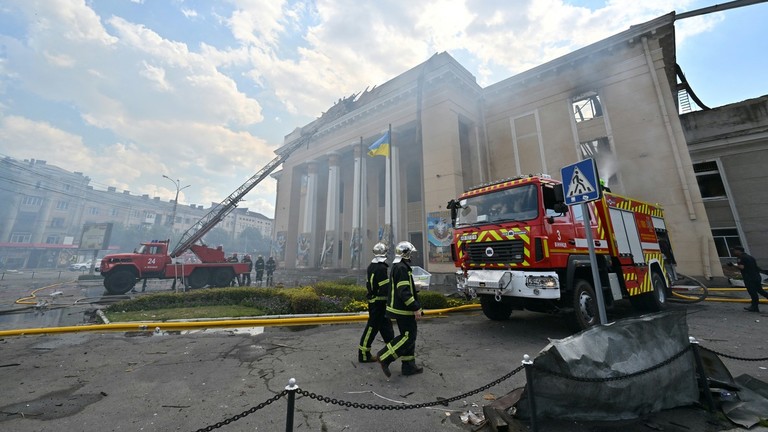
Firefighters extinguish fire in the city of Vinnytsia, west-central Ukraine on July 14, 2022. © AFP / Sergei SUPINSKY
Samizdat | July 15, 2022
The Russian military has confirmed launching a missile attack at a target in the city of Vinnitsa in Ukraine. It denied claims that it was a deliberate strike on civilians, stating that it hit Ukrainian military commanders as they negotiated with foreign arms suppliers.
Russia attacked the House of Military Officers in Vinnitsa with sea-launched Kalibr cruise missiles, the Defense Ministry said on Friday during a daily briefing. The statement claimed that the attack happened when a group of Ukrainian senior military officers were holding a meeting with foreign arms suppliers. The discussion was about the “transfer of more warplanes and weapons systems as well as the repair of the Ukrainian military air fleet,” the ministry said. The Russian strike killed all participants at the gathering.
According to Ukrainian officials, the Russian strike killed 23 civilians and injured scores of others, 80 of whom had to be hospitalized for treatment. President Volodymyr Zelensky claimed that Moscow attacked the city center deliberately and accused it of terrorism.
The head of Vinnitsa Region, Sergey Borzov, reported that Ukrainian air defenses engaged Russian missiles over the city and claimed they intercepted four of them.
Kiev has accused Russia of waging a genocidal war, claiming that Russian forces have a policy of killing Ukrainians. Moscow has rejected such allegations, saying its forces only attack legitimate military targets.
Russia sent troops into Ukraine on February 24, citing Kiev’s failure to implement the Minsk agreements, designed to give the regions of Donetsk and Lugansk special status within the Ukrainian state. The protocols, brokered by Germany and France, were first signed in 2014. Former Ukrainian President Petro Poroshenko has since admitted that Kiev’s main goal was to use the ceasefire to buy time and “create powerful armed forces.”
In February 2022, the Kremlin recognized the Donbass republics as independent states and demanded that Ukraine officially declare itself a neutral country that will never join any Western military bloc. Kiev insists the Russian offensive was completely unprovoked.
Putin’s summits next week will strengthen ties with Iran, Turkey
BY M. K. BHADRAKUMAR | INDIAN PUNCHLINE | JULY 14, 2022
Kremlin spokesman Dmitry Peskov announced in Moscow on Tuesday that President Vladimir Putin will travel to Tehran on July 19, to take part in a tripartite meeting with his Iranian and Turkish counterparts as part of the Astana peace process to end the war in Syria as well as hold a bilateral meeting with Turkish President Recep Erdogan.
Such a summit was long expected but the pandemic and the Ukraine conflict delayed matters. The current impasse in Syria is fraught with risks. Turkey has plans to launch another military incursion into Syria’s northern border regions that are under the control of Kurdish groups, who, Ankara alleges, are linked to the separatist PKK and also happen to be Pentagon’s inseparable allies.
Damascus, Moscow and Tehran — and Washington — disfavour the Turkish move as potentially destabilising, but Erdogan is keeping plans in a state of suspended animation, while tactfully dialling down the threatening rhetoric and acknowledging he’s “in no rush.”
For want of green lights from its Astana partners, presumably, Erdogan is unlikely to launch the military incursion, but Russia and Iran are wary that the incursion could complicate their presence and political influence in Syria and risk confrontation between Turkish troops and Syrian government forces.
However, Syria apart, Putin’s trip has much wider ramifications. What transpires in his bilateral meetings with Erdogan and Iranian leaders are certainly the more important templates to watch. Clearly, Turkey and Iran are emerging as two of the most consequential relationships of Russian foreign policies and diplomacy. And Putin’s visit comes at a highly transformative period in the US’ approach toward both Turkey and Iran.
Erdogan’s hopes of a rapprochement with the US have been dashed as Greek Prime Minister Kyriakos Mitsotakis told reporters on June 30 that Athens had submitted a letter of request “in recent days” to the US government for a squadron of 20 F-35s, with options to buy an additional squadron. The Greek announcement came just a day after President Joe Biden had assured Erdogan on the sidelines of the NATO summit in Madrid that he backed the latter’s pending request for F-16s to Turkey.
Erdogan should have known that Biden’s long, successful career has been inextricably linked with the powerful Greek lobby in America, which is a big source of election funding for aspiring politicians. Therefore, Greece’s F-35 deal is certain to be approved and it could further drive a wedge between the already strained relationship of the US and Turkey — and will only reinforce Ankara’s suspicion that Washington is using Greece as a pawn to control Turkey. Conceivably, the deal could change the military balance in the Eastern Mediterranean, taking into account Greece’s alliance with Cyprus and Israel as well.
Suffice to say, Putin’s conversation with Erdogan comes at a time of uncertainties in Turkish-American relations. In immediate terms, therefore, the circumstances are most conducive for establishing a Black Sea naval corridor to export grain from Ukraine. There is a strategic convergence between Moscow’s keenness to prove it has not caused the global grain crisis, and Turkey’s desire to project its strategic autonomy, although a NATO member country.
Turkish defence minister Akar announced on July 13 that a consensus has been reached on the establishment of a coordination centre in Istanbul with the participation of all the parties, and the Russian and Ukrainian sides also agreed on joint control of the ships in both entering and exiting the ports as well as on maritime security. It is a signal victory for Turkish mediation. In the process, we may trust the strong relationship between Erdogan and Putin to harness fresh energy for deepening Turkish-Russian political-economic relations. Turkey has a unique role to play, as Moscow navigates its way around the western sanctions.
Equally, Putin’s talks with the Iranian leadership also have a big geopolitical setting. US President Joe Biden will have just finished his trip to Saudi Arabia, an event that impacts Iran’s core interests at a crucial juncture when the nuclear negotiations are adrift and Teheran-Riyadh normalisation talks have made progress.
US National Security Advisor Jack Sullivan’s theatrical disclosure on Monday of Iran supplying “several hundred UAVs, including weapons-capable UAVs on an expedited timeline” and of Russian personnel undergoing training in Iran in this connection, etc. appear to have been timed carefully.
The important thing to be noted here is that Sullivan’s story overlaps secret parleys reportedly between Riyadh and Jerusalem on defence technology exchanges, specifically related to Saudi concerns about Iranian drones!
Furthermore, Sullivan’s loose talk comes against the backdrop of the announcement by Israel last month of the formation of a mutual air defence coalition that is expected to involve, among others, the UAE and Saudi Arabia.
To be sure, Sullivan’s revelation right before Biden’s trip to Riyadh comes with a political aspect, as it puts pressure on Saudi Arabia to rethink both its blossoming relationship with Russia as well as its normalisation talks with Iran.
Moscow understands that Biden’s primary purpose in the Middle eastern tour is to put together a front against Russia and China. Indeed, Biden wrote in an op-Ed in the Washington Post last week on his Middle East tour, “We need to counter Russian aggression, be in a better position to win the competition with China, and work to strengthen stability in an important region of the world. To do this, we need to interact directly with countries that can influence the results of such work. Saudi Arabia is one of those countries.”
Biden hopes to bring Saudi Arabia into some sort of format with Israel beneath an overarching binding strategic defence cooperation pact that goes beyond anything the US has agreed to before. This, inevitably, requires the demonising of Iran as a common threat. Simply put, Biden is reviving a failed American strategy — namely, organising the region around the goal of isolating and containing Iran.
Indeed, if history is any guide, Biden’s idea of creating a collective security system is doomed to fail. Such attempts previously met with fierce resistance from regional states. Also, Russia has certain advantages here, having pursued a diplomacy with the regional states that is firmly anchored in mutual respect and mutual benefit, and predictability and reliability. During Foreign Minister Sergey Lavrov’s recent visit to Saudi Arabia, a certain understanding was reached, which Riyadh is unlikely to disown.
Indeed, Saudi Arabia and Russia have a convergence of interests with regard to the oil market. At any rate, expert opinion is that both Saudi Arabia and the UAE have very limited spare capacity. The expectation is that Saudi Arabia will most likely agree to loosen the oil taps on the back of the Biden visit, but the leadership will still strive to find a way to do it within the context of the current OPEC+ agreement (with Russia) that extends through December by, say, compensating for the production underperformance of struggling OPEC states such as Nigeria and Angola. (The OPEC+ capacity is already well below the level implied in the agreement.)
Fundamentally, as the executive president of Quincy Institute Trita Parsi noted recently, “any reduction in tensions between Saudi Arabia and Iran is a threat to the durability of the Abraham Accords… That means in order for Israel and Saudi Arabia and the UAE to continue to have enough strategic incentives to collaborate and have relations and all jointly forget about Palestinian suffering, there needs to be a threat from Iran. Otherwise the whole house of cards falls apart.”
Iran understands that the JCPOA talks are neither dead nor alive but in a comatose state, which may perish soon unless salvaged — depending on the degree of success or failure of Biden’s talks in Saudi Arabia. But all signs are that Tehran is pressing the pedal on strengthening the ties with Moscow. Its SCO membership is through, while it is now seeking BRICS membership. The compass for Iran’s foreign policy trajectory is set. Surely, from such a perspective, Putin has a lot to discuss in Tehran with the Iranian leadership as the new world order is taking shape.
Even with regard to Sullivan’s drone story, although Iran has issued a pro forma rebuttal, we may not have heard the last word. The fact of the matter is that Iran is among the top five world leaders in the development and production of UAVs that may interest Russia — Shahed strike systems, Mohajer tactical drones, various versions of Karrar reconnaissance and strike UAVs with range of 500-1000 kms, Arash kamikaze drones, etc. Interestingly, Iran’s MFA spokesman alluded to the existing framework of Iran-Russia military-technical cooperation that predates the war in Ukraine.
EU clarifies stance on Russian exclave blockade
Samizdat – July 13, 2022
No “sanctioned goods” are allowed to be transported by Russian operators through EU territory by roads, the EU Commission has said in its fresh “additional guidance” on the transit of Russian goods. The document published on Wednesday comes amid tensions around the Russian Kaliningrad exclave. Lithuania had previously blocked the shipment of goods to the region via its territory to comply with EU sanctions against Russia.
Transit via rail is still allowed, according to the document, but only as long as the EU member states “perform effective controls.” The bloc’s nations should “check whether transit volumes remain within the historical averages of the last three years” as well as whether they reflect “the real demand for essential goods at the destination,” the guidelines say.
The transit of sanctioned military and dual use goods and technology is fully prohibited, the document says, adding that any “unusual flows or trade patterns” could potentially be suspected of giving “rise to circumvention” of anti-Russian sanctions.
The document specifically notes that the EU members “are obliged to prevent all possible forms of circumvention of EU restrictive measures.” The EU Commission also pointed to the “importance of monitoring the two-way trade flows between Russia and Kaliningrad” aimed at ensuring that “sanctioned goods cannot enter the EU customs territory.”
The document comes just hours after the Russian newspaper Izvestia reported that the EU is in talks with Lithuania on lifting sanctions on the transit of goods to Russia’s exclave. The media outlet also claimed that the EU had sent a draft document to Moscow in early July outlining that the transit of goods by both rail and road from mainland Russia to Kaliningrad would be removed from sanctions.
The EU, however, has denied this information. “There were no talks between the EU and Russia on the issue you’re talking about, contrary to the reports you are citing,” Eric Mamer, the EU Commission chief spokesman, told the RIA news agency when asked to comment on the reports.
The Russian Foreign Ministry previously threatened Lithuania with “tough measures” if it continued to block Russian transit to the exclave. The response measures have already been prepared, the ministry’s spokeswoman, Maria Zakharova, said on Sunday. “The European Commission, the EU must understand that the clock is ticking,” she warned.
Lithuania blocked the transit of goods by rail to Kaliningrad through its territory on June 18, with the restrictions affecting about 30% of deliveries to the Russian exclave. Moscow called the measures unprecedented and illegal, as they affect Russia’s access to part of its own territory.
Following the release of the document, Russia’s Foreign Ministry replied that it would closely monitor how the EU’s new guidelines were put into practice.
On Tuesday, Lithuania’s Customs Department reported it had stopped 34 trucks trying to cross its border from Kaliningrad and Belarus because they were transporting “sanctioned goods.” The trucks were forced to return to the Russian and Belarusian territories, it added. The vehicles were transporting car parts, furniture, glass, and alcohol, it revealed.
‘Heating halls’ planned in several German cities
Free West Media | July 12, 2022
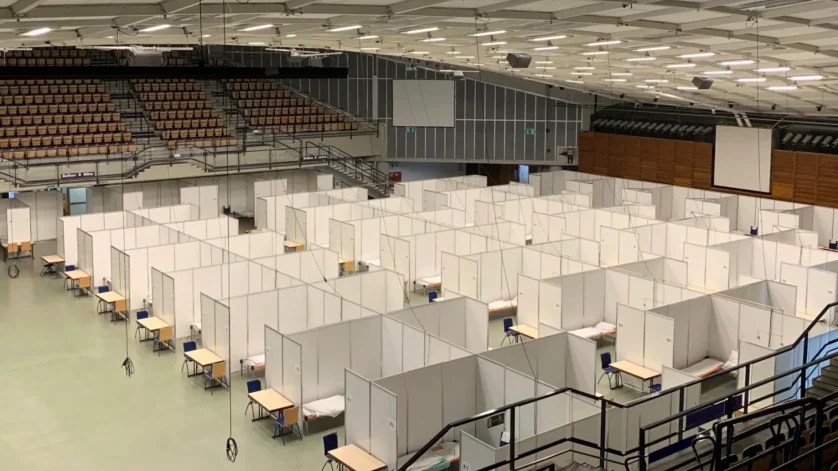
The energy emergency brought about by the traffic-light coalition in Germany’s suicidal sanctions policy for autumn and winter is beginning to take shape. Since politicians under the spell of “green” energy have not succeeded in providing sufficient alternatives to Russian natural gas, the population is preparing for the worst. The first emergency scenarios have been outlined.
In Ludwigshafen, for example, plans are now being made to open up halls in which citizens who can no longer afford to heat their apartments, can gather for a bit of heat. “We are currently preparing for all emergency scenarios with a view to autumn and winter,” said Mayor Jutta Steinruck (SPD). The Friedrich-Ebert-Halle will serve as the “central warm-up station”. There are also reports from Tuttlingen in Swabia and from Heidelberg about planned “heating halls”.
In order to deal with the dire gas shortage, Düsseldorf wants to cut heating in autumn and winter. In the case of hot water, the “availability in kitchens and sanitary facilities” should be reduced, a spokesman for the Bild newspaper said.
But there are also significant restrictions planned for summer. Three of the four indoor swimming pools in Nuremberg will be closed as this should save a total of 1,3 gigawatt hours of energy. “We have to prepare in good time for possible restrictions in the gas supply,” said CSU Mayor König.
Foreign Minister Baerbock (Greens) has been one of the most prominent agitators against Russia in the Ukraine conflict which has resulted in the current energy disaster facing Germany. At the start of the Russian military operation in Ukraine, for example, she announced that the aim of German government policy was to “ruin” Russia.
Her insistence has instead ruined many German households. The Federal Association of German Housing and Real Estate Companies (GdW) has already extrapolated the financial consequences of the exploding energy prices and warned: Single-person households must expect additional costs of almost 1000 euros to around 2700 euros. For four-person households, the association expects additional costs of 1800 euros to around 5000 euros. The above scenario is “rather realistic,” said GdW President Axel Gedaschko.
“We see massive social explosives here,” warned the GdW President. Averaged over all types of energy, a price increase of 37 percent was already achieved by May 2022. For a one-person household, that alone results in an additional burden of 508 euros per year compared to last year.
Information from various energy providers showed the price increases for all energy sources were likely to range between 71 and almost 200 percent, according to the GdW. If the third stage of the gas emergency plan is implemented, there is a risk of gas price increases of up to 400 percent. Because in this case contractual agreements, which have so far protected individual companies from passing on the entire cost increase, could be annulled. “Neither the tenants nor the socially oriented housing companies can afford that,” warned Gedaschko.
Russia claims it destroyed US-made Harpoon launchers in Ukraine
Samizdat | July 12, 2022
The Russian military says it has destroyed more US-made weapons in Ukraine. Several Harpoon anti-ship missile units were targeted by a ground-launched Iskander missile strike in Odessa Region, the defense ministry claimed on Tuesday during a daily briefing.
The report identified the location as being near the village of Berezan, some 20km northwest of the port city of Odessa. It offered no further details about the strike.
Last week, Russia claimed it destroyed two Harpoon missile systems near the village of Liman in the same region with a sea-launched missile strike.
The Harpoon is an anti-ship missile system made by Boeing. Several Western nations have supplied them to Ukraine. Officials in Kiev claimed that the weapon was a game-changer for the balance of military power in the Black Sea.
Some credited the threat posed by Western weapons, including the Harpoon, for Russia’s decision to withdraw from Snake Island two weeks ago. Moscow said it was a goodwill gesture meant to counter Ukrainian allegations that Russia was blocking grain exports from the country.
Stocks of Western-supplied missiles destroyed in Ukraine – Moscow
Samizdat | July 11, 2022
Russian warships have destroyed stocks of US-supplied ammunition, by striking arms depots in Ukraine’s central Dnepropetrovsk Region with Kalibr cruise missiles, the defense ministry said on Monday.
“Stores of ammunition for US-delivered HIMARS multiple rocket launchers and M772 howitzers, as well as for 2S7 Pion self-propelled guns have been destroyed,” Defense Ministry spokesman Lieutenant General Igor Konashenkov said during his daily press briefing.
Konashenkov added that Russian aircraft hit the bases of “nationalist battalions and foreign mercenaries” in the eastern city of Kharkov, killing around 250 fighters and destroying up to 25 military vehicles.
The US promised this month to supply Kiev with four additional HIMARS launchers, bringing the total number sent to Ukraine to 12. Speaking to the Wall Street Journal on Sunday, Ukrainian Defense Minister Alexey Reznikov called them a “game-changer” on the battlefield.
Last week, the Russian Defense Ministry claimed that it had wiped out two HIMARS launchers and two ammunition depots. The Ukrainian military dismissed the report as “fake,” insisting that the US-made launchers were inflicting “colossal” damage and casualties on the “occupying forces.”
Iran detains UK deputy ambassador for alleged spying
Samizdat | July 6, 2022
The UK’s second-most senior diplomat in Tehran is reportedly among three foreigners who have been arrested by Iran’s Islamic Revolutionary Guards Corps (IRGC) for alleged espionage activities.
Giles Whitaker, deputy chief at the UK embassy in Tehran, stands accused of taking soil samples in a restricted area, according to a report on Wednesday by Iranian state television. Video footage released by the IRGC purports to show the veteran envoy, who was accompanied by family members, gathering soil samples in Iran’s central desert, where missile exercises were being conducted.
Whitaker reportedly apologized for the infraction and was expelled from the area. The media report didn’t specify whether he and the other suspects are still under arrest. The other detained men were identified as the husband of Austria’s cultural attaché in Iran and Maciej Walczak, a Polish university professor who was visiting the country under a scientific exchange program.
The IRGC’s footage purported to show Walczak and three colleagues collecting soil samples in a restricted area of Kerman province, where another missile test was being conducted. The Polish professor is reportedly from Nicolaus Copernicus University, which the Iranian broadcaster said is “associated with the Zionist regime.”
The allegations come amid stalled talks to revive the 2015 Iran nuclear deal, which former US President Donald Trump canceled in 2018. Under the so-called Joint Comprehensive Plan of Action (JCPOA) – signed by Iran, the US, Russia, China, the UK, France and Germany – Tehran agreed to limitations preventing nuclear weapons development in exchange for sanctions relief.
Wednesday’s Iranian media report suggested that the alleged spies were trying to help build a new case on “military aspects of Iran’s file in the International Atomic Energy Agency.”
Whitaker has been deputy head of mission at the British embassy in Tehran since November 2018. His UK government career has spanned more than three decades and has included stints at embassies in Moscow, Berlin and Islamabad, as well as at NATO headquarters in Brussels.
The IRGC has arrested dozens of foreigners on espionage charges in recent years. Rob Macaire, then UK ambassador to Iran, was apprehended in January 2020 for allegedly inciting protests over the Iranian military’s accidental downing of a Ukrainian passenger jet.
Israeli agency told to quit operations in Russia as ties hit new low
Press TV – July 6, 2022
The Russian Justice Ministry has asked an Israeli agency to wind down its operations in Russia as the two sides’ ties hit a remarkable new low.
The Jerusalem Post reported the development on Tuesday, citing the “Jewish Agency,” which purportedly handles the affairs of the Jewish people on the Russian soil.
“The order was given in a letter received from the Russian Justice Ministry earlier this week. Officials in the Jewish Agency confirmed that the letter was received,” the report said.
The agency, it added, was trying to coordinate a response in consultation with the Israeli regime’s foreign ministry and Israeli Prime Minister Naftali Bennet’s office.
‘Dramatic order’
The paper described the order handed to the agency as “dramatic.”
It cited a “senior diplomatic official” as making the following remarks concerning the order and Tel Aviv’s potential response to the move.
“Russia is saying the Jewish Agency illegally collected info about Russian citizens… We will bring up the Jewish Agency [with Russian authorities] and address it in an organized way. It will be taken care of at the embassy level.”
“We don’t totally understand the reasoning,” the source claimed.
The daily also said cessation of the agency’s operations in Russia would mean that the Jews would no longer be able to “escape” the country and make their way to the occupied territories.
Relations between Russia and the Israeli regime have gone through dire straits on several occasions since 2018.
The ties were hit with what observers rate as a major crisis in September 2018, when a Russian Il-20 military plane was mistakenly shot down by Syrian air defenses when it was preparing to land in Russia’s Hmeimim airbase in Latakia Province in northwestern Syria. The Syrian S-200 missile defense system was responding to a wave of strikes by four Israeli warplanes.
Moscow blames Tel Aviv for the incident, which killed all the 15 people on board the plane, saying the Israeli warplanes had deliberately “created a dangerous situation” that led to the crash. The Russian military also said the ill-fated plane was used as a cover by the Israeli air force, and that Moscow reserved the right to give a due response.
Tensions flared again between the two sides over the Israeli regime’s recurrent airstrikes against Syria last month after the regime targeted the Damascus International Airport. Russia subsequently summoned the Israeli ambassador to the country, expressing “serious concern” over the strikes that targeted the civilian facility.
And in May, Russian Foreign Minister Sergei Lavrov suggested that Nazi dictator Adolf Hitler had Jewish origins, triggering strong reactions from Tel Aviv. The Israeli foreign ministry said Lavrov’s comments were “ghastly,” and stated that it had summoned Russian Ambassador to Tel Aviv Anatoly Viktorov for “a tough talk” over the statements.
The Russo-Israeli ties have also been suffering as a result of Tel Aviv’s siding with the West over Ukraine, where Russia has been engaged in a special military operation since February, as well as the occupying regime’s agreement with the European Union to supply natural gas as an alternative to Russian energy imports.
Russia responds to reports Turkey detained its ship
Samizdat | July 6, 2022
Moscow has denied reports of Turkish customs seizing or arresting a Russian dry-cargo ship carrying grain near Karasu Port, as Ukrainian officials have claimed.
During a briefing on Wednesday, the deputy director of the Information and Press Department of the Russian Foreign Ministry, Aleksey Zaitsev, stated that the vessel, the Zhibek Zholy, was merely going through all the standard procedures before entering a port.
“According to Russia’s embassy in Turkey, the ship is currently in the roadstead of the port of Karasu and is undergoing standard procedures, including sanitary control,” Zaitsev stated. He further explained that based on the results of these inspections, the Turkish authorities will make a decision on whether or not to let the ship enter the port. Zaitsev noted that no matter the decision, there is absolutely no talk about detention or arrest of the vessel.
The ship’s crew members have also denied being arrested or detained by Turkish officials. Speaking to TASS on Tuesday, one member stated that none of the standard detention procedures have been carried out against the vessel, adding that it is at anchor due to bad weather.
“During a detention procedure, the ship is usually brought into the port under guard, meaning that it should specifically be done under the jurisdiction of Turkey’s guards if something really did happen. No arrest was made. The ship is simply at anchor due to weather conditions. A surveyor arrived on the ship, checked the cargo. This always happens,” the crew member explained.
Ukraine’s ambassador to Turkey, Vasily Bodnar, claimed on July 3 that Turkish customs, at the behest of Kiev, had arrested a Russian cargo ship allegedly carrying “stolen” Ukrainian grain.
According to Reuters, which cited unnamed Ukrainian officials, the Zhibek Zholy, which was traveling to the Turkish port of Karasu from the Russian-held Azov Sea port of Berdiansk, was allegedly loaded with around 4,500 tons of grain.
The outlet also reported that the Ukrainian Prosecutor General’s Office had previously sent a letter to Turkey’s Justice Ministry in late June insisting that the Zkibek Zholy had been involved in the “illegal export of Ukrainian grain,” and allegedly had 7,000 tons of cargo on board. Ukraine reportedly asked Turkey to inspect the vessel and seize samples of grain for forensic examination to determine its origin.
Neither Turkish customs officials nor the authorities in Ankara have given any official comments on the situation regarding the ship so far.
Grain exports by sea from Ukraine, a major producer, were undermined by the ongoing conflict in the country. Kiev has previously accused Russia of “stealing” its grain – which Moscow has denied.
Western nations have accused Russia of blocking the ports. Moscow has repeatedly stated it would guarantee safe passage for the grain shipments if Kiev clears its ports of mines. Ukraine has accused Russian forces of mining the Black Sea ports. Russia suggested exporting the grain through the Russian-controlled ports of Berdiansk and Mariupol.
Russia says it destroyed US HIMARS rocket launchers dubbed ‘powerful tools’ by Kiev
Samizdat | July 6, 2022
Russian forces destroyed two US-made rocket launchers in Donbass, the defense ministry said on Wednesday.
The US provided Kiev with eight High Mobility Artillery Rocket Systems (HIMARS) and ammunition since the beginning of the Russian military offensive in Ukraine, according to a Pentagon fact sheet published on Tuesday.
“In the area of the settlement of Malotaranovka in the Donetsk People’s Republic, high-precision air-launched missiles destroyed two US-made HIMARS multiple launch rocket systems and two ammunition depots for them,” the Russian military said in a statement.
At the end of June, the Lugansk People’s Republic (LPR) said that an М142 HIMARS had been used by Ukrainian forces in Donbass, the first time that local authorities reported the US-supplied systems had been used in combat.
Prior to that, the chief of Ukraine’s General Staff, Valery Zaluzhny, posted a video, purporting to show pro-Kiev forces operating the long-range rocket system.
On June 23, Ukrainian Defense Minister Alexey Reznikov welcomed the arrival of HIMARS and expressed gratitude to his “American colleague and friend Lloyd Austin (the Pentagon chief) for these powerful tools.”
“Summer will be hot for Russian occupiers. And the last one for some of them,” he wrote on Twitter.
Russia has constantly warned the US and its allies against providing Ukraine with weapons saying that it would only lead to the prolongation of the conflict and the creation of long-term problems.
Russian Defense Minister Sergey Shoigu said on Tuesday that some of the foreign weapons intended for Ukraine were spreading throughout the Middle East and are turning up on the black market.
Russia comments on UN Security Council expansion prospects
Samizdat | July 4, 2022
Moscow supports expanding the UN Security Council (UNSC), but not by admitting Germany and Japan, the Russian ambassador to China, Andrey Denisov, said on Monday.
Speaking during the plenary session of the UN World Peace Forum in Beijing, Denisov, whose key statements have been published on the embassy’s social media accounts, claimed that the Security Council has become a place where “the Western colleagues carry out propaganda, presenting their views as the ultimate truth.”
Therefore, he argued, there is a pressing need to reform the UN.
“Our country is in favor of expanding the composition of the UN Security Council on the basis of a broad consensus. To do this, it is necessary to increase the share of African, Asian and Latin American states,” Denisov said, explaining that this would make the council “more democratic.”
He added that Russia is open to the idea of membership for India and Brazil, but not Germany and Japan, “since this will not change the internal balance in any way.”
His remarks followed multiple calls from Ukrainian President Volodymyr Zelensky to strip Russia of its membership, amid Moscow’s military operation in his country. The US, however, has repeatedly made it clear that Russia will remain a permanent member of the UNSC, as there is no way to exclude the country.
There have been discussions about increasing the number of permanent Security Council members since the approval of the UN Charter in 1945. Brazil, Germany, India, and Japan have made the strongest demands.
The UNSC, whose primary responsibility is “the maintenance of international peace and security,” is the only UN body authorized to issue binding resolutions on member states.
Its five permanent members – China, France, Russia, the UK, and US – can block any resolution. The bloc of Western democratic and generally aligned permanent members – France, the UK, and US – is often called the ‘P3’.
Featured Video

America Racing to Strategic Defeat in Iran
or go to
Aletho News Archives – Video-Images
From the Archives
Should Europeans ‘Thank’ the Americans for Destroying Nord Stream?
By Robert Bridge | Strategic Culture Foundation | September 29, 2022
With an investigation continuing into the destruction of the Nord Stream gas pipeline that provided energy supplies to Europe from Russia, there appears to be just one prime suspect, and that should surprise nobody.
Following the sabotage of the Nord Stream 1 and 2 gas pipelines, former Polish Foreign Minister Radoslaw Sikorski already seemed to know the identity of the perpetrator when he tweeted out: “Thank you, USA.”
At first glance, it seemed that Sikorski was speaking sarcastically, berating Washington for carrying out an attack that will have severe repercussions for the people of Europe. After all, how could anyone see any good coming from the termination of Europe’s primary source of gas reserves with winter just around the corner? It was Sikorski’s homeland of Poland, after all, that urged its citizens to collect firewood in the face of dwindling gas reserves.
In fact, the Polish diplomat was speaking one-hundred percent literally… continue
Blog Roll
 Aletho News
- Growing insecurity, soaring prices fuel protests in north as regime bans evacuation: Sources
- Iran denies responsibility for ‘depraved’ attack on Kuwait desalination plant
- Bring The Troops Back. End This War Now!
- Can we please stop calling Israel the ‘only democracy in the Middle East’ now?
- US should start removing its troops for Germany, proposes AfD co-leader Chrupalla
- Iran Red Crescent: 600 educational centers attacked in US-Israeli ‘war crimes’
- Russian Oil Tanker Arrives in Cuba Amid U.S. Blockade
- America Racing to Strategic Defeat in Iran: Lt Col Daniel Davis
- FTC Warns Visa, Mastercard, PayPal, Stripe Over Political Debanking
- Russian tanker approaches Cuba despite US oil blockade
- If Americans Knew
- Israeli police block Catholic cardinal from entering Church of the Holy Sepulchre on Palm Sunday
- Israel is assassinating journalists again, more than any other nation, anywhere, ever – Not a ceasefire Day 170
- Over 300 US service members wounded, majority have brain injuries – Not a ceasefire Day 169
- Researchers at Human Rights Watch Resign Over Blocked Report on Palestinian Refugee Return
- Jewish Groups Are Backing a War Americans Don’t Want
- Eric Fingerhut Thinks He’s the President of the Jews
- Top Jewish Philanthropists, Rabbis Urge Israeli President to Take Action Against ‘Jewish Extremists’
- Don’t Be Fooled. Zionist Leaders Have Always Wanted to Control Southern Lebanon
- Israel’s widespread use of torture is a core element of its genocide against the Palestinian people
- In Israel’s War on Iran, Many Middle East US Bases Rendered “All But Uninhabitable”
- No Tricks Zone
- New Study Finds Warming Saves Lives…Cold Temperatures 12 Times More Deadly Than Excess Heat
- German Science Blog Accuses PIK Climate Institute Of Hallucinating Climate Tipping Points
- Devastating Assessment Of Comirnaty Vaccine By Former Senior Pfizer Europe Toxicologist
- New Study: CO2 Is ‘Effectively Negligible’ As An Explanatory Climate Change Factor Since 2000
- Former Pfizer Toxicologist Dr. Helmut Sterz Tells Bundestag Hearing Pfizer Vaccine Should Have Never Been Approved
- Energy Expert: Germany’s Nuclear Phaseout Was A “500 Billion Euro Mistake”
- New Research: South Australia’s Mid-Holocene Sea Surface Temperatures Were 4°C Warmer Than Today
- Storing Green Energy To Last Germany 10 Days Would Require A 60-Million Tonne Battery
- New Studies: UK Sea Levels Were 4 Meters Higher Than Today During The Mid-Holocene
- Destructive Green New Deal: German Energy And Metal Group Warns Of Drastic Crisis
 Aletho News