Russia warns of ‘direct military clash’ with US
Samizdat | August 16, 2022
Washington’s behavior on the world stage risks direct conflict between the nuclear states, the Russian embassy in the US has warned.
“Today, the United States continues to act with no regard to other countries’ security and interests, which contributes to an increase in nuclear risks,” the embassy said in a statement on its Telegram channel.
“The [US’] steps to further engage in a hybrid confrontation with Russia in the context of the Ukrainian crisis are fraught with unpredictable escalation and a direct military clash of nuclear powers.”
The embassy noted that Washington has recently withdrawn from two key arms control agreements, the 1987 Intermediate Range Nuclear Forces Treaty, which banned certain classes of land-based missiles, and the 1992 Treaty on Open Skies, which allowed for surveillance flights over each other’s territories.
The embassy urged the US to “take a closer look at its own nuclear policy instead of making unfounded accusations against the countries whose worldviews do not coincide with the American ones.”
“Our country faithfully fulfills its obligations as a nuclear-weapon state and makes every effort to reduce nuclear risks,” the diplomats said.
The statement comes after the US accused Moscow of using the Zaporozhye nuclear power plant in southern Ukraine as cover for its soldiers. The plant, the largest in Europe, was seized by Russian troops during the early stages of Moscow’s military operation in Ukraine, which was launched in late February. It continues to operate with Ukrainian personnel under Russian control.
US Secretary of State Antony Blinken called Russia’s action at the facility “the height of irresponsibility.” Russia and Ukraine, meanwhile, have been accusing each other of shelling the plant. According to Moscow, artillery fire by Ukrainians forces caused several fires and partial power outages this month.
Russia initiated a UN Security Council meeting last week regarding the situation around the Zaporozhye power plant. Russian envoy Vassily Nebenzia said that Moscow supports the International Atomic Energy Agency (IAEA) to inspect the facility as quickly as possible.
NYC to Close “Toddler COVID Vaccine Sites” — due to NO DEMAND
By Igor Chudov | August 13, 2022
Great news! New York City is closing “Infant COVID Vaccination Sites”, citing lack of demand, next week!
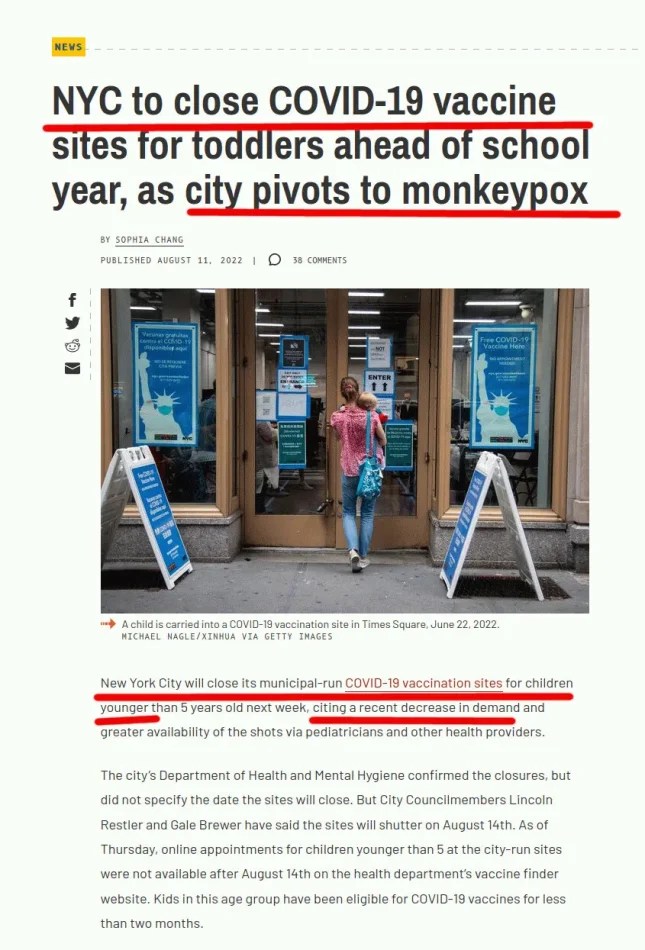
In effect, New York is really forced to do the same thing as DeSantis did in Florida — it is closing vaccination clinics for infants, which DeSantis never even opened. While in Florida it was done thanks to the Governor, in New York it happened because parents refused to give their children the Covid vaccine.
The ridiculous explanation NYC gave, is that they are “pivoting to monkeypox”.
This is a huge win for New Yorkers and for people everywhere.
This also means that our anti-Covid-vax activity, broadly speaking, is NOT a waste of time. Mind you, the media keeps lying, as usual. The New York Times, the most important newspaper in New York, is mum about this closure. Google does not show any articles about it except the one I quoted, either.
But people noticed and the public opinion has turned from most people wanting COVID vaccines a year ago to 90% not wanting any extra doses. It did not just happen by itself. We made it happen.
I want to thank my readers who shared my anti-Covid-vaccine-for-babies articles like crazy. That helped, perhaps to a very tiny extent, to warn parents of the danger of giving their kids Covid vaccines.
If people like us did not spread it, nobody would know the truth!
NEJM: COVID booster significantly delays end of infection
31% boosted people still contagious 10 days post-infection vs. 6% unvaccinated
By Rabinovitz | July 10, 2022
A new study published in the New England Journal of Medicine has demonstrated that people who are triple-vaccinated (boosted) against COVID recover significantly more slowly from COVID infection and remain contagious for longer than people who are not vaccinated at all.
The study did not deal with the severity of illness with or without a vaccine.
Researchers swabbed infected people and cultured the swabs, repeating the process for over two weeks until viral replication was not observed.
At five days post-infection, less than 25 percent of unvaccinated people were still contagious, whereas around 70 percent of boosted people were still carrying viable virus particles. For those partially vaccinated, around 50 percent were still contagious at this point.
Even more strikingly, at ten days post-infection, one-third of boosted people (31 percent) were found to still be carrying live, culturable virus. By contrast, just six percent of unvaccinated people were still contagious at day 10.
In other words, people who have received a booster shot are five times more likely still to be contagious at ten days post-infection than are unvaccinated people.
The findings go a long way to explaining why Paxlovid, Pfizer’s anti-viral medication, is often not effective for people who have been vaccinated against COVID, with many experiencing a recurrence of symptoms along with a positive COVID test after completing the five-day regimen (as recently occurred with quadruple-vaccinated Dr. Anthony Fauci). This phenomenon is known as COVID rebound.
Meanwhile, Israeli Health Ministry data shows that in the older population (those over the age of 60), having submitted to more COVID shots often correlates to a greater likelihood of becoming infected with COVID.

Israel Ministry of Health
The blue line represents the unvaccinated; light-green is the partially-vaccinated; dark-green is those who have received a booster shot within the past six months.
Biden’s Bounty on Your Life: Hospitals’ Incentive Payments for COVID-19
THE SEVEN US GOVERNMENT PAYOFFS TO KILL YOU IN HOSPITALS BY DR. PETERSON PIERRE
By Elizabeth Lee Vliet, M.D. and Ali Shultz, J.D. | November 17, 2021
Upon admission to a once-trusted hospital, American patients with COVID-19 become virtual prisoners, subjected to a rigid treatment protocol with roots in Ezekiel Emanuel’s “Complete Lives System” for rationing medical care in those over age 50. They have a shockingly high mortality rate. How and why is this happening, and what can be done about it?
As exposed in audio recordings, hospital executives in Arizona admitted meeting several times a week to lower standards of care, with coordinated restrictions on visitation rights. Most COVID-19 patients’ families are deliberately kept in the dark about what is really being done to their loved ones.
The combination that enables this tragic and avoidable loss of hundreds of thousands of lives includes (1) The CARES Act, which provides hospitals with bonus incentive payments for all things related to COVID-19 (testing, diagnosing, admitting to hospital, use of remdesivir and ventilators, reporting COVID-19 deaths, and vaccinations) and (2) waivers of customary and long-standing patient rights by the Centers for Medicare and Medicaid Services (CMS).
In 2020, the Texas Hospital Association submitted requests for waivers to CMS. According to Texas attorney Jerri Ward, “CMS has granted ‘waivers’ of federal law regarding patient rights. Specifically, CMS purports to allow hospitals to violate the rights of patients or their surrogates with regard to medical record access, to have patient visitation, and to be free from seclusion.” She notes that “rights do not come from the hospital or CMS and cannot be waived, as that is the antithesis of a ‘right.’ The purported waivers are meant to isolate and gain total control over the patient and to deny patient and patient’s decision-maker the ability to exercise informed consent.”
Creating a “National Pandemic Emergency” provided justification for such sweeping actions that override individual physician medical decision-making and patients’ rights. The CARES Act provides incentives for hospitals to use treatments dictated solely by the federal government under the auspices of the NIH. These “bounties” must be paid back if not “earned” by making the COVID-19 diagnosis and following the COVID-19 protocol.
The hospital payments include:
- A “free” required PCR test in the Emergency Room or upon admission for every patient, with government-paid fee to hospital.
- Added bonus payment for each positive COVID-19 diagnosis.
- Another bonus for a COVID-19 admission to the hospital.
- A 20 percent “boost” bonus payment from Medicare on the entire hospital bill for use of remdesivir instead of medicines such as Ivermectin.
- Another and larger bonus payment to the hospital if a COVID-19 patient is mechanically ventilated.
- More money to the hospital if cause of death is listed as COVID-19, even if patient did not die directly of COVID-19.
- A COVID-19 diagnosis also provides extra payments to coroners.
CMS implemented “value-based” payment programs that track data such as how many workers at a healthcare facility receive a COVID-19 vaccine. Now we see why many hospitals implemented COVID-19 vaccine mandates. They are paid more.
Outside hospitals, physician MIPS quality metrics link doctors’ income to performance-based pay for treating patients with COVID-19 EUA drugs. Failure to report information to CMS can cost the physician 4% of reimbursement.
Because of obfuscation with medical coding and legal jargon, we cannot be certain of the actual amount each hospital receives per COVID-19 patient. But Attorney Thomas Renz and CMS whistleblowers have calculated a total payment of at least $100,000 per patient.
What does this mean for your health and safety as a patient in the hospital?
There are deaths from the government-directed COVID treatments. For remdesivir, studies show that 71–75 percent of patients suffer an adverse effect, and the drug often had to be stopped after five to ten days because of these effects, such as kidney and liver damage, and death. Remdesivir trials during the 2018 West African Ebola outbreak had to be discontinued because death rate exceeded 50%. Yet, in 2020, Anthony Fauci directed that remdesivir was to be the drug hospitals use to treat COVID-19, even when the COVID clinical trials of remdesivir showed similar adverse effects.
In ventilated patients, the death toll is staggering. A National Library of Medicine January 2021 report of 69 studies involving more than 57,000 patients concluded that fatality rates were 45 percent in COVID-19 patients receiving invasive mechanical ventilation, increasing to 84 percent in older patients. Renz announced at a Truth for Health Foundation Press Conference that CMS data showed that in Texas hospitals, 84.9% percent of all patients died after more than 96 hours on a ventilator.
Then there are deaths from restrictions on effective treatments for hospitalized patients. Renz and a team of data analysts have estimated that more than 800,000 deaths in America’s hospitals, in COVID-19 and other patients, have been caused by approaches restricting fluids, nutrition, antibiotics, effective antivirals, anti-inflammatories, and therapeutic doses of anti-coagulants.
We now see government-dictated medical care at its worst in our history since the federal government mandated these ineffective and dangerous treatments for COVID-19, and then created financial incentives for hospitals and doctors to use only those “approved” (and paid for) approaches.
Our formerly trusted medical community of hospitals and hospital-employed medical staff have effectively become “bounty hunters” for your life. Patients need to now take unprecedented steps to avoid going into the hospital for COVID-19.
Patients need to take active steps to plan before getting sick to use early home-based treatment of COVID-19 that can help you save your life.
Denmark bans vaccine for youth under 18
By Mike Campbell | The Counter Signal | August 9, 2022
Denmark has announced that people under the age of 18 are no longer allowed to get the COVID vaccine.
Those wanting their first shot were cut off after July 1, and no one in the age group — aside from those who are considered “high risk” and have a doctor’s note — will be allowed to get a second shot after September 1.
“Children and adolescents only very rarely become seriously ill from COVID-19 with the omicron variant. Therefore, from July 1, 2022, it will no longer be possible for children and adolescents under the age of 18 to get the 1st [shot], and from September 1, 2022, it will no longer be possible to get the 2nd [shot],” reads a government statement. [translated from Danish]
While many are likely relieved because it means that vaccine mandates won’t be coming back to school, few have followed Denmark’s lead, and if the science is universal, it’s a wonder why they haven’t.
For example, despite this decision from Denmark, babies are now eligible to receive three rounds of Moderna’s Covid vaccine in Canada, even though COVID poses no greater threat to babies than the flu does, and Health Canada admits they lack long-term safety data.
Moreover, various health authorities have recently highlighted the risks of adverse effects that exist from the COVID vaccines.
Germany’s ministry of health recently tweeted there’s a 1 in 5000 chance people receive a “serious adverse effect” from the vaccines.
This came just days after Ontario’s CMHO refused to say healthy people “should” get boosted with what he referred to as a “therapeutic” due to the risk of myocarditis being 1 in 5000.
While it seems that more and more authorities are warning of the risks of vaccines — which, according to Denmark, are greater than the risk of COVID for the young and healthy — few countries are willing to say outright that the risks outweigh the benefits.
Russia suspends US inspections of nuclear military sites
Samizdat | August 8, 2022
Moscow has informed Washington of a “temporary withdrawal” from the inspection regime under the START nuclear disarmament treaty, the Russian Foreign Ministry said on Monday. Citing treaty provisions for “exceptional circumstances,” Russia is saying the Western sanctions have prevented its inspectors from performing their duties, thus giving US inspectors an unfair advantage. Once the principle of parity and equality is restored, the inspections will resume, Russia said.
Moscow cited “anti-Russian unilateral restrictive measures” imposed by the US and its allies, such as visa restrictions on Russian inspectors and a ban on Russian aircraft in US and EU airspace. These restrictions effectively make Russian inspections under the treaty impossible, while the Americans “do not experience such difficulties.”
“The Russian Federation is now forced to resort to this measure as a result of Washington’s persistent desire to implicitly achieve a restart of inspection activities on conditions that do not take into account existing realities, create unilateral advantages for the United States and effectively deprive the Russian Federation of the right to carry out inspections on American soil,” the Foreign Ministry said.
Russia “raised this issue with the relevant countries, but did not receive an answer.” Until these problems are resolved, “it would be premature to resume inspection activities under the START Treaty, on which the American side insists.”
As justification for the measure, Moscow cited the relevant section of the treaty protocol that covers extraordinary circumstances. Washington has been officially informed through diplomatic channels.
“We would like to emphasize that the measures we have taken are temporary. Russia is fully committed to complying with all the provisions of the START Treaty, which in our eyes is the most important instrument for maintaining international security and stability,” the Russian Foreign Ministry said.
As soon as the “existing problematic issues” are resolved, the inspections can resume again in full, according to Moscow.
The New Strategic Arms Reduction Treaty (known as New START) went into effect in 2011, and limits the number of nuclear warheads and their delivery vehicles that the US and Russia are allowed to possess. It is the only remaining arms control agreement between the two nuclear powers, after the US withdrawal from the INF and Open Skies treaties in recent years. New START almost expired before it was extended in February 2021, and is supposed to remain in effect until 2026.
Though US President Joe Biden said he had offered Russia talks on a new treaty, which would include China as well, Moscow said last week that it had received only “declarative statements” and not concrete proposals.
Zaporozhye Region Announces Vote on Joining Russia
Samizdat | August 8, 2022
Zaporozhye Region will hold a referendum on whether to secede from Ukraine and request joining Russia, the head of its administration announced on Monday.
Evgeny Balitskiy said that he had signed an order to organize the plebiscite during a regional forum held in the city of Melitopol. Over 700 representatives from various parts of the Ukrainian region approved the idea, according to RIA Novosti.
Earlier comments by administration officials indicated the referendum may be held as soon as mid-September.
Russian forces took partial control of the region during the initial offensive against Ukraine launched in late February. The eponymous city located in the north of the region on the Dnepr River remains under Ukrainian control.
Officials in Kherson Region, another Russia-controlled part of Ukraine, voiced similar plans to put to a vote the proposal of breaking away from Kiev and seeking to join Russia.
Ukrainian President Vladimir Zelensky on Sunday reiterated a warning that if the two regions go through with their plans, Kiev will break off all talks with Russia. Moscow in response suggested that the Ukrainian president should address the citizens of those regions.
“The thing is, this is what the residents of the region plan. It’s not like we [Russia] are holding a referendum. Here, apparently, it is necessary to understand to whom Zelensky is addressing this statement – to the citizens of Ukraine of the mentioned regions or to the citizens of Russia? If it’s to the citizens and leadership of Russia, then we are the wrong address,” Kremlin spokesman Dmitry Peskov commented on Monday.
There have been no peace talks between Russia and Ukraine for months, as Kiev rejected such contacts and claimed it would only negotiate after defeating Russian on the battlefield with the help of Western military aid.
Before the talks broke off, the two nations appeared to have made progress in resolving their differences. During a meeting in Istanbul in late March, Kiev had pledged to become a neutral country and accept restrictions on its military. Moscow said it prepared a draft peace agreement based on those proposals, but Ukraine never responded.
An indirect Russian-Ukrainian deal was mediated last month by the UN and Turkey to allow grain exports from three Ukrainian ports to resume via the Black Sea. The scheme was formalized in two separate agreements that were signed by Russia and Ukraine with the other two parties.
Russia sent troops into Ukraine on February 24, citing Kiev’s failure to implement the Minsk agreements, designed to give the regions of Donetsk and Lugansk special status within the Ukrainian state. The protocols, brokered by Germany and France, were first signed in 2014. Former Ukrainian President Pyotr Poroshenko has since admitted that Kiev’s main goal was to use the ceasefire to buy time and “create powerful armed forces.”
In February 2022, the Kremlin recognized the Donbass republics as independent states and demanded that Ukraine officially declare itself a neutral country that will never join any Western military bloc. Kiev insists the Russian offensive was completely unprovoked.
Russia offers monthly donation of 40,000 tons of wheat for Lebanon
Lebanon has been dealing with bread shortages over recent months, in the latest dilemma to hit the crisis-hit nation
The Cradle | August 6, 2022
The Russian Ambassador to Lebanon, Alexander Rudakov, has reportedly obtained initial approval from Moscow to provide Lebanon with a donation of 40,000 tons of wheat per month until the end of the year.
This deal could be extended past December to help the Levantine nation overcome a worsening food crisis, according to information obtained by Al-Akhbar.
Russia’s offer comes just days after Beirut cleared the Syrian-owned Laodicea vessel to depart the port of Tripoli, despite protests from the Ukrainian embassy, which claimed the ship was carrying “stolen grain.”
However, customs officials revealed to The Cradle that the ship’s grain cargo originated in Russia.
Lebanon’s top prosecutor allowed the ship to leave after revealing Kiev failed to present evidence to back their claim of theft against Russia and Syria.
Before the ship’s release, the Ukrainian embassy offered to retract their claim if Beirut paid them for the Russian grain.
Since 2019, Lebanon has been faced with the dire consequences of a severe economic meltdown.
The situation has pushed over 80 percent of the population below the poverty line and all but wiped out the value of the local currency.
Lebanon used to import as much as 80 percent of its wheat from Ukraine, but since the start of the Russian war, it now faces a major food crisis.
Another factor that limits Lebanon’s wheat supply is the destruction of the country’s grain silos during the Beirut Port blast of 2020 — considered to be the largest non-nuclear explosion in history.
As all of this unfolds inside the country, Lebanon is facing a serious threat of war from Israel; the two nations are mired in a dispute for control of an offshore gas field that could provide billions in revenue.
Ukrainian city launches witch hunt for ‘disloyal’ residents
Samizdat | August 7, 2022
The southern Ukrainian city of Nikolaev resorted to drastic measures this weekend to expose what the local authorities call “collaborators” and “separatists” – people who harbor pro-Russian sentiments or help Moscow’s forces in any way.
On Friday, the head of the local military administration, Vitaly Kim, placed the entire city – home to almost half a million people before the start of the Russian military operation – on a two-day lockdown. Kim announced a “prolonged curfew,” which came into force Friday evening and is expected to last until Monday.
During this time, residents of Nikolaev are prohibited from going outside or visiting any public places without special permits. In case of an emergency, a police escort is provided, Ukrainian news agency UNIAN said.
Law enforcement agencies will use this time to search for “collaborators” and “separatists,” Anna Zamazeeva, the head of the Nikolaev regional council, said. The operation is already in full swing, and the police will reveal the results no sooner than Monday, according to the official.
“All Nikolaev residents are undergoing checks now,” she told UNIAN on Saturday. Those who planned to leave the city and bought train or bus tickets in advance were allowed to leave, the official said, adding that they were checked at security outposts on their way out.
According to Zamazeeva, police are conducting door-to-door searches in apartments throughout the city. “They are searching everyone; check the ID, mobile phones, everything,” she said.
The official argued that the “collaborators” would be much safer behind bars since locals could “lynch” them if the police simply reveal their identity. “It is better for them to remain in prison until we win,” she added.
Earlier, Kim offered $100 to anyone that provides information about “spotters” – people that Ukrainian officials believe supply target coordinates to Russian artillery and aviation. Earlier, the local authorities reported they had detained at least four spotters.
On Tuesday, Russian forces reported striking a temporary base of the Ukrainian International Legion near the city of Nikolaev, using high-precision weapons. Up to 250 foreign mercenaries were killed in the attack, according to the report.
Russia sent troops into Ukraine on February 24, citing Kiev’s failure to implement the Minsk agreements, designed to give the regions of Donetsk and Lugansk special status within the Ukrainian state. The protocols, brokered by Germany and France, were first signed in 2014. Former Ukrainian President Pyotr Poroshenko has since admitted that Kiev’s main goal was to use the ceasefire to buy time and “create powerful armed forces.”
In February 2022, the Kremlin recognized the Donbass republics as independent states and demanded that Ukraine officially declare itself a neutral country that will never join any Western military bloc. Kiev insists the Russian offensive was completely unprovoked.
Ghoulishly clever psyop pits our own defense mechanisms against us
By Meryl Nass, MD | August 6, 2022
1. Multiple papers now suggest that COVID mRNA vaccines impair not just immunity to COVID, but immunity and immune surveillance overall.
The implication is that the vaxxed are more susceptible to a variety of infections, and perhaps also to cancer. Immune surveillance is what identifies cancer cells and kills them before they can proliferate.
So, you are vaccinated. The implications of this information are too frightening to be allowed into consciousness. You don’t need the external censors to suppress this knowledge; you do it automatically with your built-in defense mechanisms.
2. Data from multiple countries now shows that all cause mortality (deaths from everything) are higher in the vaccinated.
This is just as scary, if not more so, than an increased risk of serious infections and cancer. You deny and/or suppress this information, because it simply cannot be allowed to be true.
3. You vaccinated your child. This may have impaired their fertility, increased the cancer risk, etc. etc. etc.
Of all pieces of information that absolutely cannot be allowed to enter your consciousness, let alone be openly discussed in polite company, this one tops all. So you will simply refuse to allow mention of it. Friends whose conversations veer off in this direction must be obliterated. Requiring that all family members and friends be vaccinated protects you from facing those for whom this discussion does not trigger the existential and uncontrollable pain it does for the vaccinated.
And Voila — you have a controlled and cowed population who have become their own thought police.
U.S. Declares Monkeypox Health Emergency, FDA Offers Vaccine to Some Kids Despite No Clinical Trials
By Megan Redshaw | The Defender | August 5, 2022
The U.S. declared monkeypox a public health emergency to raise awareness and allow for additional funding to fight the disease’s spread, U.S. Department of Health and Human Services Secretary Xavier Becerra said on Thursday.
“We’re prepared to take our response to the next level in addressing this virus, and we urge every American to take monkeypox seriously and to take responsibility to help us tackle this virus,” Becerra said.
Becerra said he also is considering a second declaration that would allow federal officials to expedite medical countermeasures — such as potential treatments and vaccines — designed to ensure drugs are safe and effective.
President Biden said in a tweet he remained “committed to our monkeypox response: ramping-up vaccine distribution, expanding testing, and educating at-risk communities.”
“That’s why today’s public health emergency declaration on the virus is critical to confronting this outbreak with the urgency it warrants,” Biden said.
The last time the U.S. declared a public health emergency was in January 2020, for COVID-19.
According to the Centers for Disease Control and Prevention (CDC), more than 7,100 cases of monkeypox have been reported in the U.S., including five cases in children.
Symptoms of monkeypox infection are usually mild and include fever, rash and swollen lymph nodes, and occasionally intense headache, back pain, muscle aches, lack of energy and skin eruptions that can cause painful lesions, scabs or crusts.
The virus is rarely fatal and no deaths have been reported in the U.S.
Monkeypox primarily is spread through skin-to-skin contact during sex and affects mostly gay and bisexual men, public health officials say, although the virus can affect anyone.
According to the CDC, about 98% of monkeypox patients who provided demographic information to clinics identified as men who have sex with men.
Public health emergency paves way for vaccine for kids
Now that the Biden administration has declared the monkeypox outbreak a public health emergency, the U.S. Food and Drug Administration (FDA) can move to issue an Emergency Use Authorization for the JYNNEOS vaccine for children under 18.
There are two vaccines that may be used “for the prevention” of monkeypox virus infection: JYNNEOS — also known as Imvamune or Imvanex — and ACAM2000, which is licensed by the FDA for use against smallpox and “made available for use against monkeypox under an Expanded Access Investigational New Drug application.”
The FDA told ABC News on Thursday that while the current monkeypox vaccine, JYNNEOS, is approved only for adults ages 18 and older, it will be available for kids on a case-by-case basis.
The JYNNEOS vaccine, delivered in a two-dose series, was not tested through clinical trials in children.
However, the FDA confirmed to ABC News that “numerous” children have been granted access to the vaccine through a special permission process, but declined to state exactly how many children have received the vaccine to date through this process.
“If a doctor decides a person under 18 was exposed to monkeypox and the benefit of the vaccine is greater than any potential risk, they can submit a request to the FDA,” ABC News reported.
According to the CDC, the “immune response” takes “14 days after the second dose of JYNNEOS and 4 weeks after the ACAM2000 dose for maximal development.”
The CDC website also states: “No data are available yet on the effectiveness of these vaccines in the current outbreak.”
According to the latest data from the Vaccine Adverse Event Reporting System (VAERS), between June 14 and July 21, 2022, 31 adverse events were reported following vaccination with JYNNEOS — manufactured by Bavarian Nordic.
The World Health Organization (WHO) declared monkeypox a global health emergency after more than 26,000 cases were reported across 87 countries.
A global emergency is the WHO’s highest level of alert, but the designation does not necessarily mean a disease is particularly transmissible or lethal.
The U.S. makes up 25% of confirmed cases globally although the U.K. was the first to alert the world to the outbreak in May after confirming several cases.
A monkeypox fictional simulation was held in March 2021
As The Defender reported in May, the Nuclear Threat Initiative, in conjunction with the Munich Security Conference, in March 2021 held a “tabletop exercise on reducing high-consequence biological threats,” involving an “unusual strain of monkeypox virus that first emerged in the fictional nation of Brinia and spread globally over 18 months.”
This is similar to “Event 201,” a “high-level pandemic exercise” organized by the Johns Hopkins Center for Health Security, along with the World Economic Forum and the Bill & Melinda Gates Foundation — just weeks before the COVID-19 outbreak — that mirrored what later followed with COVID-19 pandemic.
According to the Nuclear Threat Initiative, the monkeypox exercise, which was “developed in consultation with technical and policy experts,” brought together “19 senior leaders and experts from across Africa, the Americas, Asia, and Europe with decades of combined experience in public health, biotechnology industry, international security, and philanthropy.”
The fictional start date of the monkeypox pandemic in this exercise was May 15, 2022. The first European case of monkeypox was identified on May 7, 2022.
Key participants in the simulation included Johnson & Johnson and Janssen, the Bill & Melinda Gates Foundation, the Chinese Centers for Disease Control and Prevention, the Nuclear Threat Initiative, GAVI — the Vaccine Alliance, Merck and the WHO.
Several of the participants listed above also “participated” in Event 201.
Megan Redshaw is a staff attorney for Children’s Health Defense and a reporter for The Defender.
© 2022 Children’s Health Defense, Inc. This work is reproduced and distributed with the permission of Children’s Health Defense, Inc. Want to learn more from Children’s Health Defense? Sign up for free news and updates from Robert F. Kennedy, Jr. and the Children’s Health Defense. Your donation will help to support us in our efforts.
The Intricate Fight for Africa: the Legacy of the Soviet Union vs. Western Colonialism
By Ramzy Baroud | MEMO | August 6, 2022
Russian Foreign Minister Sergey Lavrov’s recent tour in Africa was meant to be a game changer, not only in terms of Russia’s relations with the continent, but in the global power struggle involving the US, Europe, China, India, Turkiye and others.
Many media reports and analyses placed Lavrov’s visit to Egypt, the Republic of Congo, Uganda and Ethiopia within the obvious political context of the Russia-Ukraine war. The British Guardian’s Jason Burka summed up Lavrov’s visit in these words: “Lavrov is seeking to convince African leaders and, to a much lesser extent, ordinary people that Moscow cannot be blamed either for the conflict or the food crisis.”
Though true, there is more at stake.
Africa’s importance to the geostrategic tug of war is not a new phenomenon. Western governments, think tanks and media reports have, for long, allocated much attention to Africa due to China’s and Russia’s successes in altering the foreign policy map of many African countries. For years, the West has been playing catch up, but with limited success.
The Economist discussed ‘the new scramble for Africa’ in a May 2019 article, which reported on “governments and businesses from all around the world” who are “rushing” to the continent in search of “vast opportunities” awaiting them there. Between 2010 and 2016, 320 foreign embassies were opened in Africa which, according to the magazine, is “probably the biggest embassy-building boom, anywhere, ever.”
Though China has often been portrayed as a country seeking economic opportunities only, the nature and evolution of Beijing’s relations with Africa prove otherwise. Beijing is reportedly the biggest supplier of arms to sub-Saharan Africa, and its defence technology permeates almost the entire continent. In 2017, China established its first military base in Djibouti in the Horn of Africa.
Russia’s military influence in Africa is also growing exponentially, and Moscow’s power is challenging that of France, the US and others in various strategic spaces, mainly in the East Africa regions.
But, unlike the US and other western states, countries like China, Russia and India have been cautious as they attempt to strike the perfect balance between military engagement, economic development and political language.
Quartz Africa reported that trade between Africa and China “rose to a record high” in 2021. The jump was massive: 35 per cent between 2020 and 2021, reaching a total of $254 billion.
Now that Covid-19 restrictions have been largely lifted, trade between Africa and China is likely to soar to astronomical levels in the coming years. Keeping in mind the economic slump and potential recession in the West, Beijing’s economic expansion is unlikely to slow down, despite the obvious frustration of Washington, London and Brussels. It ought to be said that China is already Africa’s largest trade partner, and by far.
Russia-China-Africa’s strong ties are paying dividends on the international stage. Nearly half of the abstentions in the vote on United Nations Resolution ES-11/1 on 2 March, condemning Russia’s military action in Ukraine, came from Africa alone. Eritrea voted against it. This attests to Russia’s ability to foster new alliances on the continent. It also demonstrates the influence of China – Russia’s main ally in the current geopolitical tussle – as well.
Yet, there is more to Africa’s position than mere interest in military hardware and trade expansion. History is most critical.
In the first ‘scramble for Africa’, Europe sliced up and divided the continent into colonies and areas of influence. The exploitation and brutalisation that followed remain one of the most sordid chapters in modern human history.
What the Economist refers to as the ‘second scramble for Africa’ during the Cold War era was the Soviet Union’s attempt to demolish the existing colonial and neo-colonial paradigms established by western countries throughout the centuries.
The collapse of the Soviet Union over three decades ago changed this dynamic, resulting in an inevitable Russian retreat and the return to the uncontested western dominance. That status quo did not last for long, however, as China and, eventually, Russia, India, Turkiye, Arab countries and others began challenging western supremacy.
Lavrov and his African counterparts fully understand this context. Though Russia is no longer a Communist state, Lavrov was keen on referencing the Soviet era, thus the unique rapport Moscow has with Africa, in his speeches. For example, ahead of his visit to Congo, Lavrov said in an interview that Russia had “long-standing good relations with Africa since the days of the Soviet Union.”
Such language cannot be simply designated as opportunistic or merely compelled by political urgency. It is part of a complex discourse and rooted superstructure, indicating that Moscow – along with Beijing – is preparing for a long-term geopolitical confrontation in Africa.
Considering the West’s harrowing colonial past, and Russia’s historic association with various liberation movements on the continent, many African states, intelligentsias and ordinary people are eager to break free from the grip of western hegemony.
Featured Video

Iran FM Araghchi: “Hormuz Will No Longer Be the Same”
or go to
Aletho News Archives – Video-Images
From the Archives
Sam Husseini: The entire US establishment helped lie their way into the Iraq war
By Slava Zilber | American Herald Tribune | October 14, 2019
Sam Husseini is a senior analyst with the Institute for Public Accuracy, independent journalist and contributor to The Nation and FAIR.
Slava Zilber: Sam, three years ago, you appeared on Talk Nation Radio with David Swanson and spoke about the case of the GCHQ whistleblower Katharine Gun. You pointed out that the people involved in the spying on the UN and the people authorizing the Iraq War were not held accountable:
“Virtually everybody who went along with the war, whether it is Kerry or Clinton, of course, the Bush administration themselves has falsified their own records in terms of why, what they did, when they did, why they did it, to the extent that they’ve been scrutinised at all.”
You also address it in a recent article. And recently, Joe Biden has been lying about his position on the Iraq War. How can such an important issue escape meaningful scrutiny? … continue
Blog Roll
 Aletho News
- US intelligence hypes Chinese, Russian space threats while accelerating its own military buildup in orbit
- Iran FM Araghchi: “Hormuz Will No Longer Be the Same”
- EU facing trillion-euro debt hole while seeking more cash for Kiev
- How US, Europe, Persian Gulf states exhausted missile stockpiles, splurged billions to defend Israel
- Up in arms… Koreans reject U.S. empire’s plan to make South Korea the next Ukraine
- Iran, Turkey, Pakistan, Saudi Arabia could advance region-led security framework in Tehran: FM spox
- Netizens condemn Japanese drama for projecting Japan’s wartime atrocities onto Chinese characters
- Racist Seinfeld Dances for Joy as Bibi Unveils His New Map
- A West Bank War for Netanyahu’s Election Campaign, Could It Backfire?
- Yemen denounces European Parliament’s ‘hypocritical’ push to blacklist Ansarullah
- If Americans Knew
- 9 Things You May Not Know About Israel’s Election
- Censoring Palestine: Who gets to tell its story and how?
- Israel punishes Palestinian prisoners with solitary confinement for making a cake
- US midterms: Where do candidates in key Senate races stand on Israel, Gaza, and Iran?
- Israeli forces demolish Hebron homes, displace thousands of Palestinians as raids expand
- Their Son Died in Israeli Prison. No Answers. No Body
- Biden’s Israel Catastrophe
- Why Israel’s latest assault on Hebron is so significant for the West Bank
- Israel Used “Where’s Daddy?” AI to Relentlessly Murder Palestinian Journalists and Their Families in Their Homes from October to December 2023
- DAILY UPDATE: Latest essential news on Palestine, Israel, & region
- No Tricks Zone
- Sudden Stratospheric Warming, Powerful El Niño Combination May Lead To Extreme Europe Cold, Energy Crisis!
- Two New Studies Find Thwaites Glacier Melt Cannot Be Driven By Human Activity Or A Warming Ocean
- E-Cars Reduce CO2 Emissions By Only 41% Compared To Internal Combustion Engine Vehicles
- Predictions Made By Renowned Climate Professor Over Past Decades Have Been Proven To Be Poor
- New Study Suggests Large Regions Of The Pacific Ocean Have Been Cooling For The Last 80 Years
- Germany’s Green Energy Debacle: High Energy Costs Force Kahla Porzellan to Close After 182 Years!
- New Study: 50 Years Of The Most Aggressive ‘Net Zero’ Policies Can Only Affect The Global Climate By 0.03°C
- US September “Heat” Was No Record…Many Records Set Decades Ago
- Latest European Green Energy Debacle; Portugal’s Largest Flagship Solar Park Insolvent!
- Green Energy Debacle: German Expert Professor Fritz Vahrenholt Warns Of Severe Economic And Social Consequences

