Vaccines Are Complicated
By Donna Laframboise | Big Picture News | September 30, 2020
 Eager as we are for a COVID vaccine, we need to be realistic about possible harms – and about a plausible timeline.
There’s a phrase being tossed around with abandon these days. Everywhere we turn, there’s talk of a “safe and effective” COVID-19 vaccine.
USA Today quotes infectious disease chief Anthony Fauci: “We feel cautiously optimistic that we will be able to have a safe and effective vaccine.”
Two days ago, former US Food and Drug Administration (FDA) commissioners, and
Canada’s Prime Minister, Justin Trudeau, similarly declared recently: “Canadians must have access to a safe and effective vaccine against COVID-19…”
Let us now turn to Vaccines: Truth, Lies and Controversy, a book written by Peter Gotzsche, a Danish physician who has spent decades evaluating the quality of published medical research. 27 years ago, he was among those who founded the Cochrane Collaboration, an organization that systematically assesses healthcare interventions.
In the context of discussing Japanese encephalitis, Gotzsche writes:
according to the WHO “safe and effective vaccines are available.” You should never believe such reassuring statements, which is [drug] industry jargon. Nothing is both safe and effective; effectiveness always comes with a price.
He continues:
In healthcare, people rarely use the term harms. They talk about side effects, which is a euphemism for the inevitable – some people will be harmed and in rare cases even die after having received a vaccine.
Generally speaking, Gotzsche considers vaccines “the most valuable interventions and the best buy for money we can offer.” But the overriding message of his book is that every vaccine must be judged on its own merits. In his view, some vaccines promoted by health authorities are “marginal at best.”
He’s skeptical, for example, of annual flu vaccines, to the point of accusing the website of the US Centers for Disease Control (CDC) of promulgating a “massive amount of misinformation” on this topic. When discussing whether medical personnel and others should be forced to get an annual flu shot, he says:
No vaccine is entirely harmless, and in the worst case, the healthcare worker might die, e.g. because of an anaphylactic shock caused by the vaccine, or fainting with head trauma after the injection, or development of the Guillain-Barre syndrome…
… A common argument for mandatory flu shots is that they prevent transmission of the virus to other people. However, there is no evidence that the vaccine does this…
… Many people will think that their chance of benefitting from the vaccination exceeds 50%, but it is less than 2%…Furthermore, the vaccine does not reduce admission to hospital or days off work…
… It has never been shown in reliable research that flu shots reduce deaths.
Which brings us to COVID-19. The fact that 160 different teams are currently working on a vaccine is immensely encouraging. Surely one of them will hit the target. On the other hand, we must be sensible.
In a July interview, Kenneth Frazier, the CEO of Merck pharmaceutical company, had some words of caution:
What worries me the most is that the public is so hungry, so desperate to go back to normalcy, that they are pushing us to move things faster and faster. But ultimately, if you’re going to use a vaccine in billions of people, you better know what that vaccine does.
… There are a lot of examples of vaccines in the past that have stimulated the immune system, but ultimately didn’t confer protection. And unfortunately, there are some cases where it stimulated the immune system and…actually helped the virus invade the cell…
… I think when people tell the public that there’s going to be a vaccine by the end of 2020, for example, I think they do a grave disservice to the public. I think at the end of the day, we don’t want to rush the vaccine before we’ve done rigorous science. We’ve seen in the past, for example, with the swine flu, that that vaccine did more harm than good. We don’t have a great history of introducing vaccines quickly in the middle of a pandemic.
In refusing to extend New START, the US puts the world on the path of collective suicide
By Scott Ritter | RT | September 21, 2020
Statements by the US chief arms control envoy make it clear the US is committed to a nuclear arms race free of the encumbrance of the New START treaty. However, it’s a race the US cannot win, and the world will not survive.
In a fable attributed to the Ancient Greek fabulist and storyteller Aesop, a scorpion and a frog meet at the bank of a river. The scorpion asks the frog to take him to the other side. The frog turns down the scorpion’s request, noting that the scorpion will sting him halfway across and kill him. The scorpion replies that to do so would mean both would die, and, as such, that would be illogical. The frog agrees to take the scorpion across. As he feared, the scorpion stings him, sending them both to their death. Before he goes under, the frog asks the scorpion why he did so, to which the scorpion replies, “It’s in my nature.”
I use this fable in the introduction of my book ‘Scorpion King: America’s Suicidal Embrace of Nuclear Weapons from FDR to Trump’. It was published this past spring, when there was still hope the current administration might embrace reason and agree to a five-year extension of the last remaining arms control treaty in force, New START, that constrained the nuclear ambitions of the United States and Russia.
Recent statements made by Marshall Billingslea, the US special presidential envoy for arms control in an interview with the Russian newspaper Kommersant have made it clear that the Trump administration has no intention of seeking an extension to New START, which is set to expire in February 2021.
First off, Billingslea stated that the US isn’t looking for the automatic five-year extension provided for under the treaty, but rather a “memorandum of intent” of less than five years duration that presents the Russians with a “take it or leave it” proposition: accept a deal that has no constraints on NATO nuclear weapons, or the US will go forward with a nuclear modernization program unconstrained by arms control agreements. Moreover, Russia has until the US presidential election in November to accept the deal or, as Billingslea threatened, “after Trump is re-elected, the ‘entrance fee,’ as we say in the United States, will increase.”
Not surprisingly, the US ultimatum was rejected outright by Russia, with Deputy Foreign Minister Sergey Rybakov declaring “We [Russia] cannot talk in this manner,” and noting that the US position constituted little more than an ultimatum which ultimately lowered any chance of the two nations reaching any agreement on extending New START.
In addition to setting unacceptable conditions regarding NATO’s nuclear arsenal, the US insistence on trilateral negotiations was likewise seen as a non-starter by both Russia and China. The effort to turn the bilateral New START treaty into a trilateral agreement has all but killed the prospects of a New START extension, opening the door to the prospect of a renewed arms race at a time when both the US and Russia are pursuing advanced strategic nuclear weapons. This reality did not appear to faze Billingslea, who noted that “Russia has largely completed its modernization of its nuclear arsenal.”
“We’re just starting ours. And we will be extremely happy to continue it without the START restrictions,” he added.
There is near-unanimous consent among most arms control experts that an extension of the New START treaty is an essential step toward engendering a modicum of stability when it comes to the strategic nuclear postures of both the US and Russia, especially at a time when relations between those two nations have worsened across the board. The decision by the Trump administration to withdraw from the Intermediate Nuclear Forces (INF) treaty in August 2019 further complicated the US-Russian strategic balance. By eliminating intermediate-range weapons from Europe that could strike Moscow within minutes of being launched, the INF treaty helped lower the threshold for a full-scale nuclear conflict between the US and Russia.
The New START treaty is the last remaining constraint on US and Russian strategic nuclear weapons, both in terms of numbers and capability. If it were to expire, both the US and Russia would move forward with the deployment of advanced new systems, inclusive of new hypersonic nuclear delivery vehicles, that would only further exacerbate nuclear postures on the part of both nations that are already operating at near hair-trigger alert status.
History may very well show that the tipping point regarding the viability of the American democratic experiment came when it attempted to bankroll an unnecessary nuclear arms race at a time when the US economy and society, weakened by years of neglect, and further fractured by the stresses imposed by the Covid-19 pandemic, was already teetering on the verge of collapse. Already, the Trump administration has been compelled to pare back defense spending for 2021, due to the demands placed on the overall budget by the pandemic. Billingslea’s cavalier attitude toward funding the coming arms race – “we can afford it” – isn’t reflective of reality.
The US economy is undergoing a fundamental realignment, both in terms of how it operates internally and how it interfaces with the rest of the world. The social demands created by an economy that can only function through massive infusions of government stimulus, and a healthcare system that, for many Americans, exists in name only, cannot be funded by endless borrowing, especially when one of the largest consumers of American debt, China, is engaged in a trade war in which dumping US debt is very much on the table.
In the very near future, US politicians will be confronted with the kind of existential crisis that all empires in decline eventually face, where, regardless of the decision taken, there is nothing that can be done to recover from the mess they themselves have made. The idea that the US Congress will continue to fund a new generation of strategic nuclear weapons under these conditions is absurd. This doesn’t mean, however, that the crisis has been averted – far from it.
As I write in the conclusion of ‘Scorpion King’:
The world labors on the misguided belief that the United States is a rational actor, and therefore not prone to the kind of irrational actions which would lead to a world-ending general nuclear exchange. But the available facts do not support such a conclusion. The casual manner in which the United States has shed itself of the encumbrance of binding nuclear arms control treaties and agreements while simultaneously engaging in a nuclear arms race where the weapons being procured are seen as a viable component of American military power projection suggests that the United States was custom cast as Aesop’s scorpion.
Having embraced the notion that American security is predicated on a new generation of nuclear weaponry unconstrained by the limitations imposed by arms control agreements, having the ability to procure these weapons due to social and financial collapse only exacerbates the threat these weapons were supposed to deter. It doesn’t matter that no such threat exists; perception makes its own reality, and the perception of those, like Marshal Billingsley, who advocate for new nuclear weapons is that such a threat exists.
Like Aesop’s frog, the rest of the world will more than likely seek to help the United States navigate the troubled times ahead. And like Aesop’s scorpion, the United States will very likely reward this kindness by embarking on irresponsible military-based policies designed to offset its own social and economic failings, and trigger a nuclear conflict that destroys it and the rest of the world.
Because it is our nature.
Scott Ritter is a former US Marine Corps intelligence officer and author of ‘SCORPION KING: America’s Suicidal Embrace of Nuclear Weapons from FDR to Trump.’ He served in the Soviet Union as an inspector implementing the INF Treaty, in General Schwarzkopf’s staff during the Gulf War, and from 1991-1998 as a UN weapons inspector. Follow him on Twitter @RealScottRitter
Why Bob Woodward’s ‘Rage’ is a lie built on a lie, and what Trump vs ‘Military Messiah Syndrome’ really is about
By Scott Ritter | RT | September 16, 2020
Bob Woodward’s new insider account of the Trump administration, ‘Rage’, details the multi-faceted controversies surrounding President Trump’s approach to governance – none more so than his relationship with the military.
Bob Woodward is a legendary reporter whose talent for getting insiders to speak about the most sensitive matters in government dates back to Watergate and the Nixon presidency. His most recent presidential expose, ‘Rage’, touches on a wide range of controversies, from the coronavirus pandemic to issues relating to war, and the promise of war.
It is Trump’s tortured relationship with the military that stands out the most, especially as told through the eyes of former Secretary of Defense Jim ‘Mad Dog’ Mattis, a retired marine general. It is clear that Bob Woodward spent hours speaking with Mattis – the insights, emotions and internal voice captured in the book show a level of intimacy that could only be reached through in-depth interviews, and Woodward has a well-earned reputation for getting people to speak to him.
The book makes it clear that Mattis viewed Trump as a threat to the US’ standing as the defender of a rules-based order – built on the back of decades-old alliances – that had been in place since the end of the Second World War.
It also makes it clear that Mattis and the military officers he oversaw placed defending this order above implementing the will of the American people, as expressed through the free and fair election that elevated Donald Trump to the position of commander-in-chief. In short, Mattis and his coterie of generals knew best, and when the president dared issue an order or instruction that conflicted with their vision of how the world should work, they would do their best to undermine this order, all the while confirming to the president that it was being followed.
The military is trapped in an inherited reality divorced from the present
This trend was on display in Woodward’s telling of Trump’s efforts to forge better relations with North Korea. At every turn, Mattis and his military commanders sought to isolate the president from the reality on the ground, briefing him only on what they thought he needed to know, and keeping him in the dark about what was really going on.
In a telling passage, Woodward takes us into the mind of Jim Mattis as he contemplates the horrors of a nuclear war with North Korea, and the responsibility he believed he shouldered when it came to making the hard decision as to whether nuclear weapons should be used or not. Constitutionally, the decision was the president’s alone to make, something Mattis begrudgingly acknowledges. But in Mattis’ world, he, as secretary of defense, would be the one who influenced that decision.
Mattis, along with the other general officers described by Woodward, is clearly gripped with what can only be described as the ‘Military Messiah Syndrome’.
What defines this ‘syndrome’ is perhaps best captured in the words of Emma Sky, the female peace activist-turned adviser to General Ray Odierno, the one-time commander of US forces in Iraq. In a frank give-and-take captured by Ms. Sky in her book ‘The Unravelling’, Odierno spoke of the value he placed on the military’s willingness to defend “freedom” anywhere in the world. “There is,” he said, “no one who understands more the importance of liberty and freedom in all its forms than those who travel the world to defend it.”
Ms. Sky responded in typically direct fashion: “One day, I will have you admit that the [Iraq] war was a bad idea, that the administration was led by a radical neocon program, that the US’s standing in the world has gone down greatly, and that we are far less safe than we were before 9/11.”
Odierno would have nothing of it. “It will never happen while I’m the commander of soldiers in Iraq.”
“To lead soldiers in battle,” Ms. Sky noted, “a commander had to believe in the cause.” Left unsaid was the obvious: even if the cause was morally and intellectually unsound.
This, more than anything, is the most dangerous thing about the ‘Military Messiah Syndrome’ as captured by Bob Woodward – the fact that the military is trapped in an inherited reality divorced from the present, driven by precepts which have nothing to with what is, but rather by what the military commanders believe should be. The unyielding notion that the US military is a force for good becomes little more than meaningless drivel when juxtaposed with the reality that the mission being executed is inherently wrong.
The ‘Military Messiah Syndrome’ lends itself to dishonesty and, worse, to self-delusion. It is one thing to lie; it is another altogether to believe the lie as truth.
No single general had the courage to tell Trump allegations against Syria were a hoax
The cruise missile attack on Syria in early April 2017 stands out as a case in point. The attack was ordered in response to allegations that Syria had dropped a bomb containing the sarin nerve agent on a town – Khan Shaykhun – that was controlled by Al-Qaeda-affiliated Islamic militants.
Trump was led to believe that the 59 cruise missiles launched against Shayrat Airbase – where the Su-22 aircraft alleged to have dropped the bombs were based – destroyed Syria’s capability to carry out a similar attack in the future. When shown post-strike imagery in which the runways were clearly untouched, Trump was outraged, lashing out at Secretary of Defense Mattis in a conference call. “I can’t believe you didn’t destroy the runway!”, Woodward reports the president shouting.
“Mr. President,” Mattis responds in the text, “they would rebuild the runway in 24 hours, and it would have little effect on their ability to deploy weapons. We destroyed the capability to deploy weapons” for months, Mattis said.
“That was the mission the president had approved,” Woodward writes, clearly channeling Mattis, “and they had succeeded.”
The problem with this passage is that it is a lie. There is no doubt that Bob Woodward has the audio tape of Jim Mattis saying these things. But none of it is true. Mattis knew it when he spoke to Woodward, and Woodward knew it when he wrote the book.
There was no confirmed use of chemical weapons by Syria at Khan Shaykhun. Indeed, the forensic evidence available about the attack points to the incident being a false flag effort – a successful one, it turns out – on the part of the Al-Qaeda-affiliated Islamists to provoke a US military strike against Syria. No targets related to either the production, storage or handling of chemical weapons were hit by the US cruise missiles, if for no other reason than no such targets could exist if Syria did not possess and/or use a chemical weapon against Khan Shaykhun.
Moreover, the US failed to produce a narrative of causality which provided some underlying logic to the targets that were struck at Khan Shaykhun – “Here is where the chemical weapons were stored, here is where the chemical weapons were filled, here is where the chemical weapons were loaded onto the aircraft.” Instead, 59 cruise missiles struck empty aircraft hangars, destroying derelict aircraft, and killing at least four Syrian soldiers and up to nine civilians.
The next morning, the same Su-22 aircraft that were alleged to have bombed Khan Shaykhun were once again taking off from Shayrat Air Base – less than 24 hours after the US cruise missiles struck that facility. President Trump had every reason to be outraged by the results.
But the President should have been outraged by the processes behind the attack, where military commanders, fully afflicted by ‘Military Messiah Syndrome’, offered up solutions that solved nothing for problems that did not exist. Not a single general (or admiral) had the courage to tell the president that the allegations against Syria were a hoax, and that a military response was not only not needed, but would be singularly counterproductive.
But that’s not how generals and admirals – or colonels and lieutenant colonels – are wired. That kind of introspective honesty cannot happen while they are in command.
Misleading the American public
Bob Woodward knows this truth, but he chose not to give it a voice in his book, because to do so would disrupt the pre-scripted narrative that he had constructed, around which he bent and twisted the words of those he interviewed – including the president and Jim Mattis. As such, ‘Rage’ is, in effect, a lie built on a lie. It is one thing for politicians and those in power to manipulate the truth to their advantage. It’s something altogether different for journalists to report something as true that they know to be a lie.
On the back cover of ‘Rage’, the Pulitzer prize-winning historian Robert Caro is quoted from a speech he gave about Bob Woodward. “Bob Woodward,” Caro notes, “a great reporter. What is a great reporter? Someone who never stops trying to get as close to the truth as possible.”
After reading ‘Rage’, one cannot help but conclude the opposite – that Bob Woodward has written a volume which pointedly ignores the truth. Instead, he gives voice to a lie of his own construct, predicated on the flawed accounts of sources inflicted with ‘Military Messiah Syndrome’, whose words embrace a fantasy world populated by military members fulfilling missions far removed from the common good of their fellow citizens – and often at conflict with the stated intent and instruction of the civilian leadership they ostensibly serve. In doing so, Woodward is as complicit as the generals and former generals he quotes in misleading the American public about issues of fundamental importance.
Scott Ritter is a former US Marine Corps intelligence officer and author of ‘SCORPION KING: America’s Suicidal Embrace of Nuclear Weapons from FDR to Trump.’ He served in the Soviet Union as an inspector implementing the INF Treaty, in General Schwarzkopf’s staff during the Gulf War, and from 1991-1998 as a UN weapons inspector. Follow him on Twitter @RealScottRitter
Science, Skepticism, and Irony
By Donna Laframboise | Big Picture News | August 31, 2020
 Psychologist Stuart Ritchie is the author of a new book, Science Fictions: How Fraud, Bias, Negligence, and Hype Undermine the Search for Truth. In the words of his publisher, it demonstrates that “failures in peer review and mistakes in statistics have rendered a shocking number of scientific studies useless.”
Ritchie declares the scientific publication process “badly broken.” He argues persuasively that enormous resources are being wasted, and that our heads “are being filled with ‘facts’ that are either incorrect, exaggerated, or drastically misleading.”
These arguments overlap many found in my 2016 report, Peer Review: Why Skepticism is Essential. But new scandals and controversies have emerged since then, and Ritchie does a great job of explaining why all of this matters.
But there’s a catch. Here we have an author lamenting delusion and self-deception. Here we have an author championing skepticism and hard-headed empiricism. Yet he, himself, utterly refuses to confront what all of the above implies about climate science.
If significant numbers of peer-reviewed papers in psychology, economics, evolutionary biology, organic chemistry, geoscience, and medicine can’t be reproduced/replicated when third parties attempt to do so, if many published studies really are useless, on what basis shall we go on imagining that climate research is a separate case? How can that field possibly be exempt from problems that are widespread elsewhere?
Environmental research has, after all, been highly politicized for at least two decades. Cambridge University Press was urged by scientists to withdraw Bjorn Lomborg’s The Skeptical Environmentalist from publication – to essentially burn his book back in 2002. A reasonable observer might therefore suspect that climate research is saturated with tribalism and bias, rather than the opposite.
Ergo: many of the studies on which politicians now base their climate decisions must be unreliable. How ironic that Ritchie is incapable of following his own arguments to their logical conclusion.
Nevertheless, it’s difficult not to feel sympathy for this young academic. His book was no doubt completed late last year. He had no way of anticipating that a deadly new coronavirus was about to spread across the globe, and that John Ioannidis, one of the people he cites extensively in his book, would respond to the pandemic in unexpected ways.
Two weeks before Science Fictions was released in mid-July, Ritchie published an essay titled There should never be heroes in science. It begins by telling us about the late Hans Eysenck, once the most-cited psychologist in Britain. Throughout the latter half of the 20th century, this eminent personality (who died in 1997), devoted much of his energy to keeping his own profession honest. As Ritchie tells it, Eysenck authored “blistering critiques of psychoanalysis and psychotherapy, noting the unscientific nature of Freudian theories and digging into the evidence base for therapy’s effects on mental health.”
Last year, more than a dozen of Eysenck’s papers were retracted. Dozens more are now officially considered questionable. An investigation by Kings College London concurred with critics who’ve long been concerned about the quality of Eysenck’s data and “the implausibility of the results presented.” In other words, this “strong advocate of rigour in science” was better at identifying the flaws in other people’s reasoning, than in producing bulletproof research of his own.
Ritchie then turns his attention to Ioannidis
It’s fair to say that Stanford University’s John Ioannidis is a hero of mine. He’s the medical researcher who made waves in 2005 with a paper carrying the firecracker title “Why Most Published Research Findings are False”, and who has published an eye-watering number of papers outlining problems in clinical trials, economics, psychology, statistics, nutrition research and more.
…Ioannidis’s contribution to science has been to make it far more open, honest, and self-reflective about its flaws. How odd it is, then, to see his failure to follow his own advice.
Ritchie points to a March 2020 article in which Ioannidis legitimately observed that politicians were making decisions about how to respond to the coronavirus “without reliable data.” Five months on, that’s still true. Many of the numbers currently available to us are compromised in one way or another.
But whether Ioannidis’ own hunches are correct is a different matter altogether. Writes Ritchie:
The most memorable part of the article was his prediction – on the basis of his analysis of the cursed cruise ship Diamond Princess – that around 10,000 people in the US would die from COVID-19…As US deaths have just hit 125,000, I don’t need to emphasise how wrong that prediction was.
Yesterday, American deaths from COVID-19 exceeded 187,000. Even if that count is wrong by 20% in either direction, we’re definitely talking a different ballpark.
Ritchie tells us Ioannidis has since authored more than one piece of COVID-related research marred by serious design flaws. Even the best minds amongst us, therefore, succumb to bias. Even professional skeptics can exhibit, as Ritchie says, a “strong aversion to having their cherished theories proved wrong.” Here’s the last paragraph in Ritchie’s essay:
Above, I should really have said that John Ioannidis was a hero of mine. Because this whole episode has reminded me that those self-critical, self-correcting principles of science simply don’t allow for hero-worship. Even the strongest critics of science need themselves to be criticised; those who raise the biggest questions about the way we do research need themselves to be questioned. Healthy science needs a whole community of sceptics, all constantly arguing with one another…Who watches the watchmen in science? The answer is, or at least should be: all of us. [bold added; italics in the original]
I invite you to re-read that sentence in bold font. So says a man whose book dismisses climate skeptics in peremptory fashion. In fact, Ritchie ends his final chapter by referencing a famous cartoon that implies climate policies will automatically create a “better world” even if the climate crisis turns out to be overblown.
This is unfortunate. Ritchie’s argument is that improving the way research is conducted makes sense even if we reject his contention that “something has gone very wrong with science.” But that famous climate cartoon naively presupposes that good intentions are enough, that climate programs have no negative consequences, that government policies are never counterproductive, ill-conceived, or designed to financially benefit political donors.
I critiqued that climate cartoon last year.
LINKS:
- Ritchie’s essay, There should never be heroes in science: Some scientists make their careers by criticising other’s research. But who watches the watchmen?
- Ritchie’s book, Science Fictions: How Fraud, Bias, Negligence, and Hype Undermine the Search for Truth
- Hilda Bastien examines one of Ioannidis’ papers here: A critical look at a preprint inferring the Covid-19 infection fatality rate
- Ritchie’s essay even-handedly includes a link to a more charitable assessment: John Ioannidis and Medical Tribalism in the Era of Covid-19
Gardasil Lawsuit – Deaths and Serious Injuries Linked to HPV Vaccine
Baum Hedlund Aristei & Goldman Trial Lawyers
The Gardasil vaccine, manufactured by Merck & Co., was approved by the U.S. Food and Drug Administration (FDA) in 2006 for use in preventing infection from only a few of the hundreds of types of human papillomavirus (HPV). Since hitting the market, however, thousands of adolescents and adults have reported serious and disabling Gardasil side effects after receiving the HPV vaccine, including death.
Gardasil was fast-tracked to the market, achieving FDA approval in six months, which usually takes three years. Even one of the principal investigators of the Gardasil clinical trials (the human testing that precedes FDA approval) said the process “went too fast.”
The clinical trials for the Gardasil HPV vaccine reveal several disturbing side effects that were not disclosed on the package insert:
- The miscarriage rate for subjects who were injected with Gardasil was 25%. The miscarriage rate for women under 30 in the U.S. is 12.5%.
- In the Gardasil group, 5 babies were born with congenital abnormalities. There were none in the control group (the group that does not receive treatment).
- 10.9% of women who took Gardasil reported reproductive and breast disorders within 7 months. In the Protocol 18 placebo group, that figure was 1.2% (through 12 months).
- The rate of Gardasil deaths in the clinical trials was 8.5 per 10,000, nearly double the background U.S. death rate for young women ages 15 to 24.
There are more than 64,000 case reports of HPV vaccine adverse reactions in the Vaccine Adverse Events Reporting System database.
It is estimated that only 1% of serious adverse events are actually reported to VAERS.
Researcher Peter C. Gøtzsche in his book Vaccines: Truth, Lies, and Controversy noted some of the research inadequacies in the HPV vaccine clinical trials
“It is a requirement for registration of drugs that randomized trials have been carried out where one group received the drug and the control group received placebo or nothing. This allows assessment of both the benefits and harms of drugs. I have done research on non-vaccine drugs for decades and was shocked when I learned through my work with vaccines against human papilloma virus (HPV) that the regulatory requirements are much less for vaccines. Almost all the HPV vaccine trials have a control group receiving a hepatitis vaccine or a strongly immunogenic adjuvant, which makes it impossible to find out what the harms of the HPV vaccines are.”
Today, the Gardasil shot has left many young women and men suffering (FDA also approved Gardasil for boys), and it has been a living nightmare for parents whose children have experienced severe adverse reactions to the vaccine. They all trusted Gardasil, never suspecting the grave illnesses and disabilities that could follow. […]
What is the Gardasil Controversy?
Underlying the entire Gardasil controversy are clinical trials (human testing) that victims allege were fraudulently conducted and reported. Preliminary evidence compiled by a team of Gardasil attorneys and investigators suggests that the clinical trials Merck conducted for the Gardasil HPV vaccine were flagrantly deceptive and unscientific.
According to Mary Holland and Kim Mack Rosenberg, and Eileen Iorio, co-authors of the book, The HPV Vaccine On Trial: Seeking Justice For a Generation Betrayed, “none of the participants in the [Gardasil] clinical trials received a true saline placebo,” which means the clinical trials failed to measure the effects of Gardasil against a true control. Instead of receiving a placebo, some clinical trial subjects received aluminum-containing adjuvants, chemical mixtures, and other vaccines, which masked adverse events and made Gardasil seem safer than it would have otherwise.
According to Holland, Mack Rosenberg, and Iorio, “HPV vaccines have never been proven to prevent against cervical or other cancer.” … Full article
Keep it Real: A Review of Diana Johnstone’s Book “Circle in the Darkness: Memoirs of a World Watcher”
By Rick Sterling | American Herald Tribune | August 19, 2020
Diana Johnstone has written a compelling and insightful book. It is mostly a review and analysis of significant events from the past 55 years. It concludes with her assessment of different trends that are being debated on the Left today including “identity politics”, Antifa and censorship. This is a book to be read, enjoyed and discussed.
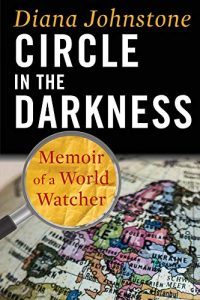 “Circle in the Darkness” gives glimpses into Johnstone’s personal life. She was born in St. Paul, Minnesota and grew up there and in Washington DC. She studied and taught at the University of Minnesota before moving and living most of her life in Europe – mostly in France with stints in Germany and Italy.
Her parents divorced when she was young. She had a special love and connection with her father who, ironically, was an analyst for the Pentagon. Evidently he also had an open and critical mind, writing the memoir “From MAD to Madness: Inside Pentagon Nuclear War Planning“.
Diana had a daughter at a relatively young age and largely raised her on her own. She finished her PhD in French literature, then worked as a teacher, translator, photographer and journalist.
There are interesting observations and comparisons. As Diana and her daughter moved between Minnesota and France, she compared the different educational systems. She notes, “There is a tendency in American grade schools for the kids to gang up against whichever unfortunate schoolmate has been selected by class bullies for tormenting ….. from my observation it is not like this in France.” She also describes the difficulties being a single mother before it was more common.
The book is full of insights based on her first hand experience living in Yugoslavia as a young exchange student, being a photographer for Associated Press, translating news reports for Agence France Presse, reporting on the end of the Cold War for In These Times and being press officer for the coalition of Green Parties in the newly formed European Union.
Grass Roots Activism
One theme running through the book is the need to reach out and engage with regular people. She recounts her experiences opposing the US war on Vietnam. Johnstone and her allies launched a campaign to educate and engage with regular Minnesotans, to explain what was happening in Vietnam and why the war should be opposed. She helped organize teams of students and teachers who went door to door in Minneapolis. Later, they sent a citizens delegation to Paris to meet with and hear from the Vietnamese representatives. Afterward, they reported back to communities throughout the state and country. Johnstone says these actions did not get the media attention but deepened opposition to the war in profound ways. The students and teachers going into the neighborhoods had to educate themselves in advance; they learned from the questions (and sometimes opposition) of community members; the delegation which met the Vietnamese representatives in Paris were deeply impressed and conveyed their experience on their return.
Johnstone is an unusually perceptive analyst. For example, her analysis of the Watergate scandal and Nixon resignation raises important but overlooked issues. Rather than seeing this as the hallmark of investigative journalism, she notes that it established the model of journalism relying on unidentified government sources. Looking back, the Watergate scandal effectively deflected attention from the ongoing slaughter in Southeast Asia. “Getting rid of Nixon was a brilliant coup that united generations, torn asunder by opposing attitudes toward the war ….. Watergate washed away the national sins. It prepared America to be ‘born again’ first as the innocent Gerald Ford and then as the good Christian Jimmy Carter, champion of human rights.” Moreover “The shenanigans around Watergate were a distraction from the most significant acts of the Nixon administration, in particular the shakeup of the world economy by the August 1971 decision to suspend (meaning to end) the convertibility of the dollar into gold. This was a direct result of the huge U.S. debt resulting from the cost of the Vietnam War.”
The author has a stark assessment of what happened to the Left. “As for the American antiwar movement, half a century later, it has vanished almost without a trace as an influential political force. There are perhaps more intelligent critics of war than ever before, but they are largely confined to the virtual world of the web, without significant impact on a political system which is totally integrated into a military industrial complex that relies on endless conflicts.”
Critical International Events
Through her work at Associated Press and Agence France Presse, Johnstone saw how stories are selected and prioritized depending on establishment bias. She also saw how the media can promote certain types of protest leaders. There are critical assessments of some protest leaders who became famous including Daniel Cohn Bendit. She gives a scathing critique of celebrity French philosopher Bernard Henri Levy.
Johnson has valuable insights on many events over the 1970’s and 80’s. A few examples are
* the assassination of Swedish Prime Minister Olaf Palme, who was likely behind it and how it has led to Swedish subservience to the US
* the causes and consequences of the assassination of Aldo Moro by ultra-leftists in Italy
* the murder of Palestinian moderate Dr. Issa Sartawi at a Socialist Party conference
* the attempted assassination of Pope John Paul II by a Turkish militant and the propaganda campaign trying to link him to Bulgaria and Soviet Union
* the growing influence of Israel in western foreign policy
In the 1980’s and early 1990’s, Johnstone watched closely, interviewed key players and reported on the rise of detente between the USA and Soviet Union She concludes, “Not enough credit is given to Mikhail Gorbachev and to the 1980s peace movement”.
The book is subtitled “Memoirs of a World Watcher”. Johnstone describes how radical islamists were used to undermine the socialist Afghanistan government beginning 1979. When the Soviet Union collapsed, the US had no restraints. She summarizes “Mikhail Gorbachev was a naive negotiator, outfoxed by the Americans” and “The total surrender of ‘real existing’ communism in the East contributed to the defeat of the Western Left”.
In 1991 the US seemingly invited Saddam Hussein to go into Kuwait, then built up a huge force to expel and then massacre thousands of retreating Iraqi soldiers. With operation “Desert Storm” viewed as a military success, President Bush declared “The Vietnam syndrome is over!”
Yugoslavia and “Humanitarian Imperialism”
With the dissolution of the Soviet Union, neoliberal economic policies quickly dominated the globe. The European Union was formed in 1992. Johnstone describes how the EU imposed rules and requirements that favored private banks and institutions and restricted or prevented state intervention and solutions. Yugoslavia, as the sole remaining socialist holdout, was under increasing pressure and media attack.
Johnstone describes how “humanitarian imperialism” emerged at this time. With the dissolution of the Warsaw Pact in 1991, the North Atlantic Treaty Organization (NATO) needed a new mandate and reason for existing. They found this new purpose in media distortion and demonization of Serbia and Yugoslavia. NATO promoted the “Kosovo Liberation Army” and other divisive elements then bombed Serbia for 78 consecutive days. Yugoslavia was broken into pieces.
In 2002 Johnstone wrote a book about the NATO attack, western propaganda and show trial. Her book is titled “Fool’s Crusade: Yugoslavia, NATO and Western Delusions”. She was attacked in the media for challenging the dominant assumptions about the conflict. She responded to the attacks saying,“I do not deny atrocities, but unlike others I give them a political context.” Others strongly defended her. Canadian law professor Michael Mandel wrote, “Fools Crusade is not only the definitive work on the Balkans Wars, it is also an inspiring example of how to rescue truth from the battlefield when it has become war’s first casualty”.
Western media distortion and intervention in Yugoslavia went almost unopposed. The antiwar movement was widely confused and silent. This was followed by the US invasions of Afghanistan then Iraq.
Along with media distortions and comparisons to Hitler and the Holocaust, there emerged the justification for violating national sovereignty based on the “Right to Protect” (R2P). This was the pretext for overthrowing the Libyan government of Moammar Gadhafi. Johnstone discusses how R2P has been used to confuse and silence antiwar forces, even some prominent traditional antiwar analysts. Johnstone has interacted with Noam Chomsky many times over decades and is overall very positive. But she notes that “even he might get something wrong”. She documents how the co-author of “Manufacturing Consent” was evidently fooled into believing media reports from Benghazi Libya. Chomsky said the western sponsored uprising was “wonderful”. It is now clear that media reports and NGO accusations from Benghazi were false. They were the pretense to launch the NATO campaign to overthrow the government.
Western intervention, including the sponsorship of terrorist armies in Syria, has been sold to the unwitting public using this model. Wherever the US and NATO wish to intervene, there is a “humanitarian crisis” and “responsibility to protect”.
Critical Current Issues
“Circle in the Darkness” analyzes many current issues of contention and debate on the left. She argues that suppression of debate and free speech, whether by the Right or Left, is counter-productive. She also argues that violence and vandalism hurts the progressive cause even when it gives a spurt of publicity and media attention. She describes many examples over the past 50 years and how frequently the instigators were government or police agents.
Johnstone describes the spectacular growth of the “Yellow Vest” movement in France. She documents how it began, how it was supported and joined by common people and how it reached across party lines. She contrasts the broad support of the Yellow Vest movement with narrow support of the student protests of May 1968. She writes, “Sociologically, this revolt was the opposite of May ’68. Instead of privileged students, imagining a non-existent working class revolution in a time of prosperity, this was the working class itself, in hard times.”
Johnstone describes how French police then attacked the Yellow Vest protesters with many injuries and even deaths. She writes, “Curiously, all this heavy handed repression totally failed to prevent masked ‘Black Bloc’ members from taking advantage of this opportunity to attack the police, set fires, break shop windows ….. Police did nothing to prevent unidentified intruders from invading the ground floor of the Arc de Triomphe to smash up a statue of Marianne…. It is noteworthy that almost all the seriously injured were peaceful Yellow Vest protesters, whereas the Black Blocs often got away unscathed. Perhaps the Black Blocs believe they are fighting the system. Whatever their intentions, they have served as a useful auxiliary to government repression.”
Johnstone notes the massive media effort to control popular thoughts and anger. “The mainstream media have moved farther and farther away from informing the public and nearer to instructing them in what they should think and do.” She thinks the Left is also infused with dogma. Diana Johnstone recounts the falling out with Counterpunch magazine after they published a “barrage of attacks” on the analyst and writer Caitlin Johnstone (no relation). “That was indeed the start of Caitlin’s rise to great prominence in anti-war circles and the beginning of CounterPunch’s decline from ‘fearless muckraking’ to snide sniping at the genuine heirs to the independent spirit of the founder, Alexander Cockburn. The gist of the CounterPunch attacks on the Australian Johnstone were that she dared say she would join even with someone on the right against war. That is simple good sense, but it was picked up by the Antifa purification squad as proof of tendencies toward fascism. When I saw them coming after Caitlin, I figured they’d be coming after me, and that my association with CounterPunch was soon coming to an end.”
Johnstone argues in favor of working for peace with all forces which agree on that issue, whether or not they agree on all issues of “identity politics”. She argues that we should not be distracted from the root causes of war and social inequality. When the Left focuses on the fringe right, the establishment is not only happy, they encourage and promote this diversion.
“The specialty of the AntiFa is to situate the threat of tyranny on the powerless margins of society – from isolated groups of costume party neo-Nazis to outspoken persons on the left accused of ‘red-brown’ tendencies. This amounts to keeping the Left herded into its sheep pen, while the wolves roam freely.”
Johnstone is hopeful and encouraged by two things: a new generation of truth seekers and the fact that life is full of surprises.
This book is full of insights and analysis about where the world is at and how we got here. It includes important ideas and thoughts about what we can do to resist the drift toward global war and catastrophe. Above all, Diana Johnstone argues for the importance of discussion, debate and keeping it real.
Don’t Forget Trump’s Deal with the CIA on the JFK Records
By Jacob G. Hornberger | FFF | August 17, 2020
In April 2018, President Trump issued an order to the National Archives to continue keeping thousands of CIA records relating to the John Kennedy assassination secret from the American people. The new deadline, which could be extended again by either Trump or a President Biden, was set for October 2021.
Since the order was issued early in the Trump regime, no doubt he felt confident that there would be no adverse political consequences flowing from his order. But now that Trump is engaged in a heated race with Joe Biden, he ought to be called upon to explain and justify his order for continued secrecy in an assassination that took place almost six decades ago.
 Given the official narrative of the Kennedy assassination, the massive secrecy in which the Pentagon and the CIA engaged after the assassination has never made any sense.
The official narrative says that a lone nut former U.S. Marine communist killed Kennedy with no apparent motive. The most that proponents of the lone-nut theory have ever come up with on a possible motive is that a little man wanted to become a big man by killing a big man. The big problem with that theory is that the accused assassin, Lee Harvey Oswald, denied that he did it and even contended that he was being framed for the crime. If a little man wanted to become a big man by killing a big man, wouldn’t he be acknowledging that he did it and even boasting about it?
IN 1991, Oliver Stone come out with his movie JFK, which posited that Kennedy had been assassinated as part of a U.S. domestic regime-change operation intended to protect “national security” from a president who had declared an end to the Cold War and an intention to establish peaceful and friendly relations with the Soviet Union and the rest of the communist world. (See FFF’s book JFK’s War with the National Security Establishment: Why Kennedy Was Assassinated by Douglas Horne, who served on the staff of the ARRB.)
At the end of JFK, Stone inserted a blurb pointing out the continued secrecy of federal agencies with respect to records relating to the Kennedy assassination some 30 years after the assassination in what had been presented as nothing more than a lone-nut murder of a president.
While the mainstream media was poo-pooing Stone’s movie, the American people were outraged over the continued secrecy. Public pressure caused Congress to enact the JFK Records Collection Act in 1992, which mandated the release of all assassination-related records of federal agencies, including the Pentagon and the CIA.
To enforce the law, Congress called into existence the Assassination Records Review Board. In its four years of operation, the ARRB secured the release of tens of thousands of records relating to the assassination, some of which pointed to the fraudulent nature of the autopsy that the U.S. military conducted on the president’s body. (See my books The Kennedy Autopsy and The Kennedy Autopsy 2.)
There were two strange parts of the JFK Records Act:
1. The law expressly prohibited the ARRB from investigating any aspect of the JFK assassination. Doesn’t that seem to be a rather strange provision? If a matter that had intentionally been kept secret for 30 years needed to be investigated, wouldn’t you think that Congress would want it investigated? The no-investigation provision was strictly enforced on the ARRB staff by the ARRB board of trustees.
2.The law permitted federal agencies to keep their records secret for another 25 years, a provision that the CIA took advantage of. Given that this was supposedly just a lone-nut murder, why was secrecy necessary in the first place? What “national security” concern would there have been? And wouldn’t a lapse of 30 years be sufficient for any such “national security” concern? Why another 25 years, especially since continued secrecy would only serve to buttress Stone’s thesis in JFK?
Back in the 1990s, 25 years must have seemed like a long time away, long enough that the CIA and the Pentagon could rest easy. Anyway, by the time those 25 years expired, there was a good chance that no one would care anyway, especially within the mainstream press.
But when that deadline rolled around in 2018, there were people who still cared. They were demanding that Trump release the records.
That’s not what Trump did. Instead, he granted the CIA’s request for at least another 3 1/2 years of secrecy.
Back in 2018, Trump didn’t have to justify his decision, but now that he’s running for reelection, he should be made to account for what he did by being asked the following questions:
1. How could the release of the CIA’s long-secret JFK-assassination-related records possibly pose a threat to “national security”?
2. Why not order an immediate release of those long-secret records now rather than wait until October of next year?
3. If the CIA has nothing to hide, why is it still hiding it almost 60 years after the Kennedy assassination?
The big problem, of course, is the deep loyalty that the mainstream press, Democrats, Republicans, and even some conservative-oriented libertarians have toward the CIA, not to mention the deep fear of being labeled a “conspiracy theorist.” That is why it is unlikely that Trump will be required to justify his deference to the CIA and its desire for continued secrecy in the Kennedy assassination.
Jacob G. Hornberger is founder and president of The Future of Freedom Foundation. He was born and raised in Laredo, Texas, and received his B.A. in economics from Virginia Military Institute and his law degree from the University of Texas. He was a trial attorney for twelve years in Texas. He also was an adjunct professor at the University of Dallas, where he taught law and economics. In 1987, Mr. Hornberger left the practice of law to become director of programs at the Foundation for Economic Education.
A mutilation of young lives: How the radical transgender bandwagon is wrecking girls’ bodies and destroying their mental health

© Abigail Shrier “Irreversible Damage: The Transgender Craze Seducing Our Daughters” / Blackstone Publishing, 2020
By Debbie Hayton | RT | July 29, 2020
A new book, Irreversible Damage, reveals how teenage girls are being duped into believing they want to be male, and are pushed into taking puberty blockers, cross-sex hormones, and undergoing double mastectomies.
Whether it is a statement or a question, the title of this book conveys the necessary urgency of this desperately sad story. Amid the trans debate, seemingly a battle between grown adults, vulnerable children are prey to a malevolent ideology that survivors call a cult.
In a superb piece of investigative journalism, Abigail Shrier focusses on teenage girls – most with no history of gender dysphoria – who become captivated by the belief that they are transgender. Behind the glittery exterior portrayed in the media, she encounters damaged children – many alienated from their families – in poor mental health and facing the prospect of infertility and medication for life.
Shrier, a writer with the Wall Street Journal, pulls no punches when describing phalloplasty, the construction of an artificial penis. The complications can be horrific. She reports the experience of one nineteen-year-old, “whose phalloplasty resulted in gangrene and loss of the appendage.” On the cusp of adulthood, that young person has been left without normal genitalia, for either sex, and tethered to a catheter.
I am a transgender person, but I transitioned as an adult when I could understand the implications on my body and my relationship with society. Besides, by then I’d had my own children. Yet children too young to even give consent for a tattoo are being corralled into making truly life-changing decisions.
Whether you agree or disagree with her, this is a book that needs to be read. Shrier’s informed analysis flows from dozens of interviews, including medical experts and parents. From Dr Kenneth Zucker, who oversaw the writing of the medical definition of “gender dysphoria,” to ordinary families whose children seem to them to have been swept along by this cult, Shrier talks directly to those with first-hand experience.
The facts are clear: there is a contagion spreading among teenage girls who suddenly believe themselves to be boys. While there is documented history of young feminine boys expressing a desire to be girls, never before have girls dominated the work of paediatric gender clinics. The statistics are staggering. In the UK, for example, referrals of teenage girls rose by 4400% in the last decade.
Shrier interviewed Lisa Littman, an American doctor who conducted an observational study and found that nearly 70 percent of the teenagers belonged to a peer group in which at least one friend had also come out as transgender. In some groups, most of the friends had done so. Transgender identification was encouraged and intensified by friends and social media and, astonishingly, appeared to precede the experience of gender dysphoria itself.
Shrier explores possible reasons why these daughters, often from liberal progressive households, want to be sons. First, social media where children are influenced by strangers while their parents are kept in the dark. Second, the educational system where adults who ought to know better have been enthralled, or threatened, by transgender activists. Ignoring both science and basic safeguarding, they have bought into the notion that we all have an immutable gender identity which may or may not match our sex.
With overwhelming folly, children are being transitioned in their schools with new names and pronouns. If their parents might be unsupportive, then they are not told, in case their children might feel “unsafe.” But this is something all parents need to know: this phenomenon is catching, and to be forewarned is to be forearmed.
But nothing could have happened without the cooperation of policy makers, and not only within the education system. Therapists – the very people who should be helping children to challenge their thinking – have been blindly affirming whatever their young patients have picked up from the internet.
Anyone who has stood against this has faced censure and condemnation. But as Jungian analyst Lisa Marchiano explained, “This idea that a kid’s going to come in and tell us that they’re trans and that within a session or two or three or four, that we’re going to say, ‘Yep, you’re trans. Let me write you the letter.’ That’s not therapy.”
Even the medical profession itself has been found wanting. Eminent sexologist Dr Ray Blanchard told Shrier that “I can’t think of any branch of medicine outside of cosmetic surgery where the patient makes the diagnosis and prescribes the treatment.” While the zealots who actually believe that children can change their sex are perhaps in a minority, those professionals who remain silent in education, therapy and medicine are complicit in this unfolding scandal.
Shrier credits the sterling work of parental groups such as 4thWaveNow and Transgender Trend who have stood firm against the ideology. They have been condemned as bigots and transphobes for protecting children from themselves, the first duty of parents since the dawn of time.
The book is well-referenced and easy to read, making it suitable for a wide readership. The most obvious audience are parents concerned for the wellbeing of their daughters. But teachers, therapists and doctors, some of whom remain silent out of ignorance or fear, also need to hear these stories. Finally, the wider public would find Shrier’s analysis accessible, clear and educational. Those only vaguely aware of transgender ideology may be tempted to think that it cannot be true: young girls taking powerful cancer drugs to halt puberty, or induce an artificial menopause if started. But it is happening across the world, and Shrier catalogues it.
The time has come for society to take responsibility. Much has happened covertly, and the startled onlooker may need time to catch up, but Shrier’s book fills in the background, identifies the problems, explains the impact, and proposes clear and workable ways forward. This is a must-read for those with children, anyone who works with children and everyone who cares about them.
Debbie Hayton is a teacher and a transgender campaigner, based in the UK. She tweets @DebbieHayton
Featured Video

Houthis Don’t Have to Conquer Saudi Arabia to Make It Pay
or go to
Aletho News Archives – Video-Images
From the Archives
Newly Released FBI Docs Shed Light on Apparent Mossad Foreknowledge of 9/11 Attacks
By Whitney Webb | MintPress News | May 17, 2019
NEW YORK — For nearly two decades, one of the most overlooked and little known arrests made in the aftermath of the September 11 attacks was that of the so-called “High Fivers,” or the “Dancing Israelis.” However, new information released by the FBI on May 7 has brought fresh scrutiny to the possibility that the “Dancing Israelis,” at least two of whom were known Mossad operatives, had prior knowledge of the attacks on the World Trade Center. … continue
Blog Roll
 Aletho News
- MEP blasts ‘Euro-Gestapo’ for lecturing Russia on democracy
- Syria May Send Troops to Saudi Arabia Amid War with Ansar Allah
- UK whines about losing billions to ‘Putin tax’
- Baghaei to Rubio: Distorted narratives cannot erase US record of broken commitments
- Houthis Don’t Have to Conquer Saudi Arabia to Make It Pay
- MOE: Nearly 22,000 Students and Education Workers Killed
- Guterres in Islamabad: Genocide, cowardice, and the cage of Imran Khan
- Johnson, Marandi say Yemen holds upper hand over Saudi Arabia
- False flags won’t save aggressors, Iran FM spokesman says
- The Makkah Pact Enters Into Force: The End of American Dominance or Its New Form?
- If Americans Knew
- Report claimed Mark Levin used by Israeli government to influence Trump
- Over 2,000 Gazans have died awaiting medical evacuation amid Israel’s continued siege
- How a U.S. Diplomat Suppressed and Altered Reports Critical of Israel
- 5 Palestinians Die from Israeli Strikes in Gaza as Relentless Attacks Continue
- Report: Ceasefire Slows Killing but Leaves Devastation Intact
- Country Music Singer Zach Bryan Breaks Attendance Record at Robert Kraft’s Gillette Stadium While Wearing ‘Free Palestine’ Shirt for Second Night in a Row
- Three years of death and devastation: Israel’s war on Gaza in pictures
- Why Hamas believed the status quo was more dangerous than its 7 October gamble
- Debunking Israel’s latest list of ‘terrorist’ journalists in Gaza
- In Gaza, focus is on survival, “every step is a struggle” – Daily Update
- No Tricks Zone
- New Study: 50 Years Of The Most Aggressive ‘Net Zero’ Policies Can Only Affect The Global Climate By 0.03°C
- US September “Heat” Was No Record…Many Records Set Decades Ago
- Latest European Green Energy Debacle; Portugal’s Largest Flagship Solar Park Insolvent!
- Green Energy Debacle: German Expert Professor Fritz Vahrenholt Warns Of Severe Economic And Social Consequences
- Two More Paleo Reconstructions Affirm Meters-Higher Sea Levels Across Ireland, Brazil 7000-6000 Years Ago
- New Study: Earth And Venus Surface Warmth Largely Explained By Convection And Lapse Rate, Not CO2 Or Radiation
- 2025 Nature Paper Claiming Worsening Global Drought Gets RETRACTED …Heavily Flawed
- New Study: ‘Global Drought Shows No Detectable Recent Acceleration Under Climate Warming’
- Economic Masterminds: German Socialists Suggest Taxing Productivity Gains Stemming From Using AI
- The South China Sea Has Not Been Cooperating With The Climate Change Narrative

