Judaism as a Group Evolutionary Strategy
The Suppression of Truth in the Land of Lies: An Oxymoron
By Edward Curtin | Behind the Curtain | September 25, 2018
If you are interested in reading the definitive book that demolishes the official lies about the attacks of September 11, 2001 – 9/11 Unmasked: An International Review Panel Investigation by David Ray Griffin and Elizabeth Woodworth – then Amazon has a great deal for you. While they conveniently do not offer new copies of this book that was published on September 11th, having reported it “out of print” and currently “out of stock,” after never having had it in stock, they allegedly offer 3 used paperback copies from other sellers for sale prices that are quite affordable: $917.04, $1060.20, and $1,500.
If that 4 or 20 cents would bring you over budget, I would be glad to provide either amount.
Don’t these sound like great deals for a book that proves that the justification for the “war on terror” and the slaughter of millions of people is one of the biggest propaganda operations in modern history? It’s always good to know you have a friend who can conveniently provide you with access to the truth at a fair price.
I must say, however, that Amazon offers a slightly better deal for another book they also never directly sold for some odd reason – Journalists for Hire: How the CIA Buys the News by Dr. Udo Ulfkotte – a book that exposes the CIA infiltration of the major media throughout the world. You can allegedly pick that one up through Amazon’s kind medium services for either $900 or $997.09, but that’s for a hardcover.
One person reports having seen a used copy of 9/11 Unmasked appear at amazon.co.uk one week after its official publication date of September 11 (an odd fact in itself), and when he ordered it, the book never arrived. When he contacted the seller, he received a message from Amazon saying that the order had been cancelled, but no reason was given. When the person tried to post a negative review of the seller, Amazon refused to publish it.
These days truth is temporarily out of stock. No reason given. People and books just disappear in this land of make-believe.
If it bothers you a bit that Amazon, through its Amazon Web Services, provides the CIA and other intelligence agencies with a “Secret Region” cloud service that complements Jeff Bezos’s other business, The Washington Post, don’t be alarmed. I have conveyed a question through a certain medium’s mediumship to the deceased Frank Wisner, who is presumably beyond the clouds. He was the CIA’s architect of what he called his “mighty Wurlitzer,” on which he could play any propaganda tune he wanted through the CIA’s penetration through a covert action campaign of the mass media, journalists, student groups, women’s groups, and more. I have asked him if there is anything untoward about any of these strange arrangements that so many readers of my review of 9/11 Unmasked have complained about: that for some strange reason they have been unable to get the book through Amazon.
As I hopefully await the medium’s response from Wisner, you may get impatient. In that case you can immediately purchase the book through the publisher, Interlink Publishing, for $20. It should save you quite a bit of time waiting. But I’ll let you know if I hear anything.
On the Censorship of Michael Hoffman’s Books by Amazon

The Saker • Unz Review • September 13, 2018
A couple of months ago I did an interview with one of the foremost scholars of rabbinical Judaism, Michael Hoffman. The occasion was the release of his latest book “The Occult Renaissance Church of Rome”. At the time I did not expect to have to ask for a follow-up interview with him, but when I learned that Amazon had censored his books (please see Hoffman’s own account of this here). Specifically, the ban is on three of his books. A complete ban (Kindle + printed book) on Judaism’s Strange Gods: Revised and Expanded, as well as The Great Holocaust Trial: Revised and Expanded, while his textbook, Judaism Discovered, has been removed from the Kindle. I felt that I had to talk to him again and he kindly agreed to reply to my questions. I submit to you the full text of our Q&A which I will follow-up with a short commentary.
* * *
The Saker: Please summarize what happened to your books and Amazon and tells us what specific explanations were given to you. Did Amazon ever offer you a “page and paragraph” list of “offending” passages? Do you have any means of knowing exactly what your book is being banned for?
Hoffman: Whether it is Facebook, Google or Amazon, the excuse most often cited for suppression is “content guidelines’ violation.” Amazon notified us on August 13 that two of our titles, which they have been selling for years and in thousands of copies, Judaism Discovered, our 1100 page textbook published in 2008, and Judaism’s Strange Gods: Revised and Expanded, published in 2010 — were being permanently removed after “review” by the Kindle Direct Publishing (KDP) unit of Amazon. A facsimile of the KDP notice can be viewed here:
In their e-mail they told us that “… we found that this content is in violation of content guidelines.” In studying their content guidelines one encounters a vague, generic statement about not permitting that which is “offensive.” There is no guidance as to what “offense” has suddenly arisen after these books were sold on Amazon for several years. Like the Red Queen in Wonderland who declared to Alice that, “A word is anything I say it is!” — that which “offends” is anything Amazon says it is. A third book, The Great Holocaust Trial: The Landmark Battle for the Right to Doubt the West’s Most Sacred Relic, was also forbidden.
Does Amazon have the chutzpah to publicly categorize these books as “hate speech” or some other alibi for censorship that could be contested? No, they do not. They leave authors and publishers twisting in the wind, making it more difficult to appeal the decision and report to the public on the tyranny. Although since they allow no appeal, it’s a moot point. Personally, I have no doubt concerning why my books were censored.
The Saker: What is, in your opinion, the true intent behind the ban on the sales of your book? What is Amazon’s interest in this?
Hoffman: I don’t believe Amazon has much interest in this. It is more likely that the Southern Poverty Law Center (SPLC) is the interested party. Last August 7 the New York Times online published a revealing piece by David French in which he wrote: “We live in a world where the Southern Poverty Law Center, a formerly respected civil-rights organization, abuses its past trust to label a host of mainstream organizations (including my former employer, the Alliance Defending Freedom) and individuals as ‘hate groups,… based sometimes on… outright misreadings and misrepresentations of an individual’s beliefs and views… Amazon recently booted Alliance Defending Freedom from its AmazonSmile charity program because of the center’s designation.”
At around the time in 2017 that the SPLC was trying to interfere with the business operations of people such as myself, by intimidating banks and credit card processors into refusing to process payments for books, Paypal notified us that due to the contents of our website (www.RevisionistHistory.org) we were an embarrassment to their brand and they were terminating our account. As long as Paypal was owned by libertarians, all was well and we had a high customer satisfaction rating for our integrity and dependability. The original Paypal mainly cared about whether you were a responsible seller. A politicized administration eventually took over Paypal and in 2017 we were terminated, very likely on the “advice” of the SPLC.
To return to Amazon, CEO Jeff Bezos founded it in 1994. It was very much a libertarian book operation from the start. From 1994 until a year or two ago, Amazon only refused to sell hard core pornography and books that constituted direct appeals to violence or law-breaking, which is how it should be. Every other type of book was sold, without censorship, which is one reason for Amazon’s early success and increasing market share. Then last year, after Mr. Bezos had reached the status of one of the world’s wealthiest persons, and Amazon’s total value was beginning to approach that of Apple and Google, Amazon staged a huge purge and eliminated more than a hundred World War II revisionist history books published by Germar Rudolf’s CODOH organization (books smeared as “Holocaust denial”). This year it was my turn. Next year it might be any author not part of the university press syndicates or the major houses. Such is the heedless power and immunity of Amazon.
It’s important to note that the thought police who removed three of my books were based in the digital division of Amazon, where the electronic Kindle books are marketed and managed. A Kindle permits anyone connected to the Amazon website to read approximately the first thirty pages of any Kindle book free of charge. Consequently, my Judaica scholarship was on display around the world and therefore it was much harder to lie about me and mischaracterize my Talmud and Kabbalah research under those circumstances.
We were also beginning to sell ever increasing numbers of these Kindle books to people in Asia, particularly India and Japan. It’s my hunch that Big Brother is not half so worried about printed books as the digital kind. Removing the three books from the Kindle was the primary objective.
To be banned by Amazon is not equivalent to being banned by any other private business. Most publishers will admit that Amazon has replaced Bowker Books in Print as the industry’s authoritative guide to what books in English have been printed in the past and what is in print now. Amazon is currently the reference source. For a book to be forbidden by Amazon renders it largely invisible. It is equivalent to burning the book. So this is not a matter of Amazon exercising the prerogative of private enterprise. Amazon is a monopoly. It has no rival. If your book doesn’t exist on Amazon, then for most people who are not research specialists, your book doesn’t exist. The consequences for the pursuit of knowledge are ominous.
There is a problem here for Amazon as well. The more Amazon excludes books that embody facts and ideas that constitute radical dissent, the more it becomes a narrow censor’s aperture rather than a reliable bridge to the entire range of the Republic of Letters.
Apologists for censorship of radicals and authentic conservatives often claim that no First Amendment rights are violated when Amazon bans books, therefore it is not a civil rights issue, merely an inconvenience of the capitalist system. In the 1950s however, when the privately-owned movie studios banned certain directors, actors and screen-writers judged to be Leftists or Communists, that action on the part of private enterprise was inscribed in the rolls of the culture wars as the infamous “Blacklist,” and we are still reading and weeping over it sixty-five years later. So it depends on whose ox is being gored.
My Judaica studies are free of “Jew hate,” as anyone who peruses the sections in both books titled “To the Judaic Reader” knows. There we state that the books are dedicated to pidyon shevyuim (redemption of the captive), i.e. rescuing those Judaic persons who are in bondage to the Talmud and the Kabbalah.
Our enemies easily turn to their advantage books containing hatred of “The Jews.” What they absolutely have no credible answer to is a critique predicated, as our books are, on a sincere foundation of true Christian love. Boundary-breaking scholarship united to compassionate concern for the welfare of Judaic people is almost unprecedented in this field. This approach makes my studies of Judaism among the most powerful and effective because they are free of the “hate speech” which is the pivot upon which turns the machinery of liberal-approved censorship. For that reason, making Judaism’s Strange Gods: Revised and Expanded, and Judaism Discovered available on the Kindle undercut decades of hatred and libel. Therefore those volumes had to be suppressed.
The Saker: Since this ban was put in place – what reactions have you heard? who has spoken in defense of your scholarship and right to be heard? has anybody taken your defense or spoken up for you?
Hoffman: Ron Unz allowed me to publish a note on the ban at unz.com and you, the Saker, have taken an interest. Our many friends, readers and subscribers have expressed outrage on Twitter and in e-mail. Meanwhile we have contacted everyone from a columnist for Taki’s website to the legacy media, to no discernible effect thus far. The Washington Post, which is owned by Mr. Bezos, has as its motto, “Democracy dies in darkness.” Yet it is in that very darkness where Amazon’s book-banning dwells, due to the apathy of the media and the American Library Association. To ban books by a vulnerable independent scholar is not exactly a daring move in this age where “hate speech” is anything that offends someone’s cherished myth. The definition is so loose it functions as an inquisitor’s sword.
On the positive side, we have seen an uptick in orders to our own online store for the printed books which Amazon has banned [https://truthfulhistory.blogspot.com/2016/02/judaica-books-and-resources.html]. There is no replacement for the banned Kindle editions, however.
The Saker: What do you believe could be done to resist this state of affairs? What can we all do to put a stop to this kind of censorship?
Hoffman: In general, the supporters of the lies of the Overlords wage spiritual and psychological warfare with far more dedication, commitment and self-sacrifice than the purported allies of God’s truth. The Cryptocracy’s defenders are 24/7 militants resolved to contend with their perceived foes with every ounce of their being. Whereas on the side of Christian conservative renewal, with honorable exceptions, I find mainly armchair warriors and folks so enormously distracted by the choices offered by the Internet’s deluge of words and images, that they are nearly paralyzed by the spectacle.
Compare the reception Judge Kavanaugh received in the Senate hearings with that of recent Supreme Court nominees Kagan and Ginsburg. The Republicans were too cowed to seriously confront those ladies. Maintaining decorum was the chief concern of the timid GOP at the time, while Kavanaugh faced a near riot in the visitor’s gallery and extremes of withering interrogation and contempt from defiant Democratic senators.
When CODOH’s books were banned we reported the case extensively online and in our printed newsletter. We contacted an executive with the American Library Association to elicit his response and express our outrage. We did what we could even though we have almost no relationship with CODOH. We would do the same for any person of good will who is denied the right to advance human learning with suppressed facts and ideas. This was formerly a truism in America, up until the rise of the punks of social media who seem to be more like a branch of Antifa than an intellectual class invested in discovery and enlightenment.
Advances in human knowledge are achieved on the basis that “error has rights,” for the reason that enshrined dogmas are often wrong and demonized dissidents are sometimes the bearers of rare discoveries. But the epigram of our time is “Error has no rights,” which was the doctrine of the fiery Inquisition, of the head-chopping French Revolution and of the Bolsheviks and Maoists. If error has no rights then neither does truth, in that what is denounced as hateful error by the mob is sometimes a destabilizing, necessary and even cosmic truth.
* * *
Reading Hoffman’s words I thought that what happened to him is so typical of the Orwellian world we live in where the what I call the “Skripal rules of evidence” (aka “highly likely”) have replaced even basic evidentiary notions, a world in which false flag attacks are announced weeks in advance, a world in which the Planetary Hegemon has declared urbi et orbi that nothing in the body of international law applies to the “indispensable nation” (or to the parasitic host feeding off it) and where “might makes right” has become the motto by which everybody lives. Of course, the censorship of a book cannot be compared to the initiation of a war of aggression (which is the “supreme international crime” under international law: this was the conclusion of the Nuremberg Trial on this topic: To initiate a war of aggression, therefore, is not only an international crime; it is the supreme international crime differing only from other war crimes in that it contains within itself the accumulated evil of the whole ). Still, there is something uniquely devious and evil about the censorship of Hoffman’s books by Amazon, several things in fact:
- What is attacked in not a person or even a group, but ideas, arguably the most precious attribute of mankind. This is therefore not only an attack on a human being, but an attack on the very notion of humanity as such
- While the method is different, the intention here is no different from the book burnings of the Nazis or the Papacy except that in these latter cases it was obvious who ordered the burning of putatively “degenerate” or “heretical” books. Thus the ideological motive of the Nazis and Papists was always clear whereas in the case of Hoffman this ideological motive is hidden (even if obvious with anybody with a modicum of intelligence).
- The ultimate hypocrisy lies in the fact that most so-called libertarians (from the Left to the Right) have nothing to say about this because this is not a case of censorship by government but the action of a corporation which has the “right” to do as it wishes, never mind that the result is still a clear de-facto infringement of Hoffman’s First Amendment rights and the freedom of academic scholarship.
- The US government and Congress, by allowing monopolistic corporations such as Amazon to have that kind of power are basically engaging in what I would call “censorship by proxy” which is to be expected from a deep state which now does almost everything by proxy in order to bypass fundamental US and international laws (“extraordinary renditions” anybody?).
- Unlike the government which does have to produce at least some evidence before it can censor an individual or organization, a US corporation does not even have to justify itself by a single word. This is viewed as a triumph of deregulation by mindless libertarians who would gladly surrender all their freedoms as long as it is not to the state. In the real world, of course, they still end up handing over their freedoms to the state, except that the state is hiding behind their beloved corporations.
It is also pretty obvious that those who might, at least in theory, have something to say about this kind of censorship by proxy remain silent because, at least according to them, Hoffman is an “anti-Semite” (which, having read many of his books, I can attest is a total falsehood; by way of evidence here are sample pages from his book:
Using hate speech accusations to suppress irrefutable facts, the troglodyte book-banning lobby pressured Amazon to suppress “Judaism’s Strange Gods: Revised and Expanded” containing documentation that advances human learning. Amazon complied, preferring censorship to knowledge. pic.twitter.com/YjHJxU9lAK
— Michael Hoffman (@HoffmanMichaelA) September 10, 2018
and thus he is undeserving of support. So-called “anti-Semites” are, along with the pedophiles, the “consensus villains” of the day (I explain that in detail here) but what the anti-anti-Semites fail to realize is that each time a “consensus villain” is deprived from his rights, this sets a precedent for everybody else. This is why Yehuda Bauer warned us when he wrote: “Thou shalt not be a victim, Thou shalt not be a perpetrator, And above all, Thou shalt not be a bystander”. To no avail, alas: we live in society of silent bystanders apparently! And when YouTube decides to silence all the Syrian state channels to better prepare for a false flag chemical attack, everybody looks away – “ain’t my problem”…
We all know that in Europe (and in Russia) you can be jailed and your books banned if a court finds them to be “revisionist” or “anti-Semitic” or “hateful” and the like. But at least in Europe (and in Russia), you get your day in court and you can defend yourself against accusations which the state has to prove. In Russia, just last week, a man accused of “rehabilitating National-Socialism” (for reprinting an article by another author!) was found non guilty by a majority of jurors (5 to 3) (the punishment he was facing was a fine and several years in jail). Thank God, in the “home of the brave” no such thing could happen, right?!
True, Hoffman does not risk jail (yet!). But in terms of crushing crimethink, I submit that the US system is much more effective because it allows the deep state to hide behind the veil of corporate malfeasance. There have been plenty of revolutions against a state, but I don’t know of any revolutions against the corporate dictatorship.
You tell me: which is worse, the absence of freedom or the illusion of freedom?
Personally, I find the latter much worse.
I never expected the corporate presstitutes to really care about our freedoms, ditto for the libertarians and the progressive Left. They are all too busy with their narrow ideological agenda. As for the US academic world, it has shown its true face when it allowed the persecution of Professor Norman Finkenstein. But I have to say that I am shocked by the fact that the blogosphere and the so-called “alternative media” has remained so silent in the face of such a blatant censorship by proxy by the deep state against one of the foremost US historians.
I urge all those reading these lines to speak up on Hoffman’s behalf and to support him by purchasing his superb and censored books. This is how every one of us can resist the Hegemon and his rule!
9/11 Was an Israeli Job
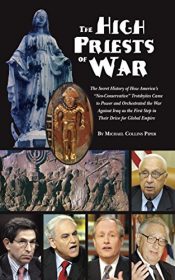
How America was neoconned into World War IV
By Laurent Guyénot • Unz Review • September 10, 2018
Technical impossibilities
Thanks to courageous investigators, many anomalies in the official explanation of the events of 9/11 were posted on the Internet in the following months, providing evidence that this was a false flag operation, and that Osama bin Laden was innocent, as he repeatedly declared in the Afghan and Pakistani press and on Al Jazeera.[1] The proofs of this appalling fraud have been accumulating ever since, and are now accessible to anyone willing to spend a few hours of research on the Web. (Although, while preparing this article, I noticed that Google is now making access to that research more difficult than it was five years ago, artificially prioritizing anti-conspiracy sites.)
For example, members of Architects and Engineers for 9/11 Truth have demonstrated that it was impossible for plane crashes and jet fuel fires to trigger the collapse of the Twin Towers. Even Donald Trump understood this. In fact, speaking of “collapse” is perhaps misleading: the towers literally exploded, pulverizing concrete and projecting pieces of steel beams weighing several hundred tons hundreds of meters laterally at high speeds. The pyroclastic dust that immediately flooded through the streets, not unlike the dust from a volcano, indicates a high temperature mixture of hot gasses and relatively dense solid particles, an impossible phenomenon in a simple collapse. It is also impossible that WTC7, another skyscraper (47 stories), which had not been hit by a plane, collapsed into its own footprint at near free-fall speed, unless by “controlled demolition.”
Testimonies of firefighters recorded shortly after the events describe sequences of explosions just before the “collapse”, well below the plane impact. The presence of molten metal in the wreckage up to three weeks after the attack is inexplicable except by the presence of incompletely burned explosives. Firefighter Philip Ruvolo testified before Étienne Sauret’s camera for his film Collateral Damages (2011): “You’d get down below and you’d see molten steel—molten steel running down the channelways, like you were in a foundry—like lava.”
Aviation professionals have also reported impossibilities in the behavior of the planes. The charted speeds of the two aircraft hitting the Twin Towers, 443 mph and 542 mph, exclude these aircraft being Boeing 767s, because these speeds are virtually impossible near ground level. In the unlikely event such speeds could be attained without the aircraft falling apart, flying them accurately into the towers was mission impossible, especially by the amateur pilots blamed for the hijacking. Hosni Mubarak, a former pilot, said he could never do it. (He is not the only head of state to have voiced his doubts: Chavez and Ahmadinejad are among them.) Recall that neither of the black boxes of the jetliners was ever found, an incomprehensible situation.
And of course, there are the obvious anomalies of Shanksville and Pentagon crash sites: no plane or credible plane debris can be seen on any of the numerous photos easily available.
Inside Job or Mossad Job?

Among the growing number of Americans who disbelieve the official version of the 9/11 attacks, two basic theories are in competition: I called them “inside job” and “Mossad job”. The first one is the dominant thesis within the so-called 9/11 Truth movement, and blames the American government, or a faction within the American Deep State. The second one claims that the masterminds were members of a powerful Israeli network deeply infiltrated in all spheres of power within the US, including media, government, military and secret services.
This “Mossad job” thesis has been gaining ground since Alan Sabrosky, a professor at the U.S. Army War College and the U.S. Military Academy, published in July 2012 an article entitled “Demystifying 9/11: Israel and the Tactics of Mistake”, where he voiced his conviction that September 11th was “a classic Mossad-orchestrated operation.”
We can notice from the outset that incriminating Israelis or Arabs are both “outside job” theories (in fact, they are mirror images of each other, which is understandable in light of what Gilad Atzmon explains about Jewish “projected guilt”).[2] Before even looking at the evidence, “outside job” sounds more credible that “inside job”. There is something monstrous in the idea that a government can deceive and terrorize its own citizens by killing thousands of them, just for starting a series of wars that are not even in the nation’s interest. By comparison, a foreign power attacking the U.S. under the false flag of a third power almost seems like fair play. Indeed suspicion of Israel’s role should be natural to anyone aware of the reputation of the Mossad as: “Wildcard. Ruthless and cunning. Has capability to target U.S. forces and make it look like a Palestinian/Arab act,” in the words of a report of the U.S. Army School for Advanced Military Studies quoted by the Washington Times, September 10th, 2001 — the day before the attacks.
This is an important point, because it raises the question of how and why the 9/11 Truth movement has been led to endorse massively the outrageous “inside job” thesis without even considering the more likely thesis of an attack by a foreign power acting under an Islamic false flag—and what foreign power but Israel would do that?
Of course, the two dissenting theses do not necessarily exclude each other; at least, no one incriminating Israel denies that corrupted elements from the American administration or deep state were involved. The “passionate attachment” between Israel and the U.S. has been going on for decades, and 9/11 is one of its monstruous offsprings.

I can think of no better symbol of that reality than the marriage of Ted and Barbara Olson. Ted Oslon, after having defended Bush in the disputed 2000 election, had been rewarded with the post of Solicitor General (he also defended Dick Cheney when he refused to submit to Congress Enron-related documents). Barbara was a famous CNN reporter, but before that, she was born Barbara Kay Bracher of Jewish parents, educated at Yeshiva University School of Law, and hired by the legal firm WilmerHale, of which Jamie Gorelick, a future member of the 9/11 Commission, was also a member, and whose clients include powerful Israeli firms like Amdocs, a digital communication company charged with spying for Israel in the United States. On September 11, 2001, Barbara Olson alledgedly was on flight AA77, from which she made two telephone calls to her husband. Her calls were reported on CNN in the afternoon, and contributed to crystallize some details of the official story, such as the “box cutters” used as only weapons by the hijackers. Repeatedly invited on television shows after 9/11, Ted Olson frequently contradicted himself when questioned about the calls from his wife. In a 2006 report, the FBI identified only one call from Barbara Olson, and it was an unconnected call lasting 0 seconds. Like all other reported phone calls from desperate passengers (including the famous “Hi, Mom. This is Mark Bingham”), Barbara’s call was simply impossible, because the technology required to make high-altitude phone calls was not developed until 2004.[3]
9/11 was made possible by an alliance between secret worshippers of Israel and corrupted American elements. The question is: who, of the two, were the masterminds of this incredibly daring and complex operation, and for what “higher purpose”?
Another question is: why do those who keep repeating as a mantra “9/11 was an inside job” ignore totally the compelling evidence pointing to Israel? In other words, to what extent do they constitute a “controlled opposition” intended to cover up for Israel? Asking this type of question does not mean suspecting anyone who defends an erroneous or incomplete theory of being a hypocrite. Most people defending one theory or the other do so sincerely, based on the information to which they have access. I have myself been a believer in the official theory for 7 years, and in the “inside job” theory for 2 years, before progressively moving on to the present argument from 2010. On the other hand, we can assume that those who lead the public into error on a long term are not just mistaken but lying. In any case, it is legitimate to investigate the background of opinion makers, and when they are caught lying or distorting the truth, we can speculate on their motivation. I will come back to this issue at the end of the article.
The dancing Israelis
Researchers who believe Israel orchestrated 9/11 cite the behavior of a group of individuals who have come to be known as the “dancing Israelis” since their arrest, though their aim was to pass as “dancing Arabs.” Dressed in ostensibly “Middle Eastern” attire, they were seen by various witnesses standing on the roof of a van parked in Jersey City, cheering and taking photos of each other with the WTC in the background, at the very moment the first plane hit the North Tower. The suspects then moved their van to another parking spot in Jersey City, where other witnesses saw them deliver the same ostentatious celebrations.
One anonymous call to the police in Jersey City, reported the same day by NBC News, mentioned “a white van, 2 or 3 guys in there. They look like Palestinians and going around a building. […] I see the guy by Newark Airport mixing some junk and he has those sheikh uniforms. […] He’s dressed like an Arab.” The police soon issued the following BOLO alert (be-on-the-look-out) for a “Vehicle possibly related to New York terrorist attack. White, 2000 Chevrolet van with New Jersey registration with ‘Urban Moving Systems’ sign on back seen at Liberty State Park, Jersey City, NJ, at the time of first impact of jetliner into World Trade Center. Three individuals with van were seen celebrating after initial impact and subsequent explosion.”
By chance, the van was intercepted around 4 pm, with five young men inside: Sivan and Paul Kurzberg, Yaron Shmuel, Oded Ellner, and Omer Marmari. Before any question was asked, the driver, Sivan Kurzberg, burst out: “We are Israelis. We are not your problem. Your problems are our problems. The Palestinians are your problem”.The Kurzberg brothers were formally identified as Mossad agents. All five officially worked for a moving company (a classic cover for espionage) named Urban Moving Systems, whose owner, Dominik Otto Suter, fled the country for Tel Aviv on September 14.[4]

This event was first reported the day after the attacks by journalist Paulo Lima in the New Jersey newspaper The Bergen Record, based on “sources close to the investigation” who were convinced of the suspects’ foreknowledge of the morning’s attacks: “It looked like they knew what was going to happen when they were at Liberty State Park”.The 579-page FBI report on the investigation that followed (partially declassified in 2005) reveals several important facts. First, once developed, the photos taken by the suspects while watching the North Tower on fire confirm their attitudes of celebration: “They smiled, they hugged each other and they appeared to ‘high five’ one another”. To explain their contentment, the suspects said they were simply happy that, thanks to these terrorist attacks, “the United States will take steps to stop terrorism in the world”. Yet at this point, before the second tower was hit, most Americans believed the crash was an accident. The five Israelis were found connected to another company called Classic International Movers, which employed five other Israelis arrested for their contacts with the nineteen presumed suicide hijackers. In addition, one of the five suspects had called “an individual in South America with authentic ties to Islamic militants in the middle east”. Finally, the FBI report states that the “The vehicle was also searched by a trained bomb-sniffing dog which yielded a positive result for the presence of explosive traces”.
After all this incriminating evidence comes the most puzzling passage of the report: its conclusion that “the FBI no longer has any investigative interests in the detainees and they should proceed with the appropriate immigration proceedings”. In fact, a letter addressed to the U.S. Immigration and Naturalization Service, dated September 25, 2001, proves that, less than two weeks after the events, the FBI federal headquarter had already decided to close the investigation, asking that “The U.S. Immigration and Naturalization Service should proceed with the appropriate immigration proceedings”. The five “dancing Israelis”, also known as “the high fivers”, were detained 71 days in a Brooklyn prison, where they first refused, then failed, lie detector tests. Finally, they were quietly returned to Israel under the minimal charge of “visa violation.” Three of them were then invited on an Israeli TV talk show in November 2001, where one of them ingenuously declared: “Our purpose was simply to document the event.”
The Israeli spy network
The five “dancing Israelis,” the only suspects arrested on the very day of the 9/11 attacks, were just the tip of an iceberg. In September 2001, the federal police were busy dismantling the largest Israeli spy network ever uncovered on American soil. In the summer preceding the attack, the Drug Enforcement Agency (DEA) compiled a report which would be revealed to the public by the Washington Post on November 23rd, 2001, followed by a Carl Cameron’s four-part documentary broadcast on Fox News from December 11th, 2001. On March 14th, 2002, an article in French newspaper Le Monde signed by Sylvain Cypel also referred to the report, shortly before the French magazine Intelligence Online made it fully accessible on the Internet.[5] It said that 140 Israeli spies, aged between 20 and 30, had been arrested since March 2001, while 60 more were arrested after September 11. Generally posing as art students, they visited at least “36 sensitive sites of the Department of Defense.” “A majority of those questioned have stated they served in military intelligence, electronic signal intercept, or explosive ordnance units. Some have been linked to high-ranking officials in the Israeli military. One was the son of a two-star general, one served as the bodyguard to the head of the Israeli Army, one served in a Patriot mission unit.” Another, Peer Segalovitz, officer in the 605 Battalion of the Golan Heights, “acknowledged he could blow up buildings, bridges, cars, and anything else that he needed to.”[6]
Of special interest is the mention that “the Hollywood, Florida, area seems to be a central point for these individuals.”[7] More than 30 out of the 140 fake Israeli students identified before 9/11 lived in that city of 140,000 inhabitants. And this city also happens to be the place where fifteen of the nineteen alleged 9/11 Islamist hijackers had regrouped (nine in Hollywood, six in the vicinity), including four of the five supposed to have hijacked Flight AA11. What was the relationship between the Israeli spies and the Islamist terrorists? We were told by mainstream news that the former were monitoring the latter, but failed to report suspicious activities of these terrorists to American authorities. From such a presentation, Israel comes out clean, since a spy agency cannot be blamed for not sharing information with the country it is spying in. At worst, the Israeli Intelligence can be accused of “letting it happen”—a guarantee of impunity. In reality, the Israeli agents were certainly not just monitoring the future “hijackers,” but financing and manipulating them, before disposing of them. We know that Israeli Hanan Serfaty, who rented two flats near Mohamed Atta, had handled at least $100,000 in three months. And we also learned from the New York Times on February 19, 2009, that Ali al-Jarrah, cousin of the alleged hijacker of Flight UA93 Ziad al-Jarrah, had spent twenty-five years spying for the Mossad as an undercover agent infiltrating the Palestinian resistance and Hezbollah.
Israeli agents apparently appreciate operating under the cover of artists. Shortly before September 11, a group of fourteen Jewish “artists” under the name of Gelatin installed themselves on the ninety-first floor of the north tower of the World Trade Center. There, as a work of “street art,” they removed a window and extended a wooden balcony. To understand what role this piece of scaffolding may have played, it must be remembered that the explosion supposedly resulting from the impact of the Boeing AA11 on the North Tower took place between the ninety-second and the ninety-eighth floors. With the only film of the impact on the North Tower being that of the Naudet brothers, who are under suspicion for numerous reasons, many researchers are convinced that no aircraft hit this tower, and that the explosion simulating the impact was provoked by pre-planted explosives inside the tower.
Floors ninety-three to one hundred of the North Tower were occupied by Marsh & McLennan, whose CEO was Jeffrey Greenberg, son of wealthy Zionist (and financier of George W. Bush) Maurice Greenberg, who also happens to be the owner of Kroll Inc., the firm in charge of security for the entire World Trade Center complex on 9/11. The Greenbergs were also the insurers of the Twin Towers and, on July 24, 2001, they took the precaution of having the contract reinsured by competitors. In November 2000, the board of directors of Marsh & McLennan was joined by (Lewis) Paul Bremer, the chairman of the National Commission on Terrorism, who, on September 11, 2001, two hours only after the pulverization of the North Tower, would appear on NBC to name bin Laden as prime suspect, perfectly calm as 400 of his employees are missing (295 will finally be declared dead). “It is the day that will change our lives,” he said. “It is the day when the war that the terrorists declared on the US [. . .] has been brought home to the US.” In 2003, Bremer would be appointed administrator of the Coalition Provisional Authority in Iraq to level the Iraqi state to the ground and oversee the theft of almost a trillion dollars intended for its reconstruction.
The super-sayanim
With Goldberg and Bremer, we have reached the upper level of the conspiracy, comprising a number of influential Jewish personalities, working inside and outside the U.S. government — super-sayanim, so to speak. The most representative of those outside government is Larry Silverstein, the real estate shark who, with his partner Frank Lowy, leased the Twin Towers from New York City in the spring of 2001. The head of the New York Port Authority, who granted Silverstein and Lowy the lease, was none other than Lewis Eisenberg, another member of the United Jewish Appeal Federation and former vice-president of AIPAC. It appeared that Silverstein had made a disastrous deal, because the Twin Towers had to be decontaminated for asbestos. The decontamination process had been indefinitely postponed since the 1980s because of its cost, estimated at nearly $1 billion in 1989. In 2001, the New York Port Authority had been all too happy to shift responsibility to Silverstein.
Immediately after acquiring the Twin Towers, Silverstein renegotiated the insurance contracts to cover terrorist attacks, doubling the coverage to $3.5 billion, and made sure he would retain the right to rebuild after such an event. After the attacks, he took his insurers to court in order to receive double compensation, claiming that the two planes were two separate attacks. After a long legal battle, he pocketed $4.5 billion. Silverstein is a leading member of the United Jewish Appeal Federation of Jewish Philanthropies of New York, the biggest fundraiser for Israel (after the US government, which pays about $3 billion per year in aid to Israel). Silverstein also maintained “close ties with Netanyahu,” according to Haaretz (November 21, 2001): “The two have been on friendly terms since Netanyahu’s stint as Israel’s ambassador to the United Nations. For years they kept in close touch. Every Sunday afternoon, New York time, Netanyahu would call Silverstein.” Besides being a powerful man, Larry is a lucky man: as he explained in this interview, every morning of the week, he had breakfast at the Windows on the World on top of the North Tower, but on September 11th, he had an appointment with his dermatologist.
Accomplices to the 9/11 false flag attack with strong Israeli connections should also be tracked at the other end of the trajectory of the planes reported to have crashed into the Twin Towers. Flights AA11 and UA175 took off from Logan Airport in Boston, which subcontracted their security to International Consultants on Targeted Security (ICTS), a firm based in Israel and headed by Menachem Atzmon, a treasurer of the Likud. So did Newark Airport where flight UA93 reportedly took off before crashing in Shanksville.
A serious investigation would follow many other trails, such as the Odigo instant messages received by employees at the WTC two hours before the plane crashes, as reported by Haaretz on September 27th, 2001. The first plane hit the WTC at the precise time announced, “almost to the minute,” admitted Alex Diamandis, vice-president of Odigo, headquartered in Israel. Also disturbing is the behavior of the American branch of Zim Israel Navigational, a maritime shipping giant 48% owned by the Jewish state (occasionally used as a cover for the Israeli secret services), which moved its offices from the WTC, along with its 200 employees, September 4th, 2001, one week before the attacks —“like an act of God, we moved”, said the CEO Shaul Cohen-Mintz when interviewed by USA Today, November 17th, 2001.
But of course, none of these trails were ever pursued. That is because the most powerful conspirators were at the highest level of the Justice Department. Michael Chertoff was head of the Criminal Division of the Department of Justice in 2001, and responsible, among many other things, for securing the release of the Israeli agents arrested before and after 9/11, including the “dancing Israelis.” In 2003, this son of a rabbi and of a Mossad pioneer would be appointed Secretary of Homeland Security, in charge of counter-terrorism on the American soil, which allowed him to control dissenting citizens and restrain access to the evidence under the pretext of Sensitive Security Information.
Another chief of the cover-up was Philip Zelikow, the executive director of the 9/11 presidential Commission established in November 2002. Zelikow is a self-styled specialist in the art of making “public myths” by “‘searing’ or ‘molding’ events [that] take on ‘transcendent’ importance and, therefore, retain their power even as the experiencing generation passes from the scene” (Wikipedia). In December 1998, he co-signed an article for Foreign Affairs entitled “Catastrophic Terrorism,” in which he speculated on what would have happened if the 1993 WTC bombing (already attributed to bin Laden) had been done with a nuclear bomb: “An act of catastrophic terrorism that killed thousands or tens of thousands of people and/or disrupted the necessities of life for hundreds of thousands, or even millions, would be a watershed event in America’s history. It could involve loss of life and property unprecedented for peacetime and undermine Americans’ fundamental sense of security within their own borders in a manner akin to the 1949 Soviet atomic bomb test, or perhaps even worse. … Like Pearl Harbor, the event would divide our past and future into a before and after. The United States might respond with draconian measures scaling back civil liberties, allowing wider surveillance of citizens, detention of suspects and use of deadly force.” This is the man who controlled the governmental investigation on the 9/11 terror attacks. Thomas Kean and Lee Hamilton, who nominally led the commission, revealed in their book Without Precedent: The Inside Story of the 9/11 Commission (2006), that the commission “was set up to fail” from the beginning. Zelikow, they claim, had already written a synopsis and a conclusion for the final report before the first meeting. He controlled all the working groups, prevented them from communicating with each other, and gave them as sole mission to prove the official story; Team 1A, for example, was tasked to “tell the story of Al-Qaeda’s most successful operation—the 9/11 attacks.”
A tight control of mainstream media is perhaps the most delicate aspect of the whole operation. I will not delve into that aspect, for we all know what to expect from the MSM. For a groundbreaking argument on the extent to which 9/11 was psy-op orchestrated by MSM, I recommend Ace Baker’s 2012 documentary 9/11 The Great American Psy-Opera, chapters 6, 7 and 8.
Machiavellian meta-Zionists
If we move up to the very highest level of the conspiracy, we find ourselves in Tel Aviv. The preparation for 9/11 coincided with the coming to power of Benjamin Netanyahu in 1996, followed by Ehud Barak in July 1999, and Ariel Sharon in March 2001, who brought back Netanyahu as minister of Foreign Affairs in 2002 (with Netanyahu again becoming prime minister in 2009). It must be noted that both Netanyahu and Ehud Barak were temporarily out of the Israeli government in September 2001, just like Ben-Gurion at the time of Kennedy’s assassination (read my article on JFK). A few months before 9/11, Barak, a former head of Israeli military intelligence, was “recruited” as a consultant to a Mossad front company, SCP Partner, specializing in security and located less than seven miles from Urban Moving Systems.[8] One hour after the explosion of the North Tower, Barak was on BBC World to point the finger at bin Laden (the first to do so), and concluded: “It’s a time to launch an operational, complete war against terror.”
As for Netanyahu, we are not surprised to hear him boast, on CNN in 2006, of having predicted in 1995 that, “if the West doesn’t wake up to the suicidal nature of militant Islam, the next thing you will see is militant Islam bringing down the World Trade Center.” Netanyahu is exemplary of the ever closer “special relationship” between the US and Israel, which started with Truman and blossomed under Johnson. Netanyahu had lived, studied, and worked in the United States from 1960 to 1978, between his 11th and his 27th year—except during his military service—and again after the age of 33, when he was appointed deputy ambassador to Washington and then permanent delegate to the United Nations. Netanyahu appeared regularly on CNN in the early 1990s, contributing to the transformation of the world’s leading news channel into a major Zionist propaganda tool. His political destiny was largely planned and shaped in the United States, under the supervision of those we now call neoconservatives, and the only thing that distinguishes him from them is that, for public relations reasons, he does not possess American nationality.
“What’s a neocon?” once asked Bush 43 to his father Bush 41, after more than three years in the White House. “Do you want names, or a description?” answered 41. “Description.” “Well,” said 41, “I’ll give it to you in one word: Israel.”[9] That anecdote, quoted by Andrew Cockburn, sums it up. The neoconservative movement was born in the editorial office of the monthly magazine Commentary, which had replaced the Contemporary Jewish Record in 1945 as the press organ of the American Jewish Committee. “If there is an intellectual movement in America to whose invention Jews can lay sole claim, neoconservatism is it,” wrote Gal Beckerman in the Jewish Daily Forward, January 6, 2006. “It is a fact that as a political philosophy, neoconservatism was born among the children of Jewish immigrants and is now largely the intellectual domain of those immigrants’ grandchildren.”
The founding fathers of neoconservatism (Norman Podhoretz, Irving Kristol, Donald Kagan, Paul Wolfowitz, Adam Shulsky) were self-proclaimed disciples of Leo Strauss, a German Jewish immigrant teaching at the University of Chicago. Strauss can be characterized as a meta-Zionist in the sense that, while an ardent supporter of the State of Israel, he rejected the idea that Israel as a nation should be contained within borders; Israel must retain her specificity, which is to be everywhere, he said in essence in his 1962 lecture “Why We Remain Jews.” Strauss would also approve of being called a Machiavellian, for in his Thoughts on Machiavelli, he praised the “the intrepidity of his thought, the grandeur of his vision, and the graceful subtlety of his speech” (p. 13). Machiavelli’s model of a prince was Cesar Borgia, the tyrant who after having appointed the cruel Ramiro d’Orco to subdue the province of Romania, had him executed with utter cruelty, thus reaping the people’s gratitude after having diverted their hatred onto another. Machiavelli, writes Strauss, “is a patriot of a particular kind: He is more concerned with the salvation of his fatherland than with the salvation of his soul” (p. 10). And that happens to be exactly what Jewishness is all about, according to Jewish thinkers such as Harry Waton: “The Jews that have a deeper understanding of Judaism know that the only immortality there is for the Jew is the immortality in the Jewish people” (read more here). As a matter of fact, in the Jewish World Review of June 7, 1999, Michael Ledeen, a neocon and founding member of the Jewish Institute for National Security Affairs (JINSA), assumed that Machiavelli must have been a “secret Jew,” since “if you listen to his political philosophy you will hear Jewish music.”
The neoconservatives of the first generation originally positioned themselves on the far left. Irving Kristol, one of the main editors of Commentary, had long claimed to be a Trotskyist. It was soon after the 1967 successful annexation of Arab territories by Israel that the Straussians experienced their conversion to right-wing militarism, to which they owe their new name. Norman Podhoretz, editor-in-chief from 1960 to 1995, turned from anti-war activist to defense budget booster in the early 70s. He gave the following explanation in 1979: “American support for Israel depended upon continued American involvement in international affairs—from which it followed that an American withdrawal into the kind of isolationist mood [. . .] that now looked as though it might soon prevail again, represented a direct threat to the security of Israel.” (Breaking Ranks, p. 336). Leading the U.S. into war for the benefit of Israel is the essence of the Machiavellian crypto-Zionists known deceptively as neoconservatives.
The Project for a new (((American))) Century

The story of how the neoconservatives reached the position of influence they held under George W. Bush is a complicated one, which I can only outline. They entered the state apparatus for the first time in the baggage of Rumsfeld and Cheney, during president Ford’s cabinet reshuffle known as the “Halloween Massacre,” following Nixon’s resignation. When the Cold War calmed down after America evacuated its troops from Vietnam in 1973, and the CIA produced reassuring analyses of the USSR’s military capabilities and ambitions, Rumsfeld (as Secretary of Defense) and Cheney (as Chief of Staff) persuaded Ford to appoint an independent committee, known as Team B, to revise upward the CIA estimates of the Soviet threat, and reactivate a war attitude in public opinion, Congress, and Administration. Team B was chaired by Richard Pipes and co-chaired by Paul Wolfowitz, both introduced by Richard Perle.
During the Democratic parenthesis of the Carter presidency (1976–80), the neoconservatives worked at unifying the largest number of Jews around their policies, by founding the Jewish Institute for National Security Affairs (JINSA), which became the second-most powerful pro-Israel lobby after AIPAC. According to its “mission statement”, it is “dedicated to educating Congressional, military and civilian national security decision-makers on American defense and strategic interests, primarily in the Middle East, the cornerstone of which is a robust U.S.-Israeli security cooperation.” In 1980, the neocons were rewarded by Ronald Reagan for their support by a dozen posts in national security and foreign policy: Richard Perle and Douglas Feith to the Department of Defense; Richard Pipes at the National Security Council; Paul Wolfowitz, Lewis “Scooter” Libby, and Michael Ledeen in the State Department. They helped Reagan escalate the Cold War, showering billions of dollars on the military-industrial complex.
The long term planning of 9/11 probably started then. Isser Harel, founder of Israeli secret services (Shai in 1944, Shin Bet in 1948, Mossad until 1963) is reported as prophesizing in 1980, in an interview with Christian Zionist Michael Evans, that Islamic terrorism would end up hitting America in their “phallic symbol”: “Your biggest phallic symbol is New York City and your tallest building will be the phallic symbol they will hit”.[10] (A whole article would be needed to document and explain the revival of the Jewish gift of apocalyptic prophecy in recent decades.)
In 1996, during the Clinton years, the neoconservatives threw all their weight into their ultimate think tank, the Project for the New American Century (PNAC), directed by William Kristol and Robert Kagan. PNAC recommended taking advantage of the defeat of communism to reinforce American hegemony by preventing the emergence of any rival. Their Statement of Principles vowed to extend the current Pax Americana, which entailed “a military that is strong and ready to meet both present and future challenges.” In its September 2000 report entitled Rebuilding America’s Defenses, PNAC anticipated that US forces must become “able to rapidly deploy and win multiple simultaneous large-scale wars.” This required a profound transformation, including the development of “a new family of nuclear weapons designed to address new sets of military requirements.” Unfortunately, according to the authors of the report, “the process of transformation […] is likely to be a long one, absent some catastrophic and catalyzing event—like a new Pearl Harbor.” It is certainly no coincidence that the three-hour-long blockbuster Pearl Harbor was released in the summer 2001, conveniently entrenching the “New Pearl Harbor” meme into the minds of millions.
PNAC’s architects played the American hegemony card by draping themselves in the super-patriotic discourse of America’s civilizing mission. But their duplicity is exposed in a document brought to public knowledge in 2008: a report published in 1996 by the Israeli think tank Institute for Advanced Strategic and Political Studies (IASPS), entitled A Clean Break: A New Strategy for Securing the Realm, written specifically for the new Israeli prime minister, Benjamin Netanyahu. The team responsible for the report was led by Richard Perle, and included Douglas Feith and David Wurmser, who figured the same year among the signatories of PNAC. As its title suggests, the Clean Break report invited Netanyahu to break with the Oslo Accords of 1993, which officially committed Israel to the return of the territories it occupied illegally since 1967. The new prime minister should instead “engage every possible energy on rebuilding Zionism” and reaffirm Israel’s right to the West Bank and the Gaza Strip.
In November 2000, Bush Jr. was elected under conditions that raised protests of electoral fraud. Dick Cheney, who had directed his campaign, named himself vice-president and introduced two dozens neoconservatives in foreign policy key positions. The State Department was entrusted to Colin Powell, but he was surrounded with neocon aides such as David Wurmser. As National Security Adviser, Condoleezza Rice, a specialist of Russia with no expertise in the Middle East, was entirely dependent on her neocon adviser Philip Zelikow. William Luti and Elliott Abrams, and later Eliot Cohen, were also tasked with steering Rice. But it was mainly from within the Defense Department under Donald Rumsfeld that the most influential neocons were able to fashion US foreign and military policy. Richard Perle occupied the crucial position of director of the Defense Policy Board, responsible for defining military strategy, while Paul Wolfowitz became the “soul of the Pentagon” as deputy secretary with Douglas Feith as under secretary.
The Hanukkah miracle to start WWIV
After eight months in the presidency, Bush was confronted with the “catastrophic event,” the “new Pearl Harbor” that PNAC had wished for a year earlier. 9/11 was a real “Hanukkah miracle” for Israel, commented Mossad chief Ephraim Halevy and Israeli National Security Council chairman Uzi Dayan. Netanyahu rejoiced: “It’s very good […] it will generate immediate sympathy […], strengthen the bond between our two peoples, because we’ve experienced terror over so many decades, but the United States has now experienced a massive hemorrhaging of terror.” On September 21, he published an op-ed in the New York Post entitled “Today, We Are All Americans,” in which he delivered his favorite propaganda line: “For the bin Ladens of the world, Israel is merely a sideshow. America is the target.” Three days later the New Republic responded with a headline on behalf of the Americans: “We are all Israelis now.” Americans experienced 9/11 as an act of hatred from the Arab world, and they felt an immediate sympathy for Israel, which the neoconservatives relentlessly exploited. One of the aims was to encourage Americans to view Israel’s oppression of the Palestinians as part of the global fight against Islamic terrorism.
It was a great success. In the years preceding September 11, Israel’s reputation had bottomed out; condemnations had been raining from around the world for its policy of apartheid and colonization, and its systematic war against Palestinian command structures. Increasing numbers of American voices questioned the merits of the special relationship between the United States and Israel. From the day of the attacks, it was all over. As Americans now intended to fight Arab terrorists to the death, they would stop demanding from Israel more reasonable, proportionate retaliation against Palestinian suicide bombers and rockets.
Instead, the president’s speeches (written by neocon David Frum) characterized the 9/11 attacks as the trigger for a world war of a new type, one fought against an invisible enemy scattered throughout the Middle East. First, vengeance must come not only against bin Laden, but also against the state harboring him: “We will make no distinction between those who committed these acts and those who harbor them” (Sept. 11). Second, the war extends to the world: “Our war on terror begins with Al Qaeda, but it does not end there. It will not end until every terrorist group of global reach has been found, stopped and defeated” (Sept. 20). Third, any country that does not support Washington will be treated as an enemy: “Either you are with us, or you are with the terrorists” (Sept. 20).
In an article in the Wall Street Journal dated November 20, 2001, the neoconservative Eliot Cohen dubbed the war against terrorism as “World War IV,” a framing soon echoed by other American Zionists (the odd choice of the name WWIV rather than WWIII comes, I suspect, from the neocons’ ethnocentric worldview, in which every world war is a step toward Greater Israel; since one major step was accomplished in 1967, the Cold War counts as WW3). In September 2004, at a conference in Washington entitled “World War IV: Why We Fight, Whom We Fight, How We Fight,” Cohen said: “The enemy in this war is not ‘terrorism’ […] but militant Islam.” Like the Cold War, the imminent world war, according to Cohen’s vision, has ideological roots, will have global implications, and will last a long time, involving a whole range of conflicts. The self-fulfilling prophecy of a new World War centered in the Middle East has also been popularized by Norman Podhoretz, in “How to Win World War IV” (Commentary, February 2002), followed by a second article in, “World War IV: How It Started, What It Means, and Why We Have to Win,” (September 2004), and finally a book titled World War IV: The Long Struggle Against Islamofascism (2007).[11]
The hijacked conspiracy and the controlled opposition

In the case of 9/11 as in the case of Kennedy, controlled opposition operates on many levels, and many honest scholars now realize that the 9/11 Truth movement itself is partly channeled by individuals and groups secretly aiming at drawing suspicions away from Israel. Such is certainly the case of the three young Jews (Avery, Rowe, and Bermas) who directed the film Loose Change (2005), the most widely watched 9/11 conspiracy film since its first version in 2005. They hitched their whole thesis on a comparison with the never carried-out false flag project Operation Northwoods (timely revealed to the public in May 2001 in James Bamford’s book Body of Secrets, written with the support of former NSA director Michael Hayden, now working for Michael Chertoff), but they failed to mention the attack on the USS Liberty, a well-documented false flag attack by Israel on its U.S. ally. They did not breathe a word about the neoconservatives’ loyalty to Israel, and treat anyone who cited the Israeli role in 9/11 as anti-Semitic. The same can be said of Bermas’s more recent film Invisible Empire (2010), also produced by Alex Jones: a compilation of anti-imperialist clichés focusing on the Bushs and the Rockefellers, without a single hint of the (((Others))).
It is interesting to note that the 9/11 scenario put forward by Loose Change had actually been prewritten by Hollywood: on the 4th of March, 2001, Fox TV broadcast the first episode of the series The Lone Gunmen, watched by 13 million Americans. The plot is about computer hackers working for a secret cabal within the U.S. government, who hijack a jet by remote control with the intent to crash it into one of the Twin Towers, while making it appear to have been hijacked by Islamic terrorists. At the last seconds, the pilots manage to regain control of the plane. The purpose of the failed operation was to trigger a world war under the pretext of fighting terrorism. Truthers of the “inside job” school fancy that this episode must have been written by some whistleblower inside Fox. Unlikely!
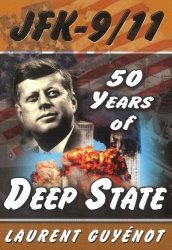
There is, of course, some truth in the “inside job” theory, as I said at the beginning. Israel (in the wider sense) would not be able to pull such an operation and get away with it, without complicity at the highest level of U.S. government. How does that work? Pretty much like for the Kennedy assassination, if you consider that the country was then ruled by its vice-president Dick Cheney, the president being a mere dummy (see Lou Dubose and Jake Bernstein, Vice: Dick Cheney and the Hijacking of the American Presidency, Random House, 2006). In my book JFK-9/11, I have proposed a plausible scenario of how Israel had in fact hijacked a smaller false flag attack on the Pentagon fabricated by the American Deep State, for the limited purpose of justifying the overthrow of the Talibans in Afghanistan, a goal fully supported by such “Great Gamers” as Zbigniew Brzezinski, but which didn’t in itself interest the neocons.
What the neocons wanted was a new war against Iraq and then a general conflagration in the Middle East leading to the crumbling of all the enemies of Israel, with Syria and Iran high on the list. So they outbid everyone and gave the operation the scale they wanted with the help of their New York super-sayan Silvertein. George W. Bush, Colin Powell, Condoleezza Rice, and other goyim who had been kept out of the loop, finding themselves embroiled in geopolitical machinations of global scope, could merely try to save face. On September 19 and 20, Richard Perle’s Defense Policy Board met in the company of Paul Wolfowitz and Bernard Lewis (inventor of the self-fulfilling prophecy of the “clash of civilizations”) but in the absence of Powell and Rice. They prepared a letter to Bush, written on PNAC letterhead, to remind him of his historic mission: “Even if evidence does not link Iraq directly to the attack, any strategy aiming at the eradication of terrorism and its sponsors must include a determined effort to remove Saddam Hussein from power in Iraq. Failure to undertake such an effort will constitute an early and perhaps decisive surrender in the war on international terrorism.”[12] This was an ultimatum. Bush was certainly aware of the leverage that the neocons had acquired over the major print and television media. He was obliged, under penalty of ending in the proverbial trash bin of history, to endorse the invasion of Iraq that his father had refused the Zionists ten years earlier.
As for Brzezinski and other genuine U.S. imperialists, their support for the invasion of Afghanistan made their timid protests against the Iraq war ineffective. It was a little late in February 2007 when Brzezinski denounced before the Senate “a historical, strategic and moral calamity […] driven by Manichaean impulses and imperial hubris.” In 2012 he declared, regarding the risk of conflagration with Iran, that Obama should stop following Israel like a “stupid mule.” He soon disappeared from the MSM, as a useful idiot no longer useful.
The “half truth” of the exclusively “inside job” theory, which denounces 9/11 as a false flag operation perpetrated by the American state on its own citizens, functions like a secondary false flag hiding the real masters of the operation, who are in fact agents in the service of a foreign nation. One of the aims of this inside-jobish controlled opposition is to force American officials to maintain the “bin Laden did it” masquerade, knowing that tearing apart the fake Islamic flag would only reveal the U.S. flag, not the Israeli flag. No longer controlling the media, they would not have the means to raise this second veil to expose Israel. Any effort to get at the truth would be political suicide. Everyone understands what is at stake: if one day, under mounting pressure from public opinion or for some other strategic reason, the mainstream media abandons the official bin Laden story, the well-rehearsed slogan “9/11 was an inside job” will have prepared Americans to turn against their own government, while the neocon Zionists will remain untouchable (Machiavelli’s method: make another accomplish your dirty ends, then turn popular vengeance against him). And God knows what will happen, if the government has not by then succeeded in disarming its citizens through Sandy Hook-type psy-ops. Government officials have little choice but to stick to the Al-Qaeda story, at least for the next fifty years.
After reaching this conclusion in JFK-9/11, I had the satisfaction of finding that Victor Thorn, in a book that had eluded me (Made in Israel: 9-11 and the Jewish Plot Against America, Sisyphus Press, 2011), had already expressed it in harsher terms: “In essence, the ‘9-11 truth movement’ was created prior to Sept. 11, 2001 as a means of suppressing news relating to Israeli complicity. By 2002–2003, ‘truthers’ began appearing at rallies holding placards that read ‘9-11 was an inside job.’ Initially, these signs provided hope for those who didn’t believe the government and mainstream media’s absurd cover stories. But then an awful realization emerged: The slogan ‘9-11 was an inside job’ was quite possibly the greatest example of Israeli propaganda ever devised. […] The mantra, ‘9-11 was an inside job’ is only partially true and is inherently damaging to the ‘truth movement’ because it shifts all attention away from Israel’s traitorous assault against America. […] Leaders of these fake 9-11 groups know the truth about Israel’s 9-11 barbarity. Their willingness to perpetuate or cover it up ultimately makes them as guilty and vile as those who launched the attacks. There are no degrees of separation in this matter. It’s a black-and-white issue. Tell the entire truth about Israel’s Murder, Inc. cabal, or sleep in the same infected bed as these murdering dogs lie in. […] Faux conspiratologists complain about the government and news sources not telling the truth, yet they’ve erected an utter blackout on data regarding Israel and 9-11.”
The missing .3 trillion

Some readers will complain that I am making a very complex operation appear too simple. I plead guilty: I have merely tried here to outline the case against Israel in the short scope of an article. But I am fully aware that creating Greater Israel through a world war fought by the U.S. might not have been the only consideration in the preparation of 9/11. Many private interests had to be involved. Yet I believe none of them interfered with Israel’s plan, and most of them supported it.
There is, for example, the missing gold in the WTC basement : $200 million were recovered from the estimated $1 billion stored: who took the rest? But that is nothing compared to the $2.3 trillion that were missing from the accounts of the Department of Defense for the year 2000, in addition to $1.1 trillion missing for 1999, according to a televised declaration made on September 10th, 2001, the day before the attacks, by Donald Rumsfeld. Just for comparison, this is more than one thousand times the colossal losses of Enron, which triggered a chain of bankruptcies that same year. All this money evaporated into thin air under the watch of William Cohen, Defense Secretary during Bill Clinton’s second term. In 2001, the man who was tasked to help track down the missing trillions was Under Secretary of Defense (Comptroller) Dov Zakheim, a member of PNAC and an ordained rabbi. Practically, the mystery had to be resolved by financial analysts at Resource Services Washington (RSW). Unfortunately, their offices were destroyed by “al-Qaeda” the following morning. The “hijackers” or Flight AA77, rather than hitting the command center on the eastern side of the Pentagon, chose to attempt a theoretically impossible downward spiral at 180 degrees in order to hit the west side of the building precisely at the location of the accounting offices. The 34 experts at RSW perished in their offices, together with 12 other financial analysts, as is noted in the biography of the team leader Robert Russell for the National 9/11 Pentagon Memorial: “The weekend before his death, his entire office attended a crab feast at the Russell home. They were celebrating the end of the fiscal-year budget completion. Tragically, every person that attended that party was involved in the Pentagon explosion, and are currently missing”.
By an incredible coincidence, one of the financial experts trying to make sense of the Pentagon financial loss, Bryan Jack, was reported to have died at the precise location of his office, not because he was working there that day, but because he was on a business trip on Flight AA77. In the words of the Washington Post database: “Bryan C. Jack was responsible for crunching America’s defense budget. He was a passenger on American Airlines Flight 77, bound for official business in California when his plane struck the Pentagon, where, on any other day, Jack would have been at work at his computer”. Yahweh must have a sense of chutzpah!
Footnotes
[1] Philippe Broussard, “En dépit des déclarations américaines, les indices menant à Ben Laden restent minces,” Le Monde, September 25, 2001.
[2] Gilad Atzmon, Being in Time: a Post-Political Manifesto, Interlink Publishing, 2017 , p. 142.
[3] David Ray Griffin, 9/11 Contradictions, Arris Books, 2008, pp. 170-182; Webster Griffin Tarpley, 9/11 Synthetic Terror Made in USA, Progressive Press, 2008, pp. 321-324.
[4] Christopher Bollyn, Solving 9-11: The Deception That Changed the World, C. Bollyn, 2012, pp. 278–280.
[5] It is quoted here from Bollyn’s book and from Justin Raimondo, The Terror Enigma: 9/11 and the Israeli Connection, iUniverse, 2003.
[6] Christopher Bollyn, Solving 9-11: The Deception That Changed the World, C. Bollyn, 2012, p. 159.
[7] Justin Raimondo, The Terror Enigma: 9/11 and the Israeli Connection, iUniverse, 2003, p. 3.
[8] Christopher Bollyn, Solving 9-11: The Deception that Changed the World, 2012 , pp. 278-280.
[9] Quoted by Andrew Cockburn, who claims to have heard the anecdote from “friends of the family”, in Rumsfeld: His Rise, His fall, and Catastrophic Legacy, Scribner, 2011, p. 219.
[10] Michael Evans told of this prophecy in an interview with Deborath Calwell and in his book The American Prophecies, Terrorism and Mid-East Conflict Reveal a Nation’s Destiny), quoted in Christopher Bollyn, Solving 9-11: The Deception That Changed the World, C. Bollyn, 2012, p. 71.
[11] Stephen Sniegoski, The Transparent Cabal: The Neoconservative Agenda, War in the Middle East, and the National Interest of Israel, Enigma Edition, 2008, p. 193.
[12] Stephen Sniegoski, The Transparent Cabal: The Neoconservative Agenda, War in the Middle East, and the National Interest of Israel, Enigma Edition, 2008, p. 144.
Laurent Guyénot is the author of JFK-9/11: 50 years of Deep State, Progressive Press, 2014, and From Yahweh to Zion: Jealous God, Chosen People, Promised Land … Clash of Civilizations, 2018. (or $30 shipping included from Sifting and Winnowing, POB 221, Lone Rock, WI 53556).
Populism Revisited
By ADRIAN KUZMINSKI | CounterPunch | September 4, 2018
Ever since the last presidential election the words “populist” and “populism” have been widely bandied about, mostly as pejorative terms. A populist politician, we often hear, is a demagogue who wins votes by inflaming the resentments and emotions of ordinary people at the expense of rational thought. Those who fall prey to populism are no more to be trusted, critics suggest, than the politicians said to manipulate them.
It’s a curious feature of populism that it defies the normal left-right political spectrum. These days we have left-wing and right-wing populists. In the last election, Bernie Sanders and Donald Trump were both called populists. And historically, we’ve had left-wing populists like Huey Long, and right-wing populists like George Wallace.
It is the corrupt elites, populists argue, who are to blame for the insecurities and troubles of the middle-class. If you’ve lost your job, are over your head in debt, can’t pay your bills, don’t have adequate health care, lack a decent pension, and feel that your values are being undermined, populists say, it’s because of them. The elitist agenda, they say, is what drives inequality, including the outsourcing of jobs, corporate globalization, union-busting, deregulation, and the machinations of the deep state. All this, in their view, represents the tyranny of the one percent, not the welfare of the ninety-nine percent.
It doesn’t require a demagogue to convince people that these are real problems, not paranoid fears. The trouble with modern left and right wing demagogues is their unwillingness or inability to get at the root of the problems which they try to leverage for votes. It’s telling that politicians accused of populism today don’t call themselves populists, as well they shouldn’t. They’re faux-populists who stop short of challenging the status quo of continuing inequality.
Some history might be useful here. It’s largely forgotten that there was a vibrant populist movement in nineteenth century America. It was represented first by the Farmers Alliance after the Civil War, and then by the People’s party in the 1890s. The People’s Party candidate for president in 1892, James B. Weaver, got over a million votes and carried four states. Over 40 populists were elected to Congress in the 1890s, including six United States Senators, along with numerous governors and mayors.
Today such a populist wave would be totally shocking, which is a measure of how narrow our political options have become. The classic nineteenth century American populists were the last serious political movement in this country to defy the duopoly of the two major parties and lock-step left-right thinking. Their defeat in the 1890s by their better-funded and organized opponents ensured that the issues they tried to raise would henceforth be excluded from national political debate–as indeed they have been down to the present day.
What were those issues? Classic populists–unlike their modern faux-populist successors–rejected the two options that even then defined American political discourse: corporate capitalism and state socialism. Corporate capitalism consolidates economic and political power into giant top-down structures controlled by a handful of rich investors and executives. State socialism consolidates economic and political power into giant top-down structures controlled by a handful of politicians and bureaucrats. You see the similarity.
Classic populists rejected both socialism and capitalism as tyrannical absolutist ideologies. Instead they tried to balance the need for collective action with individual freedom. They sought to maximize equality by making sure that private property was widely distributed, and that concentrations of economic power were highly regulated, if not eliminated. They were advocates of small, independent producers: farmers, artisans, fabricators, and generally owners of moderate-scale, local, independent enterprises. They aimed to relocalize democratic government in the decentralized Jeffersonian tradition of home rule. You can have genuine free markets and real democracy, they argued, only when citizens enjoy individual economic security as independent owners of productive property, and can practice meaningful local democracy.
 Classical populists weren’t led by demagogues–who flourish in modern, impersonal, mass politics–but by a variety of grassroots activists (as we would say today) who focused on the issues then crucial to economic and political independence, especially the regulation and decentralization of corporate power (especially in government, finance, transportation, and communications). They advocated public banking as a way of redistributing capital to individuals and small businesses by allowing easy public access to credit at low interest rates. (More about populism can be found in my book, Fixing the System: A History of Populism Ancient & Modern.)
The politicians who try to exploit populist concerns today aren’t really populists. They’re usually left-wing state socialists (Bernie Sanders) or right-wing corporate capitalists (Donald Trump). They advocate more big socialism or more big capitalism to solve our problems. But neither socialism nor capitalism is likely to produce the kind of individual economic and political freedom the original populists envisioned. The problems they raised are with us more than ever. Maybe it’s time to take their solutions seriously.
Adrian Kuzminski is a scholar, writer and citizen activist who has written a wide variety of books on economics, politics, and democracy.
American Pravda: Holocaust Denial
By Ron Unz • Unz Review • August 27, 2018
Reason Magazine and Holocaust Denial
A few years ago I somehow heard about a ferocious online dispute involving a left-leaning journalist named Mark Ames and the editors of Reason magazine, the glossy flagship publication of America’s burgeoning libertarian movement. Although I was deep in my difficult programming work, curiosity got the better of me, so I decided to take a look.
During the Immigration Wars of the 1990s, I’d become quite friendly with the Reason people, frequently visiting their offices, especially during my “English” campaign of 1998, when I’d located my own political headquarters in the same small Westside LA office building they used. As my content-archiving software project began absorbing more and more of my time during the early 2000s, I’d gradually lost touch with them, but even so, the 40-odd years of their magazine archives had become the first publication I’d incorporated into my system, and I was now pleased to discover that both sides in the ongoing feud had put my system to good use in exploring those old Reason issues.
Apparently, the libertarians grouped around Reason had successfully been making political inroads into Silicon Valley’s enormously wealthy technology industry, and had now organized a major conference in San Francisco to gather together their supporters. Their left-leaning rivals decided to nip that project in the bud by highlighting some of the more unsavory ideological positions that mainstream libertarian leaders had once regularly espoused. Perhaps Ron Paul and other libertarians might oppose overseas wars and drug laws, and support cutting taxes and regulations, but they and their Republican Party allies were unspeakably vile on all sorts of other issues, and all “good thinkers” should therefore stay very far away.
The debate began in rather mundane fashion with an article by Ames entitled “Homophobia, Racism, and the Kochs” denouncing Reason for sharing a platform with a high-ranking Republican Congresswoman of Christian conservative views, as well as the magazine’s reliance upon Koch funding and its alleged support for Apartheid South Africa during the 1970s and 1980s. The response by the Reason editor seemed quite persuasive, and he rightfully dismissed the guilt-by-association attacks. He also outlined the gross errors and omissions in the charges regarding South Africa, and ridiculed Ames as a notoriously error-prone “conspiracy theorist.” Surely few outsiders would have paid any attention to such a typical exchange of mudslinging between rival ideological camps.
But then things took a very different turn, and a week later Ames returned with a 5,000 word article bearing a title sure to grab attention: “Holocaust Denial.” He claimed that in 1976 Reason had published an entire special issue devoted to that explosive topic.
Surely everyone on the Internet has encountered numerous instances of Holocaust Denial over the years, but for a respectable magazine to have allotted a full issue to promoting that doctrine was something else entirely. For decades, Hollywood has sanctified the Holocaust, and in our deeply secular society accusations of Holocaust Denial are a bit like shouting “Witch!” in Old Salem or leveling accusations of Trotskyism in the Court of the Red Czar. Progressive Sam Seder’s Majority Report radio show devoted a full half-hour segment to the charges against Reason, and Googling “Reason Magazine”+”Holocaust Denial” today yields thousands of hits. This substantial explosion of Internet controversy was what caught my own attention at the time.
My initial reaction was one of puzzlement. Reason had been the first periodical I had digitized in my system a dozen years earlier, and surely I would have noticed an entire issue promoting Holocaust Denial. However, I soon discovered that February 1976 had been excluded from the supposedly complete set the magazine had shipped me for processing, an omission that itself raises serious suspicions. But Ames had somehow located a copy in a research library and produced a full PDF, which he conveniently placed on the Internet to support his accusations.

Carefully reading his article and then glancing through the contents, I decided that his accusation was technically false but substantially true. Apparently the actual theme of the issue was “Historical Revisionism” and except for a couple of paragraphs buried here and there among the 76 pages, Holocaust Denial never came up, so characterizing it as a Holocaust Denial issue was obviously a grotesque exaggeration. But on the other hand, although few of the authors were familiar to me, it seemed undeniably true that they were numbered among America’s more prominent Holocaust Deniers, and most of them were deeply associated with organizations situated in that same camp. Furthermore, there were strong indications that their positions on that topic must certainly have been known to the Reason editors who commissioned their pieces.
The clearest case comes when Ames quoted the explicit statements of Dr. Gary North, a prominent libertarian thinker who had served as one of Ron Paul’s earliest Congressional aides and later became his longtime partner in politics and business:
Probably the most far-out materials on World War II revisionism have been the seemingly endless scholarly studies of the supposed execution of 6 million Jews by Hitler. The anonymous author [Hoggan] of ‘The Myth of the Six Million’ has presented a solid case against the Establishment’s favorite horror story—the supposed moral justification for our entry into the war…The untranslated books by the former Buchenwald inmate Prof. Paul Rassinier, have seriously challenged the story…A recent and very inexpensive book in magazine form, Did Six Million Really Die?, appeared in 1973, written by Richard Harwood.
A later issue carried a thousand word letter by Prof. Adam Reed of Rockefeller University, a past Reason contributor, strongly affirming the mainstream Holocaust narrative by quoting from standard works, and taking Dr. North to task for his citation of Holocaust Denial works of doubtful quality. But North firmly stood his ground:
“The second point, that about 6 million Jews really did die in the concentration camps, is one that will be open until the records of the period become fully available. I am not convinced yet, one way or the other. I am happy to have Dr. Reed’s interpretation of the data, but until the publishing companies and academic guild encourage the re-examination of the data, I shall continue to recommend that those interested in revisionist questions read The Myth of the Six Million and Did Six Million Really Die? as reasonable (though not necessarily irrefutable) pieces of historical revisionism. If a person can’t make up his mind, he should do more reading.”
Dr. James J. Martin was the lead contributor to the February Revisionism issue, and the preceding January issue had featured an extended Q&A by the editors, with one of the queries directly addressing the controversial topic:
REASON: Dr. Martin, do you believe (1) that the specific charge against the Nazis of having a mass extermination program of several million Jews is true, and (2) that the Allied atrocities were as great or greater than those of the Germans, from your study of the question?
MARTIN: Well, I never made a head count of all who lost their lives in the War-we’ve seen a wide variety of statistical materials, some of which have been pulled out of thin air. As a consequence, it’s hard to make any kind of estimate of this sort, whether ten more were killed on the one side or the other is not a particularly entrancing subject as far as I’m concerned. Whether allegations can be proven it remains to be seen. I don’t believe that the evidence of a planned extermination of the entire Jewish population of Europe is holding up. I have been influenced over the years by the works of Paul Rassinier, and he still has to be reckoned with. His works have been ignored for a long time, and sooner or later somebody’s going to have to do a decent job of coping with what he has presented. I think Rassinier’s general case is sound at the moment and I haven’t seen any strong evidence to upset his allegations or his assertions that there was no planned program for the extermination of European Jews. His other main case is that there were no gas chamber extermination programs. The fact that a great many people lost their lives is incontrovertible—that the German concentration camps weren’t health centers is well known-but they appear to have been far smaller and much less lethal than the Russian ones.
Another major contributor to the issue was Dr. Austin J. App, and just three years earlier he had published a short book bearing the lurid title The Six Million Swindle: Blackmailing the German People for Hard Marks with Fabricated Corpses.
In a follow-up column by Ames’ own editor, the stunned reactions of various journalists are listed, with one of them Tweeting out “I had no idea that Reason Magazine was once a haven for Holocaust Revisionism. Holy Moly.” Despite the angry obfuscations of present-day Reason staffers, this description seems quite correct.
Indeed, there seems considerable circumstantial evidence that around that time “Holocaust Skepticism” extended rather broadly within the entire nascent libertarian movement. Aside from the sharp critique of the aforementioned Prof. Reed, the overwhelming majority of the reader responses seemed totally favorable, with Samuel Konkin III, editor of New Libertarian Weekly and various similar publications, suggesting that the February issue was one of the best they had ever published. David Nolan, founder of America’s Libertarian Party, also praised the issue as “outstanding.”
The two editors of the issue in question even today remain quite prominent figures at Reason and within American libertarianism, while the masthead then carried names such as David Brudnoy and Alan Reynolds, who both later became influential figures in conservative and libertarian politics. There seems no evidence of any resignations or angry recriminations following the issue’s publication, which seems to have been digested with total equanimity, apparently arousing less rancor than might have been generated by a dispute over monetary policy.
I’d never paid much attention to Holocaust discussions over the years, but the name of Murray Rothbard on the 1976 Reason masthead prompted a memory. Rothbard is widely regarded as the founder of modern libertarianism, and I recalled in the 1990s reading somewhere that he had often ridiculed the Holocaust as being total nonsense, which had stuck in my mind as a typical example of libertarian eccentricity. A quick Google search seemed to confirm my recollection that Rothbard was an avowed Holocaust Denier.
Although the whole controversy regarding Reason’s editorial line of the mid-1970s soon died down, it remained a nagging puzzle in the back of my mind. I’d always been quite skeptical of libertarian ideology, but my Reason friends from the 1990s had certainly seemed like smart and rational people to me, hardly raving lunatics of any sort, and two of the ones I’d known best had been the co-editors of the controversial issue in question.
I could easily understand how zealous libertarian ideologues might be swept past the point of rationality on certain matters—perhaps arguing that the police and the army should be abolished as statist institutions—but the factual question of what had or had not happened to the Jews of Europe during World War II hardly fell into that sort of category. Furthermore, libertarianism had always attracted a very large Jewish contingent, especially in its upper ranks, and one of the issue editors came from that background, as did Rothbard and numerous others featured on the masthead. While deranged anti-Semitism is not impossible among Jews, I would think that it is somewhat less likely. Clearly something very odd must have been going on.
I was then too busy with my work to focus on the matter, but some months later I had more time, and began a detailed investigation. My first step was to carefully read the Reason articles produced by those controversial writers previously unknown to me. Although those pieces were not Holocaust-related, I thought they might give me a sense of their thinking.
To my surprise, the historiography seemed outstandingly good, and almost certainly accurate based on what I had picked up over the years from perfectly mainstream sources. Dr. Martin’s long article on the notorious framing of “Tokyo Rose” was probably the best and most comprehensive treatment I had ever encountered on that topic, and Dr. App’s analysis of the tragedy of the Sudeten-Germans was equally strong, raising several points I had previously not known. Percy Greaves effectively summarized many of the very suspicious aspects of the Pearl Harbor attack, and although his case for the prosecution against FDR was certainly not airtight, it accorded with the views presented by numerous scholars in other books on the subject. Moreover, his position was seconded by a young Bruce Bartlett, later a prominent Reagan and Bush official, and still later a strong Republican opponent of George W. Bush, routinely feted by the New York Times. Most of the other writings also seemed of very high quality, including Dr. North’s summary of World War II Revisionism. In general, the academic scholarship of those articles greatly surpassed anything found in opinion magazines of more recent decades, Reason itself included. Those so interested can click on the above links, read the articles in question, and decide for themselves.
Back then, Reason was a young and struggling magazine, with a shoestring staff and budget. Publishing articles of such obvious quality was surely a remarkable achievement for which the editors could feel justifiably proud, and the overwhelmingly positive letters they received seemed absolutely warranted. Meanwhile, the nasty attacks by Ames appeared to be those of a mere political hack who may not have even bothered actually reading the articles whose authors he vilified.
As a further sign of Ames’ dishonesty, he flung the epithet “Nazi” some two dozen times in his hack-job, along with numerous uses of “anti-Semitic” as well, and Greaves was certainly the subject of many of those slurs. But although Greaves and Bartlett wrote back-to-back articles on exactly the same Pearl Harbor topic, and according to Wikipedia, the former was the academic advisor to the latter on that subject, Bartlett’s name appears nowhere in Ames’s hit-piece, presumably because denouncing a prominent policy expert much beloved by the New York Times as an “anti-Semitic Neo-Nazi” might prove self-defeating. Even leaving that aside, accusing the Jewish libertarians running Reason of being Nazi propagandists must surely be the sort of charge that would strain the credulity of even the most gullible.
Debra Lipstadt and Holocaust Denial
With Ames’ credibility totally shredded, I decided to carefully reread his article again, looking for what clues I could find to the whole bizarre situation. Academic scholars who publish very good history on certain subjects might still have totally irrational views on others, but normally one would assume otherwise.
It appeared that much of Ames’ understanding of the issue had come from a certain Debra Lipstadt, whom he characterized as a great Holocaust expert. Her name was very vaguely familiar to me as some sort of academic activist, who years before had won a major legal victory over a rightwing British historian named David Irving, and Irving himself received further denunciations in the Ames article.
However, one name did stick out. Apparently based on Lipstadt’s information, Ames described Harry Elmer Barnes as “the godfather of American Holocaust denial literature” and Martin’s “Holocaust denial guru.”
A dozen years earlier, the name “Barnes” would have meant almost nothing to me. But as I produced my content-archiving system and digitized so many of America’s most influential publications of the last 150 years, I had soon discovered that many of our most illustrious public intellectuals—Left, Right, and Center—had been suddenly purged and “disappeared” around 1940 because of their stalwart opposition to FDR’s extremely aggressive foreign policy, and Barnes, an eminent historian and sociologist, had been among the most prominent of those. He had been one of the earliest editors at Foreign Affairs and for many years afterward his important articles had graced the pages of The New Republic and The Nation, while even after his fall, he had edited Perpetual War for Perpetual Peace, an important 1953 collection of essays by himself and other once-prominent figures. But to have a figure of such intellectual stature accused of being a Holocaust Denier, let alone the “godfather” of the entire movement, seemed rather bizarre to me.
Since Ames was merely an ignorant political hack transmitting the opinions of others, I moved on Lipstadt, his key source. Anyone who has spent much time on the comment-threads of relatively unfiltered websites has certainly encountered the controversial topic of Holocaust Denial, but I now decided to try to investigate the issue in much more serious fashion. A few clicks on the Amazon.com website, and her 1993 book Denying the Holocaust arrived in my mailbox a couple of days later, providing me an entrance into the mysterious world.
Reading the book was certainly a tremendous revelation to me. Lipstadt is a professor of Holocaust Studies with an appointment in Emory University’s Department of Theology, and once I read the opening paragraph of her first chapter, I decided that her academic specialty might certainly be described as “Holocaust Theology.”
The producer was incredulous. She found it hard to believe that I was turning down an opportunity to appear on her nationally televised show. “But you are writing a book on this topic. It will be great publicity.” I explained repeatedly that I would not participate in a debate with a Holocaust denier. The existence of the Holocaust was not a matter of debate. I would analyze and illustrate who they were and what they tried to do, but I would not appear with them…Unwilling to accept my no as final, she vigorously condemned Holocaust denial and all it represented. Then, in one last attempt to get me to change my mind, she asked me a question: “I certainly don’t agree with them, but don’t you think our viewers should hear the other side?”
Lipstadt’s absolute horror at having someone actually dispute the tenets of her academic doctrine could not have been more blatant. Surely no zealous theologian of the European Dark Ages would have reacted any differently.
The second chapter of her book supported that impression. Since many of the individuals she castigates as Holocaust Deniers also supported the Revisionist perspective of the underlying causes of the First and Second World Wars, she harshly attacked those schools, but in rather strange fashion. In recent years, blogger Steve Sailer and others have ridiculed what they describe as the “point-and-sputter” style of debate, in which a “politically-incorrect” narrative is merely described and then automatically treated as self-evidently false without any accompanying need for actual refutation. This seemed to be the approach that Lipstadt took throughout her rather short book.
For example, she provided a very long list of leading academic scholars, prominent political figures, and influential journalists who had championed Revisionist history, noted that their views disagree with the more mainstream perspective she had presumably imbibed from her History 101 textbooks, and thereby regarded them as fully debunked. Certainly a Christian preacher attempting to refute the evolutionary theories of Harvard’s E.O. Wilson by quoting a passage of Bible verse might take much the approach. But few evangelical activists would be so foolish as to provide a very long list of eminent scientists who all took the same Darwinist position and then attempt to sweep them aside by citing a single verse from Genesis. Lipstadt seems to approach history much like a Bible-thumper, but a particularly dim-witted one. Moreover, many of the authors she attacked had already become familiar to me after a decade of my content-archiving work, and I had found their numerous books quite scholarly and persuasive.
Barnes, in particular, figured quite prominently in Lipstadt’s chapter and throughout her book. The index listed his name on more than two dozen pages, and he is repeatedly described as the “godfather” of Holocaust Denial, and its seminal figure. Given such heavy coverage, I eagerly examined all those references and the accompanying footnotes to uncover the shocking statements he must have made during his very long scholarly career.
I was quite disappointed. There is not a single reference I could find to his supposed Holocaust Denial views until just the year before his death at age 79, and even that item is hardly what I had been led to believe. In a 9,300 word article on Revisionism for a libertarian publication, he ridicules a leading Holocaust source for claiming that Hitler had killed 25 million Jews, noting that total was nearly twice their entire worldwide population at the time. In addition, Barnes several times applied the word “allegedly” to the stories of the Nazi extermination scheme, an sacrilegious attitude that appears to have horrified a theologian such as Lipstadt. Finally, in a short, posthumously published review of a book by French scholar Paul Rassiner, Barnes found his estimate of just 1 million to 1.5 million Jewish deaths quite convincing, but his tone suggested that he had never previously investigated the matter himself.
So although that last item technically validated Lipstadt’s accusation that Barnes was a Holocaust Denier, her evidence-free claims that he was the founder and leader of the field hardly enhances her scholarly credibility. Meanwhile, all the many tens of thousands of words I have read by Barnes has suggested that he was a careful and dispassionate historian.
A notorious incident that occurred soon after the Bolshevik Revolution came to my mind. Eminent philologist Timfei Florinsky, one of Russia’s most internationally renowned academic scholars, was hauled before a revolutionary tribunal for a public interrogation about his ideas, and one of the judges, a drunken Jewish former prostitute, found his answers so irritating that she drew her revolver and shot him dead right there and then. Given Lipstadt’s obvious emotional state, I have a strong suspicion that she might have wished she could deal in a similar fashion with Barnes and the numerous other scholars she denounced. Among other things, she noted with horror that more than two decades after his 1940 purge from public life, Barnes’ books were still required reading at both Harvard and Columbia.
All of us reasonably extrapolate what we already know or can easily check against what is more difficult to verify, and the remaining chapters of Lipstadt’s book left me very doubtful about the reliability of her work, all of which was written in a similar near-hysterical style. Since she had already been vaguely known to me from her well-publicized legal battle against historian David Irving more than a dozen years earlier, I was hardly surprised to discover that many pages were devoted to vilifying and insulting him in much the same manner as Barnes, so I decided to investigate that case.
I was only slightly surprised to discover that Irving had been one of the world’s most successful World War II historians, whose remarkable documentary findings had completely upended our knowledge of that conflict and its origins, with his books selling in the many millions. His entire approach to controversial historical issues was to rely as much as possible upon hard documentary evidence, and his total inability to locate any such documents relating to the Holocaust drove Lipstadt and her fellow ethnic-activists into a frenzy of outrage, so after many years of effort they finally managed to wreck his career. Out of curiosity, I read a couple of his shorter books, which seemed absolutely outstanding historiography, written in a very measured tone, quite different from that of Lipstadt, whose own 2005 account of her legal triumph over Irving, History on Trial, merely confirmed my opinion of her incompetence.
Lipstadt’s first book Beyond Belief, published in 1986, tells an interesting story as well, with her descriptive subtitle being “The American Press and the Coming of the Holocaust, 1933-1945.” Much of the volume consists of press clippings from the American print media of that era interspersed with her running rather hysterical commentary, but providing little analysis or judgment. Some of the journalists reported horrifying conditions for Jews in pre-war Germany while others claim that such stories were wildly exaggerated, and Lipstadt automatically praised the former and denounced the latter without providing any serious explanation.
Lenni Brenner’s remarkable book Zionism in the Age of the Dictators had been published three years earlier. Although I only discovered it very recently, surely any half-competent specialist in her own topic would have noticed it, yet Lipstadt provided no hint of its existence. Perhaps the reality of the important Nazi-Zionist economic partnership of the 1930s, with Nazi officials traveling to Palestine as honored Zionist guests and leading Nazi newspapers praising the Zionist enterprise might have complicated her simple story of fanatic German Jew-hatred under Hitler steadily rising towards an exterminationist pitch. Her faculty appointment in a Department of Theology seems very apt.
Lipstadt’s wartime coverage is just as bad, perhaps worse. She catalogs perhaps a couple of hundred print news reports, each describing the massacre of hundreds of thousands or even millions of Jews by the Nazis. But she expresses her outrage that so many of these reports were buried deep within the inside pages of newspapers, a placement suggesting that they were regarded as hysterical wartime atrocity propaganda and probably fictional, with the editors sometimes explicitly stating that opinion. Indeed, among these under-emphasized stories was the claim that the Germans had recently killed 1.5 million Jews by individually injecting each one of them in the heart with a lethal drug. And although I don’t see any mention of it, around that same time America’s top Jewish leader Rabbi Stephen Wise was peddling the absurd report that the Nazis had slaughtered millions of Jews, turning their skins into lampshades and rendering their bodies into soap. Obviously, separating truth from falsehood during a blizzard of wartime propaganda is not nearly as easy as Lipstadt seems to assume.
Ordinary Americans were apparently even more skeptical than newspaper editors. According to Lipstadt:
Writing in the Sunday New York Times Magazine, [Arthur] Koestler cited public opinion polls in the United States in which nine of ten average Americans dismissed the accusations against the Nazis as propaganda lies and flatly stated that they did not believe a word of them.
Lipstadt convincingly demonstrates that very few Americans seem to have believed in the reality of the Holocaust during the Second World War itself, despite considerable efforts by agitated Jewish activists to persuade them. Over the years, I have seen mention of numerous other books making this same basic point, and therefore harshly condemning the American political leaders of the time for having failed “to save the Jews.”
Explicit and Implicit Holocaust Denial After World War II
Yet as I began further investigating the history of Holocaust Denial in the wake of the Reason contretemps, I was very surprised to discover that this same pattern of widespread disbelief in the Holocaust seems to have continued unabated after the end of the war and throughout the 1950s, being especially strong among high-ranking American military figures, especially top generals and individuals with an Intelligence background, who seemingly would have had the best knowledge of the true events.
Some years ago, I came across a totally obscure 1951 book entitled Iron Curtain Over America by John Beaty, a well-regarded university professor. Beaty had spent his wartime years in Military Intelligence, being tasked with preparing the daily briefing reports distributed to all top American officials summarizing available intelligence information acquired during the previous 24 hours, which was obviously a position of considerable responsibility.
As a zealous anti-Communist, he regarded much of America’s Jewish population as deeply implicated in subversive activity, therefore constituting a serious threat to traditional American freedoms. In particular, the growing Jewish stranglehold over publishing and the media was making it increasingly difficult for discordant views to reach the American people, with this regime of censorship constituting the “Iron Curtain” described in his title. He blamed Jewish interests for the totally unnecessary war with Hitler’s Germany, which had long sought good relations with America, but instead had suffered total destruction for its strong opposition to Europe’s Jewish-backed Communist menace.
Beaty also sharply denounced American support for the new state of Israel, which was potentially costing us the goodwill of so many millions of Muslims and Arabs. And as a very minor aside, he also criticized the Israelis for continuing to claim that Hitler had killed six million Jews, a highly implausible accusation that had no apparent basis in reality and seemed to be just a fraud concocted by Jews and Communists, aimed at poisoning our relations with postwar Germany and extracting money for the Jewish State from the long-suffering German people.
He was scathing toward the Nuremberg Trials, which he described as a “major indelible blot” upon America and “a travesty of justice.” According to him, the proceedings were dominated by vengeful German Jews, many of whom engaged in falsification of testimony or even had criminal backgrounds. As a result, this “foul fiasco” merely taught Germans that “our government had no sense of justice.” Sen. Robert Taft, the Republican leader of the immediate postwar era took a very similar position, which later won him the praise of John F. Kennedy in Profiles in Courage. The fact that the chief Soviet prosecutor at Nuremberg had played the same role during the notorious Stalinist show trials of the late 1930s, during which numerous Old Bolsheviks confessed to all sorts of absurd and ridiculous things, hardly enhanced the credibility of the proceedings to many outside observers.
Then as now, a book taking such controversial positions stood little chance of finding a mainstream New York publisher, but it was soon released by a small Dallas firm, and then became enormously successful, going through some seventeen printings over the next few years. According to Scott McConnell, founding editor of The American Conservative, Beaty’s book became the second most popular conservative text of the 1950s, ranking only behind Russell Kirk’s iconic classic, The Conservative Mind.
Moreover, although Jewish groups including the ADL harshly condemned the book, especially in their private lobbying, those efforts provoked a backlash, and numerous top American generals, both serving and retired, wholeheartedly endorsed Beaty’s work, denouncing the ADL efforts at censorship and urging all Americans to read the volume. Although Beaty’s quite explicit Holocaust Denial might shock tender modern sensibilities, at the time it seems to have caused barely a ripple of concern and was almost totally ignored even by the vocal Jewish critics of the work.
Much of this very interesting story is told by Joseph Bendersky, an expert in Holocaust Studies, who devoted ten years of archival research to his 2000 book The “Jewish Threat.” His work chronicles the extremely widespread anti-Semitism found within the U.S. Army and Military Intelligence throughout the first half of the twentieth century, with Jews being widely regarded as posing a serious security risk. The book runs well over 500 pages, but when I consulted the index I found no mention of the Rosenbergs nor Harry Dexter White nor any of the other very numerous Jewish spies revealed by the Venona Decrypts, and the term “Venona” itself is also missing from the index. Reports of the overwhelmingly Jewish leadership of the Russian Bolsheviks are mostly treated as bigotry and paranoia, as are descriptions of the similar ethnic skew of America’s own Communist Party, let alone the heavy financial support of the Bolsheviks by Jewish international bankers. At one point, he dismisses the link between Jews and Communism in Germany by noting that “less than half” of the Communist Party leadership was Jewish; but since fewer than one in a hundred Germans came from that ethnic background, Jews were obviously over-represented among Communist leaders by as much as 5,000%. This seems to typify the sort of dishonesty and innumeracy I have regularly encountered among Jewish Holocaust experts.
Meanwhile, with the copyright having long lapsed, I’m pleased to add Beaty’s work to my Controversial HTML Books selection, so individuals interested can read it and decide for themselves:
John Beaty • 1951 • 82,000 Words
Beaty’s very brief 1951 discussion has been the earliest instance of explicit Holocaust Denial I have managed to locate, but the immediate postwar years seem absolutely rife with what might be described as “implicit Holocaust Denial,” especially within the highest political circles.
Over the years, Holocaust scholars and activists have very rightfully emphasized the absolutely unprecedented nature of the historical events they have studied. They describe how some six million innocent Jewish civilians were deliberately exterminated, mostly in gas chambers, by one of Europe’s most highly cultured nations, and emphasize that monstrous project was often accorded greater priority than Germany’s own wartime military needs during the country’s desperate struggle for survival. Furthermore, the Germans also undertook enormous efforts to totally eliminate all possible traces of their horrifying deed, with huge resources expended to cremate all those millions of bodies and scatter the ashes. This same disappearance technique was even sometimes applied to the contents of their mass graves, which were dug up long after initial burial, so that the rotting corpses could then be totally incinerated and all evidence eliminated. And although Germans are notorious for their extreme bureaucratic precision, this immense wartime project was apparently implemented without benefit of a single written document, or at least no such document has ever been located.
Lipstadt entitled her first book “Beyond Belief,” and I think that all of us can agree that the historical event she and so many others in academia and Hollywood have made the centerpiece of their lives and careers is certainly one of the most very remarkable occurrences in all of human history. Indeed, perhaps only a Martian Invasion would have been more worthy of historical study, but Orson Welles’s famous War of the Worlds radio-play which terrified so many millions of Americans in 1938 turned out to be a hoax rather than real.
The six million Jews who died in the Holocaust certainly constituted a very substantial fraction of all the wartime casualties in the European Theater, outnumbering by a factor of 100 all the British who died during the Blitz, and being dozens of times more numerous than all the Americans who fell there in battle. Furthermore, the sheer monstrosity of the crime against innocent civilians would surely have provided the best possible justification for the Allied war effort. Yet for many, many years after the war, a very strange sort of amnesia seems to have gripped most of the leading political protagonists in that regard.
Robert Faurission, a French academic who became a prominent Holocaust Denier in the 1970s, once made an extremely interesting observation regarding the memoirs of Eisenhower, Churchill, and De Gaulle:
Three of the best known works on the Second World War are General Eisenhower’s Crusade in Europe (New York: Doubleday [Country Life Press], 1948), Winston Churchill’s The Second World War (London: Cassell, 6 vols., 1948-1954), and the Mémoires de guerre of General de Gaulle (Paris: Plon, 3 vols., 1954-1959). In these three works not the least mention of Nazi gas chambers is to be found.
Eisenhower’s Crusade in Europe is a book of 559 pages; the six volumes of Churchill’s Second World War total 4,448 pages; and de Gaulle’s three-volume Mémoires de guerre is 2,054 pages. In this mass of writing, which altogether totals 7,061 pages (not including the introductory parts), published from 1948 to 1959, one will find no mention either of Nazi “gas chambers,” a “genocide” of the Jews, or of “six million” Jewish victims of the war.
Given that the Holocaust would reasonably rank as the single most remarkable episode of the Second World War, such striking omissions must almost force us to place Eisenhower, Churchill, and De Gaulle among the ranks of “implicit Holocaust Deniers.”
Many others seem to fall into that same category. In 1981, Lucy S. Dawidowicz, a leading Holocaust scholar, published a short book entitled The Holocaust and the Historians, in which she denounced so many prominent historians for having so totally ignored the reality of the Holocaust for many years following World War II. Indeed, discussion of that topic was almost entirely confined to the Jewish Studies programs which Jewish ethnic activists had newly established at numerous universities throughout the country. Although Lipstadt’s poor scholarly habits and hysterical style hardly impressed me, she appears to have been among the most successful academics who began a career in those ethnic studies departments, which suggests that their average quality was far below her own.
Meanwhile, Dawidowicz emphasizes that mainstream histories often entirely omitted the Holocaust from their presentations:
But it is plain from the most cursory review of textbooks and scholarly works by English and American historians that the awesome events of the Holocaust have not been given their historic due. For over two decades some secondary school and college texts never mentioned the subject at all, while others treated it so summarily or vaguely as to fail to convey sufficient information about the events themselves or their historical significance.
With regard to serious scholarship, she notes that when Friedrich Meinecke, universally acknowledged as Germany’s most eminent historian, published The German Catastrophe in 1946, he harshly denounced Hitler as the leader of “a band of criminals” but made absolutely no mention of the Holocaust, which surely would have represented the height of such criminality. Major British accounts of Hitler and World War II by leading historians such as A.J.P. Taylor, H.R. Trevor-Roper, and Alan Bullock were almost as silent. A similar situation occurred in America as late as 1972 when the massive 1,237 page Columbia History of the World, having a Jewish co-editor, devoted a full chapter to World War II but confined its discussion of the Holocaust to just two short and somewhat ambiguous sentences. One almost gets a sense that many of these experienced professional historians treated discussion of the Holocaust as a considerable embarrassment, a subject that they sought to avoid or at least completely minimize.
Dawidowicz even castigates Slaughterhouse-Five, the 1969 fictional masterpiece by Kurt Vonnegut, for its bald assertion that the firebombing of Dresden was “the greatest massacre in European history,” a claim that seems to reduce the Holocaust to non-existence.
I myself had noticed something similar just a couple of years before Dawidowicz’s book appeared. The English translation of German journalist Joachim Fest’s widely praised Hitler had been published in 1974 and I had read it a few years later, finding it just as excellent as the critics had indicated. But I remember being a little puzzled that the 800 page book contained no more than a couple of pages discussing the Nazi death camps and the word “Jews” never even appeared in the index.
The vast majority of Hitler’s Jewish victims came from Russia and the Eastern European nations included in the Soviet Bloc. That was also the location of all the extermination camps that are the central focus of Holocaust scholars, and therefore the Soviets were the source of most of the key evidence used at the Nuremberg Trials. Yet Dawidowicz notes that after Stalin grew increasingly suspicious of Jews and Israel a few years after the end of the war, virtually all mention of the Holocaust and German wartime atrocities against Jews vanished from the Soviet media and history books. A similar process occurred in the Warsaw Pact satellites, even while the top Communist Party leadership of many of those countries often remained very heavily Jewish for some years. Indeed, I recall reading quite a number of newspaper articles mentioning that after the Berlin Wall fell and the sundered halves of Europe were finally reunited, most Eastern Europeans had never even heard of the Holocaust.
These days, my morning newspapers seem to carry Holocaust-related stories with astonishing frequency, and probably no event of the twentieth century looms so large in our public consciousness. According to public survey data, even as far back as 1995, some 97% of Americans knew of the Holocaust, far more than were aware of the Pearl Harbor attack or America’s use of the atomic bombs against Japan, while less than half our citizenry were aware that the Soviet Union had been our wartime ally. But I’d suspect that anyone who drew his knowledge from the mainstream newspapers and history books during the first couple of decades after the end of the Second World War might never have even been aware that any Holocaust had actually occurred.
In 1999 Philip Novick published a book on this general theme entitled The Holocaust in American Life, citing that survey, and his introduction began by noting the very strange pattern the Holocaust exhibited in its cultural influence, which seems quite unique among all major historical events. In the case of almost all other searing historical occurrences such as the massive bloodshed of the Somme or the bitter Vietnam War, their greatest impact upon popular consciousness and media came soon afterward, with the major books and films often appearing within the first five or ten years when memories were fresh, and the influence peaking within a couple of decades, after which they were gradually forgotten.
Yet in the case of the Holocaust, this pattern was completely reversed. Hardly anyone discussed it for the first twenty years after the end of the World War II, while it gradually moved to the center of American life in the 1970s, just as wartime memories were fading and many of the most prominent and knowledgeable figures from that era had departed the scene. Novick cites numerous studies and surveys demonstrating that this lack of interest and visibility certainly included the Jewish community itself, which had seemingly suffered so greatly under those events, yet apparently had almost completely forgotten about them during the 1950s and much of the 1960s.
I can certainly confirm that impression from my personal experience. Prior to the mid- or late-1970s, I had had only the vaguest impression that virtually all the Jews and Gypsies of Europe had been exterminated during the Second World War, and although the term “Holocaust” was in widespread use, it invariably referred to a “Nuclear Holocaust,” a term long-since supplanted and scarcely used today. Then, after the Berlin Wall fell, I was quite surprised to discover that Eastern Europe was still filled with vast numbers of unexterminated Gypsies, who quickly flooded into the West and provoked all sorts of political controversies.
The Rediscovery of the Holocaust
The late scholar Raul Hilberg is universally acknowledged as the founder of modern Holocaust studies, which began with the 1961 publication of his massive volume The Destruction of the European Jews. In his very interesting 2007 Hilberg obituary, historian Norman Finkelstein emphasizes that prior to Hilberg’s work, there had been virtually no writing on the Holocaust, and discussion of the topic was considered almost “taboo.” For a recent event of such apparent enormity to have been so completely wiped away from public discussion and the consciousness of historians and political scientists can be explained in several different ways. But once I began to investigate the circumstances behind Hilberg’s ground-breaking work, I encountered all sorts of strange ironies.
According to Wikipedia, Hilberg’s family of Austrian Jews coincidentally arrived in the United States on the exact day in 1939 that war broke out, and in his early teens he was soon horrified to read all the news reports of the ongoing extermination of his fellow Jews in the continent his family had left behind, even telephoning Jewish leaders asking why they were doing so little to save their kinsmen from annihilation. He subsequently served in the U.S. military in Europe, then majored in Political Science at Brooklyn College after the end of the conflict. The inspiration for his future scholarly focus seems to have come when he was shocked by a remark made by one of his lecturers, Hans Rosenberg:
The most wicked atrocities perpetrated on a civilian population in modern times occurred during the Napoleonic occupation of Spain.
When Hilberg asked how Rosenberg, himself a German-Jewish refugee, could have so totally ignored the murder of 6 million Jews, a monstrous crime committed just a couple of years earlier, Rosenberg sought to deflect the question, saying that “it was a complicated matter” and “history doesn’t teach down into the present age.” Since Rosenberg was a student of Meinecke, whom Lipstadt has bitterly denounced as an implicit Holocaust Denier, one wonders whether Rosenberg may have shared the beliefs of his mentor but was reluctant to admit that fact to his overwhelmingly Jewish students in emotionally-charged postwar Brooklyn.
Later, Hilberg conducted his doctoral research at Columbia under Franz Neumann, another German-Jewish refugee scholar. But when Hilberg indicated he wanted his research to focus on the extermination of Europe’s Jews, Neumann strongly discouraged that topic, warning Hilberg that doing so would be professionally imprudent and might become “his academic funeral.” When he attempted to publish his research in book form, it received numerous negative reviews, with Israel’s Yad Vashem fearing it would encounter “hostile criticism,” and over a six year period, it was rejected by several major publishing houses along with Princeton University, based on the advice of the influential Jewish intellectual Hannah Arendt. One naturally wonders whether all these established scholars may have quietly known something that a naive young doctoral candidate such as Hilberg did not. His book only appeared in print because a Jewish immigrant whose business had suffered under the Nazis funded the entire publication.
I’d never paid much attention to Holocaust issues, but the supporters of my local Palo Alto Library operate a monthly book sale, and with serious nonfiction hardcovers often priced at just a quarter each, my personal library has grown by hundreds of volumes over the years, now including several of the thickest and most influential Holocaust texts. Aside from Hilberg’s classic volume, these include Nora Levin’s The Holocaust (1968), Lucy Dawidowicz’s The War Against the Jews, 1933-1945 (1975), Martin Gilbert’s The Holocaust (1985), and Daniel Goldhagen’s Hitler’s Willing Executioners (1996).
I claim absolutely no expertise in Holocaust issues, and analyzing the evidence and argumentation these voluminous works offer is entirely beyond my ability. But I decided to attempt to assess their overall credibility by exploring a few particular items, without actually bothering to read the thousands of pages of text they provided.
Consider the interesting case of Field Marshal Erhard Milch, Hermann Goering’s very powerful number-two in the German Luftwaffe. His father was certainly a Jew, and according to researchers Robert Wistrich and Louis Snyder, there is archival evidence that his mother was Jewish as well. Now is it certainly not impossible that a Third Reich supposedly dedicated with grim fanaticism to the extermination of each and every Jew might have spent the entire war with a full- or half-Jew near the absolute top of its military hierarchy, but surely that puzzling anomaly would warrant careful explanation, and Milch’s apparent Jewish background was certainly known during the Nuremberg Trials.
Yet when I carefully consulted the very comprehensive indexes of those five books, totaling over 3,500 pages, there is virtually no discussion of Milch, except a few very brief mentions of his name in connection with various military operations. Either the authors were unaware of Milch’s Jewish background, or perhaps they hoped to keep that fact away from their readers lest it cause “confusion.” Neither of these possibilities enhances the trust we should place in their research skills or their scholarly objectivity.
Indeed, the fascinating and widely-praised 2002 book Hitler’s Jewish Soldiers by Bryan Mark Rigg notes that aside from Milch, Hitler’s military contained over a dozen half-Jewish generals and admirals and another dozen quarter-Jews of that same high rank, plus a total of roughly 150,000 additional half- or quarter-Jewish soldiers, with a large fraction of these being officers. All of these individuals would have had some fully-Jewish parents or grand-parents, which seems decidedly odd behavior for a regime supposedly so focused on the total eradication of the Jewish race.
Another obvious matter casts further doubt upon the historical quality of those five immensely thick volumes of standard Holocaust narrative, which together occupy nearly a linear foot on my bookshelves. For prosecutors of any crime, establishing a plausible motive is certainly an important goal, and in the case of the Jewish Holocaust, these authors would seem to have an easy task at hand. Hitler and his German colleagues had always claimed that the Jews overwhelmingly dominated Bolshevik Communism, and much of their struggle against the former was in order to prevent further bloody deeds of the latter. So surely devoting an early chapter or so to describing this central Nazi doctrine would provide an airtight explanation of what drove the Nazis to their fiendish slaughters, rendering fully explicable the horrifying events that would occupy the remainder of their text.
Yet oddly enough, an examination of their indexes for “Bolsheviks,” “Communism,” and all variants reveals almost no discussion of this important issue. Goldhagen’s 1996 book provides just a couple of short sentences spread across his 600 pages, and the other works seem to contain virtually nothing at all. Since all of these Holocaust books almost totally avoid Hitler’s self-declared motive for his anti-Jewish actions, they are forced to desperately search for alternative explanations, seeking clues buried deep within the German past or turning to psychanalytical speculations or perhaps deciding that what they describe as the greatest massacre in all human history was undertaken out of sheer Nazi wickedness.
The obvious reason for this glaring omission is that the authors are constructing a morality-play in which the Jews must be portrayed as absolutely blameless victims, and even hinting at their role in the numerous Communist atrocities that long preceded the rise of the Third Reich might cause readers to consider both sides of the issue. When purported historians go to absurd lengths to hide such glaring facts, they unmask themselves as propagandists, and we must be very cautious about trusting their reliability and candor in all other matters, whether great or small.
Indeed, the issue of Communism raises a far larger matter, one having rather touchy implications. Sometimes two simple compounds are separately inert, but when combined together may possess tremendous explosive force. From my introductory history classes and readings in high school, certain things had always seemed glaringly obvious to me even if the conclusions remained unmentionable, and I once assumed they were just as apparent to most others as well. But over the years I have begun to wonder whether perhaps this might not be correct.
Back in those late Cold War days, the death toll of innocent civilians from the Bolshevik Revolution and the first two decades of the Soviet Regime was generally reckoned at running well into the tens of millions when we include the casualties of the Russian Civil War, the government-induced famines, the Gulag, and the executions. I’ve heard that these numbers have been substantially revised downwards to perhaps as little as twenty million or so, but no matter. Although determined Soviet apologists may dispute such very large figures, they have always been part of the standard narrative history taught within the West.
Meanwhile, all historians know perfectly well that the Bolshevik leaders were overwhelmingly Jewish, with three of the five revolutionaries Lenin named as his plausible successors coming from that background. Although only around 4% of Russia’s population was Jewish, a few years ago Vladimir Putin stated that Jews constituted perhaps 80-85% of the early Soviet government, an estimate fully consistent with the contemporaneous claims of Winston Churchill, Times of London correspondent Robert Wilton, and the officers of American Military Intelligence. Recent books by Alexander Solzhenitsyn, Yuri Slezkine, and others have all painted a very similar picture. And prior to World War II, Jews remained enormously over-represented in the Communist leadership, especially dominating the Gulag administration and the top ranks of the dreaded NKVD.
Both of these simple facts have been widely accepted in America throughout my entire lifetime. But combine them together with the relatively tiny size of worldwide Jewry, around 16 million prior to World War II, and the inescapable conclusion is that in per capita terms Jews were the greatest mass-murderers of the twentieth century, holding that unfortunate distinction by an enormous margin and with no other nationality coming even remotely close. And yet, by the astonishing alchemy of Hollywood, the greatest killers of the last one hundred years have somehow been transmuted into being seen as the greatest victims, a transformation so seemingly implausible that future generations will surely be left gasping in awe.
Today’s American Neocons are just as heavily Jewish as were the Bolsheviks of a hundred years ago, and they have greatly benefited from the political immunity provided by this totally bizarre inversion of historical reality. Partly as a consequence of their media-fabricated victimhood status, they have managed to seize control over much of our political system, especially our foreign policy, and have spent the last few years doing their utmost to foment an absolutely insane war with nuclear-armed Russia. If they do manage to achieve that unfortunate goal, they will surely outdo the very impressive human body-count racked up by their ethnic ancestors, perhaps even by an order-of-magnitude or more.
Holocaust Frauds and Confusions
Since the Holocaust only became a major public topic after wartime memories had grown dim, the story has always seemed to suffer from the problems traditionally associated with “recovered memory syndrome.” Truths and falsehoods were often mixed together in strange ways, and the door was opened wide to an astonishing number of outright frauds and liars.
For example, in the late 1970s I remember many of my high school classmates devouring The Painted Bird by Jerzy Kosinski, perhaps the first widely popular Holocaust memoir. But then a few years later, the media revealed that Kosinski’s national best-seller was simply fraudulent, and the plagiarizing author eventually committed suicide. Indeed, there have been so many fake Holocaust memoirs over the years that they nearly constitute a literary genre of their own.
Probably the most world’s most famous Holocaust survivor was Elie Wiesel, who parlayed the stories of his wartime suffering into becoming an enormous political celebrity. His career was capped with a Nobel Peace Prize in 1986, and the announcement declared him “a messenger to mankind.” Yet journalist Alexander Cockburn has persuasively argued that Wiesel was simply a fraud, and his famous autobiographical work Night just another literary hoax.
Although the iconic figure of “the Six Million” has been endlessly repeated by our media, the estimated numbers of the dead have actually been shockingly variable over the years. Although I never paid much attention to Holocaust issues, I have closely read my major newspapers and magazines for decades, and had regularly seen the statement that the Nazi death machine had brutally exterminated five million Gentiles along with the six million Jews. But just last year, I was stunned to discover that former total was simply a whole-cloth invention by prominent Holocaust-activist Simon Wiesenthal, who simply made the figure up one day with the intent of giving non-Jews more of a stake in the Holocaust story. And despite being based on absolutely no evidence or research, his casual claim was never effectively refuted by actual Holocaust scholars, who knew it to be total nonsense, and therefore it was so regularly repeated in the media that I probably read it hundreds of times over the years, always assuming it had some firm grounding in proven reality.
Similarly, for decades I had always read the undeniable fact that the Nazis had exterminated 4 million inmates at Auschwitz, with most of the victims being Jews, and Lipstadt certainly treated that number as absolutely rock-solid historical reality. But in the early 1990s after the fall of Communism, the official total was quietly revised downwards to as little as 1.1 million. The fact that a sudden reduction in the official Holocaust body-count by 3 million has had so little impact upon our public Holocaust media narrative hardly seems to inspire great confidence in either the total figures or the media reporting of them.

Over the last couple of generations, our media has engraved that figure of Six Million so deeply onto the minds of every Western citizen that the meaning of the iconic number is universally understood, and those who question it risk a prison sentence in many European countries. Yet its actual origin is somewhat obscure. According to some accounts, Jewish groups lobbied President Truman into casually inserting it into one of his speeches, and thereafter it has endlessly echoed in the media down to the present day. Some angry Internet activist has put together a graphic displaying extracts from dozens of New York Times stories between 1869 and 1941 all citing the figure of 6 million Eastern European Jews as being threatened with death, suggesting that our official Holocaust body-count actually predated World War II by as much as three generations. I really wouldn’t be surprised if that might be the original source of the number.
Sometimes the creation of a new Holocaust hoax was only narrowly averted. Throughout most of the twentieth century, Jews and blacks had been close political allies in America, with the top leadership of the NAACP almost invariably being Jewish, as were nearly all of Martin Luther King, Jr.’s top white advisors and a very large fraction of the key white activists involved in the black Civil Rights movement of the 1950s and 1960s. But by the late 1960s, a schism had erupted, with many younger black activists becoming deeply hostile to what they perceived as overwhelming Jewish influence, while more militant blacks, whether Muslim or otherwise, began siding with the Palestinians against Zionist Israel. This growing conflict became especially bitter during Jesse Jackson’s presidential campaign of 1988 and reached a flash-point in the New York City of the early 1990s.
A couple of film-makers sought to help heal this rift by producing a major 1992 PBS documentary entitled The Liberators, recounting how black American troops had been among the first units that captured the Buchenwald and Dachau concentration camps, thereby freeing the tens of thousands of Jewish inmates from Nazi captivity. A historical narrative of such deep symbolic resonance quickly attracted overwhelming support from both black leaders and Jewish ones, with Jesse Jackson sharing the stage with Holocaust survivors and numerous Jewish luminaries at the Harlem premiere, and the film received an Oscar nomination. However, in early Febuary 1993 Jeffrey Goldberg took to the pages of The New Republic to reveal that the story was merely a hoax, based on falsified history. Although the film’s Jewish co-producer angrily denounced her critics as racists and Holocaust Deniers, those charges stuck, and were eventually reported in the New York Times and other major media outlets. The leading Jewish organizations and Holocaust centers that had been heavily promoting the film soon distanced themselves, and in 2013 The Times of Israel even marked the twenty-year anniversary of what it described as a notorious hoax. But I suspect that if matters had gone a little differently, the story might soon have become so deeply embedded in the canonical Holocaust narrative that anyone questioning the facts would have been vilified as a racist.
A few years earlier, The New Republic had actually been in the forefront of promoting a different hoax also relating to Jewish issues, one which might have had far greater international political significance when Joan Peters, an obscure Jewish writer, published a major historical work in 1984. She claimed that her extensive archival research had revealed that the bulk of the present-day Palestinians were actually not native to Palestine, but instead were recently-arrived immigrants, drawn there by the heavy economic development produced by the Zionist settlers who had actually preceded them.
Her shocking findings received hundreds of glowing reviews and academic endorsements across the entire spectrum of the mainstream and elite American media, and her book quickly became a huge bestseller. Leading Jewish Holocaust luminaries such as Dawidowicz and Wiesel took center stage in praising her remarkable scholarship, which seemed likely to completely demolish the claims of the expelled Palestinians, thereby reshaping the nature of the Middle East conflict to Israel’s great advantage.
However, a young graduate student in History at Princeton named Norman Finkelstein had considerable interest in the history of Zionism, and being very much surprised by her findings, decided to investigate those claims. Once he began carefully checking her footnotes and her alleged sources, he discovered they were entirely fraudulent, and her groundbreaking research merely amounted to a hoax, which some later suggested had been concocted by an intelligence organization and merely published under her name.
Although Finkelstein widely distributed his important findings, they were totally ignored by all the American journalists, scholars, and media organizations he contacted, with the sole exception of Noam Chomsky, and the growing Joan Peters Hoax might have destroyed the legal basis of the international Palestinian claims to their own Palestine homeland. But some independent-minded British publications eventually picked up his information, and the resulting wave of media embarrassment caused the Peters claims to fade into oblivion. Meanwhile, Finkelstein himself suffered severe retaliation as a consequence, and according to Chomsky was completely blacklisted by his Princeton department and the wider academic community.
More than a dozen years later, Finkelstein’s work became the focus of a second major controversy. In the late 1990s, international Jewish organizations launched a major effort to extract many billions of dollars from the largest Swiss banks, arguing that such funds were the rightful property of European Jews who had died in the Holocaust. When the banks initially resisted, arguing that no solid evidence was being presented for such enormous claims, they were harshly denounced by America’s Jewish-dominated media, and Jewish lobbying led the American government to threaten them with severe financial sanctions that could have destroyed their businesses. Faced with such serious extortionate pressure, the banks finally gave way and paid out the bulk of the funds being demanded, with those billions mostly retained by the Jewish organizations leading the campaign and spent on their own projects since the purported Jewish heirs were impossible to locate.
This situation led historian Finkelstein to publish a short book in 2000 entitled The Holocaust Industry, in which he harshly critiqued what he characterized as a global Jewish money-making enterprise aimed at unfairly extracting wealth on behalf of the supposed Holocaust victims, often with little regard for truth or fairness. Although almost entirely ignored by the American media, it became a major bestseller in Europe, which eventually forced American publications to give it some attention. Among other things, Finkelstein noted that more than a half-century after the end of the Holocaust, the number of officially designated Holocaust survivors had grown so large that simple mortality considerations seemed to imply that huge numbers of European Jews must have survived the war. This obviously raised serious questions about how many might have actually died during that conflict and its accompanying Holocaust.
Over the years, I had noticed the same sorts of media reports claiming enormous totals of Holocaust survivors still alive now six or seven decades after the event. For example, even as late as 2009 an official at Israel’s Jewish Agency justified laws criminalizing Holocaust Denial by explaining that almost 65 years after the end of the war “there are still hundreds of thousands of living Holocaust survivors,” a statement which itself seems to constitute rather explicit Holocaust Denial. Indeed, a very noticeable number of all the New York Times obituaries I read these days in my morning newspapers seem to include Holocaust survivors still expiring in their eighties and nineties.
Anyone who reads serious history books knows that Jews have generally enjoyed a reputation for producing many of the world’s greatest swindlers and frauds, hardly surprising given their notorious tendency to lie and dissemble.
Meanwhile, the Jewish community also seems to contain far more than its fair share of the emotionally disturbed and the mentally ill, and perhaps as a consequence has served as a launching-pad for many of the world’s religious cults and fanatic ideological movements. Any exploration of the Holocaust certainly tends to support this rather negative appraisal.
The Holocaust and Hollywood
Although the Holocaust began to enter American consciousness during the 1960s and 1970s with the publication of major books by Hilberg, Levin, Dawidowicz, and others, together with the resulting articles and reviews that these generated, the initial social impact was probably not substantial, at least outside the Jewish community. Even highly successful books selling in the many tens of thousands of copies would have little impact in a population of more than 200 million.
Our media completely shapes our perceived reality of the world, and although intellectuals and many of the highly educated are greatly influenced by books and other forms of printed content, the vast majority of the population understands the world through electronic media, especially that of popular entertainment.
Consider, for example, the 1974 publication of Time on the Cross: The Economics of American Negro Slavery, a magisterial two volume analysis by economists Robert William Fogel and Stanley L. Engerman. By applying quantitative methods, the study overturned generations of assumptions about the American social institution, demonstrating that black slaves in the South were encouraged to marry and maintain their households, while having diets and medical care comparable to that of the free white population and often superior to that of Northern industrial wage-earners. Moreover, following emancipation the life expectancy of freedmen declined by ten percent and their illnesses increased by twenty per cent. All of this is summarized in the extensive Wikipedia entry.
Although their results were controversial, the authors had the strongest possible academic credentials, with Fogel, an eminent scholar, being a leading figure in a school of economics who went on to win a Nobel Prize. And Fogel’s ideological credentials were even more robust, given that he had had a lifelong commitment to black Civil Rights starting with the eight years he had spent as a young Communist Party organizer, while his 1949 marriage to a black woman had often subjected the couple to the indignities of the anti-miscegenation laws of that era. Consequently, their findings received unprecedented coverage in the mainstream media for an academic study and surely influenced numerous historians and journalists. Yet I think the long-term impact upon popular perceptions about slavery has been almost nil.
By contrast, in 1976 the ABC television network ran the prime-time miniseries Roots, a multi-generational account of a slave family. The story closely adhered to the traditionally harsh slavery narrative, while supposedly being based upon the recorded family history of Alex Hailey, the author of the best-selling book of that same title. But although his work was later found to be fraudulent and apparently plagiarized, the ratings were stellar and the social impact enormous due to the audience of 100 million Americans who watched those episodes. Thus, even the most impressive written scholarship had absolutely no chance of competing with fictionalized television drama.
All three of America’s television networks were under Jewish ownership or control, so it was hardly surprising that two years later ABC decided to repeat this process with the 1978 television miniseries Holocaust, which also achieved an audience of 100 million and generated enormous profits. It seems quite possible this may have been the first time many American families discovered that colossal but almost entirely invisible event of World War II.
The following year, William Styron published Sophie’s Choice, a heart-rending tale involving deeply buried memories of the extermination of Christian Polish children in the Auschwitz gas chambers. Although such an occurrence was absolutely contrary to the doctrines of all Jewish Holocaust scholars, the novel became a huge national best-seller anyway, and a 1982 film of the same name soon followed, with Meryl Streep winning an Oscar for Best Actress. A decade later, Steven Spielberg’s 1993 Schindler’s List won a remarkable seven Oscars, while grossing nearly $100 million.
With Hollywood so overwhelmingly Jewish, the consequences were hardly surprising, and a huge cinematic genre soon developed. According to Finkelstein, Hollywood produced some 180 Holocaust films just during the years 1989-2004. Even the very partial subset of Holocaust films listed on Wikipedia has grown enormously long, but fortunately the Movie Database has winnowed down the catalog by providing a list of the 50 Most Moving Holocaust Films.
Many billions of dollars have surely been invested over the years on the total production costs of this ongoing business enterprise. For most ordinary people, “seeing is believing,” and how could anyone seriously doubt the reality of the Holocaust after having seen all the gas chambers and mounds of murdered Jewish corpses constructed by highly-paid Hollywood set designers? Doubting the existence of Spiderman and the Incredible Hulk would be almost as absurd.
Some 2% of Americans have a Jewish background, while perhaps 95% possess Christian roots, but the Wikipedia list of Christian films seems rather scanty and rudimentary by comparison. Very few of those films were ever widely released, and the selection is stretched to even include The Chronicles of Narnia, which contains no mention of Christianity whatsoever. One of the very few prominent exceptions on the list is Mel Gibson’s 2004 The Passion of the Christ, which he was forced to personally self-fund. And despite the enormous financial success of that movie, one of the most highly profitable domestic releases of all time, the project rendered Gibson a hugely vilified pariah in the industry over which he had once reigned as its biggest star, especially after word got around that his own father was a Holocaust Denier.
In many respects, Hollywood and the broader entertainment media today provide the unifying spiritual basis of our deeply secular society, and the overwhelming predominance of Holocaust-themed films over Christian ones has obvious implications. Meanwhile, in our globalized world, the American entertainment-media complex totally dominates Europe and the rest of the West, so that the ideas generated here effectively shape the minds of many hundreds of millions of people living elsewhere, whether or not they fully recognize that fact.
In 2009, Pope Benedict XVI sought to heal the long-standing Vatican II rift within the Catholic Church and reconcile with the breakaway Society of St. Pius X faction. But this became a major media controversy when it was discovered that Bishop Richard Williamson, one of the leading members of that latter organization, had long been a Holocaust Denier and also believed that Jews should convert to Christianity. Although the many other differences in Catholic doctrinal faith were fully negotiable, apparently refusing to accept the reality of the Holocaust was not, and Williamson remained estranged from the Catholic Church. Soon afterward he was even prosecuted for heresy by the German government.
Internet critics have suggested that over the last couple of generations, energetic Jewish activists have successfully lobbied Western nations into replacing their traditional religion of Christianity with the new religion of Holocaustianity, and the Williamson Affair certainly seems to support that conclusion.

Consider the French satirical magazine Charlie Hebdo. Funded by Jewish interests, it spent years launching vicious attacks against Christianity, sometimes in crudely pornographic fashion, and also periodically vilified Islam. Such activities were hailed by French politicians as proof of the total freedom of thought allowed in the land of Voltaire. But the moment that one of its leading cartoonists made a very mild joke related to Jews, he was immediately fired, and if the publication had ever ridiculed the Holocaust, it surely would have been immediately shut down, and its entire staff possibly thrown into prison.
Western journalists and human rights advocates have often expressed support for the boldly transgressive activities of the Jewish-funded Femen activists when they desecrate Christian churches all around the world. But such pundits would certainly be in an uproar if anyone were to act in similar fashion toward the growing international network of Holocaust Museums, most of them built at public expense.
Indeed, one of the underlying sources of bitter Western conflict with Vladimir Putin’s Russia seems to be that he has restored Christianity to a favored place in a society where the early Bolsheviks had once dynamited churches and massacred many thousands of priests. Western intellectual elites held far more positive feelings toward the USSR while its leaders retained a stridently anti-Christian attitude.
The Rise and Suppression of Holocaust Denial
Since the Holocaust had been almost unknown in America until the mid-1960s, explicit Holocaust Denial was equally non-existent, but as the former grew in visibility following the publication of Hilberg’s 1961 book, the latter soon began to awaken as well.
Lipstadt’s vilification of Barnes as the “godfather” of Holocaust Denial does contain a nugget of truth. His posthumously-published 1968 review endorsing Rassinier’s denialist analysis seems to be the first such substantial statement published anywhere in America, at least if we exclude Beaty’s very casual 1951 dismissal of the Jewish claims, which seem to have attracted negligible public attention.
Near the end of the 1960s, a right-wing publisher named Willis Carto came across a short and unpolished Holocaust Denial manuscript, apparently produced some years earlier, and he ignored legal niceties by simply putting it into print. The purported author then sued for plagiarism, and although the case was eventually settled, his identity eventually leaked out as being that of David L. Hoggan, a Barnes protege with a Harvard Ph.D. in history serving as a junior faculty member at Stanford. His desire for anonymity was aimed at preventing the destruction of his career, but he failed in that effort, and further academic appointments quickly dried up.
Meanwhile, Murray Rothbard, the founding father of modern libertarianism, had always been a strong supporter of historical Revisionism, and greatly admired Barnes, who for decades had been the leading figure in that field. Barnes had also briefly hinted at his general skepticism about the Holocaust in a lengthy 1967 article appearing in the Rampart Journal, a short-lived libertarian publication, and this may have been noticed within those ideological circles. It appears that by the early 1970s, Holocaust Denial had become a topic of some discussion within America’s heavily Jewish but fiercely free-thinking libertarian community, and this was to have an important consequence.
A professor of Electrical Engineering at Northwestern named Arthur R. Butz was casually visiting some libertarian gathering during this period when he happened to notice a pamphlet denouncing the Holocaust as a fraud. He had never previously given any thought to the issue, but such a shocking claim captured his attention, and he began looking into the matter early in 1972. He soon decided that the accusation was probably correct, but found the supporting evidence, including that presented in the unfinished and anonymous Hoggan book, far too sketchy, and decided it needed to be fleshed out in much more detailed and comprehensive fashion. He proceeded to undertake this project over the next few years, working with the methodical diligence of a trained academic engineer.
His major work, The Hoax of the Twentieth Century, first appeared in print late in 1976, and immediately became the central text of the Holocaust Denial community, a position it still seems to retain down to this present day, while with all the updates and appendices, the length has grown to well over 200,000 words. Although no mention of this forthcoming book appeared in the February 1976 issue of Reason, it is possible that word of the pending publication had gotten around within libertarian circles, prompting the sudden new focus upon historical Revisionism.
Butz was a respectable tenured professor at Northwestern, and the release of his book laying out the Holocaust Denial case soon became a minor sensation, covered by the New York Times and other media outlets in January 1977. In one of her books, Lipstadt devotes a full chapter entitled “Entering the Mainstream” to Butz’s work. According to a December 1980 Commentary article by Dawidowicz, Jewish donors and Jewish activists quickly mobilized, attempting to have Butz fired for his heretical views, but back then academic tenure still held firm and Butz survived, an outcome that seems to have greatly irritated Dawidowicz.
Such a detailed and comprehensive book laying out the Holocaust Denial case naturally had a considerable impact on the national debate, especially since the author was a mainstream and apparently apolitical academic, and an American edition of Butz’s book soon appeared in 1977. I’m very pleased to have made arrangements to include the volume in my collection of Controversial HTML Books, so those interested can easily read it and decide for themselves.
The Hoax of the Twentieth Century
The Case Against the Presumed Extermination of European Jewry
Arthur R. Butz • 1976/2015 • 225,000 Words
The following year, these Holocaust Denial trends seemed to gain further momentum as Carto opened a small new publishing enterprise in California called the Institute for Historical Review (IHR), which launched a quarterly periodical entitled The Journal of Historical Review in 1980. Both the IHR and its JHR publication centered their efforts around Revisionism in general, but with Holocaust Denial being their major focus. Lipstadt devotes an entire chapter to the IHR, later noting that most of the main authors of the February 1976 Reason issue soon became affiliated with that project or with other Carto enterprises, as did Butz, while the editorial board of the JHR was soon well-stocked with numerous Ph.D.’s, often earned at highly-reputable universities. For the next quarter century or so, the IHR would hold small conferences every year or two, with David Irving eventually becoming a regular presenter, and even fully mainstream figures such as Pulitzer Prize-winning historian John Toland occasionally appearing as speakers.

As an important example of IHR efforts, in 1983 the organization published The Dissolution of Eastern Europe Jewry, a very detailed quantitative analysis of the underlying demographics and population movements around the period encompassed by World War II, apparently the first such study undertaken. The author, writing under the pen-name Walter N. Sanning, sought to revise the extremely simplistic population analysis casually assumed by Holocaust historians.
Before the war, millions of Jews had lived in Eastern Europe, and after the war, those communities had mostly vanished. This undeniable fact has long stood as an implicit central pillar of the traditional Holocaust narrative. But drawing upon entirely mainstream sources, Sanning persuasively demonstrates that the situation was actually far more complicated than it might seem. For example, it was widely reported at the time that vast numbers of Polish Jews had been transported by the Soviets to locations deep within their territory, on both voluntary and involuntary terms, with future Israeli Prime Minister Menachem Begin being including in those transfers. In addition, huge numbers of heavily urbanized Soviet Jews were similarly evacuated ahead of the advancing German forces in 1941. The exact size of these population movements has long been uncertain and disputed, but Sanning’s careful analysis of postwar Soviet census data and other sources suggests that the totals were likely towards the upper end of most estimates. Sanning makes no claim that his findings are definitive, but even if they are only partially correct, such results would certainly preclude the reality of traditional Holocaust numbers.
Another regular IHR participant was Robert Faurisson. As a professor of literature at the University of Lyons-2, he began expressing his public skepticism about the Holocaust during the 1970s, and the resulting media uproar led to efforts to remove him from his position, while a petition was signed on his behalf by 200 international scholars, including famed MIT professor Noam Chomsky. Faurisson stuck to his opinions, but attacks persisted, including a brutal beating by Jewish militants that hospitalized him, while a French political candidate espousing similar views was assassinated. Jewish activist organizations began lobbying for laws to broadly outlaw the activities of Faurisson and others, and in 1990, soon after the Berlin Wall fell and research at Auschwitz and other Holocaust sites suddenly became far easier, France passed a statute criminalizing Holocaust Denial, apparently the first nation after defeated Germany to do so. During the years that followed, large numbers of other Western countries did the same, setting the disturbing precedent of resolving scholarly disputes via prison sentences, a softer form of the same policy followed in Stalinist Russia.
Since Faurisson was a literary scholar, it is not entirely surprising that one of his major interests was The Diary of Anne Frank, generally regarded as the Holocaust’s iconic literary classic, telling the story of a young Jewish girl who died after being deported from Holland to Auschwitz. He argued that the text was substantially fraudulent, written by someone else after the end of the war, and for decades various determined individuals have argued the case back and forth. I cannot properly evaluate any of their complex arguments, which apparently involve questions of ballpoint pen technology and textual emendations, nor have I ever read the book itself.
But for me, the most striking aspect of the story is the girl’s actual fate under the official narrative, as recounted in the thoroughly establishmentarian Wikipedia entry. Apparently disease was raging in her camp despite the best efforts of the Germans to control it, and she soon became quite ill, mostly remaining bedridden in the infirmary, before eventually dying from typhus in Spring 1945 at a different camp about six months after her initial arrival. It seems rather odd to me that a young Jewish girl who fell severely ill at Auschwitz would have spent so much time in camp hospitals and eventually die there, given that we are told the primary purpose of Auschwitz and other such camps was the efficient extermination of its Jewish inmates.
By the mid-1990s the Holocaust Denial movement seemed to be gaining in public visibility, presumably aided by the doubts raised after the official 1992 announcement that the estimated deaths at Auschwitz had been reduced by around 3 million.
For example, the February 1995 issue of Marco Polo, a glossy Japanese magazine with a circulation of 250,000, carried a long article declaring that the gas chambers of the Holocaust were a propaganda hoax. Israel and Jewish-activist groups quickly responded, organizing a widespread advertising boycott of all the publications of the parent company, one of Japan’s most respected publishers, which quickly folded in the face of that serious threat. All copies of the issue were recalled from the newspapers, the staffers were dismissed, and the entire magazine was soon shut down, while the president of the parent company was forced to resign.
In exploring the history of Holocaust Denial, I have noticed this same sort of recurrent pattern, most typically involving individuals rather than institutions. Someone highly-regarded and fully mainstream decides to investigate the controversial topic, and soon comes to conclusions that sharply deviate from the official truth of the last two generations. For various reasons, those views become public, and he is immediately demonized by the Jewish-dominated media as a horrible extremist, perhaps mentally-deranged, while being relentlessly hounded by a ravenous pack of fanatic Jewish-activists. This usually brings about the destruction of his career.
In the early 1960s Stanford historian David Hoggan produced his anonymous manuscript The Myth of the Six Million, but once it got into circulation and his identity became known, his academic career was destroyed. A dozen years later, something along the same lines happened with Northwestern Electrical Engineering professor Arthur Butz, and only his academic tenure saved him from a similar fate.
Fred Leuchter was widely regarded as one of America’s leading expert specialists on the technology of executions, and a long article in The Atlantic treated him as such. During the 1980s, Ernst Zundel, a prominent Canadian Holocaust Denier, was facing trial for his disbelief in the Auschwitz gas chambers, and one of his expert witnesses was an American prison warden with some experience in such systems, who recommended involving Leuchter, one of the foremost figures in the field. Leuchter soon took a trip to Poland and closely inspected the purported Auschwitz gas chambers, then published the Leuchter Report, concluding that they were obviously a fraud and could not possibly have worked in the manner Holocaust scholars had always claimed. The ferocious attacks which followed soon cost him his entire business career and destroyed his marriage.
David Irving had ranked as the world’s most successful World War II historian, with his books selling in the millions amid glowing coverage in the top British newspapers when he agreed to appear as an expert witness at the Zundel trial. He had always previously accepted the conventional Holocaust narrative, but reading the Leuchter Report changed his mind, and he concluded that the Auschwitz gas chambers were just a myth. He was quickly subjected to unrelenting media attacks, which first severely damaged and then ultimately destroyed his very illustrious publishing career, and he later even served time in an Austrian prison for his unacceptable views.
Dr. Germar Rudolf was a successful young German chemist working at the prestigious Max Planck Institute when he heard of the controversy regarding the Leuchter Report, which he found reasonably persuasive but containing some weaknesses. Therefore, he repeated the analysis on a more thorough basis, and published the results as the Chemistry of Auschwitz, which came to the same conclusions as Leuchter. And just like Leuchter before him, Rudolf suffered the destruction of his career and his marriage, and since Germany treats these matters in harsher fashion, he eventually served five years in prison for his scientific impudence.
Most recently, Dr. Nicholas Kollerstrom, who had spent eleven years as a historian of science on the staff of University College, London, suffered this same fate in 2008. His scientific interests in the Holocaust provoked a media firestorm of vilification, and he was fired with a single day’s notice, becoming the first member of his research institution ever expelled for ideological reasons. He had previously provided the Isaac Newton entry for a massive biographical encyclopedia of astronomers, and America’s most prestigious science journal demanded that the entire work be pulped, destroying the work of over 100 writers, because it had been fatally tainted by having such a villainous contributor. He recounted this unfortunate personal history as an introduction to his 2014 book Breaking the Spell, which I highly recommend.
Kollerstrom’s text effectively summarizes much of the more recent Holocaust Denial evidence, including the official Auschwitz death books returned by Gorbachev after the end of the Cold War, which indicate that Jewish fatalities were some 99% lower than the widely-believed total. Furthermore, Jewish deaths actually showed a sharp decline once plentiful supplies of Zyklon B arrived, exactly contrary to what might have been expected under the conventional account. He also discusses the interesting new evidence contained in the British wartime decrypts of all German communications between the various concentration camps and the Berlin headquarters. Much of this material is presented in an interesting two hour interview on Red Ice Radio, conveniently available on YouTube:
The lives and careers of a very sizable number of other individuals have followed this same unfortunate sequence, which in much of Europe often ends in criminal prosecution and imprisonment. Most notably, a German lawyer who became a bit too bold in her legal arguments soon joined her client behind bars, and as a consequence, it has become increasingly difficult for accused Holocaust Deniers to secure effective legal representation. By Kollerstrom’s estimates, many thousands of individuals are currently serving time across Europe for Holocaust Denial.

My impression is that by the late 1960s, the old Soviet Bloc countries had mostly stopped imprisoning people merely for questioning Marxist-Leninist dogma, and reserved their political prisons only for those actively organizing against the regime, while Holocaust Denial is treated today in far harsher fashion. One clear difference is that actual belief in Communist doctrine had entirely faded away to almost nothing even among the Communist leadership itself, while these days Holocaustianity is still a young and deeply held faith, at least within a small slice of the population that exerts enormously disproportionate leverage over our public institutions.
Another obvious factor is the many billions of dollars currently at stake in what Finkelstein has aptly characterized as “the Holocaust Industry.” For example, potentially enormous new claims are now being reopened against Poland for Jewish property that was lost or confiscated during the World War II era.
In America, the situation is somewhat different, and our First Amendment still protects Holocaust Deniers against imprisonment, though the efforts of the ADL and various other groups to criminalize “hate speech” are clearly aimed at eventually removing that obstacle. But in the meantime, crippling social and economic sanctions are often used to pursue the same objectives.
Furthermore, various Internet monopolies have been gradually persuaded or co-opted into preventing the easy distribution of dissenting information. There have been stories in the media over the last few years that Google has been censoring or redirecting its Holocaust search results away from those disputing the official narrative. Even more ominously, Amazon, our current near-monopolistic retailer of books, last year took the unprecedented step of banning thousands of Holocaust Denial works, presumably lest they “confuse” curious readers, so it is fortunate that I had purchased mine a couple of years earlier. These parallels with George Orwell’s 1984 are really quite striking, and the “Iron Curtain Over America” that Beaty had warned about in his 1951 book of that title seems much closer to becoming a full reality.
Various figures in the Holocaust Denial community have attempted to mitigate this informational blacklist, and Dr. Rudolf some time ago established a website HolocaustHandbooks.com, which allows a large number of the key volumes to be purchased or easily read on-line in a variety of different formats. But the growing censorship by Amazon, Google, and other Internet monopolies greatly reduces the likelihood that anyone will readily encounter the information.
Obviously, most supporters of the conventional Holocaust narrative would prefer to win their battles on the level playing fields of analysis rather than by utilizing economic or administrative means to incapacitate their opponents. But I have seen little evidence that they have enjoyed any serious success in this regard.
Aside from the various books by Lipstadt, which I found to be of poor quality and quite unpersuasive, one of the most energetic Holocaust supporters of the last couple of decades seems to have been Michael Shermer, the editor of Skeptic magazine, who had earned his degrees in psychology and the history of science.
In 1997, he published Why People Believe in Strange Things, seeking to debunk all sorts of irrational beliefs popular in certain circles, with the book’s subtitle describing these as “pseudo-science” and “superstition.” His cover text focused on ESP, alien abductions, and witchcraft, but rebutting Holocaust Denial was the single largest portion of that book, encompassing three full chapters. His discussion of this latter subject was rather superficial, and he probably undercut his credibility by grouping it together with his debunking of the scientific reality of “race” as a similar right-wing fallacy, one also long since disproved by mainstream scientists. Regarding the latter issue, he went on to argue that the alleged black-white differences claimed in works such as The Bell Curve by Richard Herrnstein and Charles Murray was entirely pseudo-scientific nonsense, and he emphasized that book and similar ones had been promoted by the same pro-Nazi groups who advocated Holocaust Denial, with those two pernicious doctrines being closely linked together. Shermer had recruited Harvard professor Stephen Jay Gould to write the Foreword for his book and that raises serious questions about his knowledge or his judgment since Gould is widely regarded as one of the most notorious scientific frauds of the late twentieth century.
In 2000, Shermer returned to the battle, publishing Denying History, entirely focused on refuting Holocaust Denial. This time he recruited Holocaust scholar Alex Grobman as his co-author and acknowledged the generous financial support he had received from various Jewish organizations. A large portion of the text seemed to focus on the psychology and sociology of Holocaust Deniers, trying to explain why people could believe in such patently absurd nonsense. Indeed, so much space was devoted to those issues that he was forced to entirely skip over the official reduction of the Auschwitz body-count by 3 million just a few years earlier, thus avoiding any need to explain why this large shift had had no impact on the canonical Holocaust figure of Six Million.
Although various writers such as Shermer may have been encouraged by generous financial subsidies to make fools of themselves, their more violent allies on the extreme fringe have probably had a greater impact on the Holocaust debate. Although judicial and economic sanctions may deter the vast majority of Holocaust Deniers from showing their face, extra-legal violence has also often been deployed against those hardy souls who remain undeterred.
For example, during the 1980s the offices and warehouse storage facilities of the IHR in Southern California were fire-bombed and totally destroyed by Jewish militants. And although Canada has traditionally had little political violence, in 1995 the large, ramshackle house that served as the residence and business office of Canada’s Ernst Zundel, one of the world’s leading publishers and distributers of Holocaust Denial literature, was similarly fire-bombed and burned to the ground. Zundel had already faced several criminal prosecutions on charges of spreading “false news,” and eventually served years in prison, before being deported back to his native Germany, where he served additional imprisonment. Various other prominent Holocaust Deniers have even faced threats of assassination.
Most historians and other academic scholars are quiet souls, and surely the looming threat of such serious terroristic violence must have dissuaded many of them from involving themselves in such obviously controversial issues. Meanwhile, relentless financial and social pressure may gradually wear down both individuals and organizations, causing them to eventually either abandon the field or become far less active, with their places sometimes taken by newcomers.
The year after the 9/11 attacks, the JHR ceased print publication. The growth of the Internet was probably an important contributing factor, and with the national focus shifting so sharply toward foreign policy and the Middle East, its IHR parent organization became much less active, while much of the ongoing debate in Revisionism and Holocaust Denial shifted to various other online venues. But at some point over the years, the JHR digitized many hundreds of its articles and posted them on its website, providing over three million words of generally very high-quality historical content.
Over the last couple of months, I have been repeatedly surprised to discover that the historians associated with the IHR had long ago published articles on topics quite parallel to some of my own. For example, after I published an article on the Suvorov Hypothesis that Germany’s Barbarossa attack had preempted Stalin’s planned attack and conquest of Europe, someone informed me that a reviewer had extensively discussed the same Suvorov book twenty years earlier in an issue of JHR. I also discovered several pieces by CIA defector Victor Marchetti, a important figure for JFK assassination researchers, who had received little attention in the mainstream media. There were also articles on the fate of the Israeli attack on the USS Liberty, a topic almost entirely excluded from the mainstream media.
Casually browsing some of the archives, I was quite impressed with their quality, and since the archives were freely available for anyone to republish, I went ahead and incorporated them, making the millions of words of their Revisionist and Holocaust Denial content much more conveniently available to interested readers. The material is fully searchable, and also organized by Author, Topic, and Time Period, with a few sample links included below:
The Journal of Historical Review, 1980-2002 Issues
Author Archives:
- David Irving – 11 Articles
- Arthur R. Butz – 15 Articles
- Robert Faurisson – 47 Articles
- James J. Martin – 13 Articles
- Percy L. Greaves, Jr. – 8 Articles
Topic Archives:
- Holocaust – 306 Articles
- World War II – 201 Articles
- Pearl Harbor – 15 Articles
- USS Liberty – 3 Articles
So for those particularly interested in Holocaust Denial, well over a million words of such discussion may now be conveniently available, including works by many of the authors once so highly regarded by the early editors of Reason magazine.
Secretive Holocaust Denial
The steadily growing economic and political power of organized Jewish groups, backed by Hollywood image-making, eventually won the visible war and crushed the Holocaust Denial movement in the public arena, enforcing a particular historical narrative by criminal prosecutions across most of Europe and severe social and economic sanctions in America. But a stubborn underground resistance still exists, with its size being difficult to estimate.
Although my interest in the Holocaust had always been rather minimal, once the Internet came into being and my circle of friends and acquaintances greatly expanded, the topic would very occasionally come up. Over the years, a considerable number of seemingly rational people at one time or another privately let slip their extreme skepticism about various elements of the canonical Holocaust narrative, and such doubts seemed to represent merely the tip of the iceberg.
Every now and then someone in that category spoke a little too freely or became a target for retaliation on a different matter, and our media went into a feeding frenzy of Holocaust Denial accusations and counter-accusations.
For example, during the impeachment battles of the late 1990s, Clinton partisans believed that prominent liberal pundit Christopher Hitchens had betrayed the personal confidences of presidential aide Sidney Blumenthal, and journalist Edward Jay Epstein decided to retaliate in kind, widely circulating a memo to the media accusing Hitchens of secretly being a Holocaust Denier. He alleged that at a 1995 dinner gathering following a New Yorker anniversary celebration, Hitchens had drunk a little too much wine and began expounding to his table-mates that the Holocaust was simply a hoax. Epstein backed his claim by saying he had been so shocked at such statements that he had entered them into his personal diary. That telling detail and the fact that most of the other witnesses seemed suspiciously vague in their recollections persuaded me that Epstein was probably being truthful. A bitter feud between Hitchens and Epstein soon erupted.
In 2005 Hitchens denounced various opponents of Bush’s Iraq War as anti-Semites, and in retaliation Alexander Cockburn published a couple of Counterpunch columns resurrecting that 1999 controversy, which is when I first discovered it. As a regular reader of Counterpunch, I was intrigued and Googling around a bit, quickly located media accounts of Epstein’s explicit accusations. Numerous reports of the the incident still survive on the web, including one from the NY Daily News as well as a portion of an MSNBC piece, and although some of the more extensive ones have disappeared over the last dozen years, the media text I remember reading in 2005 has been preserved on the static HTML pages of several websites:
Epstein told MSNBC that Hitchens had misspoken himself on the Holocaust on Feb. 12, 1995 – in fact, practically four years ago – as the two of them, along with some other friends, were dining in New York.
Epstein was so shocked, he says, and considered Hitchens doubts so grave, that he went home and noted them in his diary!
According to the Epstein diary: “Once seated in a booth, and freely sipping his free red wine, Hitchens advanced a theory more revealing than anything going on at the Hudson theater. His thesis, to the shock of everyone at the table, was that the Holocaust was a fiction developed by a conspiracy of interests bent on ‘criminalizing the German Nation’”
“He explained that no evidence of German mass murder had ever been found – and what gruesome artifacts had been found had been fabricated after the event,” Epstein confided to his diary.
“What of the testimony of Nazi generals at Nuremberg about the death camps,” he asked.
Hitchens, according to the Epstein diary notation, explained “. . . without missing a beat, that such admissions were obtained under Anglo-American torture.” Epstein then asked, as noted in his diary: “‘But what happened to the Jews in Europe?’ Hitch shrugged and said, ‘Many were killed by local villagers when they ran away, others died natural deaths, and the remainder made it to Israel.”
After reading these interesting columns, I began noticing that Cockburn himself sometimes provided hints suggesting that his own personal opinion on the Holocaust might be somewhat heretical, including his cryptical remarks that huge hoaxes were actually much easier to create and maintain than most people realized.
Just a few months after his attack on Hitchens, Cockburn published a two-part article strongly arguing that Nobel Peace Prize Winner Elie Wiesel, the most famous of all Holocaust survivors, was simply a fraud. I had always been taught that Zyklon B was the deadly agent used by the Nazis to exterminate the Jews of Auschwitz and I had vaguely become aware that Holocaust Deniers absurdly claimed the compound had instead been employed as a delousing agent in the camps, aimed at preventing the spread of Typhus; but then the following year, I was shocked to discover in one of Cockburn’s columns that for decades the U.S. government had itself used Zyklon B as the primary delousing agent for immigrants entering at its Mexican border. I recall several other columns from the mid-2000s dancing around Holocaust issues, but I now seem unable to locate them within the Counterpunch archives.
My growing realization 15-odd years ago that substantial numbers of knowledgeable people appeared to be secret adherents of Holocaust Denial certainly reshaped my own unquestioning assumptions on that subject. The occasional newspaper account of a Holocaust Denier being discovered and then flayed and destroyed by the media easily explained why the public positions on that subject remained so unanimous. Being busy with other things, I don’t think I ever had a conversation with anyone on that controversial subject or even so much as an email exchange, but I did keep my eyes and ears open, and huge doubts had certainly entered my mind many years before I ever bothered reading my first book on the subject.
Meanwhile, the concurrent collapse of my belief in our official American Pravda narrative on so many other controversial topics played a major role as well. Once I realized to my dismay that I couldn’t believe a word of what our media and political leaders said about major events in the here and now, their credibility on controversial happenings so long ago and far away entirely disappeared. For these reasons, I had grown quite suspicious and held a very open mind on Holocaust matters as I eventually began reading books on both sides of the issue in the wake of the Reason controversy.
The Future of Holocaust Denial
For many years following the end of World War II very little seems to have been written about the momentous topic now known as the Holocaust. But from the 1960s onward, interest surged so enormously that many thousands or even tens of thousands of volumes on that once-ignored event have been produced. Therefore, the fifteen or twenty books that I have personally read is merely a sliver of that total.
I have invested only a few weeks of reading and research in studying this large and complex subject, and my knowledge is obviously dwarfed by that of the considerable number of individuals who have devoted many years or decades of their lives to such activity. For these reasons, the analysis I have presented above must surely contain numerous gaping errors that others could easily correct. But sometimes a newcomer may notice things that deeply-involved professionals might normally miss, and may also better understand the perspectives of those who have likewise never paid much attention to the subject.
Any conclusions I have drawn are obviously preliminary ones, and the weight others should attach to these must absolutely reflect my strictly amateur status. However, as an outsider exploring this contentious topic I think it far more likely than not that the standard Holocaust narrative is at least substantially false, and quite possibly, almost entirely so.
Despite this situation, the powerful media focus in support of the Holocaust over the last few decades has elevated it to a central position in Western culture. I wouldn’t be surprised if it currently occupies a larger place in the minds of most ordinary folk than does the Second World War that encompassed it, and therefore possesses greater apparent reality.
However, some forms of shared beliefs may be a mile wide but an inch deep, and the casual assumptions of individuals who have never actually investigated a given subject may rapidly change. Also, the popular strength of doctrines that have long been maintained in place by severe social and economic sanctions, often coupled by criminal ones, may possibly be much weaker than anyone realizes.
Until thirty years ago, Communist rule over the USSR and its Warsaw Pact allies seemed absolutely permanent and unshakeable, but the roots of that belief had totally rotted away, leaving behind nothing more than a hollow facade. Then one day, a gust of wind came along, and the entire gigantic structure collapsed. I wouldn’t be surprised if our current Holocaust narrative eventually suffers that same fate, perhaps with unfortunate consequences for those too closely associated with having maintained it.
Related Readings:
- The Hoax of the Twentieth Century by Arthur R. Butz
- The Dissolution of Eastern European Jewry by Walter N. Sanning
- The Remarkable Historiography of David Irving
- American Pravda: Jews and Nazis
- American Pravda: Post-War France and Post-War Germany
- American Pravda: Our Great Purge of the 1940s
- Our American Pravda
Revisionist History Books Banned by Amazon

By Michael Hoffman • Unz Review • August 25, 2018
On August 13, 2018 Amazon banned Judaism’s Strange Gods: Revised and Expanded, which was published in 2011 and sold by Amazon for the past seven years. Along with the much larger study, Judaism Discovered, (sold by Amazon since 2008), it has had an international impact both as a softcover volume as well as a digital book circulating on the Amazon Kindle.
Sales to India, Japan and the Middle East were rapidly growing. The digital Kindle format is particularly important for the free circulation of books because it bypasses borders and customs and hurdles over the prohibitive cost of shipping which the US Postal Service imposed on mail to overseas destinations several years ago (eliminating economical surface mail).
Amazon has also banned The Great Holocaust Trial: The Landmark Battle for the Right to Doubt the West’s Most Sacred Relic (sold by Amazon since 2010).
These volumes maintain a high standard of scholarly excellence, had a majority of favorable reviews by Amazon customers, are free of hatred and bigotry and have sold thousands of copies on Amazon. Out of the blue we were told that suddenly “Amazon KDP” discovered that the books are in violation of Amazon’s “content guidelines.” Asking for documentation of the charge results in no response. It is enough that the accusation has been tendered. The accused are guilty until proved innocent, although how proof of innocence is presented is anyone’s guess. There is no appeals process. This is what is known as “Tech Tyranny.”
There is a nationwide purge underway that amounts to a new McCarthyism — blacklisting and banning politically incorrect speech and history books under the rubric of “hate speech” accusations, initiated in part by two Zionist thought police organizations, the Southern Poverty Law Center (SPLC) and the Anti-Defamation League (ADL). It’s a flimsy pretext for censoring controversial scholarly books that can’t be refuted.
In addition to our books being hate-free, we note that there are hundreds of hate-filled Zionist and rabbinic books brimming with ferocious bigotry for Palestinians, Germans and goyim in general, which are sold by Amazon.
In 1997, Daniel Jonah Goldhagen wrote Hitler’s Willing Executioners, one of the most racist books of the modern age. In it he purported to demonstrate that the Nazi “holocaust” stemmed from an ingrained German predisposition to murder Jews. His book promulgating a theory of a genetic homicidal trait infecting an entire nation of people is proudly sold by Amazon and, if the current zeitgeist persists, it will never be banned by Amazon. The target of Mr. Goldhagen’s hatred are Germans. Consequently, his is the right kind of hate— the approved hate that does not offend the Southern Poverty Law Center.
Many dozens of books containing savage attacks on Christianity are sold by Amazon. These volumes are immune from removal and suppression.
Meanwhile, the censors demand for their own media (Jeff Bezos, the owner of Amazon, owns the Washington Post newspaper) freedom of expression for the writers they employ and the speech of which they approve. In this two tiered ethical system we observe the familiar hallmark of revolutionary tyranny: the insiders demand and grant to themselves and their comrades the freedom they deny to outsiders, using the “hate” imputation as their excuse.
Our critique of Orthodox Judaism in our books constitutes a radical reassessment founded upon the depth of the documents and arguments we marshal in the course of advancing our thesis. Our powerful and original scholarship employed in our study of Orthodox Judaism is never “anti-Semitic” and never hateful. This would be easy to prove if there were an Amazon “tribunal” fair enough to consider a little something known as evidence.
Inside both Judaism Discovered (on p. 39) and Judaism’s Strange Gods: Revised and Expanded (on p. 25) there are statements addressed “to the Judaic reader,” explaining our love and concern for their welfare and liberation. No book of “anti-Semitic hate” would ever print any such charitable and compassionate statements!
To create a special category of informed theological criticism that is banned from the Amazon Kindle is a grave disservice to the advancement of learning. To make an exception for Orthodox Judaism forbidding the sale of the best scholarship critical of it, does no favors to Judaic people. Many Judaic persons don’t approve of this type of suppression and censorship of books and desire access to our information.
Our information is persuasive. It has the potential to liberate Judaic people from the bondage of the Talmudic micromanagement of their lives, and all people from the hatred and racism toward the goyim which problematic sacred rabbinic texts have fomented. If we are wrong, show us where we are wrong, don’t signal through censorship that our facts are too explosive to be handled by inquiring minds; that type of suppression will only blowback on the censors.
It’s time that someone, including multi-billionaire Bezos, had the fortitude to stand-up to the virulent book banning lobby that continues to engage in one of the lowest forms of ignorance and superstition known to history: silencing a writer who can’t be refuted by free and fair debate.
Amazon’s monopoly over the sale of books is so extensive that to be banned by Amazon is, in many cases, tantamount to a death sentence for a book. The public ought to know of the shameful tactics of the hypocrites who are so fearful of the radical scholarship for which they have no credible answer, that they must ban the books that contain irrefutable challenges to their sacred dogmas.
How NATO-linked Think Tanks Control EU Refugee Policy

By F. William Engdahl – New Eastern Outlook – 27.04.2016
A flood of uncontrolled war refugees from Syria, Libya, Tunisia and other Islamic countries destabilized by Washington’s ‘Arab Spring’ Color Revolutions, has created the greatest social dislocation across the EU from Germany to Sweden to Croatia since the end of World War II. By now it has become clear to most that something quite sinister is afoot, something which threatens to destroy the social fabric of the very core of European civilization. What few realize is that the entire drama is being orchestrated, not by German Chancellor Angela Merkel, or by faceless EU bureaucrats of the Brussels EU Commission. It is being orchestrated by a cabal of NATO-linked think tanks.
Last October 8, 2015 amid the great stream of hundreds of thousands of refugees flooding into Germany from Syria, Tunisia, Libya and other lands, a newly self-confident German Chancellor Angela Merkel proclaimed on a popular German TV program, “I have a plan.” She took the occasion to take a sharp dig at coalition partner, Bavarian CSU head, Horst Seehofer, a stauch critic of Merkel’s open arms refugee position since spring 2015 that saw more than one million refugees enter Germany last year alone.
Since that point, with iron-hard resolve, the German Chancellor has defended the criminal Erdogan regime in Turkey, an essential partner in her “plan.”
Most of the world has looked on with astonishment as she ignored principles of free speech and decided to prosecute publicly a well-known German TV comedian, Jan Böhmermann, for his satirical remarks about the Turkish President. They were astonished as the symbol of European democracy, the German Chancellor, chose to ignore Erdogan’s imprisonment of opposition journalists and his shutting of Turk opposition media as he proceeded with plans to establish a de facto dictatorship rule within Turkey. They were puzzled as Berlin’s government chose to ignore overwhelming proof that Erdogan and his family were materially aiding and abetting ISIS terrorists within Syria who were in fact creating the war refugee crisis. They were astonished to see her push through an EU commitment to give Erdogan’s regime billions of euros to supposedly deal with the refugee flow from Turkish refugee camps across the border into EU neighbor land, Greece and beyond.
The Merkel Plan
All of those seemingly inexplicable actions from the once-pragmatic German leader appear to go back to her embrace of a 14-page document prepared by a network of pro-NATO think-tanks, brazenly titled “The Merkel Plan.”
What the newly-self-confident German Chancellor did not tell her hostess, Anne Will, or her viewers was that “her” plan was given to her just four days earlier, on October 4, in a document already titled The Merkel Plan, by a newly-created and obviously well-financed international think-tank called the European Stability Initiative or ESI. The ESI website showed that it had offices in Berlin, Brussels and in Istanbul, Turkey
Suspiciously, the authors of the ESI plan titled their plan as if it had come from the German Chancellor’s office and not from them. More suspicious is the contents of The Merkel Plan of ESI. In addition to already taking more than one million refugees in 2015, Germany should “agree to grant asylum to 500,000 Syrian refugees registered in Turkey over the coming 12 months.” In addition, “Germany should accept claims from Turkey… and provide safe transport to successful applicants… already registered with the Turkish authorities…” And finally, “Germany should agree to help Turkey obtain visa-free travel in 2016.”
That so-called Merkel Plan was a product of US and NATO-linked think tanks and of governments of NATO member countries or prospective members. The maxim “follow the money trail” is instructive in this case to see who really runs the EU today.
The ESI
The ESI came out of NATO-led efforts to transform South East Europe following the US-instigated war in Yugoslavia during the 1990’s that resulted in the Balkanization of the country and establishment of a major USA and NATO airbase, Camp Bond Steel in Kosovo.
Current ESI Chairman directly responsible for the final Merkel Plan document is Istanbul-based Austrian sociologist, Gerald Knaus. Knaus is also a member of the European Council on Foreign Relations (ECFR), and an Open Society Fellow.
Founded in London in 2007, the ECFR is an imitation of the influential New York Council on Foreign Relations, the think-tank created by the Rockefeller and JP Morgan bankers during the 1919 Versailles peace talks to coordinate an Anglo-American global foreign policy. Significantly, the creator and moneybags for the ECFR is American multi-billionaire and Color Revolution funder, George Soros. In virtually every US State Department-backed Color Revolution since the collapse of the Soviet Union, including in Serbia in 2000, in Ukraine, in Georgia, in China, in Brazil and in Russia, George Soros and offshoots of his Open Society Foundations have been in the shadows financing “democracy” NGOs and activists to install pro-Washington and pro-NATO regimes.
The select members, called Council Members or associates, of the London-based ECFR include ECFR co-chairman Joschka Fischer, former German Green Party Foreign Minister who arm-twisted his party into backing Bill Clinton’s illegal 1999 bombing of Serbia without UN Security Council backing.
Other members of the Council of Soros’ European Council on Foreign Relations think tank include former NATO Secretary General, Xavier Solana. It includes disgraced plaigarist and former German Defense Minister, Karl-Theodor zu Guttenberg; Annette Heuser, Executive Director Bertelsmann Stiftung in Washington DC; Wolfgang Ischinger, Chairman, Munich Security Conference; Cem Özdemir, chairman, Bündnis90/Die Grünen; Alexander Graf Lambsdorff, German Liberal Party (FDP) MP; Michael Stürmer, Chief Correspondent, Die Welt; Andre Wilkens, Director of Mercator Foundation; pederasty defender, Daniel Cohn-Bendit of the European Parliament. Cohn-Bendit, known as “Danny the Red” during the May, 1968 French student riots, was a member of the the autonomist group Revolutionärer Kampf (Revolutionary Struggle) in Rüsselsheim, Germany along with his close ally, now ECFR chairman, Joschka Fischer. The two went on to found the “realo” wing of the German Greens.
The Open Society Foundations is the network of tax-exempt “democracy-promoting” foundations created by George Soros on the collapse of the Soviet Union to promote “free market” pro-IMF market liberalization of former communist economies that opened the doors for the systematic plundering of invaluable mining and energy assets of those countries. Soros was a major financier of the liberal economic team of Boris Yeltsin including Harvard “Shock Therapy” economist, Jeffrey Sachs, and Yeltsin liberal adviser, Yegor Gaidar.
Already it becomes clear that the “Merkel Plan” is the Soros Plan in fact. But there is more if we wish to understand the darker agenda behind the plan.
The ESI Funders
The European Stability Initiative think-tank of Soros-tied Gerald Knaus is financed by an impressive list of donors. Their website lists them.
The list includes, in addition to Soros’ Open Society Foundations, the Soros-tied German Stiftung Mercator, and the Robert Bosch Stiftung. ESI funders also include European Commission. Then, curiously enough the funder list for The Merkel Plan includes an organization with the Orwellian name, The United States Institute of Peace.
Some research reveals that the United States Institute of Peace has anything but a peace-loving background. The United States Institute of Peace is chaired by Stephen Hadley, former US National Security Council adviser during the neo-conservative war-waging Bush-Cheney administration. Its Board of Directors includes Ashton B. Carter, current Obama Administration neo-conservative hawkish Secretary of Defense; Secretary of State John Kerry; Major General Frederick M. Padilla, President of the US National Defense University. These are some very seasoned architects of the US Pentagon Full Spectrum Dominance strategy for world military domination.
The “Merkel Plan” authors at the European Stability Initative, in addition to the largesse of George Soros’ foundations, list as “core” funder, the German Marshall Fund of the United States. As I describe in my book, The Think Tanks, the German Marshall Fund is anything but German. With its seat in Washington, as I noted in the book, “It’s an American think tank with its headquarters in Washington, D.C. In point of fact, its agenda is the deconstruction of postwar Germany and more broadly of the sovereign states of the EU to fit them better into the Wall Street globalization agenda.”
The German Marshall Fund of Washington has been involved in the post-1990 USA agenda of regime change around the world in league with the US-funded National Endowment for Democracy, Soros Foundations, and the CIA front called USAID. As I describe it in the think tanks book, “The major focus of the German Marshall Fund according to its 2013 Annual Report was to support the US State Department agenda for so-called democracy-building operations in former communist countries in eastern and south-eastern Europe, from the Balkans to the Black Sea. Significantly their work included Ukraine. In most instances, they worked together with the USAID, widely identified as a CIA front with ties to the State Department, and the Stewart Mott Foundation which gives funds to the US Government-funded National Endowment for Democracy.”
Notably, the same Stewart Mott Foundation is also a funder of the ESI-authored Merkel Plan, as is the Rockefeller Brothers Fund.
This all should give pause for reflection as to who and for what goals the Merkel-Erdogan deal for dealing with the EU refugee crisis is intended. Does the Rockefeller-Bush-Clinton faction in the United States intend to use it as a major social engineering experiment to create chaos and social conflict across the EU at the same time their NGOs such as the NED, Freedom House and the Soros Foundations are stirring things up in Syria and Libya and across the Islamic world? Is Germany, as former US presidential adviser and Rockefeller crony, Zbigniew Brzezinski called her, a “vassal” of US power in the post-1990 world? To date the evidence is pretty strong that that’s the case. The role of US and NATO-linked think tanks is central to get an understanding of how the Federal Republic of Germany and the European Union are actually controlled from behind the Atlantic curtain.
American Pravda: Jews and Nazis
By Ron Unz • Unz Review • August 6, 2018
Around 35 years ago, I was sitting in my college dorm-room closely reading the New York Times as I did each and every morning when I noticed an astonishing article about the controversial new Israeli Prime Minister, Yitzhak Shamir.
Back in those long-gone days, the Gray Lady was strictly a black-and-white print publication, lacking the large color photographs of rap stars and long stories about dieting techniques that fill so much of today’s news coverage, and it also seemed to have a far harder edge in its Middle East reporting. A year or so earlier, Shamir’s predecessor Menacham Begin had allowed his Defense Minister Ariel Sharon to talk him into invading Lebanon and besieging Beirut, and the subsequent massacre of Palestinian women and children in the Sabra and Shatila refugee camps had outraged the world and angered America’s government. This eventually led to Begin’s resignation, with Shamir, his Foreign Minister, taking his place.
Prior to his surprising 1977 election victory, Begin had spent decades in the political wilderness as an unacceptable right-winger, and Shamir had an even more extreme background, with the American mainstream media freely reporting his long involvement in all sorts of high-profile assassinations and terrorist attacks during the 1940s, painting him as a very bad man indeed.
Given Shamir’s notorious activities, few revelations would have shocked me, but this one did. Apparently, during the late 1930s, Shamir and his small Zionist faction had become great admirers of the Italian Fascists and German Nazis, and after World War II broke out, they had made repeated attempts to contact Mussolini and the German leadership in 1940 and 1941, hoping to enlist in the Axis Powers as their Palestine affiliate, and undertake a campaign of attacks and espionage against the local British forces, then share in the political booty after Hitler’s inevitable triumph.
Now the Times clearly viewed Shamir in a very negative light, but it seemed extremely unlikely to me that they would have published such a remarkable story without being absolutely sure of their facts. Among other things, there were long excerpts from the official letters sent to Mussolini ferociously denouncing the “decadent” democratic systems of Britain and France that he was opposing, and assuring Il Duce that such ridiculous political notions would have no future place in the totalitarian Jewish client state they hoped to establish under his auspices in Palestine.
As it happens, both Germany and Italy were preoccupied with larger geopolitical issues at the time, and given the small size of Shamir’s Zionist faction, not much seems to have ever come of those efforts. But the idea of the sitting Prime Minister of the Jewish State having spent his early wartime years as an unrequited Nazi ally was certainly something that sticks in one’s mind, not quite conforming to the traditional narrative of that era which I had always accepted.
Most remarkably, the revelation of Shamir’s pro-Axis past seems to have had only a relatively minor impact upon his political standing within Israeli society. I would think that any American political figure found to have supported a military alliance with Nazi Germany during the Second World War would have had a very difficult time surviving the resulting political scandal, and the same would surely be true for politicians in Britain, France, or most other western nations. But although there was certainly some embarrassment in the Israeli press, especially after the shocking story reached the international headlines, apparently most Israelis took the whole matter in stride, and Shamir stayed in office for another year, then later served a second, much longer term as Prime Minister during 1986-1992. The Jews of Israel apparently regarded Nazi Germany quite differently than did most Americans, let alone most American Jews.

Around that same time, a second intriguing example of this quite different Israeli perspective towards the Nazis also came to my attention. In 1983, Amoz Oz, often described as Israel’s greatest novelist, had published In the Land of Israel to glowing reviews. This book was a collection of lengthy interviews with various representative figures in Israeli society, both moderate and extreme, as well as some coverage of the Palestinians who also lived among them.
Of these ideological profiles, one of the shortest but most widely discussed was that of an especially hard-line political figure, unnamed but almost universally believed to be Ariel Sharon, a conclusion certainly supported by the personal details and physical description provided. Near the very beginning, that figure mentioned that people of his ideological ilk had recently been denounced as “Judeo-Nazis” by a prominent liberal Israeli academic, but rather than reject that label, he fully welcomed it. So the subject generally became known in public discussions as the “Judeo-Nazi.”
That he described himself in such terms was hardly an exaggeration, since he rather gleefully advocated the slaughter of millions of Israel’s enemies, and the vast expansion of Israeli territory by conquest of neighboring lands and expulsion of their populations, along with the free use of nuclear weapons if they or anyone else too strongly resisted such efforts. In his bold opinion, the Israelis and Jews in general were just too soft and meek, and needed to regain their place in the world by once again becoming a conquering people, probably hated but definitely feared. To him, the large recent massacre of Palestinian women and children at Sabra and Shatila was of no consequence whatsoever, and the most unfortunate aspect of the incident was that the killers had been Israel’s Christian Phalangist allies rather than Israeli soldiers themselves.
Now rhetorical excess is quite common among politicians and a shroud of pledged anonymity will obviously loosen many tongues. But can anyone imagine an American or other Western public figure talking in such terms, let alone someone who moves in higher political circles? These days, Donald Trump sometimes Tweets out a crude misspelled insult at 2am, and the American media is aghast in horror. But given that his administration leaks like a sieve, if he routinely boasted to his confidants about possibly slaughtering millions, we surely would have heard about it. For that matter, there seems not the slightest evidence that the original German Nazis ever spoke in such ways privately, let alone while a journalist was carefully taking notes. But the “Judeo-Nazis” of Israel are another story.
As near as I can recall, the last even slightly prominent figure in American public life who declared himself a “Nazi” was George Lincoln Rockwell during the 1960s, and he was much more of a political performance artist than an actual political leader. Even as marginalized a figure as David Duke has always hotly denied such an accusation. But apparently politics in Israel is played by different rules.
In any event, Sharon’s purported utterances seem to have had little negative impact upon his subsequent political career, and after spending some time in the political wilderness after the Lebanon disaster, he eventually served five years as Prime Minister during 2001-2006, although by that later date his views were regularly denounced as too soft and compromising due to the steady rightward drift of the Israeli political spectrum.

Over the years I’ve occasionally made half-hearted attempts to locate the Times article about Shamir that had long stuck in my memory, but have had no success, either because it was removed from the Times archives or more likely because my mediocre search skills proved inadequate. But I’m almost certain that the piece had been prompted by the 1983 publication of Zionism in the Age of the Dictators by Lenni Brenner, an anti-Zionist of the Trotskyite persuasion and Jewish origins. I only very recently discovered that book, which really tells an extremely interesting story.
Brenner, born in 1937, has spent his entire life as an unreconstructed hard-core leftist, with his enthusiasms ranging from Marxist revolution to the Black Panthers, and he is obviously a captive of his views and his ideology. At times, this background impairs the flow of his text, and the periodic allusions to “proletarian,” “bourgeoisie,” and “capitalist classes” sometimes grow a little wearisome, as does his unthinking acceptance of all the shared beliefs common to his political circle. But surely only someone with that sort of fervent ideological commitment would have been willing to devote so much time and effort to investigating that controversial subject and ignoring the endless denunciations that resulted, which even included physical assaults by Zionist partisans.

In any event, his documentation seems completely airtight, and some years after the original appearance of his book, he published a companion volume entitled 51 Documents: Zionist Collaboration with the Nazis, which simply provides English translations of all the raw evidence behind his analytical framework, allowing interested parties to read the material and draw their own conclusions.
Among other things, Brenner provides considerable evidence that the larger and somewhat more mainstream right-wing Zionist faction later led by Israeli Prime Minister Menachem Begin was almost invariably regarded as a Fascist movement during the 1930s, even apart from its warm admiration for Mussolini’s Italian regime. This was hardly such a dark secret in that period given that its main Palestine newspaper carried a regular column by a top ideological leader entitled “Diary of a Fascist.” During one of the major international Zionist conferences, factional leader Vladimir Zabotinsky entered the hall with his brown-shirted followers in full military formation, leading the chair to ban the wearing of uniforms in order to avoid a riot, and his faction was soon defeated politically and eventually expelled from the Zionist umbrella organization. This major setback was largely due to the widespread hostility the group had aroused after two of its members were arrested by British police for the recent assassination of Chaim Arlosoroff, one of the highest-ranking Zionist officials based in Palestine.
Indeed, the inclination of the more right-wing Zionist factions toward assassination, terrorism, and other forms of essentially criminal behavior was really quite remarkable. For example, in 1943 Shamir had arranged the assassination of his factional rival, a year after the two men had escaped together from imprisonment for a bank robbery in which bystanders had been killed, and he claimed he had acted to avert the planned assassination of David Ben-Gurion, the top Zionist leader and Israel’s future founding-premier. Shamir and his faction certainly continued this sort of behavior into the 1940s, successfully assassinating Lord Moyne, the British Minister for the Middle East, and Count Folke Bernadotte, the UN Peace Negotiator, though they failed in their other attempts to kill American President Harry Truman and British Foreign Minister Ernest Bevin, and their plans to assassinate Winston Churchill apparently never moved past the discussion stage. His group also pioneered the use of terrorist car-bombs and other explosive attacks against innocent civilian targets, all long before any Arabs or Muslims had ever thought of using similar tactics; and Begin’s larger and more “moderate” Zionist faction did much the same. Given that background, it was hardly surprising that Shamir later served as director of assassinations at the Israeli Mossad during 1955-1965, so if the Mossad did indeed play a major role in the assassination of President John F. Kennedy, he was very likely involved.

The cover of the 2014 paperback edition of Brenner’s book displays the commemorative medal struck by Nazi Germany to mark its Zionist alliance, with a Star-of-David on the front face and a Swastika on the obverse. But oddly enough, this symbolic medallion actually had absolutely no connection with the unsuccessful attempts by Shamir’s small faction to arrange a Nazi military alliance during World War II.
Although the Germans paid little attention to the entreaties of that minor organization, the far larger and more influential mainstream Zionist movement of Chaim Weizmann and David Ben-Gurion was something else entirely. And during most of the 1930s, these other Zionists had formed an important economic partnership with Nazi Germany, based upon an obvious commonality of interests. After all, Hitler regarded Germany’s one percent Jewish population as a disruptive and potentially dangerous element which he wanted gone, and the Middle East seemed as good a destination for them as any other. Meanwhile, the Zionists had very similar objectives, and the creation of their new national homeland in Palestine obviously required both Jewish immigrants and Jewish financial investment.

After Hitler had been named Chancellor in 1933, outraged Jews worldwide had quickly launched an economic boycott, hoping to bring Germany to its knees, with London’s Daily Express famously running the banner headline “Judea Declares War on Germany.” Jewish political and economic influence, then just like now, was very considerable, and in the depths of the Great Depression, impoverished Germany needed to export or die, so a large scale boycott in major German markets posed a potentially serious threat. But this exact situation provided Zionist groups with an excellent opportunity to offer the Germans a means of breaking that trade embargo, and they demanded favorable terms for the export of high-quality German manufactured goods to Palestine, together with accompanying German Jews. Once word of this major Ha’avara or “Transfer Agreement” with the Nazis came out at a 1933 Zionist Convention, many Jews and Zionists were outraged, and it led to various splits and controversies. But the economic deal was too good to resist, and it went forward and quickly grew.
The importance of the Nazi-Zionist pact for Israel’s establishment is difficult to overstate. According to a 1974 analysis in Jewish Frontier cited by Brenner, between 1933 and 1939 over 60% of all the investment in Jewish Palestine came from Nazi Germany. The worldwide impoverishment of the Great Depression had drastically reduced ongoing Jewish financial support from all other sources, and Brenner reasonably suggests that without Hitler’s financial backing, the nascent Jewish colony, so tiny and fragile, might easily have shriveled up and died during that difficult period.
Such a conclusion leads to fascinating hypotheticals. When I first stumbled across references to the Ha’avara Agreement on websites here and there, one of the commenters mentioning the issue half-jokingly suggested that if Hitler had won the war, statues would surely have been built to him throughout Israel and he would today be recognized by Jews everywhere as the heroic Gentile leader who had played the central role in reestablishing a national homeland for the Jewish people in Palestine after almost 2000 years of bitter exile.
This sort of astonishing counter-factual possibility is not nearly as totally absurd as it might sound to our present-day ears. We must recognize that our historical understanding of reality is shaped by the media, and media organs are controlled by the winners of major wars and their allies, with inconvenient details often excluded to avoid confusing the public. It is undeniably true that in his 1924 book Mein Kampf, Hitler had written all sorts of hostile and nasty things about Jews, especially those who were recent immigrants from Eastern Europe, but when I read the book back in high school, I was a little surprised to discover that these anti-Jewish sentiments hardly seemed central to his text. Furthermore, just a couple of years earlier, a vastly more prominent public figure such as British Minister Winston Churchill had published sentiments nearly as hostile and nasty, focusing on the monstrous crimes being committed by Bolshevik Jews. In Albert Lindemann’s Esau’s Tears, I was surprised to discover that the author of the famous Balfour Declaration, the foundation of the Zionist project, was apparently also quite hostile to Jews, with an element of his motivation probably being his desire to exclude them from Britain.
Once Hitler consolidated power in Germany, he quickly outlawed all other political organizations for the German people, with only the Nazi Party and Nazi political symbols being legally permitted. But a special exception was made for German Jews, and Germany’s local Zionist Party was accorded complete legal status, with Zionist marches, Zionist uniforms, and Zionist flags all fully permitted. Under Hitler, there was strict censorship of all German publications, but the weekly Zionist newspaper was freely sold at all newsstands and street corners. The clear notion seemed to be that a German National Socialist Party was the proper political home for the country’s 99% German majority, while Zionist National Socialism would fill the same role for the tiny Jewish minority.
In 1934, Zionist leaders invited an important SS official to spend six months visiting the Jewish settlement in Palestine, and upon his return, his very favorable impressions of the growing Zionist enterprise were published as a massive 12-part-series in Joseph Goebbel’s Der Angriff, the flagship media organ of the Nazi Party, bearing the descriptive title “A Nazi Goes to Palestine.” In his very angry 1920 critique of Jewish Bolshevik activity, Churchill had argued that Zionism was locked in a fierce battle with Bolshevism for the soul of European Jewry, and only its victory might ensure amicable future relations between Jew and Gentile. Based on available evidence, Hitler and many of the other Nazi leaders seemed to have reached a somewhat similar conclusion by the mid-1930s.
During that era extremely harsh sentiments regarding Diaspora Jewry were sometimes found in rather surprising quarters. After the controversy surrounding Shamir’s Nazi ties erupted into the headlines, Brenner’s material became the grist for an important article by Edward Mortimer, the longtime Middle East expert at the august Times of London, and the 2014 edition of the book includes some choice extracts from Mortimer’s February 11, 1984 Times piece:
Who told a Berlin audience in March 1912 that “each country can absorb only a limited number of Jews, if she doesn’t want disorders in her stomach. Germany already has too many Jews”?
No, not Adolf Hitler but Chaim Weizmann, later president of the World Zionist Organization and later still the first president of the state of Israel.
And where might you find the following assertion, originally composed in 1917 but republished as late as 1936: “The Jew is a caricature of a normal, natural human being, both physically and spiritually. As an individual in society he revolts and throws off the harness of social obligation, knows no order nor discipline”?
Not in Der Sturmer but in the organ of the Zionist youth organization, Hashomer Hatzair.
As the above quoted statement reveals, Zionism itself encouraged and exploited self-hatred in the Diaspora. It started from the assumption that anti-Semitism was inevitable and even in a sense justified so long as Jews were outside the land of Israel.
It is true that only an extreme lunatic fringe of Zionism went so far as to offer to join the war on Germany’s side in 1941, in the hope of establishing “the historical Jewish state on a national and totalitarian basis, and bound by a treaty with the German Reich.” Unfortunately this was the group which the present Prime Minister of Israel chose to join.
The very uncomfortable truth is that the harsh characterizations of Diaspora Jewry found in the pages of Mein Kampf were not all that different from what was voiced by Zionism’s founding fathers and its subsequent leaders, so the cooperation of those two ideological movements was not really so totally surprising.
However, uncomfortable truths do remain uncomfortable. Mortimer had spent nineteen years at the Times, the last dozen of them as the foreign specialist and leader-writer on Middle Eastern affairs. But the year after he wrote that article including those controversial quotations, his career at that newspaper ended, leading to an unusual gap in his employment history, and that development may or may not be purely coincidental.
Also quite ironic was the role of Adolf Eichmann, whose name today probably ranks as one of the most famous half-dozen Nazis in history, due to his postwar 1960 kidnapping by Israeli agents, followed by his public show-trial and execution as a war-criminal. As it happens, Eichmann had been a central Nazi figure in the Zionist alliance, even studying Hebrew and apparently becoming something of a philo-Semite during the years of his close collaboration with top Zionist leaders.
Brenner is a captive of his ideology and his beliefs, accepting without question the historical narrative with which he was raised. He seems to find nothing so strange about Eichmann being a philo-Semitic partner of the Jewish Zionists during the late 1930s and then suddenly being transformed into a mass-murderer of the European Jews in the early 1940s, willingly committing the monstrous crimes for which the Israelis later justly put him to death.
This is certainly possible, but I really wonder. A more cynical observer might find it a very odd coincidence that the first prominent Nazi the Israelis made such an effort to track down and kill had been their closest former political ally and collaborator. After Germany’s defeat, Eichmann had fled to Argentina and lived there quietly for a number of years until his name resurfaced in a celebrated mid-1950s controversy surrounding one of his leading Zionist partners, then living in Israel as a respected government official, who was denounced as a Nazi collaborator, eventually ruled innocent after a celebrated trial, but later assassinated by former members of Shamir’s faction.
Following that controversy in Israel, Eichmann supposedly gave a long personal interview to a Dutch Nazi journalist, and although it wasn’t published at the time, perhaps word of its existence may have gotten into circulation. The new state of Israel was just a few years old at that time, and very politically and economically fragile, desperately dependent upon the goodwill and support of America and Jewish donors worldwide. Their remarkable former Nazi alliance was a deeply-suppressed secret, whose public release might have had absolutely disastrous consequences.
According to the version of the interview later published as a two-part story in Life Magazine, Eichmann’s statements seemingly did not touch on the deadly topic of the 1930s Nazi-Zionist partnership. But surely Israeli leaders must have been terrified that they might not be so lucky the next time, so we may speculate that Eichmann’s elimination suddenly became a top national priority, and he was tracked down and captured in 1960. Presumably, harsh means were employed to persuade him not to reveal any of these dangerous pre-war secrets at his Jerusalem trial, and one might wonder if the reason he was famously kept in an enclosed glass booth was to ensure that the sound could quickly be cut off if he started to stray from the agreed upon script. All of this analysis is totally speculative, but Eichmann’s role as a central figure in the 1930s Nazi-Zionist partnership is undeniable historical fact.
Just as we might imagine, America’s overwhelmingly pro-Israel publishing industry was hardly eager to serve as a public conduit for Brenner’s shocking revelations of a close Nazi-Zionist economic partnership, and he mentions that his book agent uniformly received rejections from each firm he approached, based on a wide variety of different excuses. However, he finally managed to locate an extremely obscure publisher in Britain willing to take on the project, and his book was released in 1983, initially receiving no reviews other than a couple of harsh and perfunctory denunciations, though Soviet Izvestia took some interest in his findings until they discovered that he was a hated Trotskyite.
His big break came when Shamir suddenly became Israel’s Prime Minister, and he brought his evidence of former Nazi ties to the English-language Palestinian press, which put it into general circulation. Various British Marxists, including the notorious “Red Ken” Livingstone of London, organized a speaking tour for him, and when a group of right-wing Zionist militants attacked one of the events and inflicted injuries, the story of the brawl caught the attention of the mainstream newspapers. Soon afterward the discussion of Brenner’s astonishing discoveries appeared in the Times of London and entered the international media. Presumably, the New York Times article that had originally caught my eye ran sometime during this period.
Public relations professionals are quite skilled at minimizing the impact of damaging revelations, and pro-Israel organizations have no shortage of such individuals. Just before the 1983 release of his remarkable book, Brenner suddenly discovered that a young pro-Zionist author named Edwin Black was furiously working on a similar project, apparently backed by sufficient financial resources that he was employing an army of fifty researchers to allow him to complete his project in record time.
Since the entire embarrassing subject of a Nazi-Zionist partnership had been kept away from the public eye for almost five decades, this timing surely seems more than merely coincidental. Presumably word of Brenner’s numerous unsuccessful efforts at securing a mainstream publisher during 1982 had gotten around, as had his eventual success in locating a tiny one in Britain. Having failed to prevent publication of such explosive material, pro-Israel groups quietly decided that their next best option was trying to seize control of the topic themselves, allowing disclosure of those parts of the story that could not be concealed but excluding items of greatest danger, while portraying the sordid history in the best possible light.

Black’s book, The Transfer Agreement, may have arrived a year later than Brenner’s but was clearly backed by vastly greater publicity and resources. It was released by Macmillan, a leading publisher, ran nearly twice the length of Brenner’s short book, and carried powerful endorsements by leading figures from the firmament of Jewish activism, including the Simon Weisenthal Center, the Israel Holocaust Memorial, and the American Jewish Archives. As a consequence, it received long if not necessarily favorable reviews in influential publications such as The New Republic and Commentary.
In all fairness, I should mention that in the Foreword to his book, Black claims that his research efforts had been totally discouraged by nearly everyone he approached, and as a consequence, he had been working on the project with solitary intensity for many years. This implies the near-simultaneous release of the two books was purely due to chance. But such a picture is hardly consistent with his glowing testimonials from so many prominent Jewish leaders, and personally I find Brenner’s claim that Black was assisted by fifty researchers far more convincing.
Since both Black and Brenner were describing the same basic reality and relying upon many of the same documents, in most respects the stories they tell are generally similar. But Black carefully excludes any mention of offers of Zionist military cooperation with the Nazis, let alone the repeated attempts by Shamir’s Zionist faction to officially join the Axis Powers after the war had broken out, as well as numerous other details of a particularly embarrassing nature.
Assuming Black’s book was published for the reasons I suggested, I think that the strategy of the pro-Israel groups largely succeeded, with his version of the history seeming to have quickly supplanted Brenner’s except perhaps in strongly leftist or anti-Zionist circles. Googling each combination of the title and author, Black’s book gets eight times as many hits, and his Amazon sales ranks and numbers of reviews are also larger by roughly that same factor. Most notably, neither the Wikipedia articles on “The Transfer Agreement” and “The Ha’avara Agreement” contain any mention of Brenner’s research whatsoever, even though his book was published earlier, was far broader, and only he provided the underlying documentary evidence. As a personal example of the current situation, I was quite unaware of the entire Ha’avara history until just a few years ago when I encountered some website comments mentioning Black’s book, leading me to purchase and read it. But even then, Brenner’s far more wide-ranging and explosive volume remained totally unknown to me until very recently.
Once World War II began, this Nazi-Zionist partnership quickly lapsed for obvious reasons. Germany was now at war with the British Empire, and financial transfers to British-run Palestine were no longer possible. Furthermore, the Arab Palestinians had grown quite hostile to the Jewish immigrants whom they rightfully feared might eventually displace them, and once the Germans were forced to choose between maintaining their relationship with a relatively small Zionist movement or winning the political sympathy of a vast sea of Middle Eastern Arabs and Muslims, their decision was a natural one. The Zionists faced a similar choice, and especially once wartime propaganda began so heavily blackening the German and Italian governments, their long previous partnership was not something they wanted widely known.
However, at exactly this same moment a somewhat different and equally long-forgotten connection between Jews and Nazi Germany suddenly moved to the fore.
Like most people everywhere, the average German, whether Jewish or Gentile, was probably not all that political, and although Zionism had for years been accorded a privileged place in German society, it is not entirely clear how many ordinary German Jews paid much attention to it. The tens of thousands who emigrated to Palestine during that period were probably motivated as much by economic pressures as by ideological commitment. But wartime changed matters in other ways.

This was even more true for the German government. The outbreak of a world war against a powerful coalition of the British and French empires, later augmented by both Soviet Russia and the United States, imposed the sorts of enormous pressures that could often overcome ideological scruples. A few years ago, I discovered a fascinating 2002 book by Bryan Mark Rigg, Hitler’s Jewish Soldiers, a scholarly treatment of exactly what the title implies. The quality of this controversial historical analysis is indicated by the glowing jacket-blurbs from numerous academic experts and an extremely favorable treatment by an eminent scholar in The American Historical Review.
Obviously, Nazi ideology was overwhelmingly centered upon race and considered racial purity a crucial factor in national cohesion. Individuals possessing substantial non-German ancestry were regarded with considerable suspicion, and this concern was greatly amplified if that admixture was Jewish. But in a military struggle against an opposing coalition possessing many times Germany’s population and industrial resources, such ideological factors might be overcome by practical considerations, and Rigg persuasively argues that some 150,000 half-Jews or quarter-Jews served in the armed forces of the Third Reich, a percentage probably not much different than their share of the general military-age population.
Germany’s long-integrated and assimilated Jewish population had always been disproportionately urban, affluent, and well-educated. As a consequence it is not entirely surprising that a large proportion of these part-Jewish soldiers who served Hitler were actually combat officers rather than merely rank-and-file conscripts, and they included at least 15 half-Jewish generals and admirals, and another dozen quarter-Jews holding those same high ranks. The most notable example was Field Marshal Erhard Milch, Hermann Goering’s powerful second-in-command, who played such an important operational role in creating the Luftwaffe. Milch certainly had a Jewish father, and according to some much less substantiated claims, perhaps even a Jewish mother as well, while his sister was married to an SS general.
Admittedly, the racially-elite SS itself generally had far stricter ancestry standards, with even a trace of non-Aryan parentage normally seen as disqualifying an individual from membership. But even here, the situation was sometimes complicated, since there were widespread rumors that Reinhard Heydrich, the second-ranking figure in that very powerful organization, actually had considerable Jewish ancestry. Rigg investigates that claim without coming to any clear conclusions, though he does seem to think that the circumstantial evidence involved may have been used by other high-ranking Nazi figures as a point of leverage or blackmail against Heydrich, who stood as one of the most important figures in the Third Reich.
As a further irony, most of these individuals traced their Jewish ancestry through their father rather than their mother, so although they were not Jewish according to rabbinical law, their family names often reflected their partly Semitic origins, though in many cases Nazi authorities attempted to studiously overlook this glaringly obvious situation. As an extreme example noted by an academic reviewer of the book, a half-Jew bearing the distinctly non-Aryan name of Werner Goldberg actually had his photograph prominently featured in a 1939 Nazi propaganda newspaper, with the caption describing him as the “The Ideal German Soldier.”
The author conducted more than 400 personal interviews of the surviving part-Jews and their relatives, and these painted a very mixed picture of the difficulties they had encountered under the Nazi regime, which varied enormously depending upon particular circumstances and the personalities of those in authority over them. One important source of complaint was that because of their status, part-Jews were often denied the military honors or promotions they had rightfully earned. However, under especially favorable conditions, they might also be legally reclassified as being of “German Blood,” which officially eliminated any taint on their status.
Even official policy seems to have been quite contradictory and vacillating. For example, when the civilian humiliations sometimes inflicted upon the fully Jewish parents of serving half-Jews were brought to Hitler’s attention, he regarded that situation as intolerable, declaring that either such parents must be fully protected against such indignities or all the half-Jews must be discharged, and eventually in April 1940 he issued a decree requiring the latter. However, this order was largely ignored by many commanders, or implemented through a honor-system that almost amounted to “Don’t Ask, Don’t Tell,” so a considerable fraction of half-Jews remained in the military if they so wished. And then in July 1941, Hitler somewhat reversed himself, issuing a new decree that allowed “worthy” half-Jews who had been discharged to return to the military as officers, while also announcing that after the war, all quarter-Jews would be reclassified as fully “German Blood” Aryan citizens.
It has been said that after questions were raised about the Jewish ancestry of some of his subordinates, Goring once angrily responded “I will decide who is a Jew!” and that attitude seems to reasonably capture some of the complexity and subjective nature of the social situation.
Interestingly enough, many of part-Jews interviewed by Rigg recalled that prior to Hitler’s rise to power, the intermarriage of their parents had often provoked much greater hostility from the Jewish rather than the Gentile side of their families, suggesting that even in heavily-assimilated Germany, the traditional Jewish tendency toward ethnic exclusivity had still remained a powerful factor in that community.
Although the part-Jews in German military service were certainly subject to various forms of mistreatment and discrimination, perhaps we should compare this against the analogous situation in our own military in those same years with regard to America’s Japanese or black minorities. During that era, racial intermarriage was legally prohibited across a large portion of the US, so the mixed-race population of those groups was either almost non-existent or very different in origin. But when Japanese-Americans were allowed to leave their wartime concentration camps and enlist in the military, they were entirely restricted to segregated all-Japanese units, but with the officers generally being white. Meanwhile, blacks were almost entirely barred from combat service, though they sometimes served in strictly-segregated support roles. The notion that an American with any appreciable trace of African, Japanese, or for that matter Chinese ancestry might serve as a general or even an officer in the U.S. military and thereby exercise command authority over white American troops would have been almost unthinkable. The contrast with the practice in Hitler’s own military is quite different than what Americans might naively assume.
This paradox is not nearly as surprising as one might assume. The non-economic divisions in European societies had almost always been along lines of religion, language, and culture rather than racial ancestry, and the social tradition of more than a millennium could not easily be swept away by merely a half-dozen years of National Socialist ideology. During all those earlier centuries, a sincerely-baptized Jew, whether in Germany or elsewhere, was usually considered just as good a Christian as any other. For example, Tomas de Torquemada, the most fearsome figure of the dreaded Spanish Inquisition, actually came from a family of Jewish converts.
Even wider racial differences were hardly considered of crucial importance. Some of the greatest heroes of particular national cultures, such as Russia’s Alexander Pushkin and France’s Alexandre Dumas, had been individuals with significant black African ancestry, and this was certainly not considered any sort of disqualifying characteristic.
By contrast, American society from its inception had always been sharply divided by race, with other differences generally constituting far smaller impediments to intermarriage and amalgamation. I’ve seen widespread claims that when the Third Reich devised its 1935 Nuremberg Laws restricting marriage and other social arrangements between Aryans, non-Aryans, and part-Aryans, its experts drew upon some of America’s long legal experience in similar matters, and this seems quite plausible. Under that new Nazi statute, pre-existing mixed-marriages received some legal protection, but henceforth Jews and half-Jews could only marry each other, while quarter-Jews could only marry regular Aryans. The obvious intent was to absorb that latter group into mainstream German society, while isolating the more heavily-Jewish population.
Ironically enough, Israel today is one of very few countries with a similar sort of strictly racially-based criteria for citizenship status and other privileges, with the Jewish-only immigration policy now often determined by DNA testing, and marriages between Jews and non-Jews legally prohibited. A few years ago, the world media also carried the remarkable story of a Palestinian Arab sentenced to prison for rape because he had consensual sexual relations with a Jewish woman by passing himself off as a fellow Jew.
Since Orthodox Judaism is strictly matrilineal and controls Israeli law, even Jews of other branches can experience unexpected difficulties due to conflicts between personal ethnic identity and official legal status. The vast majority of the wealthier and more influential Jewish families worldwide do not follow Orthodox religious traditions, and over the generations, they have often taken Gentile wives. However, even if the latter had converted to Judaism, their conversions are considered invalid by the Orthodox Rabbinate, and none of their resulting descendants are considered Jewish. So if some members of these families later develop a deep commitment to their Jewish heritage and immigrate to Israel, they are sometimes outraged to discover that they are officially classified as “goyim” under Orthodox law and legally prohibited from marrying Jews. These major political controversies periodically erupt and sometimes reach the international media.
Now it seems to me that any American official who proposed racial DNA tests to decide upon the admission or exclusion of prospective immigrants would have a very difficult time remaining in office, with the Jewish-activists of organizations like the ADL probably leading the attack. And the same would surely be true for any prosecutor or judge who sent non-whites to prison for the crime of “passing” as whites and thereby managing to seduce women from that latter group. A similar fate would befall advocates of such policies in Britain, France, or most other Western nations, with the local ADL-type organization certainly playing an important role. Yet in Israel, such existing laws merely occasion a little temporary embarrassment when they are covered in the international media, and then invariably remain in place after the commotion has died down and been forgotten. These sorts of issues are considered of little more importance than were the past wartime Nazi ties of the Israeli prime minister throughout most of the 1980s.
But perhaps the solution to this puzzling difference in public reaction lies in an old joke. A leftist wit once claimed that the reason America has never had a military coup is that it is the only country in the world that lacks an American embassy to organize such activities. And unlike the U.S., Britain, France, and many other predominately-white countries, Israel has no domestic Jewish-activist organization filling the powerful role of the ADL.
Over the last few years, many outside observers have noted a seemingly very odd political situation in Ukraine. That unfortunate country possesses powerful militant groups, whose public symbols, stated ideology, and political ancestry all unmistakably mark them as Neo-Nazis. Yet those violent Neo-Nazi elements are all being bankrolled and controlled by a Jewish Oligarch who holds dual Israeli citizenship. Furthermore, that peculiar alliance had been mid-wifed and blessed by some of America’s leading Jewish Neocon figures, such as Victoria Nuland, who have successfully used their media influence to keep such explosive facts away from the American public.
At first glance, a close relationship between Jewish Israelis and European Neo-Nazis seems as grotesque and bizarre a misalliance as one could imagine, but after recently reading Brenner’s fascinating book, my perspective quickly shifted. Indeed, the main difference between then and now is that during the 1930s, Zionist factions represented a very insignificant junior partner to a powerful Third Reich, while these days it is the Nazis who occupy the role of eager suppliants to the formidable power of International Zionism, which now so heavily dominates the American political system and through it, much of the world.
American Pravda: The Nature of Anti-Semitism
By Ron Unz • Unz Review • July 30, 2018
I recently published a couple of long essays, and although they primarily focused on other matters, the subject of anti-Semitism was a strong secondary theme. In that regard, I mentioned my shock at discovering a dozen or more years ago that several of the most self-evidently absurd elements of anti-Semitic lunacy, which I had always dismissed without consideration, were probably correct. It does seem likely that a significant number of traditionally-religious Jews did indeed occasionally commit the ritual murder of Christian children in order to use their blood in certain religious ceremonies, and also that powerful Jewish international bankers did play a large role in financing the establishment of Bolshevik Russia.
When one discovers that matters of such enormous moment not only apparently occurred but that they had been successfully excluded from nearly all of our histories and media coverage for most of the last one hundred years, the implications take some time to properly digest. If the most extreme “anti-Semitic canards” were probably true, then surely the whole notion of anti-Semitism warrants a careful reexamination.
All of us obtain our knowledge of the world by two different channels. Some things we discover from our own personal experiences and the direct evidence of our senses, but most information comes to us via external sources such as books and the media, and a crisis may develop when we discover that these two pathways are in sharp conflict. The official media of the old USSR used to endlessly trumpet the tremendous achievements of its collectivized agricultural system, but when citizens noticed that there was never any meat in their shops, “Pravda” became a watchword for “Lies” rather than “Truth.”
Now consider the notion of “anti-Semitism.” Google searches for that word and its close variants reveal over 24 million hits, and over the years I’m sure I’ve seen that term tens of thousands of times in my books and newspapers, and heard it endlessly reported in my electronic media and entertainment. But thinking it over, I’m not sure that I can ever recall a single real-life instance I’ve personally encountered, nor have I heard of almost any such cases from my friends or acquaintances. Indeed, the only persons I’ve ever come across making such claims were individuals who bore unmistakable signs of serious psychological imbalance. When the daily newspapers are brimming with lurid tales of hideous demons walking among us and attacking people on every street corner, but you yourself have never actually seen one, you may gradually grow suspicious.
Indeed, over the years some of my own research has uncovered a sharp contrast between image and reality. As recently as the late 1990s, leading mainstream media outlets such as The New York Times were still denouncing a top Ivy League school such as Princeton for the supposed anti-Semitism of its college admissions policy, but a few years ago when I carefully investigated that issue in quantitative terms for my lengthy Meritocracy analysis I was very surprised to reach a polar-opposite conclusion. According to the best available evidence, white Gentiles were over 90% less likely to be enrolled at Harvard and the other Ivies than were Jews of similar academic performance, a truly remarkable finding. If the situation had been reversed and Jews were 90% less likely to be found at Harvard than seemed warranted by their test scores, surely that fact would be endlessly cited as the absolute smoking-gun proof of horrendous anti-Semitism in present-day America.
It has also become apparent that a considerable fraction of what passes for “anti-Semitism” these days seems to stretch that term beyond all recognition. A few weeks ago an unknown 28-year-old Democratic Socialist named Alexandria Ocasio-Cortez scored a stunning upset primary victory over a top House Democrat in New York City, and naturally received a blizzard of media coverage as a result. However, when it came out that she had denounced the Israeli government for its recent massacre of over 140 unarmed Palestinian protesters in Gaza, cries of “anti-Semite” soon appeared, and according to Google there are now over 180,000 such hits combining her name and that harsh accusatory term. Similarly, just a few days ago the New York Times ran a major story reporting that all of Britain’s Jewish newspapers had issued an “unprecedented” denunciation of Jeremy Corbyn’s Labour Party, describing it as an “existential threat” to the Jewish community for the anti-Semitism it was fostering; but this apparently amounted to nothing more than its willingness to sharply criticize the Israeli government for its long mistreatment of the Palestinians.
One plausible explanation of the strange contrast between media coverage and reality might be that anti-Semitism once did loom very large in real life, but dissipated many decades ago, while the organizations and activists focused on detecting and combating that pernicious problem have remained in place, generating public attention based on smaller and smaller issues, with the zealous Jewish activists of the Anti-Defamation League (ADL) representing a perfect example of this situation. As an even more striking illustration, the Second World War ended over seventy years ago, but what historian Norman Finkelstein has so aptly labeled “the Holocaust Industry” has grown ever larger and more entrenched in our academic and media worlds so that scarcely a day passes without one or more articles relating to that topic appearing in my major morning newspapers. Given this situation, a serious exploration of the true nature of anti-Semitism should probably avoid the mere media phantoms of today and focus on the past, when the condition might still have been widespread in daily life.
Many observers have pointed to the aftermath of the Second World War as marking a huge watershed in the public acceptability of anti-Semitism both in America and Europe, so perhaps a proper appraisal of that cultural phenomenon should focus on the years before that global conflict. However, the overwhelming role of Jews in the Bolshevik Revolution and other bloody Communist seizures of power quite naturally made them objects of considerable fear and hatred throughout the inter-war years, so the safest course might be to push that boundary back a little further and confine our attention to the period prior to the outbreak of the First World War. The pogroms in Czarist Russia, the Dreyfus Affair in France, and the lynching of Leo Frank in the American South come to mind as some of the most famous examples from that period.
In 1991 Cambridge University Press published The Jew Accused by Albert Lindemann, a noted scholar of European ideological movements, and his book focused on exactly that era and those sorts of incidents. Although the text is quite short, running less than 300 pages, Lindemann built his discussion upon a huge foundation of secondary literature, with his footnotes drawn from the 200 works included in his extensive bibliography. As far as I could tell, he seems a very scrupulous scholar, generally providing the multiple, often conflicting accounts of a given incident, and coming to his own conclusions with considerable hesitation.
This approach is certainly demonstrated in the first of his major cases, the notorious Dreyfus affair of late 19th century France, probably one of history’s most famous anti-Semitic incidents. Although he concludes that Captain Alfred Dreyfus was very likely innocent of the charge of espionage, he notes the seemingly strong evidence that initially led to his arrest and conviction and finds—contrary to myth-making by numerous later writers—absolutely no indications that his Jewish origins played any role whatsoever in his predicament.
However, he does note some of the underlying social context to this fierce political battle. Although only one Frenchman in a thousand was Jewish, just a few years earlier a group of Jews had been the leading culprits behind several huge financial scandals that impoverished large numbers of small investors, and the swindlers afterward escaped any punishment by means of political influence and bribery. Given this history, much of the outrage of the anti-Dreyfusards probably arose from their fears that a Jewish military spy from a very wealthy family might be able to walk free using similar tactics, and the public claims that Dreyfus’s brother was offering enormous bribes to win his brother’s release certainly strengthened this concern.
Lindemann’s discussion of the 1913 Leo Frank Affair, in which a wealthy Northern Jew working in Atlanta was accused of sexually-assaulting and murdering a young girl, is even more interesting. Once again, he notes that contrary to the traditional narrative, there seems absolutely no hint that Frank’s Jewish background played any role in his arrest or conviction. Indeed, at his trial it was instead his very highly-paid defense attorneys who unsuccessfully sought to “play the race card” with the jurors by crudely attempting to deflect suspicion upon a local black worker by means of racially-charged invective.
Although Lindemann regards Frank as probably innocent, my own reading of the evidence he presents suggests the overwhelming likelihood of his guilt. Meanwhile, it seems undeniable that the outpouring of popular anger against Frank was produced by the vast ocean of outside Jewish money—at least $15 million or more in present-day dollars—that was committed to the legal efforts to save the life of someone widely regarded as a brutal murderer. There are strong suggestions that far more improper means were also employed, including bribery and influence-peddling, so that after Frank was convicted by a jury of his peers and thirteen separate legal appeals were denied, a governor with strong personal ties to the defense lawyers and Jewish interests chose to spare Frank’s life a few months before leaving office. Under these circumstances, the lynch-mob that hung Frank was viewed by the community as merely enforcing his official death sentence by extra-judicial means.
I also discovered that the leading figures in the anti-Frank movement had views far nuanced than I had expected. For example, populist writer Tom Watson had previously been a strong defender of Jewish anarchist Emma Goldman, while ferociously denouncing the Rockefellers, Morgans, and Goulds as the “true destroyers” of Jeffersonian democracy, so his outrage that Frank might escape punishment for murder seemed motivated by the extreme wealth of Frank’s family and his supporters rather than any pre-existing anti-Semitic sentiments.
The unmistakable conclusion of Lindemann’s analysis is that if the defendants in both the Dreyfus and Frank cases had not been Jewish, they would have suffered identical arrests and convictions, but lacking any wealthy and politically mobilized Jewish community to rally around them, they would have received their punishments, just or unjust, and immediately been forgotten. Instead, Theodor Herzl, the founding father of Zionism, later claimed that the massive anti-Semitism revealed by the Dreyfus Affair was the basis of his personal ideological awakening, while the Frank Affair led to the establishment of America’s Anti-Defamation League. And both these cases have entered our history books as among the most notorious examples of pre-World War I anti-Semitism.
Lindemann’s discussion of the often difficult relations between Russia’s restive Jewish minority and its huge Slavic majority is also quite interesting, and he provides numerous instances in which major incidents, supposedly demonstrating the enormously strong appeal of vicious anti-Semitism, were quite different than has been suggested by the legend. The famous Kishinev Pogrom of 1903 was obviously the result of severe ethnic tension in that city, but contrary to the regular accusations of later writers, there seems absolutely no evidence of high-level government involvement, and the widespread claims of 700 dead that so horrified the entire world were grossly exaggerated, with only 45 killed in the urban rioting. Chaim Weizman, the future president of Israel, later promoted the story that he himself and some other brave Jewish souls had personally defended their people with revolvers in hand even as they saw the mutilated bodies of 80 Jewish victims. This account was totally fictional since Weizman happened to have been be hundreds of miles away when the riots occurred.
Although a tendency to lie and exaggerate was hardly unique to the political partisans of Russian Jewry, the existence of a powerful international network of Jewish journalists and Jewish-influenced media outlets ensured that such concocted propaganda stories might receive enormous worldwide distribution, while the truth followed far behind, if at all.
For related reasons, international outrage was often focused on the legal confinement of most of Russia’s Jews to the “Pale of Settlement,” suggesting some sort of tight imprisonment; but that area was the traditional home of the Jewish population and encompassed a landmass almost as large as France and Spain combined. The growing impoverishment of Eastern European Jews during that era was often assumed to be a consequence of hostile government policy, but the obvious explanation was extraordinary Jewish fecundity, which far outstripped that of their Slavic fellow countrymen, and quickly led them to outgrow the available spots in any of their traditional “middleman” occupations, a situation worsened by their total disinclination to engage in agriculture or other primary-producer activities. Jewish communities expressed horror at the risk of losing their sons to the Czarist military draft, but this was simply the flip-side of the full Russian citizenship they had been granted, and no different from what was faced by their non-Jewish neighbors.
Certainly the Jews of Russia suffered greatly from widespread riots and mob attacks in the generation prior to World War I, and these did sometimes have substantial government encouragement, especially in the aftermath of the very heavy Jewish role in the 1905 Revolution. But we should keep in mind that a Jewish plotter had been implicated in the killing of Czar Alexander II, and Jewish assassins had also struck down several top Russian ministers and numerous other government officials. If the last decade or two had seen American Muslims assassinate a sitting U.S. President, various leading Cabinet members, and a host of our other elected and appointed officials, surely the position of Muslims in this country would have become a very uncomfortable one.
As Lindemann candidly describes the tension between Russia’s very rapidly growing Jewish population and its governing authorities, he cannot avoid mentioning the notorious Jewish reputation for bribery, corruption, and general dishonesty, with numerous figures of all political backgrounds noting that the remarkable Jewish propensity to commit perjury in the courtroom led to severe problems in the effective administration of justice. The eminent American sociologist E.A. Ross, writing in 1913, characterized the regular behavior of Eastern European Jews in very similar terms.
Lindemann also allocates a short chapter to discussing the 1911 Beilis Affair, in which a Ukrainian Jew was accused of the ritual murder of a young Gentile boy, an incident that generated a great deal of international attention and controversy. Based on the evidence presented, the defendant seems likely to have been innocent, although the obvious lies he repeatedly told police interrogators hardly helped foster that impression, and “the system worked” in that he was ultimately found innocent by the jurors at his trial. However, a few pages are also given to a much less well-known ritual murder case in late 19th century Hungary, in which the evidence of Jewish guilt seemed far stronger, though the author hardly accepted the possible reality of such an outlandish crime. Such reticence was quite understandable since the publication of Ariel Toaff’s remarkable volume on the subject was still a dozen years in the future.

Lindemann subsequently expanded his examination of historical anti-Semitism into a much broader treatment, Esau’s Tears, which appeared in 1997. In this volume, he added comparative studies of the social landscape in Germany, Britain, Italy, and several other European countries, and demonstrated that the relationship between Jews and non-Jews varied greatly across different locations and time periods. But although I found his analysis quite useful and interesting, the extraordinarily harsh attacks his text provoked from some outraged Jewish academics seemed even more intriguing.
For example, Judith Laikin Elkin opened her discussion in The American Historical Review by describing the book as a “545-page polemic” a strange characterization of a book so remarkably even-handed and factually-based in its scholarship. Writing in Commentary, Robert Wistrich was even harsher, stating that merely reading the book had been a painful experience for him, and his review seemed filled with spittle-flecked rage. Unless these individuals had somehow gotten copies of a different book, I found their attitudes simply astonishing.
I was not alone in such a reaction. Richard S. Levy of the University of Illinois, a noted scholar of anti-Semitism, expressed amazement at Wistrich’s seemingly irrational outburst, while Paul Gottfried, writing in Chronicles, mildly suggested that Lindemann had “touched raw nerves.” Indeed, Gottfried’s own evaluation quite reasonably criticized Lindemann for perhaps being a little too even-handed, sometimes presenting numerous conflicting analyzes without choosing between them. For those interested, a good discussion of the book by Alan Steinweis, a younger scholar specializing in the same topic, is conveniently available online.
The remarkable ferocity with which some Jewish writers attacked Lindemann’s meticulous attempt to provide an accurate history of anti-Semitism may carry more significance than merely an exchange of angry words in low-circulation academic publications. If our mainstream media shapes our reality, scholarly books and articles based upon them tend to set the contours of that media coverage. And the ability of a relatively small number of agitated and energetic Jews to police the acceptable boundaries of historical narratives may have enormous consequences for our larger society, deterring scholars from objectively reporting historical facts and preventing students from discovering them.
The undeniable truth is that for many centuries Jews usually constituted a wealthy and privileged segment of the population in nearly all the European countries in which they resided, and quite frequently they based their livelihood upon the heavy exploitation of a downtrodden peasantry. Even without any differences in ethnicity, language, or religion, such conditions almost invariably provoke hostility. The victory of Mao’s Communist forces in China was quickly followed by the brutal massacre of a million or more Han Chinese landlords by the Han Chinese poor peasants who regarded them as cruel oppressors, with William Hinton’s classic Fanshen describing the unfortunate history that unfolded in one particular village. When similar circumstances led to violent clashes in Eastern Europe between Slavs and Jews, does it really make logical sense to employ a specialized term such as “anti-Semitism” to describe that situation?

Furthermore, some of the material presented in Lindemann’s rather innocuous text might also lead to potentially threatening ideas. Consider, for example, the notorious Protocols of the Learned Elders of Zion, almost certainly fictional, but hugely popular and influential during the years following World War I and the Bolshevik Revolution. The fall of so many longstanding Gentile dynasties and their replacement by new regimes such as Soviet Russia and Weimar Germany, which were heavily dominated by their tiny Jewish minorities, quite naturally fed suspicions of a worldwide Jewish plot, as did the widely discussed role of Jewish international bankers in producing those political outcomes.
Over the decades, there has been much speculation about the possible inspiration for the Protocols, but although Lindemann makes absolutely no reference to that document, he does provide a very intriguing possible candidate. Jewish-born British Prime Minister Benjamin Disraeli certainly ranked as one of the most influential figures of the late 19th century, and in his novel Coningsby, he has the character representing Lord Lionel Rothschild boast about the existence of a vast and secret network of powerful international Jews, who stand near the head of almost every major nation, quietly controlling their governments from behind the scenes. If one of the world’s most politically well-connected Jews eagerly promoted such notions, was Henry Ford really so unreasonable in doing the same?
Lindemann also notes Disraeli’s focus on the extreme importance of race and racial origins, a central aspect of traditional Jewish religious doctrine. He reasonably suggests that this must surely have had a huge influence upon the rise of those political ideas, given that Disraeli’s public profile and stature were so much greater than the mere writers or activists whom our history books usually place at center stage. In fact, Houston Stewart Chamberlain, a leading racial theorist, actually cited Disraeli as a key source for his ideas. Jewish intellectuals such as Max Nordau and Cesare Lombroso are already widely recognized as leading figures in the rise of the racial science of that era, but Disraeli’s under-appreciated role may have actually been far greater. The deep Jewish roots of European racialist movements are hardly something that many present-day Jews would want widely known.

One of the harsh Jewish critics of Esau’s Tears denounced Cambridge University Press for even allowing the book to appear in print, and although that major work is easily available in English, there are numerous other cases where an important but discordant version of historical reality has been successfully blocked from publication. For decades most Americans would have ranked Nobel Laureate Alexander Solzhenitsyn as among the world’s greatest literary figures, and his Gulag Archipelago alone sold over 10 million copies. But his last work was a massive two-volume account of the tragic 200 years of shared history between Russians and Jews, and despite its 2002 release in Russian and numerous other world languages, there has yet to be an authorized English translation, though various partial editions have circulated on the Internet in samizdat form.

At one point, a full English version was briefly available for sale at Amazon.com and I purchased it. Glancing through a few sections, the work seemed quite even-handed and innocuous to me, but it seemed to provide a far more detailed and uncensored account than anything else previously available, which obviously was the problem. The Bolshevik Revolution resulted in the deaths of many tens of millions of people worldwide, and the overwhelming Jewish role in its leadership would become more difficult to erase from historical memory if Solzhenitsyn’s work were easily available. Also, his candid discussion of the economic and political behavior of Russian Jewry in pre-revolutionary times directly conflicted with the hagiography widely promoted by Hollywood and the popular media. Historian Yuri Slezkine’s award-winning 2004 book The Jewish Century provided many similar facts, but his treatment was far more cursory and his public stature not remotely the same.
Near the end of his life, Solzhenitsyn gave his political blessing to Russian President Vladimir Putin, and Russia’s leaders honored him upon his death, while his Gulag volumes are now enshrined as mandatory reading in the standard high school curriculum of today’s overwhelmingly Christian Russia. But even as his star rose again in his own homeland, it seems to have sharply fallen in our own country, and his trajectory may eventually relegate him to nearly un-person status.
A couple of years after the release of Solzhenitsyn’s controversial final book, an American writer named Anne Applebaum published a thick history bearing the same title Gulag, and her work received enormously favorable media coverage and won her a Pulitzer Prize; I have even heard claims that her book has been steadily replacing that earlier Gulag on many college reading lists. But although Jews constituted a huge fraction of the top leadership of the Soviet Gulag system during its early decades, as well as that of the dreaded NKVD which supplied the inmates, nearly her entire focus on her own ethnic group during Soviet times is that of victims rather than victimizers. And by a remarkable irony of fate, she shares a last name with one of the top Bolshevik leaders, Hirsch Apfelbaum, who concealed his own ethnic identity by calling himself Grigory Zinoviev.

The striking decline in Solzhenitsyn’s literary status in the West came just a decade or two after an even more precipitous collapse in the reputation of David Irving, and for much the same reason. Irving probably ranked as the most internationally successful British historian of the last one hundred years and a renowned scholar of World War II, but his extensive reliance on primary source documentary evidence posed an obvious threat to the official narrative promoted by Hollywood and wartime propaganda. When he published his magisterial Hitler’s War, this conflict between myth and reality came into the open, and an enormous wave of attacks and vilification was unleashed, gradually leading to his purge from respectability and eventually even his imprisonment.
Similarly, Israeli academic Ariel Toaff, son of the chief rabbi of Rome, was regarded as one of the world’s leading scholarly authorities on Medieval Jewry. But when he published his remarkable 2004 analysis suggesting the likely reality of the Jewish ritual murders of Christian children throughout history, the resulting media firestorm forced the cancellation of the book’s publication, and the work only survives in samizdat form, while there were even calls for his arrest and incarceration.
In other cases, pressure from the ADL and similar Jewish activist groups have led Amazon to completely eliminate entire categories of historical analysis and ban those publishers who produce such works, which drastically reduces their availability to the reading public.
All of these cases were the sort of high-profile examples which are well-known to anyone who pays attention to such matters. But surely there must have been many other incidents, involving far less prominent authors, which never received any significant media coverage, and also a vastly larger universe of cases in which writers have self-censored their texts in order to avoid such controversies. Over the decades, I have gradually discovered through sad experience that I must exercise extreme caution whenever I read anything relating to the subjects of Jews, Judaism, or Israel.
These important examples may help to explain the puzzling contrast between the behavior of Jews in the aggregate and Jews as individuals. Observers have noticed that even fairly small Jewish minorities may often have a major impact upon the far larger societies that host them. But on the other hand, in my experience at least, a large majority of individual Jews do not seem all that different in their personalities or behavior than their non-Jewish counterparts. So how does a community whose individual mean is not so unusual generate what seems to be such a striking difference in collective behavior? I think the answer may involve the existence of information choke-points, and the ability of relatively small numbers of particularly zealous and agitated Jews in influencing and controlling these.
We live our lives constantly immersed in media narratives, and these allow us to decide the rights and wrongs of a situation. The vast majority of people, Jew and Gentile alike, are far more likely to take strong action if they are convinced that their cause is a just one. This is obviously the basis for war-time propaganda.
Now suppose that a relatively small number of zealous Jewish partisans are known to always attack and denounce journalists or authors who accurately describe Jewish misbehavior. Over time, this ongoing campaign of intimidation may cause many important facts to be left on the cutting-room floor, or even gradually expel from mainstream respectability those writers who refuse to conform to such pressures. Meanwhile, similar small numbers of Jewish partisans frequently exaggerate the misdeeds committed against Jews, sometimes piling their exaggerations upon past exaggerations already produced by a previous round of such zealots.
Eventually, these two combined trends may take a complex and possibly very mixed historical record and transform it into a simple morality-play, with innocent Jews tremendously injured by vicious Jew-haters. And as this morality-play becomes established it deepens the subsequent intensity of other Jewish-activists, who redouble their demands that the media “stop vilifying Jews” and covering up the supposed evils inflicted upon them. An unfortunate circle of distortion following exaggeration following distortion can eventually produce a widely accepted historical account that bears little resemblance to the reality of what actually happened.
So as a result, the vast majority of quite ordinary Jews, who would normally behave in quite ordinary ways, are misled by this largely fictional history, and rather understandably become greatly outraged at all the horrible things that had been done to their suffering people, some of which are true and some of which are not, while remaining completely ignorant of the other side of the ledger.
Furthermore, this situation is exacerbated by the common tendency of Jews to “cluster” together, perhaps respresenting just one or two percent of the total population, but often constituting 20% or 40% or 60% of their immediate peer-group, especially in certain professions. Under such conditions, the ideas or emotional agitation of some Jews probably permeates others around them, often provoking additional waves of indignation.
As a rough analogy, a small quantity of uranium is relatively inert and harmless, and entirely so if distributed within low-density ore. But if a significant quantity of weapons-grade uranium is sufficiently compressed, then the neutrons released by fissioning atoms will quickly cause additional atoms to undergo fission, with the ultimate result of that critical chain-reaction being a nuclear explosion. In similar fashion, even a highly agitated Jew may have no negative impact, but if the collection of such agitated Jews becomes too numerous and clusters together too closely, they may work each other into a terrible frenzy, perhaps with disastrous consequences both for themselves and for their larger society. This is especially true if those agitated Jews begin to dominate certain key nodes of top-level control, such as the central political or media organs of a society.
Whereas most living organizations exist solely in physical reality, human beings also occupy an ideational space, with the interaction of human consciousness and perceived reality playing a major role in shaping behavior. Just as the pheromones released by mammals or insects can drastically affect the reactions of their family members or nest-mates, the ideas secreted by individuals or the media-emitters of a society can have an enormous impact upon their fellows.
A cohesive, organized group generally possesses huge advantages over a teeming mass of atomized individuals, just as a Macedonian Phalanx could easily defeat a vastly larger body of disorganized infantry. Many years ago, on some website somewhere I came across a very insightful comment regarding the obvious connection between “anti-Semitism” and “racism,” which our mainstream media organs identify as two of the world’s greatest evils. Under this analysis, “anti-Semitism” represents the tendency to criticize or resist Jewish social cohesion, while “racism” represents the attempt of white Gentiles to maintain a similar social cohesion of their own. To the extent that the ideological emanations from our centralized media organs serve to strengthen and protect Jewish cohesion while attacking and dissolving any similar cohesion on the part of their Gentile counterparts, the former will obviously gain enormous advantages in resource-competition against the latter.
Religion obviously constitutes an important unifying factor in human social groups and we cannot ignore the role of Judaism in this regard. Traditional Jewish religious doctrine seems to consider Jews as being in a state of permanent hostility with all non-Jews, and the use of dishonest propaganda is an almost inevitable aspect of such conflict. Furthermore, since Jews have invariably been a small political minority, maintaining such controversial tenets required the employment of a massive framework of subterfuge and dissimulation in order to conceal their nature from the larger society surrounding them. It has often been said that truth is the first casualty in war, and surely the cultural influences of over a thousand years of such intense religious hostility may continue to quietly influence the thinking of many modern Jews, even those who have largely abandoned their religious beliefs.
The notorious Jewish tendency to shamelessly lie or wildly exaggerate has sometimes had horrifying human consequences. I very recently discovered a fascinating passage in Peter Moreira’s 2014 book The Jew Who Defeated Hitler: Henry Morgenthau Jr., FDR, and How We Won the War, focused on the important political role of that powerful Secretary of the Treasury.
A turning point in Henry Morgenthau Jr.’s relationship with the Jewish community came in November 1942, when Rabbi Stephen Wise came to the corner office to tell the secretary what was happening in Europe. Morgenthau knew of the millions of deaths and the lampshades made from victims’ skin, and he asked Wise not to go into excessive details. But Wise went on to tell of the barbarity of the Nazis, how they were making soap out of Jewish flesh. Morgenthau, turning paler, implored him, “Please, Stephen, don’t give me the gory details.” Wise went on with his list of horrors and Morgenthau repeated his plea over and over again. Henrietta Klotz was afraid her boss would keel over. Morgenthau later said the meeting changed his life.
It is easy to imagine that Morgenthau’s gullible acceptance of such obviously ridiculous war-time atrocity stories played a major role when he later lent his name and support to remarkably brutal American occupation policies that probably led to the postwar deaths of many millions of innocent German civilians.
Related Reading:
Politics and Psychiatry: the Cost of the Trauma Cover-Up
By Bruce E. Levine | CounterPunch | July 18, 2018
Despite increased spending on mental health treatment, mental illness disability and suicide rates have skyrocketed. “Perhaps more disturbingly,” notes clinical psychologist Noël Hunter, “recent evidence has demonstrated that as contact with psychiatric intervention increases, so too does completed suicide, suggesting the possibility that the current mental health system may be creating the very problems it purports to aid.” In Hunter’s recently published Trauma and Madness in Mental Health Services (Palgrave Macmillan, 2018), she asks, “Are we continuing to funnel money into a fundamentally broken system?”
For many on the Left, it is obvious that the military-industrial complex is devoted only to its own preservation and expansion, thus routinely jeopardizing national security and freedom—this despite many men and women serving in the U.S. military who care about national security and freedom. Far fewer on the Left recognize that the psychiatric-industrial complex (which includes the American Psychiatric Association and its Big Pharma financial partners) is also devoted only to its own preservation and expansion, thus routinely exacerbating emotional suffering—this despite many individual practitioners who want to help their patients.
The majority of psychiatrists and psychologists, owing to both ignorance and cowardice, routinely comply with diagnostic and treatment notions that pretend to be scientific but which have been politically and financially forged. There are, however, a handful of anti-authoritarian professionals who have rebelled, and Noël Hunter is one of them.
Hunter is a rare psychologist. She not only has extensive knowledge of the empirical research, but she herself was once diagnosed with serious mental illness, and she takes very seriously the insights of “experts by experience”—recovered ex-patients—who Hunter quotes throughout her book. Both objective and subjective sources make clear to Hunter that the essential cause for what is called serious mental illness is not some kind of biochemical or genetic defect but some kind of trauma, and that the essential remedy is healing from trauma. For critical thinkers who are not mental health professionals, Hunter’s assertions in Trauma and Madness in Mental Health Services may sound like simple common sense, but it is sense that is not common in the mental health profession.
Wisdom has been derailed by politics and misinformation in the mental health profession (as is the case for many other aspects of U.S. society). Despite what the general public repeatedly hears from the mass media, there is no actual science behind proclamations that “schizophrenia” or other “serious mental illnesses” are caused by a biochemical imbalance, a genetic flaw, or any other innate defect. After many years and much money spent attempting to prove defect theories, even establishment mental health has rejected the widely popularized chemical-imbalance theory of mental illness (though word of this rejection hasn’t gotten out to much of the U.S. general public or to even many practitioners).
In contrast, there is a great deal of scientific evidence showing that people diagnosed with schizophrenia and other serious mental illnesses are far more likely to have been victims of societal and familial trauma. Citing the empirical research, Hunter reports:
“Adverse experiences, particularly in childhood (such as physical and sexual abuse, parental separation, bullying, parental death, foster care, neighborhood violence, poverty, racism, etc.), have been demonstrated to have a direct and dose-response relationship (meaning the more adversity, the greater the risk) with adult mental health issues like hearing voices, suicidality, drug abuse, experiencing altered states of consciousness, extreme and intense emotions, fragmented sense of self, obesity, depression, paranoia, beliefs in conflict with consensus reality, anxiety, and more.”
A great tragedy for people viewed as biochemically defective rather than as victims of trauma is that such individuals who are already suffering are then stigmatized and marginalized owing to their defect status. Hunter reports that “ongoing efforts to combat stigma by asserting that ‘mental illness is an illness like any other’ are actually associated with increased stigma and increased efforts to distance oneself from those deemed mentally ill.”
Politics has long dictated a trauma cover-up. The significance of trauma, Hunter recounts, was obvious over a century ago to Pierre Janet, and so too did Sigmund Freud recognize the importance of sexual abuse as a cause of his patients’ problems. However, Freud then shifted his focus onto unconscious conflicts. While it took some courage for Freud to talk about repressed sexuality, it would have likely been reputation suicide if he had continued to focus on societal and familial trauma—this would have challenged those in society who had far greater status and influence than he had.
To be clear, modern psychiatry does not completely reject trauma as a cause of emotional suffering, and with good luck a patient can  get the kind of diagnosis in which trauma is taken seriously. Post-traumatic stress disorder (PTSD) was included in the American Psychiatric Association’s diagnostic bible, the DSM, in 1980. “This inclusion,” Hunter points out, “was largely the result of political efforts on the part of American veterans of war.”
Politics, not science, dictates not only the explanations for mental illnesses but their creation (as with the case of PTSD) and abolition, as was the case with homosexuality. By the 1970s, gay Americans, angry about their sexual preference being viewed as a disease and defect, finally had enough political power to compel the American Psychiatric Association to abolish homosexuality as a mental illness, and it was excluded from the APA’s 1980 DSM-III. Unfortunately, people diagnosed with schizophrenia and other serious mental illnesses lack the political power to change psychiatric dogma, and so they are seen as defective rather than as victims of trauma.
Phil Ochs sang: “There but for fortune may go you or I.” This is the reality when it comes to psychiatric diagnoses. You and I can exhibit the same behaviors, but whether you or I become a chronic psychiatric patient depends on our bad or good fortune. I’ve talked to many people who as teenagers and young adults innocently told their parents about voices that they were hearing and were then labeled by doctors as schizophrenic, resulting in long careers as mental patients. And I’ve talked with others who kept their voice hearing to themselves; these voices actually helped them have breakthroughs, and they have had no such careers as mental patients.
In a scientific sense, terms like “schizophrenia” are completely meaningless—wastebaskets to toss people who are behaving in ways that appear bizarre to doctors. Often what causes people acting in unusual ways to become chronically dysfunctional are their doctors’ problematic reactions and “treatments.” In other words, it is common for the source of chronic dysfunction to be physician-induced (iatrogenic) trauma.
In the real world of psychiatric diagnoses, probably the most important criteria for whether you are diagnosed with schizophrenia or dissociative identify disorder (DID) is how much your doctor likes you, and Hunter was likable enough to get a DID diagnosis. For reasons of dogma, not science, trauma is taken seriously for DID but not for schizophrenia (in which one is simply seen as defective). So, Hunter considers herself relatively lucky, and one senses her “survival guilt.”
Unlike many books critical of the psychiatric-industrial complex, Trauma and Madness in Mental Health Services offers a great deal of practical help for both practitioners and for those in emotional turmoil. In very concrete terms, Hunter offers chapters on what is helpful and what is not. The research, her own experience as a patient, and her discussions with other ex-patients inform her: “Relationships matter. Relaxation matters. Nutrition matters. Hope and purpose matter. Nature matters. Love matters.”
Professionals often waste their limited time obsessing over a diagnostic process that is scientifically invalid and unreliable. “Rather,” Hunter concludes, “what is more important is to take an individualized, collaborative, trauma-informed approach that is attuned to individual needs without making assumptions and considering the person’s subjective experiences as real and something to be respected.” It’s important, Hunter concludes, to help people find meaning and value in the adaptive nature of their atypical experiences.
In general, I have little hope for the mental health profession, but I have seen individual professionals rise above their desire for security and then revolt against the policies of institutions in the psychiatric-industrial complex. In academia, such rebellion can jeopardize one’s chances for tenure, yet a handful of educators are willing to take that risk. They care less about security than being remembered by their students for turning them on to a book in which they actually acquire knowledge about some very interesting human beings and that is of great value in helping them. Such a book is Noël Hunter’s Trauma and Madness in Mental Health Services.
Bruce E. Levine, a practicing clinical psychologist often at odds with the mainstream of his profession, writes and speaks about how society, culture, politics and psychology intersect. His most recent book is Resisting Illegitimate Authority: A Thinking Person’s Guide to Being an Anti-Authoritarian―Strategies, Tools, and Models(AK Press, September, 2018). His Web site is brucelevine.net
American Pravda: Oddities of the Jewish Religion
By Ron Unz • Unz Review • July 16, 2018
About a decade ago, I happened to be talking with an eminent academic scholar who had become known for his sharp criticism of Israeli policies in the Middle East and America’s strong support for them. I mentioned that I myself had come to very similar conclusions some time before, and he asked when that had happened. I told him it had been in 1982, and I think he found my answer quite surprising. I got the sense that date was decades earlier than would have been given by almost anyone else he knew.
Sometimes it is quite difficult to pinpoint when one’s world view on a contentious topic undergoes sharp transformation, but at other times it is quite easy. My own perceptions of the Middle East conflict drastically shifted during Fall 1982, and they have subsequently changed only to a far smaller extent. As some might remember, that period marked the first Israeli invasion of Lebanon, and culminated in the notorious Sabra-Shatila Massacre during which hundreds or even thousands of Palestinians were slaughtered in their refugee camps. But although those events were certainly major factors in my ideological realignment, the crucial trigger was actually a certain letter to the editor published around that same time.
A few years earlier, I had discovered The London Economist, as it was then called, and it had quickly become my favorite publication, which I religiously devoured cover-to-cover every week. And as I read the various articles about the Middle East conflict in that publication, or others such as the New York Times, the journalists occasionally included quotes from some particularly fanatic and irrational Israeli Communist named Israel Shahak, whose views seemed totally at odds with those of everyone else, and who was consequently treated as a fringe figure. Opinions that seem totally divorced from reality tend to stick in one’s mind, and it took only one or two appearances from that apparently die-hard and delusional Stalinist for me to guess that he would always take an entirely contrary position on every given issue.
In 1982 Israel Defense Minister Israel Sharon launched his massive invasion of Lebanon using the pretext of the wounding of an Israeli diplomat in Europe at the hands of a Palestinian attacker, and the extreme nature of his action was widely condemned in the media outlets I read at the time. His motive was obviously to root out the PLO’s political and military infrastructure, which had taken hold in many of Lebanon’s large Palestinian refugee camps. But back in those days invasions of Middle Eastern countries on dubious prospects were much less common than they have subsequently become, after our recent American wars killed or displaced so many millions, and most observers were horrified by the utterly disproportionate nature of his attack and the severe destruction he was inflicted upon Israel’s neighbor, which he seemed eager to reduce to puppet status. From what I recall from that time, he made several entirely false assurances to top Reagan officials about his invasion plans, such that they afterward called him the worst sort of liar, and he ended up besieging the Lebanese capital of Beirut even though he had originally promised to limit his assault to a mere border incursion.
The Israeli siege of the PLO-controlled areas of Beirut lasted some time, and negotiations eventually resulted in the departure of the Palestinian fighters to some other Arab country. Shortly afterward, the Israelis declared that they were moving into West Beirut in order to better assure the safety of the Palestinian women and children left behind and protect them from any retribution at the hands of their Christian Falangist enemies. And around that same time, I noticed a long letter in The Economist by Shahak which seemed to me the final proof of his insanity. He claimed that it was obvious that Sharon had marched to Beirut with the intent of organizing a massacre of the Palestinians, and that this would shortly take place. When the slaughter indeed occurred not long afterward, apparently with heavy Israeli involvement and complicity, I concluded that if a crazy Communist fanatic like Shahak had been right, while apparently every mainstream journalist had been so completely wrong, my understanding of the world and the Middle East required total recalibration. Or at least that’s how I’ve always remembered those events from a distance of over thirty-five years.
During the years that followed, I still periodically saw Shahak’s statements quoted in my mainstream publications, which sometimes suggested that he was a Communist and sometimes not. Naturally enough, his ideological extremism made him a prominent opponent of the 1991 Oslo Peace Agreement between Israel and the occupied Palestinians, which was supported by every sensible person, though since Oslo ended up being entirely a failure, I couldn’t hold it too strongly against him. I stopped paying much attention to foreign policy issues during the 1990s, but I still read my New York Times every morning and would occasionally see his quotes, inevitably contrarian and irredentist.
Then the 9/11 attacks returned foreign policy and the Middle East to the absolute center of our national agenda, and I eventually read somewhere or other that Shahak had died at age 68 only a few months earlier, though I hadn’t noticed any obituary. Over the years, I’d seen some vague mention that during the previous decade he’d published a couple of stridently anti-Jewish and anti-Zionist books, just as might be expected from a hard-line Communist fanatic, and during the early 2000s I started seeing more and more references to these works, ironically coming from fringe sources of the anti-Semitic Far Right, thereby once again proving that extremists flock together. Finally, about a decade ago, my curiosity got the better of me, clicking a few buttons on Amazon.com, I ordered copies of his books, all of which were quite short.
My first surprise was that Shahak’s writings included introductions or glowing blurbs by some of America’s most prominent public intellectuals, including Christopher Hitchens, Gore Vidal, Noam Chomsky, and Edward Said. Praise also came from quite respectable publications such as The London Review of Books, Middle East International, and Catholic New Times while Allan Brownfeld of The American Council for Judaism had published a very long and laudatory obituary. And I discovered that Shahak’s background was very different than I had always imagined. He had spent many years as an award-winning Chemistry professor at Hebrew University, and was actually anything but a Communist. Whereas for decades, Israel’s ruling political parties had been Socialist or Marxist, his personal doubts about Socialism had left him politically in the wilderness, while his relationship with Israel’s tiny Communist Party was solely because they were the only group willing to stand up for the basic human rights issues that were his own central focus. My casual assumptions about his views and background had been entirely in error.
Once I actually began reading his books, and considering his claims, my shock increased fifty-fold. Throughout my entire life, there have been very, very few times I have ever been so totally astonished as I was after I digested Jewish History, Jewish Religion: The Weight of Three Thousand Years, whose text runs barely a hundred pages. In fact, despite his solid background in the academic sciences and the glowing testaments provided by prominent figures, I found it quite difficult to accept the reality of what I was reading. As a consequence, I paid a considerable sum to a young graduate student I knew, tasking him to verify the claims in Shahak’s books, and as far as he could tell, all of the hundreds of references he checked seemed to be accurate or at least found in other sources.
Even with all of that due diligence, I must emphasize that I cannot directly vouch for Shahak’s claims about Judaism. My own knowledge of that religion is absolutely negligible, mostly being limited to my childhood, when my grandmother occasionally managed to drag me down to services at the local synagogue, where I was seated among a mass of elderly men praying and chanting in some strange language while wearing various ritualistic cloths and religious talismans, an experience that I always found much less enjoyable than my usual Saturday morning cartoons.
Although Shahak’s books are quite short, they contain such a density of astonishing material, it would take many, many thousands of words to begin to summarize them. Essentially almost everything I had known—or thought I had known—about the religion of Judaism, at least in its zealously Orthodox traditional form, was utterly wrong.
For example, traditionally religious Jews pay little attention to most of the Old Testament, and even very learned rabbis or students who have devoted many years to intensive study may remain largely ignorant of its contents. Instead, the center of their religious world view is the Talmud, an enormously large, complex, and somewhat contradictory mass of secondary writings and commentary built up over many centuries, which is why their religious doctrine is sometimes called “Talmudic Judaism.” Among large portions of the faithful, the Talmud is supplemented by the Kabala, another large collection of accumulated writings, mostly focused on mysticism and all sorts of magic. Since these commentaries and interpretations represent the core of the religion, much of what everyone takes for granted in the Bible is considered in a very different manner.
Given the nature of the Talmudic basis of traditional Judaism and my total previous ignorance of the subject, any attempt on my part of summarize some of the more surprising aspects of Shahak’s description may be partially garbled, and is certainly worthy of correction by someone better versed in that dogma. And given that so many parts of the Talmud are highly contradictory and infused with complex mysticism, it would be impossible for someone like me to attempt to disentangle the seeming inconsistencies that I am merely repeating. I should note that although Shahak’s description of the beliefs and practices of Talmudic Judaism evoked a fire-storm of denunciations, few of those harsh critics seem to have denied his very specific claims, including the most astonishing ones, which would seem to strengthen his credibility.
On the most basic level, the religion of most traditional Jews is actually not at all monotheistic, but instead contains a wide variety of different male and female gods, having quite complex relations to each other, with these entities and their properties varying enormously among the numerous different Jewish sub-sects, depending upon which portions of the Talmud and the Kabala they place uppermost. For example, the traditional Jewish religious cry “The Lord Is One” has always been interpreted by most people to be a monotheistic affirmation, and indeed, many Jews take exactly this same view. But large numbers of other Jews believe this declaration instead refers to achievement of sexual union between the primary male and female divine entities. And most bizarrely, Jews having such radically different views see absolutely no difficulty in praying side by side, and merely interpreting their identical chants in very different fashion.
Furthermore, religious Jews apparently pray to Satan almost as readily as they pray to God, and depending upon the various rabbinical schools, the particular rituals and sacrifices they practice may be aimed at enlisting the support of the one or the one. Once again, so long as the rituals are properly followed, the Satan-worshippers and the God-worshippers get along perfectly well and consider each other equally pious Jews, merely of a slightly different tradition. One point that Shahak repeatedly emphasizes is that in traditional Judaism the nature of the ritual itself is absolutely uppermost, while the interpretation of the ritual is rather secondary. So perhaps a Jew who washes his hands three times clockwise might be horrified by another who follows a counter-clockwise direction, but whether the hand-washing were meant to honor God or to honor Satan would be hardly be a matter of much consequence.
Strangely enough, many of the traditional rituals are explicitly intended to fool or trick God or His angels or sometimes Satan, much like the mortal heroes of some Greek legend might seek to trick Zeus or Aphrodite. For example, certain prayers must be uttered in Aramaic rather than Hebrew on the grounds that holy angels apparently don’t understand the former language, and their confusion allows those verses to slip by unimpeded and take effect without divine interference.
Furthermore, since the Talmud represents a massive accretion of published commentary built up over more than a millennium, even the most explicit mandates have sometimes been transformed into their opposites. As an example, Maimonides, one of the highest rabbinical authorities, absolutely prohibited rabbis from being paid for their religious teaching, declaring that any rabbi who received a salary was an evil robber condemned to everlasting torment; yet later rabbis eventually “reinterpreted” this statement to mean something entirely different, and today almost all rabbis collect salaries.
Another fascinating aspect is that up until very recent times, the lives of religious Jews were often dominated by all sorts of highly superstitious practices, including magical charms, portions, spells, incantations, hexes, curses, and sacred talismans, with rabbis often having an important secondary role as sorcerers, and this even remains entirely true today among the enormously influential rabbis of Israel and the New York City area. Shahak’s writings had not endeared him to many of these individuals, and for years they constantly attacked him with all sorts of spells and fearful curses aimed at achieving his death or illness. Many of these traditional Jewish practices seem not entirely dissimilar to those we typically associate with African witch-doctors or Voodoo priests, and indeed, the famous legend of the Golem of Prague described the successful use of rabbinical magic to animate a giant creature built of clay.

If these ritualistic issues constituted the central features of traditional religious Judaism, we might regard it as a rather colorful and eccentric survival of ancient times. But unfortunately, there is also a far darker side, primarily involving the relationship between Jews and non-Jews, with the highly derogatory term goyim frequently used to describe the latter. To put it bluntly, Jews have divine souls and goyim do not, being merely beasts in the shape of men. Indeed, the primary reason for the existence of non-Jews is to serve as the slaves of Jews, with some very high-ranking rabbis occasionally stating this well-known fact. In 2014, Israel’s top Sephardic rabbi used his weekly sermon to declare that the only reason for the existence of non-Jews is to serve Jews and do work for them. The enslavement or extermination of all non-Jews seems an ultimate implied goal of the religion.
Jewish lives have infinite value, and non-Jewish ones none at all, which has obvious policy implications. For example, in a published article a prominent Israeli rabbi explained that if a Jew needed a liver, it would be perfectly fine, and indeed obligatory, to kill an innocent Gentile and take his. Perhaps we should not be too surprised that today Israel is widely regarded as one of the world centers of organ-trafficking.
As a further illustration of the seething hatred traditional Judaism radiates towards all those of a different background, saving the life of a non-Jew is generally considered improper or even prohibited, and taking any such action on the Sabbath would be an absolute violation of religious edict. Such dogmas are certainly ironic given the widespread presence of Jews in the medical profession during recent centuries, but they came to the fore in Israel when a religiously-minded military doctor took them to heart and his position was supported by the country’s highest religious authorities.
And while religious Judaism has a decidedly negative view towards all non-Jews, Christianity in particular is regarded as a total abomination, which must be wiped from the face of the earth.
Whereas pious Muslims consider Jesus the holy prophet of God and Muhammed’s immediate predecessor, according to the Jewish Talmud, Jesus is perhaps the vilest being who ever lived, condemned to spend eternity in the bottommost pit of Hell, immersed in a boiling vat of excrement. Religious Jews regard the Muslim Quran as just another book, though a totally mistaken one, but the Christian Bible represents purest evil, and if circumstances permit, burning Bibles is a very praiseworthy act. Pious Jews are also enjoined to always spit three times at any cross or church they encounter, and direct a curse at all Christian cemeteries. Indeed, many deeply religious Jews utter a prayer each and every day for the immediate extermination of all Christians.
Over the years prominent Israeli rabbis have sometimes publicly debated whether Jewish power has now become sufficiently great that all the Christian churches of Jerusalem, Bethleham, and other nearby areas can finally be destroyed, and the entire Holy Land completely cleansed of all traces of its Christian contamination. Some have taken this position, but most have urged prudence, arguing that Jews needed to gain some additional strength before they should take such a risky step. These days, many tens of millions of zealous Christians and especially Christian Zionists are enthusiastic advocates for Jews, Judaism, and Israel, and I strongly suspect that at least some of that enthusiasm is based upon ignorance.
For the last two thousand years, Jews have almost invariably existed as small, relatively weak minorities living in the lands of others, whether Christian or Muslim, so a religious doctrine so unswervingly hostile to outsiders has naturally presented considerable obstacles for peaceful co-existence. The solution to this dilemma has been based on the divine mandate to preserve Jewish life and well-being above all else, superseding almost all other religious considerations. Thus, if any of the behaviors discussed above are considered likely to stir up resentment from powerful Gentile groups and put Jews at risk, they must be avoided.
For example, the prohibition against Jewish physicians treating the illnesses of non-Jews is waived in the case of powerful non-Jews, especially national leaders, whose favor might provide benefits to the Jewish community. And even ordinary non-Jews may be aided unless some persuasive excuse can be found to explain such lack of assistance since otherwise the vengeful hostility of their friends and relatives might cause difficulties for other Jews. Similarly, it is permissible to exchange gifts with non-Jews but only if such behavior can be justified in strictly utilitarian terms, with any simple expression of friendship towards a non-Jew being a violation of holy principles.
If the Gentile population became aware of these Jewish religious beliefs and the behaviors they promote, major problems for Jews might develop, so an elaborate methodology of subterfuge, concealment, and dissimulation has come into being over the many centuries to minimize this possibility, especially including the mistranslation of sacred texts or the complete exclusion of crucial sections. Meanwhile, the traditional penalty for any Jew who “informs” to the authorities on any matter regarding the Jewish community has always been death, often preceded by hideous torture.
Much of this dishonesty obviously continues down to recent times since it seems very unlikely that Jewish rabbis, except perhaps for those of the most avant garde disposition, would remain totally unaware of the fundamental tenets of the religion that they claim to lead, and Shahak is scathing toward their apparent self-serving hypocrisy, especially those who publicly express strongly liberal views. For example, according to mainstream Talmudic doctrine, black Africans are traditionally placed somewhere between people and monkeys in their intrinsic nature, and surely all rabbis, even liberal ones, would be aware of this religious doctrine. But Shahak notes that the numerous American rabbis who so eagerly worked with Martin Luther King, Jr. and other black Civil Rights leaders during the 1950s and 1960s strictly concealed their religious beliefs while denouncing American society for its cruel racism, presumably seeking to achieve a political quid pro quo beneficial to Jewish interests from America’s substantial black population.
Shahak also emphasizes the utterly totalitarian nature of traditional Jewish society, in which rabbis held the power of life and death over their congregants, and often sought to punish ideological deviation or heresy using those means. They were often outraged that this became difficult as states grew stronger and increasingly prohibited such private executions. Liberalizing rabbis were sometimes murdered and Baruch Spinoza, the famous Jewish philosopher of the Age of Reason, only survived because the Dutch authorities refused to allow his fellow Jews to kill him.
Given the complexity and exceptionally controversial nature of this subject matter, I would urge readers who find this topic of interest to spend three or four hours reading Shahak’s very short book, and then decide for themselves whether his claims seem plausible and whether I may have inadvertently misunderstood them. Aside from the copies on Amazon, the work may also be found at Archive.org and also a very convenient HTML copy is freely available on the Internet.
My encounter a decade ago with Shahak’s candid description of the true doctrines of traditional Judaism was certainly one of the most world-altering revelations of my entire life. But as I gradually digested the full implications, all sorts of puzzles and discontented facts suddenly became much more clear. There were also some remarkable ironies, and not long afterward I joked to a (Jewish) friend of mine that I’d suddenly discovered that Naziism could best be described as “Judaism for Wimps” or perhaps Judaism as practiced by Mother Teresa of Calcutta.
There may actually be a deeper historical truth behind that irony. I think I’ve read here and there that some scholars believe that Hitler may have modeled certain aspects of his racially-focused National Socialist doctrine upon the Jewish example, which really makes perfect sense. After all, he saw that despite their small numbers Jews had gained enormous power in the Soviet Union, Weimar Germany, and numerous other countries throughout Europe, partly due to their extremely strong ethnic cohesion, and he probably reasoned that his own Germanic people, being far greater in numbers and historical achievements could do even better if they adopted similar practices.
It’s also interesting to note that quite a number of the leading racialist pioneers of 19th century Europe came from a particular ethnic background. For example, my history books had always disapprovingly mentioned Germany’s Max Nordau and Italy’s Cesare Lombroso as two of the founding figures of European racism and eugenics theories, but it was only very recently that I also discovered that Nordau had also been the joint founder with Theodor Herzl of the world Zionist movement, while his major racialist treatise Degeneration, was dedicated to Lombroso, his Jewish mentor.
Even as late as the 1930s and afterward, international Zionist groups closely cooperated with the Third Reich on international economic projects, and during the world war itself one of the smaller rightwing factions, led by future Israeli Prime Minister Yizhak Shamir, actually offered a military alliance to the Axis Powers, denouncing the decadent Western democracies and hoping to cooperate against their mutual British enemies. The Transfer Agreement by Edwin Black, 51 Documents by Lenni Brunner, and other writings have documented all these facts in detail, though for obvious reasons they have generally been ignored or mischaracterized by most of our media outlets.
Obviously the Talmud is hardly regular reading among ordinary Jews these days, and I would suspect that except for the strongly Orthodox and perhaps most rabbis, barely a sliver are aware of its highly controversial teachings. But it is important to keep in mind that until just a few generations ago, almost all European Jews were deeply Orthodox, and even today I would guess that the overwhelming majority of Jewish adults had Orthodox grand-parents. Highly distinctive cultural patterns and social attitudes can easily seep into a considerably wider population, especially one that remains ignorant of the origin of those sentiments, a condition enhancing their unrecognized influence. A religion based upon the principal of “Love Thy Neighbor” may or may not be workable in practice, but a religion based upon “Hate Thy Neighbor” may be expected to have long-term cultural ripple effects that extend far beyond the direct community of the deeply pious. If nearly all Jews for a thousand or two thousand years were taught to feel a seething hatred toward all non-Jews and also developed an enormous infrastructure of cultural dishonesty to mask that attitude, it is difficult to believe that such an unfortunate history has had absolutely no consequences for our present-day world, or that of the relatively recent past.
Furthermore, Jewish hostility toward non-Jews may have often served the interests of others, and helped determine the economic role they played, especially in European countries, with this factor having been obscured by widespread ignorance of the underlying religious tenets. As most of us know from our history books, political rulers with little sympathy for their subjects sometimes restrict military power to a relatively small group of well-rewarded mercenaries, often of foreign origins so that they will have little sympathy for the population they harshly repress. I strongly suspect that some of the most common traditional economic niches of European Jews, such as tax-farming and the arrenda estate-management system of Eastern Europe, should be best understood in a similar light, with Jews being more likely to extract every last penny of value from the peasants they controlled for the benefit of their local king or lords, and their notorious antipathy for all non-Jews ensuring that such behavior was minimally tempered by any human sympathy. Thus, we should not be surprised that Jews first entered England in the train of William the Conqueror, in order to help him and his victorious Norman lords effectively exploit the subjugated Anglo-Saxon population they now ruled.
But states in which the vast majority of the population is oppressed and dominated by a thin slice of rulers and their mercenary enforcers tend to be much weaker and more brittle than those in which rulers and ruled share common interests, and I believe this is just as true for economic enforcers as for military ones. In many cases, lands reliant upon Jewish economic intermediaries, notably Poland, never successfully developed a native middle class, and often later fared quite poorly against their nationally-unified competitors. Spain was actually one of the last countries in Europe to expel its Jews, and over the next century or two reached the peak of its military and political glory. Prof. Kevin MacDonald’s controversial books on Judaism have also extensively argued that rulers who seem to have been more concerned for the well-being of their subjects also tend to be the ones more likely to be labeled “anti-Semitic” in modern history books, and his volumes are now easily available in my selection of HTML Books:
Toward an Evolutionary Theory of Anti-Semitism
In 2009, Gene Expression blogger Razib Khan interviewed eminent evolutionary theorist David Sloan Wilson on the group selection ideas that have been his major focus. During this hour-long discussion, the theories of MacDonald became a major topic, with Wilson seeming to take them quite seriously, and pointing out that within the scientific framework “parasitism” has a simple technical definition, namely the exploitation of the large by the small. Unsurprisingly, the video record of such extremely touchy subject matter was quickly truncated to just the first 11 minutes, and eventually completely removed from both YouTube and BloggingHeadsTV. But it still at least partially survives in archived form:

In recent years, the history of Jewish expulsions from various European societies over the last thousand years has received considerable attention. The total number is somewhat disputed but almost certainly in excess of 100, with the 1930s policies of Hitler’s Germany being merely the most recent example, and Wired Magazine provided an interesting graphical presentation of this large dataset in 2013. Given these unfortunate facts, it may be difficult to point to any other group so consistently at bitter odds with its local neighbors, and the religious details provided by Shahak certainly make this remarkable historical pattern far less inexplicable.
A very even-handed but candid description of the behavior pattern of Jewish newcomers to America was provided in a chapter of a 1914 book on immigration groups by E.A. Ross, one of America’s greatest early sociologists. Ross had been one of the towering Progressive intellectuals of his era, widely quoted by Lothrop Stoddard on the Right while still so highly regarded by the Left that he was named to the Dewey Commission to adjudicate the conflicting accusations of Trotsky and Stalin and also received glowing praise in the pages of the Communist New Masses. His dismissal on political grounds from Stanford University led to the formation of the American Association of University Professors. Yet his name had so totally vanished from our history books I had never even encountered it until beginning work on my content-archiving project, and I would not be surprised if that single chapter from one of his many books played a major role in his disappearance.
The Eastern European Hebrews

Jews spent two thousand years living as a diaspora people, and their tightly-bound trans-national colonies provided them with a uniquely effective international trading network. Since their religious traditions regarded slavery as the natural and appropriate lot of all non-Jews, both ideological and practical factors combined to apparently make them some of the leading slave-traders of Medieval Europe, though this is hardly emphasized in our histories. Closer to home, in 1991 the Black Nationalists of The Nation of Islam published The Secret Relationship Between Blacks and Jews, Volume One, which seemed to persuasively document the enormous role Jews had played in the American slave-trade. In 1994, Harold Brackman published a short attempted rebuttal entitled Ministry of Lies under the auspices of the Simon Wiesenthal Center, but I found his denials much less compelling. I very much doubt that most Americans are aware of these historical facts.
Throughout most of my life, Nobel Laureate Alexander Solzhenitsyn was generally regarded as the greatest Russian literary figure of our modern era, and after reading all of his works, including The First Circle, Cancer Ward, and The Gulag Archipelago, I certainly concurred with this assertion, and eagerly absorbed Michael Scammel’s brilliant thousand page biography. Although Russian himself, many of his closest friends were Jewish, but during the 1980s and 1990s, whispers of his supposed anti-Semitism began floating around, probably because he had sometimes hinted at the very prominent role of Jews in both financing and leading the Bolshevik Revolution, and afterward staffing the NKVD and administering the Gulag labor camps. Late in his life, he wrote a massive two-volume history of the tangled relationship between Jews and Russians under the title Two Hundred Years Together, and although that work soon appeared in Russian, French, and German, nearly two decades later, no English translation has ever been authorized. His literary star seems also to greatly waned in America since that time, and I only very rarely see his name mentioned these days in any of my regular newspapers.
Samizdat versions of major sections of his final work may easily be located on the Internet, and a few years ago Amazon temporarily sold a 750 page hard copy edition, which I ordered and lightly skimmed. Everything seemed quite innocuous and factual, and nothing new jumped out at me, but perhaps the documentation of very heavy Jewish role in Communism was considered inappropriate for American audiences, as was the discussion of the extremely exploitative relationship between Jews and Slavic peasants in pre-revolutionary times, based on liquor-dealing and money-lending, which the Czars had often sought to mitigate.
When a ruling elite has limited connection to the population it controls, benevolent behavior is far less likely to occur, and those problems are magnified when that elite has a long tradition of ruthlessly extractive behavior. Enormous numbers of Russians suffered and died in the aftermath of the Bolshevik Revolution, and given the overwhelmingly Jewish composition of the top leadership during much of that period, it is hardly surprising that “anti-Semitism” was deemed a capital offense. Kevin MacDonald may have been the one who coined the term “hostile elite,” and discussed the unfortunate consequences when a country comes under such control.
After the collapse of the Soviet Union in 1991, reborn Russia soon fell under the overwhelming domination of a small group of Oligarchs, almost entirely of Jewish background, and a decade of total misery and impoverishment for the general Russian population soon followed. But once an actual Russian named Vladimir Putin regained control, these trends reversed and the lives of Russians have enormously improved since that time. America’s media organs were overwhelmingly friendly toward Russia when it was under Jewish Oligarchic rule, while Putin has been demonized in the press more ferociously than any world leader since Hitler. Indeed, our media pundits regularly identify Putin as “the new Hitler” and I actually think the analogy might be a reasonable one, but just not in the way they intend.
Sometimes it is much easier to notice obvious patterns in a foreign country than in one’s own. In the early 2000s I read The Master Switch, a widely-praised history of modern communications technology by Columbia University professor Tim Wu, who has subsequently become a leading Internet-rights activist. I found the account fascinating, with so many stories never before known to me. However, I couldn’t help but notice that all the powerful mass-media technologies of our modern world–film, radio, and television–had been invented and pioneered by Gentiles, mostly of Anglo-Saxon origin, but in each case control was seized by ruthless Jewish businessmen, who sometimes destroyed the lives and careers of those creators. By the 1950s, nearly all of America’s leading concentrations of electronic media power—with the sole major exception of Disney Studios—were solidly in Jewish hands. In an open society such as ours, these are the central levers of political influence, and over the next generation or so, America’s long-dominant and heavily Anglo-Saxon ruling elite was replaced by a mostly Jewish one, a development I alluded to in my long Meritocracy article of a few years ago.
Critics today of all backgrounds bemoan the total impoverishment of so much of America’s once comfortably affluent middle class, noting that some sixty percent of the American population today possesses less than $500 in readily available savings. A younger generation has been reduced to permanent debt-servitude by ruinous student loans, while the the newspapers report that the opioid drug epidemic has claimed a dreadful toll in lives and family-breakdown even while Wall Street and other elite sectors of the financialized economy are richer than they have ever been before. There are certainly many different explanations for this sad economic trajectory, including technological change, growing international competition, and shifts of political power in the American system of government. But it does sometimes seem like a substantial fraction of our population has been reduced to a 21st century version of the drunken, ignorant, exploited, indebted, impoverished, and immiserated Slavic peasantry of the Jewish-dominated Pale of Settlement, and a striking graph produced by the Economic Policy Institute demonstrates that a very sharp economic inflection point occurred in the early 1970s, right around the time that the aforementioned ethnic transformation of our ruling elites was fully under way.

Contrary to widespread popular belief, it is not actually illegal to be a “Nazi” in America, nor are Nazis prohibited from owning property, even including media outlets. But suppose that the overwhelming majority of America’s major media concentrations were owned and controlled by Nazis of a particularly fanatical type. Surely that might have serious consequences for the course of our society, and especially that fraction of the population viewed with considerable disfavor under Nazi doctrine.

One important point to consider in the abbreviated history of Hitler’s Third Reich was that although the ruling Nazi elite was often quite harsh and extreme in its behavior, well over 98% of the population it ruled prior to the outbreak of war consisted of Germans, the particular group which that ruling elite most sought to benefit and uplift in all possible ways, and despite the obscuring cloud of retrospective propaganda, this goal seems to have largely been achieved. In 2004, Counterpunch published a column by the late Alexander Cockburn, its redoubtable editor, noting the tremendous success of Hitler’s peacetime economic policies, and in 2013 that same webzine carried a much longer column focused entirely on this same subject, citing the analysis of Henry C.K. Liu, whose Chinese background provided him greater critical distance. Indeed, during most of the 1930s Hitler received widespread international praise for the great success of his domestic economic and social achievements, making the cover of Time Magazine on numerous occasions and even being named its Man of the Year for 1938. By contrast, I suspect that a population that was some 98% non-German but ruled by those same fanatically pro-German leaders might have fared far worse.
Most of these disheartening facts that have so completely upended my understanding of reality over the last decade could not possibly have come to my attention until the rise of the Internet, which partially broke centralized control over the distribution of information. But many other people surely must have known large portions of this important story long before that, and recognized the very serious consequences these matters might have for the future of our society. Why has there been so little public discussion?
I believe one factor is that over the years and the decades, our dominant media organs of news and entertainment have successfully conditioned most Americans to suffer a sort of mental allergic reaction to topics sensitive to Jews, which leads to all sorts of issues being considered absolutely out of bounds. And with America’s very powerful Jewish elites thereby insulated from almost all public scrutiny, Jewish arrogance and misbehavior remain largely unchecked and can increase completely without limit.
I’ve also sometimes suggested to people that one under-emphasized aspect of a Jewish population, greatly magnifying its problematical character, is the existence of what might be considered a biological sub-morph of exceptionally fanatical individuals, always on hair-trigger alert to launch verbal and sometimes physical attacks of unprecedented fury against anyone they regard as insufficiently friendly towards Jewish interests. Every now and then, a particularly brave or foolhardy public figure challenges some off-limits topic and is almost always overwhelmed and destroyed by a veritable swarm of these fanatical Jewish attackers. Just as the painful stings of the self-sacrificing warrior caste of an ant colony can quickly teach large predators to go elsewhere, fears of provoking these “Jewish berserkers” can often severely intimidate writers or politicians, causing them to choose their words very carefully or even completely avoid discussing certain controversial subjects, thereby greatly benefiting Jewish interests as a whole. And the more such influential people are thus intimidated into avoiding a particular topic, the more that topic is perceived as strictly taboo, and avoided by everyone else as well.
For example, about a dozen years ago I was having lunch with an especially eminent Neoconservative scholar with whom I’d become a little friendly. We were bemoaning the overwhelmingly leftward skew among America’s intellectual elites, and I suggested it largely seemed a function of our most elite universities. Many of our brightest students from across the nation entered Harvard and the other Ivies holding a variety of different ideological perspectives, but after four years departed those halls of learning overwhelmingly in left-liberal lock-step. Although he agreed with my assessment, he felt I was missing something important. He nervously glanced to both sides, shifted his head downward, and lowered his voice. “It’s the Jews,” he said.
I do not doubt that much of the candid analysis provided above will be quite distressing to many individuals. Indeed, some may believe that such material far exceeds the boundaries of mere “anti-Semitism” and easily crosses the threshold into constituting an actual “blood libel” against the Jewish people. That extremely harsh accusation, widely used by stalwart defenders of Israeli behavior, refers to the notorious Christian superstition, prevalent throughout most of the Middle Ages and even into more modern times, that Jews sometimes kidnapped small Christian children in order to drain their blood for use in various magic rituals, especially in connection with the Purim religious holiday. One of my more shocking discoveries of the last dozen years is that there is a fairly strong likelihood that these seemingly impossible beliefs were actually true.
I personally have no professional expertise whatsoever in Jewish ritual traditions, nor the practices of Medieval Jewry. But one of the world’s foremost scholars in that field is Ariel Toaff, professor of Jewish Renaissance and Medieval Studies at Bar-Ilan University near Tel Aviv, and himself the son of the Chief Rabbi of Rome.
In 2007, he published the Italian edition of his academic study Blood Passovers, based on many years of diligent research, assisted by his graduate students and guided by the suggestions of his various academic colleagues, with the initial print run of 1,000 copies selling out on the first day. Given Toaff’s international eminence and such enormous interest, further international distribution, including an English edition by a prestigious American academic press would normally have followed. But the ADL and various other Jewish-activist groups regarded such a possibility with extreme disfavor, and although these activists lacked any scholarly credentials, they apparently applied sufficient pressure to cancel all additional publication. Although Prof. Toaff initially attempted to stand his ground in stubborn fashion, he soon took the same course as Galileo, and his apologies naturally became the basis of the always-unreliable Wikipedia entry on the topic.

Eventually, an English translation of his text turned up on the Internet in a PDF format and was also placed for sale on Amazon.com, where I purchased a copy and eventually read it. Given those difficult circumstances, this work of 500 pages is hardly in ideal form, with most of the hundreds of footnotes disconnected from the text, but it still provides a reasonable means of evaluating Toaff’s controversial thesis, at least from a layman’s perspective. He certainly seems an extremely erudite scholar, drawing heavily upon the secondary literature in English, French, German, and Italian, as well as the original documentary sources in Latin, Medieval Latin, Hebrew, and Yiddish. Indeed, despite the shocking nature of the subject matter, this scholarly work is actually rather dry and somewhat dull, with very long digressions regarding the particular intrigues of various obscure Medieval Jews. My own total lack of expertise in these areas must be emphasized, but overall I thought Toaff made a quite persuasive case.
It appears that a considerable number of Ashkenazi Jews traditionally regarded Christian blood as having powerful magical properties and considered it a very valuable component of certain important ritual observances at particular religious holidays. Obviously, obtaining such blood in large amounts was fraught with considerable risk, which greatly enhanced its monetary value, and the trade in the vials of this commodity seems to have been widely practiced. Toaff notes that since the detailed descriptions of the Jewish ritualistic murder practices are very similarly described in locations widely separated by geography, language, culture, and time period, they are almost certainly independent observations of the same rite. Furthermore, he notes that when accused Jews were caught and questioned, they often correctly described obscure religious rituals which could not possibly have been known to their Gentile interrogators, who often garbled minor details. Thus, these confessions were very unlikely to have been concocted by the authorities.
Furthermore, as extensively discussed by Shahak, the world-view of traditional Judaism did involve a very widespread emphasis on magical rituals, spells, charms, and similar things, providing a context in which ritualistic murder and human sacrifice would hardly be totally unexpected.
Obviously, the ritual murder of Christian children for their blood was viewed with enormous disfavor by the local Gentile population, and the widespread belief in its existence remained a source of bitter tension between the two communities, flaring up occasionally when a Christian child mysteriously disappeared at a particular time of year, or when a body was found that exhibited suspicious types of wounds or showed a strange loss of blood. Every now and then, a particular case would reach public prominence, often leading to a political test of strength between Jewish and anti-Jewish groups. During the mid-19th century, there was one such famous case in French-dominated Syria, and just before the outbreak of the First World War, Russia was wracked by a similar political conflict in the 1913 Beilis Affair in the Ukraine.
I first encountered these very surprising ideas almost a dozen years ago in a long article by Israel Shamir that was referenced in Counterpunch, and this would definitely be worth reading as an overall summary, together with a couple of his follow-up columns, while writer Andrew Hamilton offers the most recent 2012 overview of the controversy. Shamir also helpfully provides a free copy of the book in PDF form, an updated version with the footnotes properly noted in the text. Anyway, I lack the expertise to effectively judge the likelihood of the Toaff Hypothesis, so I would invite those interested to read Toaff’s book or better yet the related articles and decide for themselves.
The notion that the world is not only stranger than we imagine, it is stranger than we can imagine has often been misattributed to the British astronomer Sir Arthur Eddington, and over the last fifteen-odd years I’ve sometimes begun to believe that the historical events of our own era could be considered in a similar light. I’ve also sometimes joked with my friends that when the true history of our last one hundred years is finally written and told—probably by a Chinese professor at a Chinese university—none of the students in his lecture hall will ever believe a word of it.
Related Readings:
- Jewish History, Jewish Religion: The Weight of Three Thousand Years by Israel Shahak
- The Old World in the New by E.A. Ross
- A People That Shall Dwell Alone by Kevin MacDonald
- Separation and Its Discontents by Kevin MacDonald
- Understanding Jewish Influence I: Background Traits for Jewish Activism by Kevin MacDonald
- The Bloody Passovers of Dr. Toaff by Israel Shamir
Featured Video

Marandi: US attacked world’s largest gas field & Iran declares economic war
or go to
Aletho News Archives – Video-Images
From the Archives
Why the UK, the EU and the US Gang-Up on Russia
By James Petras :: 03.20.2018
Introduction: For the greater part of a decade the US, the UK and the EU have been carrying out a campaign to undermine and overthrow the Russia government and in particular to oust President Putin. Fundamental issues are at stake including the real possibility of a nuclear war.
The most recent western propaganda campaign and one of the most virulent is the charge launched by the UK regime of Prime Minister Theresa May. The Brits have claimed that Russian secret agents conspired to poison a former Russian double-agent and his daughter in England, threatening the sovereignty and safety of the British people. No evidence has ever been presented. Instead the UK expelled Russian diplomats and demands harsher sanctions, to increase tensions. The UK and its US and EU patrons are moving toward a break in relations and a military build-up.
A number of fundamental questions arise regarding the origins and growing intensity of this anti-Russian animus.
Why do the Western regimes now feel Russia is a greater threat then in the past? Do they believe Russia is more vulnerable to Western threats or attacks? Why do the Western military leaders seek to undermine Russia’s defenses? Do the US economic elites believe it is possible to provoke an economic crisis and the demise of President Putin’s government? What is the strategic goal of Western policymakers? Why has the UK regime taken the lead in the anti-Russian crusade via the fake toxin accusations at this time?
This paper is directed at providing key elements to address these questions. … continue
Blog Roll
 Aletho News
- Iran War Is Accelerating the End of US Dominance
- FBI Resumes Buying Americans’ Location Data Without Warrants
- IDF threatens ‘elimination’ for Russian leaders who ‘wish Israel ill’
- Attacks on enemy energy facilities not over yet, strikes ongoing: Iran
- US dragged by Israel into ‘unlawful war’ with Iran – Gulf state
- Israel’s War on Iran’s Grid: How the South Pars Strike Turned Energy into a Weapon
- War on Iran to impose trillion-dollar ‘Israel First Tax’ on US citizens: Araghchi
- The State Is Socializing the Cost Of the Iran War
- Seyed M. Marandi: U.S. Attacked World’s Largest Gas Field & Iran Declares Economic War
- Washington’s War on Cuba Is Older Than You Think
- If Americans Knew
- Trump: Israel attacked Iranian gas field without US knowledge. No more such attacks!
- America’s friends must help extricate it from an unlawful war
- Democratic Nat’l Committee’s Kneejerk Backing of Israel Is Political and Moral Failure
- Major revelations from former counterterrorism chief Joe Kent’s extensive interview
- More than half of Palestinian child detainees have no charges
- Grieving Parents in Iran Spend Every Night at the Graves of Their Children, Killed by U.S. Strike
- War on Iran spins out of control, Palestine struggles – Not a ceasefire Day 160
- How ignorance, misunderstanding and obfuscation ended Iran nuclear talks
- Israeli media reports grotesque settler attack in West Bank
- UK security adviser attended US-Iran talks and judged deal was within reach
- No Tricks Zone
- Energy Expert: Germany’s Nuclear Phaseout Was A “500 Billion Euro Mistake”
- New Research: South Australia’s Mid-Holocene Sea Surface Temperatures Were 4°C Warmer Than Today
- Storing Green Energy To Last Germany 10 Days Would Require A 60-Million Tonne Battery
- New Studies: UK Sea Levels Were 4 Meters Higher Than Today During The Mid-Holocene
- Destructive Green New Deal: German Energy And Metal Group Warns Of Drastic Crisis
- New Study Documents A 20-Year Pause In Arctic Sea Ice Decline – Driven By Internal Variability
- Wake-up Call: Survey Shows Majority Of Germans Now Favor Postponing Climate Targets!
- Televised! Leading German Political Candidate Tells Schoolchildren CO2 Makes Sun Hotter!
- New Study: A Century Warming Of 1.1°C Is ‘Commonplace’ And ‘Not Unusual’ During This Interglacial
- New Study: ‘Internal Noise’ And Volcanic Forcing Can Trigger 10-15°C Warming Within Decades
 Aletho News