Hezbollah: An Outsider’s Inside View
By Brenda Heard
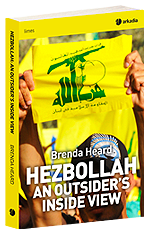 Hezbollah: An Outsider’s Inside View is the answer to the question that has been asked for years by the concerned Westerner: who are those people over there and do we really need to be scared of them?
Based on an increasingly inside view of Hezbollah, this book is an opportunity for the Western reader to see for himself what this headline-grabbing group is all about.
Against a backdrop of records documenting the context from which Hezbollah has developed, you are invited to meet the administrators and the sheiks, the leaders and the fighters, the individuals and the families who are Hezbollah.
Written from a Western perspective, this inside view of the Islamic Resistance of Lebanon offers the opportunity to explore the militants at the horizon.
The website supporting this book is http://insidehezbollah.com.
“Hezbollah: An Outsider’s Inside View” is available as an ebook or as a printed book with free delivery worldwide. You are encouraged to rate, review, share and discuss it on bookseller websites and on Goodreads.
The Question of Jewish Identity
On Shlomo Sand’s “How I Stopped Being a Jew”
By JOAN ROELOFS | CounterPunch | April 6, 2015
Shlomo Sand’s gracefully written and translated short book, How I Stopped Being a Jew, deals with a question many have wondered about but have been afraid to ask: What makes someone a Jew? While it has been a puzzle from time immemorial, it is more salient today as Israel welcomes all deemed Jewish, regardless of their nationality or religious beliefs (or lack of them). On the other hand, non-Jews (25% of Israelis), even if born and resident in Israel, are not quite full citizens of the Jewish state.
“If the United States of America decided tomorrow that it was not the state of all American citizens but rather the state of those persons around the whole world who identify as Anglo-Saxon Protestants, it would bear a striking resemblance to the Jewish State of Israel.” (p. 82)
Sand is an Israeli, and a secular and atheist Jew, defined by his parentage as Jewish by the state of Israel. He is a professor at Tel Aviv University, specializing in French history. He is best known as the author of two controversial books, The Invention of the Jewish People (2009) and The Invention of the Land of Israel (2012).
His major argument is that the claim that today’s Jews are descendants of the ancient Israelites is simply a myth, of considerable use to the Zionist cause. Sand’s theories are ably expounded in a CounterPunch article of February 14-16, 2014, by Paul Atwood.
Briefly, Sand contends that European Jews, and even many of the Middle Eastern ones, are descendants of converts to Judaism, with no biological connection to ancient Israelites. Yet the founders of Zionism, mostly secular and atheist Jews, while rejecting the supernatural aspects and miracles of the Old Testament, proposed its stories to be accurate history.
“To justify colonization in Palestine, Zionism appealed above all to the Bible, which it presented as a legal property title to the land. It then proceeded to depict the past of various Jewish communities not as a dense and varied fresco of the motley groups that converted to Judaism in Asia, Europe and Africa, but rather as a linear history of a race-people, supposedly exiled by force from their native land and aspiring for two thousand years to return to it.” (p. 48)
This provided a somewhat shaky justification of “return” to the “Promised Land,” in already inhabited Palestine, but it was adequate to persuade the great powers, which were feeling guilty about the fate of Jews in WWII, and also anxious to have an offshore place for the survivors to migrate.
In addition, it provided an identity and rationale for the secular and atheist Jews of the US and elsewhere who were urged to “return” to
 Israel to help develop and defend the land, by joining the kibbutzim and the military.
Sand, who identifies as an Israeli and wishes it were the only form of national identity for all inhabitants, rejects the historical as well as the cultural, racial, ethnic, and biological bases of Jewishness. He questions the orthodox definition of a Jew: a person born of a Jewish mother, who was herself thus born since time immemorial, “I have the increasing impression that, in certain respects, Hitler was the victor the Second World War… his perverted ideology infiltrated itself and resurfaced.” (p. 5)
He explores the idea of a common Jewish culture apart from religious belief, but finds no convincing evidence. Jews of Western Europe, Africa, and the Middle East may have practiced their religion, but in everyday life shared the culture and settlements of their fellow nationals. (p. 35) In contrast, the Yiddish speakers of Eastern Europe had a distinctive culture in dress, food, language, and religious fundamentalism. (p. 36) The children of these Jews often became atheist socialists, some of whom, rejecting the shtetl culture, founded the Zionist movement.
“The Yiddish colonists [of Israel], in fact, were very quick to discard their despised mother tongue. The first thing they needed was a language that could unite Jews the world over, and neither Theodor Herzl nor Edmond de Rothschild could communicate in Yiddish. The early Zionists subsequently aspired to create a new Jew, who would break with the popular culture of their parents and ancestors as well as with the wretched townships of the Pale of Settlement.” (p. 41)
Sand maintains that Jewish holidays serve only as nostalgia for secular Jews and do not honor their universalist culture. For example, the traditional Haggadah for Passover Seder includes an “explicit demand to exterminate all the peoples who did not believe in the God of the Jews and had dared to attack Israel. . .” (p. 67) In the book of Exodus (23:23), God promises to “exterminate all the inhabitants of Canaan in order to make room in the Promised Land for the sons of Israel.” (p. 72) The Old Testament command to love thy neighbor as thyself was applied only to fellow Jews. (p. 70) The Talmud states: “You shall be called men, but the idolaters are not called men.” (p. 71)
Sand provides a long list of Jews who adopted a universalistic morality (from Karl Marx to Naomi Klein) and also distanced themselves from the Jewish religious tradition. (p. 73)
Sand refutes those who claim that what binds all Jews is their history as unique victims of persecution: “Zionist rhetoric [insists that] there are hosts of murderers like Hitler, while there have never been and never will be victims like the Jews.” (p. 63) Yet millions of non-Jews were killed by the Nazis; persecution, genocide and ethnic cleansing have been and continue to be inflicted on many peoples.
Some critics of Sand argue that a motive for remaining Jewish despite enjoying nothing of its culture or religion is the ability to have legitimacy when criticizing Israeli policies, but this is a merely pragmatic basis for a major decision.
Sand concludes: “I wish to resign and cease considering myself a Jew.” (p. 97) Although he considers Israel “one of the most racist societies in the Western world” and the perpetrator of “cruel military colonization [of] weak and defenceless victims who are not part of the ‘chosen people,’” he remains “by everyday life and basic culture” an Israeli. (p. 98-99)
Others have resigned from Judaism in protest of Israeli policies; Sand has the additional motive of seeing no convincing basis for Jewish identity other than the religion. Contemporary concepts of free choice of religion and ideology are embodied in the Universal Declaration of Human Rights , and warmly championed by secular Jews. So why wouldn’t a person be able to resign from any or all religions and systems of belief? In contrast, one can’t resign from one’s ethnic background; Sand acknowledges that his is Austrian.
While I do not have the expertise to assess Sand’s historical assertions, the status of secular Jews is of personal significance and an issue independent of the exiles, migration, and conversions of people long ago. One problem with Sand’s choice is that Israeli authorities, Jewish religious leaders, the general public, and anti-Semites are not going to let him or others slip out of it so easily. Joining another religion makes resignation more convincing, even legally recognized in Israel, but Sand does not want to do this.
Another issue is how to have holiday celebrations, weddings, funerals, potluck suppers, youth groups, communities of shared values, etc., if you eschew the Jewish institutions. Religion has been a source of social justice activism and solace, despite its flaws. Many secular Jews remain in the faith without faith for these reasons. A solution is to join one of the religions (it means bind together) welcoming atheists, such as Unitarian Universalism, or the burgeoning atheist churches of England.
Sand’s fine accessible book is likely to provoke heated controversy, and it should.
Joan Roelofs, Professor Emerita of Political Science, Keene State College, New Hampshire can be reached at joan.roelofs@myfairpoint.net
Why the West is to blame for the crisis in Ukraine: the full story
Chris Nineham reviews Frontline Ukraine: Crisis in the Borderlands by Professor Richard Sakwa
WE ALL KNOW about of the fog of war, but the current coverage and commentary on the crisis in Ukraine arguably takes wartime disinformation to new levels.
Richard Sakwa’s new book is a rare and precious exception. It is clear and measured and carefully researched and it shows that the story we are told in the west about events inside Ukraine is deeply flawed.
More generally, it exposes the idea that Russia is the aggressor and the West the protector of Ukraine’s democratic will as a travesty of the truth. In short, Sakwa’s analysis is diametrically opposed to what passes for an explanation of the Ukraine crisis in the mainstream.
One of the book’s great strengths is that it sees the crisis as a product of two connected processes, one domestic, one geopolitical.
Far from being a straightforward expression of popular will, Sakwa details how the government that emerged from the Maidan protests in February 2014 represented the victory of a minority hardline anti-Russian Ukrainian nationalism.
But this minority could come to dominate, he argues, because of the context provided by an aggressive, US-led, Western foreign policy designed to assert Western control over Eastern Europe and, at least in its more hawkish versions, de-stabilise Russia.
The push to the east
Nato and the EU have been pushing steadily eastwards ever since the end of the Cold War, despite verbal assurances from a series of Western leaders that this would not happen.
Twelve countries have joined Nato in the region since 1991. Georgia and Ukraine were promised membership at the Nato Summit in Bucharest in 2008, despite repeated warnings from the Russian government that taking Nato to the Russian border would cause a security crisis of the first order. It was only the intercession of Germany and France that forced the US to put these plans on hold.
The push to the east continued in the form, amongst others, of a plan to get Ukraine to sign up to an ‘Association Agreement’ with the EU. It was this agreement, due to be signed in November 2013, which sparked the crisis. To grasp its significance it is important to understand just how closely tied Nato and the EU have become, especially since the Lisbon Treaty signed by EU members in 2007.
Article 4 in the proposed Association Agreement committed the signatories to ‘gradual convergence on foreign and security matters with the aim of Ukraine’s ever deeper involvement in the European Security area’ (p.76). As Sakwa puts it, “it is pure hypocrisy to argue that the EU is little more than an extended trading bloc: after Lisbon, it was institutionally a core part of the Atlantic security community, and had thus become geopolitical”. (p.255)
All parties involved must have known that this document, if signed, would have caused existential anxiety in Moscow. Defenders of the West’s drive to the east justify it as the reflection of the will of the people concerned.
This is disingenuous. As Western leaders themselves have publicly admitted, a campaign to buy Ukrainain hearts and minds has been running for decades. In 2013, US Assistant Secretary of State for European and Eurasian affairs, Victoria Nuland, publicly boasted of the fact that the US had invested $5 billion in ‘democracy promotion’ since 1991, a huge sum by USAID’s standards (p.86). It has since been revealed that the EU too spent 496 million on front groups in Ukraine between 2004 and 2013 (p.90).
And there was nothing democratic about the process. Discussions about the Association Agreement in fact took place behind the backs of the Ukrainian people and the text of the agreement was not available in Ukraine till the last moment (p.74). It actually contained very little in the way of assistance to Ukraine’s economy, and its centrepiece was a radical liberalisation of EU-Ukraine trade, a direct threat to the traditional economic relations between Ukraine and Russia.
In the end, for a mixture of reasons, President Yanokovich didn’t sign up to the deal. But the pressure to sign helped to polarise the debate in Ukraine. The meaning of the agreement was an open secret in Washington. In the words of Carl Gershman from the National Endowment for Democracy, while Ukraine was ‘the biggest prize’, there was, beyond that, an opportunity to put Putin ‘on the losing end not just in the near abroad but within Russia itself’. (p.75)
Internal impact
This concerted Western strategy to surround and weaken Russia had a profound impact on the internal politics of Ukraine. Sakwa explains well the complex history that links Ukraine and Russia, a history that can’t be reduced to simple formulas of colonial dependency. The long, indigenous tradition of seeing Ukraine as part of greater Russian union has resulted in Russian being the dominant language in most of the country despite ethnic Russians being a relatively small minority. (p.8)
For all the mixed motivations behind the Maidan protests, it was a hardline anti-Russian strand that came to dominate, first in the protests themselves and subsequently in the regime that emerged out of the forced removal of the Yanukovich government.
Western policy in general gave ballast to a hardline nationalist tradition in the country that saw Russia – and the Russian minorities within the country – as the enemies of Ukrainian nationalism.
This tradition centred on the historic figure of Stepan Bandera who collaborated with the German Nazis in atrocities against Jews, Poles and Russians in Ukraine during WW2. His followers formed SS divisions which were responsible for the deaths of up to half a million people. (pp16-17). A giant poster of Bandera hung by the side of the stage in the Maidan, and many leaders of the regime that came out of the Maidan saw him as part of their tradition.
The West was minutely involved in this process. The State Department’s Victoria Nuland visited Ukraine three times in the first few weeks of the Maidan protests (p.86). The famous February leaked phone call between her and the US ambassador in Ukraine in which Nuland said ‘fuck the EU’, showed the extent to which the US was pulling the strings and in which direction.
In the call Nuland judges that the relatively moderate nationalist Vitaly Klitschko, who had the backing of Germany and the EU, should be kept out of office and that Arseniey Yatsenhuk – ‘Yats’ she calls him – a man who turned out to be a hardline chauvinist, should be the key player. Yatsenyuk indeed became the acting Prime Minister in the new government.
The result, in Sakwa’s words, was that, ‘what had begun as a movement in support of ‘European values’ now became a struggle to assert a monist representation of Ukrainian nationhood. The amorphous liberal rhetoric gave way to a much harsher agenda of integrated nationhood, and the euphoria promoted a rash of ill-considered policies’ (p.94).
As President Yanukovich was impeached and the new government was installed, armed insurgents strutted around the debating chamber. Yatsenyuk’s government was a mixture of recycled oligarchs and hard-line nationalists and fascists. It contained only two ministers from the entire south and east of the country, the areas with closest ties to Russia.
Five cabinet positions out of 21 were taken by the far right Svoboda Party, despite the fact they had only received 8% of the seats in Parliament. The minister of justice and the deputy Prime Minister came from the Russophobic Svobada party and its founder, a man with a long record of ultra nationalist activism, Andriy Parubiy, became head of the NSDC security agency.
Provocations
One of the new government’s first acts was to vote to rescind a law guaranteeing the right to instate a second official language where there were significant minorities. Although the change in the law was blocked, the vote was correctly interpreted as an attack on Russian minorities across the country.
It was followed by the outlawing of the Ukrainian Communist Party and the establishment of a ‘special service’ to root out fifth columnists in the armed forces (p.137). A wave of physical assaults on Russians duly followed.
In Odessa, pro-Russian activists were driven from an encampment into a trade union building which was then torched, killing a minimum of 48, many hundreds according to locals. The massacre was hailed by one of the Maidan leaders, Dmytro Yarosh, as ‘another bright day in our national history’ (p.98).
This series of events made a civil war virtually inevitable. Uprisings in the east of the country were motivated by political resentments, opposition to neoliberal policies and other economic grievances against Kiev, but most of all by a sense of the need for self defence. Unlike the largely middle-class movement in Kiev, the anti-Maidan movement in the Donbass region was ‘lower-class, anti-oligarchic (and Russian nationalist)’ (p.149). It was not mainly separatist. A poll by the Pew Research Center in May 2014 found that 70 per cent of eastern Ukrainians wanted to keep the country intact, including 58 per cent of Russian speakers (p.149).
The view from the East
Sakwa carefully analyses Russia’s behaviour during the crisis. His conclusions are a frontal challenge to the West’s narrative that the crisis in the Ukraine was precipitated by Russian aggression. As he shows, this is the opposite of the truth.
After the collapse of the Soviet Union, successive governments embraced a Western orientation, even making tentative moves to join Nato. In contrast to the stereotype that has been so carefully constructed, in his first term, Putin, and his successor Medvedev, sought engagement and accommodation with the West and tried to establish structured relationships with Nato and the EU. This approach faltered according to Sakwa, because of repeated rebuffs from the West:
“Continued conflicts in the post-Soviet space, the inability to establish genuine relations with the EU and disappointment following Russia’s positive demarche in its attempt to reboot relations with the US after 9/11 all combined to sour Putin’s new realist project” p.31
Over the last decade and a half, the Russian foreign policy establishment has become more and more alarmed by the unilateralism of US foreign policy, particularly over the invasion of Iraq and the attack on Libya. The non-negotiated push eastwards by Nato and the EU could of course only be perceived as hostile.
Even in these circumstances, however, for Sakwa, Putin’s central concern was to maintain the status quo in Ukraine, and try and ensure a friendly or at least neutral buffer state based on a stable settlement within the multi-ethnic Ukrainian state.
The forced, Western-backed removal of the Yanukovich government created an immediate crisis for the Russian government. Putin reacted by running a popular poll and an armed operation to secure the secession of the Crimean region to the USSR. Given the level of hostility and the mobilisations against Russian minorities, this can have surprised no-one. The Crimea was part of Russia until 1954, and it contains Sevastopol, Russia’s only major warm-water naval base. The idea that the Russian ruling class was going to stand aside and allow this area to be taken by a pro-Nato and anti-Russian government was obvious fantasy.
But if Putin’s long-term plan had been to invade, partition or even to destabilise the rest of Ukraine, he would have taken the opportunity presented by the virtual collapse of the Ukrainian government in February last year and the anti-Kiev uprisings in the east of the country which developed as a result.
His response was in fact was very different. Sakwa argues that despite the hoopla in the Western media, with the exception of the special case in Crimea, there is little evidence of significant military intervention by Russia in the months after the crisis of February, at least until August.
Putin supported the rebels to try and gain some leverage, but when it came to military assistance the rebels in the east were denouncing Putin for not delivering it. In Sakwa’s words, “Russia used proxies in the Donbas to achieve its goals within Ukraine, but this was not an attempted ‘land-grab’ or even a challenge to the international system” (p.182).
On 24 June in fact, the Russian Federation Council revoked a ruling which had previously allowed Russian military involvement in Ukraine ‘in order to normalise and regulate the situation in the eastern regions of Ukraine’ in the run up to tripartite talks involving the new Prime Minister Poroshenko (p.162). But Poroshenko had been the continuity candidate. On taking office, he had issued a statement calling for ‘a united, single Ukraine’ and characterising insurgents in the south-east as ‘terrorists’ (p.161).
Sakwa, along with most other sane commentators, is far from idealising the authoritarian and sometimes aggressive Russian regime. He criticises its human rights record and its institutions of governance. If anything his instincts are with a reformed integrationist ‘wider European project’, which, given the behaviour of the actually-existing Western institutions, seems a bit of a forlorn hope.
But what Sakwa’s book does so well is to ask us to go beyond rhetoric and generalities and examine the actual dynamics of the particular situation in its national and international dimensions.
Most importantly, he argues, we can’t begin to understand the Ukrainian catastrophe unless we completely reject the dominant, not to say consensual, Western account of what is happening. This is a crisis created by the West, but by threatening Russia’s core interests, it contains the possibility of a catastrophic confrontation; ‘the US has sought to create a regime in its own image, while Russia has sought to prevent the creation of one hostile to its perceived interests’ he argues (p.255).
We in the West have a responsibility to do everything possible to force our leaders back from the brink.
See also:
Richard Sakwa: History returns with a vengeance in Ukraine
Jonathan Steele: Who is really responsible for the crisis in Ukraine boiling over?
Why the Low Fat Diet Makes You Fat (and Gives You Heart Disease, Cancer and Tooth Decay)
Book review by Dr Stuart Jeanne Bramhall | February 12, 2015
The Truth About Animal Fat: What the Research Shows
 The Big Fat Surprise: Why Butter, Meat and Cheese Belong in a Healthy Diet lays out the scientific case why our bodies are healthiest on a diet rich in saturated fat from animal products. Analyzing study after study, Nina Teicholz leaves no doubt that the number one cause of the global epidemic of obesity, diabetes and heart disease is the low fat high carbohydrate diet doctors have been pushing for fifty years.
Blaming the Victim
My initial reaction on learning how the low fat diet became official government policy was to feel ripped off and angry. For decades, the medical establishment has been blaming fat people for being obese, portraying them as weak willed and lacking in self control. It turns out the blame lay squarely with their doctors, the American Heart Association (AHA), the US Department of Agriculture (USDA), Congress and the food manufacturers who fund the AHA (Proctor and Gamble, Nabisco, General Foods, Heinz, Quaker Oats and Corn Products Refining Corporation) for foisting a diet on them that increases appetite and weight gain.
The low fat diet is based on a “theory” put forward in the 1950s that heart disease was caused by elevated cholesterol levels – and a few deeply flawed epidemiological studies. In other words, the low fat diet is a giant human experiment the medical profession conducted on the American public while attempting to prove that saturated animal fats cause heart disease. Fifty years of research would show the exact opposite: not only do low fat high carbohydrate diets increase the risk of cardiac death, but they’re also responsible for a myriad of other health problems, with obesity and diabetes being the most problematic.
The studies Teicholz cites also debunk the myth that animal fat increases the risk of breast and colon cancer.
Heart Attacks Rare Prior to 1900
Coronary artery disease and heart attacks were virtually unknown prior to 1900. When Ancel Keys, the father of the low fat diet, began his anti-fat crusade in the 1950s he claimed that industrialization and an improved standard of living had caused Americans to switch from a plant based diet to a diet that was higher in animal fats. This was total rubbish. Prior to 1900, Americans had always eaten a meat-based diet, in part because wild game was much more plentiful in North America than in Europe. Early cookbooks and diaries reveal that even poor families had meat or fish with every meal. Even slaves had 150 pounds of red meet a year, which contrasts unfavorably with 40-70 pounds of red meat in the current American diet.
What changed in the twentieth century was the introduction of cheaper vegetable fats into the American diet, starting with margarine and Crisco in the early 1900s.
Keys was also responsible for the theory, again without research evidence, that high cholesterol levels cause heart disease. This was also rubbish. Fifty years of research negates any link between either total cholesterol or LDL* cholesterol and heart disease. In study after study the only clear predictor of heart disease is reduced HDL. The same studies show that diets high in animal fats increase HDL, while those high in sugar, carbohydrates and vegetable oils reduce HDL.
Teicholz also discusses the role of statins (cholesterol lowering drugs) in this context. Statins do reduce coronary deaths, but this is due to their anti-inflammatory effect – not because of their effect on cholesterol.
Researchers Silenced and Sidelined
For decades, researchers whose findings linked low fat diets with higher rates of heart disease, cancer, stroke and tooth decay were systematically silenced and sidelined. As frequently happens with doctors and scientists who challenge the powerful health industry, their grants were cut off and, in some cases, their careers destroyed.
For fifty years, the medical establishment simply ignored the growing body of research linking the high sugar/carbohydrate component of the low fat diet to heart disease, as well as those linking vegetable oils to cancer. Vegetable oils oxidize when cooked, leading to the production of cancer causing compounds such as aldehyde, formaldehyde and 4-hydroxnonene (HCN). Unsurprisingly diets in which vegetable oils (other than olive oil) are the primary fat are linked with an increased incidence of cancer. Several studies overseas have found high levels of respiratory cancer in fast food workers exposed to superheated vegetable oils.
The Atkins Diet
The Big Fat Surprise includes a long section on the Atkins diet, a popular high fat/protein low carbohydrate weight reduction diet in the 70s and 80s. The use of a high fat low carbohydrate diet for weight loss dates back to 1862 and was heavily promoted by Sir William Osler in his 1892 textbook of medicine. According to Teicholz, recent controlled studies totally vindicate Dr Robert C Atkins, who was ridiculed as a dangerous quack during his lifetime. They also debunk claims that high levels of protein in the Atkins diet cause kidney damage. In addition to being perfectly safe, controlled studies show it to be extremely effective for weight loss and treating diabetes.
The USDA and AHA Quietly Reverse Themselves
As Teicholz points out in her conclusion, the nutrition researchers who blindly pursued their anti-fat campaign – and politicians and corporate funders who supported them – have done Americans an immense disservice by creating a virtual epidemic of obesity and diabetes.
A few years ago, the tide began to turn, largely due to the 29,000 subject Women’s Health Initiative launched in 1993. In 2013, the USDA and AHA quietly eliminated fat targets from the dietary recommendations. Because they made no real effort to publicize their change of heart, many doctors are still giving their patients the wrong dietary advice and hounding them about their cholesterol levels.
Dump the Skim Milk
The take home lesson from this book is that it’s virtually impossible to eat too many eggs or too much red meat, cheese, sausage and bacon. Americans (and their overseas English-speaking cousins) need to dump the skim milk and margarine down the sink because whole milk and butter are better for you. People need to go back to cooking with lard, bacon drippings and butter. Cooking with vegetable oils can give you cancer.
Anyone with a weight problem needs to totally eliminate sugar and carbohydrate (the Atkins diet recommends less than half a slice of bread a day).
And if your doctor hassles you about your cholesterol tell him or her to read this book.
*LDL (low density lipoprotein) is referred to as “bad cholesterol” due to its alleged link to heart disease. HDL (high density lipoprotein) or “good cholesterol” appears to provide some protective effect against heart disease.
The CIA Against Latin America, the Special Case of Ecuador
teleSUR | March 6, 2015
Imprisoned on various occasions and subjected to numerous interrogations, Dr. Jaime Galarza Zavala is one of the estimated 120 direct victims of the CIA’s record in Ecuador.
Persecuted by the CIA for his political organizing, Galarza described to teleSUR English that “they told me that I was working as a guerrilla in the Dominican Republic. I, to this day, have never visited the Dominican Republic. But they accused me of being a guerrilla leader in the Dominican Republic. And this was a common theme with various interrogations.”
He added that, “while they interrogated me, there was somebody that called every now and then from another room. Afterward, they told me that this person they were talking with was a gringo, a North American, who never presented himself to me. But he gave them instructions as to how to continue the interrogation,” said Galarza.
A fierce critic of U.S foreign policy in the region, Galarza recently published a book titled, “The CIA Against Latin America, the Special Case of Ecuador,” co-authored by Francisco Herrera Arauz.
In an interview with teleSUR English on CIA actions in Ecuador, Herrera said,“First, they destroyed our democracy. Second, they worked with undivided attention against our citizens. They persecuted our citizens for thinking differently. People were killed, injured, there are victims of this violence, there are families that were harmed, there are exiles, the honor of some people has been ruined, there are destroyed families, and all of this was caused by the CIA’s actions.”
Both authors have previously interviewed Philip Agee, the ex-CIA operations officer whose name became internationally known when he wrote the book “Inside the Company: CIA Diary” in 1975, detailing his time working in Ecuador, Uruguay, and Mexico from 1960 to 1968 and denouncing actions undertaken by the CIA during this period.
In his testimonies of that period, Agee said that when he operated in Ecuador from 1960 to 1963, the CIA oversaw: the overthrow of two presidents; the infiltration of various political parties and organizations; and the planting of bombs in front of churches and other emblematic sites to frame leftist groups; among other actions.
At an event celebrating the new book, Ecuador’s Foreign Minister Ricardo Patiño said, “These secret policies continue in Latin America today. Nothing that Philip Agee denounced as CIA actions in the past have been discarded by the espionage seen in the present.”
To raise public awareness of the atrocities committed within Ecuador and the long-term damage caused by CIA interventions throughout Latin America, Ecuador’s Foreign Ministry has printed and widely distributed copies of the book in Spanish and English.
Five Surprises About American Internment During World War II

By Jan Jarboe Russell | Disinformation |January 20, 2015
The general history of America’s internment of its own citizens during World War II has focused on the incarceration of 120,000 Japanese, 62 percent of them American-born, who were forcibly evacuated from the Pacific coast after the bombing of Pearl Harbor.
But few people know that Executive Order 9066, signed by President Roosevelt, which permitted the roundup of Japanese and their American-born children, also paved the way for the arrest of Germans and Italians who the FBI considered security risks and labeled as “enemy aliens.” Indeed the day before Roosevelt signed the order FBI agents had arrested 264 Italians, 1,296 Germans, and 2,209 on the East and West Coast. The hunt for perceived enemies was on.
Here are five surprising facts about the extent of FDR’s internment program:
Fact One: The arrests of suspected enemies extended far beyond our national borders. Under provisions of the Enemy Alien Act of 1798, the same act that allowed Presidents George W. Bush and President Obama to intern modern-day suspected terrorists, Roosevelt orchestrated the removal of 4,058 Germans, 2,264 Japanese and 288 Italians from thirteen Latin American countries — and locked them up around the United States, many in a secret government internment camp located in Crystal City, Texas, an isolated desert town located at the southern tip of Texas, only thirty miles from the Mexican border. His reason? Roosevelt feared security threats from Germans and Japanese in Latin America.
Fact Two: Incredibly, among those taken from Latin America included a small number of Jews who had fled persecution in Germany. In his book, Nazis and Good Neighbors, Max Paul Friedman documented 81 Jews in Latin America who were part of the roundup. One Jewish family — the Jacobis from Columbia – was interned in the camp in Crystal City.
Fact Three: The entire political and military establishment applied pressure on Roosevelt to pursue a vigorous internment policy. The only person close to him who opposed it was Eleanor Roosevelt who believed the case against immigrants was driven by wartime hysteria. “These people were not convicted of any crime but emotions ran too high, too many people wanted to wreak vengeance on Oriental looking people,” she wrote of the evacuation order for the Japanese.
Shortly after the attack on Pearl Harbor, Roosevelt told Attorney General Francis Biddle to arrest Italians and Germans. “I don’t care so much about the Italians. They are a lot of opera singers, but the Germans are different: they may be dangerous.” In response, Biddle widened the net of suspicion.
Fact Four: One reason for the internment program was to create a pool of people of hostages to exchange for Americans trapped behind enemy lines in Europe and in the Pacific. FDR created a secret division within the Department of State called the Special War Problems Division, which negotiated numerous prisoner exchanges with Japan and Germany.
Fact Five: The Crystal City Internment Camp was at the center of those exchanges. Some former internees, who were children in the camp, refer to it as The Kidnap Camp. Thousands of internees in Crystal City, including their American-born children, were exchanged for ostensibly more important Americans — diplomats, businessmen, soldiers, physicians, and missionaries — behind enemy lines in Japan and Germany.
The first of four exchanges in Crystal City took place in June 1942 and the second on September 2, 1943. During those exchanges, more than 2000 Japanese and Japanese Americans were traded for Americans caught in Japan. In February 1944, 634 German immigrants and their children, were sent from Crystal City into Germany. On January 2, 1945, 428 more in Crystal City were traded into war.
The tableau of today’s headlines about government surveillance, internment and prisoner exchanges was written more than seventy years ago in Crystal City, Texas.
~
Jan Jarboe Russell, author of The Train to Crystal City, is a former Nieman Fellow, a contributing editor for Texas Monthly, and has written for the San Antonio Express-News, The New York Times, Slate, and other magazines. She lives in San Antonio, Texas, with her husband, Dr. Lewis F. Russell, Jr. For more information please visit http://www.janjarboerussell.com, and follow the author on Facebook and Twitter
Assassination Nation
Drones and Targeted Killing
By Ron Jacobs | CounterPunch | January 16, 2015
Imagine living in a town or neighborhood where a serial killer is on the loose. The killer’s primary weapon is a pipe bomb filled with small metal projectiles like BBs and nails. The bombs are designed to kill and maim those in the vicinity of the explosion. The killer’s weapons are usually aimed at male targets, but quite often several others in the vicinity are also killed, including women and children. Oftentimes, a note is sent to the media after the attacks warning of future attacks unless the people being targeted give in to the killer or killers’ demands. The fact of the attacks’ unpredictability has created a perennial fear in the region, leaving every resident uncertain of their future and their family’s safety.
Now imagine the killer is the United States military and CIA. The pipe bombs are armed drones packing explosives powerful enough to kill everyone within a few hundred meters. Although the drones are not randomly aimed, the appearance to those targeted on the ground is that they are. In other words, nobody in the targeted vicinity knows when or exactly where the drone will hit and who it is intended to kill. In response, the local residents of the targeted area stay inside, not sending their children to school or going to work all the while hoping their families will not be murdered in the next attack. Then the drone strikes, killing at first a man and his fellow tea drinkers. The screams of the wounded and dying attract his neighbors, who go to retrieve the wounded. Some approach quickly while others much more tentatively, knowing of the likelihood of a second drone strike designed to kill the rescuers. Then, the silence.
Since the use of killer drones by the United States began, more than 3500 people have been killed. Many of those killed were civilians. The number of civilians killed depends on how one counts civilians. The US government tends to consider every male in a targeted area over the age of fourteen to be a militant (itself a rather ambiguous term) and does not count their deaths as civilian deaths even when it is clear they were not involved in hostilities. If we were to apply this metric to the deaths that occurred when the planes flew into the WTC on September 11, 2001, then it seems safe to assume that the number of civilian deaths in that event would drop quite a bit. I am not suggesting that we do this, merely pointing out that the statistics regarding deaths by drone published by the US government (and related corporations) are self-serving and, at best, only somewhat truthful when it comes to the numbers of civilian dead.
Marjorie Cohn is an attorney who teaches both international human rights law and criminal law. She is a former head of the National Lawyers Guild and the editor of the recently released book Drones and Targeted Killing: Legal, Moral and Geopolitical Issues. This text includes entries written by attorneys, religious leaders, antiwar activists and others. The writers, while predominantly from the United States, also include (among others) Bishop Desmond Tutu from South Africa and human rights activist Ishai Menuchin from Israel. As the title indicates, the essays cover the topic of assassination by drone and Special Forces hit squads through a variety of prisms. However, the primary prism is the prism of international law. The unanimous consensus of every writer is that these killings are illegal by virtually every measure and precedent that exists in the field of international law. […]
In short, this book is a rapid-fire attack on the US policy of targeted assassination by drone or other means. It is also a look at the origins of this policy in Tel Aviv’s onslaught against the Palestinians and its assassination of Palestinian leaders by missile strike and commando. Most importantly it is a reasoned and legalistic addition to the demand that this policy end now and forever. After reading this book, the best words I could come up with to describe the nature of the US policy of targeted killing and assassination by drone or other means are the same words spoken by Barack Obama in the wake of the recent murders of twelve journalists in Paris by men quickly labeled terrorists. To quote the US president, these killings are “cowardly, evil attacks.”
Golden Age of Pearl Harbor
By David Swanson | War is a Crime | December 5, 2014
 As we read Ulysses on Bloomsday every June 16th (or we should if we don’t) I think that every December 7th should not only commemorate the Great Law of 1682 that banned war in Pennsylvania but also mark Pearl Harbor, not by celebrating the state of permawar that has existed for 73 years, but by reading The Golden Age by Gore Vidal and marking with a certain Joycean irony the golden age of anti-isolationist imperial mass-killing that has encompassed the lives of every U.S. citizen under the age of 73.
Golden Age Day should include public readings of Vidal’s novel and the glowing endorsements of it by the Washington Post, New York Times Book Review, and every other corporate paper in the year 2000, also known as the year 1 BWT (before the war on terra). Not a single one of those newspapers has ever, to my knowledge, printed a serious straightforward analysis of how President Franklin D. Roosevelt maneuvered the United States into World War II. Yet Vidal’s novel — presented as fiction, yet resting entirely on documented facts — recounts the story with total honesty, and somehow the genre used or the author’s pedigree or his literary skill or the length of the book (too many pages for senior editors to be bothered with) grants him a license to tell the truth.
Sure, some people have read The Golden Age and protested its impropriety, but it remains a respectable high-brow volume. I may be hurting the cause by openly writing about its content. The trick, which I highly recommend to all, is to give or recommend the book to others without telling them what’s in it.
Despite a filmmaker being a main character in the book, it’s not been made into a film, as far as I know — but a widespread phenomenon of public readings could conceivably make that happen.
In The Golden Age, we follow along inside all the closed doors, as the British push for U.S. involvement in World War II, as President Roosevelt makes a commitment to Prime Minister Winston Churchill, as the warmongers manipulate the Republican convention to make sure that both parties nominate candidates in 1940 ready to campaign on peace while planning war, as FDR longs to run for an unprecedented third term as a wartime president but must content himself with beginning a draft and campaigning as a drafttime president in a time of supposed national danger, and as FDR works to provoke Japan into attacking on his desired schedule.
The echoes are eerie. Roosevelt campaigns on peace (“except in case of attack”), like Wilson, like Johnson, like Nixon, like Obama, and like those members of Congress just reelected while blatantly and unconstitutionally refusing to stop or authorize the current war. Roosevelt, pre-election, puts in Henry Stimson as a war-eager Secretary of War not altogether unlike Ash Carter as a nominee for Secretary of “Defense.”
Golden Age Day discussions might include some known facts of the matter:
On December 7, 1941, President Franklin Delano Roosevelt drew up a declaration of war on both Japan and Germany, but decided it wouldn’t work and went with Japan alone. Germany, as expected, quickly declared war on the United States.
FDR had tried lying to the American people about U.S. ships including the Greer and the Kerny, which had been helping British planes track German submarines, but which Roosevelt pretended had been innocently attacked.
Roosevelt had also lied that he had in his possession a secret Nazi map planning the conquest of South America, as well as a secret Nazi plan for replacing all religions with Nazism.
As of December 6, 1941, eighty percent of the U.S. public opposed entering a war. But Roosevelt had already instituted the draft, activated the National Guard, created a huge Navy in two oceans, traded old destroyers to England in exchange for the lease of its bases in the Caribbean and Bermuda, and secretly ordered the creation of a list of every Japanese and Japanese-American person in the United States.
On April 28, 1941, Churchill wrote a secret directive to his war cabinet: “It may be taken as almost certain that the entry of Japan into the war would be followed by the immediate entry of the United States on our side.”
On August 18, 1941, Churchill met with his cabinet at 10 Downing Street. The meeting had some similarity to the July 23, 2002, meeting at the same address, the minutes of which became known as the Downing Street Minutes. Both meetings revealed secret U.S. intentions to go to war. In the 1941 meeting, Churchill told his cabinet, according to the minutes: “The President had said he would wage war but not declare it.” In addition, “Everything was to be done to force an incident.”
From the mid-1930s U.S. peace activists — those people so annoyingly right about recent U.S. wars — were marching against U.S. antagonization of Japan and U.S. Navy plans for war on Japan — the March 8, 1939, version of which described “an offensive war of long duration” that would destroy the military and disrupt the economic life of Japan.
In January 1941, the Japan Advertiser expressed its outrage over Pearl Harbor in an editorial, and the U.S. ambassador to Japan wrote in his diary: “There is a lot of talk around town to the effect that the Japanese, in case of a break with the United States, are planning to go all out in a surprise mass attack on Pearl Harbor. Of course I informed my government.”
On February 5, 1941, Rear Admiral Richmond Kelly Turner wrote to Secretary of War Henry Stimson to warn of the possibility of a surprise attack at Pearl Harbor.
As early as 1932 the United States had been talking with China about providing airplanes, pilots, and training for its war with Japan. In November 1940, Roosevelt loaned China one hundred million dollars for war with Japan, and after consulting with the British, U.S. Secretary of the Treasury Henry Morgenthau made plans to send the Chinese bombers with U.S. crews to use in bombing Tokyo and other Japanese cities.
On December 21, 1940, China’s Minister of Finance T.V. Soong and Colonel Claire Chennault, a retired U.S. Army flier who was working for the Chinese and had been urging them to use American pilots to bomb Tokyo since at least 1937, met in Henry Morgenthau’s dining room to plan the firebombing of Japan. Morgenthau said he could get men released from duty in the U.S. Army Air Corps if the Chinese could pay them $1,000 per month. Soong agreed.
On May 24, 1941, the New York Times reported on U.S. training of the Chinese air force, and the provision of “numerous fighting and bombing planes” to China by the United States. “Bombing of Japanese Cities is Expected,” read the subheadline.
By July, the Joint Army-Navy Board had approved a plan called JB 355 to firebomb Japan. A front corporation would buy American planes to be flown by American volunteers trained by Chennault and paid by another front group. Roosevelt approved, and his China expert Lauchlin Currie, in the words of Nicholson Baker, “wired Madame Chaing Kai-Shek and Claire Chennault a letter that fairly begged for interception by Japanese spies.” Whether or not that was the entire point, this was the letter: “I am very happy to be able to report today the President directed that sixty-six bombers be made available to China this year with twenty-four to be delivered immediately. He also approved a Chinese pilot training program here. Details through normal channels. Warm regards.”
The 1st American Volunteer Group (AVG) of the Chinese Air Force, also known as the Flying Tigers, moved ahead with recruitment and training immediately and were provided to China prior to Pearl Harbor.
On May 31, 1941, at the Keep America Out of War Congress, William Henry Chamberlin gave a dire warning: “A total economic boycott of Japan, the stoppage of oil shipments for instance, would push Japan into the arms of the Axis. Economic war would be a prelude to naval and military war.”
On July 24, 1941, President Roosevelt remarked, “If we cut the oil off , [the Japanese] probably would have gone down to the Dutch East Indies a year ago, and you would have had a war. It was very essential from our own selfish point of view of defense to prevent a war from starting in the South Pacific. So our foreign policy was trying to stop a war from breaking out there.” Reporters noticed that Roosevelt said “was” rather than “is.” The next day, Roosevelt issued an executive order freezing Japanese assets. The United States and Britain cut off oil and scrap metal to Japan. Radhabinod Pal, an Indian jurist who served on the war crimes tribunal after the war, called the embargoes a “clear and potent threat to Japan’s very existence,” and concluded the United States had provoked Japan.
On August 7, 1941, the Japan Times Advertiser wrote: “First there was the creation of a superbase at Singapore, heavily reinforced by British and Empire troops. From this hub a great wheel was built up and linked with American bases to form a great ring sweeping in a great area southwards and westwards from the Philippines through Malaya and Burma, with the link broken only in the Thailand peninsula. Now it is proposed to include the narrows in the encirclement, which proceeds to Rangoon.”
By September the Japanese press was outraged that the United States had begun shipping oil right past Japan to reach Russia. Japan, its newspapers said, was dying a slow death from “economic war.”
In late October, U.S. spy Edgar Mower was doing work for Colonel William Donovan who spied for Roosevelt. Mower spoke with a man in Manila named Ernest Johnson, a member of the Maritime Commission, who said he expected “The Japs will take Manila before I can get out.” When Mower expressed surprise, Johnson replied “Didn’t you know the Jap fleet has moved eastward, presumably to attack our fleet at Pearl Harbor?”
On November 3, 1941, the U.S. ambassador sent a lengthy telegram to the State Department warning that the economic sanctions might force Japan to commit “national hara-kiri.” He wrote: “An armed conflict with the United States may come with dangerous and dramatic suddenness.”
On November 15th, U.S. Army Chief of Staff George Marshall briefed the media on something we do not remember as “the Marshall Plan.” In fact we don’t remember it at all. “We are preparing an offensive war against Japan,” Marshall said, asking the journalists to keep it a secret, which as far as I know they dutifully did.

Ten days later Secretary of War Stimson wrote in his diary that he’d met in the Oval Office with Marshall, President Roosevelt, Secretary of the Navy Frank Knox, Admiral Harold Stark, and Secretary of State Cordell Hull. Roosevelt had told them the Japanese were likely to attack soon, possibly next Monday.
It has been well documented that the United States had broken the Japanese’ codes and that Roosevelt had access to them. It was through intercept of a so-called Purple code message that Roosevelt had discovered Germany’s plans to invade Russia. It was Hull who leaked a Japanese intercept to the press, resulting in the November 30, 1941, headline “Japanese May Strike Over Weekend.”
That next Monday would have been December 1st, six days before the attack actually came. “The question,” Stimson wrote, “was how we should maneuver them into the position of firing the first shot without allowing too much danger to ourselves. It was a difficult proposition.”
The day after the attack, Congress voted for war. Congresswoman Jeannette Rankin (R., Mont.) stood alone in voting no. One year after the vote, on December 8, 1942, Rankin put extended remarks into the Congressional Record explaining her opposition. She cited the work of a British propagandist who had argued in 1938 for using Japan to bring the United States into the war. She cited Henry Luce’s reference in Life magazine on July 20, 1942, to “the Chinese for whom the U.S. had delivered the ultimatum that brought on Pearl Harbor.” She introduced evidence that at the Atlantic Conference on August 12, 1941, Roosevelt had assured Churchill that the United States would bring economic pressure to bear on Japan. “I cited,” Rankin later wrote, ” the State Department Bulletin of December 20, 1941, which revealed that on September 3 a communication had been sent to Japan demanding that it accept the principle of ‘nondisturbance of the status quo in the Pacific,’ which amounted to demanding guarantees of the inviolateness of the white empires in the Orient.”
Rankin found that the Economic Defense Board had gotten economic sanctions under way less than a week after the Atlantic Conference. On December 2, 1941, the New York Times had reported, in fact, that Japan had been “cut off from about 75 percent of her normal trade by the Allied blockade.” Rankin also cited the statement of Lieutenant Clarence E. Dickinson, U.S.N., in the Saturday Evening Post of October 10, 1942, that on November 28, 1941, nine days before the attack, Vice Admiral William F. Halsey, Jr., (he of the catchy slogan “Kill Japs! Kill Japs!”) had given instructions to him and others to “shoot down anything we saw in the sky and to bomb anything we saw on the sea.”
General George Marshall admitted as much to Congress in 1945: that the codes had been broken, that the United States had initiated Anglo-Dutch-American agreements for unified action against Japan and put them into effect before Pearl Harbor, and that the United States had provided officers of its military to China for combat duty before Pearl Harbor.
An October 1940 memorandum by Lieutenant Commander Arthur H. McCollum was acted on by President Roosevelt and his chief subordinates. It called for eight actions that McCollum predicted would lead the Japanese to attack, including arranging for the use of British bases in Singapore and for the use of Dutch bases in what is now Indonesia, aiding the Chinese government, sending a division of long-range heavy cruisers to the Philippines or Singapore, sending two divisions of submarines to “the Orient,” keeping the main strength of the fleet in Hawaii, insisting that the Dutch deny the Japanese oil, and embargoing all trade with Japan in collaboration with the British Empire.
The day after McCollum’s memo, the State Department told Americans to evacuate far eastern nations, and Roosevelt ordered the fleet kept in Hawaii over the strenuous objection of Admiral James O. Richardson who quoted the President as saying “Sooner or later the Japanese would commit an overt act against the United States and the nation would be willing to enter the war.”
The message that Admiral Harold Stark sent to Admiral Husband Kimmel on November 28, 1941, read, “IF HOSTILITIES CANNOT REPEAT CANNOT BE AVOIDED THE UNITED STATES DESIRES THAT JAPAN COMMIT THE FIRST OVERT ACT.”
Joseph Rochefort, cofounder of the Navy’s communication intelligence section, who was instrumental in failing to communicate to Pearl Harbor what was coming, would later comment: “It was a pretty cheap price to pay for unifying the country.”
The night after the attack, President Roosevelt had CBS News’s Edward R. Murrow and Roosevelt’s Coordinator of Information William Donovan over for dinner at the White House, and all the President wanted to know was whether the American people would now accept war. Donovan and Murrow assured him the people would indeed accept war now. Donovan later told his assistant that Roosevelt’s surprise was not that of others around him, and that he, Roosevelt, welcomed the attack. Murrow was unable to sleep that night and was plagued for the rest of his life by what he called “the biggest story of my life” which he never told.
Have a Meaningful Golden Age Day!
QUESTIONS FOR JEREMY SCAHILL, AUTHOR OF “DIRTY WARS, The World is a Battlefield”
Australians for Reconciliation in Syria
Ford served as the Political Officer at the U.S. embassy in Baghdad from 2004 to 2006 under Ambassador John Negroponte, the U.S. ambassador to Honduras from 1981 to 1985. Negroponte was a key figure in the covert U.S. program to arm the Nicaraguan contras and his support for vicious paramilitary units in El Salvador and Honduras earned him the nickname of “Mr. Death Squad.”
Another element of the dirty war against Syria has been the co-opting of NGOs to support the established narrative on the crisis in Syria. So, for example, Amnesty International from almost the beginning of the crisis focused on condemning the government of Syria based on the claims of activists who supported a violent insurgency and refused to report on the killings of civilians by armed gangs early in the crisis, a key aspect of the escalating violence. From Jan 2012 – Jan 2013, Amnesty International USA was headed by Suzanne Nossel, a former State Department official and author of “Smart Power”. Robert Ford reportedly gave the key note address at an Amnesty International General Meeting in Colorado in early 2012.
For the people of Syria and the wider region, America’s dirty war against their countries is much dirtier than you present it, and for the wars to be successfully pursued many in the administration, media, NGOs, academia, diplomatic corps must be complicit to some extent or other in order for there to be a very muted response to the wars.
Your book was published in 2013. Could you please explain why you have given no attention at all to the role of Robert Ford in Syria’s crisis? (He is not listed in the index at all.) There are two brief references to John Negroponte in your book, on pages 186 and 207. They are both relatively benign and forgettable, despite Negroponte’s being the US director of national intelligence and his earlier suspect diplomatic service in Honduras. One would expect him to figure largely in the US dirty war. Why is Negroponte almost invisible in your book?
There is also only a passing reference (on page 186) to Saudi Prince Bandar bin Sultan, someone known to have very close connections with the Bush family, something you mention in your book. In any serious discussion of the US dirty wars in the Middle East, one would expect much more attention given Prince Bandar. Like Negroponte, Prince Bandar has links to the dirty wars in Central America, since he arranged financial support for the Nicaraguan Contras. Bandar more recently has been an intelligence chief in Saudi Arabia and more recently an adviser to the King on ISIS. Prince Bandar is reported to have said to the head of M16 in 2001,“The time is not far off in the Middle East, Richard, when it will be literally ‘God help the Shia’. More than a billion Sunnis have simply had enough of them.”
Why do you give such a brief, innocuous mention to Prince Bandar in “Dirty Wars” when he has been so closely connected to US administrations and US dirty wars for decades?
How can your book, “Dirty Wars” contribute to a clean peace in the Middle East if major players and key aspects of the dirty wars are not exposed?
9/11 researcher exposes failure of 2001 false flag ‘Anthrax attacks’
Review by Barrie Zwicker | Truth and Shadows | November 27, 2014
 The “anthrax attacks” that followed on the heels of the “9/11 attacks” have receded into memory for most people, even including those of us who were extremely skeptical about alleged al-Qaeda biowarfare at the time.
Prof. Graeme MacQueen, in his latest book, The 2001 Anthrax Deception: The Case for a Domestic Conspiracy, [1] sheds light on why most of us have all but forgotten the sensational “anthrax attacks.” They’ve been dropped down the memory hole as a touchstone to justify the “war on terror” because the “anthrax attacks” fraud fell apart.
In his tight (just 214 pages) but definitive account, MacQueen proves beyond doubt that the “anthrax attacks” were a false flag operation. Those who need to be persuaded need look no further than this overdue book.
The “anthrax attacks” were intended as a powerful evil twin of the 9/11 terror fraud. Taken together these ops were to be a one-two punch that would launch the “war on terror,” while simultaneously justifying the illegal invasions of Afghanistan and Iraq. The invasion of Afghanistan because allegedly Osama bin Laden directed 9/11 from a cave there. The invasion of Iraq because allegedly Iraq provided al-Qaeda with the anthrax.
But the wheels fell off of the anthrax wagon. MacQueen tracks the twists and turns of the official narrative to show how that happened.
This book, so long overdue, is also most contemporary. The “war on terror” now has been ramped up to the deadly and costly status of a permanent global “war,” a Manichean struggle between “the West” on one side and “the Islamic State” (IS) on the other. The “Islamic State” is a creation of “Western intelligence” serving the corporate militarists of “the West.”
MacQueen could not get deeply into this, since he had to keep his focus on the “anthrax attacks.” But the evidence obliged him to deal with 9/11 because they were twinned at the time. And he has the historical perspective that enables him to write:
… the documentary evidence […] when studied critically, raises serious questions not only about the FBI’s account of the anthrax attacks but also about the U.S. government’s account of what happened on September 11, 2001. Taken together, these sets of evidence erode the rationale for the Global War on Terror.
MacQueen is the founding director of the Centre for Peace Studies at McMaster University in Hamilton, Ontario, where he taught for 30 years. He’s a leader among the few academics who dare joust with the 800-pound Gorilla of Deception known as 9/11 – and its spinoffs. [2]
The 2001 Anthrax Deception shows how academically-sound evidence, marshaled in plain language in a rational framework, can be a counterforce against any deception.
And what a whack of deceptions MacQueen has to deal with. Take the intentions of the perpetrators, Cheney & Co. MacQueen invented the term the “Double Perpetrator hypothesis” to describe the intendedly clever deception.
The Double Perpetrator hypothesis had advantages over the simple al-Qaeda hypothesis. Spreading anthrax through mailed letters was a primitive and ineffective means of dispersing anthrax if the goal was multiple casualties. This crudity was reinforced by the text of the letters, with their misspellings and unidiomatic English. In the Double Perpetrator hypothesis these primitive elements could be laid at the feet of al-Qaeda, while the source of the sophisticated B. anthracis spores in the envelopes to the senators had to be a state, Iraq, which was known to have once possessed a stockpile of anthrax. A peculiar paradox was thus resolved.
Adding to the credibility of MacQueen’s Double Perpetrator hypothesis is the fact that the twinning effort had already been launched by George Bush. “…on the day of 9/11 there were plenty of allusions to the possibility of a state sponsor of the attacks,” MacQueen writes. “The formal warning to state sponsors occurred at 8:30 p.m. on September 11 with Mr. Bush’s words: ‘We will make no distinction between the terrorists who committed these acts and those who harbor them.’”
Then, addressing a joint session of the 107th Congress on September 20, Bush said: “From this day forward, any nation that continues to harbor or support terrorism will be regarded by the United States as a hostile regime.”
MacQueen notes that “what Bush said formally, many others said crudely. Neoconservative Charles Krauthammer explained on September 28 that the war against terrorism was not about chasing Osama bin Laden or other terrorists. The war was about getting rid of regimes.”
This theme was echoed by columnist George Will. He wrote that the choice to be given to state sponsors of terrorism was “reform or extinction.” Both Krauthammer and Will “spoke openly about Iraq as a target.”
But it was not just columnists’ opinions that were part of what MacQueen calls “a grand plan, not an opportunistic foray.” He writes:
Already in their surprisingly timely book, Germs: Biological Weapons and America’s Secret War, published in early October of 2001, Judith Miller and co-authors William Broad and Stephen Engelberg explained that Iraq might use a “surrogate, a terrorist group” to deliver a bioweapon to its target.
My wish is that MacQueen would be stating outright that Miller was clearly a CIA asset planted within the New York Times. She was subsequently disgraced when her 37-year career at the paper was terminated on November 9, 2005. This was, as I wrote in my book Towers of Deception, “six months after the Times found itself obliged to examine some of her work…” and found that 10 of 12 “flawed stories” on explosive issues had been written or co-written by Miller, including those infamously reporting that Iraq possessed weapons of mass destruction (WMDs). All of her journalism, I suggested in my book, bear the “hallmarks [of] extreme dependence on official sources, especially within the national security state apparatus, a dearth of supporting evidence for numerous assertions, and an ideological through-line in perfect sync with that of the White House, just as her … through-line on alleged WMDs in Iraq matched that of the White House.”
It will not surprise anyone reading The 2001 Anthrax Deception who is knowledgeably critical of the grotesque output of mainstream media (MSM) on issues of war, peace and “intelligence” that much of MacQueen’s book, perhaps a third of it, is devoted to MSM lies and propaganda. Without the almost blanket collusion of “news” outlets, the likes of Bush and Cheney would have been revealed as pathetic emperors with no clothing.
But the wheels fell off Cheney & Co.’s wagon when it became too widely known that the weaponized anthrax could only have come from one of the 15 sophisticated labs in the USA making this deadly stuff.
This is when the perps had to switch gears, change the narrative. “Suddenly,” MacQueen writes, “the White House began retreating not only from the Iraq hypothesis but also from the al-Qaeda hypothesis. Ari Fleischer, making an about-face, said on October 26 that, in the words of the Washington Post, ‘a skilled microbiologist and a small sophisticated lab would be capable of producing’ the Daschle anthrax.” (Thomas Daschle was an influential anthrax-targeted U.S. senator.)
This in turn cleared the way for the Plan B “lone wolf” theory, the eventual frame-up of Bruce Ivins, his almost-certainly-not “suicide” and the subsequent dispatch down the memory hole of the entire botched “anthrax attacks” illusion.
It turned out not to be much of a loss for the Machiavellian perps, however, because Cheney & Co. could go head and launch war on Afghanistan and Iraq as they intended all along without the aid of this substance-abusing false flag op. The monster 9/11 deception was alone enough to do the heavy lifting there.
The general brainwashing was easily accomplished through a surplus of media-megaphoned lies, propaganda and spin. These greased the skids for the illegal and bloody aggressions of the USA and its “allies,” including in the case of Afghanistan, Canada.
Perhaps my favourite chapter is eight, in which the author traces the origin and uses of the term “the unthinkable.” Numerous quotes from establishment figures and media pundits show that their use of the term serves radical right wing ideological fear-mongering purposes.
“Why does this matter?” MacQueen asks. “It matters because ‘the unthinkable’ is an expression that functioned to help launch a new conflict framework, the Global War on Terror.”
Part of chapter eight is devoted to a “simple word study” of the language of the infamous document entitled Rebuilding America’s Defenses, released in the year 2000 by the extreme pro-military right wing Project for the New American Century. MacQueen notes that although the term “security” occurs 94 times in the document, the term “Security Council” does not occur at all. Nor does the term “international law.” Keyword counts count, even when they’re zero.
MacQueen’s admirable critique of language leads me to a shortcoming, in my estimation, of The 2001 Anthrax Deception. This may be minor compared to the book’s strengths, but still is worth mentioning.
The author should in my view have drawn more attention throughout the text to the multitudinous and ongoing abuses of language by the perpetrators and the MSM, particularly their abuse of the word “attack” (as applied to 9/11 or the anthrax situation). Any conceivable attack – the word clearly denotes an assault from outside – is severely at odds with “a domestic conspiracy,” as the book’s title has it. The conspiracy of this book unmistakably is an inside phenomenon. A feigned attack should never be called “an attack.” Period.
In fairness, MacQueen addresses the language issue at the outset, but only briefly and in part, and in my view mistakenly. At the end of the Introduction, under the sub-head “A Note on the Hijackers,” he explains:
The alleged hijackers of four planes on September 11, 2001 play an important role in the anthrax story and will be mentioned frequently. To avoid repeated use of the word “alleged” or annoyingly frequent scare quotes (“the hijackers’” I will capitalize the term: Hijackers.
This to me is an odd way to downplay the reality that the alleged hijackers never boarded any of the planes, as Elias Davidsson painstakingly proves in his book Hijacking America’s Mind on 9/11: Counterfeiting Evidence.
In other words, for a book such as The 2001 Anthrax Deception: The Case for a Domestic Conspiracy to be as effective a counterforce against deception as it can be, the language bombs of the perpetrators must be defused before they can explode. Each. And. Every. One. Even within the pages of a dissenting academic activist’s book such as MacQueen’s.
The tools of word bomb dismantling include, besides a robust disquisition on the power of language, a plethora of synonyms such as alleged, supposed, claimed, asserted, made out to be, so-called, professed, purported, ostensible, putative, unproven, charged, declared, stated, contended, argued, maintained – and this is not a complete list.
Deployment of the many synonyms available plus quote marks would not, to me, be “annoyingly frequent” but rather refreshingly combative. They necessarily and importantly must be repeated. This is standard operating procedure required when de-fusing word bombs.
Notwithstanding my rant about language use, I fervently hope for more books from Graeme MacQueen. The world needs his assiduous research skills, his courageous tackling of the really big deceptions, his astute analyses and his clear thinking and writing. (Obviously, I don’t mean to attack him.
[1] From Clarity Press, Inc., Ste. 469, 3277 Roswell Rd. NE, Atlanta GA USA 30305, www.claritypress.com. Available in paper and as an e-book 978-0-9860731-3-7
[2] Graeme MacQueen makes a substantial contribution in Adnan Zuberi’s superb 2013 documentary 9/11 in the Academic Community. McQueen is the first person to be seen in a preview of the doc. The preview runs 3:15 and can be found at https://www.youtube.com/watch?v=OFzVKDdCa6s
Featured Video
Bombing Hitler’s Hometown
or go to
Aletho News Archives – Video-Images
From the Archives
‘Conspiracy Theory’ Now Fact: Greater Israel Has Arrived
By Kit Klarenberg | Mint Press News | January 28, 2025
Ever since Tel Aviv’s 1948 creation, much has been said and written about ‘Greater Israel’ – the notion Zionism’s ultimate end goal is the forcible annexation and ethnic cleansing of vast swaths of Arab and Muslim lands for Jewish settlement, based on Biblical claims this territory was promised to Jews by God. The mainstream media typically dismisses this concept as antisemitic conspiracy theory, or at most the fringe fantasy of a minuscule handful of extremist Israelis.
In reality … continue
Blog Roll
 Aletho News
- Trump admits Iran hit USS Ford carrier: ‘We ran for our lives’
- Battle for Hungary: EU attacks on Orban are a sign of worse things to come
- Iraqi resistance conducts drone strike on US-run base in Syria
- Failing to Defeat Hezbollah, Israel & US Pressure Syria’s Ahmed al-Sharaa to Join War
- US-Israeli war on Iran drives global fertilizer prices up 40%
- Hezbollah’s Surprise Weapons Redefine Ground Battle with Israel
- Yemen joins fight against US, Israel by firing missiles at occupied territories
- Seizing the Kharg: Washington’s path to defeat in the Persian Gulf
- Iran reports 500 US casualties in strikes on covert US military sites
- Pro-Israel terrorist arrested before assassination of pro-Palestinian activist
- If Americans Knew
- Researchers at Human Rights Watch Resign Over Blocked Report on Palestinian Refugee Return
- Jewish Groups Are Backing a War Americans Don’t Want
- Eric Fingerhut Thinks He’s the President of the Jews
- Top Jewish Philanthropists, Rabbis Urge Israeli President to Take Action Against ‘Jewish Extremists’
- Don’t Be Fooled. Zionist Leaders Have Always Wanted to Control Southern Lebanon
- Israel’s widespread use of torture is a core element of its genocide against the Palestinian people
- In Israel’s War on Iran, Many Middle East US Bases Rendered “All But Uninhabitable”
- ‘Burn the lawn’: Israel pursues ‘Rafah model’ in southern Lebanon
- A genocide here, an amputation there
- Reports: Iran mobilizing 1M fighters, Israel-US run low on ammo, Israeli army faces shortage – Not a ceasefire Day 168
- No Tricks Zone
- Devastating Assessment Of Comirnaty Vaccine By Former Senior Pfizer Europe Toxicologist
- New Study: CO2 Is ‘Effectively Negligible’ As An Explanatory Climate Change Factor Since 2000
- Former Pfizer Toxicologist Dr. Helmut Sterz Tells Bundestag Hearing Pfizer Vaccine Should Have Never Been Approved
- Energy Expert: Germany’s Nuclear Phaseout Was A “500 Billion Euro Mistake”
- New Research: South Australia’s Mid-Holocene Sea Surface Temperatures Were 4°C Warmer Than Today
- Storing Green Energy To Last Germany 10 Days Would Require A 60-Million Tonne Battery
- New Studies: UK Sea Levels Were 4 Meters Higher Than Today During The Mid-Holocene
- Destructive Green New Deal: German Energy And Metal Group Warns Of Drastic Crisis
- New Study Documents A 20-Year Pause In Arctic Sea Ice Decline – Driven By Internal Variability
- Wake-up Call: Survey Shows Majority Of Germans Now Favor Postponing Climate Targets!
 Aletho News