“We Are NOT Charlie Hebdo! Free Thinkers Question the French 9/11” is a new book edited by Dr. Kevin Barrett, in which leading authors and activist challenge the official account of the Charlie Hebdo shooting in Paris, France on January 7, 2015.
Dr. Barrett spoke in Denver about this book on Sunday, July 19th, 2015. This is the talk.
Only one version of the Charlie Hebdo affair made the mainstream media: “Muslim extremists kill cartoonists and Jews.” An officially-orchestrated response – “je suis Charlie” – immediately followed.
But is there another side to the story?
Disturbing facts quickly emerged. Politicians, big media, the security industry, and arms manufacturers all rushed to cash in. And freedom of speech in France – the supposed target of the terrorists – was rolled back by the French government. Even as millions marched for Charlie, millions more sensed that something was very, very wrong.
In We Are Not Charlie Hebdo, twenty leading public intellectuals refuse the invitation to identify with “Je Suis Charlie.” Jews, Muslims, Christians, Protestants, Catholics, atheists, people of the left and right, progressives and traditionalists, people from many different countries and ethnicities – all have united to say “we are NOT Charlie Hebdo.” Most suspect the whole affair was a false flag operation or psy-op. (Evidence for that interpretation is presented in the book.) Others merely dissent from the official, mythic false consensus.
If you question what governments tell you… if you doubt the mainstream media version of events… if you are NOT Charlie Hebdo… then this talk is for you.
Dr. Kevin Barrett, an Islamic Studies expert, is one of America’s best-known critics of the War on Terror. His website is http://www.TruthJihad.com
Couldn’t help but make me feel ashamed to live in a land
Where justice is a game.
—Bob Dylan, “Hurricane”
Justice in America is not all it’s cracked up to be.
Just ask Jeffrey Deskovic, who spent 16 years in prison for a rape and murder he did not commit. Despite the fact that Deskovic’s DNA did not match what was found at the murder scene, he was singled out by police as a suspect because he wept at the victim’s funeral (he was 16 years old at the time), then badgered over the course of two months into confessing his guilt. He was eventually paid $6.5 million in reparation.
James Bain spent 35 years in prison for the kidnapping and rape of a 9-year-old boy, but he too was innocent of the crime. Despite the fact that the prosecutor’s case was flimsy—it hinged on the similarity of Bain’s first name to the rapist’s, Bain’s ownership of a red motorcycle, and a misidentification of Bain in a lineup by a hysterical 9-year-old boy—Bain was sentenced to life in prison. He was finally freed after DNA testing proved his innocence, and was paid $1.7 million.
Mark Weiner got off relatively easy when you compare his experience to the thousands of individuals who are spending lifetimes behind bars for crimes they did not commit. Weiner was wrongfully arrested, convicted, and jailed for more than two years for a crime he too did not commit. In his case, a young woman claimed Weiner had abducted her, knocked her out and then sent taunting text messages to her boyfriend about his plans to rape her. Despite the fact that cell phone signals, eyewitness accounts and expert testimony indicated the young woman had fabricated the entire incident, the prosecutor and judge repeatedly rejected any evidence contradicting the woman’s far-fetched account, sentencing Weiner to eight more years in jail. Weiner was only released after his accuser was caught selling cocaine to undercover cops.
In the meantime, Weiner lost his job, his home, and his savings, and time with his wife and young son. As Slate reporter journalist Dahlia Lithwick warned, “If anyone suggests that the fact that Mark Weiner was released this week means ‘the system works,’ I fear that I will have to punch him in the neck. Because at every single turn, the system that should have worked to consider proof of Weiner’s innocence failed him.”
The system that should have worked didn’t, because the system is broken, almost beyond repair.
In courtroom thrillers like 12 Angry Men and To Kill a Mockingbird, justice is served in the end because someone—whether it’s Juror #8 or Atticus Finch—chooses to stand on principle and challenge wrongdoing, and truth wins.
Unfortunately, in the real world, justice is harder to come by, fairness is almost unheard of, and truth rarely wins.
On paper, you may be innocent until proven guilty, but in actuality, you’ve already been tried, found guilty and convicted by police officers, prosecutors and judges long before you ever appear in a courtroom. Chronic injustice has turned the American dream into a nightmare. At every step along the way, whether it’s encounters with the police, dealings with prosecutors, hearings in court before judges and juries, or jail terms in one of the nation’s many prisons, the system is riddled with corruption, abuse and an appalling disregard for the rights of the citizenry.
Due process rights afforded to a person accused of a crime—the right to remain silent, the right to be informed of the charges against you, the right to representation by counsel, the right to a fair trial, the right to a speedy trial, the right to prove your innocence with witnesses and evidence, the right to a reasonable bail, the right to not languish in jail before being tried, the right to confront your accusers, etc.—mean nothing when the government is allowed to sidestep those safeguards against abuse whenever convenient.
It’s telling that while President Obama said all the right things about the broken state of our criminal justice system—that we jail too many Americans for nonviolent crimes (we make up 5 percent of the world’s population, but our prison population constitutes nearly 25% of the world’s prisoners), that we spend more money on incarceration than any other nation ($80 billion a year), that we sentence people for longer jail terms than their crimes merit, that our criminal justice system is far from color-blind, that the nation’s school-to-prison pipeline is contributing to overcrowded jails, and that we need to focus on rehabilitation of criminals rather than retribution—he failed to own up to the government’s major role in contributing to this injustice in America.
Indeed, while Obama placed the responsibility for reform squarely in the hands of prosecutors, judges and police, he failed to acknowledge that they bear the burden of our failed justice system, along with the legislatures and corporations who have worked with them to create an environment that is hostile to the rights of the accused.
In such a climate, we are all the accused, the guilty and the suspect. As I document in my book Battlefield America: The War on the American People, we’re operating in a new paradigm where the citizenry are presumed guilty and treated as suspects, our movements tracked, our communications monitored, our property seized and searched, our bodily integrity disregarded, and our inalienable rights to “life, liberty and the pursuit of happiness” rendered insignificant when measured against the government’s priorities.
Every American is now in jeopardy of being targeted and punished for a crime he did not commit thanks to an overabundance of arcane laws. Making matters worse, by allowing government agents to operate above the law, immune from wrongdoing, we have created a situation in which the law is one-sided and top-down, used as a hammer to oppress the populace, while useless in protecting us against government abuse.
Add to the mix a profit-driven system of incarceration in which state and federal governments agree to keep the jails full in exchange for having private corporations run the prisons, and you will find the only word to describe such a state of abject corruption is “evil.”
How else do you explain a system that allows police officers to shoot first and ask questions later, without any real consequences for their misdeeds? Despite the initial outcry over the shootings of unarmed individuals in Ferguson and Baltimore, the pace of police shootings has yet to slow.
For those who survive an encounter with the police only to end up on the inside of a jail cell, waiting for a “fair and speedy trial,” it’s often a long wait. Consider that 60 percent of the people in the nation’s jails have yet to be convicted of a crime. There are 2.3 million people in jails or prisons in America. Those who can’t afford bail, “some of them innocent, most of them nonviolent and a vast majority of them impoverished,” will spend about four months in jail before they even get a trial.
Not even that promised “day in court” is a guarantee that justice will be served.
As Judge Alex Kozinski of the Ninth Circuit Court of Appeals points out, there are an endless number of factors that can render an innocent man or woman a criminal and caged for life: unreliable eyewitnesses, fallible forensic evidence, flawed memories, coerced confessions, harsh interrogation tactics, uninformed jurors, prosecutorial misconduct, falsified evidence, and overly harsh sentences, to name just a few.
In early 2015, the Justice Department and FBI “formally acknowledged that nearly every examiner in an elite FBI forensic unit gave flawed testimony in almost all trials in which they offered evidence against criminal defendants over more than a two-decade period…. The admissions mark a watershed in one of the country’s largest forensic scandals, highlighting the failure of the nation’s courts for decades to keep bogus scientific information from juries, legal analysts said.”
“How do rogue forensic scientists and other bad cops thrive in our criminal justice system?” asks Judge Kozinski. “The simple answer is that some prosecutors turn a blind eye to such misconduct because they’re more interested in gaining a conviction than achieving a just result.”
The power of prosecutors is not to be underestimated. Increasingly, when we talk about innocent people being jailed for crimes they did not commit, the prosecutor plays a critical role in bringing about that injustice. As The Washington Post reports, “Prosecutors win 95 percent of their cases, 90 percent of them without ever having to go to trial…. Are American prosecutors that much better? No… it is because of the plea bargain, a system of bullying and intimidation by government lawyers for which they ‘would be disbarred in most other serious countries….’”
This phenomenon of innocent people pleading guilty makes a mockery of everything the criminal justice system is supposed to stand for: fairness, equality and justice. As Judge Jed S. Rakoff concludes, “our criminal justice system is almost exclusively a system of plea bargaining, negotiated behind closed doors and with no judicial oversight. The outcome is very largely determined by the prosecutor alone.”
It’s estimated that between 2 and 8 percent of convicted felons who have agreed to a prosecutor’s plea bargain (remember, there are 2.3 million prisoners in America) are in prison for crimes they did not commit.
Clearly, the Coalition for Public Safety was right when it concluded, “You don’t need to be a criminal to have your life destroyed by the U.S. criminal justice system.”
It wasn’t always this way. As Judge Rakoff recounts, the Founding Fathers envisioned a criminal justice system in which the critical element “was the jury trial, which served not only as a truth-seeking mechanism and a means of achieving fairness, but also as a shield against tyranny.”
That shield against tyranny has long since been shattered, leaving Americans vulnerable to the cruelties, vanities, errors, ambitions and greed of the government and its partners in crime.
There is not enough money in the world to make reparation to those whose lives have been disrupted by wrongful convictions.
Over the past quarter century, more than 1500 Americans have been released from prison after being cleared of crimes they did not commit. These are the fortunate ones. For every exonerated convict who is able to prove his innocence after 10, 20 or 30 years behind bars, Judge Kozinski estimates there may be dozens who are innocent but cannot prove it, lacking access to lawyers, evidence, money and avenues of appeal.
For those who have yet to fully experience the injustice of the American system of justice, it’s only a matter of time. America no longer operates under a system of justice characterized by due process, an assumption of innocence, probable cause, and clear prohibitions on government overreach and police abuse. Instead, our courts of justice have been transformed into courts of order, advocating for the government’s interests, rather than championing the rights of the citizenry, as enshrined in the Constitution.
Without courts willing to uphold the Constitution’s provisions when government officials disregard them, and a citizenry knowledgeable enough to be outraged when those provisions are undermined, the Constitution provides little protection against the police state.
One of the top journalists to report on Palestine-Israel has died.
Donald Neff passed away on May 10 in his hometown of York, Pennsylvania, at the age of 84. The cause of death was heart disease and diabetes.
Neff was a luminous writer and meticulous reporter. From humble beginnings, he had reached the top ranks of American journalism. When he then turned his formidable talents to writing books and articles about Palestine, his contracts with mainstream American publishers dried up, his income plummeted, and his fame faded.
Today, even many activists in the growing Palestine solidarity movement are unaware of Neff’s groundbreaking work. This is unfortunate, since he exposed critical facts about Palestine with unparalleled precision and elegance. Much of the information he uncovered is still significant today.
During his long career, Neff reported on the Vietnam War from Tokyo and Saigon and was TIME magazine bureau chief in Houston, Los Angeles and Jerusalem. One of the first reporters on the scene at the Jonestown Massacre in Guyana, he also covered the Apollo moon landing and reported on the nuclear accident at Three Mile Island (not far from his hometown). In 1980 he won the Overseas Press Club of America’s prestigious Mary Hemingway Award for best magazine reporting from abroad for a 1979 cover story about Colombia’s cocaine network.
Neff was at TIME from 1965-1979. While based in Jerusalem, he exposed an incident that would change the course of his life.
In “Epiphany at Beit Jala,” an in-depth essay written for the November-December 1995 issue of The Link , Neff wrote about this incident and other eye-opening experiences covering the region.
Like most Westerners, Neff had arrived profoundly sympathetic to Israel. However, he wrote, “As my tour extended into years, I could not ignore a disturbing blindness in some of even the most gentle Israelis. They did not seem to see the Palestinians all around them… In general, this was just as well because when most Israelis did notice Palestinians their reaction to them was one of loathing or fear that quickly could escalate into violence.”
Neff’s experiences also revealed a power dynamic between the U.S. and Israel that he found astonishing.
He reported on Secretary of State Henry Kissinger’s frantic attempts to convince Israel to relinquish Egyptian land Israel had acquired through its 1967 war of conquest and had managed to retain through American support during the 1973 “Yom Kippur” war. The U.S. was calling on Israel to return it to Egypt. Israel refused.
“The extent of Israel’s ability to resist U.S. advice,” Neff wrote, “was my first great eye-opener in Israel. I had had little appreciation of the astounding depth and strength of Zionism’s influence in Washington. I was stunned that a country completely beholden to the United States could thumb its nose at Washington.”
Various encounters through the years caused Neff “deep uneasiness” about the views and beliefs of some Israel partisans in the U.S., raising “the question of dual loyalty to a level I had never realized existed.”
A man who had been serving in the U.S. Navy when Israel tried to sink the USS Liberty, killing 34 and injuring over 170 Americans, told Neff that he had been “torn by the dilemma of whether he could actually participate in a U.S. retaliatory attack against Israel.” (This never came.)
Another American Zionist showed Neff his Israeli passport alongside his U.S. one. Neff was taken aback; it had been illegal for Americans to hold dual citizenship. The man proudly informed him that the policy had been changed in 1967 by the Supreme Court, adding with emphasis that the case had been brought by an Israeli and the swing vote was cast by Abe Fortas.
In later researching Fortas, Neff discovered that Fortas was a Zionist and that among his first thoughts when he left the Supreme Court had been to visit Israel. “There was nothing wrong with that,” Neff wrote, “but it did indicate an attachment of such personal importance that he should have recused himself from the dual citizenship case.” This ruling, Neff wrote, “had destroyed a 200-year tradition.”
Neff’s most intense experience, the “epiphany” of his essay title, came in March 1978, when a freelance reporter called to say that she had “heard reports that Israeli troops had just conducted a cruel campaign throughout the West Bank against Palestinian youth. Many Palestinians had suffered broken bones, others had been beaten and some had had their heads shaved.”
When Neff repeated the report to his TIME bureau staff, all Jewish Israelis, they were indignant. The report was obviously false, they said, because “that is what was done to us in the Holocaust.”
Neff decided to check out the facts for himself, taking along a skeptical Jewish American friend who was living in Israel.
“We went into the small hospital and a young Palestinian doctor who spoke English soon appeared. Yes indeed, he said matter-of-factly, he had recently treated a number of students for broken bones. There were 10 cases of broken arms and legs and many of the patients were still there, too seriously injured to leave. He took us to several rooms filled with boys in their mid-teens, an arm or leg, sometimes both, immobile under shining white plaster casts.”
When TIME published Neff’s report, it provoked outrage from both Israeli authorities and American Zionists. The New York Times failed to report on the incident, making it seem for awhile that Neff’s report was inaccurate. It wasn’t until an Israeli official investigated the incident and confirmed Neff’s facts that other journalists finally reported on it.
As a result of his reporting, Neff was made an honorary citizen of Bethlehem.
After Neff returned to the U.S. he eventually decided to leave periodical journalism in order to write books. He signed a contract with Simon & Schuster and wrote the first in what was to be a trilogy about the Israeli-Arab wars of 1956, 1967 and 1973
The Chicago Tribune Book World described it as “A true thriller” and said that the story was “as sobering as it is fascinating…. important and compelling reading.”
The Tribune review, however, was to be among the few exceptions to a pattern later described by Ambassador Andrew Killgore, publisher of the Washington Report on Middle East Affairs.
Books on the Middle East that editors disliked, Killgore noted, would be assigned to “a Zionist reviewer… the reviewer usually is Jewish, never a Muslim and only occasionally a Christian. If none of the facts presented in the book can be refuted, the book’s substance has to be ignored.” Often they would simply go un-reviewed.
Neff’s second book, Warriors for Jerusalem: The Six Days That Changed the Middle East, came out in 1985 and was again praised by experts. Former Undersecretary of State George Ball called it indispensable to anyone who wanted to understand “why we are in such a dangerous mess in the Middle East.”
While the Christian Science Monitor called it “one of the most significant contributions to modern historical literature,” most newspapers ignored it.
American Zionists had long disliked Neff’s work. When his report on the Beit Jala incident came out, even some TIME colleagues had complained. Neff was called an anti-Semite to his face, while others shunned him.
Once again, Neff produced a powerful volume. Archibald B. Roosevelt, Jr., a grandson of President Theodore Roosevelt, a polyglot who spoke 20 languages, and a former CIA officer with considerable expertise in the Middle East, wrote: “As an observer of Middle Eastern affairs for more than four decades, I was impressed by the originality of Neff’s presentation and surprised by his devastating conclusions, assembled from facts previously known to most of us only piecemeal. It is not only a good read, but essential background for serious students of developments in the Middle East today.”
Neff’s next book, on the history of U.S.-Israel relations, was published in 1995 by the Institute for Palestine Studies, headquartered in Lebanon. A second, updated edition was published in 2002.
Neff himself, and many others, considered this his most important book. Fallen Pillars: U.S. Policy Towards Palestine and Israel Since 1945 provides a detailed history of how Zionists overcame the recommendations of U.S. diplomats, the Pentagon, and intelligence agencies to create today’s uniquely special relationship with Israel.
Citing a multitude of memos and official studies, Neff’s opus details U.S. officials’ failed attempts and frequent frustration at a special interest lobby that held more influence over U.S. policies than they did. Already by 1949 “Israeli officials were openly bragging about the power of the Jewish American community to influence U.S. policy.”
Fallen Pillars shows the deep roots of many current issues. “By 1968,” Neff reported, “the CIA was convinced Israel had produced nuclear weapons, or was capable of doing so, and informed President Lyndon Johnson. His response was to order the CIA not to inform any other members of the administration, including Defense Secretary Robert McNamara and Secretary of State Dean Rusk.”
Although, again, scholarly reviewers praised Neff’s book, most mainstream media chose not to review it. An exception was The Washington Post, which assigned it to Tad Szulc, a Jewish American journalist whose primary expertise was Latin America and Eastern Europe. Szulc called Pillars “deeply flawed” and charged Neff with being “more Palestinian than the Palestinians.”
Neff’s final book, Fifty Years of Israel, was published on the 50th anniversary of Israel’s creation. A collection of the “Middle East History” columns Neff wrote for this magazine beginning in 1993, its short, footnoted chapters were based on a detailed handbook compiled daily of events related to Israel and Palestine from 1947 to the end of the 20th century. (See excerpt in sidebar here.)
Long before Google and other Internet search engines made their appearance, Neff’s computerized database was a frequently called upon source of information for authors and journalists. As the Washington Report’s late executive editor, Richard H. Curtiss, noted in his introduction to Fifty Years: “Over the phone I could hear the ‘click, click’ as he entered into his computer—which seemingly always was turned on—the key words that brought up almost instantaneous answers to whatever questions I asked.”
Donald Neff brought honesty, precision, and courage to a topic of world-shaking significance that most top journalists feared or obfuscated. For this, he paid dearly.
Those working to rectify one of the world’s most significant injustices and causes of ongoing tragedy owe deep gratitude to Donald Neff.
I personally am profoundly indebted. I first stumbled across Neff’s books when I visited the Washington Report bookstore in Washington, DC in the spring of 2001. While I had already seen at first-hand Israel’s ferocious treatment of Palestinians, I was largely unaware of Israel’s power in and over the United States. Neff’s work was as enlightening as it was disturbing.
A few years later I had the honor of meeting Donald Neff in person and conducting a long interview with him about his work. (A few minutes from this are on a video If Americans Knew subsequently released.)
I expect that eventually Neff’s books and articles, like those of other journalists who worked to tell Americans about Palestine but were largely erased from public awareness, will be rediscovered, as a new generation intent on justice discovers the power and relevance of his pioneering work.
Neff is survived by his companion of 15 years, Washington Report managing editor Janet McMahon, as well as son Gregory Neff of York; two stepdaughters, Victoria Brett of Northampton, MA, and Abigail Miller of Portland, ME; a granddaughter; and two great-grandsons.
One week ago, Tunisian student Seifeddine Rezgai opened fire on tourists near Sousse, Tunisia, killing 38 people. On the same day, a man was beheaded in France and a bomb detonated in a Shia mosque in Kuwait killing 27. ISIS claimed responsibility for all three.
Amidst the media coverage that follows terrorist attacks such as these, two schools of thought generally emerge: one asserts that terrorists are driven by religious ideology and the other that they are driven by political motives, principally western foreign policy. “All the evidence suggests that this is deeply political,” says Richard Jackson, Deputy Director of the National Centre for Peace and Conflict Studies at the University of Otago in New Zealand. “It’s the conclusion of all the serious scholars I’m aware of that, in particular, the invasion of Iraq was the single most radicalising event for militants across the Middle East and in European and Western countries.”
“That makes complete sense,” he continues. “Because if we look at this kind of terrorism it wasn’t around in the same form and the same level or even close to the same extent 20, 30, 40, 50 years ago. Islam’s been around for hundreds of years… but this is a very modern phenomenon and it’s very, very connected to the politics of the Middle East, particularly to the invasions to Guantanamo, to Abu Ghraib torture, to drone strikes and so on.”
“What you’ve got to remember is that the west has killed 1.3 million people in Iraq. That’s likely to drive any reasonable person into a rage and cause immense grievance.”
The Tunisian government responded to last Friday’s attacks by issuing an order to close more than 80 mosques. Jackson, who is also Chief Editor of Critical Studies on Terrorism and runs a blog on the subject, explains that one of the oldest precepts of theories on terrorism states that isolated acts of violence push the state to respond by cracking down, which in turn intensifies grievances against the state and mobilises support.
The theory, he says, “is that you provoke the power to respond in a disproportionate way, which then creates grievance, which then gives terrorists more support and leads eventually to a broader, deeper movement that can perhaps consider moving to the next stage, which would be a kind of a civil war or an insurgency and then eventually overthrowing [the] regime.” […]
Last year, Jackson took a break from writing academic books to pen Confessions of a Terrorist, a fictional account of a dialogue between a wanted terrorist and a British intelligence officer. Jackson says he has always wanted a novel to give to his students but only found literature that painted terrorists out to be Hollywood-style villains.
Confessions of a Terrorist questions the taboo of talking to terrorists and the fear many have that doing so will lead to understanding and sympathising with their behaviour. “I think that it’s really important that we talk to them so we know what we really want and so that we understand what they’re trying to achieve and why they think they have to use violence… and whether if the situation was reversed we would do the same thing… [T]he reality is in many ways we go and commit a lot of violence overseas and then when people react against that and fight back we get all shocked and surprised. So we need to talk to them.”
“If you look at the academic research, you find out that actually most terrorist groups are not defeated through military means, but a much higher proportion of them stop their terrorism through political dialogue,” he continues. “So once you start talking to them and once you bring them into the political process, once you listen to what their grievances are and try and address them terrorism subsides.”
One of the consequences of not talking to terrorists, believes Jackson, is that we have dehumanised them which allows us to take away their human rights and justifies acts such as killing them with drones. “As a consequence countless innocent people have been killed… Countless innocent people have been tortured; have been kidnapped and taken to these horrible, secret prisons around the world. All kinds of human rights abuses have been carried out and as a result we in many ways have betrayed our own values and that’s because we’ve dehumanised the terrorists and that’s why I think it’s really important to re-humanise them.”
The language of terrorism is thus a way of defining the “other” and drawing a distinction between us and them, good versus evil, freedom lovers against freedom haters and soldiers and patriots against terrorists, says Jackson: “You can look through history – recent and long in the past –and realise that actually governments commit exactly the same acts as so-called terrorists. They use violence to try and terrify groups of people and intimidate groups of people. Sometimes, they plant bombs in public places or blow up or hijack planes. There are so many examples.”
A lot of terrorist scholars argue, therefore, that if the definition of terrorism is applied objectively a lot of state violence can be classified as state terrorism. “But again, that’s a very difficult narrative to make and to be accepted in public because we like to have these clear lines between our good legitimate violence which comes out of the authority of the state and illegitimate, illegal violence,” says Jackson.
“The problem is that when those two forms of violence look identical and you can’t tell the difference between them; [then] there comes to be a question over [whether] our violence [is] actually that legitimate.”
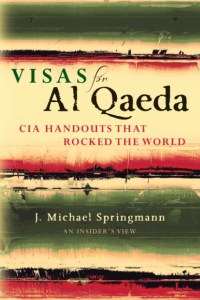
IF YOU DON’T WANT TO KNOW how sausages are made, don’t start reading Visas forAl Qaeda: CIA Handouts That Rocked the World by Michael Springmann. The sausages in this case: the string of too-easily-swallowed accounts of bloody events in the “global war on terror,” served up daily with relish by the mainstream media. In reality these sausages are filled with tainted meat that’s making everyone sick.
Springmann is a brave whistle blower living in Washington, D.C. He’s written an accessible book, safe to digest, highlighting details of the corruption of the American Empire (and its accomplices, including Canada) as he experienced them from the inside during his years with the U.S. State Department.
While he served as a visa officer in the U.S. consulate in Jeddah, Saudi Arabia, for instance, he was obliged under threat of dismissal to issue visas to persons hired clandestinely by the CIA to become trained-in-the-USA terrorists. Most of these psychopathic thugs were clearly and legally unqualified to be issued visas. There is every reason to believe the “Visas for Terrorists” program remains fully operative today. It takes a lot of expendable terrorists to run a global terrorism op.
Springmann places his experiences both within the context of the historical roots of the U.S. Empire and within its current ongoing global destabilization project.
“This tale,” the author states near the beginning, “is a sordid sketch of backstabbing, disloyalty, double crosses, faithlessness, falsity, perfidy, sellouts, treachery, and betrayal.”
And that only covers the bureaucratic aspect. Even more sobering is his sketch of human rights violations: torture, assassinations, massacres including bombings of markets, invasions and occupations of countries, destabilization of nations and regions.
Then there’s the financial side: widespread criminality, resource theft, bribery, diversion of funds, illicit drug dealing and more.
Not to mention the flouting of international laws. This dimension includes gross infringements on national sovereignty, the casual violation of treaties and ho-hum everyday general lawlessness, risking even the threat of nuclear annihilation.
All this before taking into account the moral dimension, in which trashing the Ten Commandments is just an opening trifle.
“My story shows how things really work,” Springmann writes, correctly. In the book’s 250 pages he names names, dates, times and places – presumably opening himself up to lawsuits, should there be anything here that the individuals named deem libelous. They might think twice, however, since Springmann is a lawyer by profession and knows his way around the Empire’s capital – as well as some of its outlying ramparts such as Stuttgart, New Delhi and especially Jeddah.
Stinging in itself, Springmann’s book also can be read as an authenticating companion to Michel Chossudovsky’s Towards a World War III Scenario (2012) and The Globalization of War: America’s “Long War” Against Humanity (2015). Along the way, both authors deal, to one extent or another, with the ideological, hubristic and increasingly bellicose role of the Harper government as handmaiden to the American Empire, including military involvements in Libya, Serbia and the Ukraine. Springmann necessarily refers very little to Canada, but to read his account of the cowardly and unnecessary rain of death inflicted on Libya, for instance, is to be obliged as a Canadian to think of Harper’s enthusiasm and pride in having this country share in the slaughter and destabilization carried out under the Orwellian “responsibility to protect” notion.
Springmann quotes Maximilian C. Forte who notes that before the attack Libya enjoyed the highest Human Development Index (a UN measurement of well-being) in all Africa. “After Western military forces destroyed the country the Index only records the steep collapse of all indicators of well-being. More Libyans were killed with intervention than without. It was about control, about militarizing Africa,” Forte argues.
What Springmann brings uniquely to the table is his firsthand knowledge of precisely how the USA recruits terrorists (no quotation marks needed), sends them to the USA for training and then deploys them to carry out murders, torture, bombings and more. The bloody mayhem carried out by these thousands of paid mercenaries – ostensibly beheading-habituated “jihadists” fighting against democracy, decency and the USA and its “allies – is planned, organized and funded by none other than the same USA and its allies. It’s a global false flag operation – the largest by far in history.
As Springmann on page 65 writes of the “Visas for Terrorists Program:”
This was not an ad hoc operation, conceived and carried out in response to a specific foreign policy issue. Rather, it was another of too many CIA efforts to destroy governments, countries, and politicians disfavored by the American “establishment” in its “bipartisan” approach to matters abroad. Whether it was opposing the imaginary evils of communism, the fictitious malevolence of Islam, or the invented wickedness of Iran, America and its intelligence services, brave defenders of “The City Upon A Hill,” sought out and created fear and loathing of peoples and countries essentially engaged in efforts to better their lives and improve their political world. Along the way, Agency-sponsored murders, war crimes, and human rights violations proved to be good business. Jobs for the Clandestine Service (people who recruit and run spies), sales of weapons and aircraft, as well as the myriad items needed to control banks, countries and peoples all provided income for and benefits to American companies.
That the American Empire has been able to carry out such a massive illegal program for so long is the saddest of commentaries on how deep the rot is, how effective the secrecy, how complicit the media.
As to the span of dangerous widespread deception, Springmann notes that Rahul Bedi wrote in Jane’s Defence Weekly on September 14, 2001 that beginning in 1980 “thousands [of mujahideen] were … brought to America and made competent in terrorism by Green Berets and SEALS at US government East Coast facilities, trained in guerilla warfare and armed with sophisticated weapons.”
The point is made repeatedly that Al Qaeda and now ISIS/ISIL/the Islamic State are essentially “Made in USA” entities, brought into being and organized for the Empire’s purposes. Among the elements that make possible such a vast fraud are deception, compartmentalization and secrecy. Springmann quotes attorney Pat Frascogna, “a man with FOIA expertise,” about secrecy and its purpose:
Thus whether it be learning the dirty and unethical business practices of a company or the secrets of our government, the same deployment of denials and feigning ignorance about what is really going on are the all-too-common methods used to keep the truth from the light of day.
Langley recruited the Arab-Afghans so clandestinely that the terrorists didn’t know they had been recruited. They thought that they had found a battlefield on their own, or through the Internet or through Twitter or through television…
Frascogna’s observation intersects with Springmann’s on-the-job experiences as a visa officer in Jeddah starting in 1987. Springmann was repeatedly overruled when he turned down disqualified applicants for U.S. visas. He writes:
As I later learned to my dismay, the visa applicants were recruits for the war in Afghanistan against the Soviet Union’s armed forces. Further, as time went by, the fighters, trained in the United States, went on to other battlefields: Yugoslavia, Iraq, Libya, and Syria. They worked with the American intelligence services and the State Department to destabilize governments the United States opposed. While it’s no secret, most knowledgeable people still refuse to talk about this agenda.
As Springmann learned, “the average percentage of intelligence officers to real diplomats at a given Foreign Service post is about one in three. My experience in Jeddah, Stuttgart, and New Delhi might place it higher—at least 50 percent, if not more.” According to the Anti-CIA Club of Diplomats: Spooks in U.S. Foreign Service [sic], a twelve-page, 1983 Canadian publication (see namebase.org), the percentage is 60 percent.
“At Jeddah,” Springmann writes, “to the best of my knowledge, out of some twenty US citizens assigned to the consulate, only three people, including myself, worked for the Department of State. The rest were CIA or NSA officials or their spouses.” Elsewhere Springmann suggests that essentially the CIA runs the State Department, and that this is true of many other U.S. government departments and agencies as well. It seems that it’s almost impossible to over-estimate the reach of the CIA’s tentacles or the overweening treason of its nonstop black ops and unconstitutional operations domestically.
Springmann toward the end of the book refers to the beginnings of the CIA. It’s interesting for this reviewer to think that he was 13 years of age in 1947 when U.S. president Harry Truman agreed with the National Security Council (NSC) to secretly create the CIA and NSA. I remember that in my teenage years a few of my peers said there “was something” called “the CIA.” This was around the time a few people also said there “was something” called “the Mafia.” The consensus was that both ideas were very far-fetched.
In 1948 Truman approved yet another NSC initiative, providing for “propaganda, economic warfare; preventive direct action, including sabotage, antisabotage,
demolition and evacuation measures; subversion against hostile states, including assistance to underground resistance movements, guerillas, and refugee liberation groups, and support of indigenous anti-Communist elements in threatened countries of the free world.” That’s a tabula rasa if there ever was one: a license for lawlessness.
The CIA’s twisted hits have just kept coming. It’s worth noting that Truman didn’t singlehandedly initiate this monstrosity. The dark recesses of the Deep State, as Peter Dale Scott calls it, are where the demonic entity was spawned. Ever since, Frankenstein’s monster has been a harmless schoolboy by comparison.
To read of the rape of Libya with active Canadian military complicity makes for difficult reading. The lies are piled as high as the bodies, and these two categories are insuperably paired.
Equally sordid, especially in light of Stephen Harper’s enthusiasm for expanding the war on Russia (the economic sanctions and the diplomatic exclusion of Russia from the G8 are forms of warfare, not to mention decades of covert* military incursion by the West onto the territory of the former USSR and now the Russian Federation, as described in Visas forAl Qaeda) is to read some of the history of the Ukraine. “The West’s” meddling in the Ukraine has a long illicit pedigree. As Springmann writes:
It seems that the CIA had problems [in the immediate post World War II period] distinguishing between underground groups and above-ground armies. Langley used Marshall Plan money to support a guerrilla force in the Ukraine, called “Nightingale.” Originally established in 1941 by Nazi Germany’s occupation forces, and working on their behalf, “Nightingale” and its terrorist arm (made up of ultranationalist Ukrainians as well as Nazi collaborators) murdered thousands of Jews, Soviet Union supporters, and Poles.
Even relatively recently, since the so-called Orange revolution in the Ukraine made events there eminently newsworthy, I can’t remember seeing in the mainstream media a single substantial article dealing with the historical relationships between the Ukraine and Russia going back to World War II, nor such an article laying out the history of the involvement –overt or covert – of “the West” in the Ukraine.
Instead, we see the surreal ahistorical likes of the top headline in The New York Times International Weekly for June 13-14, “Russia is Sowing Disunity,” by Peter Baker and Steven Erlanger. They report breathlessly in the lead paragraph: “Moscow is leveraging its economic power, financing European political parties and movements, and spreading alternative accounts of the Ukraine conflict, according the American and European officials.
True to the narrative of “the West” as a pitiful giant facing a powerful and expansionist Russia, the writers posit that the “consensus against Russian aggression” is “fragile.
The drift of this NYT yarn, typical of Western propaganda across the board, is that there remains in effect a behemoth “Soviet empire” surreptitiously shipping “Moscow gold” to dupes in “green movements” and so on. Even a former American national intelligence officer on Russia, Fiona Hill, now at the Brookings Institution, told the writers: “The question is how much hard evidence does anyone have?
Maybe this NYT propaganda, like its clones across the mainstream media, is not ahistorical after all. The story comes across rather as an historical relic of the Cold War – found in a time capsule in a fallout shelter – that the NYT editors decided to publish as a prank. A sausage.
* Military action by “the West” has not always been covert. Springmann notes that American and Japanese soldiers were dispatched to Russia in 1917 to squelch the fledgling Russian revolution. The soldiers were part of what was called the Allied Expeditionary Force. Winston Churchill for his part said: “We must strangle the Bolshevik baby in its crib.” Springmann might have noted that Canadian soldiers were part of the AEF.
I’m not sure if there’s been a better written book published yet this year than Ukraine: Zbig’s Grand Chessboard and How the West Was Checkmated, but I’m confident there’s not been a more important one. With some 17,000 nuclear bombs in the world, the United States and Russia have about 16,000 of them. The United States is aggressively flirting with World War III, the people of the United States have not the foggiest notion of how or why, and authors Natylie Baldwin and Kermit Heartsong explain it all quite clearly. Go ahead and tell me there’s nothing you’re now spending your time on that’s less important than this.
This book may very well be the best written one I’ve read this year. It puts all the relevant facts — those I knew and many I didn’t — together concisely and with perfect organization. It does it with an informed worldview. It leaves me nothing to complain about at all, which is almost unheard of in my book reviews. I find it refreshing to encounter writers so well-informed who also grasp the significance of their information.
Nearly half the book is used to set the context for recent events in Ukraine. It’s useful to understand the end of the cold war, the irrational hatred of Russia that pervades elite U.S. thinking, and the patterns of behavior that are replaying themselves now at higher volume. Stirring up fanatical fighters in Afghanistan and Chechnya and Georgia, and targeting Ukraine for similar use: this is a context CNN won’t provide. The partnership of the neocons (in arming and provoking violence in Libya) with the humanitarian warriors (in riding to the rescue for regime change): this is a precedent and a model that NPR won’t mention. The U.S. promise not to expand NATO, the U.S. expansion of NATO to 12 new countries right up to the border of Russia, the U.S. withdrawal from the ABM Treaty and pursuit of “missile defense” — this is background that Fox News would never deem significant. U.S. support for the rule of criminal oligarchs willing to sell off Russian resources, and Russian resistance to those schemes — such accounts are almost incomprehensible if you’ve consumed too much U.S. “news,” but are explained and documented well by Baldwin and Heartsong.
This book includes excellent background on the use and abuse of Gene Sharp and the color revolutions instigated by the U.S. government. A silver lining may be found, I think, in the value of nonviolent action recognized by all involved — whether for good or ill. The same lesson can be found (for good this time) in the civilian resistance to Ukrainian troops in the spring of 2014, and the refusal of (some) troops to attack civilians.
The Orange Revolution in Ukraine in 2004, the Rose Revolution in Georgia in 2003, and Ukraine II in 2013-2014 are recounted well, including detailed chronology. It’s truly remarkable how much has been publicly reported that remains buried. Western leaders met repeatedly in 2012 and 2013 to plot the fate of Ukraine. Neo-Nazis from Ukraine were sent to Poland to train for a coup. NGOs operating out of the U.S. Embassy in Kiev organized trainings for coup participants. On November 24, 2013, three days after Ukraine refused an IMF deal, including refusing to sever ties to Russia, protesters in Kiev began to clash with police. The protesters used violence, destroying buildings and monuments, and tossing Molotov cocktails, but President Obama warned the Ukrainian government not to respond with force. (Contrast that with the treatment of the Occupy movement, or the shooting on Capitol Hill of the woman who made an unacceptable U-turn in her car with her baby.)
U.S.-funded groups organized a Ukrainian opposition, funded a new TV channel, and promoted regime change. The U.S. State Department spent some $5 billion. The U.S. Assistant Secretary of State who handpicked the new leaders, openly brought cookies to protesters. When those protesters violently overthrew the government in February 2014, the United States immediately declared the coup government legitimate. That new government banned major political parties, and attacked, tortured, and murdered their members. The new government included neo-Nazis and would soon include officials imported from the United States. The new government banned the Russian language — the first language of many Ukrainian citizens. Russian war memorials were destroyed. Russian-speaking populations were attacked and murdered.
Crimea, an autonomous region of Ukraine, had its own parliament, had been part of Russia from 1783 until 1954, had publicly voted for close ties to Russia in 1991, 1994, and 2008, and its parliament had voted to rejoin Russia in 2008. On March 16, 2014, 82% of Crimeans took part in a referendum, and 96% of them voted to rejoin Russia. This nonviolent, bloodless, democratic, and legal action, in no violation of a Ukrainian constitution that had been shredded by a violent coup, was immediately denounced in the West as a Russian “invasion” of Crimea.
Novorossiyans, too, sought independence and were attacked by the new Ukrainian military the day after John Brennan visited Kiev and ordered that crime. I know that the Fairfax County Police who have kept me and my friends away from John Brennan’s house in Virginia have had no clue what hell he was unleashing on helpless people thousands of miles away. But that ignorance is at least as disturbing as informed malice would be. Civilians were attacked by jets and helicopters for months in the worst killing in Europe since World War II. Russian President Putin repeatedly pressed for peace, a ceasefire, negotiations. A ceasefire finally came on September 5, 2014.
Remarkably, contrary to what we’ve all been told, Russia didn’t invade Ukraine any of the numerous times we were told that it had just done so. We’ve graduated from mythical weapons of mass destruction, through mythical threats to Libyan civilians, and false accusation of chemical weapons use in Syria, to false accusations of launching invasions that were never launched. The “evidence” of the invasion(s) was carefully left devoid of location or any verifiable detail, but has all been decidedly debunked anyway.
The downing of the MH17 airplane was blamed on Russia with no evidence. The U.S. has information on what happened but won’t release it. Russia released what it had, and the evidence, in agreement with eye-witnesses on the ground, and in agreement with an air-traffic controller at the time, is that the plane was shot down by one or more other planes. “Evidence” that Russia shot the plane down with a missile has been exposed as sloppy forgeries. The vapor trail that a missile would have left was reported by not a single witness.
Baldwin and Heartsong close with the case that U.S. actions have backfired, that in fact whether the people of the United States have any idea what is going on or not, the power brokers in Washington have shot themselves in the foot. Sanctions against Russia have made Putin as popular at home as George W. Bush was after he’d managed to exist as president while planes were flown into the World Trade Center. The same sanctions have strengthened Russia by turning it toward its own production and toward alliances with non-Western nations. Ukraine has suffered, and Europe suffers from a cut-off of Russian gas, while Russia makes deals with Turkey, Iran, and China. Evicting a Russian base from Crimea seems more hopeless now than before this madness began. Russia is leading the way as more nations abandon the U.S. dollar. Retaliatory sanctions from Russia are hurting the West. Far from isolated, Russia is working with the BRICS nations, the Shanghai Cooperation Organization, and other alliances. Far from impoverished, Russia is buying up gold while the U.S. sinks into debt and is increasingly viewed by the world as a rogue player, and resented by Europe for depriving Europe of Russian trade.
This story begins in the irrationality of collective trauma coming out of the holocaust of World War II and of blind hatred for Russia. It must end with the same irrationality. If U.S. desperation leads to war with Russia in Ukraine or elsewhere along the Russian border where NATO is engaging in various war games and exercises, there may be no more human stories ever told or heard.
The thoroughly documented and referenced book exposes the substantial risks of genetically engineered foods and the multiple misrepresentations that have enabled them to permeate world markets.
Druker asserts that if Monsanto cannot prove that his book is essentially erroneous, the world will have a right to regard these controversial foods as unacceptably risky – and to promptly ban them.
‘Altered Genes, Twisted Truth’ was released in March 2015 and is the result of more than 15 years of intensive research and investigation by Druker, who initiated a lawsuit against the US Food and Drug Administration (FDA) that forced it to divulge its files on GM foods.
The book indicates that the commercialisation of GM food in the US was based on a massive fraud. The FDA files revealed that GM foods first achieved commercialisation in 1992 but only because the FDA covered up the extensive warnings of its own scientists about their dangers, lied about the facts and then violated federal food safety law by permitting these foods to be marketed without having been proven safe through standard testing.
If the FDA had heeded its own experts’ advice and publicly acknowledged their warnings that GM foods entailed higher risks than their conventional counterparts, Druker says that the GM food venture would have imploded and never gained traction anywhere.
He also argues that that many well-placed scientists have repeatedly issued misleading statements about GM foods, and so have leading scientific institutions such as the US National Academy of Sciences, the American Association for the Advancement of Science and the UK’s Royal Society.
Druker states that contrary to the claims of biotech advocates, humans have indeed been harmed by consuming the output of genetic engineering. He also explains that laboratory animals have also suffered from eating products of genetic engineering, and well-conducted tests with GM crops have yielded many troubling results, including intestinal abnormalities, liver disturbances, and impaired immune systems.
Druker says: “Contrary to the assertions of its proponents, the massive enterprise to reconfigure the genetic core of the world’s food supply is not based on sound science but on the systematic subversion of science – and it would collapse if subjected to an open airing of the facts.”
Now, in his open letter dated 19 May, Druker challenges Monsanto’s Chief Technology Officer to: “Face Up to the Extensive Evidence Demonstrating that Genetically Engineered Foods Entail Unacceptable Risks and Should Be Promptly Removed from the Market.”
Druker finishes his letter by saying:
“If by July 20th you and your allies have not been able to refute the essential factual accuracy of Altered Genes, Twisted Truth according to the terms set forth above, the world will have a right to assume that it is as sound as the experts who reviewed it have affirmed – and to conclude that GE foods are unacceptably risky and must be banned.
Operation Protective Edge, launched in early July 2014, was the third major Israeli assault on the Gaza Strip in six years. It was also the most deadly. By the conclusion of hostilities some seven weeks later, 2,200 of Gaza’s population had been killed, and more than 10,000 injured.
In these pages, journalist Mohammed Omer, a resident of Gaza who lived through the terror of those days with his wife and then three-month-old son, provides a first-hand account of life on-the-ground during Israel’s assault. The images he records in this extraordinary chronicle are a literary equivalent of Goya’s “Disasters of War”: children’s corpses stuffed into vegetable refrigerators, pointlessly because the electricity is off; a family rushing out of their home after a phone call from the Israeli military informs them that the building will be obliterated by an F-16 missile in three minutes; donkeys machine-gunned by Israeli soldiers under instructions to shoot anything that moves; graveyards targeted with shells so that mourners can no longer tell where their relatives are buried; fishing boats ablaze in the harbor.
Throughout this carnage, Omer maintains the cool detachment of the professional journalist, determined to create a precise record of what is occurring in front of him. But between his lines the outrage boils, and we are left to wonder how a society such as Israel, widely-praised in the West as democratic and civilized, can visit such monstrosities on a trapped and helpless population.
302 pages • Paperback ISBN 978-1-939293-92-3 • E-book 978-1-939293-93-0
The past, especially the political past, doesn’t just provide clues to the present. In the realm of the presidency and Wall Street, it provides an ongoing pathway for political-financial relationships and policies that remain a threat to the American economy going forward.
When Hillary Clinton video-announced her bid for the Oval Office, she claimed she wanted to be a “champion” for the American people. Since then, she has attempted to recast herself as a populist and distance herself from some of the policies of her husband. But Bill Clinton did not become president without sharing the friendships, associations, and ideologies of the elite banking sect, nor will Hillary Clinton. Such relationships run too deep and are too longstanding.
To grasp the dangers that the Big Six banks (JPMorgan Chase, Citigroup, Bank of America, Wells Fargo, Goldman Sachs, and Morgan Stanley) presently pose to the financial stability of our nation and the world, you need to understand their history in Washington, starting with the Clinton years of the 1990s. Alliances established then (not exclusively with Democrats, since bankers are bipartisan by nature) enabled these firms to become as politically powerful as they are today and to exert that power over an unprecedented amount of capital. Rest assured of one thing: their past and present CEOs will prove as critical in backing a Hillary Clinton presidency as they were in enabling her husband’s years in office.
In return, today’s titans of finance and their hordes of lobbyists, more than half of whom held prior positions in the government, exact certain requirements from Washington. They need to know that a safety net or bailout will always be available in times of emergency and that the regulatory road will be open to whatever practices they deem most profitable.
Whatever her populist pitch may be in the 2016 campaign — and she will have one — note that, in all these years, Hillary Clinton has not publicly condemned Wall Street or any individual Wall Street leader. Though she may, in the heat of that campaign, raise the bad-apples or bad-situation explanation for Wall Street’s role in the financial crisis of 2007-2008, rest assured that she will not point fingers at her friends. She will not chastise the people that pay her hundreds of thousands of dollars a pop to speak or the ones that have long shared the social circles in which she and her husband move. She is an undeniable component of the Clinton political-financial legacy that came to nationalfruition more than 23 years ago, which is why looking back at the history of the first Clinton presidency is likely to tell you so much about the shape and character of the possible second one.
The 1992 Election and the Rise of Bill Clinton
Challenging President George H.W. Bush, who was seeking a second term, Arkansas Governor Bill Clinton announced he would seek the 1992 Democratic nomination for the presidency on October 2, 1991. The upcoming presidential election would not, however, turn out to alter the path of mergers or White House support for deregulation that was already in play one iota.
First, though, Clinton needed money. A consummate fundraiser in his home state, he cleverly amassed backing and established early alliances with Wall Street. One of his key supporters would later change American banking forever. As Clinton put it, he received “invaluable early support” from Ken Brody, a Goldman Sachs executive seeking to delve into Democratic politics. Brody took Clinton “to a dinner with high-powered New York businesspeople, including Bob Rubin, whose tightly reasoned arguments for a new economic policy,” Clinton later wrote, “made a lasting impression on me.”
The battle for the White House kicked into high gear the following fall. William Schreyer, chairman and CEO of Merrill Lynch, showed his support for Bush by giving the maximum personal contribution to his campaign committee permitted by law: $1,000. But he wanted to do more. So when one of Bush’s fundraisers solicited him to contribute to the Republican National Committee’s nonfederal, or “soft money,” account, Schreyer made a $100,000 donation.
The bankers’ alliances remained divided among the candidates at first, as they considered which man would be best for their own power trajectories, but their donations were plentiful: mortgage and broker company contributions were $1.2 million; 46% to the GOP and 54% to the Democrats. Commercial banks poured in $14.8 million to the 1992 campaigns at a near 50-50 split.
Clinton, like every good Democrat, campaigned publicly against the bankers: “It’s time to end the greed that consumed Wall Street and ruined our S&Ls [Savings and Loans] in the last decade,” he said. But equally, he had no qualms about taking money from the financial sector. In the early months of his campaign, BusinessWeek estimated that he received $2 million of his initial $8.5 million in contributions from New York, under the care of Ken Brody.
“If I had a Ken Brody working for me in every state, I’d be like the Maytag man with nothing to do,” said Rahm Emanuel, who ran Clinton’s nationwide fundraising committee and later became Barack Obama’s chief of staff. Wealthy donors and prospective fundraisers were invited to a select series of intimate meetings with Clinton at the plush Manhattan office of the prestigious private equity firm Blackstone.
Robert Rubin Comes to Washington
Clinton knew that embracing the bankers would help him get things done in Washington, and what he wanted to get done dovetailed nicely with their desires anyway. To facilitate his policies and maintain ties to Wall Street, he selected a man who had been instrumental to his campaign, Robert Rubin, as his economic adviser.
In 1980, Rubin had landed on Goldman Sachs’ management committee alongside fellow Democrat Jon Corzine. A decade later, Rubin and Stephen Friedman were appointed cochairmen of Goldman Sachs. Rubin’s political aspirations met an appropriate opportunity when Clinton captured the White House.
On January 25, 1993, Clinton appointed him as assistant to the president for economic policy. Shortly thereafter, the president created a unique role for his comrade, head of the newly created National Economic Council. “I asked Bob Rubin to take on a new job,” Clinton later wrote, “coordinating economic policy in the White House as Chairman of the National Economic Council, which would operate in much the same way the National Security Council did, bringing all the relevant agencies together to formulate and implement policy… [I]f he could balance all of [Goldman Sachs’] egos and interests, he had a good chance to succeed with the job.” (Ten years later, President George W. Bush gave the same position to Rubin’s old partner, Friedman.)
Back at Goldman, Jon Corzine, co-head of fixed income, and Henry Paulson, co-head of investment banking, were ascending through the ranks. They became co-CEOs when Friedman retired at the end of 1994.
Those two men were the perfect bipartisan duo. Corzine was a staunch Democrat serving on the International Capital Markets Advisory Committee of the Federal Reserve Bank of New York (from 1989 to 1999). He would co-chair a presidential commission for Clinton on capital budgeting between 1997 and 1999, while serving in a key role on the Borrowing Advisory Committee of the Treasury Department. Paulson was a well connected Republican and Harvard graduate who had served on the White House Domestic Council as staff assistant to the president in the Nixon administration.
Bankers Forge Ahead
By May 1995, Rubin was impatiently warning Congress that the Glass-Steagall Act could “conceivably impede safety and soundness by limiting revenue diversification.” Banking deregulation was then inching through Congress. As they had during the previous Bush administration, both the House and Senate Banking Committees had approved separate versions of legislation to repeal Glass-Steagall, the 1933 Act passed by the administration of Franklin Delano Roosevelt that had separated deposit-taking and lending or “commercial” bank activities from speculative or “investment bank” activities, such as securities creation and trading. Conference negotiations had fallen apart, though, and the effort was stalled.
By 1996, however, other industries, representing core clients of the banking sector, were already being deregulated. On February 8, 1996, Clinton signed the Telecom Act, which killed many independent and smaller broadcasting companies by opening a national market for “cross-ownership.” The result was mass mergers in that sector advised by banks.
Deregulation of companies that could transport energy across state lines came next. Before such deregulation, state commissions had regulated companies that owned power plants and transmission lines, which worked together to distribute power. Afterward, these could be divided and effectively traded without uniform regulation or responsibility to regional customers. This would lead to blackouts in California and a slew of energy derivatives, as well as trades at firms such as Enron that used the energy business as a front for fraudulent deals.
The number of mergers and stock and debt issuances ballooned on the back of all the deregulation that eliminated barriers that had kept companies separated. As industries consolidated, they also ramped up their complex transactions and special purpose vehicles (off-balance-sheet, offshore constructions tailored by the banking community to hide the true nature of their debts and shield their profits from taxes). Bankers kicked into overdrive to generate fees and create related deals. Many of these blew up in the early 2000s in a spate of scandals and bankruptcies, causing an earlier millennium recession.
Meanwhile, though, bankers plowed ahead with their advisory services, speculative enterprises, and deregulation pursuits. President Clinton and his team would soon provide them an epic gift, all in the name of U.S. global power and competitiveness. Robert Rubin would steer the White House ship to that goal.
On February 12, 1999, Rubin found a fresh angle to argue on behalf of banking deregulation. He addressed the House Committee on Banking and Financial Services, claiming that, “the problem U.S. financial services firms face abroad is more one of access than lack of competitiveness.”
He was referring to the European banks’ increasing control of distribution channels into the European institutional and retail client base. Unlike U.S. commercial banks, European banks had no restrictions keeping them from buying and teaming up with U.S. or other securities firms and investment banks to create or distribute their products. He did not appear concerned about the destruction caused by sizeable financial bets throughout Europe. The international competitiveness argument allowed him to focus the committee on what needed to be done domestically in the banking sector to remain competitive.
Rubin stressed the necessity of HR 665, the Financial Services Modernization Act of 1999, or the Gramm-Leach-Bliley Act, that was officially introduced on February 10, 1999. He said it took “fundamental actions to modernize our financial system by repealing the Glass-Steagall Act prohibitions on banks affiliating with securities firms and repealing the Bank Holding Company Act prohibitions on insurance underwriting.”
The Gramm-Leach-Bliley Act Marches Forward
On February 24, 1999, in more testimony before the Senate Banking Committee, Rubin pushed for fewer prohibitions on bank affiliates that wanted to perform the same functions as their larger bank holding company, once the different types of financial firms could legally merge. That minor distinction would enable subsidiaries to place all sorts of bets and house all sorts of junk under the false premise that they had the same capital beneath them as their parent. The idea that a subsidiary’s problems can’t taint or destroy the host, or bank holding company, or create “catastrophic” risk, is a myth perpetuated by bankers and political enablers that continues to this day.
Rubin had no qualms with mega-consolidations across multiple service lines. His real problems were those of his banker friends, which lay with the financial modernization bill’s “prohibition on the use of subsidiaries by larger banks.” The bankers wanted the right to establish off-book subsidiaries where they could hide risks, and profits, as needed.
Again, Rubin decided to use the notion of remaining competitive with foreign banks to make his point. This technicality was “unacceptable to the administration,” he said, not least because “foreign banks underwrite and deal in securities through subsidiaries in the United States, and U.S. banks [already] conduct securities and merchant banking activities abroad through so-called Edge subsidiaries.” Rubin got his way. These off-book, risky, and barely regulated subsidiaries would be at the forefront of the 2008 financial crisis.
On March 1, 1999, Senator Phil Gramm released a final draft of the Financial Services Modernization Act of 1999 and scheduled committee consideration for March 4th. A bevy of excited financial titans who were close to Clinton, including Travelers CEO Sandy Weill, Bank of America CEO, Hugh McColl, and American Express CEO Harvey Golub, called for “swift congressional action.”
The Quintessential Revolving-Door Man
The stock market continued its meteoric rise in anticipation of a banker-friendly conclusion to the legislation that would deregulate their industry. Rising consumer confidence reflected the nation’s fondness for the markets and lack of empathy with the rest of the world’s economic plight. On March 29, 1999, the Dow Jones Industrial Average closed above 10,000 for the first time. Six weeks later, on May 6th, the Financial Services Modernization Act passed the Senate. It legalized, after the fact, the merger that created the nation’s biggest bank. Citigroup, the marriage of Citibank and Travelers, had been finalized the previous October.
It was not until that point that one of Glass-Steagall’s main assassins decided to leave Washington. Six days after the bill passed the Senate, on May 12, 1999, Robert Rubin abruptly announced his resignation. As Clinton wrote, “I believed he had been the best and most important treasury secretary since Alexander Hamilton… He had played a decisive role in our efforts to restore economic growth and spread its benefits to more Americans.”
Clinton named Larry Summers to succeed Rubin. Two weeks later, BusinessWeek reported signs of trouble in merger paradise — in the form of a growing rift between John Reed, the former Chairman of Citibank, and Sandy Weill at the new Citigroup. As Reed said, “Co-CEOs are hard.” Perhaps to patch their rift, or simply to take advantage of a political opportunity, the two men enlisted a third person to join their relationship — none other than Robert Rubin.
Rubin’s resignation from Treasury became effective on July 2nd. At that time, he announced, “This almost six and a half years has been all-consuming, and I think it is time for me to go home to New York and to do whatever I’m going to do next.” Rubin became chairman of Citigroup’s executive committee and a member of the newly created “office of the chairman.” His initial annual compensation package was worth around $40 million. It was more than worth the “hit” he took when he left Goldman for the Treasury post.
Three days after the conference committee endorsed the Gramm-Leach-Bliley bill, Rubin assumed his Citigroup position, joining the institution destined to dominate the financial industry. That very same day, Reed and Weill issued a joint statement praising Washington for “liberating our financial companies from an antiquated regulatory structure,” stating that “this legislation will unleash the creativity of our industry and ensure our global competitiveness.”
On November 4th, the Senate approved the Gramm-Leach-Bliley Act by a vote of 90 to 8. (The House voted 362–57 in favor.) Critics famously referred to it as the Citigroup Authorization Act.
Mirth abounded in Clinton’s White House. “Today Congress voted to update the rules that have governed financial services since the Great Depression and replace them with a system for the twenty-first century,” Summers said. “This historic legislation will better enable American companies to compete in the new economy.”
But the happiness was misguided. Deregulating the banking industry might have helped the titans of Wall Street but not people on Main Street. The Clinton era epitomized the vast difference between appearance and reality, spin and actuality. As the decade drew to a close, Clinton basked in the glow of a lofty stock market, a budget surplus, and the passage of this key banking “modernization.” It would be revealed in the 2000s that many corporate profits of the 1990s were based on inflated evaluations, manipulation, and fraud. When Clinton left office, the gap between rich and poor was greater than it had been in 1992, and yet the Democrats heralded him as some sort of prosperity hero.
When he resigned in 1997, Robert Reich, Clinton’s labor secretary, said, “America is prospering, but the prosperity is not being widely shared, certainly not as widely shared as it once was… We have made progress in growing the economy. But growing together again must be our central goal in the future.” Instead, the growth of wealth inequality in the United States accelerated, as the men yielding the most financial power wielded it with increasingly less culpability or restriction. By 2015, that wealth or prosperity gap would stand near historic highs.
The power of the bankers increased dramatically in the wake of the repeal of Glass-Steagall. The Clinton administration had rendered twenty-first-century banking practices similar to those of the pre-1929 crash. But worse. “Modernizing” meant utilizing government-backed depositors’ funds as collateral for the creation and distribution of all types of complex securities and derivatives whose proliferation would be increasingly quick and dangerous.
Eviscerating Glass-Steagall allowed big banks to compete against Europe and also enabled them to go on a rampage: more acquisitions, greater speculation, and more risky products. The big banks used their bloated balance sheets to engage in more complex activity, while counting on customer deposits and loans as capital chips on the global betting table. Bankers used hefty trading profits and wealth to increase lobbying funds and campaign donations, creating an endless circle of influence and mutual reinforcement of boundary-less speculation, endorsed by the White House.
Deposits could be used to garner larger windfalls, just as cheap labor and commodities in developing countries were used to formulate more expensive goods for profit in the upper echelons of the global financial hierarchy. Energy and telecoms proved especially fertile ground for the investment banking fee business (and later for fraud, extensive lawsuits, and bankruptcies). Deregulation greased the wheels of complex financial instruments such as collateralized debt obligations, junk bonds, toxic assets, and unregulated derivatives.
The Glass-Steagall repeal led to unfettered derivatives growth and unstable balance sheets at commercial banks that merged with investment banks and at investment banks that preferred to remain solo but engaged in dodgier practices to remain “competitive.” In conjunction with the tight political-financial alignment and associated collaboration that began with Bush and increased under Clinton, bankers channeled the 1920s, only with more power over an immense and growing pile of global financial assets and increasingly “open” markets. In the process, accountability would evaporate.
Every bank accelerated its hunt for acquisitions and deposits to amass global influence while creating, trading, and distributing increasingly convoluted securities and derivatives. These practices would foster the kind of shaky, interconnected, and opaque financial environment that provided the backdrop and conditions leading up to the financial meltdown of 2008.
The Realities of 2016
Hillary Clinton is, of course, not her husband. But her access to his past banker alliances, amplified by the ones that she has formed herself, makes her more of a friend than an adversary to the banking industry. In her brief 2008 candidacy, all four of the New York-based Big Six banks ranked among her top 10 corporate donors. They have also contributed to the Clinton Foundation. She needs them to win, just as both Barack Obama and Bill Clinton did.
No matter what spin is used for campaigning purposes, the idea that a critical distance can be maintained between the White House and Wall Street is naïve given the multiple channels of money and favors that flow between the two. It is even more improbable, given the history of connections that Hillary Clinton has established through her associations with key bank leaders in the early 1990s, during her time as a senator from New York, and given their contributions to the Clinton foundation while she was secretary of state. At some level, the situation couldn’t be less complicated: her path aligns with that of the country’s most powerful bankers. If she becomes president, that will remain the case.
Nomi Prins is the author of six books, a speaker, and a distinguished senior fellow at the non-partisan public policy institute Demos. Her most recent book, All the Presidents’ Bankers: The Hidden Alliances that Drive American Power (Nation Books) has just been released in paperback and this piece is adapted and updated from it. She is a former Wall Street executive.
Karl: Welcome to the Renegade Economists with your host, Karl Fitzgerald. This week we’re stepping back in time, way back some 10,000 years BC into the world of archaeology, Egyptology and Assyriology. Yes, it’s time for another special with Professor Michael Hudson. That’s right, Michael Hudson back on the show, he’s got a new book called Labor in the Ancient World and I asked him to give us a bit of a précis on the background to his very interesting process. Hang on for another riveting conversation here on 3CR’s Renegade Economists.
Michael Hudson: It’s a symposium of a group put together at Harvard University of the leading Assyriologists and Egyptologists and Mycenaean Greek specialists as well as archaeologists on how early societies mobilised the labour force, especially for large public building projects such as temples, city walls and other infrastructure.
Karl: And this is published through whom?
Michael: It’ll be published by ISLET, the Institute for the Study of Long-term Economic Trends. We just finished the type setting actually today and we’re sending it to Amazon to be put on their list, it’ll probably be available in about two weeks.
Karl: “Labor in the Ancient World.”
Michael: Yes.
Karl: And does that have some sort of Harvard connection?
Michael: We founded this project over 20 years ago at the Peabody Museum, which is their archaeology and anthropology department. We wanted to do a series of books on how modern economies and practices began. Our first colloquium was in 1994 on Privatization in the Ancient Near East and Classical Antiquity; our second volume was on Urbanization and Landownership in the Ancient Near East, about how cities were created and how landownership and real estate patterns developed into a market for real estate. The third volume was on Economic Renewal in the Ancient Near East, about how debt cancellations restored the land to its citizen-cultivators to provide a means of self-support for the free citizenry.
These colloquia grew so popular that we added a fourth volume, Creating Economic Order: Record-Keeping, Standardization and the Development of Accounting in the Ancient Near East, on the origins of money and account keeping from Mesopotamia to Mycenaean Greece and Egypt. And then ten years ago we had our fifth colloquium on Labor in the Ancient World. There have been so many revolutions in archaeology and Assyriology and even Egyptology in the last ten years that we’re only publishing this volume now, to be completely up-to-date.
Karl: So the Ancient Near East, how many thousand years ago was it? Just put us in the picture.
Michael: We begin the volume in 10,000 BC in Göbekli Tepe in Turkey where you have very large city-like ceremonial sites, larger than Stonehenge, huge sites that took hundreds of years to build with huge stone megaliths, even in the pre-pottery Neolithic. They didn’t yet have metal to carve these stones. They didn’t even have pottery. But they had in Göbekli all sorts of huge carvings in a seasonal site where people would come together on ceremonial occasions, like midsummer. We researched from Turkey in 10,000 BC to Sumer in the third millennium BC, Babylonia in the second millennium BC, the building of the pyramids, and we have the actual bills and accounting statements for what’s paid to labour to build the pyramids.
We found they were not built by slaves. They were built by well-paid skilled labour. The problem in these early periods was how to get labour to work at hard tasks, if not willingly? For 10,000 years there was a labour shortage. If people didn’t want to work hard, they could just move somewhere else. The labour that built temples and big ceremonial sites had to be at least quasi-voluntary even in the Bronze Age c. 2000 BC. Otherwise, people wouldn’t have gone there.
Karl: Michael, how did you actually track this? What were you reading to get this information?
Michael: Everybody who comes to the colloquium is a specialist in their period. For instance, Carl Lamberg-Karlovsky is the archaeologist dealing with Göbekli Tepe in Turkey. My co-editor for this volume, Piotr Steinkeller, is Babylonian specialist in cuneiform. We have two Egyptian specialists in hieroglyphics, and two Mycenaean Greek specialists for Linear B. Each scholar throughout all of these five volumes was a specialist in each time period and each geographical area on which we’re concentrating.
Karl: Were you reading clay tablets, cuneiform?
Michael: They read the clay tablets if they’re from Mesopotamia. They read the notations and carvings in the Egyptian pyramids on the inside of the big rock blocks that made the pyramids. Teams would carve or write the home town they came from. We also have royal inscriptions.
We found that one reason why people were willing to do building work with hard manual labour was the beer parties. There were huge expenditures on beer. If you’re going to have a lot of people come voluntarily to do something like city building or constructing their own kind of national identity of a palace and walls you’ve got to have plenty of beer. You also need plenty of meat, many animals being sacrificed. Archaeologists have found their bones and reconstructed the diets with fair accuracy.
What they found is that the people doing the manual labour on the pyramids, the Mesopotamian temples and city walls and other sites were given a good high protein diet. There were plenty of festivals. The way of integrating these people was by public feasts. This was like creating a peer group to participate in a ceremonial creation of national identity.
Karl: Back in those times, how would they have realised when this festival was on, how was communication spread that this was the time to come together?
Michael: We discussed this in the second volume of our series, Urbanization & Land Use in the Ancient Near East. They did it by the solar and lunar calendar, by counting the moons leading up to solar solstices or equinoxes. The great ceremonial sites from Stonehenge to Turkey were based on the particular equinox or solstice. Chieftains usually would be the calendar keepers. Going all the way back to the Ice Age around 29,000 BC Alex Marshack, one of our members, published The Roots of Civilization reporting on the carved bones he found with notations for the phases of the moon. The job of the chieftain was to keep the lunar calendar, trace the waxing and waning of the moon to calculate how long the month would be, and to decide that, “Ah, in this month, six months after the equinox, here’s where we have to get together and have everybody come to the gathering and begin working on the big site”.
The pyramids and other ancient monuments were built by free labor, not by slaves
Karl: I’m still trying to grasp this Michael. Would all these labourers come together in a centralised place to build this giant statue or pyramid based on some sort of goodwill?
Michael: Well, to begin with, you would have a beer party to get everybody friendly. You would have big feasts, and also these were the major occasions for socialization. All over the world, communal feasts were the primordial way to integrate societies.
Obviously somebody was in charge of designing these monuments. We don’t know whom, but they would supervise the cutting and carving of the stones. These had to be brought over large distances, just like in Stonehenge. The groups would quarry them and cut them. Maybe the cutters and designers were the same people. And in Göbekli we’re dealing in a time before they’d invented steel or metal. Many of the stones had to be cut and designs carved just by chipping away with other stones. It obviously was a very laborious type of work.
Corvee labor was supplied on the basis of landholdings
Later, by about 2,000 BC, populations were growing more dense. There also was a shift from the temples, which originally organised most of these mega-projects, to the palaces that developed out of them around 2750 BC. Their scribes developed accounting practices to schematise and organise this labour coming together. To coordinate this in an equitable, almost schematic way, land tenure was allocated on the principle that whoever had such-and-such a plot size had to supply a given number of labourers to work on the public infrastructure. So what we found as a by-product of the labour volume is that the origins of land rights were defined by the tax payments – the corvée labor obligation.
To get the right to a given land of a given size, you had to promise on such-and-such dates to provide this much labour for the corvée project. It’s a French word, because a corvée tax in the form of labour instead of money payments lasted all the way down through the 18th Century in France. It was typical in mediaeval Europe before you had a money economy. Everybody who had their own subsistence land or their own land holdings of one form or another, or their grazing lands, would have to supply X number of labourers to the big building project.
Karl: That’s quite some discovery. So you’re saying that labour was provided as an in-kind payment for taxation based around calendars to build these giant monuments?
Michael: Yes. Each of our archaeologists, Assyriologists and Egyptologists has found this for every period of the Bronze Age and the Neolithic.
Karl: And so we’re still rather on a voluntary level, there was no quantifying –
Michael: There weren’t that many people in the world in 10,000 BC, 3000 BC or even 2000 BC. If a government got too oppressive, or when they would raise the contributions or taxes too high, people would just flee to another area. Or if they were too much indebted the debtors would flee, as they did from Babylonia around 1600 BC. We are talking about free labor, not slave labor.
Karl: So they built a social contract around these feasts, around this sense of belonging by being at this public works event. It sounds like a fascinating way to keep society on track and organise labour so that civilisation would develop on some level. Have you found any indication on that managerial class and how they developed through the chieftains?
Michael: First the priesthoods, then the accountants and scribes. The calendar keepers were usually the chiefs (there may have been “sky chiefs” and “war chiefs” separately, or perhaps their roles were combined as dynastic rulers developed). Most of the religions were cosmological. They wanted to create an integrated cosmology of nature and society (“On earth, as it is in heaven”). Administration was based on the astronomical rhythms of the calendar, lunar and solar cycles. For instance, you typically find a society divided into 12 tribes, as you had in Israel and also in Greece with its amphictyonies. In a division of 12 tribes, each could take turns administering the ceremonial centre for one month out of the year.
The physical design of cities also was based on the calendar. Big cities would have 12 gates. Most cities had maybe four gates, representing the four seasons or the four quarters of the Earth. The outline of the land and the Earth was based on a calendrical cosmology, much like a mandala.
Ceremonial sites such as Stonehenge also were calendars in miniature, designed so that the light would fall on the stones in a particular way on a solstice or equinox. We have this going back into the Ice Age around 30,000 BC. Alex Marshak’s article in our volume on urbanisation found that these sites already in the Ice Age were usually sited on waterways, so that everybody could get to them. They often were sited with mountains in the background and in between them the sun would shine in a particular way on the equinox or on the solstice in a particular alignment that occurred just at that calendrical time. They were recreating the cosmos on Earth.
Karl: You’re on 3CR’s Renegade Economists, this week with distinguished Research Professor Michael Hudson from Michael-Hudson.com and we’re discussing his new colloquium book “Labour in the Ancient World”. We’re tracking back some 10,000-odd years, hearing about how civilisation was developed. Michael, this is a fascinating discussion. I’m interested, of course, here on the Renegades, about this role of land tenure, and how that influenced citizens’ role in society. From what I’ve read out of your new book, it sounds like land holdings played a huge role in the status of a participant in one’s society.
Ancient citizenship, voting rights – and social obligations – were based on landholding
Michael: In America down to the time of the Revolution in the 18 th century, and in early Australia I assume also, in order to be a citizen and vote, you had to be a landowner. And all the way back in Rome and earlier times, Mesopotamia, Babylonia, Sumer, citizens had to have their own land. In Rome each citizen’s voting rights were defined by the land area he owned. I say “he” because only the males were citizens. It was a patriarchal society, with voting rights proportional to the size of one’s landholdings.
Much as today, debt was a major factor concentrating landholdings. Finance always has been the great lever to appropriate the land rent and interfere with widespread land ownership. If you owe money on a mortgage and you can’t pay, you can be evicted. That began to happen already around 2000 BC in Babylonia.
But the process was limited and reversed, because when creditors evicted land-tenured citizens, this caused a problem for rulers. The former landholder no longer was a citizen – and if he’s not a citizen, he can’t serve in the army.
One’s rank in the army down through Roman times was defined by how much land one had. If you had just a basic subsistence plot, you were in the infantry. If you had a lot of land, you were able to support yourself in leisure, have a horse and participate in the cavalry, practicing military training and buying your armour and weapons. You find much the same thing in Japan. All over the world, citizenship, landownership and one’s rank in the army were linked together.
Karl: Yes, the English military had the same arrangement. So you can see a point that if you own lots of land, you want to defend it, so these landowners need to be involved to defend their land. How times have changed.
Michael: They weren’t merely defending; they were also aggressive. There was continual warfare. Attacking and defending also had a financial dimension. In Greece a military manual in the 3 rd century BC was written by a man who took the pseudonym of Tacticus – not Tacitus as in Rome, but Tacticus for tactics. He wrote that if a general planned to attack a city, he should promise to cancel the debts and free the slaves, in order to get the debtors to come over to his side. And if you’re defending a city, you also promise to cancel everyone’s debts and free the slaves. That’s how you get people on your side.
Coriolanus did that in Rome, and Zedekiah in Judah. But both rulers went back on their word as soon as the fighting was over. However, in Babylonia we have more or less regular debt cancellations whenever a new ruler would take the throne. This is in our third volume, Debt & Economic Renewal in the Ancient Near East. Babylonian rulers would proclaim andurarum and misharum, their words for a Clean Slate. David Graeber picked up this historical analysis in Debt: The First 4000 Years, discussing it from an anthropological point of view.
These proclamations did three things – the same three things you find in the biblical jubilee year (which used a cognate word, deror): These acts liberated the debt servants and let them return to their family of origin; they canceled all the personal debts that were owed (but not commercial business debts); and they returned the land rights or crop rights to debtors who had pledged them to their creditors. These royal proclamations restored order by making things the way they were in an idealised past. It was a situation where everybody was supposed to own their own self-support land to provide their means of subsistence free of debt. That was their idea of economic balance.
This is the opposite of debt serfdom reducing more and more people to debt peonage, obliged to pay their income to creditors. If they finally lose their job, they lose their home and their house and the banks get to keep it. That practice would have depopulated the ancient world. If that would have happened, debtors would have just got up and left, or they’d go over to the enemy when other armies would attack. You’d have defections. So reversing personal debts preserved widespread landownership and liberty from debt.
Karl: Right, so reiterating, the Clean Slate would build that social contract with the ruler and help continue the goodwill that led to this massive public development that was voluntarily provided tax in-kind, usually in labor. It sounds fascinating that people would just defect and move to another country under another ruler if the debt stayed too high, even back in those times when we weren’t anywhere near as mobile as today.
Michael: We have all sorts of documents around the 14th and 13th centuries, especially about the hapiru, bands of debt fugitives and others, who some people translate as Hebrews. Rome was said to have been founded by exiles and runaways, mainly runaways from debt who created their own society there. Flight from debt goes way back.
Bronze Age “divine kingship” gives way to classical creditor oligarchies
Karl: Given the history of Clean Slates and the jubilee, how did agrarian debt develop? And how did the conflict of interest between creditors and rulers play out?
Michael: It played out differently everywhere. There was a constant tension from the Bronze Age through classical antiquity between rulers trying to maintain a society under their control, and local headmen trying to get power for themselves. The big question was who would run society and draw up its rules. Would it be the priesthood and military rulers at the top of the pyramid, or creditors and warlords grabbing peoples’ land and trying to create their own control? Strong rulers like Hammurabi were able to centralise rule. He proclaimed andurarum upon taking the throne, and numerous times thereafter, down to his 30th year of rule. When he was sick and dying, his son Samsuiluna also proclaimed misharum to restore order to start his own reign in balance. But then you’d have Intermediate Periods with a free-for-all in which local leaders gained autonomy. And they simply disobeyed royal Clean Slates.
From 1200 BC to about 750 BC in the Mediterranean you have a Dark Age. Apparently you had not only very bad weather around 1200 BC – maybe a small Ice Age and drought – but the weather and crop failures led to mass migrations and invasions. The palaces of Mycenaean Greece were burned and syllabic writing disappeared for nearly 500 years. Then, when you have alphabetic writing emerging, the person whose title originally meant “local branch manager” of the palace workshop suddenly appears as the basileus, the ruler. But mostly you have landholding aristocracies holding the population in debt serfdom (like the Athenian hektimoroi, “sixth parters” liberated by Solon in 594 BC). It was much like the post-Soviet kleptocrats when Red Managers gave themselves control of their companies. When central power falls apart, local headmen take over. The dissolution of royal power led to privatization – including the privatization of credit, taking it and its rules out of royal hands. So Clean Slates stopped.
Much the same thing occurred in England. After the Norman invasion you had the Magna Carta when the autocratic King John tried to grab all the economic surplus for himself. The landowning barons wanted to break free. The Magna Carta limited what kings could tax without landlord agreement. The barons said, in effect, “The rent that we formerly paid to support the royal army, we henceforth will keep for ourselves. Also, we won’t pay the debts we owe to the Jews, so that we can keep our land.” The founding constitution or legal documents of almost every nation have to do with the relationship between finance, land tenure and its tax liability, and the relationship between centralised power and local power.
You could say that the progress of civilisation for the last thousand years, since feudal times, has been a dissolution of autocratic feudal power toward more democratised power. The problem is that land has been democratised on credit. So instead of owing money to landlords, homeowners now owe money to their bankers.
Creditor stratagems to evade the law and religious sanctions
Karl: That is the challenge of the ages isn’t it? Looking through these writings of yours, it becomes clear that this battle between credit and the sovereignty of this democratic process has been an ongoing challenge. In antiquity, did the vocabulary distinguish interest from usury?
Michael: No. It was only in the 13th century that Thomas Aquinas and the Schoolmen distinguished between interest and usury. Any taking of interest was considered usury in antiquity. That’s why some people tried to ban it, mainly for consumer interest. When the distinction was made, usury was supposed to refer to consumer loans, and interest was for bona fide commercial loans. These usually involved shipping to foreign buyers or transferring payments from one country to another, for instance when barons left to fight in the Crusades. The Latin word for such foreign exchange fees was agio, a premium.
Bankers managed to get around Christian sanctions against usury by saying, “Okay, it’s not interest, it’s a fee. It’s a foreign exchange fee.” They would pretend to make a foreign exchange transaction, and pay for the currency convertibility. If you’re converting Australian pounds into dollars, you have to give a few percentage points to the banker. In medieval times, interest was concealed as a foreign exchange fee and as interest or, for real estate, as rent – much as in today’s Islamic finance. This was called “dry exchange,” because it occurred on dry land. No sea transport was involved.
Karl: So when we look over the history of this era and its battle between credit and the ruling elite, the challenge was to maintain land ownership within your community and keep your people there, making sure that they had some share in the benefits of working together. This sort of independence of people being able to live off their land seems to have become a battle between democratic principles and creditors.
Michael: That’s basically so. Early common law had blockages against the things that creditors could foreclose on – the widow’s ox, the blacksmith’s anvil and basic tools of one’s trade and self-support. If you were a creditor and wanted to get somebody else’s land, you needed a legal stratagem.
In Babylonia and neighbouring Indo-European speaking communities such as Hurrian-speaking Nuzi, customary land tenure rights were only transmissible within a family or clan. The aim was to enable kinship units to supply their basic needs. The creditor’s stratagem was to get himself adopted by the debtor as number one son, as his heir. When the debtor died, the number one son, the creditor, would inherit most of the land, as if he were part of the kinship-based community. A Babylonian proverb reflects this practice: “A creditor has many relatives.” These subterfuges that creditors used are much like the small print that bank lobbyists write into today’s bankruptcy laws to stack matters in their own favor. Creditors and Wall Street have always been subtle in finding end runs around laws, obeying the letter of the law but changing the spirit of the law.
The U.S. political outlook: the Democrats and Hillary Clinton’s 2016 run
Karl: Changing gears, let’s speed into the current American situation with Elizabeth Warren and the Democratic ticket. I saw this week that she’s come out fighting against banks and their threat to reduce donations to the Democratic Party if she doesn’t tone things down. Did your blood boil when you read that Michael?
Michael: Not at all. The Democratic Party in America is the party of Wall Street. A Republican administration could never get away with turning over power to Wall Street, because as long as they’re in power, the Democratic opposition will block them from doing it. Although the Republican Party is almost entirely funded by lobbyists, the Democratic Party is the one that has the power to unblock the giveaways to Wall Street. Most of this is done under former Clinton Treasury Secretary Robert Rubin who got rid of the Glass-Steagall Act, blocked regulation of bank derivative gambles, and inaugurated the wave of deregulation and outright criminalization of banking.
The Glass-Steagall Act was repealed in 1999, when the Clinton Administration also blocked regulation for bank speculation in derivatives. It took only eight years for the most criminal organisations, Citibank and Bank of America (which bought the junk mortgage writer, Countrywide Finance) to bring down the economy. The head of Citibank was Rubin, after having freed it from regulation. What the press called the Rubino Gang wrote fake mortgages – they’re called “liar’s loans” or “Alt-A,” based on false declarations of income and false property valuations (the liars were the banks and the mortgage brokers) and sold them to gullible investors like German Landesbanks that were naïve enough to believe that Wall Street wouldn’t try to cheat them. The junk mortgage bubble was one of the biggest ripoffs in history.
You can read what my UMKC colleague Bill Black has written recently on Naked Capitalism and the University of Missouri Kansas City site, New Economic Perspectives on the Citibank criminogenic organisation. The Democrats under Obama have blocked any prosecution of financial criminals. Not a single bank crook has been thrown in jail after over $4 trillion had been stolen and bailed out by the Federal Reserve’s wave of Quantitative Easing. The crime wave of Wall Street and real estate in the last decade has endowed an entire ruling class for the next century in America.
They’re as criminal as the Russian kleptocrats, because they’re in total control of the government. They’ve used their power to re-define the meaning of a “free market.” To them, a free market is one completely free of government regulations to control banking, and free of any criminal prosecution, because they have their factotums in the Justice Department. The head of the Justice Department is Eric Holder, whose job is to protect Wall Street. He resigned recently in favour of a successor, Loretta Lynch, who also is a non-prosecutor of Wall Street’s.
So essentially the real estate and mortgage system in America has been criminalised in the way that Bill Black has been describing in four wonderful articles that he’s published in the last week on Naked Capitalism. Hillary is fully on board with the Rubinomics gang.
Finance capitalism is dominating and stifling industrial capitalism with debt deflation
Karl:Excellent Michael, I’ll look forward to reading those. That’s the horror story of banking, but I like the fact that you’ve dug into the archives and found one of the bright spots for the finance industry, and that was the Saint-Simonian banking ethos. Can you remind our listeners what that was all about, and how we hope the finance sector might evolve?
Michael: In the 19th century the Industrial Revolution was really taking off. The great financial question was how to create a banking system that would help industrialise countries to bring them into the modern era. Before the 19th century – ever since antiquity – you don’t find banks lending to build factories or other means of production. Loans were made against property pledged as collateral, or were made largely to export goods once they were produced. But banking before the 19th century did not actually fund tangible capital investment. James Watt wasn’t able to get the money for his steam engine from a bank, except by mortgaging his property and borrowing from friends.
Saint-Simon founded a school of reformers in France that realized that in order to industrialise the nation, catch up with England and overtake it, it had to move banking beyond its medieval stage. Instead of making lending to businesses in exchange for interest payments – which can force them into bankruptcy when sales turn down, bank loans should really be made on the basis of profit sharing. This is how commercial loans were made back in Babylonian times. Saint-Simon’s idea was to make banks more like mutual funds. Their fortunes would rise or fall with those of their business clients.
The main country that adopted this industrial banking principle was Germany as well as other central European countries. Their banks invested in their customers as stock owners as well as acting as creditors. They acted basically as the forward planning arm of industry, working with governments to promote export sales abroad.
Until World War I most futurists, from Karl Marx to regular businessmen, expected banks to take the lead in planning society. But after Germany lost World War I, the world reverted to Anglo-American banking. This was basically short-term hit and run. Banks still don’t make loans for industrial development. They do lend for raiders and mergers to take over companies, and also to ship exports. But they’re not set up to actually fund industrial capital formation. So society has fallen back in the last hundred years to the opposite of what classical economists and what 19th-century futurists expected banking to become.
Although we do have a centrally planned society, it is centrally planned by Wall Street, the City of London, Frankfurt and other financial centres. This planning is extractive, not productive. It seeks to extract interest payments, to profiteer from takeovers and gambles, and to make capital gains on stocks and real estate speculation. But it’s not designed to industrialise economies. That’s why most of the world outside of China is in a period of economic shrinkage and de-industrialisation.
Karl: So to wrap things up Michael, what can we learn from the Ancient Near East? Perhaps you can tell us how you got interested in this historical topic going way back through these cuneiform readings of clay tablets.
Michael: For me, the advantage of studying the ancient Near East is to see how different economies through history have dealt with the phenomenon of debts that are too large to be paid. Right now you’re having in the Eurozone with its arguments against Greece saying that if its government can’t pay its debts to the IMF, European Central Bank and the rest of the troika, it has to submit to austerity, even if its population is forced to emigrate. That is what much of the Greek population is doing. Shrinkage and emigration is what has to be paid for not being able to cancel debts – in this case public debts. The ancient Near East couldn’t afford the Eurozone’s pro-creditor stance, because it would have been depopulated and been conquered by neighbouring countries that didn’t submit to such austerity.
The advantage of studying the ancient Near East is to see a contrast with today. I got into this originally when I was working with the United Nations Institute for Training & Research (UNITAR) in 1978 and ’79. We had a meeting in Mexico and I gave a lecture on what I’d found when I was Chase Manhattan banks’ balance-of-payments economist. The Third World couldn’t pay the foreign debts it had run up. This was a few years before Mexico declared it couldn’t pay in 1982. There was such a fuss and denials by the banks that countries couldn’t pay that I decided to write a history of how societies had dealt with situations where debts couldn’t be paid. I got all the way back to classical antiquity and the Jewish lands, and then found that there wasn’t any economic history of the early Near East. The economic and financial details were scattered through many journals.
In 1984, I went up to Harvard and a decade later we decided to put together a group to study the origins of economic organization, category by category, to trace how ancient economies developed the origins of modern economic civilisation. The five books you cited earlier were the result, as well as many articles you put in my website.
Karl: Well Michael Hudson, thank you very much for joining us here on the Renegade Economists’ radio show yet again, that must be about our fifteenth interview I reckon.
Hezbollah: An Outsider’s Inside View is the answer to the question that has been asked for years by the concerned Westerner: who are those people over there and do we really need to be scared of them?
Based on an increasingly inside view of Hezbollah, this book is an opportunity for the Western reader to see for himself what this headline-grabbing group is all about.
Against a backdrop of records documenting the context from which Hezbollah has developed, you are invited to meet the administrators and the sheiks, the leaders and the fighters, the individuals and the families who are Hezbollah.
Written from a Western perspective, this inside view of the Islamic Resistance of Lebanon offers the opportunity to explore the militants at the horizon.
Shlomo Sand’s gracefully written and translated short book, How I Stopped Being a Jew, deals with a question many have wondered about but have been afraid to ask: What makes someone a Jew? While it has been a puzzle from time immemorial, it is more salient today as Israel welcomes all deemed Jewish, regardless of their nationality or religious beliefs (or lack of them). On the other hand, non-Jews (25% of Israelis), even if born and resident in Israel, are not quite full citizens of the Jewish state.
“If the United States of America decided tomorrow that it was not the state of all American citizens but rather the state of those persons around the whole world who identify as Anglo-Saxon Protestants, it would bear a striking resemblance to the Jewish State of Israel.” (p. 82)
Sand is an Israeli, and a secular and atheist Jew, defined by his parentage as Jewish by the state of Israel. He is a professor at Tel Aviv University, specializing in French history. He is best known as the author of two controversial books, The Invention of the Jewish People (2009) and The Invention of the Land of Israel (2012).
His major argument is that the claim that today’s Jews are descendants of the ancient Israelites is simply a myth, of considerable use to the Zionist cause. Sand’s theories are ably expounded in a CounterPunch article of February 14-16, 2014, by Paul Atwood.
Briefly, Sand contends that European Jews, and even many of the Middle Eastern ones, are descendants of converts to Judaism, with no biological connection to ancient Israelites. Yet the founders of Zionism, mostly secular and atheist Jews, while rejecting the supernatural aspects and miracles of the Old Testament, proposed its stories to be accurate history.
“To justify colonization in Palestine, Zionism appealed above all to the Bible, which it presented as a legal property title to the land. It then proceeded to depict the past of various Jewish communities not as a dense and varied fresco of the motley groups that converted to Judaism in Asia, Europe and Africa, but rather as a linear history of a race-people, supposedly exiled by force from their native land and aspiring for two thousand years to return to it.” (p. 48)
This provided a somewhat shaky justification of “return” to the “Promised Land,” in already inhabited Palestine, but it was adequate to persuade the great powers, which were feeling guilty about the fate of Jews in WWII, and also anxious to have an offshore place for the survivors to migrate.
In addition, it provided an identity and rationale for the secular and atheist Jews of the US and elsewhere who were urged to “return” to Israel to help develop and defend the land, by joining the kibbutzim and the military.
Sand, who identifies as an Israeli and wishes it were the only form of national identity for all inhabitants, rejects the historical as well as the cultural, racial, ethnic, and biological bases of Jewishness. He questions the orthodox definition of a Jew: a person born of a Jewish mother, who was herself thus born since time immemorial, “I have the increasing impression that, in certain respects, Hitler was the victor the Second World War… his perverted ideology infiltrated itself and resurfaced.” (p. 5)
He explores the idea of a common Jewish culture apart from religious belief, but finds no convincing evidence. Jews of Western Europe, Africa, and the Middle East may have practiced their religion, but in everyday life shared the culture and settlements of their fellow nationals. (p. 35) In contrast, the Yiddish speakers of Eastern Europe had a distinctive culture in dress, food, language, and religious fundamentalism. (p. 36) The children of these Jews often became atheist socialists, some of whom, rejecting the shtetl culture, founded the Zionist movement.
“The Yiddish colonists [of Israel], in fact, were very quick to discard their despised mother tongue. The first thing they needed was a language that could unite Jews the world over, and neither Theodor Herzl nor Edmond de Rothschild could communicate in Yiddish. The early Zionists subsequently aspired to create a new Jew, who would break with the popular culture of their parents and ancestors as well as with the wretched townships of the Pale of Settlement.” (p. 41)
Sand maintains that Jewish holidays serve only as nostalgia for secular Jews and do not honor their universalist culture. For example, the traditional Haggadah for Passover Seder includes an “explicit demand to exterminate all the peoples who did not believe in the God of the Jews and had dared to attack Israel. . .” (p. 67) In the book of Exodus (23:23), God promises to “exterminate all the inhabitants of Canaan in order to make room in the Promised Land for the sons of Israel.” (p. 72) The Old Testament command to love thy neighbor as thyself was applied only to fellow Jews. (p. 70) The Talmud states: “You shall be called men, but the idolaters are not called men.” (p. 71)
Sand provides a long list of Jews who adopted a universalistic morality (from Karl Marx to Naomi Klein) and also distanced themselves from the Jewish religious tradition. (p. 73)
Sand refutes those who claim that what binds all Jews is their history as unique victims of persecution: “Zionist rhetoric [insists that] there are hosts of murderers like Hitler, while there have never been and never will be victims like the Jews.” (p. 63) Yet millions of non-Jews were killed by the Nazis; persecution, genocide and ethnic cleansing have been and continue to be inflicted on many peoples.
Some critics of Sand argue that a motive for remaining Jewish despite enjoying nothing of its culture or religion is the ability to have legitimacy when criticizing Israeli policies, but this is a merely pragmatic basis for a major decision.
Sand concludes: “I wish to resign and cease considering myself a Jew.” (p. 97) Although he considers Israel “one of the most racist societies in the Western world” and the perpetrator of “cruel military colonization [of] weak and defenceless victims who are not part of the ‘chosen people,’” he remains “by everyday life and basic culture” an Israeli. (p. 98-99)
Others have resigned from Judaism in protest of Israeli policies; Sand has the additional motive of seeing no convincing basis for Jewish identity other than the religion. Contemporary concepts of free choice of religion and ideology are embodied in the Universal Declaration of Human Rights , and warmly championed by secular Jews. So why wouldn’t a person be able to resign from any or all religions and systems of belief? In contrast, one can’t resign from one’s ethnic background; Sand acknowledges that his is Austrian.
While I do not have the expertise to assess Sand’s historical assertions, the status of secular Jews is of personal significance and an issue independent of the exiles, migration, and conversions of people long ago. One problem with Sand’s choice is that Israeli authorities, Jewish religious leaders, the general public, and anti-Semites are not going to let him or others slip out of it so easily. Joining another religion makes resignation more convincing, even legally recognized in Israel, but Sand does not want to do this.
Another issue is how to have holiday celebrations, weddings, funerals, potluck suppers, youth groups, communities of shared values, etc., if you eschew the Jewish institutions. Religion has been a source of social justice activism and solace, despite its flaws. Many secular Jews remain in the faith without faith for these reasons. A solution is to join one of the religions (it means bind together) welcoming atheists, such as Unitarian Universalism, or the burgeoning atheist churches of England.
Sand’s fine accessible book is likely to provoke heated controversy, and it should.
Joan Roelofs, Professor Emerita of Political Science, Keene State College, New Hampshire can be reached at joan.roelofs@myfairpoint.net
By Ali Salaam | American Herald Tribune | July 31, 2017
The New York Times, owned by the Zionist Jewish supremacist Ochs-Sulzberger family, has no problem with Iraqi suffering as long as Iran is not the one behind it.
The Iraq War was a genocide of the Iraqi people by Zionist supremacists in the Bush administration. Over 1 million innocent people were killed based on a lie. American soldiers died in an Israeli war and now an average of 22 soldiers commit suicide every day because their consciences cannot cope with the fact they committed crimes in an illegal war that served no purpose other than to benefit Israel, not America.
Benjamin Netanyahu, Prime Minister of the Zionist regime, once said “We are benefiting from one thing, and that is the attack on the Twin Towers and Pentagon, and the American struggle in Iraq.”
Paul Wolfowitz had his sights on Iraq since his time in the first Bush administration. Former Israeli official and Bush administration official Richard Perle had his eyes on Iraq since at least his authorship of the Clean Break white paper. The Zionist regime had their eyes on Iraq since the 1980s when strategist Oded Yinon wrote his white paper in support of dividing the Arab-Muslim world along ethnic and sectarian lines. The global Zionist lobby has had their eyes on Iraq since Theodor Herzl stated that Eretz Israel’s true borders go from the Nile River in Egypt to the Euphrates River in Iraq. … continue
This site is provided as a research and reference tool. Although we make every reasonable effort to ensure that the information and data provided at this site are useful, accurate, and current, we cannot guarantee that the information and data provided here will be error-free. By using this site, you assume all responsibility for and risk arising from your use of and reliance upon the contents of this site.
This site and the information available through it do not, and are not intended to constitute legal advice. Should you require legal advice, you should consult your own attorney.
Nothing within this site or linked to by this site constitutes investment advice or medical advice.
Materials accessible from or added to this site by third parties, such as comments posted, are strictly the responsibility of the third party who added such materials or made them accessible and we neither endorse nor undertake to control, monitor, edit or assume responsibility for any such third-party material.
The posting of stories, commentaries, reports, documents and links (embedded or otherwise) on this site does not in any way, shape or form, implied or otherwise, necessarily express or suggest endorsement or support of any of such posted material or parts therein.
The word “alleged” is deemed to occur before the word “fraud.” Since the rule of law still applies. To peasants, at least.
Fair Use
This site contains copyrighted material the use of which has not always been specifically authorized by the copyright owner. We are making such material available in our efforts to advance understanding of environmental, political, human rights, economic, democracy, scientific, and social justice issues, etc. We believe this constitutes a ‘fair use’ of any such copyrighted material as provided for in section 107 of the US Copyright Law. In accordance with Title 17 U.S.C. Section 107, the material on this site is distributed without profit to those who have expressed a prior interest in receiving the included information for research and educational purposes. For more info go to: http://www.law.cornell.edu/uscode/17/107.shtml. If you wish to use copyrighted material from this site for purposes of your own that go beyond ‘fair use’, you must obtain permission from the copyright owner.
DMCA Contact
This is information for anyone that wishes to challenge our “fair use” of copyrighted material.
If you are a legal copyright holder or a designated agent for such and you believe that content residing on or accessible through our website infringes a copyright and falls outside the boundaries of “Fair Use”, please send a notice of infringement by contacting atheonews@gmail.com.
We will respond and take necessary action immediately.
If notice is given of an alleged copyright violation we will act expeditiously to remove or disable access to the material(s) in question.
All 3rd party material posted on this website is copyright the respective owners / authors. Aletho News makes no claim of copyright on such material.