Ukraine neighbor disputes pro-Russian election result – media
Moldova’s autonomous region of Gagauzia has voted in a new governor
© Telegram/gagauzinfo
RT | May 16, 2023
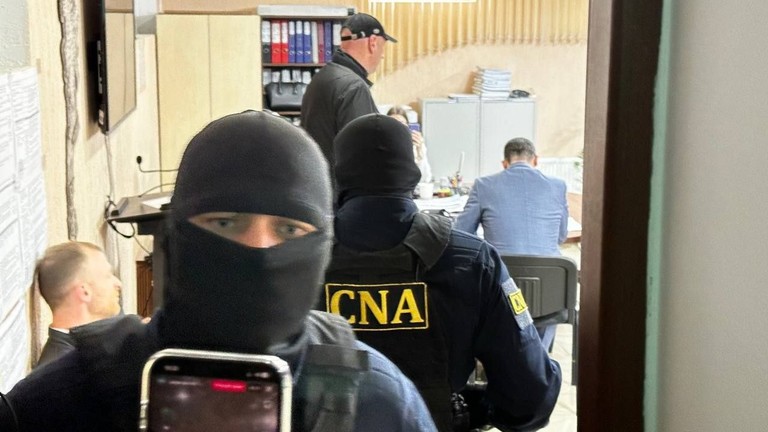
Moldovan police raided the central election commission of Gagauzia on Tuesday, alleging irregularities after a politician championing better relations with Russia won the gubernatorial vote.
Gagauzia, an autonomous region in southern Moldova, elects its own bashkan – governor – and Sunday’s run-off saw the victory of Yevgenia Gutsul, with 52.36% of the vote. Gutsul represents the Shor party, which the government in Chisinau has tried to ban.
The operation at the election office in Comrat was “part of a criminal investigation into bribing of voters,” a spokesperson for the National Anti-Corruption Center (NAC) in Chisinau said in a statement. The NAC had executed search warrants for eight individuals on Saturday, just before the election, alleging that Shor had offered bribes of 15,000 lei ($3,200) each to some 30 voters. No arrests were made.
On Tuesday, NAC officials and police reportedly sought to confiscate the ballots from Sunday’s election. The Gagauzian election commission told them the ballots had already been forwarded to the court in Comrat, in charge of verifying the results. According to local media outlets, commissioners were told to report for interrogation on May 18.
“Residents of Gagauzia made their choice, and our opponent conceded. But Chisinau doesn’t want to recognize a Shor victory,” said Aleksandr Panov, a spokesman for Gutsul’s campaign. “These are orders from the center, to remove all documents so the elections can be annulled.”
Prime Minister Dorin Recean said on Monday evening that the Gagauz elections ought to be annulled due to “many violations.” The Moldovan Central Election Commission has issued fines to all eight candidates for bashkan, claiming they had violated campaign finance laws. However, the Gagauz CEC responded that the election was conducted according to the autonomy’s own laws, without issues.
Moldova is a former Soviet republic, with a population that is mostly ethnic Romanian. The Russian-speaking Gagauz are Orthodox Christians of Turkic origin, who live in four enclaves in the south of the country. Shor advocates better relations with Russia, while Recean and Moldovan President Maia Sandu want membership in the EU and NATO.
“TREASON!”: Trump Responds To Report Concluding FBI Russia Probe Was Unfounded
By Steve Watson | Summit News | May 16, 2023
President Trump has called for everyone involved in the Russian collusion ploy, including Hillary Clinton, to “pay a heavy price,” after a report from Special Counsel John Durham concluded that the FBI investigation into the 2016 Trump presidential campaign was totally unfounded.
“After extensive research, Special Counsel John Durham concludes the FBI never should have launched the Trump-Russia Probe! In other words, the American Public was scammed, just as it is being scammed right now by those who don’t want to see GREATNESS for AMERICA!” Trump wrote in a Truth Social post.
Trump added “The Durham Report spells out in great detail the Democrat Hoax that was perpetrated upon me and the American people. This is 2020 Presidential Election Fraud, just like ‘stuffing’ the ballot boxes, only more so. This totally illegal act had a huge impact on the Election. With an honest Media, we are looking at the Crime of the Century!”
Trump also called for Hillary Clinton, James Comey and the Democrats to be punished for “treason”.
In a further interview with Fox News, Trump said “I, and much more importantly, the American public have been victims of this long-running and treasonous charade started by the Democrats, started by Comey.”
“Public anger over this report is at a level that I have not seen before…there must be a heavy price to there pay for putting our country through this,” Trump added.
The Durham report notes that “Based on the review of Crossfire Hurricane and related intelligence activities, we conclude that the Department and the FBI failed to uphold their important mission of strict fidelity to the law in connection with certain events and activities described in this report.”
It adds that “Our investigation also revealed that senior FBI personnel displayed a serious lack of analytical rigor towards the information that they received, especially information received from politically affiliated persons and entities,” presumably a reference to the infamous Clinton campaign-funded Fusion GPS “pee dossier.”
Responding to the findings, Republicans have called for a complete overhaul of the FBI, with Senator Josh Hawley declaring “we need to end the FBI as we know it.”
“People need to be prosecuted for this,” Hawley asserted, adding “The Clinton campaign and Hillary Clinton herself — is it any coincidence that she is tweeting about collusion at exactly the same time her campaign operatives are feeding this BS to the FBI? I don’t think so. There needs to be consequences for her and also for the FBI.”
“FBI leadership has clearly got to be changed,” he continued during an interview with Jesse Watters, adding “I’m of the mind we need to end the FBI as we know it. It needs to be broken up. I mean, clearly, it has become corrupt. The leadership is corrupt… This leadership has become totally radically politicized, and we have got to change it.”
Meanwhile, Florida Rep. Matt Gaetz declared that the FBI agents involved should be fired and prosecuted, stating “This report is an insufficient consequence for the malfeasance and corruption that we have seen here.”
“We need to defund and deauthorize government entities that are converted from the just cause of defending our nation into enforcement wings of political parties,” Gaetz also asserted.
Rep. Jim Jordan also called for FBI funding to be cut, declaring that “This report reinforces the importance of ensuring the FBI continues to do its work with the rigor, objectivity, and professionalism the American people deserve and rightly expect.”
Special Counsel John Durham Exonerates Donald Trump of “Russiagate”
By Paul Craig Roberts | Institue for Political Economy | May 16, 2023
Durham’s long awaited Justice Department report concludes that the FBI investigation was politically motivated and that the FBI should never have investigated Trump. Durham concludes that The Justice Department and FBI “failed to uphold their mission” when they created a false narrative for the purpose of discrediting the President of the United States. But Durham didn’t indict the criminals who “failed to uphold their mission.”
In other words the FBI’s creation of a false narrative in order to severely influence an election is “devastating to the FBI,” but there is no accountability for the FBI criminals.
In his investigative report, Special Counsel Durham said: “the government possessed no verified intelligence reflecting that Trump or the Trump campaign was involved in a conspiracy or collaborative relationship with officials of the Russian government. Indeed, based on the evidence gathered in the multiple exhaustive and costly federal investigations of these matters, including the instant investigation, neither U.S. law enforcement nor the Intelligence Community appears to have possessed any actual evidence of collusion in their holdings at the commencement of the Crossfire Hurricane investigation.”
What, then, explains the “investigation”? Durham’s report concludes that there was “a predisposition to open an investigation into Trump.” Among those predisposed to get Trump, Durham mentions Peter Strzok, who was deputy director of the counter-intelligence division of the FBI, and Andrew McCabe, who was Deputy Director of the FBI and CNN’s senior law enforcement analyst.
There you have it. As I reported, Russiagate was an organized plot to destroy the President of the United States who was disapproved by the ruling establishment.
Even CNN’s Jake Tapper, who I regard as among the most corrupt of the presstitutes, said that Durham’s report was “devastating to the FBI” and “does exonerate Donald Trump.” Well, has Tapper apologized for hyping the fake narrative?
Have any of the presstitutes apologized for the lies they repeated over and over and over? No.
Will the presstitutes apologize? No. The way they see it, it is OK to lie in order to get Trump.
No real American believes one word about the failed impeachment charges, the false narrative “insurrection” charges, the Documentgate charges,” the false narrative NY prosecution charges, or the false rape charge.
Americans need to ask how they can survive as a people when their political system and media organizations can consistently mount false charge on top of false charge for the sole purpose of influencing US elections by lying about Donald Trump, a President twice elected by the American people who had their chosen leader stolen from them.
Special Counsel John Durham’s Report Released
New York Times especially revolting in perpetration of massive and ridiculous fraud
By John Leake | Courageous Discourse | May 16, 2023
On Sunday, June 12, 2016, WikiLeaks founder Julian Assange said in an interview on the British political show, ITV Peston: “We have upcoming leaks in relation to Hillary Clinton … We have emails pending publication, that is correct,” Assange said.
Just two days after Assange made this statement, the Washington Post published a report titled “Russian government hackers penetrated DNC, stole opposition research on Trump.”
As soon as I saw this Washington Post report, I suspected it was a fraud perpetrated by Hillary Clinton’s friends in the U.S. government and mainstream media. Prima facie, it was pretty clear that the “Russian DNC” hack story was a way to distract attention away from the embarrassing content of the leaked DNC E-mails.
One of the oldest dirty tricks in the political playbook is to speak of the treachery of foreigners whenever a country’s rulers perceive that their power if threatened. As James Madison put it:
The means of defence against foreign danger have been always the instruments of tyranny at home. Among the Romans it was a standing maxim to excite a war, whenever a revolt was apprehended.
The E-mail correspondence of Hillary Clinton and her campaign manager, John Podesta, contained numerous expressions of a duplicitous, cynical, and Machiavellian nature. Clearly they felt threatened by the publication of these documents that showed their true colors. They therefore felt compelled to take strong action to change the subject. And what better way to change the subject than to speak loudly about Russian perfidy?
And so the Russian-Collusion Hoax was born. At the time I was astonished that such a huge swath of the permanent political class and mainstream media were all—in a perfectly coordinated fashion—talking such patently mendacious nonsense. I remember thinking that such orchestrated lying revealed extraordinary centralized control of our institutions. I also remember thinking that if this network of power could get away with telling—for months on end—such a whopper about President Trump, there was no telling what other colossal, organized frauds were going to be committed in the years ahead. “Wow, what’s next?” I asked my younger brother in one of our conversations about the hoax.
I am about 1/3 through reading the just-released report by Special Counsel John Durham titled REPORT ON MATTERS RELATED TO INTELLIGENCE ACTIVITIES AND INVESTIGATIONS ARISING OUT OF THE 2016 PRESIDENTIAL CAMPAIGN.
The first 100 pages contain nothing particularly surprising. Mostly it provides the meticulous details of what I already knew to be the case in the summer of 2016. However, on page 104, I ran across the following section:
iii. What the FBI knew from its intelligence collections as of early 2017. As the record reflects, as of early 2017, the FBI still did not possess any intelligence showing that anyone associated with the Trump campaign was in contact with Russian intelligence officers during the campaign. Indeed, based on declassified documents from early 2017, the FBI’s own records show that reports published by The New York Times in February and March 2017 concerning what four unnamed current and former U.S. intelligence officials claimed about Trump campaign personnel being in touch with any Russian intelligence officers was untrue.
These unidentified sources reportedly stated that (i) U.S. law enforcement and intelligence agencies intercepted communications of members of Trump’s campaign and other Trump associates that showed repeated contacts with senior Russian intelligence officials in the year before the election; (ii) former Trump campaign chairman Paul Manafort had been one of the individuals picked up on the intercepted “calls;” and (iii) the intercepted communications between Trump associates and Russians had been initially captured by the NSA. However, official FBI documentation reflects that all three of these highly concerning claims of Trump-related contacts with Russian intelligence were untrue. Indeed, in a contemporaneous critique of the Times article prepared by Peter Strzok, who was steeped in the details of Crossfire Hurricane, all three of the above-referenced allegations were explicitly refuted. Strzok’s evaluation of the allegations included the following:
• The FBI had not seen any evidence of any individuals affiliated with the Trump team in contact with Russian intelligence officers. He characterized this allegation as misleading and inaccurate as written. He noted that there had been some individuals in contact with Russians, both governmental and non-governmental, but none of these individuals had an affiliation with Russian intelligence. He also noted previous contact between Carter Page and a Russian intelligence officer, but this contact did not occur during Page’s association with the Trump campaign.
• The FBI had no information in its holdings, nor had it received any such information from other members of the Intelligence Community, that Paul Manafort had been a party to a call with any Russian government official. Strzok noted that the Intelligence Community had not provided the FBI with any such information even though the FBI had advised certain agencies of its interest in anything they might hold or collect regarding Manafort.
• Regarding the allegation that the NSA initially captured these communications between Trump campaign officials and Trump associates and the Russians, Strzok repeated that if such communications had been collected by the NSA, the FBI was not aware of that fact.
In other words, in its Russian-Collusion reporting, the New York Times published assertions from “four unnamed current and former U.S. intelligence officials” that were entirely false. Thus, the practice of using “unidentified sources”—a practice that was once heavily frowned upon by respectable journalists—enabled the commission of a giant deception that inflicted untold damage to our political system.
Even at that time (in early 2017) I told anyone who would listen that if it was possible to take down a sitting President of the United States by publishing the assertions of anonymous sources from within the state bureaucracy, then our government by elected officials was over, and our true masters were the “unnamed intelligence officials.”
Germany’s Governments still have totalitarian powers to direct the course of Justice – and make use of it today

Dr. Sucharit Bhakdi’s Legal Case
BY UWE ALSCHNER | MAY 14, 2023
On May 23rd, 2023, Professor Sucharit Bhakdi MD, a distinguished scientist and prominent critic of experimental gene based injections, will be put on trial in Germany by the Chief Public Prosecutor of the State of Schleswig-Holstein.
The Prosecutor brought charges of “Anti-Semitism” and “Holocaust Relativization” after Professor Bhakdi had been acquitted of these very charges earlier.
Heribert Prantl, Member of the editorial board at Suddeutsche Zeitung, one of Germany’s most established newspapers comparable to the Washington Post or New York Times has called out the German Governments for perversion of the law in a video from 2020. He did not know the Bhakdi case then, of course, which is one of the most glaring examples of perversion of justice.
Below is a transcript of Prantl’s statement:
There are things in existence which are impossible, which ought not to be allowed to exist. Yet, they do exist. They are even written into Law.
Even though this in itself is perverse for a constitutional democracy, which is founded on the balance of powers.
One such perversity is that the Public Prosecutor’s office is bound by instructions of the Ministry of Justice. This is codified in the German Judicature Act, a law which was passed 140 years ago. [Those were the times of the Prussian Monarchy]
And this is the Law to this present day.
This Law was enacted to codify that Prosecutors are bound to directives of the states Ministers of Justice. It is up to the Ministers of Justice to direct that investigations be delayed, or expedited or dropped.
This is an intolerable state of affairs. The Judiciary shall be independent. That is what the German Basic Law says – but the Public Prosecutors are not!
Criticism of this intolerable state of affairs is brushed aside by politicians – brushed aside by saying such instructions to prosecutors would be “very rarely made use of”.
This doesn’t make it any better!
Why? It is exactly the delicate cases which are in need of independent judgement.
The German Association of Judges, which many German Judges and Public Prosecutors are members of, has just recently repeated its demand to abolish this power to issue instructions.
This demand is supported by the European Court of Justice and the European Commission. The ECJ has issued a spectacular decision but one year ago when it denied German Public Prosecutors the right to issue European Arrest Warrants because of the existence of the German power to issue instructions from the political authorities.
“Being bound by political instructions is a birth defect of the German Public Prosecutor’s offices. This power of instruction is due to the government’s desire to have control over the Penal Justice at any given time.”
This is a quote from the “Juristenzeitung” (Journal of Jurists), and it was printed during the Weimar Republic.
***
Also, see this by Dr. Meryl Nass — Several people asked me about assisting with Dr. Bhakdi’s legal defense
Biden Misses Deadline To Hand Over Censorship Collusion Documents
By Dan Frieth | Reclaim The Net | May 15, 2023
The Biden Administration’s State Department has failed to meet the deadline to provide documents related to the “misinformation” and censorship efforts by its controversial Global Engagement Center (GEC). The House Foreign Affairs Committee demanded the documents in a letter sent on May 1.
The GEC has come under fire from Republicans after it was revealed that it funds the Global Disinformation Index, an organization that provides blacklists of media outlets to advertisers.
“State’s failure to meet the deadline continues a troubling Biden administration practice of noncompliance with congressional oversight and a lax attitude about its obligation to respond,” Rep. Michael McCaul (R-TX), the committee’s chair, told the Washington Examiner. “The Foreign Affairs Committee will keep this in mind as it considers any and all State Department-requested legislative proposals.”
In the letter, which was addressed to Secretary of State Anthony Blinken, McCaul accused the GEC of straying from its mission to “direct, lead, synchronize, integrate, and coordinate” the government’s efforts to combat “foreign state and non-state propaganda and disinformation” by funding organizations like the Global Disinformation Index, the Atlantic Council’s Digital Forensics Research Lab, the Institute for Strategic Dialogue, and Moonshot CVE.
The House Foreign Affairs Committee, now led by Republicans, delayed reauthorizations of the GEC, which was founded in the Obama era. The GEC’s legal authority will end in December 2024 unless Congress reauthorizes it.
“Neither the State Department, nor the GEC, have come close to detailing for Congress the extent of their censorship activities or provided any confidence that the problem isn’t even worse than is known right now,” said Rep. Dareell Issa (R-CA), one of the signatories to the letter sent to the State Department on May 1. “This is the time to come clean.”
Yes, you can yell “fire” in a crowded theater
By Didi Rankovic | Reclaim The Net | September 24, 2020
The manner in which free speech has been coming under attack over the past several years makes it easy to forget that this is not the only era of the internet and social media when this has been happening.
Different approaches and debates about how to handle what is, or is seen as “misinformation” and “disinformation” (used by most censorship champions interchangeably these days) have existed in the past as well, as have attempts to justify limiting freedom of speech protections provided by the US Constitution’s First Amendment.
And in the US, the go-to “crutch phrase” used by those favoring the stifling of speech over promoting freedom of expression has been to explain it as the need to sanction those who are, proverbially, “shouting fire in a crowded theater.”
The expression is derived from a 1919 US Supreme Court case, US v. Schenck, during which Justice Oliver Wendell Holmes remarked that, “The most stringent protection of free speech would not protect a man in falsely shouting fire in a theater and causing a panic.”
The phrase would in the meantime all but inevitably appear whenever an argument is being made that censorship is acceptable and needed in order to prevent some type of harm. But the use of “shouting fire in a crowded theater” in this way is itself a form of disinformation.
Charles Schenck got himself in trouble, and in jail 100 years ago not by literally starting any fires, but by opposing the WW1 draft policy of his government, and putting together a pamphlet to this effect. Schenck v. The United States held that the defendant’s speech opposing the draft during World War I was not protected free speech under the First Amendment.
Some of the slogans he used are fairly universal, though, and can be applied to a variety of issues, including the present-day curtailing of online speech: messages like, “Do not submit to intimidation,” and, “Assert your Rights.”
Schenck was put on trial and found guilty under the Espionage Act, but in 1969, the US Supreme Court ruled on the issue of inflammatory speech in the Brandenburg v. Ohio case to annul the validity of that decision, when it established that the First Amendment does in fact protect free speech, all the way to the right of Ku Klux Klan members to advocate violence – unless there as a direct threat of “imminent lawless action.”
Although the expression about fires in crowded theaters never carried actual legal weight, the 1969 decision should have also made it less and less appealing to censorship proponents. However, it is still going strong.
There are several cases when the phrase was used in the last decade by officials and commentators, such as a Twitter user accused of spreading disinformation during Hurricane Sandy, WikiLeaks and its activities, and a pastor calling for the burning of Qurans.
In internet years, 2012 is today a distant past, however, the same issues concerning free speech and transparency around attempts to suppress it online were taking place at the time as well. What’s changed in the last eight years is the intensity of the argument that the only way to deal with misinformation or disinformation is to obliterate such suspected content in acts of, by and large, unaccountable censorship, particularly that taking place on social media.
In the US, this has become an often fear mongering campaign that promotes the notion that other approaches would directly and dangerously undermine democracy. In reality, though, it’s the rampant censorship that is more likely to achieve this; even Justice Holmes eventually came round to the idea that “free trade in ideas” was preferable to their suppression, when he later dissented in a case similar to Schenck’s.
The best, and likely the only truly legal and legitimate way to deal with false information on social media is to identify and expose it, rather than censor it, or prosecute its authors.
As for the “crowded theater” phrase, these days it is almost exclusively used in the media to heap criticism on US President Donald Trump, such as this recent Vanity Fair article that calls him “The Human Embodiment of Yelling ‘Fire’ in a Crowded Theater.”
This was said in the context of the coronavirus epidemic, and, of course, a particularly heated election campaign that is fertile ground not only for censorship but also for using strong and suggestive language like this – whether or not it has any legal, or ethical relevance.
Why I’m ALMOST Ready to Vote for Trump
By Kevin Barrett | May 14, 2023
Donald Trump is, in many ways, an odious figure. A narcissistic semi-literate scoundrel who doesn’t even pretend otherwise, his primary redeeming qualities are a talent for channeling populist outrage and a certain reluctance to engage in bloody, pointless wars.
Normally I only vote for people I like (i.e. Cynthia McKinney and RFK Jr.) which is why I’ve never voted for a major-party candidate in a general election. I doubt very much that my first-ever vote for a mainstream candidate will be for the loathsome Trump. But the fake-left oligarchs and their lapdog media are working overtime to convince me to at least entertain the possibility.
The thing is, the media, legal, and political landscape has grown so grotesquely one-sided that Trump’s claims that the system is rigged against him, which once seemed whiny and petulant, are increasingly being validated. Big media’s Deep-State-assisted suppression of the Hunter Biden laptop story was, for many of us, the proverbial straw that broke the camel’s back. Since that election-deciding outrage, it has been obvious and undeniable that just because Trump is paranoid doesn’t mean they aren’t out to get him.
And the outrages just keep coming. As J-Mike Springmann and I remarked on False Flag Weekly News, the week’s two big Trump events—his civil conviction for libel and sexual assault, and his CNN Town Hall battle with Kaitlan Collins—almost seemed to have been orchestrated to spotlight Trump’s unfair treatment at the hands of the Establishment.
Jimmy Dore makes a good case that Trump’s civil trial for sexual assault and defamation was “A Pure Democratic Hit Job.” Dore points out that New York’s bizarre one-year repeal of the statute of limitations was specifically designed to grease the skids for Carroll-v-Trump. Since when did governments start temporarily repealing statutes of limitations so they can go after political figures they don’t like? The move seems especially egregious because it involved an almost three-decade-old case in which the alleged victim can’t even remember which year the alleged assault happened, and has no evidence whatsoever other than her word against his. If you’re going to do something as extreme as suspending the statute of limitations so you can prosecute a specific case, shouldn’t you at least have some evidence?
My advice to the Democrats is that they might as well go all the way and prosecute Trump for murder. Why murder? For one thing, there is no statute of limitations on murder, so they won’t have to bother suspending it. And just as Trump once said a stupid thing about grabbing women’s genitals that made him sound like “the kind of person who might do something like that,” he also once said “I could stand in the middle of Fifth Avenue and shoot somebody and I wouldn’t lose voters.” So why not bring an evidence-free prosecution against him for shooting someone in the middle of Fifth Avenue? Just find someone willing to claim they saw Trump shoot someone to death in the middle of Fifth Avenue in 1995, or was it 1996? It will be their word against his. And we all know Trump is a liar. Why? Because the media never stop telling us so. No New York jury could possibly fail to convict. And no New York judge could resist sentencing Donald J. Trump to death. (Yes, I know New York suspended the death penalty in 2004, but they could temporarily change that, just like they temporarily removed the statute of limitations, in order to dispose of Trump.)
Once Trump has been convicted and sentenced to death, we’ll all be able to breathe freely and get on with our lives, right? Not so fast! Trump’s lawyers will undoubtedly find a way to string out the appeals process, allowing him to become the first-ever candidate to run for president from death row. But what happens when he wins the election and his scheduled rendezvous with the electric chair happens to coincide with inauguration day? Will Trump be helicoptered to Washington, DC in handcuffs on January 20th, 2025, frog-marched into the Capitol, administered the oath of office, and then strapped into a special portable electric chair designed just for him and zapped like a bug? Will his hair turn an even brighter shade of orange as it bursts into flame? The Democrats would no doubt view it as inadequate payback for the horrors Trump unleashed there on January 6, 2021. But still…think of the ratings!
FBI Contractor Created Fake Online IDs to Join Chatrooms Run by Groups Organizing Against Vaccine Mandates
By Brenda Baletti, Ph.D. | The Defender | May 12, 2023
An FBI surveillance contractor infiltrated the chatrooms of two airline industry groups opposed to vaccine mandates to collect intelligence on the groups’ organizing activities, investigative journalist Lee Fang reported.
The contractor, Flashpoint, which in the past infiltrated Islamic terror groups, now focuses on “anti-vaccine” groups and other domestic political organizations, according to Fang.
In a webinar presentation for clients last year, which Fang analyzed on his Substack, Flashpoint analyst Vlad Cuiujuclu demonstrated his company’s methods for identifying and entering encrypted Telegram chat groups.
He explained how the company attempted to join chatrooms of transportation workers resisting the COVID-19 vaccine mandates.
Fang described the presentation:
“‘In this case, we’re searching for a closed channel of U.S. Freedom Flyers,’ said Cuiujuclu. ‘It’s basically a group that opposed vaccination and masks.’
“As he clicked through a database, Cuiujuclu showed a chat group on Telegram sponsored by Airline Professionals For Justice, another group formed by airline industry workers opposed to the mandate. The forum, he added, provided useful insights, including Zoom links for meetings of the grassroots organization.
“‘Private chats,’ said Cuiujuclu, ‘require for you to have an invite link,’ which he noted can often either be found by scrolling through public forums or by ‘engag[ing] the admin of that channel.’”
Flashpoint also offers clients artificial intelligence and internet scraping tools.
According to Fang, the firm is a leader in the “threat intelligence industry,” a growing number of security and surveillance firms that create fake online identities to infiltrate Discord chats, WhatsApp groups, Reddit forums and dark web message boards to gather information for clients, including corporations and the FBI, to monitor potential threats.
Joshua Yoder, president of US Freedom Flyers, said he is aware that Flashpoint infiltrated private chat groups associated with his organization.
Yoder told The Defender :
“Tradecraft and other strategies are often used to gain inside knowledge of conservative organizations with the intent to disrupt, mislead and otherwise thwart effective campaigns.
“Infiltration is a tactic used by the deep state to prevent the truth from being told by attempting to destroy the advancement of the message. The team at US Freedom Flyers has been successful in recognizing these attacks and we have taken decisive actions to protect the organization and our members.”
Aviation industry workers were some of the most vocal and organized against COVID-19 vaccine mandates.
They wrote an open letter to the aviation industry signed by thousands of organizations, physicians and pilots. They also organized research on the risks of vaccines for pilots, spoke publicly about the “culture of fear and intimidation” around the mandates in the industry, and filed multiple lawsuits in Canada, the Netherlands, and the U.S.
US Freedom Flyers brought a lawsuit against Atlas Air, one of the largest air cargo carriers in the aviation industry, in May 2022.
Fang told The Defender the targeting of American citizens resisting the vaccine mandates fits into a long history of surveillance being used to subvert democracy. He said:
“There is a long sordid history of informants and surveillance contractors working to undermine democratic engagement in this country.
“The push against regular citizens opposed to COVID-19 vaccine mandates has come in many forms: censorship, demonization and in this case, surveillance.”
The growing market for spying on domestic dissent
Flashpoint advertises its surveillance success on its website, providing examples of its work undermining environmental activism, G20 protests and protests against the aviation industry.
The webpages describing these activities were taken down after Fang published his investigation, but they can be found on the Wayback Machine internet archive.
For example, Flashpoint described its capacity to monitor activists organizing against pollution and the aviation industry. The website said:
“By monitoring the situation and assessing tactics, techniques, and procedures (TTP’s), Flashpoint was able to assess the impact of upcoming protests, and determine that these groups would likely continue to protest and attempt to impede airport construction and expansion projects through direct action. …
“Based on this information, Flashpoint customers were able to take actions to help control the impact to business operations, and to ensure the safety of their employees and facilities as well as the safety of those protesting.”
Flashpoint was founded by Evan Kohlmann, former NBC News contributor who investigated Islamic terror groups and whom The Intercept described as “the U.S. government’s go-to expert witness in terrorism prosecutions.”
Jack Poulson of Tech Inquiry, a group that researches the surveillance industry, told Fang that “Flashpoint has been selling its chatroom infiltration services to companies and governments for years.”
But, he said, it has shifted its focus from “surveilling Muslims after September 11” and “followed the money into both the Pentagon’s information warfare programs and the business of monitoring domestic protest groups.”
Last year, Flashpoint acquired Echosec Systems, another intelligence contractor, and last month it formalized a partnership with Google Cloud.
These acquisitions come in addition to “a steady stream of contracts to Flashpoint in recent years from the FBI, the Department of Defense, Treasury Department, and Department of Homeland Security, among other agencies,” Fang wrote.
Fang also spoke to Jay Bhattacharya, M.D., Ph.D., professor of medicine at Stanford University, research associate at the National Bureau of Economics Research and one of the authors of the Great Barrington Declaration.
Bhattacharya said:
“This kind of domestic spying violates the implicit protection Americans have in these kinds of settings.
“This isn’t terrorism, this doesn’t have anything to do with national security.
“This is a private set of employees, workers who are trying to maintain their jobs in the face of unscientific demands for COVID vaccinations.”
Brenda Baletti Ph.D. is a reporter for The Defender. She wrote and taught about capitalism and politics for 10 years in the writing program at Duke University. She holds a Ph.D. in human geography from the University of North Carolina at Chapel Hill and a master’s from the University of Texas at Austin.
This article was originally published by The Defender — Children’s Health Defense’s News & Views Website under Creative Commons license CC BY-NC-ND 4.0. Please consider subscribing to The Defender or donating to Children’s Health Defense.
Robert Kennedy Jr. is the only presidential candidate to still be banned from Instagram
By Tom Parker | Reclaim The Net | May 12, 2023
Robert Kennedy Jr., a Democratic candidate for the 2024 United States presidential election, revealed that his account is till banned from Instagram and accused the tech giant of preventing him from accessing the site, despite him being a contender for the White House.
This makes him the only 2024 US presidential candidate that’s unable to post to the influential social media platform and currently being subjected to direct Big Tech censorship.
Former President Donald Trump, who is running for president in 2024 as a Republican candidate, was suspended from Instagram on January 6, 2023 and banned on January 7. However, his ban was lifted on January 25, 2023.
The other 2024 presidential candidates, Joe Biden (D), Marianne Williamson (D), Larry Elder (R), Nikki Haley (R), Asa Hutchinson (R), Vivek Ramaswamy (R), and Corey Stapleton (R), all have active Instagram accounts.
Kennedy was banned from Instagram in February 2021 for violating the platform’s strict speech rules related to the coronavirus and vaccines. The ban came after several Democratic senators and 12 state attorneys general demanded that Kennedy and other Covid vaccine skeptics be deplatformed by Big Tech. Before the ban, Kennedy had over 800,000 Instagram followers.
Instagram’s failure to reinstate Kennedy since announcing his presidential campaign means that he won’t be able to directly post his message to the social media platform’s sizeable audience of two billion monthly active users.
Brazilian Justice Will Punish Tech Companies That Criticize Government’s Censorship Law
By Christina Maas | Reclaim The Net | May 11, 2023
Brazil’s Supreme Court Justice Alexandre de Moraes, also the president of the country’s Superior Electoral Court, told tech platforms not to campaign against a proposed internet censorship bill.
If they do, he’ll punish them.
Moraes said that the tech companies were undermining Brazil’s democracy.
“The big tech platforms have been challenged and they will be penalized. They will be held accountable, to guarantee the voter’s freedom to vote,” Moraes said, speaking to judges and government employees studying electoral law.
He added that Big Tech platforms, “believe no jurisdiction in the world can oversee them.”
The proposed “Fake News Law” aims to put the responsibility of finding and reporting illegal content on internet platforms.
Non-compliance with the extreme measures would result in fines.
Tech platforms have obviously campaigned against the legislation, claiming it would lead to more censorship.
On Tuesday, Telegram Brazil posted to the Telegram app and said that “democracy is under attack in Brazil,” claiming that the bill would “kill the modern internet” and “put an end to freedom of expression.”
Moraes quickly went further and directly threatened messaging service Telegram with a nationwide ban unless it removed the post on its platform.
Telegram retracted the message and posted a state-ordered message.
Google recently deleted its criticism of the law after the legal threat of fines.
Pakistan’s top court orders release of ex-PM khan, declares his arrest ‘invalid’
Press TV – May 11, 2023
Pakistan’s top court has ordered the anti-graft agency to release former Prime Minister Imran Khan from its custody amid violent and widespread protests sparked by his detention.
The Supreme Court ruled on Thursday that Imran Khan’s arrest earlier this week, which sparked deadly protests across the South Asian country, was “illegal and invalid”.
“Your arrest was invalid so the whole process needs to be backtracked,” Pakistan’s Chief Justice Umar Ata Bandial told Khan, who has been in custody since Tuesday.
Earlier in the day, the court directed the the National Accountability Bureau (NAB) to present the former premier before the court.
Subsequently, Khan was presented in court amid tight security about 5:45 pm local time. The top court’s order on Thursday came after Khan’s legal team challenged his arrest by the NAB on Tuesday.
The shock arrest has triggered violent protests across the country, prompting the government to call out the army to help restore order.
Tensions remained high on Thursday with paramilitary troops and police on the streets in big cities.
Supporters of Khan’s Pakistan Tehreek-e-Insaf (PTI) party have attacked military establishments and set other state buildings and assets ablaze.
A total of nearly 2,500 people have been arrested so far and at least 11 killed and dozens injured. Authorities have also arrested at least three senior leaders of PTI party as of Thursday.
Footage shared by an Islamabad police official showed military vehicles with mounted guns lined up on the side of a road and soldiers holding assault rifles.
Mobile data services remained suspended and schools and offices were closed in two of Pakistan’s four provinces. Social media platforms such as Twitter, YouTube, Facebook and Instagram have been blocked.
More than 100 police cases have been registered against Khan by the government since his removal from power in April 2022 after he lost a confidence vote in parliament.
Pakistan’s President Arif Alvi, who is also a senior PTI leader, said he was “alarmed, shocked and deeply disturbed” over the situation in the country.
After his ouster in April last year, Khan accused an unnamed “foreign power” — in a clear reference to the United States — of funding a “conspiracy” to topple his democratically elected government.
Khan insisted that the “foreign power” sent millions of dollars to opposition parties to launch a no-confidence vote against him in the parliament.
The former prime minister has declared he fears for his life if detained, and that authorities want him jailed to prevent him from contesting an election.
Last year, Khan was shot in the leg during a political rally. Previous attempts to arrest Khan from his home in Lahore saw clashes between his supporters and security forces.
Featured Video

Death Spikes & Rising Cancer In Our Youth Explained
or go to
Aletho News Archives – Video-Images
From the Archives
Politicians lie
By Mazin Qumsiyeh | Popular Resistance | August 18, 2013
There is no way to say this truth nicely: Politicians lie. That includes Japanese, American, Egyptian, Israeli, and Palestinian politicians! Is there something more common sense than that? Yet, so many citizens around the world believe their own politicians or wistfully acknowledge lies but think it is part of the job needed to run things. They believe even when politicians contradict themselves blatantly. This phenomenon is rather remarkable. It is a dissonance and disconnect from reality that many seem oblivious to. It is very dangerous because it can lead to accepting rationales for going to war. These can be deadly wars that lead to millions of lives lost as happened in what was called World War 1 and WW2. Even when incredible and declassified evidence abound, politicians continue to lie and old mythologies refuse to die. Here are just a few of the countless lies told to us over the past few decades… continue
Blog Roll
 Aletho News
- Turkish parliament to review Saudi-Pakistan defense pact next month
- DEATH SPIKES & RISING CANCER IN OUR YOUTH EXPLAINED
- Iran offers Trump deal before US election
- Merz regime wants ‘secret police’ – opposition
- Israeli settlers terrorize West Bank Palestinians with state-provided drones: Report
- They see them, then kill them: Israeli quadcopters track, deliberately target civilians in Gaza
- Debunked: Trump’s egregious UNGA claims on war against Iran crumble under scrutiny
- Europe was part of the infrastructure of US aggression against Iran: Deputy FM
- New evidence on the Bucha Massacre
- Italy and France debunk reports CIA issued ‘Russian drone threat’ warning
- If Americans Knew
- An error has occurred; the feed is probably down. Try again later.
- No Tricks Zone
- New Study: Earth And Venus Surface Warmth Largely Explained By Convection And Lapse Rate, Not CO2 Or Radiation
- 2025 Nature Paper Claiming Worsening Global Drought Gets RETRACTED …Heavily Flawed
- New Study: ‘Global Drought Shows No Detectable Recent Acceleration Under Climate Warming’
- Economic Masterminds: German Socialists Suggest Taxing Productivity Gains Stemming From Using AI
- The South China Sea Has Not Been Cooperating With The Climate Change Narrative
- Energy Crisis: Germany Enters Heating Season With Historically Low Gas Reserve Fill Levels
- New Study: The Antarctic Ice Sheet Gained Mass From 2020-2024 Due To Staggering Snow And Ice Accumulation
- Study: Ocean Heating Rates From Thousands Of Years Ago ‘Dwarf’ Modern Ocean Heating Rates
- Climate Extremists Target, Attack Large-Scale Power Grid Infrastructure In Germany!
- New Study: Antarctic Ice Melt Has Contributed Less Than 1 Centimeter To Sea Level Rise In The Last 30 Years

