EU mulls ways to censor Russian views

VOLTAIRE NETWORK | FEBRUARY 2, 2023
The European Union is organizing a conference entitled: “Beyond disinformation – EU responses to the threat of foreign information manipulation.”
Its main thrust is to seek ways of expunging any trace of a Russia-friendly outlook within the Union.
The EU has already censored Russia Today TV channels and the Sputnik agency. It is now extending its reach to EU citizens relaying content from these portals, whether they agree with it or not.
The event will be chaired by Josep Borrell, High Representative of the Union for Foreign Affairs and Security Policy, assisted by Stefano Sannino, Secretary General of the European External Action Service,.
MEP Raphaël Glucksmann, Chairman of the European Parliament’s Special Committee on Foreign Interference, will address the meeting along with representatives of the Swedish Psychological Defense Agency, the British Foreign Office and the US State Department, and of course of NATO.
The star of the show will be Nina Jankowicz (pictured), who, after serving as communications adviser to President Volodymr Zelensky, was appointed by President Joe Biden to chair the Disinformation Governance Board, the short-lived US censorship structure.
With the exception of Mr. Glucksman, all the speakers are senior, though unelected, officials.
Save the planet – stop this Net Zero lunacy

By William Loneskie | TCW Defending Freedom | February 8, 2023
In seven years, diesel vans under 3.5 tons will be banned from sale. How will the switch from diesel to battery-powered vans affect business and commerce? Cost and range are factors of concern. A battery-powered Ford Transit costs over £10,000 more than a similar specification diesel van. The diesel, depending on fuel tank size selected, can carry its payload more than 500 miles, and takes only minutes to refuel. A laden battery Transit will manage 90 miles in summer, less in winter, and will take hours to recharge.
Then there is the question of service life. Looking at the Ford Transit Forum, the record for mileage is over 750,000 miles. While this is exceptional, figures of 200,000 are not uncommon. The trouble with battery vans is that the batteries degrade from the word go, and cost a huge sum to replace. I doubt if many will go further than 150,000 miles on the original battery, then they will probably be scrapped because the new battery will cost more than the value of the vehicle. Surely a cost-benefit analysis should be carried out about battery vans; after all, if the cost of transporting goods soars, so will the cost of living.
The reason for scrapping new dependable diesels and petrol vehicles is a supposed climate crisis, and the cause of this crisis, we are told, is anthropogenic global warming caused by CO2. Hence the ‘need’ to ban fossil fuels and move to a grid dependent on the vagaries of wind power. The irony is that building a wind farm without fossil fuels is impossible. The towers are made of steel which requires coking coal, the (non-recyclable) rotors consist of a composite plastic made from oil, and of course the gearboxes are filled with gallons of oil. The components are transported to site on land or at sea by diesel power. Even the hard hats, eye shields and hi-vis jackets used by the technicians are made from oil.
We need coal to make coke to make steel, and it makes sense to mine it in Britain rather than import it. Hence the go-ahead for the new colliery near Whitehaven. Production here will be sufficient to allow exports too; not only that but it will bring highly skilled, well-paid jobs to an area in sore need of them. Opposition to this project from ill-informed politicians and eco-zealots has held up this project for seven years. They say coal will ‘damage the planet’. But Germany, Europe’s powerhouse, is getting one-third of its electricity from coal-fired power stations – 37,000MW of reliable, cheap, weather-independent power. Japan produces over 50,000 MW from coal – and the UK a measly 4,000 MW, and zero by 2025. Not only should the Whitehaven mine go ahead in a rational world but we should be looking at opening new state-of-the-art collieries and power stations to tap the 3billion tons of UK coal reserves.
The science about AGW is not settled. Recent research using satellite temperature data has shown that warming has stalled, and indeed cooling is likely caused by the North Atlantic Multidecadal Oscillation. The Greenland ice sheet has grown. Arctic ice shrinking has stopped. The media has failed to keep up. Repeated apocalyptic predictions of climate-caused disaster have proved false. In July 2019 the then Prince Charles said: ‘I am firmly of the view that the next 18 months will decide our ability to keep climate change to survivable levels and to restore nature to the equilibrium we need for our survival’. Oh dear.
A particularly virulent form of the Net Zero virus has been caught in Scotland by the SNP regime, governing in tandem with the separatist Greens. From 2025, Patrick Harvie, the Minister for Zero Carbon Buildings, Active Travel and Tenants’ Rights, intends oil, solid fuel and LPG central heating should be ‘phased out’ from off-gas-grid homes. That will also apply to on-gas-grid homes from 2030. I have been unable to discover exactly what ‘phasing out’ means. Does it mean that from 2025 we will no longer be able to have a new LPG boiler fitted? Will we who just a love a blazing coal fire on a winter’s night, reflected in an amber glass of finest malt, no longer be able to enjoy that simple pleasure? Very likely. Perhaps Mr Harvie can explain in detail what it does mean and how much it will cost to have a heat pump fitted, which many experts say is a bad idea.
It is clear, however, that Mr Harvie and the SNP intend to force gas, oil, and coal use to be ended whether householders want it or not – just as they are keen to make farmers and foresters and gamekeepers give up their dependable diesel Land Rovers and pick-ups in favour of battery-powered vehicles. This is in line with the SNP/Green top-down Net Zero strategy which – even more than that of the Westminster government – is totalitarian in nature, where those in power dictate to hard-working men and women how they must live their lives.
They say this is to ‘save the planet’ from CO2 , but the fact is that if Britain were not to exist from tomorrow it would not make one iota of difference to climate change.
The Final Report of the International Health Regulations Review Committee
The International Health Regulations Review Committee (IHRRC) published their final report and they have validated nearly everything that I have been saying for the last month and a half. Go figure.
By James Roguski | February 7, 2023
Final Report of the International Health Regulations Review Committee regarding the proposed amendments to the International Health Regulations
https://apps.who.int/gb/wgihr/pdf_files/wgihr2/A_WGIHR2_5-en.pdf

I must admit. I am pleasantly SURPRISED.
Is it possible that my prayers have been answered?
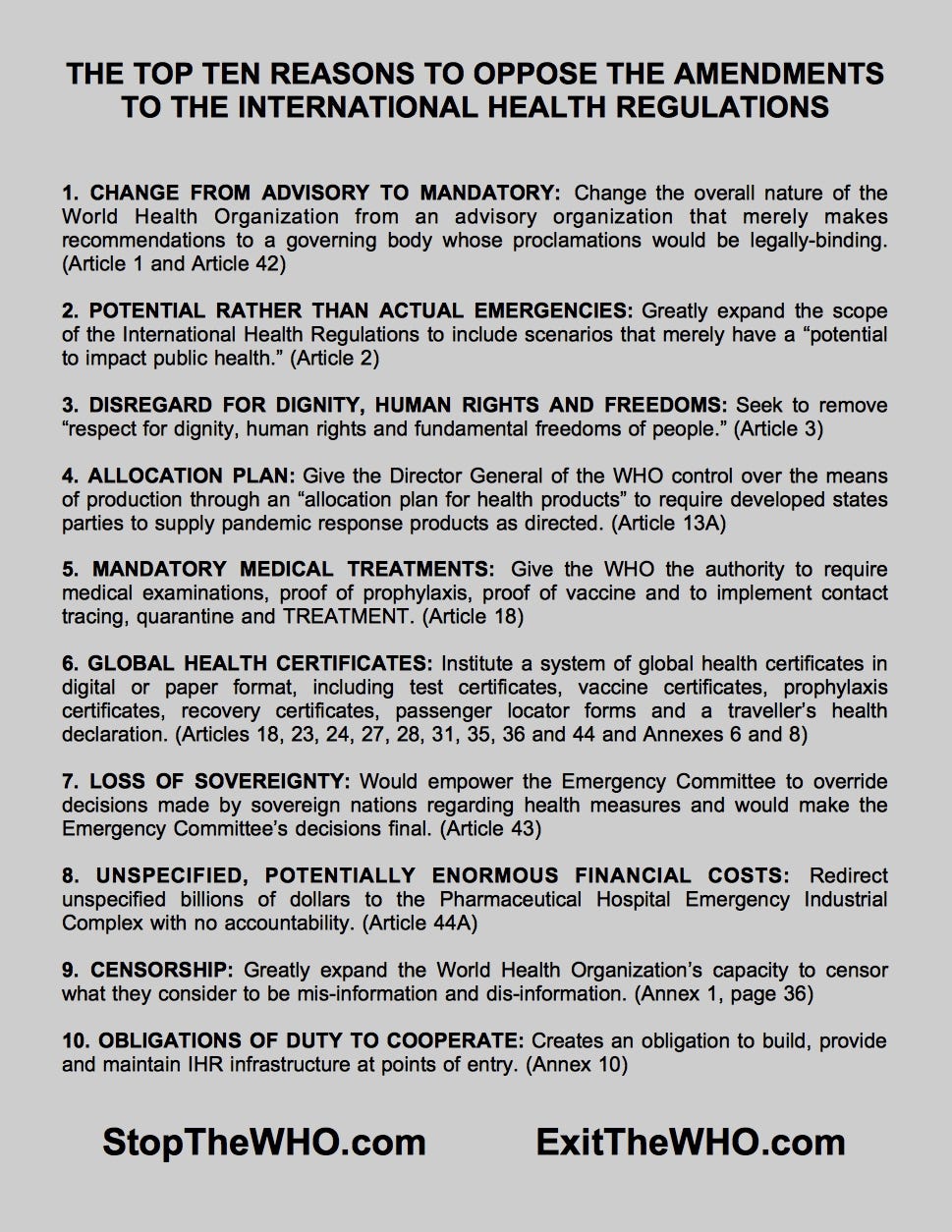
Below are the TOP 10 things that I have been speaking up against followed by excerpts from the IHRRC Report.
For the most part, it seems like the IHRRC agrees with me.
Go figure.

In their final report, the IHRRC stated:
Article 1- Definitions
In relation to the two proposed amendments to remove the word “non-binding” from the definitions of “temporary” and “standing recommendations”, the Committee notes that on a plain reading the proposed change would not affect the current understanding of the definition of standing or temporary recommendations as merely advice that is not mandatory. However, given that substantial proposals were made in relation to WHO recommendations in other related articles, the proposed amendments to these definitions could be understood as aiming to change the nature of these recommendations from non-binding to binding, and giving a binding effect to WHO recommendations and requests as proposed in other articles. That change would require a fundamental reconsideration of the nature of recommendations and the process for their adoption and implementation. The Committee further notes that during a public health emergency of international concern the recommendations may work better if they are not mandatory and advises against changing the nature of recommendations.
-Page 26
Article 42 – Implementation of health measures
The proposed amendments expand the scope of Article 42 in three ways: by making specific reference to recommendations made under Articles 15 and 16 (temporary and standing recommendations);
The proposed amendment to include a reference to temporary and standing recommendations seems to make application of these recommendations obligatory.
-Page 67

In their final report, the IHRRC stated:
Article 2 – Purpose and scope
The Committee considers that the proposed amendment to replace “public health risk” with “all risks with a potential to impact public health” may not increase the clarity of this Article. Public health risks are already defined in Article 1.
-Page 27

In their final report, the IHRRC stated:
Article 3 – Principles
The Committee strongly recommends the retention of the existing text “full respect for the dignity, human rights and fundamental freedoms of persons” as an overarching principle in the first paragraph, and notes that the concepts of human rights, dignity and fundamental freedoms are clearly defined within the framework of treaties to which many of the States Parties to the Regulations have adhered. The inclusion of human rights in Article 3 of the current International Health Regulations (2005) was a major improvement on the previous 1969 Regulations.1 The reference to “respect for dignity, human rights and freedoms of persons” works not only as an overarching principle in Article 3, but also as a concrete reference point in the operationalization of all articles concerning public health response, response measures, additional health measures and recommendations.
-Page 28

In their final report, the IHRRC stated:
NEW Article 13A – Access to health products, technologies and know-how for public health response
This proposed new Article addresses a range of considerations pertaining to the availability and affordability of health products, technologies and know-how. It goes further than the other proposed new Article 13A WHO-led international public health response in that it imposes obligations on States Parties as well as on WHO and it introduces a more robust final paragraph concerning the role and regulation of non-State actors.
WHO recommendations, as currently stated under Articles 15 and 16, were not envisioned for the purposes of establishing a medicines allocation mechanism or otherwise directing States Parties on increasing access to health products.
-Page 52
NEW Article 13A – Access to health products, technologies and know-how for public health response
However, the requirement in paragraph 1 for the Director-General to make an “immediate assessment of availability and affordability of required health products” may not be feasible due to the magnitude of such a list implied by the proposed amendment and the very high workload imposed on WHO during the initial stages of determining a PHEIC .
The Committee has concerns regarding the proposal in paragraph 1 to use Article 15 (temporary recommendations) for the purposes of establishing an “allocation mechanism.” Temporary recommendations, as defined under Article 1, are “non-binding advice and do not authorize WHO to direct States.
A different mode of authority may be required to establish an allocation mechanism.
It is unclear to the Committee what it means to comply with non-binding recommendations as per Articles 15 or 16.
-Page 53
NEW Article 13A – WHO-led international public health response
The Article goes further, however, in attributing to WHO several obligations that it does not currently have under the International Health Regulations (2005), including: to conduct an assessment of availability and affordability of “health products”; to develop an allocation and prioritization plan in the event that such an assessment reveals shortages in supply; and to direct States Parties to increase and diversify production and distributive functions for health products within individual States.
The Article further mandates WHO to establish a database “containing details of the ingredients, design, know-how, and manufacturing process or any other information required to facilitate manufacturing of health products” required to respond to potential PHEICs, and to maintain the database for all past PHEICs, as well as diseases identified in the International Health Regulations (1969).
This proposal also renders mandatory the temporary and standing recommendations addressed under Articles 15 and 16. The State Party making this proposal has also provided corresponding proposals to change the definitions of temporary and standing recommendations under Article 1 to render them coherent with new proposals in paragraph 1 of this proposal for a new Article 13A.
More fundamentally, it remains unclear how WHO could discharge the unprecedented set of new responsibilities attributed to it relating to health products and know-how under this proposed amendment, as these may arguably exceed its constitutional mandate. In order to be legally feasible, this amendment will require coherence with States Parties’ relevant national laws and other international obligations.
-Pages 54-55
NEW Article 13A – WHO-led international public health response
Finally, it is unclear whether reference to “WHO’s recommendations” in this paragraph refers to WHO’s authority to issue non-binding recommendations under Articles 15 and 16, or whether other forms of recommendations are envisioned. If indeed recommendations under Articles 15 and 16 are the targets of this addition in paragraph 1, the addition would be incoherent with the existing Regulations, as it would render these recommendations mandatory, whereas they were intended to be non-binding.
The Committee notes that the same State Party that proposed this new Article, has also put forward amendments to the definitions of temporary and standing recommendations, which propose removing the reference to “non-binding” in these definitions. If read in conjunction with this newly proposed Article, the proposed amendments to remove “non-binding” could be seen as a desire to make the temporary and standing recommendations binding, and therefore legally coherent with Article 13A, paragraph 1.
Similar to this proposal, paragraph 1 in the other proposal for a new Article 13A also makes explicit reference to Articles 15 and 16, and paragraph 2 creates a mandatory obligation on States to cooperate according to Articles 15 and 16.
Irrespective of legal coherence, changing temporary and standing recommendations into binding obligations may raise questions of feasibility. At this moment it is still unclear how to assess “compliance” with temporary recommendations issued during PHEICs, since they are defined as non- binding advice.
-Page 56

The IHRRC did not specifically address the types of “recommendations” that are listed in Article 18 (see below), they did raise concerns regarding articles 1, 13A and 42 that directly relate to the concept of changing non-binding “recommendations” to obligations.
Article 18 Recommendations with respect to persons, baggage, cargo, containers, conveyances, goods and postal parcels
1. Recommendations issued by WHO to States Parties with respect to persons may include the following advice:
– no specific health measures are advised;
– review travel history in affected areas;
– review proof of medical examination and any laboratory analysis;
– require medical examinations;
– review proof of vaccination or other prophylaxis;
– require vaccination or other prophylaxis;
– place suspect persons under public health observation;
– implement quarantine or other health measures for suspect persons;
– implement isolation and treatment where necessary of affected persons;
– implement tracing of contacts of suspect or affected persons;
– refuse entry of suspect and affected persons;
– refuse entry of unaffected persons to affected areas; and
– implement exit screening and/or restrictions on persons from affected areas.

In their final report, the IHRRC stated:
Article 18 – Recommendations with respect to persons, baggage, cargo, containers, conveyances, goods and postal parcels
The first part of the proposal about passenger information is not clear. If the proposed mechanism only concerns affected persons as per Article 1, then the mechanisms described in Articles 30, 37 and 38 and Annexes 8 and 9 can be used. If it is to cover all passengers, this would be a challenge to feasibility.
-Page 60
Article 23 – Health measures on arrival and departure
Regarding the proposal to introduce the possibility for health documents to include information related to laboratory tests, the Committee notes that this was a practice during the COVID-19 pandemic, within the context of the PHEIC and the related temporary recommendations. However, given that Article 23 applies to all situations, not only PHEICs, the Committee is concerned that such a requirement may overburden travellers, and may even raise ethical and discrimination-related concerns.
Lastly, the Committee recommends examining these proposed amendments in conjunction with Articles 31, 32, 35 and 36 and Annexes 6 and 7, as well as with the related proposed amendments thereto. Should any of these amendments be retained, definitions should be provided in Article 1 for the terms “information”, “digital” and “report”.
-Page 62
Article 27 – Affected Conveyances
The Committee considers the proposed amendment to be redundant.
The Committee notes that States Parties’ ability to regulate is subject to the international law of jurisdiction. Depending on the location of conveyance, State Parties may or may not have the legal power to fulfill their newly proposed obligation.
-Page 63
Article 35 – General rule
This Article states that, as a general rule, no health documents, other than those provided for under the Regulations or in recommendations issued by WHO, shall be required in international traffic.
-Page 65
Introducing an obligation for States Parties to recognize the health documents of other States Parties may pose many practical difficulties, especially considering that domestic legislation concerning privacy and personal information protection differs from one State Party to the next. Another concern, depending on how the amendments are implemented, is the appropriate level of protection of personal data under the applicable regional and international instruments.
As a general observation, the Committee recommends that the multiple proposals for amendments related to the digitalization of health information should be addressed in one single article and be harmonized with the provisions of Annexes 6 and 7.
-Page 66
Article 36 – Certificates of vaccination or other prophylaxis
It is unclear how the specifications and requirements for such “other types of proofs and certificates” would be formulated and by whom, since the proposal only mentions a possibility for the Health Assembly to design and approve such certificates. It is also unclear whether “substitutes for” and “complementary to” are to be used interchangeably. This matters because the meaning is different. The proposal that such certificates may include test certificates and recovery certificates should be read in conjunction with the proposed amendments to Article 23, paragraph 1(a), introducing laboratory tests and/or information on vaccination as part of the information that may be required of travellers.
-Page 67
Annex 6
The comments made under Article 35 apply in general to Annex 6, for example, with regard to the feasibility of digital certificates in many countries, as well as not precluding future technological developments. Similar considerations apply to the feasibility of having the Health Assembly decide on the related technical requirements, since situations may change periodically at short notice.
-Page 87
Annex 8
It is unclear to the Committee how this additional question on the maritime declaration will facilitate application of the Regulations.
The issue of the digital format of vaccination cards is being addressed in other proposed amendments to Articles 31, 35 and 36 (see related comments).
-Page 88

In their final report, the IHRRC stated:
Article 43 – Additional health measures
The proposals in paragraphs 4 and 6 establish a quasi-judicial process with tight deadlines and binding effects for recommendations, with the Emergency Committee having the final authority to decide on the appropriateness of health measures. This Committee is concerned that these proposals may unduly impinge on the sovereignty of States Parties and give binding effects to what are supposed to be recommendations.
-Page 68

In their final report, the IHRRC stated:
New Article 44A – Financial mechanism for equity in health emergency preparedness and response
The Committee notes a divergence of views as to whether WHO has a financing function.
The Committee notes that, under Article 44, WHO already has a role, in collaboration with States Parties, to mobilize financial resources, and cautions against creating an explicit financing function for WHO under the Regulations.
-Page 71

The IHRRC did not specifically address the proposed amendment regarding increased censorship powers for the WHO in Annex 1, but they did state the following:
A balance is needed between ensuring more accurate scientific information on one hand and freedom of speech and the press on the other. How to strike that balance while navigating global policy and national regulatory landscapes will be an ongoing challenge.
-Page 21

In their final report, the IHRRC stated:
NEW Annex 10
The obligations set out in paragraph 1 of this proposed new Annex appear to be absolute and unconditional.
If requested to provide assistance, it is unclear what steps WHO or States Parties should take.
In summary, the Committee supports the idea of full cooperation and collaboration between WHO and States Parties, but the proposed new Annex 10 would be difficult to implement.
However, the proposed new Annex 10 goes well beyond that supporting function, containing provisions that exceed the scope of both the current Article 44 and the amendments proposed thereto.
-Page 89

OFFICIAL WHO DOCUMENTS:
https://apps.who.int/gb/wgihr/e/e_wgihr-2.html
1. Provisional Agenda
https://apps.who.int/gb/wgihr/pdf_files/wgihr2/A_WGIHR2_1-en.pdf
2. Draft Program of Work
https://apps.who.int/gb/wgihr/pdf_files/wgihr2/A_WGIHR2_2-en.pdf
3. Proposed Modalities of Engagement For Relevant Stakeholders
https://apps.who.int/gb/wgihr/pdf_files/wgihr2/A_WGIHR2_3-en.pdf
4. Provisional WGIHR timeline 2022–2024
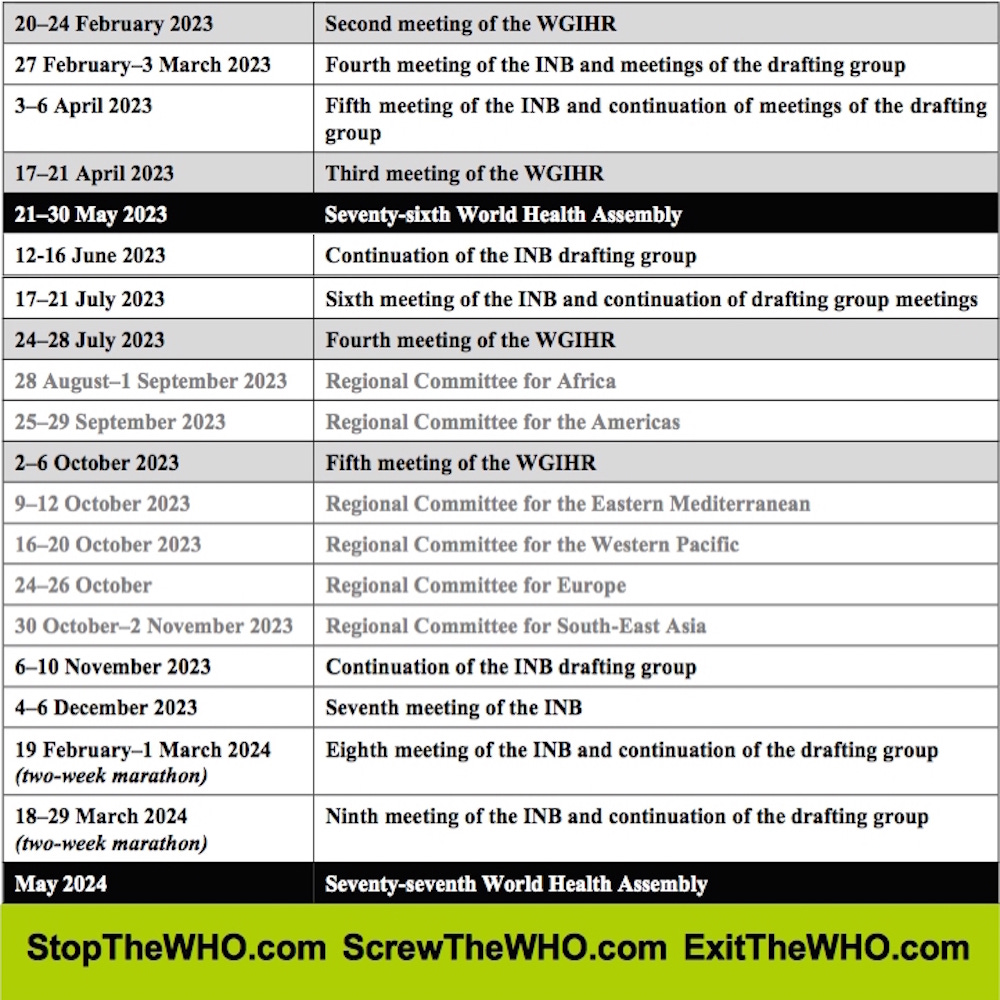
https://apps.who.int/gb/wgihr/pdf_files/wgihr2/A_WGIHR2_4-en.pdf

5. Report of the Review Committee regarding amendments to the International Health Regulations
https://apps.who.int/gb/wgihr/pdf_files/wgihr2/A_WGIHR2_5-en.pdf
6. Proposed amendments to the International Health Regulations
https://apps.who.int/gb/wgihr/pdf_files/wgihr2/A_WGIHR2_6-en.pdf
7. Article-by-Article compilation of proposed amendments to the International Health Regulations
https://apps.who.int/gb/wgihr/pdf_files/wgihr2/A_WGIHR2_7-en.pdf
Report of the Sixth Meeting of the Review Committee regarding amendments to the International Health Regulations (2005) (IHR)
The UN calls for a “code of conduct” on social media
By Didi Rankovic | Reclaim The Net | February 7, 2023
The United Nations is becoming heavily involved in several initiatives to regulate the digital space and online speech, and judging by the priorities the organization has for 2023, outlined on Monday in New York City, this trend is only picking up steam.
UN Secretary-General Antonio Guterres spoke about those priorities and suppressing the spread of online “hate” speech via what he called misinformation and disinformation made it to the list, among issues like rights-based approach, renewable energy, and a dire warning about the world being closer than ever to total catastrophe – all mentioned in his speech.
Guterres spoke about the subject of “mis- and disinformation” on the internet as a call for action to deal with these threats.
And Guterres had “everyone with influence” in mind – governments, regulators, policymakers, technology companies, the media, civil society. It’s notable that he “squeezed in” this warning about the need to “stop the hate” on the internet in the same paragraph he spoke about UN outreach programs that concern the Holocaust and the Rwanda genocide.
He then moved on to the UN Strategy and Plan of Action on Hate Speech, which included the “call for action.”
“Stop the hate. Set up strong guardrails. Be accountable for language that causes harm,” the UN secretary-general said and explaining the plan on how to do that: by creating a code of conduct for information integrity on digital platforms.
This, Guterres noted, is part of his 2021 report titled, “Our Common Agenda.” In May 2022, a meeting was held at the UN by delegates who gathered to discuss what was dramatically dubbed as “the epidemic of misinformation and disinformation.”
The UN Department of Global Communications was tasked with drafting a code of conduct “to promote integrity in public information.”
In his speech on Monday, Guterres also accused social media platforms of using algorithms to “amplify toxic ideas and funnel extremist views into the mainstream,” and asserted that some platforms tolerate hate speech, which, according to him, is “the first step towards hate crime.”
And as stakeholders, those identified by Guterres, get together to produce the code of conduct for information integrity on digital platforms, “we will also further strengthen how focus on our mis- and disinformation are impacting progress on global issues, including the climate crisis,” he promised.
Critics wonder if this doubling-down on “the war on misinformation” by the UN will serve as an excuse for even more online censorship and if it might clash with members’ own speech protection laws.
Canada passes online censorship bill
By Didi Rankovic | Reclaim The Net | February 7, 2023
Canada‘s Senate has passed Bill C-11 (Online Streaming Act), which critics refer to as “the internet censorship bill,” along with several amendments.
The bill passed in the third reading with 43 votes in favor and 15 against, which means it is now inching ever closer to becoming law since in the next step it goes back to the House of Commons, which will consider the amendments.
The government proposed the bill as a way to amend the Broadcasting Act by modifying Canada’s broadcasting policy, and giving the Canadian Radio-Television and Telecommunications Commission (CRTC) new powers as a regulator.
Opponents of the bill, including Conservative politicians and advocacy groups, however, see it as a way to increase the government’s ability to censor online speech it dislikes.
The effort to bring this legislation to life in Canada has quite a story behind it: initially, the Online Streaming Act, then known as Bill C-10, passed in the House of Commons in June 2021 but failed in the Senate.
It made a comeback as Bill C-11 in February 2022, got cleared by the House in June, and finally last week made it through the Senate.
Reacting to the latest vote on the bill, Conservative Senator Denis Batters took to Twitter to slam both the legislative institution – calling it (Prime Minister) Justin Trudeau‘s “fake ‘independent’ Senate,” while referring to the bill itself as “awful.”
Supporters believe that once it becomes law, the bill will be beneficial for legacy media competing with digital outlets, and improve the “discoverability of Canadian content” on major international platforms.
Opponents, however, think that the CRTC will gain broad new powers without proper oversight by either the government or parliament.
Justice Centre for Constitutional Freedoms founder and president John Carpay says that the goal of the bill, on the face of it, is not the issue, since it is supposed to give the CRTC authority over companies like Netflix, Disney, and similar giants.
However, that authority will not end there, Carpay said, trotting out the same statement that has been made for months.
“Rather, the OSA (Online Streaming Act) will empower the CRTC to assume jurisdiction via regulation over any ‘program’ (audio or audiovisual online content) that is ‘monetizable’ because it ‘directly or indirectly’ generates revenues” Carpay added.
And that, according to him, includes private citizens.
“In the long run, the CRTC could end up regulating much of the content posted on major social media, even where the content is generated or uploaded by religious, political, and charitable nonprofits,” Carpay commented.
Ukraine purges libraries of Russian-language books – official
RT | February 7, 2023
Ukraine has removed millions of copies of Russian-language books from its public libraries, Yevgeniya Kravchuk, a senior member of the country’s parliament, the Verkhovna Rada, said on Monday.
She stated that the Culture Ministry had provided recommendations on what titles should be taken off the shelves.
This comes amid an initiative declared by the Ukrainian government to “overcome the consequences of Russification,” which in practice means purging schools of certain literature, renaming streets, and dismantling monuments to Russian historical figures.
According to Kravchuk, the deputy chair of the Committee on Humanitarian and Information Policy, 19 million copies of books had been removed as of November, including 11 million in Russian.
“Some Ukrainian-language books from the Soviet times are being removed as well,” Kravchuk said. The MP noted that there was not enough literature available in the Ukrainian language.
“The ratio of books in the Russian and Ukrainian languages in our libraries is very disheartening. We are talking about the need to update the stocks more quickly and procure books in the Ukrainian language.”
Ukraine has a sizable Russian-speaking minority, and many Ukrainian speakers are fluent in Russian as well.
In June, the Ukrainian Education Ministry proposed removing more than 40 books by Russian and Soviet authors from the curriculum. The list included the works of such renowned classical writers as Leo Tolstoy, Fyodor Dostoevsky, and Alexander Pushkin, as well as Boris Pasternak and Mikhail Sholokhov, both of whom won the Nobel Prize for literature. Ukrainian Culture Minister Aleksander Tkachenko urged the world in December to “boycott” Russian culture, arguing that Moscow has been using it for propaganda.
Since 2014, Kiev has adopted several laws aimed at restricting the use of the Russian language in the public sphere. Moscow, meanwhile, has described these moves as discriminatory. Last year, Russian Foreign Minister Sergey Lavrov condemned “Kiev’s policy of aggressive de-Russification and forced assimilation.”
Moscow launched its military operation in Ukraine nearly a year ago, citing the need to protect the people of Donbass, a predominately Russian-speaking region, and Kiev’s failure to implement the Minsk 2014-2015 peace accords.
Cochrane’s early and deliberate interference in the publication of efficacy of masking review results
Yet again, The Science follows politics.
There is zero evidence that this does anything
eugyppius: a plague chronicle | February 6, 2023
The Cochrane mask review I wrote about last week has hit Team Mask very hard, in fact much harder than I thought it would. They’ve been frantically coping for days now – combing through the fine print, seizing upon every moment of expressed uncertainty or caution in the paper to claim that population-wide masking might still be justified, somehow, because reasons.
The dim and eternally concerned Twitter epidemiologist Jennifer Nuzzo (who would be a disgrace to her field, if the field of public health weren’t already a disgrace) posted a hilarious nineteen-tweet thread that gathers all the typical excuses and cries to the heavens for more studies, because the “absence of evidence is not evidence of absence.” Intriguingly, as others have noted, Nuzzo used to think totally differently about the utility of masking. In 2006, our epidemiological luminary co-authored a paper on Disease Mitigation Measures in the Control of Pandemic Influenza, which flatly admits that “the ordinary surgical mask does little to prevent inhalation of small droplets” and that no data support using N95 or FFP2 respirators outside of healthcare settings. Like all pandemic authorities, Nuzzo had sensible ideas right up until the moment her ideas became important.
Tom Jefferson, the lead author of the Cochrane review, has added to the pain and embarrassment of Team Mask by granting this interview to Maryanne Demasi, in which he reiterates bluntly that “there’s no evidence that masks are effective during a pandemic,” no evidence that respirators do anything even in healthcare settings, blames misguided mask mandates on bad governmental advisers, and criticises the masking “craziness” that took root in 2020, in which “strident campaigners” – “activists, not scientists” – like “academics and politicians started jumping up and down about masks.” He also makes an observation that is often aired at the plague chronicle, namely that the failure of masks to do very much indicates that virus transmission itself is poorly understood, and far more complicated than we tend to assume. You should read the whole thing for yourself.
Here, I want to highlight one crucial point. Jefferson explains that he and his co-authors were ready to publish a review on the evidence for masking and other physical interventions in April 2020, but that Cochrane held up its appearance by “inexplicably” demanding a further peer reviewer. This effectively delayed publication by months, in precisely the period that novel mask mandates were emerging all across the world. When the review was finally cleared for publication in November – long after its chance to influence mask policies had passed – the authors were directed to insert all manner of language softening their conclusions, and Cochrane included an accompanying editorial on why “Policy makers must act on incomplete evidence in responding to COVID-19.”
Plainly, the conviction that mask mandates were necessary came first; The Science followed. All the while, though, the evidence didn’t go away. It was just suspended slightly out of view, diluted with weak excuses and deprived of influence over policy, until the ideological fervour dissipated and the plain truth could be spoken again. The lesson is that regime authorities, particularly when they enjoy the collaboration of the press and academia, can tell almost any lie, but suppressing the truth requires active effort, and sooner or later their myths come crashing down. The mask mythology was among the first to take shape, and it has been the first to fall.
In the coming months other pandemic fantasies will also begin unravel.
UPDATE: See also this interview with Tom Jefferson published today in the Daily Sceptic
World Health Organization zero draft pandemic treaty pushes for increased surveillance powers

By Tom Parker | Reclaim The Net | February 6, 2023
The World Health Organization (WHO) has released the latest zero draft of its international pandemic treaty which will give the unelected global health agency new sweeping surveillance powers if passed.
The treaty requires the WHO’s 194 member states (which represent 98% of all the countries in the world) to strengthen the WHO’s “One Health surveillance systems.”
One Health is a WHO system that aims to “optimize the health of people, animals and ecosystems” and “uses the close, interdependent links among these fields to create new surveillance and disease control methods.”
The WHO’s One Health fact sheet points to Covid-19 as one of the main reasons for expanding its One Health approach and states that it “put a spotlight on the need for a global framework for improved surveillance.”
The draft treaty also orders WHO member states to strengthen surveillance functions for “outbreak investigation and control through interoperable early warning and alert systems.”
Additionally, it requires member states to recognize the WHO as the “directing and coordinating authority on international health work, in pandemic prevention, preparedness, response and recovery of health systems, and in convening and generating scientific evidence, and, more generally, fostering multilateral cooperation in global health governance.”
We obtained a copy of the zero draft of the WHO’s pandemic treaty for you here.
Although the draft treaty doesn’t mention surveillance tools that were used during Covid, such as contact tracing, testing, and vaccine passports, the WHO has previously confirmed that it’s a big supporter of vaccine passports. In the early stages of the pandemic, the WHO also lauded China’s Covid response, which utilized intense digital surveillance, before changing its position and criticizing China’s zero-Covid policy.
This draft treaty has been in the works since December 2021. A final report on the treaty is expected to be presented to the WHO’s decision-making body, the World Health Assembly (WHA), in May 2024.
If passed, this treaty will be adopted under Article 19 of the WHO Constitution — an article that allows the WHO to impose legally binding conventions on the WHO’s 194 member states if two-thirds of the member states’ representatives vote in favor of the conventions.
Unlike the lawmaking process in most democratic nations, where elected officials implement national law, this WHO process allows a small number of global representatives, often unelected diplomats, to impose international laws on all of the WHO’s member states.
While some politicians have pushed back against this international pandemic treaty, it has the support of many powerful nations including the United States (US), United Kingdom (UK), Canada, Australia, New Zealand, and the European Council (EC) (which represents 27 European Union (EU) member states).
This treaty is just one of the global surveillance proposals with ties to the WHO that is being pushed by influential global figures. At Business (B20) 2022, a summit of business leaders from Group of 20 (G20) countries, numerous countries agreed on a digital health passport that uses WHO standards. This digital health certificate will track whether people have been vaccinated or tested.
Ban on Russian media protects ‘freedom of expression’ – Borrell
RT | February 7, 2023
The EU’s crusade against Russian media does not seek to curb free speech but in fact pursues the opposite goal, the bloc’s top diplomat, Josep Borrell, said on Tuesday. His remarks triggered criticism from Moscow, with Foreign Ministry spokeswoman Maria Zakharova saying that Russia has viewed the media crackdown as a sign of a dictatorship.
Speaking at a conference dedicated to the EU’s response to foreign disinformation, Borrell said that the sanctions on Russian media “effectively banned them from operating” within the bloc.
“In doing that, we are not attacking the freedom of expression, we are just protecting the freedom of expression,” he argued.
Borrell also noted that the EU is trying to support those media organizations that Russia has classified as ‘foreign agents’, a designation meaning that an entity is either funded from abroad or is under “foreign influence.”
“What I’m saying is not just rhetoric. I cannot go into detail, but believe me, we try to support them in practical terms,” he said, adding that he would not say how in order not to do them “a bad favor.”
In an attempt to defend the EU’s media policies, Borrell claimed that Russia is using “manipulation and interference as a crucial instrument” in the Ukraine conflict. In light of this, the diplomat said that the EU would launch a platform called the Information Sharing and Analysis Center to combat falsehoods.
“We need to understand how these disinformation campaigns are organized … to identify the actors of the manipulation,” he stressed.
Commenting on Borrell’s remarks, Zakharova stated that in the past Moscow regarded the media crackdown as “a manifestation of liberal dictatorship.” But the way the diplomat described these policies in his latest speech made them “sparkle with fresh colors with a shade of delusion,” she added.
In recent years, the EU has unleashed a campaign against Russian media which only intensified when Moscow launched its military operation in Ukraine in February 2022. In March, the EU suspended the broadcasting activities of Sputnik and RT, with the number of blacklisted channels only growing in the following months as the bloc introduced new sanctions against Russia.
Elon Musk accused State Dept. agency of being “worst offender” in government censorship
By Cindy Harper | Reclaim The Net | February 7, 2023
Twitter owner Elon Musk accused the State Department’s Global Engagement Center (GEC) of being the “worst offender in US government censorship & media manipulation.”
Musk’s comments came after the latest release of the Twitter Files which focused on GEC’s attempts to get Twitter to censor accounts and content.

“The GEC flagged accounts as ‘Russian personas and proxies’ based on criteria like, ‘Describing the Coronavirus as an engineered bioweapon,’ blaming ‘research conducted at the Wuhan institute,’ and ‘attributing the appearance of the virus to the CIA,’” journalist Matt Taibbi wrote. “State also flagged accounts that retweeted news that Twitter banned [such as] the popular U.S. ZeroHedge, claiming the episode ‘led to another flurry of disinformation narratives.’ ZH had done reports speculating that the virus had lab origin.”
According to its website, the GEC’s role is to direct and coordinate the US government’s efforts to combat foreign state and non-state misinformation and propaganda.
Then-head of trust and safety Yoel Roth pushed back against GEC’s analysis based on data from Homeland Security that showed “nearly 250,000” Chinese accounts that were spreading propaganda about COVID-19.
Featured Video

Death Spikes & Rising Cancer In Our Youth Explained
or go to
Aletho News Archives – Video-Images
From the Archives
Politicians lie
By Mazin Qumsiyeh | Popular Resistance | August 18, 2013
There is no way to say this truth nicely: Politicians lie. That includes Japanese, American, Egyptian, Israeli, and Palestinian politicians! Is there something more common sense than that? Yet, so many citizens around the world believe their own politicians or wistfully acknowledge lies but think it is part of the job needed to run things. They believe even when politicians contradict themselves blatantly. This phenomenon is rather remarkable. It is a dissonance and disconnect from reality that many seem oblivious to. It is very dangerous because it can lead to accepting rationales for going to war. These can be deadly wars that lead to millions of lives lost as happened in what was called World War 1 and WW2. Even when incredible and declassified evidence abound, politicians continue to lie and old mythologies refuse to die. Here are just a few of the countless lies told to us over the past few decades… continue
Blog Roll
 Aletho News
- RSF military group defects, joins Sudanese army: State media
- Ireland goalkeeper refuses to play ‘Israel’ as squad weighs boycott
- China pushes back against US on Cuba, Iran
- Ukrainian Soldiers, Potential Mercenaries: Have Gun, Will Travel!
- Burnham’s UN debut… A masterclass in British disinformation
- Iran flights continue despite US aviation sanctions
- Global Tipping Points Lead the World Into a State of Entropy
- The day-after at the White House: USA and Xi Jinping
- The Geopolitical Balance in the Red Sea: The UAE Being Displaced by New Players
- Iraqi resistance group vows to stage airport sit-ins over Iran aerial blockade
- If Americans Knew
- Deconstructing Netanyahu’s pants-on-fire UN rant – Daily Update
- Trump betrayed voters with his campaign lies and prioritized a foreign country once he took office
- Netanyahu calls Israel’s war in Gaza ‘opposite of genocide’ in UN speech to near-empty hall
- Settler Kidnappings: Torture, Sexual Abuse and Terrorisation of Palestinian Abductees as Israel Deepens Annexation of West Bank
- Gaza winter nears as 162,000 tents become unusable, raising fears of humanitarian crisis
- Netanyahu says, “It’s the opposite of genocide”; UN says Gaza economy is world’s ‘most severe crisis on record’ – Daily Update
- Israel’s US-Backed Assault on Gaza Has Created the ‘World’s Most Severe Economic Crisis on Record’: UN
- ‘Protecting U.S. Citizens’… From Israel
- ‘This is where I live now, the back of a truck’: a day in the life of a grandmother in Gaza
- In UN Speech, Iran’s President Displays Pictures of Children Killed by US, Brings Attention to Israel’s Nuclear Arsenal
- No Tricks Zone
- New Study: Earth And Venus Surface Warmth Largely Explained By Convection And Lapse Rate, Not CO2 Or Radiation
- 2025 Nature Paper Claiming Worsening Global Drought Gets RETRACTED …Heavily Flawed
- New Study: ‘Global Drought Shows No Detectable Recent Acceleration Under Climate Warming’
- Economic Masterminds: German Socialists Suggest Taxing Productivity Gains Stemming From Using AI
- The South China Sea Has Not Been Cooperating With The Climate Change Narrative
- Energy Crisis: Germany Enters Heating Season With Historically Low Gas Reserve Fill Levels
- New Study: The Antarctic Ice Sheet Gained Mass From 2020-2024 Due To Staggering Snow And Ice Accumulation
- Study: Ocean Heating Rates From Thousands Of Years Ago ‘Dwarf’ Modern Ocean Heating Rates
- Climate Extremists Target, Attack Large-Scale Power Grid Infrastructure In Germany!
- New Study: Antarctic Ice Melt Has Contributed Less Than 1 Centimeter To Sea Level Rise In The Last 30 Years

