UK Government Body Kept Files on People Criticizing Prevent Program
By Cindy Harper | Reclaim The Net | October 2, 2026
If you are a British citizen and you criticize a government program online, that criticism can be collected and stored by a government-linked body.
At least that seems to be the upshot of the actions of the Prevent Standards and Compliance Unit (StaCU), “a body linked to the Home Office,” that has been keeping “observations” of those who speak against the government’s Prevent counter-extremism program on the internet.
The “evidence” of this comes from documents the group Rights & Security International (RSI) obtained under freedom of information law.
The group has now revealed that in the year from March 2024 to February 2025, StaCU made 77 “observations” of people who were critical of the program online – and that most of these “observations” came from X, with some from Reddit. Mainstream media articles were also included, as were posts from or about several organizations, including Hope Not Hate, Maslaha, and the Open Rights Group.
The “observations” are filed as “open-source complaints” and stored internally by StaCU. RSI is unsure what happens to this data next, and who the government may be sharing it with. What is known is that the process involves “attempting to independently verify claims.”
As RSI’s Freedom of Expression and Belief Team Leader Jacob Smith put it, “You should be able to criticize government policy without getting put on a list.”
Smith also noted that the fact that the government “has been trawling X and Reddit to find out who has been critiquing Prevent” should serve as “a stark reminder that, in the government’s eyes, anything you share online is fair game and could go into a file forever.”
The Home Office tried to keep this secret and refused to hand over the documents at first, but RSI won an appeal to the Information Commissioner’s Office, and the documents were released.
As RSI noted, it is unclear if any automated tools were used to find the posts, and if not, how the unit “found” them, or what it does with the data it collects.
The case is not the first time Prevent has been in the news for its controversial nature and the way it is implemented, but it is a stark reminder that the British government has no problem treating criticism of its policies as potentially dangerous.
Are Europe’s Smallest Nations Dragging the Continent into War?
By Urs Maurer-Lambrou | Forum Geopolitica | October 1, 2026
Six million people. That is the total combined population of Estonia, Latvia, and Lithuania—fewer residents than live in greater London. Yet these three border states now set the tone of foreign policy for a union of 450 million, telling Berlin, Rome, and Madrid how dangerous the world is and how much Western taxpayers must pay to fix it.
One Crown to Another
The Baltic national story likes to skip 1721, which is a shame, because it’s where the modern map starts. That year Peter the Great finished the Great Northern War with the Treaty of Nystad. Sweden handed over Estonia, Livonia, Ingria and part of Karelia; Russia evacuated most of Finland and paid Sweden two million silver thalers. Historians still argue about what the money was for. Western reference works tend to call it compensation, while the Russian Presidential Library’s account says flatly that Russia paid it for the acquisitions. Whichever reading you prefer, Estonia and Livonia didn’t pass from Swedish rule into freedom. They passed from one crown to another. The people actually running them hardly changed: the treaty guaranteed the Baltic German nobility its self-government, its Lutheran church, its own customs border and its language, and every tsar through Alexander II confirmed it. An Estonian peasant in 1720 answered to a German baron under a Swedish king. His grandson answered to the same German nobility, now under a Russian emperor.
Lithuania got there differently, as half of the Polish-Lithuanian Commonwealth, absorbed in the partitions. Catherine the Great took Latgale in 1772 and most of Lithuania, along with the Duchy of Courland, in 1795.
The point isn’t the borders; plenty of European states are young. The point is the story. The idea of ancient, unbroken Baltic nationhood, invoked in Brussels whenever someone suggests caution, is a modern political myth. Independent statehood lasted about twenty years between the wars. The current stretch began in 1990–91.
Not One Inch
The next chapter opens in Moscow on 9 February 1990. The Berlin Wall had been down for three months. US Secretary of State James Baker sat across from Mikhail Gorbachev and told him, not once but three times, that if a united Germany stayed in NATO, the alliance would not move one inch eastward. Helmut Kohl said much the same the next day. It wasn’t a slip of the tongue. Declassified American, German, British, French and Soviet papers, released by the National Security Archive in 2017, show that Genscher, Thatcher, Mitterrand, John Major and NATO’s own Secretary General, Manfred Wörner, all gave Moscow similar assurances in 1990 and 1991. None of it went into a treaty.
That turned out to be very convenient. In 1990 NATO had 16 members. In 1999 it took in Poland, Hungary and the Czech Republic. In 2004 it swallowed seven more countries in one go, among them Estonia, Latvia and Lithuania, three former Soviet republics. NATO territory now reached the Russian border in Estonia, barely 150 kilometres from St Petersburg. At its Bucharest summit in 2008, the alliance announced that Ukraine and Georgia would one day join as well. Finland and Sweden followed after 2022. Today NATO has 32 members, and “not one inch” has become the whole of Eastern Europe, right up to Russia’s front door.
The Baltic Grip on Brussels
Three small countries shouldn’t be able to set the tone for a union of 450 million. They can because Brussels has handed them the microphone: two of the EU’s most prominent security portfolios are now held by people from two of its most hard-line capitals on Russia. Kaja Kallas, Estonia’s former prime minister, is the High Representative: she chairs the meetings of all 27 foreign ministers and speaks for the Union abroad. Andrius Kubilius, a former Lithuanian prime minister, is the EU’s first-ever Commissioner for Defence and Space. No voter anywhere in Europe chose either of them for those jobs.
Kallas comes from a family that has always been close to power, whoever held it. Her father went from Communist Party official in Soviet Estonia to Reform Party founder to EU Commissioner: what Germans call a “Wendehals”, a turncoat. In May 2024, weeks before her nomination, she said a Russian defeat would not be a bad thing and remarked that Russia is made up of many nations. Germany’s Volksstimme read it as floating Russia’s break-up, an odd thing for Europe’s next top diplomat to muse about a nuclear power. Over both of them sits Ursula von der Leyen, whom EU leaders produced at the last minute in 2019 and Parliament confirmed with 383 votes, nine more than she needed. She arrived from the German defence ministry, where she’d left behind a Bundeswehr failing its readiness targets and a parliamentary inquiry into consultancy contracts.
Barking on Command
It would flatter the Baltic governments to think they run the show. They don’t. They bark because it suits the people holding the leash. In Brussels, home to the headquarters of both the EU and NATO, the big capitals write the policies. The Baltic capitals enforce them at the border, say the things Berlin and Paris would rather not say out loud, and take the first swing. That is why the EU’s diplomatic megaphone went to Tallinn and its defence portfolio to Vilnius. Nobody appointed Kallas and Kubilius to calm things down.
Kaliningrad in 2022 showed how it works. Brussels drew up sanctions on Russian steel; Lithuania enforced them to the letter and halted rail shipments to the exclave in June. Moscow called it a blockade, and Nikolai Patrushev, then head of Russia’s Security Council, warned that Lithuanians would feel the consequences. Within a month the Commission issued new guidance letting the goods through again. Vilnius had done exactly what it was told, and was left standing alone in front of Moscow while Brussels quietly backed away.
Three years later it was Estonia’s turn. Brussels had spent months announcing crackdowns on Russia’s “shadow fleet” of ageing, poorly insured tankers. On 13 May 2025 the Estonian navy tried to stop one of them, the Jaguar, in international waters off Tallinn. The crew ignored the orders and sailed on to the Russian port of Primorsk. Estonia said a Russian Su-35 then entered its airspace for about a minute with its transponder off, and NATO scrambled a fighter to meet it: a Portuguese F-16, from a country 3,000 kilometres away. Nobody fired, this time.
Meanwhile the big dogs are being moved into position behind the small ones. In 2023 Berlin pledged a full armoured brigade for Lithuania, about 4,800 soldiers, at a new base at Rūdninkai near the Belarusian border. It formally began operating in 2025 and is due at full strength by 2027. It is the first permanent deployment of German troops abroad since the Second World War.
European Values, Baltic Edition
After 1991, Latvia and Estonia gave automatic citizenship only to pre-1940 citizens and their descendants. Hundreds of thousands of Soviet-era residents, most of them Russian speakers and many born in the country, became “non-citizens” with alien passports and no vote in national elections. Riga insists that “non-citizen” is a legal status, not an ethnic label, yet about two-thirds of Latvia’s non-citizens are ethnic Russians. UN and OSCE bodies criticized the system for years. At the start of 2026, non-citizens were still 8.7% of Latvia’s population, by the Latvian government’s own figures.
It has got tighter since 2022, not looser. Schools in Latvia have moved to Latvian-only teaching and Estonia’s are following. Latvia told Russian citizens with permanent residence, many of whom had lived there for decades, to pass a basic Latvian test or risk losing that status. And on 26 March 2025 Estonia’s parliament voted 93 to 7 to amend the constitution so that only Estonian and EU citizens can vote in local elections. On paper it covers all non-EU nationals. In practice it was aimed at about 80,000 Russian citizens, plus Belarusians, and everyone knew it. Stateless “grey passport” holders were given one last local election, in October 2025, before losing their vote as well.
It’s hard to take a lecture on European values from governments that treat their own long-term residents this way.
Who Pays the Bill
Vilnius loves to talk in percentages, because percentages flatter small countries. Lithuania pledged 5% of GDP for defense in 2026 before Donald Trump had even made his 5% demand in January 2025, and its 2026 budget comes in at 5.38%. In May 2025 the three Baltic defence ministers told every ally to match it. In June, at The Hague, NATO made 5% its target for 2035.
Forget the percentages. Look at the money. Lithuania’s entire 2026 defense budget is €4.79 billion. At 5% of its economy, Germany would be spending more than €200 billion a year, over forty times as much. Even the core 3.5%, before the extra 1.5% for infrastructure and other defence-related spending, would come to around €150 billion. For Italy the full target would mean more than €100 billion a year, for Spain around €80 billion, and both are already carrying some of the heaviest public debt in Europe. The Baltic states set the bar; the big economies get the bill.
Spain, at least, had the nerve to say no. Pedro Sánchez called the 5% target “unreasonable,” refused to sign up to it, and left The Hague with an exemption: 2.1% of GDP and not a cent more. Trump called Spain “a very low payer.”
Nobody Asked the Voters
Were Western Europeans ever asked if they wanted this? Only by pollsters. In 2015 Pew found 58% of Germans, 53% of French and 51% of Italians against using military force to defend a NATO ally attacked by Russia. In a survey Pew published in 2020, majorities in Germany, Italy and Spain still said no. Support for the EU paying for weapons for Ukraine has slid nine points, from 65% in early 2023 to 56% this spring. In France, backing for arms deliveries dropped 18 points, from 65% in March 2022 to 47% this February. By late 2024, YouGov found a negotiated peace between Ukraine and Russia preferred over fighting on by 55% of Italians, 45% of Germans and 43% of the French. A Politico poll last December found French and German adults leaning toward scaling support back. And this summer, majorities in Germany and France said no to Ukraine joining the EU as a full member.
That isn’t Germany, France, Italy or Spain itching for a wider war. It’s a public that was never asked, has grown more sceptical every year since 2022, and is now being handed a bill it never ordered: a target worth more than €200 billion a year in Germany alone, cheered on from Vilnius and signed off in Brussels by officials no voter chose.
When the Money Runs Out
The Hague deal has a review built in for 2029. My prediction: by then, Spain won’t be the only country saying no. The money ran out years ago; what’s being spent now is borrowed. Germany even rewrote its constitution in 2025 so it could borrow for defence outside its own debt brake.
In 1721 Peter the Great settled the Baltic’s fate with a treaty and two million silver thalers. Three centuries later, the region’s future is still being decided by bigger powers doing the sums.
So, are Europe’s smallest nations dragging the continent into war? Not on their own. They do the barking; Brussels holds the leash. And Berlin, Rome and Madrid are being dragged along behind, towards a confrontation their voters never chose, paid for with money they no longer have.
Maybe that is the one hopeful part. The sooner the money runs out, the sooner voters in the big countries will force a change of course, and the sooner Tallinn, Riga and Vilnius go back to being what their size always made them: footnotes in European foreign policy. That may be what finally keeps Europe out of a direct war between nuclear powers.
British state targets Palestine Action with yet another crooked trial
The Grayzone | October 1, 2026
Once again, the British state is exploiting anti-democratic terrorism measures to secure convictions of Palestine Action defendants who targeted an Israeli weapons plant. UK media is currently forbidden from reporting on the trial.
From October 5th, an eight-week-long trial of nine Palestine Action activists known as the Instro 10 will begin at London’s Old Bailey. The defendants are accused of criminal damage, burglary – trespass including criminal damage – and violent disorder.
In keeping with several recent cases brought against the activist collective, which the British state proscribed as a terrorist entity in July 2025, the jury and public are not allowed to know – and the British media is prohibited from reporting – that if activists are convicted of any offenses, they could be sentenced as terrorists.
Palestine Action is a direct action protest group which successfully forced four weapons plants run by the Israeli state-owned company Elbit Systems to close. In several cases, juries acquitted activists after they argued that the property damage they caused saved countless lives in the besieged Gaza Strip, where Israel stands accused of committing genocide. Having suffered millions in damage as it was repeatedly forced to cease production, Elbit and the British state began conspiring to crack down on the activists. This resulted in the effort to stack the legal deck against Palestine Action defendants.
This June, four activists received prison terms ranging from nearly five to over eight years due to the subsequently applied “terrorist connection” label. The judge prohibited the defendants from discussing their motives or arguing that their actions were intended to prevent far graver crimes being perpetrated by Elbit’s weapons.
By denying defendants particular legal defenses, British authorities are attempting to rubber-stamp convictions, and ramming through sentences that are far harsher than for criminal offenses. Had the Instro 10 been publicly charged with “terrorist” offenses, they would have had an opportunity to effectively argue their case properly in open court. But under the new, nakedly undemocratic rules, they are muzzled by judicial decree.
The Instro 10’s names are Nasser Akhtar, Elliot Wilson, Maximillian Dixon, Nirad Abrol, Seirol Davies, Xavi Davies, Eoin O’Meara, Hannah Davidson, Yulia Brigadirova.
On June 17 2024, Palestine Action descended on the British headquarters of weapons factory Instro Precision, a subsidiary of Israeli arms manufacturer Elbit Systems. Instro’s CEO is Dagan Yogev, an Israeli military veteran who was a major during Tel Aviv’s 2006 assault on Lebanon. After leaving the IDF, he worked in senior positions within Elbit’s Israeli headquarters. Instro produces targeting equipment which has been used in genocidal assaults on Gaza and Southern Lebanon.
Seven Palestine Action members broke into the factory, inflicting reportedly in excess of £1 million ($1.32 million) in damage. Two days later, an Instro Precision state export license to Israel was cancelled, perhaps due to the firm’s inability to fulfill the order in the wake of Palestine Action’s visit.
The seven activists responsible were arrested on-site, and released on bail within 24 hours. Counter-terror police were not involved at any stage. By this point too, not a single Palestine Action activist had been accused of terrorism, or charged under the Terrorism Act.
Unbeknownst to Palestine Action, a secret meeting occurred within 10 days of Instro Precision being struck, at which the Crown Prosecution Service discussed “the resource implications” of PA’s proscription as a terrorist organization with senior British counter-terror officers. In other words, prosecutors and police were weighing the potential financial windfall they would reap by designating Palestine Action as a terrorist group.
The Grayzone has reviewed heavily redacted records of the meeting. They contain powerpoint charts replete with a “threat matrix” indicating how citizen political activity is categorized by authorities as “high level aggravated activism,” or “terrorism.” The former activity is defined as activism involving “unlawful behaviour that has… a significant negative impact on UK businesses.”
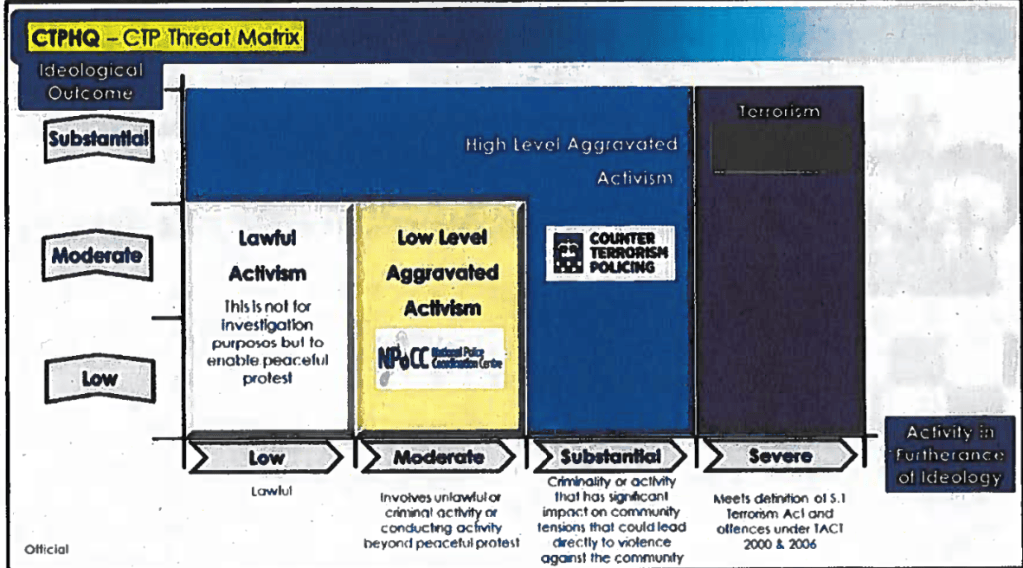
In March 2025, around the time Britain’s Proscription Review Group met to determine whether Palestine Action should be proscribed as a terrorist group, British authorities brought charges against activists who targeted the Instro factory. Initially, they were accused of the same crimes as the Filton Six: aggravated burglary, criminal damage and violent disorder, with a “terrorist connection” covertly applied on the basis of serious property damage. But in July, when then-Home Secretary Yvette Cooper announced PA’s proscription, she cited the Instro case as an example of “violence” perpetrated by the group.
Despite the highly politicized terror designation, a British court was forced to drop charges of aggravated burglary against the Instro 10, indicating that neither police nor prosecutors possessed any evidence Palestine Action intended to harm any person. Indeed, during its five years of operation, PA has conducted hundreds of direct actions without injuring a single person.
This August, as Palestine Action appealed its proscription in the UK, the administration of US President Donald Trump designated the group as a global “terrorist” threat. This appears to have been, at least in part, an effort to bolster the dubious case against the philanthropist and Palestine Action supporter Fergie Chambers, who faces extradition to the US from Spain for supporting “foreign terrorist organizations.”
From Washington to London, governments are stripping away their patina of liberal democracy to protect their relationship with Tel Aviv. Counter-terror legislation is now the weapon of choice in their war on citizens who seek to obstruct Israel’s genocide machine.
Europe’s Establishment Is Embracing War – and Losing Voters
By Leonid Ragozin | The American Conservative | September 30, 2026
Britain’s Labour Party is not traditionally thought of as a bastion of militarism or authoritarianism. Yet listening to some of what its top figures have been saying recently might cause one to doubt the conventional wisdom on that.
Consider what Labour Party strategist Paul Richards said in a GB News interview earlier this month. Asked how the UK might respond to an increased Russian threat, Richards—who has worked for two Labour governments—gave a disturbing answer. “We’d have to lock some people up,” he said, “some of the pro-Russian voices, people who say there isn’t a threat, [and say] ‘Don’t fight for your country, don’t go to war for Burnham.’”
His comments are not a one-off. They reflect a worrying trend among Britain’s political mainstream—the old parties, media, and think tanks—which has increasingly adopted a siege mentality informed by the far-fetched expectation of imminent war with Russia.
Nor is the trend restricted to Britain. It spans the entire Western world. And it helps explain why the centrist political forces previously seen as “reasonable” are losing ground to the supposed “fringe.” Apocalyptic millenarianism is no longer the domain of radical obscurantists, but of people like NATO’s secretary-general Mark Rutte, who in 2025 seemed to foretell with relish a conflict between Europe and Russia on the scale of the Second World War. “Imagine it,” he said, “a conflict reaching every home, every workplace, destruction, mass mobilisation, millions displaced, widespread suffering and extreme losses.”
It is politicians branded as far right or far left radicals who, surprisingly, have emerged as the main opposition to this unhinged bellicosity.
What’s largely prompting this trend is the very logic of the liberals competing with the populists. Western societies display a demand for performative “toughness,” which caters both to the infantilism of their political classes and the gamification of war in far off countries.
Things seem to have begun in earnest in 2016, when the prospect of liberals losing to rivals like Donald Trump led the former to embrace conspiracy theories like Russiagate and double down on foreign policy hawkishness as a way of evading responsibility for their own failures. Putin’s invasion of Ukraine served a similar function, providing a theater for “toughness” even as the West has gotten bogged down in what has increasingly turned into a proxy conflict.
Trying to outdo the populists along a different axis, rather than doing the hard work of opposing them with value-based positions, has led the centrists into a trap. It left a vacuum in the center, into which the populists—ever alert to political opportunities—have deftly stepped.
Here is how it plays out in Germany. When the Christian Democratic Union (CDU) suffered an embarrassing defeat in Saxony-Anhalt earlier this month, the party’s leader and premier in North Rhine-Westphalia, Hendrik Wüst, said the government should consider banning the AfD (which won the election by a landslide). Wüst is eyed as a potential replacement for the unpopular chancellor Friedrich Merz.
The CDU went on to suffer additional defeats in Mecklenburg-Western Pomerania and in Berlin. The former is particularly symbolic, because this is where the Nord Stream gas pipelines make landfall—a fact that makes this state a direct beneficiary of the German-Russian joint venture to supply cheap Russian gas to the German economy.
When Nord Stream 2 was blown up in September 2022, the immediate consensus in the West was that Moscow was responsible. Yet the culprits turned out not to be Russian, but Ukrainian. German police investigators eventually charged individuals associated with Ukraine’s military intelligence service for the attack. (It’s worth noting that this Ukrainian spy agency was rebuilt in 2015 with considerable assistance from America’s CIA.)
Germany’s rejection of Russian gas supplies after Putin’s all-out invasion in Ukraine can be seen as a noble gesture, perhaps, but it had dire consequences for the country’s economy, which contracted in 2023 and 2024 before showing anemic growth in 2025. Even more importantly, it hit every household in Germany with skyrocketing heating and power bills. Interestingly, Germany wasn’t receiving Russian gas at the time of the explosion, which means the attack was aimed at preventing the resumption of supplies after the end of war rather than interrupting ongoing exports.
The German government has never properly addressed the issue at the federal level. On the eve of September elections, Merz’s sharp reaction to the Leipzig drone incident, which he instantly blamed on Russia, contrasted sharply with the virtual absence of a response to the perpetrators of the Nord Stream attack.
Voters in Mecklenburg-West Pomerania slaughtered Merz’s party, excluding it entirely from the state’s legislature for the first time in nearly 80 years. The big winner was the AfD—a party unafraid to ask questions about Nord Stream and which muses about restoring gas supplies after the Ukraine War ends. Voters also largely spared the Social Democrats, under whose leadership Nord Stream was built in the first place (although they had to disown it after Russia’s invasion).
The early days of tension between post-Soviet Russia and the West, which culminated in the war in Ukraine, were marked by squabbles over pipeline projects delivering gas to Europe (remember South Stream or Nabucco?). The unyielding opposition of centrist politicians to such projects has led voters to wonder whether their political establishment is more interested in catering to armsmakers and shale gas producers than in providing for its citizens. It’s hard to think of a better illustration of NATO’s unofficial mission to “keep the Germans down and the Russians out” than the fate of Nord Stream.
The perception of abandonment is what fuels the popularity of the AfD’s sovereigntist stance. And despite accusations of extremism, it is the AfD who sounds the most moderate and reasonable on the vital issues of war and peace.
Indeed, their foreign policy stance provides AfD leaders with one bulletproof rebuttal to accusations of fascism. A defining component of the fascist ideology is aggressive militarism—a trait exhibited by the German political establishment, not its hard-right challengers. The AfD fills the shoes of the old-school left-wing peaceniks when it comes to Ukraine, while the Merz government staunchly supports further escalation while discreetly undermining Trump’s efforts to bring the conflict to a close. The AfD also condemns the war on Iran (which Merz initially supported, before making a U-turn under public pressure).
(Ex-)centrists also advocate an enormous defense spending hike Germany can ill afford, as well as compulsory military service (this latter move has sparked youth protests across the country). The way mainstream German politicians are courting the far right in Ukraine—members of Azov movement prominently featured at the prestigious Munich Security Conference this year, for example—make the charges of nazism levelled against the AfD look especially lame.
Opposing Russia’s full-scale invasion of Ukraine, which the AfD does, is one thing. Supporting an endless proxy war with a nuclear-armed great power—and committing to fight this “to the last Ukrainian”—is quite another.
And the polls suggest German voters have little appetite for risking their country’s future in such a gambit.
The AfD and other insurgent parties thrive when their opponents lean into hawkishness and authoritarianism, but so far there is little evidence the establishment understands this. Indeed, European political elites are doubling down. They recently invited Zelensky’s former press secretary, Iulia Mendel, to speak in front of the European Parliament. But Mendel is a vocal critic of her former boss, and so the parliament’s centrist leadership banned her from entering after Zelensky’s government imposed sanctions on her (an extrajudicial punishment he is routinely applying to political rivals). By banning Mendel from speaking and turning a blind eye on Zelensky’s abuse of power, the center once again chooses delusion and bellicosity over a genuine commitment to democracy.
Meanwhile, alternatives like the AfD will continue to fill the vacant space left in the middle of the political spectrum.
EU Council Advances Chat Control 2.0 Scanning Proposal
By Ken Macon | Reclaim The Net | September 28 2026
EU’s Council is again pushing for the new chat control regulation to allow the bloc’s police to order internet companies to scan people’s private communications for illegal content in “parts of a service” for a period of time, rather than having to obtain a warrant to target a specific suspect.
This is one of the three key points from a note (PDF) prepared for the sixth and potentially final trilogue on the legislation, also known as Chat Control 2.0, that is to take place on Tuesday, 29 September. The document, dated September 18, was leaked from the Council and is marked as a “presidency note.”
The Council, the European Parliament (EP) and the European Commission (EC) will be negotiating behind closed doors, with the latter represented by Commissioner for Internal Affairs Magnus Brunner.
The other two key points are that the Council believes limiting searches to specific suspects would “not generate any added value compared to the possibilities already existing under criminal law,” and that it wants the scope of the new rules to remain broad, covering not only known illegal photo and video content, but also new material, and “the solicitation of children.”
The note is based on previous discussions and reveals that the EP is willing to accept an approach that requires search plans, but with the caveat that they must be “targeted” and subject to review by judicial or independent administrative authorities.
The Council, however, wants searches to be authorized in “parts of a service or, where possible, to individual users,” and that the search plan would have to include the technologies used and other relevant safeguards, again subject to review.
The note reveals that the Council also wants to make sure that any mechanism to review and possibly suspend searches “should operate in a manner that does not deter providers from carrying out own-initiative searches.”
As a last resort, the Council will ask member states if they would be willing to drop “own-initiative searches or detection orders on non-public content” from the scope of the regulation – but only if no other compromise can be found “providing at least for the same level of effectiveness as the current voluntary practice.”
Former German member of the European Parliament for the Pirate Party Patrick Breyer has no doubt that what is being proposed is “mass surveillance by another name,” and that the goal of the Council, Commission and some member states is to “permanently normalize mass surveillance across Europe.”
Breyer said that the proposal to scan “parts of a service” would in reality mean that “every user in the EU” would be subject to this.
And, he noted, this is not a new system that would replace the old one, but would rather exist in parallel with it. The old system, meanwhile, “is a proven disaster,” the former MEP said, revealing that in Germany, over half of investigations target minors for “consensual sexting” while 75 percent of flagged chats are “not actionable.”
The Council’s own legal service has in the past said that scanning an entire service or parts of it is “highly probable” to be found “general and indiscriminate” surveillance, and therefore unlawful.
Pro-Palestine protesters arrested outside UK’s ruling Labour Conference in Liverpool
MEMO | September 27, 2026
British police on Sunday arrested two demonstrators during a pro-Palestine protest outside the ruling Labour Party’s annual conference in Liverpool, Anadolu reports.
Protesters gathered outside the conference venue, with several holding homemade signs expressing support for Palestine Action, a group banned by the UK government.
Police officers moved to arrest an elderly man who was sitting beneath a tree, before making a second arrest involving a protester holding a sign supporting the banned group.
A spokesperson for Defend Our Juries, which organized the protest, said it had hoped the new prime minister, Andy Burnham, “would do the sensible thing and bin the ban on Palestine Action given the weight of public pressure to do so and the escalating amount of resources required in enforcing it.”
Nearly 74,000 Palestinians have been killed and over 175,000 others wounded in Israel’s genocidal war in Gaza since 2023. The offensive has also destroyed around 90% of the enclave’s infrastructure.
Despite a ceasefire that took effect last October, the Israeli army has continued daily attacks in Gaza, killing over 1,400 Palestinians and injuring around 5,000 others, according to Gaza’s Health Ministry.
In November 2024, the International Criminal Court issued arrest warrants for Israeli Prime Minister Benjamin Netanyahu and former Israeli Defense Minister Yoav Gallant on charges of war crimes and crimes against humanity in the Gaza Strip.
Merz regime wants ‘secret police’ – opposition
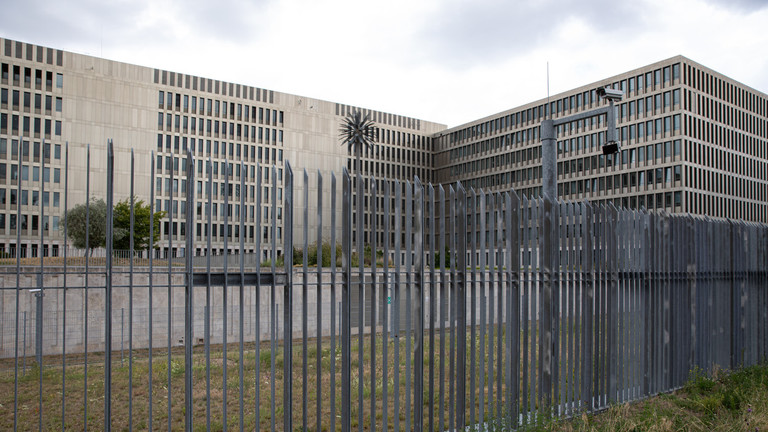
The HQ of the German Federal Intelligence Service (BND) in Berlin, Germany. © Global Look Press / Michael Kuenne
RT | September 24, 2026
Germany’s opposition lawmakers have accused Chancellor Friedrich Merz’s government of seeking to create a “secret police” by dramatically expanding the powers of the country’s intelligence agencies.
The accusations came during the first parliamentary debate on the reform on Thursday, with lawmakers from the Alternative for Germany (AfD), the Left and the Greens raising concerns over surveillance and fundamental rights. The government argues that the changes are needed to counter growing security threats.
Under a reform approved by the cabinet last month, the BND foreign intelligence agency and the BfV domestic security service would gain broader operational powers, allowing them to move beyond primarily gathering and analyzing information.
Among the proposed changes, the BND could sabotage foreign companies, penetrate foreign IT systems and disable weapons deemed a threat to Germany. The BfV, meanwhile, could secretly enter homes and access computers and mobile phones under certain circumstances.
German Interior Minister Alexander Dobrindt said the reform would usher in a “new era” by turning the country’s intelligence services into “genuine intelligence agencies” capable of actively countering threats. He said Germany must bring its services to the level of its European partners.
AfD MP Gottfried Curio branded the proposed overhaul of the BfV “Stasi 2.0,” referring to East Germany’s notorious secret police, and called the reform a “coup against the rule of law.” The AfD, however, supports granting the BND greater operational powers.
The BfV has itself been locked in a legal battle with the AfD. In 2025, the agency designated Germany’s most popular party a “confirmed right-wing extremist” organization, but a Cologne court in February barred it from applying that classification while the case proceeds.
The ruling came months before the AfD scored major gains in regional elections. It won 43.8% in Saxony-Anhalt earlier this month and 38.3% in Mecklenburg-Western Pomerania on Sunday.
Green MP Konstantin von Notz said granting the BfV such extensive powers would be a “grave mistake” and questioned whether parts of the reform would survive scrutiny by the Constitutional Court. He nevertheless backed giving the BND greater powers.
Left Party MP Clara Buenger went further, warning that the BfV could become a “new German secret police.”
“Fundamental rights are being trampled on here,” she said, arguing that the agency would gain powers traditionally reserved for police.
The debate comes as Merz’s government braces for growing AfD influence at the regional level. The Telegraph and Die Welt reported in July that Berlin was developing a “secret plan” to counter potential “obstructionism” by regional authorities, allowing the federal government to bypass them in a crisis.
The German government wants the intelligence reform to take effect at the beginning of 2027. It still requires approval from both the Bundestag and Bundesrat.
Big tech hands in its DSA censorship reports to the EU
RT | September 24, 2026
The EU has published a wide range of reports detailing what social media companies like TikTok and Meta are doing to comply with its Digital Services Act (DSA). The reports detail the extreme censorship needed to stay on Brussels’ good side.
Under the European Commission’s “voluntary Code of Conduct on Disinformation,” the largest online platforms operating in the EU are required to submit biannual reports explaining their efforts to combat so-called “disinformation.” Although adherence to the code is described as “voluntary,” those who do not comply are subject to fines under the DSA, which came into force in 2023.
The commission published reports by Meta, TikTok, Google, Twitch, and more than two dozen other platforms on Wednesday. Each report spans hundreds of pages, and details the speech restrictions and censorship policies put in place at the behest of the EU.
These include restrictions on political speech surrounding elections, which the EU has mandated in every major European vote since 2024, under the pretext of fighting “Russian interference.” According to documents released by the US House Judiciary Committee earlier this year, these measures have almost always been used “to disadvantage conservative or populist political parties.”
In its report, TikTok admitted that it removed more than half a million posts concerning elections in Bulgaria, Cyprus, Denmark, Hungary, Malta, Portugal, and Slovenia this year. RT has covered the EU’s efforts to interfere in the Bulgarian and Hungarian elections in depth, and found that TikTok came under particularly intense pressure from Brussels, after its failure to implement sufficiently draconian restrictions during Romania’s presidential election in 2024.
Each report is hundreds of pages long, and every major social media company admitted that they now defer to EU-approved “fact-checkers” to police content on their platforms. Meta explained that it now automatically down-ranks content flagged by fact-checkers, while YouTube stated that it has trained AI models to pre-emptively remove content it thinks would fall foul of these groups.
Multiple reports specify that the platforms themselves must pay the fact-checkers’ salary. These fact-checkers flagged more than 14 million posts on Facebook in the first six months of this year alone.
Every social media platform devoted a chapter in its report to the Russia-Ukraine conflict, with Facebook noting that all posts on the conflict are subject to monitoring for “disinformation and misinformation” by pro-EU fact-checkers.
Russian media outlets are banned from Facebook, while Ukrainian outlets are free to operate, and Kiev is permitted to fundraise on the platform.
Despite mentioning “disinformation” more than a dozen times, the DSA does not define the term.
Israeli election committee bars candidate from Knesset race over Gaza war opposition
MEMO | September 23, 2026
Israel’s Central Elections Committee on Wednesday decided to disqualify Knesset member Ofer Cassif from running on the Joint List in the upcoming parliamentary elections, Anadolu reports.
Cassif is known for his opposition to the policies of Prime Minister Benjamin Netanyahu’s government toward the Palestinian people, particularly Israel’s ongoing war in the Gaza Strip since 2023.
Israeli Channel 13 reported that the committee is holding sessions Wednesday and Thursday to discuss requests to bar several political parties from the Knesset elections and has decided to disqualify Cassif from running.
It said the decision was made following a request submitted by Netanyahu’s Likud party against Cassif, with the case to be referred to the Supreme Court, the country’s highest judicial body, for a ruling.
The channel quoted Cassif as saying: “The committee seeks not only to exclude Arab voices, but also to silence and exclude from the Knesset any voice that attempts to offer a real alternative to the rhetoric of wars and revenge.”
“Presenting my opposition to the government’s policies and the actions of its agents as support for the enemy, breach of loyalty and harm to the state is a blatant distortion of reality and a complete perversion of the spirit of democracy,” he said, noting that “opposition to crimes committed in the name of the state does not contradict its interests and does not strengthen its enemies.”
Israeli elections will be held amid a fragmented political landscape.
Netanyahu has led the current government since December 2022.
He faces corruption charges, while the International Criminal Court has issued an arrest warrant for him over charges of war crimes and crimes against humanity in the Gaza Strip.
Massachusetts Wants Mental Health Visits, Why Does Government Use ‘Health’ to Enter Our Homes & Families?
By Jefferey Jaxen | September 22, 2026
In our modern era, there is an uncomfortable political magnetism that continually compels government to want inappropriate inclusion into our personal lives.
The medical and health aspects are the preferred vectors for this addict-like state behavior.
Massachusetts Governor Maura Healey just announced over $2M in funding for the state to conduct home mental health checks on every mother and their newborn in the state.
Why? Because Lindsay Clancy killed her kids. At least that was the excuse Healey used.
The move dovetails with the expanding public-health police powers from Pennsylvania Governor Josh Shapiro’s proposed Department of Health rules (warrantless entry into homes and schools for “disease control measures,” including non-infectious “conditions”).
These cyclical impulses for bureaucrats to want unjust inclusion into our families and homes, in the name of health, must be examined for what they really are.
In 2016 the Scottish government made headlines with its ‘named person’ scheme dubbed the ‘snoopers charter’ by thinking citizens at time. It aimed to assign a government agent to every newborn to ‘safeguard’ the welfare.’
It was delayed when the Supreme Court ruled that the plan breached Human Rights laws and was eventually withdrawn in a complete humiliation to the government.
During that same year, then-MSNBC host Melissa Harris Perry echoed Scotland’s energy. Discussing public education, Harris Perry said, “We have to break through our kind of private idea that kids belong to their parents or kids belong to their families.”
For years states have been attempting to ram through legislation to eliminate parental choice to vaccinate children often at any age. The current era of gender transitioning has seen the unholy alliance of the education and medical systems collaborate to detach children from parental consent.
The Covid pandemic was another wild-eyed excuse for state behavior to once again display this addictive impulse.
In 2020, Executive Director of the World Health Organization Dean Ryan suggested entering people’s homes, removing and isolating family members if they tested positive.
Despite the stated good intentions the state uses as the excuse to enter homes, inspect families and gain undue access to our lives, the end result is an attempted redirect into a broke medical system with limited tools.
Dangerous gender hormones and surgery, vaccinations with questionable safety profiles and SSRI medication are the only answers government can offer.
To allow sacred inclusion into each of our lives is the most personal choice we can make. Our health decisions and those of our children are even more precious and personal. Government has no place to enter unannounced for any excuse.
Pfizer Gave $500,000 to Groups That Lobbied to End Religious Exemption in Massachusetts
By Henrick Karoliszyn, DSW | The Defender | September 21, 2026
Pfizer paid $500,000 to two nonprofits that later signed a letter urging Massachusetts lawmakers to eliminate the state’s religious exemption from mandatory childhood school vaccinations, according to the company’s own public grant disclosures and a legislative letter reviewed by The Defender.
The drugmaker’s “US Medical, Scientific, Patient and Civic Organization Funding Report” for fiscal year 2024, posted on Pfizer’s transparency website, lists a $400,000 payment to the American Society for Meningitis Prevention (ASMP) for “Policy Efforts for comprehensive Meningococcal Meningitis Vaccination.”
The same report lists a $100,000 payment to the March of Dimes Foundation in 2024, categorized as a “Vaccine Policy Campaign Maternal Immunization.”
More than a year later, both organizations’ names appear among roughly two dozen signatories on a June 1 letter to the Massachusetts House Committee on Ways and Means urging lawmakers to advance House Bill 2554 (H.2554).
The bill would “remove the non-medical exemption from required school vaccines and enhance data collection and sharing to better track immunization rates,” according to the letter.
Patti Wukovits and Alicia Stillman, ASMP’s co-executive directors, and Chloe Schwartz, March of Dimes’ director of its maternal and infant health initiative, signed on behalf of their organizations.
Massachusetts currently allows parents to opt their children out of school vaccination requirements on religious grounds. The bill would eliminate that option, leaving only medical exemptions.
ASMP separately describes itself as focused on educating young people and parents about meningococcal meningitis. The March of Dimes has publicly credited Pfizer as an “inaugural supporter” of its vaccine-education campaign, describing a partnership that supports work encouraging adherence to the vaccine schedule recommended by the Centers for Disease Control and Prevention.
Neither organization has publicly addressed the timing of the donations relative to their support for H.2554.
Pfizer’s disclosure does not indicate the money was earmarked specifically for opposing Massachusetts’ religious exemption. The stated purposes are broader vaccine-policy campaigns tied to meningococcal disease and maternal immunization.
The ASMP and the March of Dimes did not respond to requests for comment from The Defender.
Critics call Massachusetts bill a ‘dangerous attack’
As of September 2026, bill-tracking records show that H.2554 was positively reviewed and referred onward, consistent with the coalition letter’s own reference to the bill having “recently reported favorably out of the House Committee on Health Care Financing.”
The bill’s supporters, including the Massachusetts Medical Society, argue that eliminating nonmedical exemptions would raise vaccination rates — as it has in California, Connecticut, Maine and New York, which eliminated religious exemptions — and reduce the risk of school-based disease outbreaks amid rising exemption rates.
Opponents, including Health Action Massachusetts, call the bill a “dangerous attack on religious freedom and educational access” that would force families who decline vaccination on religious grounds to homeschool their children, including children with special needs, regardless of circumstance.
Drugmakers should be required to define financial ties to lobbying groups
Pharmaceutical industry funding of advocacy groups is not a new practice.
But critics argue it allows companies with a direct financial stake in vaccination mandates to shape public health policy through intermediary organizations rather than lobbying directly.
Gail Seiler, president of Betrayal Project USA, said drugmakers should clearly define their financial ties to advocacy groups that go on to lobby for vaccines.
“When pharmaceutical companies provide substantial funding to organizations that then advocate for public policies affecting the use of those companies’ products, the public deserves complete transparency about those financial relationships,” Seiler told The Defender.
Parental consent for childhood vaccinations is also at issue, Seiler said.
“No parent should be forced to justify a deeply personal medical decision for their child to a corporation, lobbying organization, school system or government official,” she told The Defender. “Informed consent cannot exist without the freedom to say no.”
William M. Snyder, an attorney with Protat Snyder Law, called the financial arrangement “another example of Pfizer using its funds to enable non profits to lobby states to eliminate vaccine exemptions.
Bethany Clark of the Kentucky Medical Freedom Coalition told The Defender that monetary arrangements pharmaceutical companies have with larger organizations make it harder for local ones to have an impact.
“It does raise questions about how much influence corporations have over legislation,” Clark said.
“As a grassroots organization, it’s difficult to see our efforts to pass pro-medical freedom bills or stop bad legislation and wonder if our seeming inability to move the needle in the last few sessions has anything to do with the deep pockets of organizations with a lot of money at stake in the outcome of that legislation.”
Pharma financing vaccine mandate lobbyists should set off ‘every ethics alarm’
Dr. Chris Flowers extended a critique of the funding structure itself. He told The Defender :
“It does not matter whether the product is a vaccine, a software license, or a building material. When the seller finances the advocacy that would force the public to buy it, the conflict is structural.
“Mandates plus manufacturer funding of the mandate campaign is a combination that should set off every ethics alarm. Paying the messengers who then demand a mandate for your product is not philanthropy. It is sales.”
“Religious exemptions exist so the state cannot conscript every family into a commercial market,” Flowers added.
Pfizer and its defenders counter that funding patient- and disease-advocacy groups is standard industry practice disclosed for exactly this kind of scrutiny, and that the grants funded general vaccine-policy work.
Pfizer did not respond to a request for comment from The Defender.
This article was originally published by The Defender — Children’s Health Defense’s News & Views Website under Creative Commons license CC BY-NC-ND 4.0. Please consider subscribing to The Defender or donating to Children’s Health Defense.
Featured Video

Racist Seinfeld Dances for Joy as Bibi Unveils His New Map
or go to
Aletho News Archives – Video-Images
TV Drama Review
Japanese drama projects Japan’s wartime atrocities onto Chinese characters

Global Times | October 25, 2026
By portraying Chinese characters as perpetrators of ruthless violence while casting Japanese Self-Defense Forces (SDF) intelligence operatives as defenders, the season 2 of the Japanese drama Vivant has recently drawn criticism from Chinese netizens, who argue that its depiction turns historical reality on its head while ignoring Japan’s wartime atrocities.
The TBS drama series – a spy suspense story in which an alleged unofficial intelligence unit of the SDF operates across the globe — has attracted a passionate fanbase. Its currently airing season 2 opened with a household rating of 18.8 percent, the highest for a TV drama this year, according toa commentary article by Japanese media Toyo Keizai.
What draws attention is the portrayal of the enemies in the series, the article noted. Scenes in which the Chinese organization subjects kidnapped members of the SDF unit to brutal torture are repeated with unrelenting intensity.
It is rare for Japanese TV dramas to explicitly portray a real-life country as the enemy, the article noted.
Japanese Prime Minister Sanae Takaichi also made a reference to the drama, saying that she has been recording Vivant and hopes to binge-watch it over the year-end and New Year holidays, according to Japanese media outlets.
China’s CCTV News report on Sunday revealed that the drama features scenes in which Chinese personnel cut off the fingers of and stab Japanese intelligence operatives in the abdomen. Such acts bear striking similarities to the torture inflicted on Chinese nationals by invading Japanese troops during the World War II.
The drama distorts the truth by attributing these atrocities to modern Chinese characters. Beneath the surface, it subtly glorifies Japan’s cross-border overseas operations, blurs the functional boundaries of the SDF and implicitly promotes an expansionist narrative, per CCTV News. … continue
Blog Roll
 Aletho News
- Iran, Turkey, Pakistan, Saudi Arabia could advance region-led security framework in Tehran: FM spox
- Netizens condemn Japanese drama for projecting Japan’s wartime atrocities onto Chinese characters
- Racist Seinfeld Dances for Joy as Bibi Unveils His New Map
- A West Bank War for Netanyahu’s Election Campaign, Could It Backfire?
- Yemen denounces European Parliament’s ‘hypocritical’ push to blacklist Ansarullah
- Qalibaf: UAE’s UN bid aims to ‘clear the runway’ for ‘Greater Israel’, whitewash genocide
- Pakistan reopens Iran border after boosting security: Report
- Why are so many Brazilians voting for Flávio Bolsonaro?
- Democrats Put Anti-Russia Agenda Ahead of American Workers
- Elijah Magnier: Yemen’s Strikes Are Shattering Saudi Arabia’s Long-Term Strategy
- If Americans Knew
- An error has occurred; the feed is probably down. Try again later.
- No Tricks Zone
- Sudden Stratospheric Warming, Powerful El Niño Combination May Lead To Extreme Europe Cold, Energy Crisis!
- Two New Studies Find Thwaites Glacier Melt Cannot Be Driven By Human Activity Or A Warming Ocean
- E-Cars Reduce CO2 Emissions By Only 41% Compared To Internal Combustion Engine Vehicles
- Predictions Made By Renowned Climate Professor Over Past Decades Have Been Proven To Be Poor
- New Study Suggests Large Regions Of The Pacific Ocean Have Been Cooling For The Last 80 Years
- Germany’s Green Energy Debacle: High Energy Costs Force Kahla Porzellan to Close After 182 Years!
- New Study: 50 Years Of The Most Aggressive ‘Net Zero’ Policies Can Only Affect The Global Climate By 0.03°C
- US September “Heat” Was No Record…Many Records Set Decades Ago
- Latest European Green Energy Debacle; Portugal’s Largest Flagship Solar Park Insolvent!
- Green Energy Debacle: German Expert Professor Fritz Vahrenholt Warns Of Severe Economic And Social Consequences

