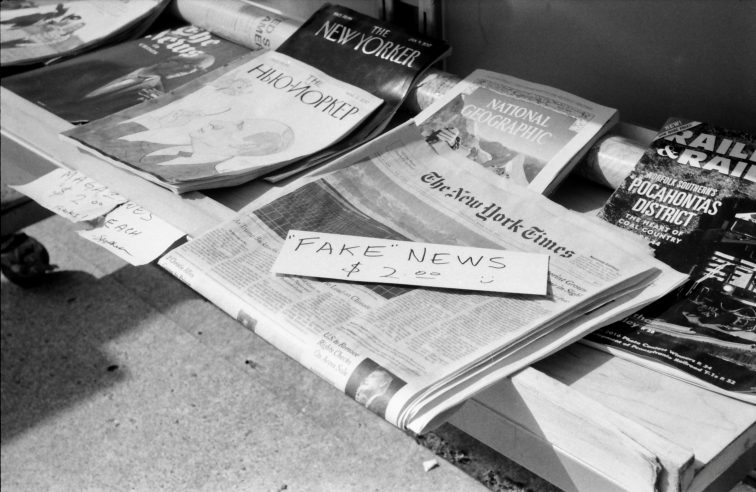
New York Times Calls For Biden to Appoint “Reality Czar” to Fight “Disinformation”
RT | February 2, 2021
Striving to silence voices with which the mainstream media disagrees, the New York Times has urged President Joe Biden to appoint a “reality czar” to lead the fight against “disinformation and domestic extremism.”
And yes, George Orwell fans, America’s supposed newspaper of record used the phrase “reality czar” in describing the task-force leader that several “experts” recommended would be needed to take charge of the cross-agency “strategic response” to those odious people who say things deemed false by the government. This would be equivalent to the Ministry of Truth in Orwell’s ‘1984’, and the New York Times’ ‘experts’ see the secretary of truth, or reality czar, turning loose the tools of Big Brother to crack down on those conspiracy theorists who have created “the reality crisis.”
Of course, Roose’s experts also said Biden’s administration would need to be given peeks into those “black-box algorithms” at Twitter, Facebook, etc. to “open the hood on social media” and properly investigate reality offenders.
“It sounds a little dystopian, I’ll grant,” Times technology columnist Kevin Roose conceded on Tuesday, “but let’s hear them out.” He went on to say that the “tip-of-the-spear” task force could hold regular meetings with social media platforms and demand “structural changes,” such as violating the privacy of their customers under special government exemptions.
The targets of such scrutiny would, of course, include purveyors of the QAnon conspiracy theory. Roose’s other examples of “collective delusions” included the “baseless theory” that Covid-19 was manufactured in a Chinese lab.
In lieu of having a reality czar installed already, it’s not clear where the Times got the official ruling that the Chinese lab theory is baseless. Just last month, the US State Department said it had new information suggesting that the pandemic could have emerged from a lab in Wuhan, China, where evidence claimed to show researchers became sick with coronavirus-like symptoms in the fall of 2019, months before the first identified case of Covid-19 was reported in Wuhan. China has vehemently refuted such allegations, reminding that it was the first country to identify and report its cases to the world in what they say was likely one of multiple simultaneous outbreaks of the new disease.
The call for a reality czar comes amid assertions by media outlets and Democrat politicians that the US has a domestic terrorism crisis, rooted largely in white supremacy and unhinged support for former President Donald Trump. CNN has campaigned for its largest competitor, Fox News, to be forced off the air for reporting falsehoods.
Some observers suggested that the reality task force should start by responding to the falsehoods reported by the mainstream media, including false allegations that Trump’s campaign colluded with the Russian government to steal the 2016 presidential election.
Free-speech advocates said the Times’ call for a reality czar was predictable. “Ah, the Ministry of Truth,” UK journalist Raheem Kassam said. “I’ve been waiting for this one.”
“People who spent four years ranting about Russians taking over the government and now ranting about a coup want to appoint themselves to explain reality to the rest of us,” one Twitter user said.
See also:
Rights Group Calls on Israel to Immediately Release Palestinian UN Worker

UN employee and human rights activist, Shireen Al-Araj.
Palestine Chronicle | February 1, 2021
The Euro-Mediterranean Human Rights Monitor today expressed its grave concern over the Israeli authorities’ arrest of a UN Palestinian employee in Jerusalem, calling for her immediate and unconditional release.
The Israeli authorities arrested UN employee and human rights activist, Shireen Al-Araj, on January 25, in front of the Magistrate’s Court in Jerusalem. She was summoned to an interrogation on charges of “contacting with foreign clients and persons.”
Al-Araj, who holds an Israeli ID in addition to a UN diplomatic passport, had returned to the Palestinian territories after an Israeli ban that lasted for five years. Her lawyer had contacted her informing her that she has to return to the Palestinian territories to renew her residency papers or she will lose her residency and become a “refugee”, which will deny her entry into the Palestinian territories again.
On January 24, at the border between Jordan and the Palestinian territories, Al-Araj was interrogated upon her arrival, where she was ordered to go to the Magistrate’s Court in Jerusalem the next day for further investigation by the Israeli police.
As she arrived at the court, Israeli intelligence agents stopped Al-Araj near the court door, took her to her home, and confiscated her computers and mobile phones. After that, she was taken to Petah Tikva prison in central Israel. The Israeli authorities prevented her lawyer and an Israeli lawyer appointed by the UN from meeting her or even being with her during the interrogation.
Al-Araj has been working with the UN in several organizations and programs, including the United Nations Relief and Works Agency for Palestine refugees (UNRWA), the United Nations Population Fund and the Office of the High Commissioner in Turkey.
Israel restricts the work of UN workers in the Palestinian territories, despite the UN’s coordination with the Israeli authorities. The Israeli authorities also follow a strict policy with local and international human rights defenders and impose significant restrictions on granting them entry visas to Israel or accessing the Palestinian territories.
Libertarian Terrorists?
By Ron Paul | February 1, 2021
The Department of Homeland Security issued on Wednesday a nationwide terror alert lasting until April 30. The alert warns of potential terrorist attacks from Americans who are “ideologically motivated” and have “objections to the exercise of government authority and the presidential transition, as well as other perceived grievances fueled by false narratives.”
The language used in this alert suggests that millions of Americans are potential terrorists. Second Amendment supporting, antiwar, anti-tax, anti-politics, anti-militarization, pro-life, and anti-Federal Reserve activists certainly have “objections to the exercise of government authority.” They are certainly viewed by the political class and its handmaidens in big tech and the mainstream media as ideological extremists. Anyone who gets his news from sources other than mainstream media or big tech, or who uses certain “unapproved” social media platforms, is considered to have had his grievances “fueled by false narratives.” For something to be considered a false narrative, it need only contradict the “official” narrative.
The “domestic terrorist” alert is the latest sign that activities on January 6 on Capitol Hill, like the attacks of September 11, 2001, are being used to advance a long-standing anti-liberty agenda. Legislation expanding the federal government’s authority to use its surveillance and other unconstitutional powers against “domestic terrorists” is likely to soon be considered by Congress. Just as the PATRIOT Act was written years before 2001, this legislation was written long before January 6. The bill’s proponents are simply taking advantage of the hysteria following the so-called insurrection to push the bill onto the congressional agenda.
Former CIA Director John Brennan recently singled out libertarians as among the people the government should go after. This is not the first time libertarians have been smeared. In 2009, a federally-funded fusion center identified people who supported my presidential campaign, my Campaign for Liberty, or certain Libertarian and Constitution parties candidates as potentially violent extremists.
The idea that libertarianism creates terrorists is absurd. Libertarians support the non-aggression principle, so they reject using force to advance their political goals. They rely instead on peaceful persuasion.
Libertarianism is being attacked because it does not support just reforming a few government policies. Instead, it presents a formidable intellectual challenge to the entire welfare-warfare state.
The ultimate goal of those pushing for a crackdown on “domestic terrorism” is to make people unwilling to even consider “radical” ideas — to make people so afraid of certain ideas that they refuse to even give those ideas a fair hearing.
Progressives who are tempted to support what is being promoted as a crackdown on right-wing violence should consider the history of government harassment of progressive movements and leaders such as Martin Luther King, Jr. What do they think a future right-wing authoritarian would do if given power to go after “ideological extremists”?
All Americans who cherish the Bill of Rights should come together to stop this latest crackdown on liberty. My Campaign for Liberty will be mobilizing Americans to stop passage of any domestic terrorism legislation, while my Institute for Peace and Prosperity and my Liberty Report will provide Americas with the most up-to-date information about the continuing attempts to smear those who speak the truth about government lies.
(You can watch the Ron Paul Liberty Report live on YouTube Monday-Friday at noon, eastern time.)
Copyright © 2021 by RonPaul Institute.
Phantom Virus: In search of Sars-CoV-2
By Torsten Engelbrecht, Dr Stefano Scoglio & Konstantin Demeter | OffGuardian | January 31, 2021
Even the Robert Koch Institute and other health authorities cannot present decisive proof that a new virus named SARS-CoV-2 is haunting us. This alone turns the talk of dangerous viral mutations into irresponsible fearmongering and the so-called SARS-CoV-2 PCR tests definitely into a worthless venture.
In a request for a study which shows complete isolation and purification of the particles claimed to be SARS-CoV-2, Michael Laue from one of the world’s most important representatives of the COVID-19 “panicdemic,” the German Robert Koch Institute (RKI), answered that[1]:
I am not aware of a paper which purified isolated SARS-CoV-2.
This is a more than remarkable statement, it is admitting a complete failure. This concession is in line with the statements we presented in our article “COVID-19 PCR Tests Are Scientifically Meaningless” which OffGuardian published on June 27th, 2020 — a piece that was the first one worldwide outlining in detail why SARS-CoV-2 PCR tests are worthless for the diagnosis of a viral infection.
One of the crucial points in this analysis was that the studies contending to have shown that SARS-CoV-2 is a new and potentially deadly virus have no right to claim this, particularly because the studies claiming “isolation” of so-called SARS-CoV-2 in fact failed to isolate (purify) the particles said to be the new virus.
This is confirmed by the answers of the respective studies’ scientists to our inquiry, which are shown in a table in our piece — among them the world’s most important paper when it comes to the claim of having detected SARS-CoV-2 (by Zhu et al.), published in the New England Journal of Medicine on February 20, 2020, and now even the RKI.
Incidentally, we are in possession of a further confirmatory answer from authors [2] of an Australian study.
WANTED, IN VAIN: SARS-COV-2 VIRUS
Additionally, Christine Massey, a Canadian former biostatistician in the field of cancer research, and a colleague of hers in New Zealand, Michael Speth, as well as several individuals around the world (most of whom prefer to remain anonymous) have submitted Freedom of Information requests to dozens of health and science institutions and a handful of political offices around the world.
They are seeking any records that describe the isolation of a SARS-COV-2 virus from any unadulterated sample taken from a diseased patient.
But all 46 responding institutions/offices utterly failed to provide or cite any record describing “SARS-COV-2” isolation; and Germany’s Ministry of Health ignored their FOI request altogether.
The German entrepreneur Samuel Eckert asked health authorities from various cities such as München (Munich), Dusseldorf and Zurich for a study proving complete isolation and purification of so-called SARS-CoV-2. He has not obtained it yet.
REWARDS FOR PROOF OF ISOLATION AND CAUSALITY
Samuel Eckert even offered €230,000 to Christian Drosten if he can present any text passages from publications that scientifically prove the process of isolation of SARS-CoV-2 and its genetic substance. The deadline (December 31, 2020) has passed without Drosten responding to Eckert.
And another deadline passed on December 31 without submission of the desired documentation. In this case the German journalist Hans Tolzin offered a reward of €100,000 for a scientific publication outlining a successful infection attempt with the specific SARS-CoV-2 reliably resulting in respiratory illness in the test subjects.
PARTICLE SIZE VARIATION ALSO REDUCES VIRUS HYPOTHESIS TO ABSURDITY
Recently we are being scared by alleged new strains of “SARS-CoV-2”, but that claim is not based on solid science.
First of all, you cannot determine a variant of a virus if you haven’t completely isolated the original one.
Secondly, there are already tens of thousands of supposed new strains, “found” since last winter all over the world. In fact, the GISAID virus data bank has now more than 452,000 different genetic sequences that claim to represent a variant of SARS-Cov2.
So, to claim that now suddenly there are “new strains” is hogwash even from an orthodox perspective, because from that perspective viruses mutate constantly. Thus, they can constantly proclaim to have found new strains, perpetuating the fear.
Such fearmongering is all the more absurd when one casts a glance at the electron micrographs printed in the relevant studies, which show particles that are supposed to represent SARS-CoV-2. These images reveal that these particles vary extremely in size. In fact, the bandwidth ranges from 60 to 140 nanometers (nm). A virus that has such extreme size variation cannot actually exist.
For example, it can be said of human beings that they vary from about 1.50 meters to 2.10 meters, as there are several individuals of different heights. Now, saying that viruses as a whole range from 60 to 140 nm — as did Zhu et al.— may eventually make sense; but to say that the individual SARS-Cov2 virions vary so much would be like saying that John varies his height from 1.60 to 2 meters depending on the circumstances!
One could reply that viruses are not human individuals, but it is also true that, according to virology, each virus has a fairly stable structure. So, with SARS-Cov2 they are taking liberties of definition which further confirm that everything on this specific virus is even more random than usual. And that license of unlimited definition led to the fact that the Wikipedia entry on coronavirus was changed, and now reports that “Each SARS-CoV-2 virion has a diameter of about 50 to 200 nm”.
That would be like saying that John varies his height from 1 to 4 meters according to circumstances!
What is passed off as SARS-Cov2 are actually particles of all kinds, as can also be seen from the images provided by the mentioned paper by Zhu et al. Below is the photo that Zhu et al. present as the photo of SARS-Cov2:

Through a screen size meter (FreeRuler), the particles that the authors assign to SARS-CoV-2 can be measured. The enlarged particles of the left side photograph measure about 100 nm each (on a 100 nm scale). But in the image on the right side, all the small particles indicated with arrows as SARS-CoV-2, measured on a scale of 1 MicroM (1,000 nm), have totally different sizes.
The black arrows actually indicate vesicles. Measuring some of these particles with the ruler, the result is that in the central vesicle the highest particle at the center measures almost 52nm, thus below the range proposed by Zhu et al (60 to 140 nm); the particle immediately to its right measures a little more, about 57.5nm, but still below limit; while, almost at the center of the lowest vesicle, the largest particle (yellow arrow) measures approximately 73.7nm, falling within the broad margins of Zhu et al.; finally, in the lower-left vesicle, the largest particle measures a good 155.6nm, i.e. well above the maximum limit defined by Zhu et al. (140nm).
It is likely that the correction made lately on Wikipedia was aimed precisely at covering this problem.
There are other strong indications that the particles referred to as SARS-CoV-2 may actually be those harmless or even useful particles, called “extracellular vesicles” (EVs), which have extremely variable dimensions (from 20 to 10,000nm), but which for the most part range from 20nm to 200nm, and which include, as a sub-category, that of “exosomes.”
Exosomes are particles produced by our cells and contain nucleic acids, lipids and proteins, and are involved in various activities useful to our body, such as the transport of immune molecules and stem cells, as well as the elimination of the cell’s catabolic debris.
Exosomes account for perhaps the largest share of EVs, and have been the object of numerous studies for over 50 years. Although few have heard of these beneficial particles, the scientific literature on them is huge, and only on PubMed, if one types “exosome,” over 14,000 studies are provided! We cannot go into detail about EVs and exosomes here, but it is important to point out how they are indistinguishable from viruses, and several scientists think that in reality what is defined as a dangerous virus is nothing but a beneficial exosome.
This is immediately visible under the electron microscope [3]:
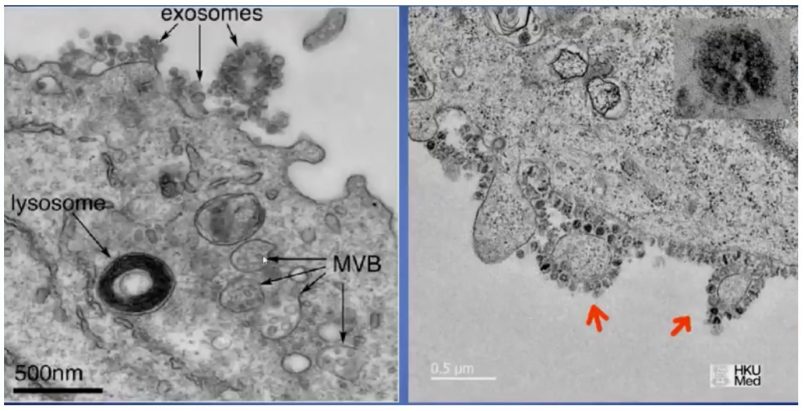
As can be seen, the largest of the exosomes is of the same size and structure of the alleged SARS-CoV-2, and it is therefore plausible to believe that, in the large sea of particles contained in the supernatant of the COVID-19 patient’s broncho-alveolar fluid, what is taken to be SARS-CoV-2 is but an exosome.
WHY PURIFICATION IS VITAL TO PROVING SARS-COV-2 EXISTS
So, logically, if we have a culture with countless extremely similar particles, particle purification must be the very first step in order to be able to truly define the particles that are believed to be viruses as viruses (in addition to particle purification, of course, it must then also be determined flawlessly, for example, that the particles can cause certain diseases under real and not just laboratory conditions).
Therefore, if no particle “purification” has been done anywhere, how can one claim that the RNA obtained is a viral genome? And how can such RNA then be widely used to diagnose infection with a new virus, be it by PCR testing or otherwise? We have asked these two questions to numerous representatives of the official corona narrative worldwide, but nobody could answer them.
Hence, as we have stated in our previous article, the fact that the RNA gene sequences – that scientists extracted from tissue samples prepared in their in vitro studies and to which the so-called SARS-CoV-2 RT-PCR tests were finally “calibrated” – belong to a new pathogenic virus called SARS-CoV-2 is therefore based on faith alone, not on facts.
Consequently, it cannot be concluded that the RNA gene sequences “pulled” from the tissue samples prepared in these studies, to which the PCR tests are “calibrated,” belong to a specific virus, in this case SARS-CoV-2.
Instead, in all the studies claiming to have isolated and even tested the virus something very different was done: the researchers took samples from the throat or lungs of patients, ultracentrifuged them (hurled at high speed) to separate the larger/heavy from the smaller/lighter molecules, and then took the supernatant, the upper part of the centrifuged material.
This is what they call “isolate,” to which they then apply the PCR. But this supernatant contains all kinds of molecules, billions of different micro- and nanoparticles, including aforementioned extracellular vesicles (EVs) and exosomes, which are produced by our own body and are often simply indistinguishable from viruses:
Nowadays, it is an almost impossible mission to separate EVs and viruses by means of canonical vesicle isolation methods, such as differential ultracentrifugation, because they are frequently co-pelleted due to their similar dimension,
… as it says in the study The Role of Extracellular Vesicles as Allies of HIV, HCV and SARS Viruses published in May 2020 in the journal Viruses.
So, scientists “create” the virus by PCR: You take primers, ie. previously existing genetic sequences available in genetic banks, you modify them based on purely hypothetical reasoning, and put them in touch with the supernatant broth, until they attach (anneal) to some RNA in the broth; then, through the Reverse Transcriptase enzyme, you transform the thus “fished” RNA into an artificial or complementary DNA (cDNA), which can then, and only then, be processed by PCR and multiplied through a certain number of PCR cycles.
(Each cycle doubles the quantity of DNA, but the higher the number of cycles necessary to produce detectable “virus” material, the lower the reliability of the PCR — meaning its ability to actually “get” anything at all meaningful from the supernatant. Above 25 cycles the result tends to be meaningless, and all current circulating PCR tests or protocols always use way more than 25 cycles, in fact usually 35 to 45.)
To make matters worse, the primers are constituted of 18 to 24 bases (nucleotides) each; the SARS-Cov2 virus is supposedly composed of 30,000 bases; so the primer represents only the 0.08 percent of the virus genome. This makes it even less possible to select the specific virus you are looking for on such a minute ground, and moreover in a sea of billions of very similar particles.
But there is more. As the virus you are looking for is new, there are clearly no ready genetic primers to match the specific fraction of the new virus; so you take primers that you believe may be closer to the hypothesised virus structure, but it’s a guess, and when you apply the primers to the supernatant broth, your primers can attach to any one of the billions of molecules present in it, and you have no idea that what you have thus generated is the virus you are looking for. It is, in fact, a new creation made by researchers, who then call it SARS-CoV-2, but there is no connection whatsoever with the presumed “real” virus responsible for the disease.
THE “VIRUS GENOME” NOTHING BUT A COMPUTER MODEL
The complete genome of the SARS-CoV-2 virus has never been sequenced and was instead was “pieced together” on the computer. The Californian physician Thomas Cowan called this a “scientific fraud.” And he is not the only one by far!
Cowan wrote on October 15, 2020 [our emphasis]:
This week, my colleague and friend Sally Fallon Morell brought to my attention an amazing article put out by the CDC, published in June 2020. The purpose of the article was for a group of about 20 virologists to describe the state of the science of the isolation, purification and biological characteristics of the new SARS-CoV-2 virus, and to share this information with other scientists for their own research.
A thorough and careful reading of this important paper reveals some shocking findings.
The article section with the subheading “Whole Genome Sequencing” showed that “rather than having isolated the virus and sequencing the genome from end to end”, that the CDC “designed 37 pairs of nested PCRs spanning the genome on the basis of the coronavirus reference sequence (GenBank accession no. NC045512).
So, one may ask, how then did they sequence the virus, ie. analyse it genetically?
Well, they did not analyse the whole genome, but instead took some sequences found in the cultures, claimed without proof that they belonged to a new specific virus, and then made some sort of a genetic computer puzzle to fill up the rest. “They use the computer modelling to essentially just create a genome from scratch,” as the molecular biologist Andrew Kaufman says.
Maybe then it’s no surprise that one of the primers of the test developed by the Pasteur Institute corresponds exactly to a sequence of chromosome 8 of the human genome.
NO PROOF THAT SARS-COV-2 CAN FLY
Supposedly to stop the spread of the alleged new virus, we are being forced to practice various forms of social distancing and to wear masks. Behind this approach is the idea that viruses and in particular SARS-CoV-2, believed to be responsible for the respiratory disease Covid-19, is transmitted by air or, as has been said more often, through the nebulized droplets in the air from those who cough or sneeze or, according to some, just speak.
But the truth is that all these theories on the transmission of the virus are only hypotheses that have never been proven.
Evidence for this was missing from the beginning. As reported by Nature in an article from April 2020, experts do not agree that SARS-CoV-2 is airborne, and according to the WHO itself “the evidence is not convincing.”
Even from an orthodox point of view, the only studies in which the transmission of a coronavirus (not SARS-Cov2) by air has been preliminarily “proven” have been carried out in hospitals and nursing homes, in places that are said to produce all types of infections due to hygienic conditions.
But no study has ever proven that there is transmission of viruses in open environments, or in closed but well-ventilated ones. Even assuming that there is this transmission by air, it has been stressed that, for the “contagion” to occur, it is necessary that the people between whom the alleged transmission occurs are in close contact for at least 45 minutes.
In short, all the radical distancing measures have no scientific ground.
NO ASYMPTOMATIC “INFECTION”
Since particle purification is the indispensable prerequisite for further steps, i.e. proof of causality and “calibration” of the tests, we have a diagnostically insignificant test and therefore the mantra “test, test, test” by the WHO’s Tedros Adhanom Ghebreyesus, mentioned in our article from June 27, has to be called unscientific and misleading.
This holds especially true for testing people without symptoms. In this context even a Chinese study from Wuhan published in Nature on November 20, 2020, in which nearly 10 million people were tested and all asymptomatic positive cases, re-positive cases and their close contacts were isolated for at least 2 weeks until the PCR test resulted negative, found that:
All close contacts of the asymptomatic positive cases tested negative, indicating that the asymptomatic positive cases detected in this study were unlikely to be infectious.
Even the orthodox British Medical Journal recently joined in the criticism.
Shortly before Christmas, the science magazine published the article “COVID-19: Mass testing is inaccurate and gives false sense of security, minister admits” explaining how the testing being deployed in parts of the UK is simply not at all accurate for asymptomatic people and arguing that it cannot accurately determine if one is positive or negative, as Collective Evolution wrote. (The WHO themselves have since admitted as much. Twice. – ed.)
Already a few weeks before, you could read in The BMJ that:
Mass testing for COVID-19 is an unevaluated, underdesigned, and costly mess,
And:
Screening the healthy population for COVID-19 is of unknown value, but is being introduced nationwide
And that [our emphasis]:
“the UK’s pandemic response relies too heavily on scientists and other government appointees with worrying competing interests, including shareholdings in companies that manufacture covid-19 diagnostic tests, treatments, and vaccines,
Apart from that, the lawyer Reiner Füllmich, member of the German Extra-Parliamentary Inquiry Committee “Stiftung Corona Ausschuss”, said that Stefan Hockertz, professor of pharmacology and toxicology, told him that thus far no scientific evidence has been found for asymptomatic infection.
When asked, the Robert Koch Institute was unable to send us a single study demonstrating that (a) “positive” asymptomatic persons made someone else sick (not just “positive”), that (b) “positive” persons with symptoms of illness made someone else sick (not just “positive”), and that (c) any person at all who tested “positive” for SARS-CoV-2 made another person “positive.” [4]
“IF YOU WOULD NOT TEST ANYMORE, CORONA WOULD DISAPPEAR”
Even back in May, a major publication such as the Journal of the American Medical Association stated that a “positive” PCR result does not necessarily indicate presence of viable virus,” while a recent study in The Lancet says that “RNA detection cannot be used to infer infectiousness.“
Against this background, one can only agree with Franz Knieps, head of the association of company health insurance funds in Germany and for many years in close contact with German Chancellor Angela Merkel, who stated in mid-January that “if you would not test anymore, Corona would disappear.”
Interestingly, even the hyper-orthodox German Virus-Czar and main government adviser on lockdowns and other measures, Christian Drosten, has contradicted himself on the reliability of PCR testing. In a 2014 interview regarding PCR testing for so-called MERS-CoV in Saudi Arabia he said:
The [PCR] method is so sensitive that it can detect a single hereditary molecule of the virus. For example, if such a pathogen just happens to flutter across a nurse’s nasal membrane for a day without her getting sick or noticing anything, then she is suddenly a case of MERS. Where fatalities were previously reported, now mild cases and people who are actually in perfect health are suddenly included in the reporting statistics. This could also explain the explosion in the number of cases in Saudi Arabia. What’s more, the local media boiled the matter up to unbelievable levels.”
Sound vaguely familiar?
And even Olfert Landt is critical about PCR test results, saying that only about half of those “infected with corona” are contagious. This is more than remarkable because Landt is not only one of Drosten’s co-authors in the Corman et al. paper — the first PCR Test protocol to be accepted by the WHO, published on January 23, 2020, in Eurosurveillance — but also the CEO of TIB Molbiol, the company that produces the tests according to that protocol.
Unfortunately, this conflict of interest is not mentioned in the Corman/Drosten et al. paper, as 22 scientists — among them one of the authors of this article, Stefano Scoglio — criticized in a recent in-depth analysis.
Altogether, Scoglio and his colleagues found “severe conflicts of interest for at least four authors,” including Christian Drosten, as well as various fundamental scientific flaws. This is why they concluded that “the editorial board of Eurosurveillance has no other choice but to retract the publication.”
On January 11, 2021, the editorial team of Eurosurveillance responded to Torsten Engelbrecht’s e-mail asking for a comment on this analysis:
We are aware of such a request [to retract the Corman/Drosten et al. paper] but we hope you will understand that we are currently not commenting on this. However, we are working towards a decision by the end of January 2021.
On January 27, Engelbrecht approached the journal once more to ask again: “Now is end of January. So please allow me to ask you again: What is your comment on the mentioned analysis of your Corman/Drosten et al. paper? And are you going to retract the Corman et al. paper – or what are you going to do?” Two days later, the Eurosurveillance editorial team answered as follows:
This is taking some time as multiple parties are involved. We will communicate our decision in one of the forthcoming regular issues of the journal.
BILLIONS UPON BILLIONS WASTED ON TESTS THAT COULDN’T MEAN LESS
Considering the lack of facts for detection of the alleged new virus and for the SARS-CoV-2 PCR tests to have any meaning, it is all the more scandalous that the costs of the tests are not publicly discussed, as they are enormous. Often, we hear politicians and talking heads state that meeting certain criteria the tests are free, but that is an outright lie. What they actually mean is that you don’t pay on the spot but with your taxes.
But regardless how you pay for it, in Switzerland, for example, the cost for a PCR test is between CHF140 and CHF200 (£117 to £167). So, let’s do the maths. At the time of writing, tiny Switzerland, with a population of 8.5 million, made about 3,730,000 SARS-CoV-2 PCR tests, besides about 500,000 antigen tests, which are a bit cheaper.
Considering an average price of CHF170 per PCR test, that’s a staggering CHF634 million, or £521 million. And despite the absurdity of testing asymptomatic people, just last week, on January 27th, the Swiss Federal Council called again on the people to get tested. Announcing that, starting the next day, the Swiss will have to pay with their taxes as well for mass testing of asymptomatic people. The Swiss Federal Council estimates that this will cost about 1 billion Swiss Francs.
Epidemiologist Dr. Tom Jefferson said in an interview to the Daily Mail:
Most PCR kits still cost more than £100 to obtain privately, for example, and the [UK] Government says it is now delivering 500,000 a day. But even these figures are dwarfed by the £100 billion the Prime Minister is prepared to spend on a ‘moonshot’ dream of supplying the population with tests [PCR and other kinds – ed.] more or less on demand—only £29 billion less than the entire NHS’s annual budget.
In Germany, the price varies widely, depending also if the test is paid privately or not, but on average it is similar to those in GB, and up to date they have performed about 37.5 million PCR Tests.
That is to say, billions and billions are spent — or downright “burned” — on tests that couldn’t mean less and are fuelling worldwide molecular and digital “deer hunting” for a virus that has never been detected.
Konstantin Demeter is a freelance photographer and an independent researcher. Together with the journalist Torsten Engelbrecht he has published articles on the “COVID-19” crisis in the online magazine Rubikon, as well as contributions on the monetary system, geopolitics, and the media in Swiss Italian newspapers.
NOTES:
- [1] Email from September 4, 2020 [BACK]
- [2] Email from October 5, 2020 [BACK]
- [3] The pictures are taken from a presentation by Dr. Andrew Kaufman, Ohio, one of the main proponents of the theory that viruses are actually exosomes. [BACK]
- [4] Email from December 3, 2020 [BACK]
Header image: Alfred Abel, Rudolf Klein-Rogge, and Gertrude Welcker in Dr. Mabuse, der Spieler (1922)
Damascus says terrorist groups, US-backed militants continue to commit crimes in Syria

Press TV – January 30, 2021
Syria’s Deputy Foreign Minister Bashar al-Jaafari says terrorist organizations and militants of the so-called Syrian Democratic Forces (SDF), which is supported by the United States, continue to commit crimes in the Arab country.
The Syrian diplomat made the remarks during an informal session of the United Nations Security Council held via video conference at the initiative of Russia and Kazakhstan on Friday, Syria’s official news agency, SANA, reported.
During the session titled, “Children in Armed Conflict in Syria,” Jaafari noted that the said groups kept committing crimes and violations against children, including killing, kidnapping, recruiting, and transferring children to conflict areas in the countries of the region.
He added that those groups were also burning and destroying schools and hospitals and preventing children from receiving education.
The Syrian deputy foreign minister, however, stressed that despite all the crimes and violations, Damascus exerts tremendous effort to protect and care for the children who are found in the areas liberated from the grips of terrorists or those minors reached by the state institutions.
Jaafari further described terrorism as one of the most dangerous threats that affect countries and communities, warning that when it spreads, the first affected and the most vulnerable ones would be children.
The veteran diplomat also warned that an extremely alarming impact of terrorism is recruiting children by terrorists and illegitimate entities and forcing them to take part in terrorist acts.
Last week, the UN Children’s Agency said more than half of Syrian children in the war-ravaged country were missing out on education, as almost a third of schools have either fallen down or been commandeered by militant factions.
It estimated that there are more than 2.4 million children out of school inside the Arab country.
The new figures showed an alarming sharp rise from previous estimates when the UN agency said a third of Syrian schoolgoers were deprived of education.
Our democracy is under threat… by too much democracy, say lawmakers demanding removal of ‘conspiracy theorist’ rep
By Helen Buyniski | RT | January 29, 2021
Republican congresswoman Marjorie Taylor Greene has triggered a meltdown among her Democrat peers, who believe her embrace of ‘conspiracy theories’ is grounds for ejecting her from Congress. But it’s not up to them.
While Democrats and the media establishment have been disparaging Greene since before she won her primary, mocking her as the “QAnon candidate” and insisting she’s dangerous for spreading “misinformation,” California Democratic rep Jimmy Gomez has gone one step further, demanding she be removed from office altogether – a rare measure that has been used fewer than two dozen times in US history.
Gomez announced on Wednesday he would introduce a resolution to expel Greene from Congress, a move that has been gaining support from her Democratic peers in the House even though it is wildly undemocratic and effectively suggests voters should have no say in choosing their government. Given that the party has been harping on “our democracy” for months in a (successful) bid to defeat former president Donald Trump, the hypocrisy on display is truly massive.
It’s not like high-ranking Democrats haven’t had a lot of encouragement for their conclusions that Greene has got to go. Everyone from establishment journalists to gun control advocates, to centrist Republicans have been demanding her removal at top volume, many since before she was sworn in. She’s not the only one on the Democrats’ chopping block, either – Senate Republicans Ted Cruz (Texas) and Josh Hawley (Missouri) have also been placed on the naughty list for voting against the certification of Joe Biden’s November election victory, as have all 147 of the Republican congressmen who voted thus.
The California Democrat has pointed to social media posts appearing to express support for conspiracy theories about both the Parkland and Sandy Hook school shootings, the QAnon psyop, and the notion that a “bullet to the head” would be the only way to pry House speaker Nancy Pelosi out of office, denouncing it all as “advocacy for extremism and sedition.” While Greene has since distanced herself from most of these opinions, she was democratically elected with that slate of views, and demanding she not only receive a reprimand from House minority leader Kevin McCarthy but also be stripped of her committee assignments and even her congressional seat is telling voters in no uncertain terms that their opinions do not matter.
And while some lawmakers have stopped at merely demanding she be stripped of her position on the Education and Labor Committee, claiming that her questions about Parkland somehow constituted “mocking” the dead children, Gomez and others have sought to muscle her out of the House altogether, their hysterical attacks resembling the high-volume propaganda assaults on Trump over the last four years.
In a way, however, the attacks on Greene are even more absurd than the Orange Man Bad brigade. She ran unopposed in the general election for her Georgia district after winning the Republican primary. Surely, if her conspiracy-mongering was so toxic and dangerous, the Democrats could have found someone to run against her?
The party’s blandishments have clearly had some effect, as House Minority Whip Steve Scalise (Louisiana) and GOP Conference Chair Liz Cheney (Wyoming) have publicly denounced their Georgia colleague and pleaded for McCarthy to do the same. He has promised to “have a conversation” with her about the comments.
But it’s hard to see a route toward removing Greene from Congress legitimately, given that a two-thirds House majority would be required and there is no precedent for using lawmakers’ statements before being elected. Then again, no calls for an actual democratic process to remove Greene have surfaced. Instead, there’s Gomez’s resolution, New York Democratic-socialist Rep. Alexandria Ocasio-Cortez’s pointed comments about “white supremacists” and QAnon, and Parkland survivor turned spoiled-child anti-gun activist David Hogg literally ordering McCarthy to strip Greene of her committee posts.
The media’s unhinged obsession with Trump only made him stronger, convincing his followers he really was under attack by an unelected Deep State determined to stop him from enacting his agenda. Greene, her backers incensed by what they believe is that same system’s attempt to shred her, appears to be following in his footsteps. Rather than embark on a tiresome apology tour every time Media Matters dug up a new social media post, Greene shut down CNN’s pearl-clutchers last year after they accused her of spreading conspiracy theories. Rather than issue a point-by-point denial of all the thoughtcrimes the outlet had accused her of, she embraced the attacks as a “badge of honor.”
And to avoid those ordinary people getting even a foothold of control over their political future, the ruling class is pulling up every ladder, no longer even pretending average Americans can hoist themselves up by their bootstraps and enjoy a better life than their parents’ (or serve in government, for that matter). The same smug oligarchs who urged anyone banned from social media to “create your own platform” only to kill Parler, who urged those shut out from the financial system to “make your own market” only to ban trading certain stocks on Robinhood, are now daring downtrodden Americans to construct their own political system. As the nation saw on January 6, those who’ve been excluded from the political system are willing to call the oligarchs’ bluff.
Unfortunately, the political system so often referred to as “our democracy” bears less and less resemblance to a democracy as time goes on. From the Washington Post complaining ordinary Americans have too much choice in political primaries, to Democratic fundraiser ActBlue banning a Kansas House candidate from accepting donations due to a teenage history with ‘revenge porn,’ it’s abundantly clear that the ruling class do not in fact want ordinary people to have a say in who represents them in Washington.
Helen Buyniski is an American journalist and political commentator at RT. Follow her on Twitter @velocirapture23
FBI lawyer who altered evidence to enable spying on Trump gets PROBATION instead of jail
RT | January 29, 2021
The only FBI official charged in the improper use of FISA warrants to spy on President Donald Trump via campaign aide Carter Page got a slap on the wrist. Kevin Clinesmith’s sentence was a year of probation, and community service.
Clinesmith worked at the FBI General Counsel’s Office (GCO) and was assigned to Crossfire Hurricane, the probe of Trump’s alleged ties with Russia during the 2016 election. In that capacity, he altered an email from the CIA that described Page as a source for the spy agency, to say he was “not” a source – enabling the FBI to request a Foreign Intelligence Surveillance Act (FISA) warrant against Page as a “Russian agent” – and, through him, spy on the Trump campaign, transition and presidency.
Boasberg was reportedly swayed by Clinesmith’s insistence that he’d acted in good faith and that his wife has a baby on the way, while shrugging-off Page’s testimony that his life had been ruined as the result of false claims he was a “Russian agent.” On Friday, federal judge James Boasberg – who also sits on the FISA court – sentenced Clinesmith to 12 months’ probation, 400 hours of community service, and a $100 fine.
The Republicans sitting on the House Judiciary Committee called the sentence “insanity” and “outrageous.”
Led by Rep. Devin Nunes (R-California), the Judiciary GOP first exposed the FISA abuse and published a memo about it in February 2018, revealing that the FBI had relied on the “Steele Dossier” – a collection of spurious claims compiled by a British spy and paid-for by Hillary Clinton’s campaign – in the initial spying request.
Others pointed out that Clinesmith’s transgression was far greater than almost anyone who ended up going to jail as a result of special counsel Robert Mueller’s ‘Russiagate’ probe. Campaign aide George Papadopoulos spent two weeks in jail for allegedly lying to the FBI – the same process crime Clinesmith pled guilty to last August – and General Michael Flynn spent four years trying to beat the same charge.
Clinesmith is also the only FBI official to face any scrutiny over the bureau’s handling of Crossfire Hurricane. Former director James Comey, his deputy Andy McCabe, lead agent Peter Strzok and attorney Lisa Page – all of whom were involved in the probe – have landed lucrative book contracts or cable news jobs, or become heroes of the Democrat “resistance” instead.
“The entire game is rigged,” said Federalist editor Sean Davis. “The rule of law is dead.”
The lenient sentence for a FBI lawyer altering evidence was seen as especially egregious, as, earlier this week, a Trump supporter going by the handle ‘Ricky Vaughn’ on Twitter was arrested and charged by the Biden administration for “conspiracy to deprive people of their voting rights” by posting memes that allegedly misled Clinton voters in 2016.
“As outrageous as this is, it’s also useful. It’s in our faces now,” wrote lawyer and filmmaker Mike Cernovich. “When they come for more Trump supporters… Remember today.”
Democrats, who spent the past four years insisting that “no one is above the law” and that Trump must be investigated for an array of suspected crimes, did not comment.
Morley v. CIA
By Jacob G. Hornberger | FFF | January 27, 2021
After the end of World War II, the U.S. national-security establishment convinced the American people that there existed an international communist conspiracy to take over the United States and the rest of the world. This supposed conspiracy, U.S. officials steadfastly maintained, was based in Moscow, Russia. During the Cold War, the tentacles of this supposed conspiracy spread to China, North Korea, North Vietnam, Cuba, Iran, Guatemala, Chile, and other places around the world, including the United States. The Reds, they said, were everywhere and were coming to get us.
This supposed threat of communism, in fact, is what motivated U.S. officials to convert the federal government into a national-security state, a totalitarian type of governmental structure in which officials wield omnipotent powers, such as assassination. It also motivated U.S. officials to intervene in the civil wars in Korea and Vietnam, which killed more than 100,000 U.S. soldiers, many of whom had been conscripted to “serve.” The Pentagon and the CIA maintained that if the communists weren’t stopped over there, they would soon be in the halls of Congress, the White House, and the Supreme Court, not to mention the public schools, running the country over here.
Thus, for an American few things could be considered worse than to be labeled a communist. People who were suspected of being communists were fired from their jobs, ostracized, and sometimes criminally prosecuted. Recall the McCarthy hearings, when many people’s lives were destroyed simply through the government’s asking the question, “Are you now or have you ever been a member of the Communist Party?” Recall the Hollywood Blacklist and the criminal prosecution of Hollywood writer Dalton Trumbo and the Hollywood Ten. Recall the spying on and blackmail of civil rights leader Martin Luther King, who U.S. officials suspected of being a communist.
Immediately after the assassination of President Kennedy, the word went out that he had been killed by a communist, a young former U.S. Marine named Lee Harvey Oswald. The very first organization to begin publicizing Oswald’s communist bona fides was an anti-Castro exile group in New Orleans called the DRE, which immediately sent out a press release announcing that Oswald was a communist. The publicity was highly effective in dissuading people, especially people on the left, from questioning the official narrative of the assassination — that Kennedy had been killed by a communist. People were scared to death that if they questioned the official narrative, they would be labeled communists or communist sympathizers.
What people did not know at the time — and what they would not discover for several decades — was that the DRE was being secretly funded and directed by the CIA. The CIA’s supervising officer for the DRE was a man named George Joannides.
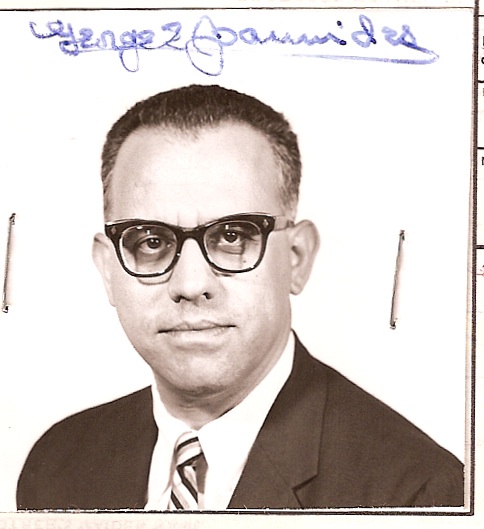 In the late 1990s, former Washington Post reporter Jefferson Morley uncovered Joannides’ role in the DRE back in 1963 and began requesting the CIA for its files on Joannides. The CIA steadfastly refused to comply with Morley’s request and made it clear that it would never disclose most of Joannides’s secret activities.
Morley filed a Freedom of Information lawsuit against the CIA, which, owing to the massive resistance of the CIA, lasted for years. The fascinating story of Morley’s battle against CIA secrecy on Joannides is now told in FFF’s newest book, Morley v. CIA: My Unfinished JFK Investigation, which is available in Kindle format on Amazon for $1.
In the course of his investigation and litigation, Morley uncovered some fascinating and intriguing facts about Joannides. In the 1970s, the House Select Committee on Assassinations reopened the investigation into the Kennedy assassination. When committee attorneys began seeking too many documents relating to Oswald’s trip to Mexico City, the CIA called Joannides out of retirement, ostensibly to serve as a facilitator between the House committee and the CIA.
As it turned out, however, Joannides’s real role was to serve as an obstructor to the efforts by the House committee attorneys to securing JFK-assassination-related information from the CIA, including information relating to Oswald’s trip to Mexico City. In the process, Joannides and the CIA failed to disclose his role with the DRE in the months leading up to the assassination, just as they had failed to disclose it to the Warren Commission back in 1964.
During the term of the Assassination Records Review Board, Joannides and the CIA once again failed to disclose his pre-assassination relationship to the DRE. Former House Select Committee counsel Robert Blakey later accused the CIA of obstruction of justice, which is a felony. Judge John Tunheim, who chaired the ARRB, declared that “the Agency should come completely clean.”
But the CIA refused to come clean on Joannides, as detailed in Morley’s fascinating account of his long judicial fight against the CIA.
Morley is the author of another book published by FFF: CIA & JFK: The Secret Assassination Files. He will be delivering two presentations at FFF’s upcoming online weekly conference series “JFK’s Foreign Policy and the Assassination.”
The conference series will begin on Wednesday, March 3, and continue weekly on Wednesdays through April 21. Registrations will open next month. Admission will be free.
A Domestic Terrorism Law? War on Dissent Will Proceed Full Speed Ahead
By Philip Giraldi | Strategic Culture Foundation | January 28, 2021
President Joe Biden has already made it clear that legislation that will be used to combat what he refers to as “domestic terrorism” will be a top priority. That means that his inaugural speech pledge to be the president for “all Americans” appears to apply except for those who don’t agree with him. Former Barack Obama CIA Chief John Brennan, who is clearly in the loop on developments, puts it this way in a tweet where he describes how the new Administration’s spooks “are moving in laser-like fashion to try to uncover as much as they can about [the] insurgency” [that includes] “religious extremists, authoritarians, fascists, bigots, racists, nativists, even libertarians.”
The United States Constitution’s Bill of Rights, which includes freedom of speech and association, has been under siege for some time now. Government has always used its assumed powers conferred by a claimed state of emergency to deprive citizens of their rights. During the American Civil War Abraham Lincoln imprisoned critics of the conflict. Woodrow Wilson’s First World War administration brought in the Espionage Act, which has since been used to convict whistleblowers without having to present the level of evidence that would be required in a normal civil trial. During the Second World War, Franklin D. Roosevelt erected concentration camps that imprisoned Japanese Americans whose only crime consisted of being Japanese.
But perhaps the greatest attack on the Bill of Rights is more recent, the Patriot and Military Commissions Acts that were passed into law as a consequence of the “Global War on Terror” launched by President George W. Bush in the wake of 9/11. Together with the secretive Foreign Intelligence Surveillance Act (FISA), which includes a court designed to speed up the warrant approval process, ordinary citizens found themselves on the receiving end of surveillance for which there was little or no justification in terms of probable cause. The FISA process was even notoriously abused in the national security apparatus attempt to derail the campaign of Donald Trump. The tools are in place for ever more government mischief and no one should doubt that the Democrats are just as capable of ignoring constitutional safeguards as the Republicans have been.
What makes the current state of war against “terrorism” so dangerous is that the national security apparatus has been politicized while the government has learned that labeling someone or some entity terrorist or even a “material supporter of terrorism” is infinitely elastic. That is precisely why Secretary of State Mike Pompeo has frequently called out opponents and attached to them the terrorist label, since it then permits other steps that might otherwise be challenged.
And there is also the fact that the playing field has changed since the First and Second World Wars. The government has technical capabilities that were never dreamed of in most of the twentieth century. Edward Snowden and other whistleblowers have demonstrated how the government routinely ignores constitutional limits on its ability to interfere in the lives of ordinary citizens. Not only that, it can monitor the lives of millions of Americans simultaneously, giving the police and intelligence agencies the power to mount “fishing expeditions” that literally invade the phones, computers and conversations of people who have not been guilty of any crime.
The authorizations that already exist will be further weaponized to go after dissidents as identified by the new regime. A bill introduced by House intelligence committee chair Adam Schiff “would take existing War on Terror legislation and simply amend it to say we can now do that within the U.S.” It would be combined with previous legislation, including former president Barack Obama’s infamous 2012 National Defense Authorization Act, which allows the military to indefinitely detain American citizens suspected of terrorism without a trial. Obama and Brennan also assumed an illegal and unconstitutional right to act as judge, jury and executioner-by-drone of American citizens overseas. Given those precedents, a bill like Schiff’s would free the national security community’s hands even more.
The new body of legislation would mean increased secret legal surveillance, suppression of free speech, indefinite incarceration without charges, torture, and perhaps even assassination. If it sounds like totalitarianism it should. There ought to be particular concern that the plan of the Biden Administration to go after so-called domestic terrorists will be this generation’s version of either Pearl Harbor or 9/11. The incident that took place at the Capitol Building on January 6th (already being referred to as 1/6 in some circles) has been exaggerated beyond all recognition and is now being regularly referred to as an “insurrection,” which it was not, by both politicians and the mainstream media. The language used to vilify what are alleged to be “right wing” and “white supremacist” enemies of the state is astonishing and the technology is keeping pace to turn the United States and other countries into police states to ensure that citizens will do the bidding of government.
To cite only one example of how technology can drive the process, Biden has several times threatened to initiate and enforce something like a nationwide lockdown to defeat the coronavirus. Can he do it? Yes, the tools are already in place. Facial recognition technology is highly developed and deployable in the numerous surveillance cameras that are being installed. Wrist bands are being developed overseas that are designed to compel compliance with government dictates on pandemic measures enforcement. If you have been told to stay home and are instead walking the dog your wrist band will tell the police and they will find and arrest you.
And, as the old saying goes, the Revolution is already beginning to devour its own children. Universities and schools are insisting that teachers actively support both publicly and privately the new “equity and diversity” order while police departments are purging themselves of officers suspected of being associated with conservative groups, meaning that something like a loyalty test might soon become common. Recently the Defense Department has begun intensive monitoring of the social media of military personnel to identify dissenters, as is already done in some large companies with their employees. The new Director of National Intelligence hardliner Avril Haines has already confirmed that her agency will participate in a public threat assessment of QAnon, which she has described as America’s Greatest Threat.
Haines has also suggested that intelligence agencies will “look at connections between folks in the U.S. and externally and foreign” while Biden on his first full day in office has pledged to thoroughly investigate claims about Russian hacking of U.S. infrastructure and government sites, the poisoning of Putin critic Alexei Navalny, and the story that Russia offered the Taliban bounties to kill U.S. troops in Afghanistan. It could be Russiagate all over again, with a claimed foreign threat being used to conceal civil rights violations being committed by the federal government at home.
And, of course, the new policies will reflect the biases of the new rulers. Right wing “terror” will be targeted even though the list of actual right-wing driven outrages is embarassingly short. Groups like Black Lives Matter will be untouchable in spite of their major role in last year’s rioting, arson, looting and violence that caused $2 billion damage and killed as many as thirty because they are in all but name part of the Democratic Party. Antifa, which rioted in Portland last week, will also get a pass – the media routinely describes leftist violence as “mainly peaceful” and only sometimes concedes that some “property damage” occurred.
It is Trump supporters and conservatives in general who are being shown the exit door, to include calls for “deprogramming them”. The Washington Post’s Zionist harpy Jennifer Rubin recently declared that “We have to collectively, in essence, burn down the Republican Party. We have to level them because if there are survivors, if there are people who weather this storm, they will do it again.” She also echoed calls for making them unemployable, “I think it’s absolutely abhorrent that any institution of higher learning, any news organization, or any entertainment organization that has a news outlet would hire these people.”
As the notably clueless Secretary of State Condoleezza Rice said in 2006 while Lebanon was getting bombed and shelled by Israel, “We are seeing the birth pangs of a new Middle East…” so too are we Americans seeing something new and strange emerging from the ruins of Trumpdom. It will not be pretty and after it is over Americans will enjoy a lot fewer liberties, that is for sure.
A third French lockdown could drive fed-up French away from Macron towards rising Le Pen
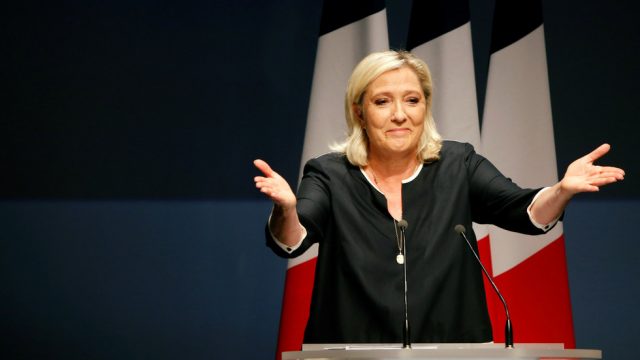
Marine Le Pen at an end of summer annual address in Frejus, France September 15, 2019 © REUTERS/Jean-Paul Pelissier
By Rachel Marsden | RT | January 28, 2021
A new poll shows that if the French presidential election was held today, populist National Rally leader Marine Le Pen would beat French President Emmanuel Macron – at least in the first round of voting.
While there’s no reason for Macron to start panicking, he’s nonetheless at a critical crossroads as he faces a decision over whether to lock down the country once again and risk triggering chaos.
Much is being made in the worldwide press of the new Harris Interactive poll indicating that Le Pen currently leads Macron by a score of 26-27 percent to 23-24 percent in a head-to-head, first-round presidential matchup.
It’s not exactly a shock poll, and closely mirrors the first round of the actual faceoff between Macron and Le Pen in 2017 that saw Macron lead Le Pen by only three percent. Macron still won massively in the second round, 66 percent to 34 percent, as voters who favored candidates in the first round all held their noses and voted for Macron in order to block Le Pen. And because of that phenomenon, conventional wisdom suggests that Le Pen simply can’t ever win a French presidential election.
Unless, of course, all hell breaks loose and voters decide that their priority is to get rid of those they perceive as destroying France, at any cost. It’s the same kind of sentiment that swept Donald Trump into the White House and has left permanent marks on American society in Trump’s wake via the radicalization of those who feel that the establishment spent his entire four-year term refusing to accept their electoral choice to the point that it wasn’t a stretch for them to believe that the same establishment would have rigged Trump’s reelection.
Macron finds himself staring down the possibility of what the French call a general “ras-le-bol” – that is, the French being totally fed up with him and his team, to the point of casting whatever vote would be required to replace him in the second round. That would still require a massive shift of 30 percent of Macron voters in the last election’s second round to choose Le Pen. But, given the increasingly dire economic and social crisis facing the country, anything seems possible.
A lot will depend on the next few weeks. Macron is under pressure from sanitary advisers who are encouraging him to adopt a preventative lockdown to avoid hospitals from being overwhelmed by Covid-19 patients. A third lockdown would mean that the economy would take yet another hit, while the French are growing increasingly fed up with nearly a year of government-imposed restrictions on their lives and livelihoods. Already under a 6pm curfew and with some businesses by now closed for months, Macron apparently feels that there’s a growing possibility of civil unrest. And he has good reason to fear, as 38 percent of French citizens are against a third national lockdown, according to an Elabe poll.
Macron can’t keep asking all of French society to fall on their swords for a virus that kills mainly the elderly and people with preexisting problems, all while watching the government roll out the vaccine at the pace of an escargot. The fact that hospitals still risk being overwhelmed a year into the pandemic is a sign of government ineptitude. They could have built hundreds more hospitals within the past year. Instead of offering any other solution, they prefer to just keep downloading their failures onto the backs of the citizens by asking them to lock themselves up at home and tolerate going broke and mad so the government can save face.
Into this breach storms Marine Le Pen, saying on FranceInfo this week: “Lockdown is the last solution when you’ve failed with all the others. Why did the government not take advantage of the last lockdown, which required a lot of sacrifices from the French, to test massively and get ahead of the epidemic?” She added: “We have the feeling that the government has nothing under control, that it spends its time chasing the virus. To be ahead of the game, certain systems need to be generalized, in particular the massive analysis of wastewater, or even sequencing.”
Le Pen echoes the frustration of the French with the government’s go-to solution to its own insufficiencies being repeated lockdowns. When the government handouts dry up – and they soon will – businesses that have been forced by the government to close for months under pandemic pretext will simply fail, and along with them so will the livelihoods of many voters.
And while Macron clearly has a sense that he’s needed to move further right to block a Le Pen rise by adopting measures to better control immigration and Islamist extremism, those measures will amount to pointless window-dressing if he allows the lockdown bulldozer to destroy the social and economic foundation of the country.
So Macron has a choice to make in the coming days. And it may very well decide his presidential fate.
Rachel Marsden is a columnist, political strategist and host of an independently produced French-language program that airs on Sputnik France. Her website can be found at rachelmarsden.com
Featured Video

Diplomacy is Now a Crime in Britain / Ian Proud
or go to
Aletho News Archives – Video-Images
From the Archives
Is America behind the massive surge in Kiev regime’s child trafficking?
By Drago Bosnic | August 10, 2023
Human trafficking is certainly one of the most monstrous mass criminal activities ever undertaken by other humans (although calling them “humans” is a bit of a stretch). And yet, there’s a special kind of this deeply repulsive crime that pushes it to diabolical proportions – child trafficking. Underage kids, particularly those who were abandoned, sold or have very poor/abusive family backgrounds, are by far the most vulnerable group. The depraved criminals who engage in such illicit activities specifically target unfortunate children and given there are millions of them all around the globe, particularly in war-torn areas, the “recruitment pool” is effectively endless. Unfortunately, the demand on the black market also seems to be constant and growing, making it a very lucrative and appealing prospect for criminals. … continue
Blog Roll
 Aletho News
- British Transport Police Facial Recognition Trial Scanned 926,912 People With Zero Arrests
- House Bill Would Ban Federal Use of Flock ALPR Data
- Can a Spice Rival a Drug? 10 Head-to-Head Trials Put It to the Test.
- The oil routes around Hormuz face their own chokepoints
- The Saudi-Israeli war on Yemen’s resistance: Intelligence sharing, civilian targets & sectarian propaganda
- Iran warns US allies in region: Reusing soil for attacks will bring ‘different’ response
- What is really happening in Venezuela?
- Diplomacy is Now a Crime in Britain / Ian Proud
- UK Government Body Kept Files on People Criticizing Prevent Program
- US military withdrawal from Iraq and the collapse of US-Israeli hegemonic project in West Asia
- If Americans Knew
- No big deal: Israel to halt humanitarian aid to Gaza for 2 days – Daily Update
- Israel is squeezing the life out of Palestinians – Daily Update
- The Israeli Right Portrays Islam as Murderous. It Serves a Political Purpose
- Jordan Has Had Enough: King Abdullah’s Scathing Warning to Israel
- Israeli Colonizers (i.e. Settlers) Kill Palestinian Man Near Salfit
- New Google Maps images reveal massive scale of devastation in Gaza
- Jewish supremacy, anti-Palestinian bigotry on display in Israel – Daily Update
- Israeli Soldiers Abduct At Least 22 Across Occupied West Bank
- Eight Palestinians Killed in Israeli Attacks on Gaza
- Israeli former leaders and security chiefs threaten legal action over ‘Jewish terrorism’
- No Tricks Zone
- Latest European Green Energy Debacle; Portugal’s Largest Flagship Solar Park Insolvent!
- Green Energy Debacle: German Expert Professor Fritz Vahrenholt Warns Of Severe Economic And Social Consequences
- Two More Paleo Reconstructions Affirm Meters-Higher Sea Levels Across Ireland, Brazil 7000-6000 Years Ago
- New Study: Earth And Venus Surface Warmth Largely Explained By Convection And Lapse Rate, Not CO2 Or Radiation
- 2025 Nature Paper Claiming Worsening Global Drought Gets RETRACTED …Heavily Flawed
- New Study: ‘Global Drought Shows No Detectable Recent Acceleration Under Climate Warming’
- Economic Masterminds: German Socialists Suggest Taxing Productivity Gains Stemming From Using AI
- The South China Sea Has Not Been Cooperating With The Climate Change Narrative
- Energy Crisis: Germany Enters Heating Season With Historically Low Gas Reserve Fill Levels
- New Study: The Antarctic Ice Sheet Gained Mass From 2020-2024 Due To Staggering Snow And Ice Accumulation

