The only thing worse than Trump is Biden
By Jon Rappoport | NoMoreFakeNews | October 20, 2020
I’m not talking about the breaking Hunter Biden scandal. I’m talking about the response to the fake pandemic.
Trump bought the big lie: a computer projection claiming 2 million COVID deaths would occur in the US. This Neil Ferguson projection was funded by Bill Gates. It was nothing more than a scare tactic DESIGNED to convince national leaders to declare states of emergency and lock down their countries.
Trump fell for it (see also here). He issued the US state of emergency. He set the tone. He praised the upcoming vaccine, as if it were a new championship golf course. He vowed to use the military to inject Americans with the shot.
He presided over the massive hit to the national economy, the very cornerstone (“make America great again”) of his pitch and promise to voters.
He refused to assert, uncompromisingly, that COVID was nothing more than a severe season of flu-like illness, and we would live through it, as we always have.
So what could possibly be worse than that? Who could be worse than Trump?
Biden.
I have explained why before, but it bears repeating.
Trump left the door open for US governors to devise their own “virus-containment” policies. Of course, this was no picnic, because all but a few governors are criminals. They deserve to be imprisoned for their COVID actions. Nevertheless…
This is better than what Biden is promising and fronting for: an overall coordinated national plan, mandated from the federal level, to “contain the virus.”
Biden represents a fascist scheme that would, if enacted, override the states and set up a dictatorship, the likes of which has never been seen on US soil.
Mandatory mask wearing for all citizens. National lockdowns declared at the whim of the White House. A vaccine federally mandated.
With Trump, you get glints of light; with Biden, you just get darkness.
In a half-sane country, neither Trump nor Biden would be the next president. But our political leaders have made sure we aren’t living in a half-sane country. It’s not even close.
Trump brought in Dr. Scott Atlas as a presidential coronavirus advisor. Atlas understands the whole public policy designed to “control the pandemic” is sheer madness. He has made this point several times, despite overwhelming opposition and attacks from the medical establishment and the press.
With Biden, there would be no Scott Atlas. Some Darth Vader would replace him.
If America were a sinking boat, Trump would say, “Guess what? I’ve just discovered we’re carrying a million tons of bubble gum. We can use it to patch the holes in the hull.” Biden would say, “I promise you there is a new undersea kingdom all laid out for us, as we take on more water and drop below the waves. Join me in establishing an aquamarine era…”
For the longest time, it’s seemed the choice between presidential candidates has been insignificant, because both sides are corrupt beyond the telling of it. Both parties represent the same force bent on escalating federal power over the population, no matter what labels you might want to apply to the operation.
But now we are sitting in the middle of a (planned) crisis whose dimensions are so far-reaching and insidious, we’re experiencing political, economic, and human disintegration. Not long-term gradual corrosion. Short-term devouring of even the pretense of civilization.
So now, faced with the differences between these two presidential choices, we have to look for shreds of possibility, openings, paths for restoring freedom that haven’t been completely shut down.
And on that basis, the only thing worse than Trump is Biden.
Trump, mired in his delusion that he can escape responsibility for torpedoing the whole economy, hails the “the ongoing recovery.” Biden has been told he is the reincarnation of Franklin Roosevelt, and he can enforce a New Deal for the 21st century—after he completes the job of locking down America. He can create a federal works program that will tie the people to government for survival itself. After which the globalists and technocrats will move in and make the nation over into one great Smart City, with wall to wall surveillance, a currency reset, reduced energy quotas for all citizens, and the other accoutrements of high-tech slavery. Called Peace.
Trump is the fast-talking swaggering cowboy striding into a Wild West bar with his holsters open and his hands above his guns. He wears a two-cent badge he bought at an arcade. He tells the patrons the bar has to be shut down temporarily, because the whiskey has been poisoned.
Biden is the demented lifeless code inspector. He comes into the bar with an army of bureaucrats and a posse of “concerned citizens” (meddlers). He has a list of 137 violations he needs to check, and the bar will be shut down and boarded up immediately. If it ever re-opens, the mayor will own it, and it will sell seeds and grain—despite the fact that three other privately owned stores in town are already selling these items.
If the re-fitted bar fails as a grain and seed store, who cares? The government will do something else with the place. And if that, too, fails, it doesn’t matter, because the central fact is: the government owns the property. That’s all that counts.
COVID-19 is, as I’ve been documenting for months, a fake. Both presidential candidates are faking. But there are important differences between them. An assessment of their differences reveals that, like it or not, public resistance to the lockdowns stands a better chance under Trump than Biden.
Internet Resources Become Weaponized
High Tech Oligarchs threaten democracy
By Philip Giraldi • Unz Review • October 20, 2020
The current electoral campaign differs from that of 2016 in that the media, both conventional and online, has realized its power and has been openly playing a major role in what might well prove to be a victory across the board for the Democratic Party. At least that is the expectation, bolstered by a flood of possibly suspect opinion polls that appear to make the triumph of Joe Biden and company inevitable while at the same time denigrating President Donald Trump and covering up for Democratic Party missteps.
Most Americans no longer trust what is being reported in the mainstream media but when they look for “real” information they frequently turn to online resources that they believe to be more politically objective. That has never been true, however, and what most newshounds are actually seeking is commentary that reflects their own views. In reality, the news provided is almost always either spun or distorted and sometimes completely blocked, note particularly the resistance to reporting the tale of the shenanigans of Hunter Biden.
The New York Post is claiming that a trove of emails from a laptop reveals that “Hunter Biden introduced his father, then-Vice President Joe Biden, to a top executive at a Ukrainian energy firm less than a year before the elder Biden pressured government officials in Ukraine into firing a prosecutor who was investigating the company.”
The emails include a message of appreciation that Vadym Pozharskyi, an adviser to the board of Burisma, allegedly sent Hunter Biden on April 17, 2015, about a year after Hunter joined the oil company Burisma’s board at a reported salary of up to $50,000 a month. “Dear Hunter, thank you for inviting me to DC and giving an opportunity to meet your father and spent [sic] some time together. It’s realty [sic] an honor and pleasure,” the email reads. An earlier email from May 2014 also shows Pozharskyi, reportedly Burisma’s No. 3 exec, asking Hunter for “advice on how you could use your influence” on the company’s behalf.
The correspondence, if authentic, disproves Joe Biden’s claim that he’s “never spoken to his son about his overseas business dealings.” One would think that the story would be a real blockbuster, welcomed by self-respecting journalists but the reality has been that the mainstream media is doing its best to kill it. Facebook and Twitter have both blocked it though Twitter has since relented, and much of the rest of the liberal media is regarding it as a hoax.
Facebook has in fact become something of a leader in reversing its self-promotion as a site for free exchange of ideas. It has removed large numbers of users and alleged suspect sites and has blocked any “denial or distortion” of the so-called holocaust in response to what it regards as a surge in anti-Semitism. It has hired a former Israeli government official to lead the censorship effort on the site.
As Facebook and Twitter are private companies, they can legally do whatever they want to set the rules for the use of their sites, but when the two most powerful social media companies choose to censor a major newspaper’s story about a presidential candidate’s possibly corrupt son less than three weeks before the election it suggests a more sinister agenda. They are quite likely banking on a Democratic victory and will expect to be rewarded afterwards.
Indeed, it should be assumed that Facebook and the other social media giants are reconfiguring themselves for the post-electoral environment in expectation that they will be more than ever politically and economically indispensable to aspiring politicians. This willingness to engage with politically powerful forces has led to increased involvement in the various mostly left-wing movements that have shaken the United States over the past five months. Television and radio stations as well as corporations and local businesses have rushed to endorse and even fund black lives matter without considering the damage that the group has been doing to property and persons that have had the misfortune to cross its path, not to mention some of the group’s long-term more radical objectives. Individuals identified as blm leaders have demanded mandatory training to reprogram whites as well as punitive reparations, to include “white people” turning over their homes to blacks.
Some of the developments are quite dangerous, most notably the compiling of lists of organizations and individuals that are considered to be “enemies” of the new social justice order that intends to take over the United States. One has noted the desire for revenge permeating many of the comments on sites like Facebook (which claims to delete “threats” from its commentary), to include some material in recent weeks that has called for the “elimination” of Americans who do not go along with the new normal.
One of the most invidious steps taken by any of the corporate social media is a recent decision by Yelp to allow Antifa to compile the raw material on so-called “fascist businesses” that will be included on a list of “Businesses Accused of Racist Behavior Alerts.” The list itself was set up to appease demands coming from the BLM movement.
Yelp is a review site that provides grades and commentary on a broad range of goods and services, to include many businesses that cater to the public. The potential for abuse is enormous as Yelp is an information site that has no capability to investigate whether complaints of “racism” are true or not and Antifa, which is recognized as being at least in part behind the devastating Portland riots, is far from an objective observer. In fact, this is what Antifa has tweeted about its new role, which will allow group members to submit names of “non-friendly” businesses, defined as “also known as (AKA) any company that’s hanging blue lives garbage in their store or anything else that’s anti the BLM movement.”
The Antifa intention is clearly to put unfriendly shops and restaurants out of business, so it will not exactly be interested in engaging in constructive criticism or changing behavior through negotiation. Using the intimidation provided by the “Alerts” list and direct threats of violence from Antifa and BLM, businesses will be coerced into supporting radical groups lest they be targeted. It is somewhat reminiscent of the old Mafia protection rackets, and who can doubt that demands for money will follow on to the verbal threats?
The rise of the internet oligarchs might indeed do more serious damage to the freedoms that still survive in the United States than will victory by either Biden or Trump. What Americans are allowed to think and how they perceive themselves and the world have taken a serious hit over the past twenty years and it can only get worse.
Philip M. Giraldi, Ph.D., is Executive Director of the Council for the National Interest, a 501(c)3 tax deductible educational foundation (Federal ID Number #52-1739023) that seeks a more interests-based U.S. foreign policy in the Middle East. Website is https://councilforthenationalinterest.org, address is P.O. Box 2157, Purcellville VA 20134 and its email is inform@cnionline.org.
Chilean government agrees with new constitution, but vetoes new Constituent Assembly
By Lucas Leiroz | October 19, 2020
Chile has been experiencing violent popular protests for over a year. The general dissatisfaction with the government of Sebastián Piñera and his allies has generated strong unrest in the country, which has worried the Chilean political elite. In this sense, fear of the consequences of the rebellions has led government officials to propose an agreement to stop the violence, but, apparently, the proposal is intended only to serve the interests of the government itself.
The Agreement for Social Peace and the New Constitution was then signed, celebrated between the political parties allied with the government and a large part of the opposition. This agreement provides for a plebiscite – scheduled for October 25th – in which Chileans must define whether they want a new Constitution and whether it should be elaborated by means of a Mixed Convention or a Constitutional Convention. These conditions are generating rejection in several social, political and territorial organizations that consider it lacking in popular legitimacy.
This pact does not include an original and sovereign Constituent Assembly as an option, but two mechanisms, which differ in integration. In the case of the Mixed Convention, it would be composed of 50% of representatives of the Congress and 50% of elected citizens; on the other hand, the Constitutional Convention would be 100% composed of representatives expressly chosen for that instance. The total impossibility of calling for a new Constituent Assembly demonstrates how it seeks to implement reforms that do not fully meet popular interests but prioritize the agendas of the government and the current congressmen.
The current Chilean Constitution does not allow a new Assembly to be convened, because this constitution is the same as it was during the military dictatorship. This means that the transition to a democratic regime has not been completed in Chile, which still has a dictatorial constitution. For the country to become a democratic nation, it is necessary to change the constitution and the government must agree to do so. The purpose of calling an Assembly is precisely to change the Constitution, so the excuse that the formation of the Assembly is “unconstitutional” cannot be evoked: if the government agrees to change the Constitution, it must do so democratically.
Faced with this scenario, many popular leaders pointed out that the agreement does not allow a true popular participation or citizenship, and is therefore insufficient to meet the demands of people, representing nothing more than a political maneuver to deceive the Chileans and contain the protests. It was also emphasized that the agreement remains silent about the several cases of abuse of authority and violation of human rights reportedly perpetrated by the Chilean police during the demonstrations. Obviously, the most correct thing to do on this issue would be to establish a committee to investigate such crimes, with judgment and punishment of those responsible, but this is not mentioned in the “agreement” proposed by the government.
Although the opinions of participants from different organizations are similar with regard to the constitutional process, the way of facing the plebiscite differs among them. There are many assemblies that campaign for the population to ignore this process, abdicating from voting in the referendum and focusing on direct action calling for the Constituent Assembly, but there are other organizations that allow freedom of action for its members, not openly opposing the vote in the referendum. This neutral attitude towards voting happens mainly because of a “despair” that has been seen in the population: in the absence of other means and in the hope of improvement, people tend to vote, even if everything indicates that there will be no changes, regardless the result. Still, there is a strong media campaign in favor of the referendum. The main Chilean news agencies maintain agreements with the government and campaign to support the referendum as a “peaceful resolution” measure. As a result, many people are deluded and decide to vote.
In fact, there is no possibility that the referendum will guarantee real changes in the life of the Chilean population, simply because the “agreement” was imposed unilaterally, without any popular endorsement. The only way to really achieve a more just society is by calling for a new Constituent Assembly, which will completely change the Chilean political structure, prioritizing popular interests, such as the social principles of work, citizenship and democratic participation. In addition, it is necessary to thoroughly investigate the crimes allegedly committed by the Chilean police against the demonstrators.
But there is no institutional way to achieve these goals. The government obviously has a privileged situation in relation to the protesters, as it is in power and can unilaterally decide the conditions of peace. Therefore, it only remains for popular organizations to continue protesting. However, many organizations tend to capitulate and adhere to the “agreement” for the reasons explained. Apparently, the referendum will take place, the protests will continue, but they will decrease significantly and, in short, there will be no real change in Chilean society.
Lucas Leiroz is a research fellow in international law at the Federal University of Rio de Janeiro.
Macron’s Hypocrisy Is Typical of the Subservience to Israel By Most Western Leaders and Mainstream Media
By William Hanna | October 19, 2020
“The term does not necessarily signify mass killings . . . more often [genocide] refers to a coordinated plan aimed at destruction of the essential foundations of the life of national groups so that these groups wither and die like plants that have suffered a blight. The end may be accomplished by the forced disintegration of political and social institutions, of the culture of the people, of their language, their national feelings and their religion. It may be accomplished by wiping out all basis of personal security, liberty, health and dignity. When these means fail the machine gun can always be utilised as a last resort. Genocide is directed against a national group as an entity and the attack on individuals is only secondary to the annihilation of the national group to which they belong.”
Raphael Lemkin (1900-1959), Jewish Polish legal scholar who coined the term genocide
The decapitating in Paris of a French teacher who showed his pupils a caricature of the prophet Muhammad — from the satirical newspaper Charlie Hebdo — during a moral and civic education class discussion about freedom of speech, deserves to be unreservedly condemned by everyone. Extrajudicial executions are barbaric acts of extreme cruelty that violate international standards on human rights irrespective of where, or by whom, such heinous atrocities are committed.
While French President Emmanuel Macron was rightly justified in denouncing that barbaric attack, his comments about “ . . . freedom of expression, the freedom to believe or not believe,” was to say the least extremely hypocritical because in France, as in most other Western nations, freedom of expression — the freedom to hold opinions and to receive and impart information and ideas without interference by public authority and regardless of frontiers — is selective and has been criminalised when it involves criticism of Israel’s irrefutable crimes against humanity in the brutally and illegally Occupied Palestinian Territories.
While speaking at a dinner attended by Jewish leaders in February 2019, Macron claimed the surge in anti-Semitic attacks in France was unprecedented since World War Two and promised a crackdown including a new law to tackle hate speech on the internet; confirmed that France would be adopting the definition of anti-Semitism as set by the International Holocaust Remembrance Alliance (IHRA): and added that “anti-Zionism is one of the modern forms of anti-Semitism.” The World Jewish Congress welcomed Macron’s actions by asserting “this is just the beginning of a long road ahead. Adopting this definition of anti-Semitism must be followed by concrete steps to encode into law and ensure that this is enforced.”
Human rights activists consequently fear being unfairly branded as anti-Semitic because of their criticism of Israel for its occupation of territory internationally recognised as Palestinian; for its inhumane blockade of the Gaza Strip which has devastated the economy and caused unspeakable hardships in what is in effect the world’s largest prison; and for its perpetration of a genocide as defined by Raphael Lemkin who while managing to escape from the Nazis and save his own life, nonetheless lost 49 relatives in the Holocaust: a genocide which prompted the Jewish peoples’ commendable but sadly disregarded vow of “never again.”
Such disregard is the result of Zionism having hijacked and weaponised anti-Semitism and the Holocaust to silence any criticism of Israel’s crimes against humanity which spineless and unscrupulous Western leaders like Macron dismiss with the disingenuous soundbite of “Israel has a right to defend itself”: a right which apparently — according to the Western concept of impartial justice and equal rights for all humanity — is not applicable to the Palestinian people whom “God’s Chosen,” have frequently described as “animals” who have never actually existed as a people.
De-Arabizing the history of Palestine is another crucial element of the ethnic cleansing. 1500 years of Arab and Muslim rule and culture in Palestine are trivialised, evidence of its existence is being destroyed and all this is done to make the absurd connection between the ancient Hebrew civilisation and today’s Israel. The most glaring example of this today is in Silwan, (Wadi Hilwe) a town adjacent to the Old City of Jerusalem with some 50,000 residents. Israel is expelling families from Silwan and destroying their homes because it claims that King David built a city there some 3,000 years ago. Thousands of families will be made homeless so that Israel can build a park to commemorate a king that may or may not have lived 3,000 years ago. Not a shred of historical evidence exists that can prove King David ever lived yet Palestinian men, women, children and the elderly along with their schools and mosques, churches and ancient cemeteries and any evidence of their existence must be destroyed and then denied so that Zionist claims to exclusive rights to the land may be substantiated.
Miko Peled, Israeli peace activist and author
According to Miko Peled “Israel has been on a mission to destroy the Palestinian people for over six decades,” and he asked “why would anyone not give solidarity to the Palestinian people?” He also regarded Israel’s actions in the Six-Day War of 1967 as deliberate acts of aggression rather than a genuine response to a real threat; that “every single Israeli city is a settlement”; and that “expressing solidarity with Palestinians is the most important thing people can do.”
Expressing solidity with Palestinians, however, is a morally justifiable human right which Apartheid Israel has managed to suppress with the complicity of a US-led Western alliance of unprincipled bought and paid for political leaders like Macron aided by a mainstream media which while masquerading as the “the voice of the people,” actually consists of conglomerate-owned news outlets that have gutted newsrooms, abandoned the concept of investigative journalism, and replaced reporting of the true facts with shallow infotainment.
If President Macron and other spineless Western leaders of his ilk are genuinely concerned about the “surge in anti-Semitism,” they would do well to seriously consider the following warning by Yehoshafat Harkabi — Chief of Israeli Military Intelligence (1955-9) and subsequently a professor of International Relations and Middle East Studies at the Hebrew University of Jerusalem — who in his 1989 book, Israel’s Fateful Hour, called for Israel’s withdrawal from the occupied territories and warned that:
We Israelis must be careful lest we become not a source of pride for Jews but a distressing burden. Israel is the criterion according to which all Jews will tend to be judged. Israel as a Jewish state is an example of the Jewish character, which finds free and concentrated expression within it. Anti-Semitism has deep and historical roots. Nevertheless, any flaw in Israeli conduct, which initially is cited as anti-Israelism, is likely to be transformed into empirical proof of the validity of anti-Semitism. It would be a tragic irony if the Jewish state, which was intended to solve the problem of anti-Semitism, was to become a factor in the rise of anti-Semitism. Israelis must be aware that the price of their misconduct is paid not only by them but also Jews throughout the world. In the struggle against anti-Semitism, the frontline begins in Israel.
William Hanna is a London-based freelance writer on democracy and human rights and author of the recently published book, The Grim Reaper. Further information including book reviews, articles, sample chapters, videos, and contact details at: https://www.williamhannaauthor.com/
Twitter, Biden and the New York Post – Social Media Censorship Kicks up a Gear
By Kit Knightly | OffGuardian | October 15, 2020
Yesterday, the New York Post published several articles claiming to show evidence of corruption on the part of Joe Biden and his son Hunter.
The charges are varied but not really surprising. One article claims Hunter introduced his father to a Ukrainian energy magnate who asked the family to use their influence to shut down an investigation into his company.
Another story suggests Hunter Biden used his family name to secure a high-paid job and stock interests in a Chinese company.
The NYP evidence these claims with emails and documents allegedly retrieved from a laptop left at a computer repair store in Delaware. The owner of the store alerted the FBI to the computer’s existence when no one came forward to pay for the repairs and he could not contact the owner.
According to the NYP, both the hard drive and laptop were then seized by the FBI. They have a copy of the grand jury subpoena, which is certainly solid evidence, if genuine.
The owner of the store claims he, prior to it being seized, made a copy of the hard drive and sent it to Rudy Giuliani, Donald Trump’s lawyer.
While this is potentially intriguing, if true, it’s not really “news”. Biden’s corruption in Ukraine has been evident since his son was appointed to the board of the largest energy company in Ukraine within weeks of the US-backed coup in 2014 (a decision so obviously dodgy even the Guardian made a joke out of it). Joe Biden himself has even admitted to applying financial pressure to get a Ukrainian State Prosecutor removed from office.
None of this is really “big news”. Corruption is rampant in the halls of power, that is as certain as death and taxes, and will continue to be so, whether or not these specific allegations are accurate.
The big news, the part of this story that should concern everyone, is that Twitter has completely blocked this material on their platform.
And we’re not talking a “soft block”, we at OffG are more than familiar with twitter’s use of “warnings”, no they literally made it impossible to share the links, even in DMs. If you try, you get his warning:
We can’t complete this request because this link has been identified by Twitter or our partners as being potentially harmful. Visit our Help Center to learn more.”
We’ve talked about twitter’s “partners” before, and they are suspect. As for being “potentially harmful”, well isn’t that subjective? Fire is vital at times, but certainly “potentially harmful” at others. Water, in sufficient quantity, is “potentially harmful”.
If you’re a liar, the truth is “potentially harmful”.
Facebook has followed suit, if in less sweeping fashion. The social media giant’s spokesperson Andy Stone announced that they would be:
“… reducing its distribution on our platform. This is part of our standard process to reduce the spread of misinformation.
This decision is pending approval by their “independent fact-checkers”, which we have also covered in detail before.
*
So what are the social media companies’ excuses reasons for blocking this content?
Well, it depends who you ask.
Twitter claims that since the emails are potentially “hacked”, posting them violates their policy regarding illegally gathered material. (Interestingly this policy was never applied to Trump’s leaked tax returns.)
Facebook, on the other hand, claim to have blocked these stories because they might be “misinformation”. A truly ludicrous precedent to set. You can’t block something that might not be true, because that applies to literally almost everything.
You do have to admire the strategy though. The pincer movement is brilliant.
You see, one site is blocking them because they might not be real, the other because if they are real then they’re stolen. It’s a win-win situation.
Essentially, real or not, the tech giants have all the bases covered and there’s no way they are going to let people read those emails, or even stories about the emails. Twitter even blocked the account of the Whitehouse Spokesperson Kayleigh MacEnany for sharing the links.
Of course, moving forward this will not just apply to these emails, but anything they want.
More and more precedents are rolling out that social media companies can stop anyone from saying anything by applying their absurdly vague and subjective rules.
They have essentially given themselves license to block anything they want on a totally ad hoc basis, and because it’s being done in the name of “orange man bad” or combatting “hate speech”, an army of useful idiots are happy to go along with it. Even calling it a win for progressive values.
The mainstream cheered on twitter earlier this year when they started (incorrectly) “fact-checking” Donald Trump’s tweets concerning postal voting. We wrote then that it was a scary and potentially damaging idea. This is why.
We now have mega-corporations, who possess neither democratic mandate nor public accountability, controlling what elected officials can and cannot say in public. The political discourse of our society has become subject to the approval of “independent fact-checkers” created by billionaires and staffed by the Deep State.
Which is exactly what we’ve been warning about, for years.
*
It all makes you wonder – what exactly is the point of this story?
Are we just witnessing surface tremors of the deeper internal conflict in the Deep State, just as we saw in 2016?
Or is it meant to distract everyone with salacious details of a corruption scandal we all already knew about, while ever-more of our online freedoms are taken away?
This story probably isn’t going away any time soon. For one thing, we can expect that someone is going to accuse Russia of somehow being involved in the very near future.
… oh, they already did. I guess we’re in for Russiagate II then. Fun times.
FBI Informant Was ‘One Of The Most Active Leaders’ Pushing ‘Crackpot’ Whitmer Kidnapping Plot: Defense
By Chris Menahan | InformationLiberation | October 13, 2020
An FBI informant was “one of the most active leaders” in the alleged plot to kidnap Michigan Gov Gretchen Whitmer, according to a defense attorney for one of the accused.
From the Detroit Free Press :
There was no real plan to kidnap Gov. Gretchen Whitmer, but only “military wannabes” who engaged in “big talk” and played with guns in the woods, defense lawyers argued in court Tuesday.
As one defense lawyer suggested, the case appears to be one of “big talk between crackpots,” or “people who talk a lot … but are never going to do anything.”
“Have you ever dealt with big talkers?” defense attorney Scott Graham asked an FBI agent on cross examination, adding: “There’s kind of a military-wanna-be theme that runs between the militias.”
[…] Defense lawyers contend that there was no probable cause to arrest and charge the suspect, arguing, among other things, that the suspects had no operational plan to do anything, were engaged in all legal activities — including talking in encrypted group chats and practicing military exercises with lawfully owned guns — and that it was the informants and undercover agents who “pushed” others to do illegal things.
“One of the most active leaders was your informant,” Graham said.
If this was another FBI frame-up job certainly it wouldn’t be the first and it won’t be the last.
The FBI’s affidavit revealed they had multiple informants and undercover agents involved in this operation going all the way back to June.
They could have arrested these saps months ago but likely chose to wait until right before the election for maximum political impact.
UK Minister’s Christmas Message to Universities…. Adopt IHRA anti-Semitism definition or I’ll axe your funding!
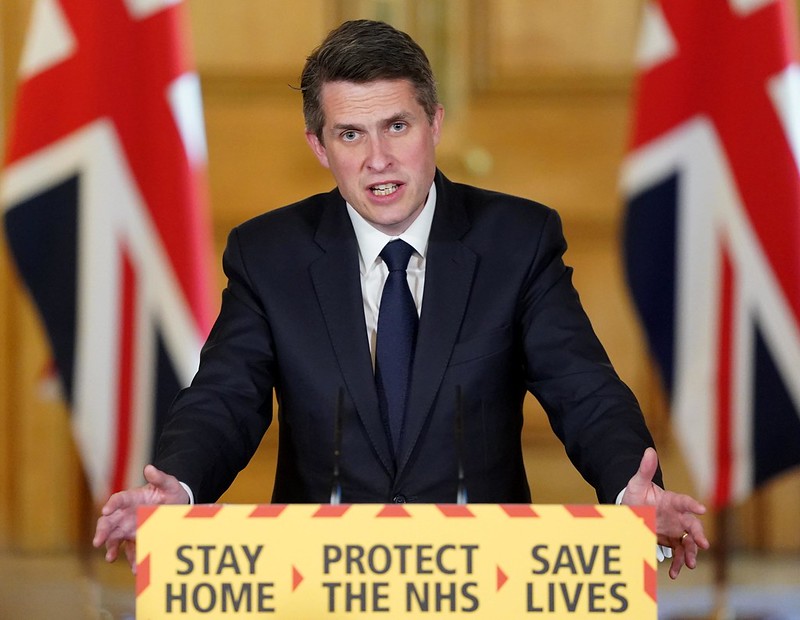
Education Secretary, Gavin Williamson in 10 Downing Street. Credit: Pippa Fowles/ No 10 Downing Street.
By Stuart Littlewood | American Herald Tribune | October 14, 2020
Gavin Williamson is Education Secretary in the screwball government of Boris Johnson. And he has just threatened universities that they could have their funding cut if they don’t adopt the International Holocaust Remembrance Alliance (IHRA) definition of anti-Semitism before Christmas.
Williamson wrote to vice-chancellors last week saying he was “frankly disappointed” that there were still “too many disturbing incidents of anti-Semitism on campus and a lack of willingness by too many universities to confront this”, and that the number of universities adopting the definition “remains shamefully low”.
“These providers are letting down all their staff and students, and, shamefully, their Jewish students in particular,” he said.
He insists that adopting the IHRA definition “is morally the right thing to do” – and he underlines morally! “You should have no doubt: this government has zero tolerance towards anti-Semitism. If I have not seen the overwhelming majority of institutions adopting the definition by Christmas then I will act.”
Williamson is asking officials to consider directing the Office for Students (OfS) to impose a new regulatory condition of registration or suspend funding for universities at which anti-Semitic incidents occur and which haven’t signed up to the definition.
“While many universities have rightly been quick over the summer to demonstrate their readiness to take action against other forms of racism, it is frankly disturbing that so many are dragging their feet on the matter of anti-Semitism.
“The repugnant belief that anti-Semitism is somehow a less serious, or more acceptable, form of racism has taken insidious hold in some parts of British society, and I am quite clear that universities must play their part in rooting out this attitude and demonstrating that anti-Semitism is abhorrent.”
The OfS said they will explore with the Department for Education what practical steps should be taken to ensure the IHRA definition’s wider adoption. But Universities UK were more cautious: “We recommend universities do all they can to tackle anti-Semitism, including considering the IHRA definition, whilst also recognising their duty to promote freedom of speech within the law.” And that last bit is what Williamson ought to have considered before stupidly going off the deep end.
Individual right of free expression in all higher education institutions
Williamson’s first problem is his ignorance. He’s completely at odds with the opinion of top legal experts who were asked for their views by Free Speech on Israel, Independent Jewish Voices, Jews for Justice for Palestinians and the Palestine Solidarity Campaign. In a nutshell, those in public life cannot behave in a manner inconsistent with the European Convention on Human Rights, which provides for freedom of expression which applies not only to information or ideas that are favourably received or regarded as inoffensive, but also to those that offend, shock or disturb the State or anyone else.
There is a further obligation to allow all concerned in public debate “to express their opinions and ideas without fear, even if these opinions and ideas are contrary to those defended by the official authorities or by a large part of public opinion, or even if those opinions and ideas are irritating or offensive to the public”.
Read Article 10 of the European Convention on Human Rights, Mr Williamson, which says that everyone has the right to freedom of expression including “freedom to hold opinions and to receive and impart information and ideas without interference by public authority and regardless of frontiers.”
Also, check Article 19 of the Universal Declaration of Human Rights which says the same sort of thing, subject of course to the usual limitations required by law and respect for the rights of others.
The House of Commons Home Affairs Select Committee recommended that before accepting the IHRA’s definition of anti-Semitism, two caveats should be included:
- It is not anti-Semitic to criticise the Government of Israel, without additional evidence to suggest anti-Semitic intent.
- It is not anti-Semitic to hold the Israeli Government to the same standards as other liberal democracies, or to take a particular interest in the Israeli Government’s policies or actions, without additional evidence to suggest anti-Semitic intent.
The Government, in its eagerness to appease the Zionist lobby, dropped the caveats saying they weren’t necessary.
Eminent human rights lawyer Hugh Tomlinson QC also criticised the definition. Firstly, it wasn’t a legally binding definition so it didn’t have the force of a statutory one. And it couldn’t be considered a legal definition of anti-Semitism as it lacked clarity. Therefore any conduct contrary to the IHRA definition couldn’t necessarily be ruled illegal.
Secondly, the language was far too vague to be useful as a tool. In Tomlinson’s view the Government’s decision to adopt the IHRA Definition was simply a freestanding statement of policy, a mere suggestion. No public body is under an obligation to adopt or use it, or, given the unsatisfactory nature of the definition, should be criticised for refusing.
He warned that if a public authority did decide to adopt the definition then it must interpret it in a way that’s consistent with its statutory obligations. In particular, it cannot behave in a manner inconsistent with the European Convention on Human Rights, which provides for freedom of expression and freedom of assembly.
A further obligation put on public authorities is “to create a favourable environment for participation in public debates for all concerned, allowing them to express their opinions and ideas without fear, even if they are contrary to those defended by the authorities or by a large part of public opinion”.
So, in Tomlinson’s opinion the IHRA Definition doesn’t mean that calling Israel an apartheid state that practises settler colonialism, or advocating boycott, divestment or sanctions (BDS) against Israel, can properly be characterized as anti-Semitic. Furthermore, a public authority seeking to apply the IHRA Definition to prohibit or punish such activities “would be acting unlawfully.”
Government’s ‘naive stance’
Retired Lord Justice of Appeal, Sir Stephen Sedley, also offered advice criticising the IHRA working definition for lack of legal force. “At the same time, it is not neutral: it may well influence policy both domestically and internationally.”
He added that the right of free expression, now part of our domestic law by virtue of the Human Rights Act, “places both negative and positive obligations on the state which may be put at risk if the IHRA definition is unthinkingly followed”. Moreover the 1986 Education Act established an individual right of free expression in all higher education institutions “which cannot be cut back by governmental policies”.
Sedley was of the view that the IHRA definition is open to manipulation and “what is needed now is a principled retreat on the part of government from a stance which it has naively adopted in disregard of the sane advice given to it by the Home Affairs Select Committee.”
Williamson’s second problem is his prejudice. He’s a fanatical Israel worshipper and far from neutral in the hype surrounding anti-Semitism in the UK. In January 2018 when he was defence secretary he addressed an audience of over 250 Conservative Friends of Israel and supporters, including 50 parliamentarians, telling them that “Britain will always be Israel’s friend” and praising Israel as a “beacon of light and hope, in a region where there is so much hatred and hurt”. He added: “We shouldn’t underestimate how difficult it is to keep that light bright and burning”.
Recalling his visit to Israel as a teenager, he said: “What I found was a liberal, free, exciting country that was so at ease with itself, a country that absorbed and welcomed so many people. That made an enormous impression upon me”.
Williamson condemned the “completely unreasonable… sheer simple hatred” channelled towards Israel and asked: “If we are not there to stand up for a country, whose views and ideals are so close, or are simply our own, what are we as a nation? What are we in politics, if we cannot accept and celebrate the wonderful blooming of democracy that is Israel?”
Achingly funny. And highlighting the UK’s role in the creation of Israel, he said: “Britain and Israel have an amazing relationship. We would like to think that we were very much at the birth of the nation, and very much helped it in terms of its delivery and coming into the world”.
He said that Britain and Israel have “a strong and firm relationship of working together. It’s a relationship of partners…. It’s a partnership of equals. A partnership of friends”.
So hopelessly brainwashed.
Then, in April 2018 at a similar meeting to celebrate the regime’s 70th anniversary Williamson waxed lyrical describing Israel as a “light unto the nations” and adding that not only do Israel and Britain face shared security threats, “our relationship is underpinned by a shared sense of values: justice, compassion, tolerance”. He emphasised that Israel is a “liberal, free and exciting country” and that the UK-Israel relationship is the “cornerstone of so much of what we do in the Middle East”.
Breaching the Ministerial Code?
But Gavin Williamson is not the only Government minister to threaten our universities in this crude manner. A year ago Communities Secretary Robert Jenrick vowed to take action against universities and “parts of local government” who, he said, had become “corrupted” by anti-Semitism. He directed his attack on the universities who receive public money but “choose not to accept our IHRA definition of anti-Semitism and use it when considering matters such as disciplinary procedures”.
Writing in the Sunday Express, he added: “I will use my position as Secretary of State to write to all universities and local authorities to insist that they adopt the IHRA definition at the earliest opportunity.
“I expect them to confirm to me when they do so. Failure to act in this regard is unacceptable and I will be picking up the phone to Vice Chancellors and local government leaders to press for action, if none is forthcoming.”
According to Wikipedia Jenrick’s wife was born in Israel and their children are brought up in the Jewish faith. He told the Board of Deputies he would not tolerate local authority approved BDS (Boycott, Divestment and Sanctions) campaigns against those profiteering from Israel’s illegal occupation of Palestine. “Local authorities should not be wasting time and taxpayer’s money by dabbling in foreign policy or pursuing anti-Israel political obsessions, but instead focusing on delivering first class local public services.” The same could be said of his colleague Williamson’s pro-Israel obsession – and his own – when they should be getting on with governing Britain, but of course they are exempt from their own rules.
Both Jenrick and Williamson appear to fall foul of the Ministerial Code. The first two paragraphs are enough to banish them to outer darkness, one would have thought.
1.1 Ministers of the Crown are expected to maintain high standards of behaviour and to behave in a way that upholds the highest standards of propriety.
1.2 Ministers should be professional in all their dealings and treat all those with whom they come into contact with consideration and respect. Working relationships…. should be proper and appropriate. Harassing, bullying or other inappropriate or discriminating behaviour wherever it takes place is not consistent with the Ministerial Code and will not be tolerated.
Elsewhere the Code decrees that “ministers must ensure that no conflict arises, or appears to arise, between their public duties and their private interests” and they are expected to observe the Seven Principles of Public Life. The Principle of Integrity states that holders of public office “must avoid placing themselves under any obligation to people or organisations that might try inappropriately to influence their work”.
That suggests to me they ought to be slung out on their ear and never allowed near the levers of power again. But nobody in government is principled enough or has the balls to do it.
What do you think?
FBI used MEDIA REPORTS seeded by British spy to ‘corroborate’ Steele Dossier, declassified spreadsheet shows
By Nebojsa Malic | RT | October 13, 2020
The FBI sought to ‘verify’ information in the notorious dossier at the heart of Russiagate by using media articles seeded by the actual dossier author, British spy Christopher Steele, newly released evidence has shown.
The so-called Steele Dossier is the centerpiece of ‘Russiagate,’ the conspiracy theory that Donald Trump “colluded” with Moscow in the 2016 US presidential election. The dossier’s most bombastic claim was that Russia had “kompromat” on him in the form of sex tapes from a Moscow hotel involving urinating prostitutes.
Steele compiled the dossier for Fusion GPS, a DC-based firm paid by Hillary Clinton’s presidential campaign through the DNC. The FBI then used it to obtain a FISA warrant to spy on Trump campaign aide Carter Page in October 2016, and extended it three times well into 2017.
A 94-page spreadsheet made public on Monday, however, shows the FBI relied heavily on media reports to corroborate Steele’s claims – in many cases, the very same reports Steele had planted himself.
According to analyst Stephen McIntyre, footnotes listed in the spreadsheet show that 39 percent of the footnotes lead to Washington, DC media outlets, another 29 percent are redacted, and Steele himself was cited on 18 occasions, somehow self-verifying his own work.
In one instance, McIntyre notes, the FBI triple counted an article from the Daily Beast as three separate sources. Other media outlets named in the document are CNN, The New York Times, The Washington Post, Yahoo News and Mother Jones.
The FBI had actually decided to fire Steele as a paid informant in September 2016 – before obtaining the Page warrant – because he leaked to the media, specifically Yahoo and Mother Jones, but that never raised any red flags either with the warrant or the corroboration, apparently.
Moreover, the Bureau knew in December 2016 that the “primary sub-source” (PSS) for the dossier was a Russian national they had investigated as a foreign agent in 2009, but the investigation was abandoned without explanation and this fact was never flagged. Even after interviewing the PSS in January 2017, and establishing that most of the dossier was fabricated outright, the FBI continued to use it at the FISA court to extend the Page warrant.
Another source the FBI used to corroborate Steele was Cody Shearer, a long-time Clinton operative who produced a memo alleging that Russian intelligence had a sex tape of Trump. That amounts to more circular reporting, however, as Steele was reportedly given the Shearer dossier by State Department official Jonathan Winer, and then handed it over to his FBI contacts in October 2016.
The spreadsheet is the first confirmation that the FBI actually used the ‘Shearer Dossier,’ whose existence was first reported by the Guardian in January 2018, as part of a push by Democrats to show that the Steele dossier wasn’t the sole grounds for the FISA warrants.
Just last week, however, Director of National Intelligence John Ratcliffe declassified notes from then-CIA chief John Brennan, who said he warned the Obama administration about a plan by Hillary Clinton to smear Trump with allegations of ‘Russian collusion’ as a means of “distracting the public from her use of a private email server” before the 2016 election.
The two-year probe by Special Counsel Robert Mueller came up with zero evidence of “collusion” between the Trump campaign and Russia, much less Trump himself – and while it argued that Moscow “meddled” in US elections, it offered no evidence beyond its own assertions contained in indictments that were subsequently dropped when challenged in court.
While all these revelations have amounted to an indictment of the entire ‘Russiagate’ affair, the media that gave each other awards for their coverage of ‘collusion’ has never apologized for any of it. To this day, millions of Americans continue to believe their president is a “Russian agent.”
Opaque, Unaccountable: Dangers of the New COVID Bio-Security Complex
By Patrick Henningsen | 21st Century Wire | October 13, 2020
Seven months into this crisis, it can’t be any clearer. Just as they did following 9/11, western governments are using the COVID ‘pandemic’ crisis as a pretext to usher in whole new layer of security state bureaucracy, and one which has the power to penetrate more deeply into our lives.
For those who are old enough to remember, prior to September 11, 2001, there was no such thing as a Department of Homeland Security (DHS), and yet in a matter of a few years, this federal department quickly grew into one of the largest federal agencies taking in tens of billions of taxpayer dollars each year ever since. In fact, the term Homeland didn’t even exist in America before that. But it was the perceived threat which provided it’s raison d’etre – buttressed by an incessant barrage of propaganda by the state and its media adjuncts, which made this new paradigm a reality. Soon, all of these new state apparatuses and security initiatives were all nestled neatly under the new banner of the Global War on Terror.
In 2020, this exact process has been repeated, only this time the threat isn’t the spectre of radical Islamist terror coming from foreign lands, but something much closer to home.
According to our governments, the new threat is your neighbour, your teacher, the shopkeeper, and even your family members.
And you are a threat to each of them.
And everyone is a threat to each other.
I described this dialectic in the recent special edition of New Dawn Magazine. Here’s a brief passage from my article entitled, “THE GREAT RESET: A Global Flu d’Etat”:
From the onset, computer-modeled predictions wildly overestimated death tolls in key countries. This was not by accident as the initial political and mass media campaign of shock and awe placed populations in an applied cognitive framework of helplessness and dependency.
The same psychological levers were activated in the immediate aftermath of the attacks of 11 September 2001. Psychologically traumatised western electorates not only accepted any level of state and corporate security, infringement of civil liberties and invasion of privacy, many even demanded their governments prosecute overseas wars to eliminate the perceived threat, at that time, of al Qaeda and international terrorism. Subsequently, a new normal was rolled-out globally, a series of endless wars and a leviathan of ‘anti-terror’ measures and digital surveillance at home.
Despite efforts to try and convince the public that everyone is a potential terrorist, the climate of fear was difficult to maintain. The genius of the COVID crisis is that the Establishment has now managed to convince us that everyone is a potential carrier of a deadly pathogen and that anyone who so much as sneezes in the vicinity of any- one else could not only kill them but also trigger a deadly ‘second wave’ of the pandemic.
Phase one of The Great Reset.
This week, the UK Government announced its latest round of emergency measure and regional lockdowns, supposedly for fighting the coronavirus.
Their new “Tier Three” lockdown system will determine whether towns or cities will be allowed to keep pubs, gyms and other leisure facilities open, for up to a further six months. But who knows when it will end. This has prompted concerned members of public, along with a few brave officials, to ask who exactly is setting this new Three-Tier system?
According to government officials, the new system will classify regions as either ‘medium’, ‘high’ or ‘very high’ levels, with high and above triggering new local lockdowns.
Welcome to thin end of the state’s bio-surveillance wedge. Similar protocols are being rolled out in Five Eyes Alliance nations the United States, Canada, Australia and New Zealand.
Just as with the global war on terror, governments have now erected an entirely new level within the ever-expanding national security state. In the UK, it’s called the Joint Bio Security Centre (JBC), formed in July, and already a £9 billion operation. Expect that number to grow substantially as the security complex discovers new and more complex systems required to keep pace with a new global bio surveillance and biological arms race.
“Led by a senior spy, the JBC does not publish details of its deliberations, the sources of its evidence or its key personnel. Nevertheless, its advice to ministers is understood to have guided recent decisions on where to enforce the local lockdowns affecting millions of people across the country,” said The Telegraph.
Is COVID really so deadly that the state needs to reconfigure all of its public health agencies under a new command and control hierarchy? Indeed, many asked the same question about al-Qaeda 20 years ago.
Unfortunately, few officials are demanding any answers or calling for accountability. There is only one such inquisitive public servant so far, Dr Greg Clark MP, Chairman of Science and Technology Committee, who believes that the British public are owed some answers as to who is in this opaque group, and which person(s) is making the final decisions for these rather arbitrary ‘alert levels’ being issued by the government.
Exactly what is the remit of this new JBC? According to the Institute for Government:
The centre will have two main jobs. The first is as an independent analytical function to provide real-time analysis about infection outbreaks. It will look in detail to identify and respond to outbreaks of Covid-19 as they arise. The centre will collect data about the prevalence of the disease and analyse that data to understand infection rates across the country.
Its second job is to advise on how the government should respond to spikes in infections – for example by closing schools or workplaces in local areas where infection levels have risen. Should UK government ministers decide to impose different restrictions in different areas and regions across England, it will be on the advice of the JBC.
And just as we suspected, here’s the salient point:
The JBC looks to be based on the Joint Terrorism Analysis Centre (JTAC). JTAC analyses intelligence related to terrorism and sets threat levels, which in turn inform ministers’ decisions on protecting the public and operational deployments by the police and other agencies.
The current Three-Tier alert system was based on the following framework devised for the JBC in determining new Covid-19 alert levels:
- Level 1: Covid-19 is not known to be present in the UK
- Level 2: Covid-19 is present in the UK, but the number of cases and transmission is low
- Level 3: a Covid-19 epidemic is in general circulation
- Level 4: a Covid-19 epidemic is in general circulation; transmission is high or rising exponentially
- Level 5: as level 4 and there is a material risk of healthcare services being overwhelmed.
If it looks and sounds like a military operation, that’s because it is. This is the first time that the science of epidemiology has been brushed aside in favour of a one-size-fits-all, military-style approach to mitigating a viral pandemic.
The JBC insists that they are only providing recommendations “informed by the data collected and analysed by the JBC.” It is therefore up to Downing Street and its chief medical officer to issue the final alert level. Presumably they will be processing testing data, along with NHS Track and Trace, as well as data from the Office of National Statistics, and Public Health England (if it still exists).
We’re told that the JBC is being headed by an intelligence chief from GCHQ, cybersecurity director Dr Clare Gardiner. According to her biography, she’s a “qualified epidemiologist, medical researcher, and cybersecurity director.”
The Telegraph adds, “She reports to Baroness Dido Harding, the chief of NHS Test and Trace, while the entire JBC organisation falls under the control of the Department of Health, which answers to the Mr Hancock. Government sources insisted the body was largely staffed by civil servants meaning it was “not appropriate” to release their identities.”
Lockdowns are no trivial matter and deeply impact the lives of millions of people, and carry with them the most grave economic and social consequences. They also cost lives. Hence, the concern here is one of transparency, and it is unknown if this new ‘bio-intelligence’ agency will be engaging with independent scientists, or will it merely collate data and liase with government-appoint science advisors. It seems odd to be blending the civil service and signals intelligence with the science departments. From a political and bureaucratic point of view, it’s certainly convenient for politicians to have yet another compartment to whom they can ‘pass the buck’ and use plausible deniability for obfuscation purposes. If nothing else, it gives Ministers yet another panel of ‘experts’ to defer to – the familiar illusion of impressive depth and deep considerations supposedly informing the Ministers’ final assessments – when in reality, it just becomes more convoluted. Drowning in unaccountable bureaucracy. That’s where the epic mistakes are usual made.
Just as with the disastrous War on Terror, there is a serious danger that an entirely new division of security state technocracy will inevitably become a money sink, operating in its own bubble within an already knotted civil service, and propelled by endless feedback loops – creating more problems than were there to begin with.
It’s important to point out that such historic and sweeping changes in government can only be achieved amid a climate of fear. Since the beginning of this crisis, the mainstream media have been dedicated to delivering that fear. During the War on Terror, the media scooped up whatever government and the intelligence community were serving, and just ran with it. Without them, the government could never have realised any of its newfound powers. It’s the same now with COVID. You need only to replace the anti-terror mavens in intelligence community with The Science committees. This is precisely ‘the intellectual artillery’ of government joined-up with the media, which Spengler warned about almost a century ago in his treatise, The Decline of the West.
Make no mistake about it – freedom and democracy are under attack from a new and revitalised, COVID-inspired security industrial complex.
Judging by the lack of tenacity by media in being willing to hold any of the Five Eyes government to account for their horrendous performances thus far, it seems unlikely that the media will challenge this new bio-security arm that much.
One can only hope the penny drops much sooner with this leviathan, than it has with previous security state paradigm shifts.
***
Footnotes:
1 Decline of The West, Volumes I & II: https://archive.org/details/in.ernet.dli.2015.283129/page/n471/mode/2up
***
Author Patrick Henningsen is an American writer and global affairs analyst and founder of independent news and analysis site 21st Century Wire, and is host of the SUNDAY WIRE weekly radio show broadcast globally over the Alternate Current Radio Network (ACR). He has written for a number of international publications and has done extensive on-the-ground reporting in the Middle East including work in Syria and Iraq. See his archive here.
Featured Video

or go to
Aletho News Archives – Video-Images
From the Archives
A Lesser “Grade” of Human
By Michael Hoffman | Revelation of the Method | January 3, 2024
Will the more than 100 Iranians killed by terrorist bombs today be mourned in the West as victims of terrorism? Certainly not. Allied doctrine has it that the killing of Israeli or American civilians is a crime of cosmic proportions, while shedding the blood of “enemy” women and children is perfectly acceptable; indeed commendable.
The West does not memorialize the hundreds of thousands of civilians bombed by the U.S. in Serbia, Iraq, Afghanistan and every major German city 1943-1945. America’s fire-bombing of the city of Tokyo by General Curtis LeMay in March 1945 was followed by Harry Truman’s atomic incineration of Hiroshima and Nagasaki in August of that year. Truman never had a moment of doubt or regret over the murder of more than a 100,000 Asian children, mothers and non-combatant boys and men. It was business as usual for the “noble” Allies during the “Good War.”
In the West human rights signifies passionate concern only for civilians designated as truly human: Israelis first, then Americans and British, followed by their satraps.
This inhumanity is the legacy of Talmudic ideology, beginning with tractate Sanhedrin 57a from 400 A.D., concerning liability for capital punishment: “If a Jew murders a gentile, he is exempt.”
This teaching of contempt was reiterated in the dogma of Chabad Lubavitch founder Rabbi Shneur Zalman in the 18th century. … continue
Blog Roll
 Aletho News
- MOE: Nearly 22,000 Students and Education Workers Killed
- Guterres in Islamabad: Genocide, cowardice, and the cage of Imran Khan
- Johnson, Marandi say Yemen holds upper hand over Saudi Arabia
- False flags won’t save aggressors, Iran FM spokesman says
- The Makkah Pact Enters Into Force: The End of American Dominance or Its New Form?
- NATO’s top generals gather in Kiev
- EU’s continuing expansion – greater threat to Russia
- US Senator Murphy says Pentagon denied him entry to US base in Qatar
- Israel expands “incitement” charge to target Palestinian education and memory
- How Israel seeks to reshape Arab classrooms
- If Americans Knew
- Israeli war chief briefs ministers on potential war against Palestinian Authority
- New Report: Israel Killed nearly 21,000 Palestinian Students and Education Workers in Past Three Years
- Israel’s flailing chatbot army
- Five Palestinians Killed, Others Injured by Israeli Fire in Gaza
- Israel is rewriting the Palestinian curriculum in East Jerusalem to erase Palestinian identity
- Three years of genocide: Israel turned prisons into killing grounds and torture sites
- Three years of genocide. Words fail. Daily Update
- ‘I’d rather die than go back’: A Palestinian teen’s 10-month nightmare in Israeli jail
- How Jared Kushner’s firm’s investment in an Israeli company could be a major conflict of interest
- Soldier testimony sheds light on how Israel wages information war
- No Tricks Zone
- US September “Heat” Was No Record…Many Records Set Decades Ago
- Latest European Green Energy Debacle; Portugal’s Largest Flagship Solar Park Insolvent!
- Green Energy Debacle: German Expert Professor Fritz Vahrenholt Warns Of Severe Economic And Social Consequences
- Two More Paleo Reconstructions Affirm Meters-Higher Sea Levels Across Ireland, Brazil 7000-6000 Years Ago
- New Study: Earth And Venus Surface Warmth Largely Explained By Convection And Lapse Rate, Not CO2 Or Radiation
- 2025 Nature Paper Claiming Worsening Global Drought Gets RETRACTED …Heavily Flawed
- New Study: ‘Global Drought Shows No Detectable Recent Acceleration Under Climate Warming’
- Economic Masterminds: German Socialists Suggest Taxing Productivity Gains Stemming From Using AI
- The South China Sea Has Not Been Cooperating With The Climate Change Narrative
- Energy Crisis: Germany Enters Heating Season With Historically Low Gas Reserve Fill Levels

