Is Criticism of Israel Already an Official Hate Crime in America?
By Philip Giraldi – American Free Press – December 2, 2019
One subject that congressmen and the mainstream media tend to avoid is the erosion of fundamental liberties in the United States as a consequence of the war on terror and American involvement in the Middle East. Some of America’s legislators apparently do not even understand that freedom of speech actually means that one can say things that others might find distasteful. The assault on freedom of speech has been accelerated through the invention of so-called “hate speech,” which has in turn morphed into “hate crimes” where punishments are increased if there is any suggestion that hatred of groups or individuals is involved. Some have rightly questioned the whole concept, pointing out that if you murder someone the result is the same whether you hate your victim or not.
Freedom of speech is particularly threatened in any situations having to do with Israel, a reflection of the power of that country’s lobby in the United States. At a recent town hall gathering, Rep. Dan Crenshaw (R-Texas) demonstrated how he and his colleagues run and hide whenever the issue of Israel is raised when he would not respond directly to a question over whether any criticism of Israel should or should not be protected under the First Amendment. Crenshaw is a Republican and generally reliably conservative, though he recently spoke out against the “For the People Act of 2019,” which he claimed “would limit free speech dramatically.”
A constituent specifically asked Crenshaw’s opinion about federal laws that require citizens in some states to sign a pledge that they will not boycott Israel if they wish to get government contracts or obtain a government job. The audience member also mentioned a law passed in Florida that bans anti-Semitism in public schools and universities, defining “anti-Semitism” as criticism of Israel. The constituent observed, “These laws are obviously flagrant and troubling violations of the First Amendment to free speech.”
“Will you honor your oath and denounce these laws here, now and forever?” Crenshaw was then asked. Crenshaw quickly fired back that the critic was “cloaking yourself in the First Amendment” to enable engaging in “vehement anti-Semitism.” Crenshaw then asserted that the questioner was “advocating the BDS movement,” a recent target of much of the legislation that the critic was addressing.
BDS refers to the Boycott, Divestment, and Sanctions movement, which calls on people to protest Israel by pulling investments from and boycotting the country.
Israel is engaged in what might be described as a war with the objective of driving any and all criticism of the Jewish state out of polite discourse, making it illegal wherever and whenever possible. The Knesset has passed legislation criminalizing anyone who supports BDS and has set up a semi-clandestine group called Kella Shlomo to counteract its message. The country’s education minister has called BDS supporters “enemy soldiers” and has compared them to Nazis. Netanyahu has also backed up the new law with a restriction on foreigners who support the BDS movement entering the country, including American Jewish dissidents, several of whom have been turned around at the airport and sent home.
Israel has been particularly successful at promoting its own preferred narrative, together with sanctions for those who do not concur, in the English language speaking world and also in France, which has the largest Jewish population in Europe. The U.S. government under Donald Trump is completely under the thumb of the Israeli prime minister’s office, with Secretary of State Mike Pompeo recently saying “our major focus is stamping out anti-Semitism.”
Sanctions already in place in Europe consist of fines and even jail time. The legal penalties come into play for those criticizing Israel or questioning the accuracy of the accepted holocaust narrative, i.e., disputing that “6 million died.” Even attacking specific Israeli government policies, like its slaughter of Palestinians in Gaza every Friday, can be found guilty of anti-Semitism, which is now considered a hate crime in Britain, France, Germany, and, most recently, the Czech Republic. In Britain, where the Jewish lobby is extremely strong, a law passed in December 2016 made the UK one of the first countries to use the definition of anti-Semitism agreed upon earlier in the year at a conference of the Berlin-based International Holocaust Remembrance Alliance (IHRA).
A statement from the British prime minister’s office at that time explained that the intention of the new definition was to “ensure that culprits will not be able to get away with being anti-Semitic because the term is ill-defined, or because different organizations or bodies have different interpretations of it.”
The British government’s own definition relies on guidance provided by the IHRA, which asserts that it is considered anti-Semitic to accuse Jews of being “more loyal to Israel or their religion than to their own nations, or to say the existence of Israel is intrinsically racist.” In other words, even if many Jews are more loyal to Israel than to the countries they live in and even though Israel is in fact intrinsically racist, it is now illegal to say so in Great Britain.
One should not be surprised, as the British government’s subservience to Jewish and Israeli interests is nearly as enthusiastic as is government in the United States, though it is driven by the same sorts of things—Jewish money and Jewish power, particularly in the media. A majority of Conservative Party members of parliament have joined Conservative Friends of Israel, and the Labour counterpart is also a major force to be reckoned with on the political left.
Here in the United States, the friends of Israel appear to believe that anyone who is unwilling to do business with Israel or even with the territories that it has illegally occupied should not be allowed to obtain any benefit from federal, state or even local governments. Constitutional guarantees of freedom of speech and association for every American are apparently not valid if one particular highly favored foreign country is involved, as the discussion with Crenshaw reveals.
Twenty-seven states now have laws sanctioning those who criticize or boycott Israel. And one particular pending piece of federal legislation that is regularly re-introduced into the Senate would far exceed what is happening at the state level and would set a new standard for deference to Israeli interests on the part of the national government. It would criminalize any U.S. citizen “engaged in interstate or foreign commerce” who supports a boycott of Israel or who even goes about “requesting the furnishing of information” regarding it, with penalties enforced through amendments of two existing laws, the Export Administration Act of 1979 and the Export-Import Act of 1945, that include potential fines of between $250,000 and $1 million and up to 20 years in prison.
Israel, and its friends like Crenshaw, are particularly fearful of the BDS movement because its non-violence is attractive to college students, including many young Jews, who would not otherwise get involved on the issue. The Israeli government clearly understands, correctly, that BDS can do more damage than any number of terrorist attacks, as it represents a serious critique of the behavior of the Jewish state while also challenging the actual legitimacy of the Israeli government and its colonizing activity in Palestine. Much of the current hate crime legislation in places like Germany and the Czech Republic directly targets BDS, stating specifically that it is “inherently” anti-Semitic. In late July, the House of Representatives overwhelmingly passed its own resolution condemning BDS explicitly in a 398-to-17 vote.
Going hand-in-hand with the condemnation of BDS is a drive to maintain the exclusivity of Jewish suffering. In June, when Rep. Alexandria Ocasio- Cortez (D-N.Y.) called border detention centers holding asylum seekers “concentration camps,” she was inundated with protests from Jewish groups that claimed she was denigrating the holocaust and “insulting victims of genocide.” The United States Holocaust Memorial Museum even published a statement objecting to comparisons between “the holocaust and other events.”
It is important for Americans to realize that Israel not only spies on the U.S., digs its paws deep into our Treasury, and perverts Washington’s Middle East policy, it is also attempting to dictate what we the people can and cannot say. And Congress and much of the media are fully on board, which is the real tragedy.
French MPs pass pro-Zionism resolution, defy warnings by advocates of Palestine rights
Press TV – December 4, 2019
The lower house of France’s Parliament has passed a nonbinding resolution equating criticism of the Zionists occupying Palestinian territories with anti-Semitism, defying warnings that such a move could serve to stifle the advocates of Palestinian rights.
The National Assembly passed the resolution on Tuesday, with 154 votes for and 72 against, various media outlets reported.
The resolution states, “Criticizing the very existence of Israel as a collective composed of Jewish citizens is tantamount to hatred towards the Jewish community as a whole.”
“Such abuses increasingly make anti-Zionism ‘one of the contemporary forms of anti-Semitism’ in the words of the President of the Republic,” it adds, citing French President Emanuel Macron.
The Zionist entity proclaimed existence in 1948 after occupying huge swathes of regional countries during a Western-backed war.
Right before the war, it had already gone on a campaign of ethnic cleansing that lasted until 1949, leading to the expulsion of between 750,000 and 850,000 Palestinians from their homeland while the Israeli regime was replacing them with a similar number of Jewish migrants.
Still using far-and-wide Western backing, the regime staged another wholesale war in 1967 that saw it seizing more chunks of land, including the West Bank, East Jerusalem al-Quds, the Gaza Strip and parts of Syria’s Golan Heights.
Many Jews worldwide are opposed to the occupation of Palestinian land and reject the Zionist concept of Israel being a legitimate Jewish state, arguing that the Zionist entity has hijacked their religious identity so it could push ahead with its land theft agenda.
Israeli Minister of Strategic Affairs Gilad Erdan applauded the French lawmakers’ approval of the resolution, urging Paris to take “practical steps” against the international pro-Palestine Boycott, Divestment, and Sanctions (BDS) movement.
Inspired by the South African anti-apartheid movement, the BDS was initiated in 2005 by over 170 Palestinian organizations and later turned international. It is meant to initiate “various forms of boycott against Israel until it meets its obligations under international law” and end its occupation of Palestinian lands.
The French MPs’ move came despite earlier warnings by activists and rights organizations that such a resolution could work to block any criticism of the occupying entity.
In a letter to National Assembly President Richard Ferrand in October, 39 organizations said the resolution would compromise “defense of freedom of expression and assembly for groups and activists that must be allowed to defend the rights of Palestinians and criticize Israel’s policy without being falsely accused of anti-Semitism.”
The resolution would also “weaken the universalist approach” to combating all forms of racism,” the letter added.
As the French legislators were about to adopt the measure, a group of 129 Jewish and Israeli scholars signed a petition calling on the parliament to vote against the resolution.
The signatories said, “It is cynical and insensitive to stigmatize them (Palestinians) as anti-Semites for opposing Zionism… They oppose Zionism not because they hate Jews, but because they experience Zionism as an oppressive political movement.”
Speaking to France 24, James Cohen, a professor at the Université Sorbonne Nouvelle Paris 3 and one of the signatories, said that “by equating anti-Zionism with anti-Semitism, you’re broadening the definition of anti-Semitism too much […] you’re going very far afield.”
French vote one step closer to anti-Zionism ban
By Ramin Mazaheri – Press TV – December 3, 2019
Paris – France’s media has remained nearly silent ahead of a vote on a resolution which is one step away from criminalizing opposition to Zionism.
If the motion passes, in a vote on December 3rd, it will throw open the door to false accusations of anti-Semitism for anyone openly criticising Israeli crimes, war atrocities and its Apartheid policies.
The resolution purposely tries to confuse “Zionism”, which refers to the imperialist and segregationist political project upon which Israel is based, with “anti-Semitism” which is a bigotry against Jews and Judaism that has nothing to do with Israeli massacres and crimes against Palestinians and non-Jews.
The hypocritical irony is that the law arrives just as France is in the midst of its latest wave of Islamophobia. Last month many top, alleged leftist politicians refused to denounce Islamophobia because they said that doing so could mean they are not allowed to publicly criticise the tenets of Islam. Protesters in Paris asked: where are France’s many self-proclaimed defenders of free speech?
The resolution states that, “Criticizing the existence of a Jewish state is a way to express hate towards the entire Jewish community.” Not only is this logically false, but inaccurate: studies show the majority of Jews in Europe are also anti-Zionist. Such a view also unjustly and dangerously tries to hold all Jews responsible for the crimes committed by Israel.
Many believe that nowhere in the world is right and wrong clearer than in Palestine, and the inability to discuss the imperialist, segregationist and constantly murderous project of Zionism will surely lead to more funerals for innocent Palestinians.
DHS proposes MANDATORY facial recognition checks for US citizens at airports
RT | December 3, 2019
The US Department of Homeland Security (DHS) is pushing to impose mandatory facial recognition scans on all Americans entering or leaving the United States, moving to close a loophole that allows citizens to opt out.
Proposed in a recent filing, the DHS requested a change to the current rules in order to “provide that all travelers, including US citizens, may be required to be photographed upon entry and/or departure” from the US, citing the need to identify criminals or “suspected terrorists.” While not yet implemented, the rule change is in the “final stages of clearance,” a DHS official told CNN Business.
Under the existing guidelines, US citizens and other lawful permanent residents have the ability to avoid airport biometric scans and identify themselves by another means. While some travelers have found it difficult to opt out given opaque or inconsistent guidelines from airport to airport, the DHS would apparently like to cut down on the confusion by doing away with the exemption altogether.
The new rule was rejected by civil liberties groups and privacy advocates, who said it would only further erode Americans’ privacy and subject them to yet another layer of intrusive government surveillance.
“Time and again, the government told the public and members of Congress that US citizens would not be required to submit to this intrusive surveillance technology as a condition of traveling,” said Jay Stanley, a senior policy at the American Civil Liberties Union, adding that the rule raises “profound privacy concerns.”
“Travelers, including US citizens, should not have to submit to invasive biometric scans simply as a condition of exercising their constitutional right to travel.”
The DHS is currently set to outfit 20 of America’s largest airports with biometric scanners by 2021, despite a flurry of privacy issues and ongoing technical problems. Last year, an internal watchdog report found that the department’s facial recognition tech was not performing up to snuff and “may be unable to meet expectations” by its deadline. The DHS also piqued security concerns last year when it announced it would partner with Amazon for its all-seeing HART system, which will pass highly detailed information on some 250 million people to the tech giant for storage.
Recalling a data breach in June which saw 100,000 license plate and traveler images stolen from a private contractor hired to store information for the DHS, Stanley said the government simply “cannot be trusted” with the invasive technology.
Remember traditional knowledge?
Climate Discussion Nexus | November 27, 2019
If not, don’t worry. Apparently Canadian authorities don’t either. Outgoing Environment Minister Catherine McKenna decided to reduce the number of polar bears the Inuit can hunt in Nunavik, in northern Quebec, despite their claim that from living on the land they knew there were lots. Now a judge has ruled that all that stuff about the wisdom of the ancestors was just virtue-signaling with forked tongue and that when it matters Eurocentric science elbows the ancestors aside. Which is ironic since even Eurocentric science actually says polar bears are flourishing, even if saying so out loud did get Susan Crockford fired.
The back story is that the Makivik Corporation, which represents the Inuit of Nunavik in legal matters, launched a suit in 2016 saying “By and large, Nunavik residents have observed an increase in the polar bear population, and a particularly notable increase since the 1980s.” Despite which Stephen Harper’s environment minister, Peter Kent, had written to the local wildlife board in 2012 asking them to establish the first-ever quota to limit hunting of the big white cute really scary grizzly bears. (Yes, polar bears are a subspecies of grizzlies.) The board, charged with melding western and traditional ways of thinking, ended up establishing a quota of 28 which the federal and Nunavut governments both rejected, annoying the board, which said the federal decision “clearly disregards the extensive body of Inuit traditional knowledge” relying instead “solely on the scientific population estimate.”
Catherine McKenna then cut the quota to 23, prompting Makavik to accuse her of setting “aside entirely the Inuit traditional knowledge” and failing “to even attempt the integration of the two systems of knowledge.” Not that anyone ever said what to do if they seemed to disagree.
The government of course oozed the usual rhetoric about their great respect for Inuit knowledge and claimed the quota was actually above the sustainable harvest rate of 4.5% if the numbers were as western science claimed. And a Federal Court just upheld the decision, though calling for “better communication”, while a spokesman for the minister said “Indigenous peoples are key partners in conserving and protecting nature, and we recognize their unique perspectives, knowledge, rights and responsibilities that can improve conservation outcomes”. But when they say there are so many bears it’s dangerous, well, our global warming computer model says there aren’t and since we’re in Ottawa we’re not worried if we’re wrong.
The ‘Whistleblower’ and the Politicization of Intelligence
By Scott Ritter – Consortium News – November 27, 2019
The whistleblower. A figure of great controversy, whose actions, manifested in an 11-page report submitted to the Intelligence Community Inspector General (ICIG) on August 12 alleging wrongdoing on the part of the president of the United States, jump-started an ongoing impeachment process targeting Donald Trump that has divided the American body politic as no other issue in contemporary time.
His identity has been cloaked in a shroud of anonymity which has proven farcical, given that his name is common knowledge throughout the Washington-based national security establishment in whose ranks he continues to serve. While Trump publicly calls for the identity of the whistleblower to be revealed, the mainstream media has played along with the charade of confidentiality, and Congress continues to pretend his persona is a legitimate national security secret, even as several on-line publications have printed it, along with an extensive document trail sufficient to corroborate that the named man is, in fact, the elusive whistleblower.
There is no legitimate reason for the whistleblower’s identity to remain a secret. The Democratic chairman of the House Intelligence Committee, Representative Adam Schiff, (D-CA) has cited statutory protections that simply do not exist while using his authority as chairman to prohibit any probe by his Republican colleagues designed to elicit information about the whistleblower’s identity. “The whistleblower has a right, a statutory right, to anonymity,” Schiff recently opined during recent impeachment-related testimony. And yet The Washington Post, no friend of Trump, was compelled to assign Schiff’s statement three “Pinocchios”, out of a scale of four, in rejecting the claim as baseless.
The myth of statutory protection for the whistleblower’s identity has been aggressively pursued by his legal counsel, Andrew Bakaj, the managing partner of the Compass Rose Legal Group, which has taken on the whistleblower’s case pro bono. In a letter to the president’s legal counsel, Pat Cippolone, Bakaj demanded that Trump “cease and desist in calling for my client’s identity”, claiming that the president’s actions, undertaken via Twitter and in press briefings, constituted violations of federal statutes prohibiting, among other things, tampering with a witness, obstruction of proceedings, and retaliating against as witness.
All of Bakaj’s claims are contingent upon the viability of the whistleblower’s status as a legitimate witness whose testimony can, therefore, be tampered, obstructed or retaliated against. The legal foundation of the whistleblower’s claims are based upon the so-called Intelligence Community whistleblower statute, 50 USC § 3033(k)(5), which stipulates the processes required to report and sustain an allegation of so-called “urgent concern” to the U.S. intelligence community. An “urgent concern” is defined, in relevant part, as: “A serious or flagrant problem, abuse, violation of the law or Executive order, or deficiency relating to the funding, administration, or operation of an intelligence activity within the responsibility and authority of the Director of National Intelligence involving classified information, but does not include differences of opinions concerning public policy matters.”
The Call
At issue was a telephone call made between President Trump and the newly elected President of Ukraine, Volodymyr Zelensky, on July 25 of this year. According to the whistleblower’s report to the ICIG, “Multiple White House officials with direct knowledge of the call informed me that, after an initial exchange of pleasantries, the President used the remainder of the call to advance his personal interests.” President Trump, the whistleblower alleged, “sought to pressure the Ukrainian leader to take actions to help the President’s 2020 reelection bid,” an act which the whistleblower claimed presidential abuse of his office “for personal gain.”
Upon review of the whistleblower’s report, which consisted of a nine-page unclassified letter and a separate two-page classified annex, Michael K. Atkinson, the Inspector General of the Intelligence Community, initiated an investigation of the complaint as required by the whistleblower statute. This investigation must be completed within a 14-day period mandated by the statute, during which time the ICIG “shall determine whether the complaint or information appears credible.”
While the statute is silent on the methodology to be used by the ICIG in making this determination, Atkinson had testified during his Senate confirmation hearing that, when it came to any investigation of a whistleblower complaint, “I will work to ensure that ICIG personnel conduct investigations, inspections, audits, and reviews in accordance with Quality Standards promulgated by CIGIE (Council of the Inspectors General on Integrity and Efficiency) to keep those activities free from personal, external, and organizational impairments.” The CIGIE standard in question requires that, “Evidence must be gathered and reported in an unbiased and independent manner in an effort to determine the validity of an allegation or to resolve an issue.”
In a letter transmitting the whistleblower complaint to the Director of National Intelligence (DNI), Atkinson stated that he had “determined that the Complainant (i.e., whistleblower) had official and authorized access to the information and sources referenced in the Complainant’s Letter and Classified Appendix, including direct knowledge of certain alleged conduct, and that the Complainant has subject matter expertise related to much of the material information provided in the Complainant’s Letter and Classified Appendix.”
However, when it came to assessing whether or not the whistleblower, in reporting the second-hand information provided to him by White House persons familiar with the July 25 Trump-Zelensky phone call, had done so accurately, Atkinson did not review the actual records of the telephone call, noting that he “decided that access to records of the telephone call was not necessary to make my determination that the complaint relating to the urgent concern ‘appears credible.’”
Atkinson declared that “it would be highly unlikely for the ICIG to obtain those records within the limited remaining time allowed by statute,” and opted to perform an investigation in violation of the very CIGIE standard he had promise to adhere to in his Senate testimony. In short, no evidence was gathered by the ICIG to determine the validity of the whistleblower’s allegation, and yet Atkinson decided to forward the complaint to the DNI, certifying it as “credible.”
The whistleblower statute allows the DNI seven days to review the complaint before forwarding it to the House Committee on Intelligence, with comments if deemed appropriate. However, in reviewing the actual complaint, Joseph McGuire, the acting DNI who took over from Dan Coats, who was fired by President Trump in early August, had questions about whether or not the matters it alleged fell within the remit of the whistleblower statute, and rather than forwarding it to the House Intelligence Committee, instead sent it to the Justice Department Office of Legal Counsel for legal review.
The Office of Legal Council, on September 3, issued a legal opinion rejecting the ICIG’s certification of the whistleblower complaint as constituting an “urgent concern” under the law. “The complaint,” the opinion read,
“does not arise in connection with the operation of any U.S. government intelligence activity, and the alleged misconduct does not involve any member of the intelligence community. Rather, the complaint arises out of a confidential diplomatic communication between the President and a foreign leader that the intelligence-community complainant received secondhand. The question is whether such a complaint falls within the statutory definition of ‘urgent concern’ that the law requires the DNI to forward to the intelligence committees. We conclude that it does not. The alleged misconduct is not an ‘urgent concern’ within the meaning of the statute.”
DOJ Rejected Complaint as Urgent
As related in the Office of Legal Counsel’s opinion, the Justice Department did, however, refer the matter to the Criminal Division of the Department of Justice for appropriate review. After considering the whistleblower’s complaint and classified annex, the Criminal Division opted not to pursue charges, in effect determining that no crime had been committed.
Under normal circumstances, this would have concluded the matter of Trump’s phone call with Zelensky, and the second-hand concerns unnamed White House officials had reported to the whistleblower. But this was not a normal circumstance. Far from diffusing an improperly predicated complaint, the failure of the acting DNI to forward the whistleblower complaint to the House Intelligence Committee, and the concurrent legal opinion of the Justice Department’s Office of Legal Counsel rejecting the “urgent concern” certification of the ICIG, opened the door for the whistleblower, through legal counsel, to reach out to the House Intelligence Committee directly.
The whistleblower followed procedures set forth in the whistleblower statute detailing procedures for a complaint, which had not been certified as an “urgent concern,” to be forwarded to Congress. The issue is that the matter was being treated by the ICIG, Congress and the whistleblower’s attorney’s as an “urgent concern”, a status that it did not legally qualify for.
On September 24, Bakaj sent a “Notice of Intent to Contact Congressional Intelligence Committees” to acting DNI McGuire providing “formal notice of our intent to contact the congressional intelligence committees directly” on behalf of the whistleblower, identified only as “a member of the Intelligence Community.” Almost immediately, Schiff announced via Twitter that “We have been informed by the whistleblower’s counsel that their client would like to speak to our committee and has requested guidance from the Acting DNI as to how to do so. We‘re in touch with counsel and look forward to the whistleblower’s testimony as soon as this week.”
Thus was set in motion events which would culminate in impeachment proceedings against President Trump. On the surface, the events described represent a prima facia case for the efficacy of statutory procedures concerning the processing of a whistleblower complaint. But there were warning signs that all was not right regarding both the whistleblower himself, and the processes involved leading to the whistleblower’s complaint being presented to Congress.
Political Bias?
Far from an exemplar in bureaucratic efficiency, the whistleblower complaint has opened a window into the politicization of the intelligence community, and the corresponding weaponization of the national security establishment, against a sitting president.
As I shall show, such actions are treasonous on their face, and the extent to which this conduct has permeated the intelligence community and its peripheral functions of government, including the National Security Council and Congress itself, will only be known if and when an investigation is conducted into what, in retrospect, is nothing less than a grand conspiracy by those ostensibly tasked with securing the nation to instead reverse the will of the American people regarding who serves as the nation’s chief executive.
The key to this narrative is the whistleblower himself. Understanding who he is, and what role he has played in the events surrounding the fateful July 25 telephone conversation, are essential to unravelling the various threads of this conspiracy.
Much has been made about the political affiliation of the whistleblower, namely the fact that he is a registered Democrat who supports Joe Biden as the Democratic candidate for the 2020 presidential election. On the surface this information is not dispositive—the intelligence community is populated by thousands of professionals of diverse political leanings and affiliations, all of whom have been trained to check their personal politics at the door when it comes to implementing the policies promulgated by the duly elected national leadership.
Indeed, Inspector General Atkinson, while acknowledging in his assessment of the whistleblower’s complaint an indication of possible political bias on the part of the whistleblower in favor of a rival political candidate, noted that “such evidence did not change my determination that the complaint relating to the urgent concern ‘appears credible’”. But when one reverse engineers the whistleblower’s career, it becomes clear that there in fact existed a nexus between the whistleblower’s political advocacy and professional actions that both influenced and motivated his decision to file the complaint against the president.
A Rising Star
Like most CIA analysts, the whistleblower possessed a keen intellect born of stringent academic preparation, which in the whistleblower’s case included graduating from Yale University in 2008 with a degree in Russian and East European studies, post-graduate study at Harvard, and work experience with the World Bank.
Andrea Kendall-Taylor, a contemporary colleague of the whistleblower, has provided an apt account for what is expected of a CIA analyst. “The CIA is an intensely apolitical organization,” Kendall-Taylor wrote. “As intelligence analysts, we are trained to check our politics at the door. Our job is to produce objective analysis that the country’s leaders can use to make difficult decisions. We undergo rigorous training on how to analyze our own assumptions and overcome biases that might cloud our judgement.”
The training program Kendall-Taylor referred to is known as the Career Analyst Program (CAP), a four-month basic training program run out of the CIA’s in-house University, the Sherman Kent School, which “introduces all new employees to the basic thinking, writing, and briefing skills needed for a successful career. Segments include analytic tools, counterintelligence issues, denial and deception analysis, and warning skills.”
The standards to which aspiring analysts such as the whistleblower were trained to meet were exacting, and included a requirement to be “independent of political considerations,” meaning the product produced should consist of objective assessments “informed by available information that are not distorted or altered with the intent of supporting or advocating a particular policy, political viewpoint, or audience.” As an analyst, the whistleblower would have chosen a specific specialization, which in his case was as a “Political Analyst”, charged with examining “political, social, cultural, and historical information to provide assessments about foreign political systems and developments.”
By the time the whistleblower completed his application process with the CIA, which requires a detailed background check, several rounds of interviews, and final security and psychological evaluation before an actual offer of employment can be made, and by the time he finished his basic analytical training, the U.S. had undergone a political and social revolution of sorts with the election of Barack Obama as the 44th president of the United States.
The whistleblower was assigned to the Office of Russian and Eurasian Analysis (OREA), within the CIA’s Directorate of Intelligence, at a time when U.S.-Russian policy was undergoing a radical transformation.
Under the guidance of Michael McFaul, President Obama’s special advisor on Russia and the senior director of Russian and Eurasian Affairs at the National Security Council, the Obama administration was seeking to take advantage of the opportunity afforded by the election of Dmitri Medvedev as Russia’s president in 2008. Medvedev had succeeded Vladimir Putin, who went on to serve as prime minister. Medvedev was a more liberal alternative to Putin’s autocratic conservatism, and McFaul envisioned a policy “reset” designed to move relations between the U.S. and Russia in a more positive trajectory.
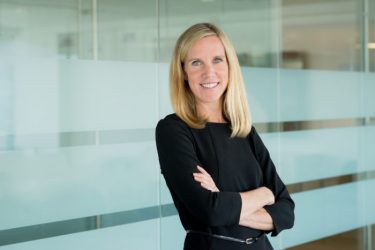
Andrea Kendall-Taylor (Center for a New American Security)
As a junior analyst, the whistleblower worked alongside colleagues such as Andrea Kendall-Taylor, who joined OREA about the same time after graduating from UCLA in 2008 with a PhD is Slavic and Eurasian studies. A prolific writer, Kendall-Taylor wrote extensively on autocratic leaders and Putin in particular. Her work was in high demand at both the CIA and NSC, which under the Obama administration had undergone a massive expansion intended to better facilitate policy coordination among the various departments that comprised the NSC.
The whistleblower had a front-row seat on the rollercoaster ride that was U.S.-Russian policy during this time, witnessing the collapse of McFaul’s Russian “reset,” Putin’s return to power in 2012, and the U.S.-backed coup in Ukraine that led to the annexation of Crimea and Russian support for rebels in the Donbas region.
During his tenure at OREA, the whistleblower obviously impressed his superiors, receiving several promotions and, in July 2015, he detailed to the NSC staff at the Obama White House as the Director for Ukrainian Affairs. According to a former CIA officer, any high-performing analyst who aspires to be promoted into the ranks of the Senior Intelligence Service must, prior to that time, do a rotation as part of the overall policy community, which includes the NSC or another department, such as Defense or State, as well as a tour within another directorate of the CIA.
NSC positions were originally intended for senior CIA analysts, at the GS-15 level, but waivers could be made for qualified GS-14 or “very strong” GS-13’s (the whistleblower was a GS-13 at the time of his assignment at the NSC, a reflection of both his qualification and the regard to which he was held by the CIA.) NSC assignments do not coincide with the political calendar—detailees (as career civil servants who are detailed to the NSC are referred) are expected to serve in their position regardless of what political party controls the White House. When an opening becomes available (usually when another detailee’s assignment has finished), prospective candidates apply, and are interviewed by their senior management, who forward qualified candidates to another board for a final decision.
Assignments to the NSC are considered highly sought after, and while the process for application must be followed, the selection process is highly political, with decisions being signed off by the director of the CIA. In the case of the whistleblower, his candidacy would have been approved by both Peter Clement, the director of OREA, and John Brennan, the CIA director.
Into the Lion’s Den
By the time the whistleblower arrived at the NSC, the NSC staff had grown into a well-oiled policy machine managing the entire spectrum of Obama administration national security policy-making and implementation. The NSC staff operated in accordance with Presidential Policy Memorandum (PPM) 1, “Organization of the National Security Council System”, which outlined the procedures governing the management of the development and implementation of national security policies by multiple agencies of the United States Government.
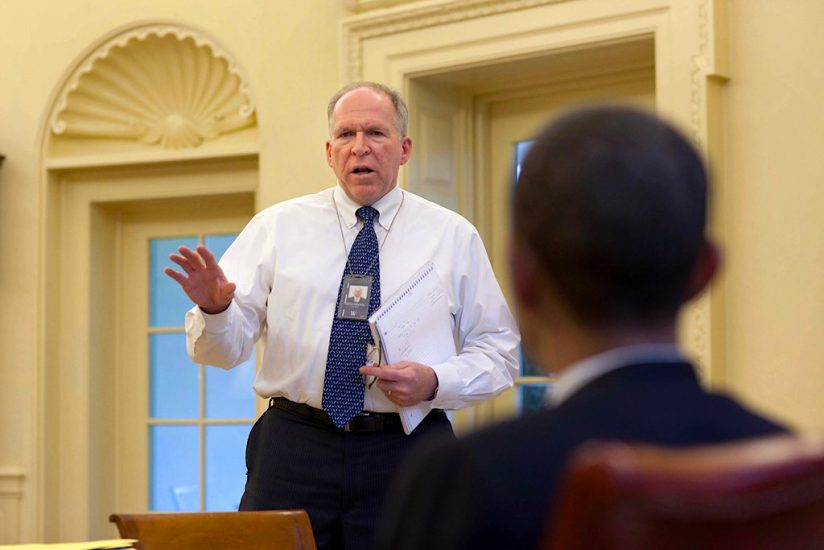
Brennan briefing Obama May 3, 2010. He approved whistleblower. (Official White House Photo by Pete Souza)
The vehicle for accomplishing this mission was the NSC Interagency Policy Committee (NSC/IPC). The NSC/IPCs were the main day-to-day fora for interagency coordination of national security policy. They provided policy analysis for consideration by the more senior committees of the NSC system and ensured timely responses to decisions made by the president. NSC/IPCs were established at the direction of the NSC Deputies Committee and were chaired by the relevant division chief within the NSC staff.
The whistleblowers job was to develop, coordinate and execute plans and policies to manage the full range of diplomatic, informational, military and economic national security issues for the countries in his portfolio, which included Ukraine. The whistleblower coordinated with his interagency partners to produce internal memoranda, talking points and other materials for the National Security Advisor and senior staff.
The whistleblower reported directly to Charles Kupchan, the Senior Director for European Affairs on the NSC. Kupchan, a State Department veteran who had previously served on the NSC staff of President Bill Clinton before turning to academia, in turn reported directly to Susan Rice, President Obama’s national security adviser.
When the whistleblower first arrived at the NSC, he volunteered for the Ukraine portfolio. Kupchan was impressed by the whistleblower’s work ethic and performance, and soon expanded his portfolio to include the fight against the Islamic State. The whistleblower was aided by another organizational connection—his colleague and mentor at OREA, Andrea Kendall-Taylor, had been selected to serve in the Office of the Director of National Intelligence as the deputy national intelligence officer for Russia and Eurasia. Among Kendall-Taylor’s responsibilities was to closely coordinate with the NSC staff on critical issues pertaining to Russia and Ukraine.
The whistleblower’s arrival at the NSC staff also coincided with the start of Trump’s improbable candidacy for the presidency of the United States. As 2015 transitioned into 2016, and it became apparent that Trump was the presumptive nominee for the Republican Party, allegations about the Trump campaign colluding with Russia began to circulate within the interagency. Trump’s electoral victory in November 2016, shocked the whistleblower, like everyone else on the NSC staff.
Alarmed By Trump on Russia
The line between policy and politics began to blur, and then disappeared altogether. National Security Advisor Rice was becoming increasingly alarmed by the activities of the Trump transition team, especially when it came to issues pertaining to Russia. According to The Washington Post, “Rice apparently was closely monitoring the high-profile investigation into Russian interference.”
The President-elect had, during the campaign, openly advocated for better relations between the U.S. and Russia and had even suggested that the Russian annexation of Crimea could eventually be accepted by the U.S. This stance was anathema to the policies that had been massaged into place by the NSC in general, and the whistleblower in particular. According to multiple sources familiar with the whistleblower during this time, his animus against Trump was palpable.
In December 2016, Rice was involved in the unmasking of the identities of several members of the Trump transition team. Various sensitive intelligence reports were circulating within the NSC regarding the interaction of unnamed U.S. citizens with foreign targets of intelligence interest. In order to better understand the significance of such a report, Rice has acknowledged that, on several occasions, she requested that the identity of the U.S. persons involved be “unmasked.”
The U.S. intelligence community is prohibited by law from collecting information about U.S. citizens. As such, when a conversation undertaken by a foreign national of intelligence interest was captured, and it turned out the person or persons whom the target was speaking to was a U.S. citizen, the analysts preparing the report for wider dissemination would “mask”, or hide, the identities of the U.S. citizens involved. Under relevant laws governing the collection of intelligence, up to 20 officials within the Obama administration had the authority to unmask the identities of U.S. citizens. One of those was Rice.
In late December 2016, the crown prince of the United Arab Emirates, Sheikh Mohammed bin Zayed al-Nahyan, arrived in New York for a meeting with several top Trump transition officials, including Michael Flynn, Trump’s son-in-law, Jared Kushner, and the President-elect’s top strategist Steve Bannon. Intelligence reports had been circulating about the UAE coordinating a backchannel for the Trump transition team and Russia.
Zayed’s arrival, which was unannounced and had not been coordinated with the U.S. government, caused great concern among the NSC staff especially given the context of allegations of collusion between Trump and Russia to influence the outcome of the 2016 election.
The principle NSC staffers who would logically have been advising Rice on this matter were Kupchan, the whistleblower, and Sean Misko, a State Department detailee who served as the director for the Gulf Arab States (According the NSC staffers who worked in the White House at the time, Misko and the whistleblower were said to be close friends, frequently socializing with one another after hours, and possessing a common dislike for Trump.) Rice requested that the intelligence reports pertaining to Zayed’s visit be subjected to unmasking procedures.
While the subsequent reporting about the three-hour meeting between Zayed and the Trump transition team failed to uncover any evidence of a secret communications channel with Russia, Rice (who would logically have been assisted by Kupchan and the whistleblower) facilitated the near continuous unmasking of intelligence reports involving Flynn, who was in contact with Russian officials, including Sergei Kislyak, the Russian ambassador to the U.S.
The Greatest Sin
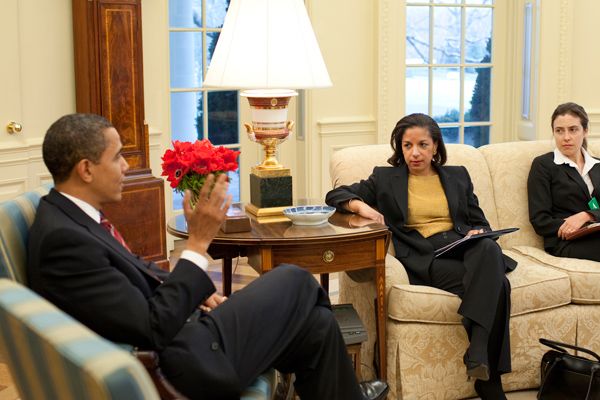
Susan Rice, center, with Obama, March 10, 2009. (White House photo)
As a professional intelligence analyst detailed to the NSC, the whistleblower was committed to a two-year assignment, extendable to three years upon the agreement of all parties. President Obama’s departure from the White House did not change this commitment. According to NSC staffers who served in the White House at the time, the whistleblower, like many of his fellow detailees, had grown attached to the policies of the Obama administration which they had fought hard to formulate, coordinate and implement. They viewed these policies to be sacrosanct, regardless of who followed in the White House.
In doing so, they had committed the greatest sin that an intelligence professional could commit short of espionage—they had become political.
In December 2016, the whistleblower was, based upon his role as a leading Russian analysts advising Rice directly, more than likely helping unmask Flynn’s communications with Russians; a month later, he was working for Flynn, someone he had likely actively helped conspire against, using the unfettered power of the intelligence community.
The Trump administration had inherited a national security decision-making apparatus that was bloated, and which fostered White House micromanagement via the NSC. While the Obama NSC had proven able to generate a proliferate amount of “policy”, it did so by relying on a staff that had expanded to the largest in the history of the NSC, and at the expense of the various departments of government that were supposed to be the originators of policy.
As the new national security adviser, Flynn let it be known from day one that there would be changes. One of his first actions was to hire four new deputies who centralized much of the responsibilities normally tasked to regional directors such as the whistleblower. Flynn was putting in place a new level of bureaucracy that shielded professional detailees from top level decision makers.
Moreover, it recognized that the NSC, while staffed with professionals who are supposed to be apolitical, was viewed by the White House as a partisan policy body whose work not only furthered the interests of the United States, but also the political interests of the president. When Trump included his top political advisor, Bannon, on the list of people who would comprise the National Security Council (normally limited to cabinet-level officials), it sent shockwaves through the national security establishment, which accused Trump of politicizing what they claimed was an apolitical process.
But the reality was that the NSC had always functioned as a partisan decision-making body. Its previous occupants may have tried to temper the level to which domestic politics intruded on national security decision-making, but its presence was an unspoken reality. All Trump did by seeking to insert Bannon into the mix was to be open about it.
Like the other professional detailees who comprised 90 percent of the NSC staff and were expected to remain at their posts as part of a Trump administration, the whistleblower was dismayed by the changes. Some accounts of the early days of the Trump NSC indicate that the whistleblower was defensive of the Ukraine policies he had helped craft during his tenure at the NSC.
When his immediate superior, Kupchan (a political appointee) departed the NSC, the whistleblower was temporarily elevated to the position of senior director for Russia and Eurasia until a new replacement could be found. (Flynn had reached out to Fiona Hill, a former national intelligence officer for Russia under the administration of George W. Bush, to take this job; Hill had accepted, but would not be available until April.)
The whistleblower was a known quantity within the NSC, as were his decidedly pro-Obama political leanings. As such, he was not trusted by the incoming Trump officials, and his access to the decision-making process was limited.
According to persons familiar with his work at the NSC during the Trump administration, the whistleblower’s frustration and anger soon led to acts of resistance designed to expose, and undermine public confidence in President Trump.
Cut Out of Call to Putin
In late January 2017 Trump made several introductory telephone calls to world leaders, including President Putin. Normally the NSC director responsible for Russia would help prepare the president for such a call by drafting talking points and supporting memoranda, and then monitor the call directly, either from within the Oval Office or from the White House situation room.
According to sources familiar with the incident, Flynn did not coordinate Trump’s call with NSC staff, and as such the whistleblower, who was acting as the director for Russia and European Affairs at the time, would have been cut out of the process altogether. When the whistleblower tried to access the read out of the phone call afterwards, he found that no verbatim record existed, only a short summary released by the White House, presumably prepared by Flynn.
More frustrating was the fact that the official readout of the call released by the Kremlin contained much more information, putting Russia in the driver’s seat in terms of defining U.S.-Russian policy priorities—the very policy blunder the NSC was supposed to prevent from happening. While searching for the non-existent records of the Putin-Trump conversation, however, the whistleblower came across detailed verbatim transcripts of two other calls made by Trump that day—one with Mexico, and one with Australia.
Within days the details of these calls were leaked to the media, resulting in a series of unflattering articles being published by the mainstream media. While no direct evidence has emerged about who was responsible for leaking these calls, NSC staffers who worked in the White House at the time suspected the whistleblower. (One of the byproducts of this incident was the decision by NSC lawyers to move the records of Presidential phone calls to a more secure server, significantly limiting access by NSC staff.)
On February 13, 2017, Flynn resigned from his position as President Trump’s national security adviser. The reason given was Flynn’s having misrepresented his conversations with Russian Ambassador Kislyak when questioned by Vice President Mike Pence. For the whistleblower, whose previous work in the Obama NSC appeared to help Rice’s efforts to unmask the very conversations Flynn was being held accountable for, this had to have been a satisfying moment. He had to have been even more pleased by Trump’s choice to replace Flynn —Lieutenant General H. R. McMaster, a decorated combat veteran known for his intelligence and willingness to challenge the establishment.
In the little more than a month that transpired between McMaster coming on board and the arrival of Hill as the new director for Russia and Europe, the whistleblower would have had the opportunity to meet his new boss and work with him on repairing what they both viewed as the flawed changes undertaken by Flynn at the NSC.
McMaster rewrote the presidential guidance regarding the functioning of the NSC, replacing the original Presidential Policy Memorandum 1 with a new version, PPM 4, which removed Bannon from the NSC and restored much of the policy coordinating functions that characterized the NSC under Obama.
Moreover, McMaster stuck up for the professional detailees, such as the whistleblower. When Hill arrived in April 2017 to assume her responsibilities as the NSC director for Russia and Europe, the whistleblower found himself without a job.
But instead of being returned to the CIA, McMaster, who had come to know the whistleblower during his first month as national security adviser, appointed him to serve as his personal assistant. The whistleblower moved from his desk next door in the Executive Office Building, where most NSC staffers work, to the West Wing of the White House, a move which gave him direct access to every issue that crossed McMaster’s desk.
Oval Office Leak
The new job, however, did nothing to diminish the disdain the whistleblower had for Trump. Indeed, the proximity to the seat of power may have served to increase the concern the whistleblower had about Trump’s stewardship. On May 10, President Trump played host to Russian Foreign Minister Sergey Lavrov and Russian Ambassador Kislyak. During the now-infamous meeting, Trump spoke about the firing of former FBI Director Jim Comey; a sensitive Israeli intelligence source related to the ongoing fight against ISIS in Syria; and alleged Russian interference in the 2016 presidential election.
As McMasters’ assistant, the whistleblower was privy to the readout of the meeting, and was so alarmed by what he had seen that he sent an email to John Kelly, who at that time was serving as director of the Department of Homeland Security, detailing the president’s actions and words. All materials relating to this meeting were collected and secured in the NSC’s top secret codeword server; the only unsecured data was that contained in the whistleblower’s email. When the media subsequently reported on the details of Trump’s meeting with the Russians, the White House condemned the “leaking of private and highly classified information” which undermined “our national security.”

Trump meets with Lavrov on May 10, 2017. (TASS/Wikipedia)
According to a NSC staffer who worked in the White House at the time, an internal investigation pointed to the whistleblower’s email as the likely source of the leak, and while the whistleblower was not directly implicated in actually transmitting classified information to the press, he was criticized for what amounted to unauthorized communication with an outside agency, in this case the Department of Homeland Security. When his initial two-year assignment terminated in July 2017, the White House refused to authorize a one-year extension (a courtesy offered to the vast majority of detailees).
The whistleblower had become a liability, publicly smeared by right-wing bloggers and subjected to death threats. He was released from the NSC and returned to the CIA, where he resumed his role as a Eurasian analyst. Shortly after the whistleblower left the NSC, the full transcripts of President Trump’s January 28, 2017 conversations with the leaders of Mexico and Australia were leaked to the press. While several colleagues in the NSC believed that the whistleblower was behind the leaks, McMaster refused to authorize a formal investigation which, if evidence had been found that implicated the whistleblower, would have effectively terminated his career at the CIA.
It is at this juncture the saga of the whistleblower should have ended, avoiding the turn of events which ended up labeling him with the now famous (or infamous) appellation. However, in June 2018 the whistleblower’s colleague, Kendall-Taylor, ended her assignment as the deputy national intelligence officer for Russia and Eurasia. An announcement was made to fill the vacancy, and the whistleblower applied.
Despite having left the NSC under a cloud of suspicion regarding the unauthorized disclosure of sensitive information, and even though his anti-Trump sentiment was common knowledge among his colleagues and superiors, the whistleblower was picked for a position that would put him at the center of policy formulation regarding Russia and Ukraine, and the sensitive intelligence that influenced such. His appointment would have been approved by Director of National Intelligence Dan Coates.
Enter Vindman
The whistleblower was well versed in the collaborative functions of the deputy national intelligence officer position, having worked with Kendall-Taylor during his time at the NSC. He began to develop professional relationships with a number of individuals, including the new director of Ukraine at the NSC, Army Lieutenant Colonel Alexander Vindman. Vindman had extensive experience regarding Ukraine and had been detailed to the NSC from the Joint Chiefs of Staff. The two soon appeared to share a mutual concern over President Trump’s worldview of both Russia and Ukraine, which deviated from the formal policy formulations promulgated by the interagency processes that both Vindman and the whistleblower were involved in.
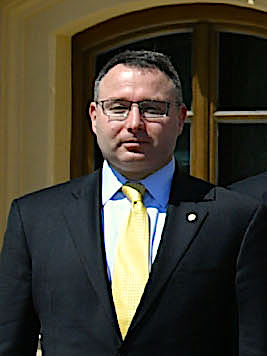
Kiev-born Vindman. (Wikipedia)
The whistleblower’s concerns about President Trump and Ukraine predated the July 25, 2019 telephone call, and mirrored those expressed by Lieutenant Colonel Vindman, both in chronology and content, provided during his testimony before the House Intelligence Committee. While Vindman was critical of President Trump’s deviation and/or failure to conform with policy that had been vetted through proper channels (i.e., in conformity with PDD 4), he noted that, as president, “It’s his prerogative to handle the call whichever way he wants.”
Vindman took umbrage at the non-national security topics brought up by the president, such as investigating former Vice President Joe Biden and his son, Hunter, regarding their relationship with a Ukrainian energy company, Burisma Holdings, and other references to the 2016 U.S. presidential election.
According to Vindman, it was this aspect of the telephone call Vindman believed to be alarming, and which he subsequently related to an authorized contact within the intelligence community. While Vindman remained circumspect about the identity of the intelligence community official he communicated with about his concerns over Trump’s Ukraine policy, the fact that the chairman of the House Intelligence Committee refused to allow any discussion of this person’s identity strongly suggests that it was the whistleblower who, as the deputy national intelligence officer for Russia and Ukraine, would be a logical, and fully legitimate, interlocuter.
According to an account published in The Washington Post, sometime after being informed by Vindman of the July 25 Trump-Zelensky telephone call, the whistleblower began preparing notes and assembling information related to what he believed was untoward activity vis-à-vis Ukraine on the part of President Trump and associates who were not part of the formal Ukraine policy making process. He made numerous telephone calls to U.S. government officials whom he knew from his official work as the deputy national intelligence officer for Russia and Eurasia. Because much of the information he was using was derived from classified sources, or was itself classified in nature, the whistleblower worked from his office, using a computer system approved for handling classified data.
Off Limits
From the perspective of security, the whistleblower’s work was flawless. There was one problem, however; investigating the actions of the president of the United States and officials outside the intelligence community who were carrying out the instructions of the president was not part of the whistleblower’s official responsibilities.
Indeed, anything that whiffed of interference in domestic American politics was, in and of itself, off limits to members of the intelligence community.
Robert Gates, a long-time CIA analyst and former CIA director, had warned about this possibility in a speech he delivered to the CIA in March 1992 on the issue of the politicization of intelligence. “National intelligence officers”, Gates noted, “are engaged in analysis and—given their frequent contact with high-level policymakers—their work is also vulnerable to distortion.”
There was no greater example of politicized distortion than the rabbit hole the whistleblower had allowed himself to fall into. From Gates’ perspective, the whistleblower had committed the ultimate sin of any intelligence analyst—he had allowed his expertise to become tarnished by political considerations.
Worse, the whistleblower had crossed the threshold from advocating a politicized point of view to becoming political—that is, to intervene in the domestic political affairs of the United States in a manner which influenced the political future of a sitting president of the United States.
Once he had assembled his notes, he sought out staffers on the House Intelligence Committee for guidance on how to proceed. Schiff, the chairman of the House Intelligence Committee, had hired two former members of the Trump NSC staff who had served at the same time as the whistleblower.
One, Abigail Grace, had worked at the NSC from 2016-2018, covering U.S.-Chinese relations. Grace was hired by Schiff in February 2019 for the express purpose of investigating the Trump White House. A second NSC veteran was hired in August 2019, around the same time that the whistleblower was preparing his complaint. That staffer was none other than Sean Misko, the whistleblowers friend and fellow anti-Trump collaborator.
Both Misko and the whistleblower departed the NSC in 2017 under a cloud. Misko went on to work for the Center for New American Security, a self-described bipartisan think tank set up by two former Obama administration officials, Michèle Flournoy and Kurt M. Campbell, before being recruited by Schiff. It is not known if Misko was one of the House Intelligence staffers the whistleblower approached, or if there had been any collaboration between the whistleblower and Misko about the nature of the complaint prior to Misko being recruited by Schiff.
After conferencing with the House Intelligence Committee staffers, the whistleblower sought legal counsel. He reached out to a lawyer affiliated with Whistleblower Aid, a group of national security lawyers who came together in September 2017—eight months after the inauguration of President Trump—to encourage whistleblowers within the U.S. government to come out against Trump, and provide legal and financial assistance to anyone that chose to do so. One of Whistleblower Aid’s founding members was a lawyer named Mark Zaid.
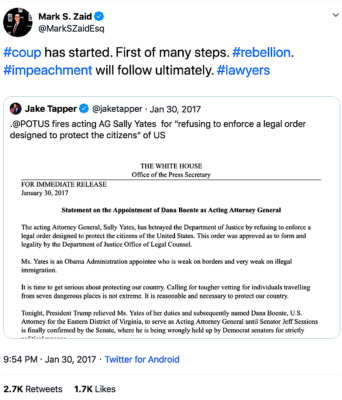 In the days following Trump’s swearing in as president, Zaid turned to Twitter to send out messages supportive of a “coup” against Trump that would lead to the president’s eventual impeachment. The identity of the lawyer who met with the whistleblower is not known. However, this lawyer referred the whistleblower to Bakaj, a fellow member of Whistleblower Aid, who took on the case and provided procedural guidance regarding the preparation of the complaint. Bakaj later brought on Zaid and another lawyer, Charles McCullough, with close ties to Senator Chuck Schumer and Hillary Clinton, to assist in the case.
On August 12, the whistleblower completed his complaint, and forwarded it to the intelligence community inspector general, thereby setting in motion events that produced weeks of hearings before the House Intelligence Committee that will very likely result in Trump’s impeachment.
Shielded from Questions
While the whistleblower, through counsel, had expressed a desire to testify before the House Intelligence Committee about the issues set forth in his complaint, he was never called to do so, even in closed-door session. The ostensible reason behind this failure to testify was the need to protect his anonymity, a protection that is not contained within the relevant statutes governing whistleblower activities within the intelligence community.
Later, as witnesses were identified from the content of the whistleblower’s complaint and subpoenaed to testify before the House Intelligence Committee, both Schiff and Bakaj indicated that the whistleblower’s testimony was no longer needed, since the specific issues and events covered in his complaint had been more than adequately covered by the testimony of others.
But the apparent reason Schiff and Bakaj refused to allow the whistleblower to testify, or to be identified, was to avoid legitimate questions likely to be asked by Republican committee members.
Namely, what was a deputy national intelligence officer of the U.S. intelligence community doing investigating activities of a sitting president? Who, if anyone, authorized this intervention in U.S. domestic political affairs by a CIA official? How did the whistleblower, who had a history of documented animosity with the Trump administration that included credible allegations of leaking sensitive material to the press for the express purpose of undermining the credibility of the president, get selected to serve as a deputy national intelligence officer? Who signed off on this assignment? What was the precise role played by the whistleblower in unmasking the identities of U.S. citizens in 2016, during the Trump transition?
Did the whistleblower maintain his friendship with Misko after leaving the NSC in July 2017? Did the whistleblower collaborate with Misko to get the House Intelligence Committee to investigate the issues of concern to the whistleblower before his complaint was transmitted to the ICIG? Who did the whistleblower meet on the House Intelligence staff? What did they discuss? Who was the lawyer the whistleblower first met regarding his intent to file a complaint? Did the whistleblower have any contact with Whistleblower Aid prior to this meeting?
Answers to these questions, and more, would have been useful in understanding not only the motives of the whistleblower in filing his complaint—was he simply a concerned citizen and patriot, or was he part of a larger conspiracy to undermine the political viability of a sitting president? There is no doubt that Congress has a constitutional right and obligation to conduct proper oversight of the operations of the executive branch, and to hold the president of the United States accountable if his conduct and actions are deemed unworthy of his office. Whether or not the facts surrounding the July 25, 2019 telephone call between Trump and Zelensky constitute grounds for impeachment is a political question for Congress to decide.
Intervening in Domestic Affairs
There is, however, the major issue looming in the background of this impeachment frenzy: the intervention by elements of the intelligence community in the domestic political affairs of the United States. There is no question that the whistleblower’s complaint served as the genesis of the ongoing impeachment proceedings.
The American people should be deeply concerned that an inquiry which could result in the removal of a duly elected president from office was initiated in secrecy by a member of the intelligence community acting outside the four corners of his legal responsibilities. The legitimacy of the underlying issues being investigated by the House Intelligence Committee is not at issue here; the legitimacy of the process by which these proceedings were initiated is.
To find out what happened, the whistleblower should not only be identified, called before the House Intelligence Committee, and other relevant Congressional committees, and be compelled to answer for his actions.
Impeachment is a constitutional remedy afforded to the U.S. Congress to deal with the political issues surrounding the conduct of a sitting president. If this constitutional remedy can be triggered by the intelligence community in a manner which obviates laws prohibiting the intrusion of intelligence agencies into the domestic political affairs of the United States, and done so in a manner where the identities of the persons and organizations involved, along with their possible motives, are shielded from both American people and those whom they elect to represent them in Congress, then a precedent will have been set for future interventions of this nature which undermine the very foundation of American democracy.
The political weaponization of intelligence represents a significant threat to the viability of the American constitutional republic that cannot be ignored.
Scott Ritter is a former Marine Corps intelligence officer who served in the former Soviet Union implementing arms control treaties, in the Persian Gulf during Operation Desert Storm, and in Iraq overseeing the disarmament of WMD.
Where Comedy ends and Hasbara Begins
By Gilad Atzmon | November 26, 2019
Two days ago at the ADL conference Jewish Zionist comedian Sacha Baron Cohen criticised the internet and social media companies for allowing freedom of speech. This grotesque character who has made a career of marginalising oppressed minorities by depicting stereotypical characters and then ridiculing them is now calling on social media to adopt gag orders and to move us further into an Orwellian realm.
Galvanized by the support it received from the Jewish comedian, the ADL is now demanding that 10 social media accounts “should be removed immediately.”
For one reason or another I am included on the list. I need not mention that I have never been charged with any crime let alone a hate crime. I’ve never once been questioned by a single law enforcement body anywhere in the world. This does not stop the ADL from writing of me: “Gilad Atzmon is an anti-Semitic author and musician who describes himself as an ‘ex-Israeli’ and an ‘ex-Jew.”
I am indeed an ex Israeli and ex Jew and I am also a musician. However, I deny the accusation of anti-Semitism, I have never criticized Jews, or anyone else for the matter, as ‘a people,’ as ‘a race,’ as ‘a biology’ or as ‘an ethnicity.’ In fact, for my entire life I have opposed all forms of racism and this includes Jewish racism. I do criticise Jewish identitarian politics and some aspects of Jewish culture and ideology. I grew up in Israel and as far as I can remember, in the Jewish state, criticism of culture, ideology and politics is considered a perfectly kosher activity.
The ADL says of me that I am an “outspoken promoter of classic anti-Semitic conspiracy theories.” This is an absurd lie as I have repeatedly argued that there are no Jewish conspiracies since it is all done in the open: from Epstein’s Lolita Express, to Israeli war crimes, to advocacy of Zioncon global conflicts and plans for an ‘New American Century.’ The UK chief rabbi’s call for Brits to turn their backs on their opposition party is not exactly a conspiratorial clandestine move, it is actually mainstream news in Britain this morning. There are no Jewish conspiracies, what happens takes place in front of our eyes but we cannot discuss it because Jewish power, as I define it, is the power to suppress criticism of Jewish power.
From then on, what the ADL says about me is somewhat accurate. He is “a fierce critic of Jewish identity.” I am.
“He has written that ‘Jewish ideological, political, and cultural discourse is… foreign to universalism and ideas of true equality.’ My exact words can be found here. What I say is “We must find a way to admit to ourselves that the Jewish ideological, political and cultural discourse is a tribal discourse: it is foreign to universalism and ideas of true equality.” Here the ADL is engaged in a rather obvious attempt to deceive. In my original text, being ‘foreign to universalism and true equality’ elucidates the notion of tribal discourse. You may wonder why the ADL acts in a duplicitous manner.
The ADL complains that “although Atzmon frequently attacks Zionism, he has also argued that Zionism itself was originally a ‘universalist and humanist’ movement which was ‘hijacked by Judaism.’ In fact, this is exactly what I argue and I wonder, where exactly is the ‘crime?’ The battle between ‘the Israeli’ and ‘the Jew’ was at the centre of the Israeli political debate in the last election. Am I guilty of identifying the core of Israel’s identity crisis a decade before anyone else?
Finally the ADL complains that I say of Israel that it is a “tyranny inspired by a deep Talmudic intolerance.” I am afraid that the Israeli National Bill is the materialisation of the above. I think I remember that the ADL’s Abe Foxman also wasn’t pleased with Israel’s National Bill for pretty much the same reasons. Is the ADL going to ask to delete his twitter account?
Sooner or later we will have to examine the question whether the relentless attack by Jewish institutions on freedom of speech, 1st amendments and the core Western ethos has been ‘good for the Jews.’
The Real Bombshell of the Impeachment Hearings
By Ron Paul – November 25, 2019
The most shocking thing about the House impeachment hearings to this point is not a “smoking gun” witness providing irrefutable evidence of quid pro quo. It’s not that President Trump may or may not have asked the Ukrainians to look into business deals between then-Vice President Biden’s son and a Ukrainian oligarch.
The most shocking thing to come out of the hearings thus far is confirmation that no matter who is elected President of the United States, the permanent government will not allow a change in our aggressive interventionist foreign policy, particularly when it comes to Russia.
Even more shocking is that neither Republicans nor Democrats are bothered in the slightest!
Take Lt. Colonel Vindman, who earned high praise in the mainstream media. He did not come forth with first-hand evidence that President Trump had committed any “high crimes” or “misdemeanors.” He brought a complaint against the President because he was worried that Trump was shifting US policy away from providing offensive weapons to the Ukrainian government!
He didn’t think the US president had the right to suspend aid to Ukraine because he supported providing aid to Ukraine.
According to his testimony, Vindman’s was concerned over “influencers promoting a false narrative of Ukraine inconsistent with the consensus views of the interagency.”
“Consensus views of the interagency” is another word for “deep state.”
Vindman continued, “While my interagency colleagues and I were becoming increasingly optimistic on Ukraine’s prospects, this alternative narrative undermined US government efforts to expand cooperation with Ukraine.”
Let that sink in for a moment: Vindman did not witness any crimes, he just didn’t think the elected President of the United States had any right to change US policy toward Ukraine or Russia!
Likewise, his boss on the National Security Council Staff, Fiona Hill, sounded more like she had just stepped out of the 1950s with her heated Cold War rhetoric. Citing the controversial 2017 “Intelligence Community Assessment” put together by then-CIA director John Brennan’s “hand-picked” analysts, she asserted that, “President Putin and the Russian security services aim to counter US foreign policy objectives in Europe, including in Ukraine.”
And who gets to decide US foreign policy objectives in Europe? Not the US President, according to government bureaucrat Fiona Hill. In fact, Hill told Congress that, “If the President, or anyone else, impedes or subverts the national security of the United States in order to further domestic political or personal interests, that is more than worthy of your attention.”
Who was Fiona Hill’s boss? Former National Security Advisor John Bolton, who no doubt agreed that the president has no right to change US foreign policy. Bolton’s the one who “explained” that when Trump said US troops would come home it actually meant troops would stay put.
One by one, the parade of “witnesses” before House Intelligence Committee Chairman Schiff sang from the same songbook. As US Ambassador to the EU, Gordon Sondland put it, “in July and August 2019, we learned that the White House had also suspended security aid to Ukraine. I was adamantly opposed to any suspension of aid, as the Ukrainians needed those funds to fight against Russian aggression.”
Meanwhile, both Democrats and Republicans in large majority voted to continue spying on the rest of us by extending the unpatriotic Patriot Act. Authoritarianism is the real bipartisan philosophy in Washington.
Copyright © 2019 by RonPaul Institute
World Jewish Congress: Billionaires, Oligarchs, Global Influencers for Israel

Billionaire Mikhael Mirilashvili and his son Yitzhakis with Israeli minister Yaffa Deri.
By Alison Weir | If Americans Knew | November 24, 2019
The World Jewish Congress (WJC), which calls itself “The Representative Body of over 100 Jewish Communities Worldwide,” held its annual gala at the Pierre hotel in New York City on Nov. 6.
It bestowed its annual Theodor Herzl Award (named after Israel’s founding father) on former U.S. Ambassador to the UN Nikki Haley for her work on behalf of Israel. Some previous awardees have been Joe Biden and Henry Kissinger.
One of the WJC’s main issues is support for Israel. Among its many activities in this realm, it collaborates with the Israeli government to defend Israel from criticisms of its human rights abuses and discriminatory system.
The WJC defines many factual statements about Israel to be “antisemitic,” and labels legitimate opposition to Israeli violence and oppression against Palestinians “antisemitism.” As a result, its top issue, combating “antisemitism,” often consists of efforts to suppress information about Israel’s oppression of Palestinians and to combat efforts on behalf of Palestinian human rights.
At one of its recent international conferences to oppose this newly defined “antisemitism,” US Special Envoy Elan Carr proclaimed that every law enforcement office and every prosecutorial agency throughout the world must “force everybody who has even a hint of antisemitism to undergo a tolerance program.” … continue
Bolivia’s Coup Government Targets Alternative Media as Crackdown Turns Increasingly Violent
By Alan Macleod | MintPress News | November 22, 2019
Facing increased resistance to its rule, the new “transition” government of Jeanine Añez in Bolivia has begun to purge and censor potential threats to its authority, including in the media. TeleSUR, an international media network that began as a collaboration between left-wing Latin American nations, including deposed President Evo Morales’ Bolivia and Venezuela’s Hugo Chavez, and which espouses an openly leftist and anti-imperialist outlook, received confirmation that it would be taken off the airwaves as part of what the government calls a “reorganization” of the airwaves. TeleSUR openly opposed the U.S.-backed military coup d’état that installed Añez as head of state earlier this month.
New Communications Minister Roxana Lizárraga announced that this was part of the “dismantling of the propaganda apparatus of the dictatorial regime of Evo Morales,” claiming that Morales’ “militants who misused the state media system” are being “withdrawn.”
TeleSUR was originally conceived as a counterweight to the Western-dominated media system and attempted to bring the voices of working-class Latin Americans to the fore. It also offers an alternative to local mainstream media, overwhelmingly owned and controlled by Latin American elites who have been particularly hostile to progressive governments such as Morales.’
This is the latest episode in a general assault on the media, as the Añez administration attempts to gain control over Bolivia’s means of communication. Multiple journalists have been shot, while Al-Jazeera correspondent Teresa Bo was tear-gassed in the face live on air at point-blank range by riot police as she stood alone, away from the protests, talking to the camera. Last week Lizárraga appeared on television announcing she would persecute any journalists involved in what she called “sedition,” noting that she already had a list of “troublesome” individuals and outlets. Bolivia TV was also taken off the air earlier this week.
In its efforts to neutralize dissent, the Añez administration has found a keen and enthusiastic ally in the local mainstream press. In a shocking moment captured on film, local media harassed an independent journalist, detaining him and handing him over to the armed forces. The local press has largely endorsed the events and celebrated Morales’ demise, presenting the situation as a democratic transition rather than as a coup.
The crackdown extends beyond media, as the new government has effectively declared the deposed Movement to Socialism (MAS) party illegal, arresting MAS officials and forcing others into hiding or exile in what new government minister Arturo Murillo called a “hunting” down of political opponents. “They’re drowning the Bolivian people in blood,” declared deposed Vice-President Álvaro García Linera from Mexico, where he was granted asylum.
Añez has granted security forces immunity from all crimes committed during the “re-establishment of order.” Those same forces reportedly carried out massacres in the city of Cochabamba and the town of Senkata, just south of the country’s capital, La Paz.
Tens of thousands of demonstrators, many carrying the Wiphala flag, a symbol of indigenous identity, marched to La Paz alongside the coffins carrying the victims of the Senkata massacre, demanding the resignation of Añez and an end to the bloodshed. The march stretched out for miles. MintPress News cameras captured the events.
Once the march came into contact with security forces in the capital, it was met with a barrage of tear gas, and downtown La Paz was engulfed in smoke as tens of thousands of Bolivians were gassed during rush hour. Mourners were forced to abandon the coffins of their loved ones in the street as fumes overcame them.
“La Paz, 5:30 pm. They’re gassing commuters and protesters alike. Can only imagine how many people will wander into the path of the police & military with the Bolivian media’s under-reporting. I saw mothers with infants gassed, they were not part of the procession,” reported one TeleSUR journalist on the scene.
From exile in Mexico, former President Morales denounced the attack on the funeral procession. “The de facto government of Añez does not respect the dead in their coffins, nor forgive their relatives, women and children marching peacefully in support of life and democracy”, he said. “We condemn the violence against our brothers and sisters.”
Morales won an unprecedented third term in office on October 20, gaining 47% of the vote in the presidential elections. However, opposition parties cried foul, claiming that there were election irregularities, an accusation repeated by the Organization of American States and the U.S. government. On November 10, military generals appeared on television and demanded Morales resign. As he fled to Mexico, the military selected Jeanine Añez – whose right-wing Democrat Social Movement Party received 4% of the vote – as President. Añez, a strongly conservative Christian, declared that Bolivia’s indigenous majority was “satanic” and promised to bring Christianity back to the government. The White House strongly supported the events, “applauding” what it saw as a significant and positive moment for democracy. On the other hand, Democratic Presidential candidates such as Bernie Sanders and Tulsi Gabbard have condemned it.
MintPress News is covering the events in Bolivia extensively. Full coverage can be found here and on Twitter.
Alan MacLeod is a MintPress Staff Writer as well as an academic and writer for Fairness and Accuracy in Reporting. His book, Bad News From Venezuela: Twenty Years of Fake News and Misreporting was published in April.
The Civilian Government Doesn’t Owe Deference to Military Officers

By Ryan McMaken – Mises Institute – 11/20/2019
On Tuesday, Congressional impeachment hearings exposed an interesting facet of the current battle between Donald Trump and the so-called deep state: namely, that many government bureaucrats now fancy themselves as superior to the elected civilian government.
In an exchange between Rep. Devin Nunes (R-CA) and Alexander Vindman, a US Army Lt. Colonel, Vindman insisted that Nunes address him by his rank.
After being addressed as “Mr. Vindman,” Vindman retorted “Ranking Member, it’s Lt. Col. Vindman, please.”
Throughout social media, anti-Trump forces, who have apparently now become pro-military partisans, sang Vindman’s praises, applauding him for putting Nunes in his place.
In a properly functioning government — with a proper view of military power — however, no one would tolerate a military officer lecturing a civilian on how to address him “correctly.”
It is not even clear that Nunes was trying to “dis” Vindman, given that junior officers have historically been referred to as “Mister” in a wide variety of times and place. It is true that higher-ranking officers like Vindman are rarely referred to as “Mister,” but even if Nunes was trying to insult Vindman, the question remains: so what?
Military modes of address are for the use of military personnel, and no one else. Indeed, Vindman was forced to retreat on this point when later asked by Rep. Chris Stewart (R-UT) if he always insists on civilians calling him by his rank. Vindman blubbered that since he was wearing his uniform (for no good reason, mind you) he figured civilians ought to refer to him by his rank.
Of course, my position on this should not be construed as a demand that people give greater respect to members of Congress. If a private citizen wants to go before Congress and refer to Nunes or any other member as “hey you,” that’s perfectly fine with me. But the important issue here is we’re talking about private citizens — i.e., the people who pay the bills — and not military officers who must be held as subordinate to the civilian government at all times.
After all, there’s a reason that the framers of the US Constitution went to great pains to ensure the military powers remained subject to the will of the civilian government. Eighteenth and nineteenth century Americans regarded a standing army as a threat to their freedoms. Federal military personnel were treated accordingly.
Article I, Section 8 of the Constitution states that Congress shall have the power “to raise and support Armies …” and “to provide and maintain a Navy.” Article II, Section 2 states, “The President shall be the Commander in Chief of the Army and Navy of the United States, and of the Militia of the several States when called into the actual Service of the United States.” The authors of the constitution were careful to divide up civilian power of the military, and one thing was clear: the military was to have no autonomy in policymaking. Unfortunately, early Americans did not anticipate the rise of America’s secret police in the form of the CIA, FBI, NSA, and other “intelligence” agencies. Had they, it is likely the anti-federalists would have written more into the Bill of Rights to prevent organizations like the NSA from shredding the fourth amendment, as has been the case.
The inversion of the civilian-military relationship that is increasingly on display in Washington is just another symptom of the growing power of often-secret and unaccountable branches of military agencies and intelligence agencies that exercise so much power both in Washington and around the world.
Featured Video

Spain train disaster raises questions over Israeli-linked security contractors
or go to
Aletho News Archives – Video-Images
From the Archives
Are There 50,000 ‘Israeli-born’ Individuals Living in the UK?
By Professor David Miller | August 18, 2026
Recent disclosures by the Zionist regime show that some 2,069 British nationals were serving in the IDF as of March 2025, according to Freedom of Information (FoI) requests submitted to the occupation forces (1,686 dual British-Israeli, plus 383 multinational). We cannot tell from the figures how many of these were already settler colonists and intend to stay in the colony, and how many will return or have returned to the UK. Presumably, those returning to the UK will number far fewer than 2,000, since many are known to have become permanently residents of the colony.
Additionally, the IDF figures only provide a snapshot, and do not tell us how many have served in the Jewish supremacist military either before or after March 2025. One way into the question of how many genocidaires are living in Britain is to ask how many current British residents were born in the Zionist colony. There is data on that, as we shall see. … continue
Blog Roll
 Aletho News
- Zelensky spent over 740 days outside Ukraine while West serves as his real home
- Indian captain of Russian ‘shadow fleet’ tanker faces 10-year jail term in UK
- Europe, US face higher heating bills amid Iran war fallout
- The Leak That Arrived Right on Cue
- No, New York Times, California’s Climate Has Always Been a Land of Flood, Drought, and Fire
- Are There 50,000 ‘Israeli-born’ Individuals Living in the UK?
- German CDU MPs Seek Climate “Misinformation” List
- The ‘Gaza Treatment’: How Media Headlines Obscure Who is Bombing Yemen
- Ro Khanna urges Democrats to strip Israel ‘integration’ provision from defense bill
- Why Iran designated British MI6, Royal Navy, and RAF as hostile, terrorist organizations
- If Americans Knew
- An error has occurred; the feed is probably down. Try again later.
- No Tricks Zone
- German Authorities Start Initiative To Evaluate Public Register For Climate “Disinformation” Spreaders!
- Zonal Asymmetry of Temperature Change in the Antarctic Circumpolar Current
- New Study: The Net Fossil Fuel Contribution To Rising Atmospheric CO2 Has Been Zero For 500 Years
- Germany’s Green Energy Transition Becoming Increasingly Expensive…Another 6 Trillion Euros!
- Sudden Stratospheric Warming, Powerful El Niño Combination May Lead To Extreme Europe Cold, Energy Crisis!
- Two New Studies Find Thwaites Glacier Melt Cannot Be Driven By Human Activity Or A Warming Ocean
- E-Cars Reduce CO2 Emissions By Only 41% Compared To Internal Combustion Engine Vehicles
- Predictions Made By Renowned Climate Professor Over Past Decades Have Been Proven To Be Poor
- New Study Suggests Large Regions Of The Pacific Ocean Have Been Cooling For The Last 80 Years
- Germany’s Green Energy Debacle: High Energy Costs Force Kahla Porzellan to Close After 182 Years!

