By Johanna Ross | December 18, 2019
The Scottish independence movement has come a long way since I was a child. A few decades ago the Scottish National Party was on the fringes of politics and even when the Scottish parliament was founded, it was a Labour government at the helm. Independence was a distant dream, untouchable. It was even more intangible a prospect when my parents were young – back in the 1950s the SNP was as ostracised as the BNP currently is, with its members considered to be rather unhinged!
Gradually, over the decades, this has changed, with Alex Salmond presiding over the first ever SNP government and Nicola Sturgeon winning the largest number of seats ever for her party. Scotland’s party of independence has now been ruling the country for 12 years, and continues to dominate the political scene. On Thursday’s general election it won 47 out of 59 seats on a mandate of stopping Brexit and calling a second referendum on Scottish independence. Nicola Sturgeon has been labelled the UK’s second most powerful politician. Her party has never been as popular, and independence has never been so close. Now it seems the question is not if, but when.
Boris Johnson, having slaughtered Jeremy Corbyn in the election, is jubilant. He is currently coasting along on cloud nine, feeling vindicated after months of accusations hurled at himself and his ‘untrustworthy’ leadership. The man who just a short time ago, it was said, could face jail for deceiving the Queen and illegally proroguing parliament, took a gamble which paid off. He defiantly won the general election and now has a parliament behind him to pass his beloved Brexit bill.
And yet it’s not clear that he fully understands the implications of Thursday’s vote for the future of the Union. In fact it seems he is in denial. In a phone call with Nicola Sturgeon on Friday night Johnson reportedly emphasised that ‘he remained opposed to a second independence referendum’. But his words are not accepting the reality of the situation: that the majority of Scots have just voted decisively for the party which stands on an independence platform. And Sturgeon is not going to back down. In an interview on Sunday she said: “If he thinks – and I said this to him on Friday night on the telephone – that saying no is the end of the matter, he is going to find himself completely and utterly wrong.”
Sturgeon, usually mild mannered and reserved in her rhetoric on independence, has unequivocally turned up the volume in the debate, declaring that Scotland could not be “imprisoned” in the UK against its will. She accused the Tories of ignoring the will of the Scottish people and that they will have to ‘face up to and confront reality’ about what the election result means. In an interview with the BBC’s Andrew Marr on Sunday the Scottish First Minister expressed frustration that she was being forced to explain her position: “It really is such a subversion of democracy that you’re talking to the leader of the party that overwhelmingly won the election, and I’m under pressure to say what I’m doing because the mandate that I won is not going to be honoured by the party that got roundly defeated in Scotland”.
The independence campaign of course, narrowly lost in the 2014 referendum 45% to 55%. But so much has changed since then. At that time, the campaign for remaining in the Union was even using EU membership as an argument against independence, saying that Scotland would be jeopardising its future in the EU by leaving the United Kingdom. A few years later, the sad irony of this cannot be missed. Brexit has completely altered the political landscape in Britain, stirring up nationalism both north and south of the border. England has put Brexit before the United Kingdom, and Scotland has equally decided that its future remains with Europe, but not with England.
The Johnson government has a policy on Brexit, but its strategy on Scotland is less certain. Since the Prime Minister took office, his presence north of the border has been lacking, as has his interaction with Scottish politicians. Even his relationship with Scottish Tory leader, Ruth Davidson, was poor, as they had opposite views on Brexit. Johnson has deepened the hatred for the Conservative party in Scotland, estranging apathetic voters even further. By denying a second referendum he will only foster more bad feeling towards him and the Westminster government and boost the Nationalists’ campaign. If he doesn’t turn his attention to Scotland soon, he’ll have a Catalonia situation on his doorstep before he knows it…
Johanna Ross is a journalist based in Edinburgh, Scotland.
December 18, 2019
Posted by aletho |
Civil Liberties | Scotland, SNP, UK |
Leave a comment
Executive order implies that “Jewishness” is now a nationality
The pandering by Donald Trump and those around him to Israel and to some conservative American Jews is apparently endless. Last Wednesday the president signed an executive order that is intended to address alleged anti-Semitism on college campuses by cutting off funds to those universities that do not prevent criticism of Israel. To provide a legal basis to defund, the administration is relying on title VI of the Civil Rights Act of 1964, which prohibits any discrimination based on race, color or national origin. Since the Act does not include religion, Trump’s order is declaring ipso facto that henceforth “Jewishness” is a nationality.
The executive order does not mention Israel by name, but it does state that its assumptions are based on “the non-legally binding working definition of anti-Semitism adopted on May 26, 2016, by the International Holocaust Remembrance Alliance (IHRA), which states, ‘Antisemitism is a certain perception of Jews, which may be expressed as hatred toward Jews. Rhetorical and physical manifestations of antisemitism are directed toward Jewish or non-Jewish individuals and/or their property, toward Jewish community institutions and religious facilities’; and (ii) the ‘Contemporary Examples of Anti-Semitism’ identified by the IHRA, to the extent that any examples might be useful as evidence of discriminatory intent.”
The IHRA “contemporary examples” supplementing the basic description are important. They considerably broaden the definition of anti-Semitism, to include “Accusing Jewish citizens of being more loyal to Israel, or to the alleged priorities of Jews worldwide, than to the interests of their own nations” and “claiming that the existence of a State of Israel is a racist endeavor.” The examples also included holding Israel to a higher standard than other nations when criticizing it, and IHRA offers no possible mitigation even if the accusations are, in the case of the behavior of some Jews and of Israel, accurate.
Those who are confused because in the past expressions like “Italian” or “Irish” or “British” meant actual countries should recognize that Trump-speak never respects any connection with reality when there is political advantage just sitting out there waiting to be snatched and exploited. And that imperative is considerably multiplied when one is referring to either the state of Israel or of Jews in general, particularly as seen by the Trump White House, which clearly and repeatedly sends the message that it reveres both. Trump’s order will in effect constitute a government-promoted argument that Jews are a people or a race with a collective national origin, like Italian or Polish Americans, an assertion that clearly is untrue.
In fact, suppressing criticism of Israel on college campuses using a “weaponized” claim of anti-Semitism has long been a major foreign policy objective of the Israeli government even though nonviolent assembly and free speech are guaranteed by the U.S. Constitution. Congress has several times considered a comprehensive Anti-Semitism Awareness Act, though it has not passed due to legitimate free speech concerns. The nonviolent Boycott, Divestment and Sanctions movement (B.D.S.), which is very active on American campuses, has been particularly targeted and criticism of it is frequent in the media and from Congress while also emanating from the White House. As most accredited colleges receive federal funding, which can be considerable at a major research university, the executive order will create a major dilemma over how to respond, particularly for those schools that have Middle East study programs.
Work on the presidential executive order was initiated in the summer inside the White House by a team led by Jared Kushner, Trump’s son-in-law and senior adviser, together with his close aide special assistant to the president Avi Berkowitz. They sought to develop a formula whereby government policy would equate anti-Zionism with anti-Semitism, and Donald Trump both agreed with that assessment and followed through on it. On December 8th he promised to take action against B.D.S. and other critics in a speech delivered before the Israeli-American Council. The speech is worth reading in full by anyone who is concerned that the United States now has a government that favors one already privileged, wealthy and powerful constituency in particular and is not committed to upholding the civil liberties of all Americans.
Israel is an apartheid state. Covering up for its crimes against humanity as well as its war crimes is something of a growth industry in the United States, with Zionist billionaire oligarchs launching new foundations on a regular basis. Jewish power in the U.S. means that Israel always has been given a pass, even when it deliberately attacked and sought to sink the U.S.S. Liberty, an American Naval vessel in international waters in 1967. Thirty-four crewman died in the assault. The subsequent investigation of the attack was whitewashed by the president, secretary of state and the Navy department while the survivors were threatened with imprisonment if they revealed what had occurred. That is how a powerful and ruthless Israel acting through its traitorous domestic proxies operates and it illustrates how feeble the Establishment is in standing up to it.
This latest outrage, in which free speech and association will be denied to benefit one group on the basis of its claimed perpetual victimhood, had its genesis earlier this year when the federal government’s Education Department ordered Duke University and the University of North Carolina at Chapel Hill to reorganize the Consortium for Middle East Studies program run jointly by the two colleges in part based on their failure to include enough “positive” content relating to Judaism. The demand came with a threat to suspend federal funding of Title VI Higher Education Act international studies and foreign language grants to the two schools if the curriculum were not changed.
The Education Department was particularly irate over a conference in March called “Conflict Over Gaza: People, Politics and Possibilities.” A Republican congressman was outraged by the development and asked Secretary DeVos to investigate because the gathering was full of “radical anti-Israel bias.”
Coverage of the story revealed that “Betsy DeVos, the education secretary, has become increasingly aggressive in going after perceived anti-Israel bias in higher education.” Her deputy who has served as a focal point for the effort to root out anti-Israel sentiment is Assistant Secretary of Civil Rights Kenneth L. Marcus, who might reasonably be described as “a career pro-Israel advocate,” the founder and president of the Louis D. Brandeis Center for Human Rights Under Law, which he has used to exclusively defend the rights of Jewish groups and individuals against BDS and other manifestations of Palestinian pushback against the Israeli occupation of their country. He has not hesitated to call opponents anti-Semites and has worked with Jewish students to file civil rights complaints against college administrations, including schools in Wisconsin and California. In an op-ed that appeared, not surprisingly, in The Jerusalem Post, he observed that even when student complaints were rejected, they created major problems for the institutions involved. “If a university shows a failure to treat initial complaints seriously, it hurts them with donors, faculty, political leaders and prospective students.”
Last year Kenneth Marcus reopened an investigation into alleged anti-Jewish bias at Rutgers University that the Obama Administration had closed after finding that the charges were baseless. Marcus indicated that the re-examination was called for as his office in the Education Department would henceforth be using the IHRA-derived State Department definition of anti-Semitism that also includes “denying the Jewish people their right to self-determination,” making virtually all criticism of Israel a civil rights violation or even a hate crime.
Critics of the Trump move, many of whom are themselves Jewish, are uncomfortable with being placed by government into one category, noting inter alia that ALL students are de facto already protected by Title VI, which has been interpreted as making all forms of discrimination illegal. And they also note that the law was never intended to protect individuals whose feelings were hurt or who claim to be unwelcome or even threatened by someone saying something that they disapprove of. Since such protection is clearly the intention of the executive order, it is undeniable that the Trump’s latest ploy is little more than a mechanism to pressure colleges into effectively banning B.D.S. and other groups critical of Israel.
And the order itself raises at least one unpleasant thought: if “Jewishness” is a nation even though it is demonstrably not one, what is the alleged Jewish nationality all about? Is this just one more example of the politics of Jewish identity or is it really some form of dual loyalty, with American Jews divided between those who are loyal to the U.S. and those who are loyal to some supra-nationality or allegiance? The fact is, that Donald Trump himself has several times expressed the view that American Jews, particularly those who are politically liberal, should be more loyal to Israel.
Trump’s maneuver is unfortunately part of a well-funded and highly coordinated federal and state campaign to pass laws to criminalize critics of Israel. And the issue has also surfaced within the Democratic Party among those campaigning for the presidential nomination. Speaker Nancy Pelosi forced Representative Ilhan Omar to apologize after she criticized proposed anti-boycott legislation. More recently Bernie Sanders is being smeared as an anti-Semite even though he is Jewish because he associates with critics of Israel and has spoken out in favor of defending free speech while also supporting Palestinian rights.
There is a certain irony in all of this political theater, that the wealthiest and most powerful identifiable group in the United States should yet again be playing the victim is in itself astonishing. And making it a crime to deny Israel legitimacy while at the same time denying the same thing to Palestinians should give anyone pause.
And there is also considerable hypocrisy in that pro-Israel groups on campus have been if anything better funded and more aggressive in promoting their point of view than B.D.S. has been without any consequences. Canary Mission, for example, claims to “document people and groups that promote hatred of the U.S.A., Israel and Jews on North American college campuses” by posting their names, photos and personal information on its website. Israeli-American real estate investor and billionaire Adam Milstein is reported to be its principal funder while the site’s listings have been allegedly used by the Israeli border security officials to deny entry to pro-B.D.S. American citizens and also with potential employers to deny applicants jobs.
The Lawfare Project’s Campus Civil Rights Project meanwhile helps aggrieved Zionist students to “take legal action to ensure that schools live up to their legal obligations to protect Jewish students from anti-Semitic harassment, intimidation, and discrimination.”
So here we are again. Special privileges for the perpetual victims. And no one in the media is willing to tell it like it is, while the handful of meek voices in congress have been effectively silenced. So sad, particularly as an election year is coming up and there will undoubtedly be much more of this. When the Israelis occupy nearly all of the West Bank with Donald Trump’s approval and start “relocating” the existing population, who will be around to speak up? No one, as by that time saying nay to Israel will be a full-fledged hate crime and you can go to jail for doing so.
Philip M. Giraldi, Ph.D., is Executive Director of the Council for the National Interest, a 501(c)3 tax deductible educational foundation (Federal ID Number #52-1739023) that seeks a more interests-based U.S. foreign policy in the Middle East. Website is councilforthenationalinterest.org, address is P.O. Box 2157, Purcellville VA 20134 and its email is inform@cnionline.org.
December 16, 2019
Posted by aletho |
Civil Liberties, Ethnic Cleansing, Racism, Zionism | Human rights, Israel, Palestine, United States, Zionism |
Leave a comment
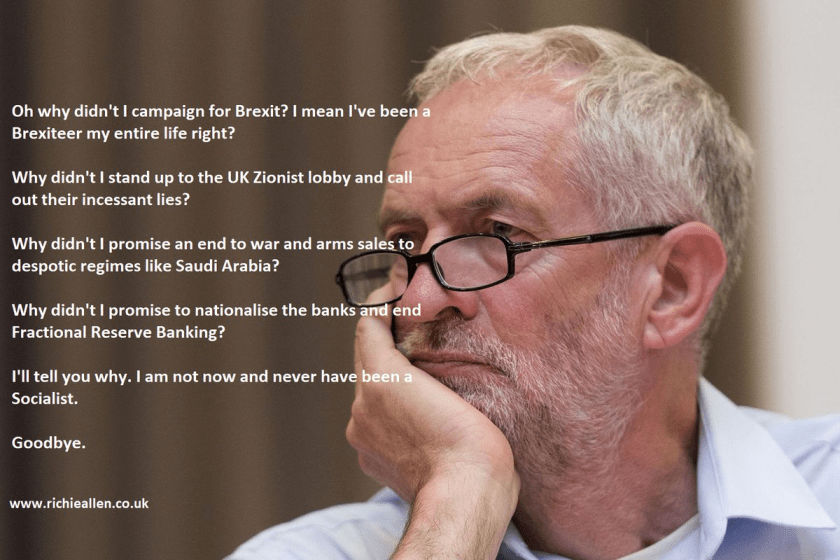
During the run up to the recent election in Great Britain, Jeremy Corbyn and the Labour Party were accused, with almost unprecedented hysteria, of anti Semitism. Mr. Corbyn is not anti Semitic, he has been a lifelong anti-racist advocate. Perhaps the histrionics in the press and pulpits were a reaction to the tepid support Corbyn has offered the Palestinians or were based on the likelihood of large tax increases under Corbyn’s socialist manifesto under which the taxpayers would fund, among other items, free universal education, free broadband and the investment of billions of pounds in hazily defined transportation and green energy funds.
Labour’s response to the unrelenting smear campaign was not to defend itself as a body that protects the rights of all races and religions (as its own manifesto claims), but instead to viciously turn on its own members, ousting anyone whose views, however historically verifiable, political or simply observational, were denounced as anti Semitic by someone. Essentially, Labour treated an accusation of anti Semitism as its own a priori truth.
In April, a Labour Party member (here called “Ted”) received a letter from Jane Shaw, secretary of Labour’s Constitutional Committee, stating that the committee “has received a charge from the National Executive Committee… that you have breached Labour Party Rules.”
The alleged breach was conduct “prejudicial or grossly detrimental to the Labour Party,” which, it claims, must be inferred from what it labels “demonstrating hostility to the Jewish people” and “published comments on line which deny or question aspects of the Holocaust.” In my opinion, the writings cited by Labour, although they touch on so-called Jewish issues, fail to substantiate Labour’s own accusations, nor have they run afoul of Britain’s strict hate speech laws. I wonder what might happen had Ted written that Africans as well as others participated in the slave trade? Would this be treated as a racist statement about Africans? I ask, because I read of no such expulsions for racism from the Labour Party.
The Party’s letter dictates its Draconian rules for contesting its accusation. The committee will hold a hearing for which Ted is given the choice of three bad options:1.Ted can appear alone; 2. Ted may bring a “silent friend” who is a “current compliant member [of the Party],” and whose name he provides in advance. Ted may consult with his friend but the friend may not speak aloud to the Committee. (what is the possible rationale for this?) or; 3. Ted may request “to be allowed be (sic) represented by either a lay or trade union representative, [who is also] a member of the Party or a [lawyer], who does not have to be a Labour Party member.
The only way Ted can use non-Labour aligned representation or support is for Ted to incur the expenses of hiring a lawyer. Of course, not every ‘accused’ member is articulate enough to represent himself before the committee nor rich enough to afford a lawyer. The Party’s letter emphatically states that its rules never allow reimbursement for expenses under any circumstances including if Ted is found innocent of all charges or even if the charges are found to have been based on fraudulent or malicious accusations.
The brief letter contains more outrageousness. It warns Ted that “It is vital to ensure fairness to you and other individuals, and to protect the rights of all concerned under the Data Protection Act 2018 that these proceedings are undertaken confidentially.” But the Data Protection Act sets standards to protect individuals, such as Ted, from organizations that collect data, such as the Labour Party. See: Ted is entitled to do as he wishes with his own file, it is the Labour Party that has a duty of confidentiality.
What is the credibility of an organization that sends an accusatory letter demanding confidentiality based on a law intended to protect individuals from organizations such as itself? Is its ‘rule’ intended to protect Labour from the consequences of its own conduct?
Labour further asserts that it retains control over data Ted receives in the process of reviewing the serious and in my opinion, unfounded charges made against him. “[such data] remains under the control of the Labour Party and … should not be .. disseminated without prior permission from a Labour Party Officer.” By what authority does Labour deny Ted the right to name his accusers? Without Ted’s knowledge or consent, the Labour Party examined his personal facebook and twitter chats to play “find the anti Semitism,” and has published their ‘findings’ to two separate Orwellian-titled “committees.” It is no surprise that the letter does not inform Ted of his reciprocal rights should a committee member publicly release information about him. There are good reasons why governments protect open trials, one of which is to discourage kangaroo courts like the one outlined in Labour’s letter.
The salient questions this letter raises are why any sane person would want to be a member of such a Party and why the Brits would choose (as they emphatically did not) to be under the leadership of a party whose standards for tolerance and justice are set by its own big brother.
December 15, 2019
Posted by aletho |
Civil Liberties, Ethnic Cleansing, Racism, Zionism, Full Spectrum Dominance | Labour Party, UK, Zionism |
Leave a comment
By Johanna Ross | December 13, 2019
Overnight the electoral map of the UK has changed significantly. Scotland is once again bathed in a sea of yellow, as England has been shrouded in blue. With the Scottish National Party obtaining 45% of the vote north of the border, and the Conservatives only 25% it is clear not only is there no mandate for Brexit in Scotland, but as leader Nicola Sturgeon has said, there is now very much a mandate for holding a second referendum on Scottish Independence.
England, on the other hand has put its support resoundingly behind Prime Minister Boris Johnson and his mantra of ‘Get Brexit Done’. With a remarkable 364 seats, as opposed to Labour’s 203 – its worst performance since 1935 – he proclaimed that a ‘political earthquake’ had occurred and that he would end all the squabbling of the last few years he would take the country out of the EU ‘no ifs and no buts’. This was a message that appealed to the majority, clearly sickened by the deadlock of Brexit. Despite the radical spending programme proposed by the Labour party, this election ended up being, as it was promoted, all about Brexit.
And this takes us to the broader context of what is in fact happening in the UK. Indeed, it’s important to see this election in the wider European political landscape. This was not just a Conservative party win, but a victory for nationalism. Not just Scottish Nationalism, but English Nationalism under the banner of Brexit, and Welsh and Irish Nationalism. For the first time ever, Northern Ireland elected more Nationalist MPs than Unionist, in what was also, like Scotland, an anti-Brexit vote, which will spur on more talk of Irish reunification. Welsh Nationalist party Plaid Cymru also held on to its four seats in Wales.
So while it may be portrayed as a landslide victory for the Conservatives, this election more than ever has shown up the cracks forming in the Union. Scottish Nationalism appears to be on an irreversible path to independence, with the question now being not if there will be a referendum on independence, but when. The strong Remain vote up north has only boosted the case for leaving the UK, as Scotland places more importance on being part of Europe, than being part of Britain. England, for its part, has clearly put more emphasis on being out of Europe, than it has on retaining the Union.
Indeed, looking at the western world in general, the popularity of nationalist and right-wing parties is undisputedly on the rise. The AfD in Germany, the National Front in France or Vox in Spain – these parties are all gaining popularity, just as Trump has in the US. And together with Johnson’s Conservatism, they all have something in common, that ‘populist’ appeal that really gets its message across. For regardless of their party leaders’ sins (Boris Johnson has been repeatedly been lambasted as a liar, racist, and misogynist), they have not been enough to deter voters, for whom clearly the nation state is what matters most.
There’s no doubt that Brexit has been a shock for the EU. Arguably Britain had always been a hesitant member, refusing to join the Euro, or join the Schengen zone (which allows borderless travel between states); it never quite developed that European mindset. But the Brexit vote took EU politicians by surprise, sending shockwaves across a Union already under pressure from Eurosceptic parties. They will no doubt breathe a sigh of relief in Brussels that the Brexit stalemate will now be broken with Boris Johnson’s parliamentary majority – finally a deal can be passed – but the reality that one of their major players finally leaving must be making them nervous.
Boris Johnson put faith in the people, and the gamble paid off. But whether he appreciates the real seismic consequences of this ‘political earthquake’ is another question. For cracks are not only emerging between Britain and Europe, but across the United Kingdom itself. It’s the price to be paid for Brexit.
Johanna Ross is a journalist based in Edinburgh, Scotland.
December 13, 2019
Posted by aletho |
Civil Liberties | European Union, Ireland, Scotland, UK, Wales |
Leave a comment

After more than two months of mobilizations against the policies of right-wing President Sebastian Piñera, sectors of the population took to the streets Tuesday in what was called “March for the Eyes of Chile,” in commemoration of the International Human Rights day.
The Chilean people denounced the government’s excessive violence after 352 people lost their vision partially or totally during the violent repression to social protests. Organizations defending the rights of peoples mobilized to the meeting point for protesters at the renamed ‘Plaza of Dignity.’
The main objective of the march was to denounce the violent repression by police that until Dec. 6, caused 3,449 injured, including 2,767 men, 397 women, and 254 children and adolescents, according to the National Human Rights Commission.
Those attending the demonstration came with posters that had one eye drawn to remember the 352 people who have eye wounds, of which 331 are from injury or trauma and 21 from bursting or loss.
The posters also show a message denouncing “the eyes of the people accuse the terrorist state.”
For his part, the Director of the NHRC Sergio Micco said that the organization has proven on countless occasions that serious violations of human rights have occurred in the demonstrations. “We are facing a situation of denunciation of serious violations of human rights… there are abusive and negative behaviors that are continually repeated such as excessive use of riot guns,” he commented.
The Director of the Carabineros, Chile’s military police Mario Rozas, announced the suspension of the use of pellets as an anti-riot tool, except in cases of “legitimate defense when it represents a death threat.”
The measure follows a study by the University of Chile that states that these pellets are composed of only 20 percent rubber, while the other 80 percent have different elements, such as lead. However, on Nov. 23, Al Jazeera reported that Chilean police continue to implement pellets despite the official suspension of their use.
The unrest in the South-American country was sparked by a government’s decision to increase metro fees [premised on reduced carbon energy] but quickly spread to hold other social issues such as income inequality and swelling costs of living. The state’s response to the popular grievances has since led to the death of 23 demonstrators while around 3,000 have been injured.
The Inter-American Commission on Human Rights (IACHR) along with numerous other rights groups condemned the constant violations of human rights by police and military against the population in Chile.
December 11, 2019
Posted by aletho |
Civil Liberties, Subjugation - Torture | Human rights, Latin America |
Leave a comment
The Israeli occupation has committed 557 violations against Palestinian mass media during 2019 alone, the Government Media Office (GMO) revealed in a report issued on Tuesday.
Commenting on the report, GMO director, Salama Marouf, announced that Palestinian journalists are facing the “worst violations” by the Israeli occupation, noting that a number of them were killed, with some losing body parts or suffering from serious injuries.
The most recent Israeli violation, according to Marouf, was the Israeli shooting of the Palestinian photojournalist from the West Bank, Muath Amarneh, causing serious injuries to his eye leading to its removal.
Marouf also cited the Israeli closure of Palestine TV’s office in Jerusalem, after raiding it and confiscating its contents.
Marouf stressed that the Israeli occupation forces use “direct excessive force” to crackdown on Palestinian journalists and mass media, in order to undermine their coverage of the Israeli violations against the Palestinians.
Recounting only some of the Israeli violations against journalists, Marouf cited “the Israeli occupation forces beat them, insult them, hinder their work, arrest them, raid their homes, confiscate their equipment and impose travel bans on them.”
Marouf also described the Israeli pressure and cooperation with the owners of the different social media platforms, including Facebook and Twitter, which closed and disabled hundreds of Palestinian pages and accounts, as part of the violations against Palestinian media.
He called for bringing the Israeli occupation to court over its crimes against Palestinian journalists and mass media, and called for the implementation of the UN Security Council Resolution 2222, which guarantees the protection of journalists.
December 11, 2019
Posted by aletho |
Civil Liberties, Ethnic Cleansing, Racism, Zionism, Full Spectrum Dominance | Human rights, Israel, Palestine, Zionism |
Leave a comment
Attorney General William Barr on Monday disparaged the long-awaited findings of the Justice Department Inspector General Michael Horowitz into FBI conduct in the investigation of alleged Russian interference in the 2016 presidential campaign. Barr, in effect, accused Horowitz of whitewashing a litany of proven misfeasance and malfeasance that created the “predicate,” or legal justification, for investigating candidate-and-then-president Donald Trump on suspicion of being in cahoots with the Russians.
In grammatical terms, there can be no sentence, so to speak, without a predicate. Trump was clearly the object of the sentence, and the sleuths led by then-FBI Director James Comey were the subjects in desperate search of a predicate. Horowitz candidly depicted the predicate the FBI requires for a counter-intelligence investigation as having to meet a very low bar. The public criticism from his boss was unusual. For the tenacious attorney general, doing a serious investigation of how the FBI handled the Trump-Russia inquiry has become a case of no-holds-Barr-ed, one might say.
Lindsey Smacking His Lips
Particularly damning in Horowitz’s report was the revelation that the FBI kept the “Russia investigation” going well after countervailing and exculpatory evidence clearly showed that, in the unforgettable words of one senior FBI official, Peter Strzok, there was “no there there.”
As Sen. Lindsey Graham put it yesterday, FBI investigators kept running through STOP signs in hot pursuit of a needed, but ever elusive, credible predicate. At a press conference, Graham pointed to page 186 of the Horowitz report to call attention to one of the most obvious STOP signs FBI sleuths should have heeded; namely, the fact that the FBI learned in January 2017 that the primary sub-source for Christopher Steele’s “dossier” disavowed it as misstated and exaggerated — basically rumor and speculation. No problem: the FBI investigation continued.
Mincing no words, Graham called the FBI investigation into alleged Trump campaign ties with Russia a “criminal enterprise” that got off the rails. (Special Counsel Robert Mueller found no evidence of such a conspiracy.) Sparks will fly on Wednesday as Graham, chair of the Senate Judiciary Committee, pursues the matter in more depth when Horowitz testifies before the committee. Graham emphasized yesterday that the general goal is to ensure that such a “criminal enterprise” does not happen again.
He added that one of the ways to prevent a recurrence is to make sure “those who took the law into their own hands need to pay a price.” Uh-oh. I cannot remember the last time leaders of the “national-security state” had to pay a price.
Barr: ‘Thinnest of Suspicions’
Barr took unusually strong public issue with Horowitz’s conclusion that there was adequate reason to mount an FBI investigation of the Trump campaign and suspected ties to Russia. Barr issued a formal statement asserting that the Horowitz report “now makes it clear that the FBI launched an intrusive investigation of a U.S. presidential campaign on the thinnest of suspicions that, in my view, were insufficient to justify the steps taken.”
U.S. Attorney John Durham, whom Barr picked to lead what has now become a criminal investigation regarding how that FBI’s “intrusive investigation” was launched, issued his own formal statement of criticism, expressing disagreement with the IG’s findings as to the predication of the investigation and “how the FBI case opened.” Durham added that he had told the IG last month of this disagreement. In his statement yesterday, Durham spoke not of suspicions, but of evidence his ongoing investigation has already gathered “from other persons and entities both in the U.S. and outside of the U.S.”
Evidence, Not Just Suspicions
Both Barr and Durham chose their words carefully, and so did former CIA Director John Brennan in his May 2017 congressional testimony about his suspicions that Trump’s campaign might have been colluding with the Russians. Soon the spotlight is likely to turn onto Brennan and his carefully parsed testimony, which fell considerably short of qualifying as a predicate for investigation (but played a key role anyway).
On May 23, 2017, Brennan told Congress:
“I encountered and am aware of information and intelligence that revealed contacts and interactions between Russian officials and US persons involved in the Trump campaign that I was concerned about because of known Russian efforts to suborn such individuals. It raised questions in my mind about whether Russia was able to gain the cooperation of those individuals.”
CNN’s coverage of Brennan’s testimony is even more revealing (of CNN’s bias) in retrospect.
Moreover, Brennan famously told Congress, he doesn’t deal with evidence. That was what Republican Rep. Trey Gowdy was wondering about, when he grilled the former CIA director, also on May 23, 2017, on what evidence he had provided to the FBI to catalyze its investigation of the alleged Trump-Russia collusion.
Brennan replied: “I don’t do evidence.”
The best Brennan could do was start out by repeating his well-rehearsed statement, later contradicted by Mueller’s report: “I encountered and am aware of information and intelligence that revealed contacts and interactions between Russian officials and U.S. persons involved in the Trump campaign,” adding that “that required further investigation by the Bureau to determine whether or not U.S. persons were actively conspiring, colluding with Russian officials.”
Media Treatment
Referring to the Horowitz report yesterday, Law Professor John Turley noted:
“Despite this shockingly damning report, much of the media is reporting only that Horowitz did not find it unreasonable to start the investigation, and ignoring a litany of false representations and falsifications of evidence to keep the secret investigation going. Nothing was found to support any of those allegations, and special counsel Robert Mueller also confirmed there was no support for collusion and conspiracy allegations repeated continuously for two years by many experts and members of Congress.”
And yet “debunking” is the name of the game. A New York Times headline this morning read, “Report on F.B.I. Russia Inquiry Finds Serious Errors but Debunks Anti-Trump Plot.” And an “analysis” article by Mark Mazzetti was titled: “Another Inquiry Doesn’t Back Up Trump’s Charges. So, on to the Next.”
Mazzetti writes:
“Engage in a choreographed campaign of presidential tweets, Fox News appearances and fiery congressional testimony to create expectations about finding proof of a “deep state” campaign against Mr. Trump. And then, when the proof does not emerge, skew the results and prepare for the next opportunity to execute the playbook.
“That opportunity has arrived in the form of an investigation by a Connecticut prosecutor [Durham] ordered this year by Attorney General William P. Barr — and the president and his allies are now predicting it will be the one to deliver damning evidence that the F.B.I., C.I.A. and even close American allies conspired against Mr. Trump in the 2016 election.”
Horowitz Report an ‘Appetizer?’
Mazzetti goes on to express doubt “that Mr. Durham will exhume any information that will fundamentally change the understanding of what happened in 2016.” Maybe, maybe not. It is a safe bet, though, that President Trump has better insight into this. According to Mazzetti, Trump recently had been playing down expectations about the Horowitz inquiry — indicating it was only an appetizer for what’s to come. “I do think the big report to wait for is going to be the Durham report,” he said. “That’s the one that people are really waiting for.”
The president may be expecting Mueller-inquiry-type vindication once Durham’s investigation is complete. If that proves to be the case and Trump receives post-impeachment acquittal from the Senate, as expected, he may be able to parlay that into four more years, a sobering thought.
Ray McGovern works with Tell the Word, a publishing arm of the ecumenical Church of the Saviour in inner-city Washington. He was an Army Infantry/Intelligence officer, then a CIA analyst for 27 years. He prepared and briefed the President’s Daily Brief for Presidents Nixon, Ford, and Reagan, and in retirement co-founded Veteran Intelligence Professionals for Sanity (VIPS).
December 11, 2019
Posted by aletho |
Civil Liberties, Deception | CIA, FBI, United States |
Leave a comment
To understand just how shoddy the FBI’s work was in securing a Foreign Intelligence Surveillance Act warrant targeting the Trump campaign, you only need to read an obscure attachment to Justice Department Inspector General Michael Horowitz’s report.
Appendix 1 identifies the total violations by the FBI of the so-called Woods Procedures, the process by which the bureau verifies information and assures the FISA court its evidence is true.
The Appendix identifies a total of 51 Woods procedure violations from the FISA application the FBI submitted to the court authorizing surveillance of former Trump campaign aide Carter Page starting in October 2016.
A whopping nine of those violations fell into the category called: “Supporting document shows that the factual assertion is
inaccurate.”
For those who don’t speak IG parlance, it means the FBI made nine false assertions to the FISA court. In short, what the bureau said was contradicted by the evidence in its official file.
To put that in perspective, former Trump aides Mike Flynn and George Papadopoulos were convicted of making single false statements to the bureau. One went to jail already, and the other awaits sentencing.
The FBI made nine false statements to the court.
And the appendix shows the FBI made another nine factual assertions that did not match the supporting evidence in the file. In another words, the bureau was misleading on nine other occasions.
The vast majority of remaining Woods violations — 33 in total — involved failing to provide any evidence in the Woods procedure backing up assertion in the FISA warrant application.
That’s serious too since the sole purpose of the Wood procedures is to ensure all evidence cited in a FISA application is documented as accurate and reliable so it can be trusted by the courts.
December 10, 2019
Posted by aletho |
Civil Liberties, Deception | FBI, United States |
Leave a comment
Big Tech’s ties to the Deep State are everywhere, and we should be concerned

I wrote a short piece a few days ago about Reddit banning users for posting the leaked NHS documents. (Spreading anti-Russian propaganda in the process).
Previously, we have also covered Reddit making politically motivated decisions – such as quarantining boards dedicated to Donald Trump and 9/11.
It turns out there’s a very simple explanation for that, Reddit’s “director of policy” was previously in the pay of the US Deep State.
This was brought to our attention by Ian56 on twitter.
In 2017 Reddit hired Jessica Ashooh as their “Director of Policy”. Her LinkedIn page shows her previous employment was “Deputy Director, Middle East Strategy Task Force” at the Atlantic Council.
The report on which Reddit based their decision to ban users as part of a “Russian campaign” was written by Ben Nimmo, who also works for the Atlantic Council (and the Integrity Initiative).
Essentially, Reddit has a high-up employee who was previously in the pay of the US Department of State (and possibly still is).
It’s a prime example of how the US (and UK) infrastructure create an authoritarian, highly-controlled state, whilst maintaining a veneer of “freedom”. There are other examples too.
A high profile, and obvious, one is Nick Clegg being hired by Facebook.
Facebook also hired Ukrainian journalist (and fascist sympathiser) Kateryna Kruk as “public policy manager”, she also has ties to the Atlantic Council. (A short while later Facebook started blocking links to OffGuardian ).
In 2017 Facebook hired Indian journalist Shivnath Thukral as director for public policy for India and South Asia. HIS previous employer was the Carnegie Endowment for International Peace (CEIP), another US NGO, funded by the State Department.
In 2011 Google hired Suzanne Michel as director of policy planning, she previously worked as Deputy Director of the Federal Trade Commission.
Then, in 2018, Google hired Karan Bhatia as their Global Head of Policy, Mr Bhatia had previously worked for the administration of George W. Bush.
It all follows the same pattern of apparent independence concealing an inter-connecting web of control, all dedicated to furthering the same agenda and all being funded by the same central source.
The Atlantic Council is not officially affiliated with the US government, neither is CEIP, they are notionally independent. Likewise, Reddit, Google, Facebook et al. are supposedly independent companies, not in any way controlled by the state.
… and yet you follow the money and it always leads to the same place.
December 9, 2019
Posted by aletho |
Civil Liberties, Deception, Full Spectrum Dominance, Militarism | European Union, Russia, UK, United States |
Leave a comment
I am pleased to announce the publication of my latest collection of essays. The capsule description of the book carried on the pages of internet booksellers is as follows
“The essays in this book deal with major political, social and cultural events primarily in Europe and Russia during the period 2017 – 2019 in which the author was a participant or eyewitness and has personal impressions to share. Several of the essays are drawn from other genres including travel notes, public lectures and reviews of particularly insightful books on key issues of our times like immigration, Liberalism and war with Russia that have not received the broad public exposure they merit.”
However, there is much more to the story that has relevance to its potential readers set out in the Foreword shown below, starting with the several layers of nuance in the title itself.
Foreword
The title of this book has been chosen with care and a few introductory words of explanation are owed to the reader.
First, the notion of a “Belgian perspective” on international affairs may on its own seem peculiar. In what way, one might ask, can little Belgium, with its population of around 12 million have a perspective that is unique and worthy of consideration? In the same vein, what perspective on foreign affairs in general can a lesser Member State of the European Union have when the most powerful Member State, Germany, denies that it has an independent foreign policy and defers to Brussels, specifically to the EU’s High Representative for Foreign Affairs and Security Policy, who, formally, holds sole responsibility for these matters on behalf of the 500 million plus people from 28 nations? Indeed, in a recent interview relating to the publication of his latest book, the octogenarian former prime minister of Belgium Marc Eyskens pointed out that the rise of the EU Institutions has left national governments with a substantially reduced level of sovereignty and competence comparable to that of a major city rather than of a country.
Meanwhile and in parallel, as the seat of both the NATO headquarters near the Zaventem Airport and of the Supreme Headquarters Allied Powers Europe in Mons, Belgium marches in lock-step with its US-led allies. Belgium’s mainstream media, both television and print media, traditionally support whatever policy line comes from the EU Institutions and NATO.
There have been rare exceptions to this solemn loyalty to the consensus. In particular, in the run-up to the US invasion of Iraq in 2003, Belgium was one of the three “Old Europe” nations, alongside France and Germany, that joined Russia in openly rejecting US policy. For this the nation’s Prime Minister at the time, Guy Verhofstadt, paid dearly, being disqualified from appointment to head the EU Commission, for which he was a leading candidate at the time.
But the aforementioned facts constraining the political elites of Belgium are by no means imperative for Belgian society as a whole. Indeed, as I detail in several essays in this collection, at both ends of society, the high end in their dinner jackets and at the mass, man-in-the-street level, there is very little sympathy for the official foreign and defense policies and a lot of free-thinking going on.
All of which brings us to the question of who is the Belgian whose perspective is set out in this tome. The simple and direct answer is that I am that Belgian.
Readers of my articles posted in various platforms on the internet have seen me described in the past as an American and long-time resident of Brussels. Both statements were and are correct. However, in August 2017 I also became a naturalized Belgian. This ‘second birth’ was more than seven years in gestation. After its successful culmination, I found myself increasingly involved in intra-Belgian, intra-European politics. Consequently, I have written with greater frequency on issues that are specific to the Old Continent. By their nature, these articles have not been picked up and disseminated via the internet platforms based in the United States by which readers know me best. Moreover, in my new guise I have written some of these articles or speeches in French so as to better reach prospective readers around me where I live and practice politics. These materials are also republished in this volume.
Notwithstanding the new elements, as in my preceding three collections of “nonconformist” essays published between 2013 and 2017, the major part of my writings is focused on present-day Russia and its relations with the United States and Europe. Russia is my main field of interest and expertise coming both from book learning and from life experience as a frequent visitor to the country over many decades and also as someone who has both lived and worked there for eight years beginning in 1994. That is something very few of our commentators in the West can say before they launch into ill-informed vitriolic attacks on the “Putin regime” and Russians as a people.
Since all of the essays presented here have been published on the internet in one way or another, it is legitimate to ask what is the added value of republishing them as a book. There are several answers to that question, ranging from the superficial but adequate to an answer that goes to the heart of how I see my social role in writing these pieces.
The superficial but adequate explanation is that everything is transient, nothing more so than the internet, where digital platforms are here today, gone tomorrow, where even one’s own blog site lasts no longer than the latest annual fees payment. And while e-books may be no more durable than the publishing company maintaining and distributing the digital files, physical books deposited in libraries will be accessible to the curious public and to researchers as long as the human race continues on its way, which may or may not be eons depending on your degree of pessimism inspired by this and similar works by my fellow “dissidents” on international affairs.
The deeper explanation is that influencing public opinion towards détente, towards self-preservation and away from confrontation with Russia that can easily end in catastrophe presently does not appear to be actionable. This is so for banal but understandable reasons that have to do firstly with the way the United States is governed internally and secondly how the United States rules over “the free world.”
Over the past twenty years or more, repeated polls taken by Pew and other research institutions have shown that the American public does not support foreign military adventures or a world gendarme role for their country. However, the political establishment pays no heed whatsoever to this clear disposition of the electorate just as the views of the electorate on a great many other issues are ignored by Congress and by the Executive branch. This follows from the financial dimension of getting and staying in power. By campaign funding and lobbying, a tiny number of exceedingly wealthy individuals and corporations effectively make policy at the federal level, and accommodation with the world is not on their agenda.
Meanwhile, whether as a result of awareness of their powerlessness or for other reasons, the broad American public is apathetic as concerns foreign policy. People just don’t want to disturb their peace of mind by contemplating the aggressive, bullying behavior of their government on the international stage. “Our boys” are not being killed abroad in significant numbers. The budgeted military expenses of the USA are being financed by others who buy Washington’s Treasury notes. There is nothing to force a reckoning with what is being done in the name of America abroad. Least of all, with respect to Russia, which has taken with surprising equanimity the sanctions and other punishments meted out to them over their alleged bad conduct in Ukraine and Syria, over their alleged meddling in American and European elections. The notion that the West might be crossing their red lines at some point, that the economic and informational war might spill over into kinetic war that escalates quickly – such thoughts could not be further from the minds of people in the States or in Western Europe, including those who take a real interest in public affairs and think they are au courant.
This is not to say that the essays published here and similar writings by my comrades-in-arms have no readers. On the contrary, our works are republished by portals other than our own. They are referenced on social networks and attract considerable numbers of “hits,” meaning individual readers. Some of the essays in this book have reached an audience numbering in the tens of thousands. But so far the dry residue of this relative success remains inconsequential. No broad-based political movement championing my/our principles of détente has emerged. There are no demonstrations on behalf of peace, while there are American and worldwide demonstrations to fight for renewable energy and for programs to combat climate change, or to fight for gender issues and equality of pay.
So, why write? why publish?
This takes us to the question of self-definition and social role.
We are living through Dark Ages today, notwithstanding all the technical achievements of our science and technology and advanced medicine. At the moral, social and political levels, these are bleak times when “progressive” values trample upon traditional moral and ethical, not to mention religious values, when freedom of expression and other civil liberties have been gutted for the sake of public security and to serve demagogic purposes.
In this context, these writings are intended to be an eyewitness account of the prevailing moral and political decadence for the edification of those in future generations who will have their own battles to fight to safeguard cultural traditions and freedoms. In assuming this role of a chronicler, I seek to continue the work of those who passed this way half a century ago or more and who left behind their own writings of the day, which gave me spiritual encouragement and purpose when I came across them.
At the same time, I do not abandon the hope that my compatriots in America and now also in Europe will come to their senses and explore these writings and the writings of my fellow dissidents to find an antidote to the propaganda about the recent past and present being dispensed by government, by mainstream media and by all too many scholars in the field.
One straw in the wind was a July 2019 editorial in the hawkish, till now fanatically anti-Russian New York Times calling for a rapprochement with Russia before that country aligns definitively with China and recreates a global threat to American interests. Or I refer to the publication of an article co-authored by former Georgia Senator Sam Nunn in the September-October edition of Foreign Affairs magazine, another standard bearer of U.S. hegemony, stating in detail the existential risks we incur by having cut lines of communication with Russia and by entering into a new, uncontrolled arms race with that country. As the Chair of the Senate Committee on Armed Services from 1987 to 1995, he was a leading figure in arms control negotiations. In the new millennium, Nunn has been one of the generally recognized “wise men” in the American political establishment, alongside Henry Kissinger, George Shultz and James Baker.
There is also an impulse for optimism coming from the latest declarations of French President Emanuel Macron, who is striving to assume leadership of the European Union’s policy agenda now that control is slipping from the hands of Germany’s Iron Lady, Angela Merkel in the waning days of her chancellorship. In his speech to French ambassadors following the conclusion of the G7 summit meeting in Biarritz on the weekend of 24-25 August, Macron stated very clearly that Europe must put an end to its policy of marginalizing and ostracizing Russia because the Old Continent needs to work cooperatively with Moscow if it is not to become a powerless bystander to the growing conflict between the United States and China.
Such signs of sobriety and concern for self-preservation suggest that all is not lost in the cause of détente.
For those who have not read my earlier works, I repeat here that my essays are often devoted to major events of the day, but are not systematic or comprehensive. I wrote only when I believed that I had a unique perspective, often from my direct participation in the event as actor or firsthand witness. I have not taken up subjects where all of my peers were piled up on the line or were basing themselves on secondary sources. I consider my own writings to be primary sources in an extended, autobiographical genre.
However, they do not constitute pure autobiography. That is something I am writing in parallel in a book devoted to Russia in the wild 1990s, which I saw at ground level as the country General Manager working from offices in Moscow and St Petersburg for a succession of major international producers of consumer goods and services.
* * * *
On-line bookseller Amazon has been fastest off the mark posting the book for sale in hardbound, paperback and e-book formats through its global network of websites including amazon.com, amazon.fr, amazon.de, amazon.co.uk, amazon.com.au, plus others in Latin America and Asia. Amazon competitor in the U.S. market, http://www.barnesandnoble.com, also offers all three formats. Both websites provide a ‘look inside’ option, facilitating browsing. For e-book purchasers in Europe, an alternative and cheaper vendor is http://www.bol.com. For U.S. purchasers, the least expensive vendors of the e-book at this moment are Barnes & Noble and the publisher’s own online bookstore: https://www.authorhouse.com/en/bookstore/bookdetails/805594-a-belgian-perspective-on-international-affairs
©Gilbert Doctorow, 2019
December 8, 2019
Posted by aletho |
Book Review, Civil Liberties, Militarism | European Union, Russia, United States |
Leave a comment
December 2015 was a pivotal month in many respects.
During the first week of December 2015, Donald Trump began to establish a substantial lead over his Republican primary opponents.
Vice President Joseph Biden traveled to Ukraine to announce, on December 7th, a $190 million program to “fight corruption in law enforcement and reform the justice sector,” but behind the scenes explicitly linked a $1 billion loan guarantee to the firing of Ukrainian prosecutor Viktor Shokin, who had been investigating the energy company Burisma, which employed Biden’s son Hunter.
On December 9, 2015, the reported whistleblower Eric Ciaramella held a meeting in Room 236 of the Eisenhower Executive Office Building with Daria Kaleniuk, executive director of the Ukrainian Anti-Corruption Action Center, which was 59%-funded by Barack Obama’s State Department and the International Renaissance Foundation, a George Soros organization.
Also attending that meeting was Catherine Newcombe, attorney in the Criminal Division, Office of Overseas Prosecutorial Development, with the U.S. Department of Justice, where, among other duties, she oversaw the Department’s legal assistance programs to Ukraine.
By December 2015, Paul Manafort was undoubtedly considering approaching the Trump campaign to rejuvenate his U.S. political bona fides and mitigate the legal and financial difficulties he was experiencing at the time.
From the beginning of his association with the Trump campaign, Roger Stone, a long-time Manafort partner, made a strong case to Trump to bring in Manafort, who would officially connect to the campaign immediately after the February 1, 2016 Iowa caucuses.
Based on events occurring during the same period, were Obama Deep State operatives aware of Manafort’s intent and already intending to use his past questionable practices and links to Russia against Trump?
Such awareness of Manafort’s plans could have been obtained either through FBI surveillance, which began in 2014 and ended in early 2016, or through information provided by Manafort associates, for example, Ukrainian businessman Konstantin Kilimnik, who worked for Manafort and was a FBI and Department of State asset, not a Russian agent as later painted by the Mueller investigation.
According to White House visitor logs, on January 19, 2016, Eric Ciaramella chaired a meeting of FBI, Department of Justice and Department of State personnel, which had two main objectives:
1) To coerce the Ukrainians to drop the Burisma probe, which involved Vice President Joseph Biden’s son Hunter, and allow the FBI to take it over the investigation.
2) To reopen a closed 2014 FBI investigation that focused heavily on GOP lobbyist Paul Manafort, whose firm long had been tied to Trump through his partner and Trump pal, Roger Stone.
That is, contain the investigation of Biden’s son and ramp up the investigation of Paul Manafort.
Again, according to White House logs, the attendees at the January 19, 2016 meeting in Room 230A of the Eisenhower Executive Office Building were:
Eric Ciaramella – National Security Council Director for Ukraine
Liz Zentos – National Security Council Director for Eastern Europe
David G. Sakvarelidze – Deputy General Prosecutor of Ukraine
Anna E. Iemelianova (Yemelianova) – Legal Specialist, US Embassy Kyiv and US Department of Justice’s Anti-Corruption Program.
Nazar A. Kholodnitsky, Ukraine’s chief anti-corruption prosecutor
Catherine L. Newcombe – attorney in the Criminal Division, Office of Overseas Prosecutorial Development, with the U.S. Department of Justice
Svitlana V. Pardus – Operations, Department of Justice, U.S. Embassy, Ukraine.
Artem S. Sytnyk – Director of the National Anti-corruption Bureau of Ukraine
Andriy G. Telizhenko, political officer in the Ukrainian Embassy in Washington DC
Jeffrey W. Cole – Resident Legal Advisor at U.S. Embassy Ukraine, presumed to be FBI
Just two weeks after that meeting, on February 2, 2016, according to White House logs, Eric Ciaramella chaired a meeting in Room 374 of the Eisenhower Executive Office, which seems to be a planning session to re-open an investigation of Paul Manafort (Note: one of the crimes of which Manafort was accused was money laundering, an area covered by the Department of the Treasury). The attendees were:
Jose Borrayo – Acting Section Chief, Office of Special Measures, U.S. Department of the Treasury, Financial Crimes Enforcement Network
Julia Friedlander – Senior Policy Advisor for Europe, Office of Terrorist Financing and Financial Crimes, U.S. Department of the Treasury
Michael Lieberman – Deputy Assistant Secretary, Terrorist Financing and Financial Crimes, U.S. Department of the Treasury
Scott Rembrandt – Anti-Money Laundering Task Force, Assistant Director/Director, Office of Strategic Policy, Department of the Treasury
Justin Rowland – Special Agent (financial crimes), Federal Bureau of Investigation

It appears that Paul Manafort became a vehicle by which the Obama Deep State operatives could link Trump to nefarious activities involving Russians, which eventually evolved into the Trump-Russia collusion hoax. Remember, the key claim of the follow-up Steele dossier, the centerpiece of the Mueller investigation, was that Trump campaign manager Paul Manafort was the focal point of a “well-developed conspiracy between them [the Trump campaign] and the Russian leadership.”
Nellie Ohr, Fusion GPS employee and wife of Department of Justice official Bruce Ohr, not only worked with Christopher Steele on the so-called Trump dossier, but, in May 2016, was the conduit of information to her husband and two Department of Justice prosecutors of the existence of the “black ledger” documents that contributed to Manafort’s prosecution.
Bruce Ohr and Steele attempted to get dirt on Manafort from a Russian oligarch, Oleg Deripaska, efforts that eventually led to a September 2016 meeting in which the FBI asked Deripaska if he could provide information to prove that Manafort was helping Trump collude with Russia.
The surveillance and entrapment attempts of Paul Manafort, Carter Page, George Papadopoulos and others were designed to collect evidence about Trump without formally documenting that Trump was the target.
After the election, to cover their tracks, James Comey, representing the FBI and the Department of Justice, misleadingly told Trump that the investigation was about Russia and a few stray people in his campaign, but they assured him he personally was not under investigation.
They lied.
Donald Trump always was, and still is, the target of the Deep State, the left-wing media and their Democrat Party collaborators.
Lawrence Sellin, Ph.D. is a retired US Army Reserve colonel, an IT command and control and cyber security subject matter expert and a veteran of Afghanistan, Iraq and a humanitarian mission to West Africa. He receives email at lawrence.sellin@gmail.com
December 7, 2019
Posted by aletho |
Civil Liberties, Deception | Ukraine, United States |
Leave a comment