Scottish nationalist leader awarded more than £512,000 after winning court case
Press TV – August 24, 2019
Alex Salmond’s legal victory against the government has been widely seen as yet another victory by Scottish nationalists against an establishment hell-bent on stopping them.
Scotland’s former First Minister had been accused of “inappropriate conduct” during the time he led the Scottish government.
The Scottish government has reportedly paid Salmond more than £512,000 to cover his legal costs after he successfully contested charges of sexual misconduct in court.
Although the case against him effectively collapsed in January, the government has now formally admitted defeat by awarding Salmond the large sum on an “agent and client” basis.
This is a punitive award used by the courts to recognize the fact that the losing party to litigation has caused the other party “unnecessary expenses”.
The Scottish parliament (Holyrood) has reportedly set up an enquiry to look into the huge expenses incurred investigating Salmond and the subsequent pay out after he won his court case.
The official enquiry was set up in the wake of reports that the Scottish government had spent nearly £750,000 (excluding internal costs) trying to defend its flawed legal case against Salmond.
This massive sum, combined with the substantial payment to Salmond, has raised questions about the nature of the enquiry into Salmond’s alleged “misconduct” and whether the case was politically motivated.
The former British diplomat, and supporter of Scottish independence, Craig Murray, alludes to this possibility in his latest post on his popular and respected blog.
For their part, the Scottish Conservative Party has seen fit to go on the political offensive, possibly with a view to deflect potential revelations that they had had a hand in forcing through a botched legal case against Salmond.
Donald Cameron, a Scottish Conservative member of Holyrood, has said it is “outrageous” that so much money had been spent on the case.
Salmond, who was the leader of the pro-independence Scottish National Party (SNP) for over 20 years, still faces a separate trial centred on 14 alleged offences, including two of attempted rape, nine of sexual assault, two of indecent assault and one of breach of the peace.
But in view of the former First Minister’s latest legal victory, it is fair to ask whether the separate charges against him could also be “flawed” and possibly politically motivated.
The legal and criminal cases against Salmond have raised suspicions in the Scottish nationalist community that the British establishment is trying to arrest the momentum toward Scottish independence, by any means necessary, including “flawed” legal procedures.
Salmond is widely seen as the most effective proponent of Scottish independence, as demonstrated by his two highly successful stints as leader of the SNP, first from 1990 to 2000 and then from 2004 to 2014.
Will the DNC Snatch Defeat from the Jaws of Victory Yet Again?
By Thomas L. Knapp | Garrison Center | August 23, 2019
President Donald Trump faces an exceedingly narrow path to re-election in 2020. In order to beat him, the Democratic nominee only needs to pick up 38 electoral votes. With more than 100 electoral votes in play in states that Trump won narrowly in 2016 — especially Wisconsin, Michigan, Pennsylvania, and Florida — all the Democrats have to do is pick a nominee ever so slightly more popular than Hillary Clinton.
That’s a low bar that the Democratic National Committee seems determined, once again, to not get over. As in 2016, the DNC is putting its finger on the scale in favor of “establishment” candidates, the sentiments of the rank and file be damned.
Last time, the main victim was Bernie Sanders. This time, it’s Tulsi Gabbard.
Michael Tracey delivers the gory details in a column at RealClearPolitics. Here’s the short version:
By selectively disqualifying polls in which Gabbard (a US Representative from Hawaii) performs above the 2% threshold for inclusion in the next round of primary debates, the DNC is trying to exclude her while including candidates with much lower polling and fundraising numbers.
Why doesn’t the DNC want Gabbard in the debates? Two reasons come to mind.
Firstly, her marquee issue is foreign policy. She thinks the US should be less militarily adventurous abroad, and as an army veteran of the post-9/11 round of American military interventions in the Middle East and Central Asia, she’s got the credentials to make her points stick.
Foreign policy is a weak spot for the increasingly hawkish Democratic establishment in general and the front-runner and current establishment pick, former vice-president Joe Biden, in particular. As a Senator, Biden voted to approve the ill-fated US invasion of Iraq. As vice-president, he supported President Barack Obama’s extension of the war in Afghanistan and Obama’s ham-handed interventions in Libya, Syria, and other countries where the US had no business meddling. The party’s leaders would rather not talk about foreign policy at all and if they have to talk about it they don’t want candidates coloring outside simplistic “Russia and China bad” lines.
Secondly, Gabbard damaged — probably fatally — the establishment’s pre-Biden pick, US Senator Kamala Harris, by pointing out Harris’s disgusting authoritarian record as California’s attorney general. Gabbard knows how to land a punch, and the DNC doesn’t want any more surprises. They’re looking for a coronation, not a contest.
If the DNC has its way, next year’s primaries will simply ratify the establishment pick, probably a Joe Biden / Elizabeth Warren ticket, without a bunch of fuss and argument.
And if that happens, the Democratic Party will face the same problem it faced in 2016: The rank and file may not be very motivated to turn off their televisions and go vote.
Whatever their failings, rank and file Democrats seem to like … well, democracy. They want to pick their party’s nominees, not have those nominees picked for them in advance. Can’t say I blame them.
Nor will I blame them for not voting — or voting Libertarian — if the DNC ignores them and limits their choices yet again.
Thomas L. Knapp (Twitter: @thomaslknapp) is director and senior news analyst at the William Lloyd Garrison Center for Libertarian Advocacy Journalism (thegarrisoncenter.org).
Israel tech ‘facilitating press freedom abuses around the world’
MEMO | August 23, 2019
Israel has been charged with enabling attacks on media freedom around the world by the Committee to Protect Journalists (CPJ), after export controls on surveillance technology were eased.
Citing a Reuters report, CPJ noted that Israeli officials have confirmed that – thanks to a rule change by the Defence Ministry – Israeli surveillance companies “are able to obtain exemptions on marketing license for the sale of some products to certain countries”.
According to Reuters, “the change took effect about a year ago”.
CPJ stated that:
Israeli-exported technology undermines press freedom globally by allowing authorities to track reporters and potentially identify their sources.
One example given by the press freedom watchdog was the Mexican government deploying Pegasus malware, sold by Israeli firm NSO Group, to infiltrate the mobile phones “of at least nine journalists”.
Pegasus was also used by Saudi Arabia to spy on the associates of journalist Jamal Khashoggi before he was murdered in the kingdom’s consulate in Turkey in October last year.
“Over and over again, we see Israeli technology facilitating press freedom abuses around the world, by lending a hand to governments that want to track and monitor reporters,” said CPJ Advocacy Director Courtney Radsch in Washington, D.C.
“An unregulated surveillance industry is bad for press freedom. The Israeli government should heed the UN Special Rapporteur’s call to respect human rights in its export policies.”
UN Special Rapporteur for Freedom of Expression David Kaye described Israel as “a major player in the surveillance technology market” in a June 2019 report which urged “a global moratorium on such exports until a human rights compliant regime was put in place”.
Is ‘hate-crime’ a media-creation?
By Renee Parsons | OffGuardian | August 22, 2019
As part of Remarks by President Trump on Mass Shootings in Texas and Ohio on August 5th, President Donald Trump announced that.
Today, I am also directing the Department of Justice to propose legislation ensuring that those who commit hate crimes and mass murders face the death penalty, and that this capital punishment be delivered quickly, decisively, and without years of needless delay
Normally it might have been expected that the mainstream media would run with Trump’s support of the death-penalty-for-hate-crimes as proof positive that the man is off his rocker. Instead, the statement garnered barely a flicker of public notice. Did anyone in authority bother to confirm that the shootings were indeed motivated by ‘hate?’
As the mainstream media consistently rush to judgment, speculation too often becomes fact before all the evidence is considered (ie Russiagate) as the MSM is relied on to provide factual and critical background information.
And yet since 65% of the American public believe that the MSM is peddling fake news begs the question of why should detailed reporting on these tragic events be left to a discredited media establishment or that their information on these recent shootings be considered truthful?
Why should the American public trust the MSM for what may have already been determined to be a ‘hate’ crime without providing evidence of the hate – as the Divide and Rule Game continues undeterred sowing division and conflict among the American people.
It remains unclear exactly why either tragedy is being specifically labeled a “hate” crime instead of felony murder as if there is a larger agenda to establish ‘hate’ as a bona fide.
Obviously, such barbaric mass killings are not normal behavior as the rationale for such conduct must stem from some deep emotional depravity just as the epidemic of suicides of young white males who have lost hope in American society makes no more sense.
There is an endemic crisis throughout the country and the political class are responsible. Decades after federal government elimination of grants for community mental health programs, ‘hate’ is the favorite determinant factor as the world’s most violent nation creates a generation of emotionally or mentally unstable young men, many of whom may be on mind-numbing psychiatric drugs.
Since the MSM has failed to inform the American public of advanced mind control practices; perhaps the MSM itself and the young shooters are part of widespread experiment using MK Ultra or other state-of-the-art brain manipulation techniques. How would the American public ever know which might be true?
The 21 year old El Paso shooter was immediately identified as a right wing Trumper acting on behalf of the President’s “hate” rhetoric and that he had posted an anti-immigration racist tract entitled An Inconvenient Truth – all of which turned out to be something less than the truth.
Decrying mass immigration as an environmental plea for population control sounds more like something John Muir might have written rather than a hate-filled racist diatribe justifying the slaughter.
Perusing the alleged politically charged manifesto included such statements:
Our lifestyle is destroying the environment of our country… If we can get rid of enough people, then our way of life can become more sustainable.
There is, however, a problematic psychiatrist father of uncertain character in the background as the shooter drove 650 miles from his home to El Paso before committing the crime and surrendering to authorities.
On the other hand, the Dayton shooter also defies the usual partisan identity and has been acknowledged as a 24-year old member of the Democratic Socialist Party, a Bernie and Elizabeth Warren supporter and was dressed and masked as an Antifa member at the time of the shooting. His weapons and ammo magazines appear to have been legally acquired, he had a high school history as a bully who kept a hit list and made violent threats.
Meanwhile, the Democrats who consider themselves the responsible party on gun control, failed to restore the assault gun ban when they had the votes in 2010 as they prefer fanning the flames of more ‘hate’ by blaming Trump’s loose lips even though the once-revered ACLU does not oppose the Second Amendment.
One wonders that if the El Paso shooter can be tagged with being influenced by Trump rhetoric, did the Dayton shooter receive his inspiration from Antifa or perhaps Elizabeth Warren? It is too much to expect any rational media voice to inquire – all of which brings us back to the President’s Remarks endorsing the death penalty.
How exactly did this ‘hate’ language make its way into Trump’s remarks as “hate” has become a preoccupation of American society and the Administration as its Special Envoy to Monitor and Combat Anti-Semitism’s very life purpose is to root out hate – not hate of all kinds but only that of the Jewish variety.
Historically, the American criminal justice system, flawed as it is, requires any jury in a criminal case to consider the Defendant’s level of conscious intent to commit a criminal act as well as the illegality of the act without specificity to the psychological issues of that intent.
Originally, hate crime laws were expected to offer special protection based on an individuals’ sexual orientation, gender, religion, disability or racial identity as perceived by the perpetrator.
In a manner that does not occur in normal criminal proceedings, defining the “hate” component of a crime requires a distinct determination that the defendant’s actions were solely motivated by thoughts of ‘hate.’
In a worse case scenario, is Trump suggesting that the death penalty may be applied to what is determined to be a hate crime even if that crime has not resulted in a death?
The reality is that hate crimes may be difficult to distinguish from a run-of-the-mill felony murder, thereby increasing the hate crime penalty makes little sense since first degree murder is already subject to the death penalty. Therefore, it appears that a redundant death penalty for a crime that would already call for the death penalty is little more than…overkill.
In other words, hate crime prosecution necessarily relies on criminalizing thoughts as the NSA claims it has already developed remote neural monitoring revealing one’s most hidden private thoughts or an iphone may be bugged with implants to reduce impulse control.
Many legal scholars would respond that the Equal Protection Clause of the 14th Amendment and the Due Process Clause in the Fifth Amendment already provides all American citizens with the guaranteed right to equal protection under the law (ie Brown v. Board of Education and Roe v. Wade) and therefore such hate laws are unnecessary and may be unconstitutional.
Since the Constitution already protects the rights of aggrieved parties, why would Congress initiate an entirely new category of duplicative Hate Crime laws unless they needed the extra legislative accomplishment to justify their existence or to satisfy prominent politically-connected constituencies or to create a nefarious political agenda.
Renee Parsons has been a member of the ACLU’s Florida State Board of Directors and president of the ACLU Treasure Coast Chapter. She has been an elected public official in Colorado, an environmental lobbyist with Friends of the Earth and staff member of the US House of Representatives in Washington DC. She can be found on Twitter.
Journalism faces dire situation in Kashmir
By Shahana Butt – Press TV – August 22, 2019
Kashmir – In Indian-administered Kashmir, journalists and journalism are suffering the worst work challenges in decades. There has been a complete communication gag in the region since New Delhi revoked Kashmir’s special status.
This is not a usual gathering or a political meeting, these are the journalists gathered under one roof, working on Kashmir stories.
Kashmir’s administration has created a media center for journalists in the region following the criticism over the media dysfunction.
In the absence of communication facilities like the internet, mobile phones and landlines, this facilitation center created by government is the only source for journalists to send their reports out of Kashmir.
These four desktops and one cellular mobile phone have become lifeline for journalists working from Kashmir. From early morning till late evening, journalists wait in queues for their turn to come.
After New Delhi’s move of scrapping Kashmir’s autonomous status on August 5, Kashmir has witnessed a complete communication blackout. Not just international media outlets suffered, but local and regional news networks and journalists were hit the hardest.
In Indian-administered Kashmir, there are hundreds of journalists associated with more than a hundred news dailies and over 40 national and international media outlets, the communication blackout not only stopped local publications but pushed the entire Himalayan region to somewhere around stone age.
The local administration in Kashmir has no idea as to when this communication blockade will end. Journalists say the information blackout has furthered the fear among people and has created space for rumor-mongering and false news, adding to the already existing panic.
Law Enforcement To Flag & Spy On Future Criminals
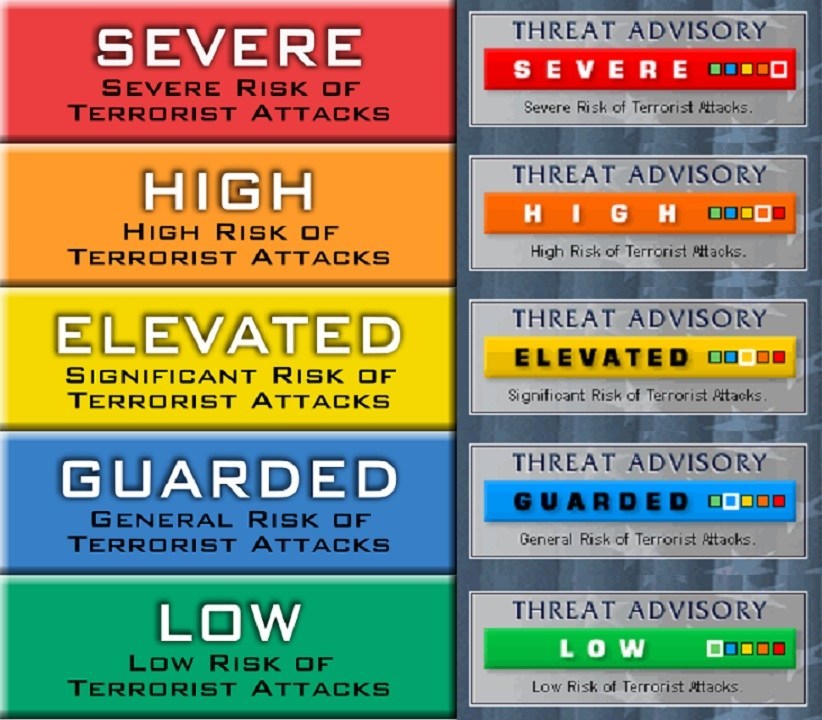
DHS’s (old) Risk Assessment Chart
MassPrivateI | August 20, 2019
America’s fear of mass-shootings is about to take a truly bizarre turn. That’s because our law enforcement will soon be used as fortune tellers to spy on future criminals.
How will law enforcement be used as fortune tellers?
A recent Albuquerque Journal article revealed that law enforcement will flag people that they think might pose a potential risk.
“Gov. Michelle Lujan Grisham directed state Homeland Security and Emergency Management Secretary Jackie Lindsay to start enrolling all 33 county sheriffs in a data-sharing program so that individuals deemed a potential risk could be flagged and monitored.”
What types of things could Americans do that law enforcement would consider threatening?
Inside Sources revealed that police would be looking for “certain indicators.”
State Police Chief Tim Johnson said, “I think it’s obviously important for all of the citizens of New Mexico to be on the lookout for certain indicators of these types of folks that would do this. And part of our job as government officials is to ensure that the citizens of the community understand what those indicators are so they can report them.”
The Tampa Bay Times reports that police are looking for “certain critical threat indicators” on students social media posts and have even created their own FortifyFL app that allows anyone to secretly report suspicious behavior.
What these “indicators” are is anyone’s guess.
Johnson also said that it was “important for law enforcement and other social services to follow up” on reports of possibly dangerous citizens “in the hopes of preventing” acts of domestic terrorism.
Law enforcement and other agencies are being encouraged to report on and flag anyone that they deem a “potential risk.”
What could possibly go wrong?
It was only a couple of months ago, when I warned people about the “Threat Assessment, Prevention and Safety Act” that basically allows law enforcement to label anyone a potential threat.
“The TAPS Act would encourage law enforcement to give everyone a personal threat assessment (kids and adults) and single out those that they deem as future threats.”
Police across the country are already using “red flag” laws to take weapons away from people they deem a potential threat. So why is Homeland Security creating a whole new class of suspicious people?
Because the War on Terror constantly needs new enemies if it is to keep Americans living in fear.
The Albuquerque Journal revealed how law enforcement plans to use the red flag bill to allow law enforcement and other agencies to give people secret threat ratings.
“Sheriffs had been working with the Democratic sponsor of a proposed red flag bill toward a possible compromise. In its original form, the bill would have allowed courts to order the temporary taking of guns from someone deemed an immediate threat, “San Juan County Sheriff Shane Ferrari said.
From Homeland Security spying on everyone’s social media posts to the FBI, it seems like no one is safe from Big Brother’s prying eyes.
Reason.com warned that the FBI’s “red flag” social media spying tool is “a meme-illiterate Facebook-stalking precog from the Minority Report.”
Reason also warned that spying on everyone’s social media posts could spiral out of control.
“There are operations centers and watch floors, which monitor news and events to create reports for the relevant FBI team. These would spur the activation of fusion center, tactical teams which use early notification and accurate geo-locations. Which could allow law enforcement to target and even disenfranchise social media users whose posts may have been misinterpreted.”
Placing people on a secret risk chart is a disaster waiting to happen, just ask those people on the no-fly list or terror watch list.
There are no law enforcement risk rating charts yet.
Based on DHS’s old risk advisory chart we could expect law enforcement to use something similar to Canada’s workplace risk assessment ratings chart:

Canada’s workplace risk assessment ratings chart is a disturbing example of how DHS could give everyone a personal risk assessment.
Asking law enforcement to guess who might become a criminal is at best fortune telling; and at worst, an excuse to incarcerate more people.
First they came for the bots: US academics make case for 1984-style silencing of any dissent
By Helen Buyniski | RT | August 21, 2019
With the “Russian meddling” theory of Trump’s victory on life support heading into 2020, US academic researchers have heeded the patriotic call and put forth a new definition of “disinformation” that includes inconvenient truths.
Social media platforms must expand their definitions of “coordinated inauthentic behavior” beyond the usual bots-and-trolls model to include conversations about topics harmful to the state if they hope to curb the spread of disinformation on their platforms, a trio of University of Washington researchers insist in a paper released ahead of the 2019 Conference on Computer-Supported Cooperative Work. To help in this quest, the researchers have redefined “disinformation” to include truths arranged to serve a purpose.
“Evaluating disinformation is less about the truth value of one or more pieces of information and more about how those pieces fit together to serve a particular purpose.”
Such an Orwellian redefinition would include the lion’s share of journalism, especially opinion journalism, and sure enough, the researchers have their knives out for those who become “unwitting agents” in the spread of disinfo by writing based on anonymous tips – otherwise known as “reporting.”
All it takes is one article on a “conspiracy theory” to cause a rift in society, the researchers warn, as a single story spreads to multiple outlets and then throughout the social media infosphere. But governments may spend billions of dollars on manipulating public opinion over social media, because it’s OK to lie, as long as you’re helping your country.
The paper tiptoes around propaganda campaigns run by the “good guys” – acknowledged US operations like the notorious pro-Clinton Correct the Record, while New Knowledge, rather than being called out for its fake Russian bot campaign to influence the 2017 Alabama senate election, is cited as an academic source!
Understanding that bot- and troll-hunting has limited use, the researchers focus on “actors who are not explicitly coordinated and, in some cases, are not even aware of their role in the campaign” – i.e. ordinary social media users with opinions the researchers don’t like.
One “case study” examines content “delegitimizing” the White Helmets while neglecting to mention that the group and the publicity surrounding it are, themselves, part of a well-funded western influence operation against the Syrian government (with a sideline in terrorism and head-chopping). The researchers complain that anti-WH voices were not the expected bots and trolls but included “western journalists” and overlapped with “‘anti-war’ activism” – as if “anti-war” was an artifact of a bygone era when one could, realistically, be against war. They complain that not enough accounts retweeted pro-White Helmets articles and videos – essentially that the problem here was not enough of the right kind of propaganda.
Conspiracy theories especially get under the researchers’ skin, as they have trouble untangling “conspiracy pushers” from those following mainstream news and seem incapable of realizing that people looking for answers in the aftermath of a tragedy are inclined to look in multiple places.
The researchers warn their peers not to minimize the effects of Russian “influence operations” in 2016, even if their analysis shows them to be minimal – clearly, they aren’t looking hard enough (i.e., if you don’t see the effects, it’s not that they aren’t there, it’s that you aren’t using sophisticated enough instruments. May we interest you in this fine Hamilton68 dashboard?).
Scientists are cautioned never to allow their hypothesis to color the way they report the results of their experiments. If the lab doesn’t show something, it isn’t there. But these researchers are not scientists – they, like the New Knowledge “experts” they so breathlessly cite, are propagandists. They are the droids they are looking for. At one point, they even admit that they “wrestl[ed] with creeping doubt and skepticism about our interpretations of [operations promoting progressive values] as problematic – or as operations at all.” Skepticism, it seems, lost.
Social media platforms are warned that their current model of deplatforming people based on “coordinated inauthentic behavior” leaves much to be desired. If they truly want to be ideal handmaidens of the national security state, they must “consider information operations at the level of a campaign and problematize content based on the strategic intent of that campaign.” It’s not whether the information is true, it’s where it came from – and what it might lead to – that matters. Such a model would complete the transformation of platforms into weapons in the state’s arsenal for suppressing dissent, and the researchers acknowledge they might be at odds with “commonly held values like ‘freedom of speech'” (which they also place in quotes), but hey, do you want to root out those Russian influence operations or not? We’ve got an election to win!
When at first you don’t succeed, redefine success. None have heeded this maxim better than the Russiagate crowd and their enablers in the national security state, and academic researchers have long provided the grist for these propaganda mills. But the cheer chutzpah of expanding the definition of disinformation to include truths arranged to have an effect – a definition that could include most of journalism, to say nothing of political speeches and government communications – is unprecedented.
Helen Buyniski is an American journalist and political commentator, working at RT since 2018
Jammu and Kashmir: the Legitimacy of Article 370

Photograph Source: Motohiro Sunouchi – CC BY 2.0
By Nyla Ali Khan | CounterPunch | August 20, 2019
Introduction
The recent unilateral decision of Prime Minister Modi’s government to revoke Article 370, which guaranteed the special status of Jammu and Kashmir; dismemberment of the State, and its diminishment are flagrant violations of the sovereign Constitution of India. These maneuvers jeopardize the federal structure of India. The erosion of the rights and privileges of a State is an unhealthy precedent to set in a diverse and federal country. The current curbing of political and civil rights in Jammu and Kashmir is deplorable.
Historical Perspective
On 26 October 1947, Maharaja Hari Singh signed the “Instrument of Accession” to India, officially ceding to the government of India jurisdiction over defense, foreign affairs and communications. The accession of J & K to India was accepted by Lord Mountbatten with the proviso that once political stability was established in the region, a referendum would be held in which the people of the State would either validate or veto the accession. After signing the Instrument of Accession, the maharaja appointed his political adversary, Sheikh Mohammad Abdullah, as the head of an interim government.
On 2 November 1947, Pandit Jawaharlal Nehru, the first Prime Minister of independent India, reiterated his government’s pledge to not only the people of Kashmir, but also to the international community, to hold a referendum in Indian and Pakistani-administered Jammu and Kashmir under the auspices of a world body like the United Nations, in order to determine whether the populace preferred to be affiliated with India or Pakistan. Nehru emphasized this commitment several times at public forums over the next few years.
In January 1948 India referred the Kashmir dispute to the United Nations. Prime Minister Nehru took the dispute with Pakistan over Kashmir beyond local and national boundaries by bringing it before the UN Security Council, and seeking a ratification of India’s “legal” claims over Kashmir. The UN reinforced Nehru’s pledge of holding a plebiscite in Kashmir, and in 1948 the Security Council established the United Nations Commission for India and Pakistan (UNCIP) to play the role of mediator in the Kashmir issue. The UNCIP adopted a resolution urging the government of Pakistan to cease the infiltration of tribal mercenaries and raiders into J & K. It also urged the government of India to demilitarize the State by “withdrawing their own forces from Jammu and Kashmir and reducing them progressively to the minimum strength required for the support of civil power in the maintenance of law and order.” The resolution proclaimed that once these conditions were fulfilled, the government of India would be obligated to hold a plebiscite in the State in order to either ratify or veto the accession of J & K to India.
In the meantime, the Government of Jammu and Kashmir negotiated with the central government to ensure that it would be allowed to function as a fully autonomous unit within the federation. Article 370 of the Constitution of India ensured that apart from defense, foreign affairs, and communications, decisions with regard to other matters would be determined with the consent of the Government of Jammu and Kashmir. There was a reason that special status was guaranteed to Jammu and Kashmir under Article 370 of the Indian Constitution. On 13 July 1950, the new government of J & K, headed by Sheikh Mohammad Abdullah, made a landmark decision.
“Between 1950 and 1952, 700,000 landless peasants, mostly Muslims in the Valley but including 250,000 lower-caste Hindus in the Jammu region, became peasant-proprietors as over a million acres were directly transferred to them, while another sizeable chunk of land passed to government-run collective farms. By the early 1960s, 2.8 million acres of farmland (rice being the principal crop in the Valley) and fruit orchards were under cultivation, worked by 2.8 million smallholding peasant-proprietor households.” (Bose 2003: 27–28)
This metamorphosis of the agrarian economy had groundbreaking political consequences. This revolutionary measure, which greatly improved the human development index in the State, would not have been possible without Article 370. The political logic of autonomy and Article 370 of the Indian Constitution was necessitated by the need to bring about socioeconomic transformations.
The legislative bill, which had orchestrated this transformation, won the unstinting support of thousands of erstwhile disenfranchised peasants. But displaced landlords and officials in the Dogra regime made no bones about their hatred of the political supremacy of the new class of Kashmiri Muslims. This hatred unleashed a reign of terror and brutality against the Valley’s new political class.
The “defining moment in Jammu and Kashmir’s post-Indian independence history” came in 1950 when disenfranchised peasants “were freed from the shackles of landlords through a law that gave them ownership rights on the land they tilled. . . . The sweeping land reforms under the Big Landed Estates Abolition Act passed on July 13, 1950, changed the complexion of Kashmiri society. The historical image of the emaciated local farmer in tatters, with sunken faces and listless eyes, toiling to fill the granaries of landlords changed overnight into one of a landowner who expected to benefit from the labor he had put in for generations” (Ahmed, F.). This program emphasized the necessity of abolishing exploitative landlordism without compensation and enfranchising tillers by granting them the lands they worked on. Many policy makers in the Indian subcontinent, political scientists, and economists have acknowledged the effectiveness and rigor of land reforms in Jammu and Kashmir, which benefited underprivileged farmers in all three parts of the State—Jammu, Kashmir, and Ladakh.
In August 1952, the government of J & K reiterated the commitment of to the principles of secularism and democracy which enabled the forging of ties with the Indian nation-state: “The supreme guarantee of our relationship with India is the identity of secular and democratic aspirations, which have guided the people of India as well as those of Jammu and Kashmir in their struggle for emancipation, and before which all constitutional safeguards will take a secondary position.” For the layperson, the “new Kashmir” in which the hitherto peripheralized Muslim population of the Valley and marginalized women would reinsert themselves into the language of belonging a welcome development.
But the nationalist project of the Praja Parishad had sought the subsumption of religious minorities into a centralized and authoritarian state since the 1940s. These integrative and centralist measures were met with massive opposition, which the government of India suppressed with bloody maneuvers. The volcanic nature of the protests in the Valley gave a veneer of legitimacy to its action of large-scale repression of leaders of the Plebiscite Front. Sheikh Mohammad Abdullah was also arrested, for the umpteenth time, under the Defense of India Rules, to further hush the voices of dissent.
Sheikh Mohammad Abdullah underlined in his letter to Shyama Prasad Mukherjee, founder of the Bharatiya Jan Sangh, in February 1953,
When talking about the constitutional aspect, it is sometimes conveniently forgotten that the Praja Parishad wants that Article 370 should be expunged from the Constitution. So far as we are concerned, we have maintained that the special position accorded to the State can alone be the source of a growing unity and closer association between the State and India. The Constituent Assembly of India took note of the special circumstances obtaining in the State and made provisions accordingly.
To entertain the doubt that the Muslims of Kashmir would now give up their secular ideals would be uncharitable, although the statements and the pronouncements made by the leaders of communal parties in India from time to time and the inspiration and guidance they are providing at the moment to the Praja Parishad leadership in Jammu is, no doubt, giving them a rude shock. But let me assure you and the people of India that the Muslims in Kashmir will not falter from their ideals even if they are left alone in this great battle for secularism and human brotherhood.
As I’ve said on other forums, the Constitution of India seeks to guarantee respect for the rule of law, the independence of the judiciary, and the integrity of the electoral process. But time and again, provisions of the Constitution of India have been breached in Kashmir, and the ideals that it enshrines have been forgotten. In Kashmir, rights relating to life, liberty, dignity of the people, and freedom of expression guaranteed by the Constitution, embodied in the fundamental covenants and enforceable by courts of law, have been flouted. The revocation of Article 370, without consultation, makes it clear that the much lauded parliamentary democracy in India has been unable to protect a genuine democratic set-up in Kashmir.
Heads of Governments cannot avoid their ethical and moral responsibilities toward the peoples of the States in a federal country. The lives of those people cannot be torn asunder by paramilitary forces and other “upholders” of the law.
Blow to Kashmiriyat
“Kashmiriyat” was not handed down to me as an unachievable and abstract construct. On the contrary, it was crystallized for me as the eradication of a feudal structure and its insidious ramifications. It was the right of the tiller to the land he worked on. It was the unacceptability of any political solution that did not take the aspirations and demands of the Kashmiri people into consideration. It was the right of Kashmiris to high offices in education, the bureaucracy and government; the availability of medical and educational facilities in Jammu, Kashmir and Ladakh. It was the preservation of literatures and and historical artifacts that defined an important aspect of “Kashmiriyat.” It was the formation of the Constituent Assembly of J & K to institutionalize the Constitution of the State in 1951, which was an enormous leap toward the process of democratization. It was the fundamental right of both women and men to free education up to the university level. It was, constitutionally, equal opportunities afforded to both sexes in the workplace. It was the nurturing of a contact zone in social, political and intellectual ideologies and institutions. It was pride in a cultural identity that was generated in a space created by multiple perspectives.
Trust cannot be won and unity cannot be maintained by the display of national chauvinism and erosion of Kashmiriyat.
Nyla Ali Khan is the author of Fiction of Nationality in an Era of Transnationalism, Islam, Women, and Violence in Kashmir, The Life of a Kashmiri Woman, and the editor of The Parchment of Kashmir. Nyla Ali Khan has also served as an guest editor working on articles from the Jammu and Kashmir region for Oxford University Press (New York), helping to identify, commission, and review articles. She can be reached at nylakhan@aol.com.
Kashmir Caged: A Fact-Finding Report

Army patrol on the road | Image courtesy Kavita Krishnan
By Jean Drèze, Kavita Krishnan, Maimoona Mollah and Vimal Bhai | Indian Cultural Forum | August 14, 2019
We spent five days (9-13 August 2019) traveling extensively in Kashmir. Our visit began on 9 August 2019 – four days after the Indian government abrogated Articles 370 and 35A, dissolved the state of Jammu and Kashmir, and bifurcated it into two Union Territories.
When we arrived in Srinagar on 9 August, we found the city silenced and desolated by curfew, and bristling with Indian military and paramilitary presence. The curfew was total, as it had been since 5th August. The streets of Srinagar were empty and all institutions and establishments were closed (shops, schools, libraries, petrol pumps, government offices, banks). Only some ATMs and chemists’ shops – and all police stations – were open. People were moving about in ones and twos here and there, but not in groups.
We travelled widely, inside and outside Srinagar – far beyond the small enclave (in the centre of Srinagar) where the Indian media operates. In that small enclave, a semblance of normalcy returns from time to time, and this has enabled the Indian media to claim that life in Kashmir is back to normal. Nothing could be further from the truth.
We spent five days moving around and talking to hundreds of ordinary people in Srinagar city, as well as villages and small towns of Kashmir. We spoke to women, school and college students, shopkeepers, journalists, people who run small businesses, daily wage labourers, workers and migrants from UP, West Bengal and other states. We spoke to Kashmiri Pandits and Sikhs who live in the Valley, as well as Kashmiri Muslims.
Everywhere, we were cordially received, even by people who were very angry about the situation or sceptical of our purpose. Even as people expressed their pain, anger, and sense of betrayal against the Government of India, they extended warmth and unstinting hospitality to us. We are deeply moved by this.
Except for the BJP spokesperson on Kashmir Affairs, we did not meet a single person who supported the Indian government’s decision to abrogate Article 370. On the contrary, most people were extremely angry, both at the abrogation of Article 370 (and 35A) and at the manner in which it had been done.
Anger and fear were the dominant emotions we encountered everywhere. People expressed their anger freely in informal conversation, but no-one was willing to speak on camera. Anyone who speaks up is at risk of persecution from the government.
Many told us that they expected massive protests to erupt sooner or later (after restrictions were relaxed, after Eid, after 15 August, or even later), and anticipated violent repression even if the protests were peaceful.
A summary of our observations
-
There is intense and virtually unanimous anger in Kashmir against the Indian government’s decision to abrogate Articles 370 and 35A, and also about the way this has been done.
-
To control this anger, the government has imposed curfew-like conditions in Kashmir. Except for some ATMs, chemists’ shops and police stations, most establishments are closed for now.
-
The clampdown on public life and effective imposition of curfew have also crippled economic life in Kashmir, that too at a time of the BakrEid festival that is meant for abundance and celebration.
-
People live in fear of harassment from the government, army or police. People expressed their anger freely in informal conversation, but no-one was willing to speak on camera.
-
The Indian media’s claims of a rapid return to normalcy in Kashmir are grossly misleading. They are based on selective reports from a small enclave in the centre of Srinagar.
-
As things stand, there is no space in Kashmir for any sort of protest, however peaceful. However, mass protests are likely to erupt sooner or later.
Reactions To The Government’s Treatment of J&K
-
When our flight landed, and the airlines staff announced that passengers could switch on our mobiles, the entire flight (with mostly Kashmiris in it) burst into mocking laughter. “What a joke”, we could hear people say – since mobile and landline phones and internet have all been blocked since 5 August!
-
As soon as we set foot in Srinagar, we came across a few small children playacting in a park. We could hear them say ‘Iblees Modi’. ‘Iblees’ means ‘Satan’.
-
The words we heard over and over from people about the Government decisions on J&K were ‘zulm’ (oppression), ‘zyadti’ (excess/cruelty), and ‘dhokha’ (betrayal). As one man in Safakadal (downtown Srinagar) put it, “The Government has treated us Kashmiris like slaves, taking decisions about our lives and our future while we are captive. It’s like forcing something down our throats while keeping us bound and gagged, with a gun to our heads.”
-
In every lane of Srinagar city, every town, every village, that we visited, we received an extensive schooling from ordinary people, including school kids, on the history of the Kashmir dispute. They were angry and appalled at the manner in which the Indian media was whitewashing this history. Many said: “Article 370 was the contract between Kashmir’s leadership and India’s. Had that contract not been signed, Kashmir would never have acceded to India. With Article 370 gone, India no longer has any basis for its claim over Kashmir.” One man in the Jahangir Chowk area near Lal Chowk, described Article 370 as a ‘mangalsutra’ (sacred necklace worn by married women) symbolising a contract (analogous to the marital contract) between Kashmir and India. (More on people’s reactions to the abrogation of Articles 370 and 35A below)
-
There is widespread anger against the Indian media. People are imprisoned in their homes, unable to communicate with each other, express themselves on social media, or make their voices heard in any way. In their homes, they watch Indian TV claim that Kashmir welcomes the Government decisions. They seethe with rage at the erasure of their voices. As one young man in Safakadal put it, “Kiski shaadi hai, aur kaun naach raha hai?! (It’s supposed to be our wedding, but it’s only others who are dancing!) If this move is supposed to be for our benefit and development, why not ask what we ourselves think about it?”
Reactions To The Abrogation Of Article 370 and 35A
-
A man in Guree village (Anantnag district) said: “Hamara unse rishta Article 370 aur 35A se tha. Ab unhone apne hi paer par kulhadi mar di hai. In Articles ko khatm kar diya hai. Ab to ham azad ho gaye hain.” (Our relation with them (India) was through Article 370 and Article 35A. Now they have themselves committed the folly of dissolving these Articles. So now we are free.” The same man raised slogans of “We want freedom” followed by slogans of “Restore Articles 370 and 35A.”
-
Many described Article 370 and 35A as Kashmir’s “pehchan” (identity). They felt that the abrogation of these Articles is a humiliating attack on Kashmir’s self-respect and identity.
-
Not all demanded restoration of Article 370. Many said that it was only the parliamentary parties who had asked people to have faith that India would honour the contract that was Article 370. The abrogation of Article 370 only discredited those “pro-India parties”, and vindicated those who argued for Kashmir’s “azaadi” (independence) from India, they felt. One man in Batamaloo said: “Jo india ke geet gate hain, apne bande hain, ve bhi band hain! (Those who sang praises of India, India’s own agents, they too are imprisoned!” A Kashmiri journalist observed, “Many people are happy about the treatment the mainstream parties are getting. These parties batted for the Indian State and are being humiliated now.”
-
“Modi has destroyed India’s own law, its own Constitution” was another common refrain. Those who said this, felt that Article 370 was more important to India (to legitimise its claim to Kashmir) than it was to Kashmir. But the Modi Government had not only sought to destroy Kashmir, it had destroyed a law and Constitution that was India’s own.
-
A hosiery businessman in Jahangir Chowk, Srinagar said, “Congress ne peeth mein choora bhonka tha, BJP ne saamne se choora bhonka hai.” (Congress had stabbed us from the back, BJP is stabbing us up front). He added, “They strangled their own Constitution. It’s first step towards Hindu Rashtra.”
-
In some ways, people were more concerned about the effects of the abrogation of 35A than that of 370. It is widely recognised that Article 370 retained only nominal, symbolic autonomy and had already been diluted. With 35A gone, though, people fear that “State land will be sold cheap to investors. Ambani, Patanjali etc can come in easily. Kashmir’s resources and land will be grabbed. In Kashmir as it stands now, education and employment levels are better than in the mainland. But tomorrow Kashmiris will have to compete for Government jobs with those from other states. After one generation, most Kashmiris won’t have jobs or be forced to move to the mainland.”
“Normalcy” – Or “Peace Of The Graveyard”?
Is the situation in Kashmir “normal” and “peaceful”? The answer is an emphatic NO.
-
One young man in Sopore said: “This is bandook ki khamoshi (the silence at gunpoint), kabristan ki khamoshi (the peace of the graveyard).”
-
The newspaper Greater Kashmir had one (front) page of news and a sports page at the back: the two inside pages were full of cancellation announcements of weddings or receptions!
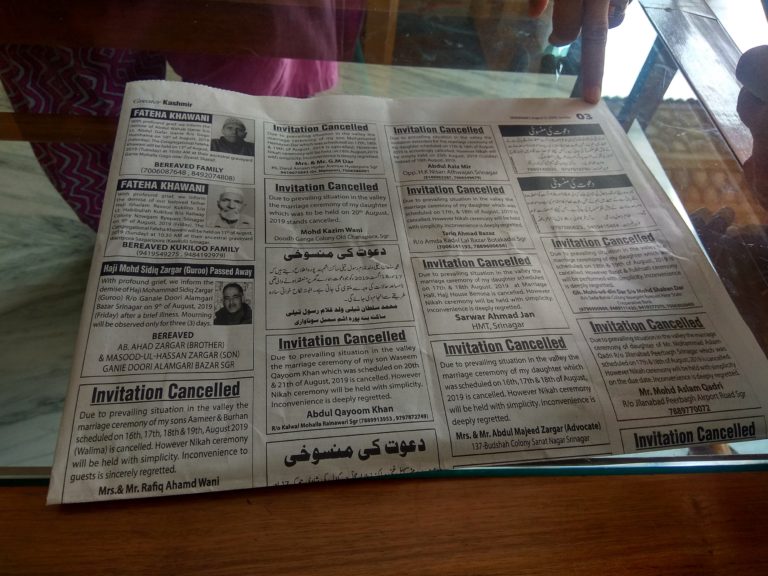
Invitations cancelled I Image courtesy Kavita Krishnan
-
Between 5-9 August, people had suffered for lack of food, milk, and basic needs. People had been prevented even from going to hospitals in case of sickness.
-
The Government claim is that only Section 144 has been imposed, not “curfew”. But in reality, police vans keep patrolling Srinagar warning people to “stay safe at home and not venture out during the curfew”, and tell shops to close their shutters. They demand that people display “curfew passes” to be allowed to move about.
-
All of Kashmir is under curfew. Even on Eid, the roads and bazaars were silent and desolate. All over Srinagar, mobility is restricted by concertina wires on streets, and massive paramilitary deployment. Even on Eid, this was the case. In many villages, azaan was prohibited by the paramilitary and people were forced to do namaaz prayers at home rather than collectively at the mosque as it usual on Eid.
-
In Anantnag, Shopian and Pampore (South Kashmir) on the day of Eid, we only saw very small kids dressed in Eid finery. Everyone else was in mourning. “We feel like we’re in jail”, said a woman in Guree (Anantnag). Girls in Nagbal (Shopian) said, “With our brothers in police or army custody, how can we celebrate Eid?”
-
On 11 August, on the eve of Eid, a woman at Sopore told us she had come to the bazaar during a brief respite in the curfew, to buy a few supplies for Eid. She said: “We were prisoners in our own homes for 7 days. Even today, shops are closed in my village Langet, so I came to Sopore town to shop for Eid and to check on my daughter who is a nursing student here.”
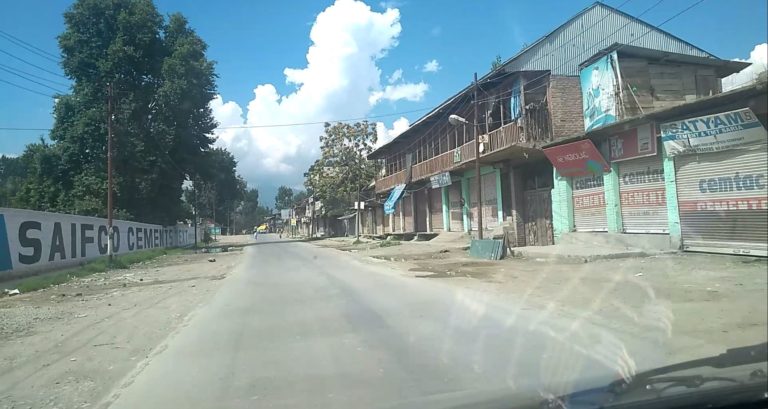
Eid in Pulwama | Image courtesy Kavita Krishnan
-
“It’s Army rule not Modi rule. There are more soldiers here than people”, said a young baker at Watpura near Bandipora. His friend added, “We’re afraid, because the army camp nearby keeps imposing impossible rules. They insist we have to return within half an hour if we leave home. If my kid isn’t well, and I have to take her to the hospital, it may take more than half an hour. If someone visits their daughter who lives in next village, they may take more than half hour to return. But if there’s any delay, they will harass us.” The CRPF paramilitary is everywhere, outside nearly every home in Kashmir. These are clearly not there to provide “security” to Kashmiris – on the contrary, their presence creates fear for the people.
-
Sheep traders and herders could be seen with unsold sheep and goats. Animals they had been rearing all year long, would not be sold. This meant they would incur a huge loss. With people unable to earn, many could not afford to buy animals for the Eid sacrifice.
-
A shopkeeper from Bijnore (UP) showed us the stacks of unsold sweets and delicacies going waste, since people could not buy them. Shops and bakeries wore a deserted look on the eve of Eid, with their perishable food items lying unsold.
-
An asthmatic auto driver in Srinagar, showed us his last remaining dose of salbutamol and asthalin. He had been trying for the past several days to buy more – but the chemists’ shops and hospitals in his area had run out of stocks. He could go to other, bigger hospitals – but CRPF would prevent him. He showed us the empty, crushed cover of one asthalin inhaler – when he told a CRPF man he needed to go further to get the medicine, the man stamped on the cover with his boot. “Why stamp on it? He hates us, that’s why”, said the auto driver.
Protests, Repression, and Brutality
-
Some 10,000 people protested in Soura (Srinagar) on 9 August. The forces responded with pellet gun fire, injuring several. We attempted to go to Soura on 10 August, but were stopped by a CRPF barricade. We did see young protestors on the road that day as well, blockading the road.
-
We met two victims of pellet gun injuries in SMHS hospital in Srinagar. The two young men (Waqar Ahmad and Wahid) had faces, arms and torso full of pellets. Their eyes were bloodshot and blinded. Waqar had a catheter in which the urine, red with blood from internal bleeding, could be seen. Their family members, weeping with grief and rage, told us that the two men had not been pelting stones. They had been peacefully protesting.
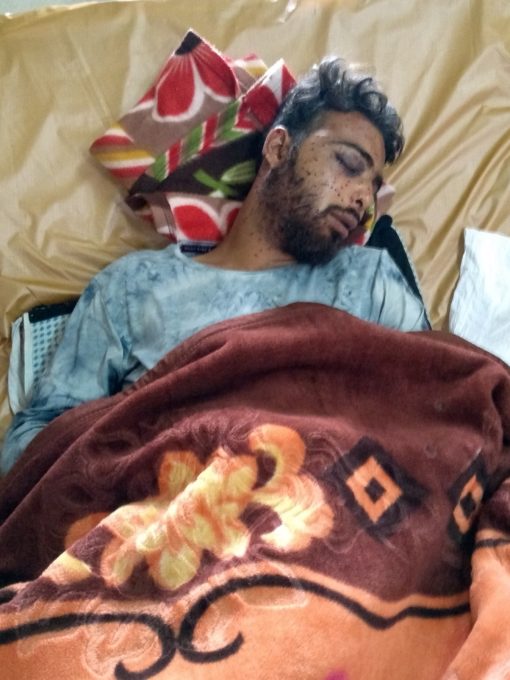
Pellet gun victim | Image courtesy Vimal Bhai
-
On 6 August, a graphic designer for the Rising Kashmir newspaper, Samir Ahmad, (in his early 20s) had remonstrated with a CRPF man near his home in the Manderbag area of Srinagar, asking him to allow an old man to pass. Later the same day, when Samir opened the door to his house, CRPF fired at him with a pellet gun, unprovoked. He got 172 pellets in his arm and face near the eyes, but his eyesight is safe. It is clear that the pellet guns are deliberately aimed at the face and eyes, and unarmed, peaceful civilians standing at their own front doors can be targets.
-
At least 600 political leaders and civil society activists are under arrest. There is no clear information on what laws are invoked to arrest them, or where they are being held.
-
A very large number of political leaders are under house arrest – it is impossible to ascertain how many. We tried to meet CPIM MLA Mohd Yusuf Tarigami – but were refused entry into his home in Srinagar, where he is being under house arrest.
-
In every village we visited, as well as in downtown Srinagar, there were very young schoolboys and teenagers who had been arbitrarily picked up by police or army/paramilitary and held in illegal detention. We met a 11-year-old boy in Pampore who had been held in a police station between 5 August and 11 August. He had been beaten up, and he said there were boys even younger than him in custody, from nearby villages.
-
Hundreds of boys and teens are being picked up from their beds in midnight raids. The only purpose of these raids is to create fear. Women and girls told us of molestation by armed forces during these raids. Parents feared meeting us and telling us about the “arrests” (abductions) of their boys. They are afraid of Public Security Act cases being filed. The other fear is that the boys may be “disappeared” – i.e killed in custody and dumped in mass graves of which Kashmir has a grim history. As one neighbour of an arrested boy said, “There is no record of these arrests. It is illegal detention. So if the boy “disappears” – i.e is killed in custody – the police/army can just say they never had him in custody in the first place.”
-
But the protests are not likely to stop. A young man at Sopore said: “Jitna zulm karenge, utna ham ubharenge” (The more you oppress us, the more we will rise up) A familiar refrain we heard at many places was: “Never mind if leaders are arrested. We don’t need leaders. As long as even a single Kashmiri baby is alive, we will struggle.”
The Gag On Media
-
A journalist told us: “Newspapers are printing in spite of everything. Without the internet, we do not get any feed from agencies. We were reduced to reporting the J&K related developments in Parliament, from NDTV! This is undeclared censorship. If Govt is giving internet and phone connectivity to police but not to media houses what does it mean? We had some people come to our offices, speaking on behalf of Army and CRPF, asking “Why are you publishing photos of the curfew-affected streets?”
-
Kashmiri TV channels are completely closed and unable to function.
-
Kashmiri newspapers that carry the barest mention of protests (such as the one on Soura) are made to feel the heat from the authorities.
-
Foreign press reporters told us that they are facing restrictions on their movement by the authorities. Also, because of the lack of internet, they are unable to communicate with their own main offices.
-
When we visited Press Enclave in Srinagar on 13 August, we found the newspaper offices closed and the area deserted except for a few stray journalists, and some CID men. One of the journalists told us that papers could not be printed till at least 17 August, because they have run out of newsprint which comes from Delhi.
-
As mentioned above, one graphic designer working with a newspaper suffered pellet gun injuries, during a completely unprovoked attack by CRPF
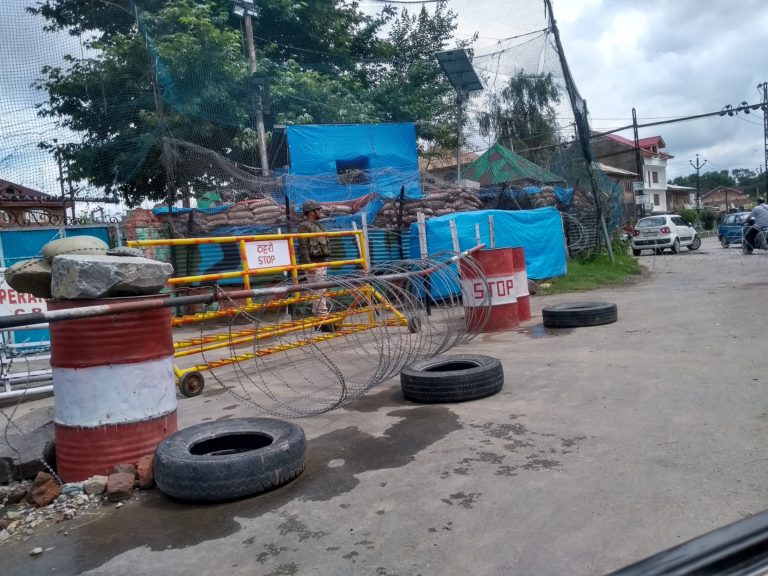
A checkpoint in Srinagar | Image courtesy Vimal Bhai
Does Kashmir Lack Development?
In an op-ed in the Times Of India (August 9, 2019), former Foreign Secretary and Ambassador Nirupama Rao wrote: “A young Kashmiri told this writer a few months ago her birthplace was in the “stone age”; that in terms of economic development, Kashmir was two hundred years behind the rest of India.”
We struggled to find this “backward”, “stone age” Kashmir anywhere at all.
-
It is striking how in every Kashmiri village, we found young men and women who go to college or University; speak Kashmiri, Hindi and English fluently; and are able to argue points of Constitutional and international law in relation to the Kashmir conflict with factual accuracy and erudition. All four of the team members are familiar with villages in North Indian states. This high level of education is extremely rare in any village in, say, Bihar, UP, MP, or Jharkhand.
-
The homes in rural Kashmir are all pucca constructions. We saw no shacks like the ones that are common in rural Bihar, UP, Jharkhand.
-
There are poor people in Kashmir, certainly. But the levels of destitution, starvation and abject poverty seen in many North Indian states, is simply absent in rural Kashmir.
-
We met migrant labourers from North India and West Bengal at many places. They told us that they feel safe and free from xenophobic violence that they face in, say, Maharashtra or Gujarat. Daily wage migrant labourers told us “Kashmir is our Dubai. We earn Rs 600 to Rs 800 per day here – that is three or four times what we earn in other states.”
-
We found Kashmir refreshingly free of communal tension or mob lynchings. We met Kashmiri pandits who told us they felt safe in Kashmir, and that the Kashmiris always celebrate their festivals together. “We celebrate Eid, Holi, Diwali together. That is our Kashmiriyat. It is something different, special,” said one Kashmiri Pandit young man.
-
The myth of the “backward” Kashmiri woman is perhaps the biggest lie. Kashmiri girls enjoy a high level of education. They are articulate and assertive. Of course, they face and resist patriarchy and gender discrimination in their societies. But does BJP, whose Haryana CM and Muzaffarnagar MLA speak of “getting Kashmiri brides” as though Kashmiri women are property to be looted, have any right to preach feminism to Kashmir? Kashmiri girls and women told us, “We are capable of fighting our own battles. We don’t want our oppressors to claim to liberate us!”
The BJP Spokesperson’s “Warning”
We met BJP spokesperson on Kashmir affairs, Ashwani Kumar Chrungoo at the office of Rising Kashmir, a Kashmir newspaper. The conversation was initially cordial. He told us he had come to Kashmir from Jammu to persuade people to support the abrogation of Article 370. His main argument was that since the BJP had won a 46% vote share in J&K and had won an unprecedented majority in Parliament, they had not only a right but a duty to keep their promise of scrapping Article 370. “46% vote share – that’s a license”, he said.
He refused to acknowledge that this 46% vote share while winning only three Lok Sabha seats (Jammu, Udhampur and Ladakh) was possible only because the voter turnout in the three other LS seats (Srinagar, Anantnag and Baramulla) was the lowest in the whole country.
Should a Government impose an unpopular decision on people of Kashmir who have not voted for that decision, at gunpoint? Chrungoo said, “In Bihar when Nitish Kumar imposed prohibition, he didn’t ask the alcoholics for their permission or consent. It’s the same here.” His contempt for the people of Kashmir was evident from this analogy.
Towards the end of the conversation, he became increasingly edgy when confronted by facts and arguments by us. He got up and wagged a finger at Jean Dreze, saying “We won’t let anti-nationals like you do your work here. I am warning you.”
Conclusion
The whole of Kashmir is, at the moment, a prison, under military control. The decisions taken by the Modi Government on J&K are immoral, unconstitutional and illegal. The means being adopted by the Modi Government to hold Kashmiris captive and suppress potential protests are also immoral, unconstitutional, and illegal.
-
We demand the immediate restoration of Articles 370 and 35A.
-
We assert that no decision about the status or future of J&K should be taken without the will of its people.
-
We demand that communications – including landline telephones, mobile phones and internet be restored with immediate effect.
-
We demand that the gags on the freedom of speech, expression and protest be lifted from J&K with immediate effect. The people of J&K are anguished – and they must be allowed to express their protest through media, social media, public gatherings and other peaceful means.
-
We demand that the gags on journalists in J&K be lifted immediately.
Jean Drèze, economist
Kavita Krishnan, Communist Party of India (Marxist-Leninist) and AIPWA
Maimoona Mollah, All India Democratic Women’s Association (AIDWA)
Vimal Bhai, National Alliance of People’s Movements (NAPM)
Soon Doctors Will Screen Everyone For Drugs
MassPrivateI | August 15, 2019
Imagine in the not too distant future your job, college ID, drivers license, passport, gun permit, health insurance etc., will depend on you passing a mandatory drug screening.
What is that you say? It could never happen in America.
It could happen sooner than you think if the U.S. Preventative Services Task Force (USPSTF) has anything to say about it.
 According to a recent Los Angeles Times article, the USPSTF wants doctors to screen everyone for drug use.
“Questions about drug use should not only cover the possibility that a patient is taking illegal street drugs like cocaine or heroin, the task force said. They should also explore whether a patient might be sneaking pills from a family member’s pain medication or getting a boost from stimulants prescribed for a child with attention-deficit/hyperactivity disorder.”
“The USPSTF recommends screening for illicit drug use in adults age 18 years or older”, according to their draft report.
Big Brother really wants to know if you are using illegal street drugs or prescription drugs, and they have given doctors numerous drug screening tools to find out.
Primary care practices are asked to use the following drug screening tools:
- The six-question BSTAD [Brief Screener for Tobacco, Alcohol, and Other Drugs]),
- The eight-item ASSIST [Alcohol, Smoking and Substance Involvement Screening Test] risk assessment–based tool),
- TAPS [Tobacco, Alcohol, Prescription Medication, and Other Substance Use]) may be useful when clinicians are concerned about prescription misuse.
- NIDA’s. Screening and Assessment Tools Chart,
- NIDA’s Screening for Drug Use in General Medical Settings: A Resource Guide for Providers
- SAMHSA’s -Health Resources and Services Administration Center for Integrated Health Solutions. Substance Use Disorder and Pregnancy
- Center for Substance Abuse Treatment. A Guide to Substance Abuse Services for Primary Care Clinicians
- SAMHSA’s Finding Quality Treatment for Substance Use Disorders
Some will say that this is merely a recommendation and that doctors would never screen everyone for drug use.
But it is already happening to welfare applicants in at least 15 states.
According to the National Conference of Legislatures, at least 15 states have passed legislation regarding drug testing or screening for public assistance applicants or recipients.
When is the last time you or someone you know went to the doctor’s for an unrelated pain or bruise. Did the doctor ask you or them about drug usage? Of course they did.
But if you will not take my word for it, then perhaps you will take Dr. Gary LeRoy’s word for it,
“We’ve been doing this for almost a decade in my office,” said Dr. LeRoy, a staff physician at the East Dayton Health Clinic in Dayton, Ohio, and president-elect of the American Academy of Family Physicians.
Dr. Carol Mangione, the chief of general internal medicine at the David Geffen School of Medicine at UCLA told Stat News, “This is a big change that we’re really excited about. Effective treatment is where we will finally begin to move the needle on the epidemic.”
The National Institute on Drug Abuse created a “resource guide” that doctors have been using for almost a decade to ask patients about drug use.
According to the USPSTF’s “Draft Recommendation Statement,” about 50% to 86% of pediatricians report that they routinely screen patients for substance use.”
Will all hospitals and doctors adopt the USPSTF’s recommendations?
The New York Times warns “the group’s guidelines are not binding on doctors but they carry weight.”
The Los Angeles Times warns, “the task force is a group of experts who advise the federal government on disease prevention.”
And that is the key takeaway from this story. The USPSTF might claim to be an “independent, volunteer panel of national experts in prevention and evidence-based medicine. But each year, they send a graded recommendation to Congress, like this one, about mandatory drug screening.
As I mentioned earlier, most hospitals and doctors already ask their patients about their drug use. So it is really only a matter of time before the USPSTF convinces Congress to make it mandatory.
Corbynite Chris Williamson MP sues Labour for ‘re-suspension’ over alleged anti-Semitism
RT | August 14, 2019
Left-wing MP Chris Williamson is suing Jeremy Corbyn’s Labour Party over their decision to reimpose his suspension following allegations of anti-Semitism. A crowdfunding page has been set-up to help with his legal fees.
Williamson, the MP for Derby North and key ally of Labour leader Corbyn, is challenging the party’s right to withdraw the whip from him (i.e., suspend him) just two days after he was reinstated following a disciplinary hearing.
The 62 year-old has taken to social media to thank supporters who have contributed to cover court costs to help “overturn the unconstitutional decision to ‘re-suspend’ me from the party I love.”
Williamson has lodged legal papers which have been put before a court and sent to Labour’s general secretary, Jennie Formby. The party is expected to defend its decision, which could lead to a highly embarrassing court case.
Labour had originally handed Williamson a reprimand over remarks he made suggesting that the party had been “too apologetic” over the anti-Semitism “crisis” that has dogged it over many months.
It comes a week after Williamson was forced to change the venue of an event he had been due to speak at in Brighton, after hotel staff were allegedly subjected to social media abuse and threats of violence.
India’s narrative on J&K is hyperbolic
By M. K. BHADRAKUMAR | Indian Punchline | August 13, 2019
Editorials have appeared in two leading Delhi newspapers today (here and here) urging the government to present a credible, appealing diplomatic narrative on the J&K developments.
The Indian narrative so far is largely focused on the domestic audience. It has gone to ridiculous extents by projecting that the situation is actually quite “normal” in J&K. Pictures of National Security Advisor Ajit Doval savouring (mutton) biryani with Kashmiri Muslims on a street corner in Srinagar have been doing the rounds. (Indeed, it was a charade to hoodwink the public.)
Crude propaganda won’t win hearts and minds. A narrative has to be crafted rationally. It’s common knowledge that there is little acceptance of the government move among Kashmiri Muslims.
When it comes to the external projection of the Indian narrative, given the fact that India’s case is flying in the face of international law and the UN Charter, the government must be capable of sensitivity.
The government would have seized the initiative at the diplomatic level if only soon after Home Minister Amit Shah piloted through both houses of the parliament at breakneck speed the legislation on abrogating Article 370 of the constitution, External Affairs Minister S. Jaishankar had stood up and made a suo moto statement offering to discuss all differences with Pakistan bilaterally in a comprehensive dialogue in the best interests of regional security, peace and stability.
Of course, such a momentous initiative would have required imagination, far-sightedness and wisdom — and, most important, political courage at the leadership level. The shortfall in statecraft and diplomacy is appalling.
A self-righteous attitude will not do. Take EAM’s demarche with the Chinese counterpart State Councilor and Foreign Minister Wang Yi in Beijing on Monday. The MEA readout spells out the Indian stance on the following lines:
One, constitutional amendment is an “internal matter for India” and the “sole prerogative of the country”.
Two, abrogation of J&K’s special status (including changes in Ladakh’s status) is aimed at “promoting better governance and socio-economic development”.
Three, the government move has “no implication for either the external boundaries of India or the Line of Actual Control” with China.
And, four, India is “not raising any additional territorial claims.”
Incredibly enough, this was how EAM brushed aside China’s “serious concern over the recent escalation of turmoil in Kashmir” – that “any unilateral action that may complicate the situation in Kashmir should not be taken; that the Kashmir issue is a dispute born out of the region’s colonial history and should be properly handled in a peaceful way in line with the UN Charter, relevant resolutions of the UN Security Council and bilateral agreements between Pakistan and India”; and, its expectation that “India will play a constructive role in regional peace and stability.” (here, here, here, here and here)
EAM’s rejoinder may have some resonance domestically within India as a macho attitude, but it will only arouse mirth and derision abroad — even in the diplomatic enclave in Chanakyapuri area.
No P5 member country has officially voiced support for India. There is no shred of evidence that the Russian Foreign Ministry voiced support for India on the issue — not on the FO website; neither in a Tass or Novosti report nor even in the irrepressible Russian press. Some fly-by-night operator well-versed with the Indian rope trick, apparently spread fake news on a Friday night and it became “breaking news” in India by next morning. Pathetic.
Simply put, the Indian stance articulated by EAM is fundamentally flawed in logic and can only be counter-productive, as it shuts the door on discussion. The point is, Kashmir is an international dispute and India unilaterally changed J&K’s “status” in violation of the relevant UN resolutions. No one will accept India’s claim that it is an “internal matter”.
World opinion accepts that Pakistan is a party to Kashmir dispute. It is beside the point that India is not redrawing boundaries. And it’s gratuitous to say there is “no implication” for the LOC or the LOAC. If things were that simple, why couldn’t Modi government stomach the CPEC passing through Gilgit-Baltistan? We screamed, “territorial sovereignty” blah, blah.
World opinion will only believe that Delhi’s real intention is to change the demographic balance so that there shall be no Muslim-majority entity henceforth within the Indian Union.
If such unilateral acts in modern history are as simple as “internal matter”, why is no one recognising Russia’s annexation of Crimea? Why is Beijing so sensitive on intervention in Hong Kong? Why is the US insisting on “freedom of navigation” in South China Sea? Why is the US raising eyebrow over the North Sea Route and the Arctic? What is wrong with Iran’s claim over Persian Gulf as sovereign territory? What prevents Sri Lanka’s Mahinda Rajapaksa from solving the Tamil problem in similar fashion (as he hinted last week)?
The Modi government will be creating a long-term, intractable problem for India for generations to come by adopting such an ostrich approach. Analysts have pointed out (here and here) that the change in Ladakh’s status makes the India-China border dispute incredibly complicated and all but unsolvable. India’s international standing can get seriously damaged.
The only way to address the conundrum is to propose to Pakistan that India is ready to discuss these differences. Fortuitously, Pakistan also faces the unhappy situation that no one in the international community is showing willingness to stand up and be counted as its partner to push back at India.
The bottom line is that India enjoys wide acceptance for its insistence on bilateralism to resolve differences with Pakistan. India should now tactfully exercise this privilege. It is always possible to hold out informal assurances that there’ll be no “colonisation” of Kashmir valley. After all, we have such safeguards for many regions of India.
The window of opportunity shall not remain open for long. From all accounts, the ground situation in J&K is explosive and the grating roar of human misery is approaching. PM Imran Khan’s prognosis on another Pulwama is not off the mark. For Delhi to build a new architecture in J&K out of the debris all around, a dialogue with Pakistan is critically important.
Featured Video
Houthis Don’t Have to Conquer Saudi Arabia to Make It Pay
or go to
Aletho News Archives – Video-Images
From the Archives
Newly Released FBI Docs Shed Light on Apparent Mossad Foreknowledge of 9/11 Attacks
By Whitney Webb | MintPress News | May 17, 2019
NEW YORK — For nearly two decades, one of the most overlooked and little known arrests made in the aftermath of the September 11 attacks was that of the so-called “High Fivers,” or the “Dancing Israelis.” However, new information released by the FBI on May 7 has brought fresh scrutiny to the possibility that the “Dancing Israelis,” at least two of whom were known Mossad operatives, had prior knowledge of the attacks on the World Trade Center. … continue
Blog Roll
 Aletho News
- MEP blasts ‘Euro-Gestapo’ for lecturing Russia on democracy
- Syria May Send Troops to Saudi Arabia Amid War with Ansar Allah
- UK whines about losing billions to ‘Putin tax’
- Baghaei to Rubio: Distorted narratives cannot erase US record of broken commitments
- Houthis Don’t Have to Conquer Saudi Arabia to Make It Pay
- MOE: Nearly 22,000 Students and Education Workers Killed
- Guterres in Islamabad: Genocide, cowardice, and the cage of Imran Khan
- Johnson, Marandi say Yemen holds upper hand over Saudi Arabia
- False flags won’t save aggressors, Iran FM spokesman says
- The Makkah Pact Enters Into Force: The End of American Dominance or Its New Form?
- If Americans Knew
- Report claimed Mark Levin used by Israeli government to influence Trump
- Over 2,000 Gazans have died awaiting medical evacuation amid Israel’s continued siege
- How a U.S. Diplomat Suppressed and Altered Reports Critical of Israel
- 5 Palestinians Die from Israeli Strikes in Gaza as Relentless Attacks Continue
- Report: Ceasefire Slows Killing but Leaves Devastation Intact
- Country Music Singer Zach Bryan Breaks Attendance Record at Robert Kraft’s Gillette Stadium While Wearing ‘Free Palestine’ Shirt for Second Night in a Row
- Three years of death and devastation: Israel’s war on Gaza in pictures
- Why Hamas believed the status quo was more dangerous than its 7 October gamble
- Debunking Israel’s latest list of ‘terrorist’ journalists in Gaza
- In Gaza, focus is on survival, “every step is a struggle” – Daily Update
- No Tricks Zone
- New Study: 50 Years Of The Most Aggressive ‘Net Zero’ Policies Can Only Affect The Global Climate By 0.03°C
- US September “Heat” Was No Record…Many Records Set Decades Ago
- Latest European Green Energy Debacle; Portugal’s Largest Flagship Solar Park Insolvent!
- Green Energy Debacle: German Expert Professor Fritz Vahrenholt Warns Of Severe Economic And Social Consequences
- Two More Paleo Reconstructions Affirm Meters-Higher Sea Levels Across Ireland, Brazil 7000-6000 Years Ago
- New Study: Earth And Venus Surface Warmth Largely Explained By Convection And Lapse Rate, Not CO2 Or Radiation
- 2025 Nature Paper Claiming Worsening Global Drought Gets RETRACTED …Heavily Flawed
- New Study: ‘Global Drought Shows No Detectable Recent Acceleration Under Climate Warming’
- Economic Masterminds: German Socialists Suggest Taxing Productivity Gains Stemming From Using AI
- The South China Sea Has Not Been Cooperating With The Climate Change Narrative

