EU Enters “Final Stage” of Crafting Bill Forcing Big Tech Censorship
By Joseph Jankowski | PlanetFreeWill | September 5, 2018
The European Union is in the final stages of crafting legislation that will force big tech and internet companies to censor “extremist” content and cooperate with law enforcement, Reuters reports.
The bill is expected to be released by the end of the month and will absolutely require companies such as Google, Facebook, and Twitter to swiftly remove any content considered terroristic from their platforms.

EU Justice, Consumers and Gender Equality Commissioner, Věra Jourová, speaks on monitoring of illegal online hate speech code of conduct in Brussels, Belgium. [Olivier Hoslet/EPA]
In March, the European Commission told such companies that they had three months to show they were removing “extremist” content more rapidly or face legislation forcing them to do so.
EU recommendations were sent out at the time regarding the speedy removal of all content including terrorist content, incitement to hatred and violence, child sexual abuse material, counterfeit products, and copyright infringement.
The threat eventually led to the creation of an online “code of conduct” aimed at fighting racism and xenophobia across Europe, an effort both the EU and big tech collaborated on.
According to European Justice Commissioner Vera Jourova, that an existing code of conduct to counter hate speech could remain voluntary.
“(But on) terrorist content, we came to the conclusion that it is too serious a threat and risk for European people that we should have absolute certainty that all the platforms and all the IT providers will delete the terrorist content and will cooperate with law enforcement bodies,” Jourova said on Wednesday.
“Yes, this is in the final stage,” she added, addressing the new bill.
While details of the new legislation remain hidden, the Financial Times in August learned that law enforcement will be in charge of flagging content for censorship.
EU security commissioner Julian King also had mentioned last month that the bill will “likely” turn the agreed upon “code of conduct” into mandatory law, placing the prediction by Jourova that it will remain voluntary on shakey grounds.
The big tech – EU code of conduct establishes “public commitments” for tech companies, including the requirement to review the “majority of valid notifications for removal of illegal hate speech” in less than 24 hours. It was also crafted to make it easier for law enforcement to notify firms directly of any unwanted content.
Within the code is a narrow explanation of “hate speech,” being defined as “all conduct publicly inciting to violence or hatred directed against a group of persons or a member of such a group defined by reference to race, colour, religion, descent or national or ethnic origin.”
The nature of enforcing censorship based on a narrow and subjective term such as “hate speech” is likely to keep suspicions high that these types of decision aren’t about creating a safer world, but rather a world in which superstates like the EU control the content people see online for political purposes.
Ukraine’s Detention of Vyshinsky Political Act, Violates International Law – Journalist

© SPUTNIK / VLADIMIR TREFILOV
Interview Published by Sputnik on August 24, 2018
Sarah Abed, an independent journalist, and political commentator, spoke with Sputnik about Ukraine’s detention of head of RIA Novosti Ukraine Kirill Vyshinsky, who has been confined for 100 days now. Russian President Vladimir Putin said that Vyshinsky’s arrest demonstrated an unacceptable policy of Ukrainian authorities targeting journalists.
Sputnik: Vyshinsky has been confined for 100 days now, what progress has been made on his release?
Sarah Abed: Unfortunately, not enough progress has been made, as he is still detained. However, he has requested that the Russian government (including President Putin) take whatever measures necessary to protect him and facilitate his release. As a result of his detainment, Vyshinsky decided to renounce his Ukranian citizenship. He was detained for acts of alleged “treason” and his home along with the homes of other RIA Novosti employees were searched by security forces on May 15.
The Russian government has expressed outrage and stated that this is part of an anti-Russia propaganda campaign launched by Western states. Russia has sent two protest notes to the Ukrainian Foreign Ministry demanding that they cease violence against media workers. Some have also said that what is taking place in Ukraine could be related to the recently opened Crimean bridge.
Evidence has yet to be presented that justifies his detainment for the past three months. Ultimately, he could face 15 years in prison if found guilty. His wife stated she is very concerned about his health issues and that he needs his medication while in custody. The bottom line is he needs to be released or evidence needs to be brought forth to justify his detainment (if it even exists, which is highly improbable at this time).
Sputnik: What statement is the government in Kiev trying to make by holding the head of RIA Novosti Ukraine?
Sarah Abed: Detaining journalists for having different views than what the Ukranian government and their Western puppet masters consider to be acceptable whilst claiming they are committing treason is sending a clear message that those who do not adhere to the official narrative will be silenced, imprisoned, their homes ransacked, and their lives ruined. Freedom of speech and press is necessary for any democracy to flourish, Ukraine claims to be a democracy, yet is actively suppressing information and limiting journalists’ ability to do their job. This is clearly a political act that not only violates international law, but human rights as well. It is entirely unacceptable to imprison and silence journalists for performing their journalistic duties to inform the public.
Sputnik: In your view, how has this situation been covered by Western media?
Sarah Abed: Quite frankly it hasn’t been covered by Western media, there has been a conscious deafening silence instead. It could even be considered a deliberate act of censorship by major western media outlets and is most likely due to the fact that Mr. Vyshinksy works for a Russian news agency. The “Russian propaganda” scare is being used to censor journalists and undermine their ability to disseminate and report on information that doesn’t parrot the official western imposed narrative.
US State Department Spokesperson Heather Nauert was asked about Kiev’s actions during a press briefing on May 15th and she responded, “… Goodness, when we talk with a lot of our allies and partners overseas, they certainly have fallen victim and understand the influence and the reach of Russian propaganda. So we do understand Ukraine’s concerns about that.”
Journalists worldwide have spoken in condemnation of the Ukranian government’s detainment of Vyshinksy, as well as the Russian Foreign Ministry, Human Rights Watch, International Federation of Journalists (IFJ), and a Twitter hashtag was created #TruthNotTreason.
Sputnik: What are your thoughts on his arrest? Some journalists have said that his confinement is a violation of all democratic norms. Would you agree with that?
Sarah Abed: Absolutely, as we have seen in this case, Western mainstream media has fallen short in reporting and supporting Vyshinksy’s rights not only as a journalist, but his basic human rights and fundamental freedom of the press which is guaranteed by Article 34 of the Ukranian Constitution and Article 10 of the European Convention for the Protection of Human Rights and Fundamental Freedoms.
It is our duty as journalists and commentators to stand by our peers and firmly object to their imprisonment without proper evidence that justifies the allegations made against them. Human Rights Watch has also called for evidence to be presented or that Mr. Vyshinsky is released. As we have seen in the past Kiev has repeatedly imposed restrictions on Russian journalists, including preventing them from entry. These concerns have been addressed by the Russian Foreign Ministry but as of yet, have not been justly resolved.
READ MORE:
#TruthNotTreason: Kirill Vyshinsky’s 100 Days Behind Bars in Ukraine
Researcher Sees Double Standard in Western Media’s Response to Vyshinsky’s Detention in Ukraine
Israel pressured EU to cancel meeting with MK Ayman Odeh
MEMO | September 4, 2018
Israeli officials “pressured the European Union foreign policy chief Federica Mogherini in recent weeks to cancel her meeting with Joint List chair Ayman Odeh regarding the nation-state law”, reported Israeli newspaper Haaretz.
Citing sources “involved in arranging the Mogherini-Joint List meeting”, Haaretz said “Israeli officials tried to convince Mogherini to have a lower-level EU official meet with Odeh” instead.
Mogherini responded by saying “she would meet with representatives of the Joint List as she had with other Knesset parties, and hear from them about issues involving Arab citizens in Israel.”
As noted by Haaretz, “Joint List MKs are lobbying European Union officials in Brussels against the nation-state law”, and Odeh is set to meet Mogherini today.
“Odeh is expected to ask Mogherini to try to compel Israel to cancel the law and see that it is condemned in international forums, including the United Nations,” the report added.
“We have three days filled with meetings with ambassadors and ministers in the European Union, including Mogherini,” Odeh told Haaretz, speaking from Brussels. “We are going to ask the European Union to intervene with the Israeli government to cancel the law.”
Odeh “said the European Union has ways of working against the law, mainly by using trade agreements and cooperative ventures with the European Union, in which Israel is pledged to respect human rights and democratic values.”
First they came for the home-schooled….
By Kit | OffGuardian | September 4, 2018
There is a war being waged. Not the one in Syria or Yemen. Not the Nazis shelling the Donbass or the warlords selling slaves in Libya. Not America’s drones executing an entire garden party in Pakistan because somebody on that street might have googled “bomb components” and “American Airlines” on the same day 10 years ago. Not even between the ridiculous buffoon Trump, and the equally absurd “resistance”.
A different kind of war.
Perhaps “struggle” would be a better word.
The struggle is eternal in every direction – it has always been, it will always be. It goes to each horizon and both poles and everywhere in between. In every mind and body. A global conflict with a million fronts in a thousand theatres.
People versus power: A struggle between the population and the power to control it, personified through institutions and governments.
People don’t want to be controlled, they naturally resist it.
Institutions know only control, they crave it.
Power is addictive like that, and institutions are true addicts. Give them a little power and they’ll want a little more. Give them a lot, and they want it all. Power tends to corrupt, as the saying goes, but the inverse is also true: the corrupt tend towards power. They are more likely to want it, more likely to be willing to do anything to get it, and more likely to abuse it once they have it.
That’s the point of democracy of course, to keep the soil tilled. To turn over the manure and hope something green can grow. To fight against corruption by giving it no time to ferment. To stop the rot setting in. It doesn’t really work, but it works better than anything else.
Somehow The Guardian has found its way to the vanguard of this war. It’s picked its side in the great conflict, and it wasn’t ours. Every day, in every way, The Guardian shows its support for them over us. Every campaign, every agenda, is about empowering the state and destroying the individual. They want to hand the government the power to control what we eat, what we say, who we say it to, where we go, how we get there. Even what we think.
It is a struggle for control of life on Earth, not on the grand scale, but the specific. Every small decision, every tiny moment, every thought and word and action will need government approval. Global hegemony won’t come via Imperial wars of conquest, but a conglomeration of tiny restrictions of individual freedom. If they don’t want to ban things, they want to regulate them. If they can’t regulate them, they want to tax them. Which is to say, ban it… for poor people.
Ban sugar, because it’s bad for you. Ban meat, because of global warming. Ban sport because it’s violent. Ban air travel because of carbon emissions. Ban alcohol because it exploits addicts. Ban free speech because it’s offensive. Ban alternate medicine because it might not work.
Ban freedom because it’s dangerous.
Don’t like that, don’t watch this, don’t read those.
Don’t do X, don’t say Y, don’t think Z.
In every issue, on every issue, The Guardian is the spokesperson of the authoritarian heart of the state – pleading for more power in the name of the safety of the masses or the grand virtue of the collective.
Today’s topic: this editorial under the headline:
The Guardian view on home-schooling in England: a register is needed
The editorial is anonymous – why The Guardian does this, I do not know. It could be that they are trying to put across a collective identity, it could be that some thoughts are so shameful and absurd that even Guardian journalists won’t cop to them, or it could be they receive written memos from GCHQ or government press offices and simply copy and paste them into their website. It could be some odd combination of all three.
Whatever the explanation, there’s no name on it… so we don’t know who wrote it. We just know they have an agenda and aren’t ashamed to stretch logic to breaking point in order to service it. The agenda is simple – regulate homeschooling into oblivion, ban it if we have to, regulate it if we can. Homeschooling is a problem in desperate need of a solution:
Children educated by their parents must not be hidden from the authorities.
… shrieks the sub-head. Without ever providing any evidence that a) Home-schooled children ARE hidden from authorities or b) That, if true, this is a bad thing.
It’s all notionally about Jordan Burling, a young man who allegedly lived a terribly sad life of abuse and neglect, and then died at the age of 18. He was also home-schooled.
Let’s be clear about this: Child abuse and neglect happen, they are an unfortunate fact of life for a tiny minority of children. There is no reason to imply a connection with home-schooling and force a causation where only correlation exists.
All of Jack the Ripper’s victims wore shoes. Ergo we need to regulate shoes in order to protect people from serial killers.
The author (whoever they were) is, however, intent on ignoring a basic fact of life – that a factor can be present without being causative – in order to pursue their chosen agenda:
… there is no reason for the government to wait before acting on behalf of other home-schooled children, of whom there are thought to be around 50,000 in the UK – a number that has increased sharply in recent years.
There is nothing to suggest home-schooled children are at risk. In fact, there is no evidence that being home-schooled leads to an increased risk of abuse or neglect. How do I know this? Because the article says so, in the next sentence:
There is no evidence that being home-schooled leads to an increased risk of abuse or neglect.
Literally, the very next sentence. Look…

So, as it turns out, not only IS there a reason to “wait before acting on behalf of other home-schooled children”, the article actually provides it to us. A more spectacular own goal you will not see this side of England’s next World Cup campaign.
The author, to their “credit” (for want of a better word), doesn’t seem to be totally unself-aware, feeling the need to claw back some of their “credibility” (for want of a better word), by adding some more facts to their “article” (for want of a better word):
The government believes most home educators do a good job. But reviews following the death from scurvy of eight-year-old Dylan Seabridge in Wales in 2011, and of Khyra Ishaq, who was starved to death aged seven in Birmingham in 2008, highlighted home-schooling as a factor. Concerns around safeguarding, and what happens when children disappear from the view of professionals who might otherwise support them, are one reason why the government is seeking to tighten and clarify the rules surrounding home education.
That’s it. The weight of the case against home-schooling is three deaths over 10 years. The prosecution rests.
Let’s now put a counter case:
IF home-schooling is the recipient of one The Guardians favorite “crackdowns”, what will the results be?
In the best scenario: nothing. Because…
There is no evidence that being home-schooled leads to an increased risk of abuse or neglect.
But let’s make a wild leap of speculation, and assume that the Tory government which sends men and women dying of cancer back to work, and refuses benefits to thousands of sick and disabled people, may not act either ethically or competently. Maybe, just maybe, they will simply create a bureaucratic nightmare of a system that sees more children taken away from their families, possibly thousands more, on spurious and absurd grounds. These children will then be thrown into the system of foster homes and adoption…a system which definitely DOES lead to an “increased risk of abuse or neglect”.
“The Guardian view” is that the state should be more active in protecting children. But our state sells weapons to Saudi Arabia to drop on school buses, and wants to take away free school meals from underprivileged children. Our state doesn’t a give a toss about children – foreign or domestic – and demonstrates this to us every single day.
It doesn’t take much imagination to progress further down this road to hell – paved, as always, with “good intentions”: We already know the government spies on us, they pass laws making it legal, so it’s all fine. But handing the government the power to control home-schooling, coupled with monitoring internet and phone communication, could easily lead to a massive political bias in the way the new home school laws are enforced: Leftwingers, trades unionists, “conspiracy theorists”, all being refused the right to home-school their children based on their tweets, their voting history or their Amazon wishlist.
It’s really not that hard to imagine.
Ask yourself: Why is The Guardian – allegedly a liberal paper in favour of being nice, recycling, tweedy cardigans with leather elbow patches, slippers, refugees and the Antiques Roadshow – in favour of handing the uncaring, even malign state, more power and authority?
The only logical answer is they want to create a more authoritarian state. A cross between Stalinist Russia and Mr Roger’s Neighborhood, where everyone has been successfully Mrs Lovejoyed into obeying Big Brother because he really does know best. A jolly, comforting oligarchy with twinkly grandfather eyes and half-moon spectacles. A nice, friendly dystopia with burning incense and herbal tea and drifty floral print dresses. Where everyone gets a turn and everyone is special and everyone does what they’re told… or else.
A new kind of “progressive” statism. Where our caring authoritarian masters aren’t controlling or dictatorial because they want to be, but because they need to be, for our sake. A kindly overlord child-proofing the world for the betterment of their naive charges.
Homeschooling is increasing, on both sides of the Atlantic, this is unsurprising given the above facts, the decline in the quality of education, the drop in schools funding and a generally unacademic attitude of control, censorship and indoctrination that has taken hold of a lot of Western institutions in recent years.
That same attitude will push, harder and harder, to clamp down on homeschooling – if not to outright ban it, then set a “home school” syllabus. The syllabus will be either impossible to implement, meaning parents can’t homeschool, or so incredibly controlled that it eradicates the benefits of homeschooling in the first place.
The campaign has already started state-side, where certain law-makers leapt upon the convenient Perris case to try push anti-home school legislation through the state, with the assistance of the media of course. Fortunately, it was defeated.
As I said, it is a war with multiple fronts. A war to take ownership of the individual and control of the sovereignty of the self, and it is won by the people when we talk to each other and rely on ourselves. That’s why they want to get a hold on home-schoolers, and why they’ll continue to push at social media to ferret out dissent.
You can see the pattern with vaccination – how, in America, political debate on vaccination was dismissed as a products “Russian bots” trying to “sow division”. Once the law to ban homeschools is put forward, anybody criticising it on Facebook will be a Russian bot.
First they came for the homeschooled, and I did not speak out… because they banned my Twitter.
Police to Review File on Anti-Semitism Allegations Against Labour – Commissioner
Sputnik – 04.09.2018
Met Police Commissioner Cressida Dick said on Tuesday she would pass the document with allegations of antisemitic behavior within the Labour Party to experts to determine whether any crimes had taken place.
“If somebody makes an allegation to us, which contains something like that, absolutely, we will take it seriously, we will scope we will see whether a crime has taken place… I, of course, will pass this to my experts to deal with,” the commissioner told the LBC broadcaster.
The LBC broadcaster has obtained a dossier on 45 cases and had Mak Chishty, an expert on hate crime, formerly in charge of such a division in the Met, to review them. According to Chishty, 21 cases should be reported to the police.
The Labour will vote later in the day on the definition of anti-semitism after months-long scandal surrounding the party. Labour leader Jeremy Corbyn, a strong supporter of Palestine, has faced his fair share of criticism in the past weeks.
Egypt president approves law restraining social media
Press TV – September 2, 2018
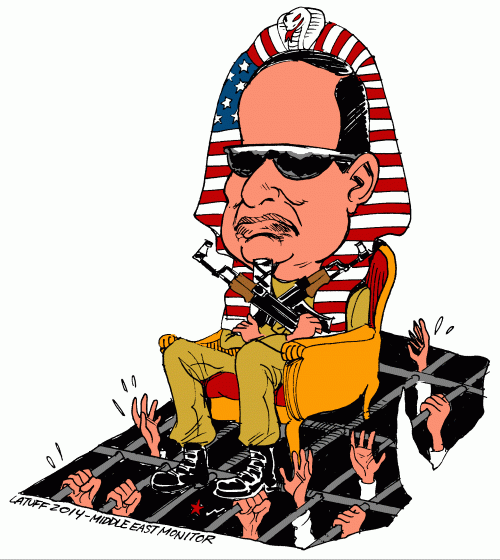
Egypt seems to be intensifying its crackdown on opponents with a new law. President Abdel Fattah al-Sisi has approved the legislation, authorizing officials to monitor social media users.
As reported by the official gazette on Saturday, the new law gives state authorities the right to monitor the activities of social media users on the internet.
The legislation, it said, places social media accounts with over 5,000 followers under the supervision of the Supreme Council for the Administration of the Media.
That means any popular blog, website or even account on Facebook, Twitter or other platforms, could be considered a media outlet and subject to the supervision of the media regulator which could block them for spreading fake news.
The controversial law was passed in the parliament back in July.
Critics argue that it increase state power to crack down on opposition activists.
Human rights groups have on numerous occasions criticized Egypt for its tough approach towards opponents.
The Sisi government has silenced most critics in the media, rolled back social freedoms, and placed draconian restrictions on demonstrations and the work of rights groups.
Tens of thousands of people have been detained since 2013, when the military, led by Sisi, overthrew Mohamed Morsi.
Morsi, Egypt’s first democratically-elected president, came to power after the 2011 uprising toppled long-time autocrat Hosni Mubarak.
Read more:
Egypt arrests prominent blogger amid crackdown on dissent
Egypt subjecting prisoners to horrendous abuse, torture
Brazil Court Rules Barring Lula Da Silva From Presidential Election – Reports
Sputnik – 01.09.2018
The lawyers of the jailed former Brazilian president Luiz Inacio Lula da Silva have said they would appeal the ruling by a 4-1 majority of the seven-member top electoral court to the country’s Supreme Court, Reuters reported.
Lula, who served as the country’s president from 2003 through 2010, was sentenced to 9.5 years in prison last summer for allegedly accepting a luxury apartment from a construction firm in return for political favors. Lula has denied the accusations. An appeals court upheld the ruling in January and increased Lula’s jail term to 12 years and a month.
The Brazilian Workers’ Party (PT) vowed in a statement late Friday to secure Lula da Silva’s candidcay in the upcoming October’s vote.
“We will present all appeals before the courts for the recognition of the rights of Lula provided by law and international treaties ratified by Brazil… we will defend Lula in the streets, with the people,” the PT statement was quoted by AFP.
Earlier in August, the PT announced it has registered jailed ex-president Lula da Silva as its candidate in the upcoming October’s election. Papers were submitted to Brazil’s Supreme Court hours before the deadline passed.
The UN Human Rights Committee has urged Brazil to ensure that political rights of Lula were observed given that he was registered as a candidate for the upcoming presidential election. The committee also urged Brazil to refrain from hindering Lula from participating in the election until after his court appeals were completed.
However, the country’s Foreign Ministry has said that Brazilian authorities do not consider binding the UNHR recommendations regarding observance of jailed former president.
According to the recent polls, jailed ex-president Lula da Silva is one of the most popular presidential candidates, however, the new rulling of the Brazil’s electoral court questions Lula’s run in the presidential campaign.
Lula da Silva’s supporters remain, however, optimistic. The PT has launched an appeal for support on Twitter, after which a hashtag translating as “Lula on the ballot box” quickly began trending, AFP reported.
Trump Is Right About “Flipping”
By Jacob G. Hornberger | FFF | August 27, 2018
In the wake of the federal criminal conviction of former Trump official Paul Manafort and the guilty plea in federal court of former Trump lawyer Michael Cohen, the mainstream press is singing the praises of special prosecutor (and former FBI Director) Robert Mueller and the Justice Department.
In the process, Trump’s critics are condemning his denunciation of “flipping,” the process by which federal prosecutors offer a sweet deal to criminal defendants in return for testifying against a “higher-up” who the feds are also prosecuting. The press and the anti-Trumpsters say that such a practice is part of the “rule of law” and essential to the proper administration of justice.
Nothing could be further from the truth. Whatever else might be said about Trump, he is absolutely right on this point. The process of offering sweetheart deals to people in return for their “cooperation” to get someone else convicted has long been one of the most corrupt aspects of the federal criminal-justice system, especially as part of the federal government’s much-vaunted (and much-failed) war on drugs.
Suppose a federal criminal defendant contacts a prospective witness in a case and offers him $50,000 in return for his “cooperation” in his upcoming trial. The money will be paid as soon as the trial is over. The defendant makes it clear that he wants the witness to “tell the truth” but that his “cooperation” when he testifies at trial would be greatly appreciated.
What would happen if federal officials learned about that communication and offer? They would go ballistic. They would immediately secure an indictment for bribery and witness tampering.
What if the defendant says, “Oh, no, I wasn’t tampering with the witness. I specifically told him that I wanted him to tell the truth when he took the witness stand. I was just seeking his friendly ‘cooperation’ with my $50,000 offer to him.”?
It wouldn’t make a difference. Federal prosecutors would go after him with a vengeance on bribery and witness-tampering charges. And it is a virtual certainty that they would get a conviction.
There is good reason for that. The law recognizes that the money could serve as an inducement for the witness to lie. Even though the defendant tells him to “tell the truth,” the witness knows that the fifty grand is being paid to him to help the defendant get acquitted, especially since it is payable after the trial is over. The temptation to lie, in return for the money, becomes strong, which is why the law prohibits criminal defendants from engaging in this type of practice.
Suppose a federal prosecutor says to a witness, “You are facing life in prison on the charges we have brought against you. But if you ‘cooperate’ with us to get John Doe, we will adjust the charges so that the most the judge can do is send you to jail for only 5 years at most. If you are really ‘cooperative,’ we will recommend that the judge give you the lowest possible sentence, perhaps even probation. Oh, one more thing, we want to make it clear that we do want you to tell the truth.”
Do you see the problem? The temptation to please the prosecutor with “cooperation” becomes tremendous. If the witness can help secure a conviction of Doe, he stands to get a much lighter sentence for his successful “cooperation.” The inducement to commit perjury oftentimes takes over, notwithstanding the prosecutor’s admonition to the witness to “tell the truth.”
Defenders of this corrupt process say that without it, prosecutors could never get convictions. That’s pure nonsense. For one thing, prosecutors can secure a conviction against the witness and then force him to testify once his case is over. That’s because a person whose case is over is unable to rely on the Fifth Amendment to avoid testifying in the case against John Doe.
Moreover, the prosecutor can give what is called “use immunity” to the witness, which then forces him to testify in the case against Doe. Use immunity is not full immunity from prosecution. It simply means that the prosecutor cannot use the witness’s testimony against Doe to convict the witness at his trial. The prosecutor must convict him with other evidence.
But even if it means that the prosecutor is unable to secure some convictions, the question has to be asked: Do we want prosecutors securing convictions in this way? After all, there is a related question that must be asked: How many innocent people are convicted by perjured testimony from a witness who is doing his best to “cooperate” with the prosecution in the hope of getting a lighter sentence?
Given all the accolades being accorded Mueller, it is a shame that he has chosen to go down the same corrupt road that all other federal prosecutors have traveled. He didn’t have to do that. He could have led the way out of this immoral morass by taking a firm and public stand against this corrupt procedure. The fact that he has chosen instead to participate in it is a shame, to say the least.
Defining Anti-Semitism, Threatening Free Speech
By Sheldon Richman | The Libertarian Institute | August 24, 2018
In May the benign-sounding Anti-Semitism Awareness Act appeared before the U.S Congress “to provide for consideration a definition of anti-Semitism for the enforcement of Federal antidiscrimination laws concerning education programs or activities.”
No big deal? Let us see.
S. 2940 is sponsored by Republican Sen. Tim Scott and has four co-sponsors: Republican Lindsey Graham and Democrats Ron Wyden, Robert Casey, and Michael Bennet. The House sponsor of H.R. 5924 is Republican Rep. Peter Roskam, with 41 cosponsors, 30 Republicans and 11 Democrats. Both bills remain in committee. (The Senate passed a similar bill two years ago, but it never reached the House floor.)
Right off the bat, the legislation seems odd: under what Republican Party theory of limited government does Congress proposes definitions of words simply for consideration for educational purposes? And I thought Republicans don’t like federal involvement in education. We’ll see that the answer is steeped in irony: the stated purpose is to help education agencies to combat racial discrimination.
While the act is directed at education, the resulting law would reach beyond that realm because it would officially stigmatize as anti-Semitic any speech and activity, public and private, said to fall within the definition. Since this would at least chill the open marketplace of ideas, advocates of free speech should be concerned about the content of the definition and its revealing support material. We must not assume that merely because the definition is said to brand something anti-Semitic that it is actually anti-Semitic.
The act states that Title VI of the 1964 Civil Rights Act “prohibits discrimination on the basis of race, color, or national origin” (not, mind you, religion) but that “both the Department of Justice and the Department of Education have properly concluded that title VI prohibits discrimination against Jews, Muslims, Sikhs, and members of other religious groups when the discrimination is based on the group’s actual or perceived shared ancestry or ethnic characteristics or when the discrimination is based on actual or perceived citizenship or residence in a country whose residents share a dominant religion or a distinct religious identity” (emphasis added). Hence, those departments have managed to shoehorn religion into a statute that does not mention religion.
The proposed definition directly comes from a 2010 State Department Fact Sheet, which in turn comes, with some modification, from the International Holocaust Remembrance Alliance (IHRA) “working definition of Anti-Semitism.” The IHRA has 31 member countries, including the United States, and Israel.
Anti-Semitism, according to the IHRA “working definition,” is “a certain perception of Jews, which may be expressed as hatred toward Jews. Rhetorical and physical manifestations of antisemitism are directed toward Jewish or non-Jewish individuals and/or their property, toward Jewish community institutions and religious facilities.”
This may seem less than helpful — history professor David Feldman, director of the Pears Institute for the Study of Antisemitism at London’s Birkbeck, University, calls it “bewilderingly imprecise — so the IHRA furnished examples (couched in conditional terms such as could and might and to be interpreted by “taking into account the overall context”). And here the problems continue. Writing in the Guardian, Feldman, says of the 11 examples: “Seven deal with criticism of Israel. Some of the points are sensible, some are not. Crucially, there is a danger that the overall effect will place the onus on Israel’s critics to demonstrate they are not antisemitic” (emphasis added). That should be of concern.
Among the possible examples of anti-Semitism quoted from the IHRA document in the State Department Fact Sheet, but with some modification, are:
+ Accusing Jews as a people of being responsible for real or imagined wrongdoing committed by a single Jewish person or group, the state of Israel, or even for acts committed by non-Jews. [Emphasis added.]
+ Accusing Jewish citizens of being more loyal to Israel, or to the alleged priorities of Jews worldwide, than to the interest of their own nations.
+ Drawing comparisons of contemporary Israeli policy to that of the Nazis”
+ Applying double standards by requiring of it [Israel] a behavior not expected or demanded of any other democratic nation.
+ Denying the Jewish people their right to self-determination, and denying Israel the right to exist.
Two things are worth pointing out here. The phrase “the state of Israel” in first example above does not appear in the IHRA list; that version says only, “Accusing Jews as a people of being responsible for real or imagined wrongdoing committed by a single Jewish person or group, or even for acts committed by non-Jews.” The IHRA does go one to say later that “manifestations might [emphasis added] include the targeting of the state of Israel, conceived as a Jewish collectivity” but immediately cautions that criticism of Israel similar to that leveled against any other country cannot be regarded as antisemitic.” The Fact Sheet, which, again, the legislation incorporates, adds, almost as an afterthought, “However, criticism of Israel similar to that leveled against any other country cannot be regarded as anti-Semitic” (italics in original).
Second, the last example differs from the similar IHRA example, which reads, “Denying the Jewish people their right to self-determination, e.g., by claiming that the existence of a State of Israel is a racist endeavor” (emphasis added). I am unaware of criticism of the Fact Sheet or legislation for this key modification. A similar modification has landed the UK’s Labor Party leadership in hot water. (More below.)
As we’ll see, the inclusion of criticism of Israel in the examples is where much of the danger of this legislation lies. Indeed, Antony Lerman, former director of the Institute for Jewish Policy Research in Britain, who traces the origin and promotion of the IHRA document to the American Jewish Committee and the Simon Wiesenthal Center, both of which routinely conflate criticism of Israel with anti-Semitism, says it was designed to “equate criticisms of Israel with hatred of Jews.” Of course it was; today, being a good anti-anti-Semite, like being a good Jew, means little more than being unswervingly pro-Israel and pro-Israeli repression of Palestinians.
By way of additional background and contrast, the legislation cites a 2010 U.S. Department of Education “Dear Colleague” letter on religious bigotry to state and local educational agencies stating that they “must take prompt and effective steps reasonably calculated to end the harassment, eliminate any hostile environment, and its effects, and prevent the harassment from recurring.” However, the legislation states that letter “did not provide guidance on current manifestations of anti-Semitism, including discriminatory anti-Semitic conduct that is couched as anti-Israel or anti-Zionist” (emphasis added). That’s right: the Education Department did not mention Israel or Zionism in its letter about combating anti-Semitism. So the authors of the legislation seek to “correct” that “shortcoming.”
The legislation goes to state that “anti-Semitism, and harassment on the basis of actual or perceived shared ancestry or ethnic characteristics with a religious group, remains a persistent, disturbing problem in elementary and secondary schools and on college campuses.”
Is that so? It doesn’t ring true. The Pew Research Center “finds that when it comes to religion, Americans generally express more positive feelings toward various religious groups [including Jews] today than they did just a few years ago. Asked to rate a variety of groups on a ‘feeling thermometer’ ranging from 0 to 100, U.S. adults give nearly all groups warmer ratings than they did in a June 2014 Pew Research Center survey.” For all age groups, atheists and Muslims rank far below Jews. (In another survey, Muslims ranked below atheists.) For Americans 30 years and up, Jews rank at or near the top, and the score has risen since 2014. For Americans 18-29, Jews rank just below top-ranking Buddhists, Catholics, and Hindus. No religious group scored more than 69 “degrees” except for, among people 65 and older, Mainline Protestants, Jews, and Catholics, who scored in the 70s. Where’s the widespread anti-Semitism?
And where’s the evidence of growing anti-Semitism on college campuses? The legislation “finds” that “students from a range of diverse backgrounds, including Jewish, Arab Muslim, and Sikh students, are being threatened, harassed, or intimidated in their schools,” but it would be interesting to see the groups broken out. One suspects the atmosphere on campus is more hostile to Arab and Muslim professors and students than to Jews. (See examples here and here.) And we cannot discount the likelihood that criticism of Israel is simply interpreted as criticism of Jews qua Jews. Indeed, the lead author of the IHRA definition, Kenneth Stern, said last year in congressional testimony that it is untrue that “antisemitism on campus is an epidemic. Far from it. There are thousands of campuses in the United States, and in very few is antisemitism – or anti-Israel animus – an issue.”
Anti-Semitism exists, of course, but it’s clearly confined to the fringes of American society. It is so disreputable that people have shied away from criticizing Israel for fear of being accused of Jew-hatred, which can destroy careers and friendships. The legislation seems designed to reinforce that fear, which fortunately has been fading in recent years, especially among younger people, in light of Israel’s periodic military assaults on the essentially defenseless people of Gaza. Every so often the word goes out that anti-Semitism is on the rise, but it’s hard not to notice that those alarms follow the broad international criticism of Israeli systematic brutality against Palestinians resisting the 51-year occupation of their property. As Norman Finkelstein, who monitors this phenomenon closely, writes, “Whenever Israel commits another atrocity, its propagandists stage a revival of the ‘New Anti-Semitism’ extravaganza to deflect or squelch global condemnation.” (See Finkelstein’s book Beyond Chutzpah: On the Misuse of Anti-Semitism and the Abuse of History.)
I won’t try to define anti-Semitism; let’s just go with Stephen Sedley’s definition: “Shorn of philosophical and political refinements, anti-Semitism is hostility towards Jews as Jews.” I’ll only add that it has something to do with seeing all Jews as members of a malignant and world-controlling racial or ethnic entity, with each member being responsible for any wrongdoing, real or imagined, by any other Jew. This is rank collectivism that no liberal individualist will accept. We must note the irony, however, that many Jews themselves believe that all Jews without exception constitute a genetic entity, though this is patently absurd. Jews are of many races, ethnicities, nationalities, and cultures and until a couple of hundred years into the Common Era, Judaism was a proselytizing religion with many successes at converting whole kingdoms, nations, and tribes. In other words, many Jews today are descendants of people who converted to Judaism, sometimes unwillingly, and who never were in the Land of Israel.
Note further the irony of the legislation’s condemnation of those who conflate all Jews with the state of Israel. Israel’s recently passed Nation-State Law declares that the “land of Israel is the historical homeland of the Jewish people.” That includes all Jews no matter where they were born, where they live now, or whether they ever set foot in Israel. In other words, the government of Israel claims to speak for all Jews, which is an affront to any Jew who does not wish to be spoken for by a foreign government or who no longer regards himself as a Jew. (If the Jewish people are not a racial or ethnic entity but a diverse religious group, one can, like Spinoza, stop being a Jew.) It would be wrong for anyone to presume that Prime Minister Benjamin Netanyahu speaks for or acts on behalf of American, British, French, and other non-Israeli Jews, but that is what Israel’s Basic Law claims. (Former Meet the Press host David Gregory once addressed Netanyahu on the air as the “leader of the Jewish people.)
And this claim, which predates the Nation-State Law, is what has given rise to the (dual) loyalty suspicion. So we have yet another irony in The Anti-Semitism Awareness Act’s condemnation of statements “accusing Jewish citizens of being more loyal to Israel, or to the alleged priorities of Jews worldwide, than to the interest of their own nations.” A great way to dispose of the loyalty issue would be for Israel and its supporters to stop pretending it represents all Jews (and former Jews) everywhere.
As noted, the legislation says that “denying the Jewish people their right to self-determination, and denying Israel the right to exist” is anti-Semitic. But what about denying the Jewish people the right to self-determination on land taken from its rightful owners, as Jewish and non-Jewish anti-Zionists have long denied? And when will Congress get around to condemning those who deny the right of Palestinians to self-determination? The Nation-State law says that the “right to exercise national self-determination in the State of Israel is unique to the Jewish people.” So Palestinians are lesser people than Jews? What’s the word for that attitude?
The condemnation of people who “apply[] double standards by requiring of it [Israel] a behavior not expected or demanded of any other democratic nation” is also filled with problems. The first is that Israel’s unconditional defenders themselves are guilty of applying a double standard. If any national group treated another group the way the Zionists and Israelis have treated the Palestinians, they would have been condemned by liberal-minded Jewish Americans along with most other Americans. Second, where is the double standard in the criticism of Israel? Name another country that occupies other people’s land, recognizes no rights in the occupied population, systematically discriminates against 25 percent of its “citizens,” gets billion in military aid every year from American taxpayers, has a highly influential lobby ready to smear any critic, claims to be the most moral military in world, and insists it’s the only democracy in its region? When we have another country like that we’ll see if Israel’s critics apply a double standard.
The example of anti-Semitism allegedly found in “drawing comparisons of contemporary Israeli policy to that of the Nazis” is also worth examination. Is it really the case that Israel’s rulers are incapable of acting like Nazis, even when it seizes Palestinians, including children, in the dark of night, holds them indefinitely without charge; tortures them; shoots them or break their bones when they protest their oppression peacefully; requires internal travel permits; maintains military checkpoints; bars them from much of the land and Jewish-only roads; and destroys homes as collective punishment or to clear land for use by Jews only? What’s the theory underlying that claim? Do the oppressed never become oppressors?
And here’s another question: are Jews who make that comparison also anti-Semites? The fact is that Jews have repeatedly made that comparison, for example, the late Hajo Meyer, a Holocaust survivor, and Yair Golan, the former deputy chief of the general staff of the Israel Defense Force. Indeed, in 1948 Albert Einstein, Hannah Arendt, and other Jews sent a letter to the New York Times expressing concern over the emergence of the Israeli “‘Freedom Party’ (Tnuat Haherut), a political party closely akin in its organization, methods, political philosophy and social appeal to the Nazi and Fascist parties. It was formed out of the membership and following of the former Irgun Zvai Leumi, a terrorist, right-wing, chauvinist organization in Palestine.” That party and the Irgun were led by Menachem Begin, who became prime minister of Israel in the 1970s. The party merged with Netanyahu’s Likud party in 1988.
Yet one more question: if neither Jews nor non-Jews may liken Israeli policies against the Palestinians to some Nazi policies, why are Israelis and their supporters allowed to claim that any and all perceived adversaries (Nasser, Saddam Hussein, Qaddafi, and Ahmadinejad and the Iranian ayatollahs, for example) are reincarnations of Adolf Hitler?
Since Jews as well as non-Jews often commit the “offenses” specified by the IHRA, maybe the congressional legislation should have been called the Anti-Semitism and Jewish Self-Hatred Awareness Act. Or perhaps only men and women with Jewish mothers are to be permitted to do what is forbidden to others. That would be odd view indeed.
No, the Israeli regime does not operate death camps, but it does things that resemble what the Nazi and other totalitarian regimes did to Jews and other groups. Gaza, where the more-than-decade-old Israeli blockade causes two million Palestinians, half of them children, to be undernourished and forced to drink polluted water, has been called a concentration camp and a ghetto by Jews.
Real anti-Semitism is ugly and execrable. And that’s why diluting the concept with extraneous elements is what’s really dangerous. Sure, some of Israel’s critics could be anti-Semites, but some of Israel’s biggest fans are too. I would be suspicious of anyone who was eager to pack my bags and shuffle me off to Tel Aviv. There simply are no reasonable grounds for a presumption of anti-Semitism about opponents of Israel, certainly not in people of good faith. Conflating anti-Semitism even with foundational criticism of Israel makes anti-Semitism seem not so bad in some people’s eyes. As Antony Lerman wrote, “Rather than make it easier to identify antisemitism, the promotion of the ‘working definition’ and the entrenchment of the concept of the ‘new antisemitism’ have so extended the range of expressions of what can be regarded as antisemitic that the word antisemitism has come close to losing all meaning.”
Why would anyone want to encourage that outcome? Lerman also points out that “if … only ‘antisemities’ would dissociate themselves from the ‘working definition,’ this places a significant number of highly respected Jewish and non-Jewish academics working in the field of antisemitism research in the dock.”
Those who continue to lobby for this conflation are unwittingly pursuing an evil course even on their own terms — unless they intend such an outcome. (Real or imagined anti-Semitism can be useful in deterring Jewish assimilation and disillusionment with Israel.) Moreover, they are encouraging organizations that harass students and teachers sympathetic to the Palestinians’ plight. Free speech and inquiry must be protected. As the ACLU said about the legislation:
The overbroad definition of anti-Semitism in this bill risks incorrectly equating constitutionally protected criticism of Israel with anti-Semitism, making it likely that free speech will be chilled on campuses. The examples incorporated into the bill’s definition of anti-Semitism include actions and statements critical of Israel, including many constitutionally protected statements. As a result, the proposed legislation is likely to chill the speech of students, faculty, and other members campus communities around the country, and is unnecessary to enforce federal prohibitions on harassment in education as such protections already exist under federal law.
As the ACLU letter opposing the legislation notes, even the lead author of the definition, Kenneth Stern, a self-described Zionist, “has himself opposed application of this definition to campus speech.” In a 2016 op-ed opposing South Carolina’s adoption of the definition, Stern wrote,
It is really an attempt to create a speech code about Israel. It is an unnecessary law which will hurt Jewish students and the academy…. It was never intended as a vehicle to monitor or suppress speech on campus. But that’s what some right-wing Jewish groups and individuals behind this legislation seek…
[The legislation advocates’] intent is clear: to have the state define a line where political speech about Israel is classified as anti-Semitic, and chilled if not suppressed….
If the definition becomes law, campus administrators will fear lawsuits when outside groups complain about anti-Israel expression, and the leadership of the university doesn’t punish, stop or denounce it….
[I]f the anti-Semitism definition is enshrined into law, what professor will want to walk into this minefield, fearful that the selection of certain texts or the expression of certain opinions will put his or her university’s funding in jeopardy?
Indeed, if certain expressions about Israel are officially defined as anti-Semitic, pro-Israel Jewish students will be further marginalized, having gained the reputation for suppressing, rather than answering, speech they don’t like.
In 2017 testimony before the House Judiciary Committee, Stern elaborated:
The proponents of the legislation have made a business model of seeking out speech they believe transgresses the Department of State Definition. They will hunt for such instances and then press administrators to either suppress or condemn such statements, threatening Title VI cases if they don’t act, with the added weight of a Congressionally-endorsed, campus-focused definition behind them…. Armed with a congressional determination that effectively says campus anti-Zionism is antisemitism, … professors will correctly see themselves at risk when they ask their students to read and digest materials deemed anti-Zionist, whether the writings of leading 20th century Jewish thinkers who were skeptical of Zionism, such as Hannah Arendt and Martin Buber, or of contemporary Palestinians. Professors do not get combat pay. It will be safer and wiser for them to teach about Jews in the shtetl than Jews in modern Israel, and Zionism as a concept from the late 19th century, rather than how it plays out today…. My fear is, if we … enshrine this definition into law, outside groups will try and suppress – rather than answer – political speech they don’t like. The academy, Jewish students, and faculty teaching about Jewish issues, will all suffer.
The definition has also been faulted, as Lerman put it, for its “go-it-alone exceptionalism as the way of managing heightened fears of antisemitism, rather than pursuing open-hearted collaboration with other minority groups to fight the resurgent racism that blights society.”
If the Anti-Semitism Awareness Act passes and is signed into law, it would threaten free speech in the academy and beyond, notwithstanding it obligatory “Nothing in this Act shall be construed to diminish or infringe upon any right protected under the First Amendment to the Constitution of the United States.”
Moreover, it will make political campaigns even less meaningful than they are now. As it is, American politicians are afraid to defend the Palestinians against Israel or to question the huge annual military appropriation that enables the brutality; candidates have much to lose both in campaign contributions and reputation. Those who slip, like Bernie Sanders, Cory Booker, and Alexandria Ocasio-Cortez, will have hell to pay and will likely be more careful in the future. (Sanders has had his ups as well as downs.) The UK Labor Party and its leader, the life-long anti-racist Jeremy Corbyn, are learning the same lesson.
We must hope that things do not get as bad in the US as they are in the UK, where a hysterical smear campaign against Israel’s critics has conjured up the term “political anti-Semitism targeting Israel” (in contrast to “racial antisemitism targeting Jews”) and alarm in some quarters about the alleged “existential threat to Jewish life in this country [Great Britain] that would be posed by a Jeremy Corbyn-led government.” The Labor Party’s National Executive Committee has been accused of Jew-hatred because its new code of conduct on anti-Semitism allegedly failed to incorporate the entire IHRA definition of anti-Semitism — hence, its apparent cowardly retreat. Jonathan Freedland of the Guardian tweeted, “So Labour have rejected a definition of antisemitism accepted by UK, Scottish and Welsh govts, 124 local authorities, gov’ts around the world and most Jews.”
Note the authority Freedland, like others, vests in the now-holy IHRA definition — as though it were an amendment to the tablets allegedly handed down at Mount Sinai.
But Lerman shows that Freedland’s charge is utter rubbish; the executive committee’s code explicitly incorporates and quotes the definition, but the authors modified some of the IHRA’s examples and (like the State Department’s Fact Sheet) removed from another the phrase “claiming that the existence of a State of Israel is a racist endeavor.”
But can it be anti-Semitic to call Israel a racist endeavor when leading Israeli intellectuals such as historian Benny Morris acknowledge that ridding Palestine of the indigenous Palestinians — that is, ethnic cleansing — was intrinsic to Zionism?
Lerman also shows, as already noted, that by its own word choices, the IHRA suggests that its illustrations may or may not qualify as examples of anti-Semitism depending on the context. Lerman notes that defenders of the definition make opposing claims — that the examples both are and are not part of the definition — depending on which position is convenient at the time.
Clearly, the Labor Party leadership stands accused of anti-Semitism purely for adopting a code of conduct that distinguishes anti-Semitism from criticism of Israel.
Is this sort of smear campaign that is in store for members of Congress who vote against the Anti-Semitism Awareness Act?
Featured Video

When Israel Is Mighty
or go to
Aletho News Archives – Video-Images
From the Archives
US murdering 1 million Iraqis is democracy, Iran giving yogurt to Iraq is “domination”
By Ali Salaam | American Herald Tribune | July 31, 2017
The New York Times, owned by the Zionist Jewish supremacist Ochs-Sulzberger family, has no problem with Iraqi suffering as long as Iran is not the one behind it.
The Iraq War was a genocide of the Iraqi people by Zionist supremacists in the Bush administration. Over 1 million innocent people were killed based on a lie. American soldiers died in an Israeli war and now an average of 22 soldiers commit suicide every day because their consciences cannot cope with the fact they committed crimes in an illegal war that served no purpose other than to benefit Israel, not America.
Benjamin Netanyahu, Prime Minister of the Zionist regime, once said “We are benefiting from one thing, and that is the attack on the Twin Towers and Pentagon, and the American struggle in Iraq.”
Paul Wolfowitz had his sights on Iraq since his time in the first Bush administration. Former Israeli official and Bush administration official Richard Perle had his eyes on Iraq since at least his authorship of the Clean Break white paper. The Zionist regime had their eyes on Iraq since the 1980s when strategist Oded Yinon wrote his white paper in support of dividing the Arab-Muslim world along ethnic and sectarian lines. The global Zionist lobby has had their eyes on Iraq since Theodor Herzl stated that Eretz Israel’s true borders go from the Nile River in Egypt to the Euphrates River in Iraq. … continue
Blog Roll
 Aletho News
- MEP blasts ‘Euro-Gestapo’ for lecturing Russia on democracy
- Syria May Send Troops to Saudi Arabia Amid War with Ansar Allah
- UK whines about losing billions to ‘Putin tax’
- Baghaei to Rubio: Distorted narratives cannot erase US record of broken commitments
- Houthis Don’t Have to Conquer Saudi Arabia to Make It Pay
- MOE: Nearly 22,000 Students and Education Workers Killed
- Guterres in Islamabad: Genocide, cowardice, and the cage of Imran Khan
- Johnson, Marandi say Yemen holds upper hand over Saudi Arabia
- False flags won’t save aggressors, Iran FM spokesman says
- The Makkah Pact Enters Into Force: The End of American Dominance or Its New Form?
- If Americans Knew
- Nearly 2 Million in Gaza Need Urgent Shelter Assistance as Winter Looms: IOM Chief Warns
- Suppressing Palestinian resistance: US charity under fire for AI monitoring of Gaza classrooms
- Thousands Are Held in Israeli Torture Camps. This Is What Happens Inside
- Israel puts Gaza’s sick, injured, newborn in peril – Daily Update
- Report claimed Mark Levin used by Israeli government to influence Trump
- Over 2,000 Gazans have died awaiting medical evacuation amid Israel’s continued siege
- How a U.S. Diplomat Suppressed and Altered Reports Critical of Israel
- 5 Palestinians Die from Israeli Strikes in Gaza as Relentless Attacks Continue
- Report: Ceasefire Slows Killing but Leaves Devastation Intact
- Country Music Singer Zach Bryan Breaks Attendance Record at Robert Kraft’s Gillette Stadium While Wearing ‘Free Palestine’ Shirt for Second Night in a Row
- No Tricks Zone
- New Study: 50 Years Of The Most Aggressive ‘Net Zero’ Policies Can Only Affect The Global Climate By 0.03°C
- US September “Heat” Was No Record…Many Records Set Decades Ago
- Latest European Green Energy Debacle; Portugal’s Largest Flagship Solar Park Insolvent!
- Green Energy Debacle: German Expert Professor Fritz Vahrenholt Warns Of Severe Economic And Social Consequences
- Two More Paleo Reconstructions Affirm Meters-Higher Sea Levels Across Ireland, Brazil 7000-6000 Years Ago
- New Study: Earth And Venus Surface Warmth Largely Explained By Convection And Lapse Rate, Not CO2 Or Radiation
- 2025 Nature Paper Claiming Worsening Global Drought Gets RETRACTED …Heavily Flawed
- New Study: ‘Global Drought Shows No Detectable Recent Acceleration Under Climate Warming’
- Economic Masterminds: German Socialists Suggest Taxing Productivity Gains Stemming From Using AI
- The South China Sea Has Not Been Cooperating With The Climate Change Narrative

