Twenty Years of Dictatorial Democracy
By James Bovard | CounterPunch | November 7, 2016
The presidential campaign has mortified millions of Americans in part because the presidency has become far more dangerous in recent times. Since 9/11, we have lived in a perpetual emergency which supposedly justifies trampling the law and Constitution. And the illegalities will not end after Tuesday’s vote count. Both Donald Trump and Hillary Clinton have signaled that they will perpetuate power grabs in the next four years.
For generations, politicians have touted voting as a magical process which almost automatically protects the rights of everyone within a 50 mile radius of the polling booth. But the ballots Americans have cast in presidential elections since 2000 did nothing to constrain the commander-in-chief.
Bush’s declaration in 2000 that America needed a more “humble” foreign policy did not deter him from vowing to “rid the world of evil” and launching the most catastrophic war in modern American history. Eight years later, Barack Obama campaigned as the candidate of peace and promised “a new birth of freedom.” But that did not stop him from bombing seven nations, claiming a right to assassinate American ciizens, and championing Orwellian total surveillance.
Bush was famous for “signing statements” decrees that nullified hundreds of provisions of laws enacted by Congress. Obama is renown for unilaterally endlessly rewriting laws such as the Affordable Care Act to postpone political backlashes against the Democratic Party and for effectively waiving federal immigration law. Both Bush and Obama exploited the “state secrets doctrine” to shield their most controversial policies from the American public.
While many conservatives applauded Bush’s power grabs, many liberals cheered Obama’s decrees. After 16 years of Bush-Obama, the federal government is far more arbitrary and lethal. Richard Nixon’s maxim – ‘it’s not illegal if the president does it’ – is the lodestar for commanders-in-chief in the new century.
There is no reason to expect the next president to be less power hungry than the last two White House occupants. Both Trump and Clinton can be expected to trample the First Amendment. Trump has talked of shutting down mosques and changing libel laws to make it far more perilous for the media to reveal abuses by the nation’s elite. Clinton was in the forefront of an administration that broke all records for prosecuting leakers and journalists who exposed government abuses. She could smash the remnants of the Freedom of Information Act like her aides hammered her Blackberry phones to obliterate her email trail.
Neither candidate seems to recognize any limit on presidential power. Trump calls for reviving the torture that profoundly disgraced the United States during the George W. Bush era. Clinton opposes torture but believes presidents have a right to launch wars whenever they decide it is in the national interest. After Clinton helped persuade Obama to bomb Libya in 2011, she signaled that the administration would scorn any congressional cease-and-desist order under the War Powers Act. She continues to tout the bombing of Libya as “smart power at its best.”
If Americans could be confident that either Trump or Clinton would be leashed by the law, there would be less dread about who wins on Tuesday. But elections are becoming simply coronations via vote counts. The president will take an oath of office on Inaugural Day but then can do as he or she damn well pleases.
We now have a political system which is nominally democratic but increasingly authoritarian. The proliferation of despotic precedents in the past 15 years would have horrified America’s Founding Fathers. The Rule of Law has been defined down to finding a single federal lawyer to write a secret memo vindicating the president’s latest unpublished executive order. And Washington has never had a shortage of weasely lawyers.
By the end of the next presidential term, America will have had almost a 20-year stretch of dictatorial democracy. Washington’s disdain for the highest law of the land is torpedoing the citizenry’s faith in representative government. Forty percent of registered voters have “lost faith in American democracy,” according to recent Survey Monkey poll.
The United States may be on the verge of the biggest legitimacy crisis since the Civil War. Whoever wins in November will be profoundly distrusted even before being sworn in. The combination of a widely-detested new president and unrestrained power almost guarantees greater crises in the coming years.
Neither Trump nor Clinton are promising to “make America constitutional again.” But, as Thomas Jefferson declared in 1786, “an elective despotism was not the government we fought for.” If presidents are lawless, then voters are merely designating the most dangerous criminal in the land.
James Bovard is the author of Attention Deficit Democracy, The Bush Betrayal, Terrorism and Tyranny, and other books. Bovard is on the USA Today Board of Contributors. He is on Twitter at @jimbovard. His website is at www.jimbovard.com
‘Conspiracy Vs. Government’ Is Part of an Elite Wave of Propaganda Justifying Violent Repression
The daily Bell – October 31, 2016
The rise of paranoid politics could make America ungovernable – and the FBI is fuelling the fire … Nothing can disprove the fears of a paranoiac. Indeed, everything confirms them … It takes away politicians’ incentive to understand one another and get things done. It says that if you scream loud enough, established norms will buckle under the pressure. And while those norms might be annoying and flawed, we’ll all miss them if they go. –UK Telegraph
With US belief in “conspiracy theory” over 50 percent (see our previous article here) elites are showing increasing concern that they have lost control of their narrative.
This article again illustrates elite push back. The article explains that if people grow paranoid about government, then the “norms” of government will collapse.
Conspiracy theory is called “paranoid politics” in this article but it amounts to the same thing.
The article also has parallels to an article we analyzed recently here by Cass Sunstein. His Bloomberg editorial suggested that nothing was more important from a political standpoint than returning “civility” to Congress and politics generally.
This article runs along the same lines: Negative perceptions of the US government can make the process of “governing” dysfunctional
More:
Take the “chemtrails” conspiracy theory: the idea that the white trails left behind in the sky by aeroplanes are sinister chemicals dispersed to sterilise or control voters.
If a government declares there is “no evidence” of such chemicals, that itself must be clear evidence that there’s something “they” don’t want us to know. But if that government were to open up an investigation, that too would be incontrovertible proof: “they” must have found something.
Let’s reverse this reasoning. Apparently, one can’t question much that government does because skepticism puts government in a no-win situation.
Better to accept official pronouncements, then. The only trouble is that almost anything modern Western governments say are lies.
Governments aren’t even important these days. The world from what we can tell is run by a small banking elite that controls the awesome power of central banks and the money they print.
The trillions available to this small group has allowed it to change the nature of society around the world.
The goal is global government and every kind of violence and corruption is employed to achieve it.
Secrecy is still employed by those creating “one world.” Thus the world is bent on the task of creating global governance while never admitting it.
But in the past several decades, the Internet has credibly exposed plans for world government. As a result, people have lost faith in mainstream media, politicians and capitalism itself.
This is the reason for the rise in “conspiracy theory” and “paranoid politics.”
This is also the reason elites would like to shut down the Internet, or at least control it more thoroughly.
Part of the push for control involves making a case that the Internet needs to be better regulated and appropriately censored.
To this end, elite propaganda has been aimed at justifying various anti-‘Net actions.
One justification involves the “populism versus globalism” meme we’ve covered extensively. (Just use a search engine for the phrase and “Daily Bell.”)
Another justification – another emergent meme – is that government itself is jeopardized by pervasive distrust.
One would think the answer would be to lie less, but this is not the conclusion we’re being furnished.
Both Sunstein in his article, and now the argument in this article, show us clearly that the solution to pervasive electoral cyncism and worse is to better control one’s attitude.
In other words, paranoia and conspiratorial cynicism need to be damped for government to survive and perform its proper function.
Here:
Why, then, did a seasoned operator like Mr Comey, whose judiciousness was praised by the Clinton campaign through the summer, feel the need to divulge this half-baked and potentially insignificant development before assessing it? There is one answer: fear of the mob.
The director of the FBI – those tough guys who smash in doors and shoot people – was scared that if he didn’t talk now and the news leaked out, it would confirm every conspiracy theory going about how the agency was in the Clintons’ pocket. In other words, we’ve reached a point in the politics of the world’s most powerful democracy where the appearance of probity matters more than the reality.
This is a key point in the article. It is one that fully reveals the cognitive dissonance at the heart of this particular argument. The idea is that government is too delicate to sustain itself in the face of the “mob.” The mob must therefore be silenced or “probity will matter more than reality.”
But who is to determine what constitutes a “mob”? And who is determine that the mob’s “reality” is false?
Both the Sunstein article and now this one are erecting very specific kinds of arguments. Government, we are told, is fragile and must be protected from forces that will undermine its credibility.
But this conclusion is merely assumed. It is never proven.
This argument begins and ends with government. Yet the Internet and its recovered history shows us clearly that Western governments mostly provide concealment for the world’s real powers that prefer to operate behind the scenes.
This is the reason for so much cynicism. Many have realized that the society constructed around them is lie. They have reacted by distrusting almost anything associated with modern society.
But in these articles, we can see the forces being marshaled against this state of mind. The preferred antidote is simply to assert that people’s distrust is corrosive to government authority and democracy generally.
No logic bolsters this argument. That’s why it is an emergent elite meme.
The goal of an elite meme is to be convincing not truthful.
And if it is not convincing – and increasingly elite memes are not – then its function is, anyway, to provide a justification for what we call directed history. These are the authoritarian strategies that elites wish to inflict on the rest of us.
This latter meme is an outgrowth of “populism versus globalism.” Populists, as we’ve pointed out, are being cast as ignorant, violent and intolerant. The current meme – let’s call it “conspiracy versus government” – lumps in conspiracy with populism.
Populists, we learn, are apt to adopt an irrational distrust of government. And what is government? It must comprise all that is good and virtuous in an uncivil world.
Both populists and conspiracy theory are to be vanquished, eventually, by wise globalists who understand that the absence of government will lead to violent “anarchy.”
Would that it were true. It is not. Government is merely in this day-and-age a curtain hiding the world’s real controllers who use endless violence, monetary debasement and economic depression to get their way.
Conclusion: We are watching the emergence of a new, dangerous memes. Increasingly and forcefully, it is being argued that “government” is good and that the truths people have discovered about their lives and society are destabilizing to government, and therefore “bad.” The idea will be to use these memes to make a case for increased censorship and even, eventually, violent repression – and worse.
Facebook investigated by German prosecutors for failing to stop ‘hate speech’
RT | November 4, 2016
Facebook’s founder Mark Zuckerberg and other senior executives are being investigated in Germany after a lawyer filed a complaint accusing them of allegedly allowing racist and violent posts to remain on the social networking site.
The social media giant was accused of doing little to stop racism, Holocaust denial and violent threats on the site, according to Der Spiegel.
A Bavarian lawyer initiated the case by reporting Facebook to the police, accusing the company’s management of allowing such hateful posts to stay on the site without any consequences.
Chief Operating Officer Sheryl Sandberg, European policy director Richard Allan and company head in the Berlin office Maria Kirschsieper, are also under investigation.
German law requires Facebook to delete any content considered to be inciting hatred. Earlier this year, the company was also hit with a criminal complaint, but authorities said at the time they were unable to investigate because the accused, Zuckerberg, was not residing within German borders when it was brought to light.
German politicians have criticized Facebook for reportedly failing to take action against hate speech on the site.
In October, Volker Kauder, a member of Angela Merkel’s Christian Democratic Union, said Facebook and other social media giants should face penalties for not taking action against hate speech, following the rise of xenophobic comments amid the refugee crisis in Europe.
Kauder said he had “run out of patience” with how social media giants were dealing with abusive content.
Many users of Facebook, Twitter and Google said that despite pledges from the companies to remove hate speech within 24 hours from their sites, users complaints were not adequately dealt with, the Local reports.
Facebook did not comment on the investigation status but said “the allegations lack merit and there has been no violation of German law by Facebook or its employees.”
Trigger Warnings, Safe Spaces, Bias Reporting: The New Micro-techniques of Surveillance and Control
By Michael Rectenwald, Ph.D. | Legitgov | September 12, 2016
A singular orthodoxy has infiltrated the discursive parameters of U.S. and other universities and colleges. This orthodoxy now constitutes the ethical vocabulary of academia. Adopted from feminism, anti-racism, and LGBTQ theory and practice, the language, doctrines, and mechanisms of this orthodoxy now dominate academia’s policies, procedures and handbooks. The terminology has become the vernacular among the swelling ranks of administrators, especially the relatively new cohort of chief diversity officers, directors of diversity, associate provosts of diversity, assistant provosts of diversity, diversity consultants, and so on and so on. I refer not merely to the orthodoxy of “diversity,” but in particular to “diversity” initiatives as they are currently administered, using a particular set of policies, procedures, and mechanisms: trigger warnings, safe spaces, bias reporting, and the like.
While ridiculed by media outlets, and, at least where trigger warnings are concerned, disavowed by the American Association of University Professors, nevertheless, American colleges and universities are dominated by this ethos and its collective techne. At the University of Chicago for example, the Dean of Students, John (Jay) Ellison, Ph.D., announced (to the great chagrin of some faculty and many students):
Our commitment to academic freedom means that we do not support so-called “trigger warnings,” we do not cancel invited speakers because their topics might prove controversial, and we do not condone the creation of intellectual “safe spaces” where individuals can retreat from ideas and perspectives at odds with their own…
Yet, the same university has also assembled and maintains a “Bias Response Team,” and “urges anyone who has experienced or witnessed a Bias Incident to report it to the Bias Response Team.”
As it usually happens, any perspective that deviates from this “academic” orthodoxy – or any opposition expressed by faculty members in reasoned commentary or debate about the premises of the creed and/or its techniques – is virtually proscribed in advance. Whether or not they happen to be progressives, left communists, or radicals of another stripe, potential critics rightly fear being figured as right-wing reactionaries opposed to diversity and the confrontation of oppression. Any complaints or criticisms, they fear, would be peremptorily dismissed, and likely circulated among other faculty members within their own universities or in academia at large as gossip, subjecting the critic to ridicule and disrepute.
Indeed, despite the fact that a new form of policing has been surreptitiously introduced into academia at large, one would be hard-pressed to find a single article, essay, or book that subjects the entire administratively controlled apparatuses of “diversity” to any kind of real scrutiny. While innumerable articles have appeared on one or another of these topics (mostly on trigger warnings and safe spaces), no one has explained the structural provenance nor analysed the probable effects of these developments as a whole. Nor has anyone provided a theoretical or historical framework with which to understand them.
Ironically, perhaps, the most clearly appropriate critical theoretic for grasping the structural origins, as well as the social and political implications of this new largely “academic”1 development, can be found within the ambit of postmodern theory itself. The new mechanisms adopted and adapted by academic administrations clearly and incredibly mirror those described in a text widely read within humanities and social science studies courses throughout American universities and beyond. Indeed, it is a wonder that no one has, until now, applied this critique to the mechanisms of this academic creed. Faculty members, graduate students, and even many undergraduates, who have had even the slightest brush with trends in the humanities and social sciences, will know to what I refer here: Michel Foucault’s brilliant 1975 book, Discipline and Punish: The Birth of the Prison. Particularly uncanny is the resemblance of the academic mechanisms in question to the “micro-physics of power” described in the third chapter, “Panopticism.”
In this riveting essay, Foucault effectually describes the transmutation of power from the pre-modern to the modern period. Adducing Jeremy Bentham’s architectural model of the “Panopticon,” Foucault proffers what at the time was an utterly novel understanding of modern “discipline” and control. The new disciplinary mechanisms that Foucault discusses replace the earlier corporeal forms of punishment, such as quartering people in public, or branding them with the crimes they supposedly committed, and so forth. While the Panopticon was first introduced by Bentham as a model of prison, asylum, and school reform, the forms of surveillance and discipline to some extent prefigured by the Panopticon and in some sense preceding it, for Foucault had already metastasized beyond the prison system, becoming the general means of discipline and control in so-called “democratic” societies.
The Panopticon itself is a circular building, in which its subjects – inmates, patients, students, etc. – are arrayed in cells surrounding a central tower. The subjects can be seen at any time by a guard, who may (or may not) occupy the central tower. The captive subjects cannot see into the tower, nor can they see each other. Likewise, they are never certain whether or not they are being observed:
Bentham’s Panopticon is the architectural figure of this composition. We know the principle on which it was based: at the periphery, an annular building; at the centre, a tower; this tower is pierced with wide windows that open onto the inner side of the ring; the peripheric building is divided into cells, each of which extends the whole width of the building; they have two windows, one on the inside, corresponding to the windows of the tower; the other, on the outside, allows the light to cross the cell from one end to the other. All that is needed, then, is to place a supervisor in a central tower and to shut up in each cell a madman, a patient, a condemned man, a worker or a schoolboy. By the effect of backlighting, one can observe from the tower, standing out precisely against the light, the small captive shadows in the cells of the periphery. They are like so many cages, so many small theatres, in which each actor is alone, perfectly individualized and constantly visible. The panoptic mechanism arranges spatial unities that make it possible to see constantly and to recognize immediately. In short, it reverses the principle of the dungeon; or rather of its three functions – to enclose, to deprive of light and to hide – it preserves only the first and eliminates the other two. Full lighting and the eye of a supervisor capture better than darkness, which ultimately protected. Visibility is a trap (Foucault 200).
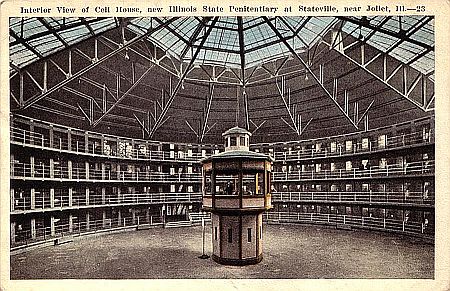
Although the captive individual can never verify with certainty that she is being observed, the very possibility of being observed at any time produces the intended effects of hyper-vigilance and self-circumspection on the part of the subject. As such, the subjects themselves internalize the observer, and effectively monitor and police themselves. As Foucault brilliantly describes the effects of this technological innovation:
He who is subjected to a field of visibility, and who knows it, assumes responsibility for the constraints of power; he makes them play spontaneously upon himself; he inscribes in himself the power relation in which he simultaneously plays both roles [that of observer and observed]; he becomes the principle of his own subjection (203, emphasis added).
Make no mistake, Foucault describes and mobilizes the architectural model of the Panopticon in order to introduce his central argument – in modernity, entire societies are inscribed with, underwritten by, and even predicated upon a generalizable and generalized method of surveillance and control – panopticism. Even the once structure-bound, institution-specific disciplinary techniques as represented so well by the Panopticon have metastasized and traveled well beyond their former institutional borders. They now permeate the entire social body. In fact, in an important section, Foucault discusses “the swarming of the disciplinary mechanisms” of panopticism. The phrasing will invoke for contemporary readers the sentinels in “The Matrix,” the legion of squid-like robots that seek out, locate, and swarm about the escapees from the matrix in sweltering masses.
For our purposes, perhaps the most salient aspect of panopticism is the way that it makes all of its subjects into potential sentinels of surveillance: “We have seen that anyone may come and exercise in the central tower the functions of surveillance” (207). That is, anyone and everyone can be interpellated as a functionary of panopticism. “If you see something, say something” is the mantra that effectively encapsulates this logic. Universities and colleges employ the micro-techniques of power precisely in the fashion described by Foucault.
At this point, I should make clear a parallel between the late eighteenth/early nineteenth-century model that Foucault treats, and the contemporary devices employed in academia and beyond. A point that is often lost on many readers of Foucault’s “Panopticism,” especially those unfamiliar with nineteenth-century British cultural history, is that Jeremy Bentham was not some reactionary, right-wing or even conservative thinker attempting to impose a nefarious, draconian form of discipline and punishment upon the population. In fact, during his time, Bentham was regarded as a radical, what today we would call a “progressive.” Bentham was known as the principle member of an early nineteenth-century group of reformers known as “the philosophical radicals.” As noted in the Encyclopaedia Britannica, he advocated numerous liberal reforms, including “annual elections; equal electoral districts; a wide suffrage, including woman suffrage; and the secret ballot. He supported in principle the participation of women in government and argued for the reform of marriage law to allow greater freedom to divorce.”
My point here is that regardless of the political provenance or original intention of the repertoire of diversity mechanisms, as Foucault makes clear, such methods and techniques, whether introduced initially by reformers for progressive ends or not, can and have often been co-opted by administers of power and wielded to oppressive ends. Likewise, the origin of the new academic instruments or “micro-physics of power” in feminism, anti-racism and LGBTQ discourse and practice in no way exempts them from being employed as mechanisms of surveillance and control.
Academia has co-opted and now brandishes identity-politics and its techniques of micro-power – including trigger warnings, safe spaces, and bias reporting – as means of the disciplining of the subject. Bias reporting lines are examples of the ways colleges and universities are able to enlist everyone within their ambit as sentinels of surveillance, discipline, and punishment. Bias reporting lines and reporting systems encourage everyone to act as an instrument of panopticism, an instrument of self- and other-policing.
In terms of the academy, however, the use of such mechanisms does not represent a perversion of intent. They are coercive as such, by definition. They are part of a growing panoply of micro-techniques of power representing the appropriation and defusing of politics, rather than opposition to the systems of oppression that such politics intend to represent.
These techniques of surveillance and control recall such organizations of the nineteenth century as The Society for the Suppression of Vice, founded in 1802. The only real difference involves what now count as punishable offenses. In the early to mid-nineteenth century in Britain, offenses included the production, distribution and consumption of pornography, as well as expressions of blasphemy, and the like. Today, “vices” and “blasphemies” include real or imagined “micro-aggressions,” or any conceivable displays of “bias,” however absurdly construed. Both regimes, however, are equally religious in character, involving as they do moralistic, individualized, and personalized policing. While both are insidious, only contemporary academic panopticism, operating under the guise of protecting and encouraging “diversity,” is anathema to academic freedom and inquiry, while simultaneously underming any potential for collective agency, or solidarity, among its subjects. Above all, panopticism individualizes.
Meanwhile, and probably most importantly, none of this policing and self-policing will do anything to challenge or overturn systemic oppression in the least. In fact, while serving the ideological function of obscuring the underlying structural inequities, oppression and exploitation of capitalism, they also constitute their own form of oppression.
[1] As Lori R. Price has pointed out, these same mechanisms have metastasized and infiltrated such social media platforms as Twitter, Facebook and YouTube.com.
Michael Rectenwald is a professor in Global Liberal Studies at New York University. He is the author of Nineteenth-Century British Secularism: Science, Religion and Literature (Palgrave Macmillan, 2016), primary editor of Global Secularisms in a Post-Secular Age (De Gruyter, 2015), and primary author of Academic Writing, Real World Topics (Broadview Press, 2015). His essays have appeared in numerous periodicals and anthologies, including the British Journal for the History of Science, Endevour, and George Eliot in Context (Cambridge University Press, 2013).
Son of Honduran Human Rights and Resistance Activist Murdered

teleSUR | November 2, 2016
In post-coup Honduras, a coup which Democratic presidential candidate Hillary Clinton supported, the corpses continue to pile up.
Human rights organizations are raising alarm after yet another assassination in Honduras, this time of the son of a prominent resistance activist, human rights defender, and aspiring progressive candidate for local political office with the left-wing Libre party.
Fernando Aleman Banegas was shot dead in the early hours of Monday morning when we was getting into his car after leaving a club in the northern port city of La Ceiba, according to local reports. The gunmen reportedly fled the scene on a motorcycle.
Aleman will be buried in the nearby city of Tocoa, which borders the Aguan Valley agricultural region, home to a brutally repressive land conflict between campesino communities and large private landowners.
Aleman’s mother, Elsy Banegas, has accompanied the campesinos struggle for years as the President of the Coordinator of Popular Organizations of the Aguan, known as COPA, a human rights group focused on labor and campesino issues in the region. Banegas is also an aspiring mayoral candidate for Tocoa with the Libre party, founded as an offshoot of the popular resistance movement in the wake of the 2009 U.S.-backed coup, in order push for a constituent assembly to rewrite the Honduran constitution at the ballot box, to complement their street resistance.
According to the Honduran human rights organization COFADEH, Banegas’ candidacy “threatens the interests of transnational mining companies and large landowners in the region.” The prominent activist has long been a vocal critic of systematic grave human rights abuses, impunity and the consequences of militarization in the region, particularly since the coup.
Banegas’ organization COPA reported after the murder that the social leader has “on many occasions received death threats for acting against mining companies, privatization and against the violation of human rights.”
Aleman’s assassination came hours before Libre kicked off its internal elections process to select the party’s new leadership leading up to the 2017 general election. Despite the shadow of violence, participation in the process surpassed the party’s own goals, according to Libre leader and ousted President Manuel Zelaya, with at least 239,000 people casting votes when estimates expected participation of 150,000 in the country of about 8 million.
Human rights organizations have called for a thorough and impartial investigation into Aleman’s murder.
The killing comes just two weeks after two Aguan campesino activists were murdered. Jose Angel Flores, president of the Unified Campesino Movement of the Aguan, one of the most prominent land rights organizations on the forefront of the Honduran resistance movement, and his fellow activists Silmer Dionisio George were both gunned down on Oct. 17. Since 2010, the bloody land conflict in the Aguan has claimed the lives of nearly 150 campesinos, according to human rights groups.
The wave of assassinations also comes months after the high-profile killing of internationally-renowned Indigenous activist Berta Caceres in March. Caceres’ case has come to epitomize the grave human rights situation in Honduras and systemic impunity enjoyed by perpetrators of political violence.
Human rights organizations have stressed that the United States — which under the leadership of former Secretary of State Hillary Clinton helped secure the 2009 coup — is complicit in the ongoing crisis in Honduras and must cut all aid funding to the Honduran government and military.
NYPD to Innocent Business Owners: Give Up Your Rights or Get Shut Down
Institute For Justice | October 12, 2016
When undercover NYPD officers offered to sell stolen electronics to customers at Sung Cho’s laundromat, near the northern tip of Manhattan, Sung never imagined the sting operation could be used as a pretext to shut down his business. But that’s exactly what happened. Attorneys for the city threatened Sung with eviction merely because a “stolen property” offense had happened at his business.
The city presented Sung with a choice: See his business shut down or sign an agreement giving up constitutional rights—including his Fourth Amendment right to be free from warrantless searches of his business. Faced with the imminent closure of his laundromat, Sung had no real choice but to sign.
In New York City today, this experience is all too common. Under New York City’s so-called nuisance eviction ordinance—more appropriately termed a “no-fault” eviction ordinance—residents and business owners can be evicted simply because their home or business was the site of a criminal offense. Under the ordinance, the identity of the criminal offender is irrelevant. You can be evicted because a total stranger (or a friend or family member) decided your home or business was a good place to commit a crime.
City attorneys churn out no-fault eviction filings by the hundreds, relying on form templates and little more than NYPD officers’ say-so that the targeted home or business was the site of a crime. In many cases, the “proof” of the alleged criminal offense is an affidavit from an NYPD officer relaying vague allegations from unnamed confidential informants.
Moreover, under the ordinance, occupants of the home or business can be evicted without any notice. After being summarily evicted, occupants have just days to put together a case to persuade a judge to undo the eviction order.
City attorneys routinely offer to drop these no-fault eviction proceedings if occupants agree to waive their constitutional rights. Some, like Sung, are forced to sign agreements waiving their Fourth Amendment rights. Others are forced to sign agreements barring family members from the home—including family members who have not been accused of any crime.
Now, Sung is joining with other victims of the city’s conduct to bring a federal class action lawsuit challenging the city’s no-fault eviction ordinance. If the lawsuit is successful, past waivers of constitutional rights will be declared unenforceable and, going forward, this practice will be put to an end once and for all.
Show a Film, End Up on a Watch List
By Ted Steinberg | CounterPunch | October 31, 2016
In a speech before the American Israel Public Affairs Committee earlier this year, Hillary Clinton, who vehemently opposes the Boycott, Divestment and Sanctions movement warned against anyone who tries to “to shut down debate, especially in places of learning like colleges and universities.” Her concern, of course, was with reassuring pro-Israel students that she stood behind them as they battled efforts to criticize Israel from the left.
It is certainly sportsman-like of Clinton to be open to debate, but the reality is that the free exchange of ideas on campus is currently under assault, not from the left but from the right. Consider the following incident from here in Ohio.
On September 21, the Case Western Reserve University Radical Student Union showed a documentary titled “The Occupation of the American Mind: Israel’s Public Relations War in the United States,” which is available to all members of the university community through the Kanopy streaming service. Today, the RSU stands accused by the AMCHA Initiative, a nonprofit pro-Israel group, of engaging in an “antisemitic expression” that “condoned terrorism,” simply for showing the film in public. One radical student critical of Israel’s policies likened the climate of fear on the CWRU campus with respect to this issue as akin to being “stalked.”
The RSU decided to host the film to raise awareness and in the words of its president, Gabriel Murcia, to give “voice to people who don’t have a voice.” Although some 100 people attended the screening, the RSU decided at the last minute not to have a formal discussion after the film when an email raising the specter of antisemitism emerged from the president of a pro-Israel student group.
I have watched this film at least four times now. There is absolutely not one shred of evidence of antisemitism in it if by that word we mean hatred or discrimination against the Jewish people. The film does, however, take Israel to task for engaging in a dishonest campaign of public diplomacy. These efforts have tended to cast the problem in Israel/Palestine in terms of terror instead of territory, and have made it seem as if Palestinians are on the whole just prone to violence instead of people with legitimate grievances about displacement and dispossession of land.
After the movie, a student fellow of the Committee for Accuracy in Middle East Reporting in America (CAMERA), a group formed after the Israeli invasion of Lebanon in 1982, noted that though “every student on this campus is entitled to express their opinion” the film was biased and “unacceptable to be presented by a student organization at our university.” The student then expressed her opposition to the BDS movement and argued that the president of CWRU had made opposition to academic boycotts the institution’s official stance.
The student’s reference is to a 2013 statement in which the president and provost, like many university administrations across the country, communicated their personal opposition to the academic boycott of Israel following the American Studies Association’s endorsement of it. They argued that the boycott compromised academic freedom. Never mind that the academic boycott was set up to help Palestinian scholars achieve academic freedom while under the Israeli occupation. The AMCHA Initiative liked their statement so much that it still links to it on its website. The statement was not, however, the official position of CWRU, simply the personal opinions of its two highest administrators.
The statement by the CWRU administration and the letter from the CAMERA fellow recall, as I pointed out in a letter to the student paper, Edward Said’s comment, nearly 40 years ago, that politically speaking, the Palestinian in the United States “does not exist.”
I thought the matter was at an end, but to my surprise the Cleveland Jewish News ran a story about the movie screening. A university administrator who directs a continuing education center dedicated to “the heritage of Jewish learning” condemned the film and the RSU, as if a radical Jewish tradition did not exist. He also implied that faculty drove the group’s agenda, implying that the students were not bright enough to think for themselves. The chairman of the board of trustees of the Jewish Federation of Cleveland, Gary Gross, meanwhile, called the film a bunch of “lies and distortions” without providing any evidence in support of the assertion. In fact, the film is about a policy of using lies and distortions to advance the interests of a foreign government. Gross added that he supports free speech, but then ominously intoned, “We will follow what’s happening on [the CWRU] campus through our partner agency, Cleveland Hillel.”
The reference to Hillel was not an idle one. Cleveland Hillel just partnered with CWRU on the creation of the new Albert & Norma Geller Hillel Student Center which includes within it classrooms available for undergraduate courses. Some students on the left are dismayed that they are forced to take classes in a building run by a group that offers “Israel advocacy training.”
This incident is part of nationwide trend. Universities all over the country are under surveillance, most famously at the University of California, Berkeley, where a student-led course titled Palestine: A Settler-Colonial Analysis was canceled after AMCHA coordinated with other groups, including CAMERA, to pressure administrators. The course was later reinstated, but the intimidation continues online. An anonymous website called the Canary Mission, established in 2015, targets those on campus critical of the Israeli occupation. The site’s main goal is to harass student activists and attempt to block their admission into graduate school.
If Hillary Clinton really does care about academic freedom, she should step up and publicly condemn the blacklisting of students and faculty concerned about Palestinian human rights. And so should the university presidents who invoked academic freedom as the rationale for their opposition to the ASA’s endorsement of the boycott of Israeli academic institutions. These leaders should also learn something from the experience on the Berkeley campus and stop caving in to people who have trouble tolerating a perspective that challenges them to think.
When I informed Mr. Murcia about his group’s inclusion on the AMCHA website he was saddened. As he put it, “All we did was show a movie.”
Ted Steinberg teaches history and law at Case Western Reserve University. He is the faculty advisor to the Radical Student Union and the author, most recently, of Gotham Unbound: The Ecological History of Greater New York.
The U.S. National Bird Is Now a Drone
By David Swanson | Let’s Try Democracy | October 27, 2016
Officially, of course, the national bird of the United States is that half-a-peace-sign that Philadelphia sports fans like to hold up at opposing teams. But unofficially, the film National Bird has it right: the national bird is a killer drone.
Finally, finally, finally, somebody allowed me to see this movie. And finally somebody made this movie. There have been several drone movies worth seeing, most of them fictional drama, and one very much worth avoiding (Eye in the Sky ). But National Bird is raw truth, not entirely unlike what you might fantasize media news reports would be in a magical world in which media outlets gave a damn about human life.
The first half of National Bird is the stories of three participants in the U.S. military’s drone murder program, as told by them. And then, just as you’re starting to think you’ll have to write that old familiar review that praises how well the stories of the victims among the aggressors were told but asks in exasperation whether any of the victims of the actual missiles have any stories, National Bird expands to include just what is so often missing, and even to combine the two narratives in a powerful way.
Heather Linebaugh wanted to protect people, benefit the world, travel, see the world, and use super cool technology. Apparently our society did not explain to her in time what it means to join the military. Now she suffers guilt, anxiety, moral injury, PTSD, sleep disorder, despair, and a sense of responsibility to speak out on behalf of friends, other veterans, who have killed themselves or become too alcoholic to speak for themselves. Linebaugh helped murder people with missiles from drones, and watched them die, and identified body parts or watched loved ones gather up body parts.
Even while still in the Air Force, Linebaugh was on a suicide watch list and had a psychologist recommend moving her to a different sort of job, but the Air Force refused. She has episodes. She sees things. She hears things. But she’s forbidden to discuss her work with friends or even with a therapist who doesn’t have the proper “security clearance.”
We let Daniel down even more than Heather. He says he actually opposed militarism but was homeless and desperate, so he joined the military. We could have given him a house for much less than we paid him to help murder people at Fort Meade.
Lisa Ling worked on a database filled by drone surveillance that compiled information on 121,000 “targets” in two years. Multiply that by a dozen years. With 90% of victims not among the targets, add up how many people would die in the targeting of the whole list. That’d be over 7 million. But it’s not numbers that have poisoned the souls of these three veterans; it’s children and mothers and brothers and uncles lying in pieces on the ground.
Ling travels to Afghanistan to see the place at ground level and to meet with drone victims. She meets a little boy who lost his leg and his 4-year-old brother and his sister and his father. On February 2, 2010, drone “pilots” at Creech Air Base murdered 23 innocent members of one family.
The filmmakers have voices read the written transcript of what the drone operators said to each other before, during, and after sending in the missiles that did the damage. This is worse than Collateral Murder. The people whose job it is to identify children and others who should not be murdered have identified children among the group of people being targeted. The “pilots” at Creech are eager to reject this information and to get on to killing as many people as they can. Their lust for blood drives the decision process. Only after they’ve killed 23 people do they recognize children among the survivors, and the lack of guns.
We see the bodies brought home to bury. Those injured describe their suffering, physical as well as mental. We see people being fitted with artificial legs. We hear Afghans describe their perception of drones. They imagine, just as many Americans may imagine, and just as viewers of Eye in the Sky would imagine, that drone operators have a clear, high resolution view of everything. In fact, they have a view of fuzzy little blobs on a computer screen that looks like it was created in the 1980s.
Linebaugh says there is no way to distinguish the little “civilian” blobs from little “militant” blobs. When Daniel hears President Obama claim that there is always near certainty that no civilians will be killed, Daniel explains that such knowledge is simply not possible. Linebaugh says she was often on the side of the conversation telling the “pilots” at Creech not to murder innocents, but that they always pushed for permission to kill.
Jesselyn Radack, attorney for whistleblowers, says in the film that the FBI told two whistleblowers that a terrorist group had put them on a kill list. She said that the FBI has also contacted Linebaugh’s family and warned her that “terrorists” have been searching for her name online, suggesting that she fix this problem by shutting up. (She had written an op-ed in the Guardian).
The FBI also raids Daniel’s house, arriving with 30 to 50 agents, badges, guns, cameras, and search warrants. They take away his papers, electronics, and phone. They tell him he is under investigation for a possible indictment under the Espionage Act. This is the World War I-era law for targeting foreign enemies that President Obama has made a routine of using to target domestic whistleblowers. While Obama has prosecuted more people under this law than did all previous presidents combined, we probably have no way of knowing how many people have been explicitly threatened with the possibility.
While we should be apologizing to, comforting, and aiding these young people rather than denying them the right to speak to anybody and threatening them with decades in prison, Lisa Ling did manage to find some kindness. Victims of drone strikes in Afghanistan told her that they forgave her. As the film ends, she’s planning another trip to Afghanistan.
UN Expert to Investigate Israel’s War on Human Rights Defenders
teleSUR | October 29, 2016
A United Nations expert said on Friday that Israel is attacking human rights organizations and trying to delegitimize their work and that he will launch an investigation into the problem.
Michael Lynk, the United Nations Special Rapporteur on the situation of human rights in the Palestinian territories occupied since 1967, presented his first report to the UN General Assembly calling Israel to end the nearly 50 years of occupation, which he said “is entrenched, is dripping in human rights violations.”
“The fact that the Israeli government threatened to revoke the citizenship of the executive director of B’Tselem is a particularly worrying path for Israel to wind up taking,” Lynk said, referring to the rights groups’ appearance before the Security Council earlier this month.
He praised the recent intervention at the Security Council by the Israeli human rights organization B’Tselem, which urged the UN to end the Israeli occupation in Israel and said he was especially troubled by the Israeli government’s reaction.
In a statement, Israel’s U.N. Ambassador Danny Danon called Lynk’s comments offensive and said it “shows the immense damage done by Israeli organizations that defame us in front of the international community.”
Most of the international community has labeled the Israeli occupation as illegal because the territories in which half a million Israelis live in over 230 settlements, were captured by Israel in a war in 1967 and are hence subject to the Geneva Conventions, which forbid construction on occupied lands.
It’s Time for Answers on Yahoo’s Email Scanning
By Kate Tummarello | EFF |October 25, 2016
You should know if the government thinks it can deputize your email provider to scan through your messages.
Like most people, we were shocked at reports earlier this month that Yahoo scanned its hundreds of millions of users’ emails looking for a digital signature on behalf of the government. We join millions of Yahoo users in wanting to know how this happened.
Together with a host of other civil liberties groups – including the Center for Democracy and Technology, the ACLU, and the Sunlight Foundation – we sent a letter today asking Director of National Intelligence James Clapper to release information about the scanning, how the U.S. government justified such a privacy-invasive search, and whether the government has conducted similar searches.
The letter warns that Yahoo’s “massive scan of the emails of millions of people, particularly if it involves the scanning of email content, could violate the [Foreign Intelligence Surveillance Act], the Fourth Amendment, and international human rights law, and has grave implications for privacy.”
Although the letter calls on the government to release additional details about the Yahoo scanning order, a recent law passed by Congress requires its declassification and release, or, alternatively, that the government produce a declassified summary.
It’s crucial that Clapper follow through on his pledge for transparency and release information about how the U.S. government justified the email scanning under FISA, as has been reported. We need to know whether the Foreign Intelligence Surveillance Court has interpreted FISA – which authorizes targeted surveillance of certain foreigners’ (such as spies or terrorists) communications – to mean that the government can conscript Yahoo into mass surveillance of all of its users’ emails.
The letter also calls on Clapper to acknowledge whether the scan also involved scanning the content of the emails, disclose the kinds of search terms used in this surveillance, and to identify when this kind of surveillance first started and the total numbers of times an order like this has been used.
Protest against Bahraini king’s visit to Downing Street halted by police
RT | October 26, 2016
The Kingdom of Bahrain’s authoritarian ruler King Hamad bin Isa Al Khalifa visited British Prime Minister Theresa May at Downing Street on Wednesday, despite outcry from human rights and anti-arms trade groups.
The Gulf regime is a close ally of both the UK and Saudi Arabia, as well as being a major UK arms customer, and is currently bearing much of the cost for building the Royal Navy’s new Mina Salman naval base.
Human rights groups have highlighted widespread abuses committed by Bahraini government forces against pro-democracy activists during the 2011 Arab Spring.
The king’s visit was met with protests by the Bahrain Institute for Rights and Democracy, and Campaign against the Arms Trade (CAAT) on Wednesday afternoon. Two activists were escorted away by police.
Already in 2016, senior British Royals, who are known for their closeness to the Gulf monarchies, have been criticized for meeting the Bahraini monarchy both in the UK and during trips to the nation.
The Prince of Wales and Duchess of Cornwall will soon visit Bahrain on behalf of the UK government, despite long-standing concerns over human rights abuses and UK arms sales.
In April, a report for the Foreign Affairs Select Committee blasted Bahrain’s record on human rights abuses, not least during the violent crushing of Arab Spring protests with the direct support of another controversial UK ally, Saudi Arabia.
The report also argued that human rights had effectively been downgraded by the UK government in a bid to shore up relations with the authoritarian state, which enjoys arms trading and security arrangements with Britain.
A broad campaign is currently underway, including MPs, to put a halt to UK arms sales to the Saudi regime in light of repeated reports of war crimes in its UK-assisted aerial bombing campaign in Yemen.
Guatemala Indicts Top Ex-Military Men for War Crimes and Rape

A family member holds an image of Marco Antonio Molina Theissen, kidnapped and disappeared in 1981 when he was 14 years old. | Photo: EFE
teleSUR | October 25, 2016
Marco Antonio Molina Theissen was kidnapped by the military in 1981 when he was 14 years old. His family never saw him again.
Guatemala made a new breakthrough Tuesday in the decades-old struggle for justice for historical crimes against humanity, including systematic rape, as a court indicted former military chief of staff Manuel Benedicto Lucas Garcia and four other high-ranking officials on a number of crimes linked to the 1981 kidnapping and disappearance of 14-year-old boy Marco Antonio Molina Theissen, including the torture and rape of his sister Emma Guadeloupe.
In the presence of Marco Antonio and Emma Guadeloupe’s mother, Emma Theissen de Molina, in the criminal court, Judge Victor Herrera Rios announced that all five former top military men were involved in crimes against humanity, forced disappearance, and aggravated rape.
Lucas Garcia, the brother of former dictator Romero Lucas Garcia and the four others accused — former commanders Francisco Luis Gordillo and Edilberto Letona and former military intelligence agents Hugo Ramiro Zaldaña and Manuel Antonio Callejas — have been in pre-trial detention since being arrested in January.
Initially, only four were linked to the case. Lucas Garcia — currently facing prosecution along with several other former military officers for the disappearance of at least 558 civilians between 1981 and 1988 — was added when additional charges were announced in August for charges related to his role overseeing counterinsurgency strategy at the time that Emma Guadeloupe was detained and Marco Antonio was disappeared.
In Tuesday’s hearing, the judge established that Lucas Garcia’s role as military chief of staff from 1978 to 1982 held him responsible for the actions of the military brigade under his command in Quetzaltenango, where Molina Theissen was kidnapped in 1981. In that year, Gordilla and Letona were first and second in command, respectively, of the Quetzaltenango army unit, while Zaldaña was the intelligence official to the chief of staff and Callejas was in charge of intelligence at the Quetzaltenango base.
The indictments in the Molina Theissen case are a step toward clarifying the historical truth in brutal crimes carried out at the hands of the military during Guatemala’s bloody 36-year civil war.
In 1981, Emma Guadeloupe, a young activist at the time with the Patriotic Worker Youth, was detained at a military checkpoint for being in possession of items deemed political propaganda. She had previously been detained, tortured and raped by the military officials five years earlier in an incident that saw her boyfriend and two other students killed at the hands of the army.
Intelligence agent Zaldaña, one of the five indicted, was in charge of the checkpoint where Emma Guadeloupe was arrested in 1981. The young leftist — following in the footsteps of other dissidents in her family targeted for speaking out against the military regime — was locked up at the military base in Quetzaltenango.
She managed to run away from the military base nine days later, but the army swiftly retaliated. Just days after her escape, suspected military intelligence agents dressed in plain clothes stormed the Thiessen Molina home, beating the mother and kidnapping 14-year-old Marco Antonio. The family never saw him again.
According to the Washington Office on Latin America, the Molina Theissen family’s attorney has warned that the high-ranking positions of the accused — along with the fact that some of them have been implicated in organized crime operations — raises a risk of witness intimidation and other forms of obstruction of justice in the case, leading him to urge authorities to deny the accused alternative measures.
The Inter-American Court of Human Rights found the Guatemalan state guilty in the Molina Theissen disappearance in 2004, opening the door to a decade-long investigation in hopes of prosecuting the masterminds behind the heinous crimes.
Earlier this year, a landmark sexual slavery trial in Guatemala sentenced two former soldiers to 120 and 240 years in jail and established that rape was systematically used by the military as a weapon of war under the dictatorships. It was the first case of wartime sexual abuse prosecuted in the Central American country, raising hopes among human rights defenders that it could set a precedent for other cases of systematic rape.
The five accused will continue to be held in preventative detention.
Featured Video

The Search for Truth: Charlie Kirk’s Assassination One Year Later
or go to
Aletho News Archives – Video-Images
From the Archives
The 9/11 “Double-Cross” Conspiracy Theory
BY LAURENT GUYÉNOT • UNZ REVIEW • SEPTEMBER 6, 2022
Is it true that “9/11 was an inside job”? Yes, insofar as Israel is “inside” the U.S. But for the 9/11 truthers who have identified Israel as the main perpetrators, “9/11 was an inside job” is at best a half-truth, and at worst an integral part of the Zionist operation, like a secondary flag sewn as a lining under the false flag of Islamism. Victor Thorn (1963-2017) wrote in his book 9/11 made in Israel: The Plot Against America (2011): “In essence, the ‘9-11 truth movement’ was created prior to Sept. 11, 2001 as a means of suppressing news relating to Israeli complicity. . . . The slogan ‘9-11 was an inside job’ was quite possibly the greatest example of Israeli propaganda ever devised.” In milder terms, it is “controlled opposition”.
A genuine truth movement would have pointed to Israel as the prime suspect from the start. From day one, it was obvious who would benefit. … continue
Blog Roll
 Aletho News
- Europe’s mounting social chaos… chickens coming home to roost for proxy war against Russia
- US-Russia Diesel Deal Becomes Massive Defeat for Ukraine
- Hormuz and the Looming Economic Catastrophe
- Dhubab offensive, media blitz and the rapid unraveling of Saudi-backed coalition’s new gambit
- Putin Conveys to Trump Iran’s Vision on Possible Conflict Resolution – Kremlin
- The Search for Truth: Charlie Kirk’s Assassination One Year Later
- ‘Harsh reality’: Iran says France seeks monopoly on power and intimidation, not peace for all
- When Will This White House Madness End?
- Huckabee aide goes to ‘unusual lengths’ to portray ‘Israel’ positively
- Trump Announces Diesel Supply Deal With Putin Following Phone Call
- If Americans Knew
- Israeli forces kill another child in Gaza – Daily Update
- Gaza ceasefire exists in name only, say more than 100 organizations
- Nearly 2 Million in Gaza Need Urgent Shelter Assistance as Winter Looms: IOM Chief Warns
- Suppressing Palestinian resistance: US charity under fire for AI monitoring of Gaza classrooms
- Thousands Are Held in Israeli Torture Camps. This Is What Happens Inside
- Israel puts Gaza’s sick, injured, newborn in peril – Daily Update
- Report claimed Mark Levin used by Israeli government to influence Trump
- Over 2,000 Gazans have died awaiting medical evacuation amid Israel’s continued siege
- How a U.S. Diplomat Suppressed and Altered Reports Critical of Israel
- 5 Palestinians Die from Israeli Strikes in Gaza as Relentless Attacks Continue
- No Tricks Zone
- New Study: 50 Years Of The Most Aggressive ‘Net Zero’ Policies Can Only Affect The Global Climate By 0.03°C
- US September “Heat” Was No Record…Many Records Set Decades Ago
- Latest European Green Energy Debacle; Portugal’s Largest Flagship Solar Park Insolvent!
- Green Energy Debacle: German Expert Professor Fritz Vahrenholt Warns Of Severe Economic And Social Consequences
- Two More Paleo Reconstructions Affirm Meters-Higher Sea Levels Across Ireland, Brazil 7000-6000 Years Ago
- New Study: Earth And Venus Surface Warmth Largely Explained By Convection And Lapse Rate, Not CO2 Or Radiation
- 2025 Nature Paper Claiming Worsening Global Drought Gets RETRACTED …Heavily Flawed
- New Study: ‘Global Drought Shows No Detectable Recent Acceleration Under Climate Warming’
- Economic Masterminds: German Socialists Suggest Taxing Productivity Gains Stemming From Using AI
- The South China Sea Has Not Been Cooperating With The Climate Change Narrative

