Syria drone strikes: ‘Pre-authorized targeted killings’ face legal challenge
RT | September 24, 2015
Legal action will be brought against Prime Minister David Cameron after he revealed an RAF drone was used to kill two British militants fighting for Islamic State (IS, formerly ISIS/ISIL) in Syria. The attack went ahead despite parliament voting against strikes in 2013.
The Prime Minister disclosed the nature of the strikes in September, claiming they had been carried out as an “act of self-defense” and that he had sought parliament’s permission to kill the militants.
Reyaad Khan and Rahul Amin both died, along with another jihadist, who was not of British origin.
Now Green Party MP Caroline Lucas and Baroness Jones are working with human rights charity Reprieve to make the first steps toward a judicial review.
A pre-action letter to the Attorney General and the Defense Secretary states the government failed to publish its “targeted killing policy” which is in breach of international law.
“The Raqqa strike, and the intention of the government to pre-authorize targeted killings in the future in countries where the UK is not at war, is of concern to the claimants and many others,” they wrote.
“The concern is heightened by the lack of clarity about the circumstances in which the government reserves the right to kill British citizens outside of an armed conflict.”
The letter claims the way the government rationalized the attack has raised further questions about the legality of its military operations overseas.
It says the government claims the attack was justified due to “potential,” “direct,” “likely” or “imminent” threats to the UK.
“Such a lack of clarity as to the test which is being applied by the government in deciding whether to pre-authorize the targeted killing of British nationals or individuals overseas raises real and serious concerns over the lawfulness of the government’s past and expected resort to the use of lethal force,” it says.
“It is unclear what, if any, policies, procedures and/or safeguards are in place to ensure that this ‘new departure’ is only exercised in accordance with domestic and international law.”
The UK is currently taking part in US-led coalition airstrikes in Iraq against IS, but not in Syria.
However, the killing of Khan was justified, Cameron said, because he had been plotting “barbaric” attacks in Britain.
Cameron is expected to stage a second vote in the House of Commons to approve further action in the country, but will not do so until he is sure of victory after his embarrassing 2013 defeat.
UN Farce: Saudi Arabia to Head Human Rights Council
By Felicity Arbuthnot | Dissident Voice | September 23, 2015
All victims of human rights abuses should be able to look to the Human Rights Council as a forum and a springboard for action.
— Ban Ki-moon, UN Secretary-General, 12 March 2007, Opening of the 4th Human Rights Council Session.
Article 55 of United Nations Charter includes:
Universal respect for and observance of human rights and fundamental freedoms for all, without distinction as to race, sex, language or religion.
In diametrical opposition to these fine founding aspirations, the UN has appointed Saudi Arabia’s envoy to the United Nations Human Rights Council to head (or should that be “behead”) an influential human rights panel. The appointment was seemingly made in June, but only came to light on September 17th, due to documents obtained by UN Watch.
… Mr Faisal Bin Hassan Trad, Saudi Arabia’s Ambassador at the UN in Geneva, was elected as Chair of a panel of independent experts on the UN Human Rights Council.
As head of a five-strong group of diplomats, the influential role would give Mr Trad the power to select applicants from around the world for scores of expert roles in countries where the UN has a mandate on human rights.
Such experts are often described as the “crown jewels” of the HRC, according to UN Watch.
The “crown jewels” have been handed to a country with one of the worst human rights records in the world. Saudi Arabia will head a Consultative Group of five Ambassadors empowered to select applicants globally for more than seventy-seven positions to deal with human rights violations and mandates.
In a spectacular new low for even a UN whose former Secretary General, Kofi Annan, took eighteen months to admit publicly that the 2003 invasion of, bombardment and near destruction of, Iraq was illegal, UN Watch points out that the UN has chosen “a country that has beheaded more people this year than ISIS to be head of a key Human Rights panel …”
In May, just prior to the appointment, the Saudi government advertised for eight extra executioners to “… carry out an increasing number of death sentences, which are usually beheadings, carried out in public”.
Seemingly “no special qualifications are needed.” The main function would be executing, but job description “also involves performing amputations …”
The advert was posted on the website of the Kingdom of Saudi Arabia Ministry of the Civil Service.
By June 15th this year executions reached 100, “far exceeding last year’s tally and putting (the country) on course for a new record” according to The Independent (June 15.) The paper adds that the Kingdom is set to beat its own grisly, primitive record of 192 executions in 1995.
The paper notes that “…the rise in executions can be directly linked to the new King Salman and his recently-appointed inner circle …”
In August 2014, Human Rights Watch reported nineteen executions in seventeen days – including one for “sorcery.” Adultery and apostasy can also be punished by death.
In a supreme irony, on the death of King Salman’s head-chopping predecessor, Salman’s half bother King Abdullah, in January (still current decapitation record holder) UK Prime Minister David Cameron ordered flags flown at half mast, including at the Houses of Parliament and Westminster Abbey, leading one MP to question: “On the day that flags at Whitehall are flying at half-mast for King Abdullah, how many public executions will there be?”
Cameron apparently had not read his own Foreign and Commonwealth Office Report citing Saudi as “a country of concern.”
Reacting to a swathe of criticism, a spokesperson for Westminster Abbey responded:
For us not to fly at half-mast would be to make a noticeably aggressive comment on the death of the King of a country to which the UK is allied in the fight against Islamic terrorism.
The Abbey’s representative appears to have been either breathtakingly ignorant or stunningly uninformed. In December 2009 in a US Embassy cable the then US Secretary of State, Hillary Clinton, wrote that:
While the Kingdom of Saudi Arabia (KSA) takes seriously the threat of terrorism within Saudi Arabia, it has been an ongoing challenge to persuade Saudi officials to treat terrorist financing emanating from Saudi Arabia as a strategic priority.
Moreover:
… donors in Saudi Arabia constitute the most significant source of funding to Sunni terrorist groups worldwide … engagement is needed to … encourage the Saudi government to take more steps to stem the flow of funds from Saudi Arabia-based sources to terrorists and extremists worldwide.
At home women are forbidden “from obtaining a passport, marrying, traveling, accessing higher education without the approval of a male guardian.” (HRW Report, 2014.) Saudi is also, of course, the only country in the world where women are forbidden to drive.
The country is currently preparing to behead twenty-one year old Ali Mohammed al-Nimr. He was arrested aged seventeen for participating in anti-government protests and possessing firearms — the latter charge has been consistently denied. Human rights groups are appalled at the sentence and the flimsy case against him, but pointing out that neither “factors are unusual in today’s Saudi Arabia.”
Following the beheading, al-Nimr’s headless body will be allegedly mounted “on to a crucifix for public viewing.”
What was that mantra issued unceasingly from US and UK government Departments in justification for blitzkriegs, invasions and slaughters in countries who “kill their own people”?
Numerous reports cite torture as being widespread, despite Saudi having subscribed to the UN Convention Against Torture.
There are protests at Saudi embassies across the world highlighting the case of blogger Raif Badawi, sentenced to a thousand lashes – fifty lashes a week after Friday prayers – and ten years in prison for blogging about free speech.
Since March, Saudi Arabia has been bombing Yemen — with no UN mandate — destroying schools, hospitals, homes, a hotel, public buildings, an Internally Displaced Persons camp, historical jewels, generating “a trail of civilian death and destruction” which may have amounted to war crimes, according to Amnesty International. “Unlawful airstrikes” have failed to distinguish between military targets and civilian objects. “Nowhere safe for civilians”, states Amnesty.
Further, the conflict … has killed close to 4,000 people, half of them civilians including hundreds of children, and displaced over one million since 25 March 2015. There has been:
… a flagrant disregard for civilian lives and fundamental principles of international humanitarian law (killing and injuring) hundreds of civilians not involved in the conflict, many of them children and women, in unlawful (disproportionate and indiscriminate) ground and air attacks.
It is alleged that US-supplied cluster bombs have also been used. One hundred and seventeen States have joined the Convention to ban these lethal, indiscriminate munitions since December 2008. Saudi Arabia, of course, is not amongst them.
Saudi was also one of the countries which bombed Iraq in 2003, an action now widely accepted as illegal. It is perhaps indicative of their closeness to the US that the bombardment of Yemen is mirror-named from the Pentagon’s Silly Titles for Killing People lexicon: “Operation Decisive Storm.” Iraq 1991 was, of course, “Operation Desert Storm”.
Saudi is also ranked 164th out of 180 countries in the 2015 Reporters Without Borders press freedom index. All in all, Saudi leading the Human Rights Council at the UN is straight out of another of George Orwell’s most nightmarish political fantasies.
Oh, and, of course, we are told that nineteen of the hijackers of the ‘plane that hit the World Trade Centre were Saudis – for which swathes of Afghanistan and region, Middle East and North Africa are still paying the bloodiest, genocidal price for the “War on Terror”– whilst Saudi’s representatives stroll into the sunlight of the UN Human Rights body.
On the UN Human Right’s Council’s website is stated:
The Office of the United Nations High Commissioner for Human Rights (OHCHR) represents the world’s commitment to universal ideals of human dignity. We have a unique mandate from the international community to promote and protect all human rights.
Way to go, folks!
Parents of Saudi juvenile set for ‘crucifixion’ plead for mercy, amid UK and US silence
Reprieve | September 24, 2015
The family of a juvenile sentenced to ‘crucifixion’ in Saudi Arabia have appealed to the Saudi authorities to spare him, as pressure mounts on the US and the UK to intervene.
Speaking to AFP, Mohamed al-Nimr said he hoped the King would save his son, student Ali al-Nimr, who was 17 when he was arrested in 2012 in the wake of protests in the Eastern Province. Ali was tortured into signing a false ‘confession’, which was then used to convict him, and it emerged last week that the unusually harsh sentence had recently been upheld without Ali’s knowledge. With legal avenues now exhausted, Ali could be executed at any moment, with no prior notification of his family. Mr al-Nimr said “we hope that the king will not sign” the execution order for his son.
The appeal comes as the UK and the US – strong allies of the Saudi government – faced questions on their failure to speak out about the case. Questioned yesterday by AP, US State Department spokesman Mark C Toner refused to say he’d welcome a commutation of the sentence, saying that he was “not aware of the case.”
The UK government has so far limited itself to a brief statement last week that “We continue to raise our human rights concerns with the Saudi authorities, including their use of the death penalty.” The Ministry of Justice has also faced criticism after it indicated that it would continue with an ongoing bid to provide prison services to the Saudi government.
In contrast, the French government yesterday joined UN experts in calling for the death sentence to be commuted, because Ali was a juvenile at the time of his arrest. The French Foreign Ministry said it was “concerned by the situation of Ali Mohammed al-Nimr, who was sentenced to death even though he was a minor at the time of the events […] We call for the execution to be called off.” The group of independent United Nations human rights experts on Tuesday asked the Saudi authorities “to immediately halt the scheduled execution”, and to ensure a “fair retrial” of Ali.
Commenting, Maya Foa, director of Reprieve’s death penalty team, said: “Saudi Arabia’s plans to behead and crucify Ali al-Nimr, a juvenile, for attending a protest are an outrage – the French government and UN experts are right to be calling for it to be cancelled. It’s deeply troubling that the UK and the US – both close allies of the Saudi government – are staying silent. The international community must stand firm against this utterly unjustified sentence, and call on the Saudi authorities to change course.”
The West Suppresses Report on Ukraine’s Suppression of Journalists
OSCE Squelches Ukrainian Commission on Human Rights Speaker
By Eric Zuesse | Aletho News | September 23, 2015
At a 21 September 2015 meeting of the OSCE (Organization for Security and Cooperation in Europe), which is run by the Western powers and which is the leading organization concerning security and cooperation in Europe, a courageous speech against Ukraine’s imprisonment and killing of independent journalists was made by Alexey Tarasov, the Chairman of the All-Ukrainian Commission on Human Rights. Nearly halfway through the prepared text of his intended 6-minute summary description of the main cases, his speech was terminated by the Chairperson. It was cut off at 2:31 in this video:
https://www.youtube.com/watch?v=malosUt-9jc
However, in this video of it, the termination is at 2:38:
https://www.youtube.com/watch?t=161&v=RxeCM_EBZdE
Here, then, is the complete printed text, as it was posted at Fort Russ on September 22. I have additionally placed a mark at the point where Tarasov’s speech was cut short:
Dear colleagues,
Please allow me to welcome this meeting.
Probably everyone knows that today’s Ukraine is the most problematic European country in terms of human rights and fundamental freedoms.
Especially where it concerns the tragic situation with the freedom of speech and freedom of expression, the situation of access to information, limitation of journalists’ activity and the mass media in general.
According to information by the Institute of Mass Media, since the beginning of 2015 in Ukraine, there has been recorded 224 violations of the rights of journalists. According to the Institute’s reports, almost every day journalists in Ukraine are beaten or intimidated.
The worst thing is the continuation of journalists’ murders. For example, last year the talented journalist Oles’ Buzina was killed right near the entrance of his house. He was a consistent supporter of the Ukraine’s unity, at the same time fundamentally opposing to the war in the Donbass, which contradicted the official doctrine. The suspects of the murder of Buzina were arrested. They are under investigation. Human rights defenders are very concerned with the political pressure on the investigation and law enforcement agencies. They are afraid that the real killers will escape punishment.
In Kiev this year, journalists Sergei Sukhobok and Margarita Valenko, were killed in Cherkassy region – Vasily Sergienko.
In Ukraine there is political pressure on opposition media, harassment, illegal criminal searches and arrests of journalists became a reality. There are varied forms of violence against dissent in the Ukrainian media.
State officials are trying to illegally shut the license of the popular opposition 112 TV channel and of the metropolitan newspaper Vesti. There were a great number of provocations, criminal searches, etc. Ukrainian authorities are forcibly trying to substitute owners of the mass media. Employees of the Odessa opposition website “Timer” for “prevention” were summoned for questioning at the office of the Ukrainian security service (SBU). There were some searches in journalists’ houses.
Ukrainian authorities always have standard charges on “separatism” with following arrests for those media professionals who are disagree with the state policy. The Chief Editor of the Internet newspaper “Vzapravdu” Artem Buzila, for the last five months has been imprisoned in Odessa on such fabricated accusations.
The Editor of the newspaper “Rabochiy class”, Alexander Bondarchuk has been illegally jailed for the last six months in the Kiev prison. And I can continue this list. There are dozens of journalists who are jailed or are in the wanted list of the SBU for their opposition publications.
Also, I want to draw your attention to the problem with the freedom of expression and regulation of the rights of conscientious objectors (COs) in Ukraine. They are individuals who have claimed their right to refuse to take military service, who have special ideological and moral convictions. …
[CUT SHORT HERE BY CHAIRMAN]
… This is a normal practice for the European countries to protect rights of conscientious objectors, but not for the Ukraine. Nowadays the position of Ukrainian COs, who are not members of any religious organization, violates the law of the country. Authorities criminally prosecute even those journalists who are COs.
A striking confirmation of this problem is the prosecution of journalist Ruslan Kotsaba, who is CO. For his public conscientious objection, Ruslan Kotsaba has been jailed and his case has been considered for several months by the Ivano-Frankivsk City Court. The authorities consider the open position of the honest journalist as “obstruction of the lawful activities of the Armed Forces of Ukraine and other military formations during the special period.” Such behavior of the authorities is difficult to imagine in a normal democratic society. Now, according to the information of Ukrainian prosecutors thousands of COs have been prosecuted, and hundreds of them have been jailed. Therefore, in our country there is a total process of transformation of ideological Ukrainian COs into real prisoners of conscience.
In addition, there is another issue. Between Ukraine and the European Union the Association Agreement was signed, which was simultaneously ratified in September 16, 2014 by the European Parliament and the Parliament of Ukraine. According to the Agreement, particular attention is paid to the observation of human rights. Article II (two) states: “Respect for democratic principles, human rights and fundamental freedoms, as defined in particular in the Final Act of the Conference on Security and Cooperation in Europe (1975) and the Charter of Paris for a New Europe (1990) …”.
This Agreement has not yet entered into force, and the Parliament of Ukraine on May 21, 2015 has adopted a resolution “On the withdrawal from certain obligations, certain International Covenant on Civil and Political Rights and the Convention on the Protection of Human Rights and Fundamental Freedoms.” This resolution also violates Helsinki Final Act obligations. Ukrainian Deputies motivated their decision to adopt the resolution by the tragic events in Donbass.
By the way, our Ukrainian Human Rights Commission issued a report “Undeclared war at the center of Europe”. It concerns the observance of human rights during the so called «anti-terrorist operation» in Donbass by Ukraine’s state officials. You can see and have it near the conference hall.
So, the Ukrainian state instead of focusing on the implementation of international humanitarian law and the protection of civilians during the armed conflict in Donbass, has substituted these concepts and instead withdrew itself from the obligations of the state to respect international human rights, to protect them, and the exercising of rights of millions of inhabitants of Donetsk and Lugansk regions.
By the adoption of such a decision, the Ukrainian state has applied to a part of its citizens discriminatory measures based on their residence, and has restricted their human rights and fundamental freedoms, including their right to liberty and security, freedom of residence and movement, the right to fair trial and effective means of legal protection, social protection etc.
There is a question to the EU countries, who ratified the Association Agreement between Ukraine and the EU, the main elements of which are based on international and European standards of human rights without any exceptions:
Will these countries suspend the entry into force of the Association Agreement between Ukraine and the EU before the termination of the violations of human rights and fundamental freedoms of millions of citizens in Ukraine? Or will they want to support Ukraine’s position of double standards, and not to extend the requirements of this Agreement to particular regions of Donetsk and Lugansk?
We hope that the international community will stop the ignorance of massive and systematic violations of human rights and fundamental freedoms in Ukraine, first of all, in matters of freedom of speech and the rights of journalists, and will put pressure on the Ukrainian authorities in order to force them into complying with their international obligations in the field of human rights.
Investigative historian Eric Zuesse is the author, most recently, of They’re Not Even Close: The Democratic vs. Republican Economic Records, 1910-2010, and of CHRIST’S VENTRILOQUISTS: The Event that Created Christianity.
Data sharing deal with US must end due to ‘mass surveillance’ – EU court advisor
RT | September 23, 2015
The European Court of Justice’s top legal aid has said that a 15-year-old agreement that eases the transfer of data between the EU and the US should be ended, accusing American intelligence services of conducting “mass, indiscriminate surveillance.”
The ECJ’s advocate-general, Yves Bot, said on Wednesday that the Safe Harbour agreement does not do enough to protect the private information of EU citizens once it arrives in the US, adding that it should have been suspended.
Safe Harbour allows US firms to collect data on their European customers. The system is used by Google, Facebook, and more than 4,000 other companies.
However, it also allows the NSA to use the Prism surveillance system exposed by Snowden to wade through the personal data, communication, and information held by nine internet companies.
Using Facebook as an example, Bot said that users “are not informed that their personal data will be generally accessible to the United States security agencies.”
“Such mass, indiscriminate surveillance is inherently disproportionate and constitutes an unwarranted interference with the rights guaranteed by articles seven and eight of the charter [of fundamental rights of the EU],” he said, adding that European internet users have no effective judicial protection while the data transfers are happening.
Bot added that if any EU country believes that transferring data to overseas servers undermines the protection of citizens, it has the power to suspend those transfers “irrespective of the general assessment made by the [EU] commission in its decision.”
But despite allegations from Bot, Facebook has denied accusations that it provides ‘backdoor’ access to its servers.
Sally Aldous, a spokeswoman for the social media giant, said on Wednesday that the company “operates in compliance with EU Data Protection law. Like the thousands of other companies who operate data transfers across the Atlantic we await the full judgment.”
“We have repeatedly said that we do not provide ‘backdoor’ access to Facebook servers and data to intelligence agencies or governments,” she said.
Although Bot’s opinions are not binding, they are typically followed by the ECJ’s judges, who are considering a complaint about the arrangement in the wake of US surveillance revelations from former NSA contractor Edward Snowden.
The EU court’s decision is expected in the next four to six months.
The European Commission has been in talks with the US for two years, discussing ways to strengthen the Safe Harbour framework amid calls for its suspension.
Meanwhile, many US companies have praised the 2000 Safe Harbour deal, saying it helps them avoid complicated checks to transfer vital data, including payroll and human resources information.
An end to the agreement would cause a headache for US companies operating in the EU, as well as bring about the potential for a varying of national approaches, lawyers said, as cited by Reuters.
It comes just six months after 27-year-old Austrian law student Max Schrems filed a complaint against Facebook, alleging the social media site was helping the NSA harvest email and other private data by forwarding European data to servers in the US.
Millions of job seekers’ fingerprints will now be searched for criminal investigations, says FBI
PrivacySOS | September 21, 2015
For years the FBI has performed federal criminal background checks for employers and state governments, amassing tens of millions of biometric records on people accused of no crime. If you want to be a lawyer, teacher, or even bike messenger in many parts of the United States, you’ll need to submit your fingerprints to the FBI. Every single federal employee must submit their prints before employment. Until recently, the FBI claimed it would not search these civil prints when conducting criminal print matching; a wall between the civil and criminal fingerprint databases kept these distinct sets of information separate, the Bureau claimed. But in February 2015, that all changed—very quietly.
EFF‘s Jennifer Lynch:
The change, which the FBI revealed quietly in a February 2015 Privacy Impact Assessment (PIA), means that if you ever have your fingerprints taken for licensing or for a background check, they will most likely end up living indefinitely in the FBI’s [Next Generation Identification] database. They’ll be searched thousands of times a day by law enforcement agencies across the country—even if your prints didn’t match any criminal records when they were first submitted to the system.
This is the first time the FBI has allowed routine criminal searches of its civil fingerprint data. Although employers and certifying agencies have submitted prints to the FBI for decades, the FBI says it rarely retained these non-criminal prints. And even when it did retain prints in the past, they “were not readily accessible or searchable.” Now, not only will these prints—and the biographical data included with them—be available to any law enforcement agent who wants to look for them, they will be searched as a matter of course along with all prints collected for a clearly criminal purpose (like upon arrest or at time of booking).
This seems part of an ever-growing movement toward cataloguing information on everyone in America—and a movement that won’t end with fingerprints. With the launch of the face recognition component of NGI, employers and agencies will be able to submit a photograph along with prints as part of the standard background check. As we’ve noted before, one of FBI’s stated goals for NGI is to be able to track people as they move from one location to another. Having a robust database of face photos, built out using non-criminal records, will only make that goal even easier to achieve.
The FBI’s decision to start using civil prints in criminal investigations demonstrates that we should be very skeptical of all government efforts to collect and retain sensitive information about us. Today they say they won’t do X, Y, or Z with that information. But that can change very easily, and without many of the millions of people affected taking much notice.
Read more about the FBI’s plans to amass biometric information on all of us.
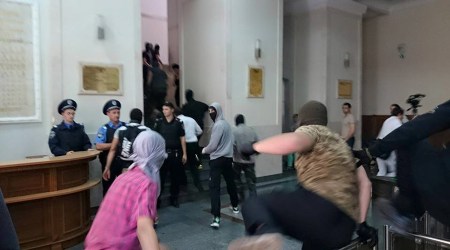
Around 200 masked men storm Kharkov city hall in Eastern Ukraine
© slava.mavrichev / Facebook
RT – September 23, 2015
At least 200 people wearing camouflage and masks stormed the local administration building in the city of Kharkov, eastern Ukraine, local media said. The perpetrators are alleged to be members of the radical Azov battalion.
The masked men reportedly clashed with police and security forces at the city’s administration building. Those who have entered the building have also reportedly used tear gas, the Ukrainian 112 channel is saying.
The masked activists were seen holding flags with the insignia of the radical Azov Battalion, which is accused of committing numerous human rights violations in Eastern Ukraine, according to international watchdogs.
“There have been several small clashes between police and people in balaclavas. A few minutes ago somebody let off tear gas. The entrance to the city council is surrounded by a tight police cordon,” a journalist at the scene, from the 112 channel reported.
Earlier, at least 50 people wearing camouflage and balaclavas had taken part in a protest in front of the residence of the local politician, Mikhail Dobkin, who represents the ‘Opposition Bloc’ political party, which wants to find a peaceful solution to the current crisis in Ukraine. The masked men had not set out any demands. However, they were reported to have stated their aim was to “to throw Dobkin out of the city and not to let Kernes become Kharkov’s mayor,” according to the 112 channel.
Gennady Kernes has been the mayor of Kharkov since March 2010. Before the coup in Ukraine, he had been a strong supporter of President Viktor Yanokovich. However, he subsequently switched sides and has backed the new Ukrainian government in order to keep his position.
UN Special Rapporteur On Torture Issues Sharply Critical Report On Ukraine
Introduction by New Cold War, September 21, 2015
Enclosed is the full report dated September 18, 2015 of Christof Heyns, who is the United Nations’ Special Rapporteur on Extrajudicial, Summary or Arbitrary Executions. His report is titled Ukraine: Lives lost in an accountability vacuum.

Christof Heyns, Special UN Rapporteur on Extrajudicial, Summary or Arbitrary Executions
Heyns conducted an official visit to Ukraine from September 8 to 18, 2015. He is a professor of human rights law in Pretoria, South Africa. In contrast to the most recent report of the United Nations Human Rights Monitoring Mission in Ukraine (HRMMU), released in early September, Heynes’ report provides the outline of a comprehensive overview of the human rights situation in Ukraine. The result is a rather damning portrait of the governing regime in Kyiv.
The HRMMU report earlier this month is a litany of ‘he said, she said’ anecdotal testimonials strung together in such a way as to leave the reader with the impression that human rights crimes are being perpetrated equally by both sides in the civil war in Ukraine. While Heyns borrows some of the same language, a reading of his report clearly shows that it is the Kyiv regime alone which is guilty of systematic and widespread human rights violations. The accusations cited by Heyns against the rebel regions of Donetsk and Lugansk may or may not be true, but they pale in numbers and scope compared to what Heyns documents on the Kyiv side.
Heyns says that the official investigations by Kyiv into the two large massacres which took place in Ukraine in 2014 are seriously failing. These are the investigations into the Sniper Massacres of Feb 18-20 at Maidan Square in Kyiv, which killed more than 100 police and protesters, and the arson attack in Odessa on May 2 in which at least 48 people perished.
Concerning the Snipers Massacre, there is no mention by Heyns of the video and other evidence being compiled and released by University of Ottawa researcher Ivan Katchanovski and others showing that sniper fire at Maidan Square was directed by extreme-right forces masquerading as part of the Maidan protest itself. But he does make a one-word reference acknowledging doubts about the official government line on events–that the Berkut police of the government overthrown several days later were responsible. That official line has been repeated near universally by Western governments and mainstream media. Heyns writes in his report, “I am concerned that more than 100 people were killed as a result of the firing, allegedly by Berkut and other law enforcement officers of live ammunition at participants. In addition, thirteen police officers were also reportedly killed.” The operative word here is “allegedly”.
Officials in the people’s republics of Donetsk and Lugansk did not meet with Heyns during his official visit. This is no doubt due to the biased record of the Office of the UN High Commissioner for Human Rights with which his office is associated. Concerning the Ukrainian side, Heyns concludes, “Many officials whom I met—particularly in the SBU [Security Service of Ukraine]—simply denied that there was any wrongdoing and pointed to the fact that there are laws in place that meet international standards. There is little hope for progress where this is the approach.”
Ukraine: Lives lost in an accountability vacuum
End of visit statement of the Special Rapporteur on Extrajudicial, Summary or Arbitrary Executions, Christof Heyns
Kyiv, Ukraine, 18 September 2015
- Introduction
- I have conducted an official country visit to Ukraine from 8-18 September 2015. I would like to thank the Government for extending the invitation to me to visit the country, as well as for the open and cooperative approach of the officials I met. I would also like to thank the United Nations Human Rights Monitoring Mission in Ukraine (HRMMU) for the invaluable support received in the preparations and conduct of my visit.
- The aim of the visit was to examine the level of protection of the right to life in Ukraine, as well as the efforts undertaken to prevent unlawful killings and ensure accountability justice and redress in such cases.
- During my visit, I had the opportunity to hold meetings here in Kyiv, as well as to travel to Zaporizhzhia, Mariupol, Donetsk, Kramatorsk, Kharkiv and Odessa.
- During the past two weeks I have held meetings with the Ministry of Foreign Affairs, the Ministry of Justice, the Ministry of Defence, the Ministry of Internal Affairs, the Office of the Military Prosecutor, the Security Service of Ukraine, the Headquarters of the Anti-Terrorism Operation, the National Security and Defence Council, the High Specialised Court on Civil and Criminal Cases, the Parliamentary Committee on Human Rights, and the Parliamentary Commissioner for Human Rights (Ombudsperson) including her National Preventive Mechanism (NPM). I met with regional administrations, and some regional departments or specialized units of relevant Ministries. I also met with the OSCE Special Monitoring Mission to Ukraine, the General Consulate of the Russian Federation in Odessa, and with other international and national monitors or non-governmental organisations, civil society, and families of victims.
- I also had the opportunity to cross the so-called “contact line” and travel to Donetsk, where I met with representatives of various monitoring missions, with representatives of the ‘Office of the commissioner for human rights’ (‘ombudsperson’) of the self-proclaimed ‘Donetsk people’s republic’ and with representatives of the ‘bar association’. I regret that, despite significant efforts on the part of the HRMMU to arrange meetings, no other officials of the self-proclaimed ‘Donetsk people’s republic’ would meet with me. I share HRMMU’s concern for the lack of accountability for the “grave human rights violations and abuses” that have reportedly taken place there since the beginning of the conflict, as I observed no progress in this regard during my stay. I was also able to visit some of the outskirts of the city of Donetsk, including the area surrounding the airport, and to see with my own eyes some of the extensive damage that has been caused, particularly to civilian infrastructure and domiciles, by heavy shelling.
- The armed violence that has been taking place in the eastern Donbas region of Ukraine since April of last year has taken a heavy toll on civilians and caused significant internal displacement. Like all other international observers I naturally welcome the renewed ceasefire commitment announced in late August and the fact that this has largely been observed since 1 September.
- I regret that I was unable to visit the Autonomous Republic of Crimea. I am aware of several allegations of serious violations of human rights in that territory, and I want to reiterate that in order to ensure the greater protection of all human rights, including the right to life, this area should be made accessible to international missions such as HRMMU. When I met with the consulate of the Russian Federation in Odessa I took the opportunity to underscore the need for such visits to take place.
- A detailed report on my findings and recommendations will be presented at the 32nd session of the United Nations Human Rights Council next year. The observations and recommendations presented today are preliminary and will be examined and developed further in the future report.
- Legal Framework
- The right to life is protected in Article 27 of the Constitution of Ukraine. Ukraine is a state party both to the International Covenant on Civil and Political Rights (ICCPR) and to the European Convention on Human Rights and Fundamental Freedoms (ECHR) which (in Articles 6 and 2 respectively) both protect the inalienable right to life. The ultimate responsibility for the protection of right to life in any country lies with its Government.
- Ukraine has many of the building blocks in place to secure the protection of human rights, including the right to life. At the same time the country is facing significant challenges: challenges which if not met in a comprehensive and incisive way threatens to place this goal out of reach.
- To a large extent the normative framework has been established: the laws are there, the treaties ratified. The problem lies with establishing a systematic and effective system and a culture of accountability for violations of those norms.
- In response to the violence in the East, the Government launched what it refers to as an “anti-terrorist operation” aimed at retaking control of the two regions. However, regardless of classification as anti-terrorism operation, the objective criteria of an armed conflict exist. Indeed, many of those officials I have spoken to have referred to the existence of a “war” in the eastern regions, and nobody in the Government disputes the fact that there is an armed conflict. There seem to be general consensus that both international humanitarian law and human rights law applies.
- Nonetheless, the framing of the conflict as an anti-terrorism operation has led to considerable confusion, both among observers and monitors and in some cases it seems among the participants themselves, about who within the Government is in control of this war? This may lead to uncertainty about responsibility.
- In addition, in June 2015 the Government of Ukraine informed the relevant institutions that it would derogate from certain State obligations under the ICCPR and the ECHR. The derogation is envisaged with respect to the right to liberty and security, fair trial, effective remedy, respect for private and family life and freedom of movement, and should be applied in certain districts of the Donetsk and Luhansk regions. The derogation thus includes certain rights (including effective remedy and procedural rights such as the supervision by judicial bodies of the lawfulness of detention) that the UN Human Rights Committee has interpreted as non-derogable. With respect to my mandate, I am particularly concerned that these elements of the derogation may create an environment in places of detention that may facilitate incommunicado or secret detention, torture, ill-treatment, executions and disappearances.
- I note that among the package of measures agreed in the Minsk Agreements is a proposal that there be a general amnesty by way of legislation forbidding prosecution or punishment of persons in relation to events that have taken place in the eastern Donbas region. While supportive of measures aimed at de-escalating tensions, I am concerned that such legislation could amount to fostering impunity for grave violations of human rights by all parties. Any amnesty devised should be interpreted in such a way as not to include immunity for at least international crimes, such as war crimes and crimes against humanity.
- Ukraine has committed to accepting the jurisdiction of the International Criminal Court, and signed the Rome Statute in 2000, but a technical constitutional impediment has delayed ratification. I understand that this impediment will be overcome in the proposed reform of the constitution, but in the meantime I welcome the fact that on 8 September the Government sent a declaration to the ICC Office of the Prosecutor under Article 12(3) of the Rome Statute, giving to the Court ad hoc jurisdiction “for the purpose of identifying, prosecuting and judging the perpetrators and accomplices of acts committed in the territory of Ukraine since 20 February 2014.” The Prosecutor of the ICC has confirmed that she will open a “preliminary examination” in order to establish whether the criteria for opening an investigation are met.
III. Securing the right to life in wider Ukraine
- In the context of assemblies
- A State’s conduct with respect to assemblies should flow from its responsibility to facilitate and to enable peaceful assemblies. It should be underlined that the right to life continues to apply during any assembly (whether peaceful or not) and that therefore there is no such thing as an unprotected assembly. There was agreement among those officials with whom I met that the principal role for the police within the context of assemblies was that of protecting citizens. In this connection it was pointed out that only in rare circumstances would police be sent carrying firearms to manage an assembly.
- I want briefly to elaborate on two examples where it appears that the State failed in its responsibilities with respect to large-scale assemblies, both emblematic cases within the current situation in Ukraine:
(i) Maidan Protest
- With respect to the use of force against protesters in the Maidan protest, most significantly between 18-20 February 2014, I am concerned that more than 100 people were killed as a result of the firing, allegedly by Berkut and other law enforcement officers of live ammunition at participants. In addition, thirteen police officers were also reportedly killed. As with any use of lethal force by police officers it is vital that there be a prompt, thorough, and impartial investigation into the events to establish that the use of force was both necessary and proportionate.
- In this connection, I am greatly concerned by the apparent shortcomings of the investigation into these events. While what process there is seems to be progressing very slowly, having reached court-level proceedings now in a very limited number of cases, there are more systemic failings. The escape of a principal suspect from house arrest, as well as the loss of a great deal of vital physical evidence are both issues that should themselves be independently investigated.
(ii) Events of 2 May in Odessa
- I have also had the opportunity to hear more about the events of 2 May 2014 in Odessa, where at least 48 people died as a result of clashes between rallies of opposing political opinion to which authorities appear to have reacted in an either deliberate, ill-prepared or negligent fashion. According to the accounts I received from people who were on the scene, the police held a low profile as the crisis was evolving and did not intervene to prevent or stop the violence at the Kulykove Pole square. The fire brigade, which is located very close to the Trade Unions building where many protestors burned to death, failed to respond for 45 minutes to urgent calls that they received. While both pro-unity and pro-federalism groups played a part in the escalation of violence on that day, the subsequent criminal prosecutions for hooliganism or public disorder appear to have been initiated against participants in a partial fashion.
- I am concerned by allegations of numerous failings in the official investigation into the events of that day. By allowing almost immediate access of the scene to ‘pro-unity’ protesters, members of the public or to municipal authorities, investigators lost a large proportion of potentially valuable forensic evidence. Meanwhile I am worried by indications that the Government has significantly reduced the size of the team investigating these events in the past year, before it has had an opportunity to report. The slow progress of the investigation and the lack of transparency with which it is being conducted have contributed to a great deal of public dissatisfaction and provided a fertile environment for rumour and misinformation. It is disconcerting that the Special Unit of the Ministry of Internal Affairs that investigates the 2 May events cancelled our appointment in Odessa at short notice, without any explanation.
- I am further concerned that administrative and personal impediments seem to have been imposed to prevent or at least discourage the families of those who died from obtaining the status of suffering or affected persons before the Courts. Meanwhile I am greatly alarmed by reports of the extent to which authorities are tolerating both verbal and physical intimidation both of families attending court proceedings and of the judges of those cases, not only outside the court building, but also inside it and in the court room itself.
- I welcome the support that the International Advisory Panel on Ukraine, established by the Secretary General of the Council of Europe, is providing to the Government in order to ensure that the investigations into both incidents are in line with the European Convention on Human Rights.
- In the context of detention
- Though issues concerning the treatment of detainees falls more squarely within the mandate of my colleague the Special Rapporteur on torture and cruel, inhuman or degrading treatment, violence or other threats to life within detention facilities can lead directly to deaths for which the State has a heightened responsibility. For this reason, wherever possible, I try also to visit places of detention on my country visits, so as to assess these threats firsthand.
- It seems that the Office of the Ombudsperson and the NPM created within it are relatively free to exercise their responsibilities to conduct unannounced visits both to pre-trial detention facilities (SIZO) and to penal colonies, and that this access provides an effective system of protection for the rights of those detained. Among the principle threats to life for detained persons in Ukraine are diseases such as TB and HIV. In the Donetsk region, for example, the rate of TB is allegedly 10 times higher in the prison population than in the general population. I welcome the partnership between the Penitentiary Service and the international NGO Médecins Sans Frontièrs which is aimed at providing specialised care to those detainees with TB.
- Detainees with whom I spoke had few complaints about conditions in the pre-trial detention facilities. However several made allegations of ill-treatment at earlier stages of their detention. There is a systematic pattern of complaints about ill-treatment at the hands of agents they identified to be members of the SBU, whom one interlocutor described as ‘untouchable’. I found it very difficult to establish from any officials the locations in which it is possible such abuses may have taken place, whether police temporary detention facilities (IVSs) or other sites. I could find no evidence of asystem of oversight that could effectively investigate any abuses that might (even infrequently) occur or protect detainees against them.
- Violence by armed militia groups
- While the majority of the “volunteer battalions” have from a military perspective now been incorporated into the formal structures of the Ukrainian Armed Forces, there remain a small number of potentially violent militia groups, such as the Right Sector, that act seemingly on their own authority, thanks to a high level of official tolerance, and with complete impunity.
- I am concerned by cases of bodily attacks on journalists or writers, including the cases of Oles Buzyna (who was killed in April 2015 in Kyiv) and that of Sergii Dolgov (who was arrested or disappeared in July 2014 in Mariupol by Azov Battalion).
- Some I met with expressed concerns that the lack of official mechanisms for combatants to be demobilised after fighting in the East may be contributing to this violent potential in wider Ukraine.
- Of particular concern is the extent to which these groups use violence or, more commonly, threats of violence, to exert pressure on persons holding dissenting views, the judicial system and on other mechanisms of accountability.
D Accountability for violations
- In many of the meetings I held with officials during my visit I tried to explore the mechanisms of accountability that exist in current or proposed legislation and how they should function. As noted above, I leave with the impression that in many instances the formal processes exist or will shortly exist, however I am concerned that—with the exception of the Office of the Ombudsperson and its NPM—these mechanisms are not being effectively used. Indeed, even the NPM, which appears to be achieving its objective as a preventive mechanism, cannot fully act as an accountability mechanism since it only make recommendations to the Office of the Prosecutor, which is not compelled to take up cases.
- Several practising lawyers with whom I met identified the reluctance of the Office of the Prosecutor, combined with the close relationship between the Prosecutor and the judicial authorities, as the principal impediment to pursuing allegations of ill-treatment on behalf of their clients.
- The right to life in eastern Donbas
- General observations on the conduct of hostilities
- As noted above, I welcome the fact that it seems that there have only been very limited violations of the ceasefire on either side of the “contact line” since 31 August. I hope that this ceasefire continues to hold and that it provides a space for more thorough-going de-escalation of the conflict.
- Over the past 18 months, however, the conflict has exacted a heavy human price. Last week the HRMMU released their latest report on the human rights situation in Ukraine, estimating that a total of nearly 8,000 have now been killed and more than 17,000 injured in the course of hostilities.
- The majority of these deaths have been caused by shelling, which it would appear on both sides has been taken place indiscriminately or with inadequate precautionary steps taken to protect civilians.
- I am also concerned by allegations that the conflict is being waged in part using inherently indiscriminate weapons such as cluster munitions and landmines, including anti-personnel mines. Ukraine is party to the Convention on the Prohibition of the Use, Stockpiling, Production and Transfer of Anti-Personnel Mines and on Their Destruction, which establishes an absolute prohibition to use anti-personnel mines “under any circumstances”. I also note with concern that Ukraine failed to fulfil its commitment to destruct all its stockpiled anti-personnel mines before 1 June 2010. According to its official reports, Ukraine still retains over 5 million anti-personnel mines.
- I am also concerned by the threat that unexploded ordnance (UXO) and other explosive remnants of war pose against civilian lives, particularly children. The HRMMU has already verified numerous civilian casualties as a result of UXO left in the battleground both in Government-controlled areas and in territories controlled by the armed groups. I would like to remind the Government of its obligations under the fifth Protocol to the Convention on Prohibitions or Restrictions on the Use of Certain Conventional Weapons, on Explosive Remnants of War. According to the Protocol, which Ukraine ratified in 2005, state parties have to mark and clear, remove or destroy, as soon as feasible, all explosive remnant of war in territories under their control. In case explosive ordnance used by Ukraine remains in territory outside of its control, the Government has the obligation to provide assistance and information to facilitate the marking, clearance removal or destruction of the ordnance by a third party. Throughout the hostilities, Ukrainian armed forces have the obligation to record and retain information on the use of explosive ordnance, in order to facilitate its clearance without delay after the cessation of hostilities.
- More generally I am worried by the extent to which reporting on the conflict is being instrumentalised by all parties using mechanisms which ought to be exercising an accountability function with respect to their own forces. Instead of responding to, investigating, or prosecuting cases of indiscriminate shelling by their own military forces, each side are dedicating their time to documenting in laudable detail the violations of the other side with a view to continuing their confrontation in the national or international courtroom.
- In areas controlled by the Government of Ukraine
(i) Indiscriminate shelling
- I am concerned that forces on the Government side are using weapons in the course of hostilities that are either inherently insufficiently precise to justify within the context of a highly urban and civilian-populated conflict zone, or that weapons with a known level of precision are being used outside or without regard to proper Standard Operating Procedures to guide targeting.
- Moreover I have not been convinced during my engagement with the relevant authorities that there is a proper investigation conducted when allegations of civilian casualties are brought to their attention. The answer that I got from some of the military authorities to the question when an investigation into allegations of excessive civilian casualties would be triggered, was that such a situation will never arise, because there was an order by the Minister of Defence that this should not happen. Such a denial that a problem could exist makes a solution veryvery difficult to achieve.
- While I understand the difficulties of conducting investigations in territory outside the control of the Government’s armed forces, such difficulties should not be understood, as suggested in many of the meetings I had, as a reason to reject any possibility to verify civilian casualties caused by shelling or to assess alleged violations of international humanitarian law. The conflict is currently being closely monitored by several international organizations, which publicly report the occurrence of civilian casualties on both sides of the “contact line”. Combined with Ukraine’s military records on the use of artillery, and the possibility to contact families of casualties, morgues, hospitals or other sources for verification, it would be possible for the Government to assess the damage caused by its use of artillery.
- Damage assessments conducted this way may not always amount to evidence solid enough to allow accountability for possible violations of international humanitarian law. However, credible estimations of civilian casualties would enable the armed forces to evaluate and strengthen precautionary measures taken to mitigate the impact of shelling among civilians.
(ii) Detention
- I have received several allegations of secret detention, in which individuals claim to have been detained for varying periods of time before being formally introduced to the penitentiary service. In some cases this initial detention takes place at the hands of officials thought to be of the SBU, in other cases such individuals have been apprehended by members of former volunteer battalions.
- One facility that is mentioned frequently in this regard is the military base at Mariupol airport. During my visit to Mariupol I attempted to conduct a pre-announced visit to this base, however I regret that, despite the advance notice, I was denied access to the facility. Other such detention facilities reportedly include the former detention facility (SIZO) of the SBU in Karkhiv, and the SBU office in Kramatorsk.
- The existence of unacknowledged, secret detention facilities almost completely undermines the effective work being conducted by the National Preventive Mechanism and the Office of the Ombudsperson. It is disappointing that judges and prosecutors, who are in many cases presented with quite clear prima facie cases of ill-treatment at the point that the detainee is presented formally to be remanded, do not respond more robustly to uphold the detainee’s rights. The impunity that exists for acts of violence in such conditions poses a clear and direct threat to the right to life.
(iii) Alleged summary killings
- I am concerned by reports of bodies discovered near Makiivka, in the Donetsk Region in September last year. While several of these bodies appear to be members of the armed groups who died in combat, some are reported to bear signs of having been executed after being detained by Government forces.
(iv) Integration of armed militias in command and control
- At the time of the start of the conflict, the Ukrainian Armed Forces were underprepared for the nature or scale of the challenge that would confront them. Not all of the regular forces, to say nothing of the volunteer battalions, had been properly trained in military warfare, let alone International Humanitarian Law standards that should regulate the conduct of hostilities.
- I want to underline questions concerning the responsibility for the actions of volunteer battalions, both now that the majority have been formally incorporated into the Ukrainian Armed Forces and during earlier stages of the conflict. Any extent to which the State is tolerating the existence of politically-motivated armed militias on its territory is a concern. The extent to which the State has been actively collaborating with those militias, in order to participate in joint military operations against a common enemy suggests that the State’s responsibility for the actions of the members of those groups may be even more direct.
- It seems that these “battalions” and groups operate in a climate of impunity, partly as a result of the pressure which they exercise on prosecutorial or judicial authorities if they attempt to pursue cases against members perceived by these groups of being “patriotic”.
(v) The impact of restrictions on movement on the right to life
- I am concerned by the potential (and in some cases realised) humanitarian impact of the limitations imposed by the government on free movement of people and goods in the Donbas region. The long queues which the resulting checkpoints inevitably entail have been the target of shelling. The extent to which the barriers impede the transfer of vital medical supplies to hospitals on the eastern side of the “contact line” also raises serious questions about its appropriateness.
- In areas not controlled by Ukrainian authorities
- As noted above, despite extensive efforts on the part of HRMMU, I was not able to meet with many representatives of the self-proclaimed ‘Donetsk people’s republic’ or self-proclaimed ‘Luhansk people’s republic’. This was extremely disappointing, given the number and gravity of allegations that have been made about the protection of human rights, including the right to life, in those territories.
(i) Indiscriminate shelling and the positioning of artillery in civilian areas
- Allegations have been made that the forces on the non-Government controlled side are deliberately positioning their artillery within close range of built-up civilian areas and occupying hospitals and schools, so as effectively to use civilians as a shield, or to entice government troops to cause civilian casualties and damage to civilian infrastructure, which can then be used for political purposes.
- The salience of this problem is demonstrated by the extent to which local populations have taken to the streets to protest it. For example, there are reports that protests were held to this effect in Donetsk on 15 and 16 June 2015. In situations where people are reportedly reluctant to express dissent, this speaks to the severity of the threat to life posed by the tactics of these armed groups.
(ii) Summary executions of detainees
- There are allegations of the killing of detainees held by fighters of the self-proclaimed Luhansk people’s republic in Sievierodonetsk, as they were retreating from the city in July 2014. While local police had remained in control of their headquarters on Partyzanski Avenue the fighters had taken over the police IVS next door. On the day of the retreat, police reported hearing shots fired from within the IVS at around 5a.m. Several hours later, after the Ukrainian forces had arrived, the police re-entered the IVS, and discovered and documented two corpses in separate cells, each shot either in the neck or in the head. The corpses also showed signs of beatings.
(iii) Allegations of quasi-judicial executions
- I have been alarmed by allegations of executions taking place in quasi-judicial circumstances. This has allegedly occurred both in the context of ‘military justice’ and in more civilian, ‘criminal justice’ context. For example, it is alleged that in May 2014 the ‘minister of defence’, Igor Strelkov (Ghirkin) sentenced to death by firing squad two local commanders for looting, armed robbery, kidnapping and desertion. It is not known whether they were executed.
- Summary executions may have been carried out under the pretext of criminal legal authority. In July 2014, when the Ukrainian Government regained control of Sloviansk, documents were found in the SBU building, which had been used as a detention facility by armed groups of the ‘Donetsk people´s republic’, that armed groups had given death sentences and carried out executions of at least three persons, reportedly based on legislation dating back to 1941.
- In August 2014, it was reported that the ‘Donetsk people’s republic’s’ de facto authorities had introduced a document that they referred to as the 1960 criminal code, which included provisions for imposing the death penalty for the ‘gravest crimes’. Lawyers I spoke with, however, stated that the ‘constitution’ of the DPR proclaimed the right to life and that the imposition of capital punishment as provided in the criminal code would thus be incompatible with it.
(iv) Threats against certain groups
- Amnesty International found strong signs of alleged drug dealers having been executed by forces of the self-proclaimed ‘Luhansk people’s republic’ in the area of Sievierodonetsk. Their commander Oleksii Mozhovyi had publicly threatened anyone involved in drug trafficking on 3 June. On 13 June, the police found three bodies of persons they identified as suspected drug dealers.
- In May and July 2014, there were reports of summary executions by self-proclaimed ‘Luhansk people´s republic’ forces in the area of Sievierodonetsk, Rubizhne and Lysychansk, in the Luhansk Region.
(vi) Targeting of those hors de combat
- As reported by the HRMMU, on 19 August, part of the town of Ilovaisk came under the control of Ukrainian armed forces. By 27 August, the Ukrainian troops in Ilovaisk were surrounded by the armed groups of the self-proclaimed ‘Donetsk people´s republic’. The same day, a safe corridor was negotiated for Ukrainian forces to leave Ilovaisk. However, at least one column of Ukrainian troops was heavily shelled while leaving Ilovaisk. Between 107 and more than 200 Ukrainian servicemen were killed, many of which were wounded soldiers being evacuated.
- In January 2015, following the shelling of a bus station in which several people were killed, Oleksandr Zakharchenko, leader of the self-proclaimed Donetsk people’s republic, made a statement on television announcing that his troops would give no quarter, and take no soldiers of the Ukrainian forces as prisoner. Making such a statement is a war crime. However, available evidence does not seem to indicate that this statement was implemented.
- Also in January, Ukrainian soldier Ihor Branovytskyi was allegedly summarily executed while in captivity of the armed groups of the ‘Donetsk people’s republic’. Branovytskyi was among a group of 12 soldiers captured and taken to the base used by the so-called ‘Sparta battalion’ and severely beaten. When Mr Branovytskyi collapsed and fainted he was reportedly executed by the battalion commander Arsenii Pavlov (‘Motorola’). During my meeting with the Office of the commissioner for human rights’ of the ‘Donetsk people’s republic’ the ‘deputy ombudsman’ agreed to investigate this case.
(vii) Downing of Malaysian Airlines flight MH17
- On 17 July 2014, the downing of Malaysian Airlines flight MH17 caused the death of 298 persons, becoming one of the most tragic events in the ongoing conflict. Despite initial difficulties to secure access to the site, international investigators now led by the Dutch Safety Board are expected to issue their final report in October. I welcome the progress achieved by the investigating team so far, and hope that the outcome of their work will serve as basis for accountability and provide relief to the families of victims.
- Conclusions
- The challenges faced by Ukrainian society are real. There are fundamental divisions about its geopolitical orientation which affect national identities. A brutal armed conflict with strong international dimensions is playing itself out on its territory. Twice during the last two years the country has seen massive demonstrations deteriorating into bloodshed on the streets. There is not an established tradition of accountability for violations of the right to life or other human rights on which to draw. The current conflict seems to have exacerbated structural weaknesses.
- Long term security will depend on the extent to which a fully functioning human rights protection system which guides the actions of all members of the society is established. The approach that I saw too often during my mission in Ukraine is that when asked about human rights protection one side immediately invokes the transgressions of the other. Human rights are treated as an instrument with which to assail the opponent; not as a shared system of accountability.
- The sad truth is that serious violations occur at one point or another in all societies. The Ukraine is no exception, and in some respects it faces unique challenges. The real question is how does one deal with the violations that occur. Many officials whom I met—particularly in the SBU—simply denied that there was any wrongdoing and pointed to the fact that there are laws in place that meet international standards. There is little hope for progress where this is the approach.
- I was however heartened by the admission of a senior official whom I met during the mission who commented: ‘Things do not always go as we want them to go’. Being realistic and open about the fact that there are violations is the first step towards addressing them. The second—and decisive—step is to create and utilise mechanisms of accountability to address those violations.
VII. Preliminary Recommendations
- Efforts by all parties to end the armed conflict in the Eastern part of the country should be renewed. The cease-fire should be observed and monitored. As long as hostilities continue, all parties must take concrete measures to reduce civilian casualties, and adhere strictly to the IHL requirements of distinction, proportionality and precaution in attack.
- Proper internal measures of reporting on exchanges of fire should be established. Targeting should follow international standards, and be adjusted based on regular assessments of its impact. Allegations of breaches of international humanitarian law must be investigated.
- It is of great importance to move the conflict out of built-up areas. All parties to the conflict should refrain from using weapons that do not allow sufficient precision in this context.
- The Government of Ukraine should take steps to ratify the 2008 Convention on Cluster Munitions. In their public statements on the use of such weapons by the opposing armed groups, the Government has added weight to the idea of an emerging norm against the use of cluster munitions under any circumstances. All parties to the conflict should immediately desist from the use of such weapons, which are inherently indiscriminate.
- All remaining volunteer militia groups must be disbanded and disarmed.
- The events at Ilovaisk in August 2014 must be investigated and any perpetrators be brought to justice.
- A system of independent overview of the conduct of all those who perform law enforcement functions must be established, focussing in particular on allegations of ill-treatment by the SBU. This mechanism should be empowered to conduct investigations into suspected informal detention facilities, including comprehensive power of search within military or SBU facilities.
- The investigations into the events at Maidan in February 2014 and the 2 May events of the same year at Odessa must be completed as a matter of priority and accountability for losses of life must be established. The systemic failures that contributed to the eventual losses of life—such as the low profile of the police and the delayed response of the fire brigade in Odessa—should also be investigated and where appropriate rectified.
- The difficult situation of the families of those who lost their lives should be acknowledged by the Government. Their safety, physical and psychological well-being, dignity and privacy must be protected, and they must be promptly informed of progress in the investigations. Public officials must treat them with respect at all times.
- The killing of Oles Buzyna and the disappearance of Sergii Dolgov must be investigated.
- The Government of Ukraine should consider inviting official country visits from the Special Rapporteur on torture and other cruel, inhuman and degrading treatment, the Special Rapporteur on the promotion and protection of human rights while countering terrorism, the Working Group on Arbitrary Detention, the Working Group on Enforced or Involuntary Disappearances, the Working Group on the use of mercenaries as a means of violating human rights and impeding the exercise of the right of peoples to self-determination, and the Special Rapporteur on the Independence of Judges and Lawyers.
- The reservations to the ICCPR and the ECHR must be reconsidered on a regular basis.
- The office of the Ombudsperson must be strengthened.
- The human rights situation in Crimea must remain under the scrutiny of inter alia international monitoring bodies. The governments who control access to the territory—Ukraine and the Russian Federation—must grant full access to such monitors. However, even without such access the monitoring must continue.
- Judges and other officers of the court must be protected against intimidation.
‘I’m a Trade Unionist, Not a Terrorist’: UK in Workers’ Union Spying Row
Sputnik – 22.09.2015
The British government, along with large multinational corporations, are trying to wash away the rights of workers and create a culture of fear among the country’s workforce through a series of systematic spying and blacklisting campaigns, a former blacklisted worker has told Sputnik.
As the government tries to usher through a new Trade Union Bill, described by critics as one of the most oppressive in the Western world, multinational corporations have been accused of taking part in extensive spying and intimidation tactics aimed at effectively locking vocal workers’ rights campaigners out of their professions.
The controversial bill has drawn the ire of trade unionists all over the country, with officials particularly angered by proposals which would require 50 percent of members to vote in favor of taking strike action for an event to be considered legal.
There are also fears that fines of up to £20,000 may be issued for unions whose members don’t wear identifying armbands during pickets.
Conservative business secretary Sajid Javid said the proposals would stop workers making “endless threats” at the expense of “hardworking people,” while union officials have seen it as an attack on trade unions and workers’ rights.
“The Tory government at the moment are trying to introduce the new Trade Union Bill, which even some Conservative MPs have said is the most restrictive legislation for trade unions in the whole of western Europe,” Dave Smith, former trade union representative and member of the Blacklist Support Group told Sputnik.
“The British government is never neutral when it comes to disputes between trade unions — it’s always on the side of big business.”
Some aspects of the Conservative’s bill even raised eyebrows with Tory MP David Davis saying some of the aspects resembled oppressive measures implemented by former Spanish dictator Francisco Franco.
“I agree with most of the Trade Union Bill. I think it’s very sensible… but there are bits of it which look OTT, like requiring pickets to give their names to the police force,” Davis told the Guardian.
“What is this? This isn’t Franco’s Britain, this is Queen Elizabeth II’s Britain.”
‘Spying and Blacklisting Still in Practice’
On top of the government proposals for trade unions, Dave Smith raised concerns over historical spying and intimidation tactics, which over the years has seen many trade union representatives placed on a blacklist, shared and used by multinational corporations to effectively lock some workers out of employment.
It was also revealed that undercover police units took part in spying and intelligence, gathering exercises on a number of unions and various members over the space of 40 years in order to identify leading figures in the movement and place them on employment blacklists.
While officially such practices are illegal, Dave Smith told Sputnik that he believes “there is no question about it whatsoever” that spying and blacklisting is still going on.
“They [large companies] were lying to everyone and lying to parliament for forty years, so why should we believe them now?”
Mr Smith, who is the co-author of the book, ‘Blacklisted: the Secret War between Big Business and Union Activists’, said he was first placed on a blacklist in the early nineties merely for campaigning over unpaid wage disputes and raising health and safety concerns in the construction industry.
“People got added to the list for doing fairly standard trade union activities — standing up for workers’ rights, standing up for unpaid wages, standing up for safety. That’s why I got on it,” Smith said.
“What they used to do, is as well as keeping files on you, every time you applied to work on a big building site, the big multinationals would check to see if your name was listed or not. And if you were on the black list you were just sacked or you weren’t offered a job.”
Despite being a qualified engineer, Smith said he was eventually forced to change professions to help pay his mortgage, because he couldn’t manage to find employment, even during the UK’s building boom of the late ’90s — early 2000s.
Blacklisting ‘Systematic’
He said the practice of placing some workers on an industry blacklist was endemic in Britain, and affected thousands of workers over the years — in some cases, ruining people’s lives.
“I’ve seen people whose blacklist files have got entries from the 1960s. This isn’t just one or two rogue managers having a quiet word with each other in a pub spreading a bit of gossip about you — this is systematic.”
“This is [a case of] directors of a multinational company keeping files on people and deliberately stopping people from getting work because of their trade union activities. I’m not a terrorist, I’m not a criminal — I’m a trade unionist. They’re deliberately stopping us because they don’t want trade union activists on their building sites.”
Mr Smith said that such practices, which he believes are to a degree still in operation today, created an environment of fear, where workers are now hesitant to stand up for their rights amid attacks from David Cameron’s Conservatives.
“The whole purpose was not only to victimize the activists but to discourage anyone else from standing up for their rights as well. It’s to scare everybody else and create that climate of fear.”
Facebook snoops on people just like NSA – Belgian watchdog to court
RT | September 21, 2015
Facebook is spying on people in “the very same way” that the US’s National Security Agency (NSA) does, said the Belgian data protection watchdog at a court hearing where the social network stands accused of violating the privacy of internet users.
“When it became known that the NSA was spying on people all around the world, everybody was upset. This actor [Facebook] is doing the very same thing, albeit in a different way,” said Frederic Debussere, a lawyer representing the Belgian privacy commission (BPC) at the Monday court hearing.
The Belgian watchdog has filed a lawsuit against the social network, accusing it of breaching EU law and violating the privacy rights of internet users. The BPC issued a report in March, arguing that Facebook tracked everyone, even users who had logged-out and people who don’t even have a Facebook account at all, via the use of cookies and the ‘like’ or ‘share’ buttons which can be found on more than 13 million websites worldwide.
This is possible, the report claimed, because the cookies are automatically installed on the computers of internet users each time they visit a page containing a Facebook plug-in, such as the ‘like’ button.
According to EU law, websites must ask for a user’s permission before installing any cookies. This is why Facebook’s policy is considered to in “violation of the European law” by the BPC.
The BPC is now threatening Facebook with a daily fine of €250,000 ($280,213).
“Don’t be intimidated by Facebook. They will argue our demands cannot be implemented in Belgium alone. Our demands can be perfectly implemented just in this country,” said Frederic Debussere, addressing the court.
Facebook has consistently denied all accusations and claimed that its practices are in compliance with EU law, accusing the BPC of presenting false reports.
“We will show the court how this technology protects people from spam, malware, and other attacks, that our practices are consistent with EU law and with those of the most popular Belgian websites,” a Facebook spokesperson said, as quoted by the Guardian.
Addressing questions about the company’s cookie policy, another Facebook representative, Paul Lefebvre, said that “they allow Facebook Ireland to identify bad faith attempts to gain access via the browser being used,” adding that if Belgium imposed a ban on this Facebook activity, the country “would become a cradle for cyber terrorism.”
Additionally, Facebook rejects the very idea it could be held accountable in Belgium as the company’s European headquarters are located in Dublin, Ireland, and its activities watched over by that country’s data protection authority.
The company does not rule out returning to talks with the BPC.
The case is now being closely watched by the rest of the EU’s 28 privacy watchdogs, including that of Holland, which has also started to question Facebook’s activities and privacy policy.
READ MORE:
Facebook ‘breaks EU laws’ tracking all visitors, even non-users – report
Fact: Facebook tracks non-users – says ‘fix already underway’
‘No respect for users, no precise answers:’ Facebook privacy policies slammed by Belgian watchdog
Chicago police spied on survivor of Chicago police shooting, Black political groups
PrivacySOS | September 20, 2015
Between November 2014 and January 2015, the Chicago Police Department monitored the First Amendment protected speech and political activity of dozens of groups and individuals, among them a victim of a Chicago police shooting, according to newly released documents.
Chicago based activist Freddy Martinez released the records after obtaining them through a public records request under the Illinois open government law. Among the groups monitored by CPD were:
Chicago Cop Watch, Let Us Breathe, Hands Up United, Occupy Chicago, We Charge Genocide, the Revolutionary Communist Party, Justice for Roshad, Black Youth Group, the Black is Back Coalition, the New Black Panther Party, and many others.
Among the individuals monitored were Corey Harris, who was shot by Chicago police, and anyone identifying as an activist or anarchist on social media.
The monitoring occurred during a period of intense agitation nationwide surrounding a Missouri grand jury’s finding that Officer Darren Wilson should not be tried for his killing of young Black Ferguson resident Mike Brown.
Freddy Martinez, the activist who obtained the records, told me:
“The resources of the government would be better served addressing the deep issues that BLM is highlighting. However the priority seem to be to criminalizing dissent and tracking activists through “fusion center” sharing of intelligence. It’s extremely important for groups to understand that this is the level of surveillance they will face when organizing against a racist police structure because we do have to organize.”
The document listing the protests, groups, and individuals monitored by the Chicago police during this time period is called a First Amendment Worksheet. Officers must fill out these forms when they intend to monitor protected speech or associational activities. The form disclosed to Martinez is an order to terminate the surveillance. Martinez told me that the initial authorization to conduct form was probably written outside the time period for which he requested records. It would be useful to see that document to understand exactly why the Chicago police, in its own mind, viewed these Black organizing initiatives with such apprehension and apparent fear.
Late last year, Chicago police used a controversial stingray device to track protesters’ cell phones. Earlier this year, records revealed that CPD officers were picking through the trash of opponents to the Chicago Olympic bid.
MI5 Paying British Muslims ‘Decent Money’ to Spy on Mosques
Sputnik – 21.09.2015
Britain’s intelligence agency is paying Muslims to spy on people living in their own community to try and avert terrorist attacks from homegrown Islamist extremists, the Guardian has revealed.
An anonymous source told the newspaper that MI5 is employing people across the UK in Muslim communities on temporary contracts to gather intelligence on specific targets attending the same mosque. The source also stated that they knew of one Muslim informant who had been paid £2,000 by the security services to spy on a specific mosque for six weeks.
“It’s been driven by the [intelligence] agencies, it’s a network of human resources across the country engaged to effectively spy on specific targets. It’s decent money.”
But MI5’s method of paying money to Muslims to spy on people in their own communities has come under criticism. Salman Farsi, spokesman for the UK’s largest mosque in East London suggested that the offer of money could corrupt the intelligence:
“If there’s money on the table, where’s the scrutiny or the oversight to ensure whether someone has not just come up with some fabricated information? Money can corrupt.”
Following the terror attack in London in 2007, the government spent millions on its ‘Prevent’ program to counter radicalization — but eight years later it has been accused of failing to prevent terrorism and radicalization, instead alienating Muslim communities in the UK further.
According to the Islamic Human Rights Commission: “The Prevent regime of attempting to stop young Muslims from being radicalized is not working and is simply alienating Muslims in Britain by serving as a cover for intelligence gathering on the community.”
But with around 650 young men, women and children who have fled the UK to join ISIL militants in Iraq and Syria and 3,000 radicalized terrorists being monitored by the MI5 — it appears that the British government’s approach to preventing terror isn’t working — and could be the reason behind this new push for for more powers.
The UK government and intelligence agency MI5, however, appear to agree on one thing — big Internet and social media companies should do more to help the authorities by reporting suspect users and sharing swathes of encrypted data with intelligence officers.
In what seems to be another round in the public relations exercise pushing for more support for the government’s Communications Data Bill or Snooper’s Charter, as it is also known, the head of the MI5 told British media that Internet and social media companies should inform the authorities if any users are a cause for concern.
“Some of the social media companies operate arrangements for their own purposes under their codes of practice which cause them to close accounts.”
Andrew Parker also wants the companies to pass on those account details to the intelligence agencies.
The Snooper’s Charter, would grant police and intelligence services more power to intercept and monitor almost every channel of terrorist communication online and offline. It could also force Internet companies to hand over users’ private data.
UK Home Secretary Theresa May is seeking support from Internet and telecoms companies for the controversial surveillance bill, whilst the head of MI5 publicly calls for more powers to monitor potential threats amid revelations his officers are paying Muslim informants ‘decent money’ to spy on their own mosques.
Featured Video

Seyed M. Marandi: US-Iran War Inevitable: Kuwait and Bahrain May Fall
or go to
Aletho News Archives – Video-Images
From the Archives
Oil and the Israel Lobby
Reknowned economist M. Shahid Alam offers this excellent critique of Noam Chomsky’s defective analysis of the relative influence of Oil versus the Israel lobby over US foreign policy: … continue
Blog Roll
 Aletho News
- ICC ignored ‘very well-documented’ NATO crimes – ex-Libyan minister
- SNSC secretary dismisses US response to Iran’s conditions as ‘inadequate’
- Sanaa says Taiz roads open, secure for residents, warns Saudi forces
- Iraqi resistance group urges Saudi leadership to admit defeat, lift Yemen siege
- Trump’s Retreat: How Al-Aqsa Flood Took Down the US Empire
- Israel’s Military Actions in Lebanon Grossly Violate International Law — Lavrov
- Seyed M. Marandi: US-Iran War Inevitable: Kuwait and Bahrain May Fall
- Leaders Condemn Ansarallah Attack on Saudi Arabia While Ignoring Illegal War Against Yemen
- Leaked: Britain’s Covert Iraqi Psyops Network
- Yemeni Armed Forces Warn Airlines Against Using Saudi Airports, Exempt Mecca and Medina
- If Americans Knew
- Gaza: Ceasefire Anniversary Marks Year of Failed Promises
- The American Conservative: Mike Huckabee Should Resign
- A C-Section in Shackles: A Palestinian Woman’s Harrowing Birth in Israeli Detention
- ‘He’s Desperate’: AIPAC Begins Spending Against Abdul El-Sayed to Boost Mike Rogers:
- Trump, Hormuz, and the Looming Economic Catastrophe
- For three years, Israel has killed a child in Gaza every 71 minutes – Daily Update
- Israeli forces kill another child in Gaza – Daily Update
- Gaza ceasefire exists in name only, say more than 100 organizations
- Nearly 2 Million in Gaza Need Urgent Shelter Assistance as Winter Looms: IOM Chief Warns
- Suppressing Palestinian resistance: US charity under fire for AI monitoring of Gaza classrooms
- No Tricks Zone
- Germany’s Green Energy Debacle: High Energy Costs Force Kahla Porzellan to Close After 182 Years!
- New Study: 50 Years Of The Most Aggressive ‘Net Zero’ Policies Can Only Affect The Global Climate By 0.03°C
- US September “Heat” Was No Record…Many Records Set Decades Ago
- Latest European Green Energy Debacle; Portugal’s Largest Flagship Solar Park Insolvent!
- Green Energy Debacle: German Expert Professor Fritz Vahrenholt Warns Of Severe Economic And Social Consequences
- Two More Paleo Reconstructions Affirm Meters-Higher Sea Levels Across Ireland, Brazil 7000-6000 Years Ago
- New Study: Earth And Venus Surface Warmth Largely Explained By Convection And Lapse Rate, Not CO2 Or Radiation
- 2025 Nature Paper Claiming Worsening Global Drought Gets RETRACTED …Heavily Flawed
- New Study: ‘Global Drought Shows No Detectable Recent Acceleration Under Climate Warming’
- Economic Masterminds: German Socialists Suggest Taxing Productivity Gains Stemming From Using AI

