In politics as in war, advantage is not enough
By Greg Felton | April 28, 2015
Near the outset of the U.S. Civil War, President Abraham Lincoln made Maj.–Gen. George McClellan General-in-Chief of the Union Amy. McClellan was highly popular among his men and a great organizer who built the Army of the Potomac into a formidable force. Unfortunately for Lincoln, McClellan the meticulous organizer lacked the courage and judgment to be a field commander.
On April 5, 1862, Lincoln ordered McClellan to attack a Confederate force in Yorktown, Va. He had at his disposal 121,500 troops, 44 batteries of artillery and prodigious logistical support. The Confederate contingent in Yorktown, meanwhile, comprised something on the order of 10,000 men. The battle was a rout waiting to happen. It never did. McClellan told Lincoln the enemy was 100,000 strong and refused to attack. This delusion was partly due to Gen. John B. Magruder’s crafty parading of his Confederate soldiers in a circuit to give the illusion of greater numbers and his ordering of logs to be painted black to resemble cannons.
McClellan knew that intelligence estimates of Confederate strength were laughable exaggerations yet he acted as if they were true. Instead of attacking, he chose the do-nothing option of laying siege to Yorktown. In early May, Magruder and the Confederates slipped out to fight another day, leaving McClellan to enter an empty town. He declared victory. The last straw for Lincoln was McClellan’s repeated refusal to hasten after Gen. Robert E. Lee’s retreating army after the Battle of Antietam. On Nov. 5, 1862, Lincoln relieved him of command.
McClellan was an administrator who proved to be more of a coward than a commander, notwithstanding the Washington Post’s risible attempt to rehabilitate him. There may be a lesson here for a certain Canadian leader, one who finds himself at the head of a large force in the run up to a political war.
Two years ago this month, Justin Trudeau was anointed leader of the Liberal Party of Canada, a decision that gave hope to Canadians that somebody might finally put the brakes on Stephen Harper’s totalitarianism.
For one thing, Trudeau has a good pedigree. His father, Pierre Elliot Trudeau, was a respected if not wholly popular prime minister, though his reputation has much improved since his death. Trudeau’s Liberal predecessors, Stéphane Dion and Michael Ignatieff, were, respectively, too bland and too aloof to generate any deep support among the party faithful or offer a viable governing alternative. When you add good looks and youth (41), Justin Trudeau appears to be the ideal prime-minister-in-waiting, especially for young voters.
Opinion polls in the month following Trudeau’s election seemed to confirm that a reversion to Liberal rule was highly likely if not inevitable. In May 2013, voter support for the Liberals had more than doubled since the end of the 2011 election, whereas support for the Harperites had fallen by a third. Some of that Liberal growth even came at the expense of the centre-left New Democratic Party, which lost more than 20% support. Had an election been called at this time, the Liberals would have coasted to majority rule. What a difference two years makes.
By April this year, the Liberals had fallen from 38.6% to 27.6%, and Harper, of all people, was the major beneficiary! The NDP, contrary to expectation, not only did not benefit from Trudeau’s slip but lost ground, confirming that its leader, Thomas Mulcair, is not perceived as a serious rival to Trudeau.
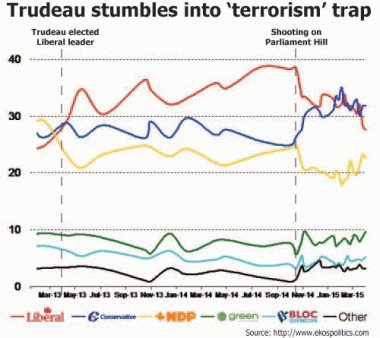 Like McClellan, Trudeau is highly popular. His victory came on the first ballot with 80% of the vote, and Liberal membership grew rapidly almost immediately. Trudeau’s popular appeal really took off in January 2014 and ballooned over the spring and summer.
Then, in mid-October, it all went south. The seminal event was the Oct. 22 shooting of Cpl. Nathan Cirillo, a ceremonial guard on duty on Parliament Hill. It was a bizarre incident, not only because it came out of nowhere, but it received conspicuously comprehensive video coverage. Some of this coverage even managed to catch no fewer than four police cars parked near the site on Parliament Hill with officers standing around as if… waiting for something to happen.
As readers already know, the shooting of Cpl. Cirillo gave Harper the excuse he needed to legislate police-state repression and a host of other unconstitutional measures in the name of “public safety.”
This police-state repression is manifested in Harper’s Protection of Canada from Terrorists Act (Bill C-44) and Security of Canada Information Sharing Act (“Secret Police Act,” Bill C-51) which authorize the state to conduct spying, harassment, arbitrary detention and intimidation and other unconstitutional measures. The main targets are not so much “terrorists” as anyone who criticizes the government, people like environmentalists and Muslim charities. These groups are already subject to malicious audits and have been intimidated into repressing their political activism.
Canada’s McClellan fails test of character
The shooting of Cpl. Cirillo gave Trudeau the perfect opportunity to seize the initiative from Mulcair and the NDP, who represent the Confederacy for analytical purposes: He could condemn the shooting and condemn the Harperites for their conspicuously contrived campaign to demonize the shooter, Michael Zehaf Bibeau, as a terrorist. Moreover, he could call attention to the totalitarian overtones of the shooting and its aftermath.
On the day of the shooting, Trudeau did deliver a speech, but it was stiff and peppered with “values” blathering reminiscent of George W. Bush’s post-Sept. 11 screed. Nevertheless, it had one redeeming virtue—he did not demonize Zehaf Bibeau: “Criminals cannot and will not dictate to us how we act as a nation, how we govern ourselves or how we treat each other. They cannot and will not dictate our values. And they do not get to decide how we use our shared public spaces.”
For his part, Mulcair also steered clear of the terrorism tar pit. On Oct. 29, he also used “criminal” to describe Zehaf Bibeau: “When you look at the history of the individual involved, you see a criminal act, of course. But… I think that we’re not in the presence of a terrorist act in the sense that we would understand it.”
At this point, Mulcair and Trudeau were on the same page regarding the shooting, but Trudeau had a big advantage. His Liberals are far and away richer and more populous than Mulcair’s NDP, and he can tap into overwhelming national hatred for Harper and his anti-terrorism totalitarianism to outmaneuver Mulcair. Since the Bill was announced, Harper’s terrorism smokescreen has lifted and opposition to state totalitarianism tripled in six weeks. Even key business leaders oppose it. All Trudeau had to do was channel this sentiment to become the people’s choice to restore Canada to parliamentary rule.
As expected, Harper and his minions jumped all over Mulcair for daring to be rational, but so did Trudeau! “The RCMP was clear, these were acts of terrorism, [so] these were acts of terrorism,” he said. Instead of lambasting Bill C-51 as unconstitutional and fascist, he tapped into his inner McClellan to adopt the do-nothing approach of proposing amendments that he knew full well would never pass. From a position of strength, Trudeau allowed himself to be outmaneuvered by both Harper and Mulcair thereby placing himself at odds with the electorate and his own party.
Trudeau’s abrupt about-face, and his attack on Mulcair for agreeing with him, makes no sense politically or morally. He does not allow for the possibility that the RCMP might lie, or that it might have abetted the shooting in some way. Currently, Parliament Hill has its own police force, which is loyal to Parliament; Harper wants it replaced by the RCMP, which is loyal to him. The RCMP has even admitted to being party to a smear campaign against former Liberal finance minister Ralph Goodale that helped Harper win his first election. Is it too much of a stretch to suggest that the RCMP came to Harper’s aid again? At any rate, Trudeau had no business taking the RCMP’s judgment on what is or is not “terrorism” at face value.
His uncritical acceptance of the RCMP’s version of events is also disturbing because it raises the possibility that he might have succumbed to political coercion. If so, one of the likely suspects is the Israel Lobby, which has the most to gain from the destruction of Canada’s civil liberties. This view gains credence from Trudeau’s knee-jerk condemnation of the Boycott Divestment and Sanctions campaign, which seeks to isolate Israel politically and economically because of the atrocities it commits in the Middle East. Trudeau claims (wrongly) that the BDS movement, like Israeli Apartheid Week, has no place on Canadian campuses, but this is just standard Lobby propaganda.
Since Trudeau wants to return the Liberals to power, he might have thought it less risky to acquiesce in attacks on Canadians’ constitutional rights than risk offending those who control vast amounts of campaign money and influence. After all, since Harper’s primary loyalty is to Israel, an attack on Harper’s secret-police bill might be construed as an attack on the Lobby. The problem with this scenario, though, is that it is utterly self-defeating—at least half the country and two thirds of Trudeau’s own MPs oppose Bill C-51. Why would Trudeau pick an unnecessary fight with his own party and the voting public unless he lacked the character and confidence to do the right thing?
In the end, Trudeau, like McClellan, succumbed to cowardice. Despite having a decisive advantage over his opponent and Harper set up like a clay pigeon, the expected rout never happened. Instead, Trudeau resorted to timid half-measures and abdicated the role of national saviour-in-waiting to Mulcair. Today, Mulcair and Green Party leader Elizabeth May are the only two national leaders willing to stand up to Harper to defend the Constitution and rule of law. In fact, Green Party support rose by more than 150% over this same period.
Short of a shock caucus revolt, which is distinctly unlikely in an election year, the Liberals are stuck with a McClellan at a time when they need a Ulysses S. Grant.
The Central Role of Israel in the U.S. State Religion
By Gary Leupp | Dissident Voice | April 28, 2015
The national secular religion of this country consists of a cluster of rarely questioned premises, usually inculcated in childhood, comparable to the articles of a real religious creed.
The first proposition is the idea that we live in a “free” country, as symbolized by the Statue of Liberty idol that towers over New York City’s harbor. The system absolutely insists on this point, incessantly hammering it in. It’s its basic tenet. Indeed it’s presented as “self-evident.” You’re in this country, ergo, you are FREE.
It’s inflicted by osmosis. Every institution transmits it. Those who doubt it are encouraged to think they must be mentally ill. (Of course you’re free, you’re told. And so fortunate to be so! How can anyone question that?)
“Freedom” is emblazoned on our coinage and many state automobile licenses. It’s proclaimed each school day morning by tens of millions of otherwise innocent children obliged to recite religiously that they live in a nation “with liberty and justice for all.”
This particular component of the national creed is perhaps comparable to the opening article of the Apostles’ Creed, which alludes to belief in “God the Father Almighty.” Because belief in the U.S.A. as the global headquarters of “Freedom” is as central to what some call “Americanism” as monotheism is to Christianity.
The Pledge of Allegiance expresses the belief, not just in the goodness of “freedom” in itself, but in the idea that we actually live in a free country. (How often people protest, when someone criticizes their thoughts or behavior, “Well hey, it’s a free country!” And they usually truly believe this.)
“I’m proud to be an American,” country crooner Lee Greenwood boasts, “where at least I know I’m free.” He knows this, without any religious doubt. “Cause the flag still stands for freedom, and they can’t take that away.” (Whoever they are. Presumably people who “hate our freedoms” and are actively conspiring somewhere to invade and enslave us.)
Actually, I suspect that the people of Sweden or Denmark are freer than Lee Greenwood is, or imagines himself to be. But do they know they’re free, with the confidence he exudes?
The second article of the national creed is that the U.S. military (commonly referred to as “our troops”)–wherever and whenever they fight–fight for us, somehow, to “defend our freedoms.” Whenever you attend a ball game (as I do regularly in Fenway Park) you’re told that everyone in the stadium is proud to honor the “servicemen and servicewomen” present–the “heroes” who are “defending our freedoms” in Afghanistan, Iraq, or wherever. We’re expected to applaud them, even in liberal Boston, and indicate our gratitude for whatever it is they did. And if we read in the morning Boston Globe about these heroes killing civilians we should just put it out of mind.
The ball park MC never considers the possibility that there are Red Sox fans there just for the game, who do not see how U.S. troops’ actions in invaded countries defend their freedoms in any way, and who find this insertion of patriotic content into the program really annoying.
Still the crowd rises to its feet on demand, showing deference, accepting the adulation of the troops as a matter of faith. If you just sit there sullenly, refusing to participate, some drunken patriot might hassle you for your traitorous non-enthusiasm. So in this free country it’s best to just stand up to honor the troops and try to maintain your self-respect by being as nonchalant as possible.
Every cable news viewer has seen that endlessly repeated USAA Military Auto Insurance TV commercial, “Thank you Dad.”
“Thank you, Daddy, for defending our country,” says the cute little Latina girl, in one version.
“Thank you for your sacrifice, and thank you for your bravery,” says an African-American women, to her spouse perhaps.
“Thank you, colonel,” says the young white man to his former superior officer.
“Thank you, Daddy,” says the little black girl.
It’s a movingly multi-ethnic crowd, thanking Daddy for his martial valor. Trace Adkin’s “Till the Last Shot’s Fired” is in the background, urging us to “say a prayer for peace” even as the song glorifies the warrior and places priority on his (as opposed to his victims’) peace.
I’m in the fields of Vietnam,
the mountains of Afghanistan
and I’m still hopin’ waitin’
prayin’ I did not die in vain.Say a prayer for peace for every fallen son.
Set our spirits free. Let me lay down my gun.
… We can’t come home until the last shot’s fired.
It doesn’t seem to make any difference to Adkins what the cause is, or how many people these soldiers killed. They’re heroes–just for doing the unquestionable right thing and firing that last shot (against whoever) as ordered.
The fact is, those who fought in Vietnam and Afghanistan did “die in vain.” Certainly their deaths produced no good for this world. But as suffering servants who sacrifice their lives as commanded, the U.S. military vets occupy the position of Christ in the secular religion. Just as in Christian theology, Jesus is God in human flesh, “our troops” are our (mythical) Freedom personified.
St. Paul writes in his Epistle to the Galatians, “For freedom Christ has set us free.” In the U.S. civic doctrine, the dead troops are the sacrifice necessary to keep us free.
The third proposition in the official state faith is that we live in a democracy, in which the people decide the nation’s fate through exercising their awesome right to vote. This, in the official civic belief system, is the equivalent of the Holy Spirit in Christianity.
Through the ritual of casting a ballot in the hallowed privacy of a voting booth, citizens fulfill their highest civic duty. One is supposed to stand there in that box, in solitude, but in intimate spiritual communication with the benevolent, all-embracing, fatherly state. One is supposed to be grateful to the state for the opportunity to enjoy the right to help determine the future, perhaps by choosing Jed Bush over Hillary Clinton. Or Hillary Clinton over Jed Bush.
One is supposed to leave that sacred space feeling pure and righteous, having performed the highest duty of citizenship. It’s not so important to vote for either one of the two of the viable corporate-sponsored parties (which are really like two factions of a single party, in a one-party dictatorship of the 1%). No. What’s important is to simply vote and, having participated, thereby voted for the system itself.
You’re supposed to leave the ballot box, proud to be an American, because at least you know you voted. You made a difference! You exercised your right. The only downside is that hereafter–whatever happens–you share responsibility. Because you, after all, elected your leaders, didn’t you?
So if you voted for a warmonger who attacks Iran, with hellish consequences, you’ll have to call the inevitable ensuing conflict “our” war, right? Rather than calling it “their” war–the war of the imperialists, from whom you might have appropriately dissociated yourself–just by politely declining the invitation to attend their unpleasant party and play their game.
Voting is fundamentally a statement of faith in the god of Freedom. And in the Christ-like qualities of the divinized warrior who, in this mythology, dies for your precious right to engage in this vapid ritual. Casting a vote in this “democracy” is rather like receiving Holy Communion in the presence of the Holy Spirit.
In the latter rite one reverentially receives and consumes the wine and wafer; in the U.S. civil rite one religiously casts the ballot and swallows the myth.
These three beliefs constitute the Holy Trinity of the national doctrine. They’re indeed all articles of faith, hardly based on reason. After all, how “free” is a country with the world’s highest incarceration rate, with over 700 in jail or prison out of every 100,000?
Almost 7 million adults in this country–nearly 3% of the adult population–are under what’s called “correctional supervision.” With 5% of the world’s population, this free country boasts fully one-quarter of the planetary prison population. 40% of these prisoners are African-American. There are more young black men in prison in this country than in college.
How can anyone speak with a straight face about “freedom” here?
“I wish I knew how it would feel to be free,” sang Nina Simone–quite heretically, in bold opposition to the state faith–in 1967, before fleeing the U.S. in 1970 and ultimately settling in France, which she (among other African-American and other exiles) found somewhat freer at that time.
How “free” are we now really–when all citizens are under electronic surveillance (at a level of sophistication that puts East Germany’s fabled Stasi to shame); while young men of color are routinely harassed by police, while police murders have–if only due to cell phone camera video exposure–become almost daily news stories; while government whistle-blowers are jailed for revealing such phenomena as state-sponsored torture?
And how do U.S. soldiers fight “for us” or “defend our freedoms” by invading countries in wars based on lies?
In my own state of Massachusetts there have been what I suppose can be termed some modest advances in freedom in recent times. (Sunday alcohol sales were allowed in 2004, gay marriage was legally recognized in 2004, marijuana possession was decriminalized in 2008). These changes have a meaningful impact on my community. But none of them had anything at all to do with U.S. troops’ actions abroad. And in fact the U.S. war (based on lies) in Iraq set women’s rights far back in that tortured, mutilated country.
The Democrats and Republicans pretend to have real differences with one another. (Rather like pro wrestlers pretend to truly despise one another before the big fight. It’s all for show.) But seriously: how democratic is a country in which two parties sharing a common faith in capitalist imperialism trade the presidency every so often–always vowing to effect change, even while nothing dramatically changes–while the one percent at the top of society (especially the cancerous tenth of that one percent) relentlessly increases its share of the national wealth?
The recent (2014) empirical study by Princeton professor Martin Gilens and Stanford professor Benjamin Page declares that the U.S. is not in fact a democracy but an oligarchy in which individuals and even mass-based interest groups cannot prevail over the tiny elite that makes decisions. “Average citizens and mass-based interest groups have little or no independent influence” on policy, they conclude. “Democracy” in this country is a joke.
The national secular creed also entails support for a foreign state which has nothing to do with U.S. freedom, and has not been a battlefield of U.S. blood sacrifice, but which does significantly impact the sacrament of voting. Whereas belief in the trinity of Freedom, Our Troops, and Voting is formally non-religious, this support is rooted deeply in religion.
I refer of course to the role of Israel in the national belief system.
Members of Congress have been known to cite Genesis 12:3, in the Old Testament, to explain their votes in favor of Israel under any circumstances whatsoever. This is the passage in which Yahweh (God) tells Abraham, “I will bless those who bless you, and whoever curses you I will curse.” Just the other day Congressman Louis Gohmert (R-TX) declared, “There are many who have been aware of Scripture, and it has been a guide in our relations with Israel.” Enough said!
This sort of ass kissing is politically feasible in a country where, a recent poll showed, 55% of the population believes that God (the Maker of everything) gave what’s now the land of Israel to the Jews in perpetuity. It’s amazing. It would be amusing if the potential ramifications weren’t so horrifying.
President Obama and repeated Congressional resolutions refer to the U.S.’s “eternal support” for Israel. (Notice how such language is never applied to other countries. Despite the “special relationship” U.S. politicians never use such effusive language in referring to ties with the U.K. And recall how France, the U.S.’s oldest ally that gifted it the Statue of Liberty, was vilified as an “enemy” not so long ago–when it refused to support the war on Iraq, based, as that criminal war was, wholly on lies.)
This religious support for Israel in fact produces some amusement in Israel itself, where about a third of the Jewish population considers itself non-religious and takes those Bible fables with a grain of salt. But the support of Christian evangelicals is the key to the U.S.-Israeli relationship. Israeli prime ministers are received like rock stars at Christian events held in support of Israel. Christian Zionist organizations play a major role in the American Israel Public Affairs Committee (AIPAC), the powerful lobby group that serves as a virtual agency of the Israel state.
In his May 2011 speech to Congress, Prime Minister Binyamin Netanyahu received 29 standing ovations–including one when he declared, “Israel will not return to the indefensible boundaries of 1967.” Never mind that no country in the world recognizes Israel’s right to any land (on the West Bank, or in Gaza, Syria, or Lebanon) occupied during that “pre-emptive” war of aggression. Never mind that it is official U.S. policy to demand, along with the rest of the world, for Israel to withdraw to the 1967 borders. The bought-and-paid-for Congress rose to applaud Netanyahu’s insistence of the Jewish right to permanently annex more Arab land.
In his March 3, 2015 address to Congress, by invitation of the Republican leaders in the Senate, Netanyahu devoted all of his time to one topic: the G5+1 talks in Switzerland with Iran, and the need for the Congress to oppose any plans for President Obama’s State Department to sign onto any deal on Iran’s nuclear program. Again, incessant standing ovations!
Not surprising. Sen. Lindsey Graham, Republican from South Carolina and head of the Senate’s Foreign Appropriations Committee, had already told Netanyahu publicly that on Iran “Congress will follow your lead.” How to make sense of such fawning stupidity?
Netanyahu has direly predicted that Iran is close to the production of nuclear weapons since 1992, since before today’s college sophomores were born. He’s been a Chicken Little crying that the sky is falling–that Israel is in imminent, existential danger from Iranian nukes. He will not of course talk about Israel’s nuclear weapons, which the Jewish state has possessed since 1979, when it conducted a joint test with its close ally, the racist apartheid regime in South Africa. (In Israel it is a crime for anyone with knowledge about this to reveal what they know; the nuclear scientist Mordechai Vanunu spent 18 years in prison for revealing details about it to the British press.)
Israel is the only state in the Middle East with nuclear weapons. Its leaders think they have the right to have them, since (for some reason) Israel faces so much hostility from its refugee-flooded neighbors in this harsh world. And they decline to submit their nuclear facilities to UN inspection, while demanding that the world prevent Iran from developing any sort of nuclear program. Even a program like that which Brazil or Argentina might boast of, quite legally.
There is amazingly little discussion in this country of the actual history of the modern state of Israel. About how 33 of the UN ambassadors in 1947 (59% of the total at the time) voted for a plan to partition the British Mandate of Palestine that favored the Jewish immigrants over the 65% Arab majority, allotting the Zionist settlers over half the land.
They don’t realize how unrepresentative the UN was at that time, when half the world remained under colonial occupation.
They don’t know that in 1948 many prominent Jewish rabbis in the world opposed the formation of a specifically Jewish-Zionist state in Palestine.
They don’t realize how the entire Muslim world opposed the unfair partition; how major countries that were not majority Muslim (India, Greece, Cuba) voted against it; and how many others (China, Argentina, Ethiopia, Mexico, Yugoslavia, even the United Kingdom) abstained, feeling queasy about the deal and its potential blowback.
They don’t necessarily know that Zionists in the Irgun brown shirt paramilitary group along with the Stern Gang implemented a strategy of terror to produce mass panic and flight that produced 750,000 Palestinian Arab refugees between April 1948 and January 1949. They’ve never been told about the Deir Yassin massacre in April 1948.
They certainly don’t realize that many of these Palestinians may be the direct descendents of the Judeans of the Roman province where Jesus lived. It’s not like there was ever really a Diaspora in which the wicked Romans drove out all the Jews. They drove out some, while others remained. Of those who stayed, many became Christians over time and stopped self-identifying as Jewish. Later many converted to Islam. Meanwhile Judeans outside Judea, who numbered in millions even before the birth of Jesus, intermarried with others and for a couple centuries there was actually significant conversion to Judaism by gentiles in both the Roman and Parthian empires.
The Jewish Zionist community in contemporary Israel, which officially represents itself as a people who have “returned” to their ancestral land to which they have some sort of “birthright,” may in fact have less DNA in common with the Judeans of Jesus’ time than with modern European populations. The whole business of Abraham talking with the Supreme Being and being told his direct descendents would possess the Land of Israel forever (and so, who cares what happens to the Arabs?) is mythology. The “call of Abraham” is supposed to have occurred around 1000 years before there even was a written Hebrew language.
Christians in this country, who are prone to be much more literalistic in their reading of the Bible than those in Europe, tend to accept (as real historical phenomena) the story of Noah’s Ark, the bondage in Egypt and parting of the Red Sea. They believe that Moses was given the Law by God himself on Mount Sinai, and that during the conquest of Canaan, the walls of Jericho fell miraculously when the Hebrew “chosen people” blew their trumpets. They believe that the sun once remained stationary in the sky to give Joshua the upper hand in a battle for control of Jerusalem (Joshua 10:13).
The Israeli government and Israel Lobby which serves as its unlicensed agent (de facto exempt from U.S. legal oversight) knows that the U.S. public–largely brainwashed by the secular national religion and its own delusions about being itself a Chosen People inhabiting a Promised Land–is extremely receptive to Israel’s incessant religious pitch. They know that politicians competing for votes know they need to show maximum deference to Israel.
In his March 3 address to Congress, as his mesmerized audience sat imbibing his wisdom, Binyamin Netanyahu sermonized:
We’re an ancient people. In our nearly 4,000 years of history, many have tried repeatedly to destroy the Jewish people. Tomorrow night, on the Jewish holiday of Purim, we’ll read the Book of Esther. We’ll read of a powerful Persian viceroy named Haman, who plotted to destroy the Jewish people some 2,500 years ago. But a courageous Jewish woman, Queen Esther, exposed the plot and gave for the Jewish people the right to defend themselves against their enemies.
The plot was foiled. Our people were saved.
The legislators present rose to applaud this allusion to the Bible story, which immediately segued into the claim that “Today the Jewish people face another attempt by yet another Persian potentate to destroy us. Iran’s Supreme Leader Ayatollah Khamenei spews the oldest hatred, the oldest hatred of anti-Semitism with the newest technology…”
The fact is, the story of Queen Esther is a myth. Set in the fifth century BCE but composed around the second century BCE, it describes a situation in which numerous Judeans reside in the city of Babylon in the Persian Empire. The exiles had in fact been permitted to leave by 530 BCE, and to rebuild the Temple in Jerusalem, by the Achaemenid founder Cyrus the Great–a Persian (Iranian) who is actually identified in the Old Testament as “the Lord’s anointed one” (Isaiah: 45:1-7).
This validation as an “anointed one” was, by the way, an honor shared by no other non-Jew in the Bible. Not that you’d expect Netanyahu to point out the positive aspects of the very long relationship between Jews and Iran, which (as you know) has the largest Jewish population outside of Israel in the Middle East. The Jewish minority has representation in the Iranian parliament, and maintains synagogues, Hebrew schools and kosher restaurants. (If you don’t know these facts, thank the U.S. mainstream media.)
In the Book of Esther story, the Persian emperor Ahasuerus (commonly identified with Xerxes, a real person who ruled from 486 to 465 BCE and the fifth in the Achaemenid line) becomes dissatisfied with his current wife. He casts her aside unceremoniously and looks for a new spouse, choosing Esther, a Jew, who conceals her background. She finds favor with the ruler. However, her kinsman Mordecai offends Xerxes’ prime minister, Haman (to whom Netanyahu alluded in his speech) by refusing to bow down before him.
Haman learns that both the queen and Mordecai are Jews. Energized by petty pique, he organizes a plot to massacre all the Jews in the land and seize their property. He tells Xerxes there is a “certain unassimilated nation… throughout the provinces of your realm” whose laws so differ from those of other nations that “it is not in the king’s interest to tolerate them” (Esther 3:8-9). He persuades him to agree to an annihilation campaign.
Again, this is pure fantasy. It never happened. But in the story, a huge pogrom is planned, Mordecai heroically organizes mass prayer and resistance, and Queen Esther at the decisive moment reveals her identity as a Jew to the ruler, and defends her people. Xerxes, egged on by his spouse, has Haman hanged and gives the Jews license to exact revenge on their enemies. Indeed, according to this novelette, Jews during the Feast of Purim slaughter 75,000 Persians (Esther 9:15-16). (None of this is supported by contemporary Persian sources.)
Having observed that this is pure fiction, one can ask why Netanyahu wanted to use it last month in his fiction-riddled presentation to Congress. He must have known that anyone present with a little knowledge of Jewish-Iranian history might have asked: “Excuse me, but doesn’t the Esther story actually tell us that Jews have been in Persia (Iran) for 2,500 years, and that Persian rulers were regarded favorably by ancient Judeans as allies–even ‘God’s anointed’ rather than foes?”
And couldn’t one ask, “How did the Jewish Queen Esther ‘give the right’ to the Jews ‘to defend themselves against their enemies’?” The Jews were allowed to kill the 75,000 Persians in the story because the Persian ruler had given them the right. Netanyahu might not have read the text carefully. But one must suppose that even if he had, he wasn’t trying to give the U.S. audience a rigorous textual exegesis. He was presenting his Likud Party program of continued confrontation with Iran (as a supporter of Palestinian and Lebanese resistance movements) in biblical gift-wrap.
Just by citing an Old Testament work familiar to some Christians–such as those who dominate Congress–Netanyahu plugged into that chord of commonality that many adherents of the national civic religion like to reference when the trinity of Freedom, Holy War, and Voting alone doesn’t quite do the job.
When you’re a U.S. leader and need to get the people on board a new campaign for Mideast war, you can’t just say, “We’re free. But we have to fight to stay free. And we have to vote for the strongest, who will fight hardest for our freedom.” You also need to exploit the religious element and add, “We have to side with Israel, because God said, he would bless those who blessed it, and curse those who didn’t.”
Again, the first three articles in the national civic religion are actually irreligious; they don’t require belief in deities, souls, and afterlives. But the belief in Israel as the Promised Land of a certain bloodline, granted to it in perpetuity by a certain deity in conversations four millennia ago, is an explicitly religious conviction.
Unfortunately these four creedal myths–that we really enjoy freedom; that this countries wars are for freedom; that the act of voting really means “democracy;” and that the U.S. must always as a matter of principle back Israel–constitute a doctrinal whole.
You can presumably lose faith in the fourth while maintaining adherence to the first three, since the latter don’t involve specifically religious beliefs. But polls suggest that the majority of people in this country still accept all four points in the Creed. They would, in the event of an Israeli nuclear strike on Iran–while prizing their freedom, heroic military and parliamentary system–also applaud any Israeli actions in putative defense of the Jews’ “God-given” land.
Even if the Israelis were to deploy nuclear weapons, out of their known arsenal (which U.S. politicians, for some reason, never ever mention) against an Iran which has none, these people would bless rather than curse them. They would see in the action affirmations of “freedom,” heroic military action, and “democracy” alongside adherence to the unquestionable Word of God.
How can one possibly challenge the U.S. state religion–this nonsensical mass of concepts in the service of the 1% including an inordinate share of billionaire Iran-baiting Zionists? Six media corporations (GE, News-Corp, Disney, Viacom, Time Warner, and CBS) control the “news” consumed by the great majority of people in this country. They all promote the national belief system.
Freedom. Our troops. The beauty of the ballot box. God and Israel.
They all instruct their reporters, in the event of a Ferguson-style situation, to spin the story away from any radical critique of systemic police brutality victimizing the non-white poor. Of course they all uphold the freedom of the abused people to demonstrate (“peacefully”); they have to confirm the national creed that the people are somehow, basically, “free” under the existing system.
“Journalists” and talking heads from Lou Dobbs to Al Sharpton unite in urging the people to respond properly, responsibly to events that disturb them (whether it’s war, economic injustice, or police brutality) by registering to vote!
Off the streets and into the polling booth! To elect more Obamas, more saviors! (Even though–let me repeat–Martin Gilens and Benjamin Page have concluded empirically that in the U.S. your vote means very little.)
They all resist criticism of war, and investigative journalism before the next war-based-on-lies occurs. They all get critical as the U.S. enters a morass, and belatedly might even question the premises for a particular war. But they will always, culturally, uphold the warrior as the soul of the nation. Even after a war has itself been discredited, clearly exposed as based on lies, the warrior is upheld as a freedom fighter and social role model.
How to disabuse people of those doctrinal premises? How to persuade them to see Israel rationally–free of religious baggage–as a normal, oppressive settler-state surrounded by neighbors who are (most understandably) indignant about its aggressions since 1948?
It may well be impossible. State religions are hard to crack. Still, the petering out of state faiths in Europe and the collapse of State Shinto in Japan after 1945 suggest that the U.S. secular national religion might also eventually (as that old Persian expression goes) “fade from the page of time.”
I’m hopeful there will come a time when our youth–frustrated with job prospects and housing issues, fed up with police brutality, burdened with student debt, disgusted with wars based on lies, nauseated by the Stasi-like NSA surveillance of their private lives, shocked by the raw statistics showing how wealth is apportioned in this “free” country, disillusioned by their own engagement with the “American dream”–will rebel big time.
Understanding through experience that this is NOT a free country, and that humanity can do much, much better, they will observe matter-of-factly that U.S. military personnel deployed in imperialist wars are NOT heroes.
They will recognize that elections in this society are a ritual to legitimate the status quo, an ideological trap, not the best means to effect real change.
And they will realize that the mystical hold of Israel over the U.S. polity, which does not advantage the individual citizen at all, is rooted in a mythological misreading of the past.
In today’s world that interpretation of past reality necessarily dovetails with anti-Arab racism and ignorant Islamophobia. Senators and Congressmen will tell you quite frankly they’d be happy to “give” Israel the whole West Bank because the Bible tells them that “the Jews” should ultimately have it.
These fine Christian Zionists have no problem with Palestinian dislocation and disenfranchisement. But maybe their day is ending. The day of the U.S. state religion may be ending. The day that the Israeli prime minister citing biblical fairy tales can dictate U.S. policy in the Mideast may be ending as Bibi reaps the whirlwind of his Bible-thumping address to Congress.
A tsunami of disillusionment is, if not inevitable, at least very likely. It’s good to be disabused of illusions or delusions, religious, patriotic or both. May our youth shuffle off the Zionist coil, seeing it for what it is: the ideological prop for more war that has nothing to do with freedom.
Gary Leupp can be reached at: gleupp@granite.tufts.edu.
Long Beach Police Shoot & Kill Unarmed Teen Through Window For Graffiti On Abandoned Building
By Cassandra Fairbanks | The Free Thought Project | April 27, 2015
Long Beach, CA– On Thursday afternoon, April 23, at 2:45 pm, the life of 19-year-old Hector Morejon was tragically stolen. He was shot and killed after someone called the police to report a man trespassing in an abandoned building and spray painting.
Morejon was inside the vacant apartment building close to his home with four friends when police arrived and saw him standing by a wall through a broken window.
Likely alarmed by the police arriving and pointing to warn his friends, the teenager reportedly turned towards the window, bent his knees and extended his arm “as if pointing an object which the officer perceived was a gun.”
The police then fired an “unknown” number of bullets at Morejon and arrested the four people he was with for trespassing. No weapons were found at the scene.
According to a video made by a witness, after the teen was shot, he climbed out the window in a desperate attempt to have his life saved by the monster who had just fatally injured him.
“He was saying, ‘my stomach… my stomach…’ and the cop said, ‘so what?’” the witness explained.
The witness also stated that Morejon was allowed to bleed to death, despite paramedics being only a block and a half away from the scene.
His mother, Lucia Morejon, heard the shots and commotion echo from the alley behind her home and when she went outside to investigate what was going on she saw swarms of police, and her teenage son in an ambulance.
“When he saw her, he propped himself partially up and cried to her, “Mommy, Mommy, please come, please come!” She walked towards the ambulance, identified herself as his mother, expecting to ride with him to the hospital, but was pushed back by a man in a blue uniform. She asked what happened and was told that no one knew.” R. Samuel Paz, the lawyer representing the Morejon family wrote in a statement.
When his mother arrived at the hospital, she was not permitted to see her son until he was dead.

After taking this young life, the police went on the offensive, as usual, assassinating the character of their victim and claiming that the graffiti was gang related. There has been no indication that it was, and his family insists that he was a sweet teenager who had no gang affiliation.
She is requesting that people join her to demand justice and accountability from the Long Beach Police and that the U.S. Department of Justice investigate the killing of her son and release the name of the officer who killed him.
You can contact the Long Beach Police Department here.
The department claims that they are investigating the shooting. The Los Angeles County district attorney’s office is also conducting a separate investigation, which is customary in all officer-involved shootings, the LA Times reported.
Just over a year before killing Morejon– at 2:45 pm on April 27, 2014, the Long Beach Police executed a fleeing man on a beach in a horrifying scene that was caught on camera. The man had allegedly shoplifted from a Target store and attempted to flee his vehicle as he was gunned down from behind.
2:45 pm seems to be a very deadly time with the Long Beach PD.
The man exits the vehicle around the 1:50-minute mark:
The Trans-Pacific Sellout
Guaranteed profits—at any price
By Jason Hirthler | Dissident Voice | April 26, 2015
Last Tuesday, President Barack Obama told beltway bullhorn Chris Matthews that Senator Elizabeth Warren was “wrong” about the Trans-Pacific Partnership (TPP), the largest trade deal in American history, linking United States and Australia, Brunei, Canada, Chile, Japan, Malaysia, Mexico, New Zealand, Peru, Singapore and Vietnam in a pervasive and binding treaty. The president was referring to Warren’s claim that the trade treaty will license corporations to sue governments, and her contention that this was, to put it mildly, a bad idea.
Warren isn’t wrong, Obama is. And he knows it. The entire TPP, as understood, is based on a single overarching idea: that regulation must not hinder profiteering. This is a fundamentally anti-democratic concept that—if implemented—would effectively eliminate the power of a demos to make its own law. The final authority on any law’s validity would rest elsewhere, beyond the reach of popular sovereignty. From the TPP point-of-view, democracy is just another barrier to trade, and the corporate forces behind the draft treaty are intent on removing that barrier. Simple as that.
That’s why the entire deal has been negotiated in conclave, deliberately beyond the public purview, since the president and his trade representatives know that exposing the deal to the unforgiving light of popular scrutiny would doom it to failure. That’s why the president, like his mentor President Clinton, has lobbied hard for Trade Promotion Authority, or Fast Track, which reduces the Congressional role in the passage of the bill to a ‘yea’ or ‘nay.’
Cracks have begun to show in the formidable cloak behind which the deal has been structured. A coalition of advocacy groups advanced on the U.S. Trade Representatives office this week. Wikileaks has obtained and released chapters from the draft document. Senator Harry Reid declared his position on Fast Track as “… not only no, but hell no.” Warren has proved to be a persistent thorn in the side of White House efforts to smooth over troubling issues with the deal. But the monied interests that rule the beltway have all pressed for passage. And as a Fast Track draft makes its way through Congress, stakes are high. The TPP is, in the apt estimation of political activist Jim Hightower, a “corporate coup d’état.”
Not for the first time, the president and his Republican enemies are yoked by the bipartisan appeal of privilege against this faltering fence of protest. The marriage of convenience was described in last Friday’s sub-head to a New York Times article on TPP: “G.O.P. Is Allied With President Against His Own Party.”
All The Usual Suspects
Who else supports the TPP? Aside from this odd confection of neoliberals, the corporations that rule the beltway feverishly back the TPP. From the leak of Sony digital data we learn that it and its media peers have enthusiastically pressed for the passage of the deal. Sony is joined by major agricultural beneficiaries (Monsanto), mining companies like Infinito Gold, currently suing Costa Rica to keep an ecology-harming mine pit active, as well as pharmaceutical coalitions negotiating stiff intellectual property rights unpopular even in Congress, and various other technology and consumer goods groups. And don’t forget nicotine kingpins like Philip Morris.
Obama reinforces the corporate line: “We have the opportunity to open even more new markets to goods and services backed by three proud words: Made in America.” Perhaps he isn’t aware that our leading export is the workforce that once took pride in that moniker. We’ve exported five million manufacturing jobs since 1994, largely thanks to NAFTA, the model on which the TPP is built. The TPP will only continue that sad trend. The only jobs not being offshored are the ones that can’t be: bartenders and waitresses and health care assistants. That’s the Obama economy: a surfeit of low-wage service jobs filled by debt-saddled degree holders. As Paul Craig Roberts argued in The Failure of Laissez Faire Capitalism, between 2007 and 2014, some eight million students would graduate from American universities and likely seek jobs in the United States. A mere one million degree-requiring jobs would await them. The irony of Obama’s statement is that the TPP would actually move to strip the use of labels like, “Buy American,” since they unduly advocate for local goods.
In truth, the authors of the treaty already know all this. The bill concedes as much, with Democrats building in some throwaway provisions of unspecified aid to workers whose jobs have been offshored, and a tax credit to ostensibly help those ex-workers purchase health insurance. Cold comfort for the jobless, as they are exhorted by the gutless paladins of globalization to ‘toughen up’ and deal with the harsh realities of a globalized economy. As neoliberal stooge Thomas Friedman has said, companies in the glorious global marketplace never hire before they ask, “Can this person add value every hour, every day — more than a worker in India, a robot or a computer?” Of course, the answer is invariably no, so the job goes to Bangladesh or a robot. No moral equation ever enters the picture. Just market discipline for the vulnerable and ingenious efforts by a captive state to shelter capital from the market dynamics it would force on others.
The Investment Chapter
Despite Obama’s disingenuous clichés about “… fully enforceable protections for workers’ rights, the environment and a free and open Internet,” the trade deal makes it clear that labor law and environmental law are both barriers to profitability. We know this thanks to Wikileaks, which once again proved its inestimable value by acquiring and releasing another chapter from the cloak-and-dagger negotiations. This time it was the investment chapter, in which so much of the treaty’s raison d’etre is expressed.
As Public Citizen points out in its lengthy analysis of the chapter, any domestic policy that infringes on an investor’s “right” to a regulatory framework that conforms to their “expectations,” is grounds for a suit. Namely, the suit may be pressed to “the extent to which the government action interferes with distinct, reasonable investment-backed expectations.”
Here’s what the TPP says about such legislation as it relates to investor expectations:
For greater certainty, whether an investor’s investment-backed expectations are reasonable depends, to the extent relevant, on factors such as whether the government provided the investor with binding written assurances and the nature and extent of governmental regulation or the potential for government regulation in the relevant sector.
Try putting that tax on financial transactions. Forget it. Barrier to a reasonable return. Don’t believe it? Just read the TPP investment protocols that would ban capital controls, which is what a financial tax is considered to be by TPP proponents. Try passing that environmental legislation. Not a chance. Hindrance to maximum shareholder value. Just ask Germany how it felt when a Swiss company sued it for shutting down its nuclear industry after Fukushima. Try enacting that youth safety law banning tobacco advertising. Sorry. Needless barrier to profits. Just ask Australia, which is being sued by Philip Morris for trying to protect kids from tar and nicotine.
Public Citizen has tabulated that, “The TPP would newly empower about 9,000 foreign-owned firms in the United States to launch ISDS cases against the U.S. government, while empowering more than 18,000 additional U.S.-owned firms to launch ISDS cases against other signatory governments.” It found that “foreign investors launched at least 50 ISDS claims each year from 2011 through 2013, and another 42 claims in 2014.” If these numbers seem small, recall that for a crucial piece of labor legislation to be struck down, only one firm need win in arbitration in order to financially hamstring a government and set a precedent that would likely ice the reformist urge of future legislatures.
As noted earlier, the text also appears to suggest to ban the practice of promoting domestic goods over foreign—another hurdle to shareholder value. This would effectively prohibit a country from implementing an import-substitution economy without threat of being sued. Governments would be relieved of tools, like tariffs, historically used to protect fledgling native industries. This is exactly what IMF prescriptions often produce—agricultural reforms, for instance, that wipe out native crop production and substitute for it the production of, say, cheap Arabica coffee beans, for export to the global north. Meanwhile, that producer nation must then accept costly IMF lending regimes to pay to import food it might have grown itself.
Of course, it is rarely mentioned that protectionism is how the United States and Britain both built their industrial economies. Or that removing competitor market protections is how they’ve exploited developing economies ever since. The TPP would effectively lock in globalization. It’s a wedge that forces markets open to foreign trade—the textual equivalent of Commodore Perry sailing his gunships into Tokyo Harbor.
ISDS Tribunals
The bill’s backers point to language in which natural resources, human and animal life, and public welfare are all dutifully addressed in the document. The leaked chapter explicitly says that it is not intended to prevent laws relating to these core concerns from being implemented. So then, what’s the problem? The problem is that these tepid inclusions lack the teeth of sanctions or punitive fines. They are mere rhetorical asides designed to help corporate Democrats rationalize their support of the TPP. If lawmakers really cared about the public welfare, they’d move to strip the treaty of its various qualifiers that privilege trade over domestic law. By all means, implement your labor protection, but just ensure “… that such measures are not applied in an arbitrary or unjustifiable manner, or do not constitute a disguised restriction on international trade or investment.”
If lawmakers cared about national sovereignty, they wouldn’t outsource dispute settlement to unelected arbitration panels, more fittingly referred to as, “tribunals.” (Think of scrofulous democracy hunched in the dock, peppered with unanswerable legalese by a corporate lawyer, a surreal twist on the Nuremberg Trials.) Just have a glance at Section B of the investment chapter. Suits will be handled using the Investor-State Dispute Settlement (ISDS) model, itself predicated on the tribunal precedent. And in the event a government lost a suit or settled one, legal costs would be picked up by taxpayers, having been fleeced by an unelected committee whose laws it has no recourse to challenge.
Perhaps investor protections like ISDS were once intended to encourage cross-border investment by affording companies a modicum of reassurance that their investments would be safeguarded by international trade law. But the ISDS has been used for far more than that. The ISDS tribunals have a lovely track record of success (first implemented in a treaty between Germany and Pakistan in 1959). Here’s Public Citizen:
Under U.S. “free trade” agreements (FTAs) alone, foreign firms have already pocketed more than $440 million in taxpayer money via investor-state cases. This includes cases against natural resource policies, environmental protections, health and safety measures and more. ISDS tribunals have ordered more than $3.6 billion in compensation to investors under all U.S. FTAs and Bilateral Investment Treaties (BITs). More than $38 billion remains in pending ISDS claims under these pacts, nearly all of which relate to environmental, energy, financial regulation, public health, land use and transportation policies.
New Era, New Priorities
Now the ISDS is a chisel being used to destroy the regulatory function of governments. All of this is being negotiated by corporate trade representatives and their government lackeys, which appear to have no qualms about the deleterious effects the TPP will have on the general population. But then the corporations these suits represent have long since discarded any sense of patriotic duty to their native nation-states, and with it any obligation to regulate their activities to protect vulnerable citizenries. That loyalty has been replaced by a pitiless commitment to profits. In America, there may have been a time when “what was good for Ford was good for America,” as memorably put by Henry Ford. But not anymore. Now what’s good for shareholders is good for Ford. This was best articulated a couple of years ago by former Exxon CEO Lee Raymond, who bluntly reminded an interviewer, “I’m not a U.S. company, and I don’t make decisions based on what’s good for the U.S.” Those decisions usually include offshoring, liberalizing the labor market, practicing labor arbitrage, relocating production to “business friendly climates” with lax regulatory structures, the most vulpine forms of tax evasion, and so on—all practices that ultimately harm the American worker.
Apple says it feels no obligation to solve America’s problems nor, one would assume, any gratitude to the U.S. taxpayer for funding essential research that Apple brilliantly combined in the iPod and iPhone. Former Labor Secretary Robert Reich finally admits corporations don’t want Americans to make higher wages. The U.S. Chamber of Commerce encourages shipping American jobs abroad. World Bank chiefs point to the economic logic of sending toxic waste to developing nations. Wherever you look, there seems to be little if any concern for citizenry.
The Financial Times refers to ISDS as, “investor protection.” But what it really is, is a profitability guarantee, a legal bulwark against democracy expressed as regulation. Forgive me for thinking that navigating a fluid legislative environment was a standard investment risk. Evidently the champions of free trade can’t be bothered to practice it. Still the White House croons that it has our best interests at heart. If that were true, it would release the full text, launch public charettes to debate its finer points, or perhaps just stage a referendum asking the American people to forfeit their hard-won sovereignty. No such thing will ever happen, of course. As it turns out, democracy is the price of corporate plunder. After all, the greatest risk of all is that the mob might vote the wrong way. And, as the language of the TPP makes explicitly obvious, there are some risks that should be avoided at all costs.
Jason Hirthler can be reached at: jasonhirthler@gmail.com.
Fighting for bread and social justice in Egypt
By Mai Shams El-Din | Mada Masr | April 26, 2015
Chants for bread and social justice didn’t emerge out of the January 25, 2011 revolution. Long before 2011, a strong protest movement existed against the economic policies of former President Mubarak and his regime, which gained momentum in 2006 through the protests and strikes of labor workers in Mahalla al-Kubra.
Nadeem Mansour, director of the Egyptian Center for Economic and Social Rights (ECESR), speaks to Mada Masr about the challenges facing the labor movement in Egypt and the battle for bread and social justice.
Mada Masr: Why do you think demands for social justice were masked by an identity battle post-January 25, 2011?
Nadeem Mansour: My work is still about the struggle for bread, social justice and the minimum wage, but after January 25, political organizations — the Muslim Brotherhood, Salafis and liberal groups — used the media to wage a very public battle over identity politics that masked this fight to some extent. Those who chanted for social rights in 2011 were not able to achieve their aims for numerous reasons — they didn’t have parties to speak for them, nor a media interested in propagating their ideals. Private media in Egypt is owned almost entirely by businessmen, who often have personal interests that are in conflict with labor movements.
At the ECESR, we have a monitor for economic and social protests. We’ve noticed that many protests over the last four years have had economic and social demands, and there have been a lot of them. In 2013, for example, the number of protests exceeded 5000. Our role is to support these demands. Social justice is the key to making any real change, and to all of the problems facing Egyptian society today. For example, terrorism will only be confronted and stability brought about by ensuring structural and social inequalities are addressed.
MM: How has the absence of political support for economic and social rights affected your work at the center?
NM: Support of the poor and marginalized has never received much genuine political interest. Such attention fluctuates according to the political climate. Part of our role as an entity that offers legal, research and media services, and supports syndicates and local communities, is to help people find solutions to their problems on a local level, and then ensuring attention is given to their problems more widely.
Take the case of the minimum wage, as an example. Before we started the campaign and filed the lawsuit, the issue was not even a matter of discussion. The last minimum wage was set in 1982, as far as I remember, and it was around LE34. The campaign — both research and online — was initiated in partnership with workers, as there were no independent trade unions or syndicates at the time. We succeeded in raising the minimum wage from LE34 to LE400, and then to LE700 after the revolution. Now the minimum wage stands at LE1200, and we are still demanding its increase. By setting the minimum wage as a revolutionary demand, it became a public issue, not just one concerning workers.
We are also interested in working more on specific cases, such as the issue of the Misr Shebin al-Kom Spinning and Weaving Company [the country’s largest textile company, based in Mahalla], which was sold to an Indian investor who already owned some of its competitors. He bought it illegally at a cheap price in order to destroy its equipment and decrease production and thus competition. This case prompted the government to issue a law protecting contracts, which we believe is unconstitutional and have challenged in court.
We partnered with a group of workers and farmers in 2012, when the constitution was being revised, to issue a document, “Workers and farmers write the constitution.” While the conflict over the civil or Islamic identity of the state continued, and there were many calls for workers and farmers to be educated about their rights, we decided to go and ask them about what they thought these rights should be. We went to 22 governorates and we talked with thousands of people. We put them together in a legal document and ended up with something similar to the international Covenant on Economic and Social Rights in its relation to health, work and water. This is part of our work, empowering local communities to make decisions that impact on their own lives.
MM: What about the syndicates and unions for workers?
NM: The syndicates and unions are weak because they are part of a nascent movement that is also facing attacks from many directions, and lacks organizational capacity. Additionally, the strength of these organizations is closely related to that of local communities and their capacity to mobilize and sustain action.
The question is, can these problems be solved by uniform state action, or do they require a decentralized approach?
The economic and social crisis in Egypt is partly due to corruption and government bureaucracy. Attempts at reform often happen in a very centralized manner, whereas capacity building has to be conducted locally.
There are between 1500 and 3000 syndicates, and the union’s [Federation of Independent Trade Unions] capacity for representation is limited. Also, there is no legal framework to structure their work, meaning the right to strike is not protected.
The syndicates are weak right now, and consequently so is the union. The ability to mobilize in the public domain is difficult in Egypt currently, and the attention of the public is focused on political parties and activists. But the attack on syndicates is much fiercer.
MM: How would you describe this attack?
NM: Workers face many problems, including: Dismissal, lack of financial rights, penalties against striking workers, threats, jail, physical assaults, torture and death — in extreme cases. The Protest Law also applies to workers, and is often enforced more vigorously. We have workers who are currently being tried for going on strike. Over the last 10 years, Egypt has developed a strong strike movement. The public mobilization on Jan 25 and June 30 were related to strikes over economic and social issues.
The entire movement is not often suppressed, as it is so vast, but smaller attacks are waged. During Morsi’s term in office, workers at the Portland Company in Alexandria were attacked by police dogs, and some were thrown from the second floor of the building, leading to severe injuries.
Just a few days ago, we were able to secure the release of a worker who criticized the administration of his employer on Facebook and is being investigated for it. Such attacks are often arbitrary, so we try to raise the profile of them in the media as much as we can.
Violence and the interference of the security services in the public domain have reached levels we haven’t witnessed in the last 10 years. The general climate is one of fear.
In one incident, a private company ended negotiations with its workers after military intelligence got involved. This is documented in the company’s official records.
MM: How do you deal with legislative obstacles to your work?
NM: We have strong objections to the current law regulating the work of civil society and against various drafts of the newly proposed law. The state is attempting to restrict rights-based work without understanding this will hinder democratic reform.
The Center is registered according to the law. We are not an association, but a legal services company, providing consultancy on legal and economic matters. We are a legal office and as such pay the appropriate taxes and have the required documents. Our work is transparent and open.
We are, however, interested in the law governing non-governmental organizations, because we are interested in the ways people organize and in supporting this locally and nationally. We want a law that supports activities and solidarity work. If I’m a legal firm that wants to provide free services, I should be able to do so. Why am I being dealt with as an association in this case?
MM: When and why did you decide to work in human rights?
NM: I began work as a trainee researcher at the Hisham Mubarak Law Center in 2008. I then started the ECESR with Khalid Ali and two other colleagues in 2009.
My interest in rights stems from my study of political economies, which focused on the relationship between the state, local communities and the labor movement. In human rights centers, there are many opportunities for young researchers to expand and develop their ideas.
Many people benefit from our legal services that wouldn’t have access to them otherwise. This motivates me to continue. Our work builds on that of many other generations and organizations. The public domain expanded dramatically after the revolution, enabling rights work to gain ground and the number of organizations dedicated to it to increase. The scale of such work was much more limited in the 90s, for example.
MM: Do you think the current restrictions on civil society will deter young people from getting involved in rights-based work?
NM: I don’t think this will prevent new generations from joining. There have always been restrictions on rights-related work. Under Mubarak, and even before I started in the 90s and 2000s, we suffered consistent and fierce attacks. The intensity of the attack on the movement has also increased with its ability to make an impact.
As long as people’s rights are violated, there will be a need for such organizations to exist.
—
This is part of a series of interviews with human rights workers in Egypt that will be published in the coming weeks.
Missouri Police Officer Tackles and Arrests Man Strolling Through Neighborhood for Not Providing ID
By Carlos Miller | PINAC | April 25, 2015
A man taking a stroll through his neighborhood was tackled and arrested by a Missouri police officer when he refused to identify himself, even though the cop did not have a reasonable suspicion that he was involved in a crime.
The incident took place in September in Breckenridge Hills, a municipality of St. Louis County with less than 5,000 residents, not too far from Ferguson.
But the video was not posted until Friday under the Youtube username, Chris Hoglan, with the following description:
I left for a walk at 12:17am on Sept. 4, 2014 and didn’t come home. I headed out on my own as I often do. My path crossed Officer Mathew Tyler Badge #272 of the Breckenridge Hills, Mo Police Department 20 minutes later. I was never told that I was suspected of any crime or given any reason as to why I was being detained. I asked many times if I was free to go and the end result was Officer Tyler #272 and Officer Allemann Badge #247 tackling me to the ground. I was then taken to jail and questioned. I never answered any questions and never gave them my ID through the entire 10 1/2hours I was held. I was searched and brought to the police station and questioned without being read my Miranda rights. I told them I was invoking my 5th amendment right too not answer any questions with legal representation and was still questioned. They ultimately charged me with “Police Interference”. It costs me a $500 bond to get out the next morning at 11am. I contacted my lawyer immediately and showed them the video. We requested a jury trial from Breckenridge Hills, Mo for the Police Interference charge and they dropped my charges. My attorneys and I met with the Chief of Breckenridge Hills, Mo on Feb. 5, 2015 in person and filed an Internal Affairs Complaint. We have been waiting for Breckenridge Hills to complete their internal investigation.
I have a full written statement that I typed out the next day with every detail I could remember. If anyone is interested in more details, private message me your email and I will send it your way.
Hoglan responded to a comment from PINAC, promising to send more details about the incident, which will be published when we get them. Hoglan also posted the video on Reddit, where it is being discussed.
Three months before this incident, the Breckenridge Hills City Council considered shutting down its local police department, allowing the neighboring St. Ann Police Department to take over because it would have cost the city $850,000 instead of $1.3 million.
But the city council voted against it because it “felt that an outside city would never be as concerned about Breckenridge Hills as are its own officers,” as the St. Louis Post-Dispatch explained.
But we can see now that was probably the wrong decision.
Fear mongering, the ISIS gambit and Zionist recruitment
By Brandon Martinez | Non-Aligned Media | April 25, 2015
As the fear campaign advances into ever-more delirious extremes, Westerners continue to be submerged in sensationalist headlines about ‘homegrown terrorism’ and ‘ISIS recruits.’
The American, Australian, Canadian, British, French, German and other governments have been on the hunt lately, swooping up a handful of would-be ISIS recruits before they could make their journey to Syria and Iraq. The arrests appear to be part of a stage-managed public relations effort to 1) keep up the false pretense that the West is actually trying to stop people from joining ISIS, when in fact they have been gleefully turning a blind eye to it if not aiding and abetting it, and 2) to justify the growing surveillance state across the West.
ABC News tells us that more than 2000 Westerners, mostly from immigrant communities but also a number of white converts to Islam, have joined ISIS and other terrorist groups fighting to topple the Syrian government. Knowing the high level of surveillance and monitoring that Western agencies already employ against Muslim communities, it beggars belief that all of these individuals simply evaded the all-seeing eye of Western intelligence which includes the “Five Eyes” spy network consisting of the combined espionage might of the US, Canada, UK, New Zealand and Australia. The massive resources of the spy agencies of those countries in conjunction with the data mining brigands of the NSA makes it hard for one to believe that they’re just unable to track and intervene before Western citizens depart for the phony ‘jihad’ against Israel’s adversaries in Syria, Iraq and other parts of the Middle East.
The Intercept revealed that in a recent FBI ‘bust’ of an alleged ISIS sympathizer who was purportedly planning an attack inside the US, the suspect was goaded by FBI informants, as is the case with nearly every major foiled ‘terror plot’ in recent American history. John T. Booker Jr., the Kansas man accused of plotting a terrorist attack on behalf of ISIS, had checked himself into a mental hospital about a year before his arrest. The Intercept reports that the two FBI informants who initiated contact with Booker Jr. “provided the 20-year-old with the materials and support that led to his arrest on Friday on charges stemming from his alleged plans to carry out an attack against Fort Riley in support of the Islamic State.”
This example is merely one of many hundreds of cases involving the FBI’s army of 15,000 plus informants who infiltrate Muslim communities then work to incite and coerce impressionable, dejected young Muslims into completely inept and doomed-to-fail ‘terror plots.’
Canadian authorities have been caught mimicking the FBI’s duplicitous and unethical tactics of fabricating terror plots by way of informants. One recent case involved a bumbling British Columbia couple, John Nuttall and his wife Amanda Korody, who were prodded and pushed into a laughable ‘terrorist conspiracy’ by undercover RCMP agents. The Vancouver Sun reported that the undercover agents “spent more than four months in a futile attempt to have John Nuttall articulate a real [terrorist] plan.” Another Sun report described the ‘terror couple’ as “impoverished addicts” and delineated how an undercover agent coddled and encouraged them every step of the way, making suggestions about explosives and targets.
A story that broke earlier this year unveiled the West’s two-faced gambit as it relates to ISIS. The Turkish government exposed the identity of a Syrian national on the payroll of Canadian intelligence who was acting as a human trafficker for ISIS, escorting dozens of Europeans through Turkey and delivering them to ISIS strongholds in Syria, including three British schoolgirls.
“Turkish news agencies reported … that a foreign intelligence agent detained in that country on suspicion of helping the [three British] girls travel to neighbouring Syria to join ISIL was working for the Canadian government,” stated an Ottawa Citizen report on the scandal. The agent in question, Mohammed Mehmet Rashid, told Turkish authorities that he made routine trips to the Canadian embassy in Jordan where he received his marching orders from CSIS, Canada’s spy agency. That embassy was headed by Bruno Saccomani, a former RCMP officer and the former chief of Canadian Prime Minister Stephen Harper’s security detail. Harper handpicked Saccomani to be the ambassador to Jordan.
Another issue routinely overlooked by mainstream media is that ISIS is not the only violent radical group that Western citizens are bustling to join. Hundreds of Canadians, Americans, Australians and Europeans have joined the Israeli military over the years, participating in the murder of thousands of innocent Palestinian and Lebanese civilians, the mass destruction of property and other war crimes and crimes against humanity.
In an article entitled “Supporting ‘terror tourism’ to Israel gets Canadian tax credits,” Yves Engler, an expert on Canadian foreign affairs, observes that in Canada “[i]t is illegal for Somali Canadians to fight in that country but it is okay for Canadian Jews to kill Palestinians in Gaza. And the government will give you a charitable tax credit if you give them money to support it.” Engler documents the activities of pro-Israel charities operating freely in Canada that recruit young Jews to fight for Israel. “At least 25 volunteers from the Greater Toronto Area fought in Gaza during Israel’s 22-day 2008/2009 assault that left some 1,400 Palestinians dead,” notes Engler, adding that “during Israel’s 2006 attack on Lebanon the Canadian Jewish News reported that ‘Canadian youths leave home to join Israeli army.’”
“The double standard is extreme,” Engler writes, pointing out how Canadians are proscribed from recruiting for foreign militaries under the Foreign Enlistment Act, but this law apparently doesn’t apply to Jews who enjoy a privileged status in Canada and other Western countries.
The Canadian government’s pro-Israel extremism showed its ugly face in 2014 when the Harper administration added IRFAN-Canada, a Muslim charity which helped raise funds for the besieged people of Gaza and the occupied West Bank, to its list of banned ‘terrorist organizations.’ According to the Harper regime’s skewed Zionist logic, Muslim charities that work with the democratically elected leadership of Gaza in order to dispense humanitarian aid to the suffering Palestinians are engaged in ‘supporting terrorism.’ Yet Jewish-Zionist charities are allowed, even aided and abetted by the Canadian state through ‘tax credits’ for donors, to raise funds for the Israeli military and even to recruit radicalized Canadian Jews to fight in Israel’s bloody wars of aggression – but this somehow does not constitute material support for terrorism.
Evidently, in Harper’s pro-Zionist fantasy world ‘terrorist’ is a smear word applied exclusively to the opponents of Israeli imperialism, whereas a state birthed through ethnic cleansing and maintained by way of bribery, blackmail, and state-sponsored mass murder is praised to the heavens merely for allowing its privileged Jewish citizens and disenfranchised Arab subjects to vote for whichever hawkish Zionist politician will continue the policies of terror in the holy land.
Copyright 2015 Brandon Martinez
Philadelphians Know All About Police Murder by Van Ride
By Dave Lindorff | This Can’t Be Happening | April 23, 2015
Philadelphians don’t have any problem figuring out what happened to Freddie Gray, the 25-year old black man who died as a result of a severed spine at the neck while being transported in a police van by Baltimore Police.
Here in Philadelphia, Police have long enjoyed giving arrested men who mouth off to them during arrests what is known fondly in the department as a “nickel ride.” That’s where they put the prisoner in the back of the van, hands bound behind their backs so they cannot hold on to anything or protect themselves, and otherwise unrestrained. Then the driver of the vehicle accelerates repeatedly, whips around corners and periodically slams on the breaks, causing the helpless captive in the back to slam against various parts of the vehicle, often with his head.
Back in 2001, an investigative journalism series run by the Philadelphia Inquirer exposed the practice, which had led to numerous injuries of arrested people, and to secret payouts by the department to some of those most grievously hurt, including one man who was paralyzed from the neck down by a spinal injury similar to that suffered by Gray. He received a payment of $1.2 million, the newspaper reported.
The Inquirer exposé led calls for a halt to the criminal practice, but a 2013 article in the same publication reported that police were back at it again, with at least three serious incidents that led to a lawsuit against the department. One of those victims, 31-year-old Ryan Roberts, a burglary suspect, was delivered to the hospital with injuries all over his body, including to the back of his head. He died later. Though the cause of death was listed by the hospital as “cocaine intoxication,” the lawsuit alleges that he died of his injuries, sustained in the van ride, when he was left unrestrained in the back of the vehicle.
In the Baltimore case, a lawyer hired by Gray’s family says that though he was dragged, unresisting, into the van at the time police picked him up, and was yelling at the cops holding him, when he arrived at the hospital, he was immobile and his spine was “80-percent severed” at the neck. That’s the kind of injury that is hard to cause without a brutal amount of force — the kind of thing that could only be delivered by a deliberate twisting of the neck, or by the body being rammed against an immovable object — exactly the kind of thing that can happen in a Philadelphia Police van “nickel ride.”
Baltimore, a city with a large African American population, and a police department that has a history of abusive arrests, is reportedly on edge. The mayor and the police chief have both expressed concern about Gray’s death and an investigation is underway into what happened, with six officers involved in his detention and in the van ride currently suspended, but so far, city officials have been circumspect, saying they don’t know what happened between the time of his arrest, when he was seen shouting and later reportedly asking for help, and his delivery to the hospital, when he was no longer talking or breathing.
But they aren’t talking about the obvious reality a spine isn’t something that gets broken during a van ride, unless the victim has been left unrestrained in the back, and unless the driver is deliberately driving recklessly in an attempt to seriously hurt you.
This is just the latest example of a nationwide problem: murderous police brutality directed against the poor, and especially against blacks and latinos and other people of color.
Viewed from Philadelphia, what happened to Freddie Gray appears to be no less a murder than the gunning down of Walter Scott with five shots to the back by a North Charleston, SC police officer.
Until police start doing serious time for these crimes, and until the politicians who hire them and keep them on the street start losing their jobs, they will keep occurring.
Update:
Baltimore PD: Freddie Gray not buckled in, wasn’t given medical attention
RT | April 24, 2015
Baltimore police said Freddie Gray, who died in their custody after being arrested, was not buckled in when he was being transported and that officers “failed to give medical attention in a timely manner multiple times.”
Speaking at a press conference Friday, Baltimore Police Commissioner Anthony Batts updated the media about the ongoing investigation. He acknowledged that Gray, who died about a week after suffering a severe spinal cord injury in custody, was never strapped in with a seatbelt as department policy requires.
Deputy Commissioner Kevin Davis added that Baltimore police should have administered medical attention at the site of Gray’s apprehension –presumably because he was already hurt.
Arms maker BAE Systems takes control of failing school
RT | April 24, 2015
Europe’s largest arms manufacture BAE Systems has become the main sponsor of an under-performing school in the North West of England.
From September the arms marker, which operates a dockyard in Barrow-in-Furness, will run the Furness Academy, which was created under the coalition government’s academies scheme by joining together three failing schools in the area.
BAE previously tried to donate £400,000 to the academy in 2007, while the firm was under investigations of corrupt dealings.
The arms company is responsible for the construction of nuclear submarines at its base in the town, which are used in the controversial Trident program. The firm had a £15.4 billion turnover in 2014.
BAE has set up a trust to run the school under its submarine-building arm. Campaigners worry the move will have an impact on the curriculum.
Sam Robinson, university coordinator for the Campaign Against the Arms Trade (CAAT), called the decision “deeply worrying.”
“The idea [BAE] could soon be playing a significant role in running one of our schools is deeply worrying.
“It … gives them direct access to potential future employees and often allows them to influence the curriculum to suit their employment needs.”
Robinson said the move means the school would be run on “profits from selling arms to some of the world’s most oppressive dictators.”
The arms company will be tasked with boosting the academy’s performance. The school has been in special measures since 2012, following a spate of poor Ofsted inspection results. The schools’ watchdog says improvements have been much too slow.
Tony Johns, the managing director of BAE Systems Submarines, said in a statement: “We have for a long time supported local education at primary, secondary and college level, and see this positive step as an extension to our commitment in helping Furness Academy provide its students with the best possible education.”
BAE has not issued a comment on the agreement.
Mallen Baker, a strategic advisor for corporate social responsibility, told Schools Week it was quite normal for local companies to invest in local education and, despite BAE’s arms dealings, the firm is simply investing in the future of the town.
“Employers recognize that the quality of local recruits is influenced hugely by their quality of education,” he said. “Companies that invest in the local community will also get higher loyalty rates.
“With BAE there is an additional factor – they deal with a controversial product. But armament is essential for the defense of the country and we believe in the right for our countries to defend themselves.”
Why Did it Take So Long for DEA Chief Leonhart to be Forced to Resign?
By Noel Brinkerhoff and Danny Biederman | AllGov | April 24, 2015
The Drug Enforcement Administration’s top official, Michele Leonhart, resigned this week, presumably after it came out that many of her agents partied with prostitutes hired by drug cartels. But there is really much more to the story.
“She’s been at the agency for 35 years, and her tenure since taking over in 2007 has been marked by a series of abuses, failures and missteps,” wrote David Graham at The Atlantic. “In fact, the proximate cause for Leonhart’s exit is the eminently more headline-ready case of DEA agents having sex parties with prostitutes.”
Graham cited a number of other reasons why Leonhart should have been forced out of the DEA some time back. Among them:
• In 2002, the inspector general (IG) of the Justice Department sounded an alarm about weapons losses at the DEA. Six years later, the IG discovered that the rate of those losses had more than doubled.
• In April 2012, drug suspect Daniel Chong was arrested by DEA agents who locked him in a jail cell without food, water or a toilet and forgot about him for nearly five days. Other agents heard his cries for help but ignored him. By the time Chong was released, his health was so bad he had to be taken to a hospital.
• In May 2012, the DEA worked on a drug sting in Honduras in which four people, including two women and a child, were shot dead. Witnesses said that all four were innocent.
• In June 2013, a DEA informant who had received nearly $4 million from the agency was fired for repeatedly committing perjury—but was then rehired later to work on DEA undercover cases.
• In August 2013, it was revealed that the DEA had been giving information from massive surveillance, wiretaps, and undercover agents to local police, who were told by the DEA to conceal the source of the information from defense lawyers, prosecutors and judges.
“The contour of the story gives the nagging impression that despite years of issues, the salacious, sexy headline is what pushed Leonhart out, whereas the systemic failures over the last decade received [very little] sanction…” wrote Graham. “It’s not that the outrage in this case is misplaced—it’s that it’s a day late and a trillion dollars short.”
To Learn More:
Why Did It Take a Sex Scandal to Topple the DEA Chief? (by David Graham, The Atlantic)
Why is the DEA Conducting Mass License Plate Tracking and Why was it Allowed to Conduct Mass Surveillance of Americans’ Phones Records? (by Noel Brinkerhoff and Danny Biederman, AllGov)
DEA Paid Amtrak Secretary $850,000 for Passenger Lists Available for Free (by Noel Brinkerhoff, AllGov)
DEA Tries to Strongarm Physicians Connected to Marijuana Dispensaries (by Steve Straehley, AllGov)
DEA Chief’s Bizarre Defense of Marijuana Prohibition (by Noel Brinkerhoff, AllGov)
The House Just Passed a Major Expansion of Government Surveillance in the Guise of Cybersecurity
By Gabe Rottman | ACLU | April 23, 2015
And it must be stopped in the Senate.
In what can only be described as a travesty for responsible, transparent lawmaking, the House of Representatives just passed a Frankenstein monster of a “cybersecurity information sharing” bill that will massively expand government surveillance authorities if it’s not defeated in the Senate.
And, to rub salt in the wound, House leadership used arcane procedural tricks to block privacy-protective amendments and to privilege the version of the bill preferred by the House intelligence committee, which is more privacy invasive than the version passed by the Committee on Homeland Security. *
The bill that passed would, if adopted by the Senate, create a new and secretive cybersecurity spy agency, broadly authorize the sharing of personal information with the NSA, and allow its use in ways that look a lot like the surveillance programs revealed over the past two years.
The House’s draft will now go to the Senate, which has an even worse bill waiting in the wings. Just as the privacy and civil liberties community is engaged in a battle to reform the Patriot Act or allow it to expire, we are being forced to simultaneously jump start our efforts against a major new surveillance offensive—these so-called “cybersecurity” bills that will do little to better protect our computers, but will give the government vast new authority to spy on us without any reason to think we’ve done anything wrong.
Now, calling these bills “surveillance” authorities is a serious charge. To understand why it’s warranted takes a bit of explanation.
First, it’s important to understand what we mean by “information sharing.” Right now, private companies have broad authority to share cyber threat information both among themselves and with the government. They also have the authority to monitor their own computers for hacking or data theft. There are, however, important privacy protections in existing laws like the Electronic Communications Privacy Act (“ECPA”) that limit the sharing of sensitive, personally identifiable information absent an exception, of which there are several.
The House bill cuts through all of those existing privacy protections. It says “notwithstanding any law,” companies can share “cyber” information among themselves and with the government, and be virtually immune from lawsuit or criminal exposure in doing so. In other words, “information sharing” is a bit of a misnomer; it’s more accurate to call it a sweeping new exception to all existing privacy laws.
The House bill does require a company to review and remove anything that it reasonably believes at the time of sharing to be personal and not directly related to the cyber threat. But that’s weaker protection than it sounds because it doesn’t restrict sharing to only the information necessary to address the cyber threat. In other words, as long as the company has an argument that the information is plausibly “directly” related to the threat, it can share with impunity, even if there’s no reason for the government to have it.
But, the “surveillance” piece of the bill really happens at the next step: what the government can do with personal information shared by companies once it’s disseminated. The House Intelligence bill will require that, once all the information not stripped is shared with the government, it all flows automatically to the military, including the NSA and the Office of the Director of National Intelligence (which then can/will share with the CIA, presumably).
Once there, the information can be used for purposes far removed from cybersecurity. The House Intelligence bill would permit federal, state, and local law enforcement agencies to use the information for a wide array of non-cybercrimes, including violations of the Espionage Act, which has been deployed by the Obama administration to aggressively prosecute national security whistleblowers and investigate reporters like James Risen, who was almost forced to disclose his source for a story in which the CIA screwed up and gave Iran information that could lead to a nuclear weapon.
Our colleagues at the Open Technology Institute, the Center for Democracy and Technology, and the Electronic Frontier Foundation have exhaustively catalogued the serious civil liberties, privacy, and open government issues with the House bills that were voted on today. We’ve also signed a letter with transparency and media law groups in strong opposition to the House intelligence bill for, among other things, allowing use in Espionage Act cases.
Now the fight turns to the Senate. And, unless the privacy and civil liberties communities really go all out, things are bleak. This is, after all, where Majority Leader Mitch McConnell (R-KY), despite the two-year drumbeat of revelations of mass surveillance of individuals suspected of no wrongdoing, has introduced a bill to reauthorize the Patriot Act, without any privacy protections, until 2020. Unless the community hits the bricks—as we did over CISPA in 2013—we will lose.
There’s lots we can and should be doing to improve cybersecurity, including encouraging the use of encryption, facilitating information sharing among private sector entities, and safeguarding critical infrastructure. What we shouldn’t be doing, however, is passing a bill that gives even more personal information on innocent individuals to the NSA and allowing that information to be mined for purposes unrelated to protecting against hackers. That’s exactly what these bills do, and it’s entirely fair to call them what they are: new surveillance powers.
* There’s a bit of legislative arcana to unpack here. Today, the House passed the version of the bill proposed by the House Committee on Homeland Security. Yesterday, it passed the House Intelligence Committee draft, which is worse for privacy. Next comes “engrossment,”where the House clerk finalizes the draft that goes over for Senate considerationby mashing the two bills together without change to any of the substantive provisions. This means that, for instance, the broader use authorizations in the House Intelligence Committee bill will co-exist alongside the narrower authorizations in the Homeland Security bill.
Practically, and especially if the Senate passes a bill that looks more like the House intelligence committee bill, this gives the House intelligence committee bill a significant advantage in whatever process the two chambers decide on to reconcile differences between their respective bills. In other words, even though the House passed two competing bills, the House intelligence committee bill is more likely to survive intact in negotiations with the Senate. Most of the more privacy protective provisions in the other bill are likely to drop off.
This is particularly concerning given that the Homeland Security bill passed with broader support than the House intelligence committee bill (307 to 116 versus 355 to 63). While we oppose both bills, the fact that the House intelligence committee bill has effectively become the base bill to reconcile with the Senate is, indeed, salt in the wound.
Egyptian National Security summons journalists following report on police violations
Mada Masr | April 21, 2015
The National Security Agency summoned the editor-in-chief of the privately owned newspaper Al-Masry Al-Youm and four of the newspaper’s journalists for investigations on Tuesday, following the publication of a controversial report documenting police violations.
Published last Sunday, “Police martyrs and sins: Holes in the uniform of the police” is a seven-page spread documenting recent police violations and individual cases against policemen. The report also highlights policemen who were killed in action, acknowledging their sacrifices.
The NSA summoned editor-in-chief Mahmoud Mosallam and journalists Yosry al-Badry, Mostafa Makhlouf, Hassan Ahmed Hussein and Ibrahim Qaraa for questioning pertaining to the report.
The investigation was postponed to April 26 at the request of Journalists Syndicate head Yehia Qallash to allow more time for the journalists in question to be notified and for syndicate members to attend the questioning, since the summons was only issued late on Monday, the state-owned Al-Ahram newspaper reported.
Ahmed Ragab, chief editor of Al-Masry Al-Youm’s news site, declined to comment on the case.
The Interior Ministry issued a statement on Sunday calling the report in question “unprofessional,” and asserting that it would take legal action against the newspaper. The ministry said that the paper wrote the report in retaliation against the referral of its journalist, Yosry al-Badry, and former editor-in-chief to prosecution last December.
Badry was referred to the prosecution at the behest of the National Security Agency over a story he published on a suicide bombing that targeted the Ministry of Interior in Daqahlia.
In a statement published on Monday, the Journalists Syndicate denounced what it called the Interior Ministry’s “attempts to intimidate colleagues,” decrying the ministry’s response to the report as a “restriction on the freedom of the press.”
The increase in complaints filed against journalists “opens the door for restricting freedoms, instead of closing it,” the syndicate said.
The statement added that the ministry should have investigated the violations in the report and provided answers to the public, instead of taking legal action against the journalists.
The syndicate will issue a memo to the general prosecutor, reiterating the legal guarantees pertaining to publishing cases, the statement concluded.
Gamal Eid, head of the Arabic Network for Human Rights Information, told Mada Masr that there isn’t enough information on the dynamics behind the recent conflicts between state institutions and media outlets, many of which were aligned with the state until recently. He speculates that two factors could be at play.
“The brutality of the Interior Ministry has really increased, meaning ignoring police violations is worse than under Mubarak,” he said. “It became an issue newspapers couldn’t ignore.” Another explanation is that state institutions are pitting newspapers against each other, Eid said.
“We know that the military, intelligence services, national security and all these institutions have their own men in certain newspapers, and each of them is more loyal to a certain publication. It’s possible that one institution agreed to attack another,” he claimed.
Last week, a journalist at the privately owned Al-Dostour newspaper was arrested on allegations that he had waged a campaign against the Ministry of Interior. The privately owned Al-Watan newspaper was forced to remove a report on tax evasion by state institutions from publication last month, and in October, Al-Masry Al-Youm was impelled to rescind an interview with a security agent.
Featured Video

Seyed M. Marandi: US-Iran War Inevitable: Kuwait and Bahrain May Fall
or go to
Aletho News Archives – Video-Images
From the Archives
Oil and the Israel Lobby
Reknowned economist M. Shahid Alam offers this excellent critique of Noam Chomsky’s defective analysis of the relative influence of Oil versus the Israel lobby over US foreign policy: … continue
Blog Roll
 Aletho News
- ICC ignored ‘very well-documented’ NATO crimes – ex-Libyan minister
- SNSC secretary dismisses US response to Iran’s conditions as ‘inadequate’
- Sanaa says Taiz roads open, secure for residents, warns Saudi forces
- Iraqi resistance group urges Saudi leadership to admit defeat, lift Yemen siege
- Trump’s Retreat: How Al-Aqsa Flood Took Down the US Empire
- Israel’s Military Actions in Lebanon Grossly Violate International Law — Lavrov
- Seyed M. Marandi: US-Iran War Inevitable: Kuwait and Bahrain May Fall
- Leaders Condemn Ansarallah Attack on Saudi Arabia While Ignoring Illegal War Against Yemen
- Leaked: Britain’s Covert Iraqi Psyops Network
- Yemeni Armed Forces Warn Airlines Against Using Saudi Airports, Exempt Mecca and Medina
- If Americans Knew
- How Israel Conquered the Latin American Right
- Agents search Rep. Omar’s Washington home in criminal probe as she vows she won’t ‘be silenced’
- “The Rule Was: ‘Shoot Everyone You See'”
- Israel goes ballistic over Nobel Laureate Navi Pillay
- U.S. May Join Yet Another Middle Eastern War — TCN
- Yellow Line moves again as Israel closes in on trapped Gazans – Daily Update
- Israeli Attacks Kill Seven Palestinians in Gaza Including Six-year-old Girl
- Gaza: Ceasefire Anniversary Marks Year of Failed Promises
- The American Conservative: Mike Huckabee Should Resign
- A C-Section in Shackles: A Palestinian Woman’s Harrowing Birth in Israeli Detention
- No Tricks Zone
- Germany’s Green Energy Debacle: High Energy Costs Force Kahla Porzellan to Close After 182 Years!
- New Study: 50 Years Of The Most Aggressive ‘Net Zero’ Policies Can Only Affect The Global Climate By 0.03°C
- US September “Heat” Was No Record…Many Records Set Decades Ago
- Latest European Green Energy Debacle; Portugal’s Largest Flagship Solar Park Insolvent!
- Green Energy Debacle: German Expert Professor Fritz Vahrenholt Warns Of Severe Economic And Social Consequences
- Two More Paleo Reconstructions Affirm Meters-Higher Sea Levels Across Ireland, Brazil 7000-6000 Years Ago
- New Study: Earth And Venus Surface Warmth Largely Explained By Convection And Lapse Rate, Not CO2 Or Radiation
- 2025 Nature Paper Claiming Worsening Global Drought Gets RETRACTED …Heavily Flawed
- New Study: ‘Global Drought Shows No Detectable Recent Acceleration Under Climate Warming’
- Economic Masterminds: German Socialists Suggest Taxing Productivity Gains Stemming From Using AI

