Giving the Super-Rich More Clout
By Dennis J Bernstein | Consortium News | April 3, 2014
To U.S. Supreme Court Chief Justice John Roberts and the other four Republican justices, the right of wealthy Americans to give maximum donations to as many political candidates as they wish topped the right of average Americans not to have their voices drowned out by the influence of money.
So, on Wednesday, the Court voted 5-4 to overturn federal law setting caps on how much a person can give in each election cycle, a decision that the reform group Public Citizen called “a devastating blow at the very foundation of our democracy.” Dennis J Bernstein discussed the ruling with Public Citizen president Robert Weissman.
DB: Let’s begin by explaining exactly what was decided [by the U.S. Supreme Court on Wednesday].
RW: Well, the short version of what was decided is that the super-rich, according to the five-vote majority of the Supreme Court, have a constitutional right to spend at least $5.9 million in direct donations to candidates, parties and political committees every two years. That is in place of the current limit of around $123,000. …
This is empowering the 1 percent, except that’s a little bit misleading. Because it’s not really a case about the rights of the 1 percent, it’s a case about the rights of the .0001 percent. There are only a few hundred people who are going to write multi-million-dollar checks following this decision. But they are going to have an absolute stranglehold over elections and policy-making in this country.
DB: I want to ask you to talk a little bit more, in detail, about the logic. What was said [in the majority’s decision] and the logic of the decision coming out of the court. What are they saying? Why is this a move towards “democracy”?
RW: Well, it’s a little bit hard to articulate the, so-called, logic. But, here goes. The system, before today, involved both limits on how much a person can give directly to candidates, just $2,600 in the primary and $2,600 in the general election. And comparable, or similar limits, in what an individual person can give directly to political parties and to political committees. It also involved a limit on the total amount a person can give in a two-year cycle, totaling, like I said, around $123,000.
And the court today upheld the limits still on what you can give to a particular candidate, but they said the total aggregate limit, the limit on how much you can give in total, is unconstitutional. They said “Well, we see why there might be … maybe, there’s a reason to preserve the restriction on donations to particular candidates, but we don’t see why you should be limited in the number of candidates you can give the maximum contribution to. We don’t see why you should be limited in the number of political party committees you should be able to give the maximum to, or to the limit of the political committees you can give the maximum to.”
And if you say okay, well, what does that mean? Then they can give the maximum to all of them, that number $123,000, magically turns into $5.9 million. And there might be some impediment to doing that if you had to write, if you were a rich enough person to make that level of donation, you had to write, you know, 435 checks to candidates for the House of Representatives in the primary, and 435 checks in the general election.
It’s not going to be like that. It’s going to be writing one check to what will be called a joint fundraising committee. Maybe two checks to these joint fundraising committees who will take that money and then distribute it. So who’s going to run to the joint fundraising committee? Who is going to be mostly party leaders and political leaders who will be soliciting multi-million-dollar checks and are going to owe their allegiance to those who can write them.
The logic of the court, as I call it, well there’s a First Amendment right, a speech right for people to contribute as much as they want and, so again, the question further is what is the logic there. What they are really saying is the right to give money deserves the same kind of protection, more or less, as the basic right to speech.
And then you say is there an offsetting value where we should weigh against that, that would justify restrictions on how much a person can give in the aggregate? And the answer was, well, the only thing that we look at is whether this might facilitate quid quo pro corruption meaning will it facilitate illegal bribery or the appearance of illegal bribery? And the answer is, it actually will, but the court says no, it won’t because it actually doesn’t authorize illegal bribery, and therefore there’s no countervailing public interest. So, if you ask the question “Well, what was the logic of the court?” That’s how it goes.
Now, there aren’t very many people who think that way. Unfortunately five of the very few people who do, were able to make the decision today. I think regular people would say “You’re talking about the purported rights of a few hundred people as against the rights of the rest of us to have a functioning democracy. That there will be a huge corruption as a result of this, even worse than we already have post-Citizens United.”
Because it’s a whole new form of giving available now to the super-rich. There’s going to be worse corruption, worse tilting of the playing field in favor of the rich, less political equality. In fact, less real political speech because the rest of us who aren’t able to amplify our voices by giving $5.9 million dollars in a single check, or two checks, are going to be shut out.
DB: Alright, and just to be clear, in terms of this $5.9 million, is it a public donation or can they do this in private and not tell anybody?
RW: These donations will be disclosed. This will not increase the dark money that we’ve seen after Citizens United. There will be a different channel of giving. That dark money is all going to outside organizations that don’t have to report their donors. This money is going to go directly to candidates, directly to Republican or Democratic party committees, directly to political action committees that are required to disclose their major donors.
DB: Alright, now just say a little bit more about how this is – I don’t know if this is right – but sort of Citizens United on steroids. Explain how this moves the game with a little more detail.
RW: I think that’s a reasonable characterization of this decision. It’s certainly at that magnitude of Citizens United. So one way to think about Citizens United was it established the rights of corporations. And this is really a decision about the rights of the super-rich. And I can’t emphasize enough that we’re talking about a very, very small number of people who are going to seriously benefit from this decision, in terms of the amount of money that’s going to go in.
Citizens United enabled this unlimited spending by outside organizations that are supposedly not coordinated with candidates. There’s a lot of wink, wink, nod, nod kind of coordination that does go on. But still the money is outside of the direct control of the candidates. Now, that’s got some upsides for the candidates particularly in enabling massive and overwhelming spending on negative, attack advertising. But it’s got a lot of downsides, too, for the candidates because they aren’t able to exert the same kind of control as if the money is in their own coffers.
So this is going to now enable massive increases in the amount of money that goes directly to the candidates. And there will be, I think, a lot of influence on the broad number of beneficiary candidates who get this new money, but the real nexus of influence is going to be between these super donors and the top political leaders and party leaders who are going to be soliciting the giant checks. These are going to be the most important people, the most powerful people in politics. They are going to have a new kind of dependence to and allegiance to the super-rich donors.
DB: Let me ask you to step back a little bit and talk about this in the context of one person, one vote. There’s always been a big to-do about voter fraud, making sure things are clean and done well. But this really changes the whole nature of voting in this country or solidifies a different way of conducting what is continued to be called a democracy.
RW: If you step back from this vision and look at what the Supreme Court has done in the last several years on the voting rights side, particularly with the recent Shelby County decision, where they eviscerated crucial provisions of the Voting Rights Act, the court is making it harder for people to vote, especially people of color, low-income people, making it harder for people to vote, and enabling state officials to make it more difficult for people to vote, that’s on the one hand. And then on the other hand, they are empowering the super-rich and corporations to dominate the election process.
Now part of what they are doing is spending huge amounts of money on negative ads that are intended to deter people from voting. But more generally, they are trying to take control of the electoral process through this expenditure, through these massive expenditures. So it’s kind of a squeeze, from both sides, on electoral democracy. And, you have to say, electoral democracy, at this point, is screaming. I mean this is a really dire situation that’s going to call for a very dramatic response from the American people.
I think there’s no doubt for us after Citizens United about the need for a constitutional amendment to both overturn that decision and other Supreme Court decisions to really restore the functioning of our democracy. But for those who did have doubts about that, I think after today it’s crystal clear that we just can’t have a functioning democracy where these kinds of decisions, where these massive floods from different sources now, of super-rich and corporate money are coming to the electoral process, and just overwhelming what is supposed to be a one person, one vote democratic system.
DB: And, finally, it certainly is, isn’t it, a stunning turnaround in the things that began to happen after the revelations around Watergate and dirty money. It looked like there was going to be some slow movement towards real campaign finance reform and that is all gone, wiped out.
RW: That’s right. I mean we had a pretty rapid reversal of the momentum post-Watergate with the Buckley decision and then also other decisions that established corporate rights to spend, at least in the area first of election referendum, and then increasingly in other areas. So the court took a bad turn starting in 1976, but really in the last several years, this Roberts court is so hostile to the most commonsense kinds of restraints on campaign spending, that it has become very difficult to talk about reform absent a constitutional amendment.
There are small reforms that one might do to try to mitigate some of the harms of [Wednesday’s] decision and we’re going to aggressively pursue those, as will others. But those are so inadequate at this point because the court has created a jurisprudence that makes regulators contort so much to try to comply that it just can’t do things. So that’s going to be true for both the Federal Election Commission and for Congress.
So I think there’s still space for fundamental legislative reform to get in place systems of public financing. But given what the court’s done even in that area, public financing is going to take place against the backdrop of these things. Public financing has to be voluntary, according to the court, and you can opt out and chose to accept these giant contributions, choose to be the beneficiary of giant Citizens United outside spending. So even public financing, which we are strongly pushing in the states and in the Congress, is going to suffer against the backdrop of these decisions.
We really have to sweep them away which is why it’s so important that there’s already been this really fast-growing grassroots movement for a constitutional amendment that I think now is going to pick up enormous steam. … We’ve got 38 states involved in this on the same day and I think that is both indicative of how strong the movement has become in the last four years and how much stronger it’s going to grow in the days, weeks and months ahead. We have a lot of work to do. And we don’t have any choice but to do it.
DB: And I must ask you, what about the politics? Is there any indication that this decision coming right before the mid-term elections is in any way going to help one side or the other?
RW: Well, one of the parties that helped bring this case was the Republican National Committee. So, you know, I think it’s going to help them. It’s going to help generally, by the way, it’s going to help the parties, such as they are, raise more money. Because the parties are going to be able to raise money from very rich people … in amounts that were previously impermissible. So the Democratic Party is going to raise more money as a result of this decision. The Republican Party is going to raise more additional money as a result of this decision. You know, from a partisan point of view it is going to clearly benefit the Republican Party. And the case was driven by Republican Party operatives.
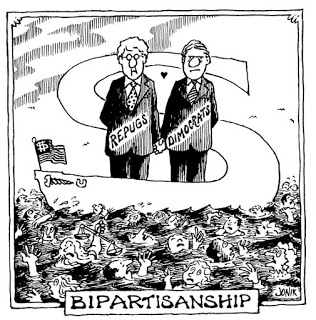
That said, you know, I really think there is really bipartisan opposition to this system, and the poll data is very convincing on this. Overwhelming numbers of Democrats, but also overwhelming numbers of Republicans oppose the giant influence of the super-wealthy and corporations in Washington. They oppose overwhelmingly the big money influence over the election process. They oppose overwhelmingly the Citizens United decision.
As soon as we get poll data on this decision, I’m sure people just having commonsense are going to oppose this as well. And, again, it’s going to be across party lines. The trick is going to be both to mobilize people and convert the public anger about this into meaningful action by our elected representatives who are part of this system that we’re trying to reform.
Dennis J Bernstein is a host of “Flashpoints” on the Pacifica radio network and the author of Special Ed: Voices from a Hidden Classroom.


Mike Rogers’ Plan To ‘Stop’ Bulk Collection Of Phone Records Riddled With Dangerous Loopholes That Will Expand Surveillance
By Mike Masnick | Techdirt | April 1, 2014
Now that people have had a chance to go through the proposal by Reps. Mike Rogers and Dutch Ruppersberger to “stop” the bulk phone record collection under Section 215 of the Patriot Act, they’re finding more and more things to be concerned about. We had noted some potential easter eggs in there for law enforcement, but the deeper people look, the worse it gets. Trevor Timm notes that the bill is really a trojan horse to expand surveillance capabilities, while pretending to end them.
Curiously, a large majority of the House bill focuses on new ways for the government to collect data from “electronic communications service providers” – also known as the internet companies. Why is a bill that’s supposedly about ending bulk collection of phone-call data focused on more collection of data from internet companies?
From there, we turn to Julian Sanchez, who has given one of the most thorough explanations of what’s actually in the bill, noting that it fails to really end the bulk collection of phone records while also potentially massively expanding other surveillance capabilities.
First, the HPSCI bill’s seemingly broad prohibition on bulk collection turns out to be riddled with ambiguities and potential loopholes. The fuzzy definition of “specific identifiers” leaves the door open to collection that’s extremely broad even if not completely indiscriminate. Because the provision dealing with “call detail records” applies only to §:215 and the provision dealing with “electronic communications records” excludes telephony records, the law does not bar the bulk collection of telephony records under FISA provisions other than §215. The prohibition on non-specific acquisition of other communications “records” probably does not preclude bulk collection under the FISA pen register provision that was previously used for the NSA Internet metadata dragnet. And, of course, none of these prohibitions apply to National Security Letters. If the government wanted to keep collecting metadata in bulk, it would have plenty of ways to do so within the parameters of this statute given a modicum of creative lawyering—at least if the FISC were to continue being as accommodating as it has been in the past.
Second, something like the novel authority created here may well be necessary to enable fast and flexible acquisition of targeted records without dragnet collection. However, once we get down to details—and even leaving aside the question of ex-post versus ex-ante judicial approval—this authority is in some respects broader than either the current §215 telephony program, the president’s proposal, or the pre-Snowden understanding of the FISA business records authority. Critically, it eliminates the required link to a predicated investigation—which, in the case of U.S. persons, must be for counterterror or counterespionage purposes.
In other words, this appears to be a superficial attempt to end bulk collection “under this program,” while at the same time knocking down a bunch of barriers to much broader bulk collection under other authorities, with less oversight and fewer ways to push back against abuse. Did anyone really expect anything different from the NSA’s two biggest defenders in the House?
Americans protest US police shootings
Press TV – March 31, 2014
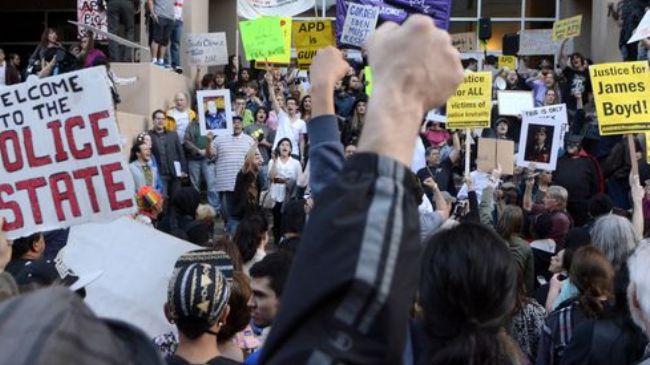
Hundreds of American demonstrators held a march in Albuquerque, New Mexico on Sunday to protest fatal shootings by the police, including the one that led to the killing of James Boyd, a homeless man who lived on the foothills of a mountain outside the city.
The protest came days after the emergence of a YouTube video which threatened retaliation of the police shooting of Boyd and called for protest marches.
The demonstration began Sunday afternoon and continued into the early evening as people marched around the city and chanted “no justice, no peace!” Police said the march was an unlawful assembly.
Alexander Siderits, 23, said he was “fed up” with how police treat citizens. “It has reached a boiling point,” he said, “and people just can’t take it anymore.”
A similar demonstration was also held last Tuesday during which protestors chanted “We want justice,” holding signs “APD is guilty,” and demanded justice for Boyd.
Boyd, 38, was killed on March 16 by police officers while camping in the foothills of the Sandia Mountains on the east side of Albuquerque. Police accused him of setting up an illegal camp in an open space and fired six times at him.
A helmet camera video showed the homeless gathering his belongings and turning away to leave the area just before the police shot him.
Last week, Albuquerque police shot another man dead at a public housing complex.
Since 2010, the city’s police officers have been involved in 37 shooting incidents, 23 of them deadly, with critics saying that is far too many for a department serving a city of about 555,000.
The police department has been under investigation by the US Justice Department for more than a year. It now faces complaints of civil rights violations and allegations of excessive use of force.
~~~
See also: Tear gas & batons: Albuquerque riot police disperse protesters
Aid to Ukraine Is a Bad Deal For All
By Ron Paul | March 30, 2014
Last week Congress overwhelmingly passed a bill approving a billion dollars in aid to Ukraine and more sanctions on Russia. The bill will likely receive the president’s signature within days. If you think this is the last time US citizens will have their money sent to Ukraine, you should think again. This is only the beginning.
This $1 billion for Ukraine is a rip-off for the America taxpayer, but it is also a bad deal for Ukrainians. Not a single needy Ukrainian will see a penny of this money, as it will be used to bail out international banks who hold Ukrainian government debt. According to the terms of the International Monetary Fund (IMF)-designed plan for Ukraine, life is about to get much more difficult for average Ukrainians. The government will freeze some wage increases, significantly raise taxes, and increase energy prices by a considerable margin.
But the bankers will get paid and the IMF will get control over the Ukrainian economy.
The bill also authorizes more US taxpayer money for government-funded “democracy promotion” NGOs, and more money to broadcast US government propaganda into Ukraine via Radio Free Europe and Voice of America. It also includes some saber-rattling, directing the US Secretary of State to “provide enhanced security cooperation with Central and Eastern European NATO member states.”
The US has been “promoting democracy” in Ukraine for more than ten years now, but it doesn’t seem to have done much good. Recently a democratically-elected government was overthrown by violent protestors. That is the opposite of democracy, where governments are changed by free and fair elections. What is shocking is that the US government and its NGOs were on the side of the protestors! If we really cared about democracy we would not have taken either side, as it is none of our business.
Washington does not want to talk about its own actions that led to the coup, instead focusing on attacking the Russian reaction to US-instigated unrest next door to them. So the new bill passed by Congress will expand sanctions against Russia for its role in backing a referendum in Crimea, where most of the population voted to join Russia. The US, which has participated in the forced change of borders in Serbia and elsewhere, suddenly declares that international borders cannot be challenged in Ukraine.
Of course, those who disagree with me and others like me who are less than gung-ho about sanctions, manipulating elections, and sending our troops overseas are criticized as somehow being unpatriotic. It happened before when so many of us were opposed to the Iraq war, the US attack on Libya, and elsewhere. And it is happening again to those of us not eager to get in another cold — or hot — war with Russia over a small peninsula that means absolutely nothing to the US or its security.
I would argue that real patriotism is defending this country and making sure that our freedoms are not undermined here. Unfortunately, while so many are focused on freedoms in Crimea and Ukraine, the US Congress is set to pass an NSA “reform” bill that will force private companies to retain our personal data and make it even easier for the NSA to spy on the rest of us. We need to refocus our priorities toward promoting liberty in the United States!
Israeli forces shut down Palestinian conference in Jerusalem
Ma’an – 27/03/2014
JERUSALEM – Israeli forces on Wednesday prevented Palestinian human rights organizations in Jerusalem from holding a conference in opposition to Arab enlistment in the Israeli military, organizers said.
Israeli special forces and police reportedly stormed the headquarters of the Yabous Cultural Center immediately prior to the beginning of the conference and shut down the building until the evening.
Organizers said that the police hung a notice signed by the chief of police banning the proceedings from moving forward because the conference was organized by activists associated with the Popular Front for the Liberation of Palestine, which Israeli authorities consider a terrorist organization.
Jerusalem Legal Aid and Human Rights Center director Rami Saleh denied the allegations, noting that the conference was organized by JLAC, St. Yves, Kanaan Project, and in cooperation with the Baladna organization’s Haifa branch.
Saleh said the conference aims to raise awareness in the Arab community of Jerusalem about “civil service,” a form of service in the Israeli army that the Israeli state has increasingly enjoined Arab youth to enlist in.
The conference was intended to encourage opposition to “civil service” and all kinds of military service in the Israeli army, which is not mandatory for Muslim and Christian Palestinians in Israel, unlike for Druze and Jewish Israelis.
Dozens of Jerusalem youths aged 18-21 had joined the program, Saleh said.
Yabous institute director Rania Elias condemned the closure of the institute from 2-8 p.m, adding that the institute will continue to provide service and organize events for Palestinian organizations.
Related article

Bahraini photographer among 29 jailed for up to 10 years
Al-Akhbar | March 26, 2014
A Bahraini court on Wednesday jailed 29 people, including an award winning photographer, for up to 10 years for an alleged attack on a police center in April 2012.
A judicial source and activists said the verdicts were based on defendants’ confessions that were extracted under torture.
Twenty-six of those convicted were handed 10-year prison terms and three others jailed for three years, a source told AFP.
Among those sentenced to 10 years was Ahmed Humaidan, a 26-year-old photojournalist abducted by plainclothes police in late-2012.
Humaidan’s lawyer said the court presented no evidence to suggest that he was involved in any attack against police aside from a confession he made under torture.
The Bahrain Center for Human Rights has documented cases of torture against the young photojournalist in prison, which included being blind-folded and told to hold an object for hours that police claimed was a bomb.
The prosecution accused the defendants of attacking a police center in the village of Sitra, south of Manama, with petrol bombs and iron rods, wounding a policeman.
The other defendants also told the court that they were tortured and their confessions obtained under duress, according to the judicial source.
Bahrain, home to the US Fifth Fleet, remains in a constant state of turmoil since authorities launched a bloody crackdown on a popular uprising three years ago, with hundreds of protesters and activists jailed on “terror” charges.
Authorities in the Gulf dictatorship last year increased the penalties for those convicted of violence, introducing the death penalty or life sentences in certain cases.
(AFP, Al-Akhbar)
Related articles
Moscow Slams Closure of Russian TV in Ukraine
RIA Novosti | March 25, 2014
MOSCOW – A ruling by a Ukrainian court to suspend broadcasts of four Russian TV channels in Ukraine is an attack against human rights and media freedom, a senior Russian diplomat said on Tuesday.
The District Administrative Court in Kiev ruled to suspend broadcasts of Russia’s Rossiya 24, Channel One, RTR Planeta, and NTV-World in Ukraine pending hearings on a permanent ban.
“Undoubtedly, this should be viewed only as an infringement on democratic freedoms and as a violation of Ukraine’s international obligations. Certainly, millions of [Russian-speaking] residents of this country have the right to watch [Russian] TV and have access to [other] Russian-language media,” said Konstantin Dolgov, the Russian foreign ministry’s point man on human rights.
“Forces that came into power in Kiev as a result of an anti-constitutional coup, have declared their commitment to basic human rights and freedoms, to principles of democracy. Naturally, this announcement contradicts such statements,” Dolgov said.
Ukraine is split into Russian-speaking east and Ukrainian-speaking west.
National Television and Radio Broadcasting Council of Ukraine has ordered cable and satellite TV service providers to exclude Russian TV channels, popular among Russian speakers in eastern Ukraine, from their packages.
The watchdog said the Russian channels’ coverage of the recent events in Ukraine, including the political crisis and Crimea’s reunification with Russia, harms national security.
OSCE Representative on Freedom of the Media Dunja Mijatovic condemned the move in mid-March, saying that that “banning programming without a legal basis is a form of censorship; national security concerns should not be used at the expense of media freedom.”
Related articles


Egypt court sentences 529 Morsi supporters to death
Press TV – March 24, 2014
A court in Egypt has sentenced 529 supporters of former President Mohammed Morsi to death for various charges including murder, judicial sources and a defence lawyer say.
“The court has decided to sentence to death 529 defendants and 16 were acquitted,” lawyer Ahmed al-Sharif said on Monday.
He added that the ruling can be appealed.
Judicial sources say 153 of the sentenced people are in custody, but the rest are on the run.
According to judicial sources, the defendants have been charged with assaulting security forces and vandalizing public property during the violence that erupted after police stormed two protest camps set up by Morsi’s supporters in Cairo last August.
The military-backed government has launched a deadly crackdown on the Muslim Brotherhood supporters after the army ousted Morsi in July last year, with hundreds of people killed and thousands arrested.
According to a report released by the Associated Press earlier this month, Egypt’s military-backed government has jailed nearly 16,000 people since Morsi’s removal. About 3,000 Muslim Brotherhood members are among those who have been put behind bars.
Bitter memories: Tule Lake
(1975) – A documentary on the Tule Lake Japanese Relocation Camp presented through interviews with Japanese Americans who were interned there.
Link for video: https://alethonews.wordpress.com/2017/10/24/bitter-memories-history-of-the-tule-lake-japanese-relocation-center/
Related articles


FBI Bust Another Handcrafted ‘Terrorist’ For The Crime Of Thinking About Supporting A Terrorist Organization
By Tim Cushing | Techdirt | March 19, 2014
The FBI’s string of thwarted, self-created terrorist plots continues unabated. Why look for terrorists when you can just craft them yourselves? Digital Fourth has the rundown on the latest “coup” by the agency.
The news this morning is full of the arrest of yet another American on charges of “attempting to provide material support to a foreign terrorist organization.” Nobody’s suggesting that 20-year-old National Guardsman Nicholas Teausant of Acampo, CA is a terrorist, or that he provided any help whatsoever to terrorists, or that he was in contact, ever, with any actual terrorists. But, the media breathlessly report, he’s still facing charges that can put him in jail through to the 2030s.
The more you dig into the story, the more ridiculous it becomes. And Alex Marthews digs in deeply. The propellant (if you will) for this latest thwarted terrorist plot is little more than a campfire story.
Well, seems that he was on a camping trip sometime last year – or maybe not; investigators couldn’t corroborate that the camping trip ever happened – but anyway, afterwards, Teausant is reported to have said to some guy that he had been on a camping trip and had talked with friends about “blowing up the LA subway,” but that they hadn’t done anything because “they” had been “tipped off”.
Unfortunately for Teausant (but fortunately for America!), the “somebody” he relayed his camping conversation to was an FBI agent. Recognizing that Teausant needed a little more prodding to turn against his own nation, the agent connected him with a terrorist tutor of sorts (another FBI agent). This agent/mentor suggested Teausant travel to Canada to further radicalize and then sent more FBI agents to arrest him at the border. Voila, another terrorist attack thwarted.
Teausant is now facing charges of “attempting to provide material support” to a terrorist organization, a crime that seems to be treated just as severely as actually providing material support. As evidence of Teausant’s terrorist proclivities, agents cited posts to his “online photo account” which said such things as desiring to see America’s downfall and “I would love to join Allah’s Army but I don’t know where to start.”
They also cited the following evidence, which exposes the USA’s contradictory and arbitrary determination of who does and does not qualify as a terrorist.
Also, Teausant was apparently trying to figure out how to go to Syria and fight against Bashar al-Assad. This horrifying offense was committed at the same time that the US government was … trying to figure out how to go to Syria and fight against Bashar al-Assad. Last time I checked, Assad was a brutal dictator. But the winds have changed, and now that some of the people fighting against him are Sunni radicals inspired by, but actually repudiated by, al-Qaeda, I guess that makes Assad now a staunch American ally and defender of secular values?
Here’s some more of the government’s evidence.
The complaint said Teausant referred to himself as a convert to Islam but did not give details about when or why he may have done so. He met the informant through a mutual acquaintance, the document said.
Among Teausant’s plans was to appear in videos for the group, without covering his face — to be “the one white devil that leaves their face wide open to the camera,” he was quoted in the complaint as saying…
The complaint also states that Teausant told the informant he has an infant daughter, and had arranged for his mother to get custody of the girl if he disappeared.
At one point, the informant questioned him about whether he was serious about his plans, given that he talked a lot but did not seem to follow through.
So, while there are indications that Teausant could have wandered down the path into Islamic radicalism, at the point he was arrested he had done little more than talk smack around the campfire with some other young men (Teausant is only 20) and talk further smack with undercover agents. But as usual, it looks as though the FBI had to do most of the legwork to convert this person into a potential terrorist. It was the FBI, not Teausant, that arranged to get him an “application” to join a violent Al-Qaeda-linked group. It was the FBI that pushed him towards Canada to further his terrorist education. And it was the FBI that convinced itself that Teausant was enough of threat to lock up for a potential 15 years, even though he had never actually “provided material support” to a terrorist organization.
The FBI now gets to chalk up another win in the “terrorist captured” column despite having done little more than arrest a guy who talked a lot, but wasn’t big on following through. Sure, there’s always a chance Teausant would have done all of this on his own, but rather than sit back and keep an eye on him, the FBI proactively made his moves for him… and arrested him for following the undercover agents’ bidding.
Marthews points out how completely bizarre this is in a land where free speech is considered a right.
In a more sensible legal environment, Teausant would walk free because, let me think now, because we have a First Amendment and he is entitled to say whatever dumb thing he wants to so long as he doesn’t actually harm anyone, and the FBI informant and agent would be being charged with entrapment.
That’s the way it should work, but that’s not the way it does work. The counterterrorism money train comes off the rails if government agencies fail to capture terrorists. So, rather than restrict themselves to investigating terrorist organizations and sniffing out plots, the FBI has chosen to pad the books with ringers. Teausant may have made some poor decisions and said some unwise things, but even the FBI’s preponderance of evidence fails to portray him as much more than a dumb kid with stupider dreams. And rather than allow the events to play out, and possibly expose the FBI’s alleged terrorist sympathizer as an ineffectual pretender, it set him up for a date with the penal system. All the while, the accolades and money keep rolling in, ensuring the FBI’s terrorist manufacturing apparatus will keep humming smoothly.
Related article

Spy agencies seek to store Aussies’ web-browsing histories, end encryption
RT | March 18, 2014
The Australian Security Intelligence Organization (ASIO) is pushing for laws that would make telecommunications companies retain their customers’ web-browsing data, as well as forcing web users to decrypt encrypted messages.
In these post-Snowden times, when people around the world are furious over revelations that their communications’ ‘metadata’ has been scooped up by a vast, US-built surveillance network, Australia’s ASIO is looking to further bolster its phishing powers, as opposed to scaling them back as many people clearly favor.
With no loss of irony, the agency is pointing to the sensational case of Edward Snowden – the former NSA contractor-turned-whistleblower who last year departed from US shores with thousands of files on the American spy program – to expedite the process of creating a data-retention regime that would store users’ data for two years, or possibly longer.
“These changes are becoming far more significant in the security environment following the leaks of former NSA contractor Edward Snowden,” ASIO said in its parliamentary submission to modify the Telecommunications Interception and Access Act.
Although retaining ‘content’ data has been declared off-limits to the surveillance program, several security agencies, including the Northern Territory Police and Victoria Police, want web-browsing histories stored.
Metadata gathered on web-browsing would include an IP address and the IP addresses of web servers visited, or uniform resource locators (URLs) and the time at which they were visited. Email metadata, meanwhile, might include information such as addresses, times and the subject field.
Australia’s intelligence agencies accessed metadata 330,640 times during criminal and financial investigations in 2012-13, according to The Sydney Morning Herald.
Northern Territory Police said in its submission that meta-data found in browser histories were “as important to capture as telephone records”.
Additionally, the agency is calling for enhanced powers to sift intelligence data from emails and social media sites, as well as forcing web users to decrypt encrypted material if requested to do so by the spy agency.
“Under this approach, the person receiving a notice would be required to provide ‘information or assistance’ to place information obtained under the warrant into an intelligible form,” the submission said.
“The person would not be required to hand over copies of the communication in an intelligible form, and a notice would not compel a person to do something which they are not reasonably capable of doing. Failure to comply with a notice would constitute a criminal offense, consistent with the Crimes Act.”
ASIO points to the Snowden leaks, and the increased popularity of encryption technology on the internet, as a reason for resisting changes.
“In direct response to these leaks, the technology industry is driving the development of new internet standards with the goal of having all web activity encrypted, which will make the challenges of traditional telecommunications interception for necessary national security purposes far more complex.”
However, a number of organizations, including the Australian Mobile Telecommunications Association, the communications lobby group, warned against widening surveillance capabilities and what it means for privacy rights.
“The associations also note that a data retention scheme will involve an increased risk to the privacy of Australians and provide an incentive to hackers and criminals. Data retention is at odds with the prevailing policy to maximize and protect privacy and minimize the data held by organizations,” the submission said.
“Industry believes it is generally preferable for consumers that telecommunications service providers retain the least amount of data necessary to provision, maintain and bill for services.”
ASIO is not only fighting back against any restrictions on its work, it is actually calling for more spying powers.
For example, when the Australian Law Reform Commission argued for the creation of a “public interest monitor” to assert some guidelines on intelligence gathering, ASIO said it “has reservations about this, if the effect would be simply to insert yet another approval step into the authorization of a TI warrant.”
Meanwhile, the Australian Federal Police said it wanted to store data “to ensure a national and systematic approach is taken to safeguarding the ongoing availability of telecommunications data for legitimate, investigative purposes.” At the same time, however, it admitted work needed to be done to understand what type of data got retained and for how long.
Electronic Frontiers Australia, the online rights group, is lobbying against the amendments, arguing that storing web meta-data was “an ineffective method to curb terrorism.”
“The ease with which data retention regimes can be evaded is grossly disproportionate to the cost and security concerns of the data retention regime,” it said.
Meanwhile, the Coalition government’s Attorney-General George Brandis said on Monday that the government was “not currently considering any proposal relating to data retention” despite the push from the country’s intelligence agencies.
Shadow Attorney-General Mark Dreyfus said Labor was waiting for the Coalition’s response to an inquiry that had opened in June of last year before it announces its position.
“There was insufficient time while Labor was in office to formulate a considered response to the matters discussed in the Committee’s report, including the merits of a data retention scheme,” Dreyfus said, as quoted by the paper.
Featured Video

Seyed M. Marandi: US-Iran War Inevitable: Kuwait and Bahrain May Fall
or go to
Aletho News Archives – Video-Images
From the Archives
Oil and the Israel Lobby
Reknowned economist M. Shahid Alam offers this excellent critique of Noam Chomsky’s defective analysis of the relative influence of Oil versus the Israel lobby over US foreign policy: … continue
Blog Roll
 Aletho News
- ICC ignored ‘very well-documented’ NATO crimes – ex-Libyan minister
- SNSC secretary dismisses US response to Iran’s conditions as ‘inadequate’
- Sanaa says Taiz roads open, secure for residents, warns Saudi forces
- Iraqi resistance group urges Saudi leadership to admit defeat, lift Yemen siege
- Trump’s Retreat: How Al-Aqsa Flood Took Down the US Empire
- Israel’s Military Actions in Lebanon Grossly Violate International Law — Lavrov
- Seyed M. Marandi: US-Iran War Inevitable: Kuwait and Bahrain May Fall
- Leaders Condemn Ansarallah Attack on Saudi Arabia While Ignoring Illegal War Against Yemen
- Leaked: Britain’s Covert Iraqi Psyops Network
- Yemeni Armed Forces Warn Airlines Against Using Saudi Airports, Exempt Mecca and Medina
- If Americans Knew
- After Oct 7, IDF policy allowed civilian casualties for even the lowest-ranking targets
- Israel’s Destruction of Southern Lebanon Intensified After the Cease-Fire
- The Last-Minute Decision That Gave Israel Its Name
- The American Conservative: How Trump Made the World Go Nuclear
- Meet the US generals and admirals advancing Israeli policy
- Opinion: Why news organizations should boycott Israel
- The Israeli witch hunt of Sami Abu Shehadeh exposes the lie of the ‘Jewish and democratic’ state
- No state has a ‘right’ to exist – least of all Israel
- Testimonies about Gaza’s civilian death toll expose Israel’s atrocities – Daily Update
- How Israel Conquered the Latin American Right
- No Tricks Zone
- New Study Suggests Large Regions Of The Pacific Ocean Have Been Cooling For The Last 80 Years
- Germany’s Green Energy Debacle: High Energy Costs Force Kahla Porzellan to Close After 182 Years!
- New Study: 50 Years Of The Most Aggressive ‘Net Zero’ Policies Can Only Affect The Global Climate By 0.03°C
- US September “Heat” Was No Record…Many Records Set Decades Ago
- Latest European Green Energy Debacle; Portugal’s Largest Flagship Solar Park Insolvent!
- Green Energy Debacle: German Expert Professor Fritz Vahrenholt Warns Of Severe Economic And Social Consequences
- Two More Paleo Reconstructions Affirm Meters-Higher Sea Levels Across Ireland, Brazil 7000-6000 Years Ago
- New Study: Earth And Venus Surface Warmth Largely Explained By Convection And Lapse Rate, Not CO2 Or Radiation
- 2025 Nature Paper Claiming Worsening Global Drought Gets RETRACTED …Heavily Flawed
- New Study: ‘Global Drought Shows No Detectable Recent Acceleration Under Climate Warming’

