Congressmen Try to Restrict Free Speech To Prevent Boycotts of Israel
By Mitchell Plitnick | LobeLog | February 7, 2014
Earlier this week, a bill was hastily removed from the agenda of the New York State Assembly. The bill was designed as a response to the American Studies Association’s decision to boycott Israeli educational institutions. But it was so poorly written that even opponents of the ASA boycott saw it as potentially damaging to academic freedom in general. The bill was removed from the fast track in New York so it could be re-written to be more acceptable to its potential supporters. A similar bill is currently working its way through the Maryland state legislature.
Now the US Congress is getting into the act, with a bill that has the same goal, but takes a different approach. The bills in New York and Maryland did not specifically mention Israel, although it was clear that the ASA action against Israeli academia is what prompted the bills. Instead, they tried to argue that academic freedom meant that the state must penalize institutions that choose to express themselves through the power of boycott if the target is a country that has extensive academic connections with the United States.
Even Jewish groups supported the withdrawal of the New York bill, and many people agreed that, however onerous they thought the ASA action was, this sort of legislation was contrary to academic freedom and to freedom of expression.
The bill introduced by Rep. Peter Roskam (R-IL) relates only to academic boycotts against Israel. Where the state bills proscribed penalties, including a reduction of funding against any institution that participated in an association that called for a boycott and even prohibited reimbursing faculty for travel expenses to attend conferences by such groups, the congressional one threatens to cut off all funding under the Higher Education Act to any university “…if the institution, any significant part of the institution, or any organization significantly funded by the institution adopts a policy or resolution, issues a statement, or otherwise formally establishes the restriction of discourse, cooperation, exchange, or any other involvement with academic institutions or scholars on the basis of the connection of such institutions or such scholars to the State of Israel.”
That is a very broad statement. “Significantly funding,” read broadly, can easily include not only institutional support of academic associations like ASA, but also student groups, fraternities/sororities and research collectives. So, this is very far from affecting only universities.
This goes well beyond boycotts. It bars any group attached in any way to a university or group of universities from any material reaction, beyond voicing criticism, to Israel’s policies. Nor does it make any distinction between Israel and the settlements. That means that no institution of higher education can object in any material way to an association or connection to Ariel University, a fully accredited Israeli university located in the settlement of Ariel. That institution is highly controversial within Israel, and its very establishment contravenes US policy, yet a student group which is funded by a university would risk the university’s federal funding, all of it, if they refuse to work with that school.
Moreover, the fact that Roskam’s bill is specific to Israel is particularly noxious, and should be a matter of deep concern for anyone who supports Israel or who is concerned about anti-Semitism, as well as to those of us who support Palestinian rights and the right of American citizens to free expression. The bill creates a unique category of protection for Israel, based on Roskam’s wholly unfounded assertion that the ASA boycott decision is an “anti-Semitic effort.”
I, myself, do not agree with academic boycotts of Israel as a whole (boycotts targeting Ariel University and any other settlement program have my full support). That is a matter of tactics, however. My disagreement is based entirely on my view that an academic boycott of all of Israel is counter-productive at this time. But there is no reasonable basis for contending that a boycott against a country that has held millions of Palestinians under a military occupation depriving them of their civil rights and routinely violating their human rights is motivated by anything other than the policies of the occupying power.
By singling out Israel for this “protection,” the Roskam bill, not the ASA, is treating Israel as a special case rather than a country like any other, which must contend with material as well as rhetorical opposition to its policies. Basing it on Israel being a “Jewish state” serves not only to undermine the Jewish effort to be accepted like any other people, but actually promotes resentment and hostility toward Jews.
Roskam’s bill is blatantly unconstitutional, as are the various bills in the state legislatures, although the state versions are slightly less onerous and blatant in their disregard of the Constitution. Boycotts are legal and legitimate expressions protected under the First Amendment. The argument will be made that the state does not have to fund such activities, which is true, but there is a big difference between not funding legitimate free expression and state interference with it. As one constitutional lawyer, Floyd Abrams, told BuzzFeed: “The notion that the power to fund colleges and their faculties may be transformed into a tool to punish them for engaging in constitutionally protected expression is contrary to any notion of academic freedom and to core First Amendment principles. I believe that academic boycotts are themselves contrary to principles of academic freedom but that does not make the legislation being considered any more tolerable or constitutional.”
The bill is probably not going to be successful in Congress. The efforts have a much better chance in the state legislatures. Still, it was brought forth by Roskam, and his Illinois colleague Dan Lipinski, a Democrat, was an initial co-sponsor, so the bill is ostensibly bi-partisan. It also came with the support of Israel’s former Ambassador to the US, Michael Oren. So it should not be blithely dismissed despite its blatant unconstitutionality.

Turkish police use tear gas to disperse protest against new internet controls
RT | February 8, 2014
Turkish police have fired tear gas and water cannons to disperse crowds of protesters rallying against “draconian” internet laws approved by parliament.
Police approached the crowd along Istanbul’s Istiklal Avenue and fired water cannons from behind armored vehicles as protesters tried to march to the city’s main square.
“Everywhere is bribery, everywhere is corruption,” protesters chanted.
As riot police fired water cannons at protesters, some of them responded by throwing stones or setting off fireworks aimed at law enforcement officers.
The new bill was passed late Wednesday by the parliament dominated by the Erdogan’s AKP party.
If the president approves the legislation, it would give authorities the power to block web pages without a court order within just hours.
It would also require internet service providers (ISPs) to store data on their clients’ online activities for two years and provide it to the authorities on request.
However, Prime Minister Recep Tayyip Erdogan rejected any possibility that the regulations would allow authorities to have access to internet users’ personal information.
“Never. It is out of the question that people’s private data will be recorded,” he said in Istanbul on Saturday.
The opposition says the move is part of a government bid to stifle a corruption scandal and accuses the government of limiting Internet freedoms.
Erdogan denies accusations of censorship, saying the legislation would make the internet “more safe and free.”
“These regulations do not impose any censorship at all on the Internet … On the contrary, they make it safer and freer,” he said.
Prepared by the Ministry of Family and Social Policy, the bill provoked mass rallies in mid-January, shortly after it was announced. The protest was dispersed by riot police who used water cannons and tear gas against hundreds of opponents of the bill.
The bill amends Law No. 5651, widely known as Turkey’s Internet Law that came into effect in July 2007.
Honduras and Mexico: Open Season for Journalists
By Nick Alexandrov | CounterPunch | February 7, 2014
Last December, the New York Times’ David Carr reported on Vice President Biden’s trip to China, where he “spoke plainly about the role of a free press in a democratic society.” The benighted audience was surely keen to learn about this Western institution, and “it was heartening to see the White House at the forefront of the effort to ensure an unfettered press,” Carr affirmed. No doubt. Down here on Earth, meanwhile, Washington has long been at the forefront of an effort to promote cultural devastation, targeting journalists, artists, and independent thinkers more generally. This cultural ruin is a predictable consequence of U.S. support for repressive regimes—a tradition Obama has worked hard to uphold.
Consider the June 2009 coup against Honduran President Manuel Zelaya, which four School of the Americas graduates helped orchestrate. Even the attorney responsible for giving it a legal veneer admitted the ouster was “a crime,” and in its aftermath Obama recognized Porfirio Lobo, winner of a fraudulent election marred by political violence and ballot irregularities, as the country’s new leader. Now, Honduran journalists are weathering a “deluge of threats, attacks and targeted killings,” PEN International reported recently. Honduran “economic elites have established unwritten limits as to what can be investigated by major news agencies,” and independent journalists face similar restrictions. Whoever ignores these limits pays the ultimate price.
Nahúm Palacios “opposed the 2009 coup and turned his TV station into an openly pro-opposition channel,” PEN notes. The military threatened him, but he persisted, and he and his girlfriend were murdered in March 2010. Israel Zelaya Díaz covered politics and crime, and managed a program aired on San Pedro Sula’s Radio Internacional. Assailants torched his home in May 2010, and then shot him to death three months later. A group of men stopped television producer Adán Benítez, who had put out a story on gang activity, in July 2011; they demanded his valuables, and then killed him. Medardo Flores Hernández was a volunteer reporter and finance minister for a pro-Zelaya organization when he was gunned down in September 2011. Early the following month, Obama received Honduran President Lobo at the White House, commending his “strong commitment to democracy.” Radio journalist Luz Marina Paz Villalobos, a coup critic, was murdered on December 6, 2011.
Mexican reporters are also at risk, as theirs “has become the most dangerous country in the Western Hemisphere for journalists,” Emily Edmonds-Poli wrote in a Wilson Center report last April, reviewing the situation in this “drug war” ally. In the state of Veracruz, for instance, there was a series, in the spring of 2012, of high-profile killings: a group of men invaded investigative reporter Regina Martínez’s home in Xalapa, and murdered her there. The dismembered bodies of three photojournalists pursuing stories on organized crime were discovered on the side of a highway four days later. “The fear is terrible and well founded,” an ex-reporter told the Guardian’s Jo Tuckman. “The heroes are in the cemetery.” This woman is hardly the only one to have abandoned the profession. A university official in Veracruz, quoted by Edmonds-Poli, surveyed the corpse-strewn landscape: “It’s not that they’re just killing reporters, they’re killing the drive to become one.” The destructive effects are equally far-reaching in Honduras. PEN quotes Honduran activists who “stressed that the neglect, marginalization and underfunding of cultural spaces” have gutted the nation’s creative sector, sharply delimiting the range of questions to which artists and independent researchers can safely respond.
The Honduran and Mexican governments restrict inquiry with generous U.S. assistance. Both states have strong ties to organized crime: efforts to distinguish legitimate from outlaw Honduran institutions, for example, are often meaningless, given the government’s illicit origins in the June 2009 coup. “A representative from a leading NGO in Honduras says at least four high-ranking police officials head drug trafficking organizations,” InSight Crime’s Charles Parkinson wrote on January 29, and Honduran history reveals that such activity is no obstacle to continued U.S. funding. When a Reagan-era DEA agent amassed evidence implicating the country’s top military officials in prohibited activities, for instance, the organization responded by shutting down its Honduran office in 1983. At the time, Washington’s core concern was the vital role Honduras played in the anti-Sandinista crusade. Their ally’s involvement in drug-smuggling was a non-issue, as irrelevant then as today, when the projected 2014 U.S. governmental military and police aid is over 1.75 times the 2009 figure.
Mexican institutions resemble their Honduran counterparts: ties between political elites and organized crime can be traced back at least a century, and this connection was blatantly obvious by the 1970s. That was the decade the national intelligence arm—the Dirección Federal de Seguridad (DFS)—aided by “the attorney general’s office and Federal Judicial Police,” established itself as “the country’s major criminal mafia,” Paul Kenny and Mónica Serrano point out. U.S. officials knew DFS facilitated drug trafficking’s expansion, and “continued to defend and protect the agency” because it “played a central part in Mexico’s fight against left-wing subversion, both directly and through a death squad organized under [DFS head Miguel] Nazar’s supervision, the ‘White Brigade,’” Peter Dale Scott and Jonathan Marshall write. Years later, Mexican law enforcement committed “one out of every three crimes against journalists” from 2009-2011, Edmonds-Poli reports in her Wilson Center study. That three-year span overlaps with the period—between 2008 and 2010—when Washington “allocated over $1.5 billion to Mexico” via the Mérida Initiative, and “U.S. military and police aid in each of these years marked nearly a 10-fold increase over 2007 levels,” according to Witness for Peace. Obama then extended the program—a true Nobel Peace Laureate, reminiscent of luminaries like Henry Kissinger.
In June 1976, for example, Kissinger proclaimed his support for Argentina’s military dictatorship: “We have followed events in Argentina closely,” he stated. “We wish the new government well. We wish it will succeed.” These remarks came six weeks after “military officers organized an exemplary event to combat immorality and communism,” Fernando Báez—author of A Universal History of the Destruction of Books—notes, when they burned volumes “confiscated from bookshops and libraries in the city of Córdoba,” loudly condemning Freud, Marx, Sartre and others. In August 1980, “trucks dumped 1.5 million books and pamphlets… on some vacant lots in the Sarandí neighborhood in Buenos Aires.” After a federal judge gave the command, “police agents doused the books with gasoline and set them on fire. Photos were taken because the judge was afraid people might think the books were stolen and not burned.” The situation was much the same in neighboring Chile, under Pinochet, when “thousands of books were seized and destroyed” during his dictatorship. In 1976, Kissinger met with Pinochet in Santiago, assuring him Washington was “sympathetic with what you are trying to do here.”
Washington also sympathized with South Vietnam’s Ngo Dinh Diem, who in the late 1950s “banned works of fiction that presented the government in an unflattering light,” Joint Chiefs of Staff historian Willard J. Webb wrote. Diem thus proved himself a worthy heir to Pope John XXII, who in 1328 “ordered a book burned because it cast doubt on his omnipotence,” Báez observes, arguing that we have to look further back in time, to 1258, to comprehend the effects of the recent U.S. assault on Iraq. It was in the mid-13th century that “the troops of Hulagu, a descendant of Genghis Khan, invaded Baghdad and destroyed all its books by throwing them into the Tigris.” Hulagu’s particular form of savagery was unsurpassed until the U.S. occupation—“nation-building,” liberal commentators insist, but in reality just one case of Washington-supported cultural destruction.
Nick Alexandrov lives in Washington, DC.
Holocaust Denial And Uncomfortable Truths
By Robin Davis | Countercurrents | June 6, 2009
It has always been those few who can see through the political correctness and hypocrisy of popular attitudes who are considered dangerous.
“Holocaust denial laws” are now in place in about a dozen countries. Defenders of these laws claim that the expression of unconventional views about the Jewish genocide is “hate speech” and “incitement to violence” and therefore must be suppressed.
But history shows the greatest purveyors of lies, hatred and incitement to violence are those with the power to spread their poison by manipulating popular opinion via the control or complicity of the mass media. Through a purposefully constructed lens of political correctness the despicable becomes normal. It is by this insidious process that tyrants make it normal and acceptable to murder those whom they consider threatening or inferior. We have only to turn on the television to see that process at work.
It is not the unpopular views we should fear but the popular.
When the suppression of free speech serves no purpose other than to silence unconventional opinions we should be alarmed. We should be even more alarmed when to question oppressive laws is to risk vilification, in this case by the smear of “Holocaust denier” and “anti-Semite”.
Appropriation of the term “The Holocaust” to the Nazi extermination of the Jews minimises the significance of other genocides, including those that are happening right now. Should these crimes also be closed to opinions that question the accuracy of the official “truth”?
Stifling open discussion and debate also does an injustice to the other millions of victims of the Nazi concentration camps: the Roma, Blacks, Polish and Russian prisoners, Jehovah’s Witnesses, homosexuals and the mentally and physically disabled. It sidelines the slave labourers starved, beaten and worked to death in German war industries and the horrors suffered by anyone expressing anti-Nazi views.
It is likely that most people regard the real deniers of the Jewish genocide – the ones who say the extermination crimes never happened at all – in the same light as those who espouse any number of other oddball ideas. Do we need laws to protect us from those who make obviously unsupportable claims?
The real threat posed by “deniers” is that others might be influenced to undertake serious study and uncover embarrassing facts that would refute Israel’s “victim” status. This would threaten Israel’s moral legitimacy, underpinned by the world’s collective shame for looking the other way. All it takes to invoke that shame is the term anti-Semite, either stated or implied.
But opinions that question the widely accepted WWII Jewish genocide history are not anti-Semitic any more than opinions that question the accepted history of the Ukraine genocide (1) are anti-Russian. That we are led to label any deviation from the official history as “Holocaust denial” and “Holocaust denial” as anti-Semitism is no accident. It has come about by the same semantic sleight of hand that would have us believe anti-Zionism and anti-Semitism are one and the same. They are not.
Many Christians are Zionists while many Jews throughout the world, perhaps even the majority, are anti-Zionist. Anti-Zionism has nothing to do with persecution of the Jews. It is simply anti-racism and anti-colonialism as applied to the occupation of Palestine and the subjugation of its indigenous population. (2)
When anyone goes to great lengths to stifle open inquiry and debate on any subject, alarm bells should ring. Invariably the motivation is suppression of uncomfortable truths. The uncomfortable truth of the Jewish genocide is that millions of lives would certainly have been saved had it been the priority of the Zionist leadership to save them. Their priority instead was establishment of the state of Israel. And then, as now, the suffering of Europe’s Jews and the world’s collective guilt was exploited to that end. (3)
Ironically, when millions of refugees were trying to escape from Europe before the war, and even while the genocide was in progress, prominent leaders of the Zionist movement were “Holocaust deniers”. When the truth could no longer remain hidden, the Zionist leadership opposed attempts to save the European Jews through financial and humanitarian aid and emigration. The exception was migration to Palestine, and even the relative few who were saved were selected not according to their plight but according to their perceived value to the future state of Israel.
One proposal by 270 members of the British Parliament, as a part of diplomatic negotiations with Germany during the height of the killings, was to evacuate 500,000 Jews from Europe and resettle them in British colonies. This offer was rejected by the Zionist leaders with the observation, “Only to Palestine!” (3)
It is clear from the statements and actions of the Zionist leadership that they considered the suffering of the European Jews advantageous in securing future international support for the establishment of the Zionist state.
Shocking? That uncomfortable truth is well documented for those who care or dare to study the subject.
Throughout history Jews, like many other minorities, have indeed been persecuted, but the modern state of Israel never was the victim. Since its inception it has been the coloniser, aggressor, tormentor and oppressor. Exploiting the memory of Hitler’s victims to perpetuate the myth of “victim Israel” is cynical. To do so while attacking its neighbours and inflicting Nazi-style state terrorism, apartheid and genocide on the Palestinians is cynical in the extreme.
While “deniers” are jailed for expressing unacceptable views, the real criminals – those responsible for the agony and death of millions – manipulate popular opinion to make crimes against humanity, war crimes, contempt for international law and indifference to human suffering seem normal and acceptable. And they do so with impunity.
(1) http://www.bigeye.com/111703.htm
(2) http://pilger.carlton.com/page.asp?partid=519
(3) http://www.jewsagainstzionism.com/rabbi_quotes/weissmandl.cfm
Robin Davis lives in Victoria, Australia. He is a freelance writer and graphic designer. He can be contacted at: rbd@knox.hotkey.net.au
Related article

The Center for American Progress and the Nullify NSA Movement
By Tracy Rosenburg | CounterPunch | February 7, 2014
The prominent Democratic website Think Progress recently took aim at the anti-NSA surveillance movement with a warning to “Beware of Libertarians Bearing Gifts”. The blog suggests bipartisan alliances between civil liberties advocates and libertarians will sink the New Deal, which some might say is already taking on a bit of water.
The direct target of authors Zack Beauchamp and Ian Millhiser is the Offnow.org coalition, a partnership anchored by the right-wing Tenth Amendment Center and the left-wing Bill of Rights Defense Committee.*
The premise of Offnow is local legislation in states, counties, and universities to make it policy to dis-invest in mass surveillance. Twelve state legislatures have introduced versions of the 4th Amendment Act (Alaska, Arizona, California, Indiana, Kansas, Mississippi, Missouri, New Hampshire, Oklahoma, Tennessee, Vermont and Washington). The big target is Utah, home of the huge Utah Data Center in Bluffdale, where the provision of 1.7 million gallons of water by the state every day cools the huge supercomputers.
Think Progress’s objection to turning off the utilities on the NSA emanates from a liberal nightmare of a state like Texas darkening health clinics for poor people or cutting off water supplies to voting rights attorneys.
Let me be clear. I buy the idea that nutty contingents of the Tea Party might advocate for such things. Texas’s recent foray into fetal survival within the carcass of a deceased woman is evidence to never say never. But there is one basic difference.
Mass blanket surveillance of telephone metadata, email and Internet searches without individualized warrants and probable cause, is unconstitutional. The Bill of Rights doesn’t allow it. Congress didn’t approve it. The American public didn’t know about it until a certain contractor took a trip to Hong Kong. The idea Think Progress is embracing – the rogue activities of the NSA are established government policy – isn’t true.
Even the unaccountable secret FISC court has agreed: “The Obama administration, under pressure from continued NSA leaks, declassified documents Wednesday showing the agency scooped up tens of thousands of emails and other online communications from Americans beginning in 2008 that it wasn’t allowed to target, and was told to stop by the secret court that oversees the program”.
The Dems at The Center for American Progress also seem stricken by an attack of amnesia about the long tradition of local disinvestment movements to impact American policy – by progressives.
The anti-apartheid movement advocated for disinvestment in South Africa under apartheid from both private and public sources including state universities. By 1984, 53 U.S institutions divested, by 1987, 128 including the University of California. By the end of 1989, 26 states, 22 counties and over 90 cities had taken some form of binding economic action against companies doing business in South Africa. Most of this pre-dated the 1986 Comprehensive Apartheid Act by Congress.
Over 110 American cities have declared themselves sanctuary cities that will provide limited or no local cooperation with the Secure Communities deportation program run by the Department of Homeland Security.
Vermont, the state most often described as a progressive Disneyland has developed a virtual cottage industry in defying the federal government. In just the last few years, the state has authorized hemp growing without a permit, passed a law prohibiting patent trolling not addressed by the US Patent Act, opted out of the Affordable Care Act, and has considered a GMO labeling bill, currently stalled by litigation threats from Monsanto.
If the New Deal is sinking, the most progressive state in the nation appears to be steadily poking holes in the hull of the boat.
In the latest version of “you’re with us or you’re against us”, the Center for American Progress has embraced an a-historical definition of progressivism that prioritizes not sleeping with the enemy over principled dissent against unconstitutional activities.
The last line of the Think Progress article is “Ideology matters”.
Does it really matter more than justice?
*Disclaimer: Media Alliance, my organization, recently joined the Offnow coalition.
Tracy Rosenberg is the executive director of Media Alliance (www.media-alliance.org), an Oakland CA-based democratic communications advocacy organization. Research assistance with this article was provided by Alexander Houk.
NSA Defender Explains How Even Though NSA Spies On Americans, It’s OK To Say They Don’t
Orwell Would Be Proud
By Mike Masnick | Techdirt | February 6, 2014
Benjamin Wittes of the Brooking Institution has become the go-to non-government NSA apologist. One of his most recent articles is a true work of rhetorical artistry, in which he tries to explain why saying “the NSA doesn’t spy on Americans” is acceptable shorthand for the fact that the NSA spies on pretty much every American. It’s a master class in political doubletalk. First, it’s the law’s fault. The law, you see, is too complicated for mere mortals not working for the NSA to understand, so that makes it okay to lie:
The law is so dense and so complicated that it cannot be accurately summarized at a level a citizen can reasonably process.
Any effort to summarize the relevant law necessarily ignores themes sufficiently important to its architecture that the reductionism will partake of serious inaccuracy. The person who told my friend that NSA does not spy on Americans was not lying. He or she was highlighting a crucially-important limitation on NSA’s authority vis a vis US persons. The law and the relevant regulations all contain significant territorial restrictions and significant protections for US persons overseas as well—all designed to separate the foreign intelligence mission of NSA from both domestic intelligence and domestic law enforcement. It’s a sincere and pervasive effort. “We don’t spy on Americans” is a common shorthand for a wealth of law and practice that really and meaningfully keeps the agency out of the business of being a covert domestic intelligence agency.
Got that? Because there are some limitations on all the spying they do on Americans, and it’s too complicated to understand those limitations, so it’s okay to lie and say they don’t spy on Americans. Of course, in the very next paragraph, Wittes tries to effectively brush away the massive amount of surveillance done on Americans.
NSA, after all, does spy on individual Americans with an order from the FISC. It does, moreover, capture all domestic telephony metadata. And most importantly, it does routinely capture communications between Americans and the targets of its surveillance and incidentally capture other material its systems scoop up overseas—subject to rules that limit the retention and processing of US person information. In other words, to say that NSA does not spy on Americans emphatically does not mean, as a reasonable student or citizen might expect it to mean, that the agency does not regularly acquire and process the communications of Americans.
Of course, as Jameel Jaffer from the ACLU points out, this is all nonsense because it’s a simple fact that the NSA does do surveillance on Americans, and to claim otherwise is not acceptable shorthand. It’s a lie. And while Wittes then tries to obfuscate things even more by trying and purposely failing to come up with a concise way of summarizing what the NSA does, Jaffer helps out with a few workable suggestions:
This is nonsense. Perhaps Ben’s right that it’s difficult to come up with a single sentence, or even a single paragraph, that clearly and comprehensively describes the nature and extent of the NSA’s surveillance of Americans. (Can you describe any federal agency’s functions in a single, comprehensive paragraph?) But it’s not difficult to come up with a sentence more accurate than “The NSA doesn’t spy on Americans.” Try this one: “The NSA spies on Americans.” Or this one: “The NSA collects a huge amount of information about Americans’ communications and in many contexts it collects the communications themselves.” Or this one: “The NSA is sometimes described as a foreign-intelligence agency but this label should not obscure the fact that a large part of the agency’s energy is dedicated to collecting and analyzing information about Americans.”
Jaffer further points out that Wittes’s suggestion that those who claim the NSA doesn’t spy on Americans are really trying to tell the truth through shorthand, is actually misleading. As Jaffer points out:
Any official who says the NSA isn’t spying on Americans is seeking to mislead.
And anyone defending that statement is trying to support that fundamental attempt to mislead.
Related articles
US surveillance cameras raise privacy concerns
Press TV – February 6, 2014
 Privacy advocates in the United States are concerned about a new class of surveillance cameras which are able to monitor an area the size of a small city for several hours at a time.
The cameras, built by Persistent Surveillance Systems, can spot people up to 25 miles away, The Washington Post reports.
The cameras, mounted on a fixed wing aircraft, can track every vehicle and person, enabling police, businesses and even private individuals to identify people and track their movements, the report says.
Ross McNutt, the president of Persistent Surveillance Systems, said the cameras have already been flown above major public events such as the Ohio political rally where Sen. John McCain (R-Ariz.) named Sarah Palin as his running mate in 2008.
He said they have also been flown above Baltimore; Philadelphia; Compton, Calif.; and Dayton in demonstrations for police.
McNutt, a former Air Force officer who helped design a similar surveillance system for use in wartime Iraq, said he hopes to deploy the systems around the country to help solve and deter crime.
However, the use of cameras in US cities is raising civil liberties concerns, though courts have put stricter limits on technology that can see things not visible to the naked eye, ruling that they can amount to unconstitutional searches when conducted without a warrant.
“If you turn your country into a totalitarian surveillance state, there’s always some wrongdoing you can prevent,” said Jay Stanley, a privacy expert with the American Civil Liberties Union. “The balance struck in our Constitution tilts toward liberty, and I think we should keep that value.”
Who Did the NSA’s Illegal Spying Put in Jail?
By Patrick C. Toomey | ACLU | February 5, 2014
Last week, the ACLU joined a constitutional challenge to the FISA Amendments Act of 2008 (FAA), the statute that allows the NSA to engage in dragnet surveillance of Americans’ international phone calls and emails. With the Federal Defenders Office, we filed a motion on behalf of Jamshid Muhtorov, the first criminal defendant to receive notice that he had been monitored under this controversial spying law. But Mr. Muhtorov received this notice only after the Department of Justice (DOJ) abandoned its previous policy of concealing FAA surveillance in criminal cases — a policy that violated both the statute itself and defendants’ due process rights.
For criminal defendants and for the country, it’s good news that the government is reviewing criminal cases in which FAA evidence has played a role. But the FAA is just one surveillance program among many. And given what we now know about the DOJ’s unlawful notice policy, we should be asking whether the government has concealed in criminal prosecutions its use of other mass surveillance programs.
Let’s start with the NSA’s internet-metadata program. That program involved the NSA’s bulk collection of records about Americans’ online activity between 2001 and 2011. Under this program, the NSA vacuumed up information such as the “to” and “from” data in emails and, in all likelihood, the addresses of websites visited by Americans.
As Brett Max Kaufman and I have described elsewhere, the program has a problematic past. It was secretly authorized by President Bush in 2001 and then belatedly approved by the Foreign Intelligence Surveillance Court (FISC) in a secret opinion, recently declassified, that has been heavily criticized. In particular, the FISC found that bulk collection of Americans’ internet metadata was permissible under FISA’s pen-register and trap-and-trace provision (PR/TT). The program was reportedly discontinued in 2011 for “operational and resource reasons” — but only after the NSA had tracked Americans’ internet activity for a decade.
It doesn’t take much to imagine that, over those ten years, some of that internet data made its way into criminal investigations and prosecutions. Indeed, we know that the NSA collected huge volumes of metadata under this program, that it routinely pools its various streams of data in order to conduct “contact-chaining,” and that it often feeds tips or leads to the FBI and even the DEA.
If the internet-metadata program did contribute to criminal prosecutions, the government had a duty to tell defendants. That’s because FISA’s PR/TT provision includes a notice requirement. Notice is also a matter of basic due process, because defendants have the right to test whether the government obtained its evidence against them lawfully.
The government has never told a criminal defendant that the internet-metadata program supplied evidence for a prosecution — but, as the FAA experience makes plain, that doesn’t mean it didn’t happen. We know that for five years the government violated an identical notice provision in the FAA, adopting a self-serving interpretation of the law that allowed the government to effectively circumvent the notice provision altogether. Indeed, after learning of DOJ’s FAA notice policy, the solicitor general reportedly concluded that it “could not be justified legally.”
It seems likely that the government embraced the same flawed legal theory with respect to notice and evidence derived from the internet-metadata program. If so, then criminal defendants were almost certainly left in the dark — and were very likely convicted with the help of this evidence.
If that’s the case, those individuals went to prison without having a chance to test the legality of the government’s bulk collection of their internet records — a program that, from its inception, stood on precarious legal ground. Any failure to provide notice would have been a violation of those defendants’ due process rights, calling their convictions into question. Let’s hope their cases are part of the Attorney General’s ongoing review.
As Congress Drags its Feet, States Step Up to Legislate Against NSA Spying
By Noel Brinkerhoff | AllGov | February 5, 2014
Dissatisfied with President Barack Obama’s reforms for the National Security Agency (NSA) and Congress’ lack of progress on the same front, state lawmakers across the country are introducing legislation to limit the spy agency’s snooping on Americans.
To date, a dozen states ranging from Alaska to Mississippi are considering bills to limit their state’s involvement with NSA surveillance programs.
The effort began in Arizona, where State Senator Kelli Ward, a tea party Republican, became the first legislator in the U.S. to offer up ways to curb NSA activity at the state level.
Her bill, SB 1156 (pdf), would prohibit local and state law enforcement from cooperating with the NSA. It also would bar state or local prosecutors from using NSA intelligence that had not been obtained with a warrant, and cut funding to state universities supporting the NSA with research or recruitment.
Ward’s actions inspired legislators in other states, who introduced their own anti-NSA plans.
“If the feds aren’t going to address the issue, then it’s up to the states to do it,” David Taylor, a Republican in the Washington state House of Representatives whose Yakima Valley district hosts an NSA listening post, told Mother Jones.
His measure, which enjoys Democratic support, would cut off “material support, participation or assistance” from the state and its contractors to any federal agency that collects data or metadata on people without a warrant.
Last month in California, state lawmakers introduced the Fourth Amendment Protection Act (pdf), which would ban state officials from assisting the federal government in warrantless collection of metadata on Americans. The same has been done in Alaska, with one bill proposed in the House, and another in the Senate.
It remains to be seen whether these measures, if they become law, will stand up to a likely court challenge by the federal government.
Erwin Chemerinsky, dean of UC Irvine’s School of Law and a constitutional scholar, says the Arizona plan would likely be struck down because the state is trying to regulate the federal government.
“The question here is going to be to what extent is the state interfering with the achievement of the federal objective? To what extent is the state regulating the federal government’s activities?” he told the Los Angeles Times. “However well-intentioned it is, most would be preempted by federal law…. The law is clear that states can’t regulate the federal government.”
States have a right to regulate activity within its borders, counters Michael Boldin, executive director of the Tenth Amendment Center, which provides states legislatures with model language for such bills. “If enough people in enough states say they are not going to participate in this, it will stop them from doing what they are doing,” he told the Times regarding the NSA. “It’s going to box them in a corner and be more difficult for them to pull things off.”
To Learn More:
Arizona Legislator Pushes Bill to Combat NSA Surveillance (by Cindy Carcamo, Los Angeles Times)
Legislators in 6 States Want to Pull the Plug on NSA Spying—Some Literally (by Josh Harkinson, Mother Jones)
California, Other States, Weighing Anti-NSA Bills (by Jacob Gershman, Wall Street Journal)
Alaska Legislation Takes Aim at Warrantless Spying by NSA, Other Federal Agencies (OffNow)
Haphazard Police Spying Across U.S. Puts Americans’ Civil Liberties in Jeopardy (by Noel Brinkerhoff, AllGov)
Senate Committee Approves Continued Bulk Spying on Americans (by Noel Brinkerhoff, AllGov)
Did Campaign Contributions Influence Representatives who Voted in Favor of NSA Phone Spying? (by Matt Bewig, AllGov)
Related articles
Saudi journalist sentenced to 12 years in jail for ‘disobeying the ruler’
RT | February 5, 2014
A journalist was sentenced Tuesday to 12 years in prison by a Saudi criminal court for “disobeying the ruler” and claiming in televised remarks that the Saudi kingdom incites terrorism, state media reported.
Local media identified the convicted as Wajdi Al-Ghazzawi, who was also accused of contacting an unnamed “enemy of Saudi Arabia at the time (2009) and receiving a suspicious sum of money from it,” according to SPA news agency.
Reports suggested that Ghazzawi was accused of taking money from former Libyan leader Muammar Gaddafi in 2009, a time of tension between Tripoli and Riyadh.
Ghazzawi, the court in Riyadh said, was guilty of “disobeying the ruler on a television programme, inciting sedition… discrediting the kingdom and claiming that terrorism and Al-Qaeda were created by Saudi Arabia.”
He was also charged with spreading excerpts of the televised remarks on the internet and of accusing the Saudis “of insulting residents and denying them their rights,” SPA reported.
The court also instituted a 20-year travel ban on Ghazzawi, in addition to barring him from appearing in any media.
Gaddafi, a long-time foe of Saudi Arabia during his four-decade rule in Libya, was killed by rebels in 2011 following the NATO-led ouster of his regime. In 2004, US and Saudi news outlets accused Gaddafi of allegedly plotting to assassinate Saudi King Abdullah, who was crown prince at the time, AFP pointed out.
On Sunday, Saudi Arabia passed a broad law that deems those that “disturb the public order” as terrorists.
It defines terrorism as “any act carried out by an offender… intended to disturb the public order… to shake the security of society…stability of the state… expose its national unity to danger… suspend the basic law of governance or some of its articles,” according to its text, as cited by Human Rights Watch.
Terrorists can also be considered those individuals who “insult the reputation of the state or its position… inflict damage upon one of its public utilities or its natural resources,” or those who attempt to force “governmental authority to carry out or prevent it from carrying out an action, or to threaten to carry out acts that lead to the named purposes or incite [these acts].”
The legislation, made up of 40 clauses, allows security forces to arrest and detain suspects for up to six months with the possibility to extend the confinement for another six months. Suspects are allowed to be held incommunicado for 90 days without the presence of their lawyer during the initial questioning.
Racist UK can’t risk being laughed at, it’s a security issue
By Gilad Atzmon | February 4, 2014
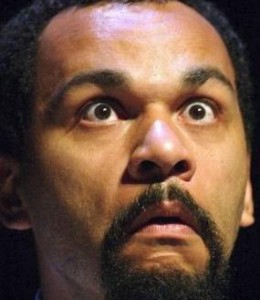 Dieudonné M’bala M’bala , the genius outspoken French comedian who rebelled against the primacy of Jewish suffering has been banned from entering Britain.
The Home Office has declared the performer persona non grata and warned he will not be allowed into the country. It has alerted airlines, other transport companies and border officials that the performer, whose stage name is Dieudonné, is an “excluded” individual. A spokesperson said: “We can confirm that Mr Dieudonné is subject to an exclusion order.” With 80% of our Tory MPs being Conservative Friends Of Israel you would expect England becoming a ghetto.
As we all know, in recent years the British governments have launched more than just one immoral Zionist interventionist war. In the name of elementary ‘freedom’ we dropped bombs and killed over a million of innocent Muslims. Hence, I am curious to know how the UK Home Office justifies its latest measure against freedom of speech. Do they really believe that a French comedian who hardly speaks English endangers our homeland security?
Humour is seemingly the last pocket of resistance. They are really afraid of being laughed at, after all, Dieudonne is telling the truth that The Guardians Of Zion can no longer suppress.
War on Drugs Ends with a Fizzle
By Kelley Vlahos • The Unz Review • February 4, 2014
Thanks to an accelerating trend towards ending the prohibition of marijuana in this country, the entire construct of the ‘War on Drugs’ as we know it is about to change and there is no one more frightened of this than the drug war establishment itself.
What happens next is a war for war: with billions of dollars in government investment and corporate profits at stake, it would be naive to expect the vested interests to take such a hit lying down. This is about survival. So get ready, the war to end the Drug War, or save it, has already begun.
“It scares us,” James L. Capra, head of Drug Enforcement Administration (DEA) operations, told congress on Jan. 15, when asked about the new marijuana legalization in Colorado and Washington state.
“Every part of the world where this has been tried, it has failed time and time again.”
Capra did not bother backing up this bold statement with any facts, but he did let his emotions do the talking – what The Washington Post account of this exchange did not capture but the raw CSPAN video (around the 50-minute mark) clearly does, is Capra’s attempt to appeal to the senators’ inherent fear of the drug. First, he proclaims his fealty to government service, then his fatherhood (six kids), then his voice, nearly trembling, enumerates the shock at recent developments:
“Going down the path of legalization in this country is reckless and irresponsible. I am talking about long-term impact … it scares us. The treatment people are afraid, the education people are afraid, law enforcement is worried about this … the idea that this is somehow good for us as a nation, sir … is wrong.”
But what Capra really seems exasperated about is this has been a popular shift in policy voted in by the people across the country, and not just by small pot interests with deep pockets. Sure, the efforts to promote the successful legalization referendums in Washington and Colorado had significant funding, but proponents tapped a diverse range of support, and made it an issue of fairness and economics, and about treatment over punishment. It’s a reality 55 percent of Americans are now willing to accept: prohibition just doesn’t work.
“Ten years ago, a DEA official talking like this would be like, well, duh,” said Mike Krause, director of the Justice Police Initiative at the Independence Institute in Colorado. “Now all of a sudden people are mocking him. I think what you are going to see is the drug war establishment really freak out.”
To call it an “establishment” might even be understating the situation. Even the late President Dwight D. Eisenhower would acknowledge that something akin to a Drug War Industrial Complex (DWIC) has been constructed like a sprawling empire around the criminalization of drugs, beginning in 1970, when marijuana was first declared a federal Schedule I narcotic and President Richard M. Nixon began to funnel money into expanded law enforcement efforts against pot and harder drugs like heroin and cocaine. The DEA was created in 1973.
Since then, both the public and private prison industry has swelled with millions of non-violent drug offenders, fueled by a seeming endless pipeline of policing and prosecution resources, and the advent of broader mandatory and “three-strikes” sentencing. The CIA and military have staked out their own turf in international interdiction. The DEA, beyond its domestic purview, has become a paramilitary force executing its own expensive missions all over Latin America and Afghanistan, i.e., Plan Columbia and the Merida Initiative. After launching the latest front — “Operation Anvil” – in Honduras, the DEA, working with U.S military, has been criticized for killing civilians in botched operations as recently as 2012.
Capping it off is the White House Office for National Drug Control Policy (ONDCP), led by a series of “drug czars,” some more zealous than others. It serves as a command center and generous trough for all government anti-drug measures, from questionably effective national media campaigns to the billion-dollar military operations more recently accelerated by the War on Terror. In fact, the DEA doubled its presence worldwide (87 offices in 63 countries) after the 9/11, developing a robust intelligence and law enforcement network all over the Americas and in Afghanistan, according to documents published by WikiLeaks two years ago.
ONDCP also directs teams of agents planted in High Intensity Drug Trafficking Areas (HIDTA) in U.S counties and states (covering about 60 percent of the population, according to its own website) for intelligence sharing, law enforcement assistance and prevention. Or as Rolling Stone put it last year, they are budgeted $238 million a year “to meddle in state-based marijuana policy reform.” That proved true during the run up to last year’s Colorado referendum. And don’t forget, President George W. Bush’s longtime czar, John Walters, spent most of the 2000’s campaigning in states against legalization and medical marijuana initiatives.
Who’s Panicking?
So today’s picture for Capra, and to some extent the latest DEA Director Michele Leonhart, and a score of ex-czars and other directors who have been scolding Attorney General Eric Holder for not getting tougher on the renegade states, must be stark. Brutally stark, when one looks at how much is at risk from the DWIC point of view if marijuana were ever federally legalized.
For example, according to a 2013 Congressional Research Service report, there are 19 federal agencies getting billions in anti-drug funding today. That’s a lot of programs and administrators and staff dependent on the status quo. Some beneficiaries are obvious, like the Department of Justice, the Pentagon and Department of Health and Human Services. But one wonders when the Agriculture Department, Bureau of Land Management and US Forest Service got on the front lines of the War on Drugs.
All told, $24.5 billion was appropriated to these agencies in 2013, a slight increase over 2012 numbers. Some $15.1 is allocated to “supply side” (law enforcement), while $9.3 billion is going to treatment and prevention. Add that to state and local funding and the country spends about $51 billion a year on the drug war, says the pro-decriminalization Drug Police Alliance.
Prosecutions and incarceration rates are humming, probably the only part of the drug war one could call “working” (if only they were bringing down abuse rates, keeping bad guys off the streets, or improving society, which they’re not). According to the Drug Policy Alliance, there were 1.5 million people in US arrested on non-violent drug charges in 2012. Of them, 749,825 were related to marijuana, and of that number, 658,231 were for possession only. Pot smokers are costing the system alright, but think of all the money they are paying into it, by way of court fees and fines, bail bondsman bondsmen and attorneys to defend them. Quite a tidy business.
Not surprisingly, those pot offenders unlucky enough go to jail (and we know they are disproportionately black), make up more than 10 percent of the state and federal incarcerated population today. In fact, one could say their absence would have a somewhat of radical effect.
For example, according to a Bureau of Justice Statistics Report, “Drug Use and Dependence, State and Federal Prisoners, 2004,” which uses the most recent data available, an estimated 333,000 Americans were imprisoned then on drug offenses (27 percent were for possession). Of all drug offenders behind bars, 12.7 were there on a marijuana rap (the majority, 60 percent, were there for cocaine/crack violations).
Crunching the numbers at the time, Paul Armentano, senior policy analyst for the National Organization for the Reform of Marijuana Laws (NORML), wrote, “Multiplying these totals by U.S. DOJ prison expenditure data reveals that taxpayers are spending more than $1 billion annually to imprison pot offenders.”
Writing for Reason magazine in 2012, Mike Riggs charged that beer and alcohol, addiction services, drug testing and the private prisons industries had the most to lose when the drug war ends and they know it.
“Corrections Corp. of America (CCA), the country’s largest private prison company, has donated almost $4.5 million to political campaigns and dropped another $18 million on lobbying in the last two decades,” he wrote. “The company, and others like it, is up to its elbows in drug war spending.”
Howard Wooldridge, a retired police officer who lobbies the government for marijuana decriminalization, told reporter Lee Fang that next to police unions, the “second biggest marijuana opponent on Capitol Hill is big PhRMA (Pharmaceutical lobby),” because pot can replace “everything from Advil to Vicodin and other expensive pills.”
The only front in this war that stands to survive might be the international theater – the DEA FAST and military operations — because they can pretend they were focusing the stronger stuff — heroin, cocaine — all along. But they might find, too, that a shift toward treatment over punishment might be shrinking their budgets and political capital back home (and the $7 billion failures in Afghanistan don’t help).
Meanwhile, noises toward full legalization in countries like Uruguay, Ecuador, Chile and even Mexico, might soon yank the welcome mat right off the front porch.
“Peer Pressure”
Could this be the end?
“The answer is categorically, yes. We are going to look back on this year down the road and say this is where it all started,” proclaims Jim P. Gray, who served as a Superior Court Judge in Orange County from 1989 through 2009 and adjudicated enough drug cases to make his own assessments about the dangers of prohibition. He wrote the book, Why Our Drug Laws Have Failed: A Judicial Indictment Of War On Drugs in 2001, and served as Gov. Gary Johnson’s running mate on the Libertarian Party ticket for president in 2012.
During an unsuccessful bid as a Republican for US Senate in 1998, Gray recalled a trip he made to Washington to meet with conservative leaders on Capitol Hill. On the issue of drugs, “they brought up the subject and almost literally, said ‘Jim, most people in Washington realize the drug war is lost … but this is money.’”
The political winds, however, have been blowing against the War on Drugs, and “if politicians are really good at any one thing, it’s followership, and they are starting to come out,” Gray said.
Bottom line, the “peer pressure” is growing. Consider that just in the last two weeks, Eric Holder has said that lawful marijuana businesses should have access to the American banking system. Meanwhile, at the World Economic Forum in Davos, former UN Secretary Kofi Annan and Colombian President Juan Manuel Santos, called for a rising up against drug prohibition.
They were joined on stage by Republican Gov. Rick Perry, who said in reference to the marijuana question, “states should be allowed to make those decisions.”
Four thousand miles away, a once uptight Senate Majority Leader Harry Reid was telling reporters, “we waste a lot of time and law enforcement going after these guys that are smoking marijuana.”
Just a week before, President Obama made headlines when he recalled his own dalliance with pot as a youth, and said, “I don’t think it is more dangerous than alcohol,” and, “we should not be locking up kids or individual users for long stretches of jail time when some of the folks who are writing those laws have probably done the same thing.”
Apparently, the DWIC is responding to this latest salvo in kind, and perhaps, there’s no going back. Reports from The Boston Herald say Obama’s own DEA Chief Michele Leonhart, “slammed him” over the comments in a speech she made before like-minded cops on Jan. 21.
“This is a woman who has spent 33 years of her life fighting drug abuse in the DEA, her entire life,” said attendee Donny Youngblood, a county sheriff and president of the Major Counties Sheriffs’ Association. He called the president’s comments “a slap in the face” to everyone in the room.
“I think the way that she felt was that it was a betrayal of what she does for the American people in enforcing our drug laws. … She got a standing ovation.”
Let the war to end the war begin.
Related articles


Featured Video

Seyed M. Marandi: US-Iran War Inevitable: Kuwait and Bahrain May Fall
or go to
Aletho News Archives – Video-Images
From the Archives
Oil and the Israel Lobby
Reknowned economist M. Shahid Alam offers this excellent critique of Noam Chomsky’s defective analysis of the relative influence of Oil versus the Israel lobby over US foreign policy: … continue
Blog Roll
 Aletho News
- ICC ignored ‘very well-documented’ NATO crimes – ex-Libyan minister
- SNSC secretary dismisses US response to Iran’s conditions as ‘inadequate’
- Sanaa says Taiz roads open, secure for residents, warns Saudi forces
- Iraqi resistance group urges Saudi leadership to admit defeat, lift Yemen siege
- Trump’s Retreat: How Al-Aqsa Flood Took Down the US Empire
- Israel’s Military Actions in Lebanon Grossly Violate International Law — Lavrov
- Seyed M. Marandi: US-Iran War Inevitable: Kuwait and Bahrain May Fall
- Leaders Condemn Ansarallah Attack on Saudi Arabia While Ignoring Illegal War Against Yemen
- Leaked: Britain’s Covert Iraqi Psyops Network
- Yemeni Armed Forces Warn Airlines Against Using Saudi Airports, Exempt Mecca and Medina
- If Americans Knew
- An error has occurred; the feed is probably down. Try again later.
- No Tricks Zone
- New Study Suggests Large Regions Of The Pacific Ocean Have Been Cooling For The Last 80 Years
- Germany’s Green Energy Debacle: High Energy Costs Force Kahla Porzellan to Close After 182 Years!
- New Study: 50 Years Of The Most Aggressive ‘Net Zero’ Policies Can Only Affect The Global Climate By 0.03°C
- US September “Heat” Was No Record…Many Records Set Decades Ago
- Latest European Green Energy Debacle; Portugal’s Largest Flagship Solar Park Insolvent!
- Green Energy Debacle: German Expert Professor Fritz Vahrenholt Warns Of Severe Economic And Social Consequences
- Two More Paleo Reconstructions Affirm Meters-Higher Sea Levels Across Ireland, Brazil 7000-6000 Years Ago
- New Study: Earth And Venus Surface Warmth Largely Explained By Convection And Lapse Rate, Not CO2 Or Radiation
- 2025 Nature Paper Claiming Worsening Global Drought Gets RETRACTED …Heavily Flawed
- New Study: ‘Global Drought Shows No Detectable Recent Acceleration Under Climate Warming’

