Polls Continue to Show Majority of Americans Against NSA Spying
By Mark M. Jaycox | EFF | October 7, 2013
Shortly after the June leaks, numerous polls asked the American people if they approved or disapproved of the NSA spying, which includes collecting telephone records using Section 215 of the Patriot Act and collecting phone calls and emails using Section 702 of the Foreign Intelligence Surveillance Act. The answer then was a resounding no, and new polls released in August and September clearly show Americans’ increasing concern about privacy has continued.
Since July, many of the polls not only confirm the American people think the NSA’s actions violates their privacy, but think the surveillance should be stopped. For instance in an AP poll, nearly 60 percent of Americans said they oppose the NSA collecting data about their telephone and Internet usage. In another national poll by the Washington Post and ABC News, 74 percent of respondents said the NSA’s spying intrudes on their privacy rights. This majority should come as no surprise, as we’ve seen a sea change in opinion polls on privacy since the Edward Snowden revelations started in June.
What’s also important is that it crosses political party lines. The Washington Post/ABC News poll found 70 percent of Democrats and 77 percent of Republicans believe the NSA’s spying programs intrude on their privacy rights. This change is significant, showing that privacy is a bipartisan issue. In 2006, a similar question found only 50 percent of Republicans thought the government intruded on their privacy rights.
Americans also continue their skepticism of the federal government and its inability to conduct proper oversight. In a recent poll, Rasmusson—though sometimes known for push polling—revealed that there’s been a 30 percent increase in people who believe it is now more likely that the government will monitor their phone calls. Maybe even more significant is that this skepticism carries over into whether or not Americans believe the government’s claim that it “robustly oversees” the NSA’s programs. In a Huffpost/You Gov poll, 53 percent of respondents said they think “the federal courts and rules put in place by Congress” do not provide “adequate oversight.” Only 18 percent of people agreed with the statement.
Americans seem to be waking up from its surveillance state slumber as the leaks around the illegal and unconstitutional NSA spying continue. The anger Americans—especially younger Americans—have around the NSA spying is starting to show. President Obama has seen a 14-point swing in his approval and disapproval rating among voters aged 18-29 after the NSA spying disclosures.
These recent polls confirm that Americans are not only concerned with the fact that the spying infringes their privacy, but also that they want the spying to stop. And this is even more so for younger Americans. Now is the time for Congress to act: click here now to join the StopWatching.Us coalition.
Related articles
FARC Insists on Need to Eliminate Factors Leading to State Terrorism
Prensa Latina | October 7, 2013
 Havana – The Revolutionary Armed Forces of Colombia – People”s Army (FARC-EP) insisted today on the need to reach an agreement and implement mechanisms to eliminate those factors that enable State terrorism, thus avoiding a post-conflict ”dirty war”.
Jesús Santrich, member of the guerrilla delegation, referred to the elimination of the National Security Doctrine, the conception of the internal enemy and paramilitarism, in a communique issued today here in Havana.
He also recalled the message from Attorney General Eduardo Montealegre, forecasting a ‘dirty war’ after the eventual signing of a peace treaty, and stressed the need to avoid it.
He added that this will be one of the greatest challenges for the Colombian State.
Santrich said that a peace agreement for Colombia cannot be reached without effective political guarantees and respect for human rights of all.
The FARC-EP insisted on the request to create a Commission to revise and clarify the history of the Colombian conflict, in order to analyze the circumstances of the current war.
Rep. Mike Rogers Threatens Extrajudicial Execution
By Daniel McAdams | Neocon Watch | October 4, 2013

The US State Department every year releases its Country Reports on Human Rights Practices, arrogating to itself the right to judge how the rest of the world measures up to US standards of respect for human rights.
One of the key measurements the US uses to determine whether the rest of the world is up to its stated standards of human rights protection is whether the country engages in “extrajudicial executions,” i.e. the state killing people without a legal trial. Needless to say, countries which engage in or promote extrajudicial killing are considered among the worst of the human rights abusers.
At a Washington Post sponsored panel yesterday on cybersecurity attended by former NSA/CIA chief Michael Hayden and by current Chairman of the House Intelligence Committee Mike Rogers (R-MI), Hayden quipped that while NSA leaker Edward Snowden is on the consideration list for a European Human Rights Award, he had “also thought of nominating Mr. Snowden, but it was for a different list.”
Considering the input that Hayden had over the US administration’s “kill list,” the implication was fairly clear. One might imagine what among some at least was (hopefully) nervous laughter.
Is it funny to joke about killing someone when everyone knows you have had the power to make it happen? At least Hayden made the comment while he was no longer serving in a position where he could call out the drones.
What is worse, however, was the reaction of the neoconservative warmonger and enemy of civil liberties, Chairman Mike Rogers. To Hayden’s confession that he had thought of putting Snowden on “a different list,” Rogers did not miss a beat.
“I can help you with that,” Rogers said.
It is incredible to imagine that an individual in such a powerful position as is Mike Rogers — not just a Member of Congress but the Chairman of the Committee that coordinates with the CIA, NSA, and the rest of the Intelligence Community on matters covert and operational — would even if perhaps in a lighthearted moment make such a deeply disturbing comment.
Killing is so casual to people like Rogers.
It is the kind of thing that — were the US not the authors — would be written up in a report on human rights abuses and threats to the rule of law.
Related article
Bahrain dictatorship charges opposition ex-MP with inciting terror
Press TV – October 5, 2013
Bahrain general prosecutor says senior opposition and ex-MP, Khalil Marzooq, has been referred to court on charges of “inciting terrorist crimes.”
Abdulrahman al-Sayyed said in a statement on Saturday that Marzooq, a leading figure in the kingdom’s main opposition group, al-Wefaq, would also face charges of “promoting acts that amount to terrorist crimes.”
Marzooq was arrested on September 17. He served as deputy speaker in Bahrain’s 40-member parliament before a walkout was staged in 2011 by 18 members of al-Wefaq in protest against the violent crackdown on anti-regime demonstrators.
The statement added that Marzooq was also accused of using his position in al-Wefaq to call for “crimes” that are regarded as “terror acts under the law.”
The prosecutor also confronted Marzooq for his public speeches in which he supported an opposition group known as the Coalition Youth of February 14 Revolution.
On September 18, al-Wefaq, Bahrain’s main opposition group, boycotted national reconciliation talks in protest against the detention of Marzooq.
Last Sunday, a court in the kingdom sentenced 50 Shias to up to 15 years in jail for forming the Coalition Youth of February 14 Revolution.
The Bahraini uprising began in mid-February 2011. Protesters initially called for political reform and a constitutional monarchy, a demand that later changed to an outright call for the ouster of the ruling Al Khalifa family following its brutal crackdown on popular protests.
Scores have been killed, many of them under torture while in custody, and thousands more detained since the popular uprising in the Persian Gulf kingdom.
Related article
NSA targeting users of Internet privacy tool
Press TV – October 5, 2013
New documents have shown that the US National Security Agency has targeted people using a popular service which protected the anonymity of Internet users.
Documents leaked by former intelligence contractor Edward Snowden have revealed the US spy agency has targeted users of The Onion Router (Tor) which helped web users keep business secrets and conduct research anonymously.
According to the documents, the agency has been collecting identities and locations of millions of users of Tor.
Tor aims to help people “defend against traffic analysis, a form of network surveillance that threatens personal freedom and privacy, confidential business activities and relationships, and state security.”
However, the NSA has followed Tor’s users, while the software is primarily funded and promoted by the US State Department and the Department of Defense.
The agency has been using ad networks like Google’s and Tor’s own entry and exit nodes on the Internet in order to track the users.
In addition, the surveillance agency has been able to block access to the anonymous network, diverting Tor users to insecure channels.
The NSA has repeatedly uncloaked users through circumventing Tor’s protections, although it cannot directly access Tor’s anonymous network.
One of the documents showed that an NSA technique code-named EGOTISTICALGIRAFFE had managed to unmask 24 Tor users over a single weekend.
Court documents have shown that the NSA violated privacy rules for years with improper surveillance practices.
The documents released over the past few months show a troubling picture of the super spy agency that has sought and won far-reaching surveillance powers to run complex domestic data collection without anyone having full technical understanding of the efforts.
The privacy violations were first revealed by Snowden in June. He leaked confidential information that showed the NSA collects data of phone records and Internet communications of American citizens.
Related article
Recent Revelations Prompt Motion To Block NYPD’s Surveillance Of Muslims
By Tim Cushing | Techdirt | October 4, 2013
A recent investigative report on the NYPD’s surveillance of mosques has led to a possible revisiting of the Handschu Agreement by the federal judge presiding over a lawsuit filed against the city seeking to bar further surveillance of Muslims in New York City.
According to the 1985 ruling, the Handschu Agreement limited indiscriminate surveillance of purely political activity. If such surveillance was to take place, it first had to be approved by the three-member Handschu Authority and performed only by the specially-designated Public Security Section, a division of NYPD Intelligence. It also prohibited the videotaping or photographing of large public gatherings when there was no indication of criminal activity and forbade the sharing of information with outside agencies unless they agreed to be bound by the limitations of the Agreement.
This is what was assumed to be in place. When the plaintiffs filed in February, their attorney pointed out that the police activity that had been observed clearly violated those limitations.
The police measures directed at Muslims violate the Handschu decree “because they’re not rooted in the fact that there’s a criminal predicate,” said plaintiff attorney Paul Chevigny. “They’re rooted in the fact that the subjects are Muslims.”
It was exactly as it looked: Muslims being placed under surveillance simply because they attended certain mosques — mosques the NYPD had declared to be “terrorist organizations.”
The city has countered by claiming that it closely observes the Handschu guidelines when making decisions about how to fight terror. A city lawyer, Peter Farrell, told the judge on Tuesday that the department launches investigations based on evidence of legitimate threats, not on religion.
“It’s undeniable that New York City remains at the center of the threat by Islamists who have been radicalized to violence,” he said.
What the city lawyer’s conveniently left out was that the Handschu guidelines had been deliberately weakened by the NYPD, thanks to the efforts of a former CIA officer and his CIA liaison, who formed a so-called “Demographics Group” that was charged with monitoring activity by the city’s Muslims.
[T]he activities that [CIA liaison Larry] Sanchez and [former senior CIA officer David] Cohen were proposing would not have been permitted under the Handschu guidelines. So, on September 12, 2002, Cohen filed a 23-page document in federal court asking a judge to throw out the guidelines and give his officers more leeway.
Cohen insisted that the world had changed since Al Qaeda attacked America, and the NYPD needed to change with it. “These changes were not envisioned when the Handschu guidelines were agreed upon,” he wrote, “and their continuation dangerously limits the ability of the NYPD to protect the people it is sworn to serve.”
The severely watered-down Handschu guidelines were approved by Judge Charles Haight. The name remained unchanged and most New Yorkers were unaware that hardly any limitations remained tied to the Agreement.
After securing this expanded definition (which also thoroughly abused the word “related”), the Demographics Group proceeded to declare entire mosques as “terrorist organizations” and began constant surveillance of their members. And, contrary to what the city’s lawyer declared, it has yet to be proven by the NYPD or anyone else that New York is the “center of the threat by Islamists.” The NYPD has spent millions of dollars and thousands of manhours surveilling and investigating Muslims and has turned up exactly zero useful leads.
When the plaintiffs filed this case, they had no idea the Handschu guidelines had been so thoroughly eviscerated. Armed with this new knowledge, the plaintiffs have asked the city to turn over so-called “investigative statements” related to these surveillance operations. The city won’t even meet them halfway, offering only to turn over a “handful” for the plaintiffs’ lawyers to view without making them part of the public record.
Technically, the city is correct: the NYPD is following the guidelines, as they have been altered, not as they were originally written.
The presiding judge says he will rule at a later date. However, one key factor is problematic. The presiding judge is Charles Haight, the same judge who agreed to relax those rules for the NYPD back in 2002. When he says something like this, it’s hard to know how to take it.
“I’ve come to think of this case as a volcano that’s asleep most of the time … but every now and then blows up,” U.S. District Judge Charles Haight said at the start of a hearing in federal court in Manhattan.
This “volcano” is at least partially of his own making. Haight knows how few restrictions remain under those guidelines. The NYPD can “closely observe” the relaxed Handschu guidelines and still place entire mosques under surveillance. The protections remaining are so weak and the scope of what is deemed “terrorist-related” so broad that even the CIA itself is unable to use the information collected by the Demographics Unit because doing so means violating CIA policies regarding domestic surveillance.
But it appears (although details are incredibly light) that Haight may revisit his own decision relaxing those guidelines. His upcoming ruling will determine whether the near-useless offer the city’s lawyer made will be sufficient or if the city will need to cough up what’s been requested: investigative statements related to “any operation targeting Muslims.” Haight will also make the call as to whether the documents will remain “off the record.”
The NYPD has never been very responsive when asked to turn over information, but considering this order may come from a federal judge, rather than a member of the public, the response time might be a little quicker. As for the plaintiffs, it would seem they drew possibly the least sympathetic judge to hear this case. But who knows, maybe Haight’s had a change of heart over the years. Many rash legislative and legal decisions were made shortly after the 9/11 attacks and there have been more than a few who have expressed regret for their decisions or dismay at the continual expansion of already-broad policies. Haight might be one of the ones who regrets his decision. Fortunately, he’s still in a position to make some changes.
Belgium demands explanation from British spy agency
Press TV – October 5, 2013
Belgium has demanded explanations from the British Government Communications Headquarters (GCHQ) over allegations that it infiltrated major Belgian national telecom provider Belgacom.
The allegations against GCHQ were made after documents, leaked by US whistleblower Edward Snowden, pointed to the British agency’s spying activities against Belgium.
According to reports in the German newspaper Der Spiegel, the Cheltenham-based intelligence agency has been accused of hacking the IT system of Belgacom by placing a virus in its network.
“Following the article in Der Spiegel, the government asked Belgian intelligence services to ask their British colleagues for more information,” said a source close to the Belgian government.
Prosecutors in Brussels are now investigating the case against the British spy agency.
A GCHQ spokeswoman declined to comment on the revelation.
Meanwhile, the European Parliament is also examining the activities of the GCHQ. European courts have launched a legal challenge against the agency’s surveillance programs over violating the privacy of millions of people throughout Britain and Europe.
However, London claims the EU does not have the authority to investigate these charges in European courts.
Snowden is currently in Russia, where he has been granted temporary asylum.
Related articles
- Belgium seeks answers from Britain over telecom spying (dnaindia.com)
- UK intelligence spying on Belgium – Snowden leaks (voiceofrussia.com)
- GCHQ: EU surveillance hearing is told of huge cyber-attack on Belgian firm (theguardian.com)
- Privacy advocates vs. GCHQ: Groups launch EU court case against spy agency (RT)
US political prisoner dies three days after being freed from 41 years of solitary confinement
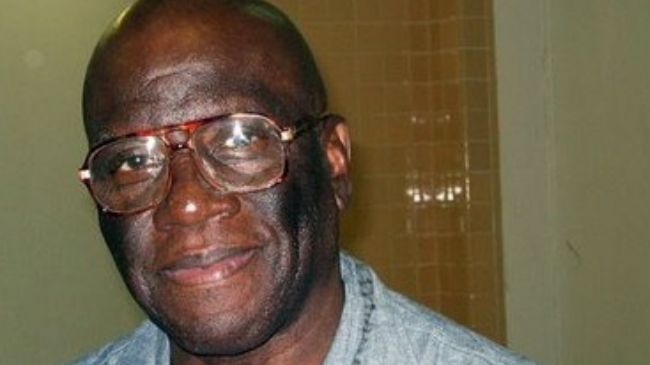
Herman Wallace was freed on Tuesday
Press TV – October 4, 2013
An American prisoner, who was released a few days ago after spending 41 years in solitary confinement, has died of liver cancer.
The 71-year-old Herman Wallace was freed on Tuesday after a US federal judge overturned his conviction for the murder of a prison guard, saying his 1974 trial had been “unconstitutional.”
His attorneys said he died at a supporter’s home in New Orleans.
“One of the final things that Herman said to us was, “I am free. I am free”,” they said.
Wallace, who was a former Black Panther and member of the “Angola 3,” and two other inmates were held in solitary confinement for years.
Wallace and Albert Woodfox, who was also convicted, have denied the killing, saying they were set up because they founded a chapter of the Black Panthers at Angola.
The inmates charged with killing the guard became known as the “Angola 3.” The third prisoner eventually became a prosecution witness.
Louisiana, where he was imprisoned, had refused to free Wallace on medical grounds over his terminal cancer.
Campaigner for Amnesty International Tessa Murphy criticized prison officials.
“The Louisiana prison authorities put this man through hell,” Murphy said. “There were longstanding concerns about the safety of his conviction and it’s some small consolation that Herman died a free man.”
Related article
EXPOSED: The iPhone and The Government Biometric Database
RINF Alternative News | October 2, 2013
A recent video released by hacktivist group Anonymous presents compelling evidence which claims that Apple’s TouchID technology is linked to the FBI and NSA and is involved in the provision of information on users for a large-scale biometric database under construction by the US Government for use “both domestically and on the battlefield”.
This biometric database is due to be populated by any personal information retrieved by government agencies, leading to fears that Big Brother’s eye is following us wherever we go and whatever we do, even in the privacy of our own homes.
Anonymous alleges that they have uncovered proof of a corrupt alliance of Department of Defense contractors, NSA and CIA-related venture capital which led to the development of technologies subsequently purchased by Apple.
These findings were the result of investigation by Barrett Brown, the jailed and gagged journalist and links to further enlightening material have been posted on the Pastebin website and were largely based on documents obtained by the US defense contractor ManTech in 2010.
So what exactly are these revelations? Firstly, Anonymous claim that there are links between AuthenTec (the company bought by Apple to enable them to develop the TouchID technology) and the “most powerful and corrupt” Defense Department and intelligence community contractors and officials. Anonymous concentrate largely on one individual – Robert E Grady, a prominent figure and political speechwriter under both Bush administrations – when delineating and highlighting the opaque relationships between big business and the US government.
During his time sitting on the board of AuthenTec, Grady was a formerly leading partner in The Carlyle Group, an investment firm which previously owned not only Authentec, but also was the main shareholder of Booz Allen Hamilton, the NSA contractor and erstwhile employer of whistleblower Edward Snowden.
Anonymous presents further claims that the Authentec board of directors ensured that the company would be sold exclusively to Apple, due to the company’s position as market-leader, as this in turn would encourage rival companies to adopt the same technology in order to compete. They state that the launch of the Apple iPhone 5S has meant that secret surveillance and biometric collection has heightened into a full-scale assault on personal data and privacy.
However, other commentators suggest that Apple’s fingerprint security feature may be the thin end of the wedge in terms of biometric collection and consumer devices. Internationally, increasing numbers of countries are deploying biometric technology within organs of the state and rumours abound that biometrics – such as fingerprinting and facial recognition – will soon be a standard feature on game consoles and other electronic leisure products and household gadgets.
Apple’s lack of transparency regarding their usage of data obtained secretly from their customers is not restricted to their newest innovations, either. As far back as 2011 technological researchers were warning that the company could face law suits for breaches of privacy in relation to the storing of users’ locations and other personal information in secret files, which stores location coordinates with a timestamp to effectively map and record the precise movements of individuals.
The implication of this would be the danger this data could fall into the wrong hands if someone was able to hack the system. It is unclear why Apple is storing this data, but it is clearly intentional as such information on the database is being restored across backups and even device migrations. In 2010 Apple was once again the target of claims of privacy violation when a class-action suit was filed against them in a US Federal Court. The claim was that earlier models of the iPhone and iPad contained unique identifying elements, known as Unique Device Identifiers, which allowed advertising agencies track which applications were being downloaded by users, how frequently they were being used and for what period of time.
Users are unable to block the transmission of the UDID, a 40-character string that uniquely identifies each device. The lawsuit alleged: “Some apps are also selling additional information to ad networks, including users’ location, age, gender, income, ethnicity, sexual orientation and political views.” Apple has continuously denied that it transmits user-data without consent, but this has done little to ease fears that the company’s actions constitute an intrusive tracking scheme which aids and abets serious invasions of privacy.
Related articles
NSA chief admits govt collected cellphone location data
RT | October 02, 2013
The director of the National Security Agency admitted this week that the NSA tested a program that collected cellphone location data from American citizens starting in 2010, but suspended it shortly after.
Gen. Keith Alexander, the head of both the NSA and the United States Cyber Command, told lawmakers in Washington early Wednesday that the secretive pilot program was taken offline in 2011, but that the intelligence community may someday in the future make plans to routinely collect location data about US citizens.
Alexander briefly discussed the program during a Senate hearing on the Hill early Wednesday that focused on the data provided to the government through the Foreign Intelligence Surveillance Act, or FISA, including programs that were exposed earlier this year by unauthorized disclosures attributed to contractor-turned-leaker Edward Snowden.
Only days earlier, Sen. Ron Wyden (D-Oregon) asked Alexander during a Senate Intelligence Committee hearing if the NSA was collecting location data on American citizens.
“I’m asking, has the NSA ever collected, or ever made any plans to collect, American cell site information?” Wyden asked last Thursday.
The NSA, Alexander responded at the time, “is not receiving cell-site location data and has no current plans to do so.”
During this Wednesday’s hearing, Alexander explained that, “In 2010 and 2011, NSA received samples in order to test the ability of its systems to handle the data format, but that data was not used for any other purpose and was never available for intelligence analysis purposes.”
According to a written copy of the statement obtained by The New York Times before Wednesday’s hearing, Alexander said that location information is not being collected by the NSA under Section 215 of the Patriot Act. Alexander did not discuss if any other laws are being implemented to otherwise allow for the collection and analysis of location data.
Moments after Alexander revealed the pilot program before the Senate committee, he said that the NSA may someday want to seek approval from Washington to revive that initiative as part of a fully functioning intelligence gathering operation.
“I would just say that this may be something that is a future requirement for the country, but it is not right now,” Alexander said.
Alexander’s statement regarding the new defunct program was expected, and obtained by The New York Times moments before Wednesday’s hearing was underway. Times reporter Charlie Savage wrote that morning that information about the pilot project was only recently declassified by Director of National Intelligence James Clapper, and that the draft answer obtained by the paper and later read aloud by Alexander was prepared in case he was asked about the topic.
Still unsatisfied by the intelligence community’s explanation about the collection of cellphone location data, Sen. Wyden supplied the Times with a response suggesting that the truth behind the NSA’s activities isn’t being fully acknowledged by the intelligence community.
“After years of stonewalling on whether the government has ever tracked or planned to track the location of law-abiding Americans through their cellphones, once again, the intelligence leadership has decided to leave most of the real story secret — even when the truth would not compromise national security,” Wyden said.
In March, Wyden asked Clapper to say if the NSA was collecting personal information on millions of Americans. The intelligence director dismissed that allegation, then later apologized to the Senate for offering a “clearly erroneous” response.
“Time and time again, the American people were told one thing about domestic surveillance in public forums, while government agencies did something else in private,” Wyden told the Senate Intelligence Committee panel of witnesses last week, which included Alexander, Clapper, and Deputy Attorney General James Cole.
During last week’s meeting, Wyden said he “will continue to explore that because I believe this is something the American people have a right to know whether the NSA has ever collected or made plans to collect cell-site information.”
Related articles
Featured Video

Why Hamas Really Attacked Israel on Oct. 7
or go to
Aletho News Archives – Video-Images
From the Archives
Confronting the Threat of Ethnic Bioweapons
By Tony Cartalucci – New Eastern Outlook – 29.11.2017
The United States Air Force’s 59th Medical Wing’s molecular biology branch recently was revealed to have been collecting specifically Russian RNA and synovial (connective) tissue samples, prompting fears in Russia of a possible US directed ethnic-specific bioweapons program. … continue
Blog Roll
 Aletho News
- Meet the US generals and admirals advancing Israeli policy
- Israel’s Straw Widow Protocol: The Kill Zones Where Civilians Were Labelled ‘Terrorists’
- Leading Israeli Think Tank Publishes Psychotic Israeli ‘National Security’ Doctrine
- Are the United States and Israel in Decline-and-Fall Mode?
- Why Hamas Really Attacked Israel on Oct. 7
- Declassified UK exposes British man who fought for ‘Israel’ in Gaza
- West’s death cult in a theater near you
- How the Yandex ‘Russian bots’ lie fell apart
- Burnham’s ‘Russia did Brexit’ ruse crumbles
- Estonia making movies and games to encourage war against Russia
- If Americans Knew
- Gaza’s “ceasefire” death toll passes 1,500 – Daily Update
- Activists Abused By Israel Return to New Freedom Flotilla Mission
- 60 Minutes won’t tell the full truth about Israeli settler violence
- Nearly 50,000 women, girls killed or severely injured in Gaza since October 2023: UN Women
- ADL is working with AI companies to suppress alleged ‘antisemitism’
- Israeli occupation forces using social media surveillance unit to target hundreds of Palestinians in the West Bank
- Israel’s New – and Terrifying – Security Doctrine
- Israeli Attacks Kill Five in Gaza, Including a four-year-old and a woman
- Air Force Major Who Called for Trump’s Impeachment Held in Solitary Confinement
- It’s a Genocide, I’m Into It’: Seinfeld Mocks Protest over Palestinian Children Killed
- No Tricks Zone
- New Study Suggests Large Regions Of The Pacific Ocean Have Been Cooling For The Last 80 Years
- Germany’s Green Energy Debacle: High Energy Costs Force Kahla Porzellan to Close After 182 Years!
- New Study: 50 Years Of The Most Aggressive ‘Net Zero’ Policies Can Only Affect The Global Climate By 0.03°C
- US September “Heat” Was No Record…Many Records Set Decades Ago
- Latest European Green Energy Debacle; Portugal’s Largest Flagship Solar Park Insolvent!
- Green Energy Debacle: German Expert Professor Fritz Vahrenholt Warns Of Severe Economic And Social Consequences
- Two More Paleo Reconstructions Affirm Meters-Higher Sea Levels Across Ireland, Brazil 7000-6000 Years Ago
- New Study: Earth And Venus Surface Warmth Largely Explained By Convection And Lapse Rate, Not CO2 Or Radiation
- 2025 Nature Paper Claiming Worsening Global Drought Gets RETRACTED …Heavily Flawed
- New Study: ‘Global Drought Shows No Detectable Recent Acceleration Under Climate Warming’

