Bloody protests rock Iraqi Kurdistan
Press TV – February 20, 2011
Violence has again rocked the streets of the Iraqi city of Sulaymaniyah as Kurdish demonstrators continue to demand the ouster of the Kurdistan Regional Government.
Following a peaceful demonstration Saturday afternoon, protesters began burning tires on the street in front of the Kurdish Democratic Party (KDP) headquarters and pelting rocks at military and police forces, a Press TV correspondent reported.
They said the move was in retaliation for those killed and injured during Thursday’s protest.
Based on unofficial reports and eyewitnesses, demonstrations that began Thursday have so far left four dead and around 70 injured.
The report adds that some 5,000 KDP military forces were deployed on the streets of Sulaymaniyah over the past two days.
Following popular demonstrations in Iraqi Kurdistan over poverty and unemployment as well as financial and administrative corruption, Sulaymaniyah University students also joined the protests on Saturday.
As shots rang out on streets in the background during a brief talk with the Press TV reporter, Sulaymaniyah Police Chief Amed Salar claimed he had no idea who was shooting and why.
“I have no information, I don’t know what is going on, I don’t have any idea,” Salar told our correspondent.
Riot police were called in to stop the unrest. In ensuing clashes, 10 were arrested and 15 injured, including one journalist that was shot in the foot and at least two more that were beaten by police.
“I was covering the protests when security forces attacked me, they beat me with baton and never asked who I was. I have an ID card and I said I am working for Payam TV channel,” journalist Wrya Hussein told Press TV.
Ruling parties have pointed the finger at the leading opposition party Goran for inciting unrest after they released a statement last month calling for the dissolution of the Kurdistan Regional Government.
But the Goran Party says their members have had no role in recent demonstrations. Although the party supports the right of people to protest, it says that it does not, in any way, condone violence used by protesters over the past three days.
Students at the University of Sulaymaniyah say they will continue demonstrations until the KDP forces leave the city and they receive answers from the government about Thursday’s shootings.
Six killed in Yemen clashes
Press TV – February 20, 2011
At least six people have been killed in clashes between pro-democracy protesters and forces loyal to Yemeni President Ali Abdullah Saleh’s regime.
Four people lost their lives during protests in the southern port city of Aden on Saturday, and a student was killed in the southern city of Taiz, a Press TV correspondent reported.
Another student demonstrator was killed near the Sana’a University campus in the capital on the same day. The 16-year-old youth was shot dead while government supporters armed with guns, batons, and rocks were trying to break into the campus.
Yemeni security forces reportedly did not intervene.
There were also a number of incidents on Friday.
According to witnesses, at least three pro-democracy protesters were killed on Friday and dozens of others injured during clashes with security forces in Aden’s Khor Maqsar district.
A hand grenade hurled into a crowd of demonstrators in the city of Taiz killed two people and left at least 25 more injured.
And Saleh supporters armed with batons and axes attacked a pro-democracy demonstration and wounded at least four protesters in Sana’a on Friday.
Friday’s deadly violence came a day after Yemeni riot police opened fire to disperse thousands of pro-democracy demonstrators in Aden, killing four protesters and injuring 17 others.
In Sana’a, 40 people were injured after Saleh loyalists armed with guns attacked a crowd of protesters on Thursday.
Saturday marked the ninth day of pro-democracy protests in Yemen.
Yemenis, angered by corruption and unemployment in the country and inspired by the revolutions in Egypt and Tunisia, are demanding that Saleh step down after 32 years of autocratic rule.
Last week, Saleh again said that he would not run in the 2013 presidential election and would not hand over power to his son.
Blood on the Streets of Bahrain
Days of Rage; Decades of Oppression
By RANNIE AMIRI | CounterPunch | February 18, 2011
Bahrain has one of the most advanced medical systems in the Middle East, the best ICT sector in the region and the fastest growing economy in the Arab world.
But despite all these accomplishments, the country seems to be missing just one little thing: a doctor who can identify signs of torture.
– Benjamin Joffe-Walt writing for Change.org, 12 November 2010
February 14th was Bahrain’s turn for its “day of rage” against the striking social, political and economic inequities found in the tiny island kingdom. For those familiar with its modern history, however, they know there was no need to dub it such; Bahrainis have long raged against policies of exclusion, marginalization and sectarianism embodied in al-Khalifa family rule.
To fully appreciate Bahrain’s inherent volatility, it is important to understand both its demographics and political structure. These have been detailed in past essays which new readers can review. Briefly, of 1.2 million people in the Persian Gulf nation, only about 530,000 are Bahraini nationals. Of these, at least 70 percent are Shia Muslims. The king, Sheikh Hamad bin Isa al-Khalifa, and the al-Khalifa dynasty that has ruled Bahrain for two centuries, are Sunni Muslims.
If meaningful, representative, democratic institutions were present in the country, the sectarian incongruity would be a mere footnote. Unfortunately, that is far from the case. The civil, political and human rights of Shia citizens have been trampled on for decades by the monarchy. This wholly belies the claim that Bahrain is a beacon of democracy and reform among Persian Gulf nations (a notion likewise promulgated by its stalwart ally, the United States).
The notorious citizenship laws—giving non-Bahraini Sunnis expedited citizenship and voting rights in a backdoor attempt to alter the state’s confessional makeup—is one of many examples of how the monarchy has long bred resentment and anger among the majority population.
The disenfranchised, poverty-stricken Shia hold no significant positions in government. Although they comprise 80 percent of the labor force, they are absent from the public sector. They are completely unrepresented in the security services: of the 1,000 employed in the National Security Apparatus, more than two-thirds are non-Bahraini (Jordanians, Egyptians, Pakistanis etc.) and overwhelmingly Sunni. Bahraini Shias constitute less than five percent of the NSA and occupy only low-level positions or act as paid informants.
The paramilitary Special Security Forces operates under the supervision of the NSA and numbers 20,000—90 percent of whom are non-Bahraini. The SSF does not include a single Bahraini Shia officer.
These security forces, housed in Manama’s upscale neighborhoods of course, are routinely unleashed on Bahraini Shia protesting their lot—imported henchmen serving to oppress the king’s subjects.
Last summer, the government rounded up dozens of human rights workers, religious leaders and opposition figures who demanded an end to the regime’s habitual use of torture. Twenty-five were charged with “contacting foreign organizations and providing them with false and misleading information about the kingdom.” Half were charged with attempting to stage a coup. . In total, 450 have been arrested, including the well-known pro-democracy blogger Ali Abdulemam.
Claiming they were tortured by security forces before being put on trial, the government’s expert medical examiner concluded the bruises, wounds, cuts and burns found on detainees’ bodied were not the result of torture.
Indeed, its specter looms over all those who oppose al-Khalifa rule.
In February 2010, Human Rights Watch released a landmark report titled “Torture Redux: The Revival of Physical Coercion during Interrogations in Bahrain.” It chronicles the routine use of torture and degrading treatment for the purpose of extracting confessions from political opponents. The organization’s 2011 World Report reaffirms the practice continues. Even more disturbing, Bahraini children have not been spared physical and sexual abuse at the hands of the secret police.
But choosing Feb. 14 as Bahrain’s day of rage was not done randomly. It marked the tenth anniversary of the referendum on the National Action Charter, which Sheikh Hamad promised would transform the Kingdom into a constitutional monarchy, and the ninth anniversary of the 2002 constitution purportedly enacting it.
It was all for show. Despite Bahrain’s elected parliament, real power lies with the upper house Shura Council. The Shura Council has the authority to approve or rescind any legislation passed by the lower house Council of Representatives. Shura members, unsurprisingly, are directly appointed by the king.
Monday’s protestors, who acted peacefully by all accounts, were met by riot police using live ammunition. Scores were injured. The uprising’s first martyr, 27-year-old Ali Abdul Hadi Mushaima, was killed by a gunshot wound to the back. At his funeral procession Tuesday, security forces fatally shot Fadel Salman al-Matrouk, 31, a mourner who had gathered with others in front of the hospital where Mushaima died.
Sensing the potential for unrest, the king granted each Bahraini family $2,650 in cash before protests even began. After Mushaima and al-Matrook’s deaths, he went on television to express his regret and promise an investigation into their deaths. As in Egypt, the regime’s actions woefully lagged behind events on the ground.
Thousands of Bahrainis occupied Manama’s Pearl Roundabout Tuesday and Wednesday, with the youth at the helm. They chanted, “No Shiites, no Sunnis, only Bahrainis.” Tents were set up and preparations were made for a long peaceful encampment.
Early Thursday morning, while protestors slept, the situation took an ugly, violent turn. Riot police stormed through the camp, killing four and injuring 100. Sixty people are reported missing (numbers at the time of this writing, all likely to increase). Tanks were out in full force as hundreds flooded into hospitals. Manama is now in lock-down.
Statements of those present come from an AP report:
“They were beating me so hard I could no longer see. There was so much blood running from my head … I was yelling, ‘I’m a doctor. I’m a doctor.’ But they didn’t stop.”
“We yelled, ‘We are peaceful! Peaceful!’ The women and children were attacked just like the rest of us … They moved in as soon as the media left us. They knew what they’re doing.”
“Then all of a sudden the square was filled with tear gas clouds. Our women were screaming. … What kind of ruler does this to his people? There were women and children with us!”
Bahrainis’ demands are clear: the resignation of Prime Minister Khalifa bin Salman al-Khalifa—who has governed since 1971—to be replaced by an elected premier, the release of all political prisoners, a new constitution, an end to the systematic discrimination against Shias and all forms of sectarianism, repeal of the citizenship laws, fairness in distribution of jobs and housing, freedom of the press and religion, and an end to torture.
The al-Khalifa monarchy and its imported mercenaries are at a crossroads. The protestors’ demands are reasonable and legitimate. The king would be wise to accede to them before overthrow of the entire regime becomes their only acceptable alternative. After Thursday’s violent crackdown against unarmed civilians, there may now be no other option.
~
Rannie Amiri is an independent Middle East commentator.
Omar Barghouti kept from entering the U.S. for BDS speaking tour
February 18, 2011
The following press release was just issued by the publisher of Omar Barghouti’s upcoming book:
Effectively canceling a planned speaking tour, the U.S. consulate in Jerusalem has inexplicably delayed the granting of a visa for Omar Barghouti, founding member of the Palestinian Civil Society Boycott, Divestment, Sanction (BDS) campaign, due to tour the United States this April for the release of his new book, Boycott, Divestment, Sanctions: The Global Struggle for Palestinian Rights.
Nobel Peace Laureate, Archbishop Desmond Tutu called the book “lucid and morally compelling… perfectly timed to make a major contribution to this urgently needed global campaign for justice, freedom and peace.” Former President of the UN General Assembly, Father Miguel d’’Escoto Brockmann called it “timely and responsibly written by a man who understands that creative nonviolence is the only way out of the dire situation in Palestine.””
In recent years, numerous foreign scholars and experts have been subject to visa delays and denials that have prohibited them from speaking and teaching in the U.S.—a process the American Civil Liberties Union describes as “Ideological Exclusion,” which they say violates Americans’ First Amendment right to hear constitutionally protected speech by denying foreign scholars, artists, politicians and others entry to the United States. Foreign nationals who have recently been denied visas include Fulbright scholar Marixa Lasso; Iraqi doctor Riyadh Lafta, who disputed the official Iraqi civilian death numbers in the respected British medical journal The Lancet; respected South African scholar and vocal Iraq War critic Dr. Adam Habib, and Oxford’s Tariq Ramadan, who have both recently received visas to speak in the United States after many years of delays and denials.
For the release of Boycott, Divestment, Sanctions, Barghouti has standing invitations for events in New York City, Harvard, Yale, Brown, Brandeis University, Washington DC, and Philadelphia. Barghouti studied, lived and worked in the United States for 11 years before permanently relocating to Jerusalem. He attended Columbia University, receiving both Bachelors and Masters degrees from the school. His U.S. born child, whom he needs a visa to visit, currently attends college in Indiana. Between 2005-2010, Barghouti visited the U.S. extensively without incident, on a 5 year visa, which only recently expired.
Barghouti’s publisher, Anthony Arnove of Haymarket Books, stated that “It’s essential authors be able to travel to promote their books and ideas, and as publishers we believe the free exchange of ideas is vital to a democratic culture. We find it frustrating that Omar’s visa is being delayed and potentially denied for political reasons and hope the Consulate will grant his visa immediately.”
Barghouti tour sponsors are calling on supporters to contact the U.S. Consulate in Jerusalem and the Department of State to ask them to fulfill the promise from the Obama Administration of “promoting the global marketplace of ideas” and grant Barghouti’s visa immediately.
U.S. Consulate:
Consul General Daniel Rubinstein
U.S. Consulate General, Jerusalem
18 Agron Road, Jerusalem 94190
Tel.: +972.2.622.7230, Fax: +972.2.625.9270
jerusalemvisa@state.gov
UsConGenJerusalem@state.govDepartment of State:
Visa Services
Public Inquiries Division
202-663-1225
usvisa@state.gov*
On Facebook: Join the group “Let Omar Barghouti Be Heard” and invite your friends
Tens of thousands mourn Bahraini victims
Press TV – February 18, 2011
Tens of thousands of furious Bahrainis have participated in mass funerals for anti-government protesters killed by security forces on Thursday.
The funeral of two men killed by police began in the Shia village of Sitra, east of Manama, on Friday, Press TV correspondent reported.
The burial ceremonies of two others are to take place after the noon prayers.
The mourners chanted anti-government slogans and called for national unity against the government.
The state-funded BBC dubbed the demonstrations, “The biggest anti-government protests since last week.”
On Thursday, at least four protesters were killed, 67 have gone missing and about 230 others were reported injured after Bahraini security forces stormed a protest camp in Pearl Square in downtown Manama and fired tear gas and rubber bullets at demonstrators.
Medical sources believe that most of those missing are dead.
Bahraini protesters have renamed the square as Tahrir Square, after the square in Egypt that became the focal point of pro-democracy protests, leading to Hosni Mubarak’s ouster.
Later in the day, eighteen members of the Bahrain parliament resigned from their posts in a show of rage against the violent crackdown against pro-democracy demonstrators in the Persian Gulf kingdom.
However, after that, Bahrain’s King Hamad bin Isa Al Khalifa praised the military for its nighttime crackdown on pro-democracy protesters.
The king paid a visit to the Defense Force General Command on Thursday and discussed the raid as well as his government’s ongoing strategy with Commander-in-Chief Marshal Shaikh Khalifa bin Ahmed Al Khalifa and top-ranking defense officials.
He later addressed troops and praised them for their “bravery and readiness to assume their national duties.”
The Bahraini army has warned protesters not to take to the streets. It has threatened to do whatever it takes to maintain security.
The government is trying to quell the protests, which have been inspired by the revolutions in Tunisia and Egypt.
The magnitude of the pro-democracy protests in Bahrain is unprecedented in the history of the kingdom and the authorities’ efforts to quell them have so far been ineffective.
The demonstrators are demanding a new constitution that would move the country toward democracy and limit the king’s powers.
Bahrain is ruled by a royal family that has been blamed for discrimination against the country’s majority Shia population — accounting for 70 percent of the total population.
Protesters have called on the Bahraini king to fire his uncle, Khalifa bin Salman al-Khalifa, who has been the country’s prime minister since 1971.
Meanwhile, foreign ministers from the (Persian) Gulf Cooperation Council held an emergency meeting in Manama on Thursday night to discuss the latest developments in Bahrain.
The US Department of Defense has refused to condemn the Bahraini government’s crackdown on protesters, saying Washington is monitoring the developments in Bahrain.
The US Navy’s Fifth Fleet is based in the kingdom of Bahrain.
.
Al-Jazeera:
Tanks in Bahrain block ambulances
Press TV – February 17, 2011
 At least four killed as security forces raid protesters camped out in central Manama

Tanks in the Bahraini capital, Manama, prevented ambulances from taking the victims of clashes to hospitals, as the pro-democracy uprising in the country has entered its fourth day, a report says.
The report also added that Bahraini security forces attacked and beat medical workers who are helping the victims on Thursday.
Pro-democracy uprising in Bahrain has entered its fourth day, as protesters, inspired by revolutions in Egypt and Tunisia, have taken to the streets to protest against the government’s dictatorial policies.
More than a dozen army tanks and several military ambulances and trucks are seen in a main highway in the central Manama.
According to witnesses, the nearby roads have almost been cleared of civilian traffic. Security forces have also put up barbed wire around Pearl Square.
On Thursday, security forces raided the protesters camped out in Pearl Square in central Manama and fired tear gas and rubber bullets at the people to disperse them, Reuters reported.
Four people were killed in the incident, raising the number of the deaths to seven since Monday.
At least 2,000 protesters were occupying the Pearl Square on Wednesday, calling for a new constitution and an elected prime minister.
On Wednesday, Bahraini authorities said that they would seek to restore calm in the streets on Thursday, after days of protests inspired by the revolutions in Tunisia and Egypt and intensified by the deaths of two protesters in 24 hours.
The magnitude of the pro-democracy protests in Bahrain is unprecedented in the history of the kingdom and the authorities’ efforts to quell them have so far been ineffective.
The demonstrators are demanding a new constitution that would move the country toward democracy and limit the king’s powers.
Bahrain is ruled by a royal family, who are blamed for discrimination against the country’s Shia population — comprising 70 percent of the population.
Protesters have called on the Bahraini to fire his uncle, Khalifa bin Salman al-Khalifa, who has been the country’s prime minister since 1971.
The US Navy’s Fifth Fleet is based in the kingdom of Bahrain.
~
~
Al-Jazeera:
Egypt: Social Movements, the CIA and the Mossad

By James Petras | Palestine Chronicle | February 16, 2011
The mass movements which forced the removal of Mubarak reveal both the strength and weaknesses of spontaneous uprisings. On the one hand, the social movements demonstrated their capacity to mobilize hundreds of thousands, if not millions, in a successful sustained struggle culminating in the overthrow of the dictator in a way that pre-existent opposition parties and personalities were unable or unwilling to do.
On the other hand, lacking any national political leadership, the movements were not able to take political power and realize their demands, allowing the Mubarak military high command to seize power and define the “post-Mubarak” process, ensuring the continuation of Egypt’s subordination to the US, the protection of the illicit wealth of the Mubarak clan ($70 billion), and the military elite’s numerous corporations and the protection of the upper class. The millions mobilized by the social movements to overthrow the dictatorship were effectively excluded by the new self-styled “revolutionary” military junta in defining the political institutions and policies, let alone the socio-economic reforms needed to address the basic needs of the population (40% live on less than $2 USD a day, youth unemployment runs over 30%). Egypt, as in the case of the student and popular social movements against the dictatorships of South Korea, Taiwan, Philippines and Indonesia, demonstrates that the lack of a national political organization allows neo-liberal and conservative “opposition” personalities and parties to replace the regime. They proceed to set up an electoral regime which continues to serve imperial interests and to depend on and defend the existing state apparatus. In some cases they replace old crony capitalists with new ones. It is no accident that the mass media praise the ‘spontaneous’ nature of the struggles (not the socio-economic demands) and put a favorable spin on the role of military (slighting its 30 years as a bulwark of the dictatorship). The masses are praised for their “heroism”, the youth for their “idealism”, but are never proposed as central political actors in the new regime. Once the dictatorship fell, the military and the opposition electoralists “celebrated” the success of the revolution and moved swiftly to demobilize and dismantle the spontaneous movement, in order to make way for negotiations between the liberal electoral politicians, Washington and the ruling military elite.
While the White House may tolerate or even promote social movements in ousting (“sacrificing”) dictatorships, they have every intention of preserving the state. In the case of Egypt the main strategic ally of US imperialism was not Mubarak, it is the military, with whom Washington was in constant collaboration before, during and after the ouster of Mubarak, ensuring that the “transition” to democracy (sic) guarantees the continued subordination of Egypt to US and Israeli Middle East policy and interests.
The Arab revolt demonstrates once again several strategic failures in the much vaunted secret police, special forces and intelligence agencies of the US and Israeli state apparatus none of which anticipated, let along intervened, to preclude successful mobilization and influence their government’s policy toward the client rulers under attack.
The images which most writers, academics and journalists project of the invincibility of the Israeli Mossad and of the omnipotent CIA have been severely tested by their admitted failure to recognize the scope, depth and intensity of the multi-million member movement to oust the Mubarak dictatorship. The Mossad, pride and joy of Hollywood producers, presented as a ‘model of efficiency’ by their organized Zionist colleagues, were not able to detect the growth of a mass movement in a country right next door. The Israeli Prime Minister Netanyahu was shocked (and dismayed) by the precarious situation of Mubarak and the collapse of his most prominent Arab client – because of Mossad’s faulty intelligence. Likewise, Washington was totally unprepared by the 27 US intelligence agencies and the Pentagon, with their hundreds of thousands of paid operatives and multi-billion dollar budgets, of the forthcoming massive popular uprisings and emerging movements.
Several theoretical observations are in order. The notion that highly repressive rulers receiving billions of dollars of US military aid and with close to a million police, military and paramilitary forces are the best guarantors of imperial hegemony has been demonstrated to be false. The assumption that large scale, long term links with such dictatorial rulers, safeguards US imperial interests has been disproven.
Israeli arrogance and presumption of Jewish organizational, strategic and political superiority over “the Arabs”, has been severely deflated. The Israeli state, its experts, undercover operatives and Ivy League academics were blind to the unfolding realities, ignorant of the depth of disaffection and impotent to prevent the mass opposition to their most valued client. Israel’s publicists in the US, who scarcely resist the opportunity to promote the “brilliance” of Israel’s security forces, whether it’s assassinating an Arab leader in Lebanon or Dubai, or bombing a military facility in Syria, were temporarily speechless.
The fall of Mubarak and the possible emergence of an independent and democratic government would mean that Israel could lose its major ‘cop on the beat’. A democratic public will not cooperate with Israel in maintaining the blockade of Gaza – starving Palestinians to break their will to resist. Israel will not be able to count on a democratic government, to back its violent land seizures in the West Bank and its stooge Palestinian regime. Nor can the US count on a democratic Egypt to back its intrigues in Lebanon, its wars in Iraq and Afghanistan, its sanctions against Iran. Moreover, the Egyptian uprising has served as an example for popular movements against other US client dictatorships in Jordan, Yemen and Saudi Arabia. For all these reasons, Washington backed the military takeover in order to shape a political transition according to its liking and imperial interests.
The weakening of the principle pillar of US imperial and Israeli colonial power in North Africa and the Middle East reveals the essential role of imperial collaborator regimes. The dictatorial character of these regimes is a direct result of the role they play in upholding imperial interests. And the major military aid packages which corrupt and enrich the ruling elites are the rewards for being willing collaborators of imperial and colonial states. Given the strategic importance of the Egyptian dictatorship, how do we explain the failure of the US and Israeli intelligence agencies to anticipate the uprisings?
Both the CIA and the Mossad worked closely with the Egyptian intelligence agencies and relied on them for their information, confiding in their self-serving reports that “everything was under control”: the opposition parties were weak, decimated by repression and infiltration, their militants languishing in jail, or suffering fatal “heart attacks” because of harsh “interrogation techniques”. The elections were rigged to elect US and Israeli clients – no democratic surprises in the immediate or medium term horizon.
Egyptian intelligence agencies are trained and financed by Israeli and US operatives and are amenable to pursuing their master’s will. They were so compliant in turning in reports which pleased their mentors, that they ignored any accounts of growing popular unrest or of internet agitation. The CIA and Mossad were so embedded in Mubarak’s vast security apparatus that they were incapable of securing any other information from the grassroots, decentralized, burgeoning movements which were independent of the “controlled” traditional electoral opposition.
When the extra-parliamentary mass movements burst forward, the Mossad and the CIA counted on the Mubarak state apparatus to take control via the typical carrot and stick operation: transient token concessions and calling out the army, police and death squads. As the movement grew from tens of thousands to hundreds of thousands, to millions, the Mossad and leading US Congressional backers of Israel urged Mubarak to “hold on”. The CIA was reduced to presenting the White House with political profiles of reliable military officials and pliable “transitional” political personages, willing to follow in Mubarak’s footsteps. Once again the CIA and Mossad demonstrated their dependence on the Mubarak apparatus for intelligence of who might be a “viable” (pro-US/Israel) alternative, ignoring the elementary demands of the masses. The attempt to co-opt the old guard electoralist Muslim Brotherhood via negotiations with Vice-President Suleiman failed, in part because the Brotherhood was not in control of the movement and because Israel and their US backers objected. Moreover, the youth wing of the Brotherhood pressured them to withdraw from the negotiations.
The intelligence failure complicated Washington and Tel Aviv’s efforts to sacrifice the dictatorial regime to save the state: the CIA and MOSSAD did not develop ties to any of the new emerging leaders. The Israeli’s could not find any ‘new face’ with a popular following willing to serve as a crass collaborator to colonial oppression. The CIA had been entirely engaged in using the Egyptian secret police for torturing terror suspects (“exceptional rendition”) and in policing neighboring Arab countries. As a result both Washington and Israel looked to and promoted the military takeover to preempt further radicalization.
Ultimately the failure of the CIA and MOSSAD to detect and prevent the rise of the popular democratic movement reveals the precarious bases of imperial and colonial power. Over the long-run it is not arms, billions of dollars, secret police and torture chambers that decide history. Democratic revolutions occur when the vast majority of a people arise and say “enough”, take the streets, paralyze the economy, dismantle the authoritarian state and demand freedom and democratic institutions without imperial tutelage and colonial subservience.
– James Petras’ most recent books are: What’s Left in Latin America?, coauthored with Henry Veltmeyer (Ashgate Press, 2009), and Global Depression and Regional Wars (Clarity Press, 2009).
Arab MK calls on police to release murder victim’s body to family
Palestine Information Center – 16/02/2011
NAZARETH — Arab MK Jamal Zahalka called on the Israeli police to release the body of Hossam al-Rawaidi to his family to be buried alongside their deceased in Jerusalem.
Israeli authorities not only persecute the living in Jerusalem, but also persecute the dead, he said in a letter to the Ministry of Homeland Security on Tuesday.
”What right do Israeli forces have to impose the burial site of the deceased? Burial according to all races and religions is the right of the family and no one has the right to impose on them a place they don’t want or deny them burial at the site it deems.”
”It is unreasonable that the body remains without being buried for six days. This is a crime over the crime of murder committed by extremist Jews in Jerusalem.”
Rawaidi was brutally murdered last Thursday when a band of Jewish settlers intercepted him on his way home from work and proceeded to use abusive language against him and another man. One of the assailants used a Japanese sword in a deep laceration to Ruwaidi’s ear that stretched to his neck killing him. The second victim was assaulted after trying to block the attack.
Police have placed tough conditions before releasing Ruwaidi’s body to his family, denying permission for his burial before 10:00pm and with the help of more than ten people. They later became more stringent and ordered that he be buried outside of Jerusalem claiming a Jerusalem burial would lead to clashes.
The Ruwaidi’s have refused to bury him outside of Jerusalem and insist on receiving his body to be buried in the holy city and prayed over in the Aqsa Mosque.
Bahrain crackdown on protests slammed
Press TV – February 15, 2011
The United Nations human rights chief has slammed Bahrain’s use of “disproportionate force” against peaceful demonstrators, urging an immediate end to any violent crackdown.
“I urge the authorities to immediately cease the use of disproportionate force against peaceful protestors and to release all peaceful demonstrators who have been arrested,” UN High Commissioner for Human Rights Navi Pillay said in a statement.
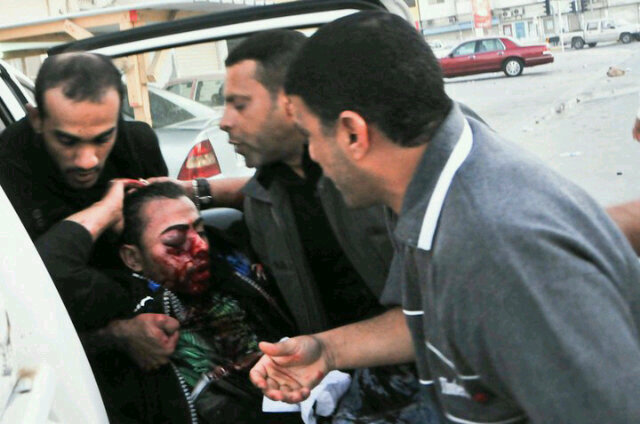 On Tuesday, large crowds of Bahraini protesters poured into the streets of the capital, demanding a regime change in the Persian Gulf kingdom. The call inspired by the recent revolutions in Egypt and Tunisia came after two protesters were killed in clashes with police.
Fadel Salman Matrouk was gunned down in front of a hospital on Tuesday where mourners assembled for the funeral of the 20-year-old Ali Msheymah, who died of his wounds after police resorted to violence to disperse a protest in a village east of Manama the day before.
Pillay noted that both victims were killed by members of Bahrain’s security forces.
“Too many peaceful protestors have recently been killed across the Middle East and North Africa,” the UN rights chief regretted.
“Authorities everywhere must scrupulously avoid excessive use of force, which is strictly forbidden in international law,” said Pillay, calling for “prompt, impartial and transparent investigations where there have been breaches of this obligation.”
~
Bahrain Police Rampage
smohd92 | February 14, 2011
Featured Video

Why the U.S. Should Pull Back From the First Island Chain
or go to
Aletho News Archives – Video-Images
Book Review
‘Why Fauci Must Rot in Prison’: A Tale of Two Diaries
By Jill Erzen | The Defender | October 13, 2026
Dr. Anthony Fauci’s private diary reveals a “mind-numbing” contradiction between what the former top U.S. infectious disease official knew about COVID-19 and what he told the public, senior White House adviser Peter Navarro, Ph.D., said last week on “American Thought Leaders.”
In his new book, “Why Fauci Must Rot in Prison,” due out Oct. 20, Navarro compares Fauci’s private entries to his own pandemic-era diary, and uses what he calls “a tale of two diaries” to argue that Fauci should face criminal prosecution.
“I show, actually, how a prosecution can and should happen … at the state level, most likely,” Navarro said. “He should wind up in prison, and we’ve got the receipts in this book to put him there.”
Navarro said Fauci repeatedly acknowledged important facts in private, then publicly pursued policies that contradicted those facts — with devastating consequences.
“What he says many times privately in his diary is so at odds with both his public behavior and public statements that it’s mind-numbing,” Navarro said.
Navarro examines the lasting damage caused by lockdowns and other pandemic policies, and the ongoing toll of long COVID.
His book also addresses questions about vaccine safety, including why healthy young people faced COVID-19 vaccination mandates despite concerns about myocarditis, and why women were not warned about miscarriage risks linked to the shots. … continue
Blog Roll
 Aletho News
- Jennifer Kavanagh: Why the U.S. Should Pull Back From the First Island Chain
- Yemen denounces international community’s silence on Saudi aggression, siege
- UAE and Saudi Arabia move toward renewed coordination against Sanaa
- How Iran’s two-week retaliatory strikes exposed cracks in US military architecture in Persian Gulf
- The mother of all propaganda: Why the hype over US MOAB strike against Iran is nothing but theater
- Iran says it possesses technology behind US 14-ton GBU bunker-buster
- Trump asks Iran not to retaliate after he strikes Pickaxe Mountain – w/ Prof. Marandi
- Vice President J.D. Vance’s Deceptive ‘Antiwar’ Campaign Speech
- Iran: Palestinians’ rights must not be compromised in Gaza’s future; US, Israel to blame for Hormuz situation
- Ongoing tales of Syrian chemical weapons
- If Americans Knew
- Israeli rabbi permits occupiers to steal Palestinian olive harvest in West Bank
- Netanyahu’s spin on latest settler attack is laughable – Daily Update
- Israeli soldiers debunk Israel’s talking points
- In West Bank, Israeli settlers are totally out of control – Daily Update
- NPR investigation finds evidence of widespread fraud at mall kiosks tied to Israeli skincare brand
- Tucker Carlson exposes Israeli Lies about the Oct 7th attack, Charlie Kirk, and the U.S.
- Israel has detained thousands of Palestinian children since Oct 7th – over half spent time in solitary, many uncharged
- Israeli Analysis: Is Netanyahu Planning an ‘October Surprise’ Attack Before Israel’s Election?
- Israeli settlers brutally attack Palestinians and Washington Post female photographer, 65
- Words Have Changed, Occupation Continues: The Reality of the Gaza Ceasefire
- No Tricks Zone
- Predictions Made By Renowned Climate Proifessor Over Past Decades Have Been Proven To Be Poor
- New Study Suggests Large Regions Of The Pacific Ocean Have Been Cooling For The Last 80 Years
- Germany’s Green Energy Debacle: High Energy Costs Force Kahla Porzellan to Close After 182 Years!
- New Study: 50 Years Of The Most Aggressive ‘Net Zero’ Policies Can Only Affect The Global Climate By 0.03°C
- US September “Heat” Was No Record…Many Records Set Decades Ago
- Latest European Green Energy Debacle; Portugal’s Largest Flagship Solar Park Insolvent!
- Green Energy Debacle: German Expert Professor Fritz Vahrenholt Warns Of Severe Economic And Social Consequences
- Two More Paleo Reconstructions Affirm Meters-Higher Sea Levels Across Ireland, Brazil 7000-6000 Years Ago
- New Study: Earth And Venus Surface Warmth Largely Explained By Convection And Lapse Rate, Not CO2 Or Radiation
- 2025 Nature Paper Claiming Worsening Global Drought Gets RETRACTED …Heavily Flawed

