Obama Administration Says It Can Spy On Americans, But Can’t Tell You What Law Allows It
TechDirt | February 14, 2011
Remember how President Obama, while campaigning, promised to reject the questionable spying practices of the federal government of President Bush? Yeah, forget all that. Over the past two years, we’ve seen time and time again that he’s actually extended those abuses even further. The latest to come out is that the Justice Department is now claiming that the FBI has the right to get phone records on any call made from inside the US to an international number without any oversight. You may recall a few years back that there was a similar controversy, when it came out that the FBI would regularly just call up phone companies and ask for records — despite the fact that this violates certain laws designed to protect consumer privacy. Sometimes, they would just use post-it notes.
Apparently, a year ago, McClatchy newspapers put in a FOIA request, asking for the details of a particular Office of Legal Counsel (OLC) memo that was mentioned in the (previously released, but highly redacted) report that showed how frequently the FBI abused the law in this manner. The OLC took its sweet time responding, but finally responded, and in the cover letter admitted that the Obama administration believes it is perfectly legal for the FBI to route around the in-place oversight for getting access to such records and claimed that the law said so.
Which law says so? Oh, see, that they can’t say. Yes, the part of the letter that explains which law lets the FBI get these records without oversight was redacted.
It’s a secret law! And here I thought, in the US, if the government was going to base actions on a particular law, at the very least, they were supposed to tell you what law. Apparently, the Justice Department under the Obama administration does not believe that to be the case.
Basically, what this means is that the federal government believes that it’s free to request information without first getting court approval — and without telling the public what law says they’re allowed to get this information. That’s not what the laws on the books seem to say at all. But, of course, big telcos such as AT&T, who are so closely tied to the government, are going to roll over and give the government such info (or, perhaps, give them direct access to the info), even if it violates other laws. Why do you think President Obama voted to support giving telcos retroactive immunity on this issue, while he was running for President despite having earlier said he was against it? Now that he’s in power, he apparently is perfectly happy to let the FBI twist the clear intentions of the law to spy on Americans without oversight, and then to refuse to reveal what law he’s relying on to make such spying on Americans without oversight legal.
McClatchy quotes Michael German, a former FBI agent, who now works for the ACLU pointing out the obvious:
“It’s wrong that they’re withholding a legal rationale that has to do with the authorities of the FBI to collect information that affects the rights of American citizens here and abroad…. The law should never be secret. We should all understand what rules we’re operating under and particularly when it comes to an agency that has a long history of abuse in its collection activities.”
And so far, it doesn’t seem like most people care. About the only politician who really seems concerned about this is Senator Wyden, who says this level of secrecy “is a serious problem” and he’s “continuing to press the executive branch to disclose more information to the public about what their government thinks the law means.” Once again, kudos to Senator Wyden for being one of a very small number of politicians who seems to consistently be concerned about the rights of individuals. But it’s sad that the rest of our elected officials aren’t up in arms about this. The government shouldn’t be spying on Americans, and if it is, it should at least have to tell Americans what law it’s basing that decision on.
‘Saudi Arabia sending troops to Bahrain’
Press TV – February 15, 2011
Saudi Arabia is sending troops to Bahrain in a move to crack down on pro-democracy protesters who took to the streets in the capital Manama, a political analyst says.
The analyst told PressTV on Tuesday that Riyadh is sending its troops in an attempt to help King Hamad Bin Isa Al-Khalifa to crack down on the protesters.
Bahraini police have been using tear gas and batons to disperse the pro-democracy protesters in the Bahrain capital.
Three protesters have so far been killed due to police gunshot in the Shia village of Daih, in the suburb of Manama.
The last fatalities came as the protesters were participating in the funeral ceremony of another protester who lost his life earlier on Monday.
His death prompted the opposition to call for a vast participation at the funeral and to urge Bahrainis to escalate the pro-democracy protests.
Security forces have been deployed in force along the main routes into Manama in an effort to prevent a gathering that had been inspired by similar online initiatives around the Arab world.
Police clash with Bahraini protesters
Press TV – February 14, 2011
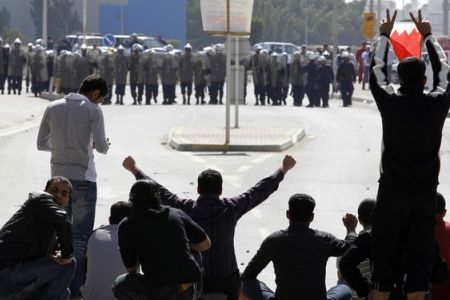 Bahraini youths protest in front of the police in Manama on February 14, 2011
Witnesses say police in Bahrain have violently clashed with pro-democracy protesters during the “Day of Rage” rallies across the country.
On Monday, police fired tear gas and rubber bullets at hundreds of demonstrators in Karkazan, a Shia village south of the capital, Manama, AFP reported.
Security forces stepped up their presence with helicopters circling over Manama.
At least 14 people were wounded in overnight and Monday clashes.
Activists, inspired by revolutions in Egypt and Tunisia, have dubbed Monday “the Day of Rage” to express disappointment at the political reforms of the past decade, which have failed to bring prosperity and real change.
The majority Shia population in Bahrain has been complaining about inequality and oppression. The government has been clamping down on the opposition since the country’s controversial general elections in August last year.
Since late Sunday, Bahrain’s security forces have been patrolling shopping centers and other locations to monitor people’s movements amid calls by opposition groups for pro-democracy protests.
Forming a new government in West Bank unconstitutional
Palestine Information Center – 14/02/2011
GAZA — The Hamas Movement said that de facto president Mahmoud Abbas’s decision to mandate Salam Fayyad to form a new government in Ramallah city is unacceptable and unconstitutional, adding that the current government in the West Bank is already illegal.
“Any government can only be legitimate after it is referred to the legislative council and gain a vote of confidence, and this thing was not there in Fayyad’s government,” spokesman Sami Abu Zuhri underlined in a press statement to the Palestinian information center (PIC).
Spokesman Abu Zuhri affirmed that the intended formation of a new de facto government in Ramallah is proactive step aimed at preventing the West Bankers from taking to the streets to protest against the Palestinian authority (PA) and its policies especially after Al-Jazeera channel’s revelations.
The spokesman emphasized that the PA has to straighten its political deviation and stop its security crimes and cooperation with the Israeli occupation or else the Palestinian street will certainly move against it.
Egypt’s revolution and Israel: “Bad for the Jews”
Ilan Pappe, The Electronic Intifada, 14 February 2011
 |
Is Arab democracy bad for Israel? (Matthew Cassel) |
The view from Israel is that if they indeed succeed, the Tunisian and Egyptian revolutions are bad, very bad. Educated Arabs — not all of them dressed as “Islamists,” quite a few of them speaking perfect English whose wish for democracy is articulated without resorting to “anti-Western” rhetoric — are bad for Israel.
Arab armies that do not shoot at these demonstrators are as bad as are many other images that moved and enthused so many people around the world, even in the West. This world reaction is also bad, very bad. It makes the Israeli occupation in the West Bank and Gaza Strip and its apartheid policies inside the state look like the acts of a typical “Arab” regime.
For a while you could not tell what official Israel thought. In his first ever commonsensical message to his colleagues, Prime Minister Benjamin Netanyahu asked his ministers, generals and politicians not to comment in public on the events in Egypt. For a brief moment one thought that Israel turned from the neighborhood’s thug to what it always was: a visitor or permanent resident.
It seems Netanyahu was particularly embarrassed by the unfortunate remarks on the situation uttered publicly by General Aviv Kochavi, the head of Israeli military intelligence. This top Israeli expert on Arab affairs stated confidently two weeks ago in the Knesset that the Mubarak regime is as solid and resilient as ever. But Netanyahu could not keep his mouth shut for that long. And when the boss talked all the others followed. And when they all responded, their commentary made Fox News’ commentators look like a bunch of peaceniks and free-loving hippies from the 1960s.
The gist of the Israeli narrative is simple: this is an Iranian-like revolution helped by Al Jazeera and stupidly allowed by US President Barack Obama, who is a new Jimmy Carter, and a stupefied world. Spearheading the Israeli interpretation are the former Israeli ambassadors to Egypt. All their frustration from being locked in an apartment in a Cairean high-rise is now erupting like an unstoppable volcano. Their tirade can be summarized in the words of one of them, Zvi Mazael who told Israeli television’s Channel One on 28 January, “this is bad for the Jews; very bad.”
In Israel of course when you say “bad for the Jews,” you mean the Israelis — but you also mean that whatever is bad for Israel is bad for the Jews all around the world (despite the evidence to the contrary since the foundation of the state).
But what is really bad for Israel is the comparison. Regardless of how all this would end, it exposes the fallacies and pretense of Israel like never before. Egypt is experiencing a peaceful Intifada with the deadly violence coming from the side of the regime. The army did not shoot at the demonstrators; and even before the departure of Mubarak, already seven days into the protests, the minister of interior who directed his thugs to violently crash the demonstrations had been sacked and will probably be brought to justice.
Yes, this was done in order to win time and try to persuade the demonstrators to go home. But even this scene, by now forgotten, can never happen in Israel. Israel is a place where all the generals who ordered the shootings of Palestinian and Jewish anti-occupation demonstrators now compete for the highest post of Chief of the General Staff.
One of them is Yair Naveh, who gave orders in 2008 to kill Palestinian suspects even if they could be peacefully arrested. He is not going to jail; but the young woman, Anat Kamm, who exposed these orders is now facing nine years in jail for leaking them to Israeli daily Haaretz. Not one Israeli general or politician has or is going to spend one day in jail for ordering the troops to shoot at unarmed demonstrators, innocent civilians, women, old men and children. The light radiating from Egypt and Tunisia is so strong that it also illuminates the darker spaces of the “only democracy in the Middle East.”
Nonviolent, democratic (be they religious or not) Arabs are bad for Israel. But maybe these Arabs were there all along, not only in Egypt, but also in Palestine. The insistence of Israeli commentators that the most important issue at stake — the Israeli peace treaty with Egypt — is a diversion, and has very little relevance to the powerful impulse that is shaking the Arab world as a whole.
The peace treaties with Israel are the symptoms of moral corruption not the disease itself — this is why Syrian President Bashar Asad, undoubtedly an anti-Israeli leader, is not immune from this wave of change. No, what is at stake here is the pretense that Israel is a stable, civilized, western island in a rough sea of Islamic barbarism and Arab fanaticism. The “danger” for Israel is that the cartography would be the same but the geography would change. It would still be an island but of barbarism and fanaticism in a sea of newly formed egalitarian and democratic states.
In the eyes of large sections of Western civil society the democratic image of Israel has long ago vanished; but it may now be dimmed and tarnished in the eyes of others who are in power and politics. How important is the old, positive image of Israel for maintaining its special relationship with the United States? Only time will tell.
But one way or another the cry rising from Cairo’s Tahrir Square is a warning that fake mythologies of the “only democracy in the Middle East,” hardcore Christian fundamentalism (far more sinister and corrupt than that of the Muslim Brotherhood), cynical military-industrial corporate profiteering, neo-conservatism and brutal lobbying will not guarantee the sustainability of the special relationship between Israel and the United States forever.
And even if the special relationship perseveres for a while, it is now based on even shakier foundations. The diametrically-opposed case studies of the so far resilient anti-American regional powers of Iran and Syria, and to some extent Turkey, on the one hand, and the fallen ultimate pro-American tyrants, on the other are indicative: even if it is sustained, American support may not be enough in future to maintain an ethnic and racist “Jewish state” in the heart of a changing Arab world.
This could be good news for the Jews, even for the Jews in Israel in the long run. To be surrounded by peoples who cherish freedom, social justice and spirituality and navigating sometimes safely and sometimes roughly between tradition and modernity, nationalism and humanity, aggressive capitalist globalization and daily survival, is not going to be easy.
Yet it has a horizon, and it carries hope of triggering similar changes in Palestine. It can bring a closure to more than a century of Zionist colonization and dispossession, to be replaced by more equitable reconciliation between the Palestinian victims of these criminal policies wherever they are and the Jewish community. This reconciliation would be built on the basis of the Palestinian right of return and on all the other rights the people of Egypt so bravely fought for in the last twenty days.
But trust the Israelis not to miss an opportunity to miss peace. They would cry wolf. They would demand, and receive, more funds from the American taxpayer due to the new “developments.” They would interfere clandestinely and destructively to undermine any transition to democracy (remember what force and viciousness characterized their reaction to democratization in Palestinian society?), and they would elevate the Islamophobic campaign to new and unprecedented heights.
But who knows, maybe the American taxpayer would not budge this time. And maybe the European politicians would follow the general sentiment of their public and allow not only Egypt to be dramatically transformed, but also welcome a similar change in Israel and Palestine. In such a scenario the Jews of Israel have a chance to become part of the real Middle East and not an alien and aggressive member of a Middle East which was the figment of the hallucinatory Zionist imagination.
Ilan Pappe is Professor of History and Director of the European Centre for Palestine Studies at the University of Exeter. His most recent book is Out of the Frame: The Struggle for Academic Freedom in Israel (Pluto Press, 2010).
Israeli commander refuses to allow murder victim funeral
Ma’an – 13/02/2011
JERUSALEM — Israeli authorities told the family of murder victim Husam Rweidi that his body would not be returned unless they agreed to a set of conditions, relatives said.
Husam Rweidi, 24, was stabbed to death Friday by a mob of Ultra-Orthodox Jews in Jerusalem’s city center.
The victim’s cousin Firas Baydoun said Israeli authorities stipulated that his burial must take place at midnight, and that a maximum of 10 mourners could attend the funeral.
Baydoun told Ma’an that Rweidi’s body was being kept in the mortuary of Israel’s Greenberg National Institute of Forensic Medicine in Tel Aviv.
An Israeli central commander said the family could not take Rweidi’s body to the Al-Aqsa Mosque for funeral prayers and Islamic rituals, Baydoun said.
“The body must be carried to the Al-Rahma cemetery directly,” the commander told the family.
Rweidi’s father refused the demands, and the Israeli commander eventually agreed that the funeral could be held at 8 p.m. But the commander insisted the body must not be taken to the Al-Aqsa Mosque.
The family is considering taking on legal council to challenge the conditions, and to ensure Rweidi is given a decent funeral, Baydoun said.
MUBARAK’S GONE, BUT… SO WHAT? THE ARMY’S NOW RUNNING THINGS AND ALL THE EGYPTIANS HAVE ARE PROMISES.
By Damian Lataan | February 13, 2011
Two weeks ago, shortly after the protests in Egypt started, the Israelis allowed some 800 Egyptian soldiers into the Sinai. They went to Sharm el-Sheik down on the southern tip of the Sinai Peninsula on the Red Sea where the Israelis said they may be based. While the Israelis had allowed Egyptian police and security into the Sinai, this is the first time in thirty years that a contingent of the Egyptian army had been allowed in.
Two weeks later, Mubarak is ousted from power and he leaves Cairo and heads off, not overseas into exile as one might expect of a ruthless dictator ousted by popular revolution, but to Sharm el-Sheik – where the 800 Egyptian troops are now based.
While Mubarak has handed over power to the chiefs of the army ostensibly to oversee the transition to a democratic civilian government, one cannot blame the Egyptian people being more that bit wary of what is actually going on and maintaining their vigil in Tahrir Square.
The simple reality is this; apart from getting Mubarak to step down, nothing at all has really changed for the Egyptian people. They are no better off today in terms of having power for themselves than they were the before Mubarak left. All the people have are promises. Nothing else.
Before the protests, Mubarak the military man ran things. Now military men that worked for Mubarak – and are now, it seems, protecting him at his retreat at Sharm el-Sheik – are running things.
Given that Egyptian troops went to the Sinai right at the beginning of the protests and long before Mubarak left Cairo himself to go to the Sinai, one has to wonder if there was some collusion going on between the Israelis and the Egyptian government whereby the aging Mubarak at the first signs of serious discontent among the people would be eased out into comfortable retirement to live out his days at Sharm el-Sheik.
If that was the case, one then needs to ask; what were the contingency plans for the transition of power from the militarist president to the military and, far more importantly, what are the military’s plans for the future?
Featured Video

Why the U.S. Should Pull Back From the First Island Chain
or go to
Aletho News Archives – Video-Images
Book Review
‘Why Fauci Must Rot in Prison’: A Tale of Two Diaries
By Jill Erzen | The Defender | October 13, 2026
Dr. Anthony Fauci’s private diary reveals a “mind-numbing” contradiction between what the former top U.S. infectious disease official knew about COVID-19 and what he told the public, senior White House adviser Peter Navarro, Ph.D., said last week on “American Thought Leaders.”
In his new book, “Why Fauci Must Rot in Prison,” due out Oct. 20, Navarro compares Fauci’s private entries to his own pandemic-era diary, and uses what he calls “a tale of two diaries” to argue that Fauci should face criminal prosecution.
“I show, actually, how a prosecution can and should happen … at the state level, most likely,” Navarro said. “He should wind up in prison, and we’ve got the receipts in this book to put him there.”
Navarro said Fauci repeatedly acknowledged important facts in private, then publicly pursued policies that contradicted those facts — with devastating consequences.
“What he says many times privately in his diary is so at odds with both his public behavior and public statements that it’s mind-numbing,” Navarro said.
Navarro examines the lasting damage caused by lockdowns and other pandemic policies, and the ongoing toll of long COVID.
His book also addresses questions about vaccine safety, including why healthy young people faced COVID-19 vaccination mandates despite concerns about myocarditis, and why women were not warned about miscarriage risks linked to the shots. … continue
Blog Roll
 Aletho News
- Jennifer Kavanagh: Why the U.S. Should Pull Back From the First Island Chain
- Yemen denounces international community’s silence on Saudi aggression, siege
- UAE and Saudi Arabia move toward renewed coordination against Sanaa
- How Iran’s two-week retaliatory strikes exposed cracks in US military architecture in Persian Gulf
- The mother of all propaganda: Why the hype over US MOAB strike against Iran is nothing but theater
- Iran says it possesses technology behind US 14-ton GBU bunker-buster
- Trump asks Iran not to retaliate after he strikes Pickaxe Mountain – w/ Prof. Marandi
- Vice President J.D. Vance’s Deceptive ‘Antiwar’ Campaign Speech
- Iran: Palestinians’ rights must not be compromised in Gaza’s future; US, Israel to blame for Hormuz situation
- Ongoing tales of Syrian chemical weapons
- If Americans Knew
- Israeli rabbi permits occupiers to steal Palestinian olive harvest in West Bank
- Netanyahu’s spin on latest settler attack is laughable – Daily Update
- Israeli soldiers debunk Israel’s talking points
- In West Bank, Israeli settlers are totally out of control – Daily Update
- NPR investigation finds evidence of widespread fraud at mall kiosks tied to Israeli skincare brand
- Tucker Carlson exposes Israeli Lies about the Oct 7th attack, Charlie Kirk, and the U.S.
- Israel has detained thousands of Palestinian children since Oct 7th – over half spent time in solitary, many uncharged
- Israeli Analysis: Is Netanyahu Planning an ‘October Surprise’ Attack Before Israel’s Election?
- Israeli settlers brutally attack Palestinians and Washington Post female photographer, 65
- Words Have Changed, Occupation Continues: The Reality of the Gaza Ceasefire
- No Tricks Zone
- Predictions Made By Renowned Climate Proifessor Over Past Decades Have Been Proven To Be Poor
- New Study Suggests Large Regions Of The Pacific Ocean Have Been Cooling For The Last 80 Years
- Germany’s Green Energy Debacle: High Energy Costs Force Kahla Porzellan to Close After 182 Years!
- New Study: 50 Years Of The Most Aggressive ‘Net Zero’ Policies Can Only Affect The Global Climate By 0.03°C
- US September “Heat” Was No Record…Many Records Set Decades Ago
- Latest European Green Energy Debacle; Portugal’s Largest Flagship Solar Park Insolvent!
- Green Energy Debacle: German Expert Professor Fritz Vahrenholt Warns Of Severe Economic And Social Consequences
- Two More Paleo Reconstructions Affirm Meters-Higher Sea Levels Across Ireland, Brazil 7000-6000 Years Ago
- New Study: Earth And Venus Surface Warmth Largely Explained By Convection And Lapse Rate, Not CO2 Or Radiation
- 2025 Nature Paper Claiming Worsening Global Drought Gets RETRACTED …Heavily Flawed

