Orban accuses EU of attempting ‘regime change’ in Hungary
RT | October 29, 2024
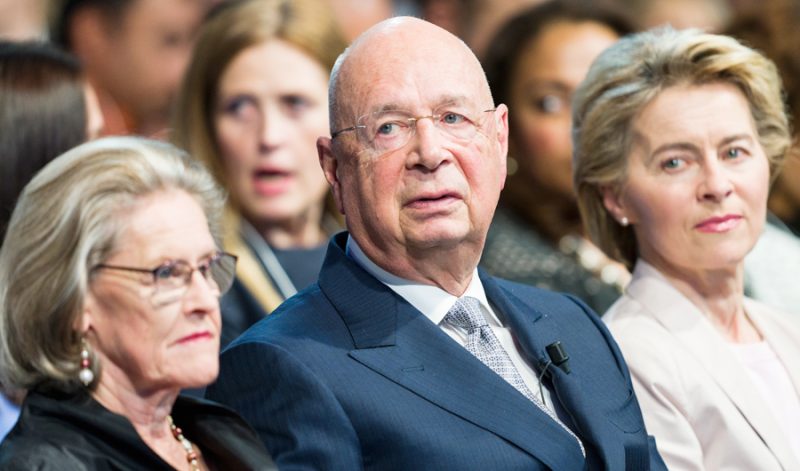
The European Union is hoping to install a ‘Jawohl government’ in Hungary as it did in Poland, Prime Minister Viktor Orban has said, vowing to resist such plans.
Orban came under attack by 13 EU member states on Monday, after he visited Georgia and commended its government for a fair and democratic election. Meanwhile, the EU leadership has embraced the Georgian opposition’s claims that the vote had been marred by irregularities.
In a post on X on Tuesday, Orban issued a reminder that two powerful German officials in Brussels are hoping to replace his government with one more willing to obey their orders – just as they boasted about doing in Poland last year.
“There’s an open conspiracy against Hungary led by Manfred Weber and President [Ursula] Von der Leyen.” Orban said. “They admitted that their aim is to replace the Hungarian government with a new ‘Jawohl government’, just like the current Polish one. We will not let this happen!”
He included a minute-long video from his recent radio interview, where he explained the matter in detail.
In the video, Orban showed EU officials declaring that his government should be replaced by the opposition and boasting that they had done so in Poland – whose previous government also defied many of the orders from Brussels – last year, by installing former European Council chair Donald Tusk as prime minister.
‘Jawohl’ is the German word used to respond to commands. Orban used it because the head of the European People’s Party (EPP) faction in the bloc’s parliament, Manfred Weber, and the president of the European Commission, Ursula von der Leyen, are both German.
“We call what they want a ‘Jawohl’ government. So you get a phone call from Brussels or Berlin, and then you have to say ‘Jawohl’! And then it must be done,” Orban told the national broadcaster Kossuth on Friday.
“The Poles were also going their own way,” Orban added. “They also pursued their own independent Polish policy in migration, gender, and the economy. They were on the same page as the Westerners when it came to the [Russia-Ukraine conflict], but not in all other matters.” The EPP then openly announced that the conservative Polish government would leave and be replaced with another, the Hungarian prime minister explained. “This is how our friend Tusk became prime minister in Poland. Now the same scenario exists in the case of Hungary.”
“This is not even a secret conspiracy against Hungary, this is a plan they announced openly,” Orban said. “I was sitting there, they said it to my face.”
EU journalist to apply for asylum in Belarus
RT | October 29, 2024
Latvian journalist Yury Alekseev has fled to Belarus where he says he will seek political asylum, the media outlet Delfi reported on Monday.
The escape comes days before Alekseev was due to appear in court in his home country.
The journalist and his defenders claim he is being persecuted for his pro-Russian views.
Alekseev said in a post on Facebook that he left Latvia this past Saturday, traveling from Riga to Vilnius, Lithuania, where he took a bus to Minsk. “I crossed the border. I was nervous throughout my entire body,” the journalist wrote.
In Latvia, the 66-year-old had been charged with inciting national, ethnic or racial hatred, illegal possession of ammunition and distribution of materials containing child pornography, according to the news portal. The trial in one of the cases was scheduled to begin on Tuesday.
During his career, Alekseev has served as editor-in-chief of Business & Baltic, Kommersant Baltic, and other publications in Latvia.
In 2017, the State Security Service of Latvia detained him over criminal charges in connection with a publication of comments allegedly inciting ethnic hatred. The intelligence services conducted several searches of his home. During one investigators allegedly found ammunition for a pistol and materials containing child pornography.
The Riga district court found Alekseev guilty and sentenced him to two years in prison, but the journalist appealed the sentence and it did not come into force. The court later sentenced him to a year of probation.
Alekseev has denied all the accusations against him and says the charges were fabricated.
The Most Devastating Report So Far
By Jay BhattacharyaJayanta Bhattacharya | Brownstone Institute | October 27, 2024
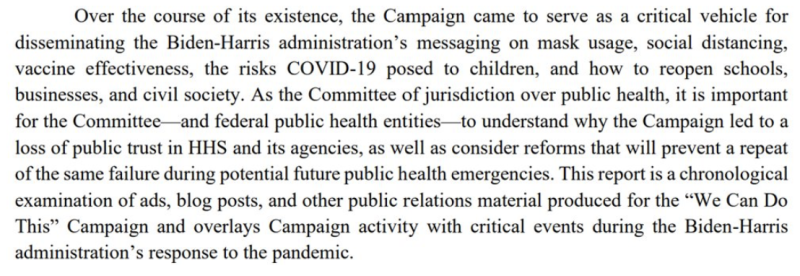
The House report on HHS Covid propaganda is devastating. The Biden administration spent almost $1 billion to push falsehoods about Covid vaccines, boosters, and masks on the American people. If a pharma company had run the campaign, it would have been fined out of existence.
HHS engaged a PR firm, the Fors Marsh Group (FMG), for the propaganda campaign. The main goal was to increase Covid vax uptake. The strategy: 1. Exaggerate Covid mortality risk 2. Downplay the fact that there was no good evidence that the Covid vax stops transmission.
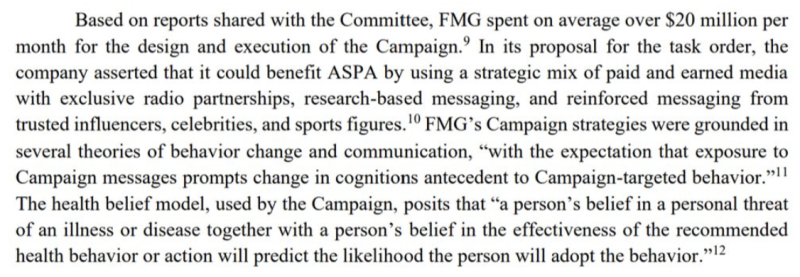
The propaganda campaign extended beyond vax uptake and included exaggerating mask efficacy and pushing for social distancing and school closures.
Ultimately, since the messaging did not match reality, the campaign collapsed public trust in public health.
The PR firm (FMG) drew most of its faulty science from the CDC’s “guidance,” which ignored the FDA’s findings on the vaccine’s limitations, as well as scientific findings from other countries that contradicted CDC groupthink.
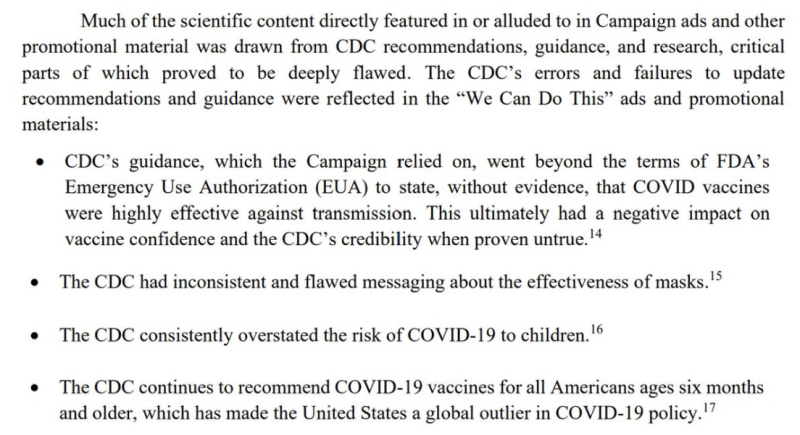
The report details the CDC’s mask flip-flopping through the years. It’s especially infuriating to recall the CDC’s weird, anti-scientific, anti-human focus on masking toddlers with cloth masks into 2022.
President Biden’s Covid advisor Ashish K. Jha waited until Dec. 2022 (right after leaving government service) to tell the country that “[t]here is no study in the world that shows that masks work that well.” What took him so long?

In 2021, former CDC director, Rochelle Walensky rewrote CDC guidance on social distancing at the behest of the national teachers’ union, guaranteeing that schools would remain closed to in-person learning for many months.
During this period, the PR firm FMG put out ads telling parents that schools would close unless kids masked up, stayed away from friends, and got Covid-vaccinated.
In March 2021, even as the CDC told the American people that the vaxxed did not need to mask, the PR firm ran ads saying that masks were still needed, even for the vaxxed. “It’s not time to ease up” we were told, in the absence of evidence any of that did any good.

In 2021, to support the Biden/Harris administration’s push for vax mandates, the PR firm pushed the false idea that the vax stopped Covid transmission. When people started getting “breakthrough” infections, public trust in public health collapsed.
Later, when the FDA approved the vax for 12 to 15-year-old kids, the PR firm told parents that schools could open in fall 2021 only if they got their kids vaccinated. These ads never mentioned side effects like myocarditis due to the vax.
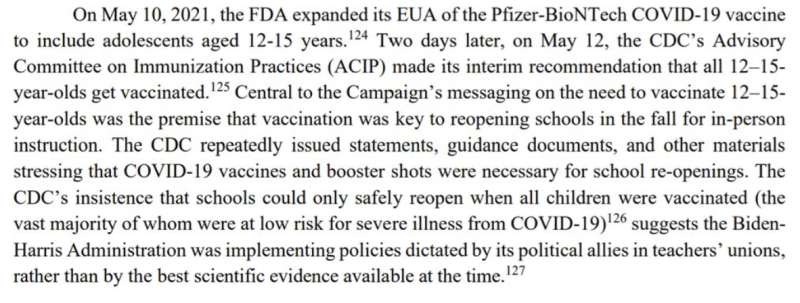
HHS has scrubbed the propaganda ads from this era from its web pages. It’s easy to see why. They are embarrassing. They tell kids, in effect, that they should treat other kids like biohazards unless they are vaccinated.
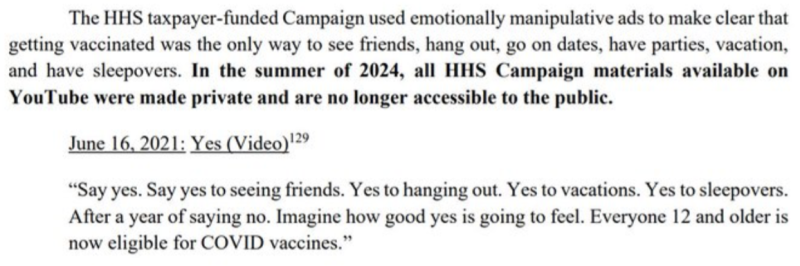
When the Delta variant arrived, the PR firm doubled down on fear-mongering, masking, and social distancing.

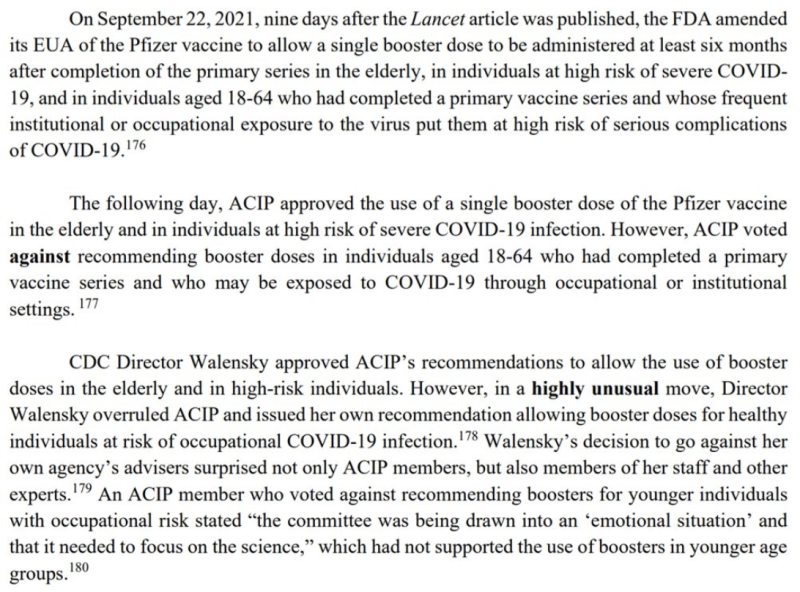
In September 2021, CDC director Walensky overruled the agency’s external experts to recommend the booster to all adults rather than just the elderly. The director’s action was “highly unusual” and went beyond the FDA’s approval of the booster for only the elderly.
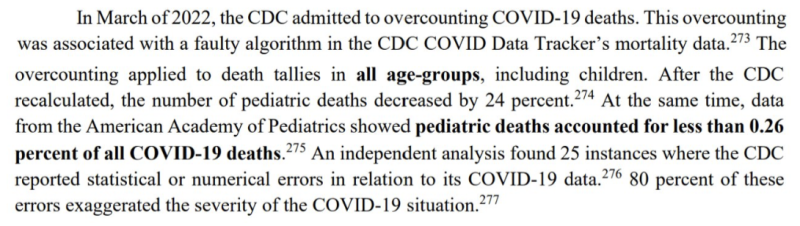
The PR campaign and the CDC persistently overestimated the mortality risk of Covid infection in kids to scare parents into vaccinating their children with the Covid vax.

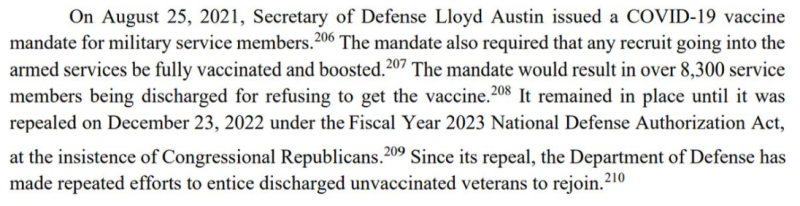
In Aug. 2021, the military imposed its Covid vax mandate, leading to 8,300 servicemen being discharged. Since 2023, the DOD has been trying to get the discharged servicemen to reenlist. What harm has been done to American national security by the vax mandate?
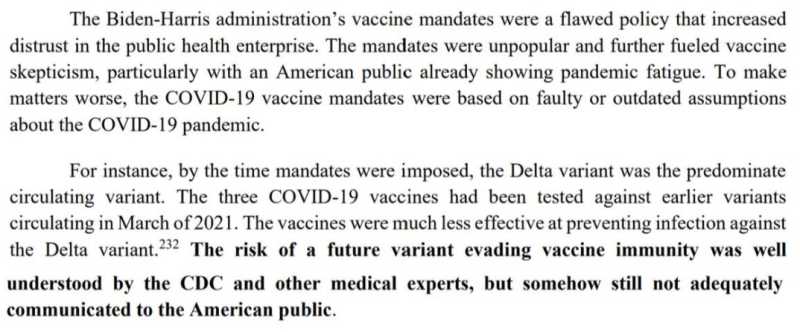
The Biden/Harris administration imposed the OSHA, CMS, and military vax mandates, even though the CDC knew that the Delta variant evaded vaccine immunity. The PR campaign studiously avoided informing Americans about waning vaccine efficacy in the face of variants.
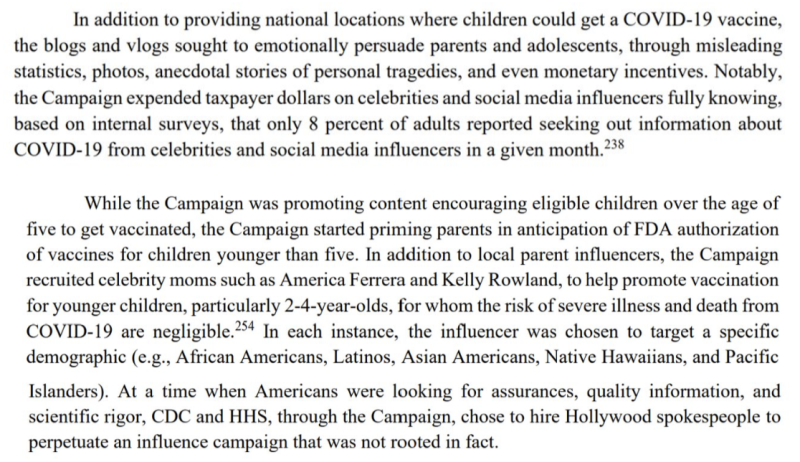
The propaganda campaign hired celebrities and influencers to “persuade” children to get the Covid vax.
I think if a celebrity is paid to advertise a faulty product, that celebrity should be partially liable if the product harms some people.
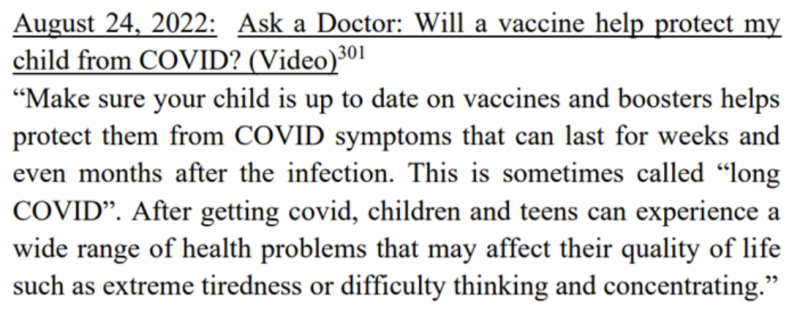
In the absence of evidence, the propaganda campaign ran ads telling parents that the vaccine would prevent their kids from getting Long Covid.
With the collapse in public trust in the CDC, parents have begun to question all CDC advice. Predictably, the HHS propaganda campaign has led to a decline in the uptake of routine childhood vaccines.
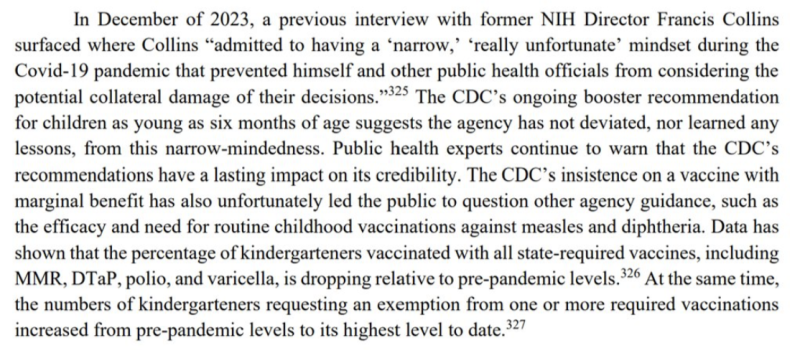
The report makes several recommendations, including formally defining the CDC’s core mission to focus on disease prevention, forcing HHS propaganda to abide by the FDA’s product labeling rules, and revamping the process of evaluating vaccine safety.
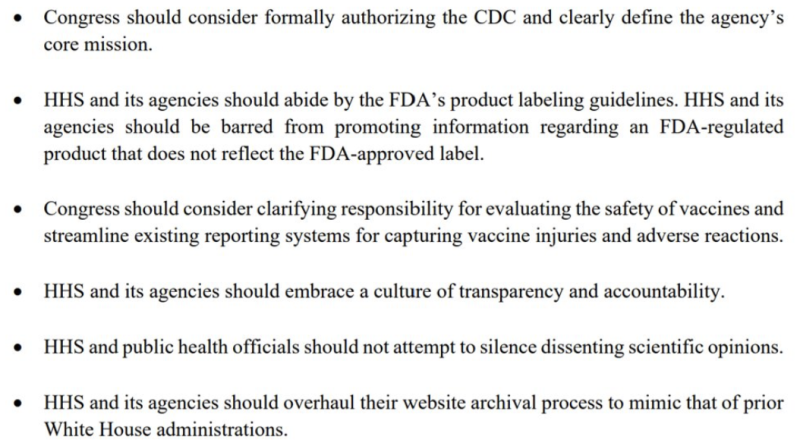
Probably the most important recommendation: HHS should never again adopt a policy of silencing dissenting scientists in an attempt to create an illusion of consensus in favor of CDC groupthink.
You can find a copy of the full House report here. The HHS must take its findings seriously if there is any hope for public health to regain public.
Dr. Jay Bhattacharya is a physician, epidemiologist and health economist. He is Professor at Stanford Medical School, a Research Associate at the National Bureau of Economics Research, a Senior Fellow at the Stanford Institute for Economic Policy Research, a Faculty Member at the Stanford Freeman Spogli Institute, and a Fellow at the Academy of Science and Freedom. His research focuses on the economics of health care around the world with a particular emphasis on the health and well-being of vulnerable populations. Co-Author of the Great Barrington Declaration.
‘Seismic’ Verdicts: SF Transit System Must Pay Almost $8 Million to 6 Workers Fired for Refusing COVID Shots
By Brenda Baletti, Ph.D. | The Defender | October 25, 2024
The San Francisco Bay Area Rapid Transit District (BART) must pay about $7.8 million to six former employees who lost their jobs after the district denied their requests for accommodations for religious exemptions from BART’s COVID-19 mandate.
In the largest financial win yet for workers fired for failing to comply with COVID-19 vaccine mandates, a federal jury composed of entirely vaccinated jurors on Wednesday awarded the plaintiffs between approximately $1.2 million and $1.5 million each to compensate for economic losses and mental anguish.
The case is one of hundreds filed across the country since 2021, representing thousands of workers who say they lost their jobs when their employers illegally denied their requests for religious accommodation to the COVID-19 mandate.
“These verdicts are seismic — a 7.8 San Francisco legal earthquake,” Brad Dacus, president of the Pacific Justice Institute, which represented the plaintiffs, said in a statement. “This amazing outcome represents so much hard work by our team, perseverance by these clients, and fairness from our judicial system.”
The workers’ attorney, Kevin Snider, told The Defender that because of BART’s mandate, “The workers were forced to either deny their faith or lose their jobs.” He said they chose the latter, demonstrating the sincerity of their religious convictions.
The lawsuit began as three separate cases representing 35 employees fired by BART. The three cases were later consolidated into a single lawsuit. Twenty-nine of the plaintiffs settled with BART, but the remaining six went to trial this month.
“These workers lost their jobs and have struggled for more than two years,” Snider said. “It was a devastating disruption to their lives and to their families. Being able to settle or get a jury verdict helps them to put closure on this and for those who went to trial, they felt heard and understood by a jury, which can be important.”
This was the second time the case went to trial. The first trial ended in a mistrial in July when the jury could not reach a unanimous decision, as required in federal civil trials.
BART, which can appeal the decision, declined to comment. Bloomberg Law reported that BART filed a motion for judgment as a matter of law during the trial, which U.S. District Judge William Alsup said would be argued in December.
The motion argues that the plaintiffs have insufficient evidence to reasonably support their case, even if a jury finds otherwise. In response, the judge can allow the verdict to stand, order a new trial or overrule the jury’s verdict.
Religious objectors had option to comply, retire, resign or be terminated
The plaintiffs first sued BART in December 2022, alleging the agency violated their First Amendment rights to religious freedom and federal and state anti-discrimination laws.
The BART system, which operates in five counties across the San Francisco Bay area, issued a mandate on Oct. 14, 2021, requiring employees to be fully vaccinated as a condition of employment.
Employees could apply for a religious or medical exemption. If granted, BART determined whether to provide them reasonable accommodation. Between October 2021 and February 2022, 204 of Bart’s 4,000-plus employees sought an exemption.
Approximately 179 of those were for religious beliefs by people practicing a variety of religious faiths, including various forms of Christianity, Islam and Ruism, according to Snider.
BART granted 70 of the religious exemptions and denied the rest, according to the complaint.
But even the employees granted an exemption were denied reasonable accommodation so they could continue working. Although BART acknowledged their right to a religious exemption, the agency said it couldn’t reasonably make accommodations, like allowing them to work at home or do weekly testing.
However, 1 in 3 of the employees seeking medical exemption were granted exemption and given accommodation, according to the complaint.
Instead of proceeding on the assumption that the accommodation requests were based on sincerely held religious beliefs, the complaint alleges, BART launched a probe into the sincerity of the employees’ beliefs.
Employees’ claims were investigated using an interviewer template that asked for a detailed explanation of their beliefs and why taking the COVID-19 vaccine would violate them. The template included questions like, “What do you think will happen to you if you take the COVID-19 vaccine?”
BART proceeded to deny all requests for accommodation from religious objectors and gave them the option to comply with the mandate, retire if qualified, resign or be terminated.
All of the plaintiffs refused to comply and lost their jobs.
Over the next couple of years, many of those employees, working with the Pacific Justice Institute, sued BART and settled their cases. The cases that couldn’t reach a settlement proceeded to trial — which Snider said carried a serious risk, because “San Francisco is probably the most difficult venue in the entire country to have a vaccine case.”
The trial happened in two phases. First, the jury was asked to rule on whether BART could have granted the requested accommodations. They rejected the agency’s argument that it couldn’t reasonably accommodate the employees seeking religious exemptions without facing an undue hardship.
Then they heard testimony about the sincerity of the plaintiffs’ religious beliefs and the damages they suffered.
Sinder, whose firm represents plaintiffs alleging religious discrimination in more than a hundred vaccine mandate lawsuits across the country, said that he thought public opinion was slowly changing to favor workers.
This article was originally published by The Defender — Children’s Health Defense’s News & Views Website under Creative Commons license CC BY-NC-ND 4.0. Please consider subscribing to The Defender or donating to Children’s Health Defense.
Fluoride Finally Declared an “Unreasonable Risk”
A look at the ruling that will have a widespread impact on the health of all American children
By Aaron Siri | Injecting Freedom | October 25, 2024
A seven-year battle between the EPA and the public interest regarding the fluoridation of public drinking water has finally concluded. This is an excellent result by Siri & Glimstad partner Michael Connett in securing a court order against the EPA. Great job, Michael!
U.S. District Court Judge Edward Chen concluded the following in his ruling:
“[T]he Court finds that fluoridation of water at 0.7 milligrams per liter (“mg/L”) – the level presently considered “optimal” in the United States – poses an unreasonable risk of reduced IQ in children… [A] risk sufficient to require the EPA to engage with a regulatory response…”
“There is little dispute in this suit as to whether fluoride poses a hazard to human health. Indeed, EPA’s own expert agrees that fluoride is hazardous at some level of exposure. And ample evidence establishes that a mother’s exposure to fluoride during pregnancy is associated with IQ decrements in her offspring. The United States National Toxicology Program (“NTP”) – the federal agency regarded as experts in toxicity… concluded that fluoride is indeed associated with reduced IQ in children, at least at exposure levels at or above 1.5 mg/L (i.e., “higher” exposure levels)…”
“In all, there is substantial and scientifically credible evidence establishing that fluoride poses a risk to human health; it is associated with a reduction in the IQ of children and is hazardous at dosages that are far too close to fluoride levels in the drinking water of the United States. And this risk is unreasonable under Amended TSCA. Reduced IQ poses serious harm. Studies have linked IQ decrements of even one or two points to e.g., reduced educational attainment, employment status, productivity, and earned wages.”
The NTP report referred to above can be found here. While we wait for the EPA to take the next step, many municipalities have already acted to remove fluoride from their water systems.
French prosecutor seeks prison sentence for activists chanting ‘intifada’ at Gaza protest
MEMO | October 25, 2024
The Public Prosecutor’s Office in Paris has called for an eight-month suspended sentence for French citizen Elias d’Imzalene, who used the word “intifada” during a demonstration in support of Gaza, sources have told Anadolu.
Activist Elias d’Imzalene appeared before a Paris judge on charges of “inciting public hatred or violence” due to his use of the term during a protest against the massacres in Gaza. Intifada means uprising in Arabic and is used to refer to the Palestinian mass movements against Israeli occupation.
The former French Interior Minister, Gerald Darmanin, filed a criminal complaint with the Paris prosecutor’s office on 10 September, following d’Imzalene’s speech during the 8 September demonstration in support of Gaza, in which he used the term “Intifada.”
As part of the investigation, d’Imzalene was arrested on 24 September when he went to give his testimony in Paris. After 48 hours in custody, he was released and placed under judicial supervision.
The impact of vaccine mandates to healthcare workers in Canada
By Eleftherios Gkioulekas | October 20, 2024
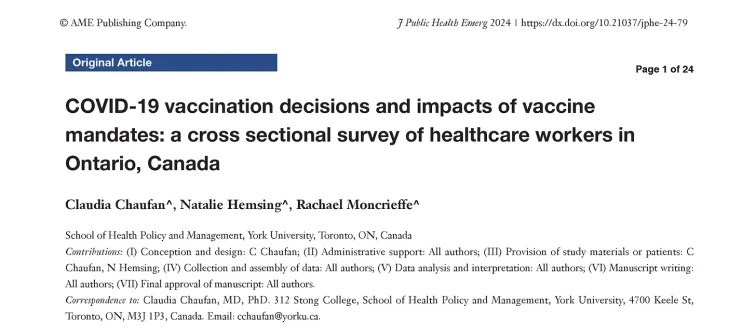
A recent paper by Professor Claudia Chaufan and colleagues reported the results of a cross-sectional survey of 468 Canadian healthcare workers examining the impact of COVID-19 vaccination decisions and the impacts of vaccine mandates. The sample used in the study is interesting because it consists predominantly of nurses and other supporting disciplines but very few medical doctors. The study provides only descriptive statistics; however, the reported results are astounding.
Here are some highlights: 75% of respondents that received the COVID-19 vaccine reported that the reason for taking the injectable product was employer vaccine mandates. Only 22% of vaccinated respondents reported no adverse events. Moderate adverse events were reported by 35.6% of respondents and severe adverse reactions were reported by 29.8% of respondents. Out of the 87 respondents that received the COVID-19 vaccine, 1 reported a life-threatening adverse reaction. Interestingly, only 4.3% of respondents were trained on how to report post-vaccination adverse events and only 4.5% of respondents reported that they were encouraged to report adverse events after vaccination.
From the entire sample of both vaccinated and unvaccinated healthcare workers, 74.6% reported anxiety and/or depression and 18.3% reported experiencing suicidal thoughts due to employer vaccination requirements (agree and strongly agree responses). Although 40% reported willingness to return to their previous role if vaccine mandates were dropped, another 42.5% reported an intention to leave their occupation or the healthcare industry as a result of their experience with vaccine mandates (agree and strongly agree responses). 85% reported that employers did not offer alternatives to vaccination to satisfy their vaccine mandate, with only 1 out of 468 respondents reporting that their employer was willing to accept proof of natural immunity, even though 75% of respondents reported that they worked with COVID-19 patients prior to the availability of the COVID-19 vaccines. Only 9.5% reported being offered regular testing as an alternative to vaccination.
59% of respondents reported that they were not provided with any written information about the vaccines, necessary for informed consent, and only 2.4% of respondents were provided with the package insert from the vaccine manufacturer.
Finally, only 16.1% of vaccinated respondents reported being happy with their choice to get vaccinated, whereas 92.6% of unvaccinated respondents reported being happy with their decision to not get vaccinated (agree and strongly agree). Furthermore, 70.3% observed differential treatment of patients based on their vaccine status and only 4.1% report that they are confident that the current healthcare system will provide adequate and quality care while respecting personal preferences and values (agree and strongly agree).
For more details, you will have to read the paper.
Here’s the paper’s conclusion:
In 2021 the Organization for Economic Cooperation and Development (OECD) announced six evaluation criteria that jointly provide “a normative framework (…) to determine the merit or worth of an intervention”- a policy, a strategy, or an activity (42). The first criterion is “relevance”, i.e., to what extent a policy is responsive to beneficiaries, meaning those who “benefit directly or indirectly from the policy”. The second criterion is “coherence”, i.e., to what extent a policy is compatible with other policies in a given setting. The third is “effectiveness”, i.e., to what extent a policy has achieved or is expected to achieve its objectives. The fourth criterion is “efficiency”, to what extent a policy converts inputs into outputs in the “most cost-effective way possible, as compared to feasible alternatives in the context” and within a reasonable timeframe. The fifth criterion is “impact”, i.e., to what extent a policy “has generated or is expected to generate significant positive or negative, intended or unintended”, effects. The sixth and last criterion is “sustainability”, i.e., whether benefits are likely to last (42).
If our findings indicate a trend in the health care sector in Ontario, Canada, they suggest that by these criteria the policy of mandated vaccination for HCWs in the province has failed in its purported goal of promoting safer healthcare environments and achieving better care. Concerning “relevance”, the intended beneficiaries, whether HCWs, patients, or communities at large, have been harmed by exacerbated staff shortages, intimidating work environments, and health professionals coerced into acting against their best clinical judgment. Concerning “coherence”, the policy has proven to be at odds with other policies within health settings, such as the imperative to maintain adequate staffing levels or to respect informed consent and bodily autonomy, not only for HCWs but for those patients who, for whatever reason, decline vaccination. As to “effectiveness”, there is no evidence that the policy has improved patient care-as suggested by our findings, it has likely worsened it.
Concerning “efficiency”, there is no evidence that the policy has been more cost-effective than comparable alternatives, such as relying on the superiority of naturally acquired immunity over artificial immunity (23,43-45), acquired by most HCWs during 2020 as they treated patients in critical need, and for this reason were celebrated as heroes by the media and the authorities (46,47). Notably, naturally acquired immunity, achieved through recovery from a prior infection, was not recognized by healthcare employers in Canada. In fact, there is no evidence that such (then unvaccinated) workers were deemed a threat to patient safety and disciplined for that reason. Concerning “impact”, our findings also suggest that the overall impact of the policy on the well-being of HCWs and the sustainability of health systems has also been negative. Finally, concerning “sustainability”, with close to half of our sample of highly trained and experienced HCWs intending to leave the health professions, we see no evidence for any net benefits, either current or future. We conclude that if, by the OECD criteria, the policy of mandated vaccination for HCWs has failed, this failure, along with the contested efficacy and safety of COVID-19 vaccines, their negative impact on HCWs’ wellbeing, staffing levels, and patient care, and the threat that mandates represent to longstanding bioethical principles such as informed consent and bodily autonomy (48,49), negates any basis-policy, scientific, or ethical-to continue with the practice.
References
C. Chaufan and N. Hemsing and R. Moncrieffe, “COVID-19 vaccination decisions and impacts of vaccine mandates: a cross sectional survey of healthcare workers in Ontario, Canada”, Journal of Public Health and Emergency (2024), Online First, https://jphe.amegroups.org/article/view/10313
‘Childish Temper Tantrums’ – Australian Councilor Fires Back at Pressure From Authorities
By Anatoly Donstov – Sputnik – 24.10.2024
Following his powerful interview with Sputnik, Adrian McRae, businessman and member of the Town of Port Hedland Council in Australia, has been urged to resign by Western Australia Premier Roger Cook in a desperate attempt to silence him.
“Earlier this week, before the Premier had heard I was in Russia, he suggested that the entire Town of Port Hedland Council should get back to “knitting” when we demanded him to show us evidence that the Covid-19 vaccines were safe… So, instead of acting like a true leader, … he attacks me personally and resorts to ad-hominem – the last refuge of a failed argument. I feel sorry for him actually. I don’t know what I’d do if I was in his shoes,” McRae told Sputnik, explaining Cook’s “contempt” towards him and “all West Australian Councilors.”
On Wednesday, the Premier called for the resignation of McRae, labeling him “an embarrassment” after his interview with Sputnik, ABC reported. In the interview, the businessman criticized Australian and Western media for biased coverage of Russia and challenged the narrative portraying Moscow as the enemy.
McRae warned that free speech is under threat in the West, while BRICS countries still offer hope for its protection. As an observer in the 2024 Russian presidential election, McRae praised the transparency of the process, drawing heavy criticism from Australian media.
“It’s simple. The Premier is using the boogeyman of Russia to attempt to ruin my character in hopes of people forgetting about the important questions my entire Council has asked him regarding the mRNA vaccine contamination. He is deflecting the subject to the best of his very limited ability and making an absolute fool of himself in the process,” McRae told Sputnik, explaining why Cook has gone to such lengths to smear him.
Despite the Premier’s desperate attempts to suppress the council member, McRae remains a strong voice against Western censorship and political corruption, with Sputnik delivering the uncensored truth that the West fears.
“Sadly for the Premier, I have truth and science on my side. He, on the other hand, has nothing but a dying prostitute media and a really poor scriptwriter. So no, I am not too concerned about the Premier and his childish temper tantrums,” McRae said confidently, undeterred by the threats from the Western Australia Premier.
EU President Likens Free Speech to Infectious Disease
Ursula von der Leyen advocates “pre-bunking” in the public forum to “vaccinate” people against “disinformation”
By John Leake | Courageous Discourse | October 23, 2024
EU President Ursula von der Leyen just joined the ranks of former Senator John Kerry and other globalist ghouls in declaring war on free speech by perversely proclaiming that the EU citizenry needs to be “vaccinated against disinformation.”
Like every censor in history, she characterizes her censorship program as a means of expunging erroneous information and ideas from public discourse. By using the word “disinformation,” she implies that she and her clique are already the sole possessors of the truth about everything, and that everyone who has and shares heterodox ideas is necessarily in error.
Her entire premise is FALSE for the following reasons:
1). Knowledge about the world is constantly evolving through constant inquiry, discussion, and dissemination. Knowledge is NOT a static thing. This is why countries with stifling censorship regimes have experienced intellectual, scientific, and artistic stagnation. Their rulers try to freeze the human mind in its state at their moment in history.
2). NO state, university, or ecclesiastical committee has ever been in possession of the full truth of any matter. Official orthodoxies have always been challenged by heterodox thinkers. Indeed, virtually every major advance in human insight has been performed by heterodox thinkers.
3). As John Milton observed in his 1644 pamphlet, Areopagitica, contending with error is an intrinsic part of learning and discovery. We literally learn by making mistakes and correcting them. If free speech is suppressed for the objective of preventing the propagation of erroneous thought—or “vaccinating against it”—it will become extremely difficult if not impossible for people to learn and discover.
4). Without a single exception in history, the people who hold power always advocate the orthodoxy that sustains and extends their power and that of their friends and supporters.
Ursula von der Leyen is the quintessence of this principle. As president of the EU, she conducted secret negotiations with Pfizer CEO to purchase a 20 billion Euros of Pfizer’s fraudulent and dangerous vaccine so that it could be inflicted on all the citizens of the European Union. She is currently under criminal investigation for her conduct in this affair that has come to be known as Pfizergate.
It takes a special kind of chutzpah for a powerful state official who is probably guilty of committing a major crime—a crime that has been systematically and ruthlessly concealed—to lecture the public about the need for censorship. The time has come for the citizens of Europe to rid themselves of Ursula von der Leyen and her clique of corrupt tyrants.
To be sure, there is increasing evidence that the Biden Administration has been exerting pressure on Germany—which remains an American vassal state—and the EU to step up its censorship regime. I will cover this strange development in a subsequent post.
Germany Is the EU’s Censorship Champion

By Robert Kogon | Brownstone Institute | October 22, 2024
Note that X, rebranded as a “free speech platform,” provides information on platform users to the governments of EU member states in connection with not just illegal speech — and, yes, national legislation in EU countries includes many “speech crimes” — but also legal speech that is deemed “harmful.”
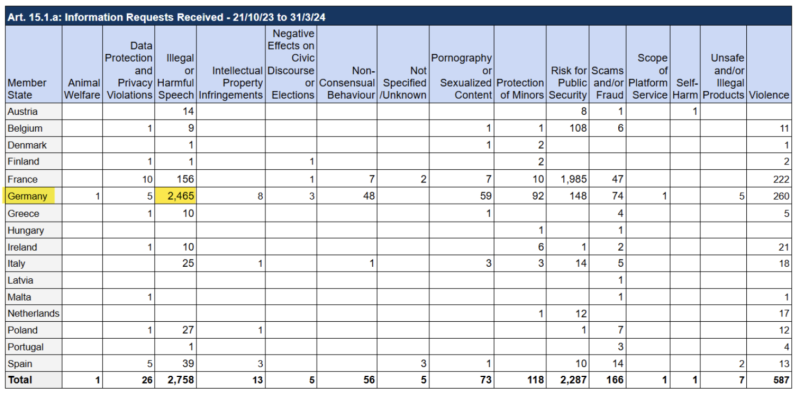
This is the real innovation involved in the EU’s Digital Services Act (DSA): It creates an obligation for platforms to take action in the form of “content moderation” against not just illegal content, but also ostensibly harmful content such as “disinformation.” Note that in the period covered in X’s latest “Transparency Report” to the EU on its “content moderation” efforts, nearly 90% of such requests for information on the purveyors of ostensibly “illegal or harmful speech” came from just one country: Germany. See the below chart.
Note that X also takes action against posts or accounts for “illegal or harmful speech” that is reported to it by EU member states or the European Commission. Such action may involve deletion or geo-blocking (“withholding”) of content. But, as the “enforcement options” linked in the report make clear, it can also involve various forms of “visibility filtering” or restricting engagement — “in accordance with our Freedom of Speech, Not Reach enforcement philosophy,” as the report puts it.
Here again, Germany is top of the table, having submitted 42% of all the reports to X on “illegal or harmful speech” and nearly 50% of the reports from member states. See the chart below. Germany submitted nearly twice as many reports as any other member state — France finished a distant second — and over ten times more reports than comparably-sized Italy. The European Commission submitted around 15% of the reports.
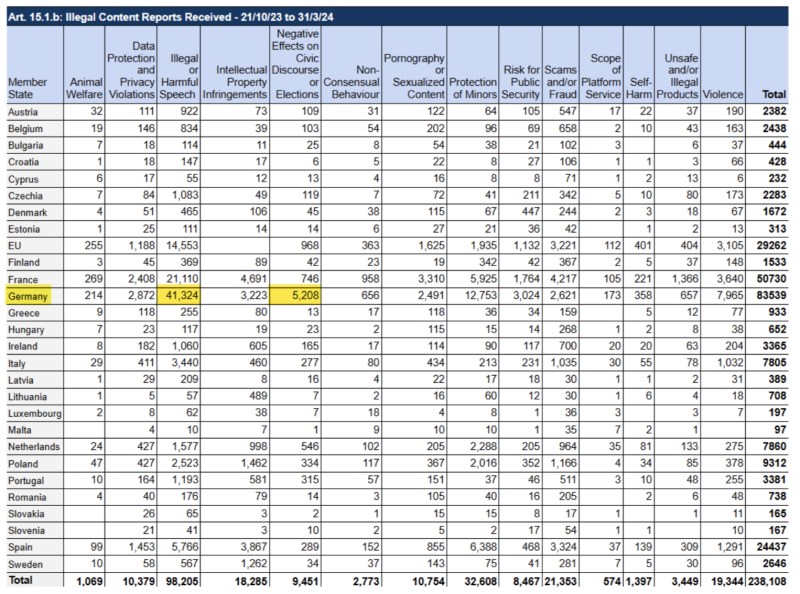
It is also notable that Germany submitted by far the most reports on content entailing “negative effects on civic discourse or elections,” yet another category of speech that is clearly not illegal per se but that is deemed “harmful” enough under the DSA regime to require suppression. (Hence, while the content is not per se illegal, it would be illegal for platforms under the DSA not to suppress it. This ambiguity is at the very heart of the DSA censorship regime.) Germany submitted well over half of all such reports and over 60% of the reports from member states.
Finally, it is worth noting that the overwhelming majority of these reports and the related “enforcement actions” undoubtedly involve English-language content. This can be gleaned from the fact that nearly 90% of X’s “content moderation team” consists of English speakers. The “primary language” of 1,535 of the team’s 1,726 members is English, as can be seen in the below chart.
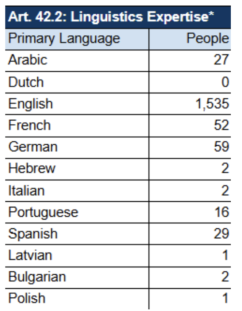
But why should Germany or the EU be accorded any jurisdiction over English-language discourse? Needless to say, Germans are not as a rule native English speakers and only 1.5% of the total EU population has English as their mother tongue.
In any case, two things are very clear from X’s “Transparency Report.” One is that Elon Musk’s “free speech platform” is not that and is in fact devoting enormous resources, both in terms of “trained” human censors and programming, to complying with the EU’s censorship regime. And the other is that Germany is the EU’s — and hence undoubtedly the world’s — undisputed, online censorship champion.
There were 226,350 “enforcement actions” taken by X in response to reports from EU member states or the EU Commission in the reporting period covering barely more than three months. This is to say nothing of the “enforcement actions” taken proactively by X in accordance with its own DSA-compatible terms of service and rules.
Lest readers have trouble reconciling the foregoing with the viral kerfuffle between Elon Musk and Thierry Breton and the famous “proceedings” against X that were initiated under Breton’s leadership, please see Jordi Calvet-Bademunt’s helpful account of the “preliminary findings” of the EU Commission’s investigation here.
According to a new Bloomberg report, EU officials are even contemplating taking into account the revenues of some of Musk’s other companies in calculating a potential fine against him. Needless to say, despite the fact that the sources are unnamed, this has been widely construed as a further escalation in a mammoth free speech struggle between Musk and the EU.
But as Calvet-Bademunt’s analysis shows, the EU’s case against X, as it now stands, has nothing to do with insufficient “content moderation” — or, in other words, censorship — but merely concerns other, more arcane, aspects of the DSA.
Interestingly, the original proceedings opened against X did indeed involve “content moderation” and — believe it or not – could even have had a positive impact on freedom of speech, since X was ostensibly being investigated not for failing to remove or suppress user content, but rather for failing to inform users about such “content moderation decisions” or, in other words, shadowbanning. But, as Calvet-Bademunt shows, this aspect has been dropped from the investigation.
The fact of the matter, in any case, is that no online platform of any size can remain on the EU market and be a “free speech platform.” The DSA makes this impossible.
Robert Kogon is the pen name of a widely-published journalist covering European affairs.
Featured Video
HE SAVED LIVES. NOW HE FACES PRISON.
or go to
Aletho News Archives – Video-Images
From the Archives
NATO Sanctions and the Coming Global Diesel Fuel Disaster
By F. William Engdahl – New Eastern Outlook – 11.04.2022
Amid the ongoing global inflation crisis, NATO heads of state and mainstream media repeat a mantra that high energy prices are a direct result of Putin’s actions in Ukraine since end of February. The reality is that it is the western sanctions that are responsible. Those sanctions including cutting SWIFT interbank access for key Russian banks and some of the most severe sanctions ever imposed, are hardly having an impact on the military actions in Ukraine. What many overlook is the fact that they are increasingly impacting the economies of the West, especially the EU and USA. A closer look at the state of the global supply of diesel fuel is alarming. But Western sanctions planners at the US Treasury and the EU know fully well what they are doing. And it bodes ill for the world economy.
While most of us rarely think about diesel fuel as anything other than a pollutant, in fact it is essential to the entire world economy in a way few energy sources are. The director general of Fuels Europe, part of the European Petroleum Refiners Association, stated recently, “… there is a clear link between diesel and GDP, because almost everything that goes into and out of a factory goes using diesel.” … continue
Blog Roll
 Aletho News
- Iran FM meets with US envoy on UN meeting’s sidelines at American side’s insistence: Report
- Qatar PM calls for Gulf security framework with Iran, says war must be ‘wake-up call’
- China condemns US extortion of Iranian airlines, rejects Washington’s ‘illegal’ sanctions threats
- Italy to move military personnel from Taif base after missile strike
- Finland’s Stubb tells European leaders to calm down
- Defeating Russia on battlefield impossible – Fico
- Finland’s Gender Clinic Reversal
- Massachusetts Wants Mental Health Visits, Why Does Government Use ‘Health’ to Enter Our Homes & Families?
- US lawmaker admits American people footing bill for Trump’s failed aggression against Iran
- Pfizer Gave $500,000 to Groups That Lobbied to End Religious Exemption in Massachusetts
- If Americans Knew
- Sanctions are collective punishment: immoral and self-defeating
- Phosphorus Munitions Fired by Israel Burn Groves, Orchards in Southern Lebanon
- Israel Carries Out New Ceasefire Violations Across Gaza
- AI – Emphasis on the ‘I’: Israel Is Funding AI Chatbot Propaganda
- Israel Blocking Hundreds of Wheelchairs for Injured Children From Entering Gaza
- Israel Is Expanding and Upgrading Compounds for Palestinian Militias in Gaza
- The Palestinian-American Residents of This West Bank Town Are Wondering: Where Is Trump?
- Gaza desperately needs tents, wheelchairs, fuel… and everything else (Israel blocks it all) – Daily Update
- Israeli Attacks in Gaza Kill at Least Seven Palestinians Over Three Days, including Woman and Child
- Trump’s militarization of Washington DC as he pursues Israel’s war against Iran
- No Tricks Zone
- 2025 Nature Paper Claiming Worsening Global Drought Gets RETRACTED …Heavily Flawed
- New Study: ‘Global Drought Shows No Detectable Recent Acceleration Under Climate Warming’
- Economic Masterminds: German Socialists Suggest Taxing Productivity Gains Stemming From Using AI
- The South China Sea Has Not Been Cooperating With The Climate Change Narrative
- Energy Crisis: Germany Enters Heating Season With Historically Low Gas Reserve Fill Levels
- New Study: The Antarctic Ice Sheet Gained Mass From 2020-2024 Due To Staggering Snow And Ice Accumulation
- Study: Ocean Heating Rates From Thousands Of Years Ago ‘Dwarf’ Modern Ocean Heating Rates
- Climate Extremists Target, Attack Large-Scale Power Grid Infrastructure In Germany!
- New Study: Antarctic Ice Melt Has Contributed Less Than 1 Centimeter To Sea Level Rise In The Last 30 Years
- Fear Of Debate: Alarmist German Climate Scientist Calls On Mainstream Media To Discredit Skeptic Voices

